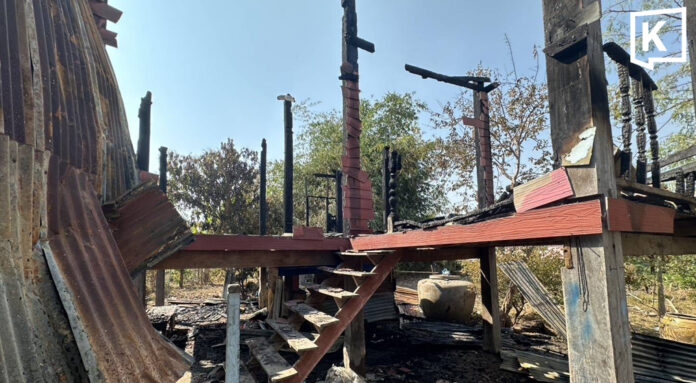
CHAIYAPHUM — 15 February 2026, A 58-year-old man set fire to his own home in northeastern Thailand after hallucinating that spirits were inside, destroying the property, officials said.
The blaze broke out at about 01:30 at a house in Ban Don Changae village, Moo 11, Ban Phet subdistrict, Bamnet Narong district, in Chaiyaphum province.
Investigators at Bamnet Narong Police Station were alerted to the fire in the middle of the village and coordinated with Ban Phet Subdistrict Administrative Organisation firefighters, nearby agencies and local rescue workers to contain the blaze.
Firefighters took around 45 minutes to bring the flames under control and prevent them from spreading to neighbouring homes. The two-storey wooden house, built with an open ground floor, was completely destroyed. No injuries were reported.
Authorities identified the suspect as Uthai Chamthuam, 58, the homeowner, who allegedly set the fire before fleeing the scene. Initial damage was estimated at about 100,000 baht (approximately £2,200).
On the morning of 15 February, Bamnet Narong district chief Acting Sub Lt. Tharathip Phonphinyo assigned security officials to work with police to inspect the site and track down the suspect. Uthai was later detained at a friend’s house in Moo 16, also in Ban Phet subdistrict.
Police said relatives told investigators that Uthai has a history of psychiatric illness and was undergoing treatment. He had been discharged from Bamnet Narong Hospital five days before the incident. He reportedly experienced hallucinations and believed spirits were inside his home, prompting him to set the fire in an attempt to drive them away.
Officers have returned him to Bamnet Narong Hospital for further treatment.
Neighbours said Uthai lived alone, while relatives stayed at another house nearby. On the night of the fire, no one knew where he had gone after setting the blaze.
PATHUM THANI — 15 February 2026, Police in Khlong Luang have arrested a suspect accused of stealing copper busbars from an underground power cable project in Khlong Sam, causing millions of baht in damage and disrupting a major 100-million-baht infrastructure scheme.
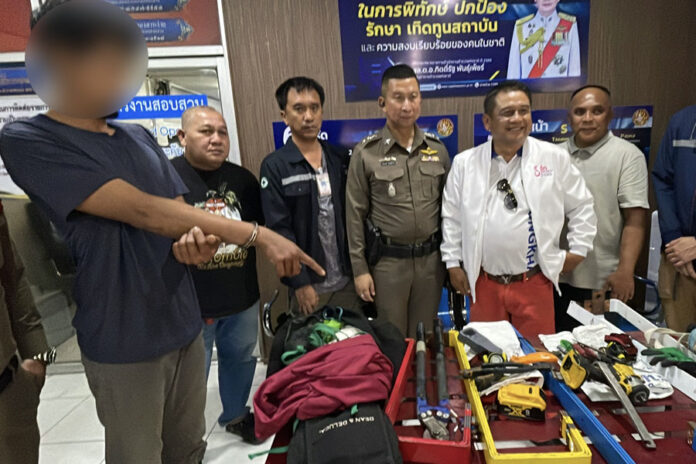
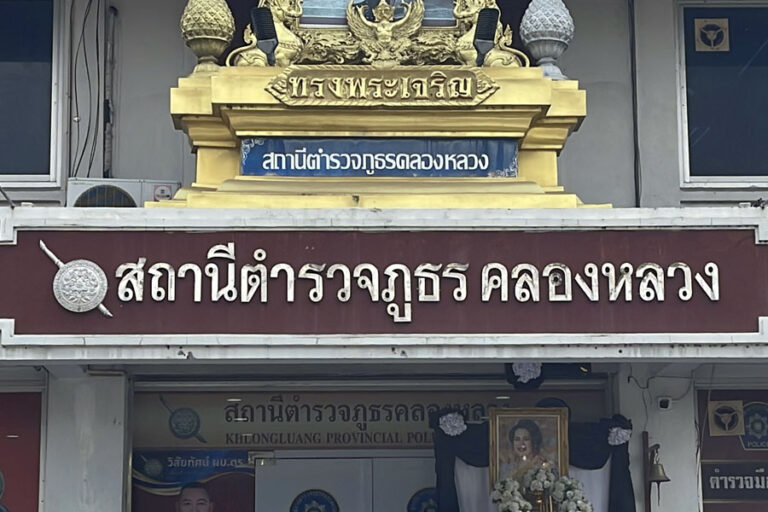
At 12:00 at Khlong Luang Police Station, senior officers, local officials and representatives from the Provincial Electricity Authority (PEA) Pathum Thani announced the arrest.
The suspect, aged 25–30, was apprehended near a bridge opposite Soi 6/3 in Khlong Sam subdistrict, Khlong Luang district. Police seized 12 copper busbars along with tools including torches, wire cutters and a metal saw, as well as a motorcycle.
Pol. Lt. Col. Kawinwet said that at approximately 03:00 on the same day, officers received a tip-off from a concerned citizen about a suspicious man sitting near the bridge. Upon inspection, officers found the suspect straddling a motorcycle. A search of the motorcycle uncovered the busbars and tools inside a black cloth bag beneath the seat.
During questioning, the suspect allegedly confessed to stealing the items from a roadside electrical control cabinet along Khlong Sam Road, opposite Chalida Village, Village 6, Khlong Sam subdistrict. He claimed it was his first offence and said he previously worked delivering gas in the Khlong Sam area.
He has been charged with night-time theft and theft using a vehicle to facilitate the offence or escape. He was handed over to investigators at Khlong Luang Police Station for legal proceedings.
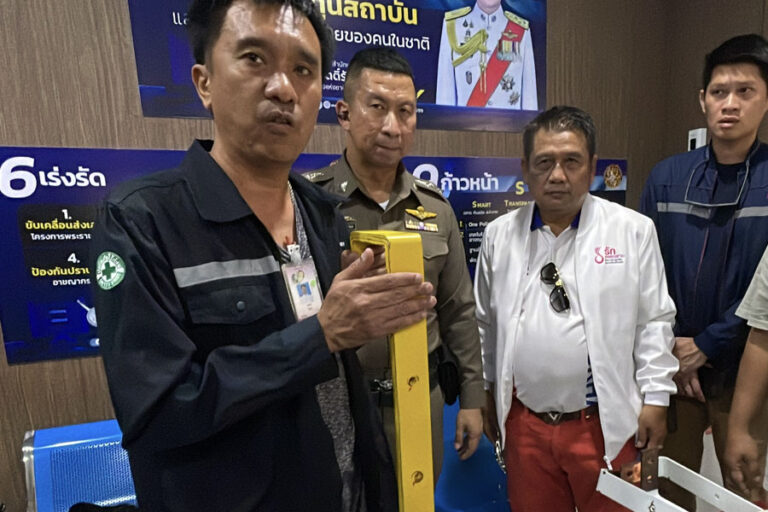
PEA officials explained that the stolen copper busbars are large copper strips that function as primary conductors inside electrical control cabinets, distributing high-voltage electricity to households. A total of 12 busbars were taken from control units 1 and 2, each valued at more than 30,000 baht, for a combined equipment loss of approximately 360,000 baht.
Dr. Wirasak said the theft has affected the underground power cable project in Khlong Sam, a major development with a budget of 100 million baht. Damage from this incident alone is estimated at 4–5 million baht, forcing work that was nearly complete and scheduled for handover within months to be halted and repaired at multiple points.
An official explains the function of the copper busbar to reporters
He confirmed the SAO is coordinating with police to pursue the case to the fullest extent of the law, regardless of any alleged connections or influence. He also warned that scrap shops found purchasing stolen state property would face closure and licence revocation. Residents are urged to report any late-night cable removal activity, as SAO officials do not conduct such operations at night.
Pol. Capt. Phongnaponn said investigators will intensify legal action, focusing on three key issues: determining the true extent of financial damage, expanding the investigation to identify possible accomplices or networks operating in other areas, and targeting scrap dealers who purchase stolen materials — a key factor enabling repeat offences.
Officials warned that damage or loss of such equipment directly affects the stability of the local power supply in Khlong Luang district. Without the busbars, electricity cannot be distributed normally. The theft has also disrupted Phase 1 of the project, requiring new procurement. Some busbars must be specially manufactured or imported and cannot be purchased from general construction supply stores, extending repair timelines.
Authorities emphasised that selling the busbars as scrap metal would yield only a small sum compared with the hundreds of thousands of baht in losses and widespread public inconvenience caused. The offence may also qualify as theft of property intended for public use, which carries heavier penalties than general theft.
BANGKOK — 15 February 2026, Thai cybercrime police have arrested four foreign nationals accused of operating mule bank accounts, withdrawing cash and sending it across the border, in a case linked to an online scam that cost a victim more than 800,000 baht (£18,000).
The arrests were ordered by Pol. Maj. Gen. Chananat Sarathwanpaet, commander of the Cyber Crime Investigation Bureau, who instructed officers from Division 3 to carry out the operation.
Three Cambodian nationals, Sophorn, 36, Bannarit, 23, and Soran, 37, were arrested in Bang Pu Mai subdistrict of Samut Prakan province. A fourth suspect, Tat, 29, a Myanmar national, was detained in Bang Phli Yai subdistrict of the same province.
They face charges including membership of a criminal association, public fraud by impersonation, entering false information into a computer system and money laundering.
Police said the case began after a victim reported being duped into buying a mobile phone via Facebook. After transferring payment, the victim did not receive the product.
The victim was later contacted by a suspect posing as an officer from Thailand’s Central Investigation Bureau, claiming he could help recover the lost funds and asking the victim to continue the conversation via the Line messaging app.
The scammer then persuaded the victim to invest in stock trading, promising profits and the recovery of the earlier losses. The victim transferred increasing sums of money, resulting in total losses exceeding 800,000 baht.
An investigation found that the funds were channelled through mule bank accounts before being withdrawn in cash at banks in Samut Prakan. Officers obtained search warrants and targeted four suspects believed to own the mule accounts and to have withdrawn the cash.
Seized items included mobile phones, ATM cards, bank books linked to mule accounts, clothing worn on the day of the alleged offences and more than 300,000 baht (£6,700) in cash.
Sophorn allegedly confessed to owning a mule account and withdrawing funds, receiving a 20% share of the withdrawn sums. Bannarit admitted acting as a coordinator between the ringleaders and those withdrawing the money, and to packaging the cash in boxes for delivery to the Thai-Cambodian border.
Soran and Tat allegedly admitted owning mule accounts and withdrawing cash in return for payments of 500 baht per transaction.
All four suspects were handed over to investigators for legal proceedings, while police said they were expanding the investigation to identify other members of the network.
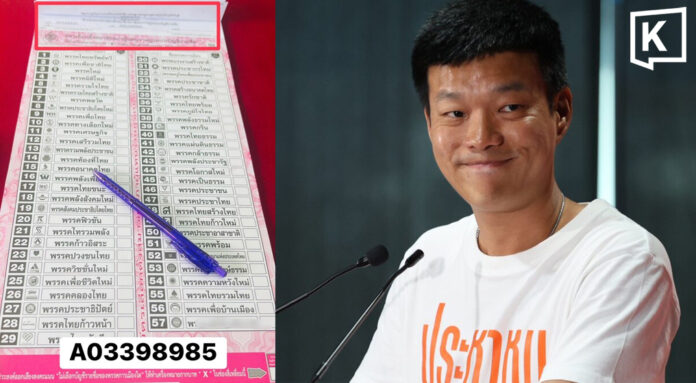
BANGKOK — 15 February 2026, Natthaphong Ruengpanyawut, leader of Thailand’s People’s Party, said on 15 February that voter data and ranked lists of eligible voters may already have been leaked to the public, raising concerns over the secrecy of the recent election.
He said a white-hat hacker on 14 February identified vulnerabilities in a government agency’s system, prompting authorities to fix the flaw later that night. However, Natthaphong said he believed that before the fix, data on voters and ranked lists of eligible voters at each polling station, which could be combined to determine how individuals cast their ballots, had already been disclosed to the public or malicious actors.
He added that images of ballot papers bearing barcodes at the bottom had circulated online. When election observers photographed polling station officials holding up ballots, both the barcode and the marked choice were visible, he said.
“If even a single case emerges in which a ballot stub containing a sequence number can be matched with a barcode and a photographed ballot from the same polling station, the three pieces of information could be combined to identify how a particular person voted,” Natthaphong said. “That would prove the Election Commission’s claim that even if barcodes can be traced back to ballot stubs, the process remains direct and secret is not true.”
He said the election process involved numerous parties, including polling station officials, members of the media and public observers, increasing the risk of exposure. “Two out of the three key data components are already public. If just one case is found, it will demonstrate that the process is neither direct nor secret,” he said.
Asked whether this would amount to electoral fraud, Natthaphong said criminal proceedings would depend on proving intent by state officials. “What can already be established is that this is a mistake,” he said, whether caused by negligence or by deliberate design of a system capable of tracing how individuals voted.
He argued that the Election Commission’s justification that barcodes were necessary to verify the authenticity of ballots and prevent fraudulent or “ghost” ballots was flawed. It would have been sufficient for barcodes to identify only the ballot booklet number, rather than individual ballot papers, he said.
Natthaphong said the People’s Party had filed complaints with the ombudsman and lodged criminal charges under Sections 157 and 172 of the Criminal Code. Others had also petitioned the ombudsman and the Central Administrative Court, he added.
He urged the Election Commission to acknowledge the error and act swiftly. “The public wants to see urgent corrective action, not delays while waiting for a court order, which could take a long time,” he said. The longer the delay, the greater the risk, including the possibility that officials with access to ballot boxes could retrieve sensitive data.
He called on the commission to order the destruction of the ballot papers as soon as possible and organise a new election without delay.
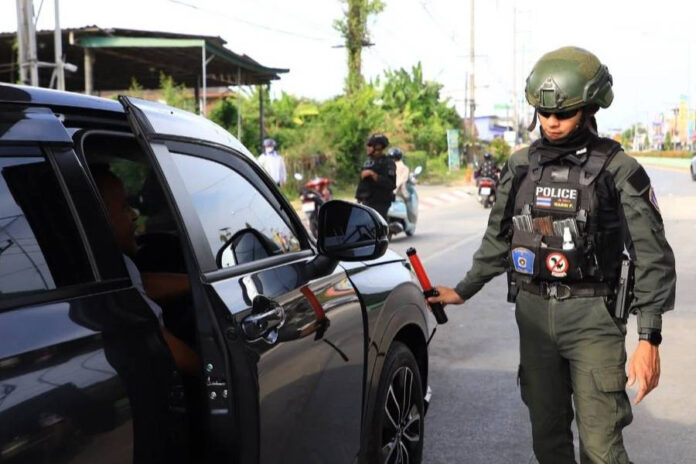
Residents and travellers in Yala are subjected to increased screening due to recent bombings in Narathiwat
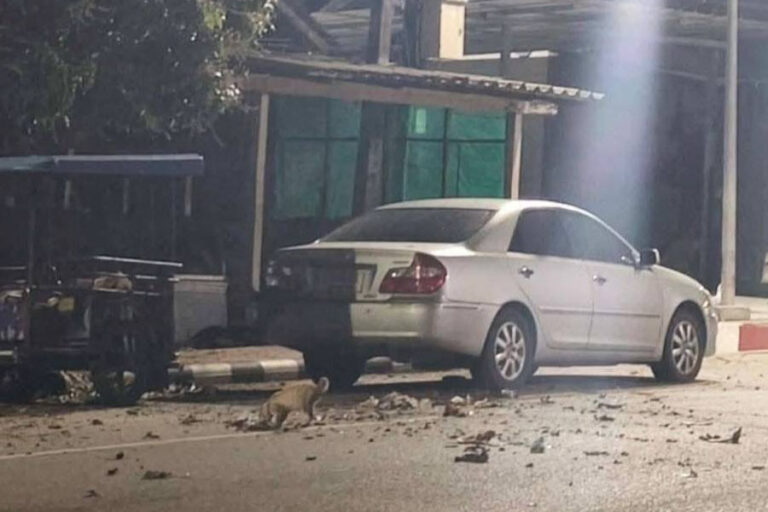
YALA — 15 February 2026, Security efforts have been heightened in Yala following a coordinated wave of seven bomb attacks in neighbouring Narathiwat over the past 48 hours.
Provincial Police Region Yala has raised security to the highest level after insurgents carried out coordinated bomb attacks at seven locations in Narathiwat between 14–15 February 2026. Although no injuries were reported, authorities remain on high alert to prevent further acts of violence and to maintain order across the southern border provinces.
Pol. Maj. Gen. Kong-at Suwannakham, commander of Yala Provincial Police, has issued urgent orders to security personnel stationed at all checkpoints and inspection points to intensify screening of suspicious individuals and vehicles. Officers have also been instructed to exercise heightened caution while on duty to avoid becoming targets.
The enhanced security measures are aimed at boosting public confidence during the upcoming Chinese New Year celebrations, ensuring the safety of Thai-Chinese residents taking part in festivities. Authorities are also preparing for the approaching Ramadan period to facilitate and safeguard Thai Muslim communities as they enter the holy month of fasting.
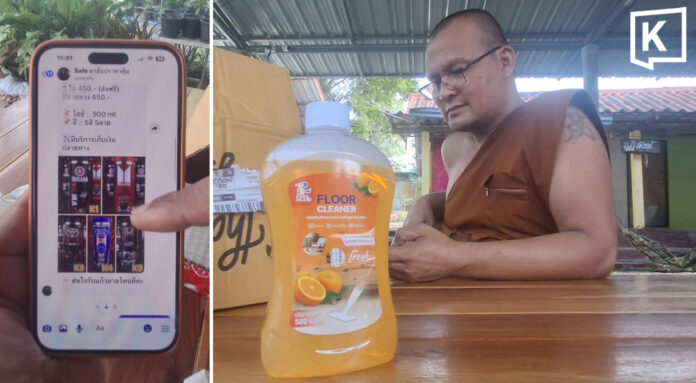
NAKHON RATCHASIMA — 15 February 2026, A temple abbot in northeastern Thailand has warned the public to be vigilant when shopping online after he ordered insulated tumblers but received a bottle of floor cleaner instead.
As often happened with online purchase, not getting what you order has become quite a norm. Either from genuine honest mistake or nefarious scamming attempt. Many people have experience these kind of situation before, even monks.
Reporters visited Wat Khlong Nok in Mittraphap subdistrict, Sikhio district, Nakhon Ratchasima province, to meet with the abbot, Phra Nonthawat Sutachitto, who get scammed.
He showed reporters the parcel he received, and said the package was expected to contain 2 insulated cups but instead held a single bottle of floor-cleaning solution. He also provided evidence of the purchase, including order details and chat messages from a Facebook page advertising the products.
Phra Nonthawat said he had seen a Facebook page named “sale ช็อปราคาคุ้ม” offering insulated tumblers. Interested in buying two, he contacted the page and placed an order on Thursday.
On the afternoon of 14 February 2026, when a parcel arrived at the temple with a cash-on-delivery charge of 300 baht. He said the weight of the box seemed consistent with two tumblers, so he did not open it immediately.But later, as he opened the package, only to found out the truth.
The duped abbot said he felt disappointed, as he had not made an online purchase for some time. He urged the public to carefully check sellers and product details before placing online orders, as scams remain widespread.
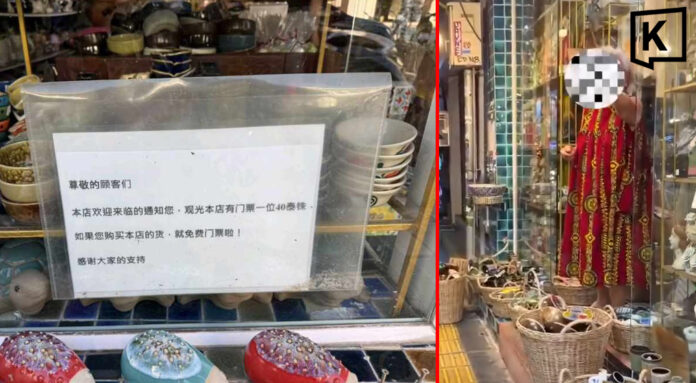
PHUKET — 15 February 2026, A video showing a shop in Phuket’s Old Town charging visitors 40 baht to enter has triggered a storm of criticism on Chinese social media, prompting calls for authorities to investigate amid concerns over the impact on Thailand’s tourism image.
The Facebook page Phuket Times reported on 15 February 2026 that the controversy had spread widely on Chinese platforms, particularly Douyin, after a clip filmed inside a shop on Thalang Road in Phuket Old Town was shared online.
According to the post, an elderly woman inside the shop demanded a 40-baht fee from Chinese tourists to enter and browse products. When the visitors declined to pay, she allegedly used inappropriate language and made gestures perceived as mocking and racially offensive, causing anger among the tourists.
After the clip circulated, it drew widespread criticism from users in both China and Thailand. Many questioned the potential damage to Thailand’s tourism reputation, while others warned that such incidents could undermine confidence among Chinese travellers, a key market for the country.
Some online comments expressed frustration with local attitudes towards visitors, with several users claiming similar practices had occurred at other दुकาน on Thalang Road. Others said incidents of this nature could drive tourists to choose alternative destinations.
A review of the video shows an elderly woman speaking with tourists and gesturing in a manner viewers described as inappropriate after they refused to pay the entry fee.
The episode has continued to generate debate online, with calls for relevant authorities to establish the facts and take appropriate action.
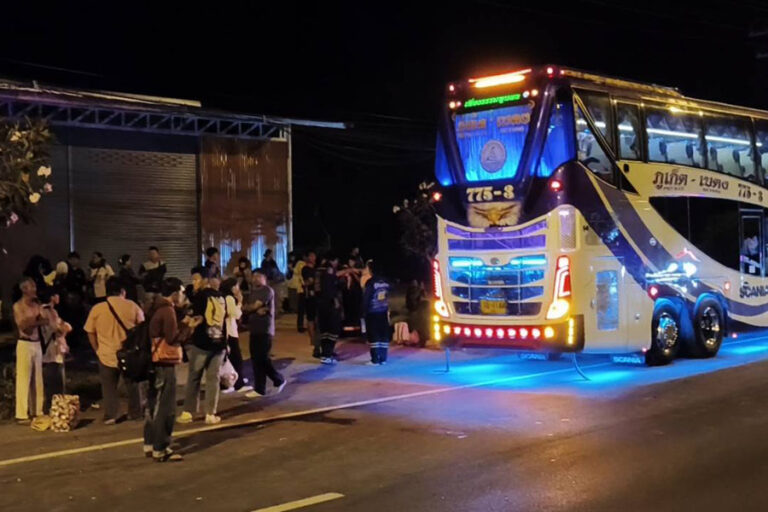
TRANG — 14 February 2026, A double-decker Phuket–Betong bus overturned in Huai Yot district in the early hours of Saturday, leaving dozens injured and the driver with a severed leg.
The crash occurred at approximately 02:00 on Phetkasem Road opposite Samakkhi Sueksa School in Na Wong subdistrict.
Police from Huai Yot Police Station, along with rescue teams and emergency responders from multiple districts, rushed to the scene after receiving reports of a passenger bus losing control and overturning at the roadside.
The first-class air-conditioned bus, operating on the Phuket–Betong route, was found lying on its right side in a roadside ditch. The front of the vehicle was heavily damaged. Authorities broke the rear glass to evacuate trapped passengers.
There were 52 people on board — 49 passengers, one driver and two attendants. A total of 30 people were reported injured, including more than 10 seriously. The injured were transported to Huai Yot Hospital and Wang Wiset Hospital.
The driver, identified as 52-year-old Sirichai Tang-sengki, suffered the most severe injuries, including the loss of his left leg and a head wound. He remained conscious and able to respond while being transported to hospital.
One passenger sustained a severe ankle fracture with bone exposure, while many others suffered cuts from broken glass and other injuries.
Officials said the bus departed Phuket at 22:00 on 14 February and was scheduled to arrive in Betong district, Yala province, at 11:30 on 15 February.
Initial reports indicate the bus lost control, slid approximately 80 m along the roadside and struck a parked truck before overturning.
The driver told rescuers that a motorcycle cut closely in front of the bus, forcing him to swerve. However, a patrol officer who was nearby at the time disputed that claim, saying no motorcycle was seen and suggesting the driver may have fallen asleep.
Some passengers also speculated that the driver may have dozed off, though others said he had not been speeding prior to the crash.
The bus company dispatched a replacement vehicle to transport remaining passengers to their destination.
Police said further questioning of the driver, staff and passengers will be conducted once the driver’s condition stabilises to determine the exact cause of the accident.
PATTAYA — Police in Pattaya have arrested a Malaysian national accused of involvement in a cross-border call centre scam that defrauded a 20-year-old man of 1,933,000 baht in cash after arranging a handover in a shopping centre car park.
Officers at Pattaya City Police Station said the victim, identified only as Pen Tai, filed a complaint on 11 February 2026 after receiving a phone call from a number claiming to represent an AIS mobile service centre.
The caller alleged that the victim’s national ID card details had been used to register a phone number to promote an online gambling website. The suspect then instructed the victim to continue the conversation via the Line messaging application, claiming authorities needed to examine his financial trail.
The victim was told to withdraw cash for inspection. Believing the claim, he withdrew 1,933,000 baht and delivered the money to a man in the car park of Big C South Pattaya.
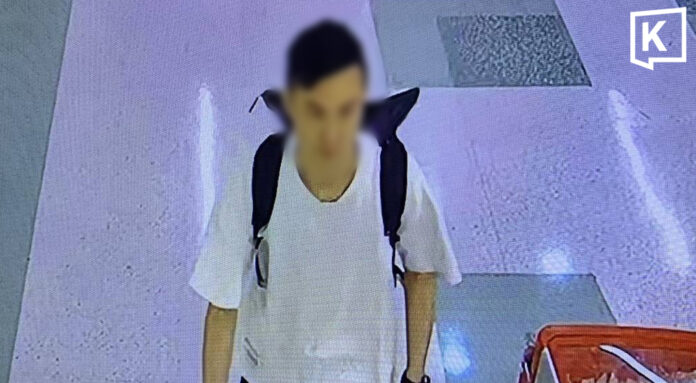
CCTV footage from 11 February 2026 showed a suspect wearing a white long-sleeved shirt, a face mask and carrying a black backpack walking in the car park at 14:42.
At 14:50, the man approached the rear of the victim’s vehicle, received the cash and returned inside the shopping centre.
At 15:01, he exited a restroom wearing a white short-sleeved shirt and no mask before leaving the building.
At 15:16, he entered a white Toyota Yaris Cross registered in Bangkok and drove along Sukhumvit Road towards the capital.
Police said the vehicle was registered to a man named Noppadol but was being used by his 60-year-old father, Samphan, who works as a ride-hailing driver through a mobile application. The driver told investigators he had transported a passenger from Bangkok to Pattaya and later returned him to a hotel in the Ngamwongwan area of Nonthaburi province.
Investigators identified the hotel guest as Yap Chin Keong, a Malaysian national who most recently entered Thailand on 10 February 2026 via Don Mueang International Airport. Police said passport photographs matched the suspect seen in CCTV footage.
Officers from Pattaya City Police Station obtained a court warrant and arrested the suspect at a hotel in Nonthaburi on 14 February 2026, in cooperation with officers from Bang Phongphang Police Station.
He faces charges including joint fraud by impersonation, joint forgery and use of forged official documents, and jointly importing false information into a computer system.
The suspect has been taken into custody for legal proceedings.
FILE - Former Thai Prime Minister Srettha Thavisin (AP Photo/Sakchai Lalit, File)
Former Prime Minister Srettha Thavisin has proposed solutions to Thailand’s economic challenges in a letter published by the Financial Times on 11 Febuary, titled “A former PM offers a cure for Thailand’s economic ills.”
Responding to a 4 Febuary report that labeled Thailand the “sick man” of Asia, Srettha wrote that while the article identified the country’s economic “symptoms,” it overlooked potential remedies.
He called for a “big reset” to tackle household debt, urging asset management companies to purchase non-performing loans to ease debt burdens and revive domestic consumption, arguing that past stimulus measures and cash handouts alone were insufficient.
Srettha also outlined a two-pronged strategy to integrate Thailand more deeply into the global economy: investing in major infrastructure projects such as a north-south railway and a land bridge linking the Andaman Sea and Gulf of Thailand, and modernizing regulations, including direct power purchase agreements to attract green-focused global investors.
He added that tourism should shift from volume to value and that improving ease of doing business is essential for long-term competitiveness.