


































35.9 C
Bangkok
Tuesday, June 9, 2026
Home Blog Page 1563

‘Exotic’ Film Fest Next Month Captures Thailand Through Foreign Lens

“Soi Cowboy” (2011)
“Soi Cowboy” (2011)

BANGKOK — Made in Thailand, by foreigners, for foreigners?

Fifteen films about Thailand, shot in Thailand, but directed by foreigners will screen for free July through August at the Thai Film Archive as part of the “Exotic Thailand?” film festival. From early 20th-century black-and-whites to modern Hollywood films, the fest looks at Thailand through a foreign lens – whether idyllic or violent, sensual or monastic.

“The films show a portrayal of Thailand, whether that reflection is true or not,” Putthapong Cheamrattonyu of the Thai Film Archive said.

Putthapong, who curated the program, said that common themes pervade the wildly different films. Early films focus on then-exotic Thai traditions and rural lifestyles, often laced with landscapes of nature. These include the 1940 Swedish film “A Handful of Rice,” which follows an agricultural society through a docudrama format, and the 1927 American “Chang: A Drama of the Wilderness”.

“Then we became a tourist spot and many people came here. We became a tourist heaven, but people also saw the seedy, violent, and dangerous parts of Thailand,” Putthapong said.

In the arguably tasteless Hollywood comedy “The Hangover II” (2011), Bradley Cooper and two buddies get tricked by a capuchin monkey and a kathoey stripper. “Lost in Thailand” (2011), which follows a similar “boys trip” premise, was once the highest-grossing film of all time in China, and is credited with erupting the waves of Chinese tourists we see today.

In darker films, violence, crime, and muay thai are central themes, such as in “Only God Forgives,” where Ryan Gosling plays an American expat running a drug ring.

But Thai women are particularly central to many contemporary foreign films about Thailand.

“Thai women are shown in both a positive light – as beautiful and with impeccable manners – and a negative light, such as in prostitution,” Putthapong said. “The dynamic of the farang man and the Thai woman is also explored a lot.”

If you only have enough time for one film, Putthapong recommends “Soi Cowboy,” a 2008 film about an overweight Danish expat and his Thai girlfriend who he meets – guess where?

A screening of the film at 1pm Aug. 17 will be followed by a panel discussion with the film’s producer, Tom Waller, and Mahidol University film studies lecturer Wikanda Phromkhunthong.

Since the inception of film, Thailand, formerly Siam, has provided attractive shooting locations and subject matter for foreign camera crews. The first film set in the country was the since-lost  “Suvarna of Siam” (1922) by American filmmaker Henry MacRae.

All screenings are free and shown at the Thai Film Archive on Phutthamonthon Sai 5 Road. The venue is reachable by public bus No. 515 from Victory Monument in front of Rajavithi Hospital, and the Y70E Microbus. Seating is on a first-come, first-served basis. Contact the Film Archive for additional information about the screenings you are interested in. 

The program is below:

Lost in Thailand 02 e1561623945461

July 4, 5:30pm: “Lost in Thailand” directed by Xu Zheng (China, 2011)

1 e1561624016600

July 6, 1pm: “A Handful of Rice” directed by Pal Fejos (Sweden, 1940)
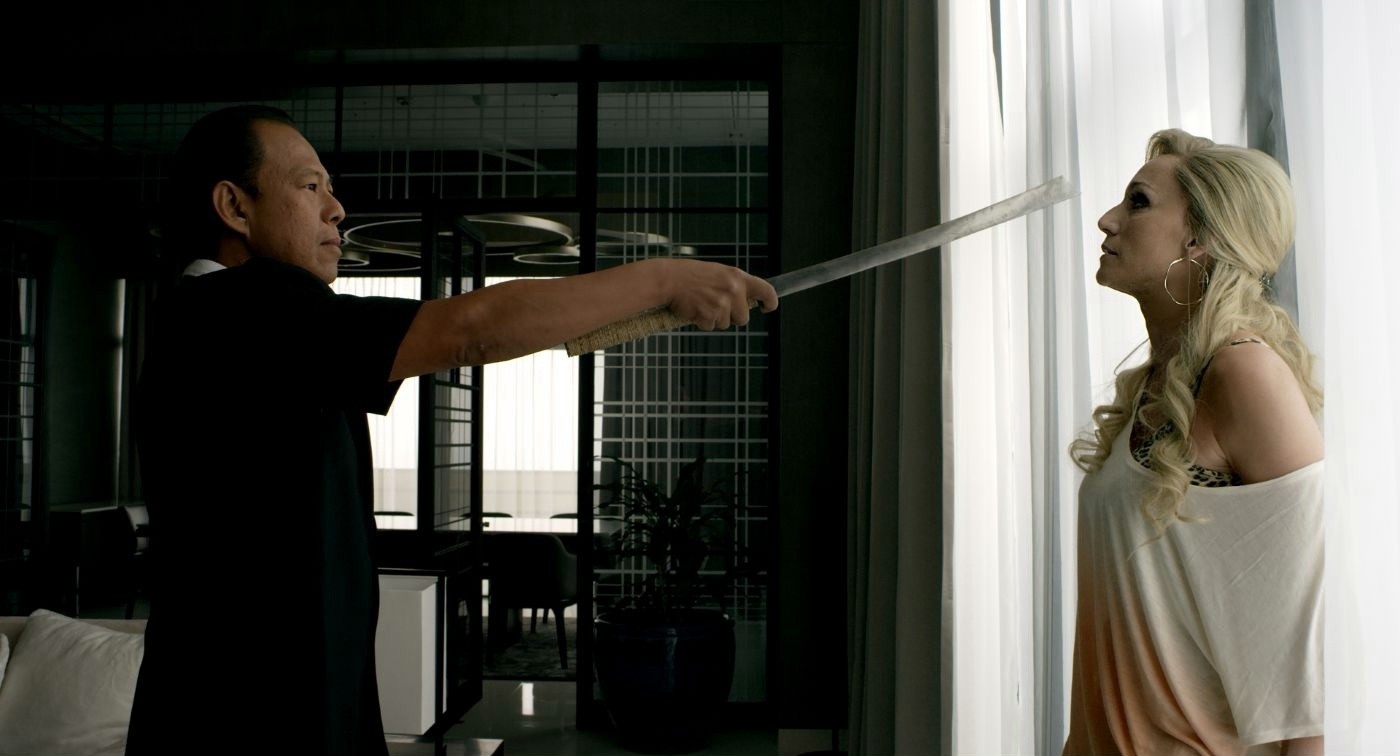
Only God Forgives 06

July 13, 1pm: “Only God Forgives” directed by Nicolas Winding Refn (Denmark, France, 2013)

ศิริพร e1561624065488

July 16, 1pm: “Yutthana-Siriporn” directed by Hans Berthel (Germany, 1963)

เพชฌฆาต 04

July 25, 5:30pm: “The Last Executioner” directed by Thai-Irish Tom Waller (Thailand, 2014)

รักแท้ วิญญาณ ความตาย 02 e1561624098539

Aug 1, 5:30pm: “Ghost of Mae Nak” directed by British Mike Duffield (Thailand, 2005)

chang a drama of the wilderness 2

Aug 3, 1pm: “Chang: A Drama of the Wilderness” directed by Ernest B. Schoedsack and Merian C. Cooper (USA, 1927)

ป่า 2

Aug 3, 3pm: “The Forest” directed by British Paul Spurrier (Thailand, 2016)

bangkok dangerous 3 e1561624161905

Aug 7, 5:30pm: “Bangkok Dangerous” directed by Hong Kongers Oxide and Danny Pang (Thailand, 1999)

ซอยคาวบอย 05

Aug 17, 1pm: “Soi Cowboy” directed by British Thomas Clay (Thailand, 2009)

Pop Aye 01 e1561624186323

Aug 24, 1pm: “Pop-Aye” directed by Kirsten Tan (Singapore, Thailand, 2017)

theelephantking e1561624272388

Aug 24, 3pm: “The Elephant King” directed by American Seth Grossman (Thailand, 2006)

Hangover II 02

Aug 25, 1pm: “The Hangover Part II” directed by American Todd Phillips (USA, 2011)

The Man with the Golden Gun 06 e1561624451832

Aug 25, 3pm: “The Man with the Golden Gun” directed by British Guy Hamilton (UK, 1974)

Butterfly Man 02 e1561624517336

Aug 29, 5:30pm: “Butterfly Man” directed by British Kaprice Kea (Thailand, 2002)
Advertisement

Party Leader Denies Responsibility For Politician’s Drug Smuggling Case

Pol. Gen. Sereepisut Temeeyavets during the parliamentary session on June 27.

BANGKOK — The leader of a pro-democracy party has defended the innocence of a party member arrested earlier this month on suspicion of drug trafficking, calling the arrest a political ploy. 

Pol. Gen. Sereepisut Temeeyavets, the leader of the Thai Liberal Party, confirmed on Wednesday after a parliamentary session that he has been informed of the arrest of party-list MP candidate, Suban Mahachanon. Suban, 57, was arrested along with another Thai and two Chinese men on June 16, while the group was inspecting a shipping container at a port in Chon Buri.

Sereepisut called for Suban to be treated as innocent until proven guilty, visibly bristling when questioned by reporters about accountability.

“I don’t have to be responsible for what happened at all,” the sharp-tongued politician said. “Use your brains to think about how exactly I can be responsible. It’s a personal matter, not the party’s. I don’t know him personally.”

“Does the Prime Minister have to kill himself if he finds out an aide is a drug dealer? Stick to the facts of what happened,” Sereepisut added. 

The party leader then suggested that the timing of the investigation suggests political motivations. 

“The arrest was made ten days ago. Why is the news breaking only now?” he asked.

The suspects have denied their involvement in drug trafficking, claiming they were informed that the shipment was of shoes.

“I also heard that the AMLO [Anti-Money Laundering Office] is investigating the party’s financial history. This means that there are currently attempts to throw the book at those who are against the government,” Sereepisut said. 

A not-so-dramatic video surfaced online on Wednesday showing Suban opening the container before undercover police officers rushed in and surrounded the men.

Inside the container, the police found 985 kilograms of methamphetamines declared as tea, but packaged in “hygienic chopstick” boxes that were packed behind shoe boxes. The two-billion baht haul was bound for the Philippines.

An investigation is underway into how the meth was smuggled into the country and whether anyone else in the party was involved. One of the suspects, Joi Sae Fong, 62, allegedly told authorities that a Chinese importer tried to dupe him into smuggling additional boxes of meth by claiming that the boxes were illegal cigarettes.

Officials holding a news conference of the arrest at a Chon Buri port on June 16.

Video: Matichon

Advertisement

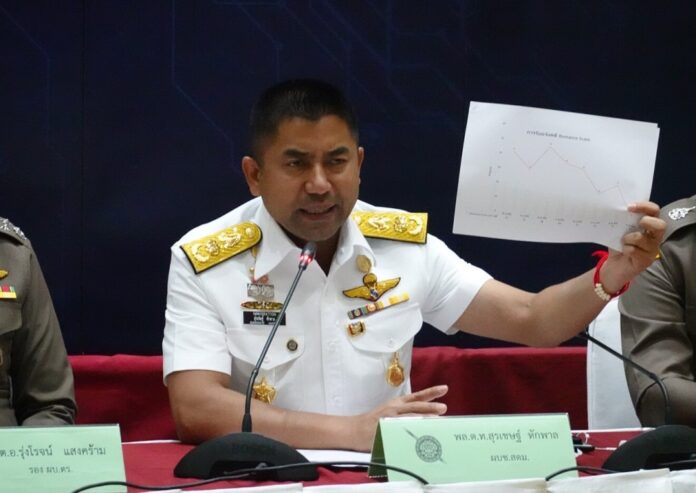
Police Shut Door on Big Joke’s Return

A file photo of Surachate Hakparn

BANGKOK — Senior police officials on Thursday rejected a proposal to reinstate a police rank to former immigration chief Surachate “Big Joke” Hakparn.

Two months after his abrupt removal from the force, Surachate was nominated for a position in a police committee earlier this week, raising speculation that his return could be imminent. But deputy police commissioner Wirachai Songmetta said top police chiefs rejected the proposal in a meeting today.

Gen. Wirachai did not give an explanation for the rejection.

In a statement distributed to the press by his aides, Surachate said he’s willing to work in any capacity.

Read: Gov’t Names Replacement for ‘Big Joke’

“No matter what position I hold, I am ready to work as a civil servant under His Majesty the King,” Surachate was quoted as saying. “And I will dedicate my strength and my heart to being a part of national development.”

Surachate, who many predicted would one day be police commissioner before his mysterious fall from grace in April, could not be reached for comment as of publication time.

He has not attended any public events since his removal, which saw him lose all his police ranks and be transferred to an obscure post ostensibly advising the Prime Minister’s Office.

Photos widely shared on social media showed Surachate praying at a temple in Nakhon Si Thammarat last week. In his statement, the former immigration chief confirmed the authenticity of the pictures.

4DQpjUtzLUwmJZZPGTo7NUsl1NKNP94oETJCkYsXmi0m

“Ever since I was appointed as a civilian [official], I no longer have to go out and fight crime like in the past, so I have more time to practice my faith,” Surachate wrote, adding that he is currently on a tour with his wife to pray at famous temples in the south and the northeast.

He did not mention the circumstances surrounding his removal from office, which struck some observers of police circles as odd: Surachate was not formally accused of any wrongdoing, and top brass never convened a disciplinary committee as is typical for disgraced police officials.

Prior to his mysterious departure from the force, Surachate held multiple senior positions including in the immigration bureau and cybercrime department.

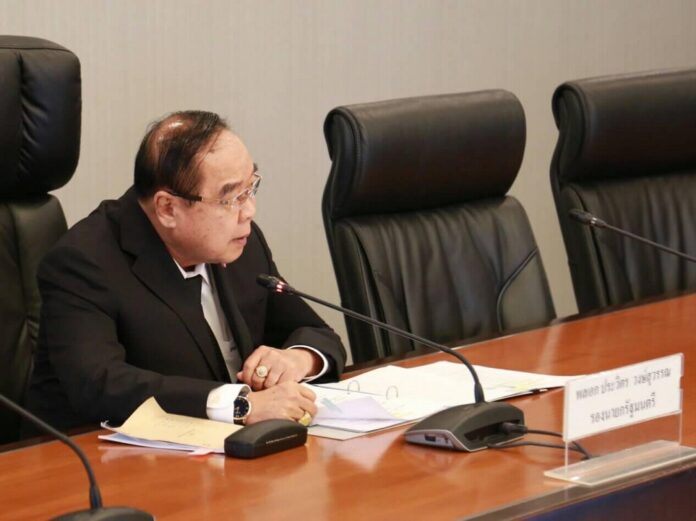
When questioned by reporters yesterday about Surachate’s possible return to the police ranks, deputy junta chairman Prawit Wongsuwan gave a resounding no.

“He can’t come back to serve in the police force, because he’s already been transferred to the civilian administration,” said Gen. Prawit, who oversees military and police affairs. “How can he come back?”

Note: Some details were omitted from this article due to legal concerns.

Advertisement

Thai Fans Mourn Divorce of Dream K-Drama Couple from ‘Descendants of the Sun’

Song Joong Ki and Song Hye Kyo at their Oct. 31, 2017 wedding.

BANGKOK — Thai fans plunged into mourning after the K-drama celebrity couple announced their divorce Thursday morning.

Song Joong Ki and Song Hye Kyo, known as the SongSong couple from the 2016 drama “Descendants of the Sun,” have made their impending divorce public.

Song Joong Ki, 34, announced though his management agency, Blossom Entertainment, that he has filed for divorce from Song Hye Kyo, 37 – to the chagrin of fans who celebrated their fairytale wedding less than two years ago.

“Right now, tears are pouring down my face. I feel so sorry for #SongJoongKi,” @NSriperm wrote. “I was hoping they would have descendants…I’m so sad, but I hope they will be strong. I’ll keep following their work.”

Song Hye Kyo’s agency, United Artists, attributed the divorce to “personality differences.”

“Rather than lengthening the process by considering each other’s faults and deriding each other, I hope to complete the divorce amicably,” Song Joong Ki said, according to AllKpop news. “ I ask for your understanding that it is difficult to reveal the specific details of our personal lives.”

The couple is proceeding with divorce through mediation. If negotiating through a third party fails, the process will go to court.

The couple tied the knot on Oct. 31, 2017, after meeting on the set of “Descendants of the Sun,” a 2016 K-drama so popular across Asia that even junta leader Gen. Prayuth Chan-ocha recommended Thais watch.

As of Thursday, four of the top trending hashtags in Thailand are about the split: #SongJoongki (in Thai), #SongJoongKi, #SongSongCouple, and #SongHyeKyo.

A tweet from @Ggpnl39, retweeted more than 18,000 times, reassured Thais about the normalcy of divorce, which is not common in Thailand.

“Filing for divorce is a normal thing overseas, but Thais don’t usually do it, so it sounds like something extreme happened. But overseas, it doesn’t have to be an extreme situation,” they wrote.

“I was shocked when they married, but even more shocked when they divorced,” wrote @Directioner_FTH.

“Sometimes, even worse than heartache is finally marrying someone you love but then finding out that the relationship won’t work out,” offered @Mm_Catt05.

@Nct_ismylife21, like many other users, posted wedding photos of the couple. Their wedding card had read, “Finally, I’ve found who I was looking for after so long.”

“It ended way too quickly. Don’t you all remember feeling jealous of Song Hye Kyo? Joong Ki was so sincere. I’ll continue to root for the both of them,” @Nct_ismylife21 wrote.

Song Hye Kyo’s latest K-drama romance “Encounter” wrapped up on Channel 7 in April, while Song Joong Ki’s high-fantasy “Arthdal Chronicles” is currently streaming on Netflix.

Song Joong Ki and Song Hye Kyo in “Descendants of the Sun” (2016).


Advertisement

Reports Say North Korea Detains Aussie Student

Alek Sigley

CANBERRA, Australia — The Australian government said Thursday it was “urgently seeking clarification” on reports that an Australian had been detained in North Korea, which the attorney-general described as a “matter of the utmost seriousness.”

Media have identified the detained man as Alek Sigley, a 29-year-old university student in Pyongyang.

Attorney-General Christian Porter, who is based in Sigley’s hometown of Perth, told Perth Radio 6PR: “It is a very unusual set of circumstances.”

“This particular jurisdiction, most Australians’ common sense would tell them, makes this a matter of the utmost seriousness,” Porter said.

The Department of Foreign Affairs and Trade said it was providing consular assistance to the family of an Australian man who has been reported as being detained in North Korea, but did not confirm his identity.

“The department is urgently seeking clarification. Owing to our privacy obligations, we will not provide further comment,” a department statement said.

Sigley said on social media that he was studying Korean literature at Kim Il Sung University and ran guided tours through a travel company he founded, Tongil Tours.

He told Australian Broadcasting Corp. two years ago that he wanted to break down negative stereotypes about the country.

“If we thought it was unsafe, we would stop doing these tours,” Sigley said. “We wouldn’t be able to bear the moral and legal responsibility of bringing people to North Korea if it was dangerous.”

Official media in North Korea haven’t mentioned the reported arrest.

South Korean television station Channel A cited an unidentified source in reporting the arrest but the source told the network it wasn’t immediately clear why Sigley had been detained.

Australia does not have an embassy in North Korea, but consular assistance can be provided to Australians by the Swedish Embassy on a limited basis.

South Korea’s National Intelligence Service, the country’s main spy agency, said it cannot confirm the report.

In March this year, Sigley wrote for Guardian Australia about living in North Korea, saying that as a long-term foreign resident on a student visa he had “nearly unprecedented access to Pyongyang.”

“I’m free to wander around the city, without anyone accompanying me,” he wrote. “Interaction with locals can be limited at times, but I can shop and dine almost anywhere I want.”

Advertisement

Lebanese Town Bans Muslims From Buying, Renting Property

This Monday, June 24, 2019 photo, shows a church in the village of Hadat, where only Christians can rent or buy property, near Beirut, Lebanon. (AP Photo/Bilal Hussein)

BEIRUT — Mohammed Awwad and his fiancee, both Muslims, recently found an affordable apartment for rent online in a town in Lebanon, southeast of Beirut.

The 27-year-old journalist called the number and asked the owner when they could drop by to take a look. He was stunned by her response: Muslims are not allowed to settle in the town, she said.

The apartment owner apologized to Awwad, saying she wouldn’t mind renting to people of any sect but officials in the town of Hadat issued orders years ago that only Christians be allowed to buy and rent property from the town’s Christian residents.

The young Shiite Muslim man could not believe what he heard and asked his fiancee, Sarah Raad, to call the municipality and she, too, was told that the ban had been in place for years.

Hadat is a small example of Lebanon’s deeply rooted sectarian divisions that once led to a 15-year civil war that left more than 100,000 people dead. Christian communities feel under siege as Muslims, who tend to have higher birth rates, leave overcrowded areas for once predominantly Christian neighborhoods.

“There are people who live in fear and feel threatened and this can be removed through (state) policies that make citizens equal,” said Pierre Abi Saab, a Lebanese journalist and critic.

Three decades ago Hadat was almost entirely Christian, but today it has a Muslim majority because the Muslim population expanded greatly between 1990, when the war ended, and 2010, when the ban was imposed. Since then, the Muslim population has hovered between 60% and 65%.

The ban only applies to Christian property — a Muslim resident or landowner of Hadat is allowed to sell or rent his property to Muslims from outside the town or to whomever he wants.

Hadat is the only area where such a ban is publicly announced. Local officials in Christian areas in central, eastern and southern Lebanon impose such bans in more discreet ways. In the predominantly Christian southern region of Jezzine, some local officials have changed the status of land in their villages from commercial to agricultural in order to prevent mass construction projects while in other villages and towns only locals are allowed to buy property.

“As a Lebanese citizen I don’t see that there is justification for fear and mixing with others is our salvation in Lebanon,” said Abi Saab, deputy editor-in-chief of the daily Al-Akhbar newspaper. He said it’s unacceptable that Lebanese citizens cannot live wherever they want in the country.

Hadat is on the edge of an area known as Dahiyeh, Beirut’s heavily populated Shiite southern suburbs that is a stronghold of the militant Hezbollah group. Hadat, along with other nearby areas, saw tens of thousands of Shiite Muslims move in over the years, raising fears among some of the country’s Christians.

Lebanon, a country of about 5 million, has a very delicate sectarian balance between its 18 religious sects. The last census was conducted in Lebanon in 1932, during which Christians were the majority but over the decades their numbers have been declining because of slower birth rates and more immigration. Today, Christians make up nearly a third of the population, while the two other thirds are almost equally split between Shiites and Sunnis.

“When he says Muslims are not allowed to rent property he means that he does not want to see Muslims,” Awwad said, referring to Hadat Mayor George Aoun.

Lebanon’s Interior Minister Raya al-Hassan denounced the town’s policy as unconstitutional.

Aoun strongly defended his decision, noting it was made in 2010, shortly after he was elected to the post. He said at the end of Lebanon’s civil war in 1990, Hadat was a purely Christian town but by 2010, tens of thousands of Muslims, many of them Shiites from Dahiyeh, moved in.

“We are telling every Christian to be proud of his or her village. Live here, work here and raise your children here. We are an exemplary village for coexistence,” he said. Asked whether his decision violates the constitution, which allows any Lebanese citizen to settle and own property anywhere in Lebanon, Aoun denied it, saying the proof is that Hadat is 60% Muslim.

“Every village should preserve itself. Every Shiite village should preserve its Shiite nature, every Christian village should preserve its Christian nature and every Sunni village should preserve its Sunni nature. We want to preserve our village or what remains of it,” Aoun said in an interview in his office, which is decorated with a giant framed map of Hadat.

800 2
n this Monday, June 24, 2019 photo, a poster shows George Aoun, head of the municipality of the village of Hadat, with Arabic that reads “We are all George Edward Aoun. Hadat youth,” in the Christian village of Hadat, where only Christians can rent or buy property, near Beirut, Lebanon. (AP Photo/Bilal Hussein)

The mayor has received a barrage of criticism recently on social media and on local TV stations that describe his decision as “racist and discriminatory.”

In response, hundreds of supporters marched in Hadat supporting the mayor’s decision over the weekend. Aoun told the crowd that he will commit to the ban until “doomsday.”

Christians once dominated Lebanon’s politics until the 1989 Taif agreement, named after the Saudi city of Taif where it was signed, that ended the 1975-90 civil war. The agreement divided Cabinet and parliament seats as well as senior government jobs, equally between Muslims and Christians. The agreement also removed powers from the Christian president and gave them to the Sunni Muslim prime minister.

According to Lebanon’s power-sharing system since independence from France in 1943, the president must be a Maronite Christian, the prime minister a Sunni and the parliament speaker a Shiite.

Hadat’s municipality is dominated by members of President Michel Aoun’s ultranationalist Free Patriotic Movement, which has been leading a campaign against Syrian refugees in the country calling for their return to safe areas in war-torn Syria.

Two years ago, Hadat’s municipality banned Syrians from working in the town, becoming one of the first areas to do so in Lebanon. Walking through the streets of Hadat, no Syrians can be seen unlike in other parts of Lebanon and shop owners boast that they only hire Lebanese.

Hadat resident George Asmar invited a reporter into his clothes shop near a church and proudly pointed to a woman who works for him, saying “she is one of our Shiite sisters.” But Asmar said he supported the mayor because the ban on Muslims owning or renting property in the town is preserving the town’s identity.

“The decision of the municipality is very good because we want to keep our sons in Hadat,” Asmar said. “It is good to keep our sons, to live with us rather than travel.”

Advertisement

Democrats Rail Against Economy-for-the-Rich in First Debate

Democratic presidential candidate Sen. Elizabeth Warren, D-Mass., speaks during a Democratic primary debate hosted by NBC News at the Adrienne Arsht Center for the Performing Art, Wednesday, June 26, 2019, in Miami. (AP Photo/Wilfredo Lee)

MIAMI — Ten Democrats railed against a national economy and Republican administration they said exists only for the rich as presidential candidates debated onstage for the first time in the young 2020 season, embracing class warfare as a defining theme in their fight to deny President Donald Trump a second term in office.

Health care, more than any other issue, led the debate. And Massachusetts Sen. Elizabeth Warren, more than anyone else, stood out — on her own at times — in calling for “fundamental change” across the nation’s economy and government to address persistent issues of inequality.

“I think of it this way. Who is this economy really working for? It’s doing great for a thinner and thinner slice at the top,” Warren declared shortly before raising her hand as one of the only Democrats on stage willing to abolish her own private health insurance in favor of a government-run plan. “Health care is a basic human right and I will fight for basic human rights.”

The debate marked a major step forward in the young 2020 presidential campaign as Democrats seek to break out from the crowded field that has so far been dominated by former Vice President Joe Biden, who will appear in a second debate featuring another 10 candidates Thursday night. Biden was not mentioned during Wednesday’s faceoff, a civil debate with moments of modest policy clashes and few instances of Democrat-on-Democrat confrontation.

Immigration was also on their minds as the candidates’ minds as they pointed to the searing photos of a drowned Salvadoran father and his toddler daughter at the Rio Grande and blamed Trump and his policies on migrants crossing into America illegally.

Former Obama administration housing chief Julian Castro said, “Watching that image of Oscar and his daughter Valeria was heartbreaking. It should also piss us all off.”

Warren spent the evening at center stage, a top-tier candidate whose campaign has gained ground in recent weeks as she has released a near-constant stream of policy proposals. She was flanked by lower-tier candidates including Sen. Cory Booker of New Jersey, former Texas Rep. Beto O’Rourke and Sen. Amy Klobuchar of Minnesota, who needed big moments to help spark momentum in the crowded field.

Several candidates, including Castro, New York Mayor Bill de Blasio, Rep. Tim Ryan of Ohio and former Rep. John Delaney of Maryland were eager to jab their rivals on issues including health care and immigration.

None of the candidates openly stumbled. Absent the ugly attacks or missteps that marred debates of past elections, the two-hour discussion allowed the Democratic Party to show off its extraordinary diversity. Wednesday’s lineup featured three women, one black man and another man of Mexican heritage. At least two candidates spoke Spanish at times, while Booker, an African American, talked about the violence that left seven people in his own urban neighborhood shot last week alone.

Yet modest differences on health care underscored a much louder internal fight over how aggressive Democrats should be on the nation’s most pressing issues.

On one side: candidates like Warren who are demanding dramatic change that includes embracing liberal policy priorities like free universal health care, debt-free college, a forgiving immigration policy and higher taxes on the rich. On the other: pragmatic-minded Democrats like Biden — and little-known former Maryland Rep. Delaney — who are calling for modest policy solutions that could ultimately attract bipartisan support.

Most of Warren’s rivals Wednesday night, including O’Rourke and Amy Klobuchar, called for universal health care but also favored preserving the private insurance market. Vermont Sen. Bernie Sanders, who will be in a second debate group Thursday night, has proposed a “Medicare for All” system without private insurance.

“We should be the party that keeps what’s working and fixes what’s broken,” said Delaney, one of the few Democrats on stage who represented his party’s moderate wing. “Why do we have to stand for taking away something from people?”

De Blasio, who joined Warren in raising his hand on health insurance, cast the debate as part of “the battle for the heart and soul of our party.”

Trump, the elephant not in the room, was in the air traveling to Japan for a round of trade talks as Democrats faced the nation for the first time in the 2020 campaign.

Earlier in the day, he confirmed that he would watch the debate from Air Force One. His first tweet of the night: “BORING!”

The Republican president helped unite the Democrats, who joined together in blaming him for the deaths of a migrant father and his toddler daughter who drowned in the Rio Grande.

But the candidates didn’t agree on everything.

Castro assailed fellow Texan O’Rourke for not calling for fully decriminalizing crossing the U.S.-Mexico border illegally.

“I just think it’s a mistake, Beto,” he said, adding that O’Rourke would agree with him “if you did your homework on this issue.”

O’Rourke says he doesn’t support fully decriminalizing such border crossings because of fears about smugglers of drugs and people. New Jersey Sen. Booker also sided with Castro, arguing for full decriminalization.

While the candidates have been courting voters in key states for several months already, the vast majority of the nation has yet to pay close attention to the diverse field.

Only 35% of registered Democrats say they’re paying close attention to the campaign, according to a new poll from The Associated Press-NORC Center for Public Affairs Research. Two-thirds say they’re paying some or no attention.

___

Peoples reported from Washington. Associated Press writers Laurie Kellman and Elana Schor in Washington, Sara Burnett in Chicago, David Bauder in New York, Alexandra Jaffe in Miami and Elana Schor in Washington contributed to this report.

Advertisement

AspenONE® Version 11 Software Targets Improved Customer Profitability (Advertorial)

Bangkok – June 26, 2019 – Aspen Technology, Inc. (NASDAQ: AZPN), the asset optimization™ software company, today announced the general availability of the aspenONE® Version 11 software release. This release breaks down barriers between engineers, planners, schedulers and maintenance professionals and enables customers to leverage analytics to streamline operations and boost profitability. With Version 11 customers can realize higher operational efficiencies and throughput.

Version 11 release features innovations across aspenONE® Asset Performance Management (APM), aspenONE® Engineering, aspenONE® Manufacturing and Supply Chain software suites and introduces Aspen GDOT dynamic optimization software, which unifies production optimization for energy and bulk chemical companies in complex industrial environments. Aspen GDOT is the next generation of dynamic optimization technology, delivering increased savings for our customers worldwide.

According to Peter Reynolds, Senior Analyst, ARC Advisory Group, “Multi-unit optimization has always been difficult for many refining and petrochemical companies due to the inherent complexity of plant-wide models. The Aspen GDOT multi-unit dynamic coordination solution uses a simpler approach with dynamic data reconciliation and parameter estimation that should help owner-operators reduce current gaps in planning and scheduling.”

Version 11 of aspenONE® Asset Performance Management (APM) software suite incorporates prescriptive maintenance into planning and scheduling to warn of future equipment condition issues and plan interventions for asset failures and quality issues. It improves operational analytics for continuous and batch operations to accurately identify sources of process and quality variability and to improve asset utilization.

For engineering and construction companies, this launch provides multiple benefits to improve engineering efficiency, boost profitability and reduce project risk, including delivering more innovative designs and projects to customers faster. For energy and bulk chemicals customers, further integration helps optimize multiple units in real-time to ensure the best site-wide economic results. Specialty chemicals, polymers, and pharmaceutical companies are now able to align their operations with market needs using a full range of solutions that synchronize manufacturing with customer requirements.

“AspenTech is committed to delivering solutions that can help to increase the profitability of our customers. The innovation behind Version 11 of our flagship aspenONE solution delivers improved value for customers through multi-unit optimization capabilities, integration of predictive equipment failure capabilities into the planning and scheduling process, and enhancements to our aspenONE® Engineering software suite. Our customers are excited about the new capabilities introduced in this release which expand AspenTech’s support of their digitalization and operational excellence initiatives,” said Antonio Pietri, President and CEO, AspenTech.

Supporting Resources

About AspenTech

AspenTech is a leading software supplier for optimizing asset performance. Our products thrive in complex, industrial environments where it is critical to optimize the asset design, operation and maintenance lifecycle. AspenTech uniquely combines decades of process modeling expertise with big data machine learning. Our purpose-built software platform automates knowledge work and builds sustainable competitive advantage by delivering high returns over the entire asset lifecycle. As a result, companies in capital-intensive industries can maximize uptime and push the limits of performance, running their assets faster, safer, longer and greener. Visit AspenTech.com to find out more.

pic2

Advertisement

MPs Can Borrow Watches, Anti-Graft Officials Rule

Deputy junta chairman Prawit Wongsuwan chairs a government meeting in November 2016.

BANGKOK — Yes, it’s okay for politicians to borrow megaluxury watches from friends and not declare them in transparency documentation, the anti-corruption agency said Wednesday.

Using the same argument that cleared deputy junta chairman Prawit Wongsuwan of his watch scandals, the Anti-Corruption Commission said politicians and officials are only required to declare their own assets in mandatory transparency reports, which does not include stuff borrowed temporarily.

Commission sec-gen Worawit Sukboon made the comment after an opposition MP raised a question during a parliament session about whether politicians can borrow expensive timepieces from their friends without getting in legal trouble, in apparent mockery of Gen. Prawit’s watch controversy.

Repeating the General’s explanation, Worawit said today Prawit was cleared of wrongdoing because he already returned all watches to his friend.

He also dismissed accusations from the public that his agency acted in favor of the junta’s second-in-command.

“Whenever we deliberate on any case, we must deliberate with facts, evidence and legal principles,” Worawit said. “We cannot deliberate with feelings and social pressure.”

Advertisement

Decade-Old Ban on Claw Machines Finally Enforced

Players try to grab prizes using claw machines at a Chiang Mai shopping mall on June 16.

BANGKOK — A ban on claw machine games is finally being enforced, more than a decade after the Supreme Court ruled they are illegal gambling machines. 

Visitpat Anantarasuchart, the head of legal affairs at the Department of Provincial Administration, vowed on Tuesday to heighten investigations into suspected arcade machines because they are “luring the youths.” 

Authorities seized a claw machine in Udon Thani on June 17, a raid prompted by a public complaint. 

In 2004, the Supreme Court classified the popular arcade games, where players use a joystick to control a claw with the aim of retrieving prizes, as “gambling machines”. 

Under the Gambling Act, any machine where players win or lose possessions is classified as gambling. The act’s annex also listed games like lucky draws, bingo, and even table footballs as gambling. But the law has not been strictly enforced, with claw machines remaining a common sight in shopping malls around the country.

The law requires a license to operate gambling machines, but no such license has ever been granted, according to a phone interview with an unnamed department official on Wednesday. 

A Ministry of Interior internal memo dated October 31, 2006 also specified that its official policy not to grant gambling licenses.

The official refused to answer whether claw machines will continue to be tacitly allowed going forward, answering that “they have to be investigated on a case by case basis.”

On Monday, the Customs Department seized containers of arcade machines imported from China falsely declared as “metal office furniture.”

Related stories:

10 Other Surprisingly Absurd Thai Laws

11 More Surprisingly Absurd Thai Laws

Advertisement

Hot News

LATEST NEWS

Bangkok
overcast clouds
35.9 ° C
36.6 °
33.3 °
56 %
4.4kmh
94 %
Tue
35 °
Wed
34 °
Thu
35 °
Fri
31 °
Sat
31 °