30.2 C
Bangkok
Tuesday, June 9, 2026
Home Blog Page 2356

Woman Fined For Calling 191 Dozens of Times Daily – For 3 Years

Lert Jaima, 60, with the phone she used to call 191 about 40 times a day.

CHIANG MAI — A woman was charged with causing a disturbance Monday by calling emergency services more than 1,000 times over the course of three years because she was lonely.

Lert Jaima, 60, was charged and fined 100 baht for calling 191 repeatedly since 2014 to chat, police said, especially with officers that sounded handsome.

“She would flirt with officers who picked up the phone and said that she wanted to have a police officer husband,” said Lt. Capt. Sawai Meesaeng. “We lost patience with her because she was using up a lot of the lines, and people in real danger could not get to us fast.”

Sawai said that when Lert made contact with handsome-sounding officers, she would become hooked and continue to call up to 40 times a day.

“Her kid gave her a phone so she could receive calls. However, she doesn’t have any other numbers, so she pressed around until she decided to call the toll free 191 hotline, which connects to the Chiang Mai Provincial Police,” Sawai said.

Sawai said Lert was not mentally ill, just “lonely.” While the maximum punishment is a sentence of a month in jail and a 5,000 baht fine, police decided only to fine her 100 baht.

“We looked at her circumstances and decided that was the right thing to do,” Sawai said of Lert, who lives alone and works as a maid for hire. “If we charged her more, she would have just gone into debt.

Lert promised Sawai and police that she would not call 191 again.

Residents can use both the 191 emergency hotline as well as the 0191 national emergency hotline to report emergency situations to the police.

Advertisement

Go Hunting for Dreams on Cambodia’s ‘Diamond Island’

“Diamond Island” Poster

BANGKOK — Watch a Cambodian-French filmmaker’s feature debut look at impoverished teens seeking better lives in a newly developed corner of Phnom Penh this month.

The luxury buildings in the capital’s so-called Diamond Island were built for the wealthy to hang out. For the poor, it’s a place of hope, where their dreams of building a better life may never be realized due to gross disparities of wealth.

Changing Cambodian society was captured in last year’s film of the same name by Davy Chou, a film recognized by Cannes’ International Critics’ Week section that year.

Chou’s previous work was the 2012 documentary “Golden Slumbers” about the rise and fall of Cambodia’s Golden Age of cinema, during which his grandfather Van Chann reigned as a leading producer.

The film will show in Cambodian with English and Thai subtitles. Currently, it’s also showing at House Rama RCA, Lido Multiplex at Siam Square and the Bangkok Screening Room.

Tickets are 120 baht and 60 baht for members. A schedule of the evening and weekend matinees is available online.

On Tuesday, buy two tickets for 500 baht and enjoy the film with French cold cuts and a cheese platter for two. Want some wine with that? Glasses are 100 baht.

The film shows now through April 25 at the Alliance Francaise auditorium on Witthayu Road, a 10-minute walk from exit No.3 of MRT Lumphini.

Advertisement

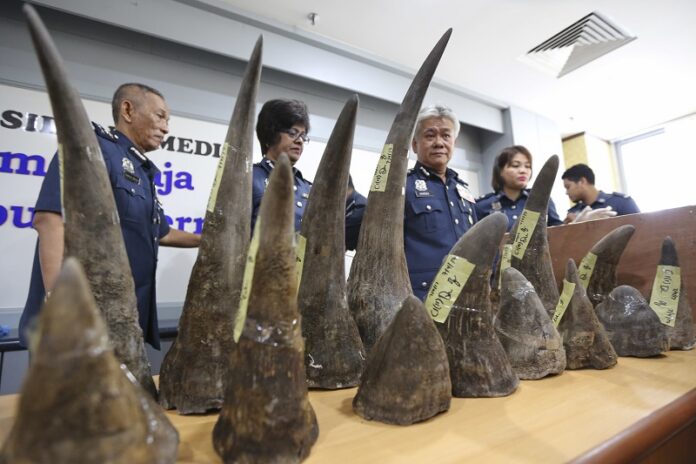
Malaysia Seizes 18 Rhino Horns From Mozambique

Kuala Lumpur International Airport (KLIA) customs director-general Hamzah Sundang, center, inspects the rhino horns that were seized at KL International airport during a press conference Monday in Custom office in Sepang, Malaysia. Photo: Vincent Thian / Associated Press

KUALA LUMPUR  Malaysian authorities say they have seized 18 rhino horns believed to have been smuggled into the country from Mozambique.

Airport customs director Hamzah Sundang says the horns were flown from Mozambique and transited in Doha before arriving at the Kuala Lumpur airport last Friday. He said the horns, which weighed 51.4 kilograms (113 pounds) and worth 13.6 million ringgit (USD $3.1 million), were declared as art objects in a forged air bill with a fake final destination.

Hamzah said Monday that custom officials made the seizure at the airport cargo warehouse based on a tip and that no arrests were made. Hamzah said the case is being investigated for smuggling of prohibited goods.

Rhino horns are believed to have medicinal properties and are in high demand in Asia.

Advertisement

Yell For Yelle: French Dance-Pop to Play Live RCA

BANGKOK — A French electro-pop duo is coming to perform for the first time in Bangkok.

Yelle is making their headliner debut in the capital city, bringing ‘80s-inspired pop, bright electro and unique French schoolgirl vocals.

The band founded by Julie Budet and Jean-François Perrieris got attention back in 2005 when they posted “Je Veux Te Voir” to Myspace, which eventually led to a record deal. The duo has made their way to the Coachella Festival three times and have worked with several artists including pop singer-fashion icon Katy Perry.

Advance tickets are 650 baht, 750 baht for general tickets and 900 baht at the door. They’re available now online.

The show happens May 9 at Live RCA Bangkok. Get there from MRT Phetchaburi by a 15 minute taxi or motorbike ride.

Advertisement

‘Mowgli’ Man of Bangkok Takes Urban Jungle Too Literally (Video)

BANGKOK — In a captivating scene of urban athleticism, a naked man rushed across a busy road Sunday in the Chatuchak district to leap from roof to roof of passing vehicles.

A day after footage of the unidentified man stopping motorists on Vibhavadi-Rangsit Road went viral, policesaid Monday that the “Mowgli of Vibhavadi,” as he was dubbed by become media, been taken to a mental health facility for care.

“He was rubbing on motorcycle riders’ helmets and rubbing car windows when I arrived on the scene,” Lance Cpl. Narong Yuuglang of Vibhavadi police said Monday. “I don’t know where he left his clothes.”

Narong said the man been taken to Srithanya Hospital for treatment.

The man, who appeared disturbed, did not injure anyone or “molest anyone with his touch,” Narong said.

News reports named him the “Mowgli of Vibhavadi” in reference to the naked, feral protagonist of “The Jungle Book.”

https://giphy.com/gifs/disney-muukXwZoRZ5lK


Advertisement

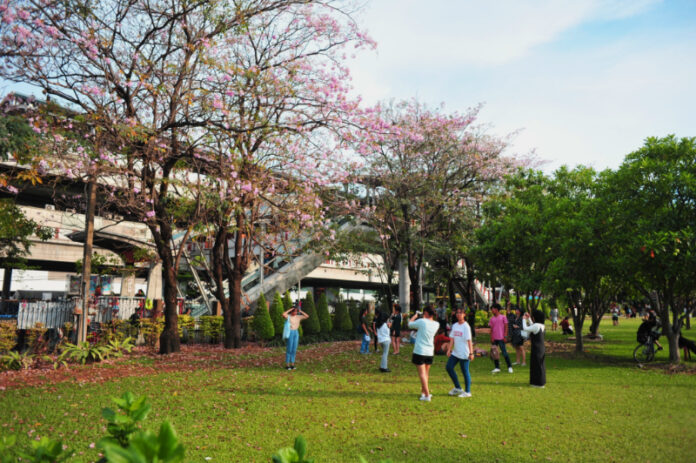
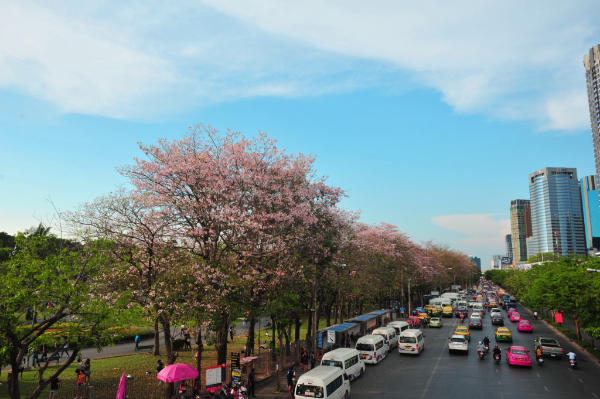
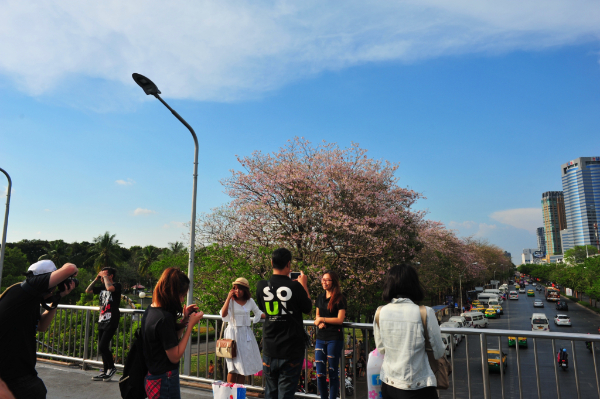
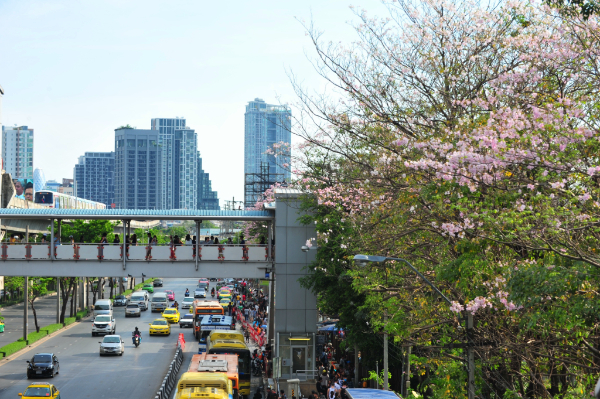
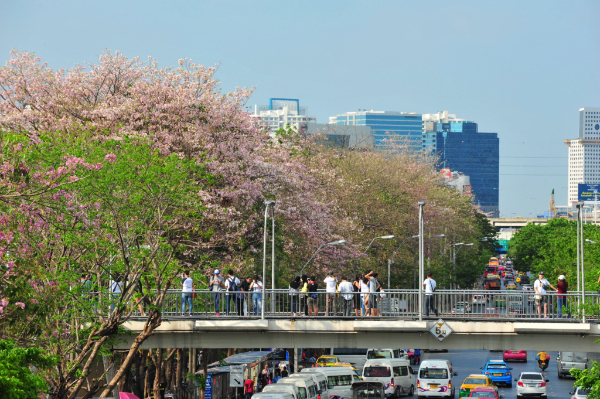
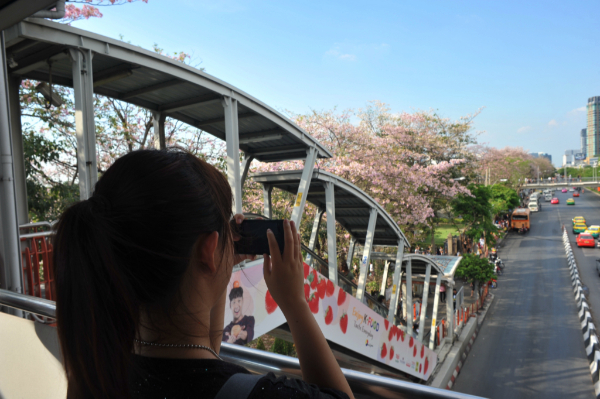
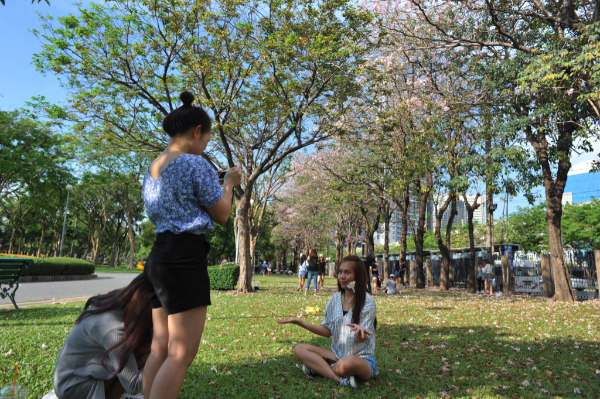
Thailand’s Sakuras Bloom at Chatuchak Park (Photos)

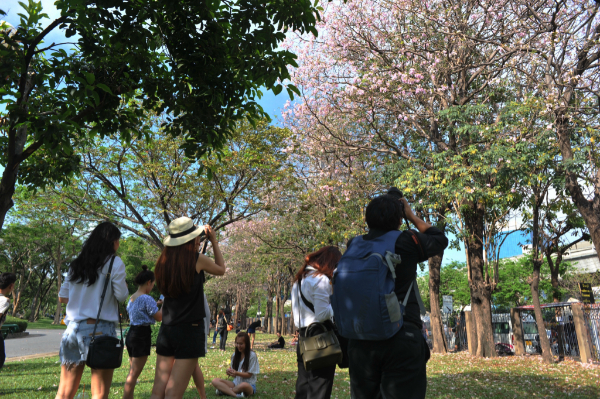
People take photos with the Tabebuia rosea trees in Chatuchak Park Sunday.

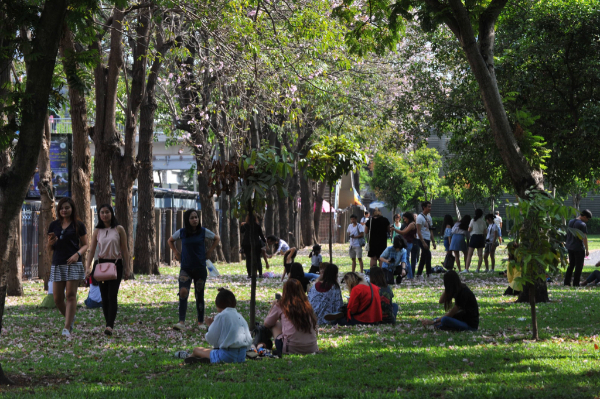
BANGKOK — Bangkokians on Sunday seized their last chance to enjoy Thailand’s sakura flowers painted Chatuchak park pink.

The peak bloom period of Thailand’s cherry blossoms, aka Tabebuia rosea or Pink Trumpet Trees, attracted admirers to capture the flowers’ last moments before they pale during the weekend.

Professional and amateur photographers – including selfie enthusiasts – took to the BTS Mo Chit skywalk and the park grass to take shots of the scenery.

Those who missed it have a last chance to witness the bloom at Kasetsart University’s Kamphaengsaen campus in Nakhon Pathom province. Its 1,200 Tabebuia rosea trees will be viewable today and Tuesday.

ชมพูพันธุ์ทิพย์ ๑๗๐๔๐๙ 0003

ชมพูพันธุ์ทิพย์ ๑๗๐๔๐๙ 0008 ชมพูพันธุ์ทิพย์ ๑๗๐๔๐๙ 0010 ชมพูพันธุ์ทิพย์ ๑๗๐๔๐๙ 0011 ชมพูพันธุ์ทิพย์ ๑๗๐๔๐๙ 0012 ชมพูพันธุ์ทิพย์ ๑๗๐๔๐๙ 0014 ชมพูพันธุ์ทิพย์ ๑๗๐๔๐๙ 0015 ชมพูพันธุ์ทิพย์ ๑๗๐๔๐๙ 0016

Advertisement

Meet the Female Monks Fighting for Spiritual Equality

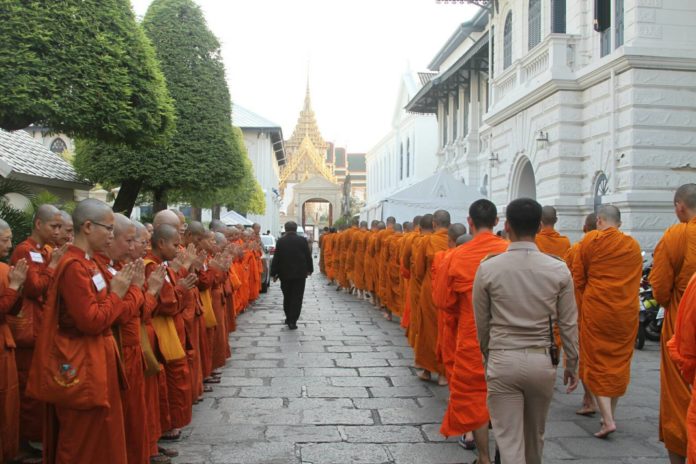
Women monks, barred from entering the Grand Palace to honor King Bhumibol, pay their respects to the male monks entering the grounds in December. Photo: Matichon

When the nation began mourning King Bhumibol after his death late last year, several dozen robed women entered the long queue to pay their respects at the Dusit Maha Prasat Throne Hall where his body lay in state.

They were led by Dhammananda, who was granted permission by officials on the afternoon of Dec. 9 for 70 monks and novices from several provinces to enter the Grand Palace. After waiting two hours inside the gate, they were turned away. The reason? Officials said women wearing the saffron robe was illegal under Thai Buddhism.

They weren’t the first. In November, 22 bhikkhunis (female monks) and samaneris  (female novices), left in disappointment after being told the only way they would be allowed in to offer their respects to their revered king was to remove their robes and wear regular black clothing as laypeople.

A few thousand kilometers away across the South China Sea, the fight for religious and secular equality for female monks in Taiwan has long been led by Shih Chao-hwei, a progressive who has campaigned for the rights of all living things, from female monks to marriage equality.

BK2
Bhikkhuni Shih Chao-hwei at Wongsanit Ashram in Nakhon Nayok on March 15.

“I love the Buddha’s dharma, but not exactly the Buddhist system, which is very complicated,” the 60-year-old Taiwanese bhikkhuni said late last month through a translator as she visited Thailand, where such rights for women are scarce.

After planting the seeds of social and religious revolution for almost two decades, Chao-hwei shared her experiences and motivations to inspire others at a three-day meeting at an ashram north of Bangkok as a patron of the International Network of Engaged Buddhists, which was founded by renowned Thai Buddhist reformer and scholar Sulak Sivaraksa.

“The most essential dharma for me is ‘dependent arising’ which explains all existence and cessation. That’s why a middle path should be taken to balance the two extremes,” she said at the Wongsanit Ashram in Nakhon Nayok province.


Thai Struggle

In Thailand, where over 90 percent of the population is Theravada Buddhist, religion and politics mix freely, as the government has a role in overseeing the religion the king is its appointed defender.

The law barring bhikkhunis from being fully ordained is the 1928 Sangha Act, which predated Thailand’s move to democracy in 1932. Under the law, the closest women could get was to become Mae Chi, the white-robed nuns who hold to the 10 basic precepts.

But that hasn’t stopped some from pursuing their spiritual calling.

“You have excellent bhikkhunis such as Dhammananda, who’s done so many good works in society that people have trust and faith in her actions,” Chao-Hwei said.

In 2003, Dhammananda Bhikkhuni became the first Thai woman of the modern era to be fully ordained. She’s currently abbess of the Songdhammakalyani Monastery in Nakhon Pathom.

It’s estimated that there are 100 fully ordained bhikkhunis across the country. Still, the government and some people marginalize them as illegal impersonators.

“We’re as close as Buddha’s teaching,” Dhammananda said in February at the Foreign Correspondents’ Club of Thailand. “The status of Bhikkhuni in Thailand is improving and our existence is already a step ahead. We also reach out to people and educate them.”

In February, a group of bhikkhunis and Paiboon Nititawan, a former chairman of the committee for the National Reform Council’s protection of Buddhism, petitioned the National Human Rights Commission to submit a 2015 report on human rights violations against bhikkhunis to the prime minister. Calls have been made to update the Sangha Act so women can be fully ordained.


The Saffron Ceiling

For Chao-hwei, Buddhist institutions remain problematic for their patriarchy and gender discrimination, something she’s spent 16 years fighting.

Underpinning the problem are the so-called Eight Heavy Rules, or The Eight Garudhammas. These are additional – and disputed – precepts for female monks which religious authorities say were established by the Buddha when he allowed his aunt to become the first bhikkhuni.

The controversial rules subordinate female monks to male monks (bhikkhus) by only allowing them to be fully ordained under bhikkhus. The rules also bar them from criticizing male monks, no matter how much seniority a bhikkhuni may have.

“Bhikkhus, bhikkhunis, laymen and laywomen, who are the four members of the Buddhist community, should be equal to one another,” said Chao-hwei, who first called for the rules to be abolished in 2001.

That was also the year she urged the Dalai Lama at a conference in Taipei to allow the revival of bhikkhunis in Tibet, where women are prohibited from being fully ordained.

She acknowledges that there are laypeople and monks who disagree with her, and whether the Buddha really established the rules – their only source of legitimacy – remains an unsettled historical argument.

BK3
Professor Yo Hsiang-Chou, at left, and Bhikkhuni Shih Chao-hwei on March 15 at the Wongsanit Ashram in Nakhon Nayok province.

“It doesn’t mean that bhikkhunis are less respectful of bhikkhus,” Chao-hwei said, as a fluffy feline inserted itself into the conversation for stomach-scratching and as a reminder that her fight for equality extends beyond the realm of religion.

She’s successfully campaigned for laws against animal abuse, horse racing, gambling, nuclear power, gender inequality and other issues.

She went outside the law in 2012 to be the first to preside over a same-sex Buddhist wedding in Taiwan, where it is illegal. The provocative event sparked optimism there that Taiwan may be the first Asian country to make marriage equality the law.


Bhikkhunis in Thailand & Taiwan

Buddhism has flourished in Taiwan in recent decades, with numbers of practicing Buddhists increasing fourfold. Chao-hwei estimated the numbers of bhikkhuni has also increased to outnumber male monks three times over.

Chao-Hwei recounted the big change in Taiwanese bhikkhuni circle stemmed in 1966 when Cheng Yen Bhikkhuni found Tzu Chi Foundation as a compassion relief that uses Buddhist Precepts to help people throughout almost 50 countries.

Education, society’s acceptance and economic independence of bhikkhunis also help in the growing number of female monks.

Also, the success comes from the fact that Taiwan adopted Mahayana rather than Theravada Buddhism from Sri Lanka and China, where women have been fully ordained for the past 2,000 years, combined with its implementation of Humanistic Buddhism that better fits the modern world.

Born in Yangon in Myanmar in 1957, Ven Chao-Hwei chose to ordain when she was 21 before graduating from National Taiwan Normal University a year later. For her, Buddhism was more reasonable and a way she could be free from traditional gender roles and have her own agency.

Now, she’s chairwoman of the Department of Religious Studies and dean of the College of Social Science at Hsuan Chuang University, a private Buddhist university and never ceased to voice her opinion on social issues through Buddhist point of view with more than 20 books and 70 research papers published.

“With the freedom to be bhikkhuni, I look at things and phenomena more openly,” she said. “Some people might be afraid to take action, but I don’t doubt that I’m doing the right thing by following Buddha’s will.”

She said the many schools and traditions in Taiwanese Buddhism are open-minded and resolve disputes by an elected Chinese Buddhist Association in processes women are allowed to participate.

There, the government does not interfere in spiritual matters.

“To identify whether it’s legal can’t be decided only by government legislation,” she said.

Advertisement

Stormy Songkran Set to Hit Bangkok

Songkran partygoers last April in Khaosan Road.

BANGKOK — Revelers this Songkran can expect to be splashed both by partygoers and Mother Nature herself.

According to the Meteorological Department, Bangkok and surrounding areas will see a 60 percent chance of rain during Songkran starting Thursday through the weekend, with lows of 23C and highs of 34C.

That means a big change from last year, when temperatures reached record highs of 44.5C.

The northern region is expected to see highs of 39C, with strong winds and a chance of thunderstorms. Residents are advised to avoid open spaces or standing under trees and other unstable building structures due to lightning.

Isaan will see similar chances of summer storms and highs of 37C, while the southern region is also likely to see seaside storms, highs of 34C and waves of up to two meters.

Related stories:

Heat For Now, Then Rain This Week

OMGWTFBBQ: Thailand Hasn’t Been This Hot Since 1960

Bangkok Songkran Party Spots Ignore Junta Advice

Advertisement

Egypt Declares 3-Month State of Emergency As Church Blast Kills 44

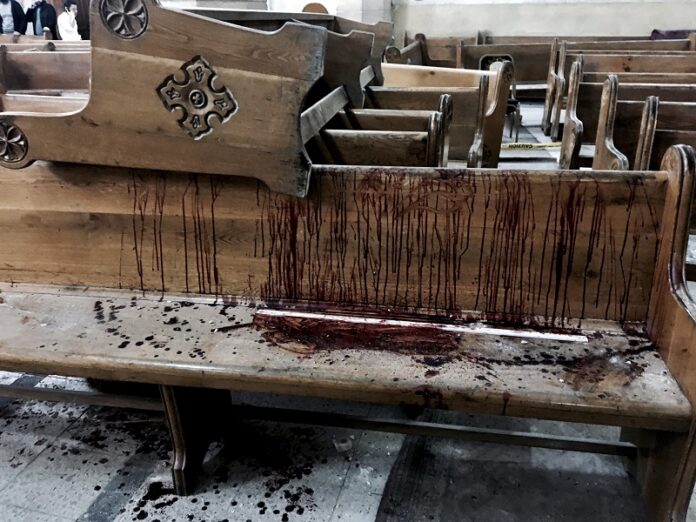
Blood stains pews inside the St. George Church after a suicide bombing, Sunday in the Nile Delta town of Tanta, Egypt. Photo: Nariman El-Mofty / Associated Press

TANTA, Egypt — Suicide bombers struck hours apart at two Coptic churches in northern Egypt, killing 44 people and turning Palm Sunday services into scenes of horror and outrage at the government that led the president to call for a three-month state of emergency.

The Islamic State group claimed responsibility for the violence, adding to fears that extremists are shifting their focus to civilians, especially Egypt’s Christian minority.

The attacks in the northern cities of Tanta and Alexandria that also left 126 people wounded came at the start of Holy Week leading up to Easter, and just weeks before Pope Francis is due to visit.

Pope Tawadros II, the leader of the Coptic church who will meet with Francis on April 28-29, was in the Alexandra cathedral at the time of the bombing but was unhurt, the Interior Ministry said.

It was the single deadliest day for Christians in decades and the worst since a bombing at a Cairo church in December killed 30 people.

Late Sunday night, President Abdel-Fattah el-Sissi called for a three-month state of emergency. According to Egypt’s constitution, parliament must vote in favor of such a declaration  a virtual certainty since it is packed with supporters of the president. It cannot exceed six months without a referendum to extend it.

The army chief-turned-president also dispatched elite troops across the country to protect key installations and accused unidentified countries of fueling instability, saying that “Egyptians have foiled plots and efforts by countries and fascist, terrorist organizations that tried to control Egypt.”

The attacks highlighted the difficulties facing el-Sissi’s government in protecting Christians, who make up about 10 percent of Egypt’s population.

“Where is the government?” screamed an angry Maged Saleh, who rushed to the church in the Nile Delta city of Tanta where his mother escaped the carnage. “There is no government!”

The first bomb exploded inside St. George’s Church in Tanta, killing at least 27 people and wounding 78, officials said, overturning pews, shattering windows and staining the whitewashed walls with blood.

Video from inside the church broadcast by CBC TV showed people gathered around what appeared to be lifeless, bloody bodies covered with papers. Several doors had been blown off. Women wailed outside.

“After the explosion, everything became dark from the smoke,” said Edmond Edward, attending Mass with his brother, Emil, who suffered head wounds and leaned on him for support at a nearby hospital.

“There was a clear lapse in security, which must be tightened from now on to save lives,” he told The Associated Press. The blast appeared to be centered near the altar, he said.

Susan Mikhail, whose apartment balcony across the street has a clear view of the church and its front yard, said the explosion violently shook her building.

“Deacons were the first to run out of the church. Many of them had blood on their white robes,” she told the AP. The more seriously wounded then were carried out by other survivors and taken to hospitals in private cars, she said.

Hundreds of residents gathered in the area, and church members blocked people from entering the church as police cordoned off the area.

A few hours later, a suicide bomber rushed toward St. Mark’s Cathedral in the coastal city of Alexandria, the historic seat of Christendom in Egypt, killing at least 17 people and wounding 48.

CCTV images showed a man with a blue sweater tied over his shoulders approaching the main gate to St. Mark’s and then being turned away by security and directed toward a metal detector. He passed a female police officer talking to another woman, and entered a metal detector before an explosion engulfed the area.

The Health Ministry said six Muslims were among the dead in Alexandria.

Pope Tawadros II had held Palm Sunday services at the cathedral and the timing of the attack indicated the bomber had sought to assassinate him.

Pope Francis marked Palm Sunday in St. Peter’s Square by expressing “deep condolences to my brother, Pope Tawadros II, the Coptic church and all of the dear Egyptian nation.”

Magdy George Youssef, a deacon at St. George’s, said the church was almost full when the blast occurred and threw him under a pew.

“All I could think of was to find my wife, and all I could see was smoke, blood and completely charred bodies,” the distraught 58-year-old said. Youssef, who suffered only an injured ear, later found his wife at home, with burns to her face.

IS said in a statement that two Egyptian suicide bombers named Abu Ishaq al Masri and Abu al Baraa al Masri carried out the church attacks and vowed to continue attacks against Christians.

“What happened is a dangerous indicator that shows how easy it is to attack a large gathering of people in different places,” said researcher Ishaq Ibrahim with the Egyptian Initiative for Personal Rights. “There is a complete government failure in taking the IS threat seriously.”

El-Sissi said in a statement that Sunday’s attacks would only strengthen the resolve of Egyptians against “evil forces.” He held an emergency meeting of the National Defense Council, which includes the prime minister, the defense and interior ministers, the speaker of parliament and top army commanders and security chiefs.

Regional police chief Brig. Gen. Hossam Elddin Khalifa was fired over the Tanta bombing, with Maj. Gen. Tarek Hassouna replacing him, state-run newspaper al-Ahram reported.

President Donald Trump tweeted that he is “so sad to hear of the terrorist attack” against the U.S. ally but added that he has “great confidence” that el-Sissi “will handle the situation properly.” The two leaders met at the White House on April 3.

Grand Sheikh Ahmed el-Tayeb, head of Egypt’s Al-Azhar  the leading center of learning in Sunni Islam — also condemned the attacks, calling them a “despicable terrorist bombing that targeted the lives of innocents.”

Both Israel and the Islamic Hamas movement ruling neighboring Gaza condemned the bombings as well.

An Islamic State affiliate claimed the December bombing as well as a string of killings in the northern Sinai that forced hundreds of Christians to flee to safer areas. The militants recently vowed to step up attacks against Christians, whom they regard as infidels.

Egypt has struggled to combat a wave of Islamic militancy since the 2013 military overthrow of an elected Islamist president.

The Sinai-based IS affiliate has mainly attacked police and soldiers, but has also claimed bombings including the downing of a Russian passenger jetliner in the Sinai in 2015, which killed all 224 people aboard and devastated Egypt’s tourism industry.

Egypt’s Copts are one of the oldest Christian communities in the Middle East and have long complained of discrimination and that the government does not do enough to protect them. Security at churches is routinely increased around religious holidays.

The Copts largely supported the military overthrow of Islamist President Mohammed Morsi, and incurred the wrath of many of his followers, who attacked churches and other Christian institutions.

While the Copts have stood steadfast alongside the government, an increase in attacks on Christians has tested that support.

Egyptian media had previously reported that the church in Tanta had been targeted before, with a bomb defused there in late March.

As night fell, hundreds of Christians, mostly clad in black, streamed to the church to offer their condolences. Scuffles broke out between the mourners and church volunteers guarding the church’s doors as many pushed and shoved to get in.

Story: Hamza Hendawi

Advertisement

Sergio Garcia Wins the Masters, Ends Drought at the Majors

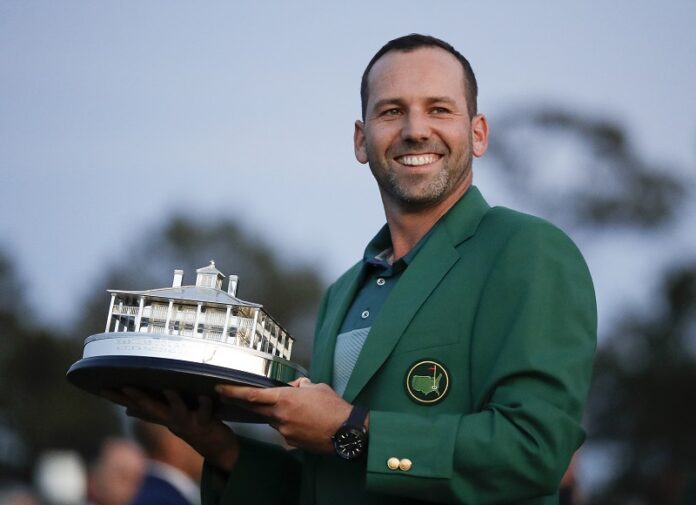
Sergio Garcia, of Spain, holds his trophy at the green jacket ceremony after the Masters golf tournament in 2019 in Augusta, Georgia. Photo: David Goldman / Associated Press

AUGUSTA, Georgia — Sergio Garcia tugged the lapel of his green jacket with both hands, proud of his prize and how he earned it.

His hopes were fading Sunday in the Masters  two shots behind with six holes to play  when his tee shot bounced off a tree and into an azalea bush, the kind of bad luck he had come to expect in the majors. Instead of pouting, he figured out how to make par.

Five feet away from winning, his birdie putt peeled off to the right. Usually resigned to fail, Garcia proved to be more resilient than ever.

He was a new man with a new title: Masters champion.

Major champion.

“It’s been an amazing week,” Garcia said, “and I’m going to enjoy it for the rest of my life.”

After nearly two decades of heartache in the tournaments that define careers, Garcia finally showed the mettle to win a major. He overcame a two-shot deficit against Justin Rose and won on the first hole of a sudden-death playoff.

No one ever played more majors as a pro (70) before winning one for the first time.

Garcia got rid of the demons and the doubts with two big moments on the par 5s  one a par, the other an eagle  in closing with a 3-under 69. It was never easy until the end, when Rose sent his drive into the trees on the 18th hole in the playoff, punched out and failed to save par from 15 feet.

That gave the 37-year-old Spaniard two putts from 12 feet for the victory, and his putt swirled into the cup for a birdie.

He crouched in disbelief, both fists clenched and shaking, and he shouted above the loudest roar of the day.

Rose, who also closed with a 69, graciously patted Garcia’s cheek before they embraced. Rose then tapped Garcia on the heart, which turned out to be a lot bigger than anyone realized.

“Ser-gee-oh! Ser-gee-oh!” the delirious gallery chanted to Garcia. He turned with his arms to his side, blew a kiss to the crowd and then crouched again and slammed his fist into the turf of the green.

All that Spanish passion was on display, raw as ever, this time sheer joy.

“Justin wasn’t making it easy. He was playing extremely well,” Garcia said. “But I knew what I was capable of doing, and I believe that I could do it.”

Garcia became the third Spaniard in a green jacket, winning on what would have been the 60th birthday of the late Seve Ballesteros. And it was Jose Maria Olazabal, who won the Masters in 1994 and 1999, who sent him a text on the eve of the Masters telling Garcia to believe and “to not let things get to me like I’ve done in the past.”

He didn’t get down after missing a 6-foot putt on the 16th hole to fall out of the lead, or missing a 5-foot birdie putt on the 18th hole that would have won in regulation.

His chin was up. He battled to the end.

“If there’s anyone to lose to, it’s Sergio. He deserves it,” Rose said. “He’s had his fair share of heartbreak.”

This was shaping up as another, especially after Garcia watched a three-shot lead disappear as quickly as it took Rose to run off three straight birdies on the front nine.

Tied going to the back nine, Garcia immediately fell two shots behind with wild shots into the pine straw bed under the trees. Rose was poised to deliver a knockout on the par-5 13th when Garcia went left beyond the creek and into the bush. He had to take a penalty shot to get out and hit his third shot 89 yards short of the green. Rose was just over the back of the green in two, in position to turn a two-shot lead into four.

Everyone figured this was coming, right?

Garcia himself had said, in a moment of self-pity, that he didn’t have what it takes to win a major. Four times he was runner-up. This was his third time playing in the final group. But right when it looked to be over, momentum shifted to Garcia.

He hit wedge to 7 feet and escaped with par. Rose rolled his chip down to 5 feet and missed the birdie putt. The lead stayed at two shots, and the game was on.

Garcia birdied the 14th to get within one. His 8-iron into the par-5 15th  “One of the best shots I hit all week,” he said  landed inches in front of the hole and nicked the pin, and he holed the 14-foot eagle putt to tie for the lead.

Rose took the lead with an 8-foot birdie on the 16th and gave it back by missing a 7-foot par putt on the 18th.

Not since 1998 have the last two players on the course gone to the 18th tied for the lead, and both had their chances to win. Rose’s approach hit off the side of the bunker and kicked onto the green, stopping 7 feet away. Garcia answered with a wedge that covered the flag and settled 5 feet away.

Both missed.

The playoff didn’t last long. Rose was in trouble from the start with a tee shot that sailed right, leaving him blocked by a Magnolia tree. He chipped out under the tree, hit his third shot to 15 feet and missed the par putt.

Former Masters champion Charl Schwartzel birdied the 18th for a 68 to finish third. Matt Kuchar made a hole-in-one on the 16th that gave him hope but not for very long. He tied for fourth with Thomas Pieters, who ran off four birdies on the back nine.

Jordan Spieth, starting the final round only two shots behind, put another tee shot into the water on No. 12 long after it mattered. He had to birdie three of his last four holes for a 75. Also an afterthought was Rickie Fowler, who started one shot behind and shot 76.

All that mattered was Garcia and Rose, who delivered a final hour as compelling as any at the Masters and a champion who began to wonder if he would ever win a major.

Garcia says he has learned to accept bad bounces. He realized he has a “beautiful life” even if he never won a major.

“If it, for whatever reason, didn’t happen, my life is still going to go on. It’s not going to be a disaster,” Garcia said.

And then smiling, he added, “But it happened.”

Story: Doug Ferguson

Advertisement

Hot News

LATEST NEWS

Bangkok
overcast clouds
30.2 ° C
31.6 °
28.8 °
76 %
4.5kmh
100 %
Tue
34 °
Wed
34 °
Thu
35 °
Fri

31 °
Sat
31 °