35.9 C
Bangkok
Tuesday, June 9, 2026
Home Blog Page 2587

Police Can’t ID Suspected Farang Forgers Or Their Dead Body

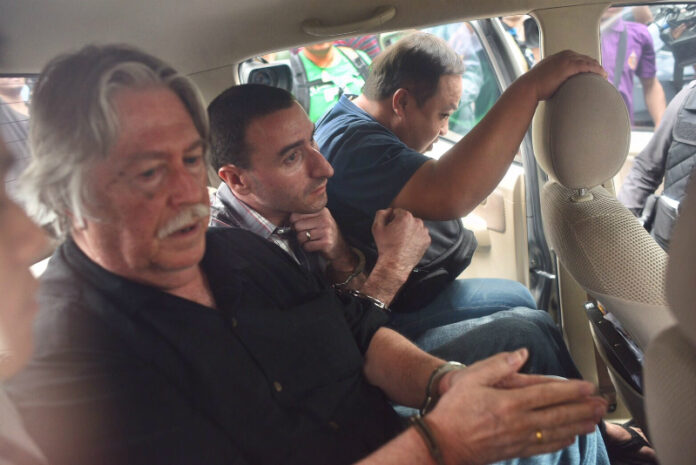
Two suspects identified as James Douglas Eger, at left, and Aaron Thomas Gabel, at middle, are taken Saturday from a police station to a Bangkok court.

BANGKOK — Three foreign men accused of shooting a police officer during a Friday raid in Bangkok have denied any knowledge of the frozen body found at the scene.

Police said Monday they still can’t verify the identities or nationalities of the three suspected forgers, who possessed American and British passports. Neither do they know whose dismembered body they found in cold storage inside the building in Soi Sukhumvit 56 where they were arrested.

“We already sent all the information including photos and fingerprints of the corpse and suspects to foreign embassies to verify,” Maj. Gen. Somprasong Yenthuam of the Metropolitan Police Bureau said.

The three Western men have been charged with concealing a corpse, possessing drugs and counterfeiting passports.

Read : Foreigners Arrested After Raid on Forgery Ring Leads to Body in Fridge

Passports in their possession identified them as Aaron Thomas Gabel, 33, and 66-year-old James Douglas Eger, both of the United States. The third suspect possessed an American passport identifying him as 63-year-old William Peter Johnson and a British passport identifying him as 58-year-old Peter Andrew Colter.

Friday’s raid was launched to target a suspected foreign forgery ring suspected of making fake passports. Johnson/Colter opened fire on police, shooting Sgt. Maj. Kanjanapong Chedet of the tourist police. He survived.

Johnson/Colter, who was being for injuries at Police General Hospital, told police the freezer with the dead body belonged to a buddy who used to live on Soi Ekkamai 12. He didn’t elaborate.

He also told police that he intended to shoot himself, but his gun accidentally fired while police were attempting to disarm him.

“But the police officer who was shot said he directly pointed the gun at him,” Somprasong said.

Passports, guns, marijuana and crystal meth found by police Friday on the fourth floor of a building in Bangkok’s Phra Khanong area.

Johnson/Colter was also charged with attempted murder of a security officer and illegally entering the kingdom. Gabel and Eger are both in custody.

A Burmese couple who lived in the building and were swept up in the raid were released without charge, Somprasong said, as police believe they were uninvolved.

Along with the guns, marijuana and crystal meth police found was an unknown chemical they believe was involved in creating fake passports. The substance is being examined.

Metropolitan police commander Sanit Mahathavorn on Sunday said police were looking into the financial records of the group.

Advertisement

Pheu Thai Says 35.7B Fine Denies Yingluck Due Process

Former PM Yingluck Shinawatra speaks to reporters on Sept. 9 outside the Supreme Court. Photo: Matichon

BANGKOK — The Pheu Thai Party has accused the military government and junta leader Prayuth Chan-ocha of not respecting due process by imposing a 35.7 billion baht (USD$1.03 billion) fine against former Prime Minister Yingluck Shinawatra for losses incurred by an agricultural subsidy enacted by her administration.

In a statement issued Sunday, Pheu Thai said it was premature for the government to order Yingluck pay the large sum before the Supreme Court even rules in the malfeasance trial against her stemming from losses the program incurred during the 2012-2014 growing seasons.

“If the court rules that the defendants are in the wrong, then civil liability lawsuit proceedings may be filed against them,” the English-language statement read. “It is inappropriate for leaders to lead the society into making conclusions before the court has announced its ruling.”

The statement called on Gen. Prayuth to adhere to normal legal procedures and not interfere with the case using the absolute power granted under Article 44 of the junta’s interim charter.

The statement also noted Prayuth, who is both prime minister and junta leader, has used his special powers to both empower agencies to seize and sell off the property of those involved in the price-pledging subsidy while granting them legal immunity from doing so.

“This will allow officials involved to take actions without regard to the rule of law, as they will be protected and the actions they take will only be to achieve the aims of those in power,” the statement read.

Prayuth defended the move on Sunday, saying his government had to take action before the statute limitations expires in February. He said he was not interfering as it was up to the courts to make the final ruling.

For her part, Yingluck called on Prayuth to show her the same consideration he’s shown to his brother, permanent defense secretary Preecha Chan-ocha. Last week the army circled wagons around Preecha, denying there was anything improper about lucrative army projects awarded to his son.

“I would like the PM to apply the same kind of thinking and justice to me as you did to protect your little brother and people who are on your side. The law is for use with everyone, not just people on my side.”

Additional reporting Asaree Thaitrakulpanich

Advertisement

Chinatown Market Fire Injures Fireman

Smoke rises from a building in the Sampeng Market on Monday morning. Original photos: @Ratchatham & @Nalinee_PLE / Twitter

BANGKOK — A fireman had to be treated for smoke inhalation Monday morning after a fire broke out at the Sampeng Market in Chinatown.

The fire started at around 10am on the top floor of a four-story building on Soi Wanit 1 near Sampeng Center and subsequently spread to the third floor.

Four people were rescued from the building. At least one fireman who was part of the rescue effort had to be treated for smoke inhalation, according to police Col. Popthorn Jitman.

The flames were put out at about noon, said Popthorn of Chakrawat police.


Advertisement

21 Thai Sex Slaves Rescued from Oman

Women rescued from forced prostitution in Oman arrive Sunday at Don Mueang International Airport in Bangkok.

MUSCAT — Twenty-one women were back in Thailand today after being rescued from sexual slavery by police in Muscat, Oman.

The women, who were lured by promises of jobs, landed at Don Mueang International Airport on Sunday after being rescued in a joint effort by Omani police and Thai immigration officials, said Maj. Gen. Nattatorn Proasoonthorn of the Immigration Bureau.

In Thursday’s rescue of the women, Omani police arrested two Thai nationals suspected of running the prostitution ring: Suphanan Yingphimai, 29, and Natnicha Kongprasith, 36. Two Omanis linked to the ring were still being sought by Omani police.

“The apartments we raided with the Omani police were completely normal looking from the outside,” said Maj. Gen. Tachai Pitanilabut of immigration police, who flew to Muscat on Tuesday. “Inside we found women of various nationalities, packed into about six per room. Their average age was around early 20s to 30s.”

Tachai said there were other women found in the building but would not disclose their nationalities.

Thursday’s raid of two apartment buildings came after three women escaped from the same circumstances last month, which led to the arrest in Thailand of 27-year-old Palida Kleepbua. All three Thai nationals have been charged with human trafficking, running a prostitution ring, and pandering.

Nattatorn said the three Thai women who escaped earlier on Aug. 5 were lured through Facebook paid plane tickets and promises of a good salary at a massage parlor in Oman.

When they got there, their passports were confiscated by the Omanis who were part of the criminal operation. The women were forced into prostitution to pay back a debt of 160,000 baht, said their captors, and were threatened with violence if they attempted to escape.

The three women said they managed to escape with the help of Indian customers who took them to the authorities.

“Let this case be an example to Thai women who are thinking of working overseas to be cautious,” Nattatorn said. “You could be tricked and forced into a torturous situation where you can’t return to your country.”

Advertisement

Watch Trump and Clinton Square Off Over BBQ Wings Tuesday

Caricatures of Hillary Clinton, left, and Donald Trump. The presidential candidates are set to go head to head for the first time on Monday night's television debate in Hoffstra University, New York. Photo: DonkeyHotey / Flickr

BANGKOK — Immerse in sauce-dripping Americana and watch the first debate between U.S. presidential candidates Hillary Clinton and Donald Trump on Tuesday at Roadhouse Barbecue in Bangkok.

Watch what could prove a pivotal moment in the campaign that has proven a departure from politics as usual with a delayed screening beginning at 7pm.

Predictions estimate 100 million viewers will watch the debate worldwide, making it the most viewed of its kind in U.S. history. Americans of all stripes and stars can register to vote at the event which is organized by Democrats Abroad Thailand.

The debate will happen at 8am on Tuesday morning at Hofstra University in Hempstead, New York. It will be moderated by Lester Holt of NBC Nightly News.

Located on Rama IV, the restaurant is a five-minute walk from MRT Silom.

Advertisement

4 Phuket Beaches Closed Due to Killer Jellyfish

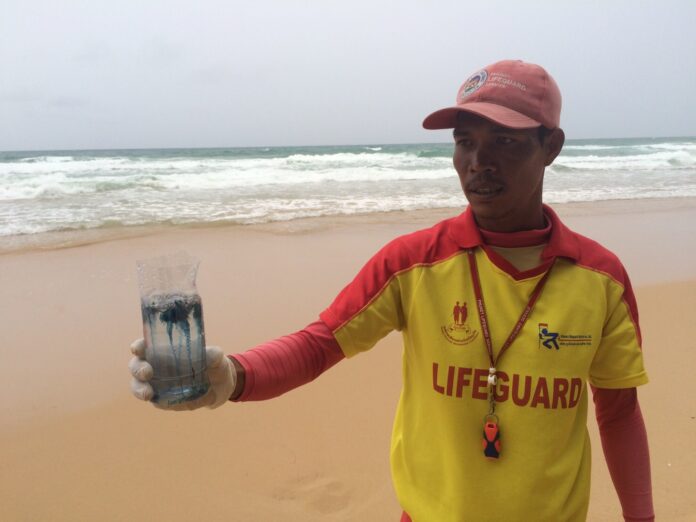
A lifeguard holds a cup Thursday containing a Portuguese man o' war, aka blue bottle jellyfish, Thursday on Phuket.

PHUKET — Four beaches on the resort island of Phuket were deserted over the weekend after swarms of potentially fatal jellyfish were found there.

Tourists on the island were barred from swimming or even stepping onto the beaches in response to the discovery Thursday of more than 100 jellyfish, mostly blue bottle jellyfish and some box jellyfish.

By Sunday, more than 140 deadly poisonous hydrozoa, mostly blue-bodied Portuguese man o’ war, were found in the sand, marine official Suracharn Sarabat said.

The four beaches closed to visitors include Layan, Nai Thon, Nai Yang and Mai Khao beaches. The closure was effective for one week, Suracharn said.

Monsoonal storms and heavy rainstorms were blamed for the influx of the blue-bodied creatures, according to Suracharn.

Several tourists, including a 20-year-old German woman and 5-year-old French boy, have died of stings in recent years due to a seasonal increase in jellyfish populations.

Portuguese man o’ war on Thursday

Related stories:

String of Jellyfish Stings Prompts Warning

Jellyfish Kill German Tourist on Koh Samui

Tourists Warned To Be Wary of Deadly Box Jellyfish


Advertisement

Arnold Palmer, Golf’s Every Man, 87

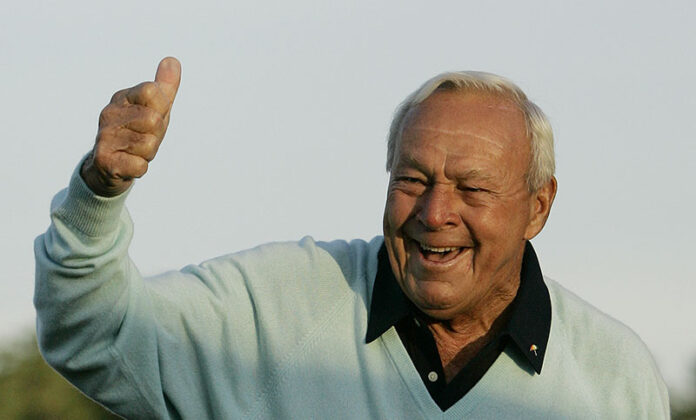
Former Masters champion Arnold Palmer smiles to the crowd after hitting the ceremonial first tee shot prior to the first round of the 2007 Masters golf tournament at the Augusta National Golf Club in Augusta, Georgia. Photo: David J. Phillip / Associated Press

Arnold Palmer brought a country club sport to the masses with a hard-charging style, charisma and a commoner’s touch. At ease with both presidents and the golfing public, and on a first-name basis with both, “The King” died Sunday in Pittsburgh. He was 87.

Alastair Johnston, CEO of Arnold Palmer Enterprises, confirmed that Palmer died Sunday afternoon of complications from heart problems. Johnston said Palmer was admitted to the UPMC Hospital on Thursday for some cardiovascular work and weakened over the last few days.

“Today marks the passing of an era,” said Johnston, Palmer’s longtime agent at IMG. “Arnold Palmer’s influence, profile and achievements spread far beyond the game of golf. He was an iconic American who treated people with respect and warmth, and built a unique legacy through his ability to engage with fans.”

Palmer ranked among the most important figures in golf history , and it went well beyond his seven major championships and 62 PGA Tour wins. His good looks, devilish grin and go-for-broke manner made the elite sport appealing to one and all. And it helped that he arrived about the same time as television moved into most households, a perfect fit that sent golf to unprecedented popularity.

“If it wasn’t for Arnold, golf wouldn’t be as popular as it is now,” Tiger Woods said in 2004 when Palmer played in his last Masters. “He’s the one who basically brought it to the forefront on TV. If it wasn’t for him and his excitement, his flair, the way he played, golf probably would not have had that type of excitement.

“And that’s why he’s the king.”

Beyond his golf, Palmer was a pioneer in sports marketing, paving the way for scores of other athletes to reap in millions from endorsements. Some four decades after his last PGA Tour win, he ranked among the highest-earners in golf.

“It is not an exaggeration to say there would be no modern-day PGA Tour without Arnold Palmer. There would be no PGA Tour Champions without Arnold Palmer. There would be no Golf Channel without Arnold Palmer,” PGA Tour Commisioner Tim Finchem said in a statement.

“No one has had a greater impact on those who play our great sport or who are touched by it. It has been said many times over in so many ways, but beyond his immense talent, Arnold transcended our sport with an extraordinarily appealing personality and genuineness that connected with millions, truly making him a champion of the people.”

On the golf course, Palmer was an icon not for how often he won, but the way he did it.

He would hitch up his pants, drop a cigarette and attack the flags. With powerful hands wrapped around the golf club,Palmer would slash at the ball with all of his might, then twist that muscular neck and squint to see where it went.

“When he hits the ball, the earth shakes,” Gene Littler once said.

Palmer rallied from seven shots behind to win a U.S. Open. He blew a seven-shot lead on the back nine to lose a U.S. Open.

He was never dull.

“I’m pleased that I was able to do what I did from a golfing standpoint,” Palmer said in 2008, two years after he played in his last official tournament. “I would like to think that I left them more than just that.”

He left behind a gallery known as “Arnie’s Army,” which began at Augusta National with a small group of soldiers from nearby Fort Gordon, and grew to include a legion of fans from every corner of the globe.

Palmer stopped playing the Masters in 2004 and hit the ceremonial tee shot every year until 2016, when age began to take a toll and he struggled with his balance.

It was Palmer who gave golf the modern version of the Grand Slam — winning all four professional majors in one year. He came up with the idea after winning the Masters and U.S. Open in 1960. Palmer was runner-up at the British Open, later calling it one of the biggest disappointments of his career. But his appearance alone invigorated the British Open, which Americans had been ignoring for years.

Palmer never won the PGA Championship, one major short of capturing a career Grand Slam.

But then, standard he set went beyond trophies. It was the way he treated people, looking everyone in the eye with a smile and a wink. He signed every autograph, making sure it was legible. He made every fan feel like an old friend.

Palmer never like being referred to as “The King,” but the name stuck.

“It was back in the early ’60s. I was playing pretty good, winning a lot of tournaments, and someone gave a speech and referred to me as ‘The King,'” Palmer said in a November 2011 interview with The Associated Press.

“I don’t bask in it. I don’t relish it. I tried for a long time to stop that and,” he said, pausing to shrug, “there was no point.”

Palmer played at least one PGA Tour event every season for 52 consecutive years, ending with the 2004 Masters. He spearheaded the growth of the 50-and-older Champions Tour, winning 10 times and drawing some of the biggest crowds.

He was equally successful off with golf course design, a wine collection, and apparel that included his famous logo of an umbrella. He bought the Bay Hill Club & Lodge upon making his winter home in Orlando, Florida, and in 2007 the PGA Tour changed the name of the tournament to the Arnold Palmer Invitational.

The combination of iced tea and lemonade is known as an “Arnold Palmer.” Padraig Harrington recalls eating in an Italian restaurant in Miami when he heard a customer order one.

“Think about it,” Harrington said. “You don’t go up there and order a ‘Tiger Woods’ at the bar. You can go up there and order an ‘Arnold Palmer’ in this country and the barman — he was a young man — knew what the drink was. That’s in a league of your own.”

Palmer was born Sept. 10, 1929 in Latrobe, Pennsylvania, the oldest of four children. His father, Deacon, became the greenskeeper at Latrobe Country Club in 1921 and the club pro in 1933.

He had two loves as a boy — strapping on his holster with toy guns to play “Cowboys and Indians,” and playing golf. It was on the golf course that Palmer grew to become so strong, with barrel arms and hands of iron.

“When I was 6 years old, my father put me on a steel-wheeled tractor,” he recalled in a 2011 interview with the AP. “I had to stand up to turn the wheel. That’s one thing made me strong. The other thing was I pushed mowers. In those days, there were no motors on anything except the tractor. The mowers to cut greens with, you pushed.

“And it was this,” he said, patting his arms, “that made it go.”

Palmer joined the PGA Tour in 1955 and won the Canadian Open for the first of his 62 titles. He went on to win four green jackets at Augusta National, along with the British Open in 1961 and 1962 and the U.S. Open in 1960, perhaps the most memorable of his seven majors.

Nothing defined Palmer like that 1960 U.S. Open at Cherry Hills. He was seven shots behind going into the final round when he ran into Bob Drum, a Pittsburgh sports writer. Palmer asked if he could still win by shooting 65, which would give him a four-day total of 280. Drum told him that 280 “won’t do you a damn bit of good.”

Incensed, Palmer headed to the first tee and drove the green on the par-4 opening hole to make birdie. He birdied the next three holes, shot 65 and outlasted Ben Hogan and 20-year-old amateur Jack Nicklaus.

Palmer went head to head with Nicklaus two years later in a U.S. Open, the start of one of golf’s most famous rivalries. It was one-sided. Nicklaus went on to win 18 majors and was regarded as golf’s greatest champion. Palmer won two more majors after that loss, and his last PGA Tour win came in 1973 at the Bob Hope Classic.

Tom Callahan once described the difference between Nicklaus and Palmer this way: It’s as though God said to Nicklaus, “You will have skills like no other,” then whispered to Palmer, “But they will love you more.”

“I think he brought a lot more to the game than his game,” Nicklaus said in 2009. “What I mean by that is, there’s no question about his record and his ability to play the game. He was very, very good at that. But he obviously brought a lot more. He brought the hitch of his pants, the flair that he brought to the game, the fans that he brought into the game.”

Palmer combined power with charm, reckless abandon with graceful elegance. Golf no longer was a country club game for old men who were out of shape. He was a man’s man, and he brought that spirit to the sport.

It made him a beloved figure, and brought riches long after he stopped competing.

That started with a handshake agreement with IMG founder Mark McCormack to represent Palmer in contract negotiations.Palmer’s image was everywhere, from motor oil to ketchup to financial services companies. Even as late as 2011, nearly 40 years after his last PGA Tour win, Palmer was No. 3 on Golf Digest’s list of top earners at $36 million a year. He trailed only Woods and Phil Mickelson.

Palmer’s other love was aviation. He piloted his first aircraft in 1956, and 10 years later had a license to fly jets that now are the standard mode of transportation for so many top players, even though the majority of them are merely passengers.Palmer flew planes the way he played golf. He set a record in 1976 when he circumnavigated the globe in 57 hours, 25 minutes and 42 seconds in a Lear 36. He continued flying his Cessna Citation 10 until he failed to renew his license at age 81, just short of 20,000 hours in the cockpit.

Through it all, he touched more people than he could possibly remember, though he sure tried. When asked about the fans he attracted at Augusta National, Palmer once said, “Hell, I know most of them by name.”

Only four other players won more PGA Tour events than Palmer — Sam Snead, Nicklaus, Woods and Hogan.

Palmer’s first wife, Winnie, died in 1999. They had two daughters, and grandson Sam Saunders plays on the PGA Tour.Palmer married Kathleen (Kit) Gawthrop in 2005.

Details on a memorial service and burial will be announced later.

Palmer was diagnosed with prostate cancer in 1997, which was caught early. He returned to golf a few months later, winking at fans as he waded through the gallery, always a smile and a signature for them.

“I’m not interested in being a hero,” Palmer said, implying that too much was made about his return from cancer. “I just want to play some golf.”

That, perhaps, is his true epitaph. Palmer lived to play.

Story: Doug Ferguson

Advertisement

Thorn in the Pillar: Freshman Makes Enemies Upsetting Tradition. Allies Too.

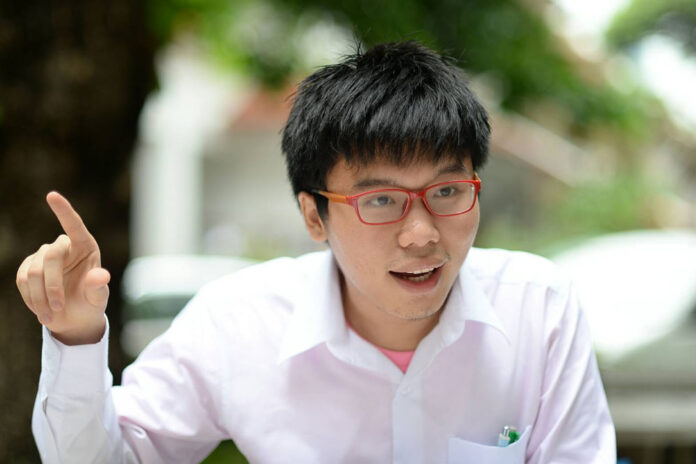
Chulalongkorn University student Netiwit Chotiphatphaisal gestures in a Sept. 20, 2016 file photo on the university's Bangkok campus.
BANGKOK — Every year freshmen in crisp uniforms press together on the campus of Chulalongkorn University. As one, thousands lower their heads to the ground in respect to statues of kings Rama V and VI in a swearing-in ceremony treated as a sacred ritual.

Except this year. On a Friday morning two months ago, a gangly political science freshman made a spectacle by refusing to prostrate to the kings’ statues. He and a friend just walked out, mid-ceremony, saying he was right by history – and one of the kings in question.

“Rama V himself cancelled the tradition of prostration,” Netiwit Chotiphatphaisal said in a recent interview. “Therefore, it’s illogical to continue to do it unthinkingly just because it’s become a norm.”

With that symbolic act, Netiwit put his peers and the institution billed as “pillar of the kingdom” on notice – he would respect the rules while throwing hammers at its customs and presumptions. For defying expectations students should be deferential and obedient, Netiwit has become both famous and infamous. Some admire his compulsion to stir thought; others complain he is an iconoclast unconcerned with their cherished values.

An interview was just beginning between classes Tuesday in his faculty’s library when, seemingly at mention of his name, library staff grew visibly uncomfortable and asked a reporter to take it elsewhere.

Sitting down on a bench outside, the 20-year-old from Samut Prakan donned his signature red glasses and clasped his hands at attention, laser-focused, to talk about that first provocative act of his university life.

“I had been thinking about not performing the swearing-in ceremony for a while, because I didn’t agree with it,” he said. “However, I also knew that I couldn’t just complain online and do nothing. I needed to incite thought.”

Chulalongkorn University freshmen participate in a mass induction on July 15, 2015, in Bangkok. Photo: Matichon
Chulalongkorn University freshmen participate in a mass induction
on July 15, 2015, in Bangkok. Photo: Matichon

Even before that morning in July, Netiwit was going after the education system’s conventions. He organized “schoolyard protests” against mandatory uniforms, standing for the national anthem, and prostrating to teachers. He founded activist reform group Education for the Liberation of Siam, declared himself a “conscientious objector” to refuse mandatory conscription at 18 and spoke out on hot-button issues, winning attention from social and traditional media.

“I want there to be more of a space in Thai society and schooling for young people: The school shouldn’t just be a place to prostrate and take tests,” he said.

For all his contrarian positions, Netiwit defies assumptions he’s some angry keyboard warrior. Instead, he comes across as a shy young man. Some might see a nerd.

“I’m not actually a rebel. I have no problem with following rules, both at school and university,” he said.

It’s when those rules exist only for their own sake and are backed by some threat of force that he reflexively balks.

“I can prostrate if you really want me to, but don’t make it an enforced thing,” he said.

‘I’m not actually a rebel. I have no problem with following rules, both at school and university’

He hopes to have it translated into English. He says that it’s the first book in many years about the educational system’s problems and believes English is important to reaching a wider audience.

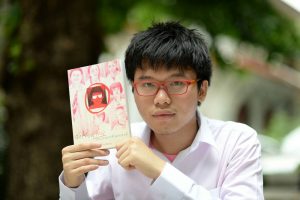
He’s not trying to embarrass anyone, he said, just help bring about a greater good.That’s when he pulls from his orange-and-navy backpack, “Degenerate Student in a Wonderful Education System,” a collection of letters he wrote to his former school. Most oppose things such as using haircuts as a disciplinary measure or requiring students donate to build a statue.

“There is a ceiling of authoritarianism in Thai schools. The focus is on the teachers and the power they wield, as well as on visible material resources,” he said. “Schools like to show off new computers, expensive gyms, and farang teachers to upgrade the school’s image.”

A promotional image for a seminar to be held at Chulalongkorn University on Oct. 6 to commemorate the 40th anniversary of the massacre of Chulalongkorn and Thammasat students.
A promotional image for a seminar to be held at
Chulalongkorn University on Oct. 6 to commemorate
the 40th anniversary of the massacre of Chulalongkorn
and Thammasat students.

Decrying the state of English-language learning, he complained some schools “hire farang teachers as decoration” to charge higher tuition, with the students in on the joke and unlikely to take them seriously.

Aware he was being interviewed for an English-language audience, Netiwit took the chance to call on those teachers to push for improvement, saying they as a base could make a “substantial push” in changing the education system.

“If you claim that you love Thailand, please help express vocally what’s wrong with the system,” he said. “The more the better. Together, we can work together for change.”

He credits his English not to Thai schools but friendly debates with Buddhists from other countries during a seven-month stay at the Deer Park Institute in India. He also decided there that learning could and should be fun.

Asked why he chose Chulalongkorn, an institution associated with conservative values over the historically liberal Thammasat University, Netiwit said that was the point. He didn’t only want to be around like-minded peers, and said conservative and progressive elements are found everywhere, regardless of the stereotypes.

Netiwit shows Tuesday a book he's collected his letters to the administrators of his previous school. He's titled it 'Degenerate Student in a Wonderful Education System.'
Netiwit shows Tuesday a book he’s collected his letters to the
administrators of his previous school. He’s titled it
‘Degenerate Student in a Wonderful Education System.’

“It’s not as conservative as they say,” he said of Chulalongkorn.

Still, Chula is home to more than its share of sacred cows, making it a target-rich environment for someone looking to bludgeon them.

Since July’s initiation episode, he’s spoken out against the hazing rituals called rub nong. He was motivated after a number of fine arts students fainted this year during hong cheer, an activity in which upperclassmen encourage or coerce freshmen to attend day-long activities involving songs and games.

On Aug. 27 he posted an audio clip of seniors harassing their junior students, which led to the faculty canceling the event – and much shade thrown at Netiwit – until freshmen petitioned for it to be reinstated, albeit with better treatment from the upperclassmen.

That gets at the grievances he’s aroused in some of his classmates.

‘You have to learn how to do so in school in order to properly show that you’re Thai’

Netiwit’s detractors call him out for being a social aberration and disruptive rebel out to destroy Thai culture and customs. They say his words and actions amount to a reckless boy’s desire to be famous and a trending social media topic.

“He’s just a kid,” said Krittamet Kumlue, a third year engineering student and member of the university and national swimming teams. “And sometimes rules just need to be followed. When I was 15, I also didn’t want to shave my head. If you can’t even cut your hair like you’re asked to, what about when you go into the workforce? Are you going to rebel against wearing ID cards as well?”

Krittamet said things such as singing the anthem Netiwit so decries are necessary displays of national identity.

“On the international stage, Thai athletes stand up and sing the Thai anthem when we win a medal,” he said. “You have to learn how to do so in school in order to properly show that you’re Thai.”

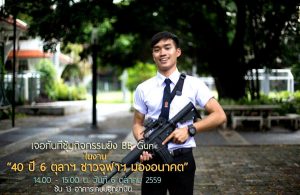
BB guns are promised in a promotional image for a seminar to be held at Chulalongkorn University on Oct. 6 to commemorate the 40th anniversary of the Thammasat University massacre.
BB guns are promised in a promotional image for a seminar to be
held at Chulalongkorn University on Oct. 6 to commemorate the 40th anniversary
of the Thammasat University massacre.

The swimmer, however, doesn’t agree with the nasty comments that openly appear on Netiwit’s Facebook page.

“Verbal abuse is not a good solution; it’s better to warn the kid. He should realize too, that society isn’t exactly as it appears from his point of view,” he said.

For his part, Netiwit said he is prepared for the attacks and isn’t discouraged by them.

But he’s also totally fired up now, having reached the topic of social change and his role.

“It’s everyone’s job to help fight for it. Individual bravery is important, but collective action is necessary,” he said. “I’ll admit that I’ve made some strategic mistakes of looking too independent in my actions.”

Whatever he’s done, there are also many cheering him on.

Worada Elstow, who graduated with a degree in French, views Netiwit as beneficial yet bitter medicine for Thai society.

“His ways of expressing his ideas may be crude and even radical, but they are necessary questions that someone needs to ask, just to open up the coconut shell that we’re all hiding under,” she said, referring to a common metaphor for Thailand’s insularism.

She said his walk-out during the swearing-in ceremony was impressive and empowering.

“This symbolic act of rebellion challenges so many conventional ideas at Chula and in Thai society,” she said. While others accuse him of destroying tradition, Worada said it cannot be destroyed, only set aside if people find no more use for it.

A promotional image for a seminar to be held at Chulalongkorn University on Oct. 6 to commemorate the 40th anniversary of the massacre of Chulalongkorn and Thammasat students.
A promotional image for a seminar to be held at
Chulalongkorn University on Oct. 6 to commemorate
the 40th anniversary of the massacre of Chulalongkorn and Thammasat students.

In true activist-nerd fashion, Netiwit was sure to plug his next act, possibly the only semi-formal recognition of the 40th anniversary of the 1976 massacre of Thammasat and Chulalongkorn university students by ultra-royalists and state security forces.

He’s excited that Oct 6: Chula Folks Look Into the Future, a seminar arranged by more than 50 other freshmen, has drawn Round Finger, a writer popular with youth; John Winyu, the devilish face of satire of “Shallow News in Depth” on YouTube; and Joshua Wong, the kindred spirit who emerged as a leader of Hong Kong’s Umbrella Movement. More than 1,000 students have registered to attend.

“I invited [Joshua] personally,” Netiwit said with a touch of pride and a smile. He starts to brag about the registration numbers before reverting to that laser-focus guise he wears when delivering the fire on society.

“Thai society is thirsting for new thoughts and ideas because society and government closes opportunities for such,” he said.

Soon after, a fan stops by and asks to take a photo with him in front of the political science department’s sign. Netiwit shyly complies, then runs off to class.

Related stories:

Chula Freshman Says Classmates Threaten Him For Calling Out Hazing
The Many Faces of Intolerance Dragging Down Thailand (Opinion)
Reformist Student Briefly Detained By Police
Outspoken ‘Reformist’ Student Stripped Of School Presidency

Advertisement

Art on Walk: Ratchaprasong Street Art Returns Next Month

Living Art Festival’s 3D graffiti by Juandrés Vera in 2014 near Gaysorn Shopping Centre. Photo: Living Art / Facebook

BANGKOK — Ratchaprasong skywalk is drum-rolling the arrival of local artists who will bring some “hip” to the commercial heart of Bangkok.

Nature is never the same when it lives in a busy urban city. The Ratchaprasong Art Maze – Urban by Nature kicks off next month with six contemporary artists – Sakarin Krue-On, Montri Toemsombat, Haritorn Akarapat, Ruangsak Anuwatwimon, Noraset Vaisayakul and Sophie Kao Arya – who will interpret nature and contribute to the art world in their own ways.

Ruangsak collected soil from across the country and will incorporate them in sculptures while Montri, inspired by traditional woven fish traps and his neglected town in Chaiyaphum province, will make futuristic-looking vessel out of bamboo.

Among other works, expect a giant wooden box, a fractal-painted floating floral field, sculpted dancing women and more.

14466874_1259656234075407_2078802583_o

The Art Maze takes place Oct. 13 through Nov. 13 on the skywalk between Amarin Plaza, the Erawan Shrine and Central World.

The celebrated art event this year is organized by Toot Yung Art Center, which was also behind the Bukruk Urban Arts Festival earlier this year.

Living Art Festival in 2014 at a skywalk near BTS Chit Lom. Photo: Living Art / Facebook

Advertisement

Al-Shabab Militarily Defeated, Says Somalia

Somalia's Foreign Minister Abdusalam Hadliyeh Omer addresses the 71st session of the United Nations General Assembly Saturday at U.N. headquarters. Photo: Andres Kudacki / Associated Press

UNITED NATIONS — Somalia’s Foreign Minister Abdisalam Omer says that as a result of successful joint operations by the Somali military and the African Union’s peacekeeping force “we have militarily defeated the evil that is al-Shabab.”

He said the al-Shabab extremist group controls less than 10 percent of the country and many of its leaders have been killed or have defected in recent months.

Omer told the U.N. General Assembly’s annual ministerial meeting on Saturday that al-Shabab has responded by turning to “asymmetric warfare tactics to conduct terror attacks against soft targets in Somalia and increasingly in neighboring countries.”

He said the government is trying “to enhance security cooperation” to prevent new attacks.

Al-Shabab is fighting to impose a strict version of Islam in Somalia, which is trying to recover from decades of violence.

Omer said the extremist group “is truly shunned by the Somali people” and its desperate suicide attacks are the best evidence of its “diminished capabilities.”

Advertisement

Hot News

LATEST NEWS

Bangkok
overcast clouds
35.9 ° C
36.6 °
33.3 °
56 %
4.4kmh
94 %
Tue
35 °
Wed
34 °
Thu
35 °
Fri
31 °
Sat
31 °