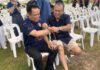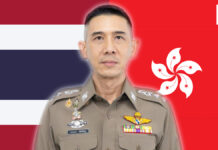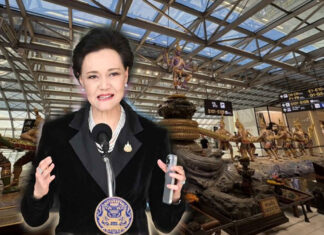






















BANGKOK — Former Prime Minister Srettha Thavisin delivered a comprehensive vision for transforming Thailand’s sports landscape along with Muay Thai superstar “Buakaw” Banchamek and Olympic gold medalist “Tennis” Panipak Wongpattanakit on Thursday.
Speaking on “Rethinking Thai Sports in Disruptive Era,” during the SPLASH – Soft Power Forum 2025, Srettha acknowledged significant progress over the past two decades. “Previously, we might have only seen football and boxing as professional sports with income, but today we have a wider variety,” he said, citing taekwondo athlete “Tennis Panipak” who has achieved fame through product endorsements.
The former PM highlighted Muay Thai as Thailand’s unique global sporting brand, crediting fighters like Buakaw for elevating the sport internationally. However, he emphasized that better access to sports science, nutrition, and training methods could further enhance athlete performance.
Funding Distribution Needs Transparency
Srettha criticized the current sports development fund allocation system, calling it “inconsistent and unclear.” He urged fund managers to establish transparent criteria for distributing budgets to various sports associations, suggesting allocations should be based on competition results and performance metrics.
“The allocation of budget to support athletes, deciding which sport should receive how much funding, and whether it’s appropriate, needs to be reviewed for true suitability,” he stated, acknowledging duplication among government agencies responsible for athlete support.

Private Sector Partnership Essential
The former premier praised private sector involvement in sports development, citing Banthongyord’s badminton support as an example. He proposed tax reduction measures for businesses that invest in sports, arguing that government incentives could encourage more corporate sponsorship.
Srettha emphasized that Thailand stands at the beginning of a promising “Sport Economy” trend, pointing to Muay Thai’s potential beyond competition—from training camps attracting foreign tourists to business opportunities in equipment and instruction.
World Cup Dreams Require Foundation Building
Addressing Thailand’s long-held aspiration for World Cup qualification, Srettha cited Japan’s 30-year preparation as a model. “I’m unsure if Thailand has started this process yet,” he admitted, urging sports associations to begin serious foundational work.
During his tenure as Prime Minister, he supported a 50-million-baht budget specifically for lower leagues, emphasizing grassroots development including nutrition and sports science. “Without starting with the basics, going to the World Cup would remain a distant goal,” he warned.
Athletes Deserve National Artist Recognition
In a notable policy suggestion, Srettha called for athletes to be eligible for National Artist status, currently reserved for cultural figures. He argued that Olympic gold medalists or internationally acclaimed fighters like Buakaw deserve the same recognition and privileges as traditional artists.
“For athletes who have won two Olympic gold medals, or for someone like Buakaw who has propagated the art of Muay Thai internationally, no one else could do what they do,” he told the Ministry of Culture.

Balancing Global Ambitions with Local Talent
While supporting Thailand’s global sports industry ambitions, Srettha expressed concern about the increasing number of foreign athletes in Thai teams. He noted that footballer “Jay” Chanathip’s recent contract worth hundreds of millions of baht demonstrates the potential for Thai athletes, but urged continued development of domestic talent.
“We want to develop the sports industry to a more global level, but we must not forget to provide opportunities for Thai athletes to develop themselves,” he said.
Building More Muay Thai Personnel

Buakaw said that as a Muay Thai athlete who has traveled to seminars and study tours in many countries, what he most wants to see develop in the Muay Thai industry in the future is support and promotion of youth, creating personnel related to Muay Thai from the grassroots level.
“I see that currently, Thai personnel entering the Muay Thai field has decreased significantly, even though the popularity of Muay Thai has increased globally. Foreigners are increasingly interested in Muay Thai, with training starting from childhood to develop skills in Muay Thai. This suggests that in the future, foreign Muay Thai personnel will increase even more,” Buakaw said.
He proposed increasing coach training, possibly having retired fighters transition to become coaches. This would not only increase the number of skilled personnel but also create ongoing career opportunities.
He also suggested increasing Muay Thai venues or bringing boxing to other provinces so that youth or people interested in Muay Thai but lacking opportunities can participate in training, helping us discover more skilled fighters.
Muay Thai is Art, Not Just Sport
When asked about his appearance showcasing Muay Thai art alongside Thai female rapper MILLI in the song “ONE PUNCH” at the “Head In The Cloud 2025” music festival in Los Angeles, USA, which went viral on social media, and whether this reflects that Muay Thai is not just a sport but an art form that can expand to other sectors like fashion and lifestyle to create business opportunities:
“At that event, I saw that watching Muay Thai sports is not just about fighting to show people we are professionals, but Muay Thai can go far on the world stage and exists in multiple dimensions,” Buakaw said.
Creating New Generation Athletes Who Are Better

Tennis Panipak, former Thai national taekwondo athlete who created a legend by winning Olympic gold medals in two consecutive Games, said that the achievements she has made are already accomplished. What she most wants to do now is to create athletes who are better than herself. Opening a taekwondo gym is challenging for her and she wants to pass on knowledge to new generation athletes, molding them to be better than herself.
Panipak continued that after starting the gym, she found that one obstacle for youth in playing sports is lack of money. Even though Thai youth have great interest in sports and many sports idols, many have dreams but no money, making it difficult to access sports and training to become skilled.
Using Social Media to Teach Training
The two-time Olympic gold medalist said that becoming a skilled, capable, and excellent athlete cannot be created in a single day but requires continuous training and repetition. Consistency is therefore important. Even though there are training camps or sports facilities, these are just a few teaching sessions, resulting in insufficient skill development.
“We try to reach everyone through teaching video clips. Whether they learn something or not through online learning, it’s still passing on small amounts of energy or dreams that they can build upon. In our athletic careers, we consider it successful to have been an inspiration to many people,” Panipak said.
The four-day SPLASH forum, running through July 11, continues to explore Thailand’s soft power potential across various sectors
_________