
































Seven Asian writers gather at Khaosod ahead of Chommanard award

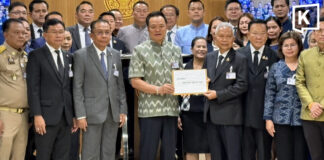
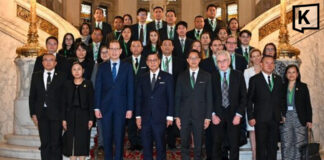
When seven distinguished women writers from Southeast and East Asia gathered at the Khaosod office in Bangkok on Tuesday, 31 March 2026 — most shortlisted for the prestigious Chommanard International Women’s Literary Award — the conversation moved well beyond books, touching on country, identity, technology and the shifting role of women’s voices.

Six of the seven were among the eight shortlisted novelists, while one was a country winner. Created and sponsored by Bangkok Bank more than a decade ago, the prize celebrates outstanding female literary talent across ASEAN and China, with a 500,000-baht grand prize to be awarded later this evening. Sixty books from 10 countries were submitted for the 2025 awards.

Voices from across Asia

From Vietnam, writer Nguyễn Phan Quế Mai, author of The Mountains Sing, spoke about the resilience of the Vietnamese people who endured and fought against successive colonisers over the centuries through their “survival spirit.”

2 web
“Vietnamese honk a lot on the streets and argue. But inside of us, there is a Buddha.” – Nguyễn Phan Quế Ma

Her Vietnamese compatriot, writer Thuận, a French writer of Vietnamese origin,
grew up and is based in Paris, and in her book Chinatown wrote about nostalgia for home. She said in Paris, many French cannot distinguish between Vietnamese, Chinese, Filipino or Thai and Chinatown became a place where many Asians identify with.

Advertisement

Hong Kong writer Lau Yee-Wa writes about the tension between Cantonese language as a mother tongue and Mandarin Chinese in her book Tongueless.

“We change the whole way of thinking and speaking,” Lau told her peers, “Our language is being erased. Lau added that the political situation in Hong Kong has changed significantly over the past few years and those who wish to write critically about China and what’s happening in Hong Kong may consider migrating to the UK or Taiwan.

1 tongueless
“After 2019, we can’t speak about the protests.” said Lau Yee-Wa

Two writers from Indonesia dwell on different topics, yet both focus on forgotten history. Leila S. Chudori, author of The Sea Speaks His Name, wrote about those who were forcibly disappeared during the Suharto dictatorial regime.

“The erasure is still going on until now,” she said on Tuesday. She warns that her work is fiction inspired by historical accounts, however. Her fellow Indonesian writer, Isna Marifa, author of Mountains More Ancient touched upon an even less known historical aspect not mentioned in history books regarding Javanese transported to become slaves in South Africa in the 18th century. Some of them fought against Dutch colonialism there and became spiritual leaders.

From Thailand, award-winning writer Veeraporn Nitiprapha, author of Memories of the Memories of the Black Rose Cat talks about writing about the lives of poor Thai-Chinese instead of rich and successful Thai-Chinese tycoons. She also told her peers about how the dominant and nationalistic Thai education has produced Thai-Chinese who cannot speak Chinese. Herself Thai-Chinese, she recalled how Taiwanese were perplexed when she visited the island but couldn’t communicate with them in Chinese.

From Singapore, writer Jemimah Wei said rapid change means even her school, though she is still in her thirties, no longer exists — not just physically, but effectively erased because it was not deemed prestigious. This despite the island republic being a “very young city state” at 61.

The author of The Original Daughter which was on Good Morning America Book Club, herself a country award winner of the Chommanard Awards, remarks on the issue of what failure does to a person in a society “designed to pressurise us.”

Women, visibility, and the Chommanard award

After the first session ably moderated by Ms. Buabucha Punnanan under the watchful eyes of the awards’ Programme Director Mr. Arthorn Techatada, Khaosod English had the opportunity to ask a few questions.

host 1
Ms. Buabucha Punnanan

One of the questions was whether being a woman writer is still an issue in Southeast and East Asia.

Indonesian writer Isna Marifa said women in Southeast Asia are stereotypically seen as quiet and expected to follow men. “No need to say much.”

“Chommanard Awards gives us some space and gives us some profile.”

Singapore’s Wei added that statistically speaking, works of women writers don’t get reprinted so they need readers to keep supporting them. “Women are phased out of history. Historically we are not kept in print.”

Thailand’s Veeraporn meanwhile said there exist stereotypical expectations that female writers should focus on domestic issues such as rite of passage and puberty.

Vietnamese writer Nguyễn Phan Quế Mai meanwhile pointed out that in Europe, there are almost no books from ASEAN women at bookshops. “This literary award is uplifting our voices,” she said, adding that literary agents from different countries are also present and the gathering on Tuesday. “This award is very important… It’s so important that you highlight female voices.”

The Vietnamese writer then recalled how she was belittled by her male colleagues who told her how dare she write about wars when women cook and clean and men go to war.

Advertisement

Meanwhile, Thuận offered a take from her experience in France. “In France, we have many female writers. The French have a saying: “Women who write are dangerous.” In Asia, we need to unite to form a common strength.

Different countries, different histories — but a familiar pattern: voices shaped, sidelined, sometimes silenced. In Bangkok, the writers spoke not just of literature, but of that tension — and of the need to keep speaking nonetheless.

banner1 e1775211600694
Each of the seven writers holds their respective book