






















30.5 C
Bangkok
Sunday, July 5, 2026
Home Blog Page 1653

American Airlines Extends Max-Caused Cancellations

In a March 13, 2019 file photo, an American Airlines Boeing 737 MAX 8 sits at a boarding gate at LaGuardia Airport in New York. Photo: Frank Franklin II / Associated Press

WASHINGTON — American Airlines is extending by over a month its cancellations of about 90 daily flights as the troubled 737 Max plane remains grounded by regulators.

American said Sunday it is extending the cancellations through June 5 from the earlier timeframe of April 24. The airline acknowledged in a statement that the prolonged cancellations could bring disruption for some travelers.

The Boeing-made Max jets have been grounded in the U.S. and elsewhere since mid-March, following two deadly crashes in Ethiopia and Indonesia. Airlines that own them have been scrambling other planes to fill some Max flights while canceling others.

American Airlines Group Inc., the largest U.S. airline by revenue, has 24 Max jets in its fleet. The Ft. Worth, Texas-based airline said it is awaiting information from U.S. regulators, and will contact customers affected by the cancellations with available re-bookings.

Boeing and the U.S. Federal Aviation Administration said last week the company needs more time to finish changes in a flight-control system suspected of playing a role in the two crashes. That means airlines could be forced to park their Max jets longer than they expected.

American said Sunday that by canceling the flights in advance, “we are able to provide better service to our customers with availability and re-booking options,” and to avoid last-minute flight disruptions.

American’s reservations staff will contact affected customers directly by email or phone, the airline said. “We know these cancellations and changes may affect some of our customers, and we are working to limit the impact to the smallest number of customers,” the statement said.

Boeing said Friday that it will cut production of the Max jet, its best-selling plane, underscoring the mounting financial risk it faces the longer the airliner remains grounded.

Starting in mid-April, Boeing said, it will cut production of the plane to 42 from 52 planes per month so it can focus on fixing the flight-control software that has been implicated in the two crashes.

Preliminary investigations into the deadly accidents in Ethiopia and Indonesia found that faulty sensor readings erroneously triggered an anti-stall system that pushed down the plane’s nose. Pilots of each plane struggled in vain to regain control over the automated system.

In all, 346 people died in the crashes. Boeing faces a growing number of lawsuits filed by families of the victims.

The announcement to cut production came after Boeing acknowledged that a second software issue has emerged that needs fixing on the Max — a discovery that explained why the aircraft maker had pushed back its ambitious schedule for getting the planes back in the air.

Story: Marcy Gordon
Advertisement

Nissan Shareholders Oust Ex-Chair Ghosn From Board

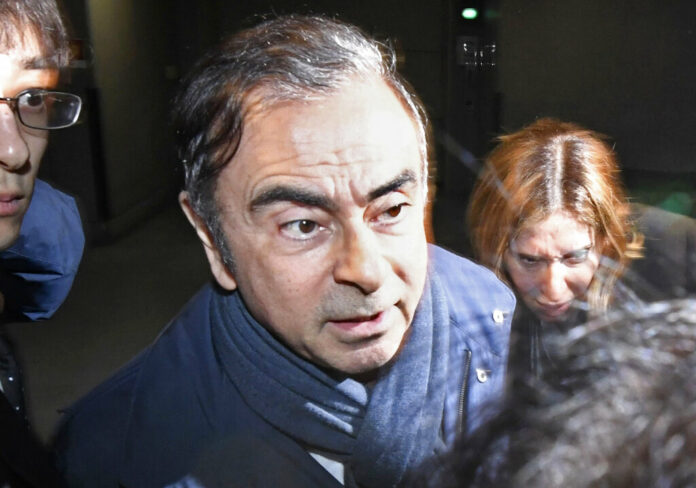
In this April 3, 2019, file photo, former Nissan Chairman Carlos Ghosn, center, leaves his lawyer's office in Tokyo. Photo: Sadayuki Goto / Kyodo News via AP

TOKYO — Nissan shareholders approved on Monday the ouster from the Japanese automaker’s board former Chairman Carlos Ghosn, who faces allegations of financial misconduct.

The approval was shown by applause from the more than 4,000 people gathered at a Tokyo hotel for a three-hour extraordinary shareholders’ meeting. Other votes had been submitted in advance.

Ahead of the vote, Nissan’s top executive apologized to its shareholders for the scandal at the Japanese automaker and asked them to approve Ghosn’s dismissal.

Chief Executive Hiroto Saikawa and other Nissan Motor Co. executives bowed deeply in apology to shareholders attending the extraordinary meeting at a Tokyo hotel.

Shareholders also approved the appointment of French alliance partner Renault SA’s chairman Jean-Dominique Senard to replace Ghosn. Renault owns 43 percent of Nissan.

Senard, introduced to shareholders at the meeting’s end, thanked them and promised to do his best to keep the automaker’s performance on track.

“I will dedicate my energy to enhance the future of Nissan,” said Senard.

They likewise also gave a green light to removing from the board a former executive direct, Greg Kelly, who has been charged with collaborating with Ghosn in the alleged misconduct.

Angry shareholders demanded an explanation for how wrongdoing on an allegedly massive scale had gone unchecked for years. The meeting was closed except to stockholders but livestreamed.

One shareholder said Nissan’s entire management should resign immediately. Saikawa said he felt his responsibility lay in fixing the shoddy corporate governance at Nissan first, and continuing to lead its operations. Another shareholder asked if Nissan was prepared for a damage lawsuit from shareholders since its stock price has plunged.

“I deeply, deeply apologize for all the worries and troubles we have caused,” Saikawa said. “This is an unprecedented and unbelievable misconduct by a top executive.”

He outlined the findings of an internal investigation, such as payments of a consultation fee to Ghosn’s sister for 13 years. The investigation has also found too much power had been focused in one person, he said.

Ken Miyamoto, 65, a Nissan shareholder, said he was disappointed.

“It is really such a pity as he was a brilliant manager,” Miyamoto said of Ghosn before heading into the meeting. “I guess he became complacent as people kept praising him too much.”

Ghosn says he is innocent of all allegations and has suggested the accusations were made by some people at Nissan hoping to remove him from power.

He has been charged with under-reporting his compensation in financial documents, and with breach of trust in having Nissan shoulder investment losses and making suspect payments to a Saudi businessman. Ghosn says the compensation was never decided on or paid, no investment losses were suffered by Nissan, and the payments were for legitimate services.

Ghosn was arrested in November, released on bail in early March and then re-arrested for a fourth time last week. The latest arrest was in connection with fresh allegations that $5 million sent by a Nissan Motor Co. subsidiary and meant for an Oman dealership was diverted to a company effectively controlled by Ghosn.

His detention on that allegation has been approved through April 14 but could be extended. The date of his trial has not been set.

Yokohama-based Nissan, which makes the Leaf electric car, March subcompact and Infiniti luxury models, was on the brink of bankruptcy when Renault sent Ghosn to turn it around two decades ago.

The Renault-Nissan-Mitsubishi Motors alliance now rivals auto giants Volkswagen AG of Germany and Japanese rival Toyota Motor Corp. in global sales.

Saikawa told shareholders the company will stick by the alliance, fix its governance problems and make the ouster of Ghosn “a turning point.”

“We had allowed a system in which wrongdoing could be carried out without detection,” he said.

Story: Yuri Kageyama

Advertisement

Cho Yang-ho, Indicted Korean Air Chairman, Dies at 70

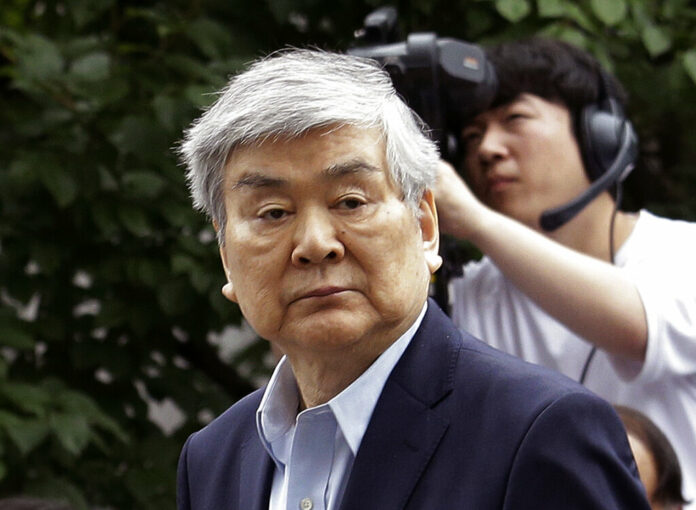
In this July 5, 2018 file photo, Cho Yang-ho, the chairman of Korean Air Lines Co., arrives for hearing to review the prosecution's request for an arrest warrant on charge of embezzlement at the Seoul Southern District Court in Seoul, South Korea. Photo: Ahn Young-joon / Associated Press

SEOUL, South Korea — Korean Air’s chairman, whose leadership included scandals such as his daughter’s infamous incident of “nut rage,” has died due to illness, the company said Monday.

Cho Yang-ho had been indicted on multiple charges, including embezzlement and tax evasion, and his death came two weeks after a shareholder vote to remove the 70-year-old from the company’s board over a series of scandals surrounding his family. Cho’s death will likely force a court to dismiss his criminal case.

The company said Cho died in the United States but did not specify his illness or provide other details in its statement. Cho had remained chairman, which is a non-board role, even after shareholders ousted him from the board. He had expressed his intent to continue participating in management.

A senior Korean Air executive said Cho had been receiving treatment for an unspecified lung illness since late last year and that his condition “worsened rapidly” following the shareholder vote, apparently because of shock and stress. The executive didn’t want to be named, citing office rules.

Cho’s eldest daughter, Cho Hyun-ah, who was formerly the head of the airline’s cabin service, received worldwide notoriety in 2014 after she ordered a Korean Air passenger plane to return to a terminal at John F. Kennedy International Airport in New York because she was angry that the crew served her macadamia nuts in a bag instead of on a plate.

The incident, dubbed “nut rage,” generated international headlines and severely tarnished the Cho family’s image, while highlighting broader concerns about the sense of entitlement among the moneyed elite in South Korea.

Cho Hyun-ah was sentenced to one year in prison for violating aviation law but was released early when a higher-level court suspended the sentence.

The Cho family also faced intense criticism after company employees alleged they were subjected to mistreatment and tantrums.

Cho’s wife was summoned last May by South Korean police to question her about allegations she abused and assaulted employees. Lee Myung-hee was accused of physically or verbally abusing more than 10 former and current employees of Korean Air’s parent company.

Cho’s younger daughter, Cho Hyun-min, also was investigated by state prosecutors for potential assault for allegedly hurling a cup of water during a business meeting. No charges were filed.

Cho Yang-ho was also the chairman of the Hanjin Group, a global transportation conglomerate of dozens of companies that includes the airline. He was also was the co-chairman of the Korea-U.S. Business Council and vice chairman of the Federation of Korean Industries.

He was involved in the bidding process and preparations for the 2018 Winter Olympics held in South Korea’s ski resort town of Pyeongchang and headed the Olympic organizing committee for two years before stepping down in 2016.

Cho’s resignation was initially described as voluntary, but he later said he left the committee under “unjust” pressure from the government of former conservative President Park Geun-hye. The committee had rejected an Olympic construction deal for a Swiss company that reportedly had a business partnership with Choi Soon-sil, a longtime friend and mentor of Park.

Park is now serving a lengthy prison term over multiple corruption charges.

South Korean prosecutors indicted Cho last October on multiple charges, including evading taxes and pocketing tens of millions of dollars through embezzlement and breach of trust. His trial had been expected to begin in the coming weeks.

Cho was previously convicted of tax evasion in 2000, facing charges with his father and brother. The Chos were charged with receiving millions in rebates when they purchased airplanes from Boeing and Airbus and evading taxes on the money. The tax probe came after the country’s president criticized Korean Air’s poor safety record.

The Cho family scandals have increased public criticism about the country’s “chaebol,” a privileged group of family-owned conglomerates that have been tied to corruption and exploitive behavior. Korean Air shareholders’ successful removal of Cho from the company’s board was seen as a milestone in a country that has been long criticized for its lax enforcement of corporate-governance rules on large companies.

Current South Korean President Moon Jae-in has vowed to curb the excesses of the chaebol. However, bad economic news appears to have softened the government’s approach to these companies, which dominate the country’s economy and are crucial to Moon’s plans for job creation.

Cho is survived by his wife, a son, two daughters and five grandchildren.

Story: Kim Tong-hyung

Advertisement

Chonburi Man Arrested Over Alleged Rape-Murder of German Tourist

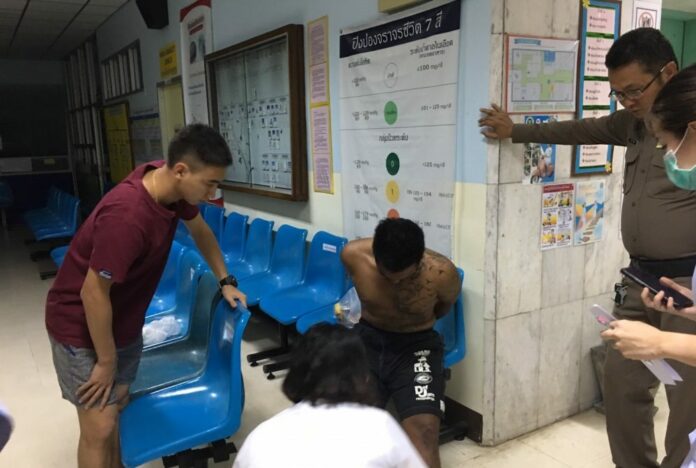
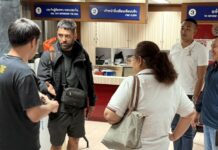
Ronnakorn Romreun, sitting at center, in a police station after he was arrested and accused of raping and murduring a German tourist Sunday on Koh Sichang, Chonburi province.

CHONBURI — A man was arrested Sunday night and accused of raping and murdering a German tourist on an island in Chonburi province.

Local police said Ronnakorn Romreun, 24, was arrested and charged with multiple counts hours after the body of the woman, later identified as a 27-year-old German tourist, was found buried under a pile of rocks and leaves on Koh Sichang yesterday evening. Police found traces of rape and several potentially fatal injuries from a blunt object to her head and face.

According to police, Ronnakorn confessed to the crime after several hours of interrogation. He told police that he tried to talk to the woman while she was touring the island on a motorcycle yesterday afternoon, but she refused to speak with him.

Police said Ronnakorn then followed her to the crime scene and raped her. He said he killed her and hid the body because he feared she would report the rape to police.

Advertisement

Gov’t Says Trying Thanathorn in Military Court is Fair

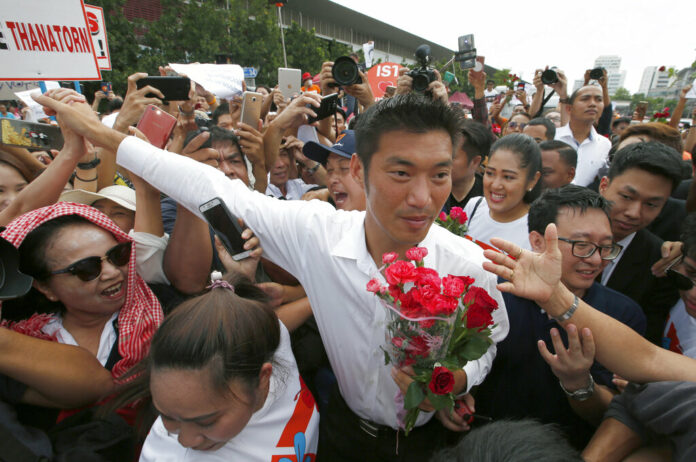
Thailand's Future Forward Party leader Thanathorn Juangroongruangkit is mobbed by his supporters Saturday upon arrival at a police station in Bangkok. Photo: Sakchai Lalit / Associated Press
Future Forward Party leader Thanathorn Juangroongruangkit is mobbed by his supporters Saturday upon arrival at a police station in Bangkok. Photo: Sakchai Lalit / Associated Press

BANGKOK — The junta has defended trialing civilians in military courts, saying it’s about maintaining peace and order.

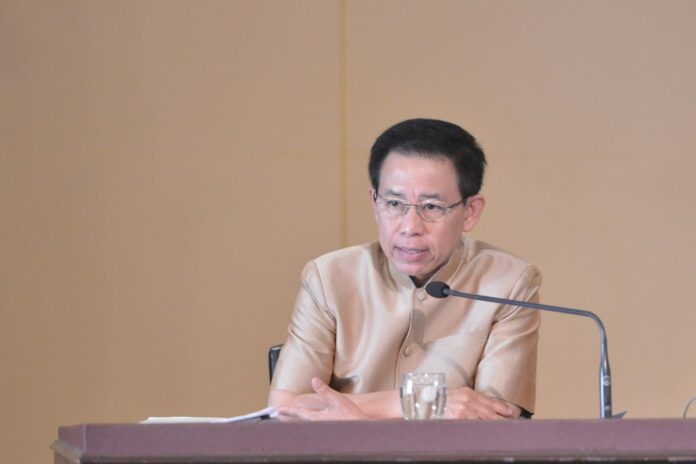
A day after the leader of a popular political party was formally charged with sedition, Col. Winthai Suvari, spokesman for the National Council for Peace and Order, insisted on Sunday on the fairness of the junta’s order to try civilians charged with violating security laws in military courts.

“The justice system will decide. There’s room for all sides to defend themselves freely [in the military court],” Winthai said.

He added that a trial in military court would not be unique to Future Forward Party leader Thanathorn Juangroongruangkit, who is now charged with sedition, violating the junta’s now-lifted ban on political gatherings of more than four people, and aiding fugitives.

Read: Thanathorn Likely to Face Military Court for Sedition

Winthai’s statements came in response to concerns expressed by Thanathorn that he could be tried in a military court, since the charges relate to alleged actions dating back to 2015. The Future Forward Party leader took to Facebook to argue that many civilians have been unfairly tried in military courts for calling for freedom and democracy.

The junta abolished the use of military courts against civilians in 2016, but did not make the order retroactive. The trial of Thanathorn in a military court could revive the use of military courts against civilians who committed alleged crimes prior to 2016, warned the law-reform advocacy group iLaw on Sunday.

According to iLaw, at least 1,886 people have been tried in military courts since the May 2014 coup. At least 92 people have been charged with sedition while at least 1,138 have been summoned to report themselves to the National Council for Peace and Order. The four-year period since the coup has seen at least 162 people charged with lese-majeste.

Winthai added that accusations that Thanathorn has been unfairly charged are subjective “personal views”, on which society can exercise its good judgment.

The junta spokesman played down the stats, saying the number of individuals charged and tried in military tribunals is not high in proportion to the Thai population of 67 million people.

Advertisement

Ex-Junta Spokesman Pulled from Army, Appointed Govt PR Head

A file photo of Lt. Gen. Sansern Kaewkamnerd. Photo: Matichon

BANGKOK — A well-known military figure and former junta spokesman became a civilian official and the head of the government’s public relations, according to a royal command published Sunday.

King Vajiralongkorn approved the removal of Lt. Gen. Sansern Kaewkamnerd from his “specialist” position in the Royal Thai Army and his appointment as Director-General of the Public Relations Department in the capacity of a civilian official. The appointment has been effective since Saturday.

The interim cabinet in December green-lit the motion to transfer Sansern from a military to civilian post specifically to head the PR department, where he had been sitting as acting director-general since 2016 by the junta’s absolute power.

Sansern served as a spokesman of the prime minister’s office from 2015, before being replaced in October.

Advertisement

Dozens Protest in London Against Brunei’s Anti-Gay Laws

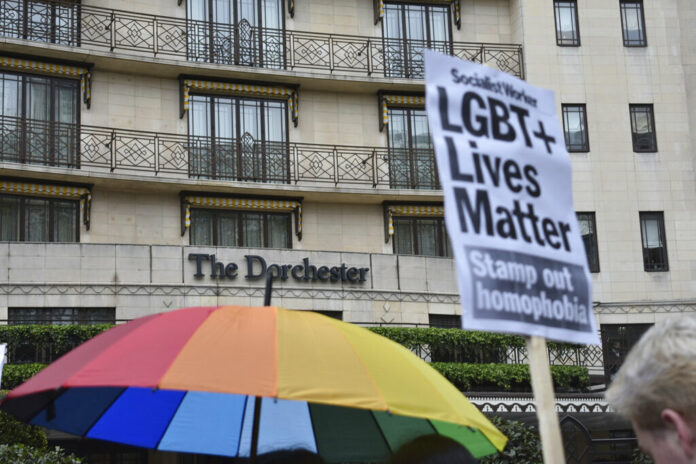
Protestors outside The Dorcester hotel on Park Lane in London, demonstrating against the Brunei anti-gay laws, Saturday April 6, 2019. Photo: Sophie Hogan / PA via AP

LONDON — Dozens of people protested in London on Saturday against new Islamic laws in Brunei that punish gay sex and adultery by stoning offenders to death, while the University of Oxford said it will reconsider an honorary degree it awarded the sultan of Brunei following international outcry over the Southeast Asian nation’s draconian measures.

The university said in a statement it shared the “international revulsion” the laws induced and that it would reconsider a 1993 decision to confer the honorary degree of civil law by diploma to Sultan Hassanal Bolkiah.

But Oxford stressed that no one had the right “summarily to rescind” the degree.

In central London, about 100 protesters raised the rainbow flag of the LGBT rights movement outside the Dorchester Hotel, which Brunei’s sultan owns. Celebrities including George Clooney, Elton John and Ellen DeGeneres have supported a global boycott of the Dorchester and eight other luxury hotels in the U.S. and Europe tied to Hassanal.

Demonstrators chanted “shame on you,” and some broke through barriers to stand at the entrance of the hotel.

“I am married to a woman so it touches home,” said protester Ashleigh Gonsalves, who carried a rainbow umbrella. “It’s very important, it’s about lives, it doesn’t get more important than that.”

Labour Party lawmaker Emily Thornberry said Brunei should be “chucked out” of the Commonwealth group of nations if the laws are not revoked.

“Any hatred against anyone is hatred against all of us. Our fight is with the sultan of Brunei. Our fight is with this terrible law. We say no,” she said.

Hassanal introduced the penalties under new sections of Brunei’s Shariah Penal Code to boost the influence of Islam in the tiny oil-rich monarchy, where two-thirds of the population are Muslim. Under the new laws, those found guilty of gay sex can be stoned to death or whipped. Adulterers risk death by stoning, too, while thieves face amputation of a right hand on their first offense and a left foot on their second. The laws also apply to children and foreigners, even if they are not Muslim.

Advertisement

Netanyahu Vows to Annex West Bank Settlements If Re-Elected

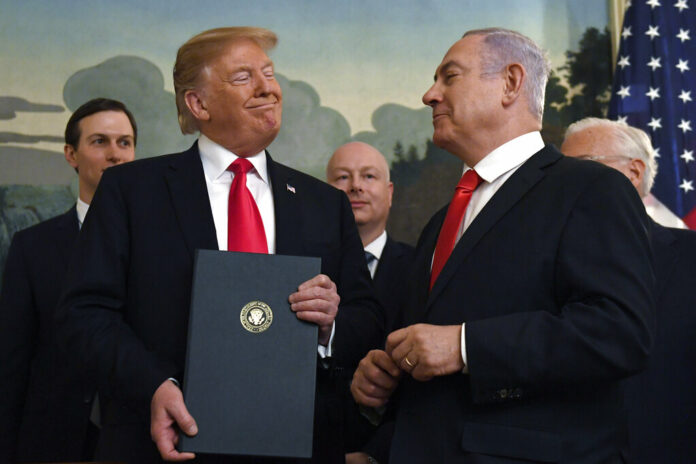
In this Monday, March 25, 2019 file photo, President Donald Trump smiles at Israeli Prime Minister Benjamin Netanyahu, right, after signing a proclamation in the Diplomatic Reception Room at the White House in Washington. Photo: Susan Walsh / Associated Press

JERUSALEM — Israeli Prime Minister Benjamin Netanyahu pledged Saturday to annex Jewish settlements in the occupied West Bank if re-elected, a dramatic policy shift apparently aimed at rallying his nationalist base in the final stretch of the tight race.

Netanyahu has promoted Jewish settlement expansion in his four terms as prime minister, but until now refrained from presenting a detailed vision for the West Bank, seen by the Palestinians as the heartland of a future state.

An Israeli annexation of large parts of the West Bank is bound to snuff out any last flicker of hope for an Israeli-Palestinian deal on the terms of a Palestinian state on lands Israel captured in 1967.

A so-called two-state solution has long been the preferred option of most of the international community. However, intermittent U.S. mediation between Israelis and Palestinians ran aground after President Donald Trump recognized Jerusalem as Israel’s capital early in his term. The Palestinians, who seek Israeli-annexed east Jerusalem as their capital, suspended contact with the U.S.

More recently, Trump recognized Israeli sovereignty over the Golan Heights, a plateau Israel captured from Syria in 1967. The move was viewed in Israel as a political gift by Trump to Netanyahu who is being challenged by former military chief Benny Gantz.

The U.S. State Department declined to comment on Netanyahu’s statement.

Polls have indicated a close race, though Netanyahu’s Likud Party is expected to have a better chance than Gantz’s Blue and White slate to form a ruling coalition. Polls forecast more than 60 out of 120 parliament seats for the Likud and smaller right-wing and ultra-Orthodox Jewish parties

On Saturday, Netanyahu gave an interview to Israel’s Channel 12 TV at the top of the prime-time newscast. Netanyahu portrayed the U.S. policy shifts on Jerusalem and the Golan Heights as his achievements, saying he had managed to persuade Trump to take these steps.

Netanyahu pledged that he would not dismantle a single Jewish settlement and that Israel would retain control of the territory west of the Jordan River — the West Bank. More than 600,000 Israelis now live on war-won lands, two-thirds in the West Bank.

The interviewer asked why he hadn’t annexed some of the larger settlements during his current term. “The question you are asking is an interesting question, whether we will move to the next stage and the answer is yes,” he said, adding that the next term in office would be fateful. “We will move to the next stage, the imposing of Israeli sovereignty.”

“I will impose sovereignty, but I will not distinguish between settlement blocs and isolated settlements,” he said. “From my perspective, any point of settlement is Israeli, and we have responsibility, as the Israeli government. I will not uproot anyone, and I will not transfer sovereignty to the Palestinians.”

In any partition deal, the more isolated Jewish settlements would likely have to be uprooted to create a viable Palestinian state.

Saeb Erekat, a veteran former Palestinian negotiator, said he held the international community, especially the Trump administration, responsible for Israel’s policies.

“Israel will continue to brazenly violate international law for as long as the international community will continue to reward Israel with impunity, particularly with the Trump administration’s support and endorsement of Israel’s violation of the national and human rights of the people of Palestine,” he said in a statement.

Story: Karin Laub

Advertisement

US Wants 2 Years to ID Migrant Kids Separated From Families

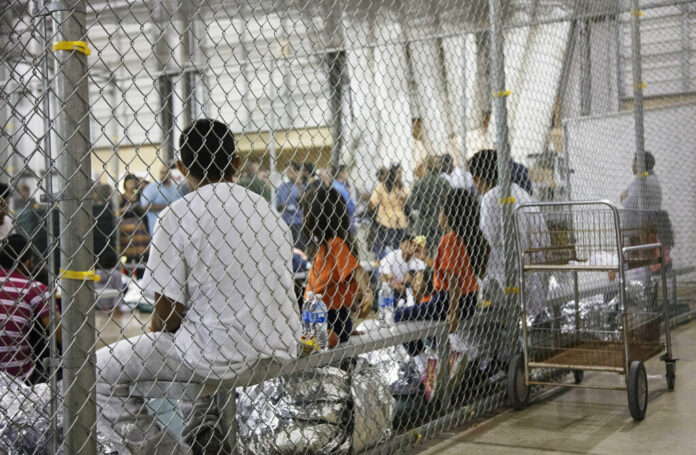
In this June 17, 2018 file photo provided by U.S. Customs and Border Protection, people who've been taken into custody related to cases of illegal entry into the United States, sit in one of the cages at a facility in McAllen, Texas. Photo: U.S. Customs and Border Protection's Rio Grande Valley Sector via AP

SAN DIEGO — The Trump administration wants up to two years to find potentially thousands of children who were separated from their families at the border before a judge halted the practice last year, a task that it says is more laborious than previous efforts because the children are no longer in government custody.

The Justice Department said in a court filing late Friday that it will take at least a year to review about 47,000 cases of unaccompanied children taken into government custody between July 1, 2017 and June 25, 2018 — the day before U.S. District Judge Dana Sabraw halted the general practice of splitting families. The administration would begin by sifting through names for traits most likely to signal separation — for example, children under 5.

The administration would provide information on separated families on a rolling basis to the American Civil Liberties Union, which sued to reunite families and criticized the proposed timeline on Saturday.

“We strongly oppose a plan that could take up to two years to locate these families,” said Lee Gelernt, the ACLU’s lead attorney. “The government needs to make this a priority.”

Sabraw ordered last year that more than 2,700 children in government care on June 26, 2018 be reunited with their families, which has largely been accomplished. Then, in January, the U.S. Health and Human Services Department’s internal watchdog reported that thousands more children may have been separated since the summer of 2017. The department’s inspector general said the precise number was unknown.

The judge ruled last month that he could hold the government accountable for families that were separated before his June order and asked the government submit a proposal for the next steps. A hearing is scheduled April 16.

Sheer volume makes the job different than identifying children who were in custody at the time of the judge’s June order, Jonathan White, a commander of the U.S. Public Health Service and Health and Human Services’ point person on family reunification, said in an affidavit.

White, whose work has drawn strong praise from the judge, would lead the effort to identify additional families on behalf of Health and Health and Human Services with counterparts at Customs and Border Protection and U.S. Immigration and Customs and Enforcement. Dr. Barry Graubard, a statistics expert at the National Cancer Institute, developed a system to flag for early attention those most likely to have been separated.

The vast majority of separated children are released to relatives, but many are not parents. Of children released in the 2017 fiscal year, 49 percent went to parents, 41 percent to close relatives such as an aunt, uncle, grandparent or adult sibling and 10 percent to distant relatives, family friends and others.

The government’s proposed model to flag still-separated children puts a higher priority on the roughly half who were not released to a parent. Other signs of likely separation include children under 5, younger children traveling without a sibling and those who were detained in the Border Patrol’s El Paso, Texas, sector, where the administration ran a trial program that involved separating nearly 300 family members from July to November 2017.

Saturday marks the anniversary of the administration’s “zero tolerance” policy to criminally prosecute every adult who enters the country illegally from Mexico. The administration retreated in June amid an international uproar by generally exempting adults who come with their children. The policy now applies only to single adults.

Story: Elliot Spagat

Advertisement

1 Drowns as 3 Hostages Escape Muslim Militants in Philippines

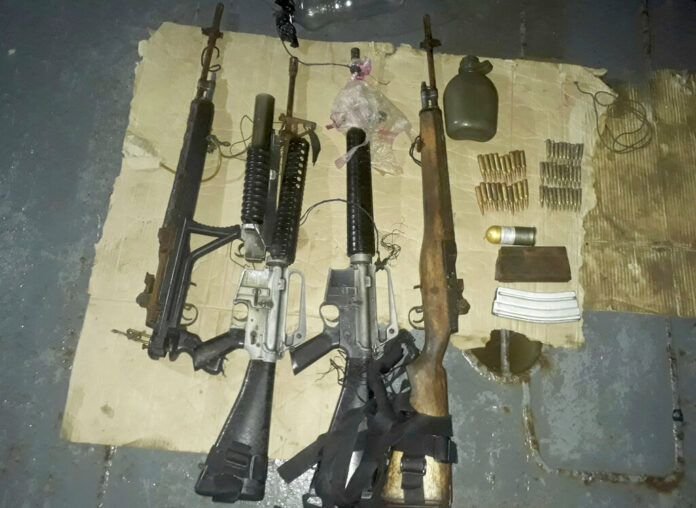
This photo provided by WESMINCOM Armed Forces of the Philippines Sunday, April 7, 2019, shows recovered firearms from Muslim extremist Abu Sayyaf kidnappers following a rescue operation that freed Indonesian hostage Heri Ardiansyah and two others off Simisa island, Sulu province in southern Philippines. Photo: WESMINCOM Armed Forces of the Philippines via AP

MANILA, Philippines — Three hostages held by Muslim militants in the southern Philippines have made a daring escape that left one drowned, another shot in the back in critical condition and another safe after swimming to his freedom, officials said.

The two Indonesians and one Malaysian separately escaped while Philippine marines were attempting to rescue them on Simusa island in southern Sulu province over the last two days, regional military spokesman Lt. Col. Gerry Besana said Saturday.

The dramatic escapes leave at least three more hostages in the hands of the Abu Sayyaf, which is blacklisted by the United States and the Philippines as a terrorist organization due to its brutal history of bombings, ransom kidnappings, extortion and beheadings. The remaining captives include a Dutch bird watcher, Elwold Horn, who was kidnapped by the militants in 2012, and two Filipinos.

One of the Indonesians, Heri Ardiansyah, was plucked from the waters by marines on board a gunboat while they recovered the body of his companion, Hariadin, who drowned. The marines gunned down three Abu Sayyaf captors who were trying to chase the two Indonesians at sea, military officials said. Like many Indonesians, Hariadin used just one name.

The marines seized four assault rifles, a grenade launcher and various ammunition from the captors of the Indonesians, military officials said.

The Malaysian, who was identified by the military as Jari Bin Abudullah, was shot by the militants when he ran away Thursday as marines tried to rescue him and engaged his captors in a gunbattle. Government forces surrounded Simusa island, where a small community thrives near mangroves, to hunt down the remaining Abu Sayyaf gunmen.

“The act of shooting the kidnap victim is indicative of the Abu Sayyaf’s hopelessness and desperateness as the militants are now surrounded by our pursuing troops,” said Sulu’s military commander, Brig. Gen. Divino Rey Pabayo Jr.

The Malaysian was airlifted to Zamboanga city, where he was in critical condition in a hospital, military officials said.

The three hostages were kidnapped off Malaysia’s Sabah state on Borneo island in December last year and taken by speedboat to Sulu, the predominantly Muslim and poverty-wracked province where a few hundred Abu Sayyaf have survived in the jungles despite frequent military offensives.

Army troops on Friday clashed with about 80 Abu Sayyaf gunmen in Sulu’s mountainous Patikul town in a fierce but brief gunbattle that left three soldiers and four militants dead and several wounded on both sides, the military said.

The Islamic State group issued a statement confirming it killed three and wounded 13 Philippine soldiers, but it said “the mujahideen returned safely to base.”

The rebels belong to an Abu Sayyaf faction led by commander Hajan Sawadjaan and aligned with the Islamic State group. Sawadjaan is the main suspect in the bombing of a Roman Catholic cathedral during a Mass that killed 23 mostly churchgoers and two suspected suicide attackers on Jan. 27 in Sulu’s capital town of Jolo.

Story: Jim Gomez

Advertisement

Hot News

LATEST NEWS

Bangkok
overcast clouds
30.5 ° C
31.1 °
30.5 °
71 %
3.4kmh
100 %
Sun
36 °
Mon
32 °
Tue
27 °
Wed
27 °
Thu
29 °