


























28.2 C
Bangkok
Thursday, August 20, 2026
Home Blog

Review: The Evil Lawyer – When justice isn’t black and white, and the courtroom isn’t reserved for good people

Review: The Evil Lawyer – When justice isn’t black and white, and the courtroom isn’t reserved for good people

The Evil Lawyer, a new Thai legal drama series released on 11 June, is directed by Thai filmmaker Nottapon Boonprakob, known for screenwriting on SuckSeed and May Who?, co-directing and writing on One for the Road, and directing the Netflix series Mad Unicorn.

This time, he turns his attention to Thailand’s legal world through the story of Mek, an idealistic young lawyer who suddenly finds himself accused of murdering the son of a police officer. To clear his name, he is forced to team up with Jittri, a notoriously cunning attorney known for exploiting loopholes in the law. Together, they navigate a justice system where the answers are rarely black and white.

What stands out most is the series’ willingness to explore the grey areas of Thailand’s justice system. Through the eyes of legal professionals, it raises uncomfortable questions about morality, power, and justice, three forces that do not always move in the same direction.

Another standout aspect is the attention to detail in depicting courtroom proceedings and cross-examinations. It is clear that the creators have done extensive research, resulting in scenes that feel remarkably authentic without unnecessary dramatisation.

HKkGnQva4AAIkvd 0

More importantly, the series reminds viewers that courtrooms are not bright, orderly or reassuring spaces, as they are sometimes portrayed in television dramas. Instead, they are spaces filled with tension, pressure, and fierce competition, where everyone fights for their own interests.

The performances are equally impressive. Not only do the lead actors deliver compelling performances, but supporting actors and even minor characters add to the sense of realism. Many of them genuinely resemble people one might encounter in Thailand’s legal profession.

The casting choices also deserve praise for going beyond the conventional standards of attractiveness often seen in Thai series. The character Seya, for example, presents a migrant worker in a way that feels natural and believable.

Visually, the series employs muted colours and subdued lighting, creating an atmosphere of discomfort and moral ambiguity that neatly complements its themes.

Seya 0

One of the series’ most striking achievements is its incorporation of cases reminiscent of real-life incidents that have shaken Thai society. These include the mysterious death of a young woman on a boat surrounded by influential figures, recalling the highly publicised case of actress Tangmo Nida, as well as references to abandoned infant remains in hospitals and devastating industrial fires. Such elements make the series feel as though it is addressing truths that reality itself often hesitates to confront directly.

The series is not without flaws. At times, the pacing moves too quickly, leaving viewers wondering whether they have missed something important. The ending also leaves several questions unresolved, walking a fine line between setting up a second season and intentionally allowing audiences to draw their own conclusions.

Rather than being entertaining in the conventional sense, The Evil Lawyer is emotionally unsettling. It leaves viewers feeling uncomfortable, disturbed, and even disgusted by certain aspects of reality. Episode five, in particular, featuring the cross-examination of a doctor accused of sexually assaulting a patient, is among the most distressing scenes in the series.

Credit must be given to actress Ying Rhatha Phongam, who portrays Jittri and reportedly contributed to the design of this sequence by avoiding rehearsals with the actress playing the victim beforehand. The result is a painfully raw and realistic scene, capturing the desperation of someone cornered into revealing the truth before the court.

Dtbezn3nNUxytg04ayx64lWvZk3Lt5bgTxKIIlJkHgXJfo 0

The series also questions the failures of Thailand’s justice system by satirising sensationalist news talk shows that invite the public to judge social issues. It reflects a painful reality: many people no longer place enough trust in formal legal mechanisms and instead seek justice through public opinion, allowing society itself to become judge and jury.

A lawyer’s duty is to fight for the best interests of their client within the framework of the law, not to determine who deserves legal representation. In that regard, the series may help dispel some of the misconceptions surrounding the legal profession.

For viewers who enjoy heavy dramas, thrillers, and stories that challenge social norms, The Evil Lawyer is not to be missed. However, audiences should be prepared for numerous sensitive themes, including sexual violence, imbalances of power, and cases that society often chooses to ignore.

Another major strength is the space the series gives to female lawyers. While women make up a significant part of the legal profession in reality, patriarchal attitudes often cause them to be overlooked. This series demonstrates that certain issues become even more powerful when told through women’s perspectives and voices.

Easter Egg 0

Its biggest drawback may also be one of its strengths: the series is packed with symbolism and subtext. Viewers who dislike interpretation and analysis may find it demanding and occasionally overwhelming. But for those who enjoy unpacking hidden meanings, The Evil Lawyer is filled with Easter eggs and narrative layers that make it worth revisiting to catch details that may have gone unnoticed the first time around.

However, it is also difficult not to feel a sense of missed opportunity. While Thailand’s media and film industry have begun pushing boundaries by producing series willing to confront moral grey areas and structural problems that are plainly visible in Thai society, these stories still rarely go all the way. Certain issues could have been explored more deeply and interrogated more forcefully, yet they seem to stop short for reasons that remain unclear.

That is not to say that The Evil Lawyer lacks impact. On the contrary, it is powerful enough to leave viewers uncomfortable, angry, and questioning the nature of justice in Thai society. At the same time, it raises another question: had this series not been released on a streaming platform, would it have retained the same level of quality and boldness in its storytelling? Or would much of its sharper commentary have been diluted, leaving behind little more than another conventional legal drama?

More than a legal thriller, The Evil Lawyer is an uncomfortable reflection of a society that is still struggling to define what justice truly means. By the end, it leaves behind a disturbing question: when the system fails, who gets to decide what justice looks like?

dFQROr7oWzulq5Fa7HCSfOP3mM7WvwhlCP54SCh9O6K73CWE0kkxfM65rC1LVDvEB0W

Advertisement

An 84-year-old paralysed woman was found alive three days after Flores earthquake

An 84-year-old paralysed woman was found alive three days after Flores earthquake

SIKKA, Indonesia — An 84-year-old paralysed woman was found alive three days after a powerful earthquake destroyed her home on an Indonesian island, an official said on 19 August, as the death toll from the disaster rose to 73.

More than 900 people were injured and nearly 60,000 were displaced after the magnitude-7.7 earthquake struck off Indonesia’s Flores island on 15 August, according to the National Agency for Disaster Management (BNPB).

Paulina Pobi’s home on a small island north of Flores was among hundreds destroyed by the earthquake. The 84-year-old was buried alive beneath collapsed bamboo walls.

84 year oldalivedaysafterearthquake 03
Rescuers carry an earthquake victim on a stretcher to a helicopter in North Lamba Leda, East Nusa Tenggara province, Indonesia. The death toll rose to 73 more than 900 people were injured and nearly 60,000 displaced by the 7.7-magnitude quake that struck off Indonesia’s Flores island on Aug 15, according to the BNPB disaster mitigation agency. (AP Photo/Firdia Lisnawati)

She remained trapped until her family returned to search for her on 18 August. The family had initially believed she had already been rescued and taken to a shelter.

“Because she was paralysed, she couldn’t move or speak, so it wasn’t until the fourth day that her family finally found her,” local official Rudolfus Riba told AFP.

“She is in good health; there were no injuries at all. She was just a bit weak because she hadn’t eaten or drunk anything for days,” Rudolfus said.

“It feels unreal, almost like a miracle.”

More than 3,000 aftershocks have been recorded since 15 August, with at least 86 strong enough to be felt by residents, according to the Meteorology, Climatology and Geophysical Agency (BMKG).

84 year oldalivedaysafterearthquake 05
A rescuer inspects an earthquake-damaged building in North Lamba Leda, East Nusa Tenggara province, Indonesia, Tuesday, Aug. 18, 2026. (AP Photo/Firdia Lisnawati)

The continuing tremors have left many residents too frightened to return to their damaged homes.

The BNPB said nearly 400 tonnes of aid, including food, water and medicine, had been delivered since 15 August.

Indonesia frequently experiences earthquakes because it lies along the Pacific “Ring of Fire”, a zone of intense seismic and volcanic activity stretching from Japan through Southeast Asia and across the Pacific Ocean.

In 2004, a magnitude-9.1 earthquake off the coast of Sumatra triggered a tsunami that killed about 220,000 people across the region, including around 170,000 in Indonesia.

Advertisement

TMD warns of heavy rain, flash floods in parts of Thailand

BANGKOK — 20 August 2026, the Thai Meteorological Department (TMD) has warned of heavy to very heavy rain in parts of the North, Northeast, Central Plains, and East over the next 24 hours, with risks of flash flooding, forest runoff, and overflowing waterways.

The weather bureau said a monsoon trough lies across the upper North and upper Northeast, extending towards a strong low-pressure area near China’s Hainan Island. A moderately strong southwest monsoon is also prevailing over the Andaman Sea, Thailand, and the Gulf of Thailand.

Residents in affected areas, particularly foothills, areas near waterways, and low-lying locations, should remain alert for heavy and accumulated rainfall, which could trigger flash floods, runoff, and river overflows.

Winds and waves are also expected to be relatively strong in the upper Andaman Sea and upper Gulf of Thailand, where waves are forecast at 2–3 metres and may exceed 3 metres during thunderstorms. The lower Andaman Sea is expected to see waves of about 2 metres, rising above 2 metres in thunderstorms.

Mariners in the Andaman Sea and Gulf of Thailand are advised to navigate with caution and avoid thunderstorms. Small boats in the upper Andaman Sea should remain ashore during this period.

The forecast is valid from 6am on 20 August to 6am on 21 August.

North

Thunderstorms are forecast across 80% of the region, with heavy rain in Chiang Mai, Chiang Rai, Lamphun, Lampang, Phayao, Nan, Phrae, and Kamphaeng Phet.

Very heavy rain is possible in Mae Hong Son, Uttaradit, Sukhothai, Tak, Phitsanulok, Phichit, and Phetchabun. Temperatures are forecast at 22–27°C, with highs of 27–31°C. Southwest winds are expected at 10–20 km/h.

Northeast

Thunderstorms are forecast across 80% of the region, with heavy rain in Nong Khai, Nong Bua Lamphu, Udon Thani, Chaiyaphum, Khon Kaen, Kalasin, Mukdahan, Maha Sarakham, Roi Et, Yasothon, Amnat Charoen, Nakhon Ratchasima, and Ubon Ratchathani.

Very heavy rain is possible in Loei, Bueng Kan, Sakon Nakhon, and Nakhon Phanom. Temperatures are forecast at 22–25°C, with highs of 26–32°C. Southwest winds are expected at 10–20 km/h.

Central Plains

Thunderstorms are forecast across 70% of the region, with heavy to very heavy rain in Nakhon Sawan, Uthai Thani, Chai Nat, Lop Buri, Saraburi, Kanchanaburi, Ratchaburi, Nakhon Pathom, Samut Sakhon, and Samut Songkhram.

Temperatures are forecast at 23–26°C, with highs of 29–33°C. Southwest winds are expected at 10–25 km/h.

East

Thunderstorms are forecast across 70% of the region, with heavy rain in Nakhon Nayok, Prachin Buri, Sa Kaeo, and Chanthaburi. Very heavy rain is possible in Trat.

Temperatures are forecast at 23–28°C, with highs of 30–33°C. Southwest winds are expected at 20–40 km/h. Waves are forecast at 2–3 metres and may exceed 3 metres in thunderstorms.

South, east coast

Thunderstorms are forecast across 40% of the region, with heavy rain possible in Phetchaburi and Prachuap Khiri Khan. Temperatures are forecast at 23–27°C, with highs of 32–36°C.

From Surat Thani northwards, southwest winds are expected at 20–35 km/h, with waves of 1–2 metres, rising above 2 metres offshore and during thunderstorms. From Nakhon Si Thammarat southwards, southwest winds are expected at 15–35 km/h, with waves of about 1 metre, rising to 1–2 metres offshore and above 2 metres in thunderstorms.

South, west coast

Thunderstorms are forecast across 40% of the region, mainly in Ranong and Phang Nga. Temperatures are forecast at 23–27°C, with highs of 31–34°C.

From Phuket northwards, southwest winds are expected at 20–40 km/h, with waves of 2–3 metres and more than 3 metres during thunderstorms. From Krabi southwards, southwest winds are expected at 20–35 km/h, with waves of about 2 metres, rising above 2 metres in thunderstorms.

Bangkok and surrounding regions

Thunderstorms are forecast across 70% of the area, with isolated heavy rain. Temperatures are forecast at 25–27°C, with highs of 32–34°C. Southwest winds are expected at 10–25 km/h.

Advertisement

Trump is threatening to bomb Oman, but why?

President Donald Trump

The world knows that U.S. President Donald Trump is angry with Iran. But he’s not happy with the small country lying across the Strait of Hormuz from the Islamic Republic, either: Oman.

Oman has played a relatively low-profile role since the Iran war began, including as a mediator. But its geography has thrust the sultanate into the uncomfortable position of negotiating with Tehran over management of the strait while facing Trump’s threats.

Trump this week told Fox News reporter Trey Yingst that the U.S. would bomb Oman if it “gets in the way,” using an expletive for emphasis. It’s not the first such threat he’s made. Oman’s foreign ministry didn’t immediately respond to emailed questions about Trump’s threat and when Oman and Iran might issue a joint statement on their deal.

Here’s a look at the country in the middle of the Washington-Tehran tug-of-war.

Trump is not happy about emerging Oman-Iran deal

Trump threatened Oman because he’s not happy that it’s close to a deal with Iran over the strait, two regional officials said Tuesday.

Trump is under pressure. He vowed a quick war and a weakened Iran, along with a better deal on Tehran’s nuclear program. Instead, Iran has seized on the Strait of Hormuz as a new weapon in talks, asserting control of what had been seen as an international waterway before the war.

U.S.-Iran negotiations have dried up. This week ended the 60-day period that launched when the U.S. and Iran signed an interim agreement. It had been meant to open the way for more detailed talks. There’s no sign of it being extended. Trump now says there are no planned talks with Iran.

So the only confirmed discussions happening now are between Iran and Oman about shipping on the strait. These have been going on for weeks. Oman hasn’t said much about them publicly. Tehran says they’re finalizing a joint statement. There’s widespread thinking that Iran is not in much of a hurry.

Trump has made plenty of threats against Iran. Now he’s venting his frustration at Oman, too.

The sultanate had been trying to make peace

Oman, with a population of just over 5 million, is one of the quieter actors in the Gulf. It has allowed the U.S. military to use its facilities, though Washington has described defense relations as smaller in scale compared with Gulf neighbors like the United Arab Emirates.

Unlike other regional states, Oman hasn’t been targeted during the war in the way that Tehran has lashed out at other Gulf neighbors. The Washington-based Quincy Institute for Responsible Statecraft notes that while Omani ports have been targeted by drones, Iran hasn’t claimed responsibility and Oman hasn’t blamed Iran, and no missiles have struck Omani territory.

Oman’s leaders have long preferred engagement with Iran. The sultanate has been involved in mediation efforts, but that work is now being driven by Qatar and Pakistan.

The world’s focus has turned more toward Oman since the interim agreement was signed. Not long after the signing, the relative calm was shattered when Iran started firing at ships trying to transit the Strait of Hormuz near the Oman coast on a route supported by the U.S.

Now Oman is in discussions that appear to be driven by Iran, which has described the talks as aiming to “develop mechanisms to ensure safe navigation through the Strait of Hormuz while respecting the sovereign rights and sovereignty of both coastal states, as well as Iran’s security and national interests.” The mechanisms might include fees.

Regional officials have said the emerging deal calls for ships to enter the Persian Gulf through an Iranian-controlled route and exit through a route controlled by Oman. But any deal appears to rely on the U.S. lifting its blockade of Iranian ports.

Oman earlier this month described the talks as “proceeding in a positive and constructive atmosphere,” while in the same statement condemning repeated attacks on ships transiting the strait.

After a meeting Tuesday between Oman’s foreign minister and his Egyptian counterpart, Egypt said the Iranian-Omani deal could pave the way for the U.S. and Tehran to return to negotiations for a “comprehensive and permanent deal that addresses all concerns and enhances regional security and stability.”

It is not clear what effect Trump’s threat might have

Oman is caught between two heavily armed and stubborn powers. Meanwhile, global supplies of oil, natural gas and related goods are only able to get through the strait at a reduced level, with ships still at risk of attack.

Since Trump’s latest threat, the government’s Oman News Agency has been posting about other things — the Muscat Stock Exchange, sports, imports of coffee and tea. Foreign ministry statements have focused on diplomatic meetings and greetings.

It is not clear whether Trump’s threat will make any difference in Oman’s talks with Iran, including in hurrying the countries to finalize and announce a deal.

But it’s clear that the U.S. president is passing along the growing heat his administration feels as midterm elections approach, and as the global economy watches events on the Iran-gripped strait for any sign of relief.

Advertisement

BFI Thailand Opens Debate on Technological Sovereignty: Lessons from India for Thailand’s Next Growth Model

BANGKOK, 18 August 2026 — BFI Thailand, or the Boiling Frog Institute, has begun its work as an independent think tank focused on addressing Thailand’s long-term structural challenges before they develop into deeper economic and social crises. The institute was founded by Dr. Suthikorn Kingkaew, who pioneered the use of the “Boiling Frog Crisis” metaphor to describe Thailand’s economic challenges in March 2017. At the time, Dr. Suthikorn warned that the country’s greatest risk might not come from a sudden financial collapse, but from the gradual erosion of competitiveness across industries while the deterioration remained largely unnoticed. Contemporary reporting from March 2017 recorded his concerns over Thai manufacturing, including automobiles, textiles and hard-disk drives, and his warning that Thailand risked becoming like a frog failing to notice steadily rising water temperature. Nearly a decade later, BFI Thailand has been established around the principles of “Bridging, Framework, Impact” — bringing different sectors together, developing practical frameworks for complex problems, and translating ideas into meaningful change.

7 1

As one of its first major activities, BFI Thailand hosted an Exclusive Roundtable Discussion, “From India to Thailand: Rethinking Technological Sovereignty,” bringing together senior representatives from government, diplomacy, business and academia for an exclusive exchange with Indian author and strategic thinker Pranjal Sharma. Participants included Dr. Kanok Wongtrangarn, Advisor to the Minister of Industry; Navodit Verma, Head of Chancery at the Embassy of India in Thailand; and Veena Upadhya, a business leader, alongside other invited experts and practitioners. The central question was deliberately practical: Which technologies must Thailand own, which should it co-develop, and which can safely be sourced through trusted global partners? Rather than advocating technological self-sufficiency, the discussion focused on how countries can preserve strategic choices, strengthen domestic capabilities and remain connected to the global economy.

2 5

This event reflects a collaboration between BFI Thailand and the Observer Research Foundation (ORF), one of India’s leading think tanks, aimed at deepening the exchange of ideas, policy perspectives, and strategic thinking between Thailand and India. Both Dr. Suthikorn Kingkaew and Pranjal Sharma are ORF Fellows, providing a strong intellectual foundation for continued dialogue and closer cooperation between the two countries.

Pranjal’s latest book, India Innovates: Technological Sovereignty in a Weaponized World, provided the starting point for the discussion. Published in 2026, the book examines India’s attempt to reduce excessive dependence on foreign technologies that could become strategic vulnerabilities in periods of geopolitical tension. Importantly, its definition of technological sovereignty extends far beyond artificial intelligence. The book considers data, computing, digital infrastructure, rare earths, navigation and space, defense and national security, manufacturing, agriculture and other strategic capabilities. The underlying argument is not that every country should produce everything domestically, but that no country should allow excessive dependence on a single external supplier to undermine its ability to make independent economic and security decisions.

3 6

That issue has become increasingly important as US–China strategic competition reshapes the global economic landscape. Technology, semiconductors, critical minerals, cloud and data infrastructure, digital platforms and industrial supply chains are no longer purely commercial matters. They have become instruments of geopolitical power. The roundtable discussed how countries caught between major powers should avoid choosing dependence on one side over dependence on another. Instead, they should diversify technology partners, suppliers, energy sources and trade relationships while simultaneously developing selected domestic capabilities.

India was discussed as an important case study. Its approach combines foreign investment with policies aimed at creating domestic production capacity and technological capability. These include outcome-linked manufacturing incentives, efforts to develop local alternatives in strategically important digital sectors, support for electronics and semiconductor manufacturing, and targeted development in areas ranging from electric vehicles to defense and space. Participants stressed, however, that the most relevant lesson for Thailand is not to copy India’s policies, but to recognize that foreign investment should leave capabilities behind — skilled workers, local suppliers, manufacturing know-how, research capacity and eventually some degree of technological ownership.

4 5

For Thailand, this raises a fundamental question about the country’s industrial strategy. Attracting foreign direct investment remains important, but investment value alone cannot be the final measure of success. Thailand needs to determine which sectors are strategically important to the next stage of its development, where the country already possesses competitive advantages, and where new capabilities must be deliberately built. Participants argued that Thailand should negotiate more systematically for technology transfer, local supplier development, workforce upgrading and research collaboration, while ensuring that manufacturing does not continue to decline as a share of the economy without being replaced by higher-value activities.

Human capital emerged as one of the most urgent constraints. Technological sovereignty cannot be achieved simply by constructing factories or purchasing advanced machines. Thailand needs technicians, engineers, robot operators, automation specialists, programmers, and skilled industrial workers capable of operating, maintaining, integrating, and improving new technologies. As robotics and automation become central to advanced manufacturing, competitiveness will increasingly depend not only on access to machines, but also on the domestic capability to design, program, deploy, and service automated production systems. Participants therefore called for renewed attention to vocational and technical education, stronger industry-based training, and closer collaboration between schools, universities, and manufacturers. They also cautioned against an education system that treats university degrees as the only pathway to economic advancement. Building a modern industrial economy requires both advanced researchers and a much larger base of highly competent technical workers who can support robotics, automation, AI-enabled manufacturing, and the factories of the future.

The discussion also identified several areas where India and Thailand could build more practical cooperation, including electronics and semiconductors, automotive technologies and EVs, agricultural and food processing technologies, digital infrastructure, logistics, tourism and workforce development. One less conventional opportunity discussed was the modernisation of traditional medicine. India and Thailand both possess substantial knowledge in herbal and traditional healthcare. Stronger scientific research, modern regulation, hospital integration, joint manufacturing and product development could potentially transform cultural knowledge into new economic and health-related industries.

1000062902

The roundtable concluded with several possible next steps, including the preparation of a joint policy paper on technological sovereignty for Thailand, the identification of a limited number of priority sectors, structured industry and skills exchanges, and further engagement between Thai and Indian companies, research institutions and policymakers.

For BFI Thailand, the technological sovereignty roundtable also reflects a broader agenda. The institute plans to continue convening experts and stakeholders around issues that may not always produce immediate crises but have the potential to gradually weaken Thailand’s competitiveness — from industrial transformation and education to government reform, technology, productivity and the country’s future growth model.

The purpose, Dr. Suthikorn argues, is not simply to point out that the water is getting warmer.

It is to create a space where Thailand can recognize structural problems early, debate them openly, develop workable solutions — and act before it is too late.

Advertisement

Thai woman caught at Taiwan airport with 72 heroin capsules in her stomach

A Thai woman has been arrested in Taiwan after allegedly swallowing 72 heroin-filled capsules to smuggle the drug into the island, according to Radio Taiwan International (RTI).

The woman, identified only as Ms. A, was arrested at Kaohsiung International Airport on 6 April after investigators received information that a foreign national was suspected of smuggling drugs into Taiwan by concealing them in luggage or inside her body, RTI reported.

Authorities said the woman had swallowed 72 oval-shaped capsules containing a total of 289.1 grams of heroin, with an estimated street value of about NT$3.6 million.

The capsules were tightly wrapped in plastic. Investigators said the method posed a serious risk to her life because if the outer wrapping were damaged by stomach acid, the heroin could leak into her body.

She was taken to hospital, where authorities administered medication to help her pass the capsules naturally. It took 10 days for all 72 capsules to be recovered, according to RTI.

The woman, who works as a Muay Thai instructor, was placed under close 24-hour supervision during the process because of her physical strength, authorities said.

She has since been handed over for prosecution under Taiwan’s drug control laws. The Kaohsiung Prosecutors Office has filed the case with the court, which ordered her detention while legal proceedings continue.


Advertisement

Congo’s Ebola outbreak reaches 5,000 cases as it outpaces response efforts at unprecedented speed

People dressed in protective gear prepare to lower into a grave the coffin containing the remains of 3-year-old Mave Mercienne, who died of Ebola, in Bunia, Ituri province, eastern Congo, Tuesday, 18 Aug 2026. (AP Photo/Dieudonne Dirole)

BUNIA, Congo (AP) — The Ebola outbreak in Congo has reached 5,000 cases, government data showed Wednesday, as responders warn it is spreading at an unprecedented speed outpacing efforts to slow it in one of the country’s remotest regions.

Data from Congo’s Ministry of Health showed the outbreak had so far recorded 5,021 cases, including 2,378 deaths as of Sunday, as it rages in some of the most challenging conditions imaginable fueled by insecurity, displacement and intense population movements.

The outbreak has infected and killed more people at a greater speed than any other outbreak in history.

1 web 16
People dressed in protective gear lower into a grave the coffin containing the remains of 6-year-old Baudjo Baraka Jules, who died of Ebola, in Bunia, Ituri province, eastern Congo, Tuesday, 18 Aug 2026. (AP Photo/Dieudonne Dirole)

Starting from the first detected case, it has spread about three times faster than an outbreak from 2014 to 2016 across West Africa, which was the deadliest Ebola outbreak on record with more than 11,000 deaths.

The outbreak “has spread rapidly and the risk of further national and international spread remains high,” World Health Organization Director-General Tedros Adhanom Ghebreyesus said Tuesday at a meeting convened by the agency.

“We must be frank: the epidemic is far from being under control,”

Safety concerns have limited the response as health workers are targeted, particularly in Ituri, the province that has been hit the worst by the outbreak.

Residents on Monday attacked a health team in the territory of Aru after a suspected case was reported there. A mob set fire to an ambulance and damaged two other vehicles, according to Michael Wani, president of the Union of Cultural Associations for the Development of Ituri.

2 web 16
People dressed in protective gear lower into a grave the coffin containing the remains of 3-year-old Mave Mercienne, who died of Ebola, in Bunia, Ituri province, eastern Congo, Tuesday, 18 Aug 2026. (AP Photo/Dieudonne Dirole)
Advertisement

20 victims lose over 5 million baht in Pokemon card scam

20 victims lose over 5 million baht in card trading scam

BANGKOK — 19 August 2026, A group of victims has filed a complaint with the Central Investigation Bureau’s Economic Crime Suppression Division after allegedly being scammed through pre-orders and trades involving Pokemon cards and other collectible cards, with total losses exceeding 5 million baht.

Tankhun Jitt-itsara accompanied the victims to file a complaint with investigators at the Economic Crime Suppression Division.

One victim, identified as “A,” a 15-year-old boy, said he first met the alleged suspect at a gaming and trading card event in Bangkok.

The suspect initially befriended him before encouraging him to pre-order Pokemon trading cards. For about four months, A said, he had regularly ordered and received cards from the suspect and earned an average profit of around 10% by reselling them.

The transactions led him to trust the suspect and continue investing in card trading. He said the suspect appeared credible, was known among card sellers and buyers, and had connections with adults and others in the trading card community.

The victim said all communication took place through the suspect’s personal Facebook account rather than a business page. Payments were made to a single bank account.

Problems arose when the latest orders failed to arrive. The suspect reportedly gave various explanations, including claims that the products were being held by immigration authorities or that shipments from overseas had been delayed.

A also said the suspect had borrowed about 10,000 baht from him. His total loss was around 140,000 baht.

The victims have since learned that about 20 people may have been affected in a similar manner, with combined losses exceeding 5 million baht. The suspect has reportedly closed both his personal Facebook and Instagram accounts and can no longer be contacted.

Another victim, identified as “L,” 23, said he was already active in the trading card community and was introduced to the suspect through another victim.

L said the suspect tried to become close to him and initially contacted him to offer Pokemon card trades. The suspect sent photographs of graded Pokemon cards — cards professionally assessed and certified for condition and quality — and offered them for sale or exchange at around 65,000 baht.

When the suspect’s cards were worth more, L said he agreed to pay the difference.

After repeated transactions, the two became close and L grew to trust the suspect. At one point, L wanted an Umbreon “Split Earth” card, which had a market price of around 500,000 baht.

The suspect allegedly offered to obtain the card for 410,000 baht, below the market price.

L said he was eventually defrauded in the same manner as the other victims, suffering losses of around 640,000 baht.

Tankhun said he had brought all the victims to file complaints with Economic Crime Suppression Division investigators so legal proceedings could be pursued to the fullest extent.

He added that the alleged suspect had also targeted other collectible cards, not just Pokemon cards, and believed more victims could come forward to report similar cases.

Advertisement

Police expand alleged ‘ghost father’ network probe; Chinese couple stopped en route to Australia

BANGKOK — 19 August 2026, immigration police have expanded an investigation into an alleged “ghost father” network accused of falsely registering Chinese children as Thai nationals, with four people facing legal action in connection with two families.

The case centres on Thai men allegedly being named as fathers on birth certificates despite DNA evidence indicating that the children’s biological fathers were Chinese nationals.

ChatGPT Image Aug 19 2026 03 04 15 PM
Graphic from Matichon Online translated by Khaosod English

Pol Col Suriya Puangsombat, superintendent of the Immigration Bureau Division 3 Investigation Sub-Division, said the inquiry began after a 39-year-old Chinese woman, surnamed Huang, applied to extend her stay in Thailand on the grounds that she was caring for Thai-national children.

Police became suspicious of the relationship between the woman and the Thai man named as the children’s father on their birth certificates.

S 91988160 0 1068x601 1

On 14 July, investigators collected DNA samples from the parents and children. Huang allegedly admitted that her two daughters were not the biological children of the 53-year-old Thai man, identified under the pseudonym Pradit, but of a 40-year-old Chinese man, surnamed Yue Long. The children’s births were registered at Si Racha district office in Chon Buri province.

Checks found that Pradit was listed as the father of six children: three with his Thai wife, two with Huang, and one with another Chinese woman, surnamed Wang, 42. Police said the information gave them grounds to suspect that foreign children had been falsely registered as Thai nationals.

The people linked to the case were placed on a watchlist. On 24 July, immigration officers at Suvarnabhumi Airport alerted investigators after Wang, her Chinese partner, surnamed Zhu, 42, and their son were preparing to fly to Australia.

Police asked the family to attend questioning and provide DNA samples. Wang allegedly admitted that Zhu, not Pradit, was her son’s biological father. The child’s birth had been registered at Khan Na Yao district office in Bangkok.

Wang is accused of jointly making false statements to officials, causing false information to be entered in official documents, and improperly registering a birth.

On 4 August, Huang and Yue Long were summoned to acknowledge similar charges, including using an official document resulting from false information. Pradit attended a second summons on 18 August and allegedly confessed to the allegations. He was released temporarily while investigators gather further evidence for prosecutors.

Police said three Chinese nationals and one Thai national are now facing legal action. Immigration Bureau Division 3 investigators said they would continue examining possible links to others involved in similar alleged misuse of Thailand’s civil registration system.

Advertisement

Lisa earns four MTV VMA 2026 nominations, leads K-pop artists

Thai K-pop star Lisa has made history with four nominations at the 2026 MTV Video Music Awards (VMAs), making her the most-nominated K-pop artist at this year’s awards.

MTV announced the official nominees for the 2026 VMAs, with Lisa, whose real name is Lalisa Manobal, earning nominations for her song “DREAM” from her debut full-length album Alter Ego.

The track, a collaboration with Japanese actor and musician Kentaro Sakaguchi, is nominated in four categories: Best Pop, Best K-pop, Best Cinematography and Best Editing.

The four nominations also put Lisa among the top 10 most-nominated artists at this year’s VMAs and make her the most-nominated Asian artist in 2026.

Lisa ranks behind Madonna, who leads this year’s nominations with 11, followed by Taylor Swift with nine. Ariana Grande and Sabrina Carpenter each have seven, while Bruno Mars, PinkPantheress and Zara Larsson have five each.

The 2026 VMAs nominations add another major milestone to Lisa’s growing international career as a solo artist.

Advertisement

Nan, Phayao and Lamphun told to brace for flash floods

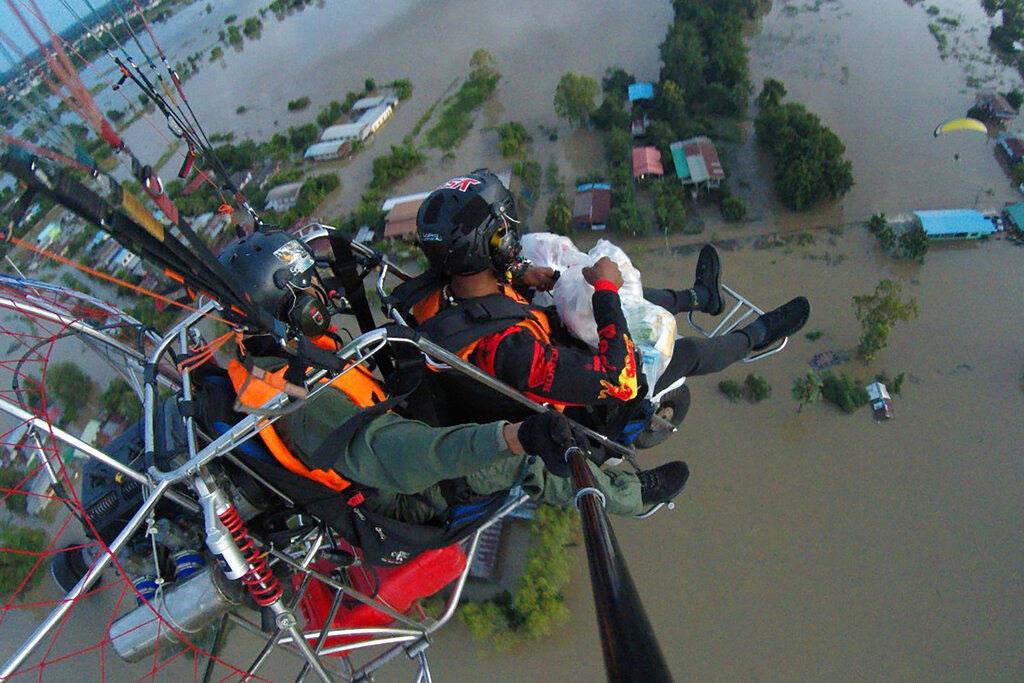
BANGKOK — 19 August 2026, Deputy Prime Minister Yodchanan Wongsawat has ordered Nan, Phayao and Lamphun provinces to urgently prepare for flooding and flash floods, including 24-hour Cell Broadcast alerts and a standby KA-32 helicopter.

Yodchanan, who is also Higher Education, Science, Research and Innovation Minister and chair of the northern regional flood and drought prevention committee, signed an urgent order to the three provincial governors on Tuesday.

The order follows a Meteorological Department forecast warning of thunderstorms, isolated heavy rain and strong winds in August, which could cause flash floods, forest runoff and rivers to overflow.

The committee set out eight measures for immediate implementation:

  1. Closely monitor and assess conditions, coordinating with upstream areas and neighbouring provinces. Authorities were told to focus on flood-prone communities,
    densely populated areas, economic zones, tourist sites and key transport routes.
  2. Improve the speed and accuracy of warnings through Cell Broadcast alerts and provincial, district, local and community-leader communication channels.
  3. Pre-position personnel, boats and water pumps in high-risk areas, with round-the-clock operations. A KA-32 disaster-relief helicopter is to remain on standby for evacuations and deliveries to inaccessible areas.
  4. Prepare temporary shelters with adequate facilities, food, drinking water, health care, kitchens and cooking supplies.
  5. Provide continuous updates on river and waterway levels, low-lying risk areas, and warnings for raft operators, restaurants, riverside residents and tourists travelling into affected areas.
  6. Set up incident command centres if flooding occurs, mobilising resources and prioritising assistance for vulnerable groups in coordination with provincial social development and human security offices.
  7. Quickly survey and record damage so relief payments can be made fairly and promptly under government policy and Finance Ministry emergency-disaster assistance rules.
  8. Coordinate with local Higher Education, Science, Research and Innovation Ministry agencies to support flood response, moving belongings and post-flood clean-up around the clock.

The measures were issued under the Prime Minister’s Office Order No. 275/2026, which established five regional flood and drought prevention committees to speed relief efforts.

Advertisement

Hot News

LATEST NEWS

Bangkok
light rain
28.2 ° C
28.9 °
27.9 °
78 %
3.2kmh
100 %
Thu
28 °
Fri
29 °
Sat
28 °
Sun
31 °
Mon
32 °