


























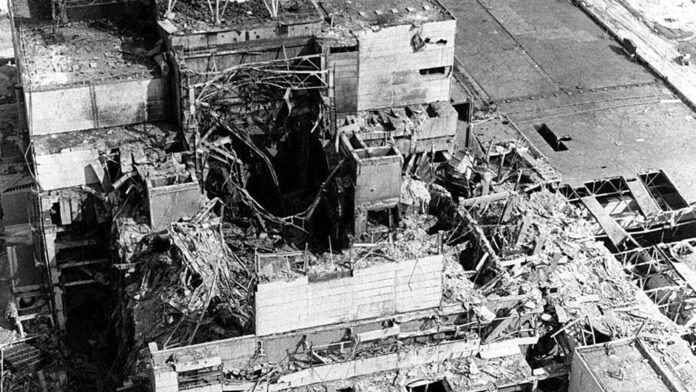
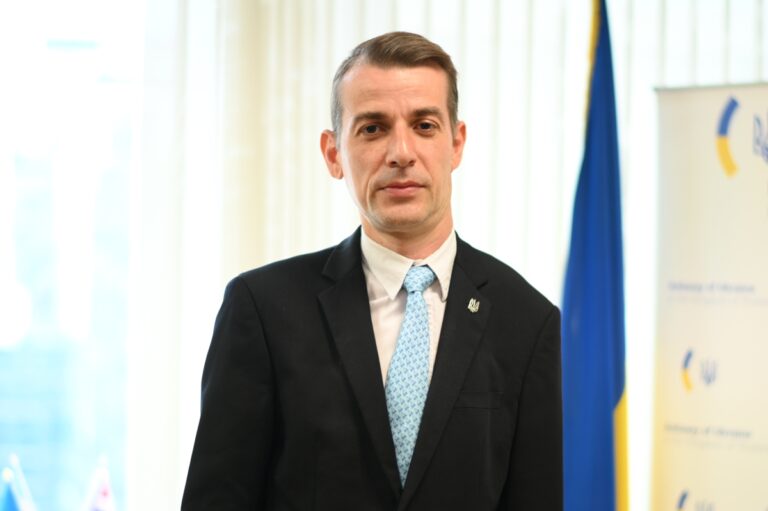
This article was written by Mr. Viktor Semenov, Chargé d’Affaires a.i. of Ukraine to the Kingdom of Thailand, on the occasion of the 40th anniversary of the Chornobyl Nuclear Power Plant disaster.
On 26 April 2026, we mark the 40th anniversary of the accident at the Chornobyl
Nuclear Power Plant, one of the largest man-made disasters in human history. The
catastrophe that unfolded in 1986 was the result of a reactor experiment carried out
under Moscow’s orders, in blatant violation of basic safety protocols.
The scale of the tragedy was not caused only by the explosion itself. The criminal
negligence, combined with the Soviet authorities’ attempts to conceal the truth about
the accident and its consequences, meant that the world remained unaware of the
explosion for at least two full days, while Soviet citizens were kept unaware for weeks.
In those critical early days, silence was enforced, and truth was suppressed.
Despite the fact that radiation was already in the air, on 1 May the Soviet
authorities forced people to participate in a demonstration in the center of Kyiv. This decision reflected a system where image and control mattered more than human life.
The consequences quickly spread far beyond Ukraine. Contamination was
recorded in Belarus, Sweden, Norway, Poland, Austria, Switzerland, Germany, Finland,
and the United Kingdom. The scale of the disaster is difficult to comprehend. 20 000
roentgens was the level of radiation in the destroyed reactor. For comparison, only 500
roentgens for five hours is a lethal dose. The total radiation from the released isotopes
was 30 times greater than that from the bomb dropped on Hiroshima. Over 145 000
square kilometers of land were contaminated with radionuclides, and 8,5 million people
were exposed to radiation.
Around 5,000 settlements across present-day Ukraine, Belarus, and Russia were
affected – 2 218 of them in Ukraine, home to approximately 2,4 million people. Over 300
000 people had to leave their homes forever. The exclusion zone remains today.
The Soviet authorities hid the fact of the accident and its effects, falsifying
diagnoses of radiation exposure. Data on contamination were classified until 1989.
It is clear that the Chornobyl tragedy was not just a technological failure, but also
the result of a Soviet system built on secrecy, the absence of freedom of speech, and
disregard for human life. The Soviet authorities concealed the scale of the disaster and
delayed action, turning an accident into a global tragedy.
Ukraine has drawn important lessons, choosing transparency, responsibility, and
international cooperation as the basis of its approach to nuclear safety. After 1991,
during all years of Ukraine’s independence, my state maintained the highest standards
of safety at its nuclear facilities.
Since 2022, however, Ukrainian nuclear industry has been under constant threat
from the Russian army’s actions.
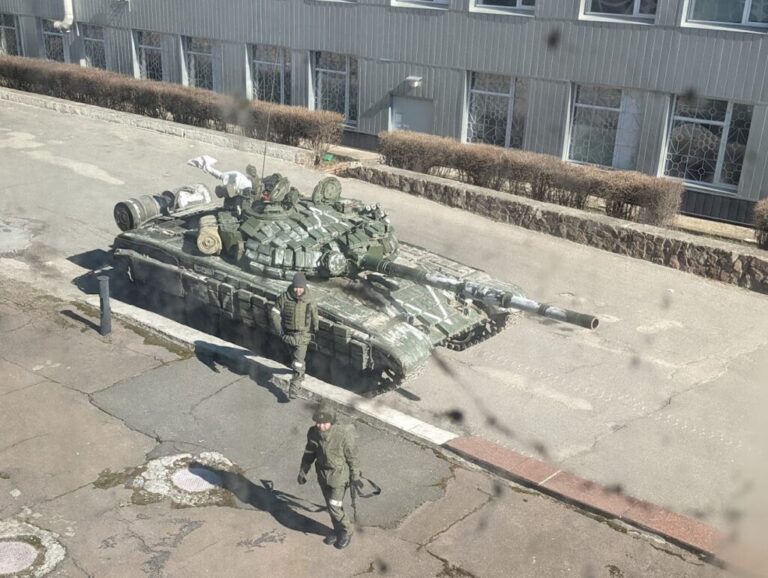
Chornobyl was among the first targets of Russia’s full-scale invasion, as the
Exclusion Zone was rapidly seized by Russian forces. Only the dedication of the
Exclusion Zone staff, who remained at their posts under the extreme conditions of
occupation, ensured the operation of the Chornobyl NPP and other facilities, and risked
their lives, a new nuclear disaster was prevented.
On 31 March 2022, the Armed Forces of Ukraine expelled Russian troops from
the Chornobyl Exclusion Zone. Unfortunately, the occupiers captured and forcibly
transported 169 personnel of the Ukrainian National Guard, who had been guarding the
Chornobyl NPP, to Belarus and then to Russia.
The aggressor state forces did not stop there. One more terrifying act of nuclear
security breach the world witnessed on the night of 13-14 February 2025, when Russia
struck the New Safe Confinement at the Chornobyl NPP, which protects the destroyed
Unit 4 reactor, with the Russian-Iranian attack drone. The strike damaged both the outer
and inner shells of the confinement structure (the NSC arch) and disabled the main
crane system.
To be clear, this arch protects the world from Chornobyl radiation. After this barbaric attack, Ukrainian rescuers contained the immediate threat. Now, we are working with our partners to restore the NSC and raise funding for this purpose. We are grateful to G7, in particular, French presidency and the EBRD for their efforts. A relevant donor conference will be held in Kyiv on 26 April 2026.
The actions of Russian army in Chornobyl zone showed a complete absence of
understanding of the radiation threat both to their own health and lives and those of
others. How come two states – both Russia and Ukraine, which lived through the same
tragedy, and were once part of the same state, drew such a different conclusions from
the same event and have such different levels of awareness on this issue?
Every Ukrainian from childhood is taught about Chornobyl with the particular
focus on the importance of responsibility in the nuclear sphere. In contrast, to our
society, the only thing our enemy’s people are taught from the very childhood is to blindly follow orders. The level of militarization within Russia is so high that it is no surprise that the Russian military carried out the order to seize Chernobyl and attack the protective arch. This is what happens when ideology takes precedence over education.
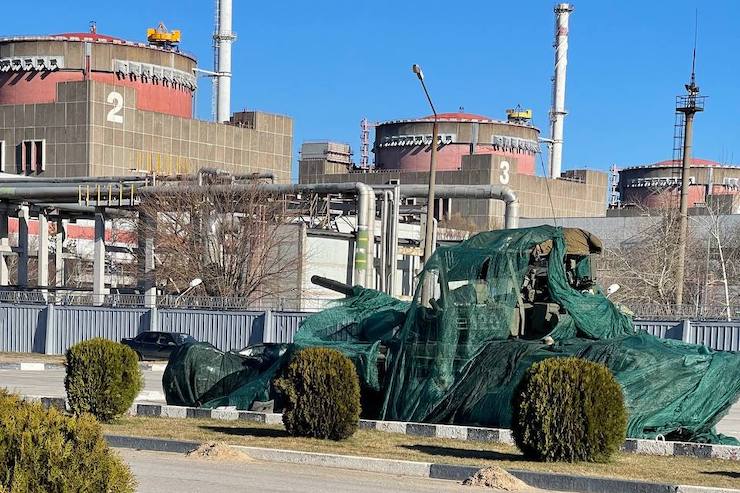
After the Chornobyl NPP, the aggressor state also captured the Zaporizhzhia
NPP – the biggest in Europe (ZNPP). Both plants were militarized by Russia and used
for both military and political purposes. For the first time in human history, a state has
forcibly seized nuclear power plants.
Russia’s occupation of the ZNPP has been marked by serious human rights
violations. At least 35 civilians – plant employees and residents of Enerhodar, satellite
city of ZNPP, – have been unlawfully detained, tortured, and convicted on fabricated
charges. Since 2022, up to 2 000 civilians in Enerhodar have faced unlawful detention,
torture, or enforced disappearance. Holding personnel of a strategic nuclear facility as
hostages is a grave breach of international humanitarian law and poses additional risks
to the plant’s safety.
The plant has experienced degradation of equipment, constant power outages,
increased fire hazard, systematic violations of nuclear and radiation safety
requirements. It lacks reliable water supply, stable external power supply, qualified
personnel and proper technical maintenance for systems critical for safety.
Since the beginning of the occupation, the ZNPP has experienced 14 complete blackouts and has repeatedly operated under critically limited power supply conditions. According to
the IAEA, on April 14 and 16, Ukraine’s ZNPP temporarily lost all internal electricity
twice within one week, marking the 13th and 14th such incidents since the start of
Russia’s full-scale military invasion of Ukraine.
In Ukraine there are three other nuclear power plants. Over the past years there
have been dangerous Russian drone flyovers over them. Moreover, Russia continues to
conduct drone and missile strikes at critical energy substations linked to our NPPs.
Such attacks have already led to emergency reactor shutdowns. Our continent was on
the brink of a disaster.
My point here is that first, by attacking Chornobyl, seizing the Chornobyl and
Zaporizhzhia NPPs and attacking energy substations linked to nuclear facilities, Russia
violated all key principles of nuclear safety and security established by the IAEA.
Once again, I would like to stress that we strongly condemn Russia’s attempts to
legitimise the illegal control over ZNPP. ZNPP belongs to Ukraine – this is not a subject
for discussion.
Second, we all have to thank Ukrainian nuclear energy professionals. They
managed to maintain safe control of nuclear reactors under such extreme conditions.
Third, we have to change Russia’s policy of nuclear blackmail. Ukraine calls on
the international community to take decisive and principled action to ensure political,
economic, and legal consequences for Russia for its crimes that undermine global
nuclear safety. No country has the right to blackmail the world with the threat of a
radiation catastrophe.
We call on all states to impose sanctions against Rosatom and restrictions on the
aggressor’s rights in the IAEA. Ukraine proposed relevant statute amendments, and we
count on partners for support.
We are confident that it is necessary to increase international pressure to ensure
the immediate release of ZNPP employees and National Guard servicemen illegally
detained by Russia and to guarantee compliance with IHL in the temporarily occupied
territories.
Security guarantees for Ukraine should cover the nuclear sector and ZNPP.
Russia must withdraw its troops from all ZNPP facilities and to return it to their rightful
owner. Restoring global nuclear safety is impossible without returning full control of all
civilian nuclear facilities on its sovereign territory to Ukraine. Russia should be barred
from participation in the global nuclear-energy market.
I am convinced that Russia has carried out a forcible seizure and occupation of
the ZNPP, which the occupiers have effectively transformed into a military base, packed
with heavy military equipment, weapons and military personnel, in fact, transformed the
plant into a time-bomb that threatens the security of the region, Ukraine and Europe as
a whole, and which can detonate at any time.
This international crime committed by the Russian Federation by attacking and occupying the ZNPP is the first case of the forcible seizure and occupation of an operating nuclear power plant in the world, which requires unconditional condemnation by the international community.
Protecting Ukraine’s civilian nuclear facilities is a global responsibility. This is not
a moment for a “Don’t Look Up” response, it is a moment to act. We urge the world not to wait for a new Chornobyl, but to help ensure the nuclear safety in Ukraine and thus in Europe and other regions of the world, as atom knows no borders.