



































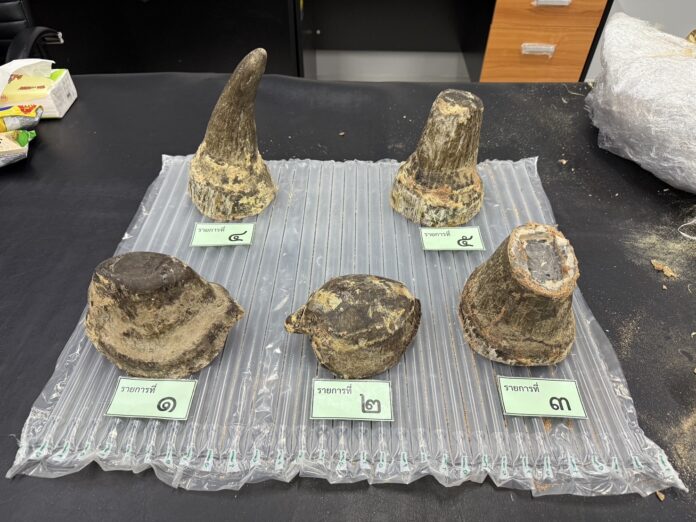
BANGKOK — Thai customs officials arrested a Vietnamese man at Suvarnabhumi Airport on Friday evening for attempting to smuggle rhino horn worth 6.9 million baht (approximately $200,000) through Thailand to Laos.
The arrest came as part of intensified efforts by the Thai Customs Department to crack down on illegal wildlife trafficking under the Convention on International Trade in Endangered Species (CITES).
Panthong Loykulnan, spokesman for the Customs Department, said the operation reflects Director-General Thirat Attanavanich’s policy to strengthen enforcement against wildlife smuggling to protect endangered species both in Thailand and globally.
The Vietnamese passenger was traveling from Luanda, Angola, with a connection through Addis Ababa, Ethiopia, before arriving at Bangkok’s main international airport. His final destination was Vientiane, the capital of Laos.
Customs officers at Suvarnabhumi flagged the passenger using advanced screening systems and intelligence data that identified him as high-risk for wildlife smuggling. During the search conducted around 7:45 PM on September 6, officials discovered five pieces of rhino horn weighing a total of 6.86 kilograms concealed in his luggage.
Wisanu Watcharavanich, Director of Suvarnabhumi Airport’s Passenger Inspection Customs Office, had instructed officers to strictly enforce anti-trafficking policies to intercept smuggling networks operating through Thailand’s airports.
The suspect faces charges under Thailand’s Customs Act of 2017, Wildlife Conservation and Protection Act of 2019, and Animal Epidemics Act of 2015.
The customs spokesman emphasized that the department continues to work closely with partner agencies to analyze data and intercept CITES-regulated wildlife trafficking operations to maintain social and environmental security.
Rhino horn remains highly valued in some Asian markets despite international bans, with criminal networks frequently using transit routes through Southeast Asia to move contraband from Africa to consumer markets