






























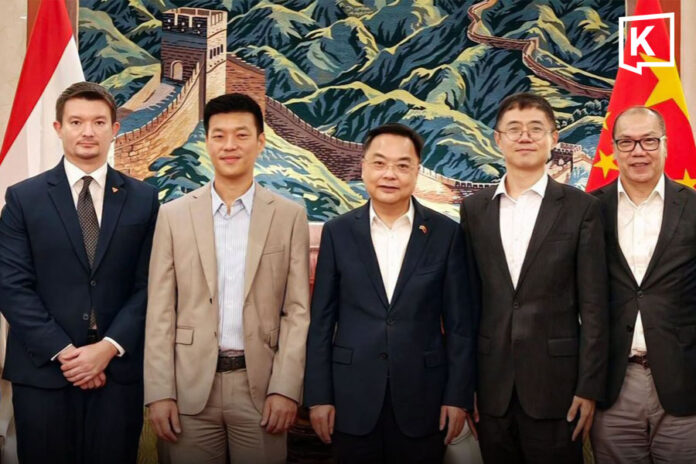
BANGKOK — 15 July 2026, People’s Party leader and party-list MP Natthaphong Ruengpanyawut, together with Chiang Mai MP Pattharapong Leelaphat, submitted evidence on cross-border water pollution to the Chinese Embassy this week, urging Beijing to help address toxic contamination believed to originate from mining operations in a neighbouring country.
Pattharapong said he stressed to Chinese Ambassador Zhang Jianwei that the issue affects people of all nationalities and requires urgent cooperation among all countries involved. He said the submission also emphasised that toxic substances detected in northern rivers for more than a year did not originate from Thailand’s natural heavy metals or activities within the country.
The documents included water and sediment test results from Thailand’s Pollution Control Department, along with research by Thanapol Penrat of Naresuan University. Pattharapong said the evidence points to contamination affecting the Kok, Sai, Ruak, Mekong and Salween rivers.
He also highlighted contamination in the Kraburi River, where arsenic and lead levels were found to exceed safety standards. According to the party, the pollution has spread through the food chain, with tests detecting excessive heavy metals in vegetables and lead contamination in fish caught from the Mekong River.
The submission also included the coordinates of 2,676 mining sites, based on data from the Stimson Center, to assist Chinese authorities in determining whether any Chinese entities are connected to the operations.
Pattharapong urged Beijing to enforce relevant Chinese laws governing rare earth management, outbound investment and export controls, and asked the Chinese government to investigate the matter and provide a written response that could be shared with the Thai public.
“We ask the Chinese government to investigate the matter and provide a written response so it can be communicated to the Thai public, demonstrating China’s commitment to resolving this issue as a founding member of the Lancang-Mekong Cooperation framework with its dedicated environmental mechanism,” he said.
He stressed that the People’s Party was not seeking to blame any particular company or country, but wanted governments involved in the mineral supply chain to jointly investigate mining operators and tackle the pollution at its source.
The party also submitted research proposing low-cost treatment methods for contaminated mine sites. According to Pattharapong, treating polluted water at operating mines would cost between 5 and 20 baht per cubic metre, while attempting to restore rivers after contamination had spread could cost hundreds or even thousands of times more and, in some cases, may prove impossible.
The Embassy Reponds
In a statement issued on Wednesday, the Chinese Embassy in Bangkok said China understands concerns over the ecological environment and public health in the river basin. However, because the affected rivers cross the Thailand-Myanmar border, the issue should be investigated in an objective, scientific and responsible manner.
The embassy said China is willing to strengthen cooperation with countries in the basin on water resources management and environmental protection, and supports Thailand and Myanmar improving communication and coordination to launch a joint investigation as soon as possible.
However, it said that while the facts remain unclear and responsibility has yet to be established, “some individuals” have used the issue to make baseless accusations and smear China. The embassy said China firmly opposes such actions and hopes the People’s Party will maintain an objective and rational position and continue to play a constructive role.
According to the embassy, Natthaphong congratulated the Communist Party of China on its 105th anniversary during the meeting and expressed his willingness to learn from the party’s experience in party-building while promoting greater mutual understanding and trust between Thailand and China.