32.7 C
Bangkok
Friday, June 19, 2026
Home Blog Page 1006

Hong Kong To Kill 2,000 Animals After Hamsters Get COVID-19

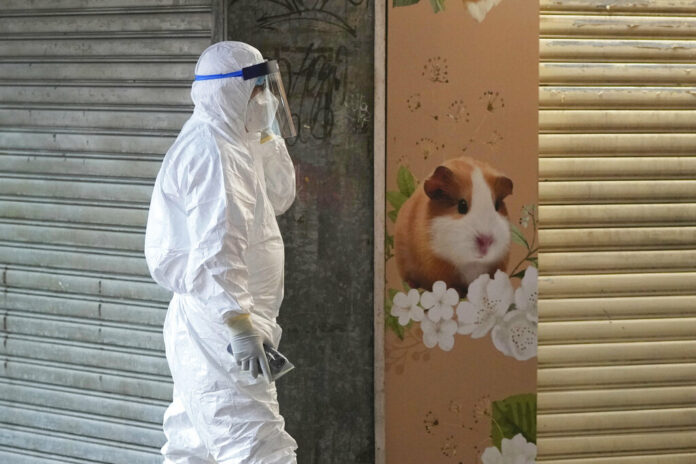
A staffer from the Agriculture, Fisheries and Conservation Department walks past a pet shop which was closed after some pet hamsters were, authorities said, tested positive for the coronavirus, in Hong Kong, Tuesday, Jan. 18, 2022. Photo: Kin Cheung / AP

HONG KONG (AP) — Hong Kong authorities said Tuesday that they will kill about 2,000 small animals, including hamsters, after several tested positive for the coronavirus at a pet store where an employee was also infected.

The city will also stop the sale of hamsters and the import of small mammals, according to officials from the Agriculture, Fisheries and Conservation Department. The pet shop employee tested positive for the delta variant on Monday, and several hamsters imported from the Netherlands at the store tested positive as well.

According to the U.S. Centers for Disease Control and Prevention, animals do not appear to play a significant role in spreading the coronavirus. But Hong Kong authorities said they are not ruling out transmission between animals and humans.

“We cannot exclude the possibility that the shopkeeper was in fact actually infected from the hamsters,” said Edwin Tsui, a controller at the Centre for Health Protection.

While this coronavirus most likely jumped from animals to humans in the first place, the outbreak became a pandemic because the virus spreads so easily between people. Minks are the only known animals to have caught the virus from people and spread it back, according to Dr. Scott Weese at Ontario Veterinary College.

Leung Siu-fai, director of the Agriculture, Fisheries and Conservation Department, said during a news conference that owners should keep hamsters at home, and not take them out. “All pet owners should observe good personal hygiene, and after you have been in contact with animals and their food, you should wash your hands,” he said.

“Do not kiss your pets,” he added.

Customers who purchased hamsters from the store after Jan. 7 will be traced and be subject to mandatory quarantine and must hand over their hamsters to authorities to be put down, officials said.

They said all pet stores in Hong Kong must stop selling hamsters and that about 2,000 small mammals, including hamsters and chinchillas, will be killed in a humane manner.

Customers who bought hamsters in Hong Kong from Dec. 22 will be subject to mandatory testing and are urged not contact others until their tests have returned negative. If their hamsters test positive, they will be subject to quarantine.

Hong Kong’s Society for the Prevention of Cruelty to Animals said it was “shocked and concerned” by the decision to kill the animals, and urged the government not to “take any drastic action before reviewing its approach.”

Hong Kong has been grappling with a local omicron outbreak traced to several Cathay Pacific crew members who dined at bars and restaurants across the city before testing positive for the omicron variant.

The government announced late Monday that two former flight attendants have been arrested for leaving their homes during quarantine and later being confirmed to have coronavirus infections. It did not identify their employer, but said the two arrived from the U.S. on Dec. 24 and 25 and “conducted unnecessary activities” while under medical surveillance.

The arrests came after Cathay Pacific said it had fired two crew members for breaching coronavirus protocols. It previously apologized and called their actions “extremely disappointing.” The company had to cut back on flights — both passenger and cargo — in January because of tightened virus curbs.

The two have been released on bail and will have their case heard in court on Feb. 9. If convicted of violating anti-epidemic regulations, they could face up to six months’ imprisonment and a fine of up to 5,000 Hong Kong dollars ($642).

Previously in Hong Kong, some air and sea crew members could isolate at home under quarantine exemptions. Regulations were tightened on Dec. 31 to require crew members to isolate in a designated quarantine hotel for about a week.

___

Story: Zen Soo.

Advertisement

COVID-19 Health Emergency Could Be Over This Year, WHO Says

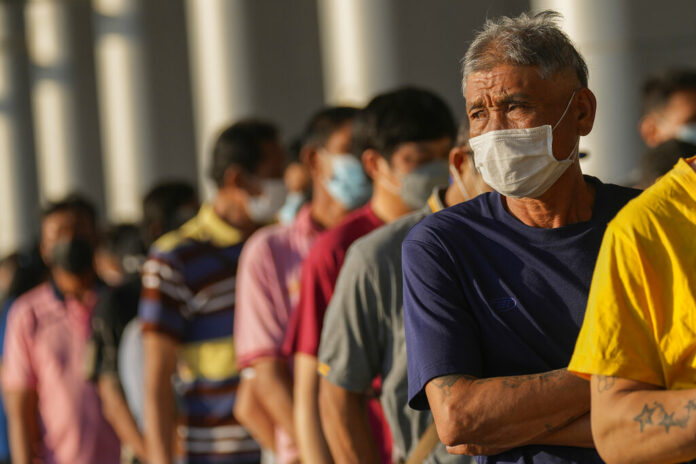
Local residents wait on line to receive shots of the Pfizer vaccine at the Central Vaccination Center in Bangkok, Thailand, Monday, Jan. 10, 2022. Photo: Sakchai Lalit / AP

GENEVA (AP) — The worst of the coronavirus pandemic — deaths, hospitalizations and lockdowns — could be over this year if huge inequities in vaccinations and medicines are addressed quickly, the head of emergencies at the World Health Organization said Tuesday.

Dr. Michael Ryan, speaking during a panel discussion on vaccine inequity hosted by the World Economic Forum, said “we may never end the virus” because such pandemic viruses “end up becoming part of the ecosystem.”

But “we have a chance to end the public health emergency this year if we do the things that we’ve been talking about,” he said.

WHO has slammed the imbalance in COVID-19 vaccinations between rich and poor countries as a catastrophic moral failure. Fewer than 10% of people in lower-income countries have received even one dose of a COVID-19 vaccine.

Ryan told the virtual gathering of world and business leaders that if vaccines and other tools aren’t shared fairly, the tragedy of the virus, which has so far killed more than 5.5 million people worldwide, would continue.

“What we need to do is get to low levels of disease incidence with maximum vaccination of our populations, so nobody has to die,” Ryan said. “The issue is: It’s the death. It’s the hospitalizations. It’s the disruption of our social, economic, political systems that’s caused the tragedy — not the virus.”

Ryan also waded into the growing debate about whether COVID-19 should be considered endemic, a label some countries like Spain have called for to better help live with the virus, or still a pandemic — involving intensified measures that many countries have taken to fight the spread.

“Endemic malaria kills hundreds of thousands of people; endemic HIV; endemic violence in our inner cities. Endemic in itself does not mean good. Endemic just means it’s here forever,” he said.

Public health officials have warned it is highly unlikely COVID-19 will be eliminated and say it will continue to kill people, though at much lower levels, even after it becomes endemic.

Fellow panelist Gabriela Bucher, executive director of the anti-poverty organization Oxfam International, cited the “enormous urgency” of fairer distribution of vaccines and the need for large-scale production. She said resources to fight the pandemic were being “hoarded by a few companies and a few shareholders.”

John Nkengasong, director of the Africa Centers for Disease Control and Prevention, decried the “total collapse of global cooperation and solidarity” over the last two years, saying it was “totally unacceptable” how few people in Africa have gotten vaccine shots. His agency says only 10% of Africa’s 1.2 billion people are fully vaccinated.

He also sought to douse the belief among some that vaccine hesitancy is widespread in Africa, citing studies that say 80% of Africans were ready to get shots if the vaccines were available.

The comments came on the second day of the online alternative to the annual World Economic Forum gathering, which was postponed over pandemic health concerns.

In speeches at the event, world leaders like Israeli Prime Minister Naftali Bennett discussed approaches to the pandemic. He said his country, which quickly rolled out a widespread vaccination campaign, has a strategy of being “at the forefront of the medicines and the vaccines” against COVID-19.

Israel’s Health Ministry says 62% of people there are fully vaccinated, including with booster shots.

Citing advanced research in Israel, Bennett said, “We want to be first in the world to know how vaccines and the new variants respond to one another.”

Japanese Prime Minister Fumio Kishida said his country had high levels of vaccination because society values protecting the elderly and the vulnerable. He plans to keep stringent border controls in place until the end of February.

He said he was trying to balance restrictions with keeping the economy open but that a “zero COVID policy against the omicron variant is not possible nor appropriate.”

In a separate press briefing Tuesday, WHO director-general Tedros Adhanom Ghebreyesus said the omicron variant “continues to sweep the world,” adding there were 18 million new COVID-19 cases reported last week.

___

Story: Jamey Keaten. Associated Press reporters Ilan Ben Zion in Jerusalem and Mari Yamaguchi in Tokyo contributed.

Advertisement

Volcanic Ash Delays Aid to Tonga as Damage Reports Emerge

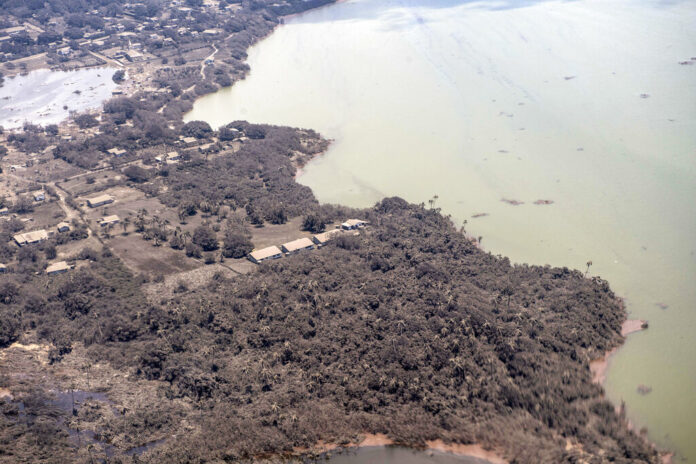
In this photo provided by the New Zealand Defense Force, volcanic ash covers roof tops and vegetation in an area of Tonga, Monday, Jan. 17, 2022. Photo: CPL Vanessa Parker / NZDF via AP

WELLINGTON, New Zealand (AP) — Thick ash on an airport runway was delaying aid deliveries to the Pacific island nation of Tonga, where significant damage was being reported days after a huge undersea volcanic eruption and tsunami.

New Zealand’s military is sending much-needed drinking water and other supplies, but said the ash on the runway will delay the flight at least a day. A towering ash cloud since Saturday’s eruption had prevented earlier flights. New Zealand is also sending two navy ships to Tonga that will leave Tuesday and pledged an initial 1 million New Zealand dollars ($680,000) toward recovery efforts.

Communications with Tonga have been extremely limited, but New Zealand and Australia sent military surveillance flights to assess the damage on Monday.

U.N. humanitarian officials and Tonga’s government “report significant infrastructural damage around Tongatapu,” U.N. spokesman Stephane Dujarric said.

“There has been no contact from the Ha’apai Group of islands, and we are particularly concerned about two small low-lying islands — Mango and Fonoi — following surveillance flights confirming substantial property damage,” Dujarric said.

New Zealand’s High Commission in Tonga also reported “significant damage” along the western coast of the main island of Tongatapu, including to resorts and along the waterfront area.

Satellite images captured the spectacular eruption, with a plume of ash, steam and gas rising like a giant mushroom above the South Pacific. Tsunami waves of about 80 centimeters (2.7 feet) crashed into Tonga’s shoreline, and crossed the Pacific, causing minor damage from New Zealand to Santa Cruz, California. The eruption set off a sonic boom that could be heard as far away as Alaska.

Two people drowned in Peru, which also reported an oil spill after waves moved a ship that was transferring oil at a refinery.

New Zealand’s Acting High Commissioner for Tonga, Peter Lund, said there were unconfirmed reports of up to three fatalities on Tonga so far.

One death has been confirmed by family: British woman Angela Glover, 50, who was swept away by a wave.

Nick Eleini said his sister’s body had been found and that her husband survived. “I understand that this terrible accident came about as they tried to rescue their dogs,” Eleini told Sky News. He said it had been his sister’s life dream” to live in the South Pacific and “she loved her life there.”

The explosion of the Hunga Tonga Hunga Ha’apai volcano, about 64 kilometers (40 miles) north of Nuku’alofa, was the latest in a series of dramatic eruptions. In late 2014 and early 2015, eruptions created a small new island and disrupted air travel to the Pacific archipelago.

Earth imaging company Planet Labs PBC had watched the island after a new vent began erupting in late December. Satellite images showed how drastically the volcano had shaped the area, creating a growing island off Tonga.

The U.N. World Food Program is exploring how to bring in relief supplies and more staff and has received a request to restore communication lines in Tonga, Dujarric said.

One complicating factor is that Tonga has managed to avoid outbreaks of COVID-19. New Zealand said its military staff were vaccinated and willing to follow Tonga’s protocols.

New Zealand’s military said it hoped the airfield in Tonga would be opened either Wednesday or Thursday. The military said it had considered an airdrop but that was “not the preference of the Tongan authorities.”

Communications with the island nation is limited because the single underwater fiber-optic cable that connects Tonga to the rest of the world was likely severed in the eruption. The company that owns the cable and repairs could take weeks.

Samiuela Fonua, who chairs the board at Tonga Cable Ltd., said the cable appeared to have been severed about 10 to 15 minutes after the eruption. He said the cable lies atop and within coral reef, which can be sharp.

Fonua said a ship would need to pull up the cable to assess the damage and then crews would need to fix it. A single break might take a week to repair, he said, while multiple breaks could take up to three weeks. He added that it was unclear yet when it would be safe for a ship to venture near the undersea volcano to undertake the work.

A second undersea cable that connects the islands within Tonga also appeared to have been severed, Fonua said. However, a local phone network was working, allowing Tongans to call each other. But he said the lingering ash cloud was continuing to make even satellite phone calls abroad difficult.

___

Story: Nick Perry. Associated Press journalist Jill Lawless in London contributed to this report.

Advertisement

Cold Case Team Shines New Light on Betrayal of Anne Frank

FILE - A woman enters the secret annex at the renovated Anne Frank House Museum in Amsterdam, Netherlands, Wednesday, Nov. 21, 2018. Photo: Peter Dejong / AP File

AMSTERDAM (AP) — A cold case team that combed through evidence for five years in a bid to unravel one of World War II’s enduring mysteries has reached what it calls the “most likely scenario” of who betrayed Jewish teenage diarist Anne Frank and her family.

Their answer, outlined in a new book called “The Betrayal of Anne Frank A Cold Case Investigation,” by Canadian academic and author Rosemary Sullivan, is that it could have been a prominent Jewish notary called Arnold van den Bergh, who disclosed the secret annex hiding place of the Frank family to German occupiers to save his own family from deportation and murder in Nazi concentration camps.

“We have investigated over 30 suspects in 20 different scenarios, leaving one scenario we like to refer to as the most likely scenario,” said film maker Thijs Bayens, who had the idea to put together the cold case team, that was led by retired FBI agent Vincent Pankoke, to forensically examine the evidence.

Bayens was quick to add that, “we don’t have 100% certainty.”

“There is no smoking gun because betrayal is circumstantial,” Bayens told The Associated Press on Monday.

The Franks and four other Jews hid in the annex, reached by a secret staircase hidden behind a bookcase, from July 1942 until they were discovered in August 1944 and deported to concentration camps.

Only Anne’s father, Otto Frank, survived the war. Anne and her sister died in the Bergen-Belsen concentration camp. Anne was 15.

The diary Anne wrote while in hiding was published after the war and became a symbol of hope and resilience that has been translated into dozens of languages and read by millions.

But the identity of the person who gave away the location of their hiding place has always remained a mystery, despite previous investigations.

The team’s findings suggest that Otto Frank was one of the first to hear about the possible involvement of Van den Bergh, a prominent member of the Jewish community in Amsterdam.

A brief note, a typed copy of an anonymous tip delivered to Otto Frank after the war, names Van den Bergh, who died in 1950, as the person who informed German authorities in Amsterdam where to find the Frank family, the researchers say.

The note was an overlooked part of a decades-old Amsterdam police investigation that was reviewed by the team, which used artificial intelligence to analyze and draw links between archives around the world.

The Anne Frank House museum in the canal-side Amsterdam building that includes the secret annex welcomed the new research, but said it also leaves questions unanswered. The museum gave the researchers access to its archives for the cold case project.

“No, I don’t think we can say that a mystery has been solved now. I think it’s an interesting theory that the team came up with,” said museum director Ronald Leopold. “I think they come up with a lot of interesting information, but I also think there are still many missing pieces of the puzzle. And those pieces need to be further investigated in order to see how we can value this new theory.”

Bayens said the hunt for the betrayer was also a way of looking for an explanation of how the horror of the Nazi occupation forced some members of a once close-knit Amsterdam community to turn on one another.

How did facism bring people “to the desperate point of betraying each other, which is an awful, really awful situation?” he said.

“We went looking for a perpetrator and we found a victim,” Bayens said.

___

Story: Mike Corder.

Advertisement

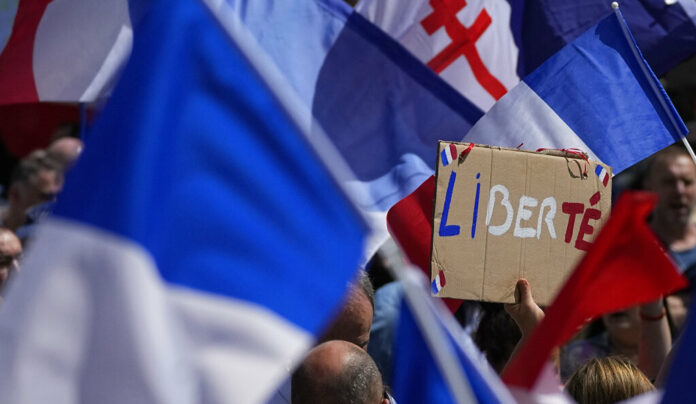
No Vaccine? No Cafe, According to New French Virus Law

FILE - A protestor waves a sign which reads 'freedom' in the middle of French flags during a demonstration in Paris, France, Saturday, July 31, 2021. Photo: Michel Euler / AP File

PARIS (AP) — France’s parliament approved a law Sunday that will exclude unvaccinated people from all restaurants, sports arenas and other venues, the central measure of government efforts to protect hospitals amid record numbers of infections driven by the highly contagious omicron variant.

The National Assembly adopted the law by a vote of 215-58. Centrist President Emmanuel Macron had hoped to push the bill through faster, but it was slightly delayed by resistance from lawmakers both on the right and left and hundreds of proposed amendments.

More than 91% of French adults are already fully vaccinated, and some critics have questioned whether the “vaccine pass” will make much of a difference.

Macron’s government is hoping the new pass will be enough to limit the number of patients filling up strained hospitals nationwide without resorting to a new lockdown. New confinement measures would strike another blow to the economy — and could also cloud Macron’s chances of reelection in the April 10 presidential vote.

Up to now, a COVID-19 pass has been required in France to go to restaurants, movie theaters, museums and many sites throughout the country, but unvaccinated people have been allowed in if they show a recent negative test or proof of recent recovery.

The new law requires full vaccination for such venues, including tourist sites, many trains and all domestic flights, and applies to everyone 16 and over. Some exceptions could be made for those who recently recovered from COVID-19. The law also imposes tougher fines for fake passes and allows ID checks to avoid fraud.

More than 76% of French ICU beds are occupied by virus patients, most of them unvaccinated, and some 200 people with the virus are dying every day. Like many countries, France is in the grip of the omicron variant, recording more than 2,800 positive cases per 100,000 people over the past week.

Advertisement

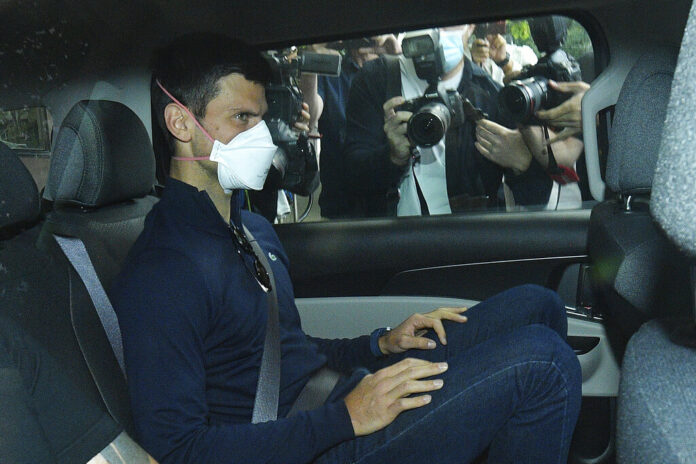
Djokovic Arrives in Dubai After Deportation From Australia

Serbian tennis player Novak Djokovic rides in car as he leaves a government detention facility before attending a court hearing at his lawyers office in Melbourne, Australia, Sunday, Jan. 16, 2022. Photo: James Ross / AAP via AP

DUBAI, United Arab Emirates (AP) — Novak Djokovic arrived early Monday in Dubai after his deportation from Australia over its required COVID-19 vaccination ended the No. 1-ranked men’s tennis player’s hopes of defending his Australian Open title.

The Emirates plane carrying Djokovic touched down after a 13 1/2-hour flight from Melbourne, where he had argued in court he should be allowed to stay in the country and compete in the tournament under a medical exemption due to a coronavirus infection last month.

At Dubai International Airport, arriving passengers wearing mandatory face masks collected their bags and walked out of the cavernous terminal. Over an hour after Djokovic’s flight arrived, he did not come out of baggage claim as many passengers from his plane already had picked up their bags on the carousel.

It wasn’t immediately clear where Djokovic planned to travel next. The Dubai Duty Free tennis tournament, which Djokovic won in 2020, doesn’t start until Feb. 14.

Dubai, the commercial capital of the United Arab Emirates, doesn’t require travelers to be vaccinated, though they must show a negative PCR test to board a flight.

Djokovic had won nine Australian Open titles, including three in a row, and a total of 20 Grand Slam singles trophies, tied with rivals Roger Federer and Rafael Nadal for the most in the history of men’s tennis. Federer is not playing while recovering from injury, and Nadal is the only former Australian Open men’s champion in the tournament that began Monday.

Djokovic’s visa was initially canceled on Jan. 6 by a border official who decided he didn’t qualify for a medical exemption from Australia’s rules for unvaccinated visitors. He was exempted from the tournament’s vaccine rules because he had been infected with the virus within the previous six months.

He won an appeal to stay for the tournament, but Australia’s immigration minister later revoked his visa. Three Federal Court judges decided unanimously Sunday to affirm the immigration minister’s right to cancel Djokovic’s visa.

Vaccination amid the pandemic was a requirement for anyone at the Australian Open, whether players, their coaches or anyone at the tournament site. More than 95% of all Top 100 men and women in their tours’ respective rankings are vaccinated. At least two men — American Tennys Sandgren and Frenchman Pierre-Hugues Herbert — skipped the first major tournament of the year due to the vaccine requirement.

Djokovic’s attempt to get the medical exemption for not being vaccinated sparked anger in Australia, where strict lockdowns in cities and curbs on international travel have been employed to try to control the spread of the coronavirus since the pandemic began.

___

Story: Jon Gambrell.

Advertisement

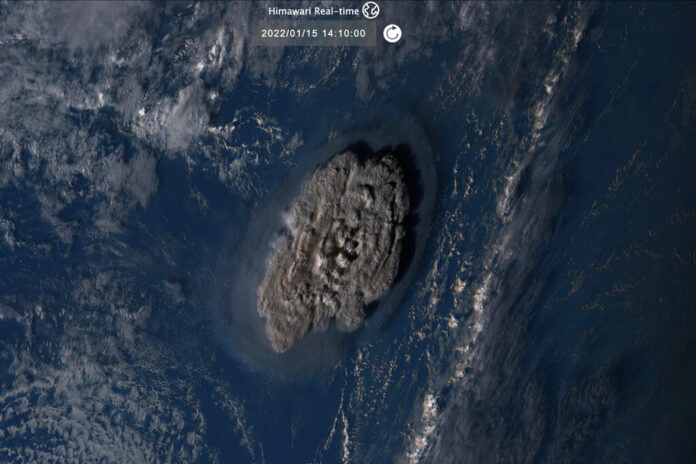
Tsunami Threat Recedes From Huge Pacific Volcanic Eruption

This satellite image taken by Himawari-8, a Japanese weather satellite operated by Japan Meteorological Agency and released by National Institute of Information and Communications Technology (NICT), shows an undersea volcano eruption at the Pacific nation of Tonga Saturday, Jan. 15, 2022. Photo: NICT via AP

WELLINGTON, New Zealand (AP) — The tsunami threat around the Pacific from a huge undersea volcanic eruption began to recede Sunday, while the extent of damage to Tonga remained unclear.

Satellite images showed the spectacular eruption that took place Saturday evening, with a plume of ash, steam and gas rising like a mushroom above the blue Pacific waters. A sonic boom could be heard as far away as Alaska.

In Tonga it sent tsunami waves crashing across the shore and people rushing to higher ground.

The eruption cut the internet to Tonga, leaving friends and family members around the world anxiously trying to get in touch to figure out if there were any injuries and the extent of the damage. Even government websites and other official sources remained without updates on Sunday afternoon.

New Zealand Prime Minister Jacinda Ardern said there had not yet been any official reports of injuries or deaths in Tonga, but cautioned that authorities hadn’t yet made contact with some coastal areas and smaller islands.

“Communication with Tonga remains very limited. And I know that is causing a huge amount of anxiety for the Tongan community here,” Ardern said.

She said there had been significant damage to boats and shops along the Tongan coastline. The capital, Nuku’alofa, was covered in a thick film of volcanic dust, Ardern said, contaminating water supplies and making fresh water a vital need.

Aid agencies said thick ash and smoke had prompted authorities to ask people to wear masks and drink bottled water.

Ardern said New Zealand was unable to send a military surveillance flight over Tonga on Sunday because the ash cloud was 63,000 feet (19,000 meters) high but they hoped to send the flight on Monday, followed by supply planes and navy ships.

One complicating factor to any international aid effort is that Tonga has so far managed to avoid any outbreaks of COVID-19. Ardern said New Zealand’s military staff were all fully vaccinated and willing to follow any protocols established by Tonga.

Dave Snider, the tsunami warning coordinator for the National Tsunami Warning Center in Palmer, Alaska, said it was very unusual for a volcanic eruption to affect an entire ocean basin, and the spectacle was both “humbling and scary.”

The tsunami waves caused damage to boats as far away as New Zealand and Santa Cruz, California, but did not appear to cause any widespread damage. Snider said he anticipated the tsunami situation in the U.S. and elsewhere to continue improving.

Tsunami advisories were earlier issued for Japan, Hawaii, Alaska and the U.S. Pacific coast. The U.S. Geological Survey estimated the eruption caused the equivalent of a magnitude 5.8 earthquake. Scientists said tsunamis generated by volcanoes rather than earthquakes are relatively rare.

The Tonga Meteorological Services said a tsunami warning was declared for all of the archipelago, and data from the Pacific tsunami center said waves of 80 centimeters (2.7 feet) were detected.

Rachel Afeaki-Taumoepeau, who chairs the New Zealand Tonga Business Council, said she hoped the relatively low level of the tsunami waves would have allowed most people to get to safety, although she worried about those living on islands closest to the volcano. She said she hadn’t yet been able to contact her friends and family in Tonga.

“We are praying that the damage is just to infrastructure and people were able to get to higher land,” she said.

U.S. Secretary of State Antony Blinken wrote on Twitter he is “deeply concerned for the people of Tonga as they recover from the aftermath of a volcanic eruption and tsunami. The United States stands prepared to provide support to our Pacific neighbors.”

Tonga gets its internet via an undersea cable from Suva, Fiji. All internet connectivity with Tonga was lost at about 6:40 p.m. local time, said Doug Madory, director of internet analysis for the network intelligence firm Kentik.

On Tonga, which is home to about 105,000 people, video posted to social media showed large waves washing ashore in coastal areas and swirling around homes, a church and other buildings. A Twitter user identified as Dr. Faka’iloatonga Taumoefolau posted video showing waves crashing ashore.

“Can literally hear the volcano eruption, sounds pretty violent,” he wrote, adding in a later post: “Raining ash and tiny pebbles, darkness blanketing the sky.”

The explosion of the Hunga Tonga Hunga Ha’apai volcano was the latest in a series of dramatic eruptions.

Earth imaging company Planet Labs PBC had watched the island in recent days after a new volcanic vent there began erupting in late December.

Satellite images captured by the company show how drastically the volcano had shaped the area, creating a growing island off Tonga.

“The surface area of the island appears to have expanded by nearly 45% due to ashfall,” Planet Labs said days before the latest activity.

Following Saturday’s eruption, residents in Hawaii, Alaska and along the U.S. Pacific coast were advised to move away from the coastline to higher ground and to pay attention to instructions from their local emergency management officials, said Snider.

“We don’t issue an advisory for this length of coastline as we’ve done — I’m not sure when the last time was — but it really isn’t an everyday experience,” Snider said.

Savannah Peterson watched in shock as the water rose several feet in a matter of minutes in front of her oceanfront house in Pacifica, California, just south of San Francisco.

“It came up so fast, and a few minutes after that it was down again. It was nuts to see that happen so quickly,” she said. “I’ve never had water come all the way up to my front door, and today it did.”

Police rescued a surfer whose surfboard broke in powerful waves off San Francisco.

Farther south in Santa Cruz, California, officials were taking stock of damage after a surge damaged boats and inundated low-lying streets and parking lots, sending cars afloat.

In Southern California, surging waters sunk at least one boat in Ventura Harbor northwest of Los Angeles.

New Zealand’s private forecaster, Weather Watch, tweeted that people as far away as Southland, the country’s southernmost region, reported hearing sonic booms from the eruption. Others reported that many boats were damaged by a tsunami that hit a marina in Whangarei, in the Northland region.

Earlier, the Matangi Tonga news site reported that scientists observed massive explosions, thunder and lightning near the volcano after it started erupting early Friday. Satellite images showed a 5-kilometer (3-mile) -wide plume rising into the air to about 20 kilometers (12 miles).

The Hunga Tonga Hunga Ha’apai volcano is located about 64 kilometers (40 miles) north of Nuku’alofa. In late 2014 and early 2015, a series of eruptions in the area created a small new island and disrupted international air travel to the Pacific archipelago for several days.

There is not a significant difference between volcanoes underwater and on land, and underwater volcanoes become bigger as they erupt, at some point usually breaching the surface, said Hans Schwaiger, a research geophysicist with the Alaska Volcano Observatory.

With underwater volcanoes, however, the water can add to the explosivity of the eruption as it hits the lava, Schwaiger added.

Before an explosion, there is generally an increase in small local earthquakes at the volcano, but depending on how far it is from land, that may not be felt by residents along the shoreline, Schwaiger said.

In 2019, Tonga lost internet access for nearly two weeks when a fiber-optic cable was severed. The director of the local cable company said at the time that a large ship may have cut the cable by dragging an anchor. Until limited satellite access was restored people couldn’t even make international calls.

Southern Cross Cable Network’s Veverka said limited satellite connections exist between Tonga and other parts of the world but he did not know if they might be affected by power outages.

Advertisement

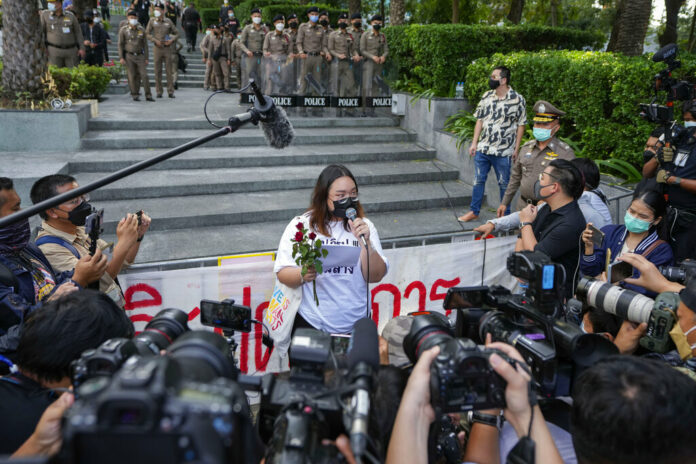
Opinion: How To Turn Thai Journalists Into PR Servants of the State

Pro-democracy activist Panusaya Sithijirawattanakul talks to the media after leaving the Constitutional Court where her protest activities came under legal review in Bangkok, Thailand, Wednesday, Nov. 10, 2021. Photo: Sakchai Lalit / AP

In a quasi-dictator’s wet dream, the ‘democratic’ state gets to decide who can become a journalist, who not, and what journalists cannot write about – basically turning them into public relations servants.

This is a dream that the regime of Gen. Prayut Chan-o-cha and his men have been dreaming of – and it is getting close to reality now. The Cabinet, led by Prayut, approved a bill to licensed, control, and punish the press on Tuesday. The draft law was penned by the government’s own Department of Public Relations, headed by no less than former junta spokesman Lt. Gen. Sansern Kaewkamnerd.

Here is how you can try to pull it off without anyone ‘suspecting’ that there’s anything fishy about it.

Step One: Obfuscate, use smoke screen, and euphemism. Named the bill with benign words like “Draft Media Ethics and Professional Standards Promotion Act.”

I mean, how could anyone oppose such a nice-sounding bill, right?

No one would have suspected that there is anything sinister about it. Trust them, they have done it before. After the May 2014 coup led by Prayut, the junta came up with the term “attitude adjustment” as a euphemism for detention without charge of its opponents, real or perceived, for up to seven days at a time.

I went through that treatment twice and the first time inside a military base in Ratchaburi province. Sansern even ‘visited’ along with a crew of army-controlled TV 5 cameraman to broadcast to the world that we were not being ill treated. He even greeted me by calling me “elder brother Pravit.”

Step Two: Get willing journalists on board to undermine the already low-level of press freedom by creating a “Press Profession Council” and reward them.

This will attain just enough veneer of respectability and independence among the proposed 11-people Press Profession Council. Under the bill, five out of 11 will be representatives from various media associations. Five more chosen from the pool experts and one to break the tie if there is a deep disagreement – from a state-sponsored media fund.

The five experts should not be a problem, the heavily pro-Prayut parliament can choose regime-friendly ‘experts’ to fill the quota. As for the five from media organizations – well, there is so many fly by night media associations out there and it would take a few hundred words to type the names of all of them here.

Even the big one like the Thai Journalists Association (TJA) has far less than half of media professionals as members. Also, TJA has a checkered history including one president who resigned to join a well-paid junta-appointed ‘National Reform Council’ (sounds familiar?) after the 2014 coup led by the same Prayut, who just gave the ceremonial nod to this press control bill.

Another past president was a staunch defender of the lese majeste law when he headed TJA and still is.

It should not be too difficult to find willing takers among journalists and media associations to serve the new proposed council – especially given the ‘prestige’ and remunerations commensurate with their expedient aspirations (and lack of press freedom principles).

Step Three: Introduce media licensing system, empower the proposed council the authority to grant and revoke license for journalists and media organizations on the pretext of maintaining “people’s good morals.”

The bill stated that while the press has freedom to report news, “the exercise of freedom must not go against Thai people’s duties or people’s good morals.” Then tasked the council with the job of coming up with ethical news reporting and commentary standards. Then voila! Problems solved.

Yes, “people’s good morals” – whatever that means. Do you know what it means? The term is so vague one could probably classified anything under the rubric of “people’s good morals” and branded anything as being against “people’s good morals.”

After all, one man’s morality is another man’s oppression. This will be the key criteria in granting, not granting, or revoking press licenses in the future if Prayut got his way.

Is reporting in detail and in an empathetic manner about the monarchy-reform movement go against people’s good morals? Probably yes, if you are an ultra-royalist or working for the Public Relations Department.

The same can be said about reporting empathetically about the ‘freedom fighters’ in Patani, the Deep South, branded by the state as separatists and even by some media today as “southern goons.”

So what is left to the state of Thai press freedom after the media control and licensing bill is passed into a law? Not much really. Real journalists will become rogue journalists while media lapdogs, or public relations officers wannabes, will be licensed as bonafide journalists.

This is nothing short of a declaration of war against press freedom in Thailand and the public’s right to be informed with diverse news and views.

Who is Prayut and Sanserm, his chief PR officer from the junta years till the present, think they are trying to fool?

Everyone apparently.

Advertisement

UKs Embattled Prince Andrew Loses Honorary Military Titles

FILE - Britain's Prince Andrew, the Duke of York, attends a memorial ceremony to mark the 75th anniversary of the liberation from German occupation in Bruges, Belgium, Saturday, Sept. 7, 2019. Photo: Olivier Matthys / AP File

LONDON (AP) — Prince Andrew has been stripped of his honorary military roles as the growing furor over allegations that he sexually abused a teenage girl trafficked by the late financier Jeffrey Epstein threatened to taint the House of Windsor.

Buckingham Palace said late Thursday that Queen Elizabeth II had also agreed that Andrew, 61, will give up his honorary leadership of various charities, known as royal patronages.

He will also no longer use the title “his royal highness″ in official settings, British media said.

The decision is an effort to insulate the monarchy from the fallout from potentially years of sordid headlines as Andrew vows to fight a lawsuit filed by an American woman, Virginia Giuffre, who alleges she was forced to have sex with the prince when she was 17. A New York judge on Wednesday rejected Andrew’s effort to have the suit dismissed, increasing the chances that he will have to testify in the case if it goes to trial.

“With The Queen’s approval and agreement, The Duke of York’s military affiliations and Royal patronages have been returned to The Queen,” the palace said, using the prince’s formal title. “The Duke of York will continue not to undertake any public duties and is defending this case as a private citizen.”

The move came after more than 150 veterans and serving members of the armed forces asked the queen to strip her second son of his military titles, saying he had failed to live up to the “very highest standards of probity, honesty and honourable conduct” that are expected of British officers.

“We understand that he is your son, but we write to you in your capacity as head of state and as Commander-in-Chief of the Army, Navy and Air Force,” they wrote in a letter released by Republic, a pressure group that campaigns for an end to the monarchy.

“These steps could have been taken at any time in the past eleven years. Please do not leave it any longer.”

Andrew served in the Royal Navy for two decades, including as a helicopter pilot during the 1982 Falklands War. The honorary military roles he lost included several overseas ones, such as his title as colonel-in-chief of the Royal New Zealand Army Logistic Regiment.

Andrew denies Giuffre’s allegations and has said he can’t recall ever meeting her.

He has spent years combatting concerns about his links with Epstein, the U.S. financier who died in 2019 while awaiting trial on child sex trafficking charges, and Epstein’s longtime companion Ghislaine Maxwell, who was convicted of related charges last month.

The prince stepped away from royal duties in November 2019 after a disastrous BBC interview in which he tried to justify his association with the pair and failed to show empathy for Epstein’s victims. But he managed to cling to his military titles and patronages until Wednesday’s ruling made Andrew’s position untenable.

Giuffre sued Andrew in August, alleging that Epstein and Maxwell coerced her into sexual encounters with the prince in 2001. Giuffre said she was sexually abused by Andrew at Maxwell’s London home, at Epstein’s New York mansion and his estate in the U.S. Virgin Islands.

On Wednesday, U.S. District Judge Lewis A. Kaplan rejected Andrew’s request to dismiss the lawsuit before trial. Lawyers for the prince had argued the terms of a 2009 settlement between Giuffre and Epstein barred her from suing anyone else associated with the case. Kaplan stressed that he wasn’t ruling on the truth of the allegations against Andrew.

Britain’s Press Association quoted a person close to Andrew as saying his team was “unsurprised by the ruling.”

“However, it was not a judgement on the merits of Ms. Giuffre’s allegations,” the person said. “This is a marathon not a sprint and the duke will continue to defend himself against these claims.”

But that is likely to have repercussions for other members of the royal family and the institution of the monarchy at a time when Elizabeth is preparing for a nationwide celebration to mark 70 years on the throne.

If the case goes to trial, Andrew will likely be required to give a sworn statement, and may have to testify in court about his relationships with Epstein, Maxwell and Giuffre. That could expose him to embarrassing questions that would undermine the authority of the royal family, said Mark Stephens, an expert on international law at Howard Kennedy in London.

“Up until now, it’s been Prince Andrew alone that has carried the water on this,” Stephens said.

“But now the issue is that he can make it much worse for the royal family when he has to get into the detail of what he was alleged to have done with a 17-year-old girl, which the public, whether it was lawful or not, are going to think was morally reprehensible.”

The decision Thursday increases the chances Andrew will do whatever he can to settle, Stephens said.

”If he’s not successful in his appeal, he’s going to have to settle because of realpolitik,” Stephens said.

___

Story: Danica Kirka and Sylvia Hui.

Advertisement

Supreme Court Halts COVID-19 Vaccine Rule for US Businesses

FILE - President Joe Biden meets with the White House COVID-19 Response Team on the latest developments related to the Omicron variant in the South Court Auditorium in the Eisenhower Executive Office Building on the White House Campus in Washington, Tuesday, Jan. 4, 2022. Photo: Andrew Harnik / AP File

WASHINGTON (AP) — The Supreme Court has stopped a major push by the Biden administration to boost the nation’s COVID-19 vaccination rate, a requirement that employees at large businesses get a vaccine or test regularly and wear a mask on the job.

At the same time, the court is allowing the administration to proceed with a vaccine mandate for most health care workers in the U.S. The court’s orders Thursday came during a spike in coronavirus cases caused by the omicron variant.

The court’s conservative majority concluded the administration overstepped its authority by seeking to impose the Occupational Safety and Health Administration’s vaccine-or-test rule on U.S. businesses with at least 100 employees. More than 80 million people would have been affected and OSHA had estimated that the rule would save 6,500 lives and prevent 250,000 hospitalizations over six months.

“OSHA has never before imposed such a mandate. Nor has Congress. Indeed, although Congress has enacted significant legislation addressing the COVID–19 pandemic, it has declined to enact any measure similar to what OSHA has promulgated here,” the conservatives wrote in an unsigned opinion.
In dissent, the court’s three liberals argued that it was the court that was overreaching by substituting its judgment for that of health experts. “Acting outside of its competence and without legal basis, the Court displaces the judgments of the Government officials given the responsibility to respond to workplace health emergencies,” Justices Stephen Breyer, Elena Kagan and Sonia Sotomayor wrote in a joint dissent.

President Joe Biden said he was “disappointed that the Supreme Court has chosen to block common-sense life-saving requirements for employees at large businesses that were grounded squarely in both science and the law.”

Biden called on businesses to institute their own vaccination requirements, noting that a third of Fortune 100 companies already have done so.

When crafting the OSHA rule, White House officials always anticipated legal challenges — and privately some harbored doubts that it could withstand them. The administration nonetheless still views the rule as a success at already driving millions of people to get vaccinated and encouraging private businesses to implement their own requirements that are unaffected by the legal challenge.

The OSHA regulation had initially been blocked by a federal appeals court in New Orleans, then allowed to take effect by a federal appellate panel in Cincinnati.

Both rules had been challenged by Republican-led states. In addition, business groups attacked the OSHA emergency regulation as too expensive and likely to cause workers to leave their jobs at a time when finding new employees already is difficult.

The National Retail Federation, the nation’s largest retail trade group, called the Supreme Court’s decision “a significant victory for employers.”

The vaccine mandate that the court will allow to be enforced nationwide scraped by on a 5-4 vote, with Chief Justice John Roberts and Justice Brett Kavanaugh joining the liberals to form a majority. The mandate covers virtually all health care workers in the country, applying to providers that receive federal Medicare or Medicaid funding. It affects 10.4 million workers at 76,000 health care facilities as well as home health care providers. The rule has medical and religious exemptions.

Biden said that decision by the court “will save lives.”

In an unsigned opinion, the court wrote: “The challenges posed by a global pandemic do not allow a federal agency to exercise power that Congress has not conferred upon it. At the same time, such unprecedented circumstances provide no grounds for limiting the exercise of authorities the agency has long been recognized to have.” It said the “latter principle governs” in the healthcare arena.

Justice Clarence Thomas wrote in dissent that the case was about whether the administration has the authority “to force healthcare workers, by coercing their employers, to undergo a medical procedure they do not want and cannot undo.” He said the administration hadn’t shown convincingly that Congress gave it that authority.

Justices Samuel Alito, Neil Gorsuch and Amy Coney Barrett signed onto Thomas’ opinion. Alito wrote a separate dissent that the other three conservatives also joined.

Decisions by federal appeals courts in New Orleans and St. Louis had blocked the mandate in about half the states. The administration already was taking steps to enforce it elsewhere.

More than 208 million Americans, 62.7% of the population, are fully vaccinated, and more than a third of those have received booster shots, according to the federal Centers for Disease Control and Prevention. All nine justices have gotten booster shots.

The courthouse remains closed to the public, and lawyers and reporters are asked for negative test results before being allowed inside the courtroom for arguments, though vaccinations are not required.

The justices heard arguments on the challenges last week. Their questions then hinted at the split verdict that they issued Thursday.

A separate vaccine mandate for federal contractors, on hold after lower courts blocked it, has not been considered by the Supreme Court.

___

Story: Mark Sherman and Jessica Gresko. Associated Press writer Zeke Miller contributed to this report.

Advertisement

Hot News

LATEST NEWS

Bangkok
overcast clouds
32.7 ° C
35 °
32.7 °
68 %
4kmh
99 %
Fri
30 °
Sat
31 °
Sun
35 °
Mon
36 °
Tue
37 °