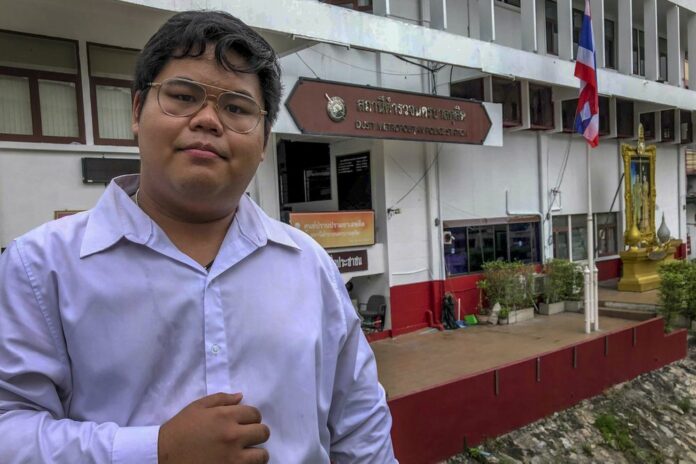
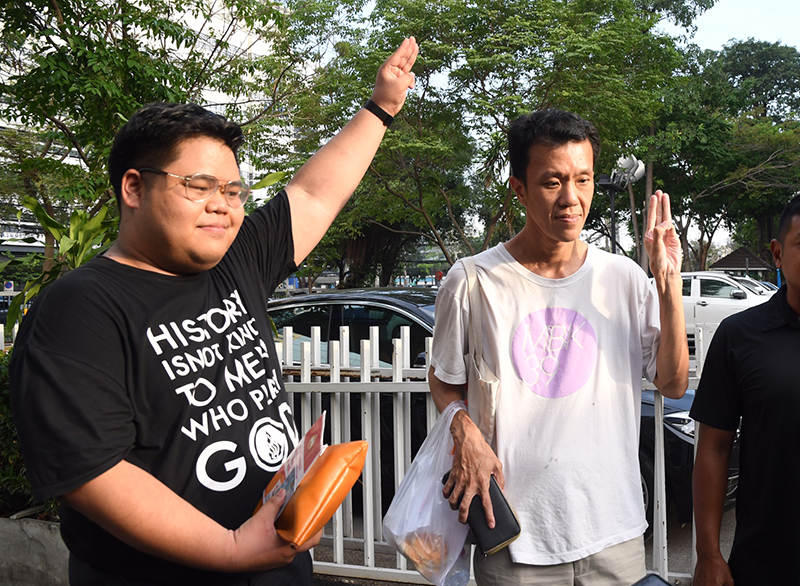
In this Oct. 16, 2020, file photo, activist Bunkueanun Paothong poses for a photo outside a police station in Bangkok, Thailand. (AP Photo/Jerry Harmer, File)
By Bunkueanun “Francis” Paothong
It is certainly chilling that it has been one year since I was charged with one of the rarest, and one of the most severe laws of this land. It was far from an ideal situation to find yourself in. Many in my family did not react well to the news. Despite the somber feelings all around, I soldiered on. And here I am now, writing this after a year of that confusing and terrifying incident, contemplating about life that has gone before, and what will be in store for the roads ahead.
One year ago, I joined one of the pro-democracy protests on October 14th, 2020. The objective was to occupy the Government House and force the Prime Minister to resign. I joined a group of friends, waiting for the main demonstration entourage at the Government House, not knowing that the Royal Motorcade that supposedly ‘passed’ through the protest would change my life from then on.
Looking back at that fateful hour, there was no telling what would happen, nobody knows, not even the lawyers at that moment. The law which I am charged with was practically never used in Thai history. And come to think of it, in a perverse way, I became part of history by being one of the first people that were charged by this law.
Bunkueanun “Francis” Paothong and Ekachai Hongkangwan on March 31, 2021.
Today, situations turned for the worst in a sense. Many of my fellow students were either incarcerated, or compelled to maintain their silence. Some soldiered on against the government, and others have sought exile in other places. Some have maintained their peaceful protests, others have taken measures to fight back themselves. The movement today was unrecognizable to the one we organized last year. One question remains at the back of my mind: “What’s next?”
This is the question that many of the student leaders, or the organizers, did not know the answers to. One fights for their own revolution in their own ways and many have their own ideas. In my view, I believe that each of us have the ability to effect change and revolutionize our country in their own ways. We have demonstrations and organizations fighting for democracy, but to make sure that this change will take root, the people have to demand and effect change in their own circles as well. White collar employees can definitely unionize and demand better pay, better care, and a safer workplace. Students can also demand their rights to better and safer colleges. Many can be the change they want to be around their places. It is apt to say that no one will fight for your rights better than you do. We have to fight for our own change, our own revolution.
It’s been a year since. I still have my own revolution to fight for. My own freedom from fear. Many are now fighting for their own revolution in jail. I am still here with the threat of going into one. I still, as many do, desire a better country, a better life, one that all of us can breathe, live and die as a free individual. There was no telling what would happen next. I could only hope that our people had not abandoned their hope just yet. Thailand is not yet lost.
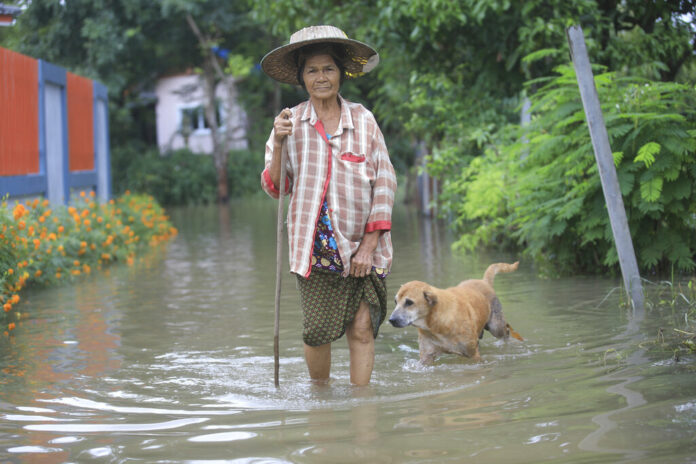
A woman wades through floodwaters in Nakhon Rachasima province, northeastern of Bangkok, Thailand, Monday, Oct. 18, 2021. Photo: Apimook Svanperthan / AP
BANGKOK (AP) — Heavy rains in central and northeastern Thailand caused new flooding on Monday, with authorities forced to release water into an already swollen river after a reservoir reached full capacity, and others facing the same possibility.
Authorities in the central province of Suphan Buri said flood warnings were in effect for communities along the Tha Chin River after water was released into it from the Krasiao reservoir.
More than 38,000 households have been affected by flooding in the province so far this year, according to the Suphan Buri governor’s office.
On Sunday, officials in the northeastern province of Nakhon Ratchasima alerted people living near a dam to closely monitor the situation, as water levels were rising quickly due to heavy rainfall. The local administration was ordered to prepare sandbags and evacuation plans.
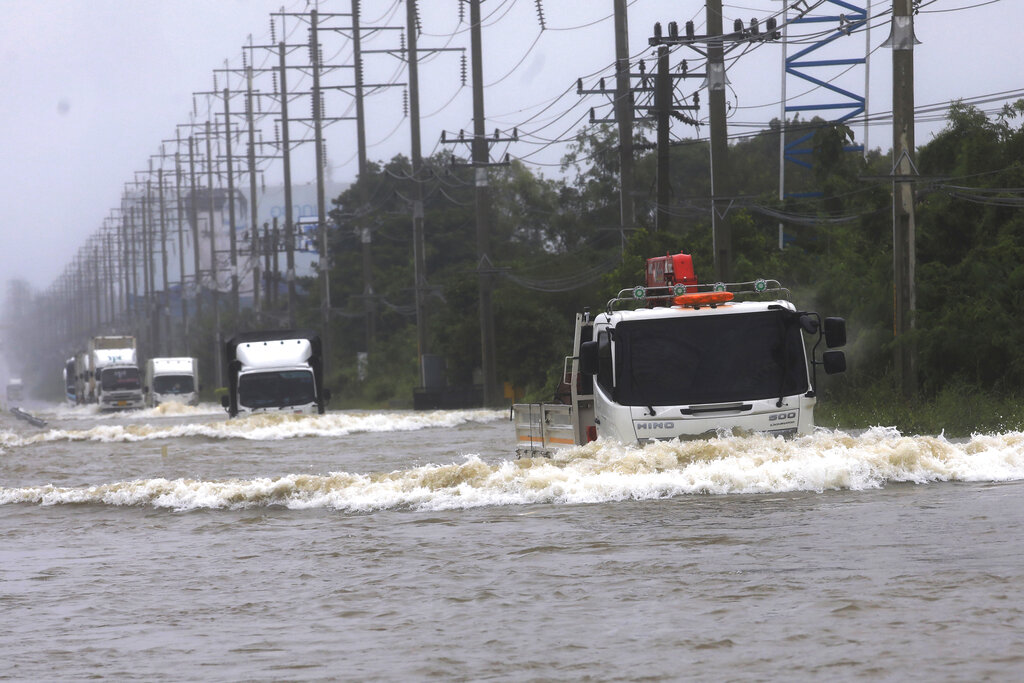
Trucks drive through flood waters in Nakhon Rachasima province, northeastern of Bangkok, Thailand, Monday, Oct. 18, 2021. Photo: Apimook Svanperthan / AP
Thailand has been hit by large-scale flooding since Tropical Storm Dianmu swept through the upper part of the country in the last week of September, along with seasonal monsoon rains. The floods, especially in the northern and central regions, impacted 300,000 households nationwide and caused 14 deaths in 33 provinces. The situation has eased in more than 24 provinces, according to the Department of Disaster Prevention and Mitigation.
Fears that Thailand’s capital, Bangkok, about 100 kilometers (60 miles) southeast of Suphan Buri, would be flooded as the water flowed downriver have so far not materialized. Bangkok is situated on the Chao Phraya River, whose headwaters are in the north. Dams and reservoirs store water to help farmers cope with dry season droughts, and can be quickly filled to capacity during the rainy season.
The capital, which experienced devastating floods in 2011, this year has suffered only normal rainy season flooding, which is largely attributed to inadequate drainage systems.
The Meteorological Department reported that monsoon conditions across the central and upper part of the northeast, and a strong southwest monsoon prevailing in the Andaman Sea off southern Thailand, would bring more rain in several provinces, mostly in the northeastern region.
It said parts of Thailand will continue to experience seasonal monsoon rains for the next 10 days.
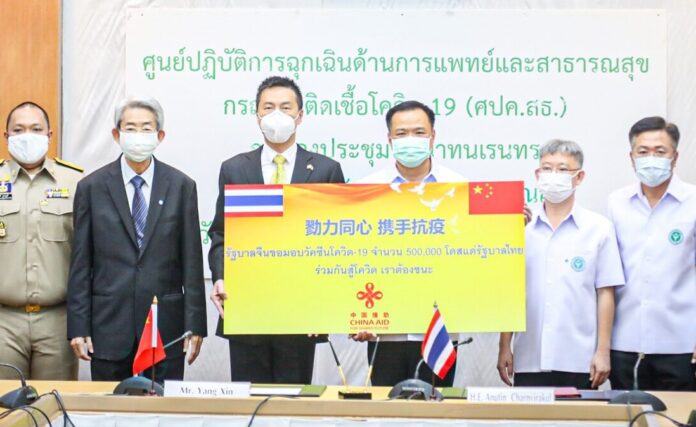
Public Health Minister Anutin Charnvirakul on May 17, 2021, presides over a ceremony to receive 500,000 doses of Sinovac vaccine donated by the Chinese government.
BANGKOK — The government said it will not place orders for further shipments of Sinovac vaccines once the current supply runs out later this month, since health authorities will now switch to a combination of AstraZeneca and Pfizer doses instead.
The decision to end the use of the China-made vaccine came after over 31.5 million Sinovac doses have been administered throughout the country. The last of Sinovac doses will likely be distributed by next week, Department of Disease Control director Opas Karnkawinpong said.
Sinovac was the first brand of COVID-19 vaccines to arrive in Thailand, back in February. The government originally said the shots will only be used on a limited number of frontline health workers and vulnerable groups, but Sinovac later became the primary type of vaccine in the national inoculation drive.
The reliance on Sinovac is partly driven by delays and production issues in locally manufactured AstraZeneca doses.
When AstraZeneca supplies became available, the Public Health Ministry adopted using Sinovac as the first dose and AstraZeneca as the second — the first country in the world to adopt such combination, though health officials defended the efficacy of the approach as scientifically valid.
The Department of Disease Control said the country now has sufficient supplies of vaccine available, especially AstraZeneca and Pfizer, so officials will now use those two types in the new mix-and-match policy.
According to the health ministry, Thailand will procure 120 million vaccine doses by next year, including 60 million doses of the locally manufactured AstraZeneca.
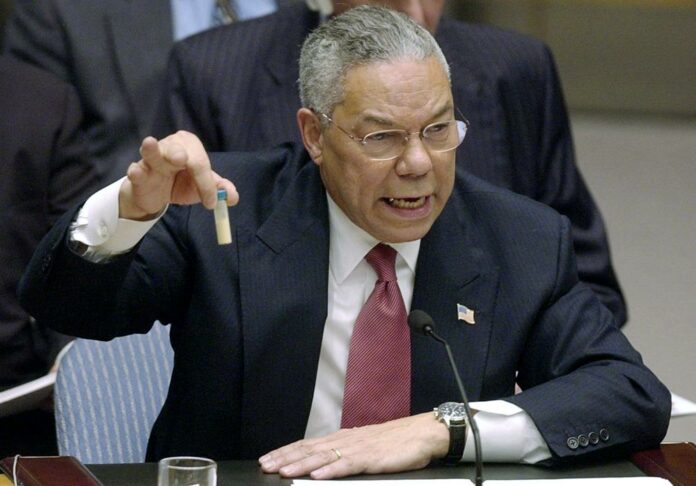
In this Feb. 5, 2003 file photo, Secretary of State Colin Powell holds up a vial he said could contain anthrax as he presents evidence of Iraq's alleged weapons programs to the United Nations Security Council. (AP Photo/Elise Amendola, File)
WASHINGTON (AP) — A child of working-class Jamaican immigrants in the Bronx, Colin Powell rose from neighborhood store clerk to warehouse floor-mopper to the highest echelons of the U.S. government. It was a trailblazing American Dream journey that won him international acclaim and trust.
It was that credibility he put on the line in 2003 when, appearing before the United Nations as secretary of state, he made the case for war against Iraq. When it turned out that the intelligence he cited was faulty and the Iraq War became a bloody, chaotic nightmare, Powell’s stellar reputation was damaged.
Still, it wasn’t destroyed. After leaving government, he became an elder statesman on the global stage and the founder of an organization aimed at helping young disadvantaged Americans. Republicans wanted him to run for president. After becoming disillusioned with his party, he ended up endorsing the last three Democratic presidential candidates, who welcomed his support.
For many Iraqis and others, Powell will forever be associated with that 2003 speech and the bloodshed that followed. But with Powell’s death Monday at 84 of COVID-19 complications, Republicans and Democrats remembered him as a historic figure, a groundbreaking soldier-turned-statesman, the first Black secretary of state and first Black chairman of the Joint Chiefs of Staff.
Powell rejected comparisons between himself and previous icons like George Marshall, the World War II general who became America’s top diplomat. But he embraced a local-kid-does-good narrative that reflected his humble roots.
He was fond of recalling his youth in the Bronx, working first as a clerk in a neighborhood store and then as a sweeper in the massive Pepsi-Cola plant directly across the East River from the United Nations headquarters, a job he frequently referred to in meetings at the United Nations. A geology student at City College of New York, Powell made clear that he found his calling in the Reserve Officer Training Corps or ROTC, which would initiate his 35-year career in the Army.
Powell served two tours in Vietnam and rose through the ranks with various stints in Cold War-era Europe before President Ronald Reagan tapped him as his national security adviser. President George H.W. Bush then appointed him chairman of the Joint Chiefs of Staff, where he oversaw the ouster of Saddam Hussein’s Iraq from Kuwait in 1991.
It was then that the “Powell Doctrine” emerged; it was a strategy for the use of American military power that relied on the deployment of overwhelming force and a clear and defined exit strategy from conflict.
Powell held the Joint Chiefs of Staff position into the Clinton administration, where he recalled arguments with Cabinet members over military intervention in the Balkans, which Powell believed was unwise.
“I thought I would have an aneurysm,” Powell wrote in a memoir about a White House incident in which then-U.S. Ambassador to the United Nations Madeleine Albright asked what good the armed forces are if they were never used. Powell ended up succeeding Albright as secretary of state in 2001.
And while his military career had taken him from the minefields of Vietnam to West Germany’s strategic Fulda Gap, it was his role as secretary of state in wartime that almost did him in.
Powell was the first of President George W. Bush’s Cabinet members to publicly blame Osama bin Laden for the Sept. 11, 2001 terrorist attacks and the first of Bush’s top national security aides to visit Pakistan, just a month later, to make clear to the Pakistanis that they must join the U.S.-led coalition or be labelled an enemy.
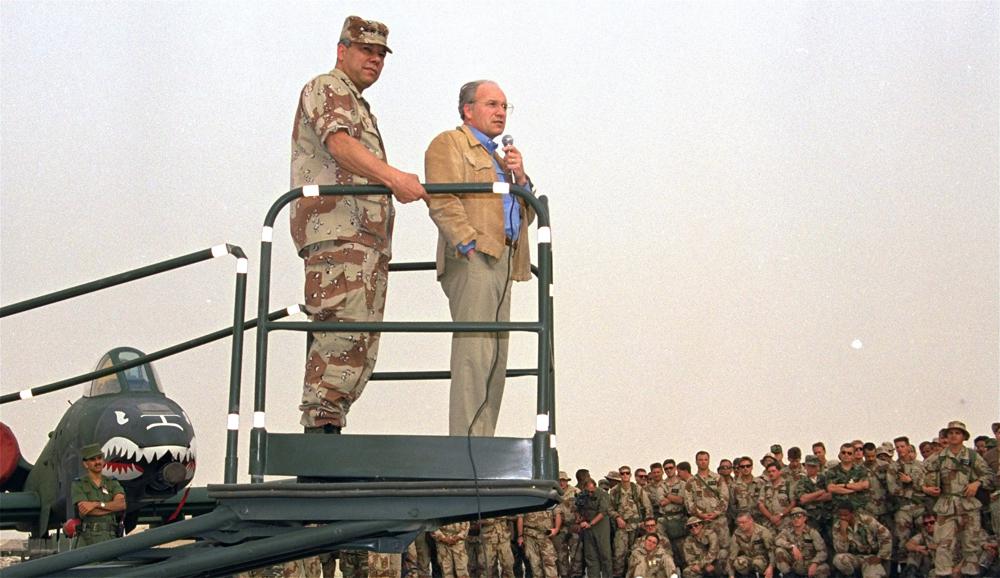
Secretary of Defense Dick Cheney, right, and Gen. Colin Powell, chairman of the Joint Chiefs of Staff, speak to members of the 354th Tactical Fighter Wing from Myrtle Beach, S.C. at their air base in Saudi Arabia Friday, Dec. 12, 1990. (AP Photo/Bob Daugherty, file)
Amid significant security concerns in the aftermath of 9/11, Powell flew to Islamabad, his plane blacked-out as it went into a corkscrew landing to avoid potential rocket strikes, to tell then-Pakistani President Pervez Musharraf that his support in the operation to avenge the attacks was non-negotiable. It worked, at least in the short-term.
Powell was personally skeptical of the 2003 Iraq invasion and cautioned against the war privately. But he dutifully presented the administration’s case for invasion not only in diplomatic meetings with his counterparts but also in the now-infamous speech before the U.N. Security Council in February 2003.
Confronted with widespread doubts about the accuracy of the American and British assessment of Saddam’s capabilities and intentions, many compared the stakes of Powell’s speech to be similar to those of former United Nations Ambassador Adlai Stevenson’s electrifying 1962 presentation to the council about the Soviet Union’s placement of missiles in Cuba.
In Powell’s speech — which he would later call a “blot” on his record — he brandished a vial that he said could have contained anthrax that intelligence agencies insisted Saddam was producing in mass quantities.
“Less than a teaspoon of dry anthrax, a little bit — about this amount,” he told the council, waving the vial. “This is just about the amount of a teaspoon. Less than a teaspoonful of dry anthrax in an envelope shut down the United States Senate in the fall of 2001.”
Some, including several critics of the Bush administration, believed Powell had hit the mark, but unlike Stevenson 41 years earlier, whatever convincing he accomplished was quickly erased.
No anthrax or, in fact, any weapons of mass destruction were found in Iraq after the end of the war, which led to a protracted U.S. military occupation of the country that many believe resulted in a broader destabilization of the Middle East, including the rise of the Islamic State, that persists to this day.
While he will always be associated with the Iraq War, Powell was not an unaccomplished diplomat. He oversaw the resolution of the Bush administration’s first foreign policy crisis, China’s force down of a Navy spy plane and the detention of its crew, and self-deprecatingly referred to successes in resolving a spat with Moscow over a Russian ban on U.S. chicken imports and an armed dispute between Morocco and Spain over a small Mediterranean island.
Powell was also critical in engineering an end to a standoff between Israel then Palestinian leader Yasser Arafat who had been blockaded in his Ramallah headquarters by Israeli troops during the second “intifada” or Palestinian uprising. And he was the first senior U.S. official to visit Afghanistan after the Taliban were ousted, flying into Kabul on a military plane in Jan. 2002, to meet with then-President Hamid Karzai.
Nonetheless, Powell’s biggest legacy at the State Department may be bureaucratic rather than diplomatic. A natural tinkerer who loved to collect and repair old Volvos and was a fan of the then-new Chrysler PT Cruiser, Powell pushed to bring the department’s antiquated computer and communications systems into the age of email and interoperability.
He fought budget battles to increase diplomatic spending and hiring and also led a successful drive to prevent the newly established Department of Homeland Security from entirely taking over the process of issuing visas, something that had been recommended in the wake of 9/11.
Unlike his predecessors and several successors as secretary of state, Powell was not enamored of foreign travel and spent less time overseas than almost any of America’s top diplomats since the dawn of the jet age, an aversion perhaps exacerbated by his unsuccessful behind-the-scenes attempts in Washington to blunt his Bush administration colleagues’ push for war with Iraq.
Personable and often approachable, Powell sought to assure his new employees that he would not be a burden on them in some of his first remarks to the diplomatic corps.
“I will be around to see you in due course,” he told his first town hall meeting. “I am an easy visitor. We are going to try to make it very easy for me to visit. Just to save a lot of cable traffic, I have no food preferences, no drink preferences. A cheeseburger will be fine. I like Holiday Inns, I have no illusions.”
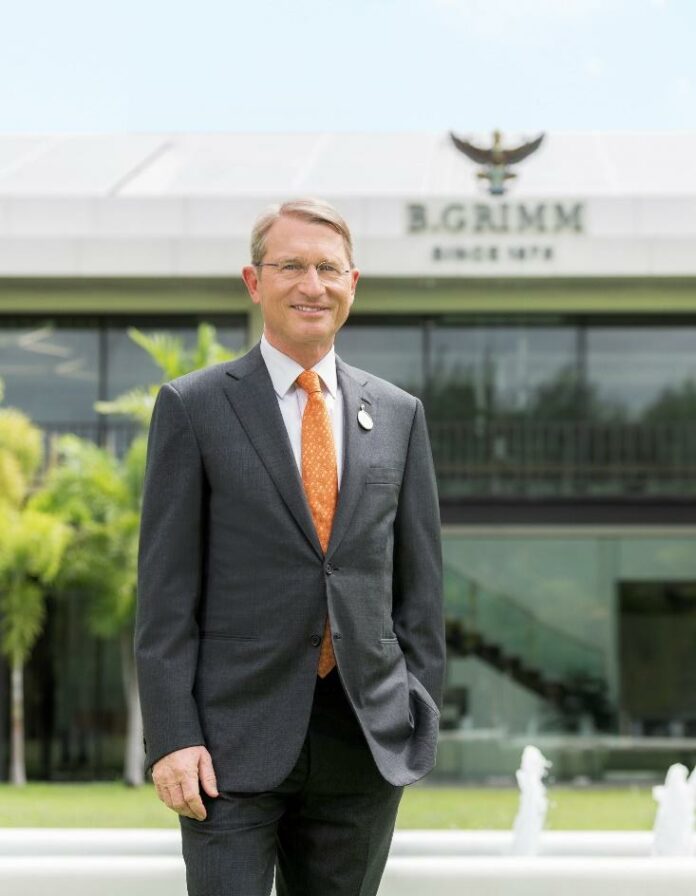
BANGKOK, October 2021: B.Grimm Power PCL (BGRIM) has maintained its leading position as a listed company with sustainable operations.
BGRIM, a Thailand’s leading industrial power producer, gained recognition from the Stock Exchange of Thailand (SET) as being “sustainable” in nature in the Resources group for 2021.
It is the fourth consecutive year that BGRIM has been honoured with the title in the Thailand Sustainability Investment (THSI)’s list of 146 companies on SET with sustainable business operations.
“The honour has once again underpinned our commitment to conducting business with responsibility for the environment, society, as well as the adherence to good corporate governance principles in line with sustainable development guidelines,” said Dr. Harald Link, Chairman and President of BGRIM.
In addition to being included in the THSI 2021 list, BGRIM has also earned awards from leading local and global organisations involving in promoting sustainability. This reinforces the business philosophy of B.Grimm group, the 143-year-old parent of BGRIM, in “Doing businesses with compassion” to benefit people, society and the environment.
The honours BGRIM has garnered so far this year include an A rating from the MSCI ESG Rating, being named a member of the FTSE4 Good Index Series for the second year in a row, and being part of ESG 100 group of securities from the Thaipat Institute for four consecutive years.
Dr. Link noted that in the midst of challenges both in terms of the economy and the crisis caused by the Covid-19 pandemic, BGRIM continues to operate its business with compassion. The company has applied the crisis management to deal with such hostile situations by leveraging on its experience and expertise in producing high-quality power and offering one-stop service.
In parallel, BGRIM is pursuing digital transformation to create long-term growth and value for all stakeholders. It is also driving towards becoming a net-zero carbon emissions organisation in 2050.
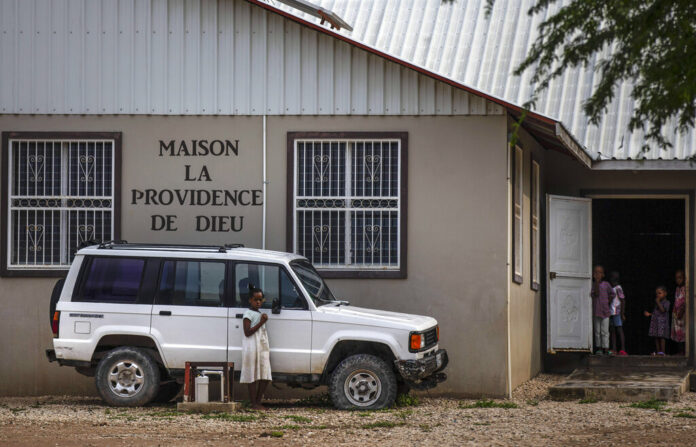
Children stand in the courtyard of the Maison La Providence de Dieu orphanage it Ganthier, Croix-des-Bouquets, Haiti, Sunday, Oct. 17, 2021, where a gang abducted 17 missionaries from a U.S.-based organization. Photo: Joseph Odelyn / AP
PORT-AU-PRINCE, Haiti (AP) — U.S. officials are working with Haitian authorities to try to secure the release of 12 adults and five children with a U.S.-based missionary group who were abducted over the weekend by a gang notorious for killings, kidnappings and extortion.
The group was snatched by the 400 Mawozo gang, which controls the Croix-des-Bouquets area east of the capital of Port-au-Prince, police inspector Frantz Champagne told The Associated Press on Sunday. The abduction happened Saturday in the community of Ganthier, which lies in the gang’s area. It was blamed for the kidnapping of five priests and two nuns earlier this year.
As authorities sought the release of the 16 Americans and one Canadian with the Ohio-based Christian Aid Ministries, local unions and other organizations expected to launch a strike Monday to protest Haiti’s worsening lack of security.
The Western Hemisphere’s poorest nation is again struggling with a spike in gang-related kidnappings that had diminished in recent months, after President Jovenel Moïse was fatally shot at his private residence on July 7 and a magnitude 7.2 earthquake killed more than 2,200 people in August.
“Everyone is concerned. They’re kidnapping from all social classes,” Méhu Changeux, president of Haiti’s Association of Owners and Drivers, told Magik9 radio station.
He said the work stoppage would continue until the government could guarantee people’s safety.
The kidnapping of the missionaries came just days after high-level U.S. officials visited Haiti and promised more resources for Haiti’s National Police, including another $15 million to help reduce gang violence, which this year has displaced thousands of Haitians who now live in temporary shelters in increasingly unhygienic conditions.
The U.S. State Department said Sunday that it was in regular contact with senior Haitian authorities and would continue to work with them and interagency partners.
“The welfare and safety of U.S. citizens abroad is one of the highest priorities of the Department of State,” the agency said in a statement.
Christian Aid Ministries said the kidnapped group included seven women, five men and five children, including a 2-year-old. The organization said they were taken while on a trip to visit an orphanage.
“Join us in praying for those who are being held hostage, the kidnappers and the families, friends and churches of those affected,” Christian Aid Ministries said in a statement. “As an organization, we commit this situation to God and trust him to see us through.”
An annual report issued last year by Christian Aid Ministries said its American staffers had returned to their base in Haiti after a nine-month absence “due to political unrest” and noted the “uncertainty and difficulties” that arise from such instability.
Nearly a year ago, Haitian police issued a wanted poster for the alleged leader of the 400 Mawozo gang, Wilson Joseph, on charges including murder, attempted murder, kidnapping, auto theft and the hijacking of trucks carrying goods. He goes by the nickname “Lanmò Sanjou,” which means “death doesn’t know which day it’s coming.”
Amid the spike in kidnappings, gangs have demanded ransoms ranging from a couple of hundred dollars to more than $1 million, sometimes killing those they have abducted, according to authorities.
At least 328 kidnappings were reported to Haiti’s National Police in the first eight months of 2021, compared with a total of 234 for all of 2020, said a report last month by the United Nations Integrated Office in Haiti.
Gangs have been accused of kidnapping schoolchildren, doctors, police officers, busloads of passengers and others as they grow more powerful. In April, a man who claimed to be the leader of 400 Mawozo told a radio station that it was responsible for kidnapping five priests, two nuns and three relatives of one of the priests that month. They were later released.
The spike in kidnappings and gang-related violence has forced Haitians to take detours around certain gang-controlled areas while others opt to stay home, which in turn means less money for people like Charles Pierre, a moto taxi driver in Port-au-Prince who has several children to feed.
“People are not going out in the streets,” he said. “We cannot find people to transport.”
___
Story: Dánica Coto and Evens Sanon. Coto reported from San Juan, Puerto Rico. Associated Press videographer Pierre-Richard Luxama in Port-au-Prince and AP writers Matthew Lee in Washington and Matt Sedensky in New York contributed to this report.
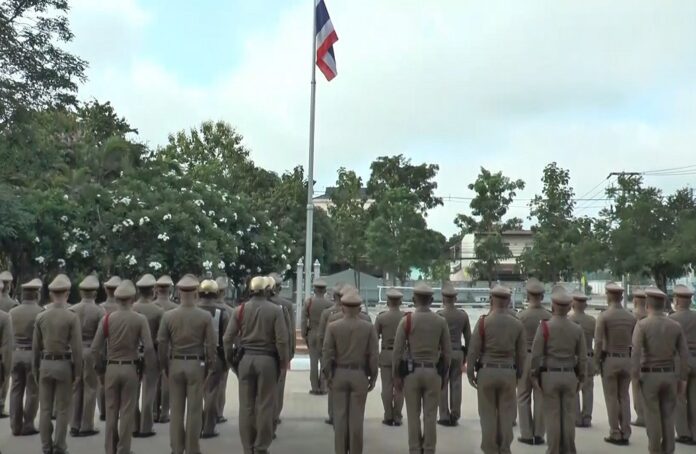
Police officers attend the morning flag-raising ceremony in Uthai Thani province on May 28, 2019.
BANGKOK — A police station in Samut Prakan province sought to encourage local residents to attend the daily flag-raising ceremony alongside the officers, an initiative described by a police spokesman as a way to instill a sense of patriotism.
However, the spokesman also said the order has now been withdrawn, citing “miscommunication.” His move came after the document issued by Samut Prakan City Police Station went viral on social media last week, drawing much ridicule and criticism.
According to the letter, which was posted on Facebook, each police officer on patrol duty was told to invite two residents they’re familiar with to join the National Flag raising ceremony at the police station. The ceremony takes place at 8am every morning, as in all public venues.
The project was supposed to come into effect on Oct. 15, the letter said.
But police spokesman Yingyot Themchamnong told reporters on Saturday that the station has since canceled its invitation, due to “miscommunication,” but did not elaborate.
However, Pol. Maj. Yingyot insisted the program was created out of a goodwill to encourage public participation in police work, and to instill “love for the Nation, Religions, and Monarchy.”
Attending the flag-raising ceremony would also allow local residents to learn about important announcements from the police and feel that their neighborhood is safe, Yingyot said.
He did not say whether the initiative would make a return in the future.
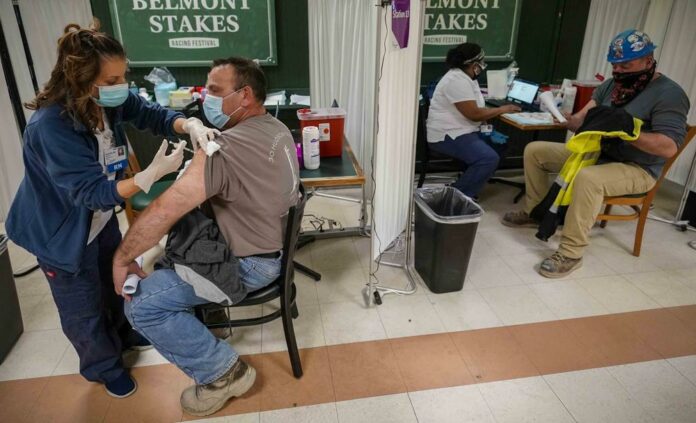
In this April 14, 2021, file photo, a Northwell Health nurses vaccinates Local 28 sheet metal workers with the first dose of the Pfizer COVID-19 vaccine in Elmont, N.Y. (AP Photo/Mary Altaffer, File)
WASHNGTON — Dr. Anthony Fauci is saying Sunday that it is “really unfortunate” that Gov. Greg Abbott has moved to ban vaccine mandates in the state of Texas.
The nation’s leading infectious disease doctor, speaking on Fox News Sunday, said that the Republican governor’s decision to block businesses from requiring inoculations would damage public health since vaccines are the “most effective means” to stop the spread of COVID-19.
Fauci was largely encouraged by the downward trend of coronavirus hospitalizations and deaths across the nation and suggested that vaccinated individuals could have a normal holiday season with others who have received the shot. But he said that those who have not been vaccinated should continue to avoid gatherings and should wear a mask.
He also suggested that those who received a shot of the Johnson and Johnson vaccine would likely have flexibility to get a booster from either Moderna or Pfizer. The FDA advisory panel ruled last week that anyone 18 and up who had the J&J shot was eligible to get a booster.
In this Oct. 7, 2021, file photo taken from video footage released by Roscosmos Space Agency, actress Yulia Peresild, left, film director Klim Shipenko, center, and cosmonaut Anton Shkaplerov speak with the Moscow Mission Control Center from the International Space Station, ISS. Photo: Roscosmos Space Agency via AP, File
MOSCOW (AP) — A Soyuz space capsule carrying a cosmonaut and two Russian filmmakers has landed after a 3 1/2-hour trip from the International Space Station.
The capsule, descending under a red-and-white striped parachute after entering Earth’s atmosphere, landed upright in the steppes of Kazakhstan on schedule at 0435 GMT Sunday with Oleg Novitskiy, Yulia Peresild and Klim Shipenko aboard.
Actress Peresild and film director Shipenko rocketed to the space station on Oct. 5 for a 12-day stint to film segments of a movie titled “Challenge,” in which a surgeon played by Peresild rushes to the space station to save a crew member who needs an urgent operation in orbit. Novitskiy, who spent more than six months aboard the space station, is to star as the ailing cosmonaut in the movie.
After the landing, which sent plumes of dust flying high in the air, ground crews extracted the three space flyers from the capsule and placed them in seats set up nearby as they adjusted to the pull of gravity. They then will be taken to a medical tent for examination.
All appeared healthy and cheerful. Peresild smiled and held a large bouquet of white flowers as journalists clustered around her.
Seven astronauts remain aboard the space station: Russia’s Anton Shkaplerov and Pyotr Dubrov; Americans Mark Vande Hei, Shane Kimbrough and Megan McArthur; Thomas Pesquet of the European Space Agency; and Japan’s Aki Hoshide.
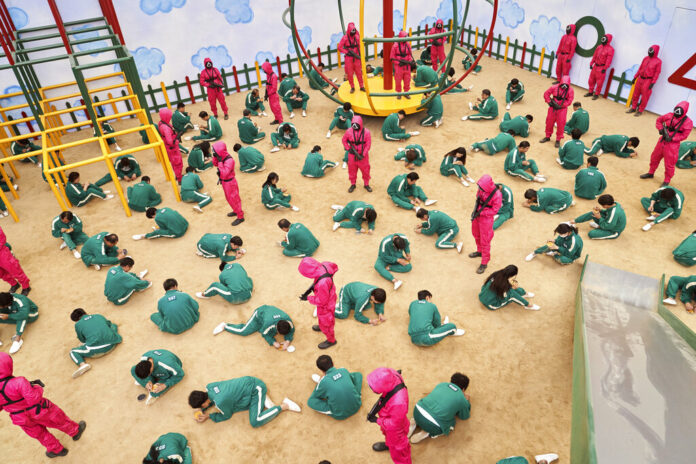
This undated photo released by Netflix shows a scene of contestants vying to win the Dalgona Korean candy challenge in a scene from "Squid Game." Photo: Youngkyu Park / Netflix via AP
The Thai state always tries to not just censor what they see is unfit for public consumption and it is literally keeping the public from maturing and becoming self-reliant. That suits them very well.
The latest is a warning by police spokesman Col. Kissana Phattanacharoen on Monday that watching the popular Korean series “Squid Game” could drive viewers to commit crimes and suggests the government may attempt to censor the Netflix series.
“It may lead to imitation, cause viewers to have violent behavior, or result in viewers to imagine that they are in similar situations shown in the series,” Kissana was quoted as saying, adding that parents or “guardians” should “exercise control and monitor the use of social media and entertainment” of young people.
Note the key words: “guardian”, “control” and “monitor.” This unconsciously sums up what the Thai state has been doing to not just to “control” young populations but adults as well.
The Thai state tries to exert control through censorship and surveillance and think of themselves as the guardian of the people.
The anachronistic lese-majeste law aside, with over 140 people charged so far, many were young Thais activists, we see censorship on other domains of our daily life as well.
Those watching Thai television for a period of time would not fail to notice that any graphic display of alcoholic drinks, cigarette smoking and nudity have to be blurred. “Smoking is detrimental to one’s health,” a typical text would warn television viewers. “Drinking is detrimental to one’s health and reduces awareness.”
The same goes with gambling. There’s a warning text telling viewers that gambling is illegal. Knives and guns are also blurred and violent scenes come with a warning that it’s illegal should not to be imitated.
Even arts is no exception. On Friday, 40 fine arts students at Chiang Mai University, a public university, petition the University President after its art works were denied from being displayed at the university’s art center as the faculty of fine arts deemed some of the works “political and against good morals.” The students hang a banner in Thai saying, “What’s Art Without Freedom?” Some of these students support anti-government and monarchy-reform movement.
Is the state trying too hard to protect us from these “vices” and “wrong information” about the monarchy or they are just trying to protect themselves by controlling us and our access to news, information and even entertainment? The latter is more likely.
Censorship is a slippery road. The next thing you know, too much has been censored and those making the decision are not accountable. This is an asymmetrical power relationship. Censorship will not make society more mature but less. By allowing, or calling for higher power to censor what we can read, watch, or hear – we are abandoning our right to decide for ourselves what’s true or false, good or evil, differentiate fact from fiction, real from fake news.
Abandoning your individual right and agency to examine and differentiate good from evil, real news from fake news by yourself, is tantamount to abandoning your right to be your own master – to let others decide what you can or cannot read or watch. You abdicate your responsibility as an active citizen and passively wait for the state or the mainstream mass media to decide on your behalf. That’s why social media, on online contents including some Netflix contents are deemed as a threat by the state.
The state (and to certain extent the mainstream press) feel they’re losing control if they do not continue to exert a power to control what content we can, or should, read or watch. Yes, social media is like a double-edge sword, like the dark side of “greedy” Facebook now fiercely debated abroad.
Collectively, we need to learn to be more savvy in the use of social media and in watching contents like Squid Game competently. Violent content, hate speech, alternative content about the monarchy – all these cannot unduly influence us if we are media literate and mindful.
We should be our own gate keeper and not let the state or the mainstream press decide for us what’s fit to be read or watched. In the 21th century, in the era of social media, Netflix, Twitter, Instagram, Tik Tok and Facebook Live, all of us should learn to be our own gatekeeper. It may be demanding but this is for the best of our society. Citizens will become more mature, less dependent and less under control of the state and the mainstream press. This is what we all should strive for if we want a more mature Thai society.
As for police spokesman Kissana, please kindly tell him to mind his own business.