
























34.4 C
Bangkok
Monday, June 8, 2026
Home Blog Page 1037

Paralympic Closing Marks End of Tokyo’s 8-Year Olympic Saga

Fireworks are set off around the Olympic Stadium during the closing ceremony of the Tokyo 2020 Paralympic Games in Tokyo, Japan, Sunday, Sept. 5, 2021. Photo: Joe Toth for OIS via AP

TOKYO (AP) — The final act of the delayed Tokyo Olympics and Paralympics came Sunday, almost eight years to the day after the Japanese capital was awarded the Games.

The Paralympics ended a 13-day run in a colorful, circus-like ceremony at the National Stadium overseen by Crown Prince Akishino, the brother of Emperor Naruhito. The Olympics closed almost a month ago.

These were unprecedented Olympics and Paralympics, postponed for a year and marked by footnotes and asterisks. No fans were allowed during the Olympics, except for a few thousand at outlying venues away from Tokyo. A few thousand school children were allowed into some Paralympic venues.

“There were many times when we thought these games could not happen,” Andrew Parsons, president of the International Paralympic Committee, said on Sunday. “There were many sleepless nights.”

The closing ceremony was entitled “Harmonious Cacophony” and involved both able-bodied actors and others with disabilities. The theme was described by organizers as a “world inspired by the Paralympics, one where differences shine.”

Like the Olympics, the Paralympics went ahead as Tokyo was under a state of emergency due to the pandemic. Like the Olympics, testing athletes frequently and isolating them in a bubble kept the virus largely at bay, though cases surged among a Japanese population that is now almost 50% fully vaccinated.

“I believe that we have reached the end of games without any major problems,” said Seiko Hashimoto, the president of the Tokyo organizing committee.

But there was fallout, however. Lots of it.
AP21248435187675
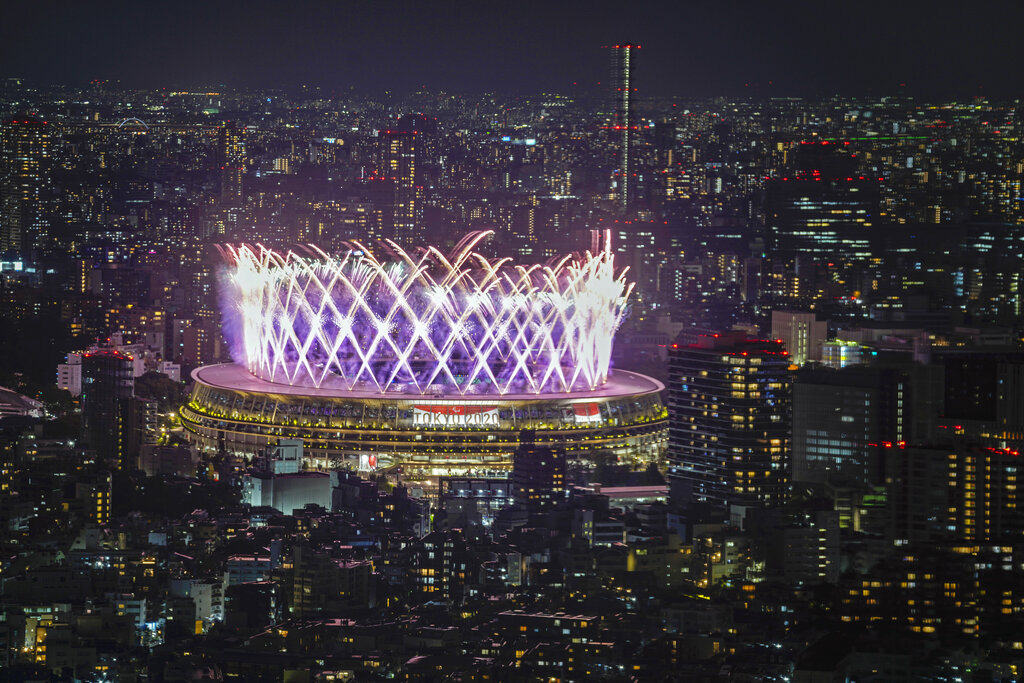
Fireworks illuminate over National Stadium viewed from Shibuya Sky observation deck during the closing ceremony for the 2020 Paralympics in Tokyo, Sunday, Sept. 5, 2021. Photo: Kiichiro Sato / AP

Japanese Prime Minister Yoshihide Suga announced Friday — two days before the closing — that he would not continue in office. Suga hoped to get a reelection bump from the Olympics. He got the opposite as his approval rating plummeted after a slow vaccine rollout in Japan, and a contentious decision to stage the Games during the pandemic.

Suga succeeded Shinzo Abe, who resigned a year ago for health reasons. It was Abe who celebrated in the front row of a Buenos Aires hotel ballroom on Sept. 7, 2013, when then-IOC President Jacques Rogge announced Tokyo as the 2020 host — ahead of Istanbul and Madrid.

In a sad coincidence, Rogge died a week ago at 79 after being in poor health.

“Now that Prime Minister Suga is forced out, taking the blame for his failure to combat the coronavirus, it would be impossible to claim that the Olympics and Paralympics were successful, a unifying moments for Japan,” Koichi Nakano, a political scientist at Sophia University, wrote in an email to The Associated Press.

The Paralympics may leave a more tangible legacy in Japan than the Olympics, raising public awareness about people with disabilities and the provision of accessible public space.

The Paralympics involved a record number of athletes — 4,405 — and a record number of countries won medals. They also saw two athletes from Afghanistan compete, both of whom arrived several days late after fleeing Kabul.

“The Tokyo Games were a model of efficiency and friendliness,” Olympic historian David Wallechinsky said in an email to The Associated Press. “If it hadn’t been for the COVID-related difficulties, these would be right at or near the top of the best-organized of the 19 Olympics — Summer and Winter — I have attended.”

The costs also set records.

study by the University of Oxford found these to be the most expensive Games on record. Japan officially spent $15.4 billion to organize the Olympics and Paralympics, double the original estimate. Several government audits suggested the real costs are twice that. All but $6.7 billion is public money.

The pandemic probably cost organizers almost $800 million in lost ticket sales, a budget shortfall that will have to be made up by more government funds. In addition, local sponsors contributed more than $3 billion to the operating budget, but got little return with few fans.
AP21248415009006
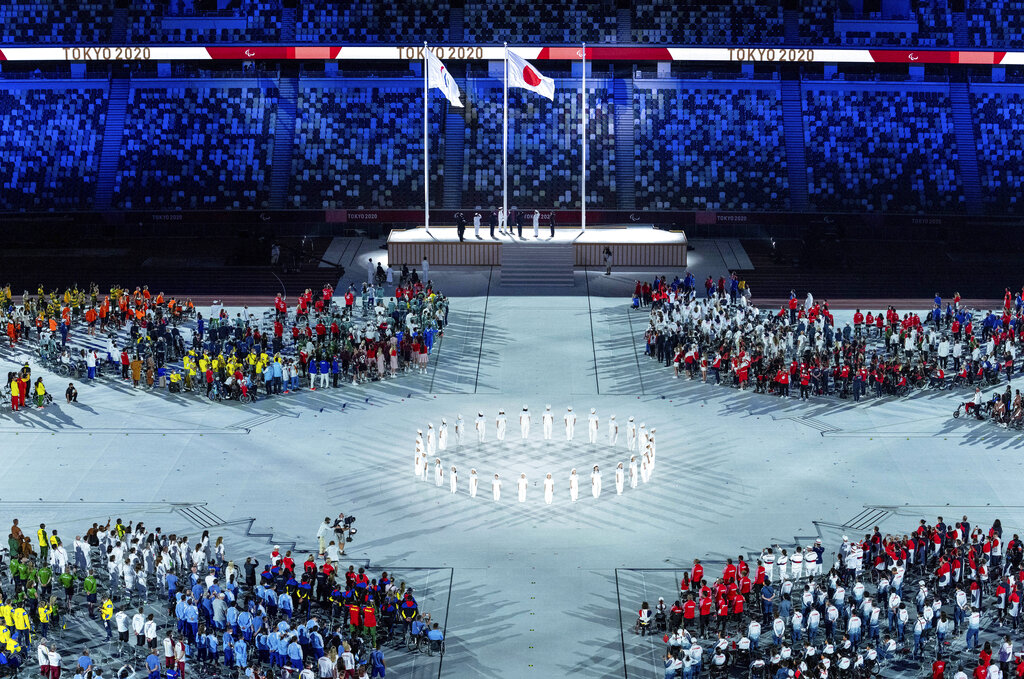
Members of the Japan Self-Defense Forces hoist the Japanese flag, center back, during the closing ceremony of the Tokyo 2020 Paralympic Games in Tokyo, Japan, Sunday, Sept. 5, 2021. Photo: Joe Toth for OIS via AP

Toyota, a major Olympics sponsor, pulled its Games-related television advertising in Japan because of public opposition to the Games.

Toshiro Muto, the CEO of the organizing committee and a former deputy governor of the Bank of Japan, framed the costs as an investment. He acknowledged that it’s difficult to sort out what are — and what are not — Olympic costs.

“It has to be scrutinized further to segregate which part is investment and which part is expenditure,” Muto said in an interview last week. “It’s difficult to define the difference.”

Tokyo was also haunted by a vote-buying scandal during the bid process that forced the resignation 2 1/2 years ago of Japanese Olympic Committee president Tsunekazu Takeda. He was also an International Olympic Committee member.

Next up are the Beijing Winter Olympics, opening in five months. They have been billed as the “Genocide Games” by rights groups that want the Games pulled from China because of the reported internment of at least 1 million Uyghurs and other largely Muslim ethnic groups in Xinjiang in northwestern China.

The US Department of State and several other governments have called the human rights violations in Xinjiang a genocide, and one major IOC sponsor — Intel — has said it agrees with the characterization.

AP21248479689944
The mayor of Paris, Anne Hidalgo, waves the Paralympic flag during the closing ceremony for the 2020 Paralympics at the National Stadium in Tokyo, Sunday, Sept. 5, 2021. Photo: Shuji Kajiyama / AP

“The COVID-related restrictions that were imposed in Tokyo are like a dream come true for the Chinese dictatorship,” Wallechinsky said. “No foreign spectators, fewer foreign media; just what the Communist Party leadership would want. Will athletes protest, and if they do, what will the Chinese do? Deport them? Arrest them? We don’t know.”

The IOC, which pushed for Tokyo to go ahead and generated about $3 billion-$4 billion in television income, has already lined up the next three Summer Olympics; Paris in 2024, Los Angeles in 2028, and Brisbane, Australia, in 2032.

The Winter Olympics after Beijing are in Milan-Cortina in Italy in 2026.

“I believe the IOC has to be greatly relieved that the next Games will be in France, Italy and the United States,” Wallechinsky said. “Both Paris and Los Angeles are cities with venues and infrastructure that are already well in place.”

Hashimoto, the head of the organizing committee, indicated Sunday that Sapporo would bid for the 2030 Winter Olympics. It was the host city in 1972.

“For 2030, Sapporo will definitely become a candidate,” Hashimoto said. “I would hope this would become a reality.”

Story: Stephen Wade
Advertisement

Taliban Special Forces Bring Abrupt End to Women’s Protest

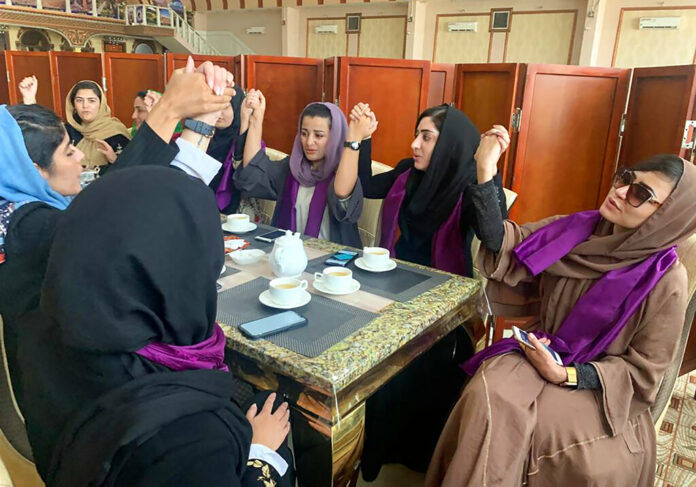
Women gather to demand their rights under the Taliban rule during a protest in Kabul, Afghanistan, Saturday, Sept. 4, 2021. Photo: Kathy Gannon / AP

KABUL, Afghanistan (AP) — Taliban special forces in camouflage fired their weapons into the air Saturday, bringing an abrupt and frightening end to the latest protest march in the capital by Afghan women demanding equal rights from the new rulers.

Also on Saturday, the chief of Pakistan’s powerful intelligence agency, which has an outsized influence on the Taliban, made a surprise visit to Kabul.

Taliban fighters quickly captured most of Afghanistan last month and celebrated the departure of the last U.S. forces after 20 years of war. The insurgent group must now govern a war-ravaged country that is heavily reliant on international aid.

The women’s march — the second in as many days in Kabul — began peacefully. Demonstrators laid a wreath outside Afghanistan’s Defense Ministry to honor Afghan soldiers who died fighting the Taliban before marching on to the presidential palace.

“We are here to gain human rights in Afghanistan,” said 20-year-old protester Maryam Naiby. “I love my country. I will always be here.”

As the protesters’ shouts grew louder, several Taliban officials waded into the crowd to ask what they wanted to say.

Flanked by fellow demonstrators, Sudaba Kabiri, a 24-year-old university student, told her Taliban interlocutor that Islam’s Prophet gave women rights and they wanted theirs. The Taliban official promised women would be given their rights but the women, all in their early 20s, were skeptical.

As the demonstrators reached the presidential palace, a dozen Taliban special forces ran into the crowd, firing in the air and sending demonstrators fleeing. Kabiri, who spoke to The Associated Press, said they also fired tear gas.

The Taliban have promised an inclusive government and a more moderate form of Islamic rule than when they last ruled the country from 1996 to 2001. But many Afghans, especially women, are deeply skeptical and fear a roll back of rights gained over the last two decades.

For much of the past two weeks, Taliban officials have been holding meetings among themselves, amid reports of differences among them emerging. Early on Saturday, neighboring Pakistan’s powerful intelligence chief Gen. Faiez Hameed made a surprise visit to Kabul. It wasn’t immediately clear what he had to say to the Taliban leadership but the Pakistani intelligence service has a strong influence on the Taliban.

The Taliban leadership had its headquarters in Pakistan and were often said to be in direct contact with the powerful Inter-Services Intelligence agency. Although Pakistan routinely denied providing the Taliban military aid, the accusation was often made by the Afghan government and Washington.

Faiez’ visit comes as the world waits to see what kind of government the Taliban will eventually announce, seeking one that is inclusive and ensures protection of women’s rights and the country’s minorities.

The Taliban have promised a broad-based government and have held talks with former president Hamid Karzai and the former government’s negotiation chief Abdullah Abdullah. But the makeup of the new government is uncertain and it was unclear whether hard-line ideologues among the Taliban will win the day — and whether the rollbacks feared by the demonstrating women will occur.

Taliban members whitewashed murals Saturday that promoted health care, warned of the dangers of HIV and even paid homage to some of Afghanistan’s iconic foreign contributors, like anthropologist Nancy Dupree, who singlehandedly chronicled Afghanistan’s rich cultural legacy. It was a worrying sign of attempts to erase reminders of the past 20 years.

The murals were replaced with slogans congratulating Afghans on their victory.

A Taliban cultural commission spokesman, Ahmadullah Muttaqi, tweeted that the murals were painted over “because they are against our values. They were spoiling the minds of the mujahedeen and instead we wrote slogans that will be useful to everyone.”

Meanwhile, the young women demonstrators said they have had to defy worried families to press ahead with their protests, even sneaking out of their homes to take their demands for equal rights to the new rulers.

Farhat Popalzai, another 24-year-old university student, said she wanted to be the voice of Afghanistan’s voiceless women, those too afraid to come out on the street.

“I am the voice of the women who are unable to speak.” she said. “They think this is a man’s country but it is not, it is a woman’s country too.”

Popalzai and her fellow demonstrators are too young to remember the Taliban rule that ended in 2001 with the U.S.-led invasion. The say their fear is based on the stories they have heard of women not being allowed to go to school and work.

Naiby, the 20-year-old, has already operated a women’s organization and is a spokesperson for Afghanistan’s Paralympics. She reflected on the tens of thousands of Afghans who rushed to Kabul’s Hamid Karzai International Airport to escape Afghanistan after the Taliban overran the capital on Aug. 15.

“They were afraid,” but for her she said, the fight is in Afghanistan.

Story: Kathy Gannon

Advertisement

Prayut Prevails Over Parliamentary Censure Motion

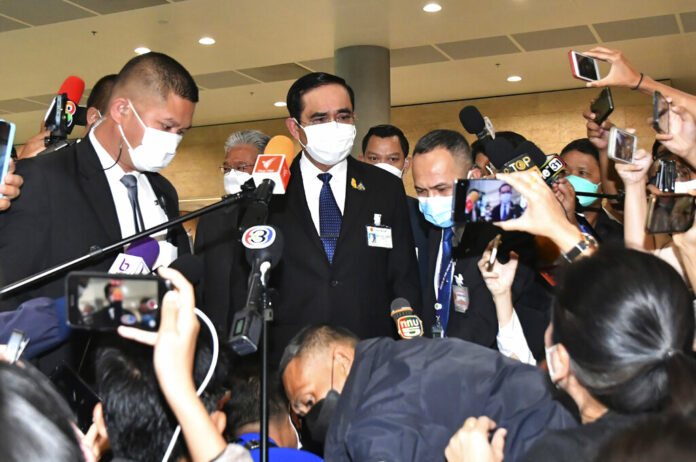
Thailand Prime Minister Prayuth Chan-ocha talks to reporters at parliament after a confidence vote on himself and five members of his Cabinet in Bangkok, Thailand, Saturday, Sept. 4, 2021. Photo: Sompong Sonnak / AP

BANGKOK (AP) — Thai Prime Minister Prayuth Chan-ocha won votes of confidence in Parliament on Saturday, helping to steady his government after it had come under intense criticism for bungling its response to the coronavirus pandemic.

Prayuth still faces pressure from street protests that have been demanding he step down. Pro-democracy activists opposing his policies have been seeking his resignation since last year and stepped up their efforts in recent weeks.

Major, though not huge, rallies were held this past week in defiance of limits on public gatherings as a virus-fighting measure, and another was scheduled for later Saturday, with organizers vowing to continue until he gets out of office.

Arriving at Parliament ahead of the voting on the censure motions against him and five members of his Cabinet, Prayuth had declared to reporters: “I am confident every day.” Asked if there will be a Cabinet reshuffle soon, he said, “It’s not time yet.”

Prayuth prevailed by a comfortable margin in the House of Representatives, with support from 264 lawmakers showing only a few defections from the 271 members of his ruling coalition, despite intense rumors of a plot among them to force him out.

There were 208 votes in support of the motion, 34 short of the 242 simple majority of the 482 total members the Opposition needed to succeed.

During four previous days of debate, little attention had been given to the details of the Opposition’s harsh accusations that Prayuth’s administration had botched the coronavirus response, countenanced corruption and mismanaged the economy.

AP21247113701369
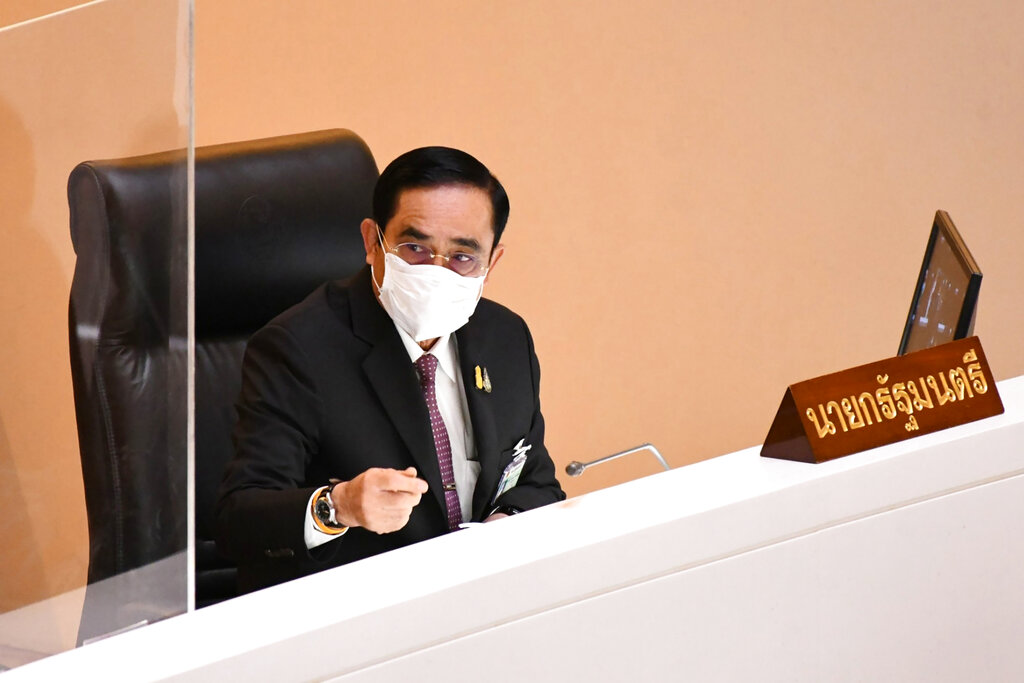
In this Tuesday, Aug. 31, 2021, file photo released by Public Relations Dpt. Lower House, Thailand’s Prime Minister Prayuth Chan-ocha arrives at the parliament in Bangkok, Thailand. Photo: Public Relations Dpt. Lower House via AP

Thai media were instead abuzz with rumors that the secretary-general of the ruling, military-backed Palang Pracharath party, which put together the coalition government that named Prayuth prime minister two years ago, was leading the effort to unseat him and pull the main opposition Pheu Thai party into the coalition.

There was no public confirmation of the rumors, which by Thursday included an accusation that Prayuth’s side met lawmakers to pay them large sums to ensure their support — an accusation he flatly denied. “Everyone came to greet me. As I hardly met them, they just came to give me the support. I would not do such a nonsense thing (paying money),” he said.

Prayuth and his government survived two other no-confidence debates since the 2019 general election. But he was seen as vulnerable now due to his government’s handling of the coronavirus crisis, particularly its failure to secure timely and adequate supplies of COVID-19 vaccines.

He faced no such challenges when he was junta chief and prime minister with unrestrained powers in a military regime installed after he staged a coup as army commander in 2014, toppling an elected government.

The other Cabinet members targeted with no-confidence motions also easily survived Saturday’s votes. They were Deputy Prime Minister and Public Health Minister Anutin Charnvirakul and Transport Minister Saksayam Chidchob from the Bhumjai Thai Party, Labor Minister Suchat Chomklin and Digital Economy Minister Chaiwut Thanakamanusorn from Palang Pracharath, and Agriculture Minister Chalermchai Sri-on from the Democrat Party.

Story: Grant Peck

Advertisement

Stripping Suchart of National Artist Award Gives Him Unexpected Boost

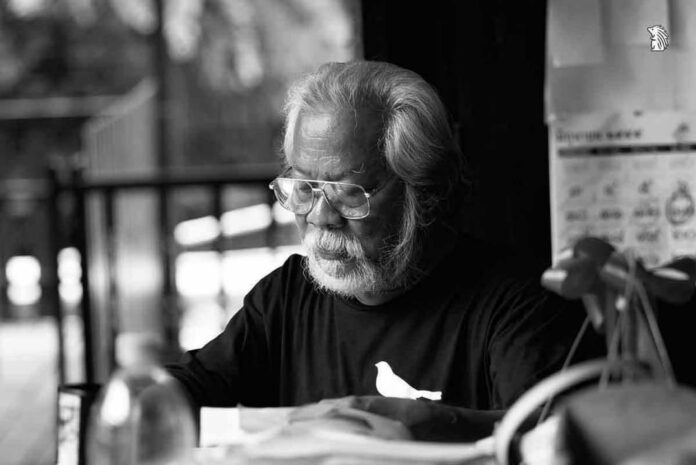
Photo: Suchart Sawasdsri / Facebook

retention.column

Last month’s decision by the Culture Ministry to strip national artist Suchart Sawasdsri from the title for “dishonorable” behaviour by supporting the anti-government and monarchy-reform movement sent a shockwave through the Thai intellectual community and beyond.

Suchart, 76, was given the award for literature a decade ago in 2011 for his role as a leading literary figure and magazine editor. The 2014 coup and subsequent rule by Gen. Prayut Chan-o-cha saw the writer becoming increasingly agitated, particularly on his personal Facebook account as he attacked the powers-that-be and openly supported the year-old youth-led monarchy reform movement.

The axe eventually fell soon after rumours spread that one national artist would be stripped of the award, which comes with a lifetime monthly stipend of nearly 25,000 baht. It led many to question the merit of the award itself.

The vast majority of the national artists named annually by the Thai state are ardent political conservatives and royalists. Suchart played an instrumental role through his writings and as a young magazine editor during the months leading up to the historic Oct. 14, 1973 revolt that overthrew military dictatorship. His removal from the list sent a clear message to other artists – toe the line, be conservative, do not question the status quo, especially the monarchy, and you will be fine.

That decision by the Culture Ministry not only demonstrates the lack of tolerance towards people of differing political ideologies but ended up degrading the prize itself.

It reminds the public that this is no true national artist award but a Thai state’s reward for sycophants of the conservative elites. It reminds the public that the award doesn’t truly reflect the diversity of views and ideologies of its laureates thus making it less than a “national award.”

A true national artist award should reflect the diversity of views that includes those who support monarchy-reform and the abolishment of the draconian lese-majeste law as well as royalists and ultra-royalists. Alas, the message this decision sent is that you must be a royalist, real or pretending, in order to be able to keep the award.

What’s more, the decision reminds the public that the state, through tax-payers-funded carrots such as the award, unabashedly favours conservative artists that do not question the government and the status quo. Since Suchart kept questioning and attacking the powers that be, the carrots have been withdrawn.

Unrepented, Suchart continues to attack the regime of Gen. Prayut and posted on Thursday on his Facebook page that he’s still awaiting the formal letter of the ministry to arrive at his home in order to see how they would justify describing him as someone who “behaves dishonourably”. On Monday, Suchart wrote on his Facebook page that once political change is achieved in Thailand, the Culture Ministry needs to be revamped and improved into a “Grade-A Ministry” with a vision and not a ministry which engages in “culture freezing.”

Since the decision became news, Suchart earned a new generation of young readers and supporters who might not have been aware of him as he’s from a different era better known in the printed world than cyberspace. His Facebook page gained many thousands of new followers within days. This is not just a serendipitous moment for Suchart but a wake-up call to the powers-that-be that they are increasingly losing grip of the grand narrative of the state of Thai society and any attempted monopoly is futile.

Suchart now has over 43,000 followers on Facebook. He’s now known among young activists many of whom may not have even heard about Suchart’s glorious days three decades ago as editor of critical magazines and short story anthologies. 

As a long-time Facebook friend of the writer laureate, I noticed that the incident has made him even more energized. Instead of retiring and becoming lethargic due to the incident, at 76, the septuagenarian writer appeared to have found a new resolve to push against political and ideological sedation. Suchart may have yet to see his best days in influencing young Thais to push for change. This may be his second chance, a reincarnation of the literary doyen as an influential voice for political change for a new generation, thanks to the Culture Ministry.

Advertisement

British Man Rescued After Being Lost 3 Days in Khon Kaen Jungle

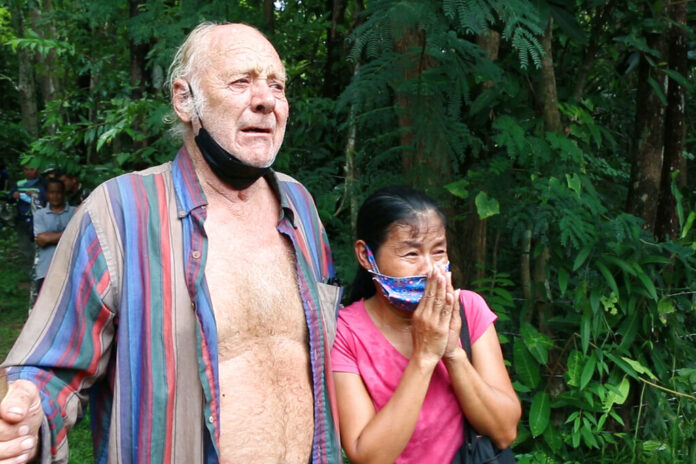
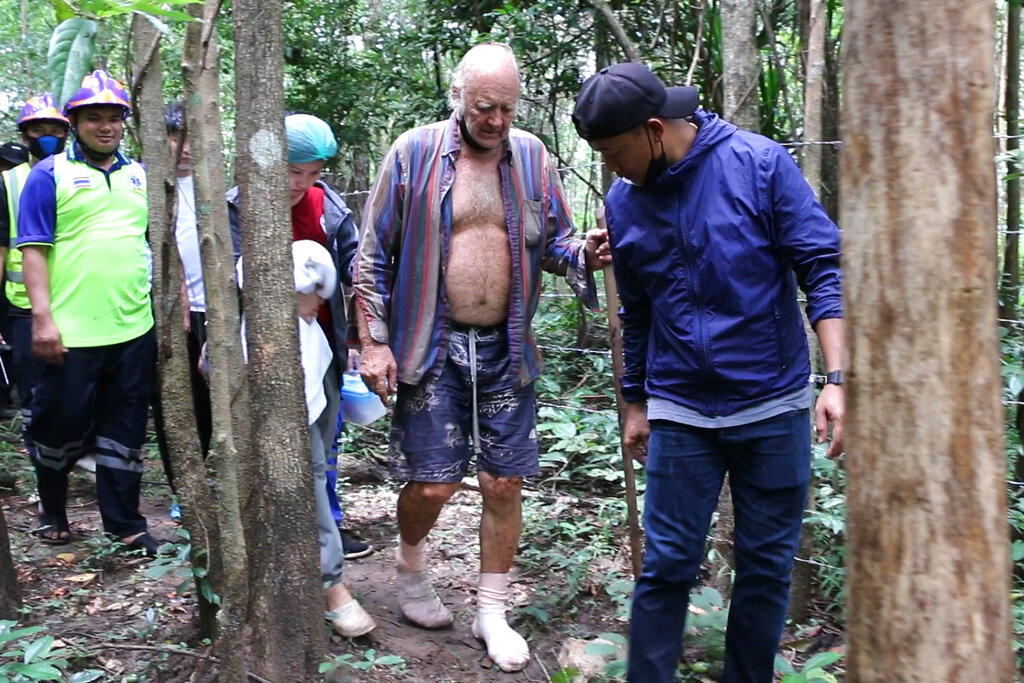
Barry Leonard Weller is reunited with his Thai partner, Tawee Chaisanrit, after he was rescued from the jungle, in Thailand's northeastern Khon Kaen province, Friday, Sept. 3, 2021. Photo: Tanadon Sribura / AP

KHON KAEN — A 72-year-old British man was found safe three days after disappearing in a thick jungle in northeastern Thailand while going to visit friends on a motorbike.

A local hunter came across Barry Leonard Weller on Friday in a remote forest in Khon Kaen province, said Nattapat Tadee, a member of a local volunteer team that helped rescue him. He was asleep on a rock formation after climbing it to try to see a route out.

Weller said he had not eaten anything during his ordeal but sipped water puddled on rocks, using grass as a straw, Nattapat said.

Video showed Weller walking gingerly out of the forest, the rescue team around him. He was shoeless and dressed in shorts and an open shirt. He looked tired and had multiple small cuts on his legs, but otherwise appeared healthy.

“Yes, I am wonderfully happy. I have never been so happy in my life,” Weller said. “My feet are sore, otherwise I am happy. Hot. I just admire the work these people are doing. It makes me cry. They are doing a good job.”

He emerged to an emotional reunion with his Thai partner, Tawee Chaisanrit. They hugged tightly and wept before thanking rescuers.

“Thank you everyone. Thank you to all the teams who kept fighting along with me,” she said, holding her hands together in a traditional Thai gesture of respect.

AP21246589832467
Rescuers lead Barry Leonard Weller, 72, out of the jungle, in Thailand’s northeastern Khon Kaen province, Friday, Sept. 3, 2021. Photo: Tanadon Sribura / AP

Tawee, 49, said by phone that Weller left their home on Tuesday and failed to return. It rained heavily and she searched for him unsuccessfully. She alerted the authorities the next day.

She said he told her that he had taken a different route than usual and became lost. Weller is retired and has lived in Thailand for about 15 years, she said.

There are many types of wild animals in Thailand’s jungles, including tigers, leopards, bears and elephants, but rescuers said that particular forest was not considered dangerous.

Advertisement

California Families Relay Harrowing Escape From Afghanistan

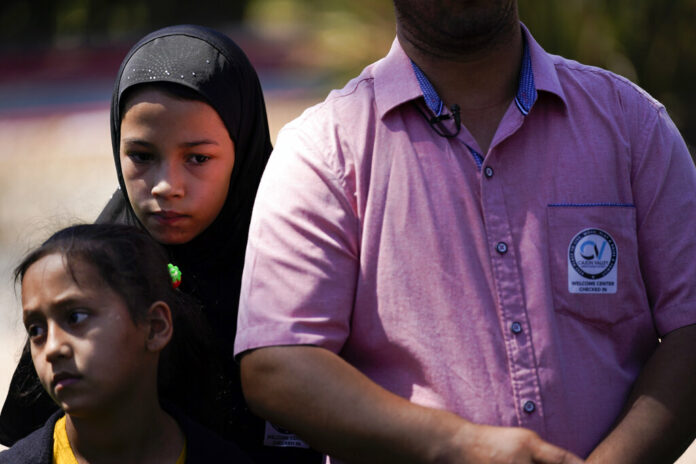
Palwasha Faizi, 10, above left, stands behind her sister, Parwana Faizi, 7, and alongside her father, Mohammad Faizi, during a news conference Thursday, Sept. 2, 2021, in El Cajon, Calif. Photo: Gregory Bull / AP

EL CAJON, Calif. (AP) — When Yousef’s wife and their four children boarded a July 15 flight in San Diego to attend her brother’s wedding in Afghanistan, they were looking forward to a month of family gatherings. It was long overdue — the coronavirus pandemic prevented them from traveling earlier.

Their return ticket was Aug. 15, two days before their children’s school year began in the San Diego suburb of El Cajon.

But the Afghan-American family found themselves dodging gunfire and trying to force their way into the crowds of thousands ringing the airport in Kabul after Afghanistan’s government collapsed and the Taliban seized power.

Yousef’s wife and children were among eight families from El Cajon who found themselves trapped after U.S. troops raced to evacuate Americans and allies and then left the country. Yousef asked that only his first name be used because he still has family in Afghanistan who could be at risk.

All but one of the families got out with the help of the Cajon Valley Union School District and Republican Rep. Darrell Issa, whose district includes El Cajon, a city with a large refugee population. The families had traveled on their own over the summer to see relatives and were not part of an organized trip.

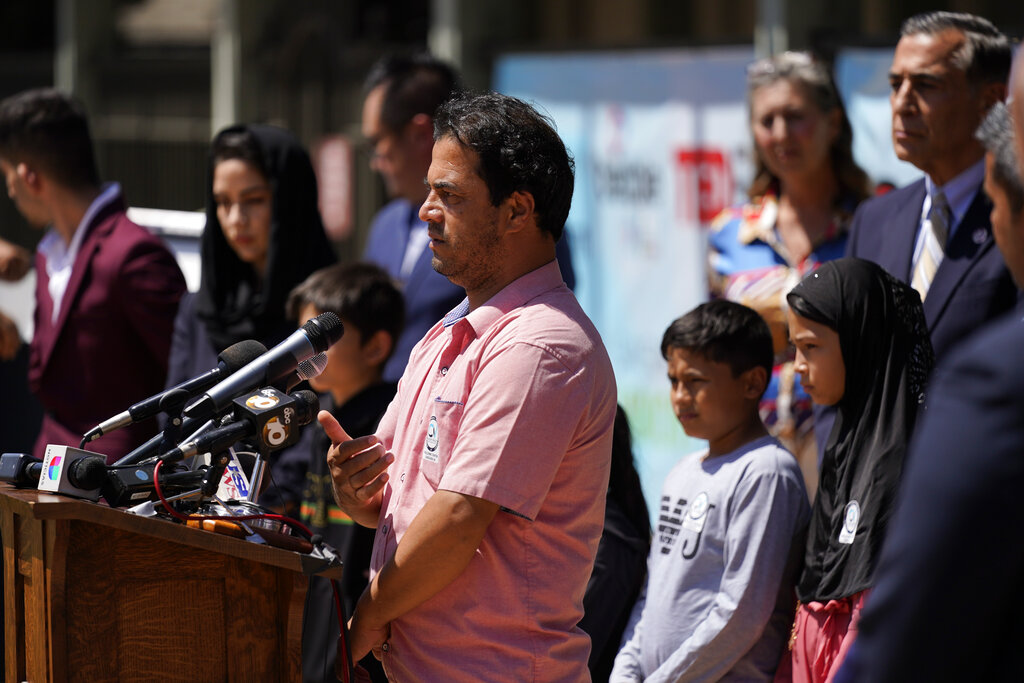
Several of the families, accompanied by Issa and school officials, spoke to reporters Thursday for the first time since they returned, recounting their harrowing experience.

The parents described running with their kids as gunfire whizzed overhead. One father said he was beaten by the Taliban. They said they were blocked at Taliban checkpoints.

They said they are grateful to be back but their children have suffered nightmares, and they worry about the family that was unable to get out, along with countless others still stuck there, including distant relatives.

“My kids are now safe at home right now thanks to God and all of you,” Yousef said.

AP21246013615954
Mohammad Faizi, center, speaks during a news conference Thursday, Sept. 2, 2021, in El Cajon, Calif. Photo: Gregory Bull / AP

But he asked people not to forget about so many others, including U.S. citizens, green card holders and Afghans who are at risk for helping the American government. He held in his hand a folder that he said contained the documents of 30 people who qualified for a special immigrant visa and should be in the United States but are still in Afghanistan, desperate to escape.

President Joe Biden has said between 100 and 200 Americans were left behind when U.S. troops completed their withdrawal Aug. 31, many of them dual citizens. The State Department has given no estimate for the number of green card holders nor the number of Afghans who remain who helped the U.S. government during the 20-year war and were recipients of a special immigrant visa to come to the United States.

Issa said he believes the number to be much higher for U.S. citizens and the others. Many of the families he helped get back to California in the past week are green card holders. Some are U.S. citizens.

“We’re delighted to have these kids back in school and their parents united, but we also know that there’s a lot more work to do,” Issa said.

Yousef said he felt helpless being in California, thousands of miles away, fearing the life they had built would come to a halt and his wife and children would be trapped in the country ruled by the Taliban. He, his wife and children are all U.S. citizens. They came to the United States on a special immigrant visa after Yousef worked for the U.S. government in Afghanistan.

AP21244717097148
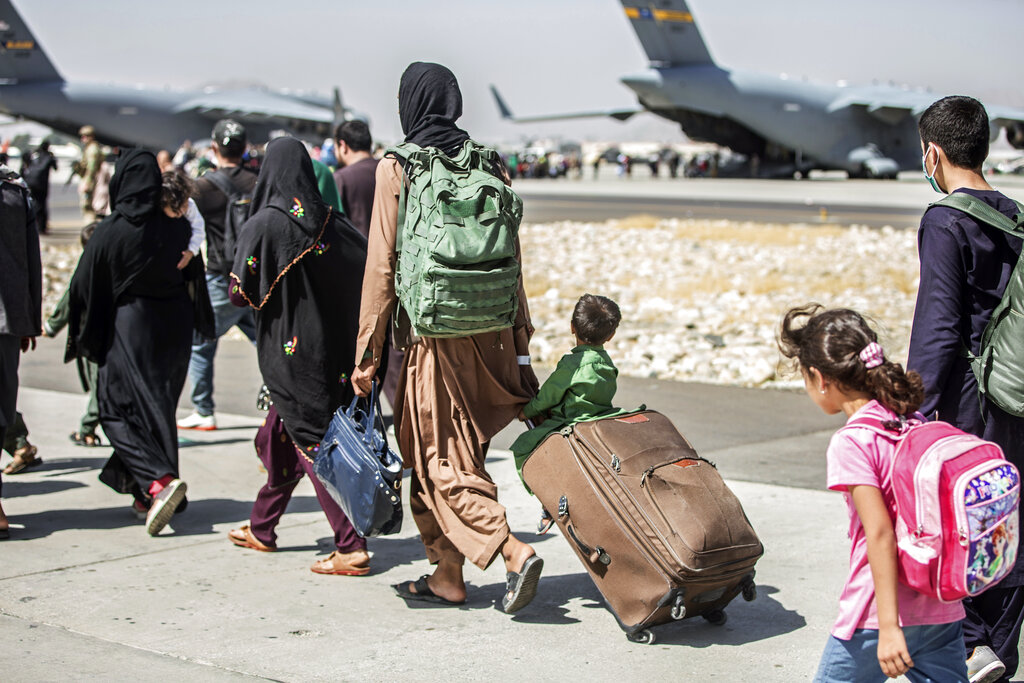
In this Aug. 24, 2021, file photo provided by the U.S. Marine Corps, families walk towards their flight during ongoing evacuations at Hamid Karzai International Airport, in Kabul, Afghanistan. Photo: Sgt. Samuel Ruiz / U.S. Marine Corps via AP

After they failed to get into the airport on Aug. 15, his wife and kids returned to their relative’s home.

Yousef alerted his family from El Cajon that the U.S. Embassy in Kabul was advising people not to go to the airport because of threats.

Eight hours later, suicide bombers set off explosions at the airport, killing 13 U.S. troops and more than 170 others.

Yousef said Issa’s team arranged a time for his family to go to the airport with an escort from U.S. authorities.

“It was like a situation room,” Yousef said of talking to Issa’s team while navigating his family through the chaos from afar. “I was sitting here talking to them. They were sending their locations and stuff like this.”

His family returned home Friday. The first thing he did was take them to IHOP, their favorite restaurant.

He hopes more of those happy moments will overtake the traumatic memories his kids hold. His 7-year-old son, his youngest, has been talking about the violence.

“They are talking about it, about the gunfire, and being scared of the Taliban, but we hope they forget all that” and return to their life as regular American kids, Yousef said.

Advertisement

Afghan Athlete Zakia Khudadadi Gets Her Chance in Taekwondo

Afghanistan's Zakia Khudadadi enters the arena during her women's K44 49kg Taekwondo match against Ziyodakhon Isakova of Uzbekistan at Tokyo 2020 Paralympic Games, Thursday, Sept. 2, 2021, in Chiba, east of Tokyo, Japan. Photo: Shuji Kajiyama / AP

TOKYO (AP) — Afghan athlete Zakia Khudadadi got her chance to compete in the Tokyo Paralympics on Thursday.

Khudadadi, one to two Afghans participating in the Paralympics, lost her first-round match in taekwondo in the 44-49-kilogram weight class to Ziyodakhon Isakova of Uzbekistan 17-12.

She also dropped a losers’ bracket match against Viktoriia Marchuk of Ukraine 48-34.

Teammate Hossain Rasouli competed on Tuesday in the long jump, where he finished last. Rasouli is a sprinter, but he arrived several days too late to run in the 100-meter race.

The Afghan athletes arrived in Tokyo days after the Paralympics opened, both fleeing Kabul for Paris, and then on to Tokyo.

Neither Khudadadi nor Rasouli have spoken in public since arriving, and officials have allowed them to skip interviews with reporters to protect their privacy.

International Paralympic Committee spokesman Craig Spence was asked to update the status of the Afghan athletes, but could not offer much.

“We’ve left them be for the last few days to focus on competition,” he said. “We’ll now start to have conversations about what happens in terms of the closing ceremony and where they go next. Those are the conversations we’ll be having in the coming days.”

The closing ceremony is Sunday.

Several countries, including Australia, have been mentioned as possible destinations.

Also, Belgian wheelchair athlete Jochaim Gerard has been hospitalized after feeling faint on Tuesday evening in the Olympic Village.

Spence said Gerard, ranked No. 3 in wheelchair tennis, had a “cardiac” issue. He was in stable condition and was expected to remain in the hospital for tests, Spence said.

In a statement, the Belgian Paralympic Committee said Gerard “suddenly and unexpectedly felt faint” and was transported to a hospital. It said he regained consciousness in the hospital and could answer questions.

Story: Stephen Wade

Advertisement

BGRIM to explore gas-fired power plants, renewable energy  and smart grid development in Asia Industrial Estate

BANGKOK, 1 Sept 2021: B.Grimm Power PCL (BGRIM) and Asia Industrial Estate Co Ltd (AIE) have agreed to explore the feasibility of developing natural gas-fired and renewable energy power plants, and integrated intelligent power transmission network at the latter’s industrial park in Samut Prakan.   

Dr. Harald Link, Chairman and President of BGRIM, and Chali Sophonpanich, President of AIE, signed a Memorandum of Understanding (MOU) to jointly pursue the cooperation.

The accord applies to the Asia Industrial Estate (Suvarnabhumi) in Bang Bo District which AIE operates jointly with the Industrial Estate Authority of Thailand (IEAT). Covering an area of ​​more than 4,000 rai, the industrial estate is ideal for industries related to automotive, auto parts, foods, pharmaceutical, logistics, e-commerce and data center operations.

It is ideal because the estate’s strategic location being only about 40 km away from Bangkok’s  business district, 20 km from the Suvarnabhumi Airport and Lad Krabang Sorting and Packing Station, 54 km from Klong Toey Port and 85 km from Laem Chabang Port.

The industrial estate is easily accessible by two main routes: Bangna-Trad Road (through Rattanakosin 200-Year Road) and Bangkok-Chon Buri Motorway (through the Peng Road which is now regarded as the main route from Bangkok to Chachoengsao Province and has its traffic lanes expanded to four and six lanes). The industrial estate is home to large-scale operators like Hino Motors Manufacturing (Thailand) Co Ltd, NGK Ceramics (Thailand) Co Ltd and Thai-Yazaki Electric Cable Co Ltd.   

Dr Link said the collaboration with AIE supports BGRIM’s drive to elevate its position as a leading industrial power producer and enhancing its competitive edge. 

image2 3

BGRIM’s planned facilities in the industrial estate will offer high quality energy supplies directly to customers through a trading mechanism bypassing state-run power utilities using the ‘Smart Grid’ developed by BGRIM. The company has trialled the energy trading system at BGRIM’s buildings and various industrial estates, he added.

BGRIM has earlier set up a pilot study project to develop a smart grid system linking Amata City Industrial Estate in Chon Buri Province with Bangkadi Industrial Park. The scheme integrates various power generation sources including natural gas-fired plants, renewable energy generators like floating solar and solar rooftops with electric vehicles charging stations and energy storage systems (ESS). 

Also under the project is upgrading transmission lines and modernising various systems to become intelligent to support technological developments and adaptation of the 5G technology. The project will be implemented in phases.

Dr Link noted that this cooperation with AIE is very much in line with BGRIM’s strategy to expand its transmission and distribution business in the region. The company has built and controlled power transmission and distribution systems in nine industrial estates in Thailand, Vietnam and Cambodia to establish infrastructure foundations necessary for the development of  ‘Smart City’ in the future.

To date, BGRIM has 50 power plants in commercial operation. The company aims to ramp up its total installed capacity from 3,058 MW at the end of 2020 to at least 7,200 MW of secured PPA by 2025 and further to 10,000 MW by 2030 with an annual revenue of more than 100 billion baht being targeted.

Advertisement

WEB HOSTING IN THE HEART OF SOUTHEAST ASIA 

Bangkok, Thailand

The new web hosting provider DeeDeeHost has set 1 big goal, to conquer the heart of Southeast Asia’s web hosting industry by introducing US and UK standards.

Founded by expats from the UK, US, France and Australia living in Thailand with each their own web hosting business abroad – and therefore many years of great experience combined – have joined forces to start a new competitive hosting provider in Thailand.

image2 2
When we asked CEO and co-founder Khun หตุน (Mr. Hatun) of DeeDeeHost Web Hosting what was meant with these new “standards”, he said that the main goal of all founders behind this big project is to introduce a combination of deploying specific web server software as used by the majority of เว็บโฮสติ้ง companies in the US, UK and other developed countries.

“This combination exists of providing the user friendly cPanel, offering faster loading times with CloudLinux, optimizing cache speeds with LiteSpeed and Imunify360 for increasing the overall security of all our web hosting clients. Our 2nd goal is to be very price competitive at the same time.”

“Thailand is located in the heart of Southeast Asia, which makes it also excellent for our clients with a website hosted by us who have their business in Laos, Myanmar and Cambodia. These neighboring countries are becoming more and more developed and we can definitely tell by the fact that around 40% of our clients are actually from the countries neighboring Thailand.”

image3
DeeDeeHost Web Hosting can be reached by visiting their website www.deedeehost.com and with 24/7 support they are ready for any questions that you might have. They also have a dedicated sales support live chat on their website that is available from 9AM till 9PM, 7 days per week. 

Advertisement

‘It Looked Apocalyptic’: Crew Describes Afghan Departure

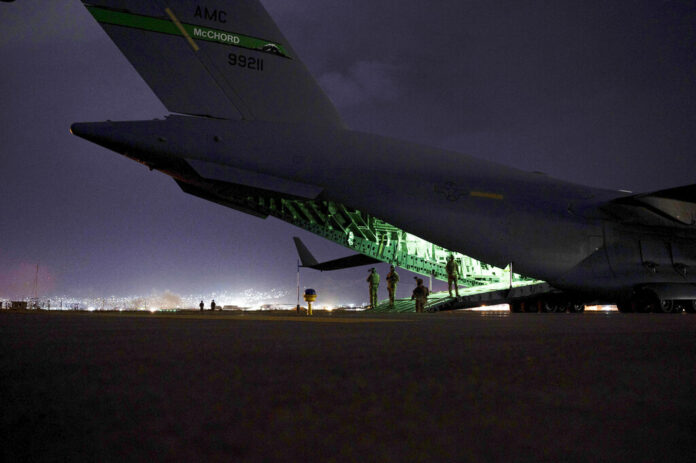
In this Aug. 30, 2021, photo provided by the U.S. Air Force, a Air Force aircrew, assigned to the 816th Expeditionary Airlift Squadron, prepares to receive soldiers, assigned to the 82nd Airborne Division, to board a U.S. Air Force C-17 Globemaster III aircraft in support of the final noncombatant evacuation operation missions at Hamid Karzai International Airport in Kabul Afghanistan. Photo: Senior Airman Taylor Crul / U.S. Air Force

WASHINGTON (AP) — It looked like a zombie apocalypse.

For the U.S. military pilots and aircrew about to make their final takeoffs out of Afghanistan, the sky was lit up with fireworks and sporadic gunfire and the airfield littered with battered shells of airplanes and destroyed equipment. Stray dogs raced around the tarmac. And Taliban fighters, visible in the darkness through the green-tinged view of night vision goggles, walked the airfield waving an eerie goodbye.

Lined up on the runway at the Kabul airport Monday night were the five last C-17s to leave the country after a chaotic and deadly airlift evacuation that marked the end of America’s involvement in the Afghanistan war. In the final hours, there were no more rocket defense systems to protect them on the runway, and no one in the airport control center to direct them out.

“It just looked apocalyptic,” said Air Force Lt. Col. Braden Coleman, who was in charge of monitoring the outside of his aircraft for artillery fire and other threats. “It looked like one of those zombie movies where all the airplanes had been destroyed, their doors were open, the wheels were broken. There was a plane that was burned all the way. You could see the cockpit was there, and the whole rest of the plane looked like the skeleton of a fish.”

AP21245052285531
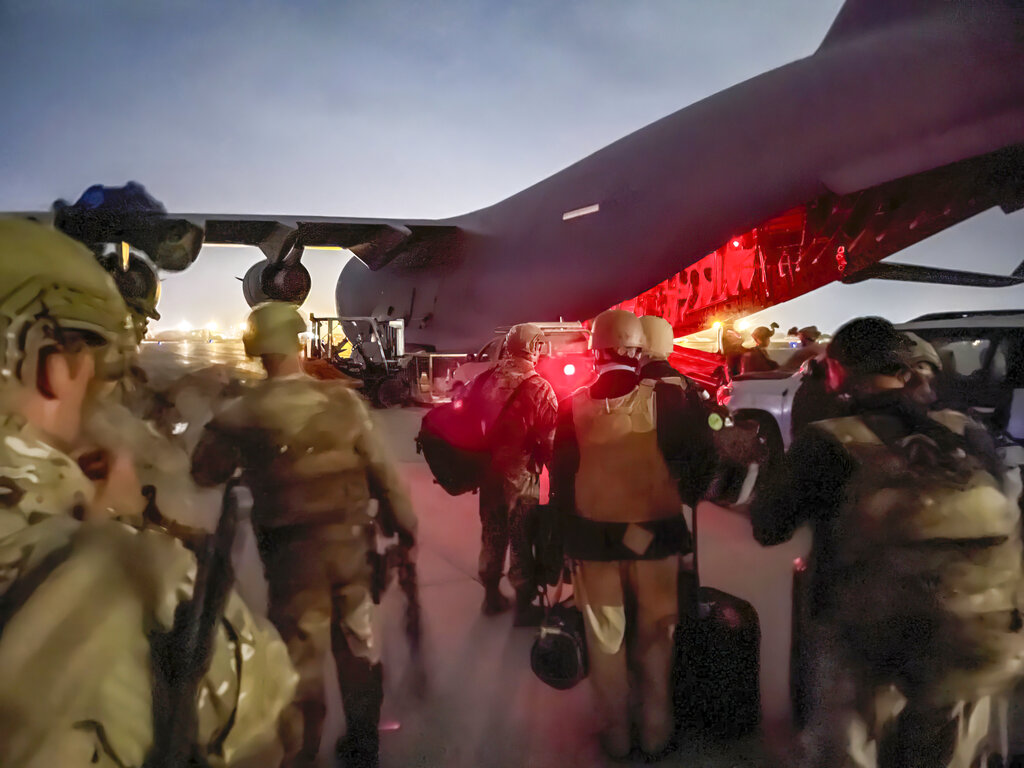
In this image provided by the U.S. Army, paratroopers assigned to the 82nd Airborne Division, and others, prepare to board a C-17 cargo plane at Hamid Karzai International Airport in Kabul, Afghanistan, Monday, Aug. 30, 2021. Photo: Master Sgt. Alexander Burnett / U.S. Army

In interviews Wednesday with The Associated Press, members of the Air Force’s 816th Expeditionary Airlift Squadron who flew out on the last military flights detailed their final fraught hours in what has been a dark, emotional and divisive U.S. exit from a war that now leaves the country in the hands of the same Taliban enemy it once ousted from power.

“It was just definitely very tense, and we were definitely all on edge watching everything going on to make sure that we were ready,” said Air Force Capt. Kirby Wedan, pilot of MOOSE81, who led the final formation of five aircraft out.

Adding to the stress, she said, was that their planes were parked in an area of the airport that had been attacked and breached in the past. At one point during the night, a group of civilians got onto the airfield and tried to get to the aircraft, but they were stopped by Army troops securing the plane, said Wedan, who is the squadron’s mission planning cell chief.

Right behind her C-17 was MOOSE92, where Coleman, the director of operations for the 816th Expeditionary Airlift Squadron, was going through his own checklists for takeoff. When he was told to taxi up a bit farther, he stepped out of the plane to help direct the crew where to go.

“I had my NVG’s on, my night vision goggles, and I had a Raven behind me following me out, making sure that I was, you know, safe,” said Coleman, referring to a member of the specially trained security forces who protect Air Force aircraft. “It was a bit tense, I’m not going to lie. But I guess you don’t really think of it at the time. You just … do what you’re trained to do.”

For more than three hours, they methodically went through about 300 items on their checklists, packing up the last four Little Bird helicopters, and ensuring they had all their troops and equipment.

From Scott Air Force Base in Illinois, Gen. Jacqueline Van Ovost, commander of Air Mobility Command, watched on video screens as the aircraft lined up for takeoff. One screen showed a scroll of the mIRC chat stream — the online message application that the military uses to communicate. And she could hear the orders from Lt. Col. Alex Pelbath, a pilot who was serving as the mission commander for the final departure.

One by one, each C-17 was told to “clamshell” — or close up the ramp. Then Pelbath’s final order: “Flush the force.” With that, Wedan began to move her C-17 down the runway.

“It was definitely different. I’ve never been on an airfield where I didn’t really have permission to take off,” said Wedan, noting the absence of air traffic control in the tower.

As they lifted off in rapid succession, cheers broke out from the troops on board — most of them special operations forces and soldiers from the 82nd Airborne Division.

“It was a visible relief,” said Wedan. “You could tell that they had been working really hard. Many of them hadn’t showered in a couple of weeks. They were all incredibly tired. … You could tell that they were just relieved to be out of there and that their mission was accomplished.”

As the last C-17 cleared Kabul airspace, Pelbath’s delivered a welcome message: “MAF Safe” — shorthand for saying that the Mobility Air Forces were out of harm’s way.

AP21245052248574
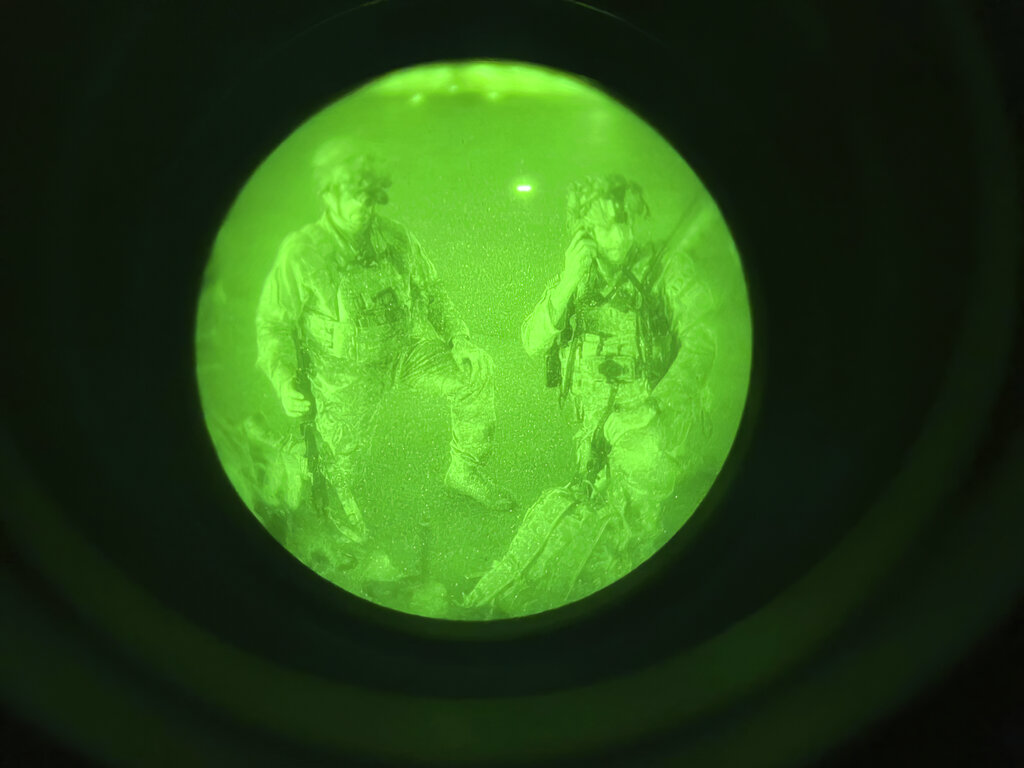
In this image made through a night vision scope and provided by the U.S. Army, Maj. Gen. Chris Donahue, commander of the U.S. Army 82nd Airborne Division, XVIII Airborne Corps, prepares to board a C-17 cargo plane at Hamid Karzai International Airport in Kabul, Afghanistan, Monday, Aug. 30, 2021, as the final American service member to depart Afghanistan. Photo: Master Sgt. Alexander Burnett / U.S. Army

Maj. Gen. Chris Donahue, commander of the U.S. Army 82nd Airborne Division, had been the last soldier to walk up the ramp on the final C-17 to depart. He had been in charge of security for the evacuation mission. Soon after the aircraft were in the air, he sent his own message: “Job well done. Proud of you all.”

Crammed onto the floor of the aircraft, exhausted troops found places to sleep. “Everyone was kind of sitting on top of each other — whatever we could do to have them get them on the aircraft and get them out,” said Wedan.

Within 30 minutes, she said, most on her plane were asleep. Coleman agreed.

“I walked downstairs and they warned me not to go to the bathroom because there were too many people in front of the lav door,” said Coleman. “There was one guy who had a box of water bottles that he was using for a pillow. I don’t know how that could have been comfortable. But, hey, he was fast asleep.”

Their flight to Kuwait was about four hours long. Coleman said his plane was lucky enough to have extra toilets. Wedan’s had just one — but her crew passed out candy.

“They’re tired and they’re resting now. But I think, for two and a half weeks, you really saw why it was that a lot of us joined,” said Coleman, who enlisted in 2001 after the Sept. 11 attacks that triggered the U.S. invasion into Afghanistan. “To see everybody step up to make this happen in the amount of time that it took to happen, to move 124,000 people out in less than three weeks. I mean, I couldn’t be prouder to be a C-17 pilot today.”

Story: Lolita C. Baldor

Advertisement

Hot News

LATEST NEWS

Bangkok
overcast clouds
34.4 ° C
34.4 °
32.7 °
71 %
4.2kmh
99 %
Mon
33 °
Tue
34 °
Wed
35 °
Thu
31 °
Fri
30 °