28.3 C
Bangkok
Tuesday, June 23, 2026
Home Blog Page 104

Iran says Thai vessel crosses Hormuz safely, vows not to “forget its friends”

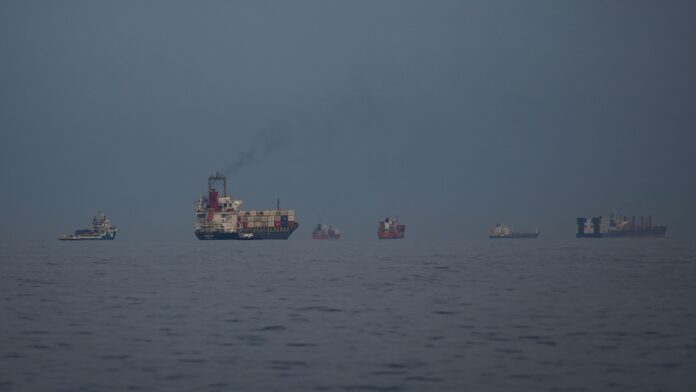
Oil tankers and cargo ships line up in the Strait of Hormuz as seen from Khor Fakkan, United Arab Emirates, Wednesday, March 11, 2026. (AP Photo/Altaf Qadri)

The Iranian Embassy in Bangkok said a Thai vessel has passed through the Strait of Hormuz safely, following close coordination between Iran, Thailand and Oman.

In a statement posted on 24 March, the embassy said the transit reflected strong cooperation and friendship between the countries, adding that Iran “will not forget its friends.”

The development follows an earlier incident on 11 March, when the Thai cargo ship Mayuree Naree was hit by two Iranian missiles while transiting the Strait of Hormuz amid the Iran conflict. The attack damaged the stern and engine room, triggering a fire on board.

All 23 crew members were Thai nationals. Twenty abandoned the vessel and were rescued by the Omani navy, while three remained trapped inside. Iran’s Islamic Revolutionary Guard Corps later claimed responsibility for the strike.

Advertisement

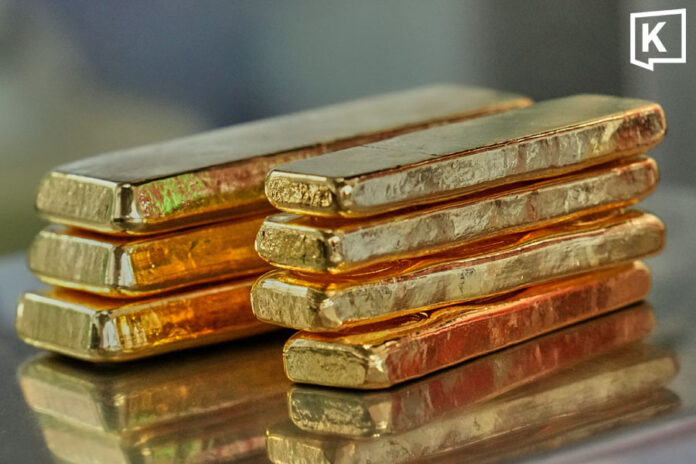
Gold Just Had Its Worst Week Since 1983. What Happened?

Photo AP

Gold has long been the asset investors reach for when the world feels dangerous. Wars, economic shocks, political chaos — historically, any of these tends to send the price of bullion climbing. So why, in the middle of an active and intensifying Middle East conflict, has gold just suffered its worst week in over 40 years?

The answer reveals something important about how markets work — and why the rules can change without warning.

The Numbers, First

Gold dropped roughly 11% last week, posting its biggest weekly loss since 1983. The metal is now down more than 14% since the war began. As of today, the spot price sits at approximately $4,357 per ounce — a sharp reversal from the record highs above $5,500 that defined the early weeks of 2026.

In Thailand, the pain has been equally stark. Gold bars fell below the key THB 70,000/baht level on Monday, with the Gold Traders Association issuing 66 separate price revisions in a single day. Just weeks ago, analysts at MTS Gold and YLG Bullion were forecasting prices of 88,000 to 90,000 baht by year-end. Those targets now look very far away.

The Paradox: Why War Is Hurting Gold

This is the question that has left many investors confused and frustrated. The logic of gold as a “safe haven” is simple: when uncertainty rises, people park their money somewhere stable, and gold has served that role for centuries.

But there is a crucial distinction that this crisis has exposed. Gold protects against uncertainty. It does not protect well against inflation — especially not when that inflation forces interest rates higher.

Here is what is actually happening. Oil prices have stayed above $105 a barrel after touching $119 earlier in the week, as Iran attacked energy targets in the Middle East following Israeli strikes on Iranian natural gas facilities. That surge in energy costs is spreading through the global economy as rising consumer prices. And rising consumer prices create a serious problem for gold.

The Bank of England kept its rate at 3.75%, warning that inflation will be “higher in the near term” due to the energy price shock. The European Central Bank also held at 2%, noting the war has made the outlook “significantly more uncertain” with upside risks for inflation.

The US Federal Reserve voted on 18 March to hold its benchmark rate at 3.5% to 3.75% for the second consecutive meeting, signaling that sticky energy-driven inflation has closed the door on any near-term rate cuts.

That combination — higher oil, stickier inflation, and central banks refusing to cut rates — is the exact environment where gold struggles.

The Opportunity Cost Problem

Gold pays no interest. No dividends. No yield. You buy it, you hold it, and you hope it goes up. When interest rates are low, this is fine — there is not much you can earn by putting your money elsewhere. But when rates are high, holding gold starts to feel expensive.

Rising real interest rates and a strengthening US dollar are shifting investor preferences away from gold. Capital is rotating toward assets that offer yield, reducing gold’s relative appeal. As one market expert put it: the dollar now offers both a better rate of interest and currency appreciation — a dual advantage that gold simply cannot match.

As Ewa Manthey, Commodities Strategist at ING, wrote last week: “Geopolitics alone rarely drives gold in a sustained way. What matters is how such shocks feed through to inflation, monetary policy and the dollar.” Right now, that chain runs in exactly the wrong direction for gold.

In this conflict, that transmission has been swift and brutal — surging oil prices have stoked inflation, inflation has frozen central banks in place, and frozen central banks mean high real yields. For gold, that chain of events is about as unfavorable as it gets.

In short: the war created the very conditions that are working against gold.

Forced Selling Makes It Worse

Beyond the interest rate mechanics, there is a second force accelerating the decline — and it has nothing to do with gold’s fundamentals at all.

The $400-plus drop in a single week triggered a cascade of margin calls, forcing institutional liquidations across the commodity complex. When investors suffer large losses in volatile markets — stocks, energy, currencies — they often need to raise cash quickly. Gold, being one of the world’s most liquid assets, becomes the piggy bank. It gets sold not because anyone has turned bearish on gold specifically, but simply because it is easy to to sell.

The institutions are not alone. Gold in recent weeks had been trading more like a meme stock than a safe haven — a sign that the 2025 bull run had attracted a wave of retail momentum traders who are now heading for the exits simultaneously.

What This Means for Thailand

Thailand is one of the most gold-conscious countries in Southeast Asia. Physical gold — bars, jewelry, ornaments — is deeply woven into the culture as both savings and family wealth. That makes the current correction feel personal for many people here.

Thailand’s Gold Traders Association revised prices 53 times in a single Thursday session, with gold closing 3,400 baht lower for the day. The association’s volatility has been extraordinary — a few days earlier, the market went through a record 102 price changes in a single session.

The baht adds an extra layer of complexity. Global gold is priced in US dollars, so any movement in the USD/THB exchange rate amplifies or softens the impact for Thai buyers. Volatility in the baht added to the speed and severity of the local price decline, with domestic gold prices adjusting more rapidly than usual.

For investors who entered the market during the 2025 bull run — when Thai gold climbed from around 60,000 baht to above 80,000 baht per baht-weight — this correction is painful. For investors who bought near recent highs, especially above 75,000 to 80,000 baht, the current drop may be difficult to sit with. Even so, many market watchers still see it as a normal correction inside a broader uptrend.

Is This the End of Gold’s Bull Run?

Probably not — but the easy money may be gone for now.

Many strategists remain optimistic. Wall Street veteran Ed Yardeni still holds a $6,000 year-end target, though he is considering lowering it to $5,000 if gold continues to underperform despite rising inflation and geopolitical stress.

The World Gold Council’s outlook is nuanced. If inflation pressures force the Fed to hold or hike rates further, pushing long-term yields higher and strengthening the dollar, the result could be a gold price correction of between 5% and 20% from current levels. That scenario is arguably already playing out.

On the other hand, if the conflict de-escalates, or if the global economy slows enough that central banks pivot back toward cutting rates, gold could recover swiftly. A combination of falling yields, elevated geopolitical stress, and a flight-to-safety could create exceptionally strong tailwinds for gold, supporting a sharp move higher — potentially 15% to 30% from current levels.

Thailand’s Gold Traders Association has not changed its longer-term target of $6,000 per ounce globally and 90,000 baht per baht-weight domestically by end-2026.

The Takeaway

Gold is not broken. What has changed is the environment it is operating in. An energy-driven inflation shock has forced the world’s central banks into a corner — they cannot cut rates without making inflation worse, but keeping rates high suppresses the very asset that should be thriving in a time of war.

Until oil prices stabilize and the inflation picture becomes clearer, gold is likely to remain volatile and under pressure. For long-term holders, that may simply be noise. For those who bought near the top expecting a quick gain, the lesson is one the market teaches periodically: even the most trusted assets can behave unexpectedly when the macro backdrop shifts.

The gold shops lining Bangkok’s Yaowarat Road are still open. They always are. But for now, they are doing a lot more revising of price boards than they are celebrating record highs.


Data accurate as of 24 March 2026. Prices may have changed. This article is for informational purposes only and does not constitute financial advice.

Advertisement

Wide Faith appoints “iZ” as “Rise Buddy” presenter, targeting 150 million baht in sales

Wide Faith Group, a manufacturer and distributor of baked rice snacks made from 100% Thai rice, is stepping up its presence in Thailand’s snack market by appointing T-Pop band “iZ”as the presenter for its Rise Buddy brand. The move aims to attract Gen Z and Millennial consumers in response to the fast-growing healthy snack trend. Positioned with the key concept of “baked, not fried,” Rise Buddy is targeting a 150-million-baht share in Thailand’s rice snack segment by 2026 while expanding nationwide distribution and promoting Thai rice snacks to consumers worldwide.

Oliver Yeh, CEO of Wide Faith Group was founded in 2002 by a management team with more than 30 years of experience in the rice snack industry. The company operates both as an ODM for global partners and as a developer of its own brands, offering more than 70 flavor formulations. Its brand portfolio includes Rise Buddy, Ravin, Bio‑Earth, and Kiddie Kare. Developed under the “Better for You” concept, the products are baked rather than fried, contain no trans fats, have less than 10% fat, and are free from MSG and gluten. They are also certified halal.

Picture1 10

For the Thai market, the company is prioritizing Rise Buddy as its flagship brand, which has already gained traction overseas. This year, the company plans a full-scale domestic launch, supported by the appointment of iZ, an eight-member T-Pop group from OneMusic, as brand presenter. The group consists of NORD, TEAM, TOON, MARC, PHOTO, KAHN, KAO, and PIE. The group’s youthful and modern image aligns with the brand’s positioning and is expected to resonate with younger consumers who are increasingly selective and health-conscious. The collaboration forms part of the company’s strategy to reach Gen Z and Millennial audiences seeking snacks that are flavorful and better for their health.

Picture2 9

The company has also launched two new commercial films for Rise Buddy, highlighting the brand’s two main product categories: Rice Bites and Rice Chippies. The commercials feature a fun storyline starring the eight members of the T-Pop group iZ, who find themselves confronting zombies and monsters in chaotic situations. In the end, the 100% Thai baked rice snack Rise Buddy becomes the bridge that brings everyone together—turning enemies into friends and reinforcing the brand’s concept of “Rise Buddy, your buddy anytime,” creating moments of fun and happiness in every situation.

Among the brand’s key products is Rice Bites, bite-sized baked rice snacks available in six flavors: Barbeque, Seaweed, Sour Cream & Onion, Smoked Katsuo, Parmesan & Herbs, and Lime & Chili. The products are available in 60-gram packs priced at 29 baht.

Picture3 8

Another highlight is Rice Chippies, an innovative thin baked rice chip developed using proprietary technology that enables the rice sheets to become thin and curved like potato chips—a form that is typically difficult to achieve with baked rice snacks that Mr.Oliver and his team has spent more than 20 years to reach the ideal chips shape . The product comes in five flavors: BBQ, Sour Cream & Onion, Sea Salt, and Cheese and is sold in 50-gram packs priced at 29 baht.

In addition, the company is expanding Rise Buddy’s distribution channels across Thailand to enhance nationwide consumer access. The products are available through convenience stores such as 7-Eleven, which serves as a key channel for building brand awareness, as well as leading supermarkets including Tops, Foodland, Gourmet Market, MaxValu, Golden Place, and Lemon Farm. Distribution also covers retail chains such as CJ Express and Super Turtle, alongside e-commerce platforms including Shopee, Lazada, TikTok Shop, and Facebook. Furthermore, the company leverages distributors and corporate sales channels to effectively meet consumer demand across all touchpoints.

Advertisement

Working together to build an LMC 2.0 and bringing regional cooperation to a higher level

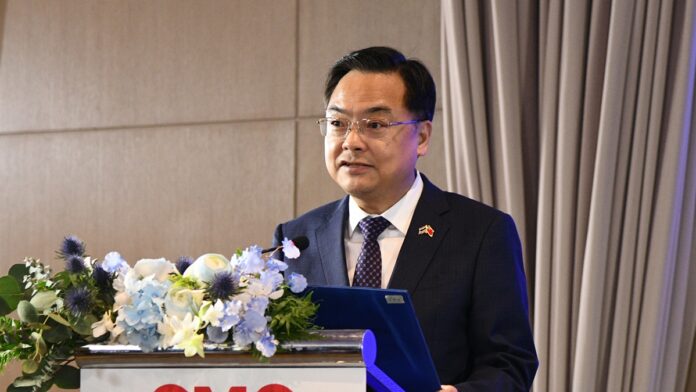
Zhang Jianwei, Chinese Ambassador to Thailand

This article was written by Zhang Jianwei, Chinese Ambassador to Thailand.

The Lancang-Mekong River, a mother river winding for thousands of kilometers and nourishing the vast lands on which it runs, binds the peoples of the six Lancang-Mekong countries closely together. This year marks the 10th anniversary of the first Lancang-Mekong Cooperation (LMC) Leaders’ Meeting. Since its inception, the LMC has stayed true to its founding mission of “shared river, shared future,” carried forward the LMC culture of equality, sincerity, mutual assistance, and kinship, and acted in the Lancang-Mekong spirit of development priority, equal negotiation, pragmatism and high efficiency, openness and inclusiveness. The LMC has been advancing cooperation across the three pillars and five priority areas at an “LMC speed” marked by daily progress, monthly results and annual elevation, becoming a golden example of dynamic regional cooperation with limitless potential.

A decade of joint endeavors yielding fruitful progress

Over the past 10 years, the strategic trust among the six countries has continued to deepen. Communities with a shared future has been established between China and all five Mekong countries, and the building of a Lancang-Mekong community with a shared future has achieved solid progress. Security cooperation has been steadily enhanced, with the Safe Lancang-Mekong joint operation advancing in depth and  combating cross-border crimes such as online gambling and online scam generating positive outcomes. Economic and trade cooperation has been steadily upgraded. Trade between China and the five Mekong countries has grown by 125 percent over the decade. Hard and soft regional connectivity has been strengthened, industrial and supply chains cooperation has deepened, and the development of innovation corridors has become a new highlight. The peoples have become ever closer to each other. The “Lancang-Mekong Visa” has made people-to-people exchanges more convenient, and the LMC Special Fund has supported over a thousand “small and beautiful” projects in areas including water resources, agriculture, poverty reduction, and public health, bringing tangible benefits to the people of the six countries.

Focusing on building an LMC 2.0 for upgraded regional cooperation

Last August, the foreign ministers of the six Lancang-Mekong countries gathered in Anning, Yunnan, and held a successful 10th Lancang-Mekong Cooperation Foreign Ministers’ Meeting. Foreign Minister Wang Yi stressed that all parties need to commit to building an LMC 2.0 featuring solidarity and cooperation, openness and win-win outcomes, green innovation, and peace and tranquility, and jointly usher in another golden decade for the LMC. These words have received positive responses from all sides. Going forward, we, the Lancang-Mekong countries, need to work to strengthen the LMC institutional building, enhance high-level strategic communication, and promote the establishment of an LMC secretariat. We should speed up economic integration, focus on the development of the Lancang-Mekong Economic Development Belt, and build a better-connected regional transport, industrial and energy network so as to provide strong underpinning for the stability of regional industrial and supply chains. We need to explore coordinated regional governance, take joint actions on countering transnational crimes, water resources management, environmental protection and other matters, and strengthen the Lancang-Mekong Integrated Law Enforcement and Security Cooperation Center to further enhance regional security. We need to foster a stronger sense of the Lancang-Mekong family, encourage people-to-people and cultural exchanges, deepen cooperation on culture, tourism, education, media and think tanks, and deliver more tangible benefits to our peoples.

Deepening Lancang-Mekong solidarity and collaboration to tackle global risks and challenges

In today’s world, changes unseen in a century are unfolding at an accelerated pace. Rampant hegemonic moves and power politics have caused severe impact on the current international order. Asia’s long-standing peace and stability has not come by easily and should be all the more cherished. China has always been an anchor of regional security, an engine of development and prosperity, and a practitioner of shared Asian values. China always advocates open regionalism and true multilateralism, follows the policy of fostering an amicable, secure and prosperous neighborhood, pursues the principle of amity, sincerity, mutual benefit and inclusiveness, and stays true to the vision of a shared future for humanity. The Lancang-Mekong countries should continue to make the region a pacesetter in high-quality Belt and Road cooperation and an exemplar in implementing the Global Development Initiative, the Global Security Initiative, the Global Civilization Initiative and the Global Governance Initiative, and commit to strengthening good neighborliness and mutually beneficial cooperation. China is ready to work with neighboring countries to accelerate the building of a peaceful, safe and secure, prosperous, beautiful, and amicable home and jointly usher in a bright future for the Lancang-Mekong region.

Carrying forward the special bond of China-Thailand friendship and jointly ushering in the next golden 50 years

 China and Thailand are good relatives, close friends, and reliable partners. The two countries have withstood the test of changing international landscapes, and have always respected each other, treated each other as equals and with sincerity and mutual trust, and stood by each other in times of need. Last year, His Majesty King Maha Vajiralongkorn, together with Her Majesty Queen Suthida Bajrasudhabimalalakshana, paid a successful state visit to China. This historic visit, the first by a Thai king to China since the establishment of diplomatic ties, stands as a powerful testament to our profound friendship characterized by the saying “China and Thailand as close as one family” and the great importance that the Thai royal family places on our bilateral relations. The strategic guidance of the two heads of state has injected strong impetus into building a China-Thailand community with a shared future for enhanced stability, prosperity and sustainability.

Thailand is a key advocate and an important contributor to Lancang-Mekong cooperation, currently serving as the co-chair of the LMC. This year marks the beginning of China’s 15th Five-Year Plan and the first year into the next golden 50 years of China-Thailand relations. China stands ready to work hand in hand with Thailand to forge greater synergy between China’s 15th Five-Year Plan and Thailand’s economic development strategies, continuously deepen strategic coordination and practical cooperation, support Thailand in hosting the fifth Lancang-Mekong Cooperation Leaders’ Meeting, and ensure that the China-Thailand community with a shared future delivers even more benefits to our two countries and peoples, thus injecting greater certainty into a changing and turbulent international situation with the stability of our bilateral relations.

Advertisement

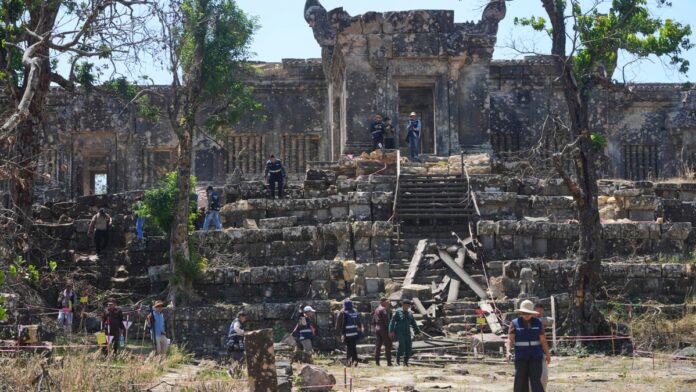
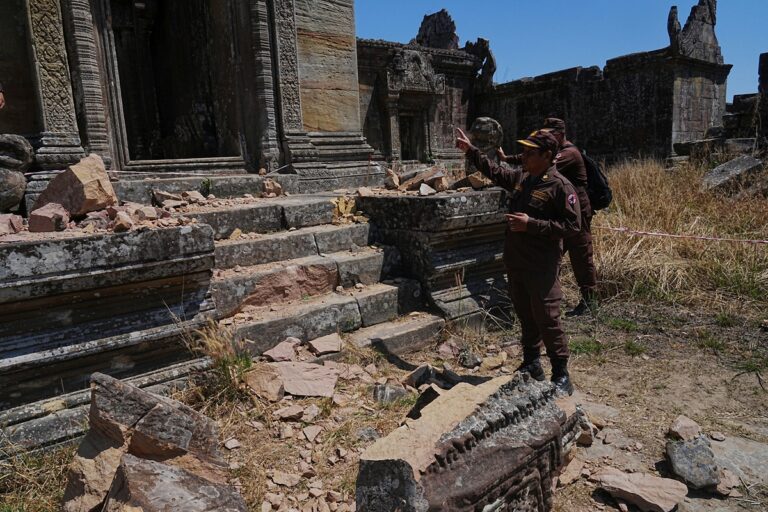
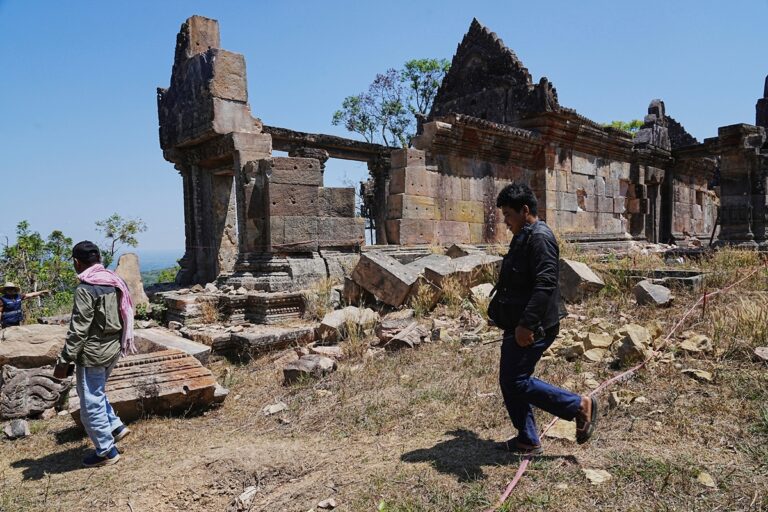
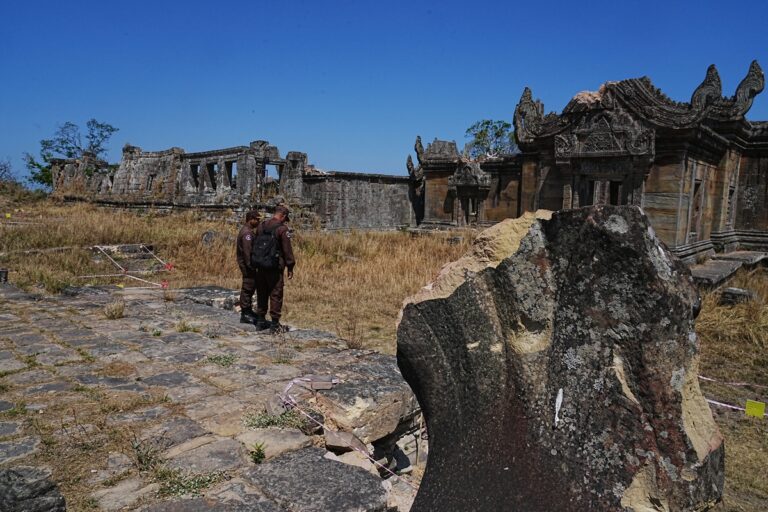
A 1,000-year-old temple lies battered after Cambodia-Thailand border clashes

Journalists visit the Preah Vihear temple, damaged during border clashes with Thailand, at Preah Vihear province, Cambodia, Saturday, March 14, 2026. (AP Photo/Heng Sinith)

PREAH VIHEAR, Cambodia (AP) — It’s been three months since a ceasefire ended bitter border fighting between Cambodia and Thailand, but signs of combat are cut deep in this 11th-century temple atop a 525-meter (1,722-foot) cliff in the Dangrek Mountain range.

The neighboring Southeast Asian countries have been fighting over Preah Vihear temple on and off for decades, and that’s putting the ancient holy site in danger.

Built by the same Khmer Empire that constructed Angkor Wat 160 kilometers (100 miles) southwest, the temple was declared a UNESCO World Heritage site in 2008 and are held as an important cultural relic by Cambodians.

AP26082493434918
Cambodian Mine Action Center, CMAC, members stand near a temple damaged during border clashes with Thailand, at Preah Vihear province, Cambodia, Saturday, March 14, 2026. (AP Photo/Heng Sinith)

But after two rounds of major combat last year, much of the structure is damaged and Cambodian officials say that parts of it may be in danger of collapse.

There’s lots of wreckage, but no tourists

Where tourists once admired the weather-beaten structure’s elaborate carvings and a magnificent view over the Cambodian plains, there is now stone debris, artillery craters, and the ashes of burnt vegetation.

“The temple has turned quiet, and its beauty looks so sorrowful because of the tragedy,” Hem Sinath, archeologist and deputy director-general of the National Authority for Preah Vihear, told Associated Press journalists visiting earlier this month.

The site is closed to tourism due to unstable walls and concern about the presence of unexploded ordnance. Areas are roped off and dotted with signs warning of land mines, a hazard Cambodians know well after decades of civil war that ended in the late 1990. Conservation staff, groundskeepers and troops remain stationed in and around the temple, from which Thai soldiers can be seen just across the border.

All five of the temple’s notable gateway pavilions were damaged, three almost beyond recognition, according to a damage assessment issued in January by Cambodia’s Culture Ministry. An ancient northern staircase previously restored by a U.S.-funded conservation project sustained severe hits from repeated bombardment.

A statement issued last week by Cambodia’s Culture Ministry said the temple had suffered damage in 142 locations during the fighting in July, and at 420 more during heavier and more sustained combat in December.

“Experts have predicted that during the upcoming rainy season, some structures on the verge of collapsing could finally fall,” Hem Sinath said.

No independent outside evaluations of the damage are available.

Cambodia charges temple was deliberately attacked

Information Minister Neth Pheaktra accused the Thai military of relying on false information to justify incursions and of deliberately damaging the temple.

AP26082493355568
Cambodian police officers walk past a temple damaged during border clashes with Thailand, at Preah Vihear province, Cambodia, Saturday, March 14, 2026, (AP Photo/Heng Sinith)

“Preah Vihear temple belongs to all humankind. It is not an enemy of Thailand,” he wrote.

International law forbids attacks on important historical sites like the temple, but Thailand has argued that Cambodia militarized the temple by installing weapons systems, storing ammunition, and using the site as a base for surveillance equipment, voiding its wartime protection. This included a tall construction crane at the site, which the Thai army attacked after claiming it served as part of a military command and control system.

Thai Army spokesperson Maj. Gen. Winthai Suvaree has insisted that Thai forces directed their fire strictly at military targets.

Cambodia denies that its military ever used the temple, with its Ministry of Culture writing in a statement that the temple is under civilian control and that any security forces present were there only to protect the cultural heritage site.

Each nation blames the other for starting the fighting that flared in July and December. Cambodia has reported that more than 640,000 people were displaced from border regions during the fighting, and almost 37,000 have yet to return to their homes.

The temple has been contested for decades

The temple, known as Phra Viharn to Thais, has been at the center of a long-standing boundary dispute since the 1950s. In 1962, the International Court of Justice ruled that the temple and surrounding area of less than five square kilometers (two square miles) belong to Cambodia. The Court reaffirmed this ruling in 2013.

For years, it drew visitors from both sides of the border, with many foreign tourists arriving via Thailand before the border was closed.

Its designation by UNESCO as a Cambodian heritage site in 2008 rubbed salt into Thai wounds, and heightened nationalism stoked by domestic politics in Thailand contributed to sporadic armed conflict at the temple in 2008 and 2011.

AP26082493318185
Cambodian Mine Action Center, CMAC, members stand near a temple damaged during border clashes with Thailand, at Preah Vihear province, Cambodia, Saturday, March 14, 2026. (AP Photo/Heng Sinith)

Restoration will be a challenge

Restoring the temple will be a major challenge. Hem Sinath fears that weakened structures could collapse during the rainy season, which normally begins in late May or early June and continues through October.

India, China and the United States have been involved in previous renovation efforts, but funding has been on hold since fighting broke out.

Hem Sinath said that new and urgent projects needed to keep the temple from deteriorating further are being hindered by concerns for safety and security while the ceasefire remains fragile.

“We have a plan; we want to do a repair — the sooner the better, but as you see, it depends on the situation along the border,” he said.

Advertisement

Vietnam to build first nuclear plant with Russia

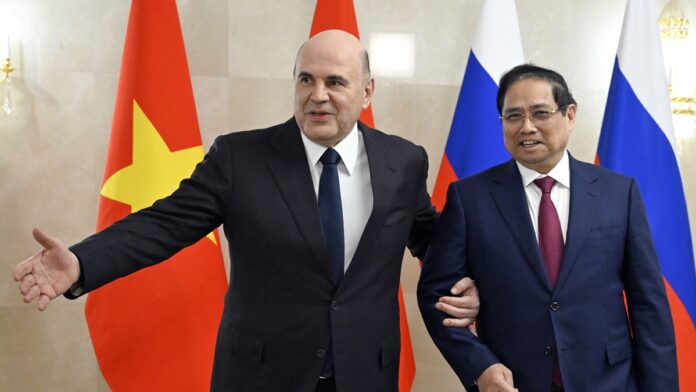
Russian Prime Minister Mikhail Mishustin, left, welcomes Vietnamese Prime Minister Pham Minh Chinh for the talks, during their meeting in Moscow, on Monday, March 23, 2026. (Alexander Miridonov, Sputnik, Government Pool Photo via AP)

Vietnam and Russia have agreed to build Vietnam’s first nuclear power plant, as Hanoi seeks to strengthen energy security amid global fuel disruptions. The deal was signed during Prime Minister Pham Minh Chinh’s visit to Russia, though no timeline for construction was announced.

Russia’s LNG giant Novatek also signed a preliminary deal to supply Vietnam, Tass reported Monday. The move comes after the Iran war disrupted oil and gas flows through the Strait of Hormuz, pushing up fuel prices and causing long queues at gas stations. Hanoi is promoting electric vehicles, biofuels, and partnerships with countries including Japan, South Korea, Angola, and Algeria to diversify its energy sources.

The Ninh Thuan 1 project will feature two Russian-designed reactors with a combined 2,400 MW capacity. Vietnam and Russia also plan to expand cooperation in clean and renewable energy. The two countries have a long history of energy collaboration, including PetroVietnam’s joint ventures with Russian state firms and Vietsovpetro, a partnership dating back to 1981.

Advertisement

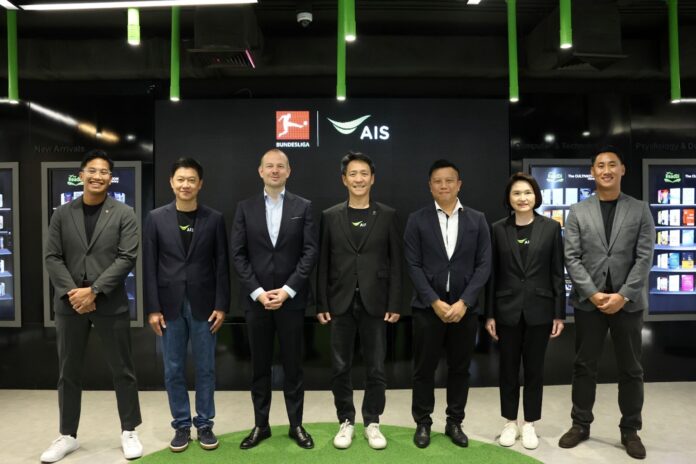
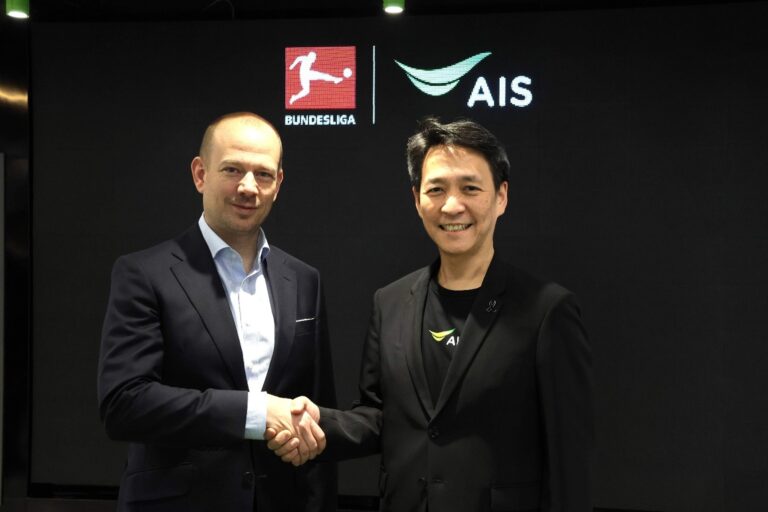
AIS secures 3-year Bundesliga broadcast deal

Advanced Info Service Public Company Limited (AIS) is advancing its strategy to be No. 1 in sports and shaking up the Thai football scene once again by announcing a major strategic partnership with Bundesliga International. Becoming “The New Home of Bundesliga in Thailand”, AIS will officially be the exclusive broadcaster of “Bundesliga”, on its streaming platform in Thailand AIS PLAY. Under a 3-year contract (starting from the 2026/27 to 2028/29 seasons), this move goes “beyond just broadcasting.” It is a collaboration to elevate and drive the ecosystem of Thai football, strengthening it from the grassroots level. This reinforces AIS’ vision that, in addition to delivering world-class sports content, the company serves as a vital gear in sustainably pushing the potential of Thai youth players to the international stage.

German football fans will be able to watch live broadcasts of Germany’s top-tier league via AIS PLAY, Thailand’s leading video streaming service and sports content provider. Serving as the most comprehensive sports hub with the strategy “All Complete, Every Sport on a Single Platform”, it covers world-class sports content including Golf (PGA Tour, LPGA Tour, DP World Tour), NFL American Football, NBA Basketball, and ATP Tour Tennis, among others. AIS PLAY also offer subscription packages for the Premier League 2025/26 through the platforms, reinforcing AIS PLAY as a comprehensive destination for sports in Thailand. Fans will be able to watch all 9 Bundesliga matches on every matchday, kicking off on August 22, 2026, with the “Franz Beckenbauer Supercup” which will feature a clash between the Bundesliga champion and the DFB-Pokal champion from the 2025/26 season.

Picture2 8

Mr. Pratthana Leelapanang Chief Executive Officer of AIS stated, “A key goal of AIS is to advance the development of intelligent national infrastructure alongside upgrading various Intelligent Platforms, particularly in entertainment, to deliver superior experiences to Thai people. In the past, we have secured broadcasting rights and formed strategic partnerships with several world-class sports organizations to bring the best content to everyone’s screens. The Bundesliga is recognized as one of the top 5 leagues in Europe. We recognize the Bundesliga is defined by its unique DNA : fast-paced, aggressive attacking football paired with the intense passion of the fans. This aligns with our vision of elevating the national sports scene to foster tangible growth in Thai sports. Therefore, we are moving forward to join hands and work together strategically with Bundesliga International in a full-scale manner. This collaboration covers exclusive live broadcasting for a long-term period of 3 seasons to reinforce being ‘The New Home of Bundesliga in Thailand’ on AIS PLAY. More importantly, we also look further toward elevating the Thai sports scene while strengthening the ecosystem of Thai football from the grassroots. We aim to do this by providing opportunities for youth and personnel in the football industry to learn and grow sustainably alongside world-class standards.”

Mr. Peer Naubert Chief Executive Officer of Bundesliga International stated, “The Bundesliga has long been a home for Asian talent, from Witthaya Laohakul to current Thailand international Nicholas Mickelson and FC Bayern München newcomer Maycon Cardozo. Through our partnership with AIS, we’re bringing the excitement of the Bundesliga even closer to Thai fans — making it easier than ever to follow every match, wherever they are and whenever they want to watch. Eight million fans in Thailand follow the Bundesliga, and more than half stay up to watch the matches live despite the time difference. That passion is incredible. Together with AIS, we want to make sure Thai fans never miss a moment of Football As It’s Meant To Be.”

639964 0

Beyond being the official broadcaster, AIS is also preparing to launch proactive collaborations with the Bundesliga under the “Future Collaboration” mission to elevate Thai football in multiple dimensions. These include The Bundesliga Dream Thailand project: moving forward for the 4th consecutive year to provide talented Thai youth with the opportunity to travel to train and gain experience at the academies of leading clubs in Germany, The Bundesliga Coaching Clinic project: transferring world-class knowledge and training standards to football personnel in Thailand; and the opportunity to bring Bundesliga clubs to visit Thailand to create highly exclusive experiences and expand the German football fan base in Thailand in the future.

The Bundesliga is considered one of Europe’s top-tier leagues, outstanding for its fast, aggressive attacking game and a high number of goals per match. It is led by giant clubs such as Bayern Munich, Borussia Dortmund, RB Leipzig, and Bayer Leverkusen. Currently, the Bundesliga has a fan base of over 8 million in Thailand, with more than half watching live broadcasts regularly. Furthermore, the interest of Thai fans has surged from following Nicholas Mickelson, the Thai national team player plying his trade with SV 07 Elversberg in Bundesliga 2. This reinforces that the German league is an open stage for Asian players, as players like Daichi Kamada and Lee Jae-sung have already made their names. In addition, Maycon Cardozo, a Brazilian rising star, has been a fan favorite in Thailand. Although he is fully Brazilian, he grew up playing football in Thailand from a young age before earning the opportunity to join a youth development program in Germany. Earlier this March, he signed an official contract with top club Bayern Munich and made his debut for the team in the same week.

Get ready! Count down to the screen-shattering excitement of the German football world, with the most aggressive, fast-paced, and thrilling playing style in Europe. True football fans must not miss it! Join in experiencing world-class football with the Bundesliga for 3 full seasons, exclusively, in crystal clear quality, packed with every match live. Watch anywhere, anytime via the AIS PLAY application and the AIS PLAYBOX. The excitement starts together this August!

Advertisement

Marriott partners AOI to build hospitality leaders in Thailand

Secondary education students to be offered opportunities for field visits, mentoring and internships at Marriott International’s portfolio of hotels and resorts across the kingdom

Bangkok, Thailand: March 10, 2026 – Marriott International, Inc. has formalized a strategic partnership with the Arthit Ourairat Institution (AOI) to help develop the next generation of hospitality leaders in Thailand by providing opportunities for secondary education students to enjoy field visits, mentorship, and internships across Marriott’s portfolio of more than 67 hotels and resorts nationwide.

This marks the first time Marriott International has signed a Memorandum of Understanding (MoU) with an international secondary education institution in Thailand, underscoring its commitment to early-stage talent development and “Putting People First.”

Sheraton Grande Sukhumvit, a Luxury Collection Hotel, Bangkok will become the pilot property for this initiative, which is expected to be rolled out all across Thailand in future. The location of AOI’s Thai campuses – in Phuket, Bangkok and Chiang Mai – aligns strategically with Marriott’s nationwide presence, creating meaningful opportunities to connect education with real-world industry experience.

Picture2 7

Ms. Priya Panjikar, Senior Director of HumanResources – Thailand, Cambodia & Myanmar at Marriott International, highlighted the shared vision behind the partnership:

“AOI’s commitment to academic excellence and real-world readiness makes it an ideal partner. This collaboration bridges classroom learning with practical hospitality exposure, providing students with hands-on experience, industry insights, mentorship, and potential career pathways within Marriott’s global network,” Ms. Panjikar revealed.

Through a progressive model, students will participate in introductory field trips in the early stages of their secondary education, followed by structured internships, departmental shadowing, and project-based learning during the upper secondary stage of their studies.

Mr. Duke Theerathada, Chief Brand Strategist of AOI, emphasized that hospitality serves as an exceptional foundation for leadership development:

“The hospitality environment builds empathy, communication skills, and professional discipline, even for students who choose different career paths. Most importantly, it ignites passion beyond the classroom,” he commented.

Marriott and AOI expressed their confidence that this partnership will inspire young individuals to explore hospitality as a rewarding global career while strengthening Thailand’s long-term industry talent base. Further program details will be announced as the collaboration progresses.

To learn more about Marriott International, please visit www.marriott.com.

To learn more about Arthit Ourairat Institution (AOI), please visit https://arthitourairat.com/.

Picture3 6

About Marriott International

Marriott International, Inc. (Nasdaq: MAR) is based in Bethesda, Maryland, USA, and encompasses a portfolio of compelling brands across luxury, premium, select, midscale, extended stay, and all-inclusive, with over 9,800 properties in 145 countries and territories, as of December 31, 2025. Marriott franchises, operates, and licenses hotel, residential, timeshare, yacht, outdoor, and other lodging products all around the world. The company offers Marriott Bonvoy®, its highly awarded travel platform. For more information, please visit our website at www.marriott.com, and for the latest company news, visit www.marriottnewscenter.com. In addition, connect with us on Facebook and @MarriottIntl on X and Instagram.


About Marriott Bonvoy®

Marriott Bonvoy, Marriott International’s award-winning travel platform, connects travelers to the people, places, and passions they love through an extraordinary collection of hotels and experiences worldwide. The platform features over 30 hotel brands and 10,000 destinations, including the largest collection of luxury offerings, distinctive boutique properties, premium home rentals, and more, providing renowned hospitality across the globe. With unrivaled access to the best in entertainment, culinary, sports, outdoor adventure, arts, culture, and more, Marriott Bonvoy offers transformative travel experiences that leave a lasting impression.

Marriott Bonvoy membership is free and unlocks unique benefits including the ability to earn points through travel and everyday activities, like purchases with co-branded credit cards. Members can redeem their points for free stays, experiences and more. Visit marriottbonvoy.com for more information and download the Marriott Bonvoy app here. Travelers can connect with Marriott Bonvoy on Instagram, TikTok, YouTube, and Facebook.


About Arthit Ourairat Institution (AOI)

The Arthit Ourairat Institution (AOI) is a Thai education group providing internationally aligned learning pathways from early years through secondary education. AOI operates a network of schools including SBS School Rangsit, SBS International School Bangkok, SBS International School Chiangmai, and the British International School Phuket (BISP).

Across all campuses, AOI schools emphasize academic excellence, holistic wellbeing, and the cultivation of curiosity and passion, reflecting the Helix philosophy that underpins learning across the institution. Supported by partnerships with leading organizations across multiple industries, AOI connects classroom learning with real world experiences.

AOI’s mission is to develop capable, confident, and compassionate global citizens.

Advertisement

Thailand hikes diesel to 33 baht to ease fund strain

Thailand hikes diesel to 33 baht to ease fund strain

BANGKOK — 23 March 2026, Thailand will raise the retail price of diesel to 33 baht per litre from 24 March 2026, as authorities move to ease mounting pressure on the state Oil Fuel Fund following a sharp spike in global energy prices.

Pornchai Jirakulpisan, director of policy and planning at the Oil Fuel Fund Office, said that the Oil Fuel Fund Management Committee approved a reduction in diesel price subsidies, effectively lifting the pump price to the new level.

The decision comes amid escalating tensions in the Middle East, particularly following attacks involving Iran, which have driven diesel prices in the Singapore market sharply higher — from about 92 U.S. dollars per barrel to 223 dollars, an increase of 131 dollars. The surge translates into an estimated rise in costs of around 26 baht per litre.

As a result, the Oil Fuel Fund has been shouldering compensation costs of nearly 2.4 billion baht per day, or roughly 70 billion baht per month, prompting urgent measures to preserve the fund’s liquidity and maintain long-term price stability.

Officials said the price adjustment also aims to narrow the gap with neighbouring countries to deter fuel smuggling and stockpiling. Malaysia, for instance, has already raised its diesel price to around 38.70 baht per litre as of 16 March.

Authorities warned that keeping domestic prices significantly lower than regional levels could incentivise illegal exports and profiteering, leading to resource leakage.

The Energy Ministry said the move was necessary to balance the fund’s financial stability with national energy security, adding that it would continue to work with relevant agencies to mitigate the impact on the public.

Advertisement

At least 66 killed in military plane crash in Colombia, head of armed forces says

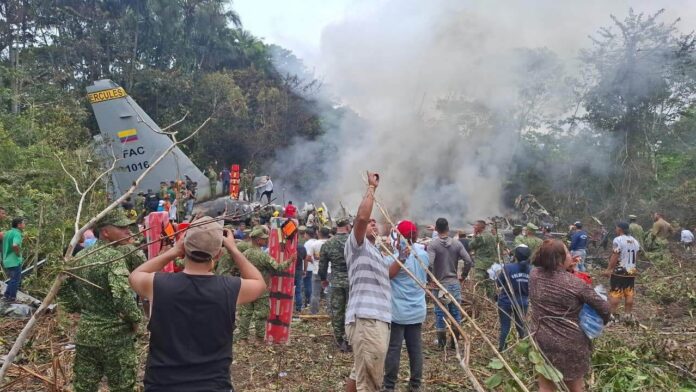
People stand around a military cargo plane that crashed after taking off from Puerto Leguizamo, Colombia, a remote municipality in the Amazonian province of Putumayo, Monday, March 23, 2026. (MiPutumayo via AP)

BOGOTA, Colombia (AP) — A military transport plane with 128 people on board, mostly soldiers, crashed shortly after taking off Monday in Puerto Leguizamo, Colombia, killing at least 66 people and leaving dozens injured, the head of Colombia’s armed forces said.

General Hugo Alejandro López Barreto said that four military personnel were still missing.

“Sadly, as a consequence of this tragic accident, 66 of our military elements died,” he said.

“At the moment, we have no information, or indications, that it was an attack by an illegal armed group,” Barreto added.

In a video posted on social media, Deputy Mayor Carlos Claros said that the bodies of the victims were taken to the small town’s morgue, and that the only two clinics in town treated the injured before they were flown to larger cities. Puerto Leguizamo is located in Putumayo, an Amazonian province that borders Ecuador and Peru.

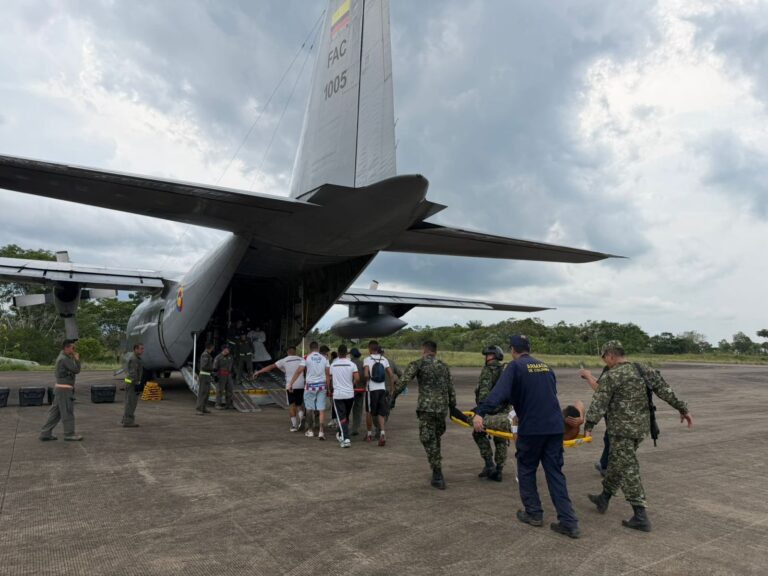
In this photo distributed by Colombia's Armed Forces press office, people who were injured on a military cargo plane that crashed shortly after take off are loaded on to another military plane to evacuate them for treatment, from Puerto Leguizamo, Colombia, Monday, March 23, 2026. (Colombia's Armed Forces press office via AP)
In this photo distributed by Colombia’s Armed Forces press office, people who were injured on a military cargo plane that crashed shortly after take off are loaded on to another military plane to evacuate them for treatment, from Puerto Leguizamo, Colombia, Monday, March 23, 2026. (Colombia’s Armed Forces press office via AP)

“I want to thank the people of Puerto Leguizamo who came out to help the victims of this accident,” Claros told Colombian television station RCN.

Defense Minister Pedro Sánchez said on X that the plane that crashed Monday was transporting troops to another city in Putumayo.

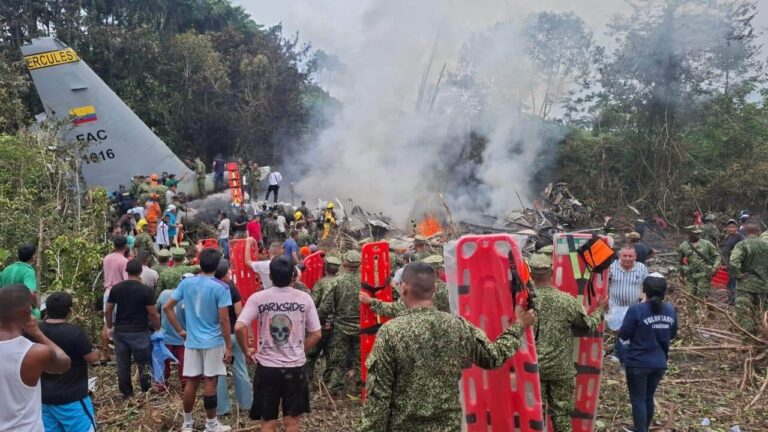
Images shared online by Colombian media outlets showed a black cloud of smoke rising from a field where the plane crashed and a truck with soldiers rushing to the site.

The airplane had 128 people on board, including 115 were from the Army, 11 crew members and 2 from the National Police. Baretto said 57 people were evacuated.

Media outlets shared videos of soldiers being rushed from the site on motorcycles driven by local residents, while another group of residents tried to put out the fire that the plane crash had created in a field surrounded by dense foliage.

Carlos Fernando Silva, the commander of Colombia’s air force, said details of the crash were not yet known, “except that the plane had a problem and went down about two kilometers from the airport.”

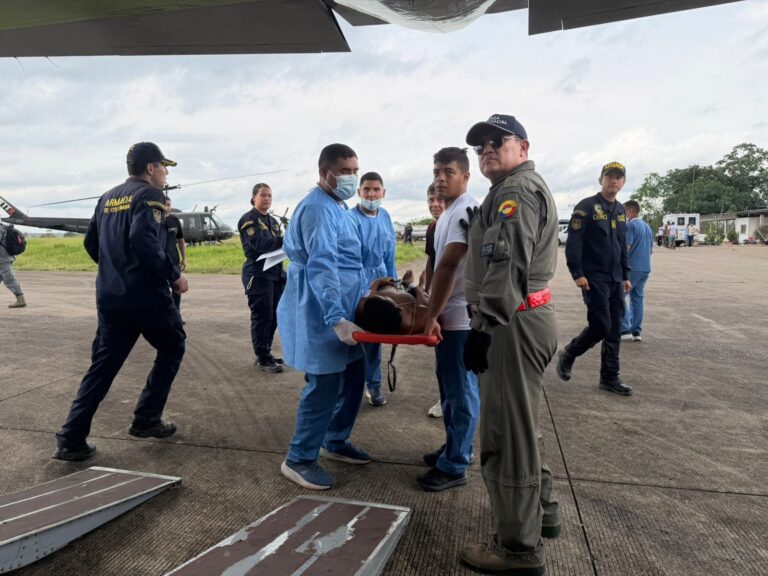
The air force commander added that two planes, with 74 beds, were sent to the area to fly the injured back to hospitals in the capital, Bogota, and elsewhere.
Petro seized on the accident to promote what he called his longtime campaign to modernize planes and other equipment used by his country’s military, saying those efforts have been blocked by “bureaucratic difficulties” and suggesting that some officials should be held accountable.

In this photo distributed by Colombia's Armed Forces press office, people who were injured on a military cargo plane that crashed shortly after take off are loaded on to another military plane to evacuate them for treatment, from Puerto Leguizamo, Colombia, Monday, March 23, 2026. (Colombia's Armed Forces press office via AP)
In this photo distributed by Colombia’s Armed Forces press office, people who were injured on a military cargo plane that crashed shortly after take off are loaded on to another military plane to evacuate them for treatment, from Puerto Leguizamo, Colombia, Monday, March 23, 2026. (Colombia’s Armed Forces press office via AP)

“If civilian or military administrative officials are not up to the challenge, they must be removed,” Petro said.

Critics of the president pointed out that military aircraft have been given less flight hours under the Petro administration due to budget cuts, which leads to less experienced crews.

Erich Saumeth, a Colombian aviation expert and military analyst, said that the Hercules C-130 that crashed Monday had been donated by the United States to Colombia in 2020. Three years later, it went through a detailed revision known as an overhaul, in which its engines were inspected and key components were replaced.

“I don’t think this plane crashed because of a lack of good parts,” Saumeth said. He said that investigations will have to determine why the engines of the Hercules, which has four propellers, failed so quickly after take off.

In a message on X Monday, Defense Minister Sánchez said that so far there were no signs indicating that the plane was attacked by rebel groups that operate near Puerto Leguizamo.

Sánchez wrote that the accident was “profoundly painful for the country,” adding that: “We hope that our prayers can help to relieve some of the pain.”

People stand around a military cargo plane that crashed after taking off from Puerto Leguizamo, Colombia, a remote municipality in the Amazonian province of Putumayo, Monday, March 23, 2026. (MiPutumayo via AP)
Advertisement

Hot News

LATEST NEWS

Bangkok
scattered clouds
28.3 ° C
28.3 °
25 °
74 %
2.8kmh
46 %
Tue
38 °
Wed
37 °
Thu
36 °
Fri
37 °
Sat
37 °