

























31.1 C
Bangkok
Tuesday, June 9, 2026
Home Blog Page 1044

Biden: Afghan Chaos ‘Gut-Wrenching’ but Stands by Withdrawal

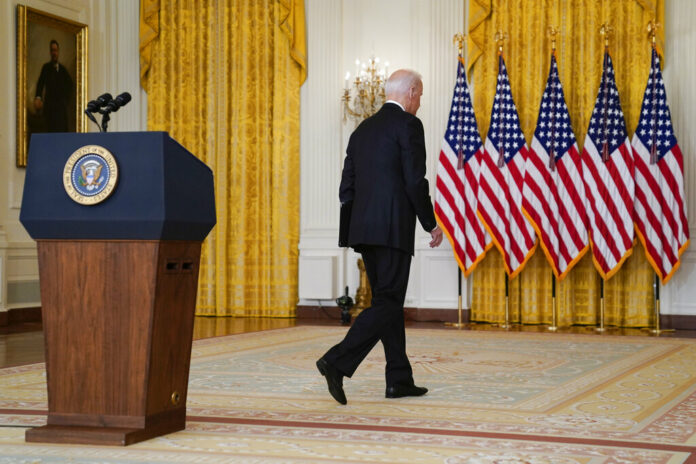
President Joe Biden walks from the podium after speaking about Afghanistan from the East Room of the White House, Monday, Aug. 16, 2021, in Washington. Photo: Evan Vucci / AP

WASHINGTON (AP) — A defiant President Joe Biden rejected blame for chaotic scenes of Afghans clinging to U.S. military planes in Kabul in a desperate bid to flee their home country after the Taliban’s easy victory over an Afghan military that America and NATO allies had spent two decades trying to build.

At the White House, Biden on Monday called the anguish of trapped Afghan civilians “gut-wrenching” and conceded the Taliban had achieved a much faster takeover of the country than his administration had expected. The U.S. rushed in troops to protect its own evacuating diplomats and others at the Kabul airport.

But the president expressed no second thoughts about his decision to stick by the U.S. commitment, formulated during the Trump administration, to end America’s longest war, no matter what.

“I stand squarely behind my decision” to finally withdraw U.S. combat forces, Biden said, while acknowledging the Afghan collapse played out far more quickly than the most pessimistic public forecasts of his administration. “This did unfold more quickly than we anticipated,” he said.

Despite declaring “the buck stops with me,” Biden placed almost all blame on Afghans for the shockingly rapid Taliban conquest.

His grim comments were his first in person to the world since the biggest foreign policy crisis of his still-young presidency. Emboldened by the U.S. withdrawal, Taliban fighters swept across the country last week and captured the capital, Kabul, on Sunday, sending U.S.-backed Afghan President Ashraf Ghani fleeing the country.

Biden said he had warned Ghani — who was appointed Afghanistan’s president in a U.S.-negotiated agreement — to be prepared to fight a civil war with the Taliban after U.S. forces left. “They failed to do any of that,” he said.

Internationally, the spectacle of the Taliban takeover and the chaos of the evacuation effort was raising doubts about America’s commitments to its allies.

German Chancellor Angela Merkel said it was “bitter” to watch the complete collapse in a war that Germany and other NATO partners had followed the U.S. into after the Sept. 11 attacks, which were plotted from Afghanistan. The humiliating scenes seemed certain to give comfort to American foes.

At home, it all sparked sharp criticism, even from members of Biden’s own political party, who implored the White House to do more to rescue fleeing Afghans, especially those who had aided the two-decade American military effort.

“We didn’t need to be seeing the scenes that we’re seeing at Kabul airport with our Afghan friends climbing aboard C-17s,” said Rep. Jason Crow, a Colorado Democrat and Iraq and Afghanistan military veteran.

He said that is why he and others called for the evacuations to start months ago. “It could have been done deliberately and methodically,” Crow said. “And we think that that was a missed opportunity.”

Besides the life-and-death situation in Kabul, the timing of the crisis was unfortunate for Biden’s domestic efforts at home. It could well weaken his political standing as he works to combat the COVID-19 pandemic and build congressional support for a $1.2 trillion infrastructure bill and an even larger expansion of the social safety net.

Still, the focus at home and abroad on Monday was on Kabul’s airport, where thousands of Afghans trapped by the sudden Taliban takeover rushed the tarmac and clung to U.S. military planes deployed to fly out staffers of the U.S. Embassy, which shut down Sunday, and others.

At least seven people died in the chaos, including two who clung to the wheels of a C-17 and plunged to the tarmac as it flew away, and two others shot by U.S. forces. Americans said the men were armed but there was no evidence that they were Taliban.

With tens of thousands of U.S. citizens and others as well as Afghans desperate to escape, Biden insisted the U.S. had done all it could to plan.

In fact, Afghan leaders had asked the U.S. not to publicly play up any advance efforts to evacuate former military translators, female activists and others most at risk from the Taliban, saying that in itself could trigger what the Afghans said could be “a crisis of confidence,” Biden said.

Pentagon spokesman John Kirby said late Monday that the U.S., which had taken charge of air traffic control at the Kabul airport, had resumed airlifts out after suspending them due to the morning’s stampedes onto the runways by frightened Afghans.

Kirby said U.S. forces are planning to wrap up their oversight of the evacuation by Aug. 31, also the date Biden has set for officially ending the U.S. combat role in Afghanistan.

The U.S. hopes to fly out up to 5,000 people a day once more of 6,000 U.S troops being deployed to secure the evacuation arrive, and once more transport planes can land, he said.

Biden pledged to work to also evacuate private U.S. citizens and citizens of foreign governments, as well as Afghans who formerly worked with Americans in the country, journalists, prominent women and other Afghans considered most at-risk of Taliban reprisal.

As of July, the U.S. had a visa application backlog of 18,000 former Afghan employees alone who were seeking a haven in the United States, and had been able to evacuate only a few thousand in what was meant to be a sped-up process over the last month.

Veterans groups and nonprofit groups that worked with Afghan women appealed to Biden on Monday to keep troops at the Kabul airport at least through the end of the month, to keep the escape route out of Taliban hands.

___

Story: Ellen Knickmeyer, Robert Burns and Zeke Miller. Associated Press writers Matthew Lee, Eric Tucker and Mary Clare Jalonick in Washington and Kirsten Grieshaber in Berlin contributed to this report.
Advertisement

Taliban Take Over Afghanistan: What We Know and What’s Next

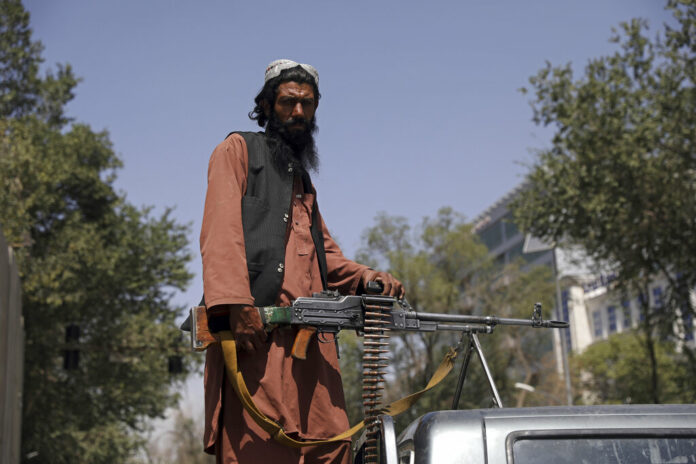
A Taliban fighter stands guard at the main gate leading to the Afghan presidential palace, in Kabul, Afghanistan, Monday, Aug. 16, 2021. Photo: Rahmat Gul / AP

The Taliban have seized power in Afghanistan two weeks before the U.S. was set to complete its troop withdrawal after a costly two-decade war.

The insurgents stormed across the country, capturing all major cities in a matter of days, as Afghan security forces trained and equipped by the U.S. and its allies melted away.

Here’s a look at what happened and what comes next:

WHAT IS HAPPENING IN AFGHANISTAN?

The Taliban, a militant group that ran the country in the late 1990s, have again taken control.

The U.S.-led invasion of Afghanistan in 2001 ousted the insurgents from power, but they never left. After they blitzed across the country in recent days, the Western-backed government that has run the country for 20 years collapsed. Afghans, fearing for the future, are racing to the airport, one of the last routes out of the country.

___

WHY ARE PEOPLE FLEEING THE COUNTRY?

They’re worried that the country could descend into chaos or the Taliban could carry out revenge attacks against those who worked with the Americans or the government.

Many also fear the Taliban will reimpose the harsh interpretation of Islamic law that they relied when they ran Afghanistan from 1996 to 2001. Back then, women were barred from attending school or working outside the home. They had to wear the all-encompassing burqa and be accompanied by a male relative whenever they went outside. The Taliban banned music, cut off the hands of thieves and stoned adulterers.

The Taliban have sought to present themselves as a more moderate force in recent years and say they won’t exact revenge, but many Afghans are skeptical of those promises.

AP21227536852661
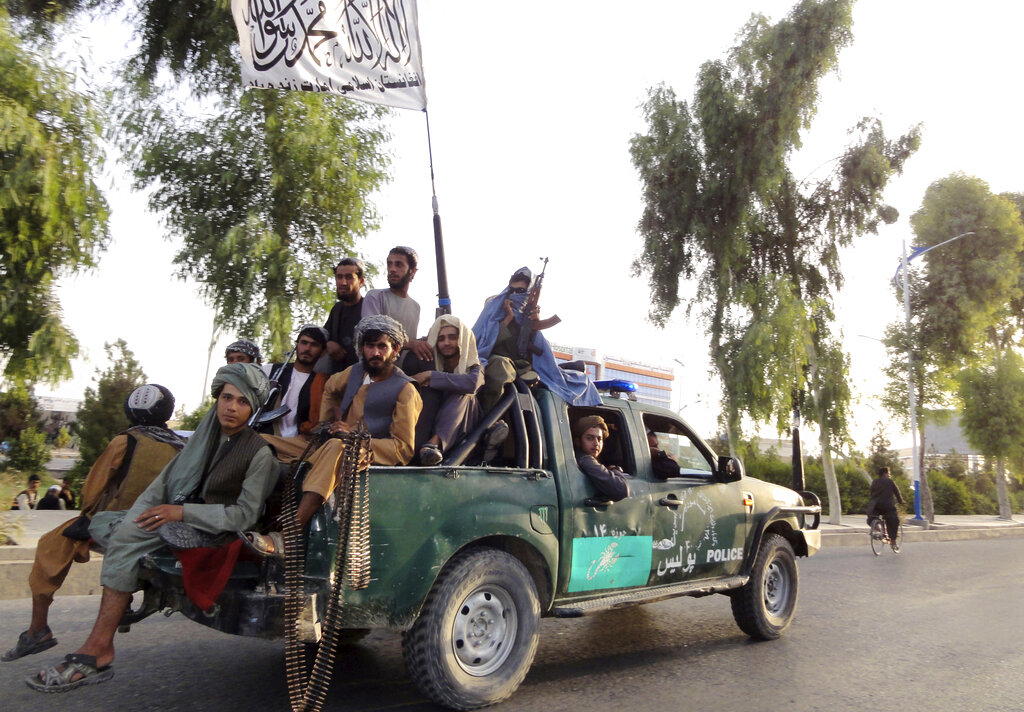
Taliban fighters patrol inside the city of Kandahar, southwest Afghanistan, Sunday, Aug. 15, 2021. Photo: Sidiqullah Khan / AP

___

WHY ARE THE TALIBAN TAKING OVER NOW?

Probably because U.S. troops are set to withdraw by the end of the month.

The U.S. has been trying to get out of Afghanistan, its longest war, for several years now.

American troops ousted the Taliban in a matter of months when they invaded to root out al-Qaida, which orchestrated the 9/11 attacks while being harbored by the Taliban. But it proved more difficult to hold territory and rebuild a nation battered by repeated wars.

As the U.S. focus shifted to Iraq, the Taliban began to regroup and in recent years took over much of the Afghan countryside.

Last year, then-President Donald Trump announced a plan to pull out and signed a deal with the Taliban that limited U.S. military action against them. President Joe Biden then announced that the last troops would leave by the end of August.

As the final deadline drew close, the Taliban began a lightning offensive, overrunning city after city.

___

WHY DID THE AFGHAN SECURITY FORCES COLLAPSE?

The short answer? Corruption.

The U.S. and its NATO allies spent billions of dollars over two decades to train and equip Afghan security forces. But the Western-backed government was rife with corruption. Commanders exaggerated the number of soldiers to siphon off resources, and troops in the field often lacked ammunition, supplies or even food.

Their morale further eroded when it became clear the U.S. was on its way out. As the Taliban rapidly advanced in recent days entire units surrendered after brief battles, and Kabul and some nearby provinces fell without a fight.

___

WHAT HAPPENED TO THE PRESIDENT OF AFGHANISTAN?

He fled.

President Ashraf Ghani hunkered down and made few public statements as the Taliban swept across the country. On Sunday, as they reached the capital, he left Afghanistan, saying he had chosen to leave to avoid further bloodshed. It’s not clear where he went.

___

WHY ARE PEOPLE COMPARING AFGHANISTAN TO THE FALL OF SAIGON?

The Fall of Saigon to North Vietnamese forces in 1975 marked the end of the Vietnam War. It became an enduring symbol of defeat after thousands of Americans and their Vietnamese allies were airlifted out of the city on helicopters. U.S. Secretary of State Antony Blinken has rejected any comparisons to Afghanistan, saying: “This is manifestly not Saigon.”

AP21227222194956
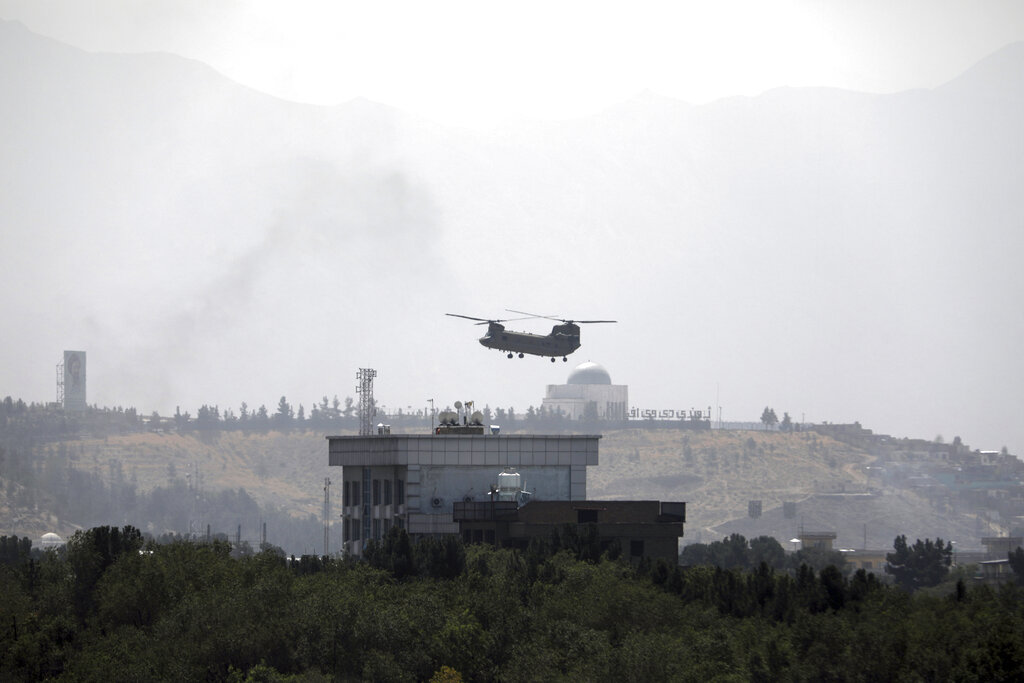
A U.S. Chinook helicopter flies over the U.S. Embassy in Kabul, Afghanistan, Sunday, Aug. 15, 2021. Photo: Rahmat Gul / AP

___

WHAT WILL HAPPEN NEXT IN AFGHANISTAN?

It’s not clear.

The Taliban say they want to form an “inclusive, Islamic government” with other factions. They are holding negotiations with senior politicians, including leaders in the former government.

They have pledged to enforce Islamic law but say they will provide a secure environment for the return of normal life after decades of war.

But many Afghans distrust the Taliban and fear that their rule will be violent and oppressive. One sign that worries people is that they want to rename the country the Islamic Emirate of Afghanistan, which is what they called it the last time they ruled.

___

WHAT DOES THE TALIBAN TAKEOVER MEAN FOR WOMEN?

Many fear it could mean a severe rollback of rights.

Afghan women have made major gains since the overthrow of the Taliban. Many are worried they will once again be confined to their homes. The Taliban have said they are no longer opposed to women attending school but have not set out a clear policy on women’s rights. Afghanistan remains an overwhelmingly conservative country, especially outside major cities, and the status of women often varied, even under Taliban rule.

AP21228263677262
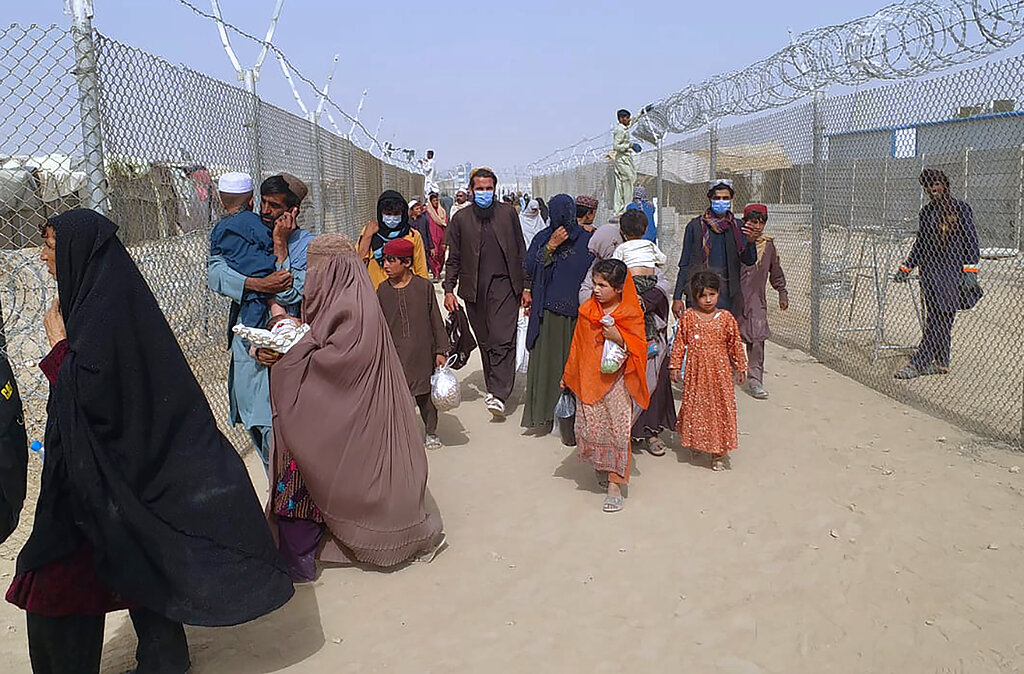
Travelers enter in Pakistan through a border crossing point in Chaman, Pakistan, Monday, Aug. 16, 2021. A special flight of Pakistan’s national airline PIA has arrived in Islamabad carrying 329 passengers from Kabul, and another carrying 170 people will arrive later today. Photo: Jafar Khan / AP

___

WILL THE TALIBAN ONCE AGAIN HARBOR AL-QAIDA?

That’s anyone’s guess, but American military officials are worried.

In the peace deal signed with the United States last year, the Taliban pledged to fight terrorism and prevent Afghanistan from again becoming a base for attacks. But the U.S. has little leverage to enforce that.

Technological advances over the last 20 years allow the United States to target suspected militants in countries like Yemen and Somalia where it does not have a permanent troop presence. The Taliban paid a heavy price for their role in the Sept. 11 attacks and likely hope to avoid a repeat as they seek to consolidate their rule.

But earlier this year, the Pentagon’s top leaders said an extremist group like al-Qaida may be able to regenerate in Afghanistan, and officials are now warning that such groups could grow much faster than expected.

Afghanistan is also home to an Islamic State group affiliate that has carried out a wave of horrific attacks targeting its Shiite minority in recent years. The Taliban have condemned such attacks and the two groups have fought each other over territory, but it remains to be seen whether a Taliban government will be willing or able to suppress IS.

Story: Joseph Krauss

Advertisement

Death Toll of Powerful Earthquake in Haiti Soars to 1,297

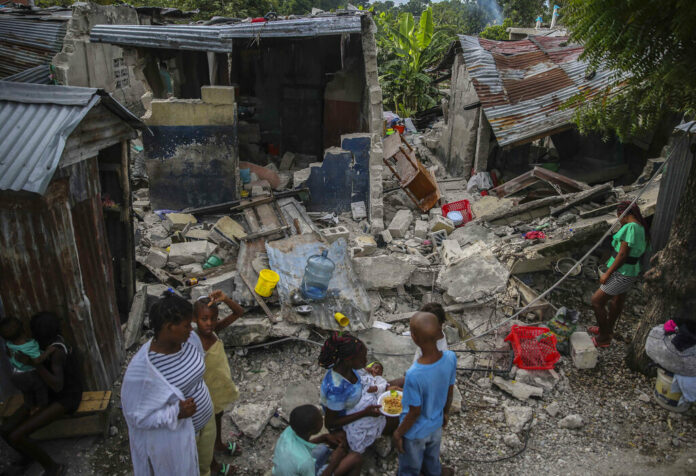
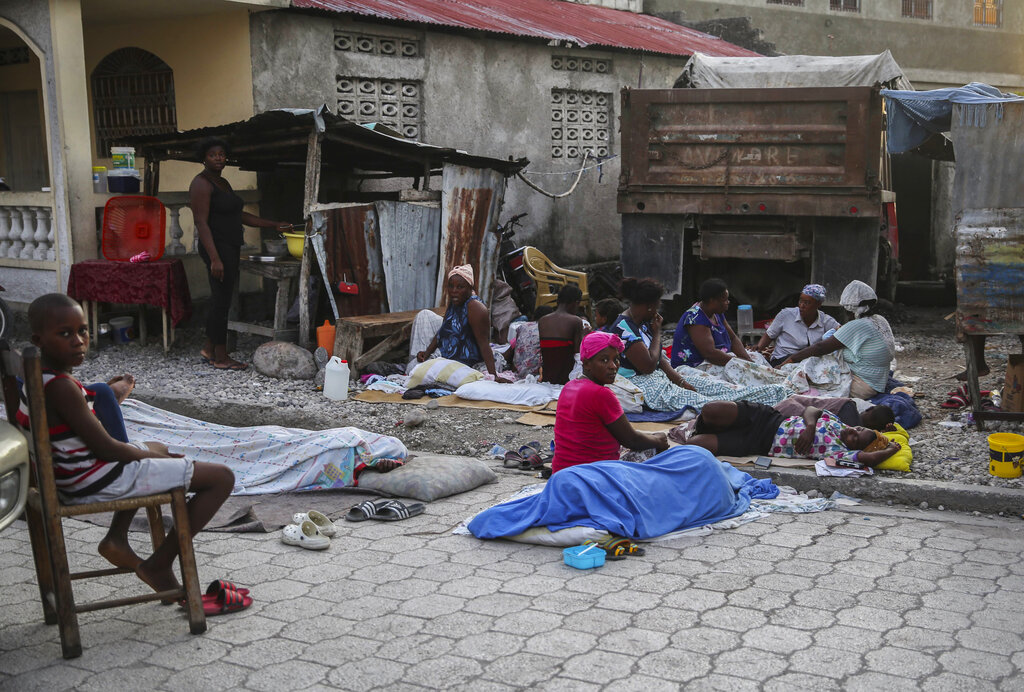
A family eats breakfast in front of homes destroyed by a 7.2 magnitude earthquake in Les Cayes, Haiti, Sunday, Aug. 15, 2021. Photo: Joseph Odelyn / AP

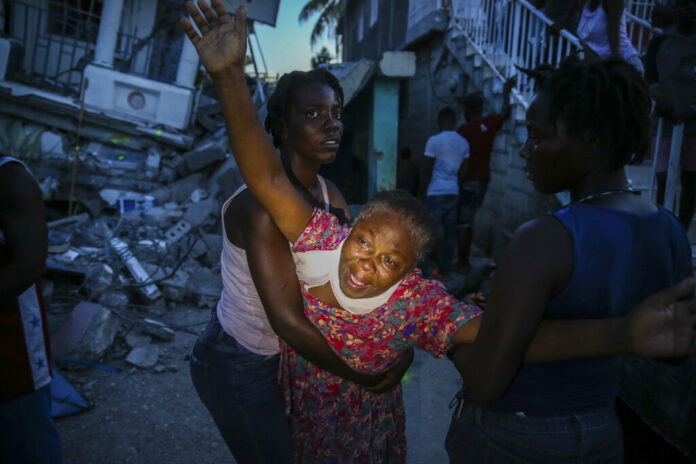
LES CAYES, Haiti (AP) — The death toll from a 7.2-magnitude earthquake in Haiti climbed to 1,297 on Sunday, a day after the powerful temblor turned thousands of structures into rubble and set off franctic rescue efforts ahead of a potential deluge from an approaching storm.

Saturday’s earthquake also left at least 5,700 people injured in the Caribbean nation, with thousands more displaced from their destroyed or damaged homes. Survivors in some areas were forced to wait out in the open amid oppressive heat for help from overloaded hospitals.

The devastation could soon worsen with the coming of Tropical Depression Grace, which is predicted to reach Haiti on Monday night. The U.S. National Hurricane Center warned that although Grace had weakened from tropical storm strength Sunday, it still posed a threat to bring heavy rain, flooding and landslides.

The earthquake struck the southwestern part of the hemisphere’s poorest nation, almost razing some towns and triggering landslides that hampered rescue efforts in a country already struggling with the coronavirus pandemic, a presidential assassination and a wave of gang violence.

The epicenter was about 125 kilometers (78 miles) west of the capital of Port-au-Prince, the U.S. Geological Survey said, and aftershocks continued to jolt the area Sunday.

In the badly damaged coastal town of Les Cayes, Jennie Auguste lay on a flimsy foam mattress on the tarmac of the community’s tiny airport waiting for anything — space at a hospital or a small plane like the ones ferrying the wounded to the capital. She suffered injuries in the chest, abdomen and arm when the roof collapsed at the store where she worked.

AP21227493330288
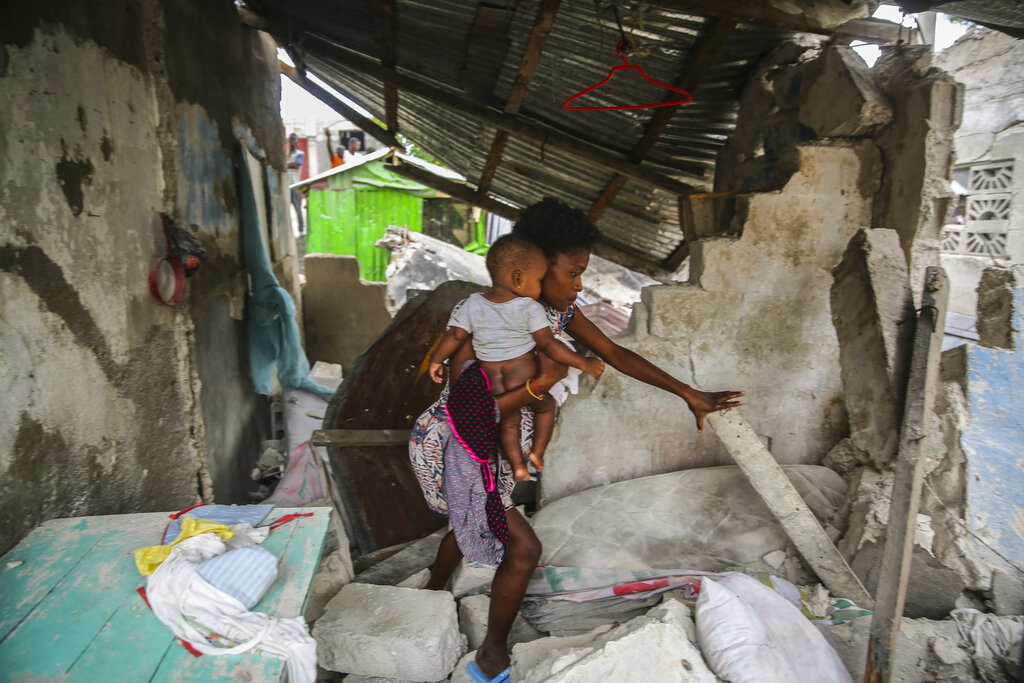
A woman carries her child as she walks in the remains of her home destroyed by Saturday´s 7.2 magnitude earthquake in Les Cayes, Haiti, Sunday, Aug. 15, 2021. Photo: Joseph Odelyn / AP

“There has been nothing. No help, nothing from the government,” Auguste’s sister, Bertrande, said.

In scenes widespread across the region hit by the quake, families salvaged their few belongings and spent the night at an open-air football pitch. On Sunday, people lined up to buy what little was available: bananas, avocados and water at a local street market.

Some in the town praised God for surviving the earthquake, and many went to the cathedral, which appeared outwardly undamaged even if the priests’ residence was destroyed.

“We only have Jesus now,” said Johanne Dorcely, whose house was destroyed. “If it wasn’t for Jesus, I wouldn’t be able to be here today.”

Workers tore through rubble of collapsed buildings with heavy machinery, shovels and picks. After sundown, Les Cayes was darkened by intermittent blackouts, and many slept people outside again, clutching small transistor radios tuned to news, terrified of a possible repetition of Saturday’s strong aftershocks.

Prime Minister Ariel Henry has declared a one-month state of emergency for the whole country and said he was rushing aid to areas where towns were destroyed and hospitals were overwhelmed.

AP21227495019915
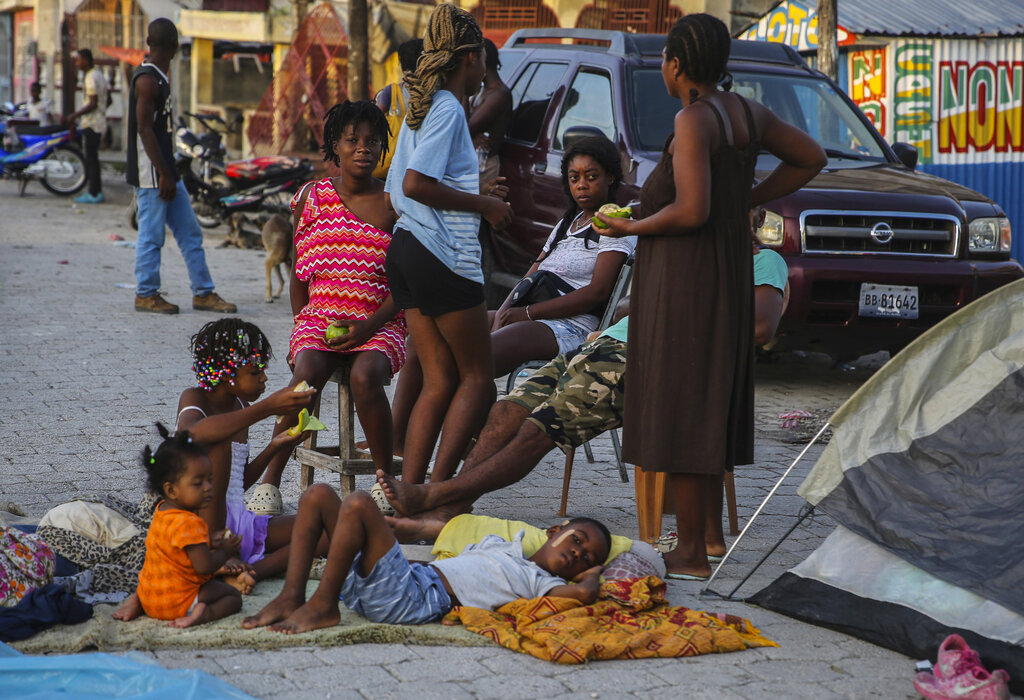
Locals eat after spending the night in the middle of a street after Saturday´s 7.2 magnitude earthquake in Les Cayes, Haiti, Sunday, Aug. 15, 2021. Photo: Joseph Odelyn / AP

“The first convoys started following the coordination efforts of several ministers mobilized at the level of the National Emergency Center,” Henry told reporters Sunday. “We salute the dignity, the resilience effort of the victims and their ability to start over. From my observations, I deduce that Haitians want to live and progress. Let us unite to offer these people a living environment conducive to development.”

UNICEF Executive Director Henrietta Fore said Sunday that humanitarian needs are acute, with many Haitians urgently needing health care, clean water and shelter. Children who have been separated from parents need protection, she said.

“Little more than a decade on, Haiti is reeling once again,” Fore said in a statement. “And this disaster coincides with political instability, rising gang violence, alarmingly high rates of malnutrition among children, and the COVID-19 pandemic — for which Haiti has received just 500,000 vaccine doses, despite requiring far more.”

The country of 11 million people received its first batch of U.S.-donated coronavirus vaccines only last month via a United Nations program for low-income countries.

Haiti’s Office of Civil Protection said more than 7,000 homes were destroyed and nearly 5,000 damaged. Hospitals, schools, offices and churches were also affected.

Medical workers from across the region were scrambling to help as hospitals in Les Cayes started running out of space to perform surgeries.

AP21227495717561
Locals begin to wake up after spending the night outside after Saturday´s 7.2 magnitude earthquake in Les Cayes, Haiti, Sunday, Aug. 15, 2021. Photo: Joseph Odelyn / AP

“Basically, they need everything,” said Dr. Inobert Pierre, a pediatrician with the nonprofit Health Equity International, which oversees St. Boniface Hospital, about two hours from Les Cayes.

“Many of the patients have open wounds and they have been exposed to not-so-clean elements,” added Pierre, who visited two hospitals in Les Cayes — one with some 200 patients, the other with around 90. “We anticipate a lot of infections.”

Pierre’s medical team was taking some patients to St. Boniface to undergo surgery, but with just two ambulances, they could transport only four at a time.

Small planes from a private firm and the Florida-based missionary service Agape Flights landed at the Port-Au-Prince airport Sunday carrying about a half dozen injured from the Les Cayes area. Young men with bandages and a woman were hoisted on stretchers to waiting Haitian Red Cross ambulances.

Silvestre Plaza Rico, who was supervising one of the volunteer flights, said rescue planes had made several airlifts of about a half dozen injured victims each on Saturday. “There were many, many, many, from different towns,” Plaza Rico said.

The earthquake struck just over a month after President Jovenel Moïse was shot to death in his home, sending the country into political chaos. His widow, Martine Moïse, who was seriously wounded in the attack, posted a message on Twitter calling for unity among Haitians: “Let’s put our shoulders together to bring solidarity.”

Shortly after the earthquake, Henry said he wanted “structured solidarity” to ensure the response was coordinated to avoid the confusion that followed the devastating 2010 earthquake, when aid was slow to reach residents after.

AP21228004762350
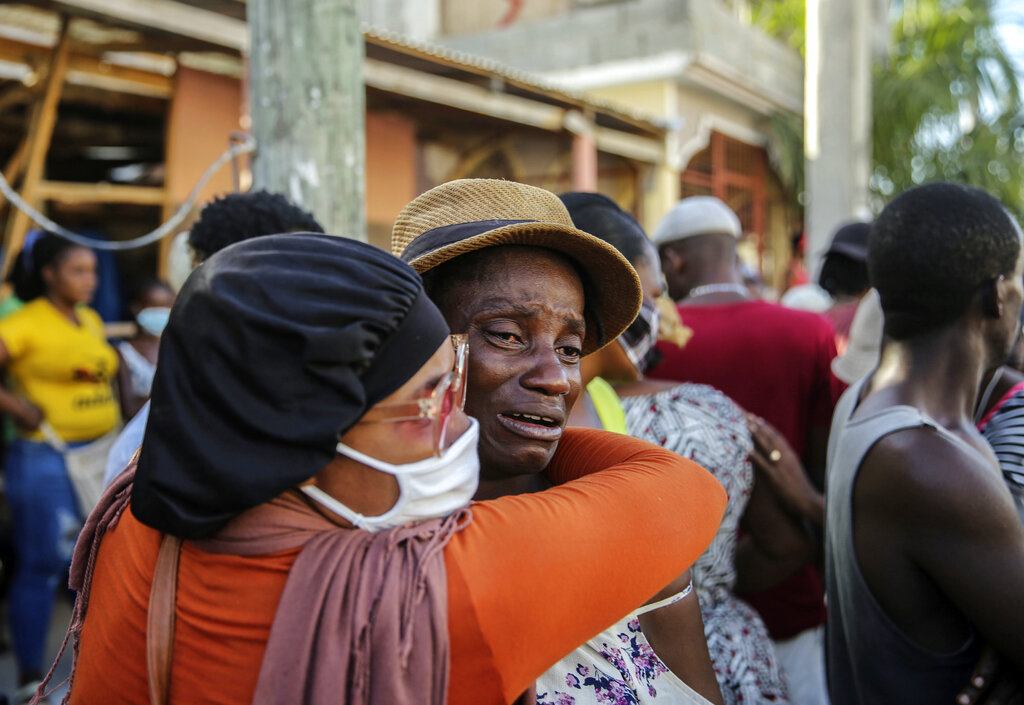
People cry during the search for those who are still missing in a house destroyed by the earthquake in Les Cayes, Haiti, Sunday, Aug. 15, 2021. Photo: Joseph Odelyn / AP

U.S. President Joe Biden named USAID Administrator Samantha Power to oversee the U.S effort to help Haiti. She announced Sunday that USAID was sending a search and rescue team from Virginia at the request of Haiti’s government. The 65-person team will bring specialized tools and medical supplies, she said on Twitter.

Working with USAID, the U.S. Coast Guard said a helicopter was transporting medical personnel from the Haitian capital to the quake zone and evacuating the injured back to Port-au-Prince. Lt. Commander Jason Nieman, a spokesman, said another helicopter was being sent from the Bahamas, along with other aircraft and ships.

Already on the scene were several members of Cuba’s 253-member health care mission to Haiti, and the socialist nation’s state media showed photos of them giving first aid to victims injured by the quake.

The North Carolina-based aid group Samaritan’s Purse announced it would fly 13 disaster response specialists and 31 tons of emergency supplies to Haiti. Those include shelter materials and water filtration units.

Humanitarian workers said gang activity in the seaside district of Martissant, just west of the Haitian capital, was complicating relief efforts.

The U.N. Office for the Coordination of Humanitarian Affairs said Haiti’s southern peninsula is a “hotspot for gang-related violence,” where humanitarian workers have been repeatedly attacked.

The agency said the area has been “virtually unreachable” over the past two months because of road blocks and security concerns. But it said late Sunday that local officials negotiated with gangs in the seaside district of Martissant to allow two humanitarian convoys a day to pass through the area.

Anna Jefferys, spokeswoman for the U.N. agency, said the first convoy passed through Sunday with government and U.N. personnel. The U.N.’s World Food Program plans to send food supplies via trucks to southern Haiti on Tuesday, she added.

Haiti, where many live in tenuous circumstances, is vulnerable to earthquakes and hurricanes. A magnitude 5.9 earthquake in 2018 killed more than a dozen people.

The magnitude 7.0 quake of 2010 hit closer to densely populated Port-au-Prince and caused widespread destruction. Haiti’s government put the death toll at more than 300,000, while a report commissioned by the U.S. government placed it between 46,000 and 85,000.

___

Story: Evens Sanon and Mark Stevenson. Associated Press writers Collin Binkley in Boston; Trenton Daniel in New York; Regina Garcia Cano in Mexico City and Colleen Barry in Milan contributed to this report.

Advertisement

Taliban Sweep Into Afghan Capital After Government Collapses

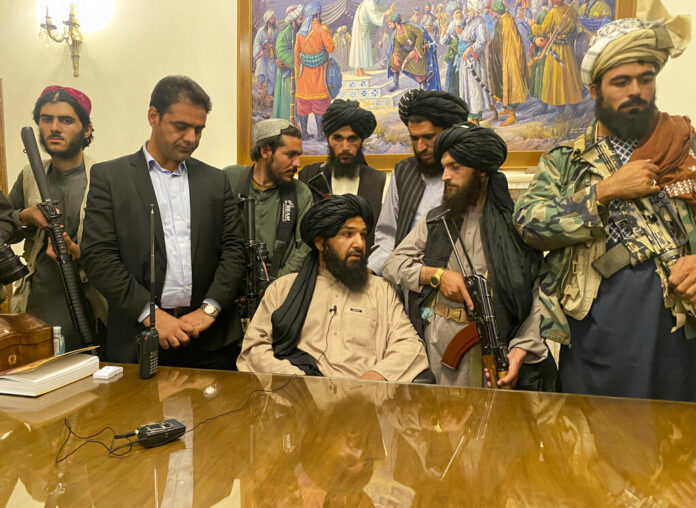
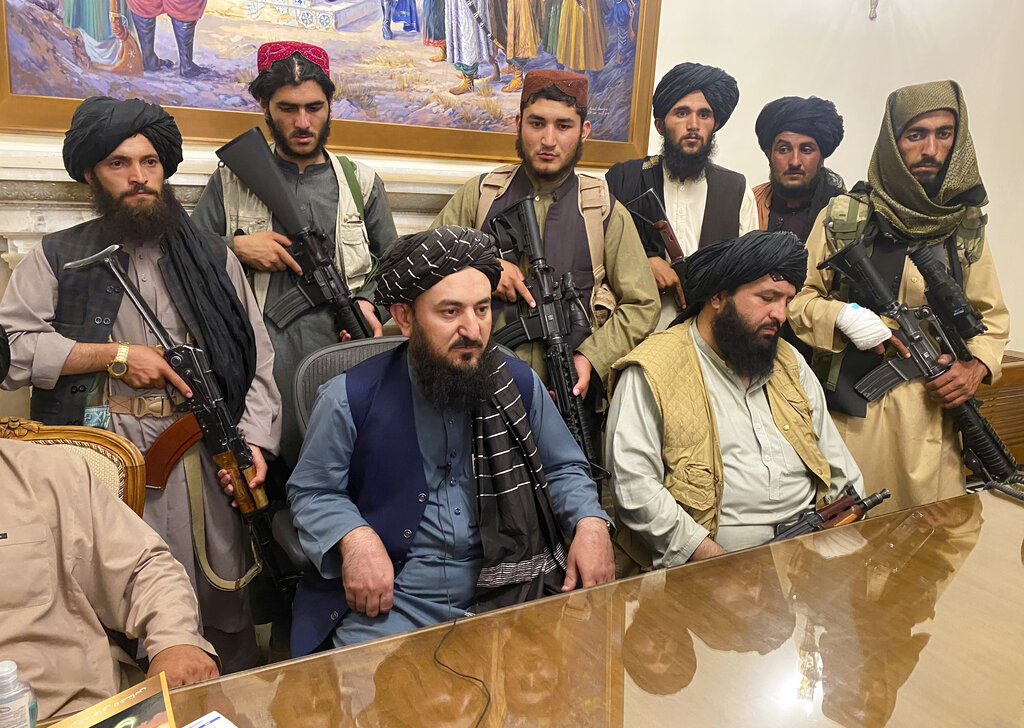
Taliban fighters take control of Afghan presidential palace after the Afghan President Ashraf Ghani fled the country, in Kabul, Afghanistan, Sunday, Aug. 15, 2021. Photo: Zabi Karimi / AP

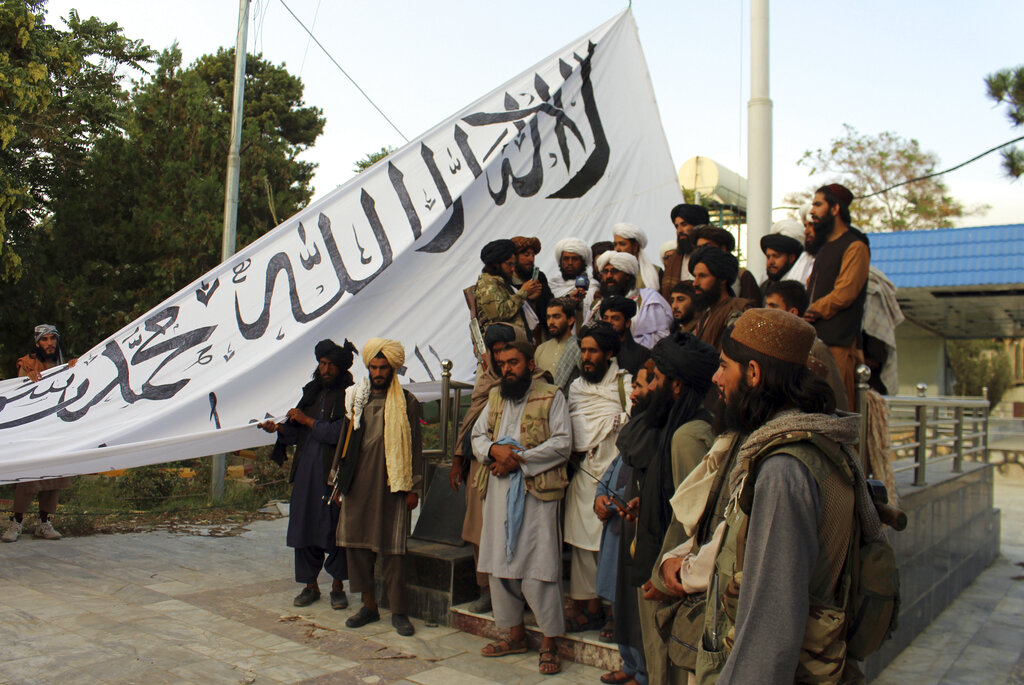
KABUL, Afghanistan (AP) — The Taliban swept into Afghanistan’s capital Sunday after the government collapsed and the embattled president joined an exodus of his fellow citizens and foreigners, signaling the end of a costly two-decade U.S. campaign to remake the country.

Heavily armed Taliban fighters fanned out across the capital, and several entered Kabul’s abandoned presidential palace. Suhail Shaheen, a Taliban spokesman and negotiator, told The Associated Press that the militants would hold talks in the coming days aimed at forming an “open, inclusive Islamic government.”

Earlier, a Taliban official said the group would announce from the palace the restoration of the Islamic Emirate of Afghanistan, the formal name of the country under Taliban rule before the militants were ousted by U.S.-led forces in the wake of the 9/11 attacks, which were orchestrated by al-Qaida while it was being sheltered by the Taliban. But that plan appeared to be on hold.

Kabul was gripped by panic. Helicopters raced overhead throughout the day to evacuate personnel from the U.S. Embassy. Smoke rose near the compound as staff destroyed important documents, and the American flag was lowered. Several other Western missions also prepared to pull their people out.

Fearful that the Taliban could reimpose the kind of brutal rule that all but eliminated women’s rights, Afghans rushed to leave the country, lining up at cash machines to withdraw their life savings. The desperately poor — who had left homes in the countryside for the presumed safety of the capital — remained in parks and open spaces throughout the city.

AP21227746300288
Taliban fighters take control of Afghan presidential palace after the Afghan President Ashraf Ghani fled the country, in Kabul, Afghanistan, Sunday, Aug. 15, 2021. Photo: Zabi Karimi / AP

Though the Taliban had promised a peaceful transition, the U.S. Embassy suspended operations and warned Americans late in the day to shelter in place and not try to get to the airport.

Commercial flights were suspended after sporadic gunfire erupted at the Kabul airport, according to two senior U.S. military officials. Evacuations continued on military flights, but the halt to commercial traffic closed off one of the last routes available for fleeing Afghans.

Dozens of nations called on all parties involved to respect and facilitate the departure of foreigners and Afghans who wish to leave.

More than 60 nations released the joint statement distributed by the U.S. State Department late Sunday night Washington time. The statement says that those in power and authority across Afghanistan “bear responsibility — and accountability — for the protection of human life and property, and for the immediate restoration of security and civil order.”

AP21227646031491
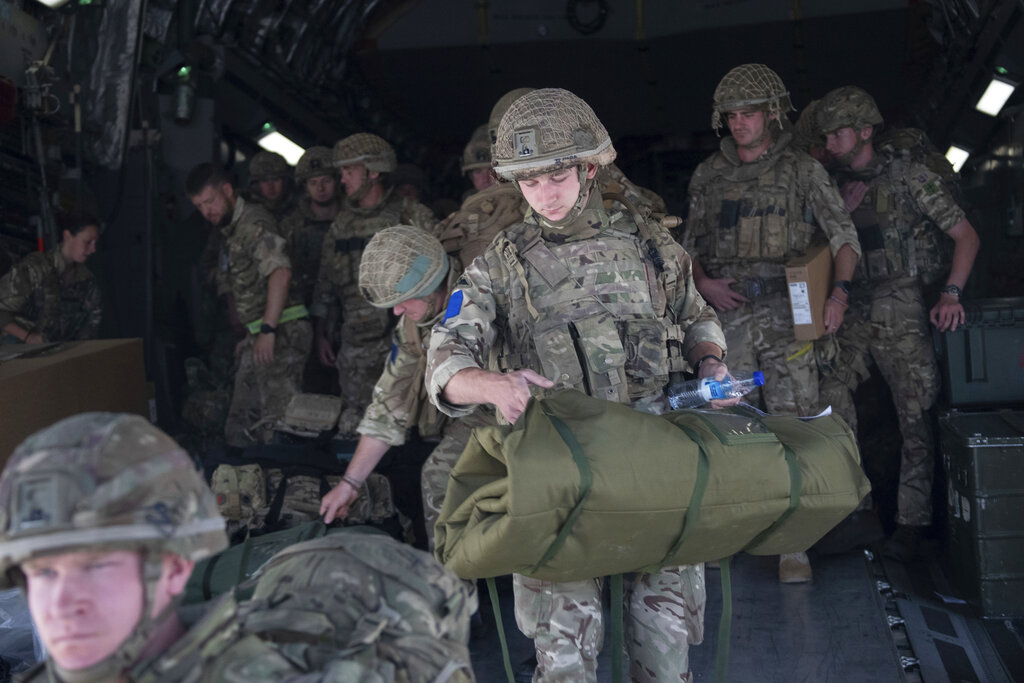
In this photo provided by the Ministry of Defence on Sunday, Aug. 15, 2021, members of the 16 Air Assault Brigade arrive in Kabul as part of a 600-strong UK-force sent to assist with Operation PITTING to rescue British nationals in Afghanistan amidst the worsening security situation there. Photo: Leading Hand Ben Shread / Ministry of Defence via AP

The nations’ statement also says that roads, airports and border crossings must remain open, and that calm must be maintained.

Many people watched in disbelief as helicopters landed in the U.S. Embassy compound to take diplomats to a new outpost at the airport. U.S. Secretary of State Antony Blinken rejected comparisons to the U.S. pullout from Vietnam.

“This is manifestly not Saigon,” he said on ABC’s “This Week.”

The American ambassador was among those evacuated, officials said. He was asking to return to the embassy, but it was not clear if he would be allowed to. The officials spoke on condition of anonymity to discuss ongoing operations.

As the insurgents closed in, President Ashraf Ghani flew out of the country.

“The former president of Afghanistan left Afghanistan, leaving the country in this difficult situation,” said Abdullah Abdullah, the head of the Afghan National Reconciliation Council and a longtime rival of Ghani. “God should hold him accountable.”

Ghani later posted on Facebook that he left to avert bloodshed in the capital, without saying where he had gone.

As night fell, Taliban fighters deployed across Kabul, taking over abandoned police posts and pledging to maintain law and order during the transition. Residents reported looting in parts of the city, including in the upscale diplomatic district, and messages circulating on social media advised people to stay inside and lock their gates.

In a stunning rout, the Taliban seized nearly all of Afghanistan in just over a week, despite the billions of dollars spent by the U.S. and NATO over nearly 20 years to build up Afghan security forces. Just days earlier, an American military assessment estimated that the capital would not come under insurgent pressure for a month.

The fall of Kabul marks the final chapter of America’s longest war, which began after the Sept. 11, 2001, terror attacks. A U.S.-led invasion dislodged the Taliban and beat them back, but America lost focus on the conflict in the chaos of the Iraq war.

For years, the U.S. sought an exit from Afghanistan. Then-President Donald Trump signed a deal with the Taliban in February 2020 that limited direct military action against the insurgents. That allowed the fighters to gather strength and move quickly to seize key areas when President Joe Biden announced his plans to withdraw all American forces by the end of this month.

After the insurgents entered Kabul, Taliban negotiators discussed a transfer of power, said an Afghan official. The official, who spoke on condition of anonymity to discuss details of the closed-door negotiations, described them as “tense.”

It remained unclear when that transfer would take place and who among the Taliban was negotiating. The negotiators on the government side included former President Hamid Karzai, leader of Hizb-e-Islami political and paramilitary group Gulbudin Hekmatyar, and Abdullah, who has been a vocal critic of Ghani.

Karzai himself appeared in a video posted online, his three young daughters around him, saying he remained in Kabul.

“We are trying to solve the issue of Afghanistan with the Taliban leadership peacefully,” he said.

Afghanistan’s acting defense minister, Bismillah Khan Mohammadi, did not hold back his criticism of the fleeing president.

“They tied our hands from behind and sold the country,” he wrote on Twitter. “Curse Ghani and his gang.”

The Taliban earlier insisted that their fighters would not enter people’s homes or interfere with businesses and said they would offer “amnesty” to those who worked with the Afghan government or foreign forces.

AP21227601035732
Taliban fighters poses for a photograph while raising their flag Taliban fighters raise their flag at the Ghazni provincial governor’s house, in Ghazni, southeastern, Afghanistan, Sunday, Aug. 15, 2021. Photo: Gulabuddin Amiri / AP

But there have been reports of revenge killings and other brutal tactics in areas of the country the Taliban have seized in recent days. Reports of gunfire at the airport raised the specter of more violence. One female journalist, weeping, sent voice messages to colleagues after armed men entered her apartment building and banged on her door.

“What should I do? Should I call the police or Taliban?” Getee Azami cried. It wasn’t clear what happened to her after that.

An Afghan university student described feeling betrayed as she watched the evacuation of the U.S. Embassy.

“You failed the younger generation of Afghanistan,” said Aisha Khurram, 22, who is now unsure of whether she will be able to graduate in two months. She said her generation was “hoping to build the country with their own hands. They put blood, efforts and sweat into whatever we had right now.”

Sunday began with the Taliban seizing Jalalabad, the last major city besides the capital not in their hands. Afghan officials said the militants also took the capitals of Maidan Wardak, Khost, Kapisa and Parwan provinces, as well as the country’s last government-held border post.

Later, Afghan forces at Bagram Air Base, home to a prison housing 5,000 inmates, surrendered to the Taliban, according to Bagram district chief Darwaish Raufi. The prison at the former U.S. base held both Taliban and Islamic State group fighters.

___

Story: Ahmad Seir, Rahim Faiez, Tameem Akhgar and Jon Gambrell. Akhgar and Faiez reported from Istanbul and Gambrell from Dubai, United Arab Emirates. Associated Press writers Kathy Gannon in Guelph, Canada; Joseph Krauss in Jerusalem; ​Matthew Lee in Washington; James LaPorta in Boca Raton, Florida; Aya Batrawy in Dubai; and Frank Jordans in Berlin contributed to this report.
Advertisement

Thai Riot Police, Anti-Gov’t Protesters Clash in Bangkok

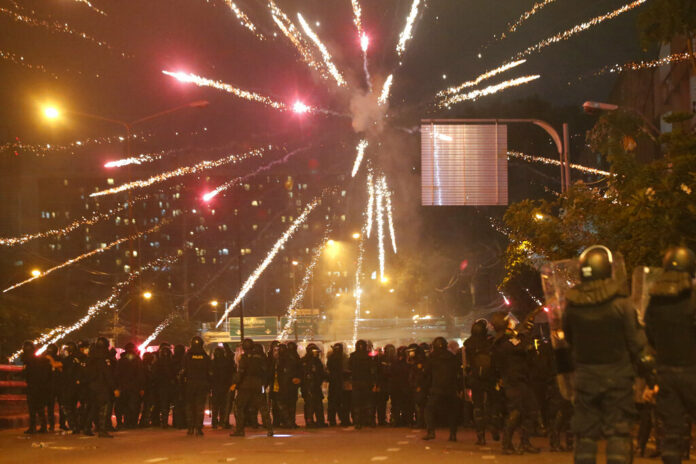
Anti-government protester shoots a firework to riot police during a protest in Bangkok, Thailand, Sunday, Aug. 15, 2021. Photo: Anuthep Cheysakron / AP

BANGKOK, Thailand (AP) — Thai riot police fired tear gas and sprayed water cannons Sunday as more than 100 anti-government protestors marched on an army base in the capital Bangkok where Prime Minister Prayuth Chan-ocha has his residence.

The group of mainly young demonstrators pelted the police lines that blocked their way, hurling rocks, fireworks and small explosives known as “ping-pong bombs.”

Images on Thai television showed a police traffic control booth in flames.

Sunday marked the fourth time in the past seven days that protestors and police have fought in the Din Daeng area of the city.

Demonstrators are calling for Prayuth’s resignation over his perceived bungling of the government’s coronavirus vaccination program. Thailand has seen infection rates surge in the past few weeks while vaccination rates remain low.

AP21227476877189
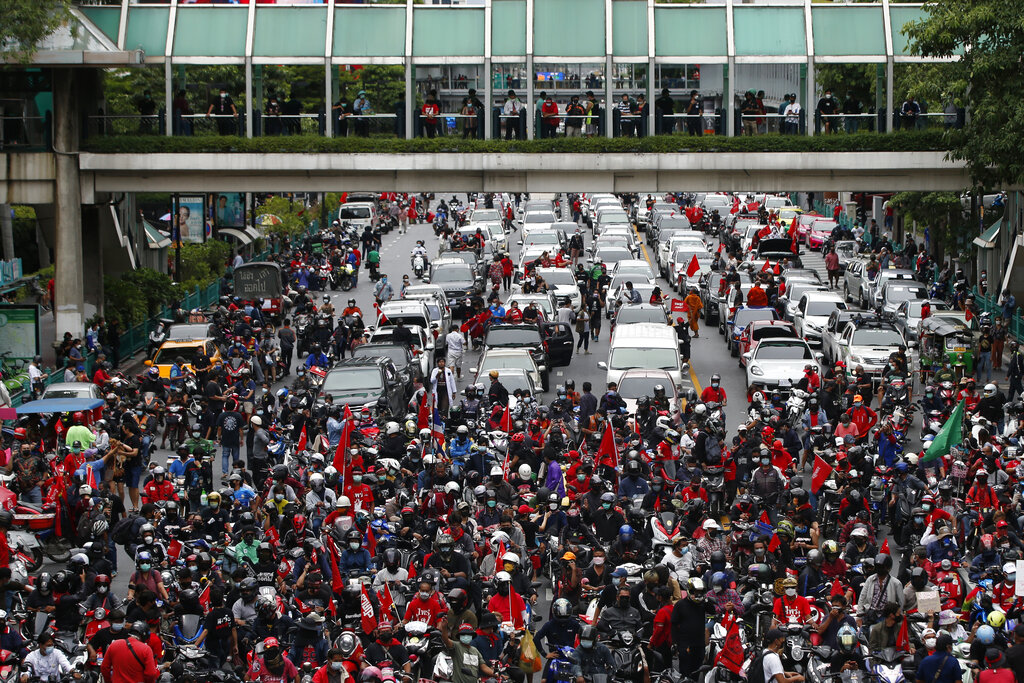
Anti-government protesters blocked road with cars and motorcycles as a part of their car mobs driving along several roads in Bangkok, Thailand, Sunday, Aug. 15, 2021. Photo: Anuthep Cheysakron / AP

But the protests are also part of a wider push for sweeping political change that includes the resignation of the government, a new constitution and – most contentious of all – fundamental reform of the powerful but opaque monarchy.

Elsewhere, thousands of protestors in vehicles and riding motorbikes gathered for a mobile anti-government rally. They met in three locations to hear speeches before slowly driving around the city. By staying in vehicles they hoped to minimize participants’ potential exposure to COVID-19.

One of the main organizers, Nattawut Saikua, a veteran activist and former deputy minister, appealed to those taking part to keep it peaceful, saying violence would alienate many potential supporters.

As police and protesters clashed in the Din Daeng area, Nattawut went to the scene to ask the protestors to disperse.

“We are not here for violence. We’re not here to beat the officers or riot police. We’re here to beat Prayuth Chan-ocha,” he said.

Advertisement

GULF Announces Q2’21 Core Profit Growth of 42% YoY after GSRC Unit 1 Begins Commercial Operation

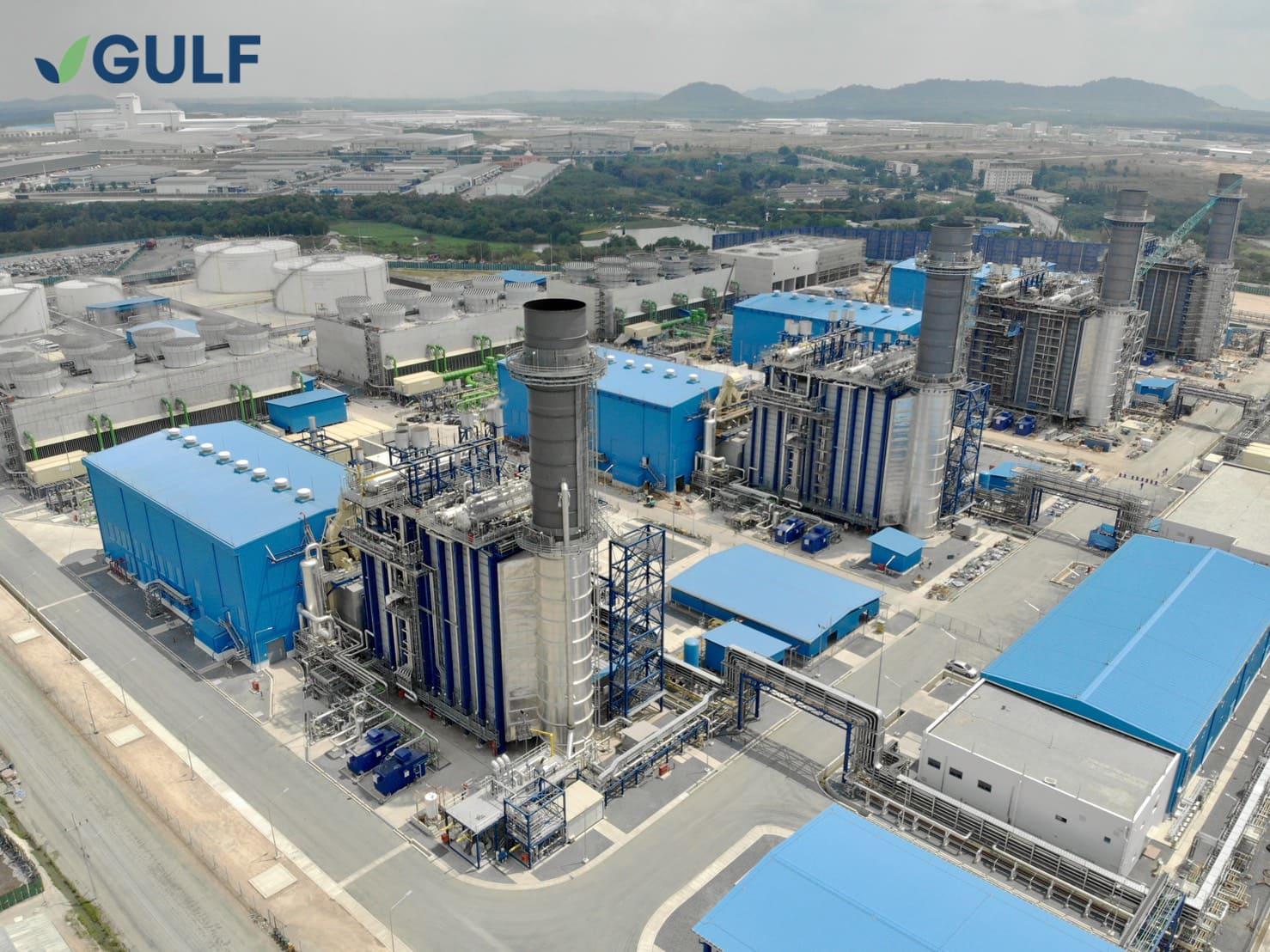
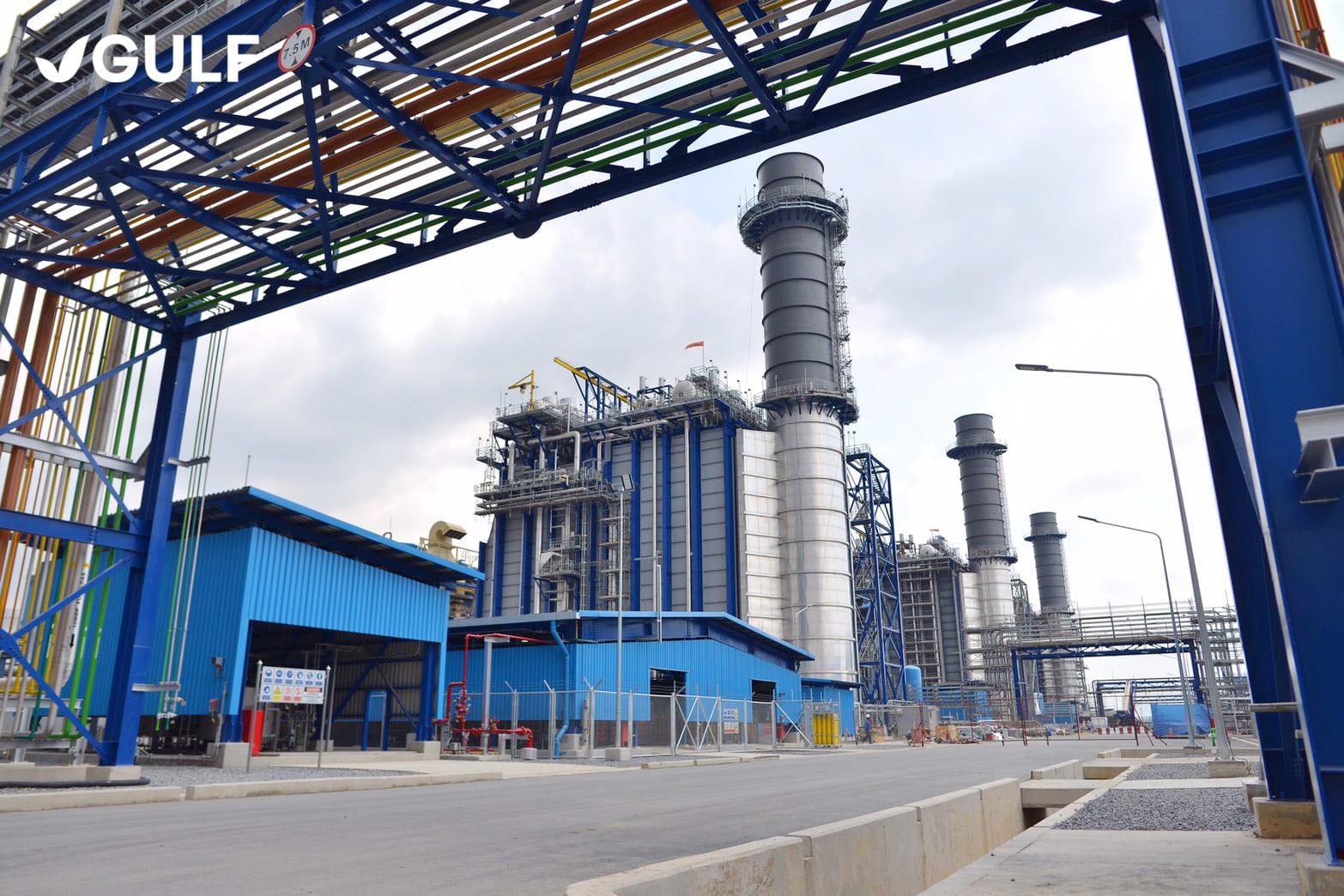
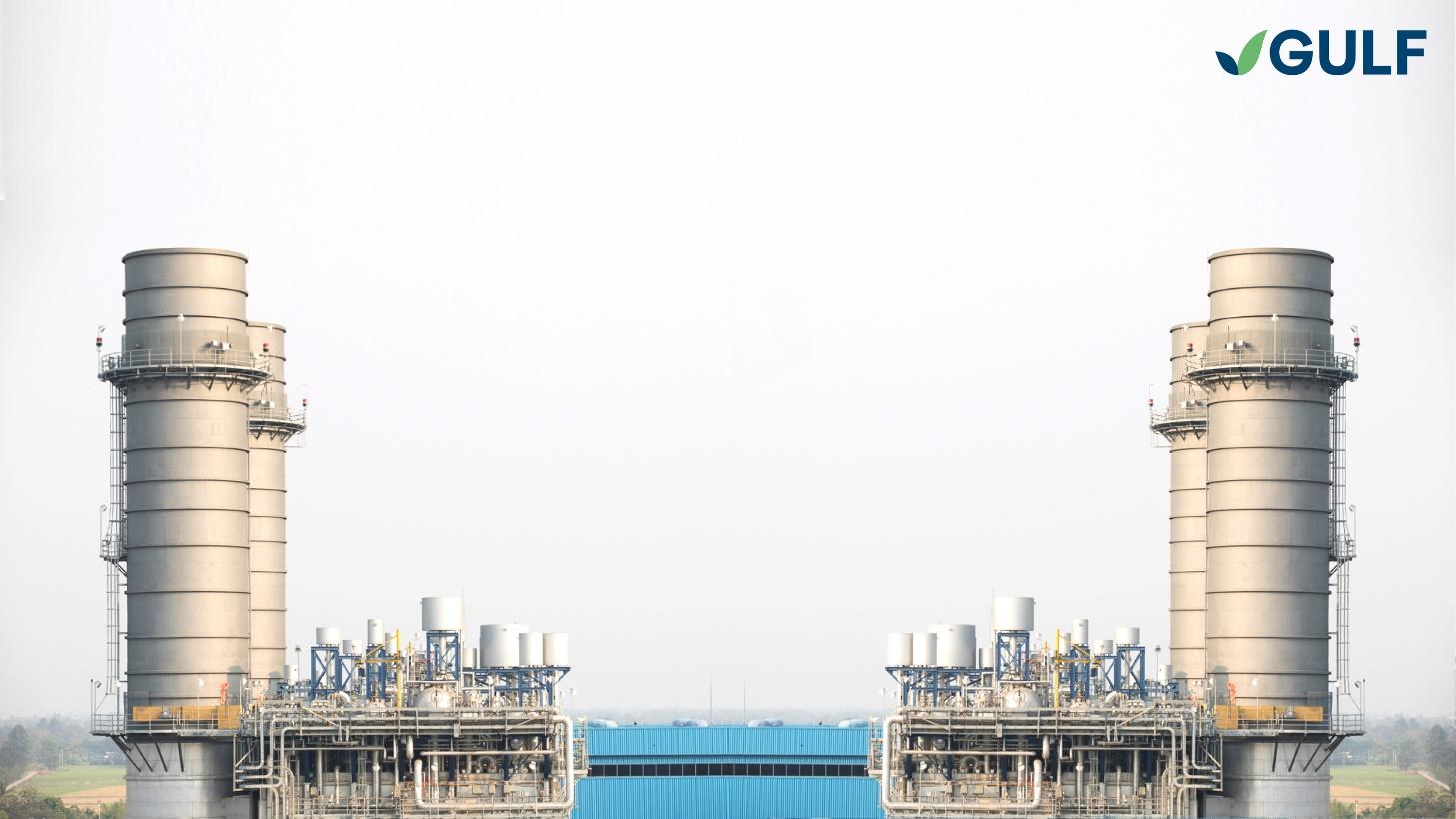
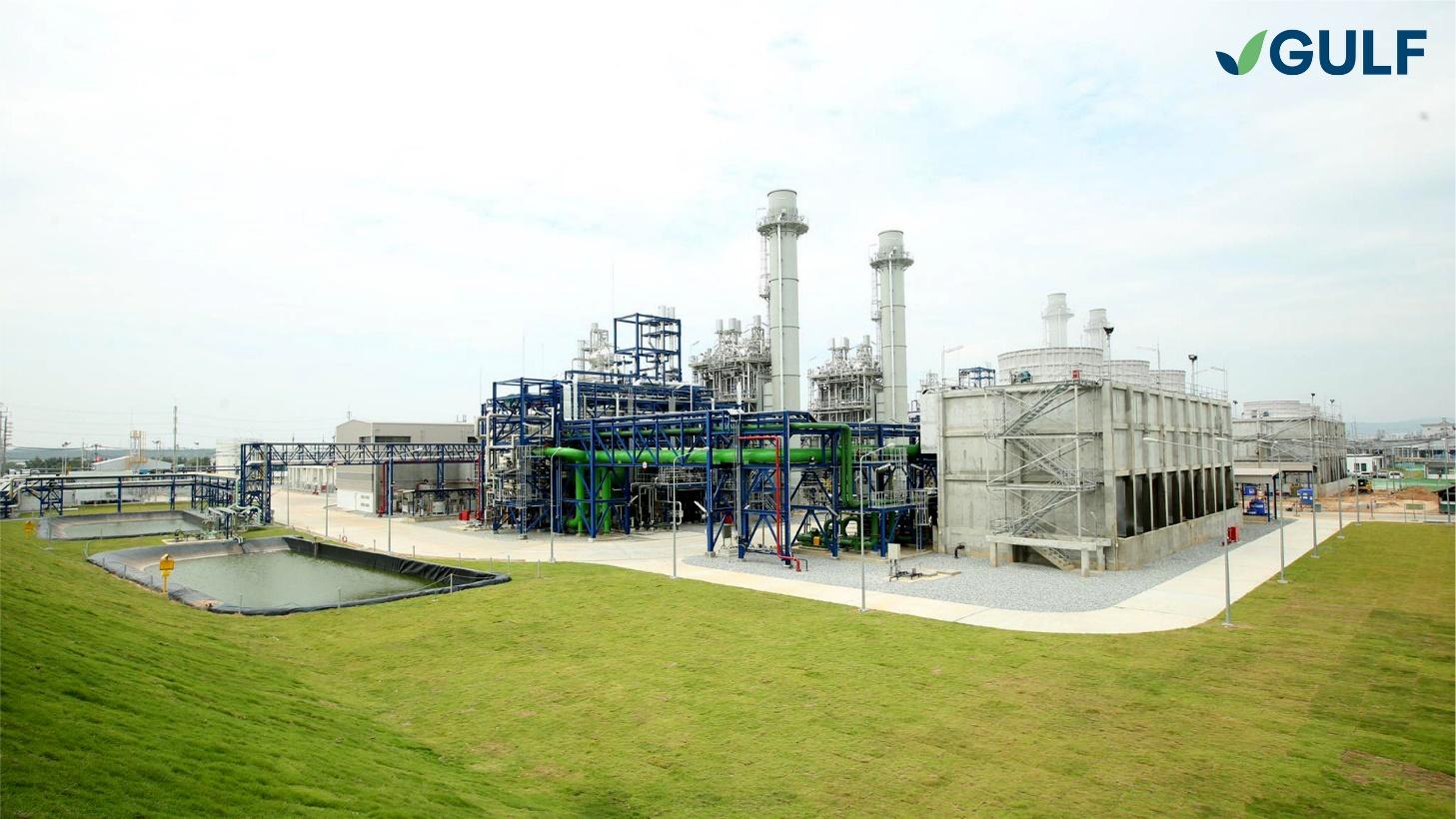
    Ms. Yupapin Wangviwat, Executive Director and Chief Financial Officer, Gulf Energy Development Plc. (GULF), revealed “For the second quarter of this year, GULF recorded a core profit of 1,401 million baht, an increase of 412 million baht or 42% year-on-year (YoY). The increase was mainly from the profit of Gulf SRC power project’s (GSRC) first unit following the commercial operation on March 31, 2021, with an installed power generation capacity of 662.5 megawatts (MW) and an average load factor of 88% in this quarter. The rise in core profit also comes from the higher volume of electricity sales of 12 SPPs under GMP group and 7 SPPs under GJP group to industrial customers from all industries, especially from the automotive, electronic components and steel industries. In Q2’21, the average load factor of industrial customers for the 12 SPPs was 63%, increasing from 51% last year, while the 7 SPPs had an average load factor of 66%, rising from 57% last year. Additionally, the volume of electricity sold to the Electricity Generating Authority of Thailand from the 2 IPPs under GJP group increased by 148% YoY, resulting in more plant efficiency. GULF also recorded share of profit from PTT NGD of 63 million baht from the company’s investment of 42% equity stake.

image3 7

    Compared to the previous quarter, core profit decreased by 989 million baht or 41.4% due to the absence of dividend income from Intouch Holdings Public Company Limited (INTUCH) in this quarter, as well as from Borkum Riffgrund 2 (BKR2) offshore wind power plant project’s lower volume of electricity sales due to seasonality, since Q2 and Q3 are low season while Q1 and Q4 are peak season for offshore wind power projects in Germany.

    Total revenue for Q2’21 was recorded at 11,845 million baht, an increase of 2,707 million baht or 29.6% YoY. The rise in revenue is mainly due to the revenue from GSRC Unit 1’s commercial operation in Q1’21, the revenue recognized from BKR2 offshore wind power project, which was recognized for the first time in Q4’20, and from the higher electricity and steam sales to industrial customers of the GMP group. Meanwhile, electricity sales from GTN1 and GTN2 solar power projects in Vietnam had a slight drop due to the temporary curtailment from the COVID-19 pandemic, affecting the nation’s electricity demand.

image2 8

    The EBITDA margin was 35.6%, an increase from 31.9% YoY. This was mainly due to a decrease in natural gas costs by 8.7% YoY, despite the decline in average Ft rate.

    GULF recorded net profit attributable to the parent company, which includes the impact from foreign exchange rate, of 1,407 million baht, a decrease of 25.2% YoY compared to net profit of 1,881 million baht in Q2’20. This resulted from the unrealized gain of 892 million baht in the previous year, while there was unrealized gain of 6 million baht in Q2’21.

    As of June 30, 2021, GULF had net interest-bearing debt to equity ratio of 1.75 times, which is still lower than the bond covenant level of 3.50 times.

    “Following the completion of the tender offer for INTUCH securities, GULF has 42.25% equity stake in INTUCH. The acquisition was financed by loans from Thai financial institutions of approximately 48,612 million baht. GULF plans to issue debentures totaling approximately 20 billion baht within this year. The proceeds will be used for future investments to support the company’s growth as well as partial loan repayment for the acquisition of INTUCH shares. In addition, the company will immediately book dividend income of approximately 1.6 billion baht in the third quarter this year,” Ms. Yupapin added.

image5 4

    For the second half of 2021, GULF has a lineup of projects that will soon begin commercial operation such as the 128-MW ‘Mekong Wind’ offshore wind farm in Vietnam. Phase 1-3 will gradually start operating within Q3-Q4 2021, GSRC unit 2 with an installed capacity of 662.5 MW is scheduled for commercial operation in October 2021, the 326-MW gas-fired power plant in Oman (DIPWP) with an installed capacity of 40MW in the first phase will be in operation by the third and fourth quarter; and solar rooftop projects under Gulf1 with a total installed capacity of 20 MW will be gradually in operation by the end of the year, resulting in the company’s total gross installed capacity of 7,922 MW by the end of 2021.

image4 6

Advertisement

Powerful Quake Adds to Haiti’s Misery, Killing at Least 304

Oxiliene Morency cries out in grief after the body of her 7-year-old-daughter Esther Daniel was recovered from the rubble of their home destroyed by the earthquake in Les Cayes, Haiti, Saturday, Aug. 14, 2021. Photo: Joseph Odelyn / AP

LES CAYES, Haiti (AP) — A powerful magnitude 7.2 earthquake added to the misery in Haiti, killing at least 304 people, injuring a minimum of 1,800 others and destroying hundreds of homes. People in the Caribbean island nation rushed into the streets to seek safety and to help help rescue those trapped in the rubble of collapsed homes, hotels and other structures.

Saturday’s earthquake struck the southwestern part of the hemisphere’s poorest nation, almost razing some towns and triggering landslides that hampered rescue efforts in two of the hardest-hit communities. The disaster also added to the plight of Haitians, who were already grappling with the coronavirus pandemic, a presidential assassination and deepening poverty.

The epicenter of the quake was about 125 kilometers (78 miles) west of the capital of Port-au-Prince, the U.S. Geological Survey said. The widespread damage could worsen by early next week, with Tropical Storm Grace predicted to reach Haiti late Monday or early Tuesday.

Aftershocks were felt throughout the day and late into the night, when many people now homeless or frightened by the possibility of their fractured homes collapsing on them stayed in the streets to sleep — if their nerves allowed them.

In the badly damaged coastal town of Les Cayes, under darkness that was only punctured by flashlights, some praised God for surviving the earthquake.

“We are alive today because God loves us,” said Marie-claire Jean-Pierre, whose home collapsed a moment after she and her son stepped outside when they felt the ground begin to shake.

Prime Minister Ariel Henry said he was rushing aid to areas where towns were destroyed and hospitals overwhelmed with incoming patients. A former senator rented a private airplane to move injured people from Les Cayes to Port-au-Prince for medical assistance.

Henry declared a one-month state of emergency for the whole country and said he would not ask for international help until the extent of the damages was known.

“The most important thing is to recover as many survivors as possible under the rubble,” said Henry. “We have learned that the local hospitals, in particular that of Les Cayes, are overwhelmed with wounded, fractured people.”

Jerry Chandler, director of Haiti’s Office of Civil Protection, told reporters that the death toll stood at 304 Saturday night. Rescue workers and bystanders were able to pull many people to safety from the rubble.

Chandler said a partial count of structural damage included at least 860 destroyed homes and more than 700 damaged. Hospitals, schools, offices and churches were also affected.

On the tiny island of Ile-a-Vache, about 6.5 miles (10.5 kilometers) from Les Cayes, the quake damaged a seaside resort popular with Haitian officials, business leaders, diplomats and humanitarian workers. Fernand Sajous, owner of the Abaka Bay Resort, said by telephone that nine of the hotel’s 30 rooms collapsed, but he said they were vacant at the time and no one was injured.

“They disappeared — just like that,” Sajous said.

People in Les Cayes tried to pull guests from the rubble of a collapsed hotel, but as the sun set, they had only been able to recover the body of a 7-year-old girl whose home was behind the facility.

“I have eight kids, and I was looking for the last one,” Jean-Claude Daniel said through tears. “I will never see her again alive. The earthquake destroyed my life. It took a child away from me.”

The reports of overwhelmed hospitals come as Haiti struggles with the pandemic and a lack of resources to deal with it. Just last month, the country of 11 million people received its first batch of U.S.-donated coronavirus vaccines, via a United Nations program for low-income countries.

The earthquake also struck just over a month after President Jovenel Moïse was shot to death in his home, sending the country into political chaos. His widow, Martine Moïse, who was seriously wounded in the attack, posted a message on Twitter calling for unity among Haitians: “Let’s put our shoulders together to bring solidarity.”

As he boarded a plane bound for Les Cayes, Henry said he wanted “structured solidarity” to ensure the response was coordinated to avoid the confusion that followed the devastating 2010 earthquake, when aid was slow to reach residents after as many as 300,000 Haitians were killed.

U.S. President Joe Biden authorized an immediate response and named USAID Administrator Samantha Power as the senior official coordinating the U.S effort to help Haiti. USAID will help to assess damage and assist in rebuilding, said Biden, who called the United States a “close and enduring friend to the people of Haiti.”

Argentina and Chile also were among the first nations to promise help.

Humanitarian workers said gang activity in the seaside district of Martissant, just west of the Haitian capital, also was complicating relief efforts.

“Nobody can travel through the area,” Ndiaga Seck, a UNICEF spokesman in Port-au-Prince, said by phone. “We can only fly over or take another route.”

Seck said information about deaths and damage was slow coming to Port-au-Prince because of spotty internet service, but UNICEF planned to send medical supplies to two hospitals in the south, in Les Cayes and Jeremie.

People in Port-au-Prince felt the tremor and many rushed into the streets in fear, although there did not appear to be damage there.

Haiti, where many live in tenuous circumstances, is vulnerable to earthquakes and hurricanes. It was struck by a magnitude 5.9 earthquake in 2018 that killed more than a dozen people.

By late Saturday, the island had experienced six aftershocks stronger than 5.0 and nine above 4.0.

Claude Prepetit, a Haitian civil engineer and geologist, warned of the danger from cracked structures.

“More or less intensive aftershocks are to be expected for a month,” he said, cautioning that some buildings, “badly damaged during the earthquake, can collapse during aftershocks.”

___

Story: Regina Garcia Cano and Evens Sanon. Associated Press writer Regina Garcia Cano reported this story from Mexico City and AP writer Evens Sanon reported in Les Cayes. AP writer Tammy Webber in Fenton, Michigan, Josh Boak in Washington and Trenton Daniel in New York contributed to this report.
Advertisement

The Paranoid State’s Top-secret List of Enemies

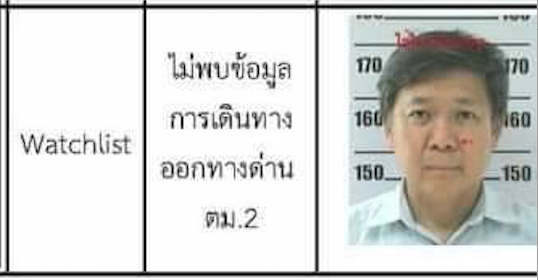
Number 143 on the list of 183 leaked enemies of the state on Aug. 9, 2021, Pravit Rojanaphruk.

retention.column

Monday’s leaked top-secret Watchlist of 183 enemies of the Thai state is a reminder that the regime is more dictatorial and paranoid than one might think.

The military junta which came to power through the coup in May 2014 was supposedly disbanded two years ago after the 2019 general elections by the current regime, led by the same ex-junta leader Gen Prayut Chan-o-cha. Prayut has proven to be equally insecure and paranoid about his hold on powers, so the state apparently needs to keep a list of citizens they need to survey.

It’s a list of who’s who among dissidents and names of famous opposition politicians, dissidents, and activists are there. Some who came out to acknowledge that they are on the list includes leader of opposition Move Forward Party’s Pita Limjaroenrat, former Future Forward Party leader Thanathorn Juangroongruangkit, Move Forward’s Rangsiman Rome, key monarchy-reform protest leaders (some now back in prison thus making the surveillance much easier), exiled dissidents wanted for lese-majeste, head of Thai Lawyers for Human Rights Group Yaowalak Anuphan – even I myself, as probably the only journalist. This list is updated as of June 1. (I am at Number 143, arranged mostly in alphabetical order, if you must know.)

What’s surprising is that a good number of the 183 people include young activists, some little known to the wider public. Two girls are 15. There’s a teenager in a boy scout uniform and even an exiled Buddhist monk. The list comes with ID photos of everyone in the document, including our ID and passport numbers, and our “criminal” record and status if there’s any. Also, details as to whether those on the list are currently in Thailand or abroad is also included. For those who have left, it includes their flight numbers and destination.

Only the state has access to such information and so there’s little or not doubt that the list is genuine, despite a spokesman of the Immigration Police saying the list wasn’t produced by them.

Yaowalak told me earlier this week that some of those on the list will soon challenge the Immigration Police about the list to have it removed and if nothing satisfactory emerges out of it, we will petition the Administrative Court. I will be joining these actions.

Is such a ‘dangerous dissidents’ or ‘enemies of the state’ list constitutional? Is this the work of a deep state, and a deeply paranoid state, since many on the lists are critical of the monarchy institution? Is Thailand under its Siamese smile veneer more like a Stalinist stare?

I spoke to a few others on the list and some were not surprised. Some contacted me to ask if I saw them on the list. Some were relieved not to be on the list, others slightly disappointed to not have made it since there’s a cachet to it. Others do not want to speak about it for fear of witch hunting against them and their families.

Given the track record of the regime back to the time when Prayut was the junta leader engaging in detention of opponents without charges, one should not be surprised. The 2019 general elections which propelled Prayut as PM only gave him a veneer of legitimacy. Dictatorial habits die hard.

The fact that many on the list are young means the state is now fighting not just against the youth but the future. Over a third, or 68, of those on the list are below 25 and seven of these under 18. One of the young on the list is Bunkueanun “Francis” Paothong, a former Mahidol University student leader. Just over twenty, he told me he wasn’t surprised to learn that he’s on the list.

“I expected it, since I was accused by the authorities of having an alleged intent to harm the Queen’s liberty [last October]. I am not surprised,” he said, “But that doesn’t mean I am okay with such invasive surveillance.”

That the state is not losing the hearts and minds of many youngsters was also confirmed by a related event earlier this week. Police will now consider taking legal action against parents who fail to keep their teenaged kids from joining monarchy-reform and anti-government protests, which have been turning ugly over the past weeks. They will use the Child Protection Act to try to make sure the parents of these teenage protesters keep them at home.

Good luck fighting with the future. And thank you for the list. We know now the state is more paranoid and insecure beneath the forced smiles of Gen Prayut.

Advertisement

Ariya Jutanugarn Takes Lead at Windy Women’s Scottish Open

Ariya Jutanugarn, of Thailand, watches her tee shot on the second hole during the second round of the women's golf event at the 2020 Summer Olympics, Thursday, Aug. 5, 2021, at the Kasumigaseki Country Club in Kawagoe, Japan. Photo: Andy Wong / AP

FIFE, Scotland (AP) — Ariya Jutanugarn had five birdies in a six-hole stretch on the back nine and shot a 6-under 66 on Friday to take the second-round lead in the LPGA Tour’s windy and rainy Trust Golf Women’s Scottish Open.

Playing in the morning in wind gusting to 40 mph at Dumbarnie Links, Jutanugarn birdied Nos. 12 and 13 and 15-17. The 25-year-old Thai star won the 2018 tournament at Gullane Golf Club.

“I felt like after I played in the afternoon yesterday, it is really windy, and I feel like today going to be better in the morning, but actually it’s not, so the wind start to blow really hard since like first hole and last three holes even worse,” Jutanugarn said. “I feel pretty lucky I finish before everything to come.”

Jutanugarn has two victories this year, the Honda LPGA Thailand and Dow Great Lakes Bay Invitational team event alongside sister Moriya.

“I don’t really feel like I’m really confident or I’m not confident at all. But I think like just have to go day by day to me,” Jutanugarn said. “When I say I still have so much thing to work on, and to me, I just want to be chilling on the course because I know when I’m chilling on the course, everything going to take care of themselves.”

Jutanugarn was at 9-under 135 total, three strokes ahead of fellow Thai player Atthaya Thitikul (70), England’s Charley Hull (69) and Denmark’s Emily Kristine Pedersen (69).

“Left a few shots out there on the back nine,” Hull said. “I left a 7-, 8-foot putt an inch off the hole, but was dead in line. But the greens were slower today and they didn’t double cut them. Felt really good. Nice to be around home turf, even in Europe. Feels more like home.”

Pederson had two eagles along with five birdies and six bogeys.

“I’ve only missed I think eight greens in two days, which is quite solid,” Pederson said. “My chipping has been really good. Obviously, it’s frustrating feeling so many parts of the game are good, and then lacking the putting a little bit.”

U.S. Women’s Open champion Yuka Saso (72) was 5 under with Jeongeun Lee6 (68), Lydia Hall (70), Kelsey MacDonald (71), Ryann O’Toole (71) and Sarah Schmelzel (71).

“In the range, I prepared just control shot,” Lee6 said. “The green is a little bit slow today. So I focused on just speed, putting.”

Michele Thomson of Scotland, the first-round leader after a 65, had an 80 to drop into a tie for 45th at 1 over. She had a birdie and nine bogeys.

Defending champion Stacy Lewis also was 1 over after a 74. She won last year at The Renaissance Club.

Advertisement

Taliban Seize Province Near Capital, Attack Northern City

Smoke rises after fighting between the Taliban and Afghan security personnel, in Kandahar, southwest of Kabul, Afghanistan, Thursday, Aug. 12, 2021. Photo: Sidiqullah Khan / AP

KABUL, Afghanistan (AP) — The Taliban seized a province just south of Afghanistan’s capital and launched a multi-pronged assault early Saturday on Mazar-e-Sharif, a major city in the north defended by powerful former warlords, Afghan officials said.

Homa Ahmadi, a lawmaker from Logar, says the Taliban control the entire province, including its capital, and reached a district in the neighboring Kabul province on Saturday. That puts the insurgents less than 80 kilometers (50 miles) south of the nation’s capital.

The Taliban have also captured much of northern, western and southern Afghanistan less than three weeks before the United States is set to withdraw its last troops.

Munir Ahmad Farhad, a spokesman for the provincial governor in northern Balkh province, meanwhile said the Taliban attacked the city of Mazar-e-Sharif from several directions, setting off heavy fighting on its outskirts. There was no immediate word on casualties.

Afghan President Ashraf Ghani had flown to Mazar-e-Sharif on Wednesday to rally the city’s defenses, meeting with several militia commanders allied with the government.

The Taliban captured much of southern Afghanistan in recent days in a rapid offensive that has raised fears of a full takeover. Their lightning advance has left the Western-backed government in control of a smattering of provinces in the center and east, as well as Kabul and Mazar-e-Sharif.

The withdrawal of foreign forces and the swift retreat of Afghanistan’s own troops — despite hundreds of billions of dollars in U.S. aid over the years — has raised fears the Taliban could return to power or the country could be plunged into civil war.

The first Marines from a contingent of 3,000 arrived on Friday to help partially evacuate the U.S. Embassy. The rest are set to arrive by Sunday, and their deployment has raised questions about whether the administration will meet its Aug. 31 withdrawal deadline.

The Taliban meanwhile released a video in which an unnamed insurgent announced the takeover of the main radio station in the southern city of Kandahar, which fell to the insurgents earlier this week.

The station has been renamed the Voice of Sharia, or Islamic law. He said all employees were present and would broadcast news, political analysis and recitations of the Quran, the Islamic holy book. It appears the station will no longer play music.

It was not clear if the Taliban had purged the previous employees or allowed them to return to work. Most residents of Kandahar sport the traditional dress favored by the Taliban. The man in the video congratulated the people of Kandahar on the Taliban’s victory.

The Taliban have operated mobile radio stations over the years, but have not operated a station inside a major city since they ruled the country from 1996-2001. At that time, they also ran a station called Voice of Sharia out of Kandahar, the birthplace of the militant group. Music was banned.

The U.S. invaded shortly after the 9/11 attacks, which al-Qaida planned and carried out while being sheltered by Taliban. After rapidly ousting the Taliban, the U.S. shifted toward nation-building, hoping to create a modern Afghan state after decades of war and unrest.

Earlier this year, President Joe Biden announced a timeline for the withdrawal of all U.S. troops by the end of August, pledging to end America’s longest war. His predecessor, President Donald Trump, had reached an agreement with the Taliban to pave the way for a U.S. pullout.

Biden’s announcement set the latest offensive in motion. The Taliban, who have long controlled large parts of the Afghan countryside, moved quickly to seize provincial capitals, border crossings and other key infrastructure. They are now within 80 kilometers (50 miles) of Kabul.

Tens of thousands of Afghans have fled their homes, with many fearing a return to the Taliban’s oppressive rule. The group had previously governed Afghanistan under a harsh version of Islamic law in which women were largely confined to the home.

___

Story: Ahmad Seir, Rahim Faiez and Joseph Krauss. Rahim reported from Istanbul and Krauss reported from Jerusalem.

Advertisement

Hot News

LATEST NEWS

Bangkok
overcast clouds
31.1 ° C
31.6 °
28.3 °
73 %
3.7kmh
100 %
Mon
29 °
Tue
35 °
Wed
34 °
Thu
34 °
Fri
28 °