29.4 C
Bangkok
Tuesday, June 23, 2026
Home Blog Page 107

Temple fire reveals unexpected items in abbot’s kuti

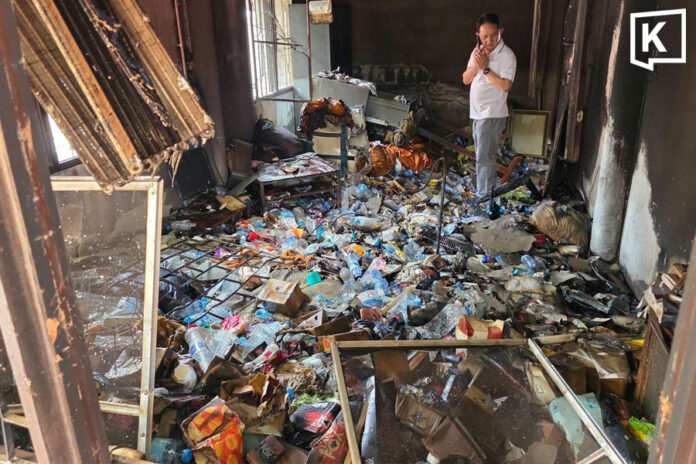
A room several meteres long and a few metres wide is strewn with trash. Windows let in daylight and there is an official in a whiteshirt standing in the garbage, which covers his ankles.
A room in the abbot’s residence was filled with trash, with several controversial items visible

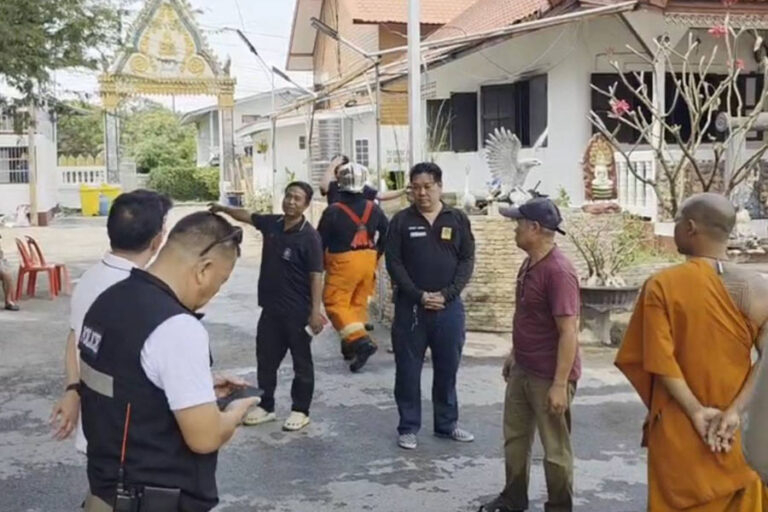
NAKHON RATCHASIMA — 22 March 2026, A fire broke out at a temple in Sikhiu district, damaging the abbot’s kuti (residence) while he was away on religious duties. No injuries or fatalities were reported.

The blaze occurred at a temple in Si Khio subdistrict, Sikhiu district. At the time, the abbot was not inside the kuti as he had left to attend an off-site religious engagement. Monks at the temple noticed the fire and alerted authorities while attempting to contain it with hoses, but the flames spread rapidly.

2banner 4

Fire engines from Sikhiu Municipality were called to the scene and brought the fire under control within about 20 minutes.

Preliminary investigations suggest the fire may have been caused by a faulty electrical outlet, which led to overheating wires and a short circuit.

After the fire was extinguished, officials inspecting the scene found extensive damage to property inside the kuti. They also reported discovering pornographic materials, including explicit books and a sex toy, among the debris.

Forensic officers will conduct further examinations to determine the exact cause of the fire.

monk junk
Boxes of flavoured cigarettes and other adult items were scattered throughout the room.
Advertisement

Filipino woman who just gave birth arrested after leaving newborn in black bag at Bangkok shopping mall

BANGKOK — A 25-year-old Filipino woman has been arrested after the body of a newborn baby was found inside a black plastic bag in a women’s restroom at a major shopping mall on Sukhumvit Road, Bangkok.

The incident came to light at 16:24 on 20 March when cleaning staff discovered the bag while performing routine trash collection in a storage room next to the women’s restroom. According to witnesses, the bag felt unusually heavy. Security personnel were immediately notified, and police, forensic teams, and medical examiners were called to investigate. Initial examination found the baby, a male, showed no visible injuries or bruises.

CCTV footage showed a foreign woman entering the restroom carrying a pink suitcase and a white tote bag. She later left the mall and took a taxi to Bangkok Apiwatthana Bus Terminal. Police tracked her to the terminal, where bloodstains were observed on her clothing. She was taken to Police General Hospital, where doctors confirmed she had recently given birth and required medical attention, including injections and stitches, necessitating an overnight stay.

Authorities are awaiting laboratory results to confirm whether the newborn found in the bag is hers and to determine the cause of death. Investigators said evidence so far points to her as the mother, but the official forensic report will provide conclusive proof. The woman faces charges related to tampering with a corpse and concealing or disposing of a body.

Police have urged witnesses and the public to come forward if they have any information to aid the ongoing investigation.

Advertisement

Trump’s mixed messages on Iran: ‘Winding down’ the war and easing sanctions but adding more troops

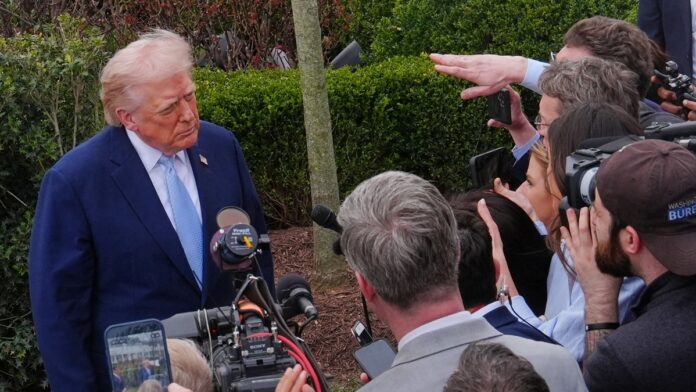
President Donald Trump speaks with reporters before departing on Marine One from the South Lawn of the White House, Friday, March 20, 2026, in Washington. (AP Photo/Julia Demaree Nikhinson)

President Donald Trump frequently contradicts himself, sometimes in the same speech, social media post or even sentence. Within the space of a few hours Friday, he sent a torrent of mixed signals about the Iran war that raise more questions about the direction of the conflict and his administration’s strategy.

During this time, Trump said he was considering winding down the war, his administration confirmed it was sending more troops to the Middle East and, in an effort to lessen the economic impact on global energy markets, the United States lifted sanctions on some Iranian oil for the first time in decades — relieving some of the pressure that Washington traditionally has used as leverage.

The confusing combination of actions deepens a sense among Trump’s critics that there is no clear, long-term strategy for the war the U.S. and Israel launched against Iran. Now in its fourth week, the war remains on an unpredictable path and a credible endgame is unclear even as the global economy is being roiled.

Just 24 hours after saying the U.S. was thinking of walking away from the conflict, Trump issued another contradictory statement Saturday evening, threatening to escalate the conflict by targeting Iran’s power plants unless the country lets oil shipments pass through the Persian Gulf.

‘Winding down’ the war

After another rough day in the financial markets, Trump said Friday afternoon on his social media network: “We are getting very close to meeting our objectives as we consider winding down our great Military efforts in the Middle East.”

Trump contended the U.S. has adequately degraded Iranian naval, missile and industrial capacity and prevented Tehran from acquiring a nuclear weapon.

The Republican president then suggested the U.S. could pull out of the conflict without stabilizing the Strait of Hormuz, the channel through which about one-fifth of the world’s oil supply travels. The strait has been ravaged by Iranian missile, drone and mine attacks during the war.

“The Hormuz Strait will have to be guarded and policed, as necessary, by other Nations who use it — The United States does not!” Trump wrote. But, in another contradiction, he said the U.S. would help if asked, “but it shouldn’t be necessary once Iran’s threat is eradicated.”

While oil that traverses the strait is usually bound for Asia and other places rather than North America, the chaos still affects the United States. Oil is bought and sold globally, so a shortage in oil for Asian countries leads to bidding up prices on oil sold to companies in America, too.

That fact, coupled with an Israeli strike on Iran’s gas fields and an Iranian retaliation that crippled a major terminal to ship liquefied natural gas from Qatar, helped tank U.S. equity markets Friday, with the S&P 500 dropping 1.5%. There also was a sharp increase in U.S. fuel prices.

Trump’s concern about the persistent blockage of the strait erupted Saturday night when the president posted on social media that he’d “hit and obliterate” Iran’s power plants unless the country opens the strait within 48 hours. The threat against Iran’s civilian infrastructure was yet another escalation.

More US military might to the Middle East

Even as Trump said the U.S. was close to winding down the war, the administration announced it was sending three more warships to the Middle East with about 2,500 additional Marines. It was the second time in the week that the administration said it was deploying more forces to the conflict. The military says some 50,000 are supporting the war effort.

Trump has been coy about sending in ground troops, while his administration has hinted at a possible deployment of special forces or similar units.

The Marines being sent to the region are an expeditionary unit designed for quick amphibious landings, but their deployment does not mean a ground invasion is certain. Analysts have suggested it may require the presence of U.S. forces on the ground to ultimately secure the strait.

The surge in troops came just a day after news emerged that the Pentagon was seeking an additional $200 billion from Congress to fund the war. That extraordinarily high number does not suggest that the war was being wound down.

Sanctions on Iranian oil sales

The administration said it would lift sanctions on the sale of Iranian oil, provided it was already at sea as of Friday. The move was an attempt to help lower skyrocketing energy prices by allowing freer sale of oil that Iran has let pass through the strait. It also extends a financial lifeline to the Iranian government that Trump is targeting.

His administration has tried other methods to lower oil prices. It has tapped the U.S. strategic petroleum reserve and lifted sanctions on some Russian oil. Yet Brent crude remained at $112 per barrel Friday, and analysts say oil prices are likely to remain high for months regardless of the next steps in the war.

The Iranian oil eventually would have reached another country, but now the United States and its allies can bid on it as well, Treasury Secretary Scott Bessent wrote on X.

“At present, sanctioned Iranian oil is being hoarded by China on the cheap,” Bessent wrote. “By temporarily unlocking this existing supply for the world, the United States will quickly bring approximately 140 million barrels of oil to global markets, expanding the amount of worldwide energy and helping to relieve the temporary pressures on supply caused by Iran.”

While 140 million barrels may seem like a lot, that is only a couple of days worth of oil on the global market.

Patrick De Haan, the head of petroleum analysis at GasBuddy, a U.S. fuel-tracking service, said he does not expect the temporary suspension to have a major impact on gas prices. The de facto closure of the strait has a much greater effect, he said. “Prices will likely still continue to rise so long as the Strait remains silent,” De Haan said.

And the contradictions in the position were obvious in Bessent’s post announcing the move, which labeled Iran “the head of the snake for global terrorism.” He said the administration would take steps to prevent Tehran from cashing in on the sales, but it was unclear how that would be done.

Even among some Republicans, the contradictions triggered rare public skepticism.

“Bombing Iran with one hand and buying Iran oil with the other,” Rep. Nancy Mace of South Carolina posted on X Saturday.

Advertisement

Trump threatens attacks on Iranian power plants if Tehran fails to open the Strait of Hormuz

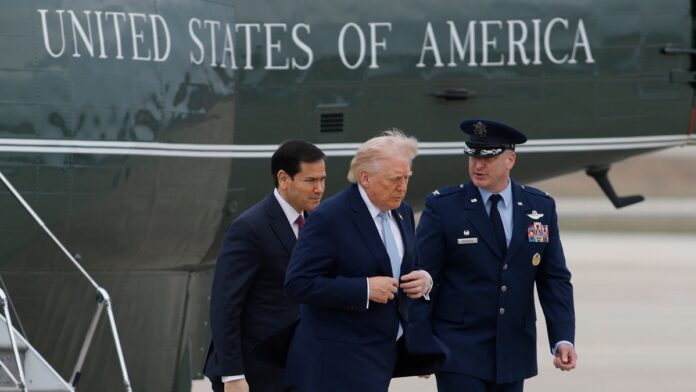
President Donald Trump, center, is escorted by Air Force Col. Christopher M. Robinson, commander of the 89th Airlift Wing, right, as he walks with Secretary of State Marco Rubio, left, from Marine One to Air Force One, at Joint Base Andrews, Md., Friday, March 20, 2026. (AP Photo/Luis M. Alvarez)

CAIRO (AP) — Iran responded Sunday with threats of its own, a day after President Donald Trump warned the United States will “obliterate” Iran’s power plants if Tehran fails to fully open the Strait of Hormuz in 48 hours and Iranian missiles struck two cities near Israel’s main nuclear research center, injuring dozens and shattering apartment buildings.

The developments signaled the war in the Middle East, now in its fourth week, was moving in a dangerous new direction.

Sirens blared across Israel as Iran launched new barrages Sunday. In the country’s south, residents faced the devastation in the cities of Dimona and Arad. In northern Israel, a man was killed in a strike by the Lebanese militant Hezbollah group.

Israeli Prime Minister Benjamin Netanyahu toured Arad and said it was a “miracle” that no one was killed by the blast, which heavily damaged several buildings. But he said that if all residents had rushed to shelters, no one would have been hurt and urged all to heed the sirens.

Iran responds to Trump’s ultimatum

Trump said on Saturday that he would give Iran 48 hours to open the vital Strait of Hormuz or face a new round of attacks. He said the U.S. would destroy “various POWER PLANTS, STARTING WITH THE BIGGEST ONE FIRST!”

He may have meant the Bushehr nuclear power plant, Iran’s biggest, which was already hit last week, or Damavand, a natural gas plant near Tehran, Iran’s capital.

In turn, Iran warned early Sunday that any strike on its energy facilities would prompt attacks on U.S. and Israeli energy and infrastructure assets — specifically information technology and desalination facilities — in the region, according to a statement citing an Iranian military spokesperson carried by state media and semiofficial outlets.

The Strait of Hormuz connects the Persian Gulf to the Indian Ocean and is a critical pathway for the world’s flow of oil. Attacks on commercial ships and threats of further strikes have stopped nearly all tankers from carrying oil, gas and other goods through the passage, leading to cuts in output from some of the world’s largest oil producers, because their crude has nowhere to go.

Seyed Ali Mousavi, Iran’s envoy to the International Maritime Organization, said in remarks carried by two Iranian news agencies that navigating the strait is possible for “everyone except enemies” — indicating Tehran would determine which vessels are allowed passage. Iran has already approved the passage of ships through the waterway to China and elsewhere in Asia.

Iran strikes area near Israeli nuclear site

Israel’s military said it was not able to intercept missiles that hit Dimona and Arad on Saturday, the largest cities near the Negev Desert nuclear center. It was the first time Iranian missiles penetrated Israel’s air defense systems in the area.

“If the Israeli regime is unable to intercept missiles in the heavily protected Dimona area, it is, operationally, a sign of entering a new phase of the battle,” Iran’s Parliament Speaker Mohammad Bagher Ghalibaf said on X.

Rescue workers said at least 64 people were taken to hospitals after the direct hit in Arad. Dimona is about 20 kilometers (12 miles) west of the nuclear research center and Arad around 35 kilometers (22 miles) north.

Israel’s hard-line national security minister, Itamar Ben-Gvir, visited Arad on Sunday, saying that Israel is in a “historic battle” against Iran and that it must “continue until victory.”

Israel is believed to possess nuclear weapons, though it doesn’t confirm or deny this. The U.N. nuclear watchdog said on X it had not received reports of damage to the Israeli center or any abnormal radiation levels.

Israel denies responsibility for attack on Natanz

Tehran’s main nuclear enrichment site at Natanz was hit earlier on Saturday. Israel denied responsibility for the attack and the Iranian judiciary’s official news agency, Mizan, said there was no leakage.

The Pentagon declined to comment on the strike on Natanz, which was also hit in the first week of the ongoing war and in the 12-day war last June.

The U.N. watchdog — the International Atomic Energy Agency — has said the bulk of Iran’s estimated 972 pounds (441 kilograms) of enriched uranium is elsewhere, beneath the rubble at its Isfahan facility.

The U.S. and Israel have offered shifting rationales for the war, from hoping to foment an uprising that topples Iran’s leadership to eliminating its nuclear and missile programs and its support for armed proxies. There have been no signs of an uprising, while internet restrictions limit information from Iran.

The war’s effects are felt far beyond the Middle East, raising food and fuel prices.

So far in Iran, the death toll in the war has surpassed 1,500, the state broadcaster reported Saturday, citing the health ministry. In Israel, 15 people have been killed by Iranian missiles. Four others have died in the occupied West Bank. At least 13 U.S. military members have been killed, along with well over a dozen civilians in Gulf nations.

Hezbollah claims deadly strike on northern Israel

Hezbollah said it was behind a strike on Sunday that killed a man in the northern Israeli town of Misgav Am in what the Israeli military said “seemed to be” a rocket attack. Israeli medics said they found the man dead in his car and released a video showing two vehicles ablaze.

Hezbollah, an ally of Iran, launched strikes on Israel soon after the U.S.-Israeli attack on Iran started on Feb. 28, saying it was in retaliation for the killing of Iran’s Supreme Leader Ayatollah Ali Khamenei. Israel struck back, bombarding Lebanon and targeting Hezbollah in deadly airstrikes, expanding its presence in southern Lebanon and amassing more troops near the border.

Lebanese authorities say Israel’s strikes have killed more than 1,000 people and displaced more than 1 million.

Crash in Qatar

Qatar said Sunday that all seven people aboard a Qatari helicopter that crashed the previous day in the Gulf Arab nation’s territorial waters are dead — including three Turkish nationals, a military officer and two civilians.

The confirmation came after the body of the missing Qatari pilot was found on Sunday. The crash was blamed on a “technical malfunction.”

Advertisement

Thailand plans to cut visa-free stay for foreigners from 60 to 30 days

Foreign Minister Sihasak Phuangketkeow

BANGKOK — Thailand’s Ministry of Foreign Affairs is preparing to propose reducing the visa-free stay period for foreign tourists from 60 days to 30 days, citing concerns over misuse of the scheme.

Foreign Minister Sihasak Phuangketkeow said the current 60-day visa exemption, introduced under the previous government to boost tourism, may be longer than necessary. He noted that 30 days should be sufficient for most visitors, while tourists would still be able to apply for a 30-day extension if needed.

He added that the proposed measure is not targeted at any specific nationality, but aims to address loopholes exploited by individuals involved in online scam networks and other non-tourism activities. Thailand remains committed to welcoming international visitors, while safeguarding national security and ensuring that entry policies are used for their intended purpose.

Advertisement

Which country is happiest in Southeast Asia in 2026?

BANGKOK — Finland has been ranked the world’s happiest country for the ninth consecutive year in the latest World Happiness Report 2026, with Nordic nations continuing to dominate the global top 10.

The annual rankings, compiled by Gallup, the Oxford Wellbeing Research Centre and the UN Sustainable Development Solutions Network, are based on a three-year average of how residents in 140 countries evaluate their own lives. The report also considers factors such as GDP per capita, social support, life expectancy, perceived freedom, generosity and levels of corruption.

In Southeast Asia, Singapore ranked highest, followed by Vietnam and Thailand. The Philippines placed fourth, ahead of Malaysia and Indonesia, while Laos, Cambodia and Myanmar rounded out the regional list.

Advertisement

Job scam alert: Thai woman rescued before crossing to Poipet

NAKHON RATCHASIMA — A young woman who posted a video seeking help after being allegedly lured to work near the Thai-Cambodian border has been rescued after police intercepted the vehicle in Sa Kaeo province, authorities said.

The incident gained widespread attention after the woman shared a clip on a local Facebook group, claiming she had been promised a high-paying job in Sa Kaeo but later became suspicious as the car appeared to be heading towards the border to cross into Poipet, Cambodia. In the video, she appeared distressed and said she had tried to alert authorities while still in Nakhon Ratchasima, but the vehicle continued travelling across several provinces without encountering checkpoints.

Following the viral post, police in Sa Kaeo tracked the vehicle and successfully stopped it before it reached the border, rescuing the woman and others safely. Authorities are now investigating to identify those behind the operation, as officials warn of ongoing scams that use lucrative job offers to lure victims into illegal work across border areas.

Advertisement

Japan names Thailand base for “New Cool Japan”, NTT DOCOMO partners with TrueVisions

Amid the rapid growth of the global media and entertainment industry, which is emerging as a key driver of the digital economy and a powerful form of “soft power” connecting people and cultures worldwide, NTT DOCOMO, Japan’s leading telecommunications and technology provider and a key partner of the Ministry of Internal Affairs and Communications (MIC) of Japan, has announced a strategic partnership with TrueVisions, an end-to-end content leader under True Corporation, in alignment with the Japanese government’s “New Cool Japan Strategy”.

Under this long-term collaboration, TrueVisions of True Corporation has signed the Japan Content Strategic Partnership Announcement & Joint Statement with NTT DOCOMO to accelerate the delivery of Japanese live-action broadcast content and intellectual property to Thai audiences. TrueVisions NOW will serve as the primary platform for legally offering high-quality Japanese live-action broadcast content through the Lemino Japanese Collection, a world of Japanese culture and entertainment, while reinforcing Thailand’s role as a key gateway connecting Japanese culture and entertainment to audiences in the digital era. Available for audiences from 25 March 2026.

9900064 5 0
Mr. Takeshi Saito, Senior Executive Vice President, NTT DOCOMO, INC., said “This historic collaboration is driven by a forward-looking vision under the ‘New Cool Japan Strategy’. The Government of Japan places great importance on Thailand as a key partner in ASEAN, not only for its rapidly growing entertainment market, but also for the long-standing cultural ties between our two nations, as well as its advanced digital infrastructure.

This partnership goes beyond expanding business opportunities in the entertainment industry. It represents a ‘cultural bridge’ that brings the people of Japan and Thailand closer together. A key ambition of this collaboration is to build the largest and most vibrant community of Japan enthusiasts in Thailand. The Lemino Japanese Collection, which showcases Japan’s rich culture and entertainment, allows Thai audiences to experience these unique offerings through TrueVisions NOW. In the initial phase, the service will be offered free of charge, allowing everyone to access and be part of this remarkable journey.”

Mr. Birathon Kasemsri Na Ayudhya, Chief Content and Media Officer, True Corporation Plc., said “This collaboration reflects True Corporation’s commitment to integrating digital technology, intelligent network infrastructure, and innovation with a comprehensive content ecosystem to elevate premium entertainment experiences for Thai audiences. We are honored that Thailand has been entrusted as a strategic hub for soft power exchange, underscoring strong confidence in the country’s advanced digital infrastructure readiness, as well as our commitment to enabling Thai people to access world-class content in line with the direction of the NBTC as the broadcasting regulator.

It also reflects the long-standing and deep-rooted cultural ties between Thailand and Japan, and underscores Thailand’s potential as one of the fastest-growing entertainment markets in ASEAN. This partnership with NTT DOCOMO marks another important milestone in elevating TrueVisions NOW as a platform for creative content and inspiration from Japan, bringing together the finest Japanese entertainment to fulfill diverse interests and deliver happiness to Thai audiences.”

9900064 5 0

Mr. Ongard Prapakamol, Head of TrueVisions & Media Business, True Corporation Plc. said “TrueVisions is delighted to partner with NTT DOCOMO to bring high-quality Japanese live-action broadcast content from Lemino Japanese Collection to Thai audiences through the TrueVisions NOW platform.

This collaboration serves as a key gateway to Japanese entertainment, making it more accessible and convenient for Thai viewers. Audiences will be able to experience a wide variety of premium Japanese content curated from 76 leading partners, including broadcasters in Tokyo, Osaka, and Nagoya, as well as production companies from across Japan. The lineup spans the most comprehensive live-action broadcast content including popular Japanese series (J-Drama), Japanese variety shows, and lifestyle content covering Japanese culture, food, and travel. It also includes Top 10-rated titles in Japan, as well as content premiering for the first time in Thailand. At launch, more than 125 titles will be available, with new content to be added continuously based on Thai audience preferences.

This will enhance a fully immersive entertainment experience on TrueVisions NOW, showcasing the unique charm and identity of Japanese culture that Thai audiences deeply appreciate. The initiative also reinforces Thailand’s role as a strategic gateway, connecting Japanese culture and entertainment with audiences across the region in the digital era.”

Advertisement

AIS ensures network continuity amid Middle East unrest

In response to the ongoing unrest in the Middle East, AIS acknowledges public concerns regarding potential impacts on communications, connectivity, and energy-related factors. The company has implemented comprehensive measures and is closely monitoring the situation around the clock to ensure stable and uninterrupted service.

  • Comprehensive Network and Connectivity Preparedness AIS maintains strong preparedness across both domestic and international networks, actively managing resources across primary and backup routes to ensure service continuity. Currently, cables passing through the affected risk areas account for less than 10% of internet traffic to Europe.
  • Continuous Monitoring to Minimize Impact The company continues to closely assess developments and potential service impacts, enabling timely mitigation measures and minimizing any effects on customers.
  • Proactive Operations AIS operates proactively through a dedicated task force that closely monitors the situation and coordinates with relevant stakeholders domestically and internationally, including global service provider partners, to ensure network stability and readiness to support all customer segments.

AIS reaffirms its full readiness to support domestic and international connectivity and remains committed to upholding the highest service standards, ensuring customers can continue to rely on AIS services with confidence under all circumstances.

Advertisement

Thailand joins US, allies to boost missile and drone production in Asia

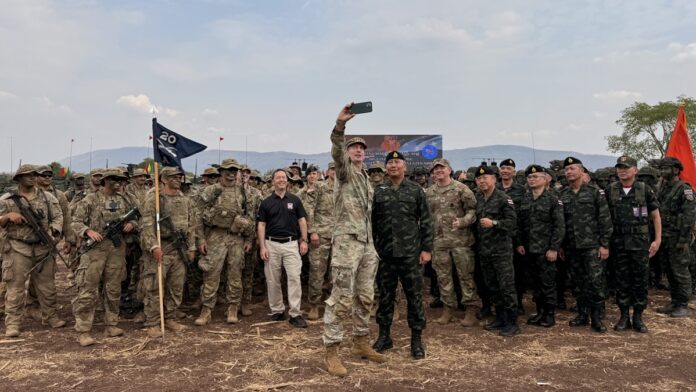
Handover ceremony of 17 Stryker armoured vehicles by the US to the Royal Thai Army during Exercise Hanuman Guardian 2026 in Lop Buri, boosting defence cooperation and military modernisation, 20 March.

Thailand has officially joined the Partnership for Indo-Pacific Industrial Resilience (PIPIR), as member nations reaffirmed their commitment to strengthening defence industrial cooperation and supply chain resilience across the region.

In a joint statement released following the group’s 2nd annual plenary meeting held virtually on March 18, representatives from 16 countries endorsed a 2026 roadmap aimed at accelerating collaboration in defence production, sustainment and technology development.

The statement, published by the United States Department of War, confirmed the accession of Thailand and the United Kingdom as the 15th and 16th members of the partnership, joining a coalition that includes the United States, Japan, Australia and several European and Indo-Pacific nations.

Senior officials and national armaments directors said the partnership would focus on addressing capacity shortfalls and strengthening resilience in the global defence industrial base, particularly in response to growing operational demands.

Members agreed to deepen integration across defence supply chains, reduce regulatory barriers, and expand forward sustainment capabilities, while accelerating the production of key military systems and components.

The meeting also reviewed progress since PIPIR’s establishment, including initiatives first announced at the Shangri-La Dialogue in May 2025. These include plans to develop a forward repair capability for P-8 radar systems in Australia and to establish common standards for small unmanned aerial systems across the Indo-Pacific.

Participants agreed to expand the regional sustainment hub in Australia to support additional P-8 operators, and to advance cooperation on drone technologies through joint industry surveys, shared standards and potential future battery development projects.

The statement highlighted ongoing efforts to enhance collaboration through training and knowledge-sharing, including an annual multinational armaments cooperation course co-hosted by the department’s Asia-Pacific Center for Security Studies and rotating PIPIR members.

New initiatives were also endorsed, including exploring the feasibility of a forward-deployed F100/F110 engine repair hub in Japan, and progressing the establishment of a CH-47 Chinook engine maintenance hub in South Korea.

Other efforts include a joint US-Japan solid rocket motor production initiative, expanded munitions development cooperation with the Philippines, and exploring modular unmanned aerial vehicle projects to support regional co-production.

Officials said PIPIR would continue to serve as a key multilateral platform to enhance defence industrial resilience, improve interoperability, and support regional security and economic stability in the Indo-Pacific.

Advertisement

Hot News

LATEST NEWS

Bangkok
broken clouds
29.4 ° C
29.4 °
25.5 °
71 %
2.9kmh
60 %
Mon
29 °
Tue
38 °
Wed
37 °
Thu
36 °
Fri
37 °