





















29.4 C
Bangkok
Saturday, June 6, 2026
Home Blog Page 1083

CP Foods Highlights “Food Security” as Strategic Key For Sustainable Business

Charoen Pokphand Foods PLC (CP Foods) highlights the “food security” strategy in a bid to achieve responsible operations throughout the supply chain and sustainably deliver sufficient quantity of quality and safe food.

In 2020, crises, such as natural disasters and the COVID-19 outbreak, have taken a toll on the economy, society and people’s livelihood. As a leading agro-industrial and food company, CP Foods is aware of its responsibility towards food security and for Thai society. Therefore, it was among the very first companies that extended assistance to society.

Under the “CPF Food from the Heart against COVID-19” program, safe food has been delivered to the frontline medical personnel and their families, individuals in quarantine, low-income earners, migrant workers, vulnerable people and others. The program was initiated in line with CP Group’ philosophy to ensure sufficient food supply and indicate the commitment to stand by all Thais in times of crisis.

Aside from continuous supply of safe food, CP Foods was the first Thai company that applied maximum safety measures for employees. The company also helped suppliers through the ”Faster Payment” scheme, that provides a 30-day credit to about 6,000 suppliers, to help them maintain liquidity and ability to keep workers.

Mr. Wuthichai Sithipreedanant, Senior Vice President – Corporate Social Responsibility and Sustainable Development of CP Foods, said that the company stressed its emphasis on the 3 pillars towards sustainability – Food Security, Self-Sufficient Society and Balance of Nature. In support of the vision of “Kitchen of the World”, the 3 pillars highlighted efficient and continuous operations, to ensure the production of quality and safe food that meets demands and environmental conservation principles under the Circular Economy concept. The concept emphasized natural resources optimization.

Additionally, CP Foods integrated the United Nations Sustainable Development Goals (SDGs) with the 3 pillars to sustainability. From total 17 goals, CP Foods is committed to accomplish 13 goals. Sustainability strategies have been reviewed regularly, to cope with changing global conditions and new challenges so that the operations can proceed and achieve continuous growth.

Mr. Wuthichai added that the 2020 Sustainability Report also presented CP Foods’ successful resource management in line with the Circular Economy concept. The Company witnessed higher efficiency in natural resource utilization in the past year; for example, raw water usage per unit of product dropped by 36% compared to the 2015 base year while water recycling and reuse increased by 42%. In the year, greenhouse gas emissions were slashed by 586,000 tons of carbon dioxide equivalent, resulted from many activities such as packaging made from 99.9% disposal materials that promises reuse and recycling; energy efficiency; and an increase of renewable energy ratio in the production process to 26%.

13817569254690

In 2020, the company fulfilled 7 sustainability goals including a cut in energy consumption per unit of product, lower dependence on raw water and lower waste to landfill. CP Foods strives to accomplish the remaining goals which include a cut in greenhouse gas emissions. On the path to become a low-carbon organization and help combat the global warming, it plans to continuously lower emissions from the operations, enhance production efficiency, promote renewable energy, create climate-friendly products, improve logistics and reduce food waste and food lost using nature-based solution.

CP Foods has been devoted effort to conserving and restoring mangrove forests including 5,971 rai of Rak Ni-Ves, Pasak Watershed, Khao Phraya Doen Tong Project in Lop buri, 2,388 rai of Grow-Share-Protect Mangrove Forestation Project in Samut Sakhon, Rayong, Chumphon, Phang Nga, and Songkhla provinces. The company also planted 1,720 rai of trees within its farms and operations. These projects have supported food safety and food security at a community level.

Mr. Wuthichai asserted that under the 2030 sustainability strategy, CP Foods will emphasize on food innovations and strengthen personnel’s capability in adjusting to changes and lifetime learning. The Company also strives for “Net-Zero” policy, by reducing greenhouse gas emissions and food waste via the Circular Economy concept. The goal is to lead a change in the national and global level and generate shared value to stakeholders, to become an organization that contributes to global food security in a sustainable manner.

CP Foods has published Sustainability Report since 2011, to communicate the company’s sustainability performance under a vision to be a “Sustainable Kitchen of the World”. This year report is printed with environmental-friendly ink and paper. The full report is published on the Company’s website: https://www.cpfworldwide.com/en/sustainability/report.

Advertisement

Transport Minister Tests Positive for COVID-19

A file photo of Saksayam Chidchob.

BURIRAM — Transport minister Saksayam Chidchob on Wednesday said he tested positive for the coronavirus.

The 58-year-old minister said he was admitted to a hospital in his home province of Buriram this morning after experiencing a high fever. He has since been put in isolation and under medical supervision, he said.

Saksayam became the highest-ranking official to date known to have been infected with the virus. He said he believes he caught the virus from his aide who tested positive earlier and denied news reports that he is the minister who had visited nightlife venues in Bangkok’s Thonglor and Ekkamai areas, where a new cluster of infection was reported among partygoers in recent days.

His official travel history is yet to be published, though his public schedule shows that he attended numerous events, including a Cabinet meeting, over the past 14 days.

The entire score of Bhumjaithai MPs were asked to isolate themselves and refrain from joining the ongoing parliamentary session on a referendum bill after they attended the same party event with Saksayam, who serves as the party’s secretary, on Tuesday.

At least eight Cabinet members also went into self-isolation after coming in contact with Saksayam and other COVID-19 patients. Speaking before today’s virtual Cabinet meeting, PM Prayut Chan-o-cha said he ordered all government-sponsored events to be canceled in order to curb the spread of the virus.

“I don’t feel stressed,” Gen. Prayut said. “I instructed every Cabinet member to share the responsibility and asked them not to make things worse. As for Saksayam, he will receive treatment like any sick citizen. I’m not stressed about it, and we must help build confidence.”

The country has seen yet another surge of infections stemming from Bangkok’s nightlife scene over the past weeks.

Health officials discovered at least 291 positive cases across 15 provinces as of Wednesday.

They urged those who visited entertainment venues, which include Krystal Club, Baan Phahol, Ekamai Beer House, Bar Bar Bar, Dollar Bangkok, The Cassette Ekkamai, Dirty Bar, as well as the EmQuartier and the Emporium shopping malls, last month to get tested immediately.

Earlier this week, the Bangkok City Hall closed 196 entertainment venues in three districts of Klong Toey, Bang Khae and Watthana for two weeks to try to limit the spread of the coronavirus.

The new cluster came ahead of the Songkran festival next week, as people prepare to travel around the country and reunite with their families.

Health minister Anutin Charnvirakul said Tuesday people can still travel freely without the need for self-isolation, though some provinces began to impose travel restrictions for people coming from Bangkok and its four neighboring provinces of Pathum Thani, Nonthaburi, Samut Prakan, and Nakhon Pathom.

“Only those who are infected or at high risk of infection have to go into isolation,” Anutin said.

As of Wednesday, people traveling from Bangkok metropolis to Bueng Kan, Khon Kaen, and Buriram provinces must notify their arrival to local health authorities and go into self-isolation for 14 days.

In today’s news briefing, Thailand’s leading virologist Yong Poovorawan confirmed that the highly contagious B.1.1.7 variant of coronavirus, which was first detected in Britain, was found among 24 partygoers.

“We are surprised to find the U.K. variant, which is 1.7 times more contagious than typical variants,” Yong said. “Even though we have all the measures in place to block the importation of the virus, it still managed to slip through. Therefore, we must minimize movement of people as much as possible.”

The government’s pandemic response center reported 334 new coronavirus infections on Wednesday, with no new fatalities, bringing the total tally to 29,905 cases and 95 deaths.

Related stories:

Samut Sakhon Governor Recovers from COVID-19

Advertisement

Official: EU Agency To Confirm AstraZeneca Blood Clot Link

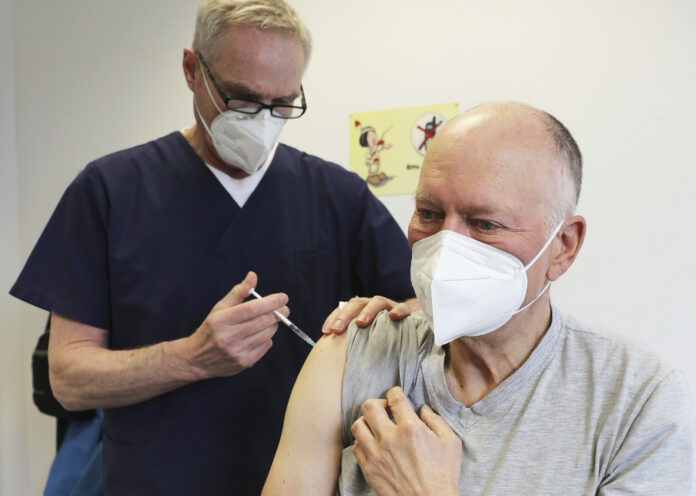
Manfred Haas, right, receives the AstraZeneca vaccine against the COVID-19 disease from his family doctor Oliver Funken in Rheinbach, Germany, Tuesday, April 6, 2021. Photo: Oliver Berg / dpa via AP

ROME (AP) — A top official at the European Medicines Agency says there’s a causal link between AstraZeneca’s coronavirus vaccine and rare blood clots, but that it’s unclear what the connection is and that the benefits of taking the shot still outweigh the risks of getting COVID-19.

Marco Cavaleri, head of health threats and vaccine strategy at the Amsterdam-based agency, told Rome’s Il Messaggero newspaper on Tuesday that the European Union’s medicines regulator is preparing to make a more definitive statement on the topic this week.

Asked about Cavaleri’s comments, the EMA press office said its evaluation “has not yet reached a conclusion and the review is currently ongoing.” It said it planned a press conference as soon as the review is finalized, possibly Wednesday or Thursday.

Based on the evidence so far, Cavaleri said there’s a clear association between the AstraZeneca vaccine and the dozens of rare blood clots that have been reported worldwide amid the tens of millions of AstraZeneca shots that have been given out.

“It is becoming more and more difficult to affirm that there isn’t a cause-and-effect relationship between AstraZeneca vaccines and the very rare cases of blood clots associated with a low level of platelets,” Cavaleri was quoted as saying.

AstraZeneca did not immediately respond to a request for comment. Late in the day, however, the pharmaceutical company and Oxford University, which developed the vaccine, announced they were pausing the trial of their jabs in children while British regulators investigate the potential blood clot link in adults.

“Whilst there are no safety concerns in the pediatric clinical trial, we await additional information” from the British regulator, an Oxford spokesperson said in a statement.

In Geneva, the World Health Organization said its experts were also evaluating a possible link between the AstraZeneca vaccine and rare blood clots — and that it might have a “fresh, conclusive assessment” before Thursday.

In March, more than a dozen countries, including Germany, suspended using AstraZeneca over the blood clot issue. Most EU nations restarted on March 19 — some with age restrictions — after the EMA said the benefits of the vaccine outweighed the risks of not inoculating people against COVID-19. At the time, the EMA recommended the vaccine’s leaflet be updated with information about the rare clots.

Any further doubts about the AstraZeneca vaccine would be a setback for the shot, which is critical to Europe’s immunization campaign and a linchpin in the global strategy to get vaccines to poorer countries. The AstraZeneca vaccine is cheaper and easier to use than rival vaccines from Pfizer and Moderna and has been endorsed for use in over 50 countries, including by the 27-nation EU and the World Health Organization. U.S. authorities are still evaluating the vaccine.

Cavaleri said while EMA was prepared to declare a link, further study was still needed to understand why and how the phenomenon occurs.

He said the rare blood clots, including some in the brain, coupled with a low level of blood platelets that may make people at risk of serious bleeding, “seem to be the key event to study further.” Cavaleri promised more details soon, adding: “In the coming hours, we will say that the link is there, how this happens we still haven’t figured out.”

Cavaleri said the biological mechanism for how the vaccine might be causing the rare clots was still unknown and if it was linked to how the shot is made, other vaccines with similar technologies might also need to be evaluated.

He stressed the risk-benefit analysis remained positive for the AstraZeneca jab, even for young women who appear to be more affected by the clots.

“Let’s not forget that young women also end up in intensive care with COVID. So we need to do very meticulous work to understand if the risk-benefit analysis remains for all ages,” he was quoted as saying.

He ruled out a preventive therapy to address the rare blood clots, saying there is still too much unknown about the phenomenon.

Even after the March 19 restart, the Dutch and German governments suspended the jabs for people under 60 and some Europeans have been shying away from getting a shot.

Romania’s national vaccination committee’s chief, Valeriu Gheorghita, said Tuesday that since March, 207,000 people in Romania had canceled their AstraZeneca vaccine appointments and another 92,000 simply didn’t show up.

“It is a high percentage, a third of people scheduled who did not show up,” Gheorghita told reporters.

British Prime Minister Boris Johnson declined to be drawn directly into the latest warnings about the vaccine but urged people to look at the advice from Britain’s independent Medicines and Healthcare Regulatory Agency.

“Their advice to people is to keep going out there, get your jab, get your second jab,” he said during a visit Tuesday to an AstraZeneca facility in Macclesfield, in northwest England.

Last week, Britain’s MHRA said seven people had died in the U.K. due to blood clots after getting the AstraZeneca jab. It said it wasn’t clear if the shots are causing the clot and that it was undertaking a “rigorous review” into the reports. The agency said it had identified 30 blood clot cases out of 18.1 million AstraZeneca jabs given by March 24.

Adam Finn, a professor of pediatrics at the University of Bristol, said the latest surge of COVID-19 cases that is filling up hospitals across Europe should prompt people to get vaccinated as soon as possible.

“If you are currently being offered a dose of Oxford-AstraZeneca vaccine, your chances of remaining alive and well will go up if you take the vaccine and will go down if you don’t,” he said.

___

Story: Nicole Winfield and Pan Pylas

Advertisement

Myanmar Forces Arrest Comedian, Break up Doctors’ Protest

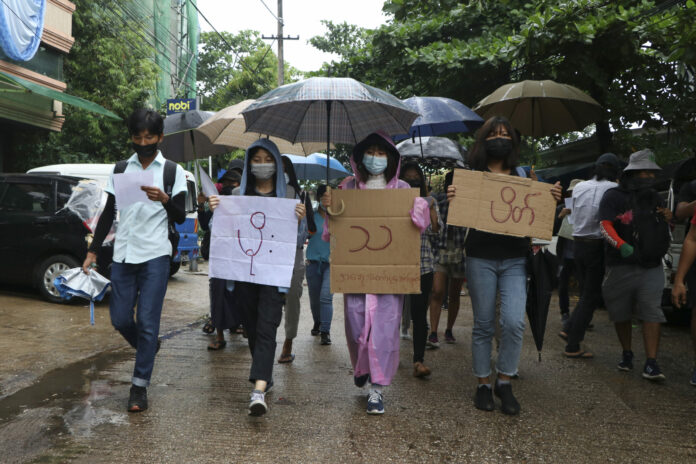
Anti-coup protesters hold slogans which read
Anti-coup protesters hold slogans which read "Rain Strike" as they use their umbrellas during a drizzle while participating in a demonstration in Yangon, Myanmar on Tuesday April 6, 2021. Photo: AP

YANGON (AP) — Authorities in Myanmar arrested the country’s best-known comedian on Tuesday as they continue to crack down on people they accuse of helping incite nationwide protests against February’s military coup.

The comedian Zarganar was taken from his home in Yangon by police and soldiers who arrived in two army vehicles, fellow comedian Ngepyawkyaw said on his own Facebook page. Zarganar, 60, is a sharp-tongued satirist who has been in and out of prison since he was active in a failed 1988 popular uprising against a previous military dictatorship. He is also well known for his social work, especially arranging assistance for victims of Cyclone Nargis in 2008.

In the past week, the junta has issued arrest warrants for about 100 people active in the fields of literature, film, theater arts, music and journalism on charges of spreading information that undermines the stability of the country and the rule of law. It was not immediately clear what Zarganar, whose real name is Maung Thura, has been charged with.

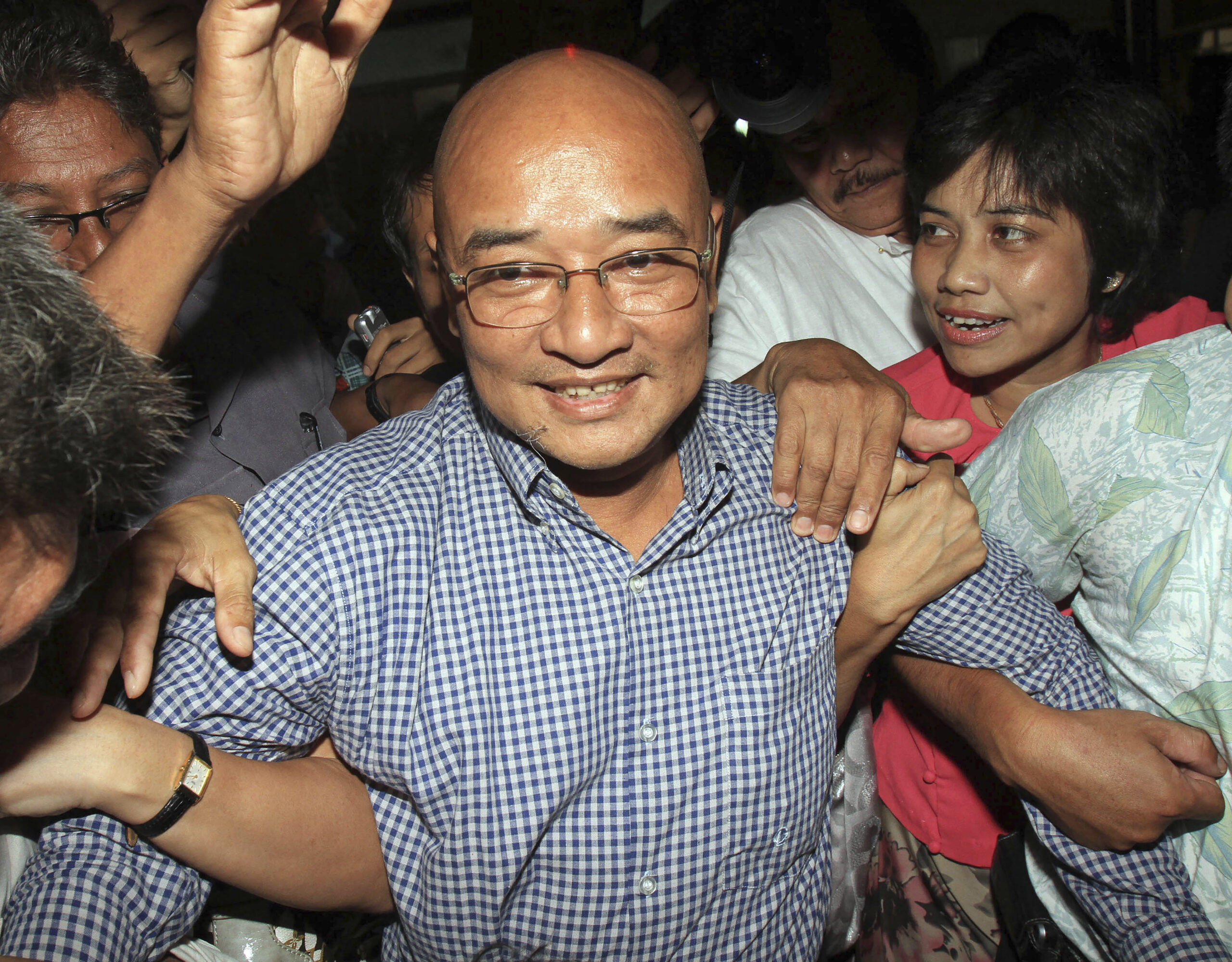
FILE - In this Oct. 12, 2011, file photo, Myanmar's comedian and activist Zarganar, who was serving a 35-year sentence in Myitkyina prison in northernmost Kachin State, arrives at Yangon International Airport in Yangon, Myanmar, after he was released early on Wednesday, Oct. 12, 2011. Photo: Khin Maung Win / AP File
FILE – In this Oct. 12, 2011, file photo, Myanmar’s comedian and activist Zarganar, who was serving a 35-year sentence in Myitkyina prison in northernmost Kachin State, arrives at Yangon International Airport in Yangon, Myanmar, after he was released early on Wednesday, Oct. 12, 2011. Photo: Khin Maung Win / AP File

Many ordinary protesters and activists are also being arrested every day, according to numerous reports on social media.

In Mandalay, the country’s second-biggest city, security forces used stun grenades and fired guns Tuesday to break up a march by medical workers who have defiantly continued to protest almost every day against the Feb. 1 coup that ousted the elected government of Aung San Suu Kyi. The army’s takeover set back Myanmar’s gradual return to democracy after five decades of military rule.

A participant who asked to remain anonymous for his own safety told The Associated Press that doctors, nurses and medical students were attacked as they gathered at about 5 a.m. by security forces who also used cars to run into protesters on motorbikes. The online news site The Irrawaddy reported that four doctors were arrested.

At least 570 protesters and bystanders, including 47 children, have been killed in the crackdown since the takeover, according to the Assistance Association for Political Prisoners, which monitors casualties and arrests. The group says 2,728 people, including Suu Kyi, are in detention.

U.N. spokesman Stephane Dujarric said U.N. officials in Myanmar are “deeply concerned” about the impact of the continuing violence on the country’s health system, pointing to at least 28 attacks against hospitals and health personnel since Feb. 1. And they are also concerned at violence against the education system, pointing to 7 attacks against schools and school personnel since the coup, he said.

“Health volunteers are attacked, and attacks against ambulances are preventing life-saving help reaching civilians wounded by security forces,” Dujarric said.

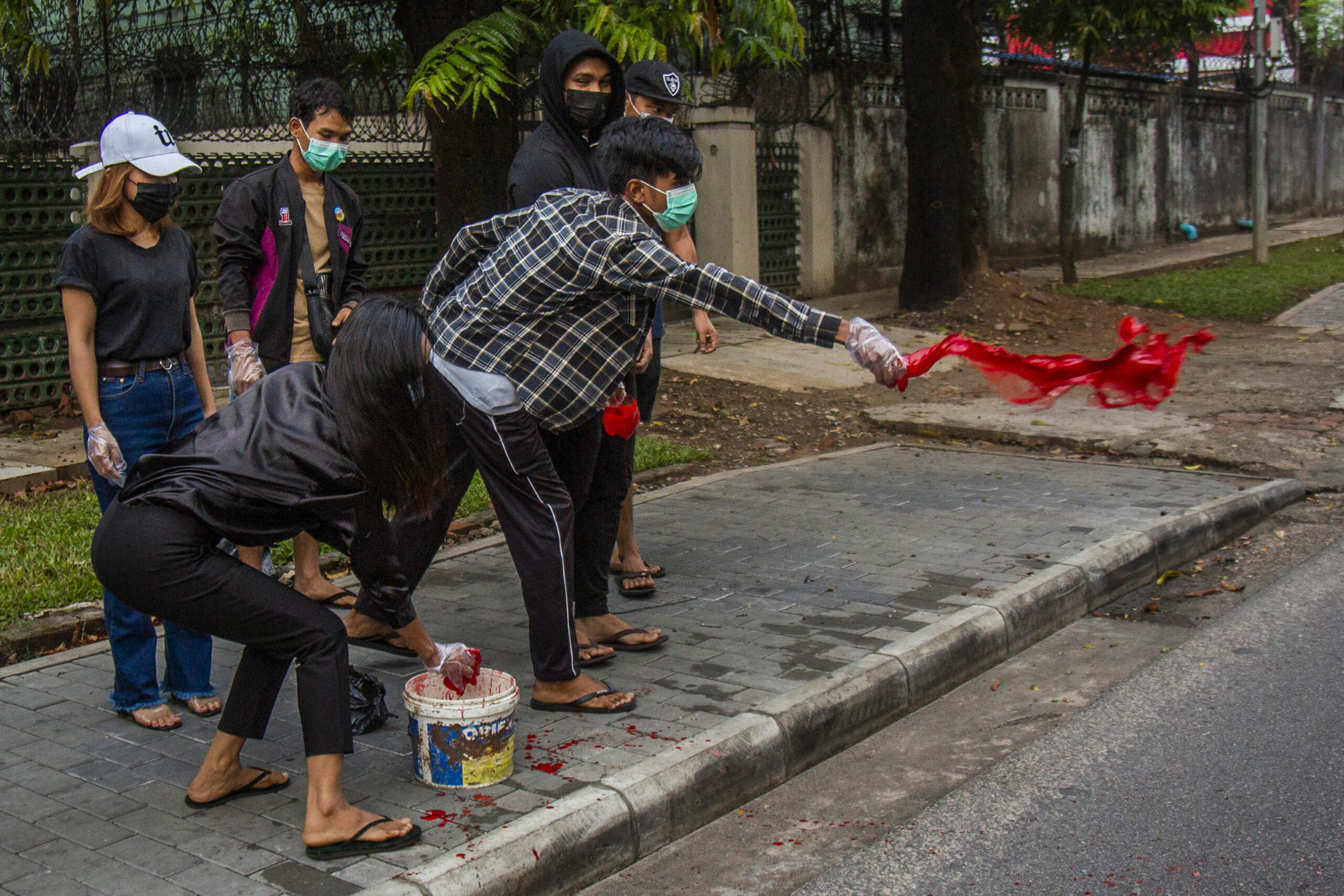
Anti-coup protesters throw red paint on a street during a demonstration in Yangon, Myanmar, Tuesday April 6, 2021. Photo: AP

Activists have begun organizing a boycott of next week’s official celebration of Thingyan, the country’s traditional New Year, usually a time for family reunions and merry-making.

In leaflets and social media posts, they are imploring people not to hold any Thingyan celebrations, saying it would be disrespectful to “fallen martyrs” to enjoy the festival.

The leaders of Brunei and Malaysia announced Monday that leaders of the Association of Southeast Asian Nations will meet to discuss the situation in Myanmar.

No date was given in the announcement, issued during a visit by Malaysian Prime Minister Muhyiddin Yassin to Brunei. He and Sultan Hassanal Bolkiah said they “expressed serious concern on the ongoing crisis in Myanmar and the rising number of fatalities.” Indonesian President Joko Widido had proposed a summit on Myanmar last month.

There was no word on whether the ASEAN leaders would participate in person or by video, or if Myanmar, one of the group’s 10 members, would attend.

Myanmar’s junta also has been battling in some border areas where ethnic minority groups maintain their own armed forces. Several major groups, most notably the Karen and the Kachin, have expressed solidarity with the anti-coup movement and vowed to protect protesters in the territory they control.

The Kachin in the country’s north have engaged in combat with government forces, but the Karen in the east have borne the brunt of the junta’s military assaults.

The area where the Karen National Union holds sway has been subject to air attacks by the Myanmar military from March 27 through Monday, said David Eubank of the Free Burma Rangers, a humanitarian organization that has for many years provided medical assistance to Karen villagers. Burma is another name for Myanmar.

Eubank said his group has verified that 14 civilians died and more than 40 were wounded in the air strikes. He said Tuesday that Myanmar’s military is mounting a ground offensive into Karen territory, driving villagers from their homes and increasing the number of displaced people in the area to more than 20,000, many of whom have to hide in caves or the jungle and are in desperate need of food and other necessities.

“The situation now seems, from our perspective, to be all-out war to the finish,” Eubank wrote Monday in an emailed message. “Unless there is a miracle, the Burma Army will not hold back in their attempt to crush the Karen and any other ethnic group that stands against them, just as they have not held back killing their own Burman people in the cities and plains of Burma.”

Advertisement

North Korea Says It Won’t Participate in Tokyo Olympics

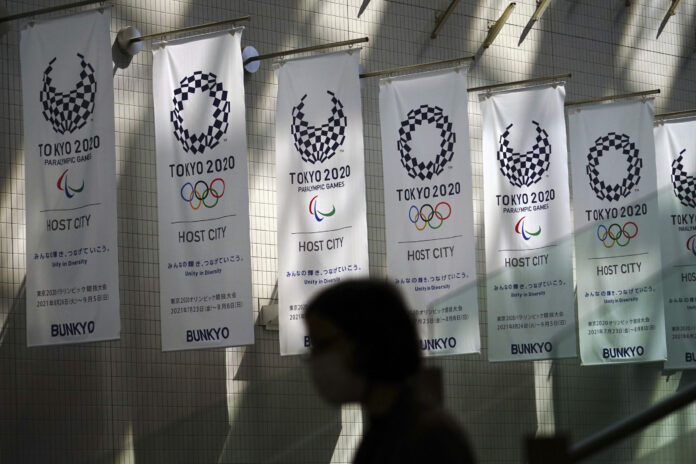
A woman wearing a protective mask to help curb the spread of the coronavirus walks near banners for Tokyo 2020 Olympic and Paralympic Games Wednesday, March 31, 2021. Photo: Eugene Hoshiko / AP

SEOUL (AP) — North Korea said it will not participate in the Tokyo Olympics because of the coronavirus pandemic.

A website run by the North’s sports ministry said the decision was made during a national Olympic Committee meeting on March 25 where members prioritized protecting athletes from the “world public health crisis caused by COVID-19.”

South Korea’s Unification Ministry on Tuesday expressed regret over the North’s decision, saying it had hoped that the Tokyo Olympics would provide an opportunity to improve inter-Korean relations, which have declined amid a stalemate in larger nuclear negotiations between Washington and Pyongyang.

Japanese Olympic Minister Tamayo Marukawa told reporters she was still confirming details and couldn’t immediately comment on the matter. Japan’s Olympic Committee said North Korea has not yet notified it that it wouldn’t participate in the Tokyo Games.

North Korea sent 22 athletes to the 2018 Winter Olympics in South Korea, along with government officials, performance artists, journalists and a 230-member all-female cheering group.

At the Pyeongchang Games, the North and South Korean athletes jointly marched under a blue map symbolizing a unified Korean Peninsula, while the red-clad North Korean cheerleaders captivated global attention. The Koreas also fielded their first combined Olympic team in women’s ice hockey, which drew passionate support from crowds despite losing all five of its games with a combined score of 28-2.

Those games were also much about politics. The North Korean contingent included the powerful sister of North Korean leader Kim Jong Un, who conveyed his brother’s desire for a summit with South Korean President Moon Jae-in, a move which helped it initiate diplomacy with South Korea and the United States.

That diplomacy has stalemated since, and North Korea’s decision to sit out the Tokyo Olympics is a setback for hopes to revive it.

FILE - In this Feb. 10, 2018, file photo, IOC president Thomas Bach, second from left, and Kim Yo Jong, right, sister of North Korean leader Kim Jong Un, talks with players after the preliminary round of the women's hockey game between Switzerland and the combined Koreas at the 2018 Winter Olympics in Gangneung, South Korea. Photo: Jae C. Hong / AP File
FILE – In this Feb. 10, 2018, file photo, IOC president Thomas Bach, second from left, and Kim Yo Jong, right, sister of North Korean leader Kim Jong Un, talks with players after the preliminary round of the women’s hockey game between Switzerland and the combined Koreas at the 2018 Winter Olympics in Gangneung, South Korea. Photo: Jae C. Hong / AP File

While North Korea has steadfastly claimed to be coronavirus-free, outsiders widely doubt whether the country has escaped the pandemic entirely, given its poor health infrastructure and a porous border it shares with China, its economic lifeline.

Describing its anti-virus efforts as a “matter of national existence,” North Korea has severely limited cross-border traffic, banned tourists, jetted out diplomats and mobilized health workers with quarantine tens of thousands of people who had shown symptoms.

Japanese Prime Minister Yoshihide Suga previously said he expected to invite President Joe Biden to the Olympics and was willing to meet with Kim Jong Un or his powerful sister, Kim Yo Jong, if either attended the Games. Suga, however, did not say if he will invite either of them.

Experts say pandemic border closures have further shocked North Korea’s economy, already broken by decades of mismanagement, aggressive military spending and crippling U.S.-led sanctions over its nuclear weapons program.

The economic setbacks have left Kim Jong Un with nothing to show for his ambitious diplomacy with former President Donald Trump, which derailed over disagreements in exchanging the release of sanctions and the North’s nuclear disarmament steps.

Kim in recent political speeches has pledged to bolster his nuclear deterrent in face of U.S.-led pressure, and his government has so far rejected the Biden administration’s overture for talks, demanding that Washington abandon its “hostile” policies first.

The North ended a yearlong pause in ballistic testing activity last month by firing two short-range missiles off its eastern coast, continuing a tradition of testing new U.S. administrations with weapons demonstrations aimed at measuring Washington’s response and wresting concessions.

Advertisement

Myanmar’s Online Pop-up Markets Raise Funds for Protest

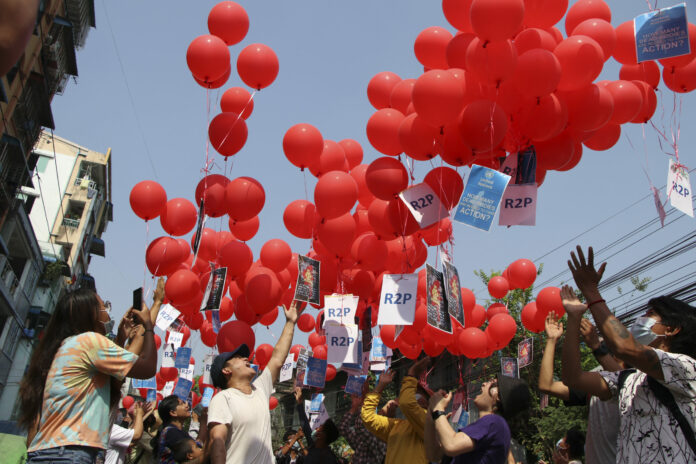
FILE - In this March 22, 2021, file photo, anti-coup protesters release red balloons with notes calling for foreign intervention to help them in Yangon, Myanmar. Photo: AP File

BANGKOK (AP) — With security forces in Myanmar having shot dead at least 570 protesters and bystanders in the past two months, many of the country’s residents see venturing out onto the street as a brave but foolhardy act.

Online, many have found a safer, more substantive way to show their defiance against February’s military takeover — virtual rummage sales whose proceeds go to the protest movement’s shadow government and other related political causes.

Everything from clothes and toys, to music lessons and outdoor adventures are on sale. Foreign friends are encouraged to donate, but fundraising inside Myanmar also serves the purpose of raising political consciousness for challenging the ousting of Aung San Suu Kyi’s elected government.

Facebook users have taken to the social network to sell off their possessions, advertising that all the money raised will go to fund the Committee Representing Pyidaungsu Hluttaw, formed by elected members of Parliament who were blocked from taking their seats by the coup.

The committee styles itself as the sole legitimate government of the country, rejecting the ruling junta as without legal standing. In turn, the junta has outlawed the committee and declared it treasonous, threatening to jail not just its members but anyone supporting it.

Formed from scratch shortly after the Feb. 1 coup, the CRPH needs money to carry on its organizing activities inside the country and diplomatic efforts abroad.

Even as the authorities keep narrowing access to the internet, lately limited to a relatively small number of households with fiber broadband connections, deals are still available.

Last week, one young woman was offering her collection of K-Pop music and memorabilia, especially of the band Exo. Anyone interested had to show her a receipt for a donation to CRPH, and the item would go to whoever gave the most.

Another put his collection of LEGO Marvel Super Heroes up for sale.

“It is not very pricey but difficult to collect. If you show me your CRPH donation slip, choose anything and I will give it to you,” his message read.

One group of friends advertised their collection of novels, poems and motivational books, with proceeds again going to the democracy fight and delivery “when everything becomes stable.”

And it isn’t just goods that are being hawked. Services are also on offer to help bankroll the struggle.

A quick check through Facebook notices turned up a seamstress offering to sew a traditional Myanmar dress for free to those who donate $25, a musician offering lifetime guitar and ukulele lessons and an outdoor expedition leader offering to take five people on an adventure holiday.

The expedition would go to the winner of a lucky draw from among receipts for donations to either the CPRH, the Civil Disobedience Movement that organizes the daily resistance activities or to help thousands of internally displaced people.

However, there’s one small caveat to that last offer — it’s advertised as being redeemable “after the revolution.”

___

Story: Jerry Harmer

Advertisement

BOI Okays Biotech Projects Worth 2.4 Billion Baht in Total Investment

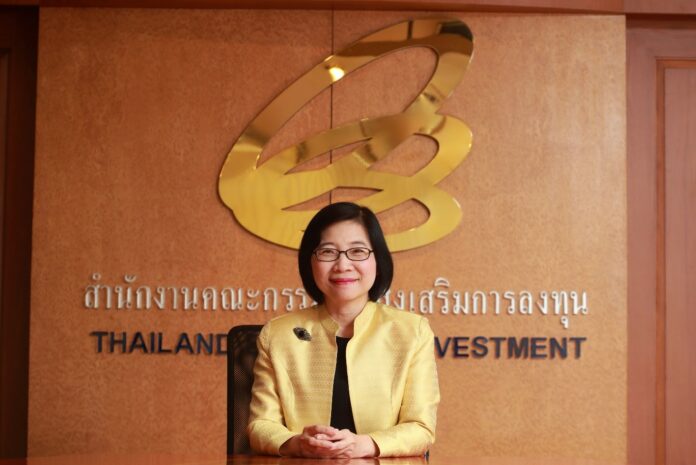
The Thailand Board of Investment (BOI) revealed on 5 April 2021 that it has recently approved new projects in the field of advanced biotechnology worth a combined 2.4 billion baht (around $78 million) in investment, reflecting the increased interest of local and foreign investors in the country’s biotech sector.

“These new and exciting projects reflect investors’ continued interest in Thailand biotech capability,” Ms. Duangjai Asawachintachit, Secretary General of the BOI. “Adding to our strong agricultural base and biodiversity, Thailand has now also a very strong pool of researchers that allow us to move into advanced technology.”

Thai Kyowa Biotechnologies Co., Ltd., a producer of amino acids for pharmaceuticals affiliated to Japan’s Kirin Holdings, received approval for an advanced biotech project to produce Human Milk Oligosaccharide (HMO), a prebiotic and key ingredient in milk powder for infants and adults, helping to build immunity. The fully Japanese-owned company, located in Thailand’s eastern province of Rayong, expects HMO production to start in 2022, mainly for exports.

Genepeutic Bio Co., Ltd., a company established by doctors from the Ramathibodi hospital in Bangkok, and local investors, received approval for a project to develop and produce an innovative treatment for patients with Acute Lymphoblastic Leukaemia (ALL). The company, based in the Thailand Science Park, close to the country’s capital, was setup to develop CAR T Cell advanced therapy medicinal products (ATMP).

Fruita Biomed Co., Ltd., a company related to Thailand’s Fruita Natural Co., Ltd., a food and beverage producer and exporter, received approval for a project to produce PHA (Polyhydroxyalkanoate) bioplastic and PHA bioplastic compound developed from organic waste. The company will use the PHA bioplastic to make a wide range of packaging products for food and medical supply as well.

Baiya Phytopharm, Co, Ltd., a Thai startup linked to the CU Innovation Hub, the incubator setup by Bangkok’s well known Chulalongkorn University, received approval for a project to develop and produce biopharmaceuticals, including plant-based vaccines and therapeutic proteins, using molecular pharming technology.

The biotechnology sector is part of the so-called BCG model (Bio, Circular and Green economy) which the Thai government has set as a priority to lead the post-Covid 19 recovery.

Advertisement

Bangkok Orders Bar Closings To Stop Virus Spread

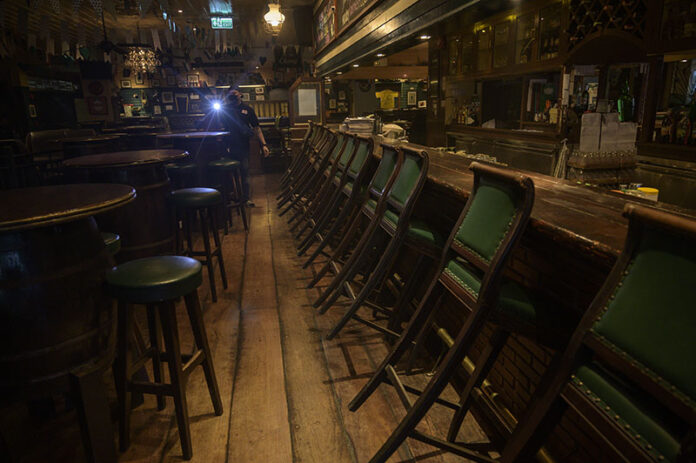
In this April 21, 2020, file photo, a security guard is seen walking a round of patrol in the empty interior of Mulligan's, a popular Irish bar on Khaosan Road. Photo: Sirachai Arunrugstichai

BANGKOK (AP) — Officials in Thailand’s capital on Monday ordered a two-week closure of all entertainment venues in three districts to try to limit the spread of the coronavirus from nightspots there.

Health officials are also trying to cope with a coronavirus outbreak at a prison in the south.

Apisamai Srirangsan, a spokesperson for the Center for COVID-19 Situation Administration, said 194 new coronavirus cases nationwide had been confirmed, most from Bangkok entertainment venues and from Narathiwat prison. Thailand has had 29,321 confirmed cases, including 95 deaths.

The center had already ordered affected nightspots closed until they undergo deep cleaning. Entertainment venues in the districts of Klong Toey, Bang Khae and Wattana — the latter with upmarket bars and bistros in the Ekkamai and Thong Lor neighborhoods — must close from April 6 to 19.

Bangkok’s city government have announced the names of the venues involved and urged people who patronized them over the past month to be tested for COVID-19.

The outbreaks come just ahead of the major holiday of Songkran in mid-April, which usually sees an exodus of people from cities to visit relatives in other provinces and is generally celebrated over an entire week. The official holiday was postponed last year because it came right after Thailand’s first wave of the virus.

The possibility of a new upsurge in COVID-19 cases comes as the government is trying to finalize plans to gradually reopen the country to foreign tourists, who stopped coming after scheduled passenger flights into the country were banned in April last year.

Thailand had appeared to be recovering from a COVID-19 wave that originated late last year in a province near Bangkok where thousands of people, mostly migrant workers, were infected.

Also in Bangkok, several international schools decided to suspend in-person classes for several days after at least one school reported a coronavirus case.

In Narathiwat province, the Corrections Department announced a one-month ban on prison visits beginning Monday after 120 inmates and officials at the provincial prison were infected.

Last month, a detention center in Bangkok for undocumented immigrants reported 395 cases of the coronavirus.

Advertisement

Hymns Through Masks: Christians Mark Another Pandemic Easter

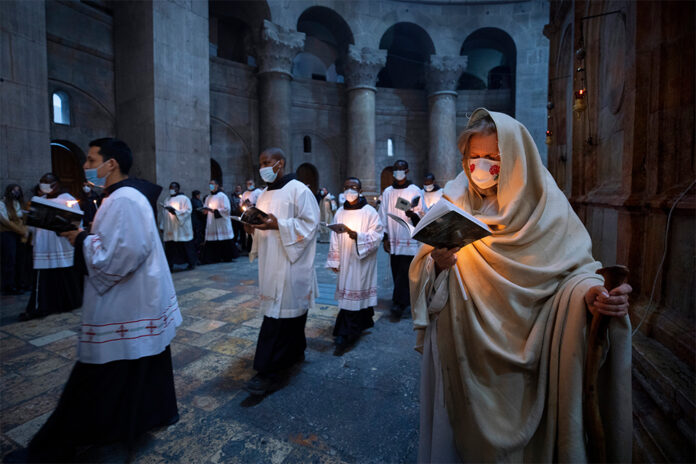
Priests circle the Edicule during Easter Sunday Mass led by the Latin Patriarch at the Church of the Holy Sepulchre, where many Christians believe Jesus was crucified, buried and rose from the dead, in the Old City of Jerusalem, Sunday, April 4, 2021. Photo: Oded Balilty / AP

VATICAN CITY (AP) — Christianity’s most joyous feast day was celebrated worldwide with the faithful spaced apart in pews and singing choruses of “Hallelujah” through face coverings on a second Easter Sunday marked by pandemic precautions.

From vast Roman Catholic cathedrals to Protestant churches, worshippers followed regulations on the coronavirus. In some European countries, citizens lined up on Easter for their turn to receive a COVID-19 vaccine.

In the Lombardy region of Italy, where the pandemic first erupted in the West, a hospital gave a traditional dove-shaped Easter cake symbolizing peace to each person waiting to get vaccinated. Many who came were in their 80s.

A soccer team in Lyon, France, opened its stadium as a vaccination center for the long holiday weekend. Some 9,000 people were expected to receive their shots there over three days as the French government tries to speed up vaccinations amid a fresh outbreak of infections.

In the Holy Land, travel restrictions and quarantine regulations prevented foreign pilgrims from flocking to religious sites in Jerusalem during Holy Week, which culminates in Easter celebrations. Pope Francis lamented that the pandemic has prevented some churchgoers from attending services.

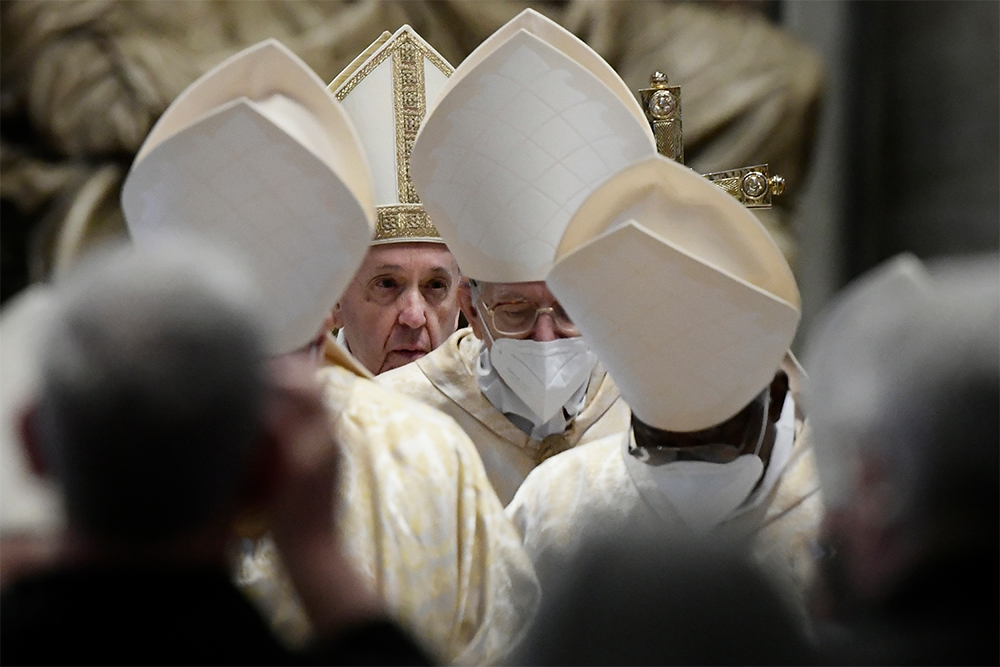
At St. Peter’s Basilica, the 200 or so faithful allowed to attend looked lost in the cavernous cathedral. Normally, thousands would be at the Mass celebrated by Francis, and more than 100,00 would sometimes assemble outside in St. Peter’s Square to receive his Easter blessing afterward.

But this year, as in 2020, crowds are banned from gathering in Italy and at the Vatican. Francis delivered his noon Easter address on world affairs from inside the basilica, using the occasion to appeal anew that vaccines reach the poorest countries.

The pontiff sounded weary as he noted that pandemic measures have affected religious holiday traditions and kept some faithful from public worship.

“We pray that these restrictions, as well as all restrictions on freedom of worship and religion worldwide, may be lifted and everyone be allowed to pray and praise God freely,” Francis said.

Pope Francis leaves after celebrating Easter Mass at St. Peter's Basilica at The Vatican Sunday, April 4, 2021, during the Covid-19 coronavirus pandemic. Photo: Filippo Monteforte /Pool photo via AP
Pope Francis leaves after celebrating Easter Mass at St. Peter’s Basilica at The Vatican Sunday, April 4, 2021, during the Covid-19 coronavirus pandemic. Photo: Filippo Monteforte /Pool photo via AP

In Syria, where a national vaccination program has yet to begin, churchgoers in the Lady of Damascus Church prayed for a way out of the economic and political crisis, only worsened by the pandemic.

“We came to the church for Easter so we get rid of the pandemic that we are in,” said Bassam Assaf. “Of course, we are not scared of coronavirus. It is the reality that we face, but it cannot stop us from coming and praying to God to take us out of this ordeal and help the world.”

A service at the Church of the Holy Sepulchre in the Old City of Jerusalem was celebrated by the senior Roman Catholic cleric in the Holy Land. That is the site where many Christians believe Jesus was crucified, buried and rose from the dead. Israel’s successful vaccination campaign has allowed reopening of many places, including religious sites.

The pandemic kept Seville’s Brotherhood of the Holy Resurrection from sending its ornate Easter float, bearing a towering statue of Jesus, through the streets of the Spanish city. Instead, the Brotherhood posted videos and old photos from their last procession, two years ago.

Some Pentecostal Christians in South Africa canceled a three-day retreat starting on Good Friday. On the hills overlooking Soweto, a Johannesburg township, Apostolic Pentecostals gathered in small groups Sunday to mark Easter.

In South Korea, Yoido Full Gospel Church, the country’s biggest Protestant church, allowed only about 2,000 people to attend Easter service, or about 17% of the capacity of the main building. Masked worshippers sang hymns and prayed as the service was broadcast online and by Christian TV channels.

Intent on tamping down weeks of surging infections, the Italian government ordered people to stay home for the three-day weekend except for essential errands. Premier Mario Draghi’s government did allow one visit to family or friends per day in residents’ home regions over the weekend, which includes the national holiday on Monday.

Italy permits religious services in the pandemic if capacity is limited and masks are worn. But early on, the predominantly Roman Catholic country’s many churches were open only for individual prayer.

Hundreds of Catholics gathered in the mammoth Cathedral of St. Paul in St. Paul, Minnesota, for the Easter Vigil service Saturday evening. Every other pew was kept empty and masks were mandatory. Still, the solemn liturgy marked a new, hopeful beginning for the congregation after a turbulent year.

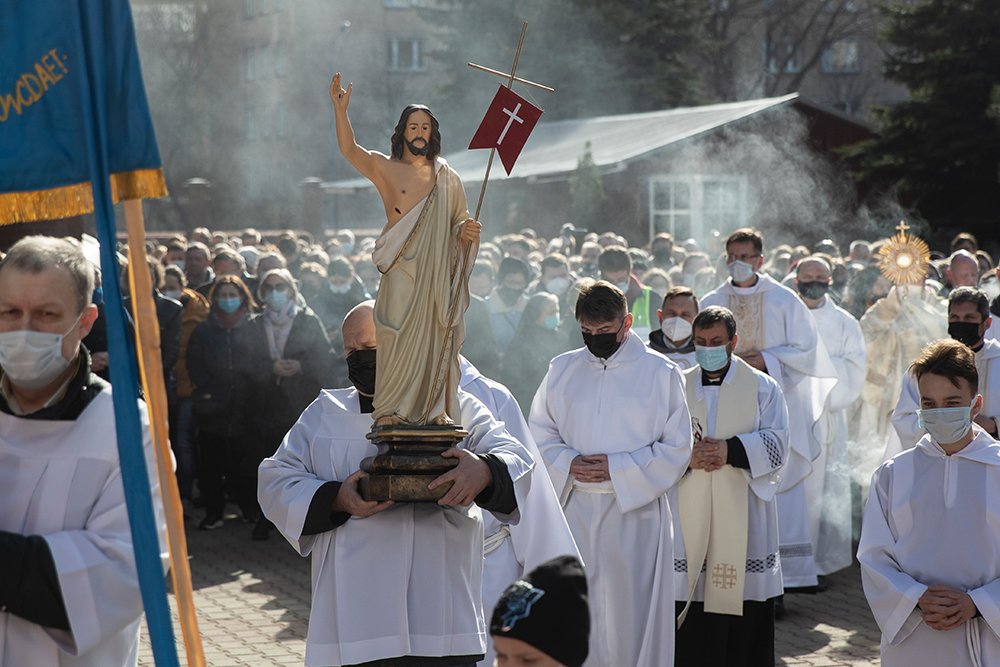
Catholic priest carries a statue of Jesus Christ as he walks in religious procession during the Holy Easter celebration in the Cathedral of the Immaculate Conception in Moscow, Russia, Sunday, April 4, 2021. Photo: Pavel Golovkin / AP

After all-virtual Easter services last year, St. Patrick’s Cathedral in New York City was at half-capacity for Sunday’s Mass. Worshippers spaced themselves out in the vaulted neo-Gothic cathedral, which can seat more than 2,000. The choir sang through masks.

In Detroit, Hartford Memorial Baptist Church opened for in-person Easter services for the first time in more than a year, with capacity limits and social distancing rules in place. The Rev. Charles Christian Adams told the Detroit Free Press that people need church, especially after the congregation lost at least 14 members to COVID-19.

Tonee Carpio said physically being in St. Vincent de Paul Church in Austin, Texas, meant a lot to her after services last year were offered only online. She said being in church helps keep her Filipino culture alive in her city, since some prayers are offered in her native Tagalog.

“When you’re inside a church, you become more solemn, you can focus on God,” she said.

In Florida, Eastgate Christian Fellowship in Panama City Beach hosted its annual sunrise service on the beach. The church had to scrap the service last year because all beaches were closed. Pastor Janelle Green estimated that about 400 people participated.

Robin Fox of Palm Bay, planned to spend Sunday driving her mother to Orlando to get a second dose of vaccine at a Federal Emergency Management Agency walk-up site.

“She’s getting that freedom on the same day that (people go to) church to celebrate Jesus being risen, so I said (to her), ‘it’s kind of like you’re being risen also,'” Fox said.

___

Story: Frances D’Emilio

Advertisement

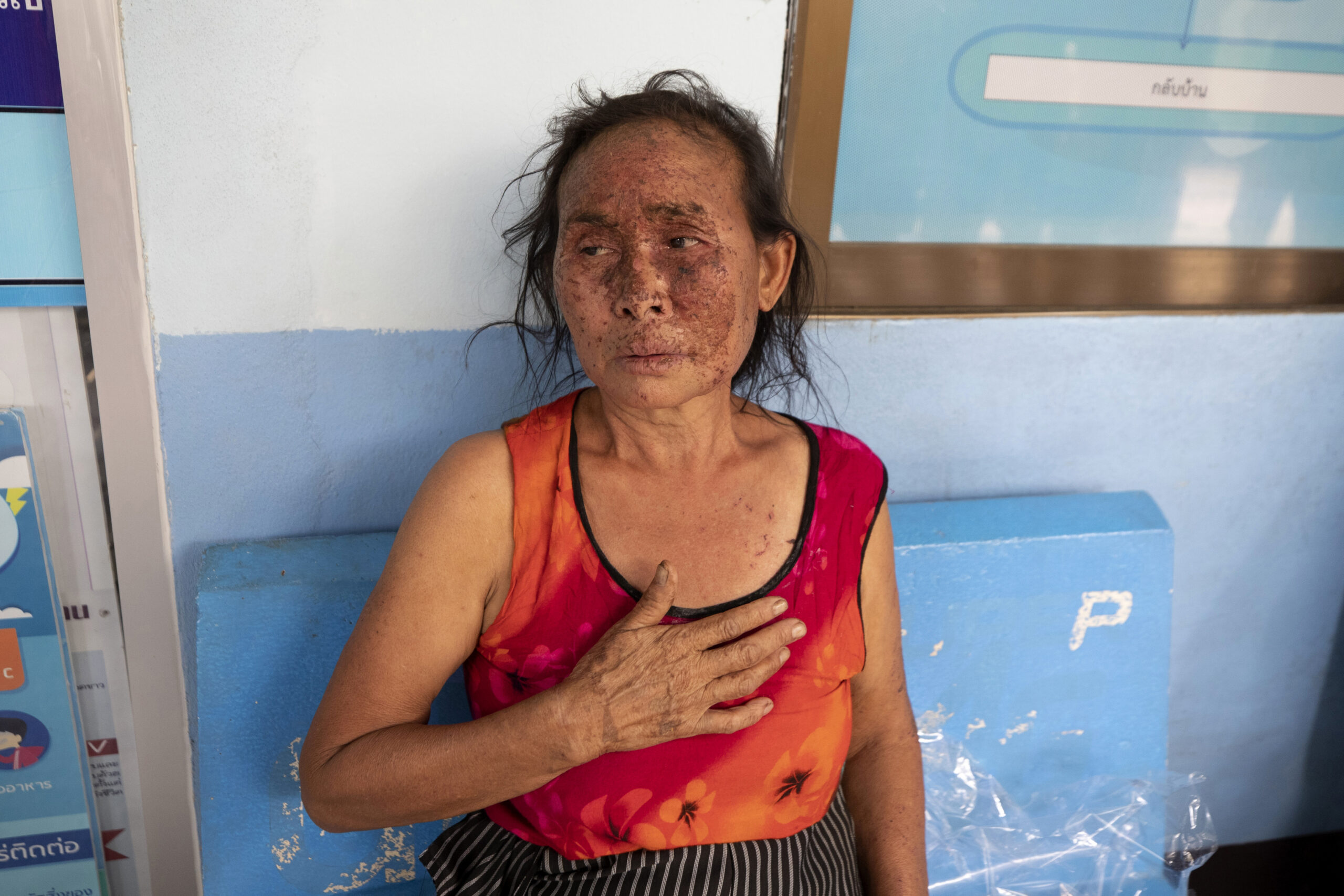
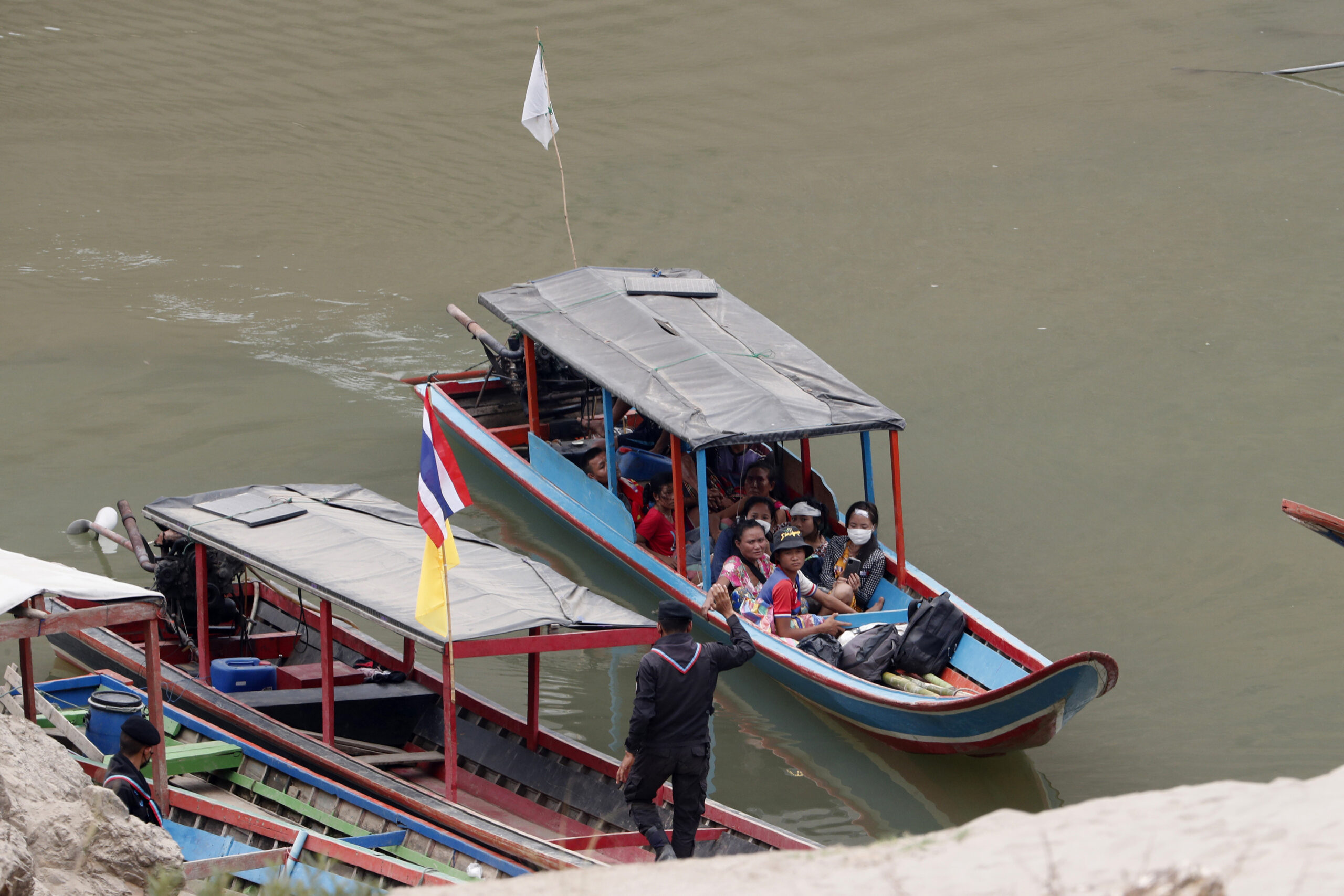
Minorities in Myanmar Borderlands Face Fresh Fear Since Coup

In this March 30, 2021, file photo, a health worker attends to an injured Karen villager from Myanmar as she and others arrive at Ban Mae Sam Laep Health Center in Mae Hong Son province, Thailand. Photo: Sakchai Lalit / AP File

JAKARTA (AP) — Before each rainy season Lu Lu Aung and other farmers living in a camp for internally displaced people in Myanmar’s far northern Kachin state would return to the village they fled and plant crops that would help keep them fed for the coming year.

But this year in the wake of February’s military coup, with the rains not far off, the farmers rarely step out of their makeshift homes and don’t dare leave their camp. They say it is simply too dangerous to risk running into soldiers from Myanmar’s army or their aligned militias.

“We can’t go anywhere and can’t do anything since the coup,” Lu Lu Aung said. “Every night, we hear the sounds of jet fighters flying so close above our camp.”

The military’s lethal crackdown on protesters in large central cities such as Yangon and Mandalay has received much of the attention since the coup that toppled Aung San Suu Kyi’s elected government. But far away in Myanmar’s borderlands, Lu Lu Aung and millions of others who hail from Myanmar’s minority ethnic groups are facing increasing uncertainty and waning security as longstanding conflicts between the military and minority guerrilla armies flare anew.

It’s a situation that was thrust to the forefront over the past week as the military launched deadly airstrikes against ethnic Karen guerrillas in their homeland on the eastern border, displacing thousands and sending civilians fleeing into neighboring Thailand.

Several of the rebel armies have threatened to join forces if the killing of civilians doesn’t stop, while a group made up of members of the deposed government has floated the idea of creating a new army that includes rebel groups. The U.N. special envoy for Myanmar, meanwhile, has warned the country faces the possibility of civil war.

Ethnic minorities make up about 40% of Myanmar’s 52 million people, but the central government and the military leadership have long been dominated by the country’s Burman ethnic majority. Since independence from Britain in 1948, more than a dozen ethnic groups have been seeking greater autonomy, with some maintaining their own independent armies.

That has put them at odds with Myanmar’s ultranationalist generals, who have long seen any ceding of territory — especially those in border areas that are often rich in natural resources — as tantamount to treason and have ruthlessly fought against the rebel armies with only occasional periods of ceasefire.

The violence has led to accusations of abuses against all sides, such as arbitrary taxes on civilians and forced recruitment, and according to the United Nations has displaced some 239,000 people since 2011 alone. That doesn’t include the more than 800,000 minority Rohingya who fled to Bangladesh to escape a military campaign the U.N. has called ethnic cleansing.

In this Tuesday March 30, 2021, file photo, an injured Karen villager from Myanmar rests at Ban Mae Sam Laep Health Center in Mae Hong Son province, northern Thailand, after they crossed Salawin river on a boat. Photo: Sakchai Lalit / AP File

Since February anti-coup protests have taken place in every border state, and security forces have responded much as they have elsewhere with tear gas, rubber bullets and live ammunition. But residents and observers say the post-coup situation in geographically isolated borderlands has been made worse by increased skirmishes between the military and armed ethnic organizations jockeying for power and territory.

Lu Lu Aung, who hails from the Kachin ethnic group, said she participated in protests, but stopped as it was now too dangerous. She said Myanmar security forces and aligned militias recently occupied their old village where they planted crops and no one left the camp because they feared they would be forced into work for the army.

“Our students can no longer continue the schooling and for the adults it’s so much difficult to find a job and make money,” she said.

Humanitarian aid for civilians in the borderlands — already strained by the pandemic as well as the inherent difficulty outside groups face operating in many areas — has been hard it since the coup as well.

Communications have been crippled, banks have closed and security has become increasingly uncertain, said the director of a Myanmar-based organization supporting displaced persons who spoke on condition of anonymity for security reasons.

“There is no more humanitarian help and support,” she said.

In eastern Karen State, where the airstrikes have displaced thousands, there are concerns that the arrival of rainy season could exacerbate a humanitarian situation already made difficult by reports that Thailand has sent back many of the civilians who fled. Thailand has said those who went back to Myanmar did so voluntarily.

Yet there are parts of the country’s borderlands that have hardly been impacted by the coup.

In Wa State, a region bordering China and Thailand that has its own government, army and ceasefire agreements with the Myanmar military, videos being shared online show life going on as usual, including the rollout of a coronavirus vaccination campaign.

Near Bangladesh in coastal Rakhine State, where the Rohingya were driven from and where violent clashes with the Arakan Army group have been ongoing for years, the junta last month removed the group from its list of terrorist groups, raising hopes a lowering of hostilities. The Arakan Army, unlike a number of other armed groups, had not criticized the coup.

The group, however, since released a statement that declared its right to defend its territory and civilians against military attacks, leading some to fear a fresh escalation in fighting.

In this March 30, 2021, file photo, Karenni villagers from Myanmar arrive on a boat with an injured person as they evacuate to Ban Mae Sam Laep Health Center in Mae Hong Son province, northern Thailand. Photo: Sakchai Lalit / AP File

Other armed groups have issued similar statements. Some such as the Karen National Union have provided protection for civilians marching in anti-coup protests.

Such actions have contributed to the calls for a “federal army” bringing together armed ethnic groups from across the country. But analysts says such a vision would be hard to achieve due to logistical challenges and political disagreements among the groups.

“These groups are not in a position where they can provide the support against the Myanmar military needed in urban centers with large populations, or really too far outside their own regions,” said Ronan Lee, a visiting scholar at Queen Mary University of London’s International State Crime Initiative.

Despite the uncertainty of what’s to come, some minority activists say they have been heartened since the coup by the increased focus on the role ethnic groups can take in Myanmar’s future. They also say there appears to be greater understanding — at least among anti-coup protesters — of the struggle minorities have faced for so long.

“If there’s any silver lining in all of this, that’s it,” said one activist, who spoke on condition of anonymity because of fears for their safety.

___

Story: Victoria Milko

Advertisement

Hot News

LATEST NEWS

Bangkok
overcast clouds
29.4 ° C
29.4 °
29.4 °
79 %
5kmh
100 %
Sat
29 °
Sun
35 °
Mon
36 °
Tue
35 °
Wed
33 °