28.3 C
Bangkok
Monday, June 29, 2026
Home Blog Page 110

MFA, Interior ministry to host ASEAN disaster management exercise

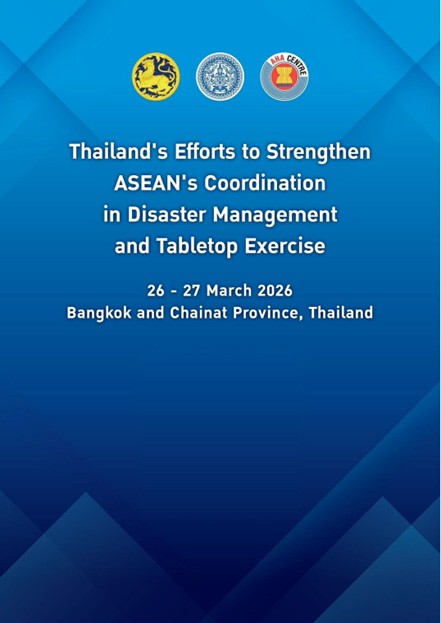
The Department of ASEAN Affairs of the Ministry of Foreign Affairs of Thailand, in partnership with the Department of Disaster Prevention and Mitigation (DDPM) of the Ministry of Interior, will co-organise a Special Programme entitled “Thailand’s Efforts to Strengthen ASEAN’s Coordination in Disaster Management and Tabletop Exerciseon Thursday 26 March 2026 at the Vithes Samosorn, Ministry of Foreign Affairs, and on Friday 27 March 2026 in Chainat Province.

The Ministry of Foreign Affairs has invited over 60 representatives from relevant Thai agencies, state enterprises, civil society organisations, embassies of ASEAN Member States and Dialogue Partners, as well as international organisations to participate in the programme.The Opening Ceremony of the Programme will be presided over by H.E. Mr. Chettaphan Maksamphan, Deputy Permanent Secretary of the Ministry of Foreign Affairs.

The key objectives of the Programme are aimed at enhancing understanding of the existing ASEAN disaster management mechanisms, and  strengthening coordination among relevant Thai agencies in accordance with the ASEAN Standard Operating Procedure for Regional Standby Arrangements and Coordination of Joint Disaster Relief and Emergency Response Operations (SASOP) and also Thailand’s role in disaster management cooperation within the ASEAN framework.

The Programme comprises activities as follows:

Day 1 (26 March 2026): (1) the opening ceremony, (2) a panel discussion on “Overview of ASEAN Cooperation in Disaster Management, Operational Experiences, and Regional-International Cooperation,” featuring speakers from the Ministry of Interior, the Ministry of Defence, the Ministry of Public Health, the AHA Centre, and the United Nations Office for the Coordination of Humanitarian Affairs, (3) a Tabletop Exercise (TTX), and (4) a special exhibition on ASEAN’s disaster management cooperation and Thailand’s contribution;

Day 2 (27 March 2026):  a study visit to the ASEAN Satellite Warehouse under the Disaster Emergency Logistics System for ASEAN (DELSA) project in Chainat Province.

Members of the press are invited to join to cover the events. For registration, please scan QR Code below.

Picture2 10

Advertisement

Drought drives hungry monkeys to temple in Trang

Drought drives hungry monkeys to temple in Trang

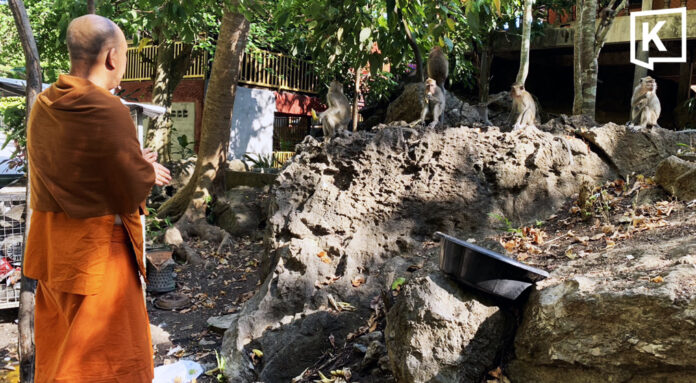
TRANG — 25 March 2026, More than 300 long-tailed macaques have descended on a temple in southern Thailand in search of food and water, as a severe drought dries up natural resources in the area.

At Wat Khao Pina in Huai Yot district, abbot Phra Athikan Boonlert Techapanyo has been feeding the monkeys with bananas after they began leaving nearby hills in groups of 40 to 120 to approach the temple.

The monkeys, divided into four troops, have been taking turns coming down from Khao Pina mountain to the temple grounds, where they sit outside the abbot’s quarters or along the verandas waiting for food. The drought this year has been more severe than in previous years, leaving vegetation parched and water sources depleted.

Despite their growing numbers, the monkeys have not shown aggressive behaviour. Monks say they do not damage property or attack people, instead waiting calmly for food. Once fed, they typically return to the hills, but on days when food or water is scarce, they remain at the temple throughout the day, particularly in the morning and evening.

Some monkeys have also been seen foraging through rubbish bins or shaking trees to attract attention from monks.

The abbot said the temple has been sharing leftover food and fruit, but supplies are insufficient due to the large population, which continues to grow as most of the animals have not been sterilised. Some monkeys have migrated to a nearby hill about 500 metres away, where food is also limited.

In response, the abbot has appealed on the temple’s Facebook page for donations of fruit such as bananas, sugarcane and other food to help feed the animals during the dry season. Local residents have contributed, but demand still exceeds supply.

He warned that some monkeys have ventured outside the temple in search of food, where they risk being hit by vehicles, attacked by dogs or harmed by people.

“This year the drought is more severe and the heat is more intense than last year. Food has run out quickly,” the abbot said. “When there is no food, the monkeys come down to the temple. If there is food, they will not come.”

He added that the monkeys’ behaviour reflects hunger rather than aggression, insisting they remain docile and do not harm visitors.

Those wishing to donate food can contact the temple via its Facebook page or by phone, at  093-6150090, the abbot said.

Advertisement

Foreign biker sparks alarm with wheelie stunt in Phuket

Foreign biker sparks alarm with wheelie stunt in Phuket

PHUKET — 25 March 2026, A foreign tourist has drawn widespread concern after being filmed performing a wheelie on a motorcycle in the middle of busy traffic in Phuket.

A 31-second clip shared on a local Facebook page shows the man accelerating and lifting the front wheel of his motorcycle while riding along Chao Fa West Road in Chalong, Muang district. The road was crowded with cars, motorcycles and trucks at the time.

The footage captures the rider maintaining the stunt for a distance before cutting in front of a green sewage suction truck and lifting the front wheel again, startling nearby motorists. The behaviour was widely criticised as dangerous and posing a constant risk of an accident.

The page captioned the video: “Don’t know what to say anymore, riding like this is dangerous for others on the road,” and “Does he think this is a racetrack?”

The clip prompted a wave of online reactions, with some users claiming the rider frequently performed such stunts. Others called on authorities to track him down, seize the motorcycle and take legal action to ensure public safety.

Advertisement

Lao man caught at Nong Khai border after killing and dismembering ex-girlfriend

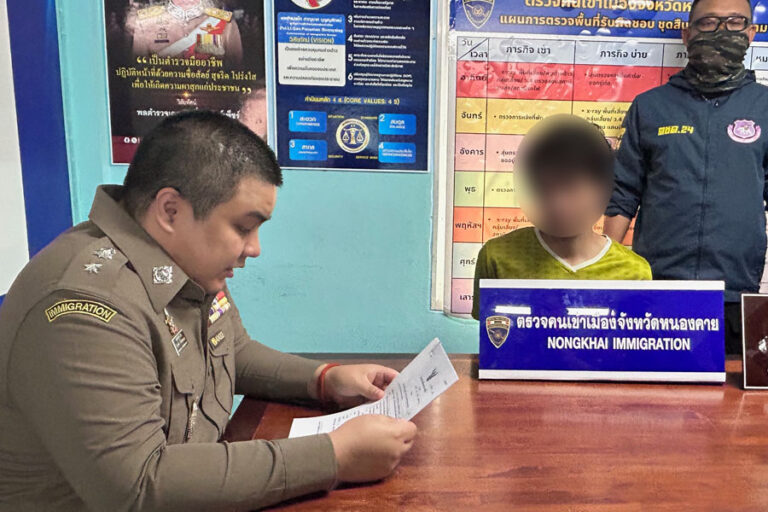
NONG KHAI — 25 March 2026, Immigration police in Nong Khai have detained a 26-year-old Lao man accused of murdering and dismembering his girlfriend, following his attempted flight across the Thai–Lao border.

The suspect, identified as Tom, was taken from the Nong Khai Immigration Detention Centre to an investigation room along with clothing worn on the day of the incident and personal belongings, including cash and a mobile phone. He had fled to Nong Khai after allegedly killing his 20-year-old Lao girlfriend, Ram.

Officers said the suspect is wanted under an arrest warrant issued by the Criminal Court on charges of premeditated murder and concealing, moving, or destroying a body to hide the cause of death. He admitted he was the individual named in the warrant.

During questioning, the suspect initially refused to speak but showed no visible signs of stress or remorse. He later told investigators he had been in a relationship with the victim for six to seven years and that they had married and moved to Thailand for work. He worked in a hospital kitchen in Bangkok, while the victim had sold meatballs before later taking a job at an entertainment venue in Chonburi.

banner3 9

He said the couple had argued frequently in recent months. The victim wanted to return to Laos due to her father’s illness, while he urged her to wait until the end of the month so both families could help mediate their dispute. According to his account, she refused and left him.

The suspect said he later tracked her to her workplace in Chonburi, where he claimed to have seen her with a male customer in an intimate manner and overheard plans to continue together at a room. He waited until the venue closed and persuaded her to return to Bangkok with him.

Authorities allege the man killed the woman at their accommodation using a knife before dismembering the body and attempting to conceal the remains.

He told police he went to work as usual the next day, leaving the remains in the room until the evening, when he disposed of them. He then fled by plane to Udon Thani and hired a motorcycle taxi to travel to the Thai–Lao Friendship Bridge in Nong Khai, believing a helmet would help conceal his identity.

Immigration officers became suspicious and arrested him before he could cross the border. Police said the suspect appeared calm and even joked about the speed of his arrest, remarking that Thai police were “very capable”.

After questioning, officers recorded his statement and said he would be transferred to investigators from Thung Song Hong Police Station in Bangkok to face legal proceedings.

banner4 3

Advertisement

Two monks caught with meth, defrocked in Kanchanaburi

Two monks caught with meth, defrocked in Kanchanaburi

KANCHANABURI — 24 March 2026, Authorities in Bo Phloi and Sangkhla Buri districts arrested two Buddhist monks who admitted to taking methamphetamine and were later defrocked.

At about 12:30 on 24 March, Bo Phloi district chief Chawarot Makkaw and local police received a tip-off that two monks at a temple in tambon Bo Phloi were involved with drugs. Officers searched their quarters and found 2.5 methamphetamine pills in the room of a 35-year-old monk, identified as Tom, and seven pills in the room of a 31-year-old monk, identified as Phan.

Both men showed no sign of distress during the arrest and appeared relaxed, smiling at officers. They confessed the drugs were for personal use. The temple abbot was summoned to formally defrock them before they were taken to Bo Phloi police station for further questioning. Urine tests later confirmed drug use.

They were charged with illegal possession and consumption of a Category 1 narcotic. Police said the source of the drugs remains under investigation.

Advertisement

A decade of Lancang-Mekong cooperation: forging ahead together toward a shared future

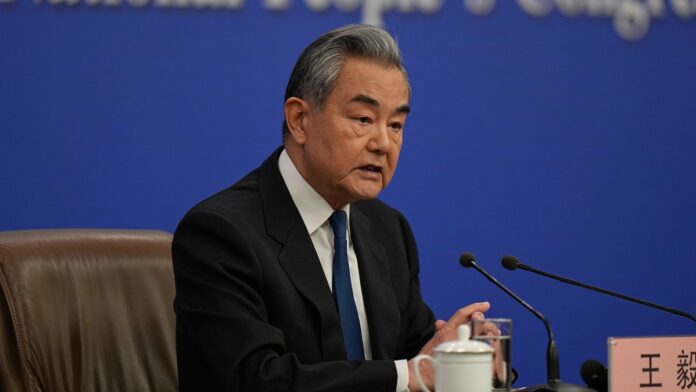
Chinese Foreign Minister Wang Yi (AP Photo/Andy Wong)

This article was written by Wang Yi, Foreign Minister of the People’s Republic of China

The Lancang-Mekong nourishes our six nations and binds us closely
together. On March 23rd 10 years ago, we officially launched the LMC,
sowing the seeds of solidarity, collective strengths and mutually
beneficial cooperation among regional countries. Under the guidance of
President Xi Jinping and leaders of Mekong countries, our six countries
have embraced the LMC culture of equality, sincerity, mutual assistance
and kinship, acted in the LMC spirit of development first, equal
consultation, pragmatism and efficiency, and openness and inclusiveness,
and created the LMC speed, with progress and results delivered daily,
monthly and annually. Thanks to such efforts, the LMC has grown from a
seed to a towering tree, setting an example for the building of a
community with a shared future for humanity.

Over the past decade, we have linked our future more closely together.
Facing changes unseen in a century, our six countries have forged ahead
hand in hand, realized full coverage in building bilateral communities
with a shared future, and become good neighbors, good friends and good
partners sharing weal and woe and supporting each other in times of
need.

Over the past decade, we have gained more robust momentum for
development. Trade between China and the five Mekong countries
surpassed US$500 billion, an increase of 150 percent over a decade ago.
The dedication and hard work of government departments and various
localities of our six countries have produced fruitful cooperation results.
Over the past decade, we have forged a stronger underpinning for security.
Our six countries have carried out the Safe Lancang-Mekong Operation,
and made concerted efforts in disaster prevention and mitigation and
public health, providing effective protection for the life and property of
people in the region. China has shared the Lancang River’s hydrological
information with downstream countries to help with flood and drought
prevention and response.

Over the past decade, we have deepened people-to-people
exchanges. The Lancang-Mekong Visa was launched. Small and
beautiful livelihood programs such as the LMC Bumper Harvest projects
and the Lancang-Mekong Sweet Spring Action have delivered impressive
cluster effects. The people of our six countries are visiting each other
more frequently, strengthening the bonds of cultural exchange and mutual
understanding.

Looking back over the past decade, we see three principles that are
essential to the robust development of the LMC: first, upholding good
neighborliness, friendship and a shared future; second, focusing on
development to serve the people; and third, pursuing innovation and
breaking new ground.

Right now, the world is entering a period of turbulence. Hegemonism and
power politics are asserting themselves and dealing a heavy blow to the
international order. Meanwhile, China just concluded the Two Sessions
and officially launched the 15th Five-Year Plan, providing much-needed
stability for our region. It is important that we better synergize our
development strategies, jointly build an “LMC 2.0”, and demonstrate the
relevance of the LMC for our times. This will contribute to long-term
stability, security, development and prosperity of our region, and set an
LMCexample for global governance.

We should pursue unity and cooperation in the LMC. We should carry
forward the Asian values of peace, cooperation, openness and
inclusiveness, and accelerate the establishment of an LMC International
Secretariat, so as to boost the building of a Lancang-Mekong community
with a shared future.

We should pursue openness and win-win outcomes in the LMC. We
should press ahead with infrastructure connectivity among our countries,
further explore the Multi-Nation Multi Park cooperation, deepen
cooperation along the New International Land-Sea Trade Corridor, and
jointly build the LMC Economic Development Belt.

We should pursue green and innovation-drive development in the LMC.
We should deepen the development of the Lancang-Mekong Innovation
Corridor, advance cooperation in digital economy, artificial intelligence,
sci-tech innovation and ecological governance, promote investment in
new energy, build regional green value chains, and foster green industrial
clusters in the region.

We should pursue mutual learning among civilizations in the LMC.
We should speed up the development of the Lancang-Mekong Tourism
Cities Cooperation Alliance, continue to deepen cooperation among the
media outlets and think tanks, amplify the benefits delivered by the LMC
Special Fund projects, and step up personnel and youth exchanges among
our six countries, so that friendship will be passed on from generation to
generation.

We should pursue peace and tranquility in the LMC. We should
strengthen cooperation on whole-basin governance, share upstream and
downstream hydrological information, step up efforts to combat
cross-border crimes such as online gambling and telecom fraud, and
ensure the success of the Safe Lancang-Mekong Operation and the
Mekong River Joint Patrol and Law Enforcement Operation. By doing so,
we will create a safe environment for building a community with a shared
future.

Since the very inception of the LMC, we have been holding the same
view that our cooperation should not be “talk shops” but “bulldozers”.
With a commitment to putting people first, we should work to deliver real
benefits for the people of our six countries. Standing at a new starting
point, China will follow the principle of amity, sincerity, mutual benefit
and inclusiveness on neighborhood diplomacy, and work with the five
Mekong countries to usher in a new golden decade of the LMC. Together,
let us build a peaceful, safe and secure, prosperous, beautiful and
amicable home, and make our contribution to peace and development in
our region and the wider world.

Advertisement

Two Thai students killed in Miami hit-and-run crash

Greathomon Laowatdhanasapya (left) and Sarisa Kongduang, two Thai nationals killed in a hit-and-run crash in Miami Beach on 17 March.

MIAMI, US — Two Thai nationals were killed in a hit-and-run crash in Miami Beach during a spring break trip, authorities in the United States said.

Sarisa “Pear” Kongduang, 22, a third-year student in Kelley School of Business at Indiana University, and Greatgomon “Great” Laowatdhanasapya, 23, a 2024 graduate of the university, were struck by a car while crossing Collins Avenue at 73rd Street at about 21:05 on 18 March. Both were taken to hospital, where they were later pronounced dead.

Police said the driver, identified as Adan Negron-Morris, 42, was speeding and driving without headlights at the time of the crash. Authorities added that several emergency calls had been made shortly before the incident, reporting a vehicle being driven erratically in the area.

After the collision, the suspect reportedly fled the scene but was later found at a nearby shop, where he was detained before officers arrived. He has been charged with two counts of vehicular homicide and two counts of leaving the scene of a crash involving death.

According to police, the suspect told officers he had intended to harm himself by closing his eyes and accelerating. Authorities are also investigating whether he was under the influence of drugs, with toxicology results pending.

A court in Miami-Dade later set bail at $1 million, with the judge describing the suspect as a danger to the community. If released, he would be placed under strict house arrest and banned from driving or consuming alcohol.

Kongduang was known for her involvement in Association of Thai Students in the United States, including leadership roles during her studies. Laowatdhanasapya had recently graduated and was working in the Bank of America as an Investment Banking Analyst

The case remains under investigation.

Advertisement

Iran says Thai vessel crosses Hormuz safely, vows not to “forget its friends”

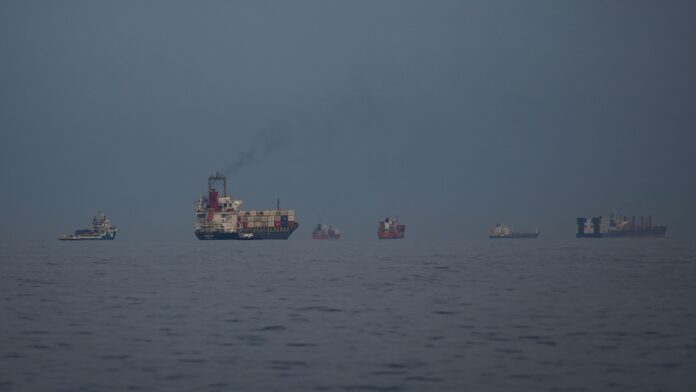
Oil tankers and cargo ships line up in the Strait of Hormuz as seen from Khor Fakkan, United Arab Emirates, Wednesday, March 11, 2026. (AP Photo/Altaf Qadri)

The Iranian Embassy in Bangkok said a Thai vessel has passed through the Strait of Hormuz safely, following close coordination between Iran, Thailand and Oman.

In a statement posted on 24 March, the embassy said the transit reflected strong cooperation and friendship between the countries, adding that Iran “will not forget its friends.”

The development follows an earlier incident on 11 March, when the Thai cargo ship Mayuree Naree was hit by two Iranian missiles while transiting the Strait of Hormuz amid the Iran conflict. The attack damaged the stern and engine room, triggering a fire on board.

All 23 crew members were Thai nationals. Twenty abandoned the vessel and were rescued by the Omani navy, while three remained trapped inside. Iran’s Islamic Revolutionary Guard Corps later claimed responsibility for the strike.

Advertisement

Gold Just Had Its Worst Week Since 1983. What Happened?

Photo AP

Gold has long been the asset investors reach for when the world feels dangerous. Wars, economic shocks, political chaos — historically, any of these tends to send the price of bullion climbing. So why, in the middle of an active and intensifying Middle East conflict, has gold just suffered its worst week in over 40 years?

The answer reveals something important about how markets work — and why the rules can change without warning.

The Numbers, First

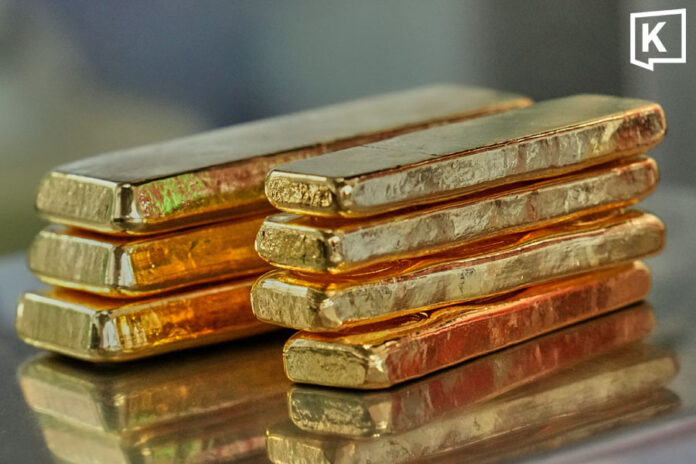
Gold dropped roughly 11% last week, posting its biggest weekly loss since 1983. The metal is now down more than 14% since the war began. As of today, the spot price sits at approximately $4,357 per ounce — a sharp reversal from the record highs above $5,500 that defined the early weeks of 2026.

In Thailand, the pain has been equally stark. Gold bars fell below the key THB 70,000/baht level on Monday, with the Gold Traders Association issuing 66 separate price revisions in a single day. Just weeks ago, analysts at MTS Gold and YLG Bullion were forecasting prices of 88,000 to 90,000 baht by year-end. Those targets now look very far away.

The Paradox: Why War Is Hurting Gold

This is the question that has left many investors confused and frustrated. The logic of gold as a “safe haven” is simple: when uncertainty rises, people park their money somewhere stable, and gold has served that role for centuries.

But there is a crucial distinction that this crisis has exposed. Gold protects against uncertainty. It does not protect well against inflation — especially not when that inflation forces interest rates higher.

Here is what is actually happening. Oil prices have stayed above $105 a barrel after touching $119 earlier in the week, as Iran attacked energy targets in the Middle East following Israeli strikes on Iranian natural gas facilities. That surge in energy costs is spreading through the global economy as rising consumer prices. And rising consumer prices create a serious problem for gold.

The Bank of England kept its rate at 3.75%, warning that inflation will be “higher in the near term” due to the energy price shock. The European Central Bank also held at 2%, noting the war has made the outlook “significantly more uncertain” with upside risks for inflation.

The US Federal Reserve voted on 18 March to hold its benchmark rate at 3.5% to 3.75% for the second consecutive meeting, signaling that sticky energy-driven inflation has closed the door on any near-term rate cuts.

That combination — higher oil, stickier inflation, and central banks refusing to cut rates — is the exact environment where gold struggles.

The Opportunity Cost Problem

Gold pays no interest. No dividends. No yield. You buy it, you hold it, and you hope it goes up. When interest rates are low, this is fine — there is not much you can earn by putting your money elsewhere. But when rates are high, holding gold starts to feel expensive.

Rising real interest rates and a strengthening US dollar are shifting investor preferences away from gold. Capital is rotating toward assets that offer yield, reducing gold’s relative appeal. As one market expert put it: the dollar now offers both a better rate of interest and currency appreciation — a dual advantage that gold simply cannot match.

As Ewa Manthey, Commodities Strategist at ING, wrote last week: “Geopolitics alone rarely drives gold in a sustained way. What matters is how such shocks feed through to inflation, monetary policy and the dollar.” Right now, that chain runs in exactly the wrong direction for gold.

In this conflict, that transmission has been swift and brutal — surging oil prices have stoked inflation, inflation has frozen central banks in place, and frozen central banks mean high real yields. For gold, that chain of events is about as unfavorable as it gets.

In short: the war created the very conditions that are working against gold.

Forced Selling Makes It Worse

Beyond the interest rate mechanics, there is a second force accelerating the decline — and it has nothing to do with gold’s fundamentals at all.

The $400-plus drop in a single week triggered a cascade of margin calls, forcing institutional liquidations across the commodity complex. When investors suffer large losses in volatile markets — stocks, energy, currencies — they often need to raise cash quickly. Gold, being one of the world’s most liquid assets, becomes the piggy bank. It gets sold not because anyone has turned bearish on gold specifically, but simply because it is easy to to sell.

The institutions are not alone. Gold in recent weeks had been trading more like a meme stock than a safe haven — a sign that the 2025 bull run had attracted a wave of retail momentum traders who are now heading for the exits simultaneously.

What This Means for Thailand

Thailand is one of the most gold-conscious countries in Southeast Asia. Physical gold — bars, jewelry, ornaments — is deeply woven into the culture as both savings and family wealth. That makes the current correction feel personal for many people here.

Thailand’s Gold Traders Association revised prices 53 times in a single Thursday session, with gold closing 3,400 baht lower for the day. The association’s volatility has been extraordinary — a few days earlier, the market went through a record 102 price changes in a single session.

The baht adds an extra layer of complexity. Global gold is priced in US dollars, so any movement in the USD/THB exchange rate amplifies or softens the impact for Thai buyers. Volatility in the baht added to the speed and severity of the local price decline, with domestic gold prices adjusting more rapidly than usual.

For investors who entered the market during the 2025 bull run — when Thai gold climbed from around 60,000 baht to above 80,000 baht per baht-weight — this correction is painful. For investors who bought near recent highs, especially above 75,000 to 80,000 baht, the current drop may be difficult to sit with. Even so, many market watchers still see it as a normal correction inside a broader uptrend.

Is This the End of Gold’s Bull Run?

Probably not — but the easy money may be gone for now.

Many strategists remain optimistic. Wall Street veteran Ed Yardeni still holds a $6,000 year-end target, though he is considering lowering it to $5,000 if gold continues to underperform despite rising inflation and geopolitical stress.

The World Gold Council’s outlook is nuanced. If inflation pressures force the Fed to hold or hike rates further, pushing long-term yields higher and strengthening the dollar, the result could be a gold price correction of between 5% and 20% from current levels. That scenario is arguably already playing out.

On the other hand, if the conflict de-escalates, or if the global economy slows enough that central banks pivot back toward cutting rates, gold could recover swiftly. A combination of falling yields, elevated geopolitical stress, and a flight-to-safety could create exceptionally strong tailwinds for gold, supporting a sharp move higher — potentially 15% to 30% from current levels.

Thailand’s Gold Traders Association has not changed its longer-term target of $6,000 per ounce globally and 90,000 baht per baht-weight domestically by end-2026.

The Takeaway

Gold is not broken. What has changed is the environment it is operating in. An energy-driven inflation shock has forced the world’s central banks into a corner — they cannot cut rates without making inflation worse, but keeping rates high suppresses the very asset that should be thriving in a time of war.

Until oil prices stabilize and the inflation picture becomes clearer, gold is likely to remain volatile and under pressure. For long-term holders, that may simply be noise. For those who bought near the top expecting a quick gain, the lesson is one the market teaches periodically: even the most trusted assets can behave unexpectedly when the macro backdrop shifts.

The gold shops lining Bangkok’s Yaowarat Road are still open. They always are. But for now, they are doing a lot more revising of price boards than they are celebrating record highs.


Data accurate as of 24 March 2026. Prices may have changed. This article is for informational purposes only and does not constitute financial advice.


Advertisement

Wide Faith appoints “iZ” as “Rise Buddy” presenter, targeting 150 million baht in sales

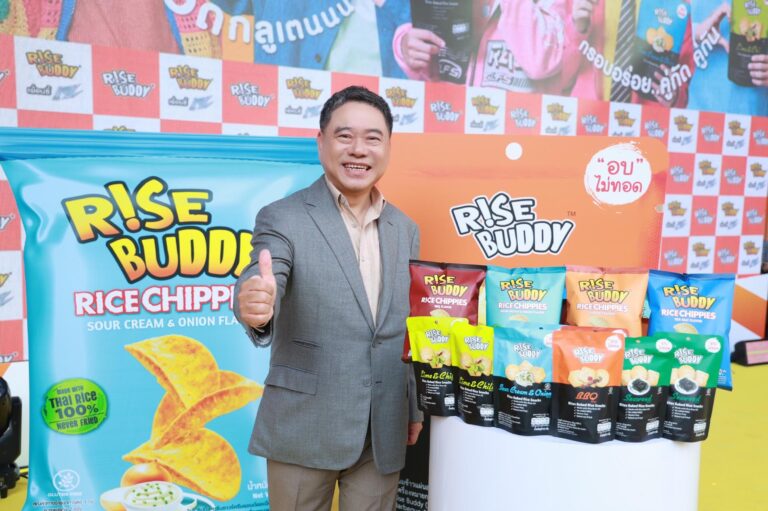
Wide Faith Group, a manufacturer and distributor of baked rice snacks made from 100% Thai rice, is stepping up its presence in Thailand’s snack market by appointing T-Pop band “iZ”as the presenter for its Rise Buddy brand. The move aims to attract Gen Z and Millennial consumers in response to the fast-growing healthy snack trend. Positioned with the key concept of “baked, not fried,” Rise Buddy is targeting a 150-million-baht share in Thailand’s rice snack segment by 2026 while expanding nationwide distribution and promoting Thai rice snacks to consumers worldwide.
Oliver Yeh, CEO of Wide Faith Group was founded in 2002 by a management team with more than 30 years of experience in the rice snack industry. The company operates both as an ODM for global partners and as a developer of its own brands, offering more than 70 flavor formulations. Its brand portfolio includes Rise Buddy, Ravin, Bio‑Earth, and Kiddie Kare. Developed under the “Better for You” concept, the products are baked rather than fried, contain no trans fats, have less than 10% fat, and are free from MSG and gluten. They are also certified halal.

Picture1 10

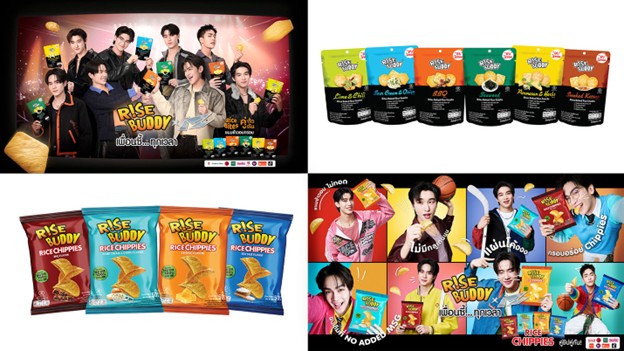
For the Thai market, the company is prioritizing Rise Buddy as its flagship brand, which has already gained traction overseas. This year, the company plans a full-scale domestic launch, supported by the appointment of iZ, an eight-member T-Pop group from OneMusic, as brand presenter. The group consists of NORD, TEAM, TOON, MARC, PHOTO, KAHN, KAO, and PIE. The group’s youthful and modern image aligns with the brand’s positioning and is expected to resonate with younger consumers who are increasingly selective and health-conscious. The collaboration forms part of the company’s strategy to reach Gen Z and Millennial audiences seeking snacks that are flavorful and better for their health.

Picture2 9

The company has also launched two new commercial films for Rise Buddy, highlighting the brand’s two main product categories: Rice Bites and Rice Chippies. The commercials feature a fun storyline starring the eight members of the T-Pop group iZ, who find themselves confronting zombies and monsters in chaotic situations. In the end, the 100% Thai baked rice snack Rise Buddy becomes the bridge that brings everyone together—turning enemies into friends and reinforcing the brand’s concept of “Rise Buddy, your buddy anytime,” creating moments of fun and happiness in every situation.

Among the brand’s key products is Rice Bites, bite-sized baked rice snacks available in six flavors: Barbeque, Seaweed, Sour Cream & Onion, Smoked Katsuo, Parmesan & Herbs, and Lime & Chili. The products are available in 60-gram packs priced at 29 baht.

Picture3 8

Another highlight is Rice Chippies, an innovative thin baked rice chip developed using proprietary technology that enables the rice sheets to become thin and curved like potato chips—a form that is typically difficult to achieve with baked rice snacks that Mr.Oliver and his team has spent more than 20 years to reach the ideal chips shape . The product comes in five flavors: BBQ, Sour Cream & Onion, Sea Salt, and Cheese and is sold in 50-gram packs priced at 29 baht.

In addition, the company is expanding Rise Buddy’s distribution channels across Thailand to enhance nationwide consumer access. The products are available through convenience stores such as 7-Eleven, which serves as a key channel for building brand awareness, as well as leading supermarkets including Tops, Foodland, Gourmet Market, MaxValu, Golden Place, and Lemon Farm. Distribution also covers retail chains such as CJ Express and Super Turtle, alongside e-commerce platforms including Shopee, Lazada, TikTok Shop, and Facebook. Furthermore, the company leverages distributors and corporate sales channels to effectively meet consumer demand across all touchpoints.

Advertisement

Hot News

LATEST NEWS

Bangkok
overcast clouds
28.3 ° C
28.3 °
28.3 °
79 %
4.1kmh
100 %
Sun
28 °
Mon
34 °
Tue
34 °
Wed
32 °
Thu
33 °