
























28.3 C
Bangkok
Thursday, July 2, 2026
Home Blog Page 1193

Parliament Meets To Debate Political Protest Tensions

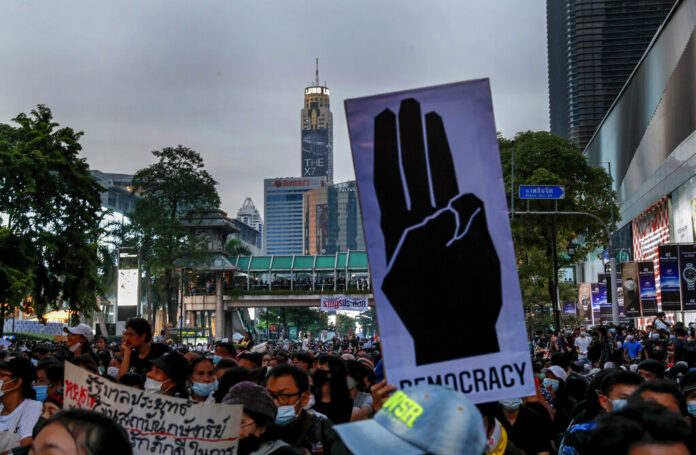
Pro-democracy protesters display placard as a billboard in the background flashes words "long live the King" during a protest rally at Ratchaprasong business district in Bangkok, Thailand, Sunday, Oct. 25, 2020. Pro-democracy protesters in Thailand gathered again Sunday in Bangkok, seeking to keep up pressure on the government a day ahead of a special session of Parliament called to try to ease political tensions. Photo: Gemunu Amarasinghe / AP

BANGKOK (AP) — Thailand’s Parliament began a special session Monday that was called to address tensions as pro-democracy protests draw students and other demonstrators into the streets almost daily demanding the prime minister’s resignation.

As Speaker of the House Chuan Leekpai began the session, only 450 of the total of 731 members of both houses had signed in for the meeting.

The demonstrations by student-led groups in the Bangkok and other cities have three main demands: that Prime Minister Prayuth Chan-ocha step down, the constitution be amended to make it more democratic and reforms be made to the monarchy to make it more accountable.

Public criticism of the monarchy is unprecedented in a country where the royal institution has been considered sacrosanct, and royalists have denounced the protesters for raising the issue.

“The only way to a lasting solution for all sides that is fair for those on the streets as well as for the many millions who choose not to go on the streets is to discuss and resolve these differences through the parliamentary process,” Prayuth said last week.

The non-voting session of Parliament is expected to last two days.

The protesters have little confidence in the parliamentary path, declaring the government’s efforts insincere.

They noted the points of discussion submitted by Prayuth’s government for debate dealt not with the protesters’ concerns but were thinly disguised criticisms of the protests themselves.

They concern instead the risk of the coronavirus spreading at rallies, the alleged interference with a royal motorcade by a small crowd earlier this month, and illegal gatherings and the destruction of images of the royal family.

The protesters allege Prayuth, who led a coup in 2014 as the army chief, was returned to power unfairly in last year’s election because laws had been changed to favor a pro-military party. The protesters also say the constitution, written and enacted under military rule, is undemocratic.

Parliament in September was scheduled to vote on six proposed constitutional amendments but instead set up a committee to further consider such proposals, and then recessed.

Constitutional changes require a joint vote of the House and the Senate, but the proposals lack support in the Senate, whose members are not elected and are generally very conservative and hostile to the protesters.

Instead of confronting lawmakers and counter-protesters on Monday, the pro-democracy protest organizers have called for an afternoon march to the German Embassy, apparently to bring attention to the time King Maha Vajiralongkorn spends in Germany.

Germany’s foreign minister, questioned in Parliament by a member of the Green Party, recently expressed concern over any political activities the king might be conducting on the country’s soil.

Protesters’ criticism of the royal institution has roiled conservative Thais. Self-proclaimed “defenders of the monarchy” mobilized last week online and in rallies in several cities, in many cases led by local civil servants.

A small group of royalist demonstrators were outside Parliament on Monday morning, saying they were there to let lawmakers know of their opposition to any changes in the status of the monarchy.

Story: Jerry Harmer
Advertisement

Protesters Take to Streets Ahead of Parliamentary Debate

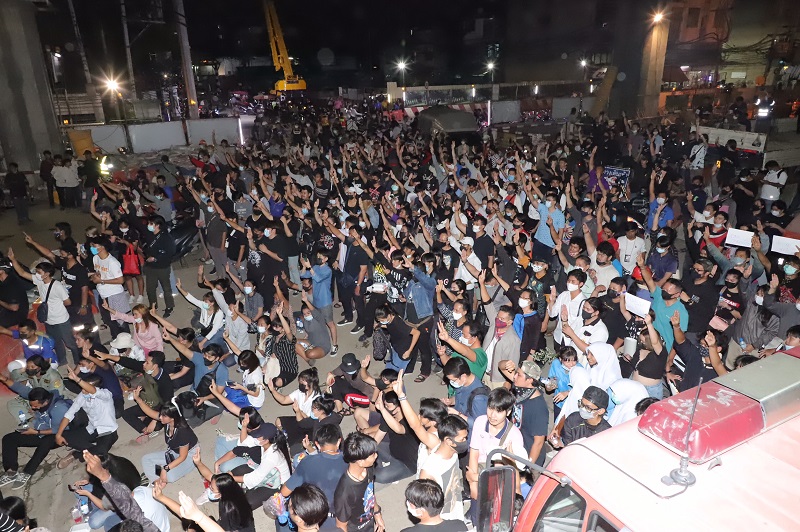
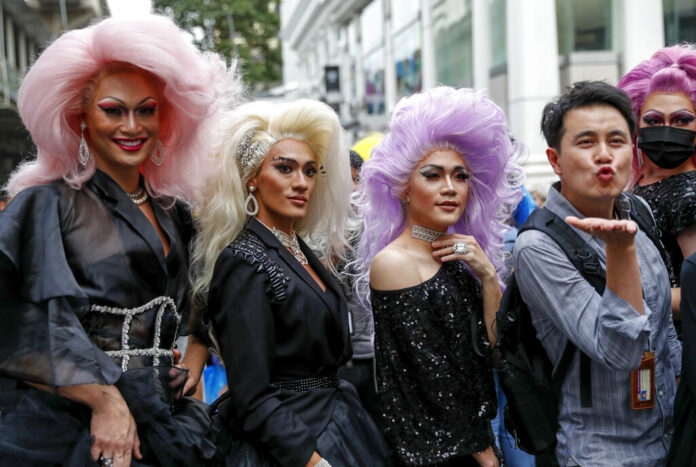
A group of LGBT community, supporters of pro-democracy movement pose in costume during a protest rally at Ratchaprasong business district in Bangkok, Thailand, Sunday, Oct. 25, 2020. Pro-democracy protesters in Thailand gathered again Sunday in Bangkok, seeking to keep up pressure on the government a day ahead of a special session of Parliament called to try to ease political tensions. Photo: Gemunu Amarasinghe / AP

BANGKOK (AP) — Thousands of pro-democracy protesters gathered in Thailand’s capital again on Sunday, seeking to keep up pressure on the government a day before a special session of Parliament that was called to try to ease political tensions.

The rally took place at the busy Rajprasong intersection, in the heart of Bangkok’s shopping district. Few protesters turned out in the first hour of the rally, but their numbers later swelled to several thousand, who listened to rude denunciations of the government in chants, speeches and even songs.

The rally was called Saturday night after Prime Minister Prayuth Chan-ocha ignored the protesters’ deadline to step down.

The protesters’ core demands also include a more democratic constitution and reforms to the monarchy. Public criticism of the monarchy is unprecedented in a country where the royal institution has been considered sacrosanct.

The demonstrators charge that Prayuth, who led a coup in 2014 as the army chief, was returned to power unfairly in last year’s general election because laws had been changed to favor a pro-military party. The protesters also say that the constitution, written and enacted under military rule, is undemocratic.

Prayuth’s government last week called the special parliamentary session to seek to defuse weeks of almost daily protests. The session begins Monday and is expected to last two days.

AP20299490950715
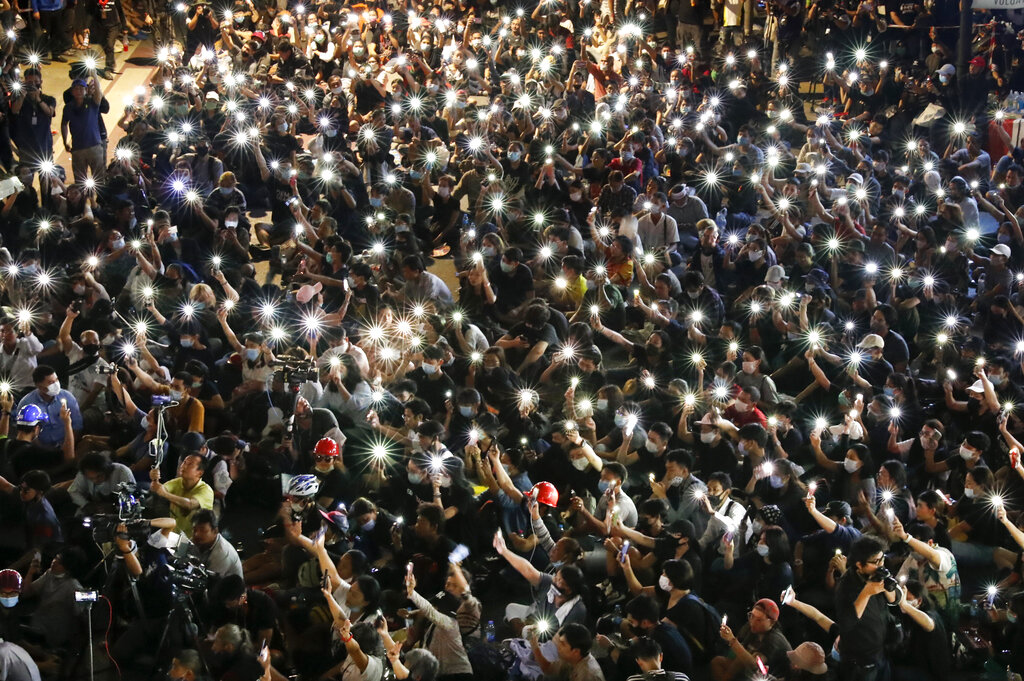
Pro-democracy activists wave their mobile phone with flashing lights, during a protest rally at Ratchaprasong business district in Bangkok, Thailand, Sunday, Oct. 25, 2020. Pro-democracy protesters in Thailand gathered again Sunday in Bangkok, seeking to keep up pressure on the government a day ahead of a special session of Parliament called to try to ease political tensions. Photo: Gemunu Amarasinghe / AP

“The only way to a lasting solution for all sides that is fair for those on the streets as well as for the many millions who choose not to go on the streets is to discuss and resolve these differences through the parliamentary process,” Prayuth said last week.

He also lifted a state of emergency that he had imposed a week earlier that made the protest rallies illegal.

The protesters were not impressed by his efforts to appease them, declaring them insincere.

They noted on social media that the points of discussion submitted by the government for debate dealt not with their concerns but were thinly disguised criticisms of the protests themselves.

They concern the risk of the coronavirus spreading at rallies, the alleged interference with a royal motorcade by a small crowd earlier this month, and illegal gatherings and the destruction of images of the royal family.

Protest organizers have called for a Monday afternoon march to the German Embassy in central Bangkok, far from the Parliament complex on the outskirts of the city.

The apparent rationale for the march is to bring attention to the protesters’ contention that King Maha Vajiralongkorn spends much of his time in Germany.

Protesters’ criticism of the royal institution has irked conservative Thais because the monarchy traditionally has been treated as sacrosanct.

Self-proclaimed “defenders of the monarchy” mobilized last week online and in rallies in several cities, in many cases led by local civil servants. On Wednesday, a small royalist rally in Bangkok broke into violence when a few attendees attacked anti-government student activists.

On Sunday, as many as 1,000 royalists gathered peacefully outside Parliament, vowing to stay overnight so they could make known to lawmakers in the morning their opposition to any changes in the status of the monarchy.

Advertisement

In Japan, ‘Healing Robots’ Help Ease COVID-19 Isolation

Image: Kyodo

NAGOYA (Kyodo) —While many people have learned to stay in touch with loved ones, friends, and colleagues through videoconferencing during the COVID-19 pandemic, the reduction of face-to-face interaction has boosted a market for robots providing substitutes for physical human contact.

“Healing robots,” such as the cuddly humanoid Lovot developed by Groove X Inc., Sony Corp.’s Aibo robotic dog, and Qoobo, a furry cushion with a tail that moves in reaction to strokes developed by Yukai Engineering Inc., are seeing sharp sales rises, the companies say.

Continue reading the story here.

Advertisement

Pope Names 13 New Cardinals, Including 1st Black US Prelate

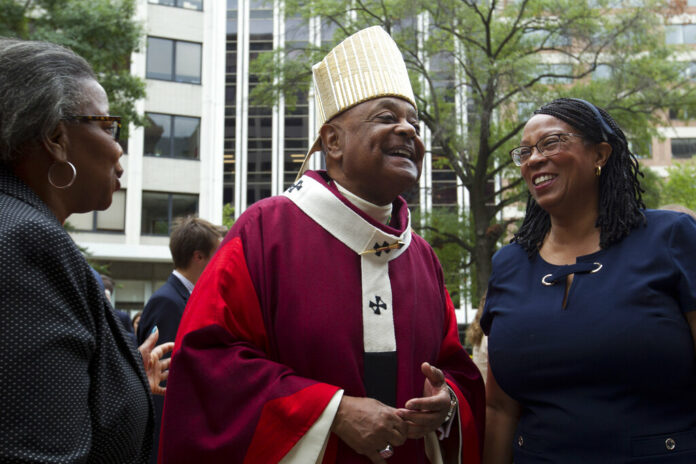
In this Sunday Oct. 6, 2019, file photo, Washington D.C. Archbishop Wilton Gregory greets churchgoers at St. Mathews Cathedral after the annual Red Mass in Washington. Pope Francis on Sunday, Oct. 25, 2020, named 13 new cardinals, including Washington D.C. Archbishop Wilton Gregory, who would become the first Black U.S. prelate to earn the coveted red hat. In a surprise announcement from his studio window to faithful standing below in St. Peter’s Square, Francis said the churchmen would be elevated to a cardinal’s rank in a ceremony on Nov. 28. Photo: Jose Luis Magana / AP

VATICAN CITY (AP) — Pope Francis on Sunday named 13 new cardinals, including Washington D.C. Archbishop Wilton Gregory, who would become the first Black U.S. prelate to earn the coveted red hat.

In a surprise announcement from his studio window to faithful standing below in St. Peter’s Square, Francis said the churchmen would be elevated to a cardinal’s rank in a ceremony on Nov. 28.

Francis asked for prayers so the new cardinals “may help me in my ministry as bishop of Rome for the good of all God’s faithful holy people.”

The selection of Gregory won praise from LGBTQ advocates in the United States, days after Pope Francis grabbed headlines for voicing support for civil unions for gay couples.

Other new cardinals include an Italian who is the long-time papal preacher at the Vatican, the Rev. Raniero Cantalamessa, who is a Franciscan friar; the Kigali, Rwanda, Archbishop Antoine Kambanda; the Capiz, Philippines, Archbishop Jose Feurte Advincula, and the Santiago, Chile, Archbishop Celestino Aos Braco.

Another Franciscan who was tapped is Friar Mauro Gambetti, in charge of the Sacred Convent in Assisi. The pope, when elected in 2013, chose St. Francis of Assisi as his namesake saint. Earlier this month, the pontiff journeyed to that hill town in Umbria to sign an encyclical, or important church teaching document, about brotherhood.

Gambetti was so surprised, at first he thought the pope was joking when he heard he was named, convent spokesperson the Rev. Enzo Fortunato said. Gambetti quickly pledged to “put himself at the service of humanity at a time so difficult to us all,” including offering compassion to the needy, Fortunato said in reference to the coronavirus pandemic.

In a reflection of the pope’s stress on helping those in need, Francis also named the former director of the Rome Catholic charity, Caritas, the Rev. Enrico Feroci, to be a cardinal.

The prestigious Washington archdiocese traditionally brings elevation to cardinal’s rank, so the appointment of Gregory, 73, last year by the pope had positioned him to be tapped for the honor.

Still, the timing of his rise to cardinal is noteworthy, coming in the thick of increased U.S. attention on racial injustice following the police killing of George Floyd, a Black man, in Minnesota this year. Gregory was publicly critical of U.S. President Donald Trump’s visit to the St. John Paul II National Shrine in Washington a day after civil rights demonstrators were forcibly cleared from a square to facilitate the president’s visit to an Episcopal church in the U.S. capital.

Gregory has had his pulse on factions in the U.S. Catholic Church, which has both strong conservative and liberal veins since he served three times as the head of the U.S. Conference of Bishops.

Conservative prelates in the United States have openly lambasted Francis for his more liberal stands, including his support for same-sex civil unions that came out in a new documentary this week.

Gregory said in a statement that becoming a cardinal would allow him to work more closely with the pontiff in caring for the Catholic Church.

While Gregory headed the Atlanta diocese earlier in his career, he wrote positively in a column about his conversations with Catholic parents of LGBTQ children. An advocate for LGBTQ Catholics, Francis DeBernardo, told The Associated Press that choosing Gregory for a cardinal’s post signals Francis wants “LGBTQ people to be part of the church, and he wants church people to respect them.”

DeBernardo linked the appointment to Francis’ recently reported comments supporting civil unions for same-sex couples.

He also praised the elevation to cardinal’s rank of a Vatican bishop who comes from Malta, a tiny, traditionally Catholic nation which has made significant progress in LGBTQ civil rights and protections in recent years.

DeBernardo was referring to Mario Grech, 63, who serves at the Vatican as secretary general of the Synod of Bishops office and who formerly headed the diocese on the Maltese island of Gozo.

“Since naming cardinals also affects who the next pontiff will be, the pope also shows that he is planning for the future of the church to continue in this affirming posture on issues of sexual orientation and gender identity,” the U.S.-based DeBernardo said in a written statement.

Not all of the pope’s picks might stir positive recollections.

In 2010, while preaching at a Good Friday service attended by the then-pope, Benedict XVI, Cantalamessa upset both Jewish and sex abuse survivors’ groups when he likened allegations that the pontiff had covered up sex abuse cases against clerics to the “more shameful aspects of anti-Semitism.” The Vatican quickly distanced Benedict from Cantalamessa’s remarks.

Nine of the new cardinals are younger than 80, and thus eligible to elect the next pontiff in a secret conclave. Some cardinals head powerful Vatican offices, and pontiffs frequently turn to cardinals for advice.

No details were immediately given by the Vatican about the formal ceremony to make the churchmen cardinals, especially in view of travel restrictions involving many countries during the COVID-19 pandemic.

As he has in other groups of cardinals he tapped in his papacy, Francis in this selection reflected the global nature of the Catholic Church and his flock of 1.2 billion Catholics.

Others receiving the honor include Monsignor Marcello Semeraro, an Italian serving as prefect of the Vatican office which runs the saint-making process; Bishop Cornelius Sim, a Brunei native who serves as apostolic vicar of Brunei; the Italian archbishop of Siena and nearby towns in Tuscany, Augusto Lojudice; the retired bishop of San Cristobal de las Casas, Mexico, Monsignor Felipe Arizmendi Esquivel; and an Italian former Vatican diplomat, Archbishop Silvano Tomasi.

Churchmen over 80 who are named cardinals are chosen to honor their life of service to the church. Those in this batch too old to vote in a conclave are Cantalamessa, Tomasi, Feroci and Arizmendi Esquivel.

___

Story: Frances D’Emilio. David Crary in New York and Elana Schor in Washington, D.C., contributed reporting.

Advertisement

‘Soi Dog’ Charity Founder Awarded British Chivalry Order

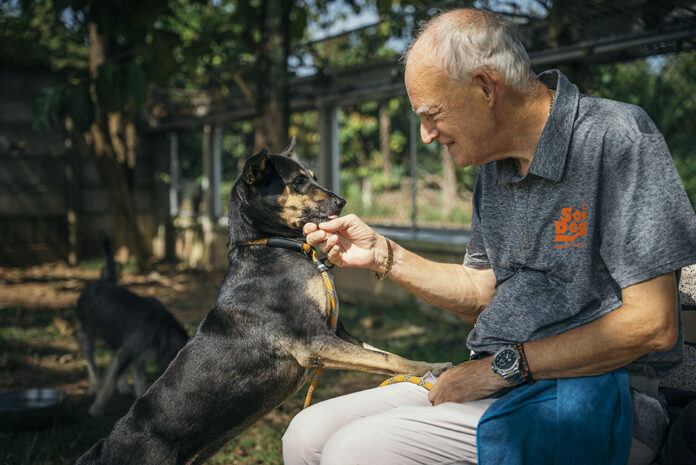
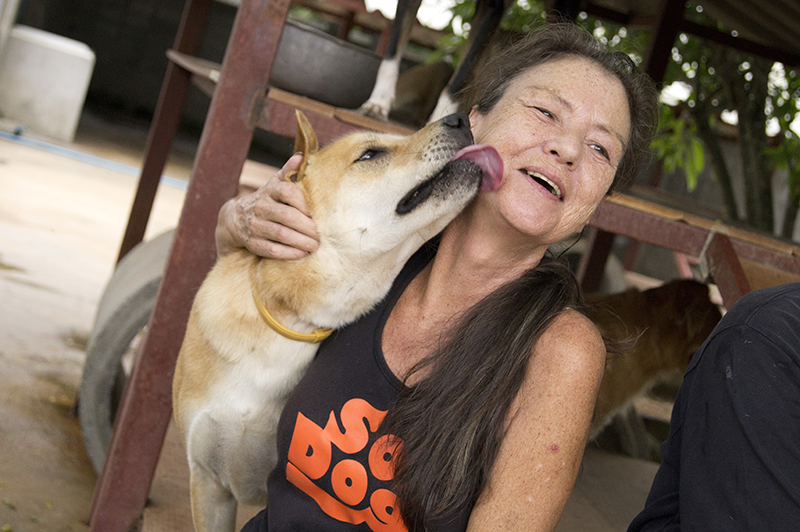
John Dalley in March 2020. Photo: Soi Dog / Courtesy

PHUKET — The founder of an organization responsible for rescuing stray animals and drafting Thailand’s first ever animal welfare law received a prestigious award from the British monarchy earlier this month, though the man himself played down his own role in a recent interview.

“This is the work of 17 years, with thousands of donors and volunteers,” Soi Dog foundation’s John Dalley said. “It’s nothing I could have done on my own.”

He added, “The mission will continue until long after I die, which is to see no more stray dogs and cats in Thailand.”

Dalley, 71, was made the Member of the Most Excellent Order of the British Empire, or MBE, on Oct. 10 for his campaigns on animal protection in Southeast Asia. The foundation he founded helps sterilize and reduce stray animal populations in Thailand, as well as drafting the animal welfare law that came into effect in 2014. 

His citation was named in Queen Elizabeth II’s Birthday Honours List, which also bestows out various honors and awards on other notable citizens of the Commonwealth. It is the third highest royal decoration handed out by the British monarch. 

Dalley, who hails from Leeds in the UK, started Soi Dog in 2003 after retiring on Phuket with his late wife, Gill, with the intention of golfing, scuba diving, and helping stray dogs they saw there while on vacation. 

johnGill November2014 2 copy
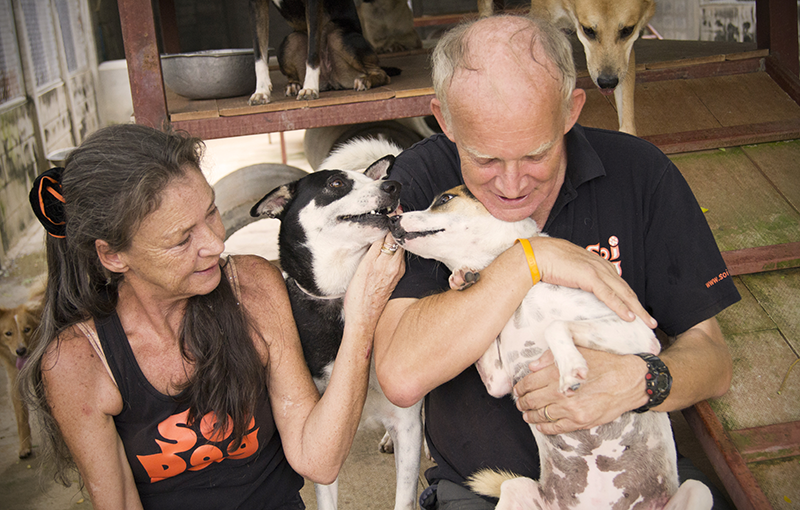
John and Gill Dalley in November 2014. Photo: Soi Dog

“There were thousands of starving dogs, and nobody was doing anything about it,” he said. 

The pair gave their all, risking – and losing – limb for their cause. In 2004, Gill lost both of her legs rescuing a dog in a flooded field, when a rare bacteria entered via her skin and almost killed her. 

“She turned from pink to blue. She nearly died, but we managed to save her arms,” Dalley recalled.

Just four days later, the pair who had flown to Bangkok for hospitalization were back on Phuket. The 2004 tsunami had just struck, and Soi Dog worked around the clock trying to save animals from the devastation. 

By Dec. 2019, Soi Dog had sterilized 500,000 dogs and cats, half of them in the last two years. Today, Soi Dog has eight mobile teams, six of them in Bangkok, and also work in Nakhon Si Thammarat and Chonburi.

Dalley drew up the country’s first animal welfare law on the drafting board in 2014, and he is one of the few foreigners to have ever addressed the Thai Parliament. 

Although Dalley proposed that the maximum penalty be used to punish animal cruelty – a punishment of two years in prison and a 40,000 baht fine is now in the books – enforcement of it is rare. 

“Nothing like that’s ever happened. This law isn’t taken seriously yet, especially on Phuket,” Dalley said. “It’s just wanton cruelty. People cruel to animals are also often cruel to humans and children.” 

John at World Rabies Day2019 2 copy
John Dalley at a World Rabies Day event in Thailand in 2019. Photo: Soi Dog

One of Dalley’s dogs, Cola, had both her legs hacked off by a man with a ceremonial sword because she had been nibbling on his boots. The man only got three months of probation, Dalley said.

Just recently on Phuket, an Australian man beat a dog with a metal bar and paid off the dog owner, who didn’t pursue the case. An Irishman threw a dog out of a car during a storm, and was slapped with a 3,000 baht fine.

In the most recent reported case, a Chinese woman was convicted by court in Krabi province for kidnapping stray cats for tortures – pulling out their nails and locking them in a refrigerator. The woman’s sentence of six months in jail was suspended. 

“This should not be the case. This should go to court; you shouldn’t be able to buy yourself out of it,” Dalley said. “If nobody pushed, nothing would happen in most cases.” 

Due to coronavirus travel restrictions, the organization currently has a dearth of volunteers since many were foreigners who walked dogs and flew dogs overseas to adopters. 

Soi Dog continues their work of capturing, neutering, vaccinating, and returning stray animals; the organization is stringently against putting dogs into government animal shelter facilities, which leave unneutered dogs to reproduce and die behind bars. 

To donate to Soi Dog, either contact them directly or donate via Charity Navigator

Gill November 2014 copy
Gill Dalley in November 2014. Photo: Soi Dog
Advertisement

Protesters Rally Outside Prison, Demand Release of Activists

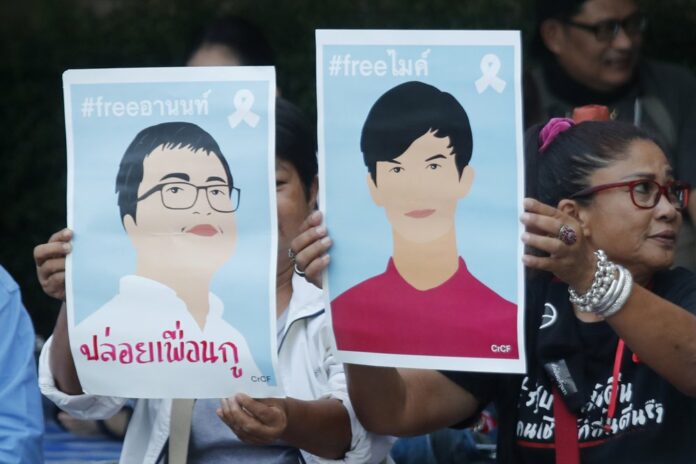
Pro-democracy activists display images of protest leaders that are kept in detention during a protest outside remand prison, in which some of the activists are kept, in Bangkok, Thailand, Friday, Oct. 23, 2020. (AP Photo/Sakchai Lalit)

BANGKOK (AP) — Pro-democracy protesters in Thailand resumed their activities Friday after a one-day break, turning their attention to fellow demonstrators who remain jailed after their arrest.

A crowd gathered outside Bangkok Remand Prison, with their numbers growing to as many as 2,000 after dark. The crowd greeted the release of one of the protest leaders, Jatupat Boonpattararaksa, but were demanding the freedom of seven others.

“We have all come here to wait for our seven friends to be freed,” Jatupat told the crowd after his release. “If they are not released, we will oust Prayuth Chan-ocha.”

In fact, ousting Prayuth is among the key goals of the protesters, who have intensified their efforts over the past 10 days with large demonstrations around the capital. Their other key demands are changing the constitution to be more democratic and reforming the monarchy.

1000 2 13
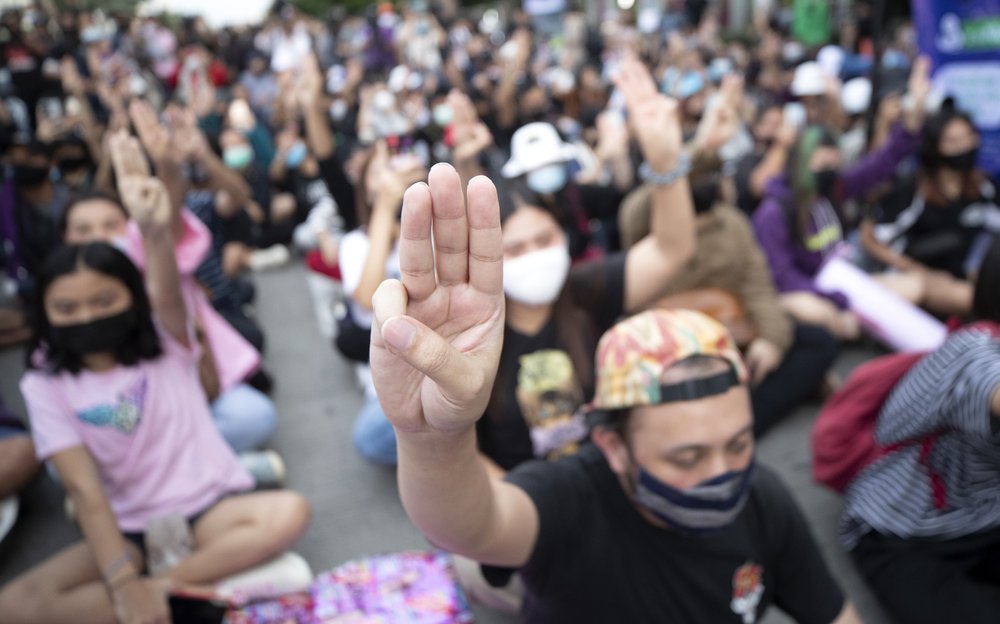
Pro-democracy activists flash three-fingered salutes outside remand prison, in which some of the activists are kept in Bangkok, Thailand, Friday, Oct. 23, 2020. (AP Photo/Sakchai Lalit)

The implicit criticism of the royal institution has irked conservative Thais because the monarchy traditionally has been treated as sacrosanct and a pillar of national identity.

The protest outside the prison was relatively low-key, but there are concerns that the weekend may bring a confrontation, as a deadline for Prayuth’s resignation set by the student-led protesters comes due.

Several protesters said they intended to stay outside the prison overnight.

The protests were launched several months ago by university students but increased in frequency and intensity last week. They carried on despite a state of emergency declared for Bangkok that made their gatherings illegal, and even after one rally was broken up by force by riot police backed by water cannons. They also spread to other areas of the country.

In a gesture to appease the protesters, Prayuth revoked the state of emergency on Thursday.

1000 4 13
Jatupat Boonpattararaksa, a pro-democracy leader, delivers a speech outside remand prison, in which some of the activists are kept, in Bangkok, Thailand, Friday, Oct. 23, 2020. (AP Photo/Sakchai Lalit)

He has urged the protesters to let Parliament deal with their grievances. Parliament will debate the political crisis on Oct. 26-28.

Despite the concession, protesters continue to insist Prayuth step down. They said they would return in large numbers if he did not meet their three-day deadline to resign, which would appear to end Saturday night.

The appeal for a solution in Parliament was unlikely to win over protesters, as some of their core complaints are that the constitution and the political structure it created are undemocratic, in part because it was written after a 2014 military coup. Prayuth himself led that coup, which toppled an elected government during political unrest that featured widespread street protests.

Complicating the situation are counter-protests held by royalists who declare they are defending the monarchy. Some have been held in several cities around the country this week, including one in Bangkok that led to clashes.

Advertisement

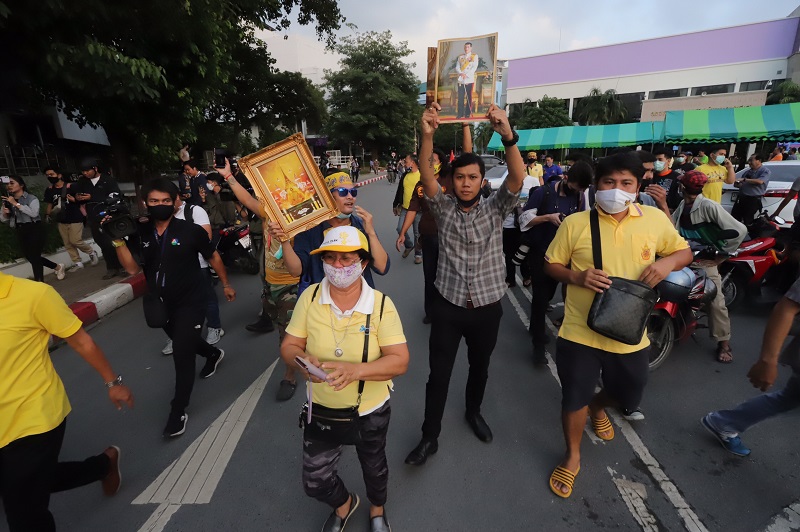
King Praises Man Who Confronted Student Protesters

His Majesty the King and Queen Suthida greet a crowd on Ratchadamnoen Avenue on Oct. 23, 2020.

BANGKOK — His Majesty the King on Friday night appears to have given praise and thanks to a man who confronted pro-democracy demonstrators last week, according to videos of the encounter.

Photos and videos posted by Facebook user Thitiwat Tanagaroon and his friends show King Vajiralongkorn and Queen Suthida recognizing him as the man who held up a portrait of the late King Rama IX while facing off with protesters, mostly students, on Wednesday.

Queen Suthida introduced the man to King Vajiralongkorn, who touched his shoulder and told him, “Very well done, very brave. I thank you.”

Their Majesties were meeting a crowd of well wishers close to Dusit Royal Palace on Friday night, where they were attending a ceremony marking Chulalongkorn Day.

It is extremely rare for the Thai monarchs to talk to a civilian directly; Facebook user Thitiwat said he was very grateful for the honor, and many of his friends wrote him messages of congratulations.

The man confronted the protesters demanding, among several other goals, monarchy reforms in front of Central Pinklao shopping mall on Monday. He was quickly taken away from the scene by police officers who feared violence.

The demonstrators also called for PM Prayut Chan-o-cha’s resignation and a more democratic constitution.

122229221 1280926198928448 6419350337353085114 n
Image: Thitiwat Tanagaroon / Facebook.
Advertisement

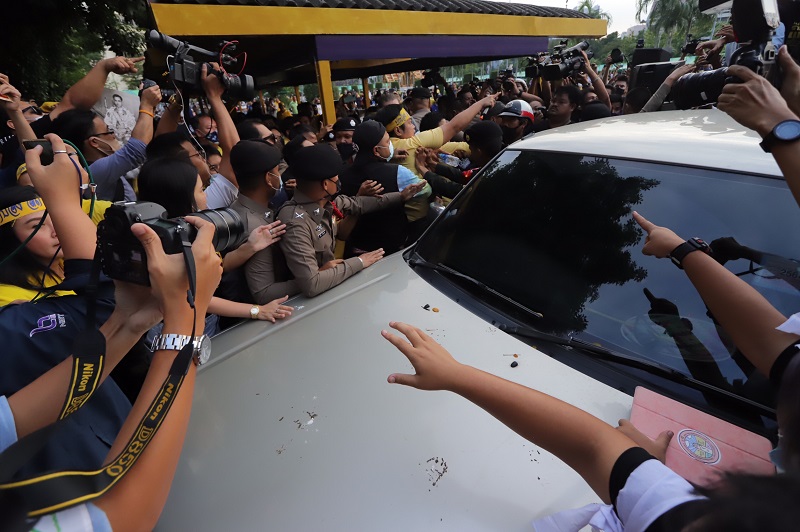
Complaint Filed Over Monarchy Clash That Injured 1

Police try to stop a scuffle between radical monarchy supporters and activists advocating for monarchy reforms on Oct. 21, 2020, at Ramkhamhaeng University in Bangkok.

BANGKOK — Three activists who campaigned for monarchy reforms said they were attacked by a group of hardline monarchy supporters at Ramkhamhaeng University on Thursday evening, which left one of them injured in the foot.

Police said the complaint was filed by one of the activists who reportedly suffered a sprained ankle following Thursday’s scuffle that, for many, shows the escalating tension between groups wanting reforms of the monarchy institution and opposing them.

Col. Lertsak Kiemsab, a superintendent at Hua Mak police station, told the media police are gathering evidence related to the alleged assault.

Both pro-reform activists and royalist hardliners were gathering at Ramkhamhaeng University on Wednesday afternoon, before the latter broke through the thin police lines separating the two sides and confronted the reformists, media reports and witnesses said.

S 2785348
Police try to stop a scuffle between radical monarchy supporters and activists advocating for monarchy reforms on Oct. 21, 2020, at Ramkhamhaeng University in Bangkok.

Shouting between the two factions ensued, and soon escalated into a brawl at about 5.10pm, according to videos of the incident. The understrength police force at the scene took some minutes before they could stop the scuffles. Many students were seen running away from the chaos.

Ramkhamhaeng University directors on Thursday told the media they allowed the pro- and anti-reform groups to use their campus because they didn’t realize the rallies would turn violent.

“We oppose use of violence and would like to rebuke the individuals who commit such acts,” the university said in a statement. “We will not infringe on the students’ rights to express their opinions. We call on all sides to commit to non-violent principles, and we urge all sides to respect and organize their political activities within the legal boundaries.”

The statement added, “We are ready to provide legal assistance and care to those injured in the incident.”

S 2785374
Hardline monarchy supporters hold up portraits of members of the Thai Royal Family on Oct. 21, 2020, at Ramkhamhaeng University in Bangkok.

Speaking to the media on Thursday, government spokeswoman Kannanat Patornsaubnukool said the public should also consider what transpired prior to the clash at Ramkhamhaeng University before making their judgement about who was right or wrong.

While she did say the pro-monarchy hardliners must answer to the law for “having the bigger share of fault” by assaulting others, Kannanat said the incident would not have happened if both sides refrained from provoking each other.

She also played a short video showing the pro- and anti-reform activists shouting at each other before the brawl took place.

Reforming the monarchy is one of the three demands put forth by the ongoing anti-government movement, apart from PM Prayut Chan-o-cha’s immediate resignation and a more democratic constitution.

S 2793556
Pro-democracy activists protest outside Hua Mak Police Station on Oct. 21, 2020, to accuse the police of inaction and failing to stop the brawls at Ramkhamhaeng University.

Their campaign is seen by many older conservatives as a direct challenge to the monarchy, an institution that all Thais are required to hold in reverence by the 2017 Constitution.

Although much of the pro-establishment faction did not interfere with the reformist protests in recent weeks, a handful of ultraroyalists often staged provocative counter-rallies close by and accused the activists of attempting to overthrow the monarchy – a charge they denied.

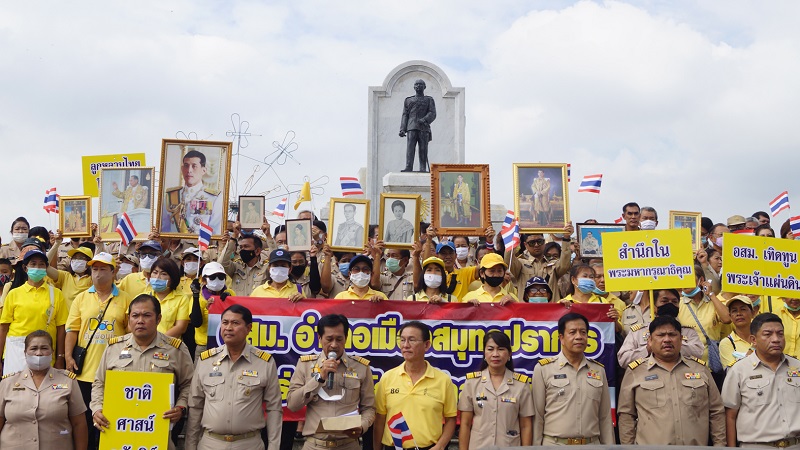
This week also saw thousands of people attending rallies held nationwide to “express loyalty to the monarchy.” These events were mostly organized by local government agencies.

DSC02290
Government officials attend a state-sanctioned rally to show support for the monarchy on Oct. 21, 2020, in Samut Prakan province.
Advertisement

Activist Arrested Hours After Prayut Urged Compromise

Pasarawalee “Mind” Thanakitwibulpol holds up the three-finger salute at the Pathumwan Circuit Court on Oct. 22, 2020.

BANGKOK — A march to Government House on Wednesday night ended with an arrest of a pro-democracy activist, just hours after PM Prayut Chan-o-cha said on a live address that everyone should “take a step back” from the brinks. 

Patsaravalee “Mind” Tanakitvibulpon, 25, was arrested at a cafe near Victory Monument while she was on the way from a protest close to PM’s office, fellow activists said. Police said there was an outstanding warrant for her arrest. Patsaravalee was released on Thursday morning. 

“This arrest does not make me afraid. This is an unlawful arrest,” Patsaravalee said as she was being taken away by police. “I know this is the government’s game.” 

The arrest was made by Police Lt. Col. Suriyasak Jirawat, who said Patsaravalee was wanted with 11 other suspects for leading a protest on Oct. 15 at the Ratchaprasong Intersection. She was charged with violating the emergency decree. 

When reached for comment on Thursday, Lt. Col. Suriyasak said he does not know if the 11 others have been arrested yet. 

Patsaravalee was released without having to post for bail, since the Pathumwan Circuit Court said she was a student studying for her finals and therefore is not considered a flight risk. 

Prior to her arrest, Patsaravalee was one of the activists who marched to Government House from the Victory Monument in a bid to demand PM Prayut’s resignation. The crowd dispersed without incidents after submitting an ultimatum that called upon Gen. Prayut to resign within three days, or face another round of protests. 

In a speech broadcast live on TV Thursday night, Prayut said the government is willing to make a compromise, but added that the protests should stop and let the Parliament debate their grievances.

“The only way to a lasting solution for all sides that is fair for those on the streets as well as for the many millions who choose not to go on the streets is to discuss and resolve these differences through the parliamentary process,” he said. 

But Pannika Wanich, a co-leader of the opposition group called Progresive Movement, said an arrest of a student activist just after Prayut’s speech showed the government was being insincere.  

“I thought you said we should take a step back and discuss in the Parliament instead. The PM’s words are just empty mouth air,” Panniwa tweeted. “You are stepping into and infringing on citizens’ rights.”

Advertisement

Officials Aim To Reduce Tourist Quarantine To 10 Days

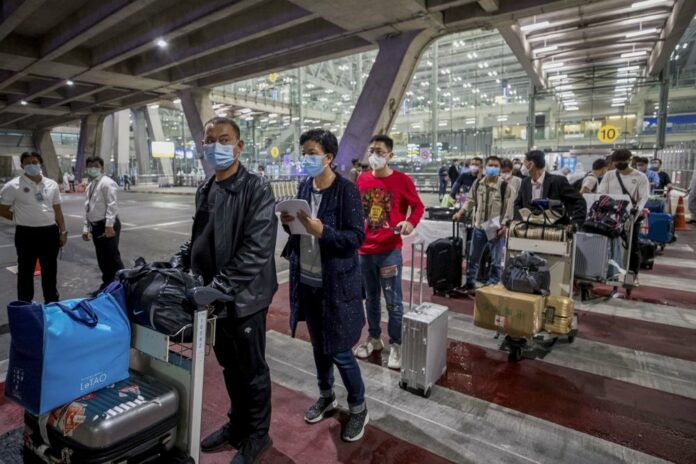
Chinese tourists from Shanghai arrive at Suvarnabhumi airport on special tourist visas, in Bangkok, Thailand, Tuesday, Oct. 20, 2020. (AP Photo/Wason Wanichakorn)

BANGKOK (Xinhua) — Thailand’s Ministry of Public Health on Wednesday said in its daily press conference that it aims to reduce quarantine for tourists from 14 days to 10 days.

The announcement came after the first batch of tourists arrived from China on Tuesday.

The arrival of the Chinese tourists was Thailand’s first foreign tourists since the closure of the border in March amid COVID-19.

The batch of tourists from Shanghai were tested for COVID-19 before arriving in Bangkok and would undergo the 14-day quarantine under current rules, said Public Health Minister Anutin Charnvirakul.

“The ministry’s Department of Disease Control proposed reducing quarantine to 10 days to begin with,” Anutin said.

“I have said that if we are confident, we do not have to be afraid since the goal is finding the safest period for quarantine. If we find a good method, it may be reduced to five, four, three days or even none.”

However, Anutin said that to prevent a second wave of COVID-19 infections, Thailand only wants to invite healthy tourists.

“We cannot let our guard down. We still need to be selective in the choice of tourists. We cannot lift out borders right away and let all tourists in,” said Anutin.

The minister said that quarantine was still effective and had achieved great results over the last five to six months, adding that Thailand still needs to focus on halting the disease at its borders, especially in the northern Tak province bordering Myanmar.

Myanmar is in the midst of a second wave of infections, prompting Thailand to seal its borders with the neighboring country.

Advertisement

Hot News

LATEST NEWS

Bangkok
overcast clouds
28.3 ° C
31.6 °
28.3 °
77 %
4.2kmh
100 %
Wed
28 °
Thu
37 °
Fri
37 °
Sat
29 °
Sun
30 °