29.4 C
Bangkok
Tuesday, July 7, 2026
Home Blog Page 14

Xi says China ready to establish security partnership with Cambodia

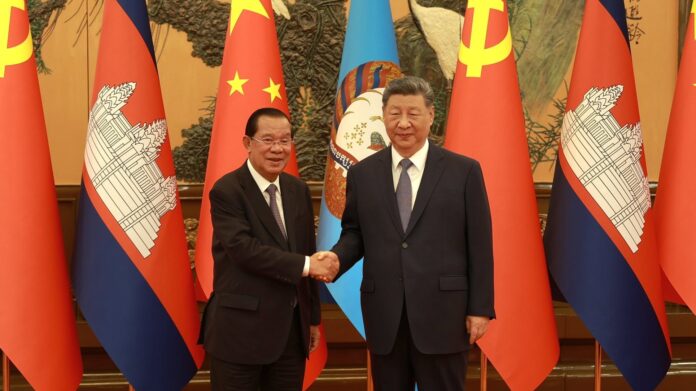
BEIJING, June 26 (Xinhua) — Chinese President Xi Jinping on Friday said China is willing to establish a security partnership with Cambodia, and work with Cambodia to make sustained efforts to root out the chronic problem of telecom fraud.

Xi made the remarks when meeting with Cambodian People’s Party (CPP) President and Senate President Samdech Techo Hun Sen in Beijing, adding China highly commends Cambodia’s determination and actions to crack down on telecom and online fraud.

Advertisement

More than 13 Bryde’s whales spotted off Bang Saen coast

More than 13 Bryde's whales spotted off Bang Saen coast

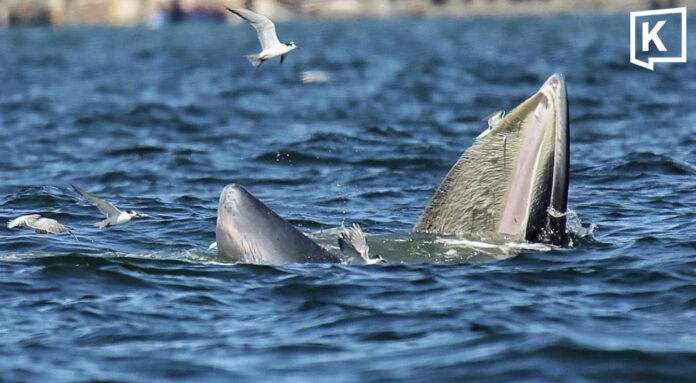
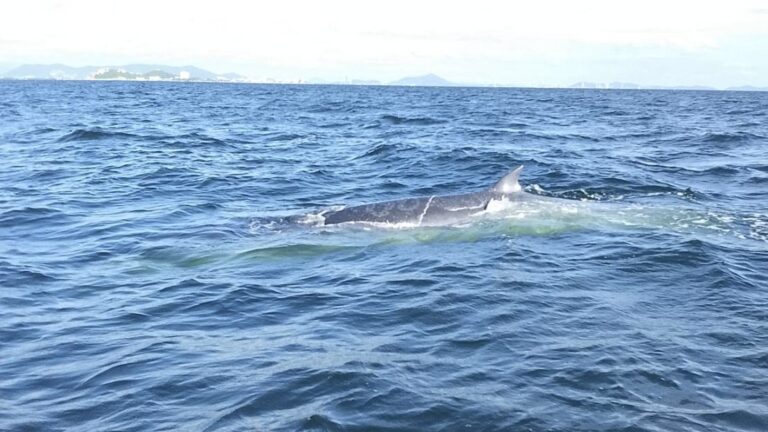
CHONBURI — 26 June 2026, More than 13 Bryde’s whales have been spotted off the coast of Bang Saen in Chon Buri province, highlighting the area’s rich marine ecosystem and drawing interest from tourists hoping to see the animals in their natural habitat.

The sightings gained attention after Facebook user Eaksak Soemsri shared drone footage showing several Bryde’s whales feeding and swimming together off Khao Sam Muk and Bang Saen Beach. The video was filmed by Prapya Chu using a drone launched from the tour boat Ploypailin Navy 2.

Speaking to reporters at 14:00 on 26 June 2026 at Laem Thaen in Saensuk subdistrict, Eaksak Soemsri, 50, a marine rescue volunteer known as “Captain Kao” and owner of Ploypailin Navy 2, said he regularly takes visitors on whale-watching trips around Khao Sam Muk.

news142863 N2bdY2YKKR1782459704

He said surveys this year have identified 13 Bryde’s whales, more than were recorded last year.

According to Eaksak, the Department of Marine and Coastal Resources has issued whale-watching guidelines requiring boats to remain at least 100 metres from the whales and switch off their engines to prevent injuries from propellers.

He added that all operators taking tourists to see the whales have completed the required training.

news142863 U97FgsG08D1782459704

The largest whale spotted this year is estimated to be about the size of a minibus and weigh nearly two tonnes, making it larger than many of the boats observing it.

Eaksak invited tourists to visit Bang Saen during the current season, noting that visitors can enjoy both the Bangsaen Grand Prix motorsport event and whale-watching trips later in the day.

Tourists interested in joining a whale-watching excursion can contact trained operators from the White Shark Marine Rescue team.

Advertisement

Thailand’s Supreme Patriarch marks 99th birthday

His Holiness Somdet Phra Ariyavongsagatanana

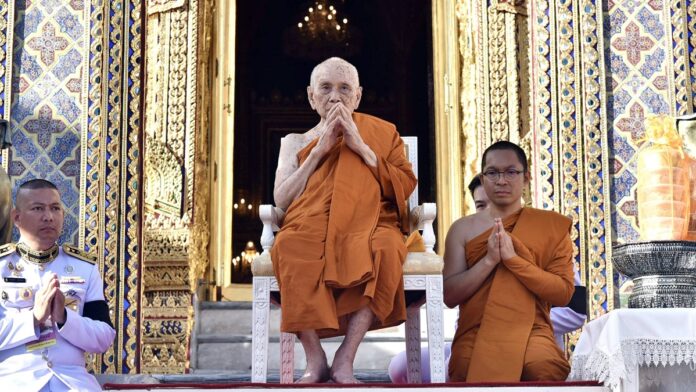
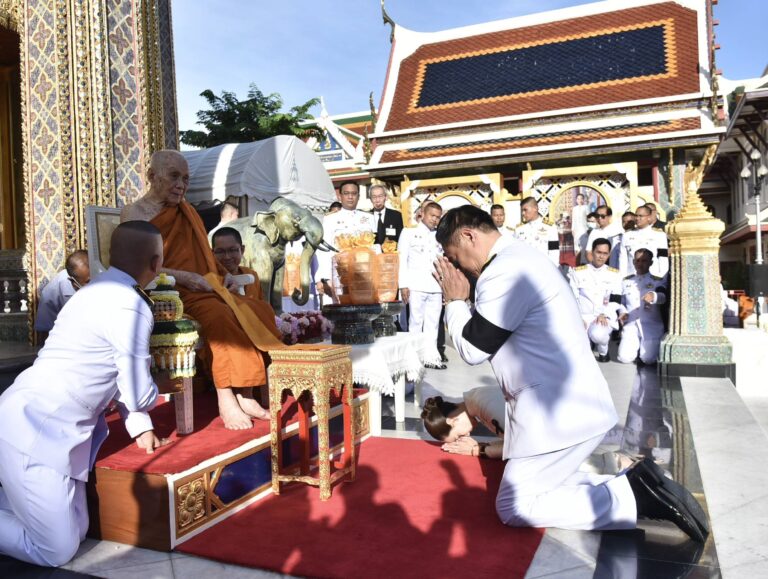
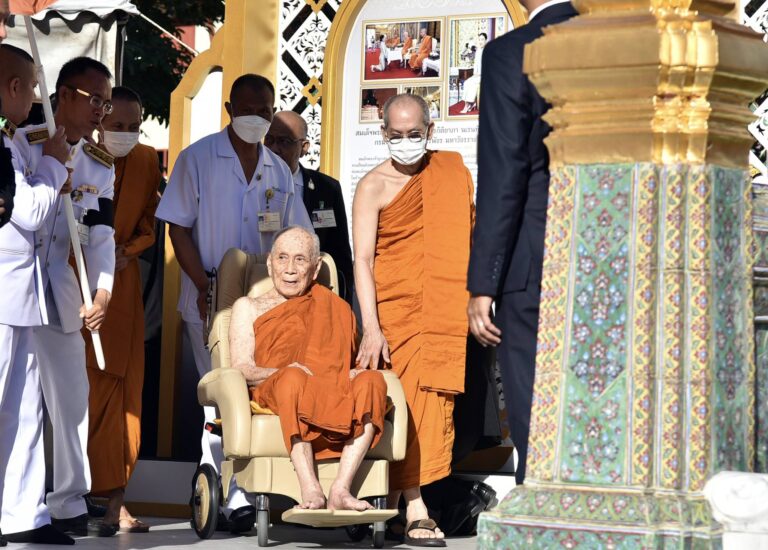
BANGKOK — Thailand’s Supreme Patriarch, His Holiness Somdet Phra Ariyavongsagatanana, celebrated his 99th birthday on Friday, with the government holding a merit-making ceremony in his honour at Wat Ratchabophit Sathit Maha Simaram.

Prime Minister Anutin Charnvirakul presided over the Buddhist chanting and alms-giving ceremony dedicated to the Supreme Patriarch’s birthday. The event was attended by Cabinet ministers, heads of independent agencies, military and police commanders, senior government officials and representatives of state organisations.

20260626085617 8750

Upon arriving at the temple, Anutin paid respects to the Supreme Patriarch inside the ordination hall.

His Holiness Somdet Phra Ariyavongsagatanana (Amborn Ambaro) was born in Ratchaburi province on 26 June 1927. He was ordained as a novice monk in 1940 in his home province before entering the monkhood on 9 May 1948 at Wat Ratchabophit Sathit Maha Simaram in Bangkok.

His Majesty the King formally appointed him as the 20th Supreme Patriarch of Thailand on 6 February 2017. The royal installation ceremony took place at the Temple of the Emerald Buddha in the Grand Palace on 12 February 2017.

20260626085617 4554

The Supreme Patriarch is the highest-ranking member of Thailand’s Buddhist Sangha, serving as the spiritual leader of the nation’s monks and as a symbol of unity and stability for Buddhism in Thailand.

Advertisement

Miss Thailand runner-up accuses pageant sponsor of sexual assault

Miss Thailand runner-up accuses pageant sponsor of sexual assault

RAYONG — 26 June 2026, A 27-year-old second runner-up of Miss Thailand Phuket 2026 has filed a police complaint, accusing a prominent durian farm owner and pageant sponsor of sexually assaulting her and attempting to rape her at a hotel in Rayong.

The woman reported the incident to Nikhom Phatthana Police Station on 26 June 2026. The suspect, identified only as “Mike” (pseudonym), is a man in his 50s who owns a well-known durian farm in Nikhom Phatthana district and was a major sponsor of the beauty pageant.

The alleged assault took place on the evening of 25 June 2026.

According to the complainant, she had travelled to Rayong to thank sponsors who had supported her in various pageants. She said she met with Mike, whom she had trusted and respected as a senior figure. As she was scheduled to film a tourism commercial in Ban Chang district the following day before travelling to Nakhon Ratchasima for another pageant, he offered to book a hotel room for her in Nikhom Phatthana district.

The woman alleged that while she was taking a shower, Mike entered the bathroom naked and attempted to force himself on her.

She said she managed to defend herself using Muay Thai techniques, striking him with a knee to the groin and punching him in the face before he fled the room.

The complainant also said she sought help from hotel staff after the incident but was disappointed by the response. Instead of receiving assistance, she claimed police were called and she was briefly treated as if she were intoxicated and causing a disturbance, despite having sustained injuries while defending herself.

Hotel staff later met investigators to explain the hotel’s handling of the incident. They said employees initially believed the pair were husband and wife. After the woman requested emergency medical assistance, staff became aware that something was wrong and followed the appropriate procedures. The hotel said it prioritises the safety of all guests.

Police are reviewing CCTV footage and questioning witnesses as part of their investigation. No charges have been announced, and the allegations have not been tested in court.

Advertisement

Japan hit by second quake in two days, no tsunami warning

Japan hit by second quake in two days, no tsunami warning

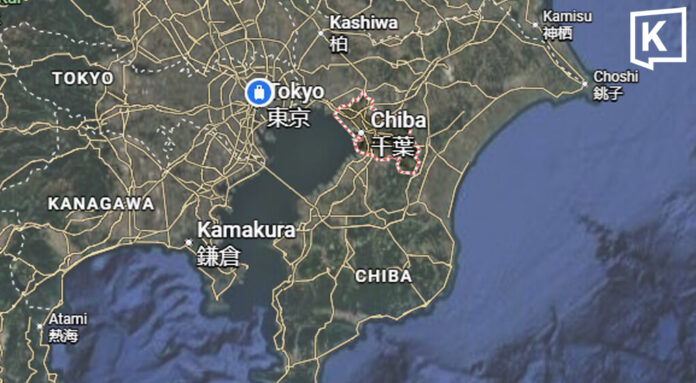
CHIBA, Japan — 26 June 2026, A magnitude 5.8 earthquake struck off the northern coast of Chiba Prefecture on Thursday, marking the second significant earthquake to hit Japan in two days, according to the Japan Meteorological Agency (JMA).

The quake occurred at 12:47 local time on 26 June 2026, with its epicentre located off northern Chiba at a depth of 50 kilometres.

Tremors were felt in several prefectures, including Saitama, Chiba, Kanagawa, Ibaraki, Gunma, and Niigata.

The JMA said no tsunami warning had been issued, and there were no immediate reports of damage.

The latest quake followed a magnitude 6.9 earthquake that struck off the coast of Iwate Prefecture in northern Japan at around 07:30 on 25 June 2026.

The earlier earthquake was widely felt across northern Japan, particularly along the Pacific coast of Aomori Prefecture. Authorities said it could cause slight fluctuations in sea levels but was not expected to trigger significant damage.

Residents were urged to monitor official updates and remain alert for possible aftershocks.

Operators of the Higashidori Nuclear Power Plant in Aomori Prefecture and the Onagawa Nuclear Power Plant in Miyagi Prefecture said inspections following Wednesday’s earthquake found no abnormalities, while radiation levels around both facilities remained normal.

Advertisement

Aerobics in cemetery becomes talk of Phayao district

Aerobics in cemetery becomes talk of Phayao district

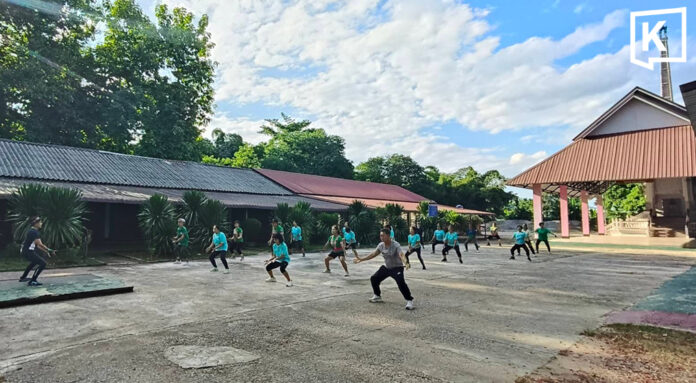
PHAYAO — A group of villagers in Phayao has become a local sensation after holding daily aerobics sessions inside a cemetery, with participants saying they are not afraid of supernatural beliefs and immediately stop the activity whenever a funeral takes place.

Reporters visiting the Ban Mang cemetery found more than 20 villagers aged between 45 and 60 enthusiastically taking part in aerobics dance sessions accompanied by music, creating a scene far removed from the usual image associated with a graveyard. The unusual exercise venue has become a talking point in Chiang Kham district.

Apiradee Pansombat, president of the Jun Police Station Housewives Association and a Ban Mang resident, said many people often ask whether participants are frightened by exercising in a cemetery. She said members view the area as a public space that can be used to promote health, provided it is done with respect for the deceased.

The aerobics activity is part of a health promotion project supported by Chiang Kham Municipality. Participants receive health education, exercise guidance, and regular health monitoring, including blood pressure checks, weight measurements, and waist circumference assessments at the beginning of each month. The program is free of charge for all participants.

In addition to exercising, members help maintain and improve the cemetery grounds by planting trees and flowers, watering plants, sweeping leaves, and preparing the sound system before each session. Their efforts have made the area cleaner, greener, and more pleasant to use.

Apiradee said the group immediately suspends activities on any day when a cremation ceremony is held in order to show respect for the deceased. Before and after each exercise session, participants also pay respects and ask forgiveness from the spirits of the place according to local beliefs.

“Even though the crematorium is right behind us, we come here to take care of our health and to care for this place with respect,” she said. “When we behave properly and honor the place, there is nothing to be afraid of. Everyone is simply happy to exercise together.”

Advertisement

At least 164 dead and 971 injured after powerful quakes rock Venezuela, acting president says

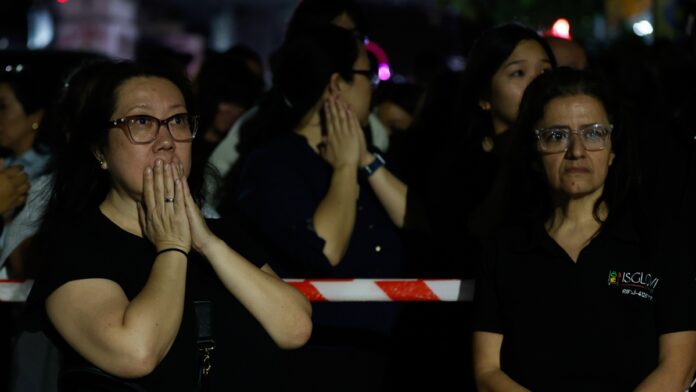
Women look at a collapsed building after an earthquake in Caracas, Venezuela, Wednesday, June 24, 2026. (AP Photo/Pedro Mattey)

CARACAS, Venezuela (AP) — At least 164 people have died and 971 were injured after a pair of powerful quakes rocked Venezuela, Acting President Delcy Rodríguez said Thursday, adding that rescue teams are rushing to the hardest-hit areas to free people trapped under rubble.

Wednesday evening’s 7.2 and 7.5 magnitude earthquakes were among the strongest to strike Venezuela in more than a century and could be felt throughout the region. The country’s main airport was damaged and closed, while buildings were evacuated in places as far away as Brazil’s Amazon, about 1,700 kilometers (1,050 miles) from Venezuela’s capital, Caracas.

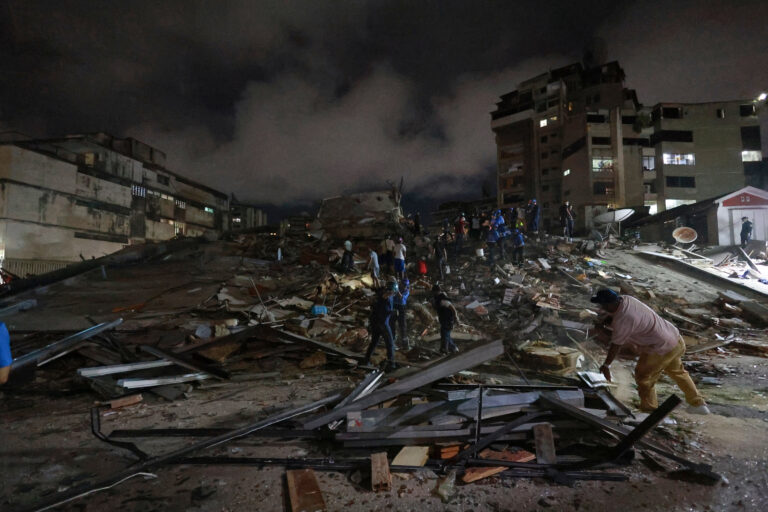
Television broadcasts Thursday showed rescue workers using power tools to work their way into piles of rubble where buildings once stood. Panicked residents of the capital were sent pouring into the streets, and after the quakes many people walked among the debris searching for the missing among collapsed buildings and toppled electric poles.

AP26176075962801
Rescue workers search through the rubble after an earthquake in Caracas, Venezuela, Wednesday, June 24, 2026. (AP Photo/Javier Campos)

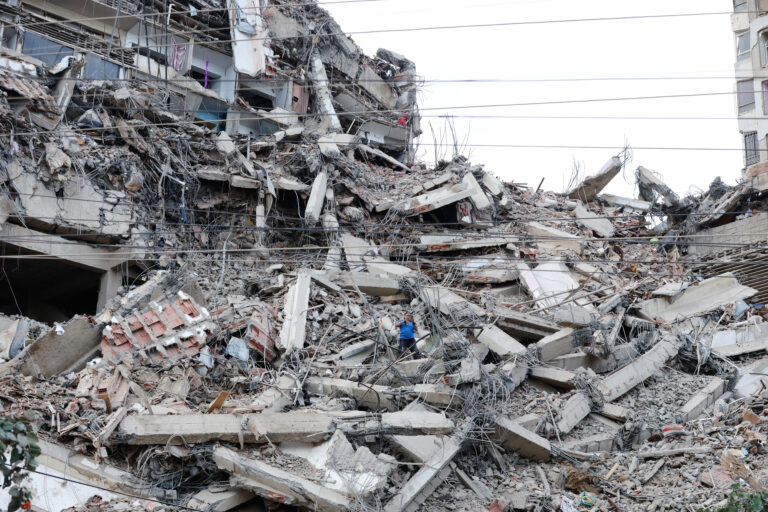
Footage on state TV showed three children, covered in dust but alive, pulled from the rubble in La Guaira state, which Rodríguez described as a “disaster zone” and one of the areas hardest hit by the quakes because of the large number of collapsed buildings.

Rodríguez said authorities were shifting rescue teams from other parts of the country to La Guaira, which sits north of Caracas on the coast. Officials were trying to make the most of the daylight hours to speed up efforts to rescue people believed to remain trapped under the rubble, she said.

“Dozens of buildings have collapsed there … and we are currently carrying out intensive rescue operations to save lives,” Rodríguez said.

Video shared online appeared to show dozens of people, some lying on the ground and others on hospital beds, being treated outside a hospital in La Guaira.

While Venezuela sits near multiple fault lines, its position straddling the South American and Caribbean plates makes strong earthquakes much less common than in other parts of Latin America.

Rodríguez appealed to businesses to make heavy construction equipment available for rescue operations, adding that search and rescue teams certified by the United Nations were on their way to Venezuela.

Residents fled their homes in panic

During the quakes, people ran from swaying buildings in Caracas, many visibly shocked when they turned back to see destroyed walls that left furniture visible from the street. Columns of dust rose in two typically busy neighborhoods in the capital.

“It started off gently and then gradually grew, and in the end, we all had to leave our houses, go outside and gather together,” Caracas resident Hector Ricci said.

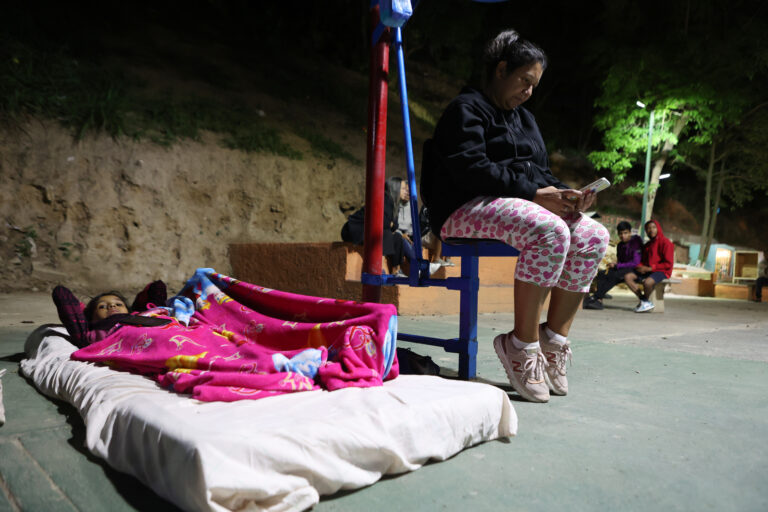
Interior Minister Diosdado Cabello urged people to remain outside as aftershocks could further damage structures, and many people stayed on the streets for hours, some sitting on the ground hugging pets as dust gathered around them. Others spent the night in parked cars, subway stations and other public places.

Parts of the capital lost power and cellphone coverage, and the earthquakes damaged and closed Simón Bolívar International Airport, the country’s main airport, Rodríguez said.

In Caracas, subway services were suspended and natural gas shut off, she said. Classes will also be canceled for several days, and the Ministry of Education said some school buildings would be used as shelters and donation centers.

Roberto Gamas, another Caracas resident, said the building he was in “shook from side to side. Unreal. The force was incredibly strong.”

AP26176435062690
A man walks among the rubble of a building that collapsed in an earthquake in La Guaira, Venezuela, Thursday, June 25, 2026. (AP Photo/Pedro Mattey)

The lack of cellphone signal in parts of Venezuela deepened the distress of many families, particularly those among the more than 7.7 million people who have left the country during its protracted crisis and who struggled to reach relatives inside the country.

On Thursday, scores of people took to social media asking for help finding loved ones, posting pictures of missing relatives and their last known location.

Venezuela opposition leader María Corina Machado, herself in exile, sent wishes on X for “strength, serenity, and solidarity.”

Venezuela was hit twice by large quakes

The U.S. Geological Survey said the first earthquake, with a magnitude of 7.2, hit west of Moron on the Caribbean coast, about 170 kilometers (105 miles) west of Caracas. It had a depth of 22 kilometers (about 14 miles).

The USGS reported a 7.5 magnitude earthquake just a minute later, with a depth of 10 kilometers (about 6 miles) and an epicenter 16 kilometers (10 miles) southwest of Moron.

Several governments offered assistance

Rodríguez declared a state of emergency in an address to the nation late Wednesday. She said the government was creating a $200 million reconstruction fund for hospitals and homes damaged by the earthquakes, and had instructed the economy and finance ministers to oversee the effort.

Offers of help poured in from countries around the world.

U.S. Secretary of State Marco Rubio said the United States is “immediately deploying search and rescue teams, medical resources, and humanitarian assistance to Venezuela.”

“We will have a whole of government response,” Rubio said Thursday in Bahrain. “It will be big. It will be fast. It will be effective.”

He added that one of the runways at Caracas’ international airport was cracked in the earthquake, making landing aircraft there difficult.

Rodríguez — who became acting president after an American military operation captured her predecessor, Nicolás Maduro, and brought him to the U.S. to stand trial — thanked U.S. President Donald Trump. She said in an X post later that she spoke with Rubio by phone without sharing details. She also expressed thanks to the leaders of various nations who have sent messages of support and offers of help.

AP26176241002995
People camp on a sports court following an earthquake in Caracas, Venezuela, Thursday, June 25, 2026 (AP Photo/Pedro Mattey)

Ecuador ordered the delivery of humanitarian aid, and Rodríguez said Qatar, Mexico and El Salvador had already sent rescue personnel.

“We send you all our solidarity and our prayers. Stay strong, Venezuela,” El Salvador President Nayib Bukele, once diametrically opposed to Venezuela’s government, wrote in a post on X.

Quakes were felt in the wider region

Buildings in Manaus, Belem and Macapa in Brazil’s Amazon were evacuated, according to reports on TV Globo. The quakes also were felt in Colombia’s Caribbean and northeast regions.

The U.S. Pacific Tsunami Warning Center issued several tsunami alerts that were quickly lifted.

While uncommon in Venezuela, earthquakes are frequent along the Pacific coast, including in Mexico and Chile, which both sit along the seismically active tectonic belt known as the Ring of Fire, an area that the USGS says is responsible for 90% of earthquakes.

Advertisement

How Far Should Thailand Go to Accommodate China?

The Chinese Ambassador to Thailand is apparently not happy about Thais using the term “grey Chinese” to refer to Chinese nationals who engage in criminal activities in Thailand and has made it known. Ambassador Zhang Jianwei feels the term made Thais appear “unfriendly” to Chinese visitors.

​His message was not directly delivered to the Thai public earlier this week, not even through Thai Foreign Minister Sihasak Phuangketkeow, but through Thai Tourism Minister Surasak Phancharoenworakul, as if to hint that non-compliance could see the loss of Chinese tourists coming to Thailand. China did that to Japan not long ago, and it may try to use tourism as leverage here if Thais do not comply.

​Ambassador Zhang’s additional argument was that the term unfairly stereotypes Chinese people. What’s more, Tourism Minister Surasak added that the Chinese envoy said those who break the law should be referred to as offenders instead. Ambassador Zhang reportedly also acknowledged that some Chinese nationals have committed crimes, but said many more contribute positively to Thailand’s economy and tourism industry.

​So what happens next?

​Should the entire country comply with the Chinese ambassador’s request?

​At the very least, the government will likely avoid using the term out of deference to China’s power and feelings. This is despite the fact that PM Anutin Charnvirakul, who personally drove his car to take visiting Chinese Foreign Minister Wang Yi to lunch, did not seem to have any problem with the term in the past while discussing the issue of “grey Chinese” with the local press.

​But what shall we use instead?

“Chinese fraudsters”? “Chinese criminal gangs”? “Groups or networks of Chinese nationals engaged in illegal or law-evading activities”? Or should we merely call them foreign criminals, or mafia from a certain East Asian nation?

And if journalists ask PM Anutin about “grey Chinese” in the future, will he or other Thai officials simply pretend not to understand the term?

​What the Chinese ambassador should understand is that “grey Chinese” is neither a slur nor a blanket label for all Chinese people. It refers specifically to Chinese nationals involved in criminal activities—whether transnational or not—including scammers, those who kidnap fellow Chinese nationals in Thailand for ransom, mafia, people running illegal businesses in Thailand, money laundering, and so on.

There are quite a lot of such cases being reported, and they make headlines almost every week. This is unlike cases involving any other nationality in Thailand. Perhaps this is due to China’s enormous population.

​The term clearly does not refer to all Chinese nationals, and “grey” is not a colour associated with any form of ethnic insult. Rather, it reflects the fact that these individuals operate in Thailand’s legal grey zones—spaces that are ambiguous or murky under Thai law.

​No one would think that Ambassador Zhang and his Chinese embassy officials, Chinese executives at BYD, Chinese celebrities such as Fan Bingbing or Jackie Chan are “grey Chinese”. When people use the term, none of these individuals come to mind—and ordinary Chinese tourists certainly do not, either. This is something the Chinese ambassador ought to understand.

​There is also the issue of freedom of expression. Thailand already has problems in this regard because of the draconian and anachronistic lese majeste law. Some things cannot be said in Thailand without risking imprisonment. Is the Chinese ambassador now asking Thai people to stop using the term “grey Chinese,” adding it to the list of self-censored words in Thailand as well?

China itself has topics that cannot be openly discussed in a critical or negative light, and the list is longer than in Thailand. They include comparisons of Xi Jinping to Winnie the Pooh, Tibet, the Uyghurs, the Tiananmen Square massacre and the Hong Kong democracy movement. In 2023, Thai public broadcaster Thai PBS deleted an interview with Taiwan’s foreign minister after a protest from China. Last year, an exhibition at the Bangkok Art and Culture Centre about Myanmar military dictator Min Aung Hlaing’s collusion with other nations, including China, was partially censored by the Chinese Embassy in Bangkok without going through the Thai Foreign Ministry.

And it is no longer just about what cannot be said inside China. Earlier this week, China’s Vice Justice Minister Hu Weilie defended a provision in China’s new ethnic unity law, which takes effect on 1 July, saying China has the right to hold individuals and groups outside its borders legally accountable if they are deemed to undermine “ethnic unity and progress” or incite ethnic separatism.

Hu insisted the provision is legitimate and would not affect normal exchanges, including academic discussion, trade and people-to-people contacts. But who gets to decide what is normal and what is not? If the Chinese state itself defines what constitutes separatism, undermining ethnic unity, or unacceptable discussion of ethnic affairs, should journalists, academics, activists, publishers, editors or artists outside China feel safe commenting on these issues, or even visiting China?

Perhaps they will not, and perhaps that is the point. The law may not need to be enforced often to have an effect. It may be enough to make people outside China think twice, soften their words, avoid certain topics, or bend quietly to China’s national will before Beijing even has to ask.

This is why Ambassador Zhang’s request should not be viewed in isolation. The Thai government has no authority to make the term “grey Chinese” illegal or punishable by law simply because it is spoken. Any Thai person who agrees with the Chinese ambassador is free to refrain from using it. However, the ambassador should be careful about making such requests, because many Thais are already jittery and concerned about China’s growing influence in Thailand. They fear that something much bigger than “grey Chinese” is the “Red Chinese government” itself.

If we allow the situation to continue as it is, one day we may have a dictionary listing terms that should not, or cannot, be used in Thailand when discussing China.

Compared with the Chinese Embassy in Manila, which is very combative, the Chinese Embassy in Thailand is still very polite.

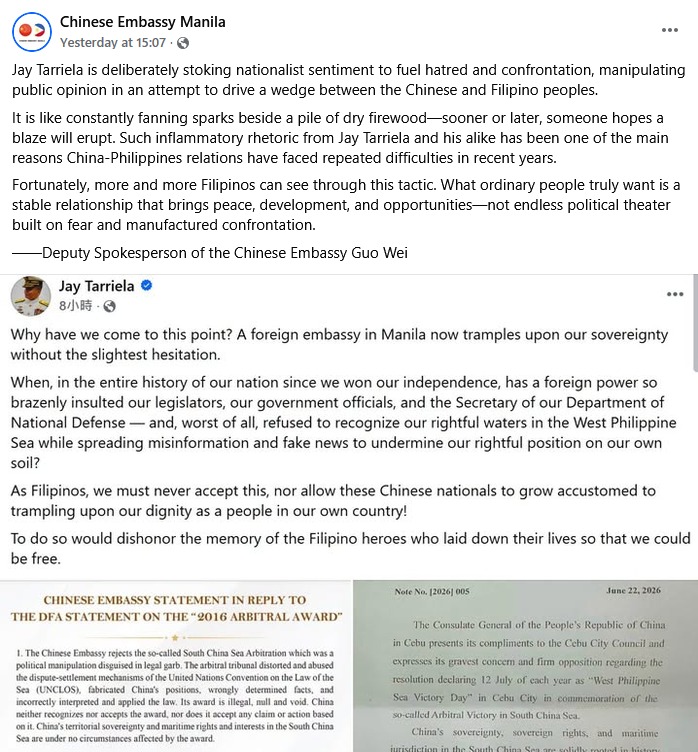
For example, on Wednesday, the Chinese Embassy in Manila published the following post. Given its undiplomatic style, one might have thought it had been written and posted by a troll. The embassy singled out one person: Jay Tarriela, spokesperson of the Philippine Coast Guard for the West Philippine Sea, who had accused the Chinese Embassy in Manila of trampling on the sovereignty of the Philippines through words.

“Jay Tarriela is deliberately stoking nationalist sentiment to fuel hatred and confrontation, manipulating public opinion in an attempt to drive a wedge between the Chinese and Filipino peoples,” Guo Wei, deputy spokesperson of the Chinese Embassy in Manila, wrote on Wednesday.
47538e69 6b24 4412 9700 b6a0aa718f13

​“It is like constantly fanning sparks beside a pile of dry firewood—sooner or later, someone hopes a blaze will erupt. Such inflammatory rhetoric from Jay Tarriela and his alike [sic] has been one of the main reasons China-Philippines relations have faced repeated difficulties in recent years.

​“Fortunately, more and more Filipinos can see through this tactic. What ordinary people truly want is a stable relationship that brings peace, development, and opportunities—not endless political theatre built on fear and manufactured confrontation.”

Whether some Thais or Filipinos like it or not, China’s influence will most likely keep rising in the foreseeable future. The balance of power between Thailand and China will become increasingly imbalanced as China gains more influence. How to manage China’s rise will be a key challenge facing Thailand and many other countries in ASEAN.

One could read this latest “request” as an undeclared attempt to see how far China can go, and how much it can get away with, without Thai resistance, to see how far Thai society will yield to such a request and bend over backwards to suit China’s preferences.

The majority of the Thai press, much of it under the spell of China’s growing soft power, proactive engagement and “incentives,” will most likely stop using the term “grey Chinese” from now on.

They are already learning the ropes. Last year, most of the Thai press ignored the story about the Chinese Embassy’s role in censoring some items at the Bangkok Art and Culture Centre (BACC). Two months ago, this writer also learned from a reliable Thai media source of a complaint about an attempt by the embassy to remove a news item about Taiwan that the Chinese Embassy did not like.

It may be the “death” of the term “grey Chinese” for the vast majority of the Thai press, but only by name.

The more important question is not whether this term should or should not be used, but whether the Thai government, Thai media and Thai society will comply with the Chinese ambassador’s requests—and to what extent.

If they do, where will this rabbit hole lead? With more “requests” in the future, how might it reshape Thailand-China relations? And what could it mean for freedom of expression, public discourse and narratives in Thailand about China?

​China must be reminded, however, that there is no significant anti-China sentiment or discrimination in Thailand, and that it should not breathe down Thailand’s neck too closely. It is counterproductive to the relationship.

Looking at the matter optimistically, this is China telling a friendly nation what she does not like to hear. Looking at it pessimistically, this is a superpower telling a much smaller and weaker nation to obey. This may not really be about the term “grey Chinese” at all, but about how far China can push its influence on Thailand.

​Realistically speaking, Thailand’s relations with both the US and China cannot be genuinely equal because of the huge discrepancy in power. That does not mean Thailand should simply submit itself and become a client state of China, however. A stance that is both tactful and firm is needed.

No matter how you see it, we can extrapolate that this is an early warning for Thailand not to become too dependent on any single nation, China or the US, grey or not grey. Ambassador Zhang’s message is a clarion wake-up call for Thailand to diversify its trade and tourism, and to avoid becoming too dependent on any single country.


Advertisement

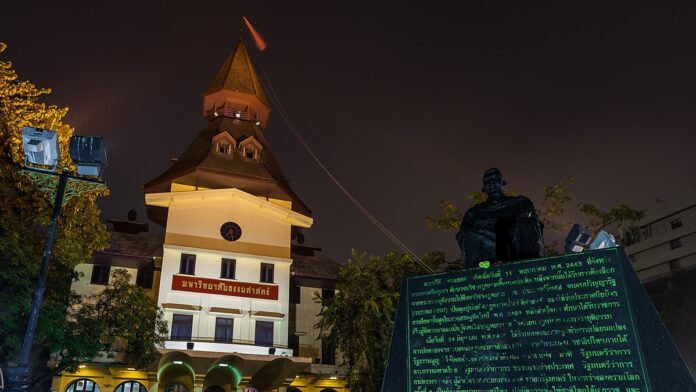
Thammasat ranks No.1 globally in SDG16 for peace, justice and strong institutions

BANGKOK — Thammasat University has been ranked first in the world for Sustainable Development Goal 16 (SDG16), which focuses on peace, justice and strong institutions, according to the Times Higher Education (THE) Sustainability Impact Ratings 2026 released on 24 June.
The UK-based ranking body also placed Thammasat 46th globally out of 1,603 institutions for overall SDG performance, with a score of 92.9, making it the second-ranked university in Thailand.

Thammasat Rector Prof. Dr. Supasawad Chatchawan said the ranking reflected the concrete efforts of administrators, faculty members, students and staff in advancing policies on peace, justice, rule of law and strong institutions through teaching, research, public service and good governance.

Assistant Professor Chon Bunnag, Assistant to the Rector for Quality and Sustainability Development and Director of the SDG Move Research Centre, said the achievement reflected collaboration across all dimensions of the university, including teaching, research, public service and governance, with a shared goal of promoting fairness, reducing inequality and expanding equal opportunities.

The university said the achievement reflects its long-standing “university for the people” philosophy over the past 92 years. It added that Thammasat will continue to apply its globally recognised expertise to public service and national problem-solving, particularly in areas of law, human rights, equality, inequality reduction and public participation.

Advertisement

Japanese tourist’s chair collapse at Hua Hin station goes viral

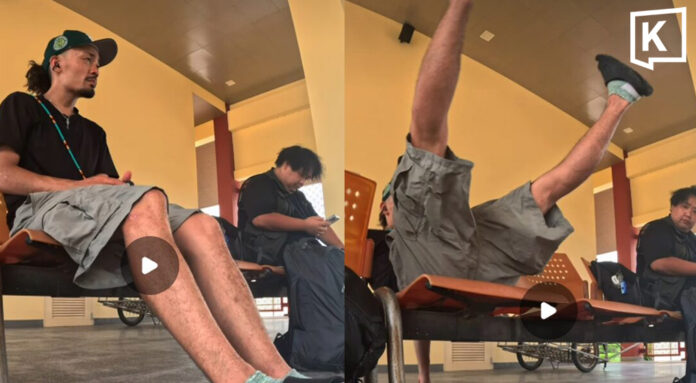
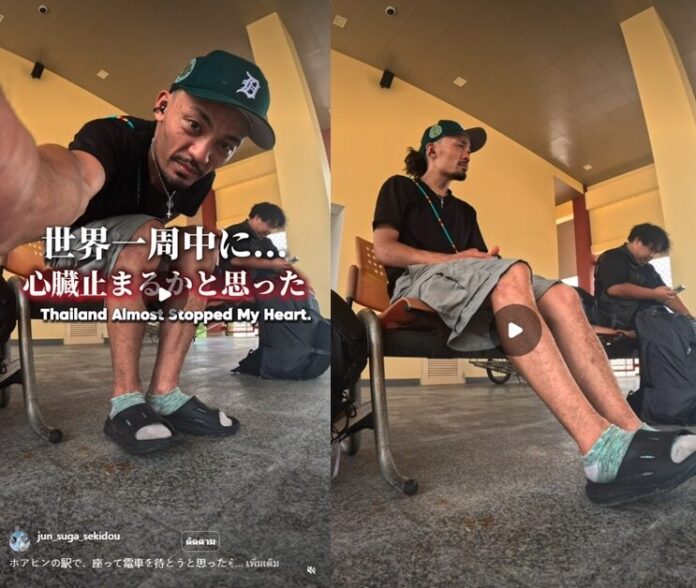
PRACHUAP KHIRI KHAN — 24 June 2026, A Japanese travel content creator has gone viral after posting a video of an unexpected mishap at Hua Hin Railway Station, where a chair suddenly broke beneath him as he leaned back while waiting for a train.

The creator, who runs the travel channel jun_suga_sekidou, shared the clip under the title “Thailand almost stopped my heart.”

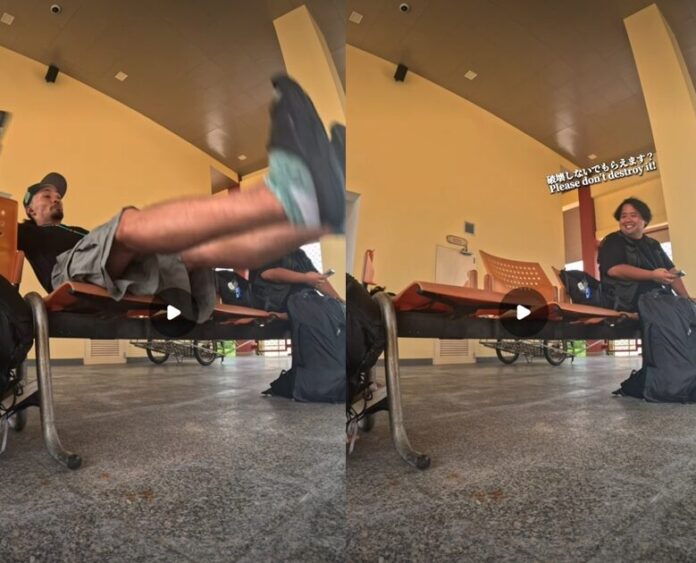
In the video, he is seen sitting on a chair at the station. As he leans back against the backrest, the chair suddenly gives way, causing him to fall backwards onto the ground with a loud crash.

1 58 696x588 1

Fortunately, he was not injured in the incident.

The creator’s friend can be heard laughing and joking, saying, “Don’t break things.” The Japanese tourist later commented that he had properly apologized to the station master following the incident.

The clip quickly attracted attention online, with many social media users expressing relief that he escaped unharmed while also finding humor in the unexpected accident.

2 46 696x563 1

Some commenters, however, noted that the incident raises questions about public safety and maintenance standards. They said authorities may need to inspect station facilities more thoroughly, as a similar accident involving a child, elderly person, or pregnant woman could potentially result in more serious injuries.

The video has since been widely shared across Thai social media platforms, drawing both amusement and concerns over safety at public transport facilities.

Advertisement

Hot News

LATEST NEWS

Bangkok
overcast clouds
29.4 ° C
29.4 °
26.6 °
77 %
2.7kmh
99 %
Tue
35 °
Wed
36 °
Thu
33 °
Fri
32 °
Sat
28 °