



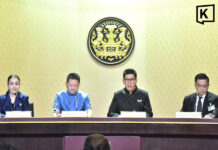
































The Chinese Ambassador to Thailand is apparently not happy about Thais using the term “grey Chinese” to refer to Chinese nationals who engage in criminal activities in Thailand and has made it known. Ambassador Zhang Jianwei feels the term made Thais appear “unfriendly” to Chinese visitors.
His message was not directly delivered to the Thai public earlier this week, not even through Thai Foreign Minister Sihasak Phuangketkeow, but through Thai Tourism Minister Surasak Phancharoenworakul, as if to hint that non-compliance could see the loss of Chinese tourists coming to Thailand. China did that to Japan not long ago, and it may try to use tourism as leverage here if Thais do not comply.
Ambassador Zhang’s additional argument was that the term unfairly stereotypes Chinese people. What’s more, Tourism Minister Surasak added that the Chinese envoy said those who break the law should be referred to as offenders instead. Ambassador Zhang reportedly also acknowledged that some Chinese nationals have committed crimes, but said many more contribute positively to Thailand’s economy and tourism industry.
So what happens next?
Should the entire country comply with the Chinese ambassador’s request?
At the very least, the government will likely avoid using the term out of deference to China’s power and feelings. This is despite the fact that PM Anutin Charnvirakul, who personally drove his car to take visiting Chinese Foreign Minister Wang Yi to lunch, did not seem to have any problem with the term in the past while discussing the issue of “grey Chinese” with the local press.
But what shall we use instead?
“Chinese fraudsters”? “Chinese criminal gangs”? “Groups or networks of Chinese nationals engaged in illegal or law-evading activities”? Or should we merely call them foreign criminals, or mafia from a certain East Asian nation?
And if journalists ask PM Anutin about “grey Chinese” in the future, will he or other Thai officials simply pretend not to understand the term?
What the Chinese ambassador should understand is that “grey Chinese” is neither a slur nor a blanket label for all Chinese people. It refers specifically to Chinese nationals involved in criminal activities—whether transnational or not—including scammers, those who kidnap fellow Chinese nationals in Thailand for ransom, mafia, people running illegal businesses in Thailand, money laundering, and so on.
There are quite a lot of such cases being reported, and they make headlines almost every week. This is unlike cases involving any other nationality in Thailand. Perhaps this is due to China’s enormous population.
The term clearly does not refer to all Chinese nationals, and “grey” is not a colour associated with any form of ethnic insult. Rather, it reflects the fact that these individuals operate in Thailand’s legal grey zones—spaces that are ambiguous or murky under Thai law.
No one would think that Ambassador Zhang and his Chinese embassy officials, Chinese executives at BYD, Chinese celebrities such as Fan Bingbing or Jackie Chan are “grey Chinese”. When people use the term, none of these individuals come to mind—and ordinary Chinese tourists certainly do not, either. This is something the Chinese ambassador ought to understand.
There is also the issue of freedom of expression. Thailand already has problems in this regard because of the draconian and anachronistic lese majeste law. Some things cannot be said in Thailand without risking imprisonment. Is the Chinese ambassador now asking Thai people to stop using the term “grey Chinese,” adding it to the list of self-censored words in Thailand as well?
China itself has topics that cannot be openly discussed in a critical or negative light, and the list is longer than in Thailand. They include comparisons of Xi Jinping to Winnie the Pooh, Tibet, the Uyghurs, the Tiananmen Square massacre and the Hong Kong democracy movement. In 2023, Thai public broadcaster Thai PBS deleted an interview with Taiwan’s foreign minister after a protest from China. Last year, an exhibition at the Bangkok Art and Culture Centre about Myanmar military dictator Min Aung Hlaing’s collusion with other nations, including China, was partially censored by the Chinese Embassy in Bangkok without going through the Thai Foreign Ministry.
And it is no longer just about what cannot be said inside China. Earlier this week, China’s Vice Justice Minister Hu Weilie defended a provision in China’s new ethnic unity law, which takes effect on 1 July, saying China has the right to hold individuals and groups outside its borders legally accountable if they are deemed to undermine “ethnic unity and progress” or incite ethnic separatism.
Hu insisted the provision is legitimate and would not affect normal exchanges, including academic discussion, trade and people-to-people contacts. But who gets to decide what is normal and what is not? If the Chinese state itself defines what constitutes separatism, undermining ethnic unity, or unacceptable discussion of ethnic affairs, should journalists, academics, activists, publishers, editors or artists outside China feel safe commenting on these issues, or even visiting China?
Perhaps they will not, and perhaps that is the point. The law may not need to be enforced often to have an effect. It may be enough to make people outside China think twice, soften their words, avoid certain topics, or bend quietly to China’s national will before Beijing even has to ask.
This is why Ambassador Zhang’s request should not be viewed in isolation. The Thai government has no authority to make the term “grey Chinese” illegal or punishable by law simply because it is spoken. Any Thai person who agrees with the Chinese ambassador is free to refrain from using it. However, the ambassador should be careful about making such requests, because many Thais are already jittery and concerned about China’s growing influence in Thailand. They fear that something much bigger than “grey Chinese” is the “Red Chinese government” itself.
If we allow the situation to continue as it is, one day we may have a dictionary listing terms that should not, or cannot, be used in Thailand when discussing China.
Compared with the Chinese Embassy in Manila, which is very combative, the Chinese Embassy in Thailand is still very polite.
For example, on Wednesday, the Chinese Embassy in Manila published the following post. Given its undiplomatic style, one might have thought it had been written and posted by a troll. The embassy singled out one person: Jay Tarriela, spokesperson of the Philippine Coast Guard for the West Philippine Sea, who had accused the Chinese Embassy in Manila of trampling on the sovereignty of the Philippines through words.
“Jay Tarriela is deliberately stoking nationalist sentiment to fuel hatred and confrontation, manipulating public opinion in an attempt to drive a wedge between the Chinese and Filipino peoples,” Guo Wei, deputy spokesperson of the Chinese Embassy in Manila, wrote on Wednesday.
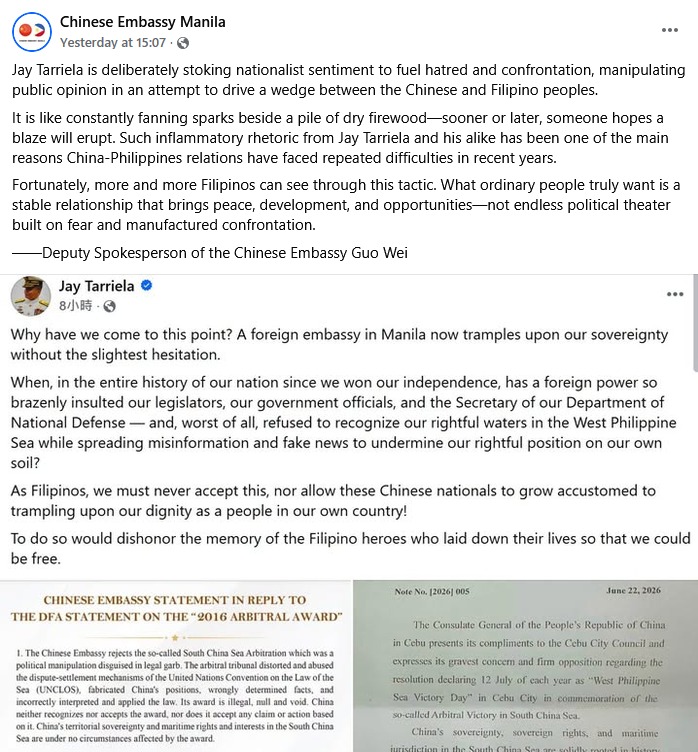
“It is like constantly fanning sparks beside a pile of dry firewood—sooner or later, someone hopes a blaze will erupt. Such inflammatory rhetoric from Jay Tarriela and his alike [sic] has been one of the main reasons China-Philippines relations have faced repeated difficulties in recent years.
“Fortunately, more and more Filipinos can see through this tactic. What ordinary people truly want is a stable relationship that brings peace, development, and opportunities—not endless political theatre built on fear and manufactured confrontation.”
Whether some Thais or Filipinos like it or not, China’s influence will most likely keep rising in the foreseeable future. The balance of power between Thailand and China will become increasingly imbalanced as China gains more influence. How to manage China’s rise will be a key challenge facing Thailand and many other countries in ASEAN.
One could read this latest “request” as an undeclared attempt to see how far China can go, and how much it can get away with, without Thai resistance, to see how far Thai society will yield to such a request and bend over backwards to suit China’s preferences.
The majority of the Thai press, much of it under the spell of China’s growing soft power, proactive engagement and “incentives,” will most likely stop using the term “grey Chinese” from now on.
They are already learning the ropes. Last year, most of the Thai press ignored the story about the Chinese Embassy’s role in censoring some items at the Bangkok Art and Culture Centre (BACC). Two months ago, this writer also learned from a reliable Thai media source of a complaint about an attempt by the embassy to remove a news item about Taiwan that the Chinese Embassy did not like.
It may be the “death” of the term “grey Chinese” for the vast majority of the Thai press, but only by name.
The more important question is not whether this term should or should not be used, but whether the Thai government, Thai media and Thai society will comply with the Chinese ambassador’s requests—and to what extent.
If they do, where will this rabbit hole lead? With more “requests” in the future, how might it reshape Thailand-China relations? And what could it mean for freedom of expression, public discourse and narratives in Thailand about China?
China must be reminded, however, that there is no significant anti-China sentiment or discrimination in Thailand, and that it should not breathe down Thailand’s neck too closely. It is counterproductive to the relationship.
Looking at the matter optimistically, this is China telling a friendly nation what she does not like to hear. Looking at it pessimistically, this is a superpower telling a much smaller and weaker nation to obey. This may not really be about the term “grey Chinese” at all, but about how far China can push its influence on Thailand.
Realistically speaking, Thailand’s relations with both the US and China cannot be genuinely equal because of the huge discrepancy in power. That does not mean Thailand should simply submit itself and become a client state of China, however. A stance that is both tactful and firm is needed.
No matter how you see it, we can extrapolate that this is an early warning for Thailand not to become too dependent on any single nation, China or the US, grey or not grey. Ambassador Zhang’s message is a clarion wake-up call for Thailand to diversify its trade and tourism, and to avoid becoming too dependent on any single country.