





























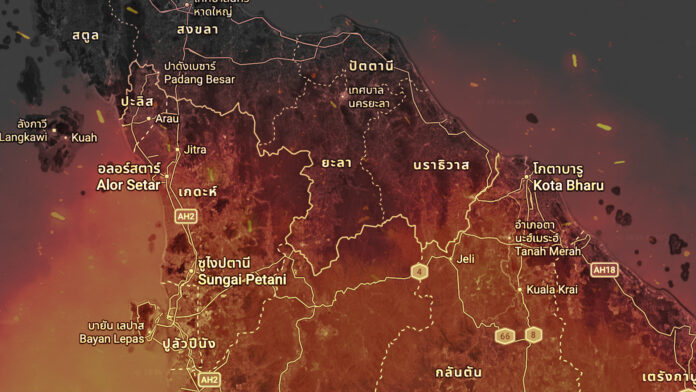
Seven security officers and two suspected insurgents have been killed recently in the deep south of Thailand. There are at least two ways for Thais to react to this violence.
First, one can see the loss and violence as merely a continuation of protracted, long-running unrest by a small group of armed insurgents and retaliation by security personnel. You can just keep ranting about the immoral and evil ‘southern goons’ or ‘jone tai’ (โจรใต้) — as they are often referred to by ordinary Thais and the tabloid press — and move on to the next news item of the day, repeating the same knee-jerk reaction when another major attack occurs.
The second reaction, or alternative, is to pause for a moment and face the uncomfortable reality of what we are dealing with.
Let us start with a few very basic facts.
First, there are some Thai-Malay Muslims who do not consider themselves Thai and yearn for an independent Patani homeland (they spell it ‘Patani’, not ‘Pattani’ which is preferred by the Thai state), and see the use of force to fight for independence as ‘legitimate’ in their eyes.
Let us face the fact that there are separatists or ‘freedom fighters’ who want to see an independent Patani state, whether Islamic in character or not.
Stop using the term ‘southern goons’, for it only obfuscates the nature of what Thailand is confronting. Thai press should also stop referring to the majority of the people in the deep south as Thai Muslims and recognise their Malay identity and referring to them as Thai-Malay Muslims instead.
As for the separatist movement, no one really knows how large it is, or how popular it is among the Thai-Malay population. There can be no official survey or poll, as under the Thai constitution, the kingdom is indivisible, and any movement to secede parts of Thailand is illegal.
One personal anecdote comes from two decades ago, when this writer was covering the immediate aftermath of the Tak Bai massacre in October 2004. Eighty-five Thai-Malay Muslim male protesters died: seven were shot at the site, while 78 suffocated after being hurled into army trucks, stacked on top of one another with their hands tied behind their backs.
A day after witnessing mass burials at sunset, I spoke to the Patani police chief and asked whether a locally elected governor in Patani and nearby provinces would make local Thai-Malay Muslims feel more in charge of their own destiny. The senior officer almost immediately replied that the day local governors are elected in the deep south would be the beginning of secession.
Such is the deep distrust that makes any meaningful decentralisation or devolution almost impossible in the region. With the mother tongue of Thai-Malay Muslims being Malay, and not Thai, it is no surprise that they may feel partially alienated in their homeland, as governors appointed from Bangkok to rule over them are mostly non-Thai-Malay Muslims. The fact that the deep south has remained one of the poorest regions in Thailand makes the disparity in their livelihoods even more visible when compared with Malaysians across the border.
Then there is the fact that some Thais, as well as Thai-Malay Muslims, do not fully trust the Thai security forces. Some, including officials this writer has spoken to over the years, suspect that elements within the security apparatus may have little interest in seeing the conflict end, believing a prolonged crisis helps secure larger budgets and salaries.
The region also operates under three overlapping security laws: Martial Law (1914), the Emergency Decree (2005), and the Internal Security Act (2008). Martial Law and the Emergency Decree can allow authorities to detain people for up to 37 days without formal charge or judicial oversight. How can life be normal under such prolonged emergency rule?
There is also the BRN and the question of whether the Thai state is genuinely negotiating with the real representatives of the separatist movement. Perhaps there is more than one group, and the BRN — Barisan Revolusi Nasional, or National Revolutionary Front — is neither the sole representative nor actively in charge of the struggle for an Islamist Patani state on the ground.
The mediator, Malaysia, is also viewed with suspicion, if not distrust, by many Thais who are not Malay Muslims. They suspect Malaysia may be partial to an eventual independent Patani homeland, separate from the Thai state, because of perceived ethnic, religious, and historical affinities with the rebels.
When the 22 July 2026 attack at the Bukeh Sami security checkpoint in Ra-ngae district of Narathiwat province killed five paramilitary rangers and injured six civilians, Army Chief of Staff General Chaiyapruek Duangprapat vowed a relentless cross-border manhunt, stating that any individual or nation offering refuge to the perpetrators would be endlessly pursued. That was a reference to Malaysia, the only country with which Thailand shares a border in the deep south.
All of these are key factors and challenges that help explain the limited progress, continuing killings, and the lack of light at the end of the tunnel.
According to conflict-monitoring organisation Deep South Watch, about 7,800 people have been killed on all sides in separatist-related violence in Thailand’s southernmost provinces since the conflict reignited in January 2004.
Over 23,000 violent incidents have been recorded, alongside more than 14,000 injuries.
And this will continue for as long as the majority of Thais remain in denial about what Thailand is actually facing.