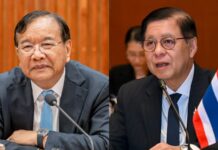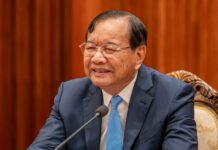

























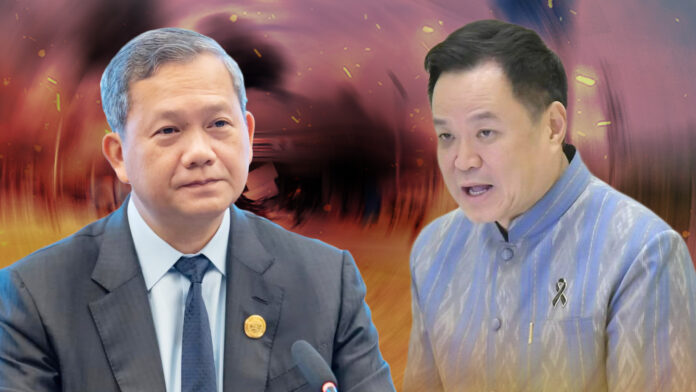
Over a year after the undeclared war between Thailand and Cambodia started, Cambodian Deputy Prime Minister and Foreign Minister Prak Sokhonn this week called for the restoration of diplomatic relations with Thailand. He argued that stronger diplomatic engagement is needed to prevent further misunderstandings and resolve bilateral disputes without resorting to military means.
Prak made the appeal in an interview aired by National Television of Cambodia (TVK) on Tuesday evening, following the second meeting of the Cambodia–Thailand Conciliation Commission under the United Nations Convention on the Law of the Sea (UNCLOS).
Cambodia’s top diplomat added that restoring diplomatic representation would give both sides a more effective means of addressing disagreements through dialogue, particularly as relations remain strained. He also highlighted the role of diplomacy in maintaining peaceful relations and fostering mutual respect between the two peoples.
Diplomatic representation between the neighbouring countries has been reduced to the level of second secretaries, which Prak described as the lowest level of representation between them.
Sensible Thais should welcome Prak’s remarks, and I believe Thailand should reciprocate by accepting the olive branch.
There are three reasons
First, it is about time and the right thing to do. Over the past year, both Thailand and Cambodia have witnessed not just military conflicts—which tragically and needlessly led to the deaths of dozens of soldiers and civilians and the displacement of tens of thousands of people in both countries—but also a runaway metamorphosis of mutual hate speech across social media and in much of the media in both countries, with much of the press doing its best to become part of the problem. It is all too common for the press in both countries to highlight bad news about the other with a sense of schadenfreude. How is that beneficial to either Thailand or Cambodia?
This is a race to the bottom, with both neighbouring nations doing their best to undermine one another and becoming distracted in the process, while most other nations focus on economic development and improving their citizens’ livelihoods. This is mutually detrimental to Thailand and Cambodia.
This highly toxic atmosphere, if left unchecked and prolonged, will undermine the future relationship between our two countries for many years, if not for generations to come.
Now that Cambodian Foreign Minister Prak has extended an olive branch, Thailand should reciprocate. Deputy PM and Foreign Minister Sihasak Phuangketkeow must muster the courage and foresight to recognise that the time has come to turn a new page in relations between Thailand and Cambodia and seize this opportunity.
By not reciprocating, we risk causing Cambodia to lose face, which will render future rapprochement even more difficult.
The main opposition People’s Party can redeem itself by calling on the government to accept Cambodia’s offer. For the past year, it has ridden ultranationalist waves over the Thai–Cambodian conflict, while offering no opposition to the two brief, undeclared wars.
Meanwhile, this is also an opportunity for the Pheu Thai Party to make amends for its disastrous and inept handling of Thai–Cambodian relations when it was in government last year. It is time for the party to send a firm signal to its main coalition partner, the ruling Bhumjaithai Party, that accepting the offer is the right thing to do and will benefit both nations.
Second, normalising relations would be good for the economies of both Thailand and Cambodia. We have spent an inordinate amount of time on this feud and been distracted from various economic challenges. Thailand’s projected GDP growth of 2.1 per cent this year and roughly the same in 2027 would be among the lowest in the ASEAN region, meaning the government and society should focus on the economy and people’s welfare—not on a zero-sum game in which Cambodia and Thailand try to undermine one another politically and economically.
Normalised diplomatic relations will pave the way towards the eventual end of the Cambodian boycott of Thai products and the return of Thai tourists to Cambodia. Thais used to represent the largest group of foreign visitors to the country before the wars.
UNCLOS talks can continue, including future border negotiations, while both countries restore diplomatic relations to the ambassadorial level.
I also recall how Japanese Embassy in Bangkok was shocked by the barrage of angry comments on its Facebook page after it merely suggested that Thailand reopen border checkpoints with Cambodia to mitigate negative impacts on cross-border supply chains. It was immature of Thai society to make Japan, one of our closest allies, collateral damage.
Third, and last but not least, we owe it to the young generations in Thailand and Cambodia not to pass on the burden and legacy of conflict unnecessarily.
Thais owe it to the next generation and to posterity not to pass on this toxic legacy. We need to resolve the conflict now instead of expecting future generations to sort out the problems we have created. It is unfair to them. It is also irresponsible and myopic to leave these conflicts to posterity.
Referring back to Prak, he noted that efforts to reverse the downgrade have been discussed previously. The two prime ministers reached an agreement in Kuala Lumpur last year to restore diplomatic ties to an appropriate level, with their foreign ministers assigned to work out its implementation.
The two sides subsequently held several rounds of discussions and agreed on dates for their deputy heads of mission to return to their respective posts. The plan was put on hold, however, as tensions between the countries re-intensified.
A further attempt came in May 2026, when the prime ministers agreed to confidence-building measures that included returning deputy heads of mission. The countries exchanged diplomatic notes after the meeting, but the arrangement has not yet been carried out.
Prak said Cambodia continued to view the restoration of diplomatic ties as necessary for creating a functioning channel to settle disputes through diplomacy instead of military action.
Prak was right, and Thailand needs all sensible voices for peace and future friendly coexistence between the two countries to convince the Thai government that now is the time.