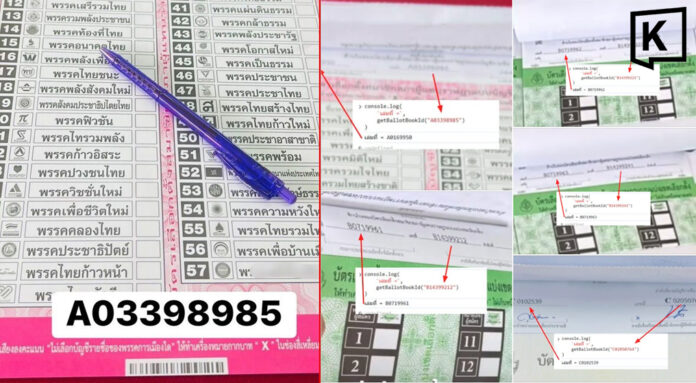
BANGKOK — 13 February 2026, Questions have spread widely online over the presence of barcodes and QR codes on Thai ballot papers, with critics warning they could potentially reveal how individuals voted and may breach election law.
The issue began after a Facebook user, Thuntee RB Sukchotrat, posted about QR codes printed on ballot papers and asked whether they could be used to verify counting errors.
He wrote that pink ballot papers carried a QR code in the top right corner and green ballots displayed one in the bottom left. According to the post, the codes appear to be eight-character alphanumeric serial numbers, possibly in Base32 or Base58 format, intended to prevent forgery or reduce counting errors.
However, the user questioned whether the QR codes might operate on a one-to-one basis or within a limited range, potentially enabling the identification of individual voters — a scenario that could contravene election law.
The post asked whether the QR codes could be used to scrutinise alleged discrepancies in ballot numbers nationwide, amid broader concerns about counting errors or possible ballot irregularities.
The controversy prompted widespread public questions to the Election Commission of Thailand. Acting Sub-Lieutenant Phatsakorn Siriphakdiayaporn, deputy secretary-general of the commission, said the concerns were likely based on a misunderstanding.
He said the barcodes were a security measure designed to identify which batch and polling station a ballot originated from, enabling administrative control. He stressed that the codes were not linked to any political party and were intended solely to ensure traceability of ballot distribution.
Subsequent online examinations, however, claimed that barcodes on pink party-list ballots matched the serial numbers printed on their counterfoils. Critics argued that this could make it possible to determine which number a voter selected.
Such a possibility, they said, could violate provisions of the Organic Act on the Election of Members of the House of Representatives, including Section 92, which requires voting to be “direct and secret”; Section 93, which mandates folding ballots to conceal votes; and Section 96, which prohibits marks that make ballots identifiable.
Another Facebook user, Thanarat Kuawattanaphan, posted a mathematical explanation suggesting that knowing a ballot’s barcode could allow someone to identify the corresponding ballot book and trace it back to a voter’s details.
He claimed that each ballot number is generated from its book number, with each book containing 20 ballots. Under the formula he cited, M = ⌊N/20⌋ + 1, knowledge of the ballot number (N) would reveal the book number (M). He further alleged that ballot numbers are uniquely generated and do not repeat, as each book number is multiplied by 20 and incremented sequentially from 1 to 20.
According to the post, this structure could allow a barcode to be traced back to an individual’s national identification number, name and surname.
The Election Commission has not publicly confirmed those claims.