30.5 C
Bangkok
Monday, June 22, 2026
Home Blog Page 1431

3 Days In, ‘7 Dangerous Days’ Kills 159 in 1,500+ Accidents on Thai Roads

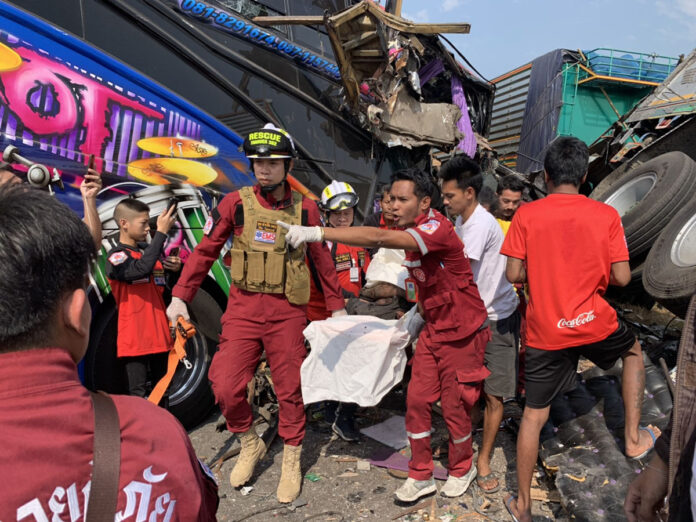
First responders carry out the bodies of two people who died in a car crash in Ayutthaya province on Dec. 28, 2019.

BANGKOK — More than 150 people have died on Thai roads in the lead up to 2020, road safety officials said Monday.

From Friday through Sunday, or during the first three Dangerous Days, the government-run Road Safety Directing Center reported a total of 1,504 accidents which resulted in 159 dead and 1,549 injured.

The “Seven Dangerous Days,” which mark the New Year’s holidays when many people travel countrywide for vacations or to their hometowns, started on Dec. 27 and will end on Jan. 2.

The deadliest province proved to be Bangkok, with 10 dead in three days, but the province with the most injured was Nakhon Pathom, where 56 people had been wounded.

Almost a third (31.83 percent) of accidents were caused by DUI and speeding (30.89 percent), the report said. A third of the accidents also happened from 4pm to 8pm.

Despite the official designation and media attention, death tolls during the seven-day period do not differ significantly from other times of year. About 20,000 people died in road traffics in 2018, or an average of approximately 55 victims a day.

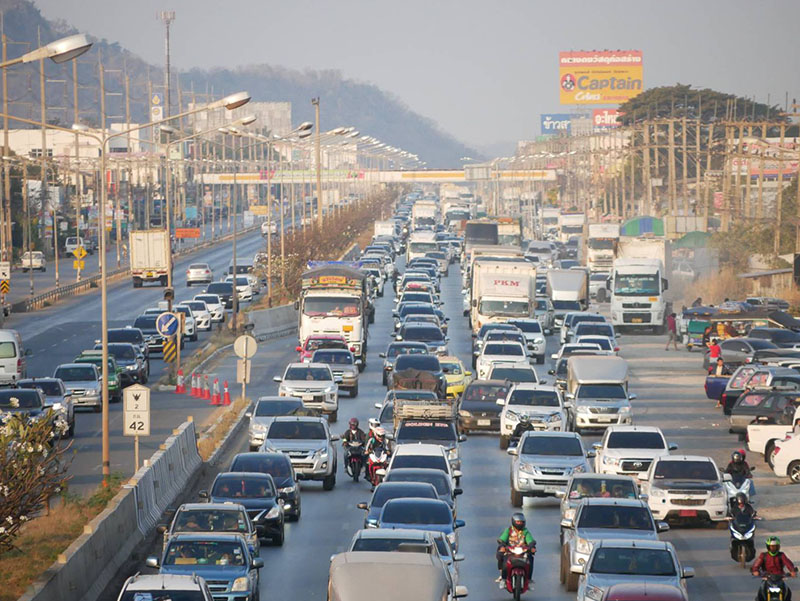
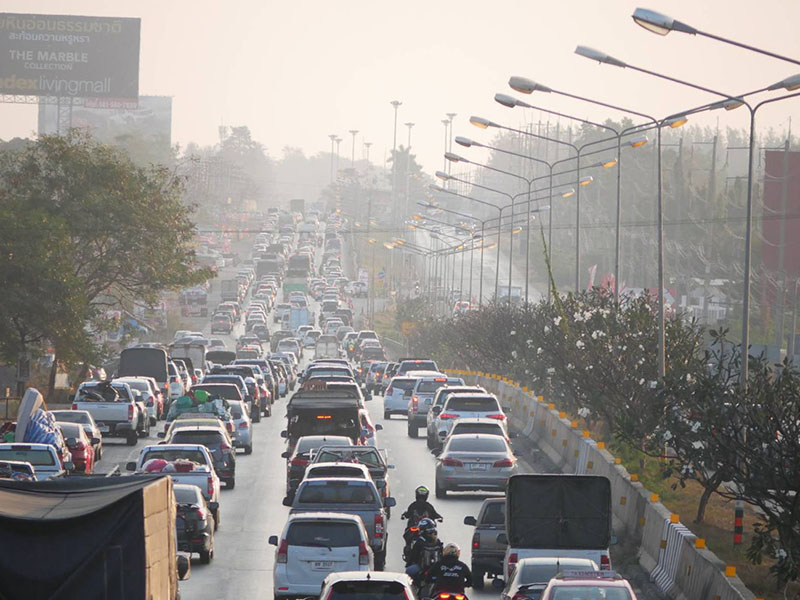
As of Monday morning, traffic still chokes the main arterial roads from Bangkok to the north and Isaan as the capital empties of cars.

Police have advised motorists to expect heavy traffic on Asia Road, or Route 32 which runs from Ayutthaya through Ang Thong, Sing Buri, and Chai Nat to the northern provinces as well as Mittraphap Road, which leads into Nakhon Ratchasima and the rest of Isaan.

During 2019’s so-called Seven Dangerous Days, 463 people died.

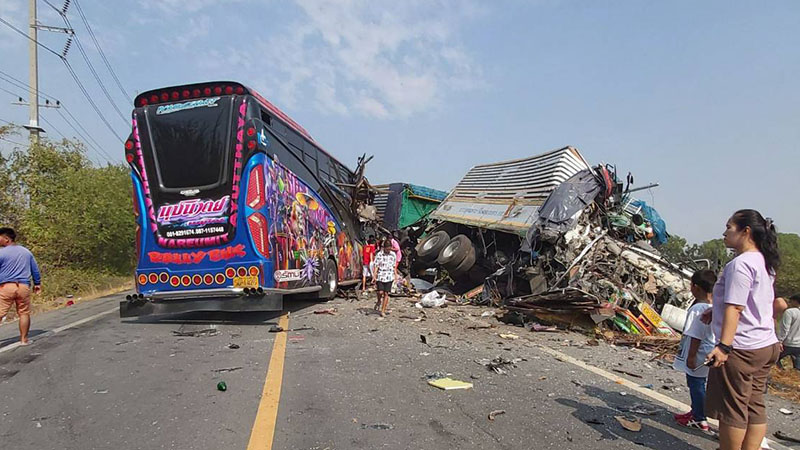
A bus and truck crash in Ayutthaya province which killed two on Dec. 28, 2019.
Cars entering Nakhon Ratchasima via Mitraphap Road on Dec. 28, 2019.

Related stories:

‘7 Dangerous Days’ Kill 463 on Thai Roads During Holidays

Advertisement

2 Serial Muggers Nabbed for Stabbing, Robbing Japanese Tourist

Somrak Iampan and Krissada Chotisomboonrat on Dec. 30, 2019 reenact their alleged robbery and assault of a Japanese tourist in Bangkok.

BANGKOK — Two Thai men were arrested for mugging and stabbing a Japanese man downtown earlier in December, police said Monday.

Somrak Iampan, 23, and Krissada Chotisomboonrat, 18, were arrested and charged with assault and robbery-related offenses for the attack on Hirotaka Yushida, 37, Khlong Tan police said Monday morning. The pair, who had a record of other robberies in the past, were nabbed on Sunday.

“They chose a foreigner because they believed he would have a lot of money and wouldn’t alert the police,” Police Lt. Gen. Pakkapong Pongpetra said.

Police said Yushida was mugged on Dec. 21, when two motorcycles rode up to either side of him in Soi Ekkamai 10, stabbed him with a knife, and made off with 20,000 baht. Police then tracked CCTV footage down to arrest Somrak and Krissada at their home.

“Before committing the robbery, the two got high on Procadyl and rode on their bikes before finding the Japanese national,” Pakkapong said. “However, he resisted, which made Somrak draw his knife and stab him.”

Police also said Somrak and Krissada had previously committed two counts of robbery in the Thonglor area. Somrak also had drug cases with the Phra Khanong police station.

Pakkapong said that the men then spent the money on online games, drugs, and gold chains.

Advertisement

Official Warns of Mekong Water Shortages Due to Weather, Dams

In this Wednesday, Dec. 4, 2019, photo, sightseers plays on a sandbar in the Mekong River in Nakhon Phanom province, northeastern Thailand. (AP Photo/Chessadaporn Buasai)

BANGKOK (AP) — Thailand should brace for serious water shortages when the hot season begins in March after a year with unusually little rainfall, one of the country’s top water management officials said Monday.

Retention of water by dams in upstream areas of the Mekong River also is seen as contributing to record-low water levels in the river, affecting the region’s ecology.

Somkiat Prajumwong, director-general of Thailand’s Office of National Water Resources, said the river will experience record-low levels, after already recording new records this past year.

His agency is warning people along the Mekong to beware of river bank slides and prepare for serious water shortages in March and April, when temperatures in Thailand usually peak.

Tests of China’s new upstream Jinghong dam on Jan. 1-3 are expected to lead to a drop in the the Mekong’s water level by as much as 1 meter (3.3 feet) along eight northern and northeastern Thai provinces, said the water resources agency.

1000 1 1
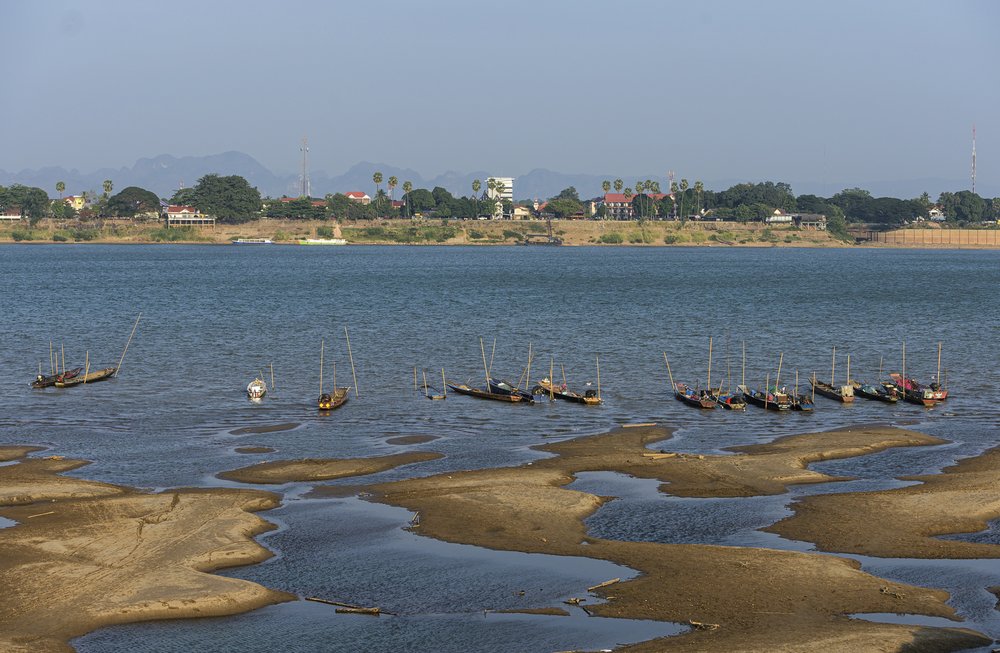
In this Wednesday, Dec. 4, 2019, photo, fishing boats are moored in Mekong River, which has turned blue instead of its usual muddy color, in Nakhon Phanom province, northeastern Thailand. (AP Photo/Chessadaporn Buasai)

Restrictions on water use from some Thai dams were imposed by late December, according to a report in the Bangkok Post newspaper. It quoted the head of Thailand’s Royal Irrigation Department, Thongplew Kongjun, as saying that water from the Ubol Ratana and Chulabhorn dams was being reserved for consumption and ecological conservation, rather than for growing crops, because of their low levels.

The Mekong River Commission already warned that severe to extreme drought was expected to hit Thailand and Cambodia at least until January. The regional agency, to which Laos and Vietnam also belong, blamed insufficient wet season rainfall, an abbreviated period of monsoon rains and unusually high temperatures and evaporation caused by El Nino, a cyclical climate phenomenon originating with warming water in the Pacific Ocean.

The commission said in a paper issued at its annual meeting in November that the long-term prognosis was bleak, as the Lower Mekong Basin for the past few decades “has been experiencing severe drought hazards with serious economic losses due to damages of agricultural crops, negative impacts on the environment, and effects on people’s livelihoods.”

“The duration and magnitude of the impacts have significantly increased over the past two decades if comparing the drought hazards from one event to another,” it said.

It warned that, depending upon factors involving the climate, the lower Mekong basin “is likely to see more severe droughts in the next 30, 60 and 90 years due to less precipitation, high air temperature,” as well a high percentage of evaporation from ground and plants.

The issue involving dams was vividly illustrated about a month ago, when the Mekong River acquired an aquamarine color due to the water becoming clear and reflecting the sky, replacing its usual yellowish-brown shade that is due to the sediment it normally carries downstream.

Experts blamed the large Xayaburi hydroelectric dam upstream in Laos that began operating in October for causing the color change.

The dam blocks much sediment from moving farther downstream, which accounts for the water becoming clear, Pravit Kanthaduang, a fishery official in Thailand’s Bueng Kan province, said earlier this month. Less sediment means less nutrition for plants and fish in the river, threatening the ecological balance, he said.

“The current has less sediment, which unleashes energy onto the river banks downstream,” said Chainarong Setthachau of the Faculty of Humanities and Social Science at Thailand’s Mahasarakham University. “This so-called ‘hungry water’ will cause much more erosion to the banks, uprooting trees and damaging engineering structures in the river.”

The dam’s developers said they spent more than 19.4 billion baht ($648 million) to mitigate negative impacts on the environment.

Environmental activists have expressed urgent concern about the upstream dams.

“Thai riverine communities living along the Mekong, downstream of dams in China and Xayaburi dam in Laos, have never experienced ecological changes at this scale,” Pianporn Deetes of the conservation group International Rivers said Monday. “Amidst drought, dams exacerbate the destruction of the Mekong’s fragile ecosystem, especially for unseasonal water fluctuation that means impacts on aquatic lives, fisheries, food and income security, water supply, navigation and more.”

___

Associated Press writer Busaba Sivasomboon in Chumphon, Thailand, contributed to this report.

Advertisement

Opinion: When Society Curbs Its Own Freedom of Expression

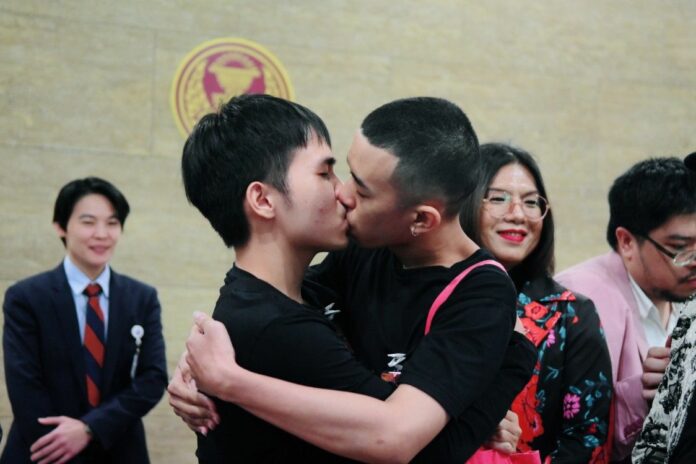
Two activists share a kiss at the Parliament on Dec. 18, 2019, after petitioning the lawmakers to legalize gay marriage and promote LGBT rights.

In Thailand, limits on freedom of expression are not only imposed by various laws on the book, but also by members of society themselves. Two recent incidents in demonstrated my point.

First was the “French kiss” at the Parliament on Dec. 18 by two LGBT activists as part of a news conference to push for a same-sex marriage law earlier this month.

The move led to much condemnation that it was inappropriate to kiss in Parliament, as the place is supposedly a place of honor, filled with honorable Members of the House of Representatives.

I will not dwell on how Thai Parliament is an abode of crooks, deceits, and political shenanigans because it is beside the topic. The point is, while a French kiss in public may normally be frowned upon in Thailand, or at least raised a few eyebrows, the two gay activists were trying to make a point.

Without the kiss, it’s unlikely that the public, as well as the press, will take note of the long struggle for equal marriage rights by LGBT community.

The deep kiss in parliament was most likely a public stunt meant to shock and remind the public about their yet-to-be-fulfilled rights. Thus, to think it was inappropriate is to miss their point – the gesture itself was meant to be inappropriate.

Tolerance for such antic was low, however, and given the widespread backlash, any future shock tactic will be less likely.

Less than a week later, another incident reminded me how little tolerance we have for ideas that we disagree with and find to be offensive.

On Christmas Eve, Matichon Weekly magazine issued an apology to readers and the public for an opinion article penned by one of its columnists. Apart from the contrition, Matichon Weekly, which is operated by the same Matichon Group that owns Khaosod English, also dropped the column and the writer from its pages, as well as deleting the controversial article from its website.

The article was written by Pensri Phaoluangthong for her column, “Our Spinning World.” In her commentary, she argued that poor northeastern women only seek to marry Caucasian men as a quick fix to lift themselves from economic plight instead of focusing on their studies and employment like Isaan men.

The article went viral in no time, not because most agreed with it, but because they found the article to be highly offensive, ignorant, and unfair towards women from the northeast.

After just a few days of online criticism, Matichon gave in to the pressure.

This is an unfortunate turn of events. While I largely disagree with Pensri, there is a need to make sure that views that you do not agree, or even strongly disagree or find it highly offensive, has a place in society.

A society that has a very low threshold of tolerance for unpopular views or actions cannot expect to have a high level of freedom of speech.

The public has to learn that in order to ensure diversity of thoughts, it has to nurture not only a culture of tolerance, but also a culture of accepting criticism. If Thailand falls short of that, it will become a society that want to only hear good things about itself, real or imagined.

And even if some words or actions may be unpopular or wrong, having little or no tolerance for it will not only deprive Thai society of food for thought and self-examination, but could also leave Thai society intellectually barren.

Many uncomfortable questions can no longer be raised and debated if we as a society only want to hear things that are comfortable to our ears and eyes.

Advertisement

5G Slated to Transform First Aid, Healthcare in China

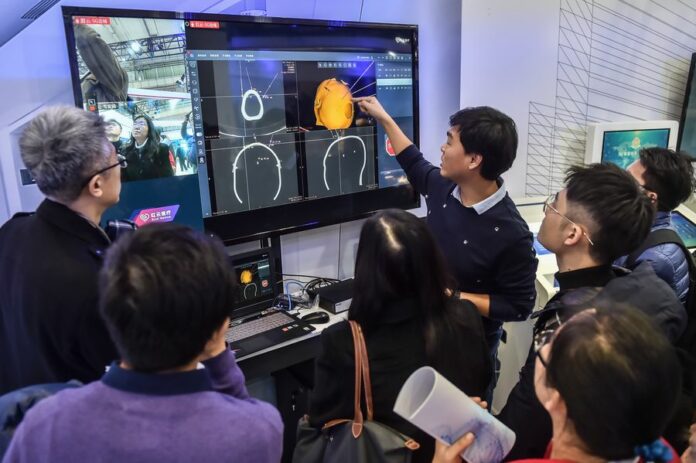
A staff member shows 5G-supported telemedicine technology during the 2019 World 5G Convention in Beijing, capital of China, Nov. 21, 2019. (Xinhua/Peng Ziyang)

BEIJING (Xinhua) — Wearing VR glasses to check a life-or-death situation in an ambulance, and closely watching the patient’s electrocardiogram and ultrasonic images transmitted back in real time, doctors at a hospital in east China’s Zhejiang Province remotely guided the paramedics and were fully prepared when the patient arrived.

This scene was a live demonstration by the emergency center of the Second Affiliated Hospital of Zhejiang University School of Medicine (SAHZU), showcasing how 5G technology has facilitated first aid and ushered in a new era for “Healthy China.”

“With the help of the 5G network, a real-time and stable digital channel for emergency rescue can be built, which will save a large amount of time and allow doctors to conduct diagnosis beyond the bounds of time and space,” said Sun Yun, a product manager with China Mobile.

China in June officially approved 5G commercial services, marking the start of a smart new era as the application of the superfast wireless technology helps connect more services, sectors and people from all walks of life.

Some 126,000 5G base stations have been established across the country so far, according to data from China’s Ministry of Industry and Information Technology.

“5G technology will bring a lot more convenience for patients in the near future,” said Zhang Mao, director of the emergency department of the hospital, adding that a 5G intensive care unit (ICU) is under construction at the hospital.

The power of 5G can advance integrated and intelligent remote consultation, as well as create a humanized medical environment with artificial intelligence for patients in the ICU, said Zhang.

After leaving the hospital, patients are still able to receive services such as online follow-ups, specialized nursing, digital imaging and pharmacy advice, according to the hospital.

Online medical services, based on brick-and-mortar hospitals, have reshaped and optimized the treatment process from pre-hospital services to post-treatment, making it easier and more convenient for patients to see a doctor, said Ye Xiaoyun, director of SAHZU’s customer service center.

Using 5G wireless technology, another 36-year-old female patient in north China’s Tianjin Municipality in August received a remote robotic surgery conducted by doctors in Beijing.

The orthopedic surgery, which lasted about four hours, was operated by a surgery robot and preoperatively planned by an expert in Beijing.

Besides the faster delivery speed and more powerful capacity, the 5G-powered technology used in the medical field is more about upgraded telemedicine capabilities, enabling doctors and patients to meet face-to-face over a distance. It also allows early warnings of abnormalities, more accurate autonomous operation of robots and unmanned aerial vehicles and more.

China started to draft standards on hospitals’ Internet construction based on 5G in September.

To regulate Internet-based diagnosis and treatment and better leverage the role of telemedicine, provinces like Zhejiang and Shandong have established Internet medical service supervision platforms at the provincial level, while Ningxia has set up an industrial organization of Internet hospitals.

Advertisement

8 Out of 10 China’s Box Office Top Grossers are Domestic Films

BEIJING (Xinhua) — Domestic films accounted for eight out of the 10 highest-grossing movies screened in China in 2019, according to the China Movie Data Information Network.

“Ne Zha,” an animated fantasy adventure featuring the Chinese mythological character of the same name, topped the China box office chart with nearly 5 billion yuan (715 million U.S. dollars).

“The Wandering Earth,” a film adaption of a Chinese science fiction novel by Hugo Award-winning author Liu Cixin, came second on the chart with 4.68 billion yuan, followed immediately by Disney and Marvel’s “Avengers: Endgame” with around 4.25 billion yuan.

Two patriotic films that premiered around the National Day — “My People, My Country,” a film recalling historical moments over the past seven decades, and “The Captain,” a cinematic portrayal of the real-life miraculous emergency landing of a Sichuan Airlines plane in 2018 — both made it to the top 10 list, garnering fourth and fifth places, respectively.

The U.S. film “Fast and Furious Presents: Hobbs and Shaw” came 10th with 1.43 billion yuan

Advertisement

In Japan, AI Finds Role as Matchmaker

Matchmaking agency Zwei's "intra-body communication" system that uses wristbands and a tablet computer. Image: Kyodo

TOKYO (Kyodo) — Artificial intelligence and other cutting-edge technologies are starting to play a matchmaking role as they find their ways into people’s lives in Japan.

AI devices are being employed to give people a picture of their potential mates along with everything about them — their hobbies, whether or not they smoke, or if they have walked down the aisle before, among other things.

Continue reading the story here.

Advertisement

Parishioners Kill Man Who Fatally Shoots 2 at Church

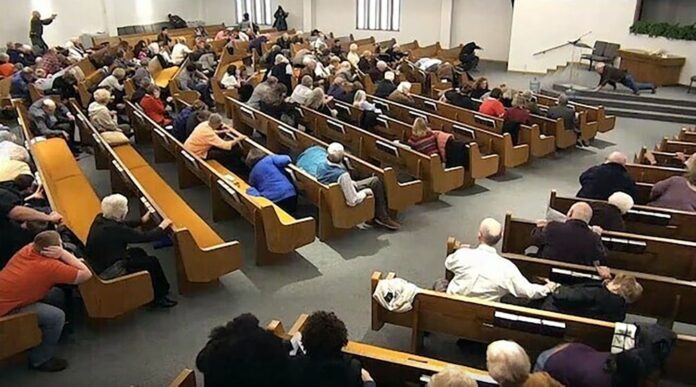
In this still frame from livestreamed video provided by law enforcement, churchgoers take cover while a congregant armed with a handgun, top left, engages a man who opened fire, near top center just right of windows, during a service at West Freeway Church of Christ, Sunday, Dec. 29, 2019, in White Settlement, Texas. (West Freeway Church of Christ/Courtesy of Law Enforcement via AP)

WHITE SETTLEMENT, Texas (AP) — A man pulled out a shotgun at a Texas church service and fired on worshippers Sunday, killing two people before he was shot to death by congregants who fired back, police said.

Authorities at a Sunday evening news conference praised the two congregants who opened fire as part of a volunteer security team at West Freeway Church of Christ in White Settlement. It was unclear if the two people who were killed were the two who shot at the gunman.

“This team responded quickly and within six seconds, the shooting was over. Two of the parishioners who were volunteers of the security force drew their weapons and took out the killer immediately, saving untold number of lives,” said Lt. Gov. Dan Patrick, who also hailed the state’s gun laws.

Britt Farmer, senior minister of the church, said, “We lost two great men today, but it could have been a lot worse.”

Authorities said there were more than 240 parishioners in the West Freeway Church at the time of the shooting.

800 3
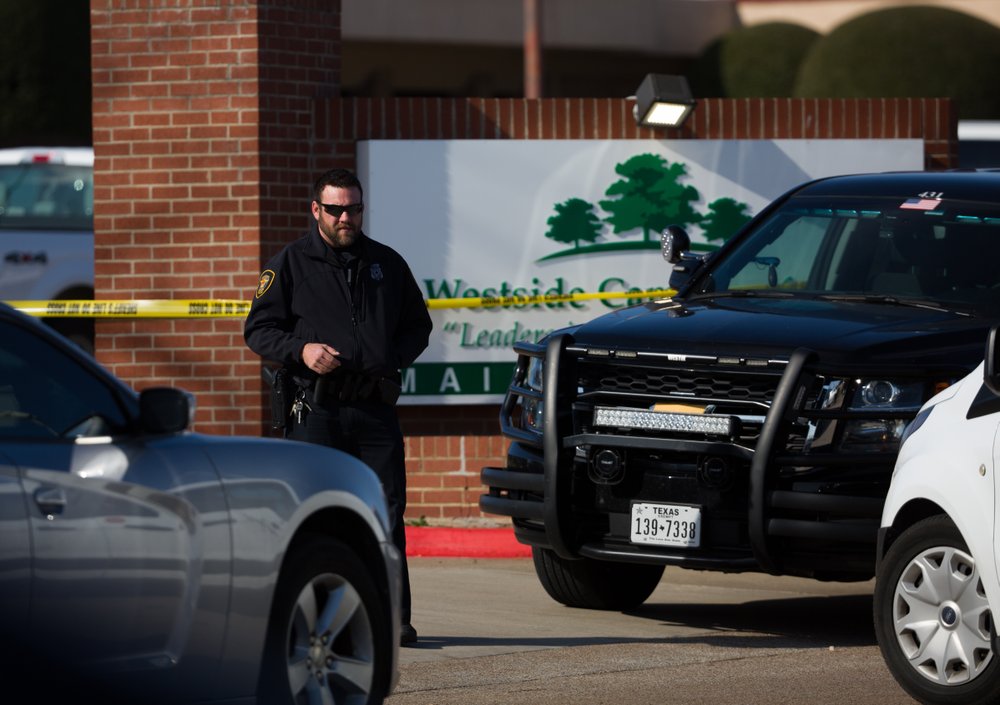
An officer stands near the scene after a church shooting at West Freeway Church of Christ on Sunday, Dec. 29, 2019 in White Settlement, Texas. (Juan Figueroa/The Dallas Morning News via AP)

White Settlement Police Department Chief J.P. Bevering said the gunman had sat down in a pew before getting up, taking out a shotgun and firing at a parishioner, who was killed. He said the church’s security team then “eliminated the threat.”

Officials have not released the names of the victims or the gunman. FBI Special Agent in Charge Matthew DeSarno said they’re working to identify the gunman’s motive, adding that he is “relatively transient” but had roots in the area.

DeSarno also said the gunman had been arrested multiple times in the past but declined to give details.

An elder at the church told the New York Times that one of those killed was a security guard who responded to the shooter, calling him a dear friend.

“He was trying to do what he needed to do to protect the rest of us,” said the elder, Mike Tinius.

“It’s extremely upsetting to see anyone committing violence,” he said.

Tinius said he didn’t know the gunman and that the shooting appeared to be random.

A woman who answered the phone at the West Freeway Church of Christ told the AP she could not answer any questions and that she was told to direct inquiries to authorities.

In a livestream of the church service, the gunman can be seen getting up from a pew and talking to someone at the back of the church before pulling out a gun and opening fire. Parishioners can then be heard screaming and seen ducking under pews or running as papers fly to the floor.

Two people with minor injuries that were sustained while ducking for cover were treated at the scene, MedStar Mobile Healthcare spokeswoman Macara Trusty said.

Gov. Greg Abbott asked the state to pray for the victims, their loved ones and the community of White Settlement, about 8 miles (12 kilometers) west of Fort Worth.

“Places of worship are meant to be sacred, and I am grateful for the church members who acted quickly to take down the shooter and help prevent further loss of life,” Abbott said in a tweeted statement.

It is not the first deadly shooting to take place at a church in Texas. In November 2017, Devin Patrick Kelley opened fire on the congregation at a church in Sutherland Springs, killing more than two dozen worshippers, before taking his own life. And in 1999, a gunman killed seven people in Wedgwood Baptist Church in Fort Worth before detonating an explosive device and killing himself.

Sunday’s shooting in Texas was also the second attack on a religious gathering in the U.S. in less than 24 hours. On Saturday night, a man stabbed five people as they celebrated Hanukkah in an Orthodox Jewish community north of New York City.

Advertisement

Asbestos Found at Tokyo Olympics Water Polo Venue

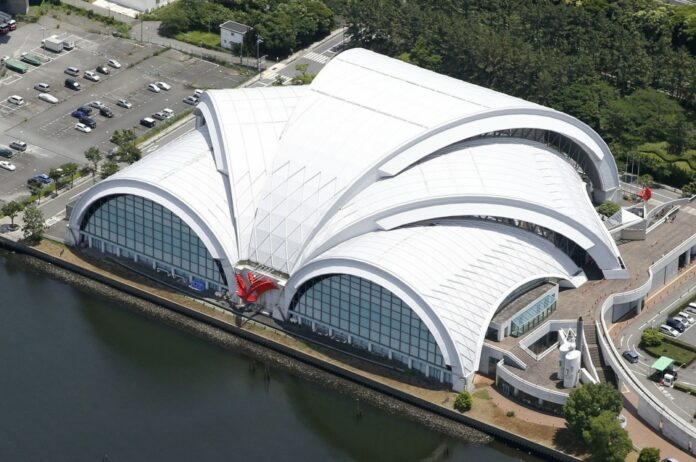
TOKYO (Kyodo) — The Tokyo metropolitan government said Monday it will take urgent measures after asbestos was discovered in the structure of a swimming center to be used for water polo at the 2020 Tokyo Olympic Games.

The material, considered a health risk, was found in fire resistant coating used at two locations on a pillar supporting the roof of the Tokyo Tatsumi International Swimming Center, which opened in 1993.

Continue reading the story here

Advertisement

Trump Faces Raft of Foreign Policy Challenges in New Year

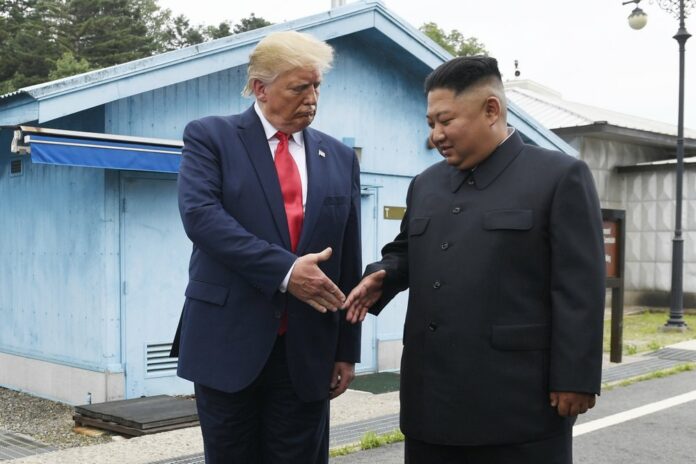
In this June 30, 2019 file photo, President Donald Trump meets with North Korean leader Kim Jong Un at the border village of Panmunjom in the Demilitarized Zone, South Korea. President Donald Trump starts the new year knee-deep in daunting foreign policy challenges at the same time he'll have to deal with a likely impeachment trial in the Senate and the demands of a reelection campaign. (AP Photo/Susan Walsh, File)

WASHINGTON (AP) — President Donald Trump starts the new year knee-deep in daunting foreign policy challenges at the same time he’ll have to deal with a likely impeachment trial in the Senate and the demands of a reelection campaign.

American troops are still engaged in America’s longest war in Afghanistan. North Korea hasn’t given up its nuclear weapons. Add to that simmering tensions with Iran, fallout from Trump’s decision to pull troops from Syria, ongoing unease with Russia and Turkey, and erratic ties with European and other longtime Western allies.

Trump is not popular overseas, and being an impeached president who must simultaneously run for reelection could reduce the time, focus and political clout needed to resolve complex global issues like North Korea’s nuclear provocations. Some foreign powers could decide to just hold off on finalizing any deals until they know whether Trump will be reelected. Trump himself has acknowledged the challenge in his Dec. 26 tweet:

“Despite all of the great success that our Country has had over the last 3 years, it makes it much more difficult to deal with foreign leaders (and others) when I am having to constantly defend myself against the Do Nothing Democrats & their bogus Impeachment Scam. Bad for USA!”

At the same time, there is widespread expectation that Trump never will be convicted by the Republican-controlled Senate, so 2020 could well bring more of the same from the president on foreign policy, said Ronald Neumann, president of the American Academy of Diplomacy.

“America still has an awful lot of power,” said Neumann, a three-time ambassador and former deputy assistant secretary of state. “With a year to go, a president can still make a lot of waves, impeachment or not.”

For Trump, 2019 was a year of two steps forward, one step back — sometimes vice versa — on international challenges. Despite claiming that “I know deals, I think, better than anybody knows deals,″ he’s still trying to close a bunch.

Trump scored high marks for the U.S. military raid in Syria that killed the leader of the Islamic State, but U.S. military leaders worry about a resurgence. He is credited with coaxing NATO allies to commit to spend billions more on defense, but along the way has strained important relationships.

His agreement on a “Phase 1” trade deal with China has reduced tensions in their ongoing trade war. But the deal largely puts off for later complex issues surrounding U.S. assertions that China is cheating to gain supremacy on technology and China’s accusation that Washington is trying to restrain Beijing’s ascent as a world power.

A deeper look at the state of play on three top foreign policy challenges on Trump’s desk as 2020 begins:

US-North Korea Nuclear Talks Lose Traction

The U.S. is watching North Korea closely for signs of a possible missile launch or nuclear test.

Pyongyang had threatened to spring a “Christmas surprise” if the U.S. failed to meet Kim Jong Un’s year-end deadline for concessions to revive stalled nuclear talks. Trump speculated maybe he’d get a “beautiful vase” instead. Any test flight of an intercontinental ballistic missile or substantial nuclear test would further derail the diplomatic negotiations Trump opened with Kim in 2018.

Washington didn’t accept Kim’s end-of-year ultimatum, but Stephen Biegun, the top U.S. envoy to North Korea, said the window for talks with the U.S. remains open. “We are fully aware of the strong potential for North Korea to conduct a major provocation in the days ahead,” Biegun, the new deputy secretary of state, said recently. “To say the least, such an action will be most unhelpful in achieving lasting peace on the Korean Peninsula.”

In recent months, North Korea has conducted a slew of short-range missile launches and other weapons tests.

In 2017, Trump and Kim traded threats of destruction as North Korea carried out tests aimed at acquiring the ability to launch nuclear strikes on the U.S. mainland. Trump said he would rain “fire and fury” on North Korea and derided Kim as “little rocket man.” Kim questioned Trump’s sanity and said he would “tame the mentally deranged U.S. dotard with fire.”

Then the two made up and met three times — in Singapore in 2018, in Vietnam last February and again in June when Trump became the first U.S. president to set foot into North Korea at the Demilitarized Zone.

While the get-togethers have made for good photo-ops, they’ve been devoid of substantive progress in getting Kim to get rid of his nuclear weapons.

Trump has held out North Korea’s self-imposed moratorium on conducting nuclear tests and trials of long-range intercontinental missiles as a major foreign policy achievement. “Deal will happen!” he tweeted.

Trump’s former national security adviser doesn’t think so.

“The North Koreans are very happy to declare that they’re going to give up their nuclear weapons program, particularly when it’s in exchange for tangible economic benefits, but they never get around to doing it,” John Bolton told National Public Radio.

US-Iran Tension Escalating

Tensions with Iran have been rising ever since Trump last year withdrew the U.S. from the 2015 nuclear deal that Tehran had signed with the U.S. and five other nations. Trump said the deal was one-sided and gave Iran sanctions relief for rolling back, but not permanently dismantling, its nuclear program.

After pulling out of the deal, Trump began a “maximum pressure” campaign, reinstating sanctions and adding more that have crippled Iran’s economy. His aim is to force Iran to renegotiate a deal more favorable to the U.S. and other nations that are still in the agreement.

In response, Iran has continued its efforts to destabilize the region, attacking targets in Saudi Arabia, interrupting commercial shipping through the critical Strait of Hormuz, shooting down an unmanned U.S. aircraft and financing militant proxy groups. Since May, nearly 14,000 U.S. military personnel have deployed to the region to deter Iran.

Iranian President Hassan Rouhani said his country’s nuclear experts are testing a new type of advanced centrifuge. Iran recently started exceeding the stockpiles of uranium and heavy water allowed by the nuclear deal and is enriching uranium at a purity level beyond what is permitted. Tehran’s violations, which it says are reversible, are an attempt to get France, Germany, Britain, China and Russia — the other nations that signed the Joint Comprehensive Plan of Action — to offer new economic incentives to offset the American sanctions.

The White House says its pressure campaign is working. The Iranian economy is collapsing, inflation is high. And crushing U.S. sanctions blocking Iran from selling its crude oil abroad have helped fuel nationwide protests.

Earlier this month, there was a rare diplomatic breakthrough when a Chinese-American Princeton scholar, Xiyue Wang, who has held in Iran for three years, was freed in exchange for a detained Iranian scientist in the U.S.

Trump said the prisoner exchange could be a “precursor as to what can be done.”

Iran says other prisoner swaps can be arranged, but there will be no other negotiations between Tehran and the Trump administration.

Afghanistan

It’s no secret that Trump wants U.S. engagement in Afghanistan to end, but critics have expressed concern about giving too many concessions to the Taliban or if they will honor any agreement that could end the fighting.

In what appeared to be a breakthrough Sunday, top Taliban leaders agreed to a temporary cease-fire nationwide, but didn’t say when it would start or how long it would last. A cease-fire, however, could provide an opening for a Taliban peace agreement with the United States that would let Trump bring U.S. troops home from Afghanistan, where they have fought for more than 18 years.

The U.S. wants any deal to include a promise from the Taliban that Afghanistan would not be used as a base by terrorist groups. A key part of a pact would include the Taliban agreeing to participate in all-Afghan negotiations to decide what a post-war Afghanistan would look like.

Such negotiations are expected to be contentious and touch on the rights of women, free speech and changes to the Afghan constitution. They also would determine the fate of tens of thousands of Taliban fighters and heavily armed militias run by Afghan warlords who have amassed wealth and power since the Taliban was ousted from power after 9/11.

“We’ll see if they want to make a deal,” Trump told U.S. troops on Thanksgiving Day when he visited Afghanistan for the first time. “It’s got to be a real deal, but we’ll see. But they want to make a deal.”

Former Defense Secretary James Mattis, who resigned from the Trump administration over his opposition to the president’s decision to remove troops from Syria, said the Taliban have not proven trustworthy in the past so instead of “trust and verify,” the U.S. should “verify and then trust.”

But he added: “I think the president was right to start the negotiations with the Taliban and I think he was right to call it off when the bombings occurred.”′ Trump canceled the talks in September when violence didn’t abate during U.S. talks with the Taliban.

And even as the militants agreed to a cease-fire, an attack in northern Afghanistan killed at least 17 on Sunday and last week an American soldier was killed in a roadside bombing, also in the north.

Sen. Lindsey Graham, R-S.C., who visited Kabul this month, said Trump might announce an American troop drawdown from Afghanistan before year’s end. Graham said that beginning next year, the president could reduce the 12,000 U.S. troops to 8,600, which he thinks is enough to make sure that Afghanistan doesn’t become a launching pad for another 9/11-style attack on the U.S. The Taliban have said any peace agreement must include getting all American troops out of the country, where more than 2,400 American service members have been killed.


Advertisement

Hot News

LATEST NEWS

Bangkok
overcast clouds
30.5 ° C
30.5 °
30.5 °
77 %
3.3kmh
100 %
Mon
30 °
Tue
36 °
Wed
38 °
Thu
36 °
Fri
36 °