Customers at Tesco Lotus Supermarket in Rama III use baskets, reused plastic bags, and cloth bags to carry groceries on Jan. 4, 2020.
The Prayuth Chan-ocha administration has taken the right step by finally banning the use of single-use plastic bags at supermarkets and convenience stores starting New Year.
This should be the beginning of a long process in making Thailand a more environmentally friendly and responsible society.
While some complain about the sudden inconveniences caused by the policy, in the long run, Thailand will have to face the fact that she is one of the world’s major plastic polluters in the sea.
For those unconvinced that the problem has reached a critical level, check old and not so-old news about how big and small sea animals are found dead with their stomachs full of plastic, or visit any popular beach in Thailand yourself and start counting plastic trash you can see. In fact, Bangkokians can just head to the nearest canal or river bank, and observe.
Yes, it’s inconvenient. Yes, supermarket and convenience store now can make more money selling “earth-friendly” cotton bags or tote bags for you if you found yourself unprepared, but we have to remain unwavering in trying to reduce single-use plastic bag if we want a cleaner and safer environment.
Supermarkets and convenience stores will no longer have to pay for single-use plastic bags. There should be ways to extract this sum and put it to a good cause or recycling process.
Banning single-use plastic bags is actually just the beginning, since fresh market have yet to introduce the ban. Environmental Minister Varawut Silpa-archa admitted earlier this week that 40 percent of the plastic-bag trash is generated by fresh markets transactions.
What the government needs to do now is to win the hearts of those who are not convinced or too unwilling to adapt. They have to try harder to convince with statistics and environmental science that this is for the good of Thailand itself and our posterity.
Incentives, cash or technological, can and should be offered to businesses in green technologies to produce alternatives to myriad types of single-use plastic packaging that is limited not to just single-use plastic shopping bags but various plastic packaging and over-packing of fresh and not-so-fresh food.
Additionally, plastic straws should be phased out and banned soon while incentives given to the production and introduction of re-use of paper, metal and bamboo straws. There is no reason why this cannot be achieved within 2020.
Also, please ban the importation of waste, electronic or otherwise from the so-called First World countries into the kingdom – unless you want Thailand to have an even trashier reputation. It is hypocritical to allow massive imports of plastic waste, third largest destination of such goods in ASEAN, while trying to tell its own citizens to not dump more plastic waste.
Back to plastic packaging of fruits and food, the government should encourage companies that produce sustainable replacement packaging that’s environmentally friendly and offer them tax-reduction.
Incentives should also be handed to businesses such as supermarkets, convenience stores and fresh market operators that are willing to go beyond not using single-use plastic bags but introduce non-plastic food and fruit packaging as well.
Last but not least, the government should encourage more efficient waste separation and recycling.
What’s not needed, however, is simpleton and dictatorial measures. The latest attempt by the government to censor images of single-use plastic bags on eight major television stations is simply a knee-jerk simplistic reactions rooted in autocratic mindset. Such news should be treated as a joke, assigned to the rubbish bin, and never recycled.
It is too early to say whether this campaign to put an end to single-use plastic will last. Other campaigns like wearing seat belts and motorcycle helmets ended up largely unenforced.
The government alone cannot be relied on for the success of this effort. The public must realize that enough is enough.
Update:The event was cancelled on March 10 due to Covid-19 concerns.
BANGKOK — With “Frozen 2” having reaped 190 million baht and counting from Thai theaters, Disney’s icy grip won’t release us – Disney on Ice is coming to town this summer.
“Disney on Ice: Live Your Dreams” will be performing from April 1 to 5 at Impact Muang Thong Thani, with characters from Moana, Frozen, Beauty and the Beast, Tangled, Coco, and so on skimming across the rink to fans’ delight.
There will be 12 performances: 6:30pm on April 1, 2:30pm and 6:30pm on April 2, and at 10:30am, 2:30pm, and 6:30pm from April 3 to 5. The English language performances are at 6:30pm on April 3 and at 10:30am on April 4.
The show is approximately two hours long, and tickets range from 400 baht to 2,700 baht.
Tickets go on sale on Jan. 25 on Thai Ticket Major, but those who wish to get a 20 percent discount on their tickets can pre-registerwith organizer Bec Tero. However, the discounts will not be eligible for the most expensive ringside tickets priced at 2,700 nor for the English performances.
Disney on Ice is a regular, almost annual visitor to Bangkok, but April’s show will be the first time that the characters of Coco will be on skates in Bangkok. Live Your Dream added Coco and Winnie the Pooh to the show in 2019.
Impact Muang Thong Thani stadium can be reached by van, taxi or Impact Link shuttle via BTS Mo Chit exit No. 4 or MRT Chatuchak Park exit No. 3.
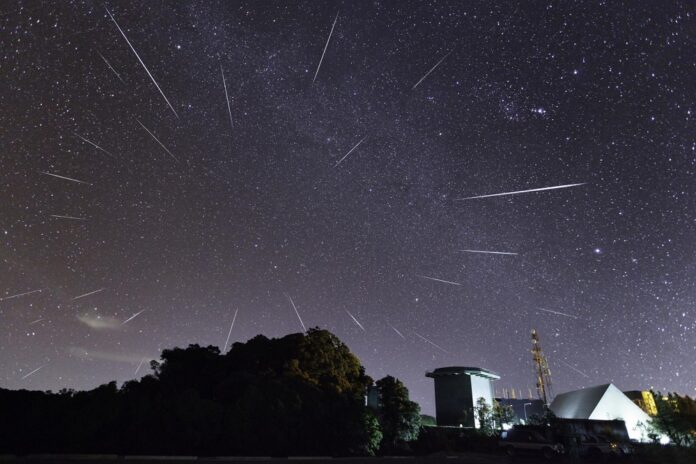
Image: National Astronomical Research Institute of Thailand
BANGKOK — Don’t worry if you missed the New Year Eve’s fireworks, a meteor shower will light up the skies Friday night.
The Quadrantids meteor shower will be visible starting late at night on Friday until the early hours of Saturday, according to the National Astronomical Research Institute.
Astronomers said this year’s annual astronomical phenomenon will fall on a moonless night, so the shower will become more visible with a peaking rate of 120 meteors per hour.
A rendering of the Quadrantids meteor shower between the Capriconus and Boötes constellations. Image: National Astronomical Research Institute of Thailand
Stargazers across the country are advised to turn to the northeast, near the Capriconus and Boötes constellations. The phenomenon can be viewed with the naked eye. However, it’s still best viewed under dark skies away from urban light pollution.
The Quadrantids are a meteor shower that occurs annually around December and January. It is named after the now-obsolete constellation Quadrantids, which was first observed by French astronomer Jerome Lalande in 1795.
It is now part of constellation Boötes following the International Astronomical Union’s modernization of the list in 1922.
Lalisa Manoban at Mqqn Cafe in Bangkok in photos posted to her Instagram on Jan. 2, 2020. Photos: @Lalalalisa_m / Instagram
BANGKOK — Fans of K-pop superstar Lisa Blackpink are fuming Friday at the owner of a cafe visited by the celebrity for making sexually inappropriate comments about her.
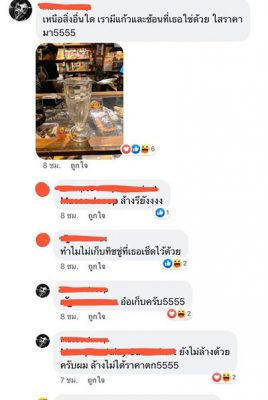
Writing in a public Facebook post, the owner of Mqqn Cafe at Talad Rod Fai Night Market and his friends joked about selling furniture, cutlery, and even the toilet used by Lalisa “Lisa” Manoban after her Thursday visit to his ‘50s-themed diner. They also made graphic references to her body parts. The post soon went viral, drawing condemnation and review bombs from the fans.
“The owner of the MQQN cafe in which lisa had her photoshoot sexually objectified her on Facebook,” @Lilibot wrote in a tweet retweeted more than 3,000 times. “This is beyond unacceptable and that pervert must be punished.”
Lisa posted photos of her visit to the diner on social media platforms on Thursday. As of Friday, #LowClassMqqnCafe is one of the top trending tweets in Thailand.
“Lisa promoted your restaurant, but instead of being grateful, you chose to sexualize her. Your whole business will go downhill now mf take the taste of your own medicine,” @Lilibot wrote.
In comments that have since been deleted, Mqqn Cafe’s owner Masse Jacop said he was selling the sofa Lisa sat on: “Someone inboxed me with an offer of 100,000 baht, but the price isn’t right yet.”
“How much is it to sniff the sofa?” another comment asked, to which Masse replied, “A 1000 baht per sniff, but 100 for friends.”
Another user, Pruch Eakapksawat, went as far as suggesting to sell Lisa’s pubic hair for real estate in Bangkok’s downtown.
“If she went to the bathroom, I would buy the toilet seat too, since I could buy a car with it,” Pruch wrote. “If there’s some hair stuck to it, I could buy some Silom area land.”
Masse replied, “There’s about 10 hairs on it right now, so I’ll have to go get their DNA tested first.”
Masse Jacop writes in comments with friends about selling the glass and spoon Lisa used. Image: Pasta Park Kim / Facebook
After criticism from the fans, Masse initially defended his comments. “If you really read what I wrote, I didn’t harass her at all. Calm down, fans,” he wrote.
He later backtracked and apologized: “I apologize for my bad posts. Sorry to Lisa and everyone involved. I accept all criticism. We all love Lisa. I’m sorry for what happened.”
But his contrition offered little damage control; fans of Lisa have also left multiple negative, 1-star reviews on the cafe’s Wongnai and Facebook pages. Some were also amazed at how the owner had blown away a once-in-a-lifetime opportunity to attract fans of the K-pop supercelebrity to his cafe.
“Fans would’ve wanted to go to the cafe Lisa went to, but the owner seems to be so disrespectful of Lisa and sexually harassing her,” @Allskybykpop tweeted.
Lisa, of Blackpink girl group under YG Entertainment, is one of Thailand’s most popular artists. In December, Time magazine listedher as one of their most influential 100 people.
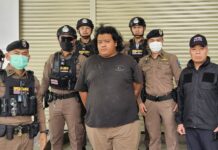
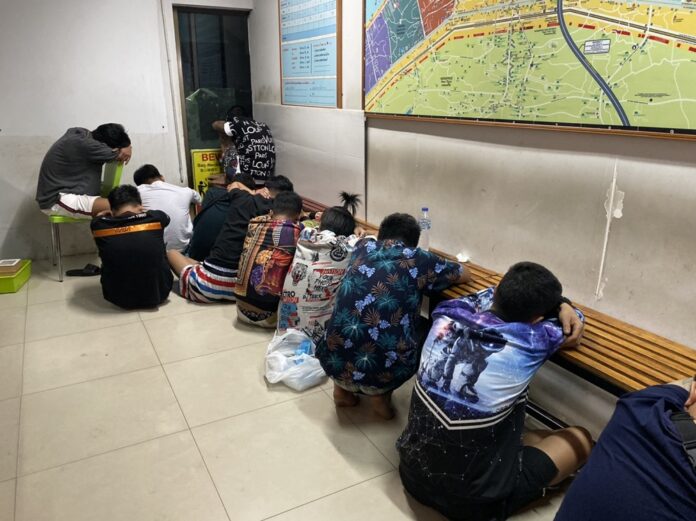
The suspects seen at Pattaya City Police Station on Jan. 2, 2020.
PATTAYA — Police said Friday a group of 20 young men and women were arrested after beating up four jet ski rental operators on the popular island of Koh Lan yesterday.
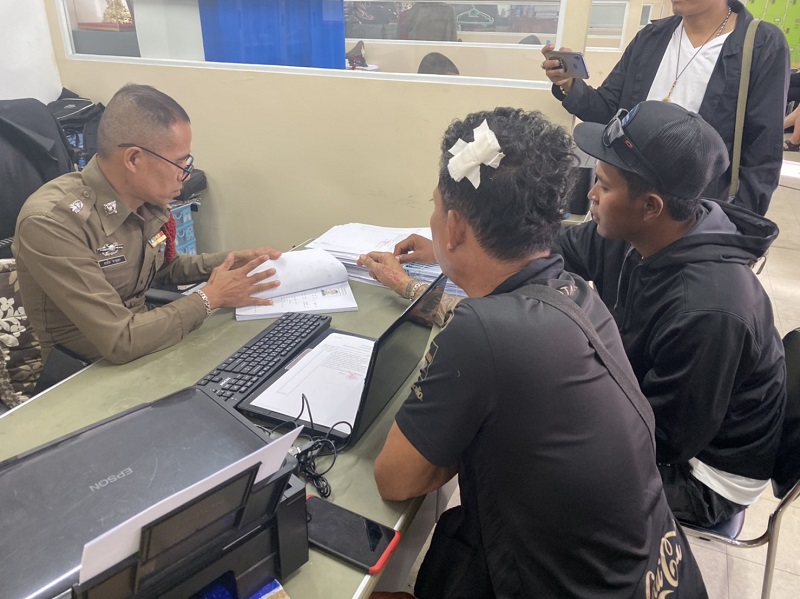
Maj. Chainarong Chai-in of Pattaya Police Station said one of the vendors attacked by the suspects suffered serious injuries while the other three suffered minor wounds. Six male assailants were later charged with physical assault on Friday afternoon, after one of the victims gave his testimony to the police.
The jet ski owner, Jirakrit Chamroenchit, said the group agreed to hire four jet skis from his son while they were sightseeing on Koh Lan on Thursday. But as the payment was still being arranged, some of the men reportedly started posing for photos with the jet skis and tried to ride the vehicles away, according to Jirakit.
Jirakrit said his son rebuked the group and told them to leave the jet skis, prompting them to beat him, who then phoned Jirakrit for help. Jirakrit said he later arrived at the scene with two other men, and they were also attacked by the suspects with wooden sticks and rocks.
Jirakrit said he called police for help after one of his companions were beaten by the youths until he lost consciousness.
Police said 12 men and 8 women in the group were present during the assault, but officers believe six of them were responsible for the attacks.
Although police initially said 19 of the suspects tested positive for drug use, lab results from a hospital showed traces of narcotics in only two of the men, according to the police. The pair was detained along with the men wanted for assaults, while the rest were released without any charges.
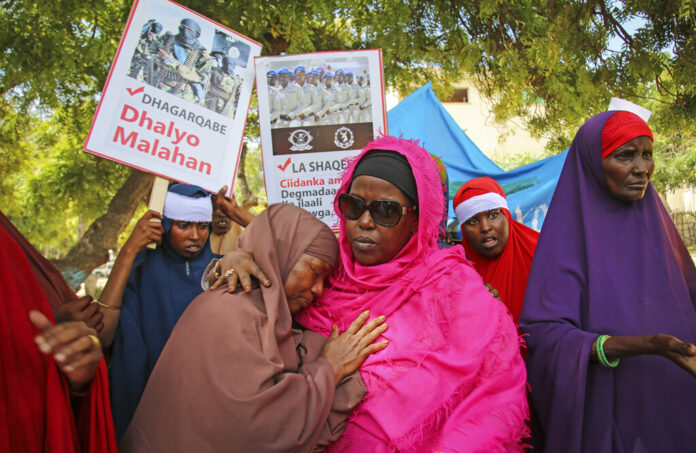
Somali women protest in memory of their relatives who died in Saturday's truck bombing which killed at least 78 people, during a protest to show solidarity with them and against such attacks, in the capital Mogadishu, Somalia, Thursday, Jan, 2, 2020. Placards in Somali read "Evil-doers are not our sons" and "Collaborate with the security forces". Photo: AP
MOGADISHU, Somalia (AP) — Hundreds of mourners and government officials in Mogadishu gathered at the capital’s Police School on Thursday to mourn the 79 people killed by a tragic truck bomb last week.
Somali government officials and residents marched through Mogadishu’s streets to show solidarity with those who lost their loved ones in the bombing that was the country’s biggest and most deadly in two years. Several mourners said that they reject terrorism.
Women and men carried flags and placards denouncing the killings. “Evil-doers are not our sons” and “Collaborate with the security forces” read some of the posters in the Somali language.
Somalia’s al-Shabab Islamic extremist rebels claimed responsibility for the weekend bomb at a busy checkpoint in which many of those killed were university students.
Mogadishu mayor Omar Filish, the mayor of Mogadishu who organized the event, told the crowd that the perpetrators of the attack failed to destroy the spirit of the Somali people and instead increased their anger at the extremist group.
”We will not cry but we will take revenge for the blood of the innocents killed in that truck bomb,” said Filish.
“We need to apprehend the al-Shabaab terrorists in their hiding places and assist each other to fight them,” said Dahir Jesow, a member of Somalia’s parliament. “They are trigger happy. We all need to be soldiers. Let’s promise to unite our fight against them.”
TOKYO (Kyodo) — The Japanese government has been actively promoting teleworking, touting the many merits of it from easing traffic congestion and enhancing disaster preparedness to helping recruit and retain talent amid a chronic labor shortage.
Yet it seems there is a long way to go before many employees can take advantage of the scheme of working from a distance by communicating with their bosses or colleagues via phone, email or chat system on a regular basis.
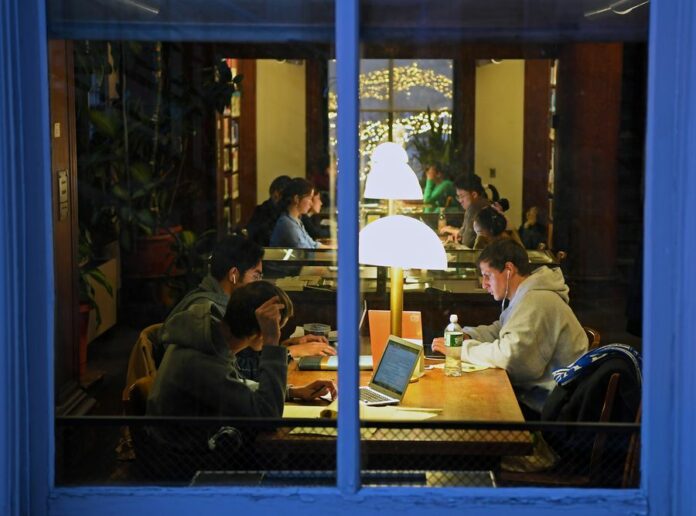
Students study at a library of Columbia University in New York, the United States, on Dec. 7, 2019. (Xinhua/Li Rui)
NEW YORK (Xinhua) — An increasing number of Chinese students have put U.S. visa obstacles, along with social instability and climbing tuition fees, into perspective, and moved on to other global destinations for higher education as well as institutions at home, as industry professionals have observed while looking back at 2019.
“Chinese students’ enthusiasm for American higher education has been dampened by the U.S. administration’s visa policy, which has delayed or denied entries to many of them, especially those aiming for STEM (science, technology, engineering and mathematics) degrees,” said Annabelle Ding, admission representative at Columbia University School of Professional Studies, in a recent interview with Xinhua.
According to the non-partisan think tank Migration Policy Institute (MPI), new international student enrollment at U.S. colleges and universities dropped for the third year in a row, and the number of student visas issued to Chinese applicants went down by 54 percent in fiscal year 2018 from fiscal year 2015. Not incidentally, the United States reportedly saw an increase of only 1.7 percent for Chinese students in fall 2018, the lowest in a decade.
“Recent U.S. policies have affected its image and reputation, obstructed its exchange with other countries, and undermined its own interests,” Chinese Foreign Ministry spokesman Geng Shuang told reporters in November.
“Today, it is all the more important for us to create positive conditions for exchange of students as well as people-to-people ties with an open and inclusive attitude,” Geng said.
Voices Against Visa Policy
Lindsay Zou founded offerbang.io to provide career education for international students and professionals, after dabbling in Wall Street as a financial executive upon completion of her schooling years in New York and Beijing.
“I’ve met Chinese students hurt by visa delay or denial. As a consequence, the upcoming ones are overshadowed. Seeing the hardship of studying and job finding in the United States, they’d rather stay in China for higher education, relinquishing their overseas plans at all,” she said.
Lan Yang just obtained his master’s degree of computer science at Pace University this year and found a job as a product and user interface/user experience manager at Zou’s company. Some of his Chinese friends and classmates were not as lucky as him.
“As I know, you have to wait longer to get your student visa, which worries not only the students themselves but their parents. For those who are still planning their studying trips to the United States, it is an omen clearly spelt – they react in no other way but jump to a conclusion that America is unfriendly toward Chinese students,” he said.
Rachel Banks, director of public policy at NAFSA: Association of International Educators, was recently quoted by The China Press as saying that the U.S. administration’s visa policy and its leaders’ comments were the prime factor that stemmed the influx of international students.
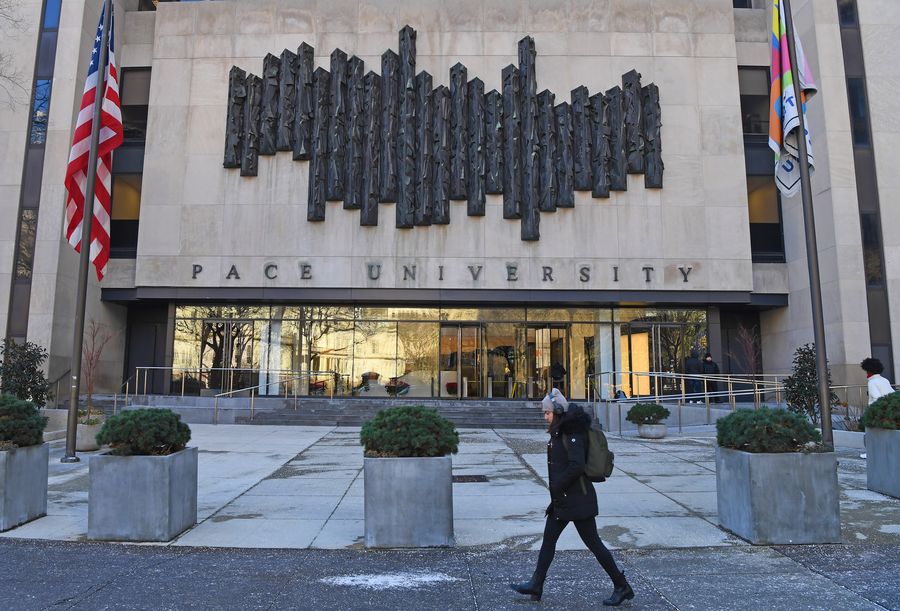
A student walks past a building of Pace University in New York, the United States, on Dec. 19, 2019. (Xinhua/Li Rui)
U.S. President Donald Trump and White House officials have denied such accusations.
Caroline Casagrande, deputy assistant secretary for academic programs in the U.S. Department of State’s Bureau of Educational and Cultural Affairs, told Xinhua at the end of November that “our visa policy is matching our discussion, which is coming from the highest office in the land. The president recently said out of the Oval Office (that) we welcome Chinese students into our universities.”
What Casagrande referred to was Trump’s remarks made on Oct. 11 in the White House — “Our universities are available. The world comes in. They use our universities. We have the greatest system in the world. And China is not going to be treated any differently.”
However, U.S. universities and education organizations picked up a different tone.
“We want the pathway (of coming to the United States) to be very clear and very transparent and very predictable. And what we’re hearing from Chinese students is that’s not always the case,” Brad Farnsworth, vice president of American Council on Education, told Xinhua recently.
Months earlier, top universities like Massachusetts Institute of Technology, Yale University, Harvard University and University of California Berkeley voiced their concern that their government’s visa policy created “toxic atmosphere” and ran counter to their doctrine of openness and transparency. Chinese students were always welcomed by U.S. universities, they added.
For the 10th consecutive year, China remained the largest source of international students in the United States in 2018/19, with 369,548 students in undergraduate, graduate, non-degree, and OPT programs.
International students, making up 5.5 percent of the total U.S. higher education population, contributed 44.7 billion U.S. dollars to the country’s economy in 2018, an increase of 5.5 percent from the previous year, according to the latest data from the U.S. Department of Commerce.
Meanwhile, according to NAFSA’s recent statistics, the consecutive slump of new international students since 2016 has led to a loss of 11.8 billion dollars to the U.S. economy.
“To be frank, it is no more the choice of choices, but one choice of choices for Chinese students to get enrolled at an American university. I recommend that they make dual options for higher education: maybe one is coming to the United States and the other is to other nations, including China itself,” said Ding.
Canada, Australia and China have been catching up in attracting international students, said a report issued in December by the Center for China and Globalization (CCG) at a summit on the internationalization of higher education in Beijing.
According to the report, China now accounts for 10 percent of the world’s total international students, ranking No. 3 on the global charts in this category, and plans to host 500,000 international students at all academic levels by 2020.
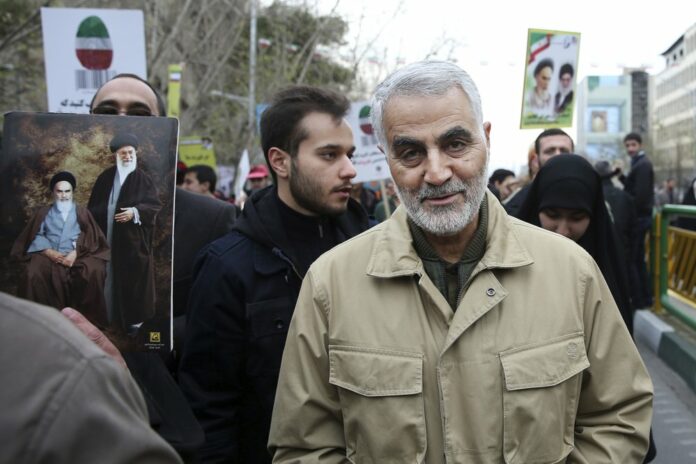
In this Thursday, Feb. 11, 2016, file photo, Qassem Soleimani, commander of Iran's Quds Force, attends an annual rally commemorating the anniversary of the 1979 Islamic revolution, in Tehran, Iran. (AP Photo/Ebrahim Noroozi, File)
BAGHDAD (AP) — The United States killed Iran’s top general and the architect of Tehran’s proxy wars in the Middle East in an airstrike at Baghdad’s international airport early on Friday, an attack that threatens to dramatically ratchet up tensions in the region.
The targeted killing of Gen. Qassem Soleimani, the head of Iran’s elite Quds Force, could draw forceful Iranian retaliation against American interests in the region and spiral into a far larger conflict between the U.S. and Iran, endangering U.S. troops in Iraq, Syria and beyond.
The Defense Department said it killed Soleimani because he “was actively developing plans to attack American diplomats and service members in Iraq and throughout the region.” It also accused Soleimani of approving the attacks on the U.S. Embassy in Baghdad earlier this week.
Iran’s Supreme Leader Ayatollah Ali Khamenei warned that a “harsh retaliation is waiting” for the U.S.
Iranian state TV carried a statement by Khamenei also calling Soleimani “the international face of resistance.” Khamenei declared three days of public mourning for the general’s death.
Also, an adviser to Iran’s President Hassan Rouhani warned President Donald Trump of retaliation from Tehran. “Trump through his gamble has dragged the U.S. into the most dangerous situation in the region,” Hessameddin Ashena wrote on the social media app Telegram. “Whoever put his foot beyond the red line should be ready to face its consequences.”
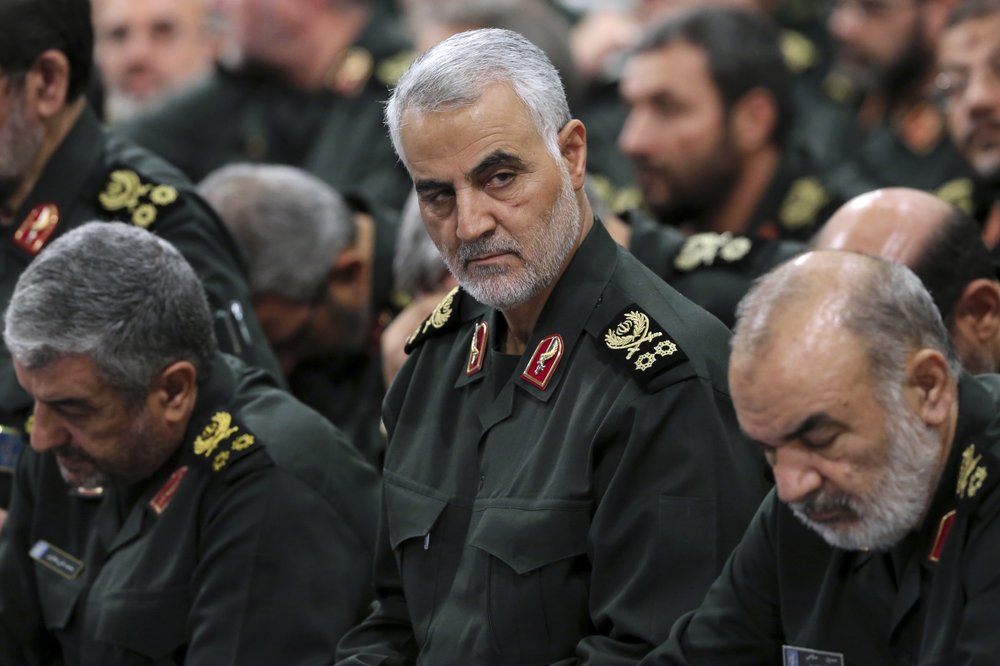
In this Sept. 18, 2016, file photo provided by an official website of the office of the Iranian supreme leader, Revolutionary Guard Gen. Qassem Soleimani, center, attends a meeting in Tehran, Iran. (Office of the Iranian Supreme Leader via AP, File)
Iranian state television later in a commentary called Trump’s order to kill Soleimani “the biggest miscalculation by the U.S.” in the years since World War II. “The people of the region will no longer allow Americans to stay,” the TV said.
The airport strike also killed Abu Mahdi al-Muhandis, deputy commander of Iran-backed militias in Iraq known as the Popular Mobilization Forces, and five others, including the PMF’s airport protocol officer, Mohammed Reda, Iraqi officials said.
Trump was vacationing on his estate in Palm Beach, Florida, but sent out a tweet of an American flag.
The dramatic attack comes at the start of a year in which Trump faces both a Senate trial following his impeachment by the U.S. House and a re-election campaign. It marks a potential turning point in the Middle East and represents a drastic change for American policy toward Iran after months of tensions.
Tehran shot down a U.S. military surveillance drone and seized oil tankers. The U.S. also blames Iran for a series of attacks targeting tankers, as well as a September assault on Saudi Arabia’s oil industry that temporarily halved its production.
The tensions take root in Trump’s decision in May 2018 to withdraw the U.S. from Iran’s nuclear deal with world powers, struck under his predecessor, Barack Obama.
The 62-year-old Soleimani was the target of Friday’s U.S. attack, which was conducted by an armed American drone, according to a U.S. official. His vehicle was struck on an access road near the Baghdad airport.
A senior Iraqi security official said the airstrike took place near the cargo area after Soleimani left his plane and joined al-Muhandis and others in a car. The official said the plane had arrived from either Lebanon or Syria.
Two officials from the PMF said Suleimani’s body was torn to pieces in the attack, while they did not find the body of al-Muhandis. A senior politician said Soleimani’s body was identified by the ring he wore.
The officials spoke on condition of anonymity because they were not authorized to give official statements.
It’s unclear what legal authority the U.S. relied on to carry out the attack. American presidents claim broad authority to act without the approval of the Congress when U.S. personnel or interests are facing an imminent threat. The Pentagon did not provide evidence to back up its assertion that Soleimani was planning new attacks against Americans.
Democratic Connecticut Sen. Richard Blumenthal said Trump owes a full explanation to Congress and the American people. “The present authorizations for use of military force in no way cover starting a possible new war. This step could bring the most consequential military confrontation in decades,” Blumenthal said.
But Trump allies were quick to praise the action. “To the Iranian government: if you want more, you will get more,” tweeted South Carolina Sen. Lindsey Graham.
For Iran, the killing represents more than just the loss of a battlefield commander, but also a cultural icon who represented national pride and resilience while facing U.S. sanctions. While careful to avoid involving himself in politics, Soleimani’s profile rose sharply as U.S. and Israeli officials blamed him for Iranian proxy attacks abroad.
While Iran’s conventional military has suffered under 40 years of American sanctions, the Guard has built up a ballistic missile program. It also can strike asymmetrically in the region through forces like Lebanon’s Hezbollah and Yemen’s Houthi rebels. The U.S. long has blamed Iran for car bombings and kidnappings it never claimed.
As the head of the Quds, or Jersualem, Force of Iran’s paramilitary Revolutionary Guard, Soleimani led all of its expeditionary forces and frequently shuttled between Iraq, Lebanon and Syria. Quds Force members have deployed into Syria’s long war to support President Bashar Assad, as well as into Iraq in the wake of the 2003 U.S. invasion that toppled dictator Saddam Hussein, a longtime foe of Tehran.
Soleimani rose to prominence by advising forces fighting the Islamic State group in Iraq and in Syria on behalf of the embattled Assad.
U.S. officials say the Guard under Soleimani taught Iraqi militants how to manufacture and use especially deadly roadside bombs against U.S. troops after the invasion of Iraq. Iran has denied that. Soleimani himself remains popular among many Iranians, who see him as a selfless hero fighting Iran’s enemies abroad.
Soleimani had been rumored dead several times, including in a 2006 airplane crash that killed other military officials in northwestern Iran and following a 2012 bombing in Damascus that killed top aides of Assad. Rumors circulated in November 2015 that Soleimani was killed or seriously wounded leading forces loyal to Assad as they fought around Syria’s Aleppo.
Soleimani’s killing follows the New Year’s Eve attack by Iran-backed militias on the U.S. Embassy in Baghdad. The two-day embassy attack, which ended Wednesday, prompted Trump to order about 750 U.S. soldiers deployed to the Middle East.
It also prompted Secretary of State Mike Pompeo to postpone his trip to Ukraine and four other countries “to continue monitoring the ongoing situation in Iraq and ensure the safety and security of Americans in the Middle East,” State Department spokeswoman Morgan Ortagus said Wednesday.
The breach at the embassy followed U.S. airstrikes Sunday that killed 25 fighters of the Iran-backed militia in Iraq, the Kataeb Hezbollah. The U.S. military said the strikes were in retaliation for last week’s killing of an American contractor in a rocket attack on an Iraqi military base that the U.S. blamed on the militia.
U.S. officials have suggested they were prepared to engage in further retaliatory attacks in Iraq.
“The game has changed,” Defense Secretary Mark Esper said Thursday, telling reporters that violent acts by Iran-backed Shiite militias in Iraq — including the Dec. 27 rocket attack that killed one American — will be met with U.S. military force.
___
Karam reported from Beirut. Associated Press writers Robert Burns and Zeke Miller in Washington, Jon Gambrell in Dubai, United Arab Emirates, Nasser Karimi in Tehran, Iran, and Bassem Mroue in Beirut contributed reporting.
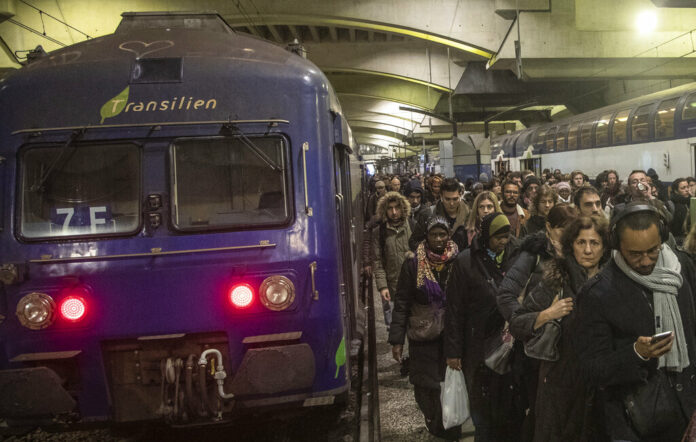
Commuters arrive at at Gare Montparnasse train station during the 29th day of transport strikes in Paris, Thursday, Jan. 2, 2020. The start of 2020 was the second New Year celebration in a row where Macron has faced social upheaval. Photo: Michel Euler / AP
PARIS (AP) — With 29 straight days of walkouts, French rail strikes against government plans to reform France’s retirement system marked a new milestone Thursday, surpassing even the lengths of strikes in the 1980s.
The nationwide walkouts against the government’s pension plans started Dec. 5. On Thursday, they surpassed a 1986-1987 rail strike in longevity, a walkout that lasted 28 days at the SNCF national rail company.
The current strikes have crippled train and metro services in Paris and across the country over the Christmas-New Year period and continue to cause severe disruptions.
The SNCF said half of its vaunted high-speed trains weren’t running on Thursday. Only two automated lines were running normally in the Paris Metro, with services spotty or non-existent across the rest of the network.
Unions are gearing up for further walkouts next week, when French schools reopen and negotiations are set to resume with the government.
In atelevised New Year address on Tuesday, French President Emmanuel Macron reaffirmed his commitment to the pension overhaul but urged his government to “find the path of a quick compromise” with unions.
Macron stayed firm on the principles of the reform, including its most decried measure: raising the eligibility age for full pensions from 62 to 64. He insisted the new system will be fairer to all French workers and will be financially sustainable. The plan aims to unite dozens of separate pension systems into one and eliminate special deals that let some French transit workers retire in their 50s.