Having heard about the latest health trend to arrive in Bangkok, I schlepped over to a Thonglor mall to see what “broth bars” are really all about – but ended up wowed over by their healthy version of Thai street food.
Genius Bar, located in Eight Thonglor mall on the street and number of the same name, claims to be the first-ever broth bar in Thailand and all of Asia. Found in the likes of Vancouver, New York, Maastricht, and so on, broth bars serve stewed broth, often in a to-go cup, and claim to have health benefits.
“If we want to make a million a month, we would have opened up a bubble tea shop,” the friendly owner owner Chinese-Canadian Darren Liu said. Liu, 33, looks to be 25. He attributes that to not just adequate eight-hour sleep and good regular exercise but healthy organic food, and says he eats his meals at Genius Bar every day.
Liu, a certified health coach is gaga about the various broths at his five-month old bar on Thonglor and will happily explain the benefits of of the three 18-hour-simmered broths on offer: beef, chicken, and mushroom broth, all 135 baht for a small cup, 175 baht for a large.
His beef broth, for example, is made from organic grass-fed beef bones, which makes the soup high in collagen and amino acids. My personal favorite was the vegetarian broth made from five different mushrooms such as shiitake, cordyceps, and agaricus as well as medicinal Chinese herbs such as dong quai, which made the light, slightly medicinal broth
Whether you order vegetarian (150 baht for a small cup), chicken (also 150 baht for a small cup) or beef broth, they are all organic. Beef broth comes from grass-fed cow bones while chicken’s from free-range chicken.
The taste of the chicken broth was too mild for me, and Liu suggested that tumeric, ginger, garlic, and cilantro can be added in to spice up any broth (15 baht).
Darren Liu poses for photos at Genius Bar
Vegetables used at Genius Bar all come from a farm owned by his Thai fiancé. For ingredients that can’t be grown or raised at the farm, Liu ordered it from reputable sources to make sure, for example, that grass-fed beef means fully grass-fed beef and not partially.
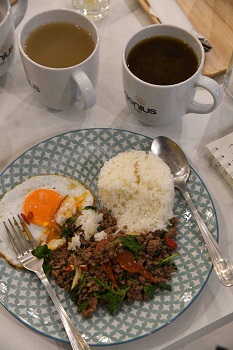
That’s partly why his beef krapao with fried organic duck egg is surprisingly good. I ordered one (200 baht) and it was one of the best and not oily krapaoI had in a very long time and itself worth visiting for.
Instead of using cheap vegetable oil to cook the dish, Liu’s cook uses beef broth – cooking the beef in its own broth beefs up the flavor, pun intended. Instead of MSG, oyster sauce, or soy sauce, they use extra-virgin olive oil and pink sea salt.
A generous handful of organic holy basil was mixed into the krapao, topped with a fried organic free-range duck egg which is more orange-colored compared to chicken egg and richer in taste. After all, man can’t live on broth alone.
The restaurant, a small glass house-like structure, is often full of regulars, usually expats. Newbies should feel welcome to ask Liu for health tips or for in-depth nutritional info: going to Genius Bar is like visiting a life coach while picking up a healthy lunch.
Get a midday workout in by doing squats to get a discount – one squat for a one-baht discount, capped at 50 squats.
Pro tip: to really get a lecture from Liu, ask him why a vegan diet might not be for you.
Genius Bar is located on the LG floor at Eight Thonglor, Thonglor Soi 8, Sukhumvit 55. It opens daily from 10am to 8pm and is a walkable distance from BTS Thong Lo.
Food was paid by the reviewer except the complimentary beef broth Liu insisted upon.
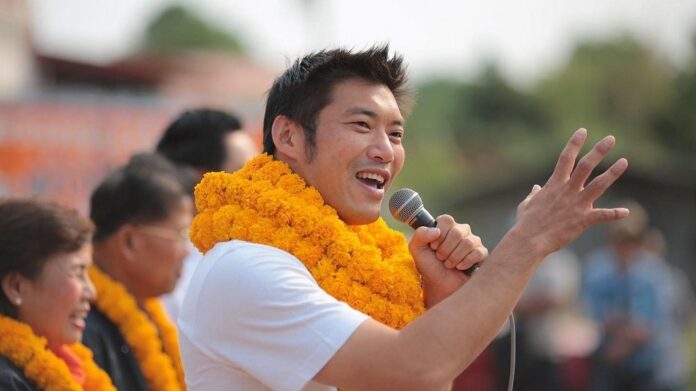
A file photo of Future Forward Party leader Thanathorn Juangroongruangkit campaigning in March 2019.
BANGKOK — Deputy Prime Minister Prawit Wongsuwan said Tuesday he is not worried about the potential protest for the upcoming court verdict that would decide the political career of Future Forward Party leader Thanathorn Juangroongruangkit.
A day after coalition politicians warned Thanathorn’s supporters against a demonstration, Prawit said the authorities have not found any credible threats of violence that could follow the Constitutional Court’s ruling on whether Thanathorn breached election laws. If found guilty, he faces up to 10 years in prison.
“It’s a matter of the judiciary. I believe there’s nothing to be worried about,” Prawit said. “It’s normal for people to turn up at the court to support him.”
Future Forward spokeswoman Pannika Wanich also announced Monday that Thanathorn has sued all the seven election regulations on charges of malfeasance. The Election Commissioners have accused Thanathorn of violating voting lawsby owning shares in a media firm called V-Luck Media.
But Thanathorn said they had rushed to submit the case to the Constitutional Court without due process, bypassing a key witness testimony. Thanathorn said such procedure is required by law before the Commissioners could press a legal action against him.
Thanathorn also said that there was no evidence that he had committed the offense as he has already sold the shares on Jan. 8.
However, Thanathorn’s critics cast doubt on his claim, pointing to his campaign schedule which shows that he was not in Bangkok on that day.
The court will deliberate on Dec. 3 whether to hear Thanathorn’s lawsuit.
The law which the Election Commissioners used against Thanathorn prohibits MPs from holding shares in media companies. If found guilty, Thanathorn faces up to 10 years in prison. He may also be banned from politics for a maximum of 20 years.
He has repeatedly denied the allegations, saying he already sold those shares by the time he signed up to run for office.
BANGKOK — Thai government said it pledged further cooperation with the armed forces of the United States and China this week.
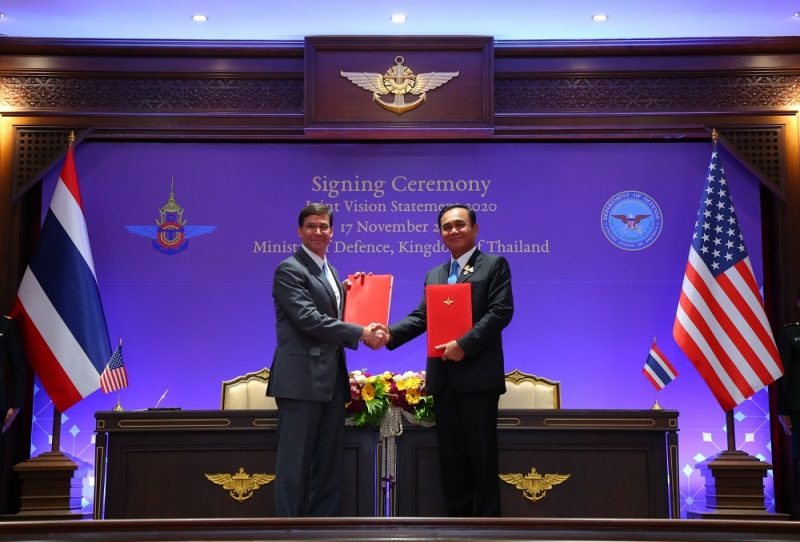
PM Prayuth Chan-ocha on Sunday signed a US-Thailand Joint Vision Statement, promising a deeper tie in accordance with so-called 20 Year National Policy implemented by the former junta regime. Prayuth also announced similar plans to boost military cooperation with the Chinese government.
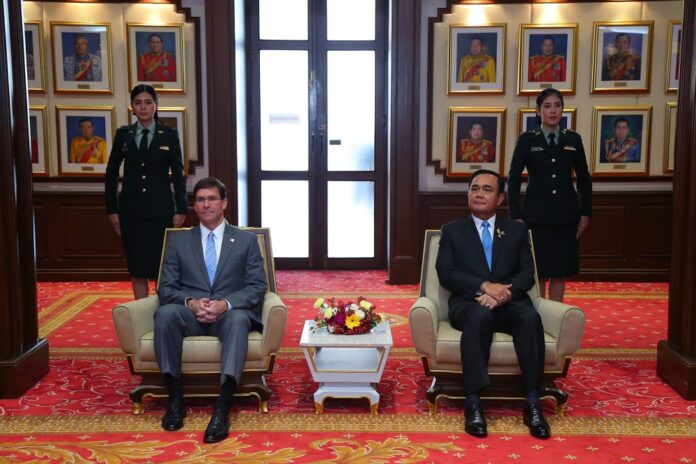
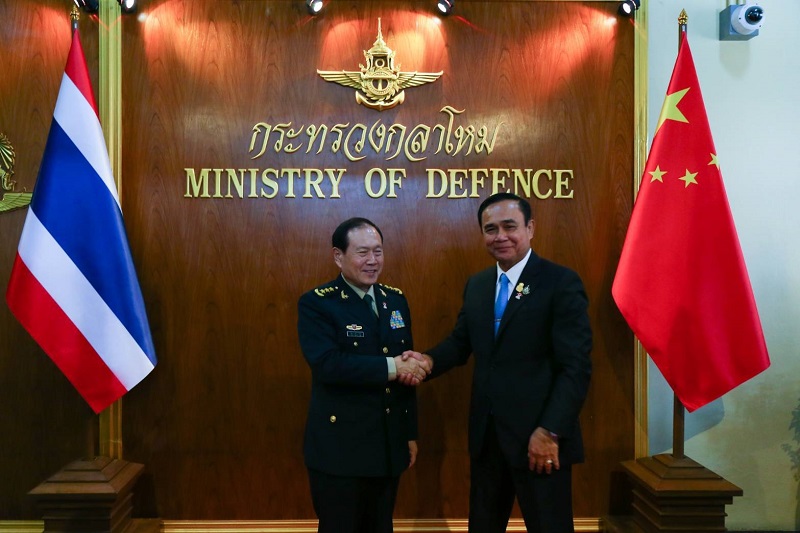
Prayuth, who doubles as Minister of Defense, unveiled the two plans in separate meetings with US Secretary of Defence Mark Esper and Chinese Defense Minister Wei Fenghe.
PM Prayuth Chan-ocha and US Secretary of Defence Mark Esper sign a new defence treaty on Nov. 17, 2019, in Bangkok.
The announcement came at a time Prayuth faces scrutiny from some critics for his perceived over-reliance on China for its military and economic prowess. The Prime Minister was recently ridiculed by his opponents after comparing Thailand to an “ant” in a joint news conference with Chinese PM Li Keqiang on Nov. 6.
In the US-Thailand Joint Vision Statement signed on Sunday, the two nations affirms a commitment to “the long-term advancement of mutual interests and shared values while also promoting security cooperation capable of deterring or acting decisively to meet the shared challenges of the future.”
PM Prayuth Chan-ocha meets Chinese Defense Minister Wei Fenghe on Nov. 17, 2019, in Bangkok.
PM Prayuth also said he “adheres to the one-China policy and is willing to actively participate in the Belt and Road Initiative” in a meeting with Gen. Wei, according to a report by Chinese state media Xinhua.
Cooperation would include support in equipment and technology, joint exercises ,and joint training.
Prayuth’s government recently acquired military hardware from both US and China; 10 US-made Stryker armored vehicles were delivered to the Thai army in September, while the Thai navy bought a fleet of landing ships from the People’s Republic.
The Fourth World Media Summit Presidium Meeting is held in Shanghai, east China, Nov. 18, 2019. Senior executives of 13 media organizations from 11 countries attended the meeting themed on "New Era, New Media and New Vision". (Xinhua/Li Xiang)
SHANGHAI (Xinhua) — Cai Mingzhao, executive president of the World Media Summit (WMS) and president of Xinhua News Agency, on Monday called for active innovation from media organizations around the world to cope with the profound changes in the global media landscape caused by mushrooming new technologies, mechanisms and applications.
He made the remarks at the fourth meeting of the WMS presidium held in Shanghai.
Senior executives of 13 media organizations from 11 countries, namely, the Agence France-Presse (AFP), Al Jazeera Media Network, the Associated Press, BBC, Kyodo News, Naspers South Africa, Reuters, Folha de S. Paulo Press Group of Brazil, International News Agency and Radio Sputnik, TASS Russian News Agency, the Hindu Group, Xinhua and ANSA, attended the meeting.
Cai, who presided over the meeting, said changes in the media landscape are mainly reflected in four aspects: cross-border communications have transformed the media landscape; mobile end users business has become mainstream in the field of communication; technological evolution has recast modes of business for news industry; fake news posts challenges to journalism ethics.
Cai Mingzhao, executive president of the World Media Summit (WMS) and president of Xinhua News Agency, presides over and delivers a keynote speech at the fourth meeting of the WMS presidium in Shanghai, east China, Nov. 18, 2019. (Xinhua/Li Xiang)
Regarding the development and innovation of media in the future, Cai proposed that mainstream media should keep their advantages in content, innovate news products, strengthen technological leadership, and build an all-media team.
He said Chinese media have proposed to advance the integration of traditional and new media, conduct a systematic transformation of all links of news dissemination, and work hard to realize the media’s integrated development.
“Amid the tides of media transformation, we cannot reverse the flow of this great river. We can only go with the flow, be proactive about innovations, and take the initiative with our development,” he said.
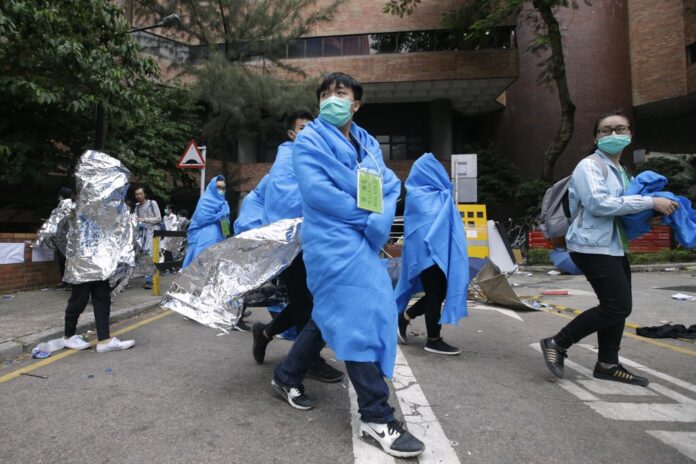
Injured protesters wrapped in blankets, walk through the campus of the Hong Kong Polytechnic University in Hong Kong, Tuesday, Nov. 19, 2019. (AP Photo/Achmad Ibrahim)
HONG KONG (AP) — About 100 anti-government protesters remained holed up at a Hong Kong university Tuesday, unsure what to do next as food supplies dwindled and a police siege of the campus entered its third day.
City leader Carrie Lam said 600 people had left the Hong Kong Polytechnic campus, including 200 who are under 18 years old.
Police have surrounded the university and are arresting anyone who leaves. Groups of protesters made several attempts to escape Monday, including sliding down hoses to waiting motorcycles, but it wasn’t clear if they evaded arrest.
Lam said those under 18 would not be immediately arrested but could face charges later. She said the other 400 who have left have been arrested.
“We will use whatever means to continue to persuade and arrange for these remaining protesters to leave the campus as soon as possible so that this whole operation could end in a peaceful manner,” she said after a weekly meeting with advisers.
After five months, the Hong Kong protest movement has steadily intensified as local and Beijing authorities harden their positions and refuse to make concessions. China took control of the former British colony in 1997 promising to let it retain considerable autonomy, but the protest movement was fueled by the belief those freedoms are being eroded.
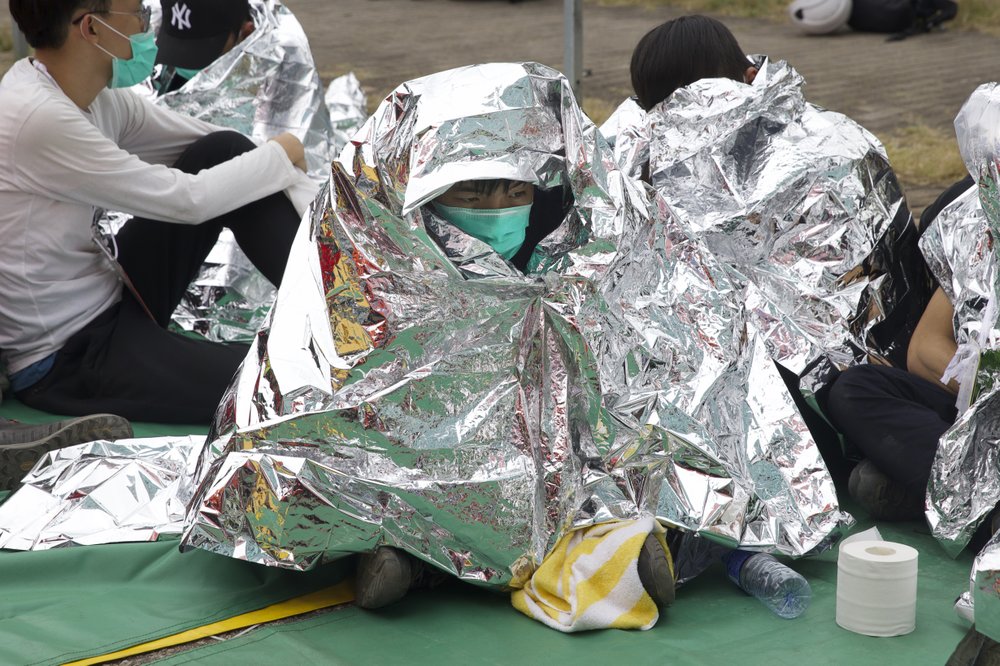
An injured youth sits under a space blanket at a casualty evacuation point near Hong Kong Polytechnic University in Hong Kong, Tuesday, Nov. 19, 2019. (AP Photo/Ng Han Guan)
Universities became the latest battleground last week, as protesters occupied several campuses, using gasoline bombs and bows and arrows to fend off riot police backed by armored cars and water cannon. Those at Polytechnic are the last holdouts.
One protester, who would not appear on camera, said he had no plan and is waiting for someone to come to help. Another said he wants to leave safely but without being charged. They would not give their full names out of fear of arrest.
Protesters milled about in small groups. Family members and teachers arrived sporadically to pick up those under 18, hugging their children before walking back to a police checkpoint, where officers recorded names and other information before letting them go.
The Japanese government said one of its citizens had been arrested near the Polytechnic campus. Japanese media identified him as Hikaru Ida, a student at Tokyo University of Agriculture. Officials did not say why he was arrested.
Hong Kong also got a new police chief, Chris Tang, who said rebutting accusations against police that he called “fake news” and reassuring the public about the force’s mission would be among his priorities.
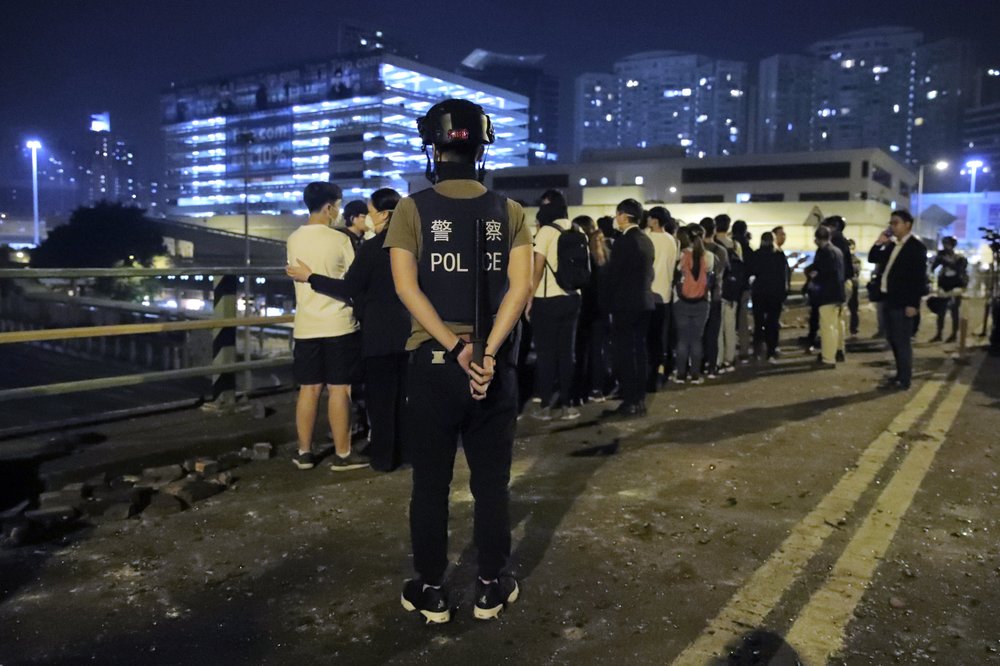
A riot policeman watches over a group of detained people on a bridge in Hong Kong, early Tuesday, Nov. 19, 2019. (AP Photo/Kin Cheung)
“We have to maintain the law and order in Hong Kong and there is a massive scale of breaking of law in Hong Kong and there is a certain sector of the community that also condones those illegal activities,” he told journalists. Tang replaces a retiring chief and was selected by Beijing after being nominated by Lam’s government.
Lam, asked whether she would seek help from Chinese troops based in Hong Kong, said her government remains confident it is able to cope with the situation.
China hinted it might overrule the Hong Kong’s high court ruling on Monday to strike down a ban on face masks that was aimed at preventing protesters from hiding their identity to evade arrest.
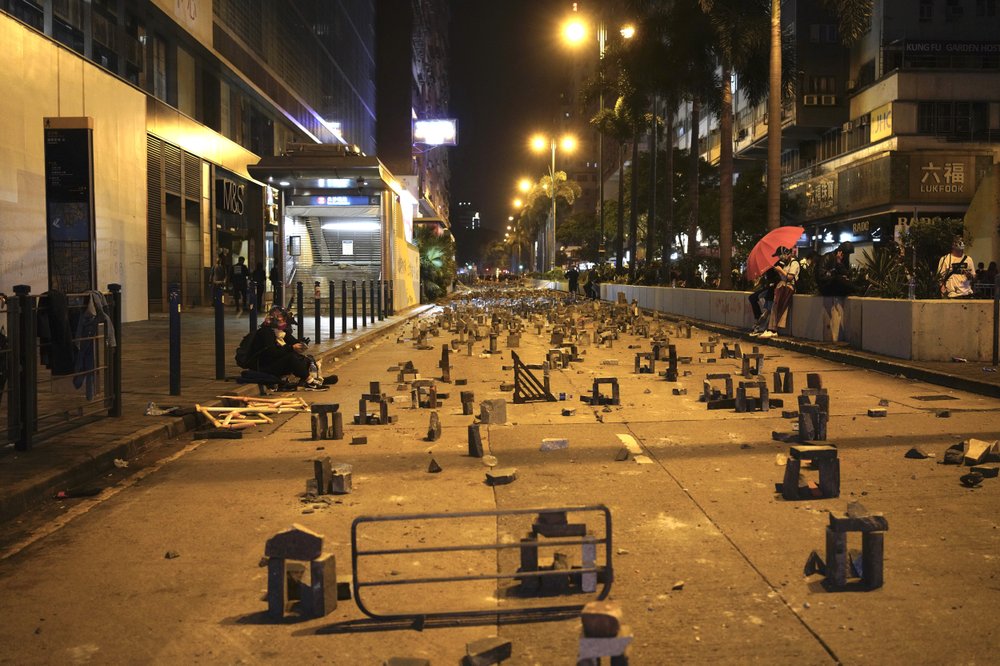
Protestors rest near a road barricaded with bricks in Hong Kong, early Tuesday, Nov. 19, 2019. (AP Photo/Vincent Yu)
A statement from the National People’s Congress’ Legislative Affairs Commission said the decision doesn’t conform with territory’s constitution, known as the Basic Law, or decisions by the Congress.
“We are currently studying opinions and suggestions raised by some NPC deputies,” the statement said.
Monday’s ruling said the ban infringes on fundamental rights more than is reasonably necessary. The ban has been widely disregarded.
___
Associated Press journalists Alice Fung and Dake Kang contributed to this report.
WASHINGTON (Xinhua) — Giant pandas are a symbol of great partnership and friendship between the United States and China and the two sides’ knowledge-sharing and collaboration have made a great contribution to the species’ conservation, the U.S. National Zoo’s director has said.
Steven Monfort, director of the Smithsonian’s National Zoo and Conservation Biology Institute, made the remarks during a recent interview with Xinhua, before U.S.-born giant panda Bei Bei’s departure from the zoo to China, scheduled for Tuesday.
The Smithsonian’s National Zoo in Washington D.C., also known as the U.S. National Zoo, received its first pair of giant pandas in 1972 as a gift from the Chinese government to mark the groundbreaking progress made in bilateral relations that year.
The arrival of the giant pandas at the zoo, which came several years earlier than the two nations officially established diplomatic ties, “was a very important symbol,” said Monfort.
“It was an opening and it was a way to increase awareness and understanding between our two countries,” he said. “In my mind, I can’t think of any other animal, any other wildlife species that has had such an important diplomatic position.”
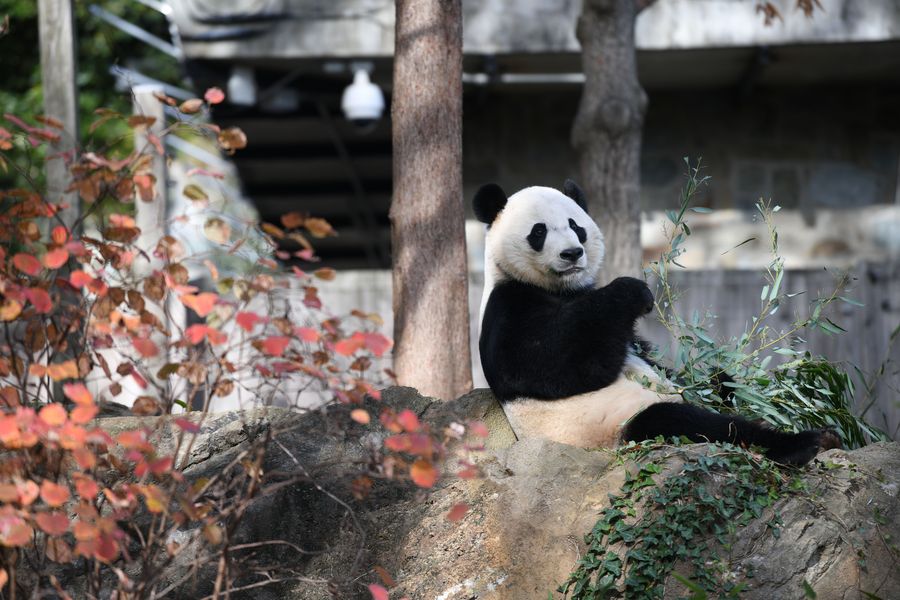
U.S.-born male giant panda Bei Bei is seen at the Smithsonian’s National Zoo in Washington D.C., the United States, on Nov. 11, 2019. (Xinhua/Liu Jie)
Over the years, giant pandas have also become a symbol for the National Zoo, as almost every visitor here comes to see the black-and-white fur balls, according to Monfort. Besides Bei Bei, his mother Mei Xiang and father Tian Tian also live in the zoo.
“They are a tremendous symbol for us,” the zoo director said. “They represent the magnificence of nature, people’s curiosity about wildlife and about nature.”
Monfort also believes the giant pandas are bringing more attention to the nature thanks to their popularity.
“While you’re here, you learn so much about all of the rest of the animals that we care for. We hope to inspire curiosity about nature and to draw people closer to nature so that they can care about it,” he said.
While speaking of the zoo’s cooperation with its Chinese partners, Monfort sounded very proud.
“If you think about it 47 years ago, neither country knew very much about pandas at that time,” he said. “The truth is we’ve grown our knowledge about the giant panda working together.”
The two sides are collaborating closely and extensively on the species’ preservation, health, nutrition, and reproduction, while studying how climate change might impact the design of giant panda reserves and technology for tracking them in the wild, among other things, according to the zoo chief.
“It’s a very extensive scientific collaboration that is everything from studying the individual animal and their health and their wellbeing all the way to understanding the ecosystems that they live in, the reserves where they live and training the next generation of professionals who will care for them and study them long into the future,” Montfort said.
“We are close friends with many of these people we’ve worked with,” he said. “I think we have excellent collaborative relationships on science, on training and we have friendships that have existed for decades. It’s something that we are very proud of.”
U.S.-born male giant panda Bei Bei is seen at the Smithsonian’s National Zoo in Washington D.C., the United States, on Nov. 11, 2019. (Xinhua/Liu Jie)
Giant pandas, dubbed China’s national treasure, mainly live in Southwest China’s Sichuan Province as well as neighboring provinces of Shaanxi and Gansu.
The latest census in 2014 found there were 1,864 giant pandas alive in the wild, up from 1,114 decades ago. The number of pandas bred in captivity has reached 600 globally, China’s National Forestry and Grassland Administration announced earlier this month.
“It’s been a big success on both fronts, on both understanding the biology and sustaining the diversity of animals in human care, but also in sustaining animals in the wild,” said Monfort, adding that the population structure is very healthy, which means there will be giant pandas available to be reintroduced to the wild.
Despite the notable increase, the giant panda population remains vulnerable to threats from disease, climate change, and habitat loss.
Monfort agreed that it is imperative for the U.S. and Chinese sides to continue their productive relationship for a greater success in preserving giant pandas.
“Success means that we will have multiple free living populations that are sustaining and sustainable in terms of their reproduction and their health,” he said. “We still have a long way to go before we achieve that goal. But the trends are moving in the right direction.”
The currently-running cooperative breeding agreement was signed in 2000 between the National Zoo and the China Wildlife Conservation Association, initially with a 10-year term. After two five-year extensions, it will expire at the end of 2020.
Monfort said the National Zoo is “very interested in continuing this great relationship” and that he hopes discussions about how they can move forward onto the next phase of the agreement could begin early next year.
“We’ve been 47 years working together on giant pandas and we hope that we can work for another 50 years or more,” he stressed.
Bei Bei’s departure is in line with the terms of the agreement that requires all cubs born at the National Zoo be sent back to China after their fourth birthday.
Bei Bei turned four on Aug. 22. He will enter the breeding program when he reaches sexual maturity between five and seven years old.
Monfort said they are sad that Bei Bei is about to leave because the National Zoo has built a special relationship with him.
“Our animal keepers, they quite literally fall in love with these animals. But they also know that he plays a very important role in conservation. So we’re quite proud that he’s going to play that role,” the director said.
“If I could speak to him, I’d say: go forward and be a good sire, have many offsprings, be healthy and help contribute to the future of giant pandas in the wild,” he added.
In this Saturday, Oct. 19, 2019, photo, a Catholic devotee kisses a sacramental with an image of the seven martyrs at cemetery during the 30th anniversary of the beatification of seven martyrs at Songkhon in Mukdahan province, northeastern of Thailand. (AP Photo/Sakchai Lalit)
SONGKHON, Thailand (AP) — When Pope Francis makes his first trip to Thailand this week, he will be visiting a country that welcomed Roman Catholic missionaries more than five centuries ago and whose Buddhist population remains strikingly tolerant of other religious beliefs.
But in 1940, as militarism and xenophobia were haunting the world, seven Catholic villagers in remote northeastern Thailand were executed for refusing to renounce their religion.
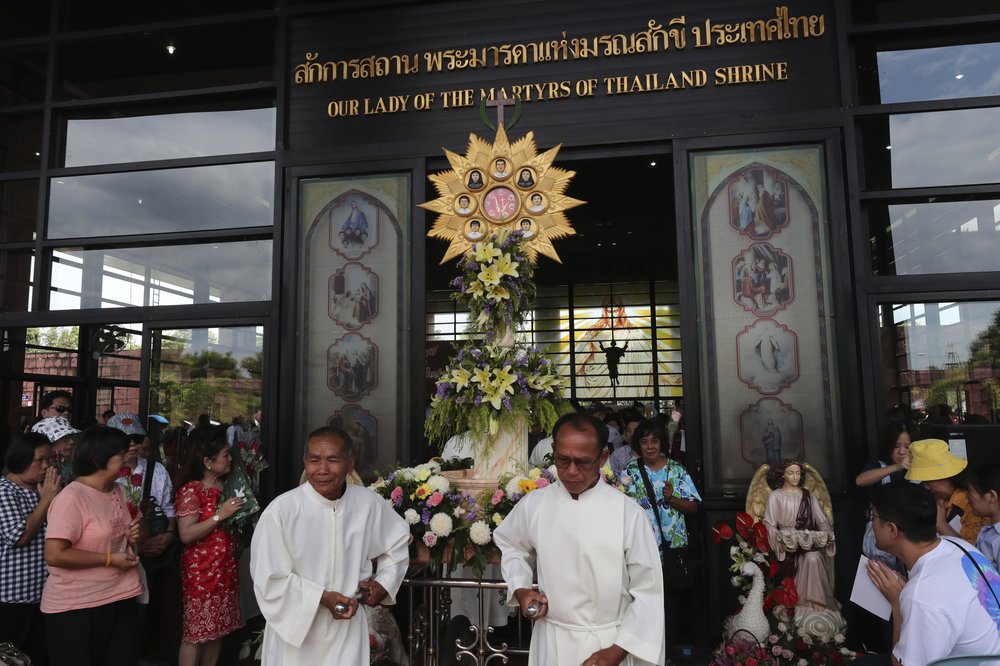
The “Seven Martyrs” were beatified by Pope John Paul II in 1989, making them eligible for eventual sainthood. They were the first Thais to be given the honor by the Vatican. The date of their beatification, Oct. 22, is marked annually in this village where they died, where there is a shrine and educational center for Catholics that is a regional landmark.
“For our history, we should not repeat the bad part but we should use it as a lesson, to move on, to build a new religious history, to bring all Thais together as brothers and sisters,” the Rev. Prayoon Phongphit, chancellor of the region’s archdiocese, said at this year’s ceremony.
The little-known story of the seven martyrs is more a political than religious tale.
In this Saturday, Oct. 19, 2019, photo, Catholic devotees pulling a pedestal with images of the seven martyrs at Christ Church, Songkhon village, Mukdahan province, northeastern of Thailand. (AP Photo/Sakchai Lalit)
They were victims of a tide of nationalism, an opportunistic policy implemented by Thailand’s then-dictator to avenge slights from Western powers while modernizing the country on a Western model. The Western model it most closely resembled was Mussolini’s fascist Italy.
Thailand fended off being colonized by placating the neighboring colonial powers, Britain and France, with territorial and economic concessions. France whittled away at territory Thailand considered its own, annexing it to its French Indochina colonies of Laos and Cambodia.
Plaek Phibunsongkhram was one of the Thai army officers who in 1932 staged a revolution ousting an absolute monarch with the aim of modernizing the country. In 1938, he became prime minister and promoted the sort of ultranationalism then seen in Italy and Nazi Germany, seeking to expunge minority cultures with their languages and religions and unite all behind loyalty to king and nation and one religion, Buddhism.
Phibunsongkhram’s rise coincided with Japan’s military drive to build a Great East Asia empire. The Japanese promoted Asian chauvinism, an appeal to the people in British, French and Dutch colonies to throw off the yoke of their Western oppressors.
Events elsewhere, meanwhile, suggested that nationalistic strongman rule was the wave of the future, as the army of Japanese ally Germany overran most of Europe.
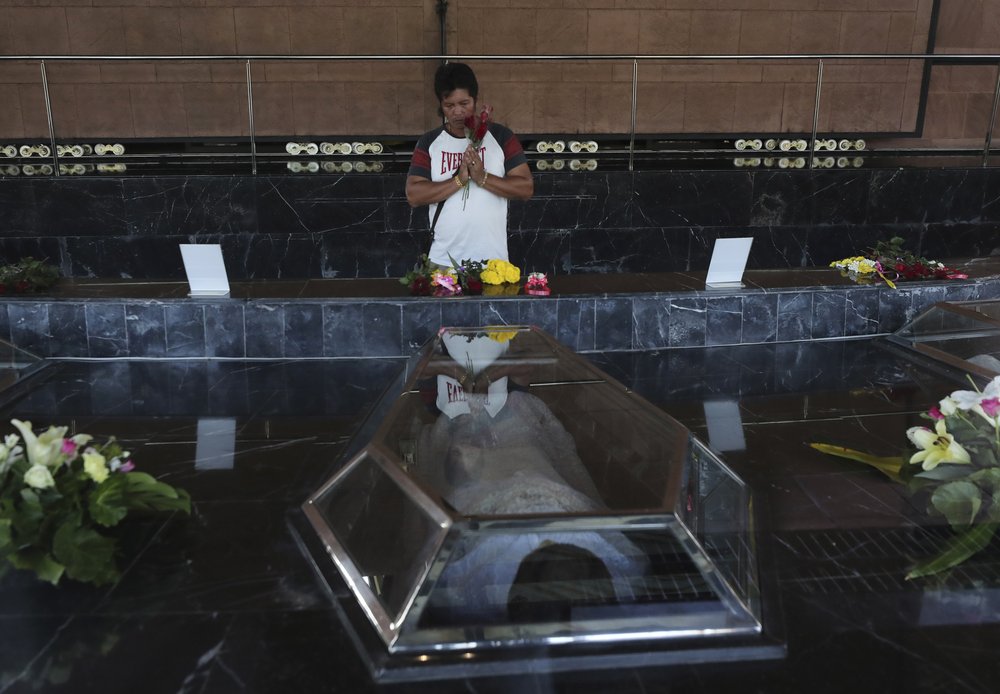
In this Friday, Oct. 18, 2019, photo, a Catholic devotee prays in front of glass caskets containing the seven replicas of the Blessed Martyrs for Christians at the Christ Church in Songkhon village in Mukdahan province, northeastern Thailand. (AP Photo/Sakchai Lalit)
An emboldened Phibunsongkhram had Thailand attack the demoralized French forces in Laos and Cambodia in a bid to regain what he considered lost Thai territories.
To whip up support for the war, all things French were painted as threatening. Inside Thailand, French missionaries — and their churches and followers — were looked upon as the enemy within. Propaganda and policy were both used to try to purge the Catholic presence, mainly by forcing conversions to Buddhism and shuttering church properties.
“Catholics were the perfect symbol of imperialism and antithesis of national identity due to their association with France, their history of political intervention, and the fact that many converts were ethnic minorities,” Shane Strate, a history professor at Kent State University in the United States, wrote in a paper about the era.
Songkhon village in Mukdahan province, 550 kilometers (340 miles) northeast of Bangkok, was one of several Catholic settlements in the area. With a population of 500-600, it had a church, a church school, a French parish priest and two sisters from a convent in Laos, which lies just across the Mekong River from the province.
Six policemen were deployed to the village after Thailand attacked French Indochina in November 1940, and the officer in charge , Boonlue Muangkote, enforced the new nationalist order avidly. As villagers were pressured to renounce their Catholic faith and embrace Buddhism, the French priest, Father Paul Fige, was deported to Laos.
Boonlue pressed his campaign, apparently assuming the absence of their priest would break the villagers’ will. But Philip Siphong Onphitak, the village religious teacher, or catechist, assumed leadership of his flock, keeping up resistance until Dec. 16, when he was murdered in the jungle, reportedly by Boonlue.
In this Friday, Oct. 18, 2019, photo, Catholic devotees pray at the Blessed Martyrs for Christians cemetery during the 30th anniversary of the beatification of seven martyrs at Songkhon village in Mukdahan province, northeastern Thailand. (AP Photo/Sakchai Lalit)
Two sisters from the Lovers of the Holy Cross Congregation, Agnes Phila and Lucia Khambang, then took over the leadership, defying Boonlue’s increasingly strident demands to convert. After they failed to yield during a Dec. 22 showdown, they decided they were ready to die for their faith.
On Christmas night, Sister Agnes wrote a letter to Boonlue declaring their intention and calling on him to carry out his threats and “open the door to heaven to us.”
After the letter was delivered the next day, Boonlue had the sisters and a handful of devotees marched over to a cemetery, where they were shot. The dead included 59-year-old Agatha Phutta and three teenage girls: Cecilia Butsi, Bibiana Khampai and Maria Phon.
Boonlue was transferred in June 1941, but only in 1944, when the tide of war began to turn against Japan and Prime Minister Phibunsongkhram was forced to step down, was the persecution of Catholics halted.
At this year’s commemoration of the beatification, Rev. Prayoon read from Sister Agnes’s defiant letter in front of hundreds of the faithful.
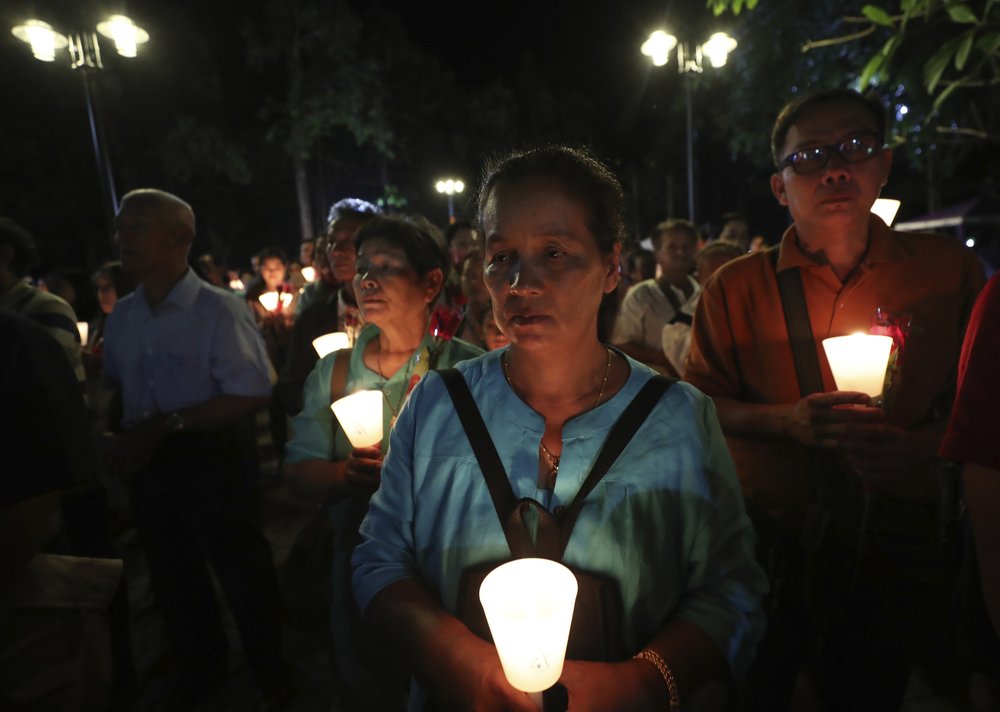
In this Friday, Oct. 18, 2019, photo, Catholic devotees hold candles during the 30th anniversary of the beatification of seven martyrs at Songkhon village in Mukdahan province, northeastern Thailand. (AP Photo/Sakchai Lalit)
“We are asking you to carry out your order with us. Please do not delay any longer. Please carry out your order. We are ready to return our lives to God who has given us our lives. We will not allow ourselves to be victims of devils and ghosts,” it said.
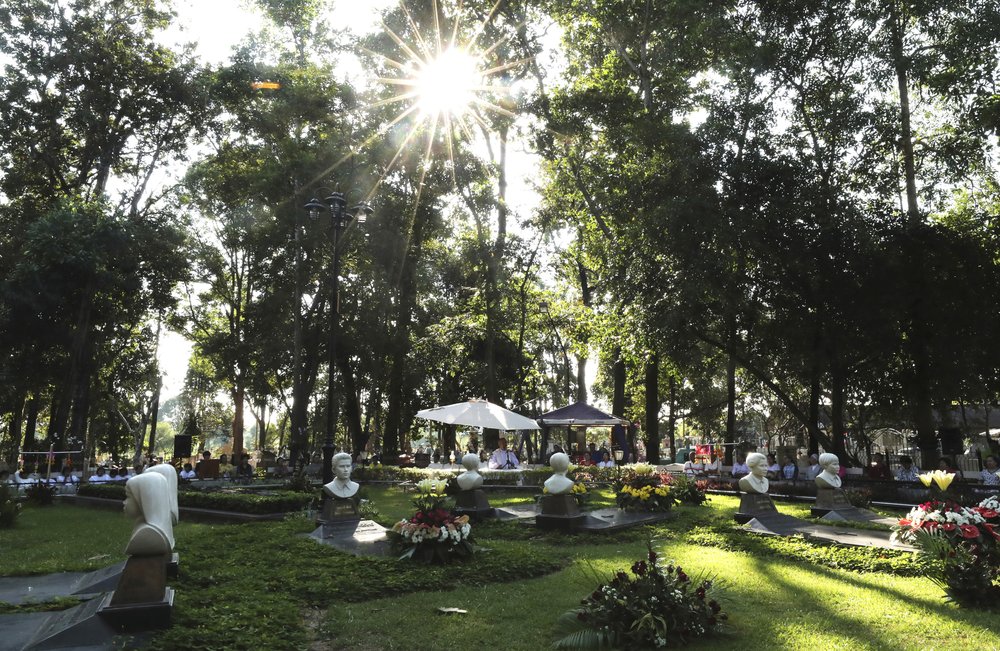
The crowd then moved to the cemetery, where statues of the martyrs are in a garden shaded by tall trees.
“We are so blessed. We are celebrating the 30th anniversary of the beatification here and Thailand will receive the pope’s visit. I am so proud,” said Elizabeth Boonsong Sitthi, a 62-year-old resident of neighboring Sakon Nakhon province who attends the ceremony almost every year and plans to be in the Thai capital Bangkok for Pope Francis’s events.
___
Story: Tassanee Vejpongsa and Grant Peck. Peck reported from Bangkok.
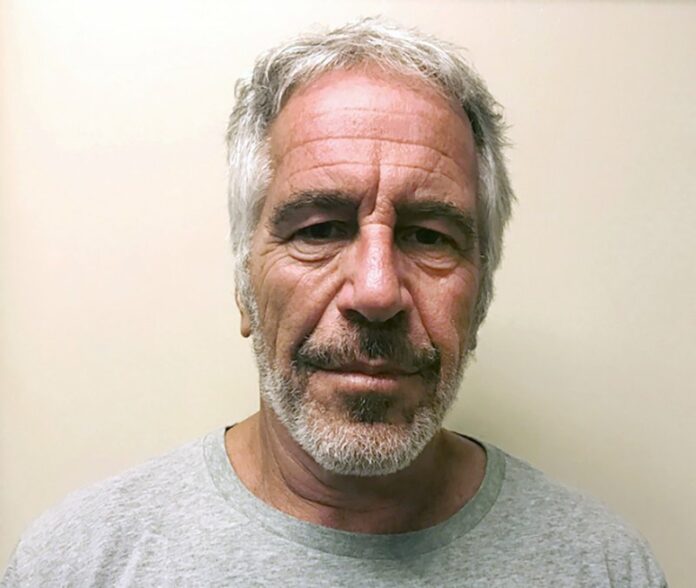
This March 28, 2017, file photo, provided by the New York State Sex Offender Registry, shows Jeffrey Epstein. (New York State Sex Offender Registry via AP, File)
WASHINGTON (AP) — Two correctional officers responsible for guarding Jeffrey Epstein when he took his own life are expected to face criminal charges this week for falsifying prison records, two people familiar with the matter told The Associated Press.
The federal charges could come as soon as Tuesday and are the first in connection with Epstein’s death. The wealthy financier died at the Metropolitan Correctional Center in New York while awaiting trial on charges of sexually abusing teenage girls.
The officers on Epstein’s unit at the federal jail in New York City are suspected of failing to check on him every half-hour, as required, and of fabricating log entries to claim they had. Federal prosecutors offered the guards a plea bargain, but the AP reported Friday that the officers declined the deal.
The expected charges will be filed by federal prosecutors in Manhattan, who have been investigating Epstein’s Aug. 10 death. The people familiar with the matter insisted on anonymity because they were not authorized to discuss the case publicly.
Both guards were working overtime because of staffing shortages when Epstein was found. The officers have been placed on administrative leave while the FBI and the Justice Department’s inspector general investigate the circumstances surrounding Epstein’s death.
The city’s medical examiner ruled Epstein’s death a suicide, but that hasn’t stopped conspiracy theories. A forensic pathologist hired by Epstein’s family to observe the autopsy has said authorities could help clear things up by being more transparent.
Epstein’s death ended the possibility of a trial that would have involved prominent figures, and it sparked widespread anger that he wouldn’t have to answer for the allegations. He had pleaded not guilty to sexually abusing girls as young as 14 and young women in New York and Florida in the early 2000s.
Even with his death, federal prosecutors in New York have continued to investigate the allegations against Epstein. The Justice Department has vowed to aggressively investigate and bring charges against anyone who may have helped him.
There is also a related investigation in Paris, where accusers are complaining police haven’t done enough to track down potential witnesses.
Epstein was placed on suicide watch after he was found July 23 on his cell floor with bruises on his neck. Multiple people familiar with operations at the jail have said Epstein was taken off suicide watch about a week before his death, meaning he was less closely monitored but still supposed to be checked on every 30 minutes.
Investigators believe those checks weren’t done for several hours before Epstein was discovered in his cell with a bedsheet around his neck, another person familiar with the matter told the AP.
The falsification of records has been a problem throughout the federal prison system, which has been plagued for years by systematic failures, from massive staffing shortages to chronic violence.
In an internal memo earlier this month, the Federal Bureau of Prisons’ new director, Kathleen Hawk Sawyer, said a review of operations across the agency found some staff members failed to perform required rounds and inmate counts but logged that they had done so anyway.
Staff members who are indicted by a grand jury will be placed on indefinite, unpaid suspension until the resolution of the criminal case, Hawk Sawyer wrote in the memo to top prison officials, a copy of which was obtained by the AP.
__
Hays reported from New York. Associated Press writer Michael R. Sisak in New York contributed to this report.
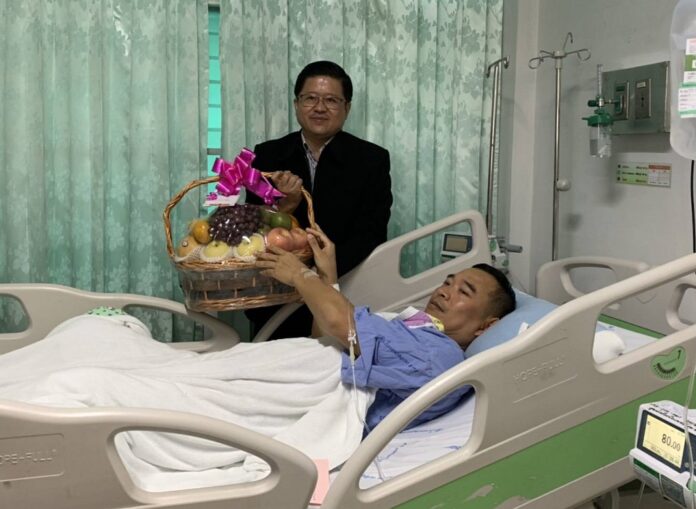
Court of Justice sec-gen Sarawut Benchakul visits Yala judge Khanakorn Pianchana in hospital on Oct. 6, 2019. Image: Court of Justice.
BANGKOK — A judge who shot himself in protest of alleged corruption was transferred from his post and placed under investigation Monday, officials said.
Khanakorn Pianchana was moved from his previous post in the southern province of Yala to Chiang Rai – Thailand’s northern province located about 1,700 km away – in an order signed by court officials today.
The order, issued by the Court of Justice, also placed Khanakorn under disciplinary review.
The judge shot himself inside a courtroom in October, moments after he acquitted five men of murder. In a statement prepared prior to the shooting, Khanakorn said he was forced by his supervisor to find the men guilty lest he faces a punishment.
Khanakorn was sent to hospital for an injury to his spleen, but he soon recovered and later left the hospital. He has not spoken to the media since the incident.
The incident sparked nationwide scrutiny into the country’s judicial impartiality, though court officials also maintained their works are transparent and free of any meddling.
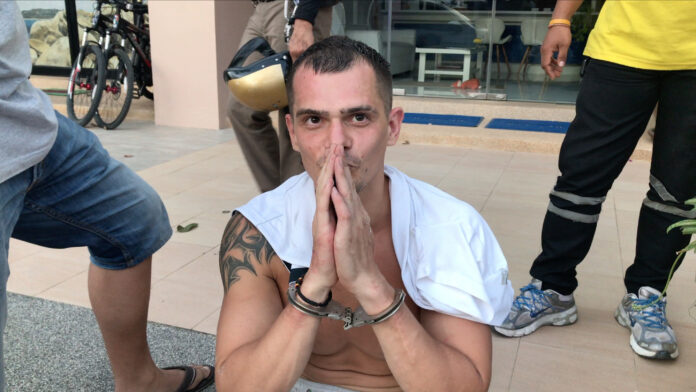
Ianin Lev Aleksandrovich apologizes to the police after his arrest on Nov. 17, 2019.
KOH SAMUI — A Russian national was arrested Monday after attempting to steal a yacht while drunk and naked on the resort island of Koh Samui, police said.
Ianin Lev Aleksandrovich, 34, was charged with disturbing public order for the incident. Col. Thongchana Hankittikanjana of Bophut Police Station said the Russian man may also be charged with damaging properties if the yacht owner files a complaint.
According to the police, Ianin stopped his car on the pier on Sunday evening and began arguing with his wife. After some minutes of a loud quarrel, Ianin – who appeared to be drunk – reportedly walked towards the sea, took off his clothes, and jumped into the sea.
Police said he then swam toward a yacht anchored about 50 meters off the pier.
On the yacht, Ianin tried to steer the boat away, but was unable to ignite the engine, police said. Officers arrived shortly after, and they had to borrow a fishing boat to reach the boat and arrest Ianin, who struggled before he was subdued.
Once he was taken back to the shore, Bophut police chief Thongchana said, Ianin’s wife slapped him at his face. Ianin was taken to Samui tourist police station, where he began to sober up and declared “I love you, I love the boat,” police said.
It is not immediately clear if the couple has made up.
Altercations involving tourists and alcohol occasionally broke out on Samui Island. In 2016, a drunken British man was arrested after brandishing a knife at his hotel pool.
Ianin after he was taken to the shore.Police making arrest on a yacht.