



































29.4 C
Bangkok
Tuesday, June 23, 2026
Home Blog Page 1482

Face to Face With China’s Latest Pride: Ending Absolute Rural Poverty

Locals dressed in traditional outfits at an apartment complex under construction in Yunnan province, China.

JINSHUIHE, Yunnan Province, China — In my recent trip to China, government officials took me to see an achievement they were so proud of: a cluster of plain-colored rural apartment buildings in a border town thousands of kilometers away from the skyscrapers of Beijing or Shanghai.

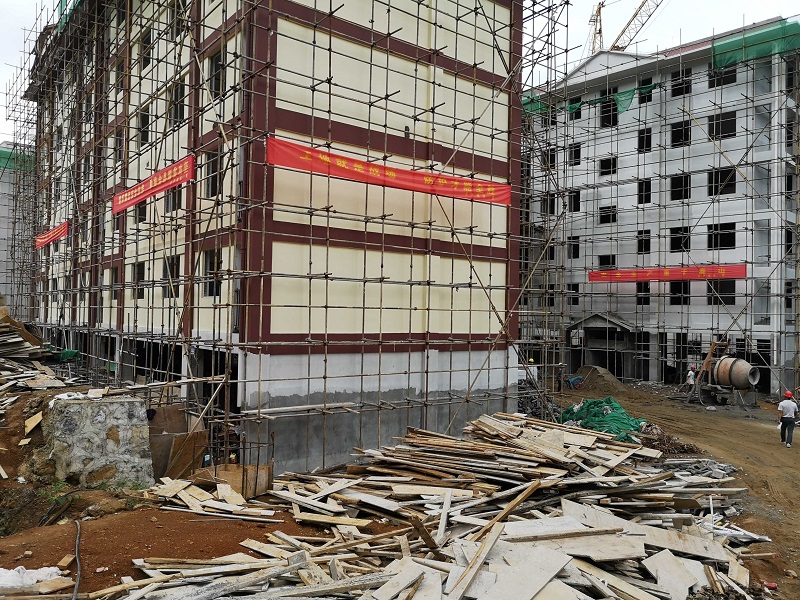
Located in the southeastern tip of Yunnan province, the apartments were nearly finished by the time China’s Ministry of Foreign Affairs took me and and a dozen reporters from other Southeast Asian nations there. Each of the 12 apartment buildings has five floors. There are a total of 410 rooms, the size of each one in the range of 70 to 90 sqm.

By the end of November, villagers as far as 100 kilometer away from the site will begin to move and live here – without having to pay rent.

This is the face of the new “moderately prosperous China,” a term rooted in Confucianism and now adopted by the Communist regime under President Xi Jinping, which is embarking on a goal of eradicating absolute poverty in rural China by the end of 2020.

Officials say they aim to achieve that mission by relocating rural farmers to rent-free lodgings like the one I saw, and providing them with basic necessities. They also aim to export their model of success to the world.

“They can work and not just depend on farming. In that way, their living conditions can be improved,” said Hei Liying, head of publicity department at Yunnan’s Jingping county. She said 61 villages have been relocated in Yunnan so far between 2016 and 2018.
O7B6R7U5S5CM7IBMHY2DS4Q4WE
Government-sponsored apartment complex in Yunnan’s Jingping county.

The goal has become a source of national pride, and Foreign Ministry spokesperson Hua Chunying told us in Beijing that it’s nothing short of a “miracle” in the making.

“Seven hundred million people out of poverty [by] next year, no absolute poverty. That’s a miracle,” Hua said. “Not only for China but the world.”

The government spent about 30 million RMB, or 128 million baht, to build the apartment complex we visited in a village close to Jinshuihe, a border town equipped with a river port to Vietnam.

Top: Ethnic Zhuang residents from Malipo County, Yunnan Province, dance to greet the media delegates.

Officials said no one was forced to move to these apartments. The comment was immediately met with skepticism from the media entourage, and a reporter from Vietnam remarked that his country had tried a similar scheme and failed. Yet the Chinese official insisted that in China, the system simply works.

Hei, the county publicity officer, said villagers are being relocated due to soil erosion and poor transportation. They can seek new jobs working at factories and be part of the growing trade in the port town.

“They now have a very stable life. A small number decided to go back however, but the government will try to convince them to stay,” Hei said.

‘You Can’t Eradicate Urban Poverty’

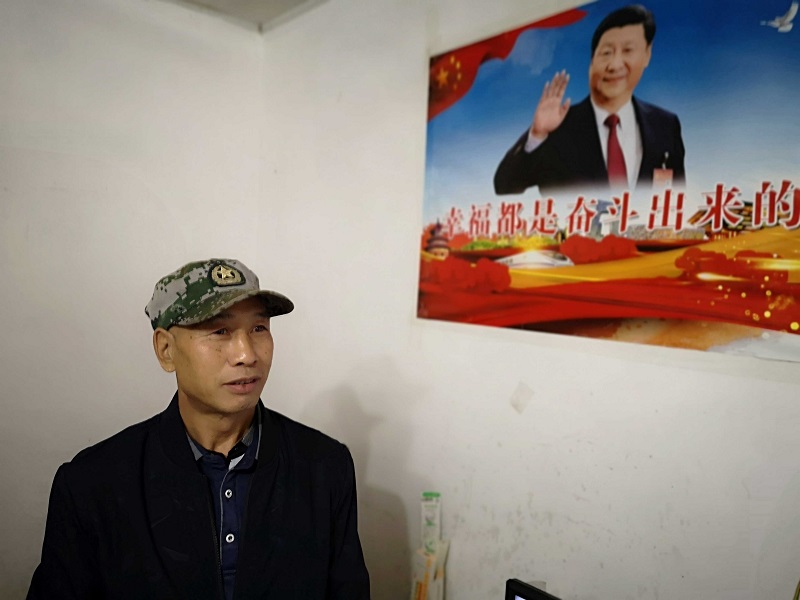
Not all poor highland villagers are being relocated. A day earlier, when our group visited a village called Wang Gou further up the mountain, 60-year-old home owner Zheng Jiguan greets us at rural home with an offer of cigarettes.

His house was being rebuilt on government money. Zheng said he received 30,000 RMB (128,400 baht) of state subsidies to renovate his house in 2014. It also comes with a new clean toilet, and the village now enjoys tab water drawn in from a source three kilometers away.

Only local villagers who have no immediate family members working for the local government can apply to such home improvement subsidies, which are worth somewhere between 18,000 to 40,000 RMB (77,040 to 171,200 baht). The amount depends on the houses’ conditions; officials would personally inspect the sites to see how shabby and unsafe they are.
445351 1
Zheng Jiguan speaks at his renovated home.

On top of that, a new stretch of concrete road was built in June with financial support from the Ministry of Foreign Affair.

But despite these efforts to make rural life more comfortable, we were told that 4,000 young people in the village and nearby communities still chose to migrate to the cities to seek work and a better income in the cities.

The trend of migration to the cities results in yet another problem for the Chinese authorities: urban poverty. Back in Beijing, I asked whether such issue could ever be solved. Even in otherwise prosperous city of Hong Kong, many sleep and live in “cage homes,” tiny apartment rooms they rented and shared with others.

Zhang Liang, deputy director of a poverty alleviation department, replied that while it’s possible to fight abject poverty in rural areas, and that goal would be met as early as the end of next year, one must concede that poverty will always exist in some forms.

“You can’t eradicate urban poverty,” Zhang said.

Unprecedented Feat

China’s index for absolute rural poverty in 2015 is 2.57 US dollars of income per head per day, higher than that of the World Bank’s which was 1.9 US dollar per head per day. The figure is adjusted up each year at around 3 percent.

“China’s standards are higher,” Zhang said, adding that the price of basic necessities is comparatively cheaper in rural China than the equivalence, say, in rural United States.

He added that providing people with access to compulsory education, basic medical care and housing are taken into consideration when it comes to implementing anti-poverty schemes, which have become an increasingly oft-cited raison d’être for President Xi and the Communist Party.

Number of poor at 1,90$ a day (1993-2017) [OC] from r/dataisbeautiful

While people outside China can always debate about controversial issues of human rights in Tibet and Xinjiang provinces, or the political future of Hong Kong, it is clear that Xi seems aware that in order to keep masses ‘happy,’ the issue of poverty eradication cannot be ignored.

According to Zhang, 40 out of 50 trips Xi made to various parts of China since he came to power as the paramount leader in 2012 have to do with poverty alleviation programs.

Today, China also lends its poverty alleviation knowhow to nearby Southeast Asian countries from Cambodia, Myanmar, Laos to far-flung countries in the African continent like Namibia.

“Now we are willing to help other countries,” Zhang said.

img 20191024 171516
Renovated rural homes in Wang Gou.

Beyond Yunnan province and out of nearly 1.4 billion people of all China, Zhang said the nationwide project of relocating rural poor to better accommodations such as the flats we saw in Jinshuihe is almost completed. About 8.7 million households have been relocated in the past five years alone, and 1.3 million more will be moved within this year and the next.

“In six years, 82.39 million people were lifted out of poverty. This is unprecedented in China’s history,” Zhang said.

The writer would like to thank the Chinese Embassy in Bangkok, the Ministry of Foreign Affairs of the People’s Republic of China, and the Yunnan Provincial Government for the kind invitation to join the media trip to China.


Advertisement

Chinese Scientists Uncover Gender-Based Difference in Microbiomes

Male and female human as depicted in the Pioneer Plaque.

KUNMING (Xinhua) — Chinese researchers have discovered how men and women differ in their microbiomes, suggesting that the gender-based difference may have an influence on whether one is at risk of some diseases.

Microbiomes refer to a community of microorganisms such as bacteria or fungi living in or on the human body.

Researchers from the Kunming Institute of Zoology, the Chinese Academy of Sciences analyzed microbiomes in 15 sites in or on the body such as skin and found seven out of 15 sites exhibited significant differences between males and females.

The researchers said that many diseases are related to immunity and metabolism in which microbiomes play a significant role. One of the reasons why males are at a higher risk of getting gouty arthritis lies in the difference in gut microbiomes.

Meanwhile, females’ microbiomes on the skin are less diversified than those of males, which makes females at a higher risk of skin diseases such as allergic contact dermatitis, they added.

The research has been published in the journal Advanced Science and is expected to provide references and guidelines on the diagnosis and treatment of microbiome-related diseases.

Advertisement

Trump’s Rust Belt Revival is Fading. Will it Matter in 2020?

In this Nov. 28, 2018, file photo Annabella Wolikow, 10-month-old daughter of Tom Wolikow, holds her grandfather John's crucifix necklace at their home in Warren, Ohio. An economic renaissance in the industrial Midwest promised by President Donald Trump has suffered in recent weeks in ways that could be problematic for Trump's 2020 re-election. (AP Photo/John Minchillo, File)

TOLEDO, Ohio (AP) — President Donald Trump once promised that coal and steel would be the beating heart of a revived U.S. economy — a nostalgic vision that helped carry him to victory three years ago in the industrial Midwest.

But a year away from Election Day, that promised renaissance is not materializing and both sectors are faltering in ways that are painfully familiar and politically significant.

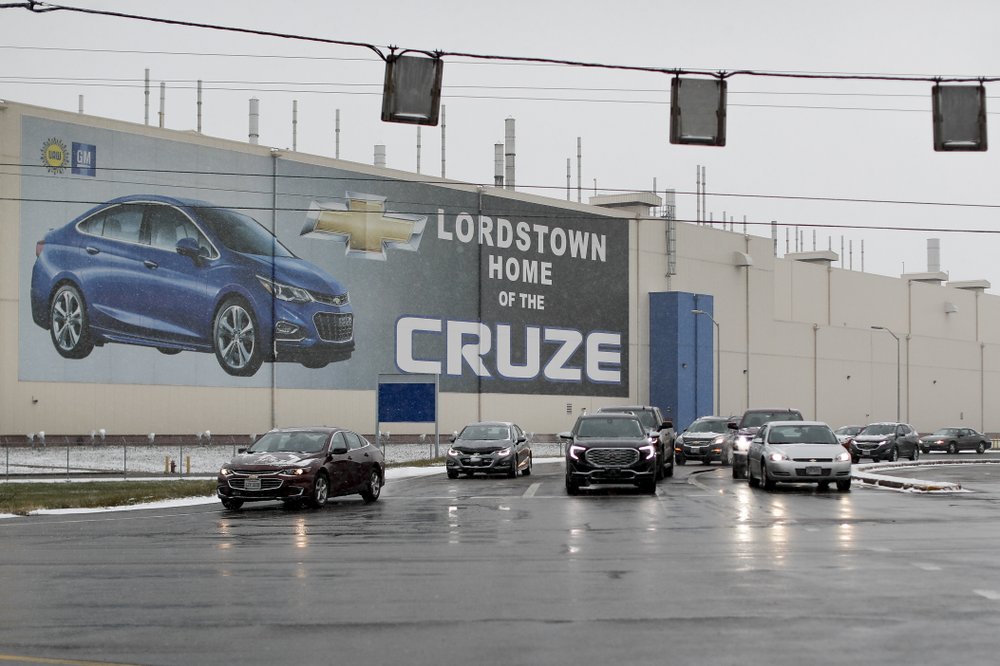
Recent data show manufacturing jobs are disappearing across Pennsylvania, Michigan and Ohio, all states critical to Trump’s reelection chances. On Tuesday, Murray Energy, a major mining firm with close ties to the president, became the latest of many coal companies to file for bankruptcy this year, rattling communities across Ohio, West Virginia and Kentucky. The news followed recent layoffs at a prominent steel manufacturer in northeastern Ohio and General Motors’ final decision this fall to shutter its massive plant at Lordstown, Ohio.

The turmoil in the manufacturing and mining sectors threatens to undermine Trump’s claim to a booming economy — the bedrock of his and his Republican allies’ campaign strategy — in places where it matters most. While Trump’s economy is benefiting high-tech manufacturing and energy sectors in other regions, the manufacturing slump across the Rust Belt may test whether Trump can retain his appeal to blue-collar workers without having fully delivered on his promise to fatten their bank accounts.

“I don’t think that Ohio is just a lock in the Republican’s column, nor do I think that blue-collar voters are settled on who they’re likely to select,” said Robert Alexander, a political scientist at Ohio Northern University. “There is a lot of economic angst still in the state.”

Recent elections haven’t shown that angst to be aimed at Republicans. After Trump won Ohio by 12 percentage points — the largest margin of any presidential candidate since 1988 — Republicans fared better in Ohio than in many other states in last year’s midterms, nabbing every statewide office but one. Their winning formula was based overwhelming support from working-class, white voters in small communities where a single company can anchor the local economy.

Murray Energy is based in St. Clairsville, Ohio, a small city near the West Virginia and Pennsylvania borders in a county that voted for Trump over Democrat Hillary Clinton by a margin of 40 percentage points. But the company’s footprint is far larger, including 17 mines across Alabama, Illinois, Indiana, Kentucky, Pennsylvania, Utah and West Virginia, as well as Colombia, South America.

The company’s former CEO Bob Murray is a Trump donor and advocate for his company’s interests. Murray openly pressured Trump to issue an emergency order that would have exempted his struggling company from environmental regulations he said were burdensome. Trump flirted with that idea but never approved it.

Murray said Tuesday the company was filing for Chapter 11 bankruptcy, a restructuring that puts at risk the incomes, pensions and health care benefits of roughly 7,000 workers.

1000 17
In this Nov. 27, 2018, file photo a banner depicting the Chevrolet Cruze model vehicle is displayed at the General Motors’ Lordstown plant in Lordstown, Ohio. (AP Photo/John Minchillo, File)

Democratic presidential candidate Elizabeth Warren, a bankruptcy expert, seized on the news as evidence of Trump failing his voters.

“He made promises to working people all across this country that he would be there on their behalf. Instead he’s been there for the lobbyists, he’s been there for the giant corporations, he’s been there to help make the rich richer and leave everyone else behind,” she said.

Trump bounded into office promising to bring back “beautiful clean coal” and deliver a victory for every factory worker. The message helped him pull out victories in Michigan, Pennsylvania, Wisconsin and Ohio, where scars from the Great Recession that technically ended in 2009 were still fresh.

For the first two years of his presidency, Trump oversaw an economic recovery that extended across sectors and regions — adding manufacturing and factory jobs in the Rust Belt and beyond.

But recent signs show that trajectory shifting downward quickly, fueled by a slumping global economy and the trade wars escalated by the Trump administration.

So far this year, Ohio has shed 2,400 factory jobs. Michigan has lost 6,200. Pennsylvania has 9,100 fewer manufacturing workers. West Virginia employers have cut 400 mining jobs. And Kentucky has let go of 600 mine workers.

General Motors struck a devastating blow to Ohio by ending more than 50 years of car manufacturing at assembly plant near Youngstown, a labor stronghold where Trump surprised Democrats by winning half the vote in 2016. But for every GM-scale closure, there are other, lower-profile layoffs in other states.

Nearly 950 manufacturing jobs in Pennsylvania were lost in May when the cabinetmaker Wood-Mode shuttered. Bimbo Bakeries closed a plant in July in northern Pennsylvania that cost 151 jobs, according to filings with the state.

Earlier this month, Canton, Ohio-based Timken Steel ousted CEO Tim Timken, also a Republican donor, as the company’s stock has plummeted over the past year.

Timken received $4 million in cash as severance. The company eliminated 55 positions in July in order to save $7 million annually next fiscal year, according to filings with the Securities and Exchange Commission.

Separately, roughly 250 Timken Steel employees so far have received extended layoff notices, said Bob Harper, president of United Steelworkers 1123. Factories have been idled at times due to a lack of orders.

Each job at Timken Steel supports about five other jobs in the community, said Harper, who says he thinks the layoffs could turn voters there against Trump.

“Things are going to get worse,” he said. “We’re going to get hurt.”

Timken’s wife is Ohio Republican Party Chairwoman Jane Timken, a chief cheerleader for Trump’s economic stewardship in the state. Asked about the layoffs and Ohio’s economy, Jane Timken issued a statement touting Trump’s record.

“President Trump is committed to bringing good paying manufacturing jobs back to Ohio and the Midwest,” she said, citing statistics largely shaped by Great Recession layoffs that preceded Trump by seven years. “Since he became president, he has brought over 14,500 manufacturing jobs back to Ohio. Compare that to President Obama who only brought 11,700 manufacturing jobs to Ohio during his entire administration. … Democrats can cry economic wolf, but Ohioans know the truth.”

It’s far from clear that Ohioans are poised to blame Trump for the economic blows.

In Ohio, Dan Wade has worked at Timken Steel for the the past 19 years. He was temporarily laid off last week, but says he expects to go back in a few days. He blames the company’s troubles on management, not Trump.

“I’m going to vote for him again. I like him, I like his attitude,” Wade said.

Timken retiree Joe Hoagland, who didn’t vote Trump and won’t in 2020, said he sees no evidence that Trump has been a boon for manufacturing.

“I don’t see any revitalization,” Hoagland said. “When you talk about bringing employment back, you can’t just all of a sudden make the happen.”

__

Boak reported from Washington. Associated Press writers Andrew Welsh-Huggins in Columbus, Ohio, and Anthony Izaguirre in Charleston, West Virginia, contributed to this report.

Advertisement

Nigerian Engineers Study in China to Drive Power Sector Back Home

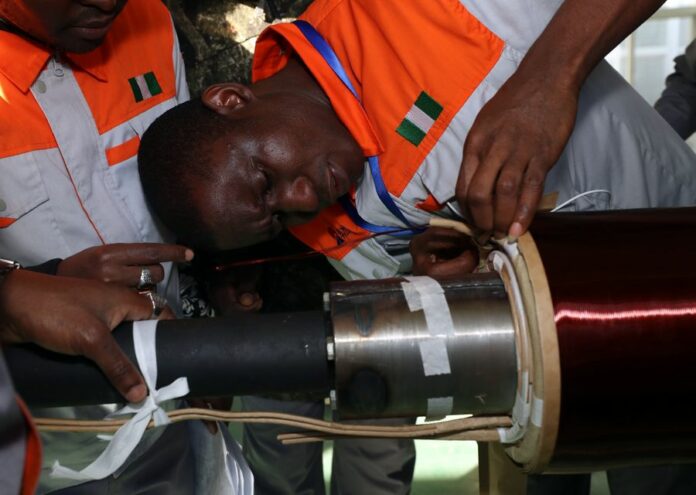
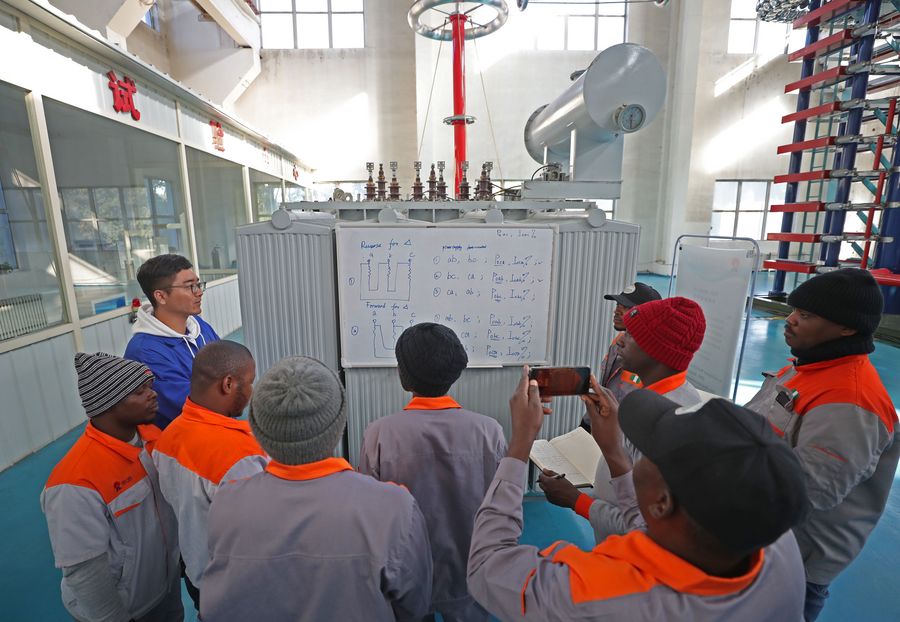
Nigerian engineers study during a training session in a factory of Huaye Group in the city of Anshan, northeast China's Liaoning Province, Oct. 14, 2019. (Xinhua/Yang Qing)

SHENYANG (Xinhua) — What does electricity mean for 41-year-old Ajayi? It means everything from watching a soccer game without interruption and running a successful bakery to bringing real prosperity to his hometown in Nigeria.

This is why Ajayi and 59 other Nigerian engineers departed the West African nation and traveled over 10,000 km to learn the transformer manufacturing in China.

Two months have passed since Ajayi arrived in a factory of Huaye Group in the city of Anshan, northeast China’s Liaoning Province, one of the heartlands of China’s heavy industry. The Nigerian engineer is well adapted to this new life.

“If a power station is compared to a heart, then the transformers are the vessels that carry the blood. Now, we don’t have the ability to produce and repair these vessels on our own,” Ajayi said. “As an engineer, I have a dream to change this situation and provide sufficient electricity for my country.”

Dream of Stable Electricity Supply

With a rapidly growing population and increasing demand for electricity, the outdated Nigerian grid system is overwhelmed.

“As a soccer fan, I was extremely frustrated when I watched a match on TV, but the electricity supply was suddenly cut off,” Ajayi said.

Living in Abuja, capital of Nigeria, Ajayi sometimes had to use an electric generator to keep the TV running.

A generator is a necessity for many Nigerians. His wife, Benedicta, runs a bakery. “Most times, I run the power generator to make cakes ordered by my customers,” she said, adding that with a steady grid, her bakery could cut its electricity costs by at least 80 percent.

Nigerian engineers study during a training session in a factory of Huaye Group in the city of Anshan, northeast China’s Liaoning Province, Oct. 14, 2019. (Xinhua/Yang Qing)

In the Chinese “school,” Wang Yi is the idol of Ajayi. Speaking fluent English, the 39-year-old staff of Huaye Group is the teacher of the Nigerian trainees.

138148256 15606926402491n 1
Nigerian engineers study during a training session in a factory of Huaye Group in the city of Anshan, northeast China’s Liaoning Province, Oct. 14, 2019. (Xinhua/Yang Qing)

“Although they lack professional knowledge about transformers, they are all very serious and hard-working,” Wang said.

When Imadu, another Nigerian engineer, could not distinguish phase resistance and line resistance, Wang first changed the obscure professional vocabulary into clear English words. Then he explained the theory through a circuit diagram while taking Imadu through a workshop.

Imadu was suddenly enlightened. “Teacher Wang is great! He can do anything!”

“Knowledge is stored in my head, and no one can take it away,” Imadu said. “With powerful and stable electricity, Nigeria’s economy can grow faster and better.”

“Teaching How to Fish”

The story of 60 engineers has attracted attention in Nigeria. Recently, Kierian Umeayo, a reporter from the Nigerian Television Authority, traveled to Anshan to make a documentary about these trainees.

“We are going to tell the audience that these 60 engineers are not here as tourists. They are studying hard,” he said, hoping them to teach more Nigerians to make, install and maintain transformers.

After returning to Nigeria, the engineers will work in an industrial park, which includes three transformer production plants and associated equipment factories.

With a total investment of 300 million U.S. dollars, the park was jointly constructed by Huaye Group and China Great Wall Industry Corporation.

“The completion of the industrial park will change Nigeria’s inability to produce power transmission and transformation equipment on its own, and the products will also be exported to other African countries,” said Ma Liming, chairman of Huaye Group.

As the ancient proverb says: “Give a man a fish and he will eat for a day; teach a man to fish and you feed him for a lifetime.” Ma said this training is only the initial stage of the program, and more Nigerian talents will study in China in the future.

It has been a year since China proposed eight major initiatives at the 2018 Beijing Summit of the Forum on China-Africa Cooperation to elevate cooperation between the world’s largest developing country and the largest developing continent.

The eight initiatives cover various fields such as industrial promotion, infrastructure connectivity, trade facilitation, green development, capacity building, healthcare, people-to-people exchanges, and peace and security.

China decided to work with Africa to set up 10 Luban workshops, a program designed to provide state-of-the-art technical and vocational training, on the continent, the first of which has already been established and opened in Djibouti.

Nigerian presidential spokesperson Garba Shehu said Nigeria has suffered a long-term deficit in power supply, which is a major obstacle in the country’s way of economic diversification.

“We expect the engineers to bring home what they have learned in China, and I’m sure they will do something in manufacturing indigenous electric devices and alleviating power shortage of the country,” Shehu said.

As a father of two, Ajayi calls his family every day. He told his kids that he had a mission — to create a life without electric generators for the family, and he believes that day will come soon.

(Reporting by Ren Yaoting, Cheng Lu, Xu Yang, Wang Bingkun, Cui Shihao and Guo Jun; video editors Li Ziwei and Gao Ming)

Advertisement

HBO Orders 10 Episodes of ‘Game of Thrones’ Prequel

LOS ANGELES (AP) — HBO is green-lighting a new “Game of Thrones” prequel after reportedly canceling another that starred Naomi Watts.

The cable channel said Tuesday that it’s given a 10-episode order to “House of the Dragon,” set 300 years before the original series that ended its eight-season run in May.

The prequel is based on George R.R. Martin’s “Fire & Blood,” HBO said. The new drama was co-created by Martin and Ryan Condal, whose credits include “Colony.”

It will focus on House Targaryen, made famous in “Game of Thrones” by Emilia Clarke’s Daenerys and her fearsome dragons.

“House of the Dragon” was announced by HBO programming president Casey Bloys during a presentation for HBO Max, the streaming service launching in May 2020 . A spinoff of HBO megahit “Game of Thrones” would be a key attraction in the increasingly crowded streaming marketplace.

HBO declined comment on reports Tuesday that it had dropped another “Game of Thrones” prequel set thousands of years before the original. A pilot episode starring Watts had been filmed in Northern Ireland.

The straight-to-series order for “House of the Dragon,” whether a sign of faith in the project or pressure to get it into production, avoids letting devotees of the fantasy saga down once more.

Casting and an air date were not announced.

Advertisement

2 Palace Retainers Fired for ‘Adultery’

An emblem of the Royal Thai Government Gazette.

BANGKOK — His Majesty the King on Tuesday fired two royal retainers on the grounds of grave misconduct and “adultery.”

Ekachai Kookrasang and Makarerk Koosamrarn, both of them army lieutenant-colonels, also lost their military ranks and any royal decorations they have received from His Majesty the King, according to a statement published in the government gazette.

The statement identified Ekachai and Makarerk as retainers who oversee royal palace bedrooms. It accused the pair of unspecified “extremely evil” acts and committing adultery, without elaborating.

Apart from Ekachai and Makarerk, at least eight other palace officials are known to have lost their jobs and titles this month, including a former Royal Noble Consort to the king.

Related stories:

6 More Palace Aides Expelled, Stripped of Their Titles

HM King Fires Senior Royal Guard

Advertisement

Trumps Hand out Halloween Candy, Greet Kids at White House

President Donald Trump, accompanied by first lady Melania Trump, places a candy bar on the head of child dressed as Minion during a Halloween trick-or-treat event on the South Lawn of the White House which is decorated for Halloween, Monday, Oct. 28, 2019, in Washington. Photo: Alex Brandon / AP

WASHINGTON (AP) — President Donald Trump and first lady Melania Trump have handed out candy to hundreds of military families and local schoolchildren as the White House got a head start on Halloween.

The children dressed up as astronauts, military officers, pirates and dinosaurs as they greeted the president and first lady one-by-one Monday. The Air Force Strolling Strings played “Thriller” from Michael Jackson, “The Addams Family” theme song and other spooky tunes to set the mood.

A Halloween display of Black Forest trees wrapped around the columns of the South Portico, while pumpkins lined the staircases.

Several agencies were also on hand to help in the fun, with the Secret Service showing off the presidential limo known as “The Beast” and NASA displaying the suit that astronauts wear for spacewalks.

AP19301799056294
President Donald Trump and first lady Melania Trump give candy to children during a Halloween trick-or-treat event on the South Lawn of the White House which is decorated for Halloween, Monday, Oct. 28, 2019, in Washington. Photo: Alex Brandon / AP
AP19301833288965
President Donald Trump and first lady Melania Trump give candy to children during a Halloween trick-or-treat event on the South Lawn of the White House which is decorated for Halloween, Monday, Oct. 28, 2019, in Washington. Photo: Alex Brandon / AP
AP19301801969504
President Donald Trump and first lady Melania Trump give candy to children during a Halloween trick-or-treat event on the South Lawn of the White House which is decorated for Halloween, Monday, Oct. 28, 2019, in Washington. Photo: Alex Brandon / AP
AP19301840768643
President Donald Trump and first lady Melania Trump depart after giving candy to children during a Halloween trick-or-treat event on the South Lawn of the White House which is decorated for Halloween, Monday, Oct. 28, 2019, in Washington. Photo: Alex Brandon / AP
AP19301812925103
President Donald Trump and first lady Melania Trump give candy to children during a Halloween trick-or-treat event on the South Lawn of the White House which is decorated for Halloween, Monday, Oct. 28, 2019, in Washington. Photo: Alex Brandon / AP
AP19301832051216
President Donald Trump and first lady Melania Trump watch a young girl as they give candy to children during a Halloween trick-or-treat event on the South Lawn of the White House which is decorated for Halloween, Monday, Oct. 28, 2019, in Washington. Photo: Alex Brandon / AP
AP19301825251447
President Donald Trump and first lady Melania Trump give candy to children during a Halloween trick-or-treat event on the South Lawn of the White House which is decorated for Halloween, Monday, Oct. 28, 2019, in Washington. Photo: Alex Brandon / AP
AP19301822978882
President Donald Trump and first lady Melania Trump give candy to children during a Halloween trick-or-treat event on the South Lawn of the White House which is decorated for Halloween, Monday, Oct. 28, 2019, in Washington. Photo: Alex Brandon / AP
Advertisement

Cabinet Approves Extra New Year Holiday

A file photo of a New Year countdown firework at Asiatique in Bangkok.

BANGKOK — Monday Dec. 30 was declared a special public holiday by the government on Tuesday.

The announcement, made by the Prime Minister’s Office, effectively brought the number of New Year festival days off to five, lasting from Saturday Dec. 28 to Wednesday Jan 1.

It is unclear whether Dec. 30 would be considered a bank holiday as well; the Bank of Thailand is reportedly deliberating on the issue as of publication time.

Advertisement

Greenpeace Implicates 5 Global Brands in Plastic Trash at Top Tourist Sites

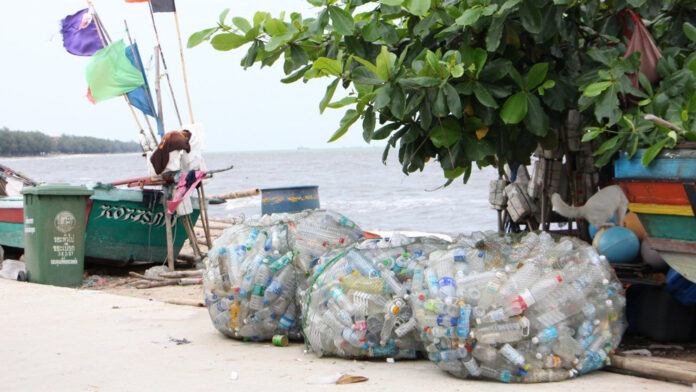
A file photo of plastic rubbish collected from a beach in Chumphon province.

BANGKOK — An environmental group on Tuesday named Coca-Cola and Nestlé among the global companies responsible for much of the plastic pollution in Thailand’s top tourist destinations.

Greenpeace said its volunteers collected 6,091 pieces of plastic waste at Doi Suthep in Chiang Mai and Laem Son On in Songkhla, and found 18 percent of them to be from five multinational producers. They urged these corporations to take more environmental responsibility and reduce their production of single-use plastics.

“This report provides more evidence of how corporations have greatly contributed to the plastic crisis we find ourselves in,” project leader Pichmol Rugrod said. “Recycling alone is not going to solve this problem. Corporations should find alternative solutions on how to distribute their products to consumers.”

Apart from Coca-Cola and Nestlé, the other global three brands were Ajinomoto, Mondelēz, and Unilever.

The report also found Thai companies led by CP, Osotspa, TCP Group, Sermsuk, and Singha Corporation to be the top domestic contributors to plastic pollution. These producers alone were responsible for 1,236 pieces of plastic waste in the two surveyed sites.

“Most of the waste we found are food packaging because they are the most consumed,” Pichmol said. “This is followed by tobacco products, household goods, and personal care products.”

A volunteer said some of the more interesting waste items she found are sofas, mattresses, and video game joysticks.

“I think I can furnish a living room here with all the waste I found in the jungle on Doi Suthep,” Torfun Kantamoon said. “I even found a chips packet which dated back to 2008. This means that some of the waste has been there for 10 years already.”

Additional manufacturers of plastic rubbish found on Doi Suthep include condom brand Okamoto, incense brand Noppamas, and even auto parts from Toyota.

The report was made based on information gathered from plastic brand audit campaign, where volunteers in Chiang Mai and Songkhla collected plastic waste at two sites and recorded their producers. The campaign is part of the global #BreakFreefromPlastic movement, which has been carried out in 51 countries.

Still, Pichmol said neither the consumer, business, or government is to be blamed entirely for the problem. She said everyone is responsible for the waste, but the purpose of pointing fingers at producers is to induce them to take more concrete action.

“Producers might say that it is consumers’ behavior that resulted in these products being discarded,” she said. “Manufacturers need to be accountable for what their products are doing to the environment.”
Advertisement

Fake Showbiz Socialite ‘Mae Manee’ Wanted for Massive Scam

A photo of Wantanee Tippaveth posted on her Facebook. Right, a police mugshot of her.

BANGKOK — Police are on the hunt for a woman suspected to be at the head of a large-scale ponzi scheme that allegedly scammed hundreds of people out of billions of baht.

Police Maj. Gen. Maitree Chimched of the Economic Crime Suppression police said Tuesday that court has issued an arrest warrant for Wantanee “Mae Manee” Tippaveth, 28, and her boyfriend, Metee Chinpa, 20, whom police suspected to have caused up to 10 billion baht in damages.

“Just from interrogating 20 people, the damage is around 35 million baht,” Police Col. Padol Jandorn said.

Wantanee and Metee were charged with fraud-related crimes and breaking the Computer Crime Act, after more than 120 people complained to the Udon Thani police Monday that they were defrauded by Wantanee’s ponzi scheme. Most of Wantanee’s victims are stay-at-home wives looking for extra income.

Wantanee is a Udon Thani and Bangkok-based internet idol who allegedly solicited people to invest money in her business and get a 93 percent profit. To shore up her credibility, she would post photos of her glamorous lifestyle on social media, such as photos of her rubbing elbows with celebrities, and claim to be a producer on many TV shows.

Similar to the Airplane Game pyramid scheme popular in the 1980s America, Wantanee would ask people to pool in money and reap returns after she or her downline found enough people to invest in the game.

Most would start off with a 1,000 baht “investment,” which she claimed would go to her cosmetics and film business endeavors. By the next month, they were told, they would get 1,930 baht in return.

One of the ads for the Mae Manee pyramid scheme, which promised 93 percent returns.
One of the ads for the Mae Manee ponzi scheme, which promised 93 percent returns.

Police said some victims deposited as much as millions of baht in such “investment,” but Wantanee never paid back their yields, citing reasons like bank transfer delays. One person allegedly lost 6 million baht to her, and others have told the media that some victims were so distraught from monetary loss they committed suicide.

Before Wantanee shut down her Facebook Tuesday, victims and netizens were brigading her page against her downline and investors who still believed they would get their money back.

She maintained that she was innocent in posts on Facebook Tuesday: “Jail is for people who aren’t fighters, and I’m a fighter … I never abandoned everyone, and I’m not how the news says I am. I’m the victim of slander, attacks, and silencing threats here. … I’ve never done wrong by anyone. My lawyers will keep working.

A photo posted by Wantanee Tippaveth of her with a BMW.
Wantanee Tippaveth, center, with Pharunyoo “Tack” Rojanawuthitham, right, in a photoshoot.
Advertisement

Hot News

LATEST NEWS

Bangkok
broken clouds
29.4 ° C
29.4 °
25.5 °
71 %
2.9kmh
60 %
Mon
29 °
Tue
38 °
Wed
37 °
Thu
36 °
Fri
37 °