BNK48 singer Cherprang Areekul, who holds a degree in chemistry, surrounded by her fans during her graduation day from Mahidol University International College on Oct. 2, 2019. Photo: Cherprang BNK48 / Facebook
BANGKOK — About half of all Thai graduates are working in fields unrelated to their university degrees, according to a survey of over 1,000 people.
UK-based market research agency YouGov found that 52 percent of Thai bachelor’s and above degree graduates work in jobs unrelated to their degrees. Those who completed a degree in humanities (67 percent) are most likely to switch their career paths, as opposed to those with a degree in health or welfare (24 percent).
“My passion has always been technology,” Supavitch Ponak, 24, a political science graduate who is now working as a digital marketing consultant said. “I felt my passion for technology is stronger than what I had been studying.”
But for a health technology graduate like Punyathat Hathaithum, 22, he chose to continue working as a medical technologist because he wanted to fully utilize his degree.
“My degree is specific to a profession. Unlike social science degrees, it’s quite difficult for me to apply for jobs in other fields,” Punyathat said. “Moreover, my job is a regulated profession. Only those who earned the degree and qualified for the license can become a medical technologist, so it’s better for me to take advantage of it.”
Apart from personal interests or nature of the job, opinions on choosing a job seem determined in part by age and whether or not their education included studying overseas.
Older Thais (aged 45 to 54) are more likely than younger generations (aged 25 to 34) to work in jobs relevant to their degree (56 percent vs. 48 percent).
Those who studied in Thailand were more likely to work in jobs unrelated to their degree (52 percent), compared to respondents who studied abroad (34 percent).
“The world is changing. The boundary which divides jobs and degrees is blurring as employers are looking at your experience rather than your grades,” Supavitch said. “People can also take online courses to learn additional skills they did get from the classroom.”
Rockstar philanthropist Artiwara “Toon Bodyslam” Kongmalai holds a degree in law.
However, two thirds (66 percent) still responded that they found their degrees “very useful,” while a third (30 percent) find them “somewhat useful.” Only 3 percent find them “useless.”
Of these respondents, those who studied health or welfare (82 percent) are more likely to think of their degrees as very useful, compared to those who studied marketing and advertising (59 percent).
“I don’t think my degree matters that much,” Vatcharakorn Tiyapornsuwan, 22, an advertising graduate said. “Everyone can take on a career in advertising if they have creativity and some technical expertise.”
When it comes to watershed moment like choosing a degree, 34 percent of the respondents made the decision on their own. Some 31 percent said the decision was influenced by their parents, 24 percent by their friends, and 15 percent by their teachers.
“I chose to study law because it’s easier to find a job, although my childhood dream is to become a pilot,” Chanchanok Vajrabukka, 23, a law graduate who is now studying for a private pilot license said. “I decided on my own and my parents did not oppose me.”
Still, almost all of the respondents (97 percent) agree that having a university degree is important.
“No matter what your degree is or where you get it from, it’s going to be useful,” Chanchanok said.
“At least it guarantees that you have the responsibility to complete your studies,” Supavitch added. “It shows that you’ve been through all those assignments and projects, which require a lot of job-related skills.”
When asked whether they would hire someone without a university degree should they assumed the position of an employer, less than half of them (46 percent) said they would be willing. Only one in six (16 percent) said they would be unwilling, while the remaining two in five (38 percent) thinks it makes no difference.
The survey was conducted online from Sept. 3 to 8 using a pool of 1,233 Thai graduates who signed up to participate in return for compensation.
The survey did not factor in socio-economic status or family background. YouGov states the study has a margin of error of 3 percent.
A staff member shows a 5G-based remote driving technology during the 2019 Smart China Expo in southwest China's Chongqing Municipality, Aug. 26, 2019. The 2019 Smart China Expo kicked off Monday at the Chongqing International Expo Center. High techs including 5G live broadcast and 5G remote emergency medical aid are among the expo's highlights. (Xinhua/Tang Yi)
SHANGHAI (Xinhua) — China will have over 600 million 5G subscribers by 2025, accounting for nearly 40 percent of the global total, Sihan Bo Chen, head of GSMA Greater China, told Xinhua on Monday.
The global 5G subscriber forecast has increased to 1.6 billion by 2025 from 1.4 billion, and much of this growth will come from China based on operators’ rolled-out plans, she said, citing a forecast by GSMA, an international association in the mobile industry.
Up to 85 percent of the Chinese population will subscribe to mobile services by 2025, while 88 percent of those subscribers will have smartphones and 36 percent will use 5G services, said John Hoffman, CEO of GSMA Ltd.
“We welcome China’s continued effort to promote openness to build a ‘shared future’ through collaboration and cooperation,” he said.
As a co-organizer of the World Internet Conference held in east China’s Zhejiang Province, GSMA released a white paper on artificial intelligence (AI) in network case studies together with China Mobile, China Telecom, China Unicom, Huawei and other companies.
“We hope the development of the mobile network in China will inspire the rest of the world and bring next-generation AI services to life,” said Sihan Bo Chen.
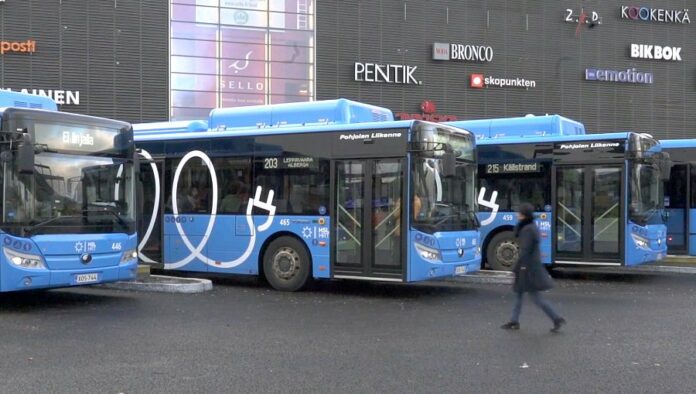
HELSINKI (Xinhua) — With a striking charging plug pattern on its side, the blue-and-white bus runs quietly, making almost zero noise. Looking carefully, one may spot the Chinese logos on the car glass.
Since August this year, residents in the capital region of Finland have often encountered such new “guys” when they travel by bus.
Being the first batch of pure electric buses in operation in Finland, the 33 buses produced by China’s Zhengzhou Yutong Bus Co. Ltd have met the requirements of Finnish authorities, participants in a media visit held in Helsinki on Monday were told.
The buses were introduced to Finland by Pohjolan Liikenne, one of Finland’s largest public transport operators.
“China is very advanced in the development and production of electric buses. Our partner Yutong is the world’s largest manufacturer of electric buses,” Heikki Alanko, managing director of Pohjolan Liikenne, told journalists.
“The battery of the electric bus produced by Yutong has good performance, large storage capacity and fast charging speed. According to our estimation, after full charge, it can support at least 200 kilometers of driving even under harsh conditions,” said Alanko.
“Our drivers gave pretty good feedback on driving Yutong pure electric buses. The passengers also praised them for the comfort and low noise,” Alanko said. “We are very satisfied.”
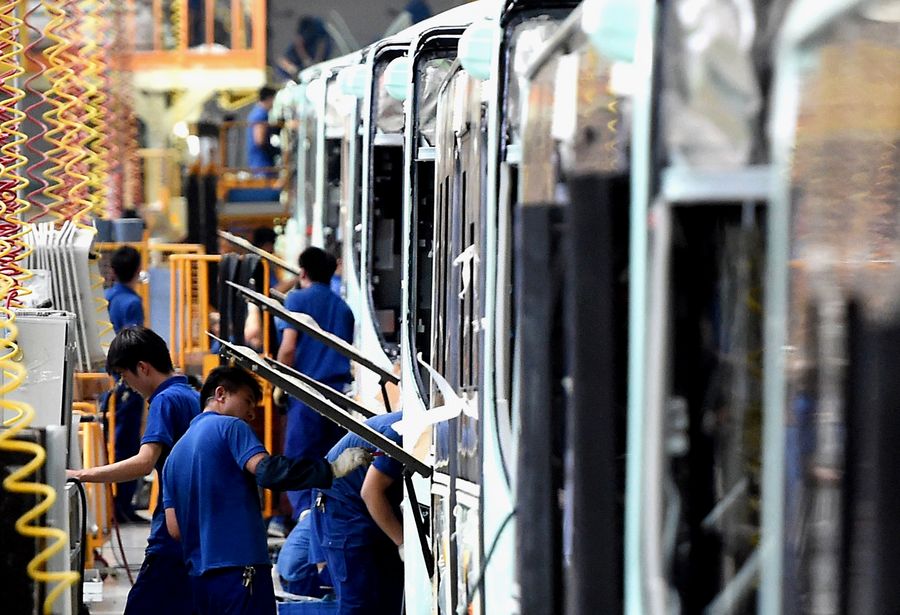
Staff members work on the production line of Yutong new energy bus in Zhengzhou, capital of central China’s Henan Province. (Xinhua/Li An)
According to Alanko, more than a year ago, the Helsinki Region Transportation Authority, which is responsible for maintaining the public transportation network of nine cities in the capital area, tendered the first batch of pure electric buses. Yutong’s products were selected by Pohjolan Liikenne, one of the bidders, for their outstanding quality, and finally got recognized by the government.
“The government and the Helsinki Regional Transportation Authority have strict control over the quality of public transport vehicles. Pure electric buses by Yutong met our requirements in terms of model size, comfort, energy consumption, safety and follow-up services,” Johanna Nyberg, head of city traffic of Espoo in the Helsinki region, said.
Pure electric buses produced in China will also play an important role in helping Finland save energy, reduce emissions and promote green travel.
According to Nyberg, several cities in the Helsinki region, including Espoo, plan to increase the proportion of zero-carbon public transport to 30 percent within five years, and reach 100 percent zero-carbon emissions in public transport system by 2030.
The arrival of the pure electric buses “will optimize our bus system,” marking an important step towards green travel in cities, Nyberg said.
Ma Kai, Nordic market project manager at Yutong, told Xinhua that in light of the long, cold and snowy winters in Finland, Pohjolan Liikenne was very concerned about the performance of the buses.
Representatives of the Finnish bus operator “came to Harbin (the capital of Heilogjiang, China’s northernmost province), which has a similar winter climate as Finland, for testing our products, and finally were convinced by the quality,” said Ma.
Ma said Yutong representatives had visited Finland many times before winning the contract with Pohjolan Liikenne.
“Yutong attaches great importance to follow-up services and sets up commissioners for overseas customers to ensure vehicle operation and provides skills training,” said Ma.
Yutong is a Chinese bus manufacturer that has an excellent track record in the new energy bus industry. The publicity department of Yutong told Xinhua that as of July 2019, the company had sold 120,000 new energy buses worldwide, including more than 8,000 in Europe. In 2018, its large and medium-sized passenger vehicles had a global market share of 13 percent.
“The development of our new energy bus business is largely due to China’s vigorous promotion of new energy vehicle research and development (R&D) and production in the past few years. The forward-looking policies have enabled us to touch the pulse of the industry, accumulate a wealth of experience and get our technical strength enhanced,” Ma said
In this June 14, 2019 photo, Jorgji Ilia, 71, stands on the shore of the Vjosa River after collecting water from a small spring in the village of Kanikol, Albania. "There is nothing else better than the river," the retired schoolteacher says. "The Vjosa gives beauty to our village." Photo: Felipe Dana / AP
ALONG THE VJOSA RIVER (AP) — Under a broad plane tree near Albania’s border with Greece, Jorgji Ilia fills a battered flask from one of the Vjosa River’s many springs.
“There is nothing else better than the river,” the retired schoolteacher says. “The Vjosa gives beauty to our village.”
The Vjosa is temperamental and fickle, changing from translucent cobalt blue to sludge brown to emerald green, from a steady flow to a raging torrent. Nothing holds it back for more than 270 kilometers (170 miles) in its course through the forest-covered slopes of Greece’s Pindus mountains to Albania’s Adriatic coast.
This is one of Europe’s last wild rivers. But for how long?
Albania’s government has set in motion plans to dam the Vjosa and its tributaries to generate much-needed electricity for one of Europe’s poorest countries, with the intent to build eight dams along the main river.
It’s part of a world hydropower boom, mainly in Southeast Asia, South America, Africa and less developed parts of Europe. In the Balkans alone, about 2,800 projects to tame rivers are underway or planned — a “dam tsunami,” says Olsi Nika of EcoAlbania, a nonprofit that opposes the projects.
Some tout hydropower as a reliable, cheap and renewable energy source that helps curb dependence on planet-warming fossil fuels like coal, oil and natural gas. The Intergovernmental Panel on Climate Change says it has “significant potential” to further reduce carbon emissions.
But some recent studies question hydropower’s value in the fight against global warming. Critics such as EcoAlbania say the benefits of hydropower are overstated — and outweighed by the harm dams can do.
Rivers are a crucial part of the global water cycle. They act as nature’s arteries, carrying energy and nutrients across vast landscapes, providing water for drinking, food production and industry. They’re a means of transportation for people and goods, and a haven for boaters and anglers. Rivers are home to a diversity of fish — including tiny minnows, trout and salmon — and provide shelter and food for birds and mammals.
But dams interrupt their flow, and the life in and around them. While installing fish ladders and widening tunnels to bypass dams helps some species, it hasn’t worked in places like the Amazon, says Julian Olden, a University of Washington ecologist who has studied the impacts of dams in Brazil, Australia and the U.S.
Dams block the natural flow of water and sediment, and can cause harmful temperatures swings. They also can change the chemistry of the water and cause toxic algae to grow.
“Once dams go in, there’s almost no going back,” Olden says. “You starve a river of water. It’s unsurprising that its inhabitants are likely to disappear.”
Those who live along the riverbank or rely on the waterway for their livelihood fear dams could kill the Vjosa as they know it. Its fragile ecosystem will be irreversibly altered, and many residents will lose their land and homes.
“It’s like humans,” says Elton Pashollari, a river rafting guide whose clients are increasingly attracted by the Vjosa’s wildness. “What happens if one of your arteries, it stops, blood doesn’t circulate anymore? It’s the same thing with the Vjosa.”
In this June 24, 2019 photo, a man jumps into a spring where it meets the Vjosa River in the Kelcyre Gorge, Albania. Albania’s government has set in motion plans to dam the Vjosa and its tributaries to generate much-needed electricity for one of Europe’s poorest countries, with the intent to build eight dams along the main river. Phot:o: Felipe Dana / AP
___
From Ilia’s plane tree near the Greek border, the Vjosa flows north through narrow gorges before passing by the town of Tepelene, growing more languid and broadening into wide gravel banks, its flow splitting into strands — what scientists call a braided river.
This characteristic is typical of wild rivers and is critical to the local ecosystem. It creates diverse habitats and allows sediment to flow, fertilizing the floodplains and rejuvenating the riverbed.
It is here that the Vjosa reveals another side of its wild nature. After seasonal floods, the river can change course, its braids re-forming along the deep gravel that serves as a filter and self-purification system. It skips from left to right to the center, across an area around 1.5 kilometers (1 mile) wide.
“A natural river is a dynamic river … a living river,” says Nika of EcoAlbania. “It’s living day by day and it changes its face. After each flood, you could never see the same scenery.”
The river’s ability to clean itself has proved crucial in a country where waste management is often rudimentary. For years, people have dumped trash in gullies that washed into the river, leaving trails of plastic and cloth clinging to tree branches. Some towns still dump raw sewage, but the river’s self-cleansing means that the overall water quality is passable.
About 25 kilometers (16 miles) northwest of Tepelene, the riverbed narrows into another tight, steep gorge teeming with life, where birds swoop from trees anchored precariously in the cliff-face. Just beyond that comes the first sign of how dramatically a dam would affect the river and the life connected to it.
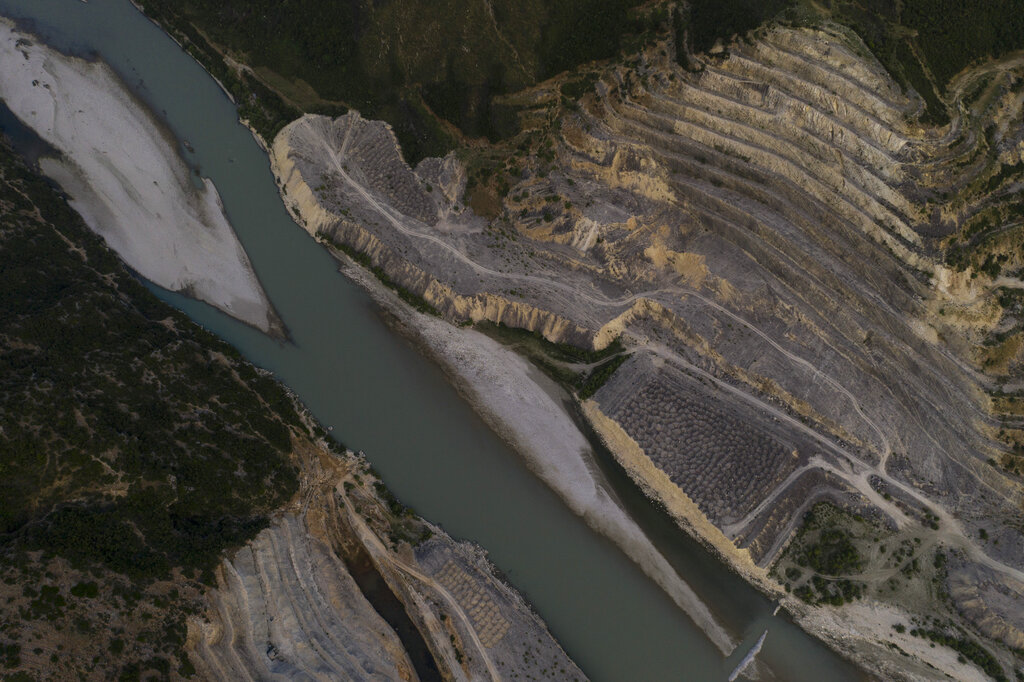
Emerging from the canyon, it like a strip mine. This is Kalivac, one of the proposed dam sites. An Italian company was awarded a contract in the late 1990s. Construction began, but never finished, plagued with delays and financial woes. It now lies derelict with guards stationed to prevent looting.
Half the hill on one side has been dug away, creating giant steps into the rock. Vehicles sit abandoned, a digging machine sunken into the ground, branches and debris clinging to its frame.
Now, the government has awarded a new contract for the site to a Turkish company.
For Benedikt Baeumler, a German advertising executive kayaking the length of the river, the sight was a shock.
“I felt like there’s all this wonderful nature, and then suddenly to see these stairs, like the Egyptian pyramids,” he says.
A few days earlier and several miles upriver, the 43-year-old had been ambivalent about the hydropower projects, noting his own country had also dammed its rivers.
But what he saw at the Kalivac site changed his mind.
“It was really unbelievable what they did to nature, removing entire parts of the mountain,” he said, setting up camp on a sandbar back in June. “I hope this dam is never built.”
Many locals agree. Dozens of residents from the village of Kute, further downriver, joined nonprofits to file what was Albania’s first environmental lawsuit against the construction of a dam in the Pocem gorge, a short distance downriver from Kalivac. They won in 2017, but the government has appealed.
The victory, while significant, was just one battle. A week later, the government issued the Kalivac contract. EcoAlbania plans to fight that project, too.
Ecologically, there is a lot at stake.
A 2018 study led by University of Vienna’s Fritz Schiemer found the Vjosa was incredibly diverse. The team logged more than 90 types of aquatic invertebrates in the places where dams are planned, plus hundreds of fish, amphibian and reptile species, some endangered and others endemic to the Balkans.
But “the majority of the specific biodiversity will disappear in the case of the planned dam constructions,” they warned.
Dams can unravel food chains by reducing populations of insects that feed fish and by limiting spawning, which in turn leaves less prey for fish-eating birds and mammals. But the most well-known problem with building dams is that they block the paths of fish trying to migrate upstream to spawn. The U.S. Atlantic salmon population has plummeted, according to the National Oceanic and Atmospheric Administration, in great part due to dams.
As pressure to build dams intensifies in less developed countries, the opposite is happening in the U.S. and western Europe, where there’s a movement to tear down dams considered obsolete and environmentally destructive.
More than 1,600 have been dismantled in the U.S., most within the past 30 years, according to the advocacy group American Rivers. In Europe, the largest-ever removal began this year in France, where two dams are being torn down on Normandy’s Selune River.
This June 23, 2019 aerial photo shows the construction site of the Kalivac dam on the banks of the Vjosa River in Albania. As pressure to build dams intensifies in less developed countries, the opposite is happening in the U.S. and western Europe, where there’s a movement to tear down dams considered obsolete and environmentally destructive. Photo: Felipe Dana / AP
___
With so few wild rivers left around the globe, the Vjosa also is a valuable resource for studying river behavior.
“Science is only at the beginning of understanding how biodiversity in river networks is structured and maintained,” says researcher Gabriel Singer of the Leibniz-Institute in Germany. “The Vjosa is a unique system.”
For Shyqyri Seiti, it’s much more personal.
The 65-year-old boatman has been transporting locals, goods and livestock across the river for about a quarter century. The construction of the Kalivac dam would spell disaster for him. Many of the fields and some of the houses in his nearby village of Ane Vjose would be lost.
“For me, the river is everything,” he says. “Someone will benefit from the construction of the dam, but it will flood everyone in the area. … What if they were in our place, how would they feel to lose everything?”
His love for the river runs deep: It feeds his family by providing work and fish to eat and sell. He taught his five children to swim here. Every morning, he runs down to the river just to take in the view.
Seiti has protested against the plans, but some of his neighbors disagree. The mayor, Metat Shehu, insists the community “has no interest” in the matter.
“The Vjosa is polluted. The plants and creatures of Vjosa have vanished,” Shehu says while tending his goats. The biggest issue, he adds, is that villagers are being offered too little to give up their land. He hopes the dam will bring investment to the area.
About 10 kilometers (6 miles) downriver of Ane Vjose lies the village of Kute, on a hill overlooking the Vjosa as it snakes its way north to the sea. Kute residents joined the lawsuit against the Pocem dam that would flood their fields, some houses and, crucially for many, a cemetery. Relieved by their victory, they now wait anxiously for the outcome of the government’s appeal.
There are some signs in their favor. In August, the government announced it was canceling a project in central Albania’s Holta Canyon near the town of Gramsh, and would tear down part of a dam that’s already built. The Infrastructure and Energy Ministry said in a statement the decision came after discussions with residents and an environmental review. Energy ministry officials rejected multiple interview requests to discuss the Vjosa River and the country’s hydropower plans.
Could the Vjosa projects also be stopped?
Jonus Jonuzi, a 70-year-old farmer who grew up along the river, still has hope.
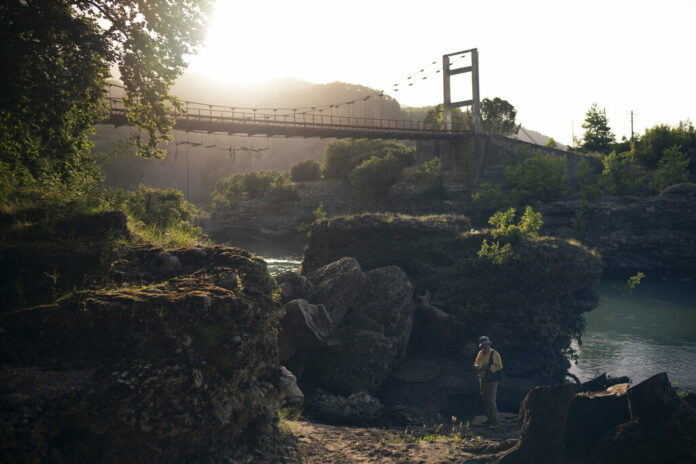
He raised his children here and now watches his grandchildren play in its waters. Before dawn each day, he crosses a bridge over a narrow gorge to tend to his goats before his son drives them to drink from a local spring, where the water emerges cold and crystal clear.
“Everything I have, I have because of the river,” he says. “Albania needs electrical energy. But not by creating one thing and destroying another. Why do such damage that will be irreparable for life, that future generations will blame us for what we’ve done?”
___
Story: Elena Becatoros and John Flesher. Flesher reported from Traverse City, Michigan.
___
This Associated Press series was produced in partnership with the Howard Hughes Medical Institute’s Department of Science Education. The AP is solely responsible for all content.
Japan's Emperor Naruhito, in a white robe, leaves after praying at “Kashikodokoro”, one of three shrines at the Imperial Palace, in Tokyo, Tuesday, Oct. 22, 2019. Emperor Naruhito visited three Shinto shrines at the Imperial Palace before proclaiming himself Japan’s 126th emperor in an enthronement ceremony. Photo: Kyodo News via AP
TOKYO (AP) — Emperor Naruhito visited three Shinto shrines at the Imperial Palace on Tuesday before proclaiming himself Japan’s emperor in an enthronement ceremony.
The 59-year-old emperor put on a white robe and prayed at “Kashikodokoro” and two other shrines. The visits Tuesday morning are to report to gods ahead of the ceremony, to be attended by 2,000 guests from in and outside Japan.
The enthronement ceremony is the high point of succession rituals that began in May when Naruhito succeeded to the Chrysanthemum Throne after the abdication of Akihito, his father. Naruhito is the 126th emperor in the world’s oldest hereditary monarchy that historians say goes back 1,500 years.
Enshrined at “Kashikodokoro” is the goddess Amaterasu, the mythological ancestress of Japan’s emperors.
Naruhito, accompanied by palace staff in black robes holding up the imperial treasures of sword and jewel in a box and neatly wrapped in fabric, walked slowly to the first shrine, bowed deeply and went inside to pray. He was to make similar visits at two other shrines.
The proclamation is largely meant to allow the government to showcase the monarchy to win public support and to preserve Japan’s cultural heritage, historians say.
The enthronement ceremony was originally modeled after one by the ancient Tang dynasty of China and the second of a three-part process following the May succession. Next month sees the highly religious and divisive ritual of the Grand Harvest. Some experts have raised questions over the government’s funding of 16 billion yen ($150 million) for ceremonies that contain religious rites.
Criticism was largely eclipsed by the festive mood, in part because Naruhito’s succession was by abdication not by death, palace watchers said.
Despite the time, effort and cost put into preparations, the ceremony is to last only 30 minutes.
At the main ceremony, Naruhito will wear a formal brownish-orange robe that has been dyed in sappanwood and Japanese wax tree bark and a black headdress decorated with an upright tail — as his father did 30 years ago — in a ceremony at Matsu-no-ma, the Imperial Palace’s most prestigious hall.
Later Tuesday, Naruhito and his wife Masako, a Harvard-educated former diplomat, will host a court banquet, to be attended by about 400 foreign dignitaries and representatives from Japan’s administrative, legislative and judicial branches and their spouses.
A parade originally planned for Tuesday afternoon has been postponed until Nov. 10 due to a deadly typhoon that caused flooding and other damage in central and northern Japan.
Naruhito and Masako have been warmly welcomed by the Japanese public, despite comparisons to their beloved predecessors. They made positive impressions by freely conversing with U.S. President Donald Trump and first lady Melania during their visit weeks after Naruhito’s succession in May, palace watchers say.
“I think people have high expectations for the emperor who is fluent in foreign language and internationalized,” said historian and monarchy expert, Eiichi Miyashiro, also a journalist.
Naruhito is a historian, a viola player and an expert on water transport who studied at Oxford. Masako, a Harvard-educated diplomat, has struggled for more than a decade since developing “adjustment disorder” after giving birth to their only child, Princess Aiko, and facing pressure to produce a boy in Japan’s monarchy that only allows male heirs.
A shortage of males in the royal family has raised succession concerns. Naruhito has an 83-year-old uncle and two potential heirs — his younger brother Crown Prince Akishino and a 13-year-old nephew, prompting calls for a debate, possibly to allow female emperors.
Abe and his ultra-conservative supporters who want to keep paternalistic family values insist on male-only succession, while a majority of the general public support allowing female emperors.
American soldier mount the U.S. flag on a vehicle near the town of Tel Tamr, north Syria, Sunday, Oct. 20, 2019. Kurdish-led fighters and Turkish-backed forces clashed sporadically Sunday in northeastern Syria amid efforts to work out a Kurdish evacuation from a besieged border town, the first pull-back under the terms of a U.S.-brokered cease-fire. Photo: Baderkhan Ahmad / AP
KABUL, Afghanistan (AP) — The U.S. may leave some forces in Syria to secure oilfields and make sure they don’t fall into the hands of a resurgent Islamic State, Defense Secretary Mark Esper said Monday, even though President Donald Trump has insisted he is pulling troops out of the country and getting out of “endless wars.”
The Pentagon chief said the plan was still in the discussion phase and had not yet been presented to Trump, who has repeatedly said the Islamic State has been defeated.
Esper emphasized that the proposal to leave a small number of troops in eastern Syria was intended to give the president “maneuver room” and wasn’t final.
“There has been a discussion about possibly doing it,” Esper told a press conference in Afghanistan before heading to Saudi Arabia. “There has been no decision with regard to numbers or anything like that.”
Still, the fact that such a plan was under consideration was another sign the administration was still trying to sort out its overall strategy amid fierce criticism from the president’s Republican allies of his abrupt decision to pull U.S. forces back — essentially clearing the way for Turkey’s military incursion into the border region to push back the American-allied Kurdish forces.
A White House official said GOP Sen. Lindsey Graham raised the issue of keeping U.S. forces in eastern Syria to protect the oilfields and that Trump supported the idea. The official spoke on condition of anonymity to discuss internal discussions.
Trump said Monday at the White House that he still wants to get all U.S. troops out of Syria, but “we need to secure the oil” in one part of the country while Israel and Jordan asked him to keep some forces in another part.
“Other than that, there’s no reason for it, in our opinion,” he said.
Esper said the main goal of leaving some troops around the oilfields would be to make sure the Islamic State doesn’t gain control of the revenue they generate.
The defense secretary said American troops around Kobani are withdrawing and that the U.S. is maintaining combat air patrol over U.S. forces in Syria as the withdrawal goes on. He said the U.S. is using overhead surveillance to try to monitor the recently negotiated cease-fire “as best we can.”
While Trump has insisted he’s bringing home Americans from“endless wars”in the Mideast, Esper said all U.S. troops leaving Syriawill go to western Iraq and the American military will continue operations against the Islamic State group.
Esper told reporters over the weekend that the fight in Syria against IS, once spearheaded by American allied Syrian Kurds who have beencast aside by Trump,will be undertaken by U.S. forces, possibly from neighboring Iraq.
But he said in a tweet Monday that the U.S. would only “temporarily reposition” troops from Syria “in the region” until they could return home.
Esper did not rule out the idea that U.S. forces would conduct counterterrorism missions from Iraq into Syria. But he told reporters traveling with him that those details will be worked out over time.
Trump nonetheless tweeted: “USA soldiers are not in combat or ceasefire zones. We have secured the Oil. Bringing soldiers home!”
The Republican president declared this past week that Washington had no stake in defending the Kurdish fighterswho died by the thousands as America’s partners fighting in Syria against IS extremists. Turkey conducted a weeklong offensive into northeastern Syria against the Kurdish fighters before a military pause.
“We never agreed to protect the Kurds for the rest of their lives,” Trump said during a Cabinet meeting Monday.
Trump’s acting chief of staff, Mick Mulvaney, asked about the fact that the troops were not coming home as the president claimed they would, said, “Well, they will eventually.” He told “Fox News Sunday” that “the quickest way to get them out of danger was to get them into Iraq.”
Trump ordered the bulk of the approximately 1,000 U.S. troops in Syria to withdraw after Turkish President Recep Tayyip Erdogan made it clear in a phone call that his forces were about to invade Syria to push back Kurdish forces that Turkey considers terrorists.
The pullout largely abandons America’s Kurdish allies who have fought IS alongside U.S. troops for several years. Between 200 and 300 U.S. troops will remain at the southern Syrian outpost of Al-Tanf.
The U.S. has more than 5,000 American forces in Iraq, under an agreement between the two countries. The U.S. pulled its troops out of Iraq in 2011 when combat operations there ended, but they went back in after IS began to take over large swaths of the country in 2014. The number of American forces in Iraq has remained small due to political sensitivities in the country, after years of what some Iraqis consider U.S. occupation during the war that began in 2003.
Esper said he will talk with other allies at a NATO meeting in the coming week to discuss the way ahead for the counter-IS mission.
Asked if U.S. special operations forces will conduct unilateral military operations into Syria to go after IS, Esper said that is an option that will be discussed with allies over time.
On Sunday, U.S. House Speaker Nancy Pelosi led a group of American lawmakers on a visit to Jordan to discuss “the deepening crisis” in Syria.
Jordan’s state news agency said that King Abdullah II, in a meeting with the Americans, stressed the importance of safeguarding Syria’s territorial integrity and guarantees for the “safe and voluntary” return of refugees.
___
Story: Lolita C. Baldor. Associated Press writer Zeke Miller contributed from Washington.
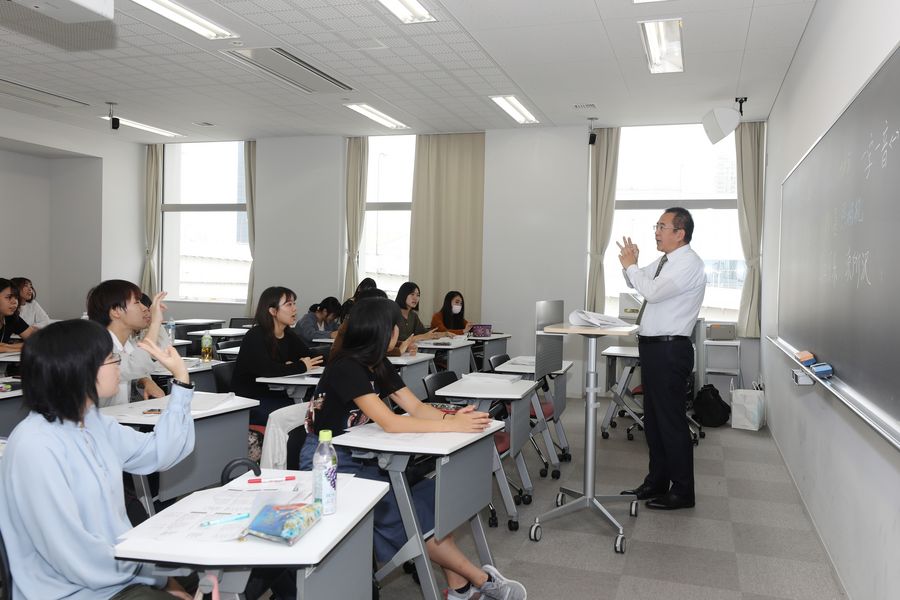
A teacher teach children to read Chinese characters during a Chinese class in Tokyo, Japan on October 19, 2019. (Xinhua/Du Xiaoyi)
TOKYO (Xinhua) — “I started learning Chinese in my freshman year and then I had the opportunity to study in Beijing as an exchange student in my sophomore year. I made a lot of Chinese friends,” Yudai Maekawa, a junior student in Teikyo University, told Xinhua recently.
While attending an event held in Tokyo to promote studying in China and job opportunities, Maekawa said, “China’s economy is developing rapidly … I want to find a job related to Chinese and China.”
At the event, about 1,500 students took the Chinese proficiency test (HSK) and several hundred other students participated in a promotion activity concerning studying in China as well as a job fair.
“There were 34,018 applicants for the HSK in Japan last year, and based on this year’s registration momentum, there are likely to be more than 40,000 applicants this year,” said Munashi Masuzawa, president of the Japan Youth Development Association.
In 2010, only around 200 people took the HSK, but the number of HSK examinees in Japan has been increasing year by year.
Liu Yong, the Chinese director of the Confucius Institute at Musashino University, said several hundred students at the university have chosen Chinese as a required course.
Many students initially learned Chinese language just to find a broader career platform, but through the process, they not only learned Chinese language, but also learned about Chinese culture, Liu said.
Liu Yong (1st R), the Chinese director of the Confucius Institute at Musashino University, speaks during a Chinese class in Tokyo, Japan on October 15, 2019. (Xinhua/Du Xiaoyi)
By participating in such programs as tourism and study tour to China, the students became more and more fond of China and increasingly active in learning Chinese.
Currently, about 400 universities in Japan offer Chinese language courses, according to Hu Zhiping, minister counselor for education of the Chinese Embassy in Japan. Some universities have set up Confucius Institutes, which not only provide a better platform for the Japanese to learn Chinese, but also make great contributions to training Japanese teachers, developing Chinese teaching materials and promoting cultural exchanges between the two countries.
Apart from university education, many Japanese are participating in activities such as Chinese Corner.
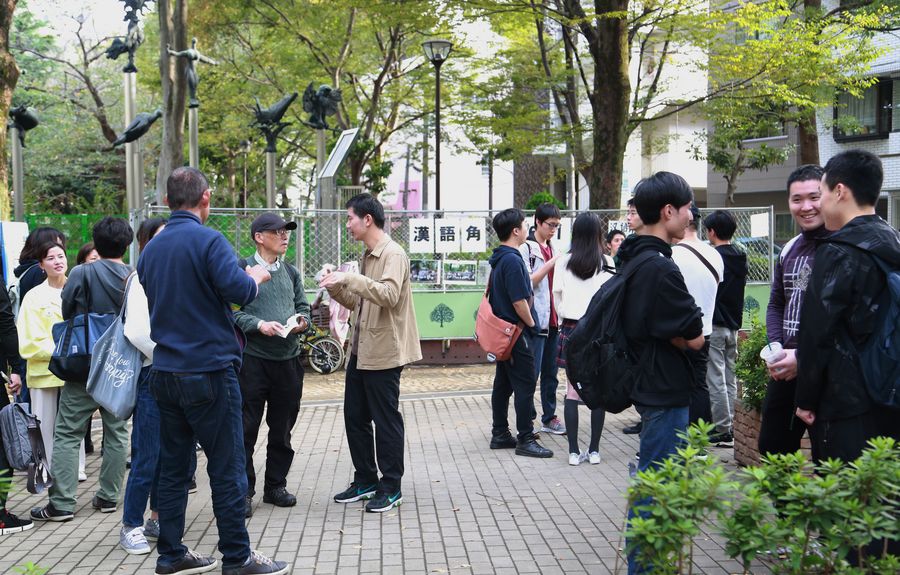
People attend a Chinese Corner in Tokyo, Japan on October 20, 2019. (Xinhua/Jiang Yucen)
Every Sunday afternoon from August 5, 2007 to now, dozens to hundreds of Japanese and Chinese people gather in Tokyo’s Nishiikebukuro Park to talk in Chinese and Japanese.
“I like this Chinese Corner very much. I come to chat here as long as I have time. It’s more about the latest Chinese news, culture and making Chinese friends than it is about learning the language,” said 67-year-old Biju Nedzu.
“It is free and has no threshold; people can come and go as they like. That’s why many Japanese people, many of whom have to work, come to the Corner all the year round. It has become a platform for sincere communication between Japanese friends and Chinese friends,” said Duan Yaozhong, founder of the Chinese Corner.
On July 14, the 600th event of the Chinese Corner was held. Kyodo News Agency, Mainichi Shimbun and other Japanese media reported the event. The gathering of the people from the two nations through the years was recognized by the Japanese society and touched many Japanese people.
“Nowadays, Chinese language is no longer just a personal interest of Japanese friends, but an important skill related to one’s future. More and more Japanese universities are offering Chinese courses, and Chinese teaching is also becoming increasingly active outside in the society,” said Hu Zhiping.
BANGKOK — His Majesty the King on Monday night fired a high-ranking royal guard from his post.
Gen. Arshawin Sawetseni served as a royal bodyguard until his expulsion, which was announced in the government gazette website.
The order did not specify why he was fired, but it came several hours before Sineenat Wongvajirapakdi, a Royal Noble Consort to His Majesty the King, was stripped of her royal and army titles in a separate announcement.
Online searches identified Gen. Arshawin as a 75-year-old soldier who also served as a royal bodyguard under the late King Bhumibol. He was transferred to the service under the new monarch after King Bhumibol died in 2016.
Correction: The timing of the order’s announcement has been corrected.
An undated file photo of Sineenat Wongvajirapakdi released by the Royal Palace in August 2019.
BANGKOK — A palace order issued Monday stripped Royal Noble Consort Sineenat Wongvajirapakdi of her royal and military ranks for alleged acts of gross insubordination.
The removal order was published in the government gazette website, which accused Sineenat of attempting to prevent Queen Suthida from being crowned and abusing her royal status. The order, which came just three months after Sineenat was named a Royal Noble Consort, was effective immediately.
According to the announcement, Sineenat not only “expressed her opposition and exerted her pressure in every possible way” regarding Queen Suthida’s elevation to the throne as the Queen of Thailand, she also sought to have His Majesty the King appoint her to the role instead.
After her repeated disobedience and attempts of interference with the royal affairs, the statement said, His Majesty the King graciously bestowed her the title of Royal Noble Consort in July out of hope that Sineenat would “lessen her pressure” and change her tact.
Instead, Sineenat continued to display “ambition” and overstepped her authority by engaging in many royal court activities without His Majesty the King’s approval, which caused much confusion to the public, the statement said.
“Her actions are considered disloyal, ungrateful, and ungracious of His Majesty’s kindness,” part of the order reads. “They caused division among the royal servants and misunderstanding among the public; these amount to acts of sabotage against the country and the institution [monarchy].”
She was subsequently stripped of all royal ranks, decorations, and military titles; Sineenat previously held an army rank of major-general.
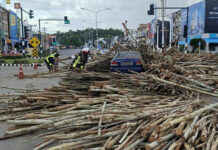
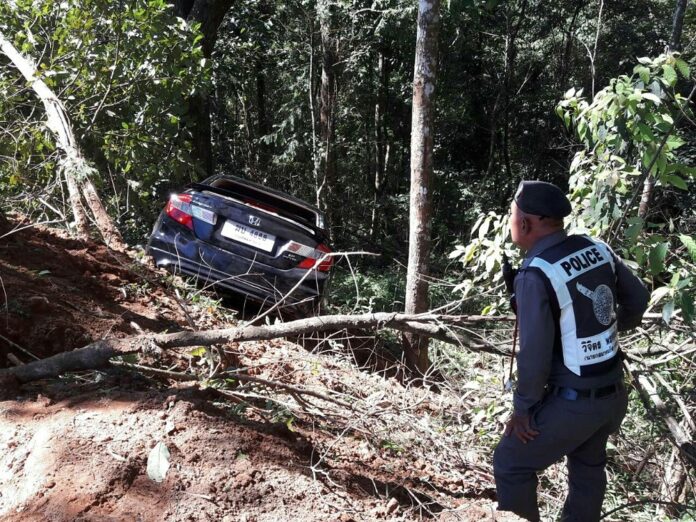
Wrong direction: a car crashes off road in Phetchabun province on Nov. 12, 2016, after reportedly following a wrong direction given by the GPS.
BANGKOK — The government may soon require all vehicles on the road, including private cars and motorcycles, to install tracker devices and send location data to the authorities, a minister said Monday.
Transport Minister Saksayam Chidchob said citizens must bear the cost of GPS devices and sacrifice some levels of privacy in order to keep the roads safe if the measure is approved. He said the policy would help reduce speeding and crack down on driving without proper licenses.
“If we could install GPS on all types of vehicles, we would be able to regulate every vehicle on the roads,” Saksayam told reporters. “Thailand would be the first in the world to do so.”
He continued, “Nothing is free, but we are weighing the benefits that [the new measure] could bring. I’ll consult with the Ministry of Industry within this month.”
The minister said the GPS devices would send relevant data, including vehicles’ location and speed, to a central server stored at the Department of Land Transport.
If the measure is enacted, motorists would be forced to pay up to 3,000 baht for a tracker device and an additional monthly fee of 300 baht, he said.
When a reporter asked whether privacy should also be considered, Saksayam replied, “We have to see what consequences from installing GPS might be. There could be a lot of benefits. At least, there would be fewer crimes, such as car theft. Regulating speed via GPS might also reduce accidents.”
He said public opinion would be solicited for the idea, which could take at least six months before it becomes a ministerial regulation. Saksayam added that he believed the tradeoff is worth it.
“I concede that some issues may affect civil rights, but it won’t cause much damage to them,” the minister said. “And it can lead to a reduction of accidents and losses.”
Public transport such as buses and vans are already required to have GPS devices onboard, but some operators said they could not afford to pay for the trackers.
Thailand is ranked by the World Health Organisation as the fifth highest road toll in the world, per capita. At least 11,000 people have died in road accidents so far this year, according to media reports.