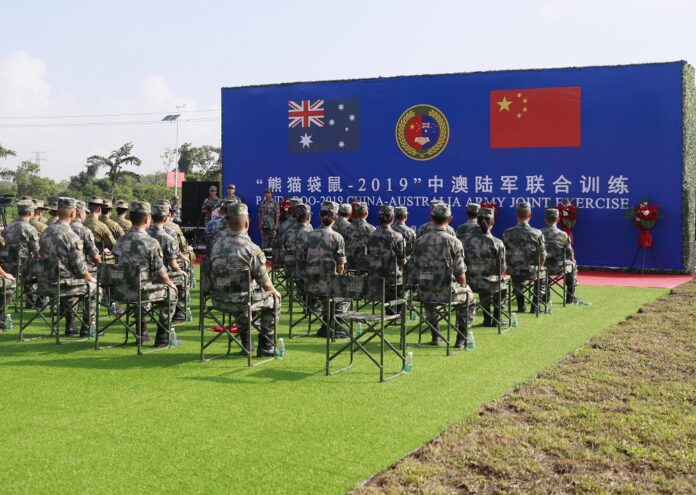
The opening ceremony of the "panda-kangaroo 2019" China-Australia joint military training, South China's Hainan Province, Oct. 10, 2019. (Xinhua/Kangya)
HAIKOU (Xinhua) — The Chinese and Australian armies on Saturday concluded a joint military training exercise in south China’s Hainan Province.
Named “Panda-Kangaroo 2019,” the exercise started on Oct. 10 with 10 officers and soldiers from each army participating, and focused on honing the participants’ military skills, willpower and team spirit via various training exercises.
“We hope to take the joint exercise with the Australian army as an opportunity to keep improving the mechanism, expanding the content and raising the level of the training, and further enhancing the quality of practical cooperation between our two sides,” said Li Bin with the inspection group of the Chinese army.
Servicemen from the two armies lived, trained and learned together, and managed to deepen their friendship and mutual trust during the training themed “cooperation, trust and exchange,” according to Chinese sources.
A worker is reviewing the operation of the solar panels of the Pinar 220 A2 photovoltaic solar park, on the outskirts of the city of Pinar del Rio, Cuba, October 15, 2019. (Xinhua/Joaquin Hernandez)
PINAR DEL RIO, Cuba (Xinhua) — The sun shines on a gigantic sheet made of solar panels located in the outskirts of the Cuban city of Pinar del Rio, some 150 km west from Havana.
Cuban and Chinese flags were fluttering above the Pinar 220 A2 photovoltaic plant, which operates on raw materials and technology donated by China.
The solar park, which came into operation in February 2018, covers about 5.8 hectares with over 15,500 panels manufactured by the Chinese solar energy company Yingli, in the northern province of Hebei.
“Electricity generation begins automatically at 08:00 and is disconnected, also automatically, at 19:00, when the sun starts to go down,” Rosa Maria Molina, director of the solar plant, told Xinhua.
Molina used to be a math teacher, but changed her profession after “falling in love” with the new Chinese technology.
The electricity generated by the solar park is injected into the national power grid, she said.
For Cuba, a country that relies heavily on oil to generate electricity, renewable energy sources are crucial, particularly solar energy, as the Caribbean nation has abundant sunshine most of the year.
According to Cuban experts, the island has the potential to generate 5.0 kilowatt-hours per day per square meter.
“Since we started operating until now, the solar plant has generated about 10,800 megawatt-hours (MWh), which represents a saving of 2,800 tons of fuel,” Molina said.
Apart from the fuel saving, she said, what is more relevant about their work is that they have “prevented 9.75 tons of carbon dioxide from being emitted into the atmosphere.”
The facility has a life span of 25 years. It employs 18 people, all university graduates or mid-level technicians who are responsible for operating, maintaining and guarding the solar park.
It is one of the eight solar parks in the province that can generate 18.5 MWh in total, meeting 14 percent of the electricity demand in the country.
Pinar del Rio has identified 28 areas for construction of photovoltaic parks, which are expected to generate 109 MWh altogether.
Cuba has 65 operating solar parks across the country and 15 others under construction now. And the country aims to build 191 solar parks.
As part of the ongoing process of economic reforms, the Cuban government expects to generate 24 percent of the electricity from renewable resources by 2024.
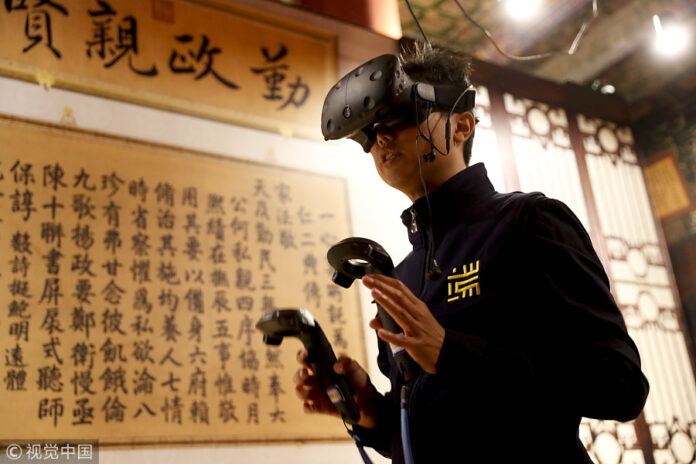
A visitor experiences VR technology during an exhibition at the Palace Museum in Beijing, Oct 10, 2017. [Photo/VCG]
NANCHANG (Xinhua) — Nanchang, capital of east China’s Jiangxi Province, laid the cornerstone of a VR town on Sunday in a bid to seek new growth engines and lead China’s VR boom with the arrival of the 5G era.
The VR town, or the VR technology and innovation town, covers a total area of nine square km with gross investment amounting to around 50 billion yuan (about 7 billion U.S. dollars).
An integrated value chain is expected to take shape in the VR town, which consists of platforms of enterprise services and talent training, to further boost VR applications, hardware manufacturing, software engineering and content production.
Chinese tech firm Huawei will help facilitate the operation and management of the VR town with technical support for the communications network, cloud computing and big data, the company said.
The 2019 World Conference on the VR Industry concludes Monday in Nanchang, with 104 contracts totaling 9.2 billion U.S. dollars signed, according to the provincial department of industry and information technology.
Newspapers display redacted copy on their front pages in Sydney, Monday, Oct. 21, 2019. Australia's major newspapers have published redacted front pages in a coordinated campaign to highlight government secrecy that is often justified on national security grounds. Photo: Rick Rycroft / AP
CANBERRA, Australia (AP) — Australia’s major newspapers published redacted front pages on Monday in a coordinated campaign to highlight government secrecy that is often justified on national security grounds.
Rival media businesses first banded together to fight for press freedom in June after police raided the Canberra home of a News Corp. journalist and the Sydney headquarters of Australian Broadcasting Corp. in search of leaked government documents that had formed the basis of news reports embarrassing to the government. A former army lawyer has been charged over the leaks and several journalists could also be charged.
The newspaper front pages ask: When government keeps the truth from you, what are they covering?
Examples of secrecy include the government’s refusal to disclose which nursing homes haven been found to abuse and neglect elderly residents. The government also will not disclose how much agricultural land has been sold to foreign entities.
“Australians should always be suspicious of governments that want to restrict their right to know what’s going on,” News Corp. Australia’s executive chairman Michael Miller said.
The media campaign began on the day the new Australian Federal Police Commissioner Reece Kershaw testified for the first time before a Senator committee that is holding an ongoing inquiry into police issues.
Kershaw, who has been in charge of police for less than three weeks, said he planned to meet news editors soon to discuss their concerns on press freedom.
“Police independence and freedom of the press are both fundamental pillars that coexist in our democracy,” Kershaw said. “I strongly believe in these two pillars.”
Police had finalized new guidelines for investigating unauthorized disclosures by government officials that take into account a recent government direction to acknowledge the importance of a free and open press, Kershaw said.
Questioned in Parliament, Prime Minister Scott Morrison on Monday would not give assurances that journalists targeted in the June raids would avoid being charged.
“There is no one in this country who is above the law,” Morrison said.
“People should not be prosecuted for their profession. They should only be prosecuted if indeed they have been found to be falling foul of the law,” he added.
Australian media organizations argue that press freedoms have been eroded by more than 70 counterterrorism and security laws that have been passed by Parliament since the al-Qaida attacks on the United States on Sept. 11, 2001.
The government responded by asking a parliamentary committee to hold an inquiry into the impact of Australian law enforcement and intelligence powers on press freedom. That committee will report next month.
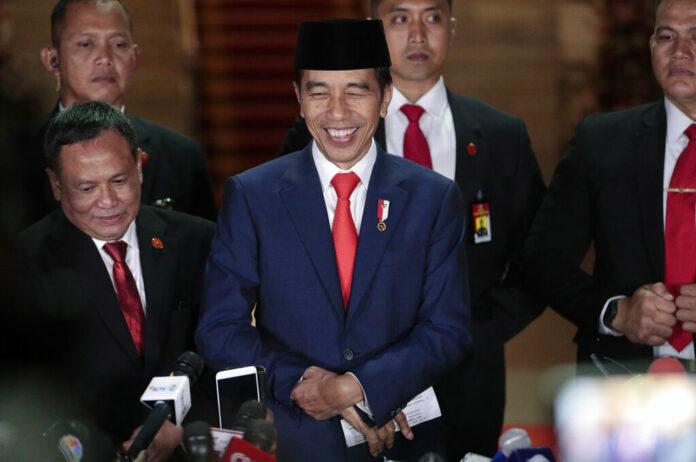
Indonesian President Joko Widodo, center, smiles as he speaks to the media upon arrival after his inauguration for his second term, at Merdeka Palace in Jakarta, Indonesia, Sunday, Oct. 20, 2019. Widodo, who rose from poverty and pledged to champion democracy, fight entrenched corruption and modernize the world's most populous Muslim-majority nation, was sworn in Sunday for his second and final five-year term with a pledge to take bolder actions. Photo: Dita Alangkara / AP
JAKARTA, Indonesia (AP) — Indonesian President Joko Widodo was sworn in Sunday for his second and final five-year term with pledges to champion democracy and take bolder actions against poverty and entrenched corruption in the world’s most populous Muslim-majority nation.
Known for his down-to-earth style, Widodo opted for an austere ceremony at the heavily guarded Parliament in contrast to the festive parade and horse-drawn carriage at his first inauguration, a relaxed affair where he was cheered on by thousands of waving supporters.
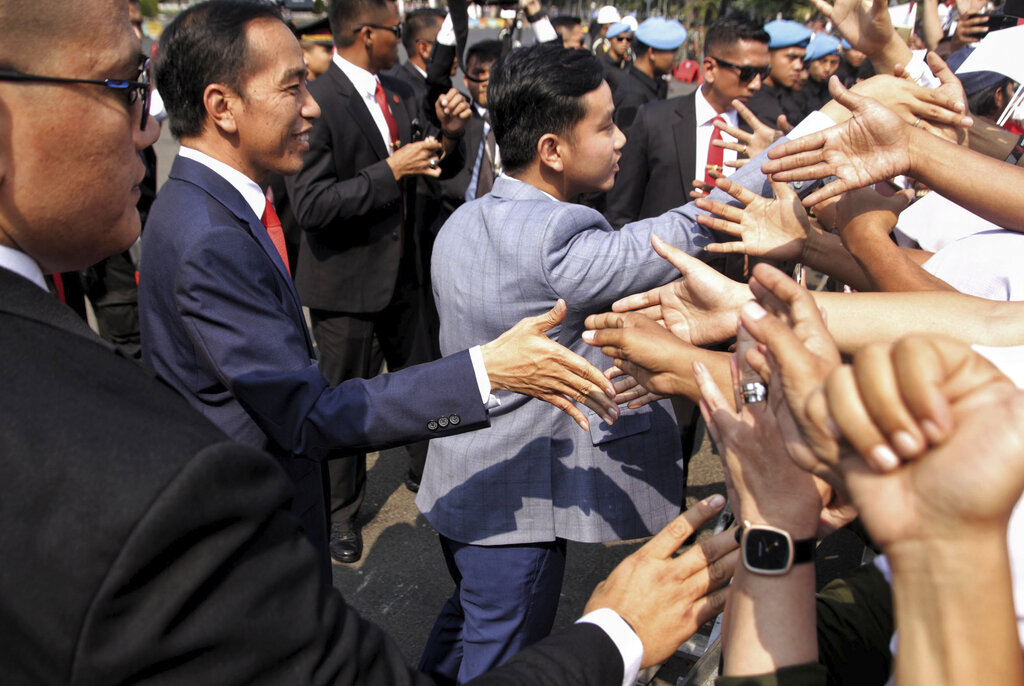
A knife attack by an Islamic militant couple against his security minister on Oct. 10 prompted a security crackdown for Widodo’s second inauguration. Army troops and police, along with armored vehicles, firetrucks and ambulances, were deployed across Jakarta and major roads were closed. On his way to the ceremony, Widodo left his convoy with some of his security escorts and shook the hands of supporters, who waved national flags, yelled his name and called him “bapak,” or father.
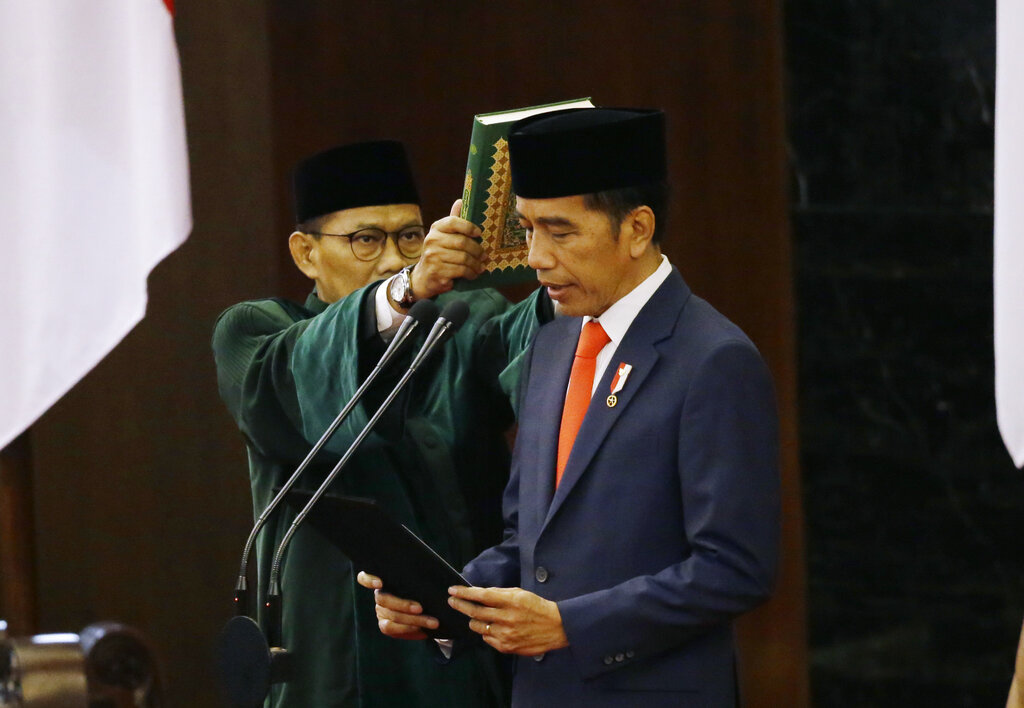
After taking his oath before the Quran, the Muslim holy book, in front of lawmakers and foreign dignitaries, Widodo laid out ambitious targets to help Indonesia join the ranks of the world’s developed nations by its centennial in 2045.
He said in his inauguration speech that he expects poverty — which afflicts close to 10 percent of Indonesia’s nearly 270 million people — to be just about wiped out and the country’s annual GDP to reach $7 trillion by then.
“For those who are not serious, I’ll be merciless. I would definitely fire people,” Widodo warned.
Indonesian President Joko Widodo, right, reads his oath during his inauguration ceremony as the country’s seventh president at the parliament building in Jakarta, Indonesia Sunday, Oct. 20, 2019. Widodo, who rose from poverty and pledged to champion democracy, fight entrenched corruption and modernize the world’s most populous Muslim-majority nation, was sworn in Sunday for his second and final five-year term with a pledge to take bolder actions. Photo: Achmad Ibrahim Pool / AP
Australian Prime Minister Scott Morrison and Chinese Vice President Wang Qishan were among the dignitaries attending. President Donald Trump sent Secretary of Transportation Elaine Chao for the ceremony in Indonesia, Southeast Asia’s largest economy and a member of the G-20 bloc of nations.
Indonesia is a bastion of democracy in Southeast Asia, a diverse and economically bustling region of authoritarian regimes, police states and nascent democracies.
After decades of dictatorship under President Suharto, the country was convulsed by political, ethnic and religious unrest in the late 1990s and early 2000s. Since then, it has consolidated its democratic transition. While most of the country remains poor and inequality is rising, it is home to a rapidly expanding middle class.
Popularly known as Jokowi, Widodo is the son of a furniture maker who grew up with his family in a rented bamboo shack on the banks of a flood-prone river in Solo city on Java island. He is the first president from outside the country’s super rich and often corrupt, political, business and military elite.
Widodo, 58, presents himself as a man of the people, often emphasizing his humble roots. His popular appeal helped him win elections over the past 14 years for mayor of Solo, governor of Jakarta and twice for president. In a reflection of his popularity, he has nearly 26 million followers on Instagram and more than 12 million on Twitter.
He has been likened to Barack Obama, but since taking office he has been perceived as unwilling to press for accountability that threatens powerful institutions such as the military. Instead, he has emphasized nationalism while also fending off attacks that he is not devout enough as a Muslim.
Widodo was sworn in with his new vice president, Ma’ruf Amin, one of the most important religious figures in Indonesia. He chose Amin as his running mate to shore up his support among pious Muslims. Amin was chairman of Majelis Ulama Indonesia, the country’s council of Islamic leaders, and supreme leader of Nahdlatul Ulama, the world’s largest Muslim organization.
But Amin, 76, has been criticized for being a vocal supporter and drafter of fatwas against religious minorities and the LGBT community. Human Rights Watch says the fatwas, or edicts, have legitimized increasingly hateful rhetoric by government officials against LGBT people, and in some cases fueled deadly violence by Islamic militants against religious minorities.
Widodo has been widely praised for his efforts to improve Indonesia’s inadequate infrastructure and reduce poverty. He inaugurated the nation’s first subway system, which was financed by Japan, in chronically congested Jakarta in March after years of delay under past leaders.
Pressing on is the biggest challenge, however, in his final years in office given the global economic slowdown, major trade conflicts, falling exports and other hurdles that impede funding.
In an interview with The Associated Press in July, Widodo said he would push ahead with sweeping and potentially unpopular economic reforms, including more business-friendly labor laws, because he’ll no longer be constrained by politics in his final term.
“Things that were impossible before, I will make a lot of decisions on that in the next five years,” he said then.
Indonesian President Joko Widodo, left, and his son, Gibran Rakabuming Raka, center, greet supporters prior to the inauguration for his second term, in Jakarta, Indonesia, Sunday, Oct. 20, 2019. Indonesian President Joko Widodo, who rose from poverty and pledged to champion democracy, fight entrenched corruption and modernize the world’s most populous Muslim-majority nation, was sworn in Sunday for his second and final five-year term with a pledge to take bolder actions. Photo: AP
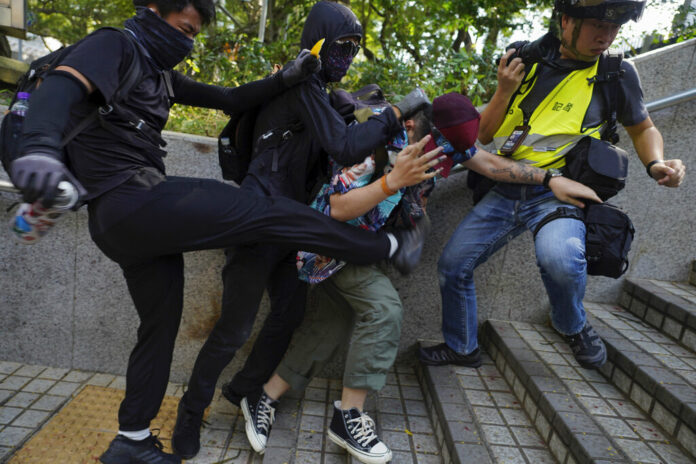
Protesters attack a man who was trying to stop them for vandalizing near the Tsim She Tsui police station during a rally in Hong Kong, Sunday, Oct. 20, 2019. Hong Kong protesters again flooded streets on Sunday, ignoring a police ban on the rally and demanding the government meet their demands for accountability and political rights. Photo: Vincent Yu / AP
HONG KONG (AP) — Hong Kong streets descended into chaotic scenes following an unauthorized pro-democracy rally Sunday, as protesters set up roadblocks and torched businesses, and police responded with tear gas and a water cannon.
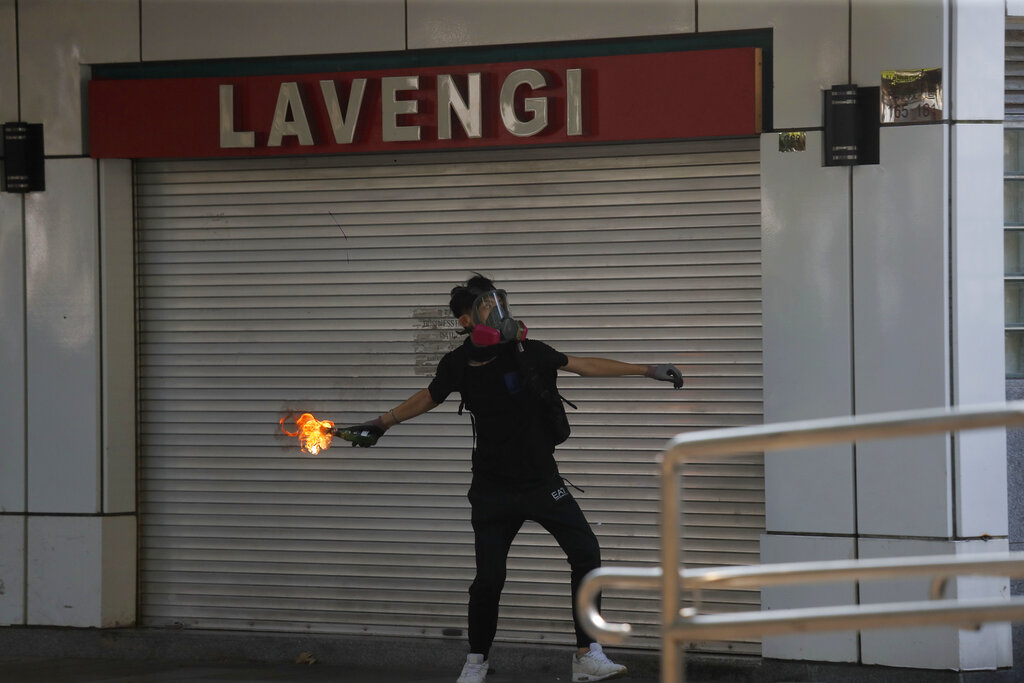
Protesters tossed firebombs and took their anger out on shops with mainland Chinese ties as they skirmished late into the evening with riot police, who unleashed numerous tear gas rounds on short notice, angering residents and passers-by.
Police had beefed up security measures ahead of the rally, for which they refused to give permission, the latest chapter in the unrest that has disrupted life in the financial hub since early June.
Some 24 people were hurt and treated at hospitals, including six with serious injuries, the Hospital Authority said.
Police did not give an arrest figure. One person was seen being handcuffed and taken away to a police van.
As the rally march set off, protest leaders carried a black banner that read, “Five main demands, not one less,” as they pressed their calls for police accountability and political rights in the semi-autonomous Chinese territory.
Supporters sang the protest movement’s anthem, waved colonial and U.S. flags, and held up placards depicting the Chinese flag as a Nazi swastika.
Many protesters wore masks in defiance of a recently introduced ban on face coverings at public gatherings, and volunteers handed more out to the crowd.
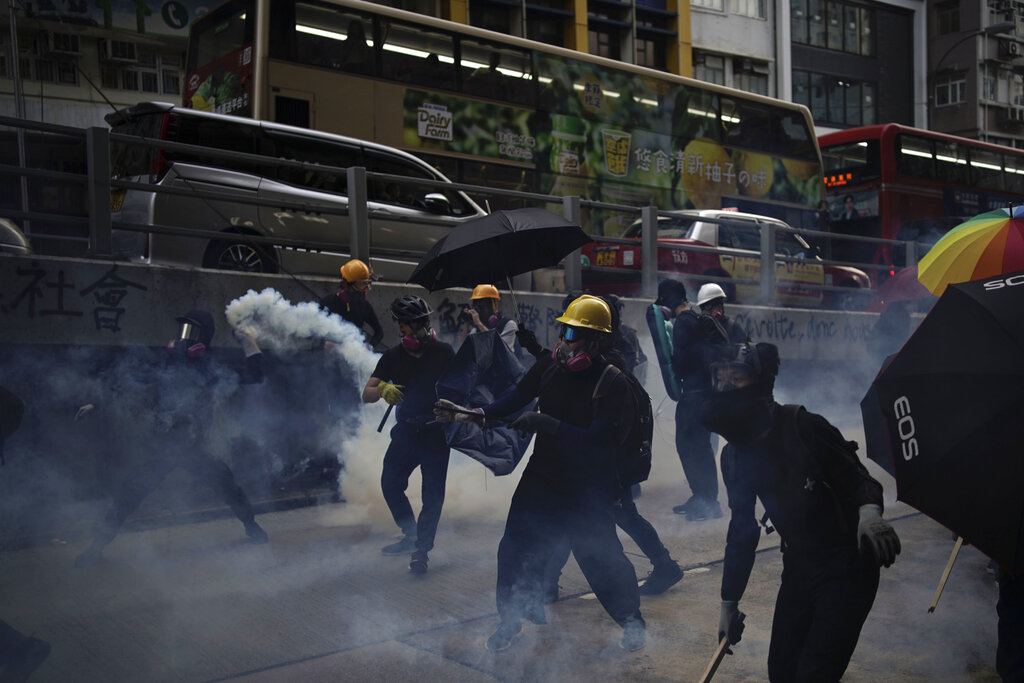
Protesters face police tear smoke in Hong Kong, Sunday, Oct. 20, 2019. Hong Kong protesters again flooded streets on Sunday, ignoring a police ban on the rally and demanding the government meet their demands for accountability and political rights. Photo: Felipe Dana / AP
Matthew Lee, a university student, said he was determined to keep protesting even after more than four months.
“I can see some people want to give up, but I don’t want to do this because Hong Kong is my home, we want to protect this place, protect Hong Kong,” he said. “You can’t give up because Hong Kong is your home.”
Some front-line protesters barricaded streets at multiple locations in Kowloon, where the city’s subway operator restricted passenger access.
They tore up stones from the sidewalk and scattered them on the road, commandeered plastic safety barriers and unscrewed metal railings to form makeshift roadblocks.
A water cannon truck and armored car led a column of dozens of police vans up and down Nathan Road, a major artery lined with shops, to spray a stinging blue-dyed liquid as police moved to clear the road of protesters and barricades.
At one point, the water cannon sprayed a handful of people standing outside a mosque. Local broadcaster RTHK reported that the people hit were guarding the mosque and few protesters were nearby. The Hong Kong police force said it was an “unintended impact” of its operation to disperse protesters and later sent a representative to meet the mosque’s imam.
As night fell, protesters returned to the streets, setting trash on fire at intersections.
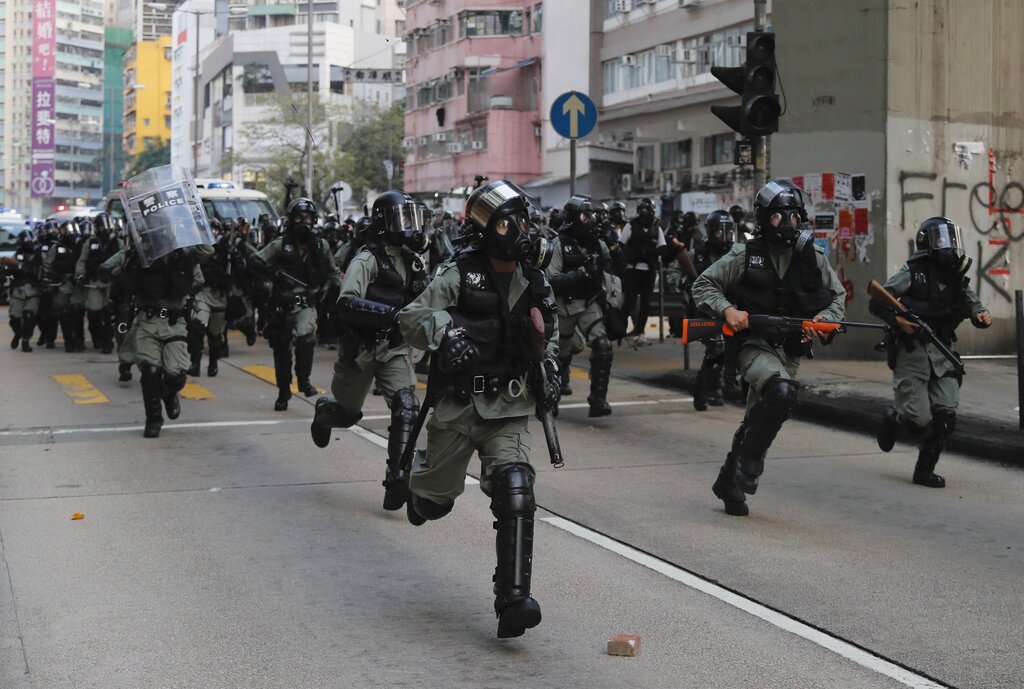
Residents jeered riot police, cursing at them and telling them to leave. The officers, in turn, warned people that they were part of an illegal assembly and told them to leave, and unleashed tear gas to disperse the crowds.
Along the way, protesters trashed discount grocery shops and a restaurant chain because of what they say is the pro-Beijing ownership of the companies. They also set fire to ATMs and branches of mainland Chinese banks, setting off sprinklers in at least two, as well as a shop selling products from Chinese smartphone maker Xiaomi.
The police used a bomb disposal robot to blow up a cardboard box with protruding wires that they suspected was a bomb.
Organizers said ahead of the march that they wanted to use their right to protest as guaranteed by Hong Kong’s constitution despite the risk of arrest.
“We’re using peaceful, rational, nonviolent ways to voice our demands,” Figo Chan, vice convener of the Civil Human Rights Front, told reporters. “We’re not afraid of being arrested. What I’m most scared of is everyone giving up on our principles.”
The group has organized some of the movement’s biggest protest marches. One of its leaders, Jimmy Sham, was attacked on Wednesday by assailants wielding hammers.
On Saturday, Hong Kong police arrested a 22-year-old man on suspicion of stabbing a teenage activist who was distributing leaflets near a wall plastered with pro-democracy messages. A witness told RTHK that the assailant shouted afterward that Hong Kong is “a part of China” and other pro-Beijing messages.
The protest movement sprang out of opposition to a government proposal for an extradition bill that would have sent suspects to mainland China to stand trial, and then ballooned into broader demands for full democracy and an inquiry into alleged police brutality.
Police arrive to chase away protestors in Hong Kong, Sunday, Oct. 20, 2019. Hong Kong protesters again flooded streets on Sunday, ignoring a police ban on the rally and setting up barricades amid tear gas and firebombs. Photo: Kin Cheung / APA protester throws a Molotov cocktail at a police station in Hong Kong, Sunday, Oct. 20, 2019. Hong Kong protesters again flooded streets on Sunday, ignoring a police ban on the rally and demanding the government meet their demands for accountability and political rights. Photo: Kin Cheung / AP
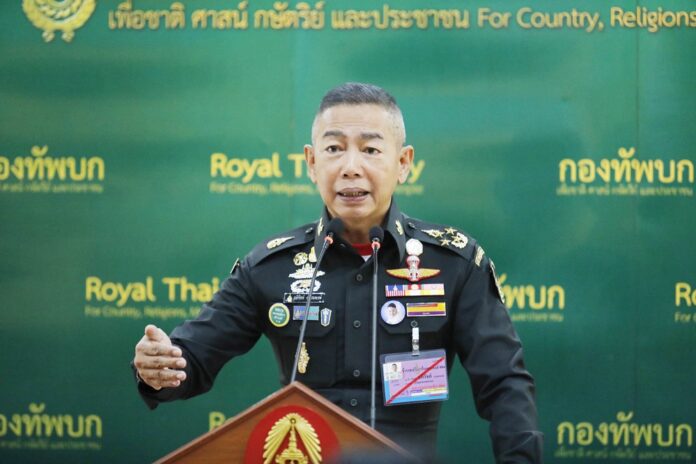
Was it a pep talk, a military psy-op, a lecture, or a paranoid rant on an epic scale that we witnessed from army chief Gen. Apirat Kongsompong last Friday?
It depends on whom you ask, but Apirat was apparently concerned about young Thais, and he seems to have failed to convince them.
“Let me ask students if one day a disappointed person incites you and uses propaganda to mess with your brain to come out onto the streets like in Hong Kong. Will you come out?” Apirat said.
The answer from Twitter users, who are mostly the younger generation, was loud and clear. Within hours by Saturday hashtag #redbuffalo was trending to the with over 226,000 tweets. You see, Apirat’s nickname is Daeng, or red in Thai, and to compare someone to a buffalo is akin to calling the person dumb. It’s also dehumanizing.
On conservative Nation TV, however, a poll among the viewers showed 97 percent support for Apirat’s speech which touched on threats of Communism, sabotage against the monarchy, and dangers from political parties supported by the youth like the Future Forward.
If a 97 percent approval rating is not enough, one of Apirat’s friend-cum-sycophants, Chuwit Kamolvisit, a massage-parlor-king-turned-politician-turned-TV-talking-head, gave him a score of 100.
But even a perfect score could not hide his incoherence and confusion.
In his 90-minute speech, Apirat attacks some Thais for holding onto Communist ideology while also attacking Joshua Wong, the young Hong Kong protest leader who took a stand against the Communist regime in mainland China.
Was Apirat aware that the threat of Communism, including anti-Communist laws, has been obsolete and abolished for decades now?
Was Apirat also aware of the cordial relations between Thailand and the biggest and most powerful Communist states on earth – China?
Did he recall that three years ago, it was his boss, Prime Minister Gen Prayuth Chan-ocha, who publicly advised his Cabinet to read Chinese Communist leader Xi Jinping’s book “The Governance of China,” and who went as far as saying that the book is “suitable” for Thailand?
Apirat can’t seem to make up his mind if he is truly for, or against, Communism.
What’s clear, however, is Apirat tried to revive Cold War fear of Thai monarchy being at risk. He needs the royalists to fear, to develop ideological insecurities. This is how he hopes to unite and rally his support base – possibly in the event of another military coup, which he infamously refused to rule out.
Whether you agree or laugh at what Apirat said for an hour and a half last week, it’s clear that the army will not return to the barracks, even though it’s been six months after the general elections that supposedly “restored” civilian rule.
The army chief – whose late father Gen. Sunthorn Kongsompong led a coup in 1991 – doesn’t feel or think he has overstep his duty by attacking political parties and feeding the public with his fear mongering doctrine.
In a democracy, and even in a Communist state like China, the army chief doesn’t have the authority to talk politics. If last Friday’s spectacle took place in those countries, the army commander would have faced disciplinary actions, if not an immediate dismissal.
But Thailand, even after the elections, is still a militarized Thailand. There is no remorse or a sign of self-awareness from Apirat that he conducted himself unprofessionally.
Forget what he said, his arrogance is one of the most serious threats Thai democracy is facing. Apirat’s rant was in essence the army’s show of superiority over civilian affairs, which made the need to send the military back to the barracks and have its influence contained all the more urgent.
And as long as that goal is still not achieved, democracy and civil liberty will continue to be at risk from military men in power like Apirat, even if his mind is so confused and incoherent. That is the real lesson we can learn from the whole debacle.
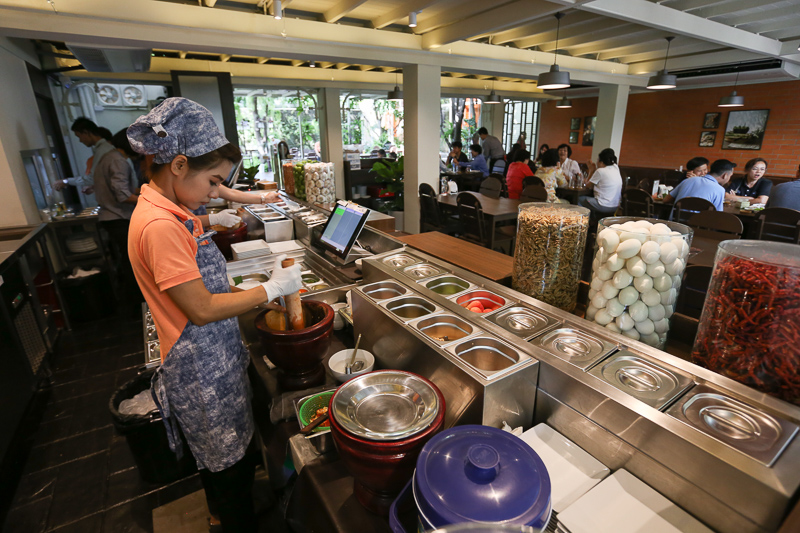
BANGKOK — A tried-and-true Isaan restaurant almost 15 years old has opened its latest branch in tourist-and-expat filled Charoen Krung.
The eighth branch of Baan Somtum opened on Oct. 10 on Charoen Krung Soi 36 in the OP Gardens shopping complex.
A crowd-and-critic favorite, Baan Somtum’s Sathorn branch was listed in the 2019 Michelin Guide with a Bib Gourmand award, and it’s been open since 2005 with its first branch in far Western Bangkok at Phuttamonton Sai 2.
The Bib Gourmand is a value for money award, and we found the prices reasonable, with around 300 to 400 baht a head for a non-drinking party.
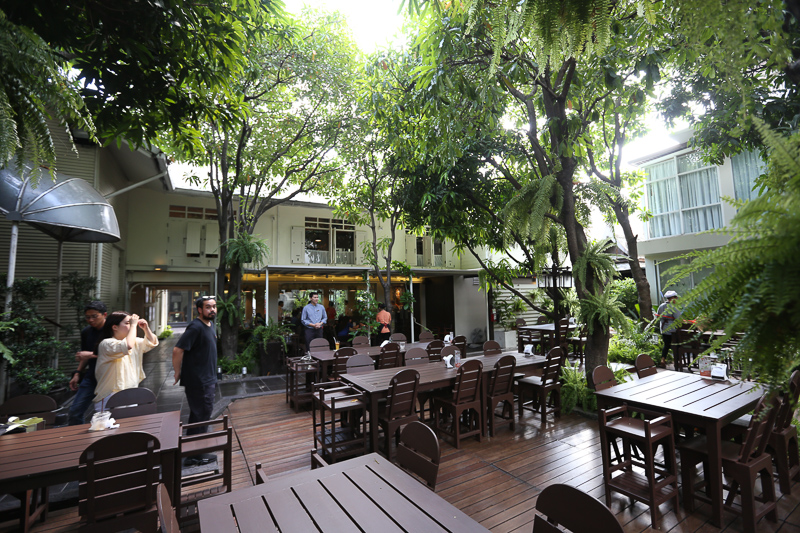
This Bang Rak branch is a two-storey renovated early 20th century wooden house with an outdoor garden dining area, suitable both for relaxed expats lunching over a plate of somtum and grandma sipping spicy soup in the cool aircon. Ask for a seat on the second floor to really appreciate the vintage wood beams.
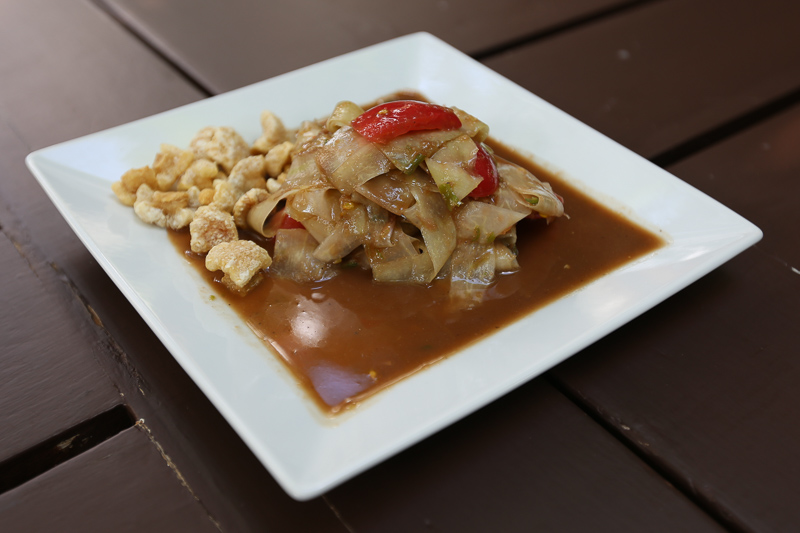
Tum Luang Prabang (75 baht).
Worthy of its name, Baan Somtum has 29 (!) different varieties of the spicy papaya salad. We tried the signature Tum Luang Prabang (75 baht), a plaa raa (fermented fish), Laotian somtum with thick, paparadelle-shaped papaya strips. The restaurant says it’s one of their most popular dishes, and claims to have sold 1.5 million dishes in their 14 years.
Even those averse to plaa raa should give it a try, since the somtum doesn’t have an intense stench like one might expect, and the pork crackling with it is delicious.
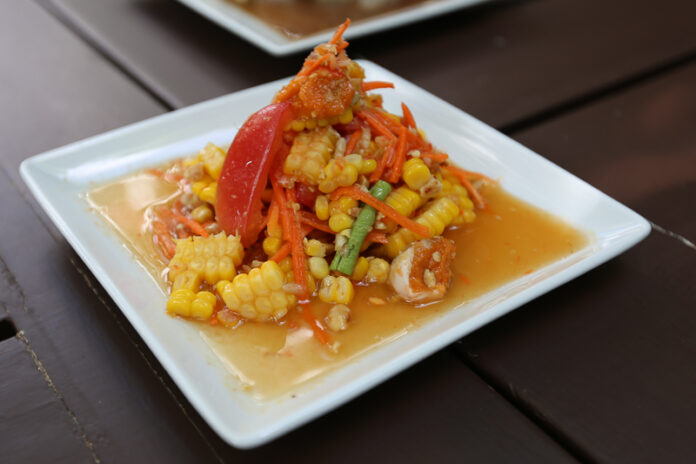
Non-spicy eaters will also love the sweet corn somtum (85 baht), with the salty egg yolk adding layers of flavor to the corn and carrots.
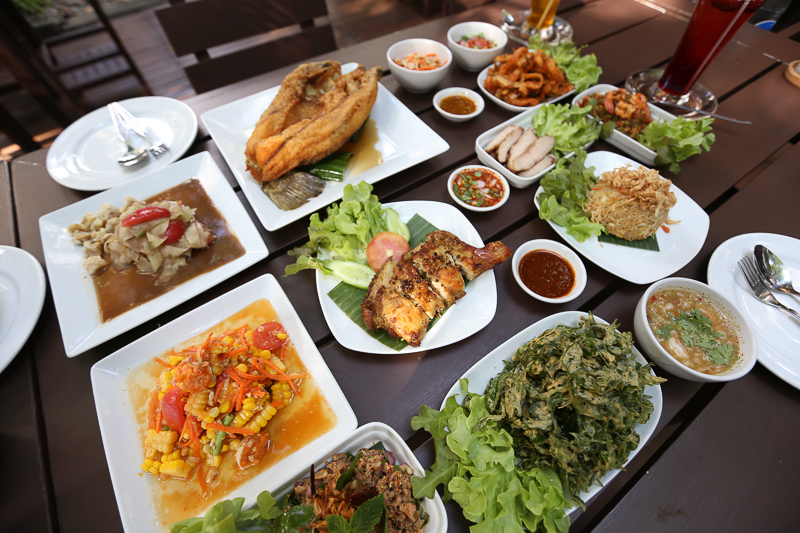
Center: grilled chicken with Sichuan pepper (80 baht).
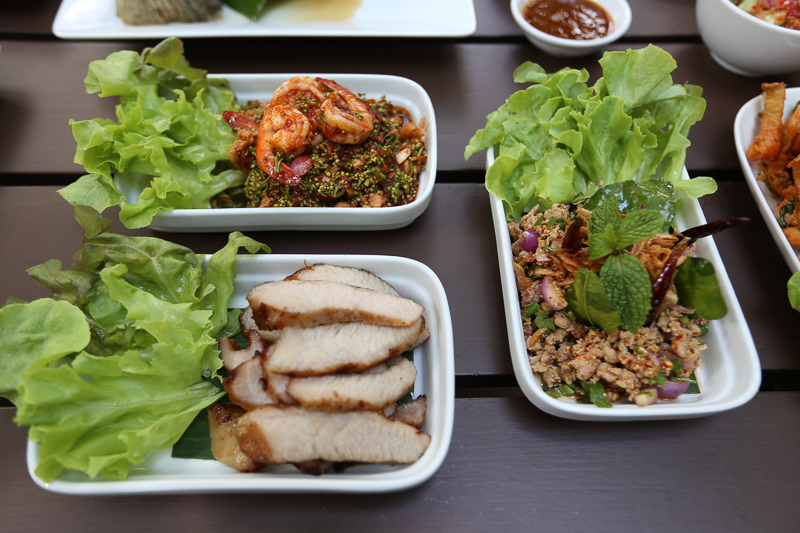
One does not eat somtum alone, of course – get a round of black sticky rice (25 baht) for everyone, as well as other Isaan food staples like the grilled pork shoulder (110 baht) with jim jaew and duck larb (115 baht), as good as any other Isaan food place. But rather than the regular grilled chicken found elsewhere, the grilled chicken with Sichuan pepper (80 baht) has an extra pungent kick we found lent the dish an exotic change.
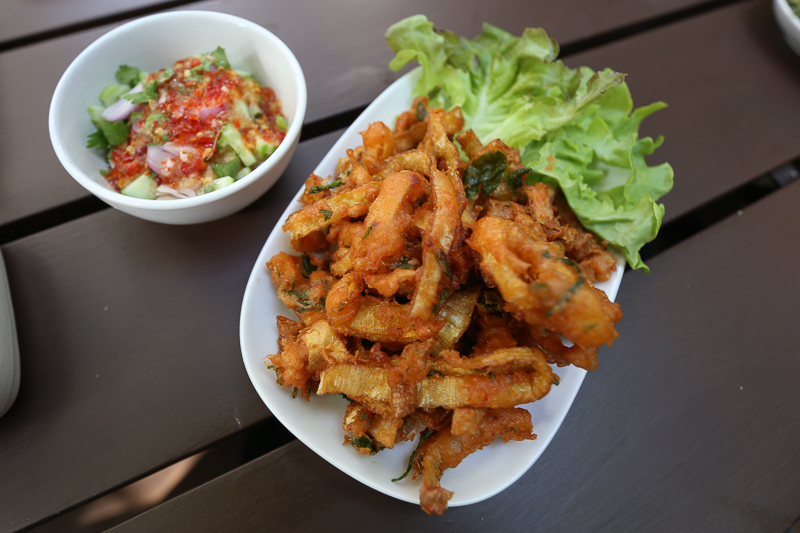
Fried banana blossom (100 baht).
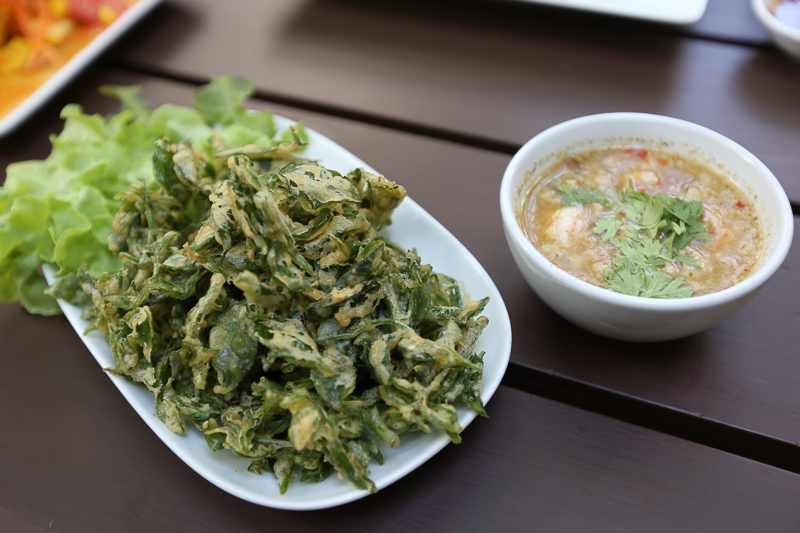
Dishes less commonly found elsewhere but surprisingly delightful included the fried banana blossom (100 baht) with ajaad cucumber and shallot relish, which are reminiscent in flavor to onion rings due to the thick batter. The fried star gooseberry (100 baht) were also snack-like fried vegetables, served with a spicy shrimp-and-pork sauce.
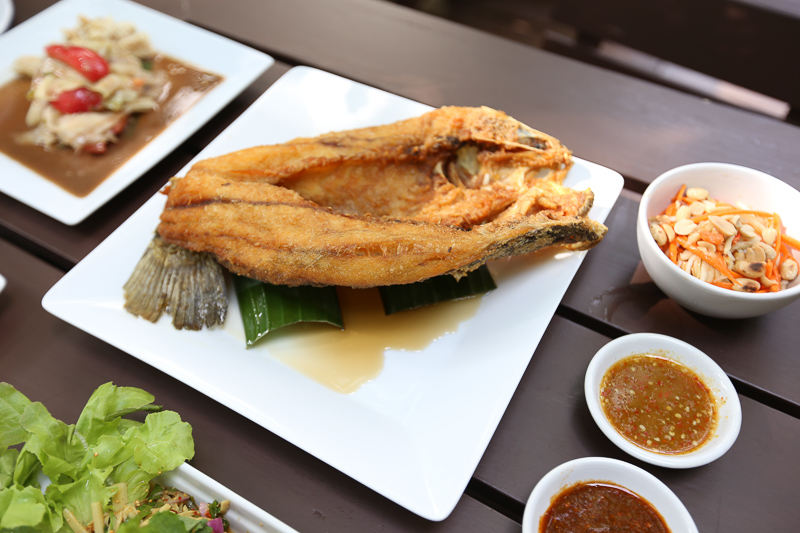
Deep-fried sea bass in sweet fish sauce served with spicy mango salad (395 baht).
Seafood dishes also didn’t disappoint. The deep-fried sea bass in sweet fish sauce served with spicy mango salad, or Plaa krapong tod naam pla (395 baht) is sure to be a family crowd-pleaser, with everyone fighting for a piece of the large-portioned, meaty white fish, drizzled with sour mango dip.
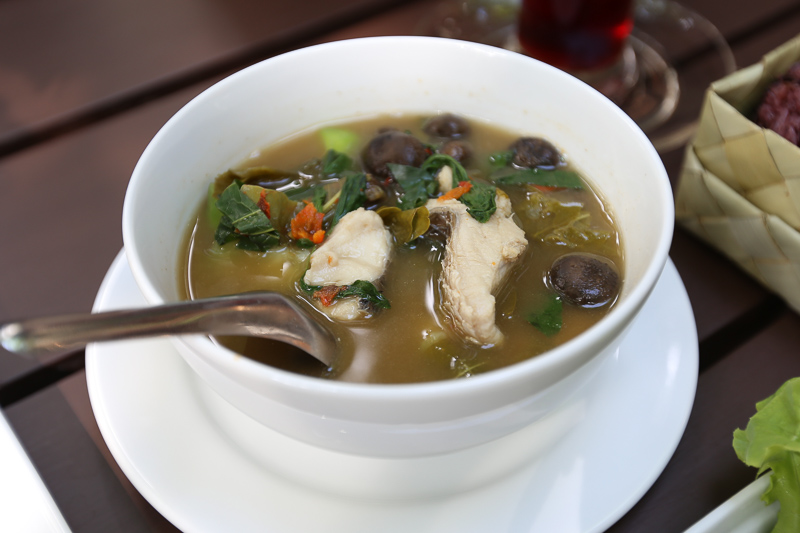
Spicy snakehead fish soup with puffball mushroom (125 baht).
For a gritty, intense soup, try the spicy snakehead fish soup with puffball mushroom (125 baht). The sour madan leaves may make you squint with its tang.
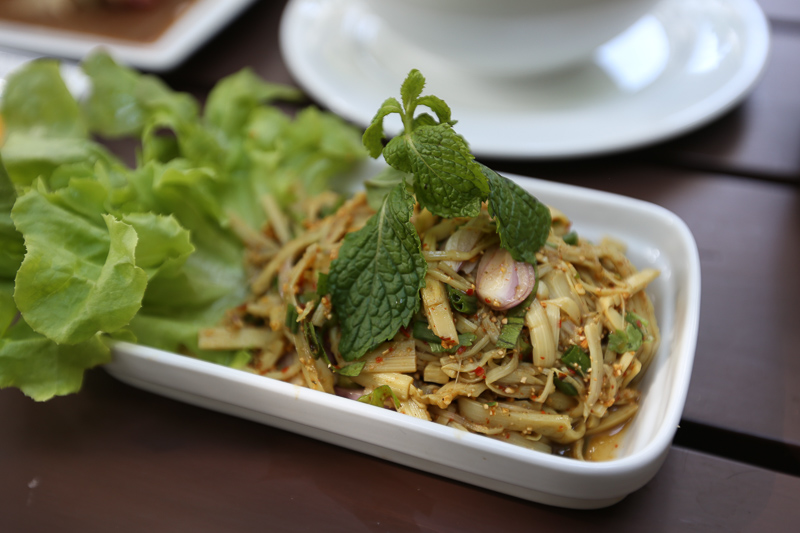
Sliced bamboo shoot salad (85 baht).
However, some dishes are more for the niche rather than surefire crowd-pleasers. The stir-fried kanom jeen noodles (85 baht) topped with shredded pork was similar to regular fried rice in taste, rather than showcasing the fermented noodles.The sliced bamboo shoot salad (85 baht) was a pile of pickled shoots outshone by the other dishes.
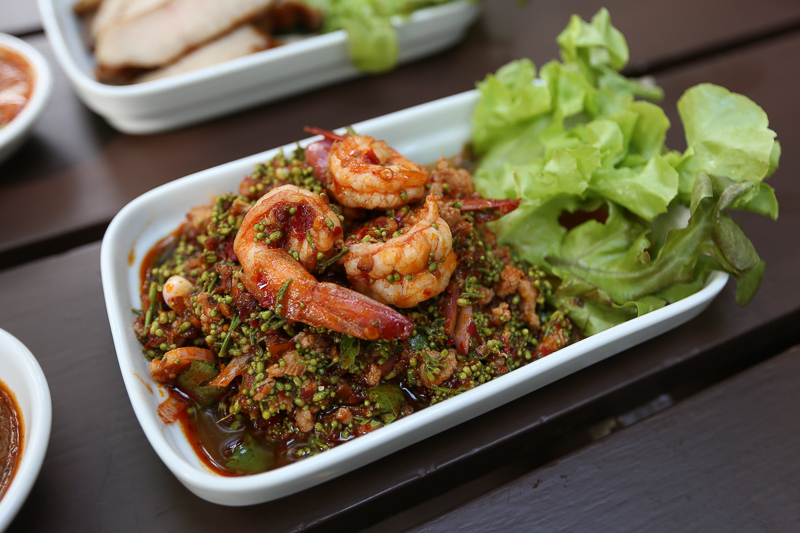
Neem and shrimp yum (100 baht).
The most challenging dish, sure to create lively division among the dinner table is the neem and shrimp yum (100 baht). The bitterness of the neem plant, when combined with the shrimp and yum sauce, is offset into a sort of medicinal dish that may appeal to the stalwart.
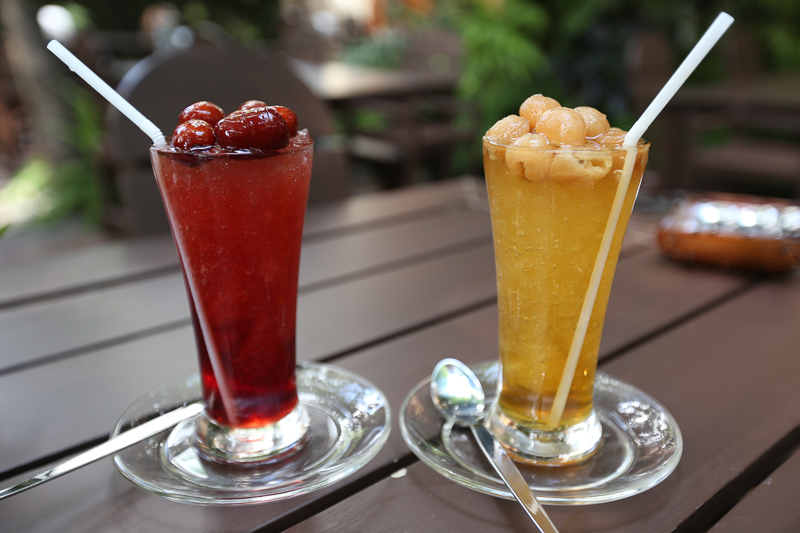
Pair dishes with a glass of sweet longan juice (70 baht), but the jujube juice (45 baht) may appeal to those wanting a less sweet, more herbal drink.
Jujube juice (45 baht) and longan juice (70 baht).
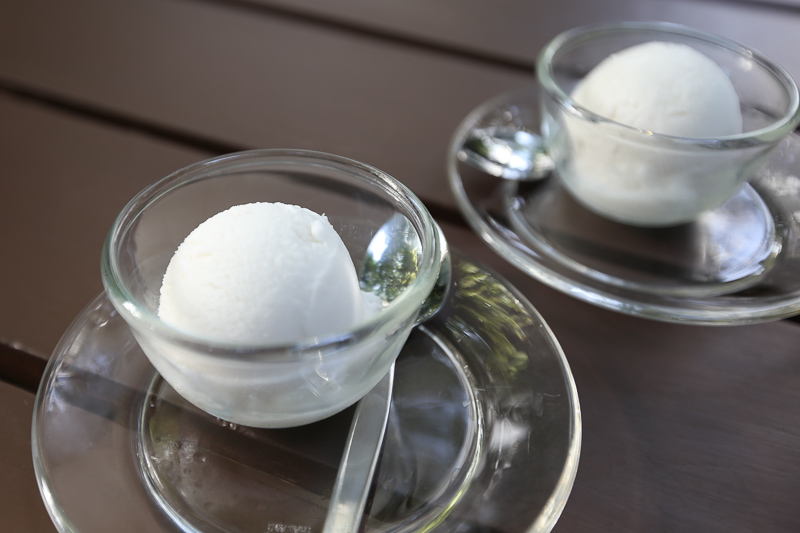
Desserts include the coconut ice cream (50 baht), which has a sorbet texture with cubes of coconut flesh.
The restaurant says their plaa raa has all been boiled and sanitized, so there’s no need to play the running stomach lottery like one does with somtum street carts.
If it’s not raining or terribly sunny, opt for outdoor seating among the mossy ferns, tall trees, and a bubbling fountain at one end of the garden.
Baan Somtum plans to open their next branches in Chic Republic mall in the Ramintra area in December, and another in Bang Na by early 2020.
Baan Somtum Bangrak is open from 11am to 10pm every day, and is located in Charoen Krung Soi 36, reachable by a 10-minute walk from BTS Saphan Taksin. Visit their website for the full menu and list of branches.
This review is unsponsored and based on a hosted visit.
Coconut ice cream (50 baht per scoop).Clockwise from top: neem and shrimp yum (100 baht), duck larb (115 baht), and grilled pork shoulder (110 baht).Fried star gooseberry (100 baht).
BANGKOK — Big-name DJs like Calvin Harris, Zedd, and Skrillex are coming to drop lots of beats for EDM fans at an annual music festival this December.
Returning for its seventh year, the 808 Festival can still keep its excitement as it announced Wednesday the first lineup that includes Scottish DJ-producer Calvin Harris, who will perform in the capital for the first time and is known for electronic smash-hits like “Summer,” “My Way,” and “Feel So Close.”
Joining the party will be American DJ-singer Skrillex, who is arguably one of the greatest pioneers of dubstep music. Debuted in 2004, it takes him over the course of 15 years to sweep eight Grammy Awards along his way with ear-kicking tracks like “Bangarang,” “Scary Monsters and Nice Sprites,” and “Where Are Ü Now.”
Russian-German DJ-producer Zedd will also take the decks. Although he is best recognized for his electro house music like “Clarity” and “Stay the Night,” the reportedly classical-trained musician also draws elements of classical and dubstep into his works like “Stache.”
The three-day music festival will run from Dec. 6 to Dec. 8 at BITEC Bangna. Tickets are on sale now for 3,345 baht via Ticketmelon. Attendees must be 20 and up.
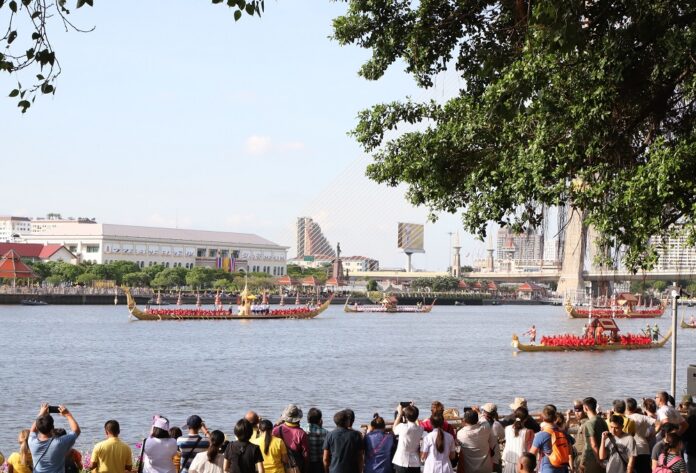
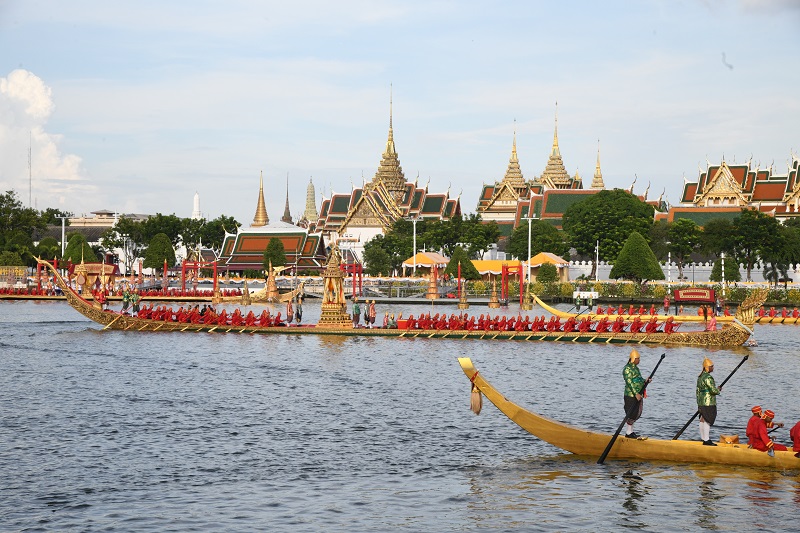
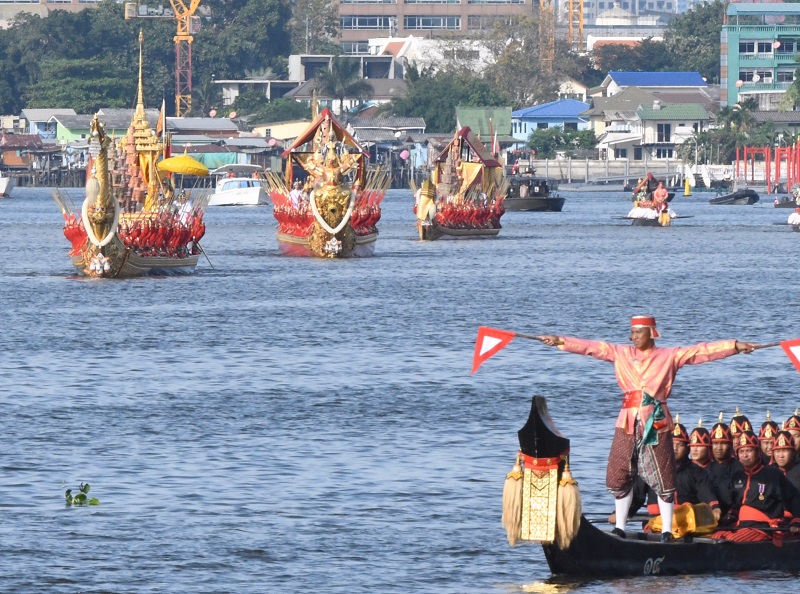
A crowd observes a rehearsal of the royal barge procession from Santi Chaiprakan Park in Bangkok on Oct. 17, 2019.
BANGKOK — As one spectator put it: You can watch it on your 50-inch TV screen but nothing beats watching the Royal Barge rehearsal in person.
Under the strong sun and considerable heat, hundreds crowded along the banks of the Chao Phraya River to watch the full dress rehearsal of the 52 ornate barges on Thursday afternoon. I spent an hour observing them before we learned that His Majesty the King defer the barge from next week, Oct 24 to Dec 12.
Deputy Prime Minister Wissanu Kreangam on Thursday cited strong currents as the reason for the postponement.
Many at the café I am stationed don yellow for the rehearsal to express their loyalty to the king. The cafés and restaurants along that stretch of the river were full of people who bought tickets in advance in order to sit or stand in comforts to watch the rehearsal.
The café next to Santi Chaiprakarn Park I booked charged 500 baht for a seat including two small dishes and a glass of pineapple juice. They told me it’s already a good value as others charge 1,000 baht or even more for the afternoon.
Seeing the real thing is an unforgettable sight. The 1.2-kilometer flotilla of 52 colorful barges in five rows, piloted by about 2,000 oarsmen, gliding along the river is simply a majestic sight to behold even if you are not a Thai person, or a staunch supporter of the monarchy.
Equally impressive was the sound of trumpets and traditional chant from the barges that adds an air of sacredness to the event.
The next rehearsal is scheduled for Oct. 21.
Oarsmen are trained for 40 days in land and another 40 days on the water for six hours a day for the procession, according to the Royal Navy.
A palace official at the café told me securities will be tight on the real day and building along the stretch of the river will be checked and cleared.
When such procession took place back in the Ayutthaya period, as many as 200 boats were assembled. Now it’s down to 52. The largest one, the royal barge Suphannahong, is 46.15 meter long, manned by 50 oarsmen that propel the barge forward by 3.5 meter per one synchronized stroke.
Built during the reign of King Rama VI (reign 1910 to 1925), its gold-lacquer head which is richly painted resemble that of an elongated hamsa, or mythical swan.
It reinforces the stature of the king, elevating him closer to the semi-divine status some believe him to be. It’s a ritual dating back at least a few centuries, all the way to the Ayutthaya kingdom (1350 – 1767) when Bangkok was a small port town.
There was a hiatus which lasted two and a half decades after the revolt when ended absolute monarchy in 1932. The royal barge procession only resumed in 1957 during the reign of the late king, Rama IX. Under his seven-decade long reign, only 11 royal barge processions took place.
The royal barge procession this December with be the first ever under the reign of Rama X. It will definitely be an occasion to project the glory of the new monarch to Thailand and the rest of the world – the government said live broadcast of the event will be available for linkup in up to 177 countries.