



























33.5 C
Bangkok
Monday, June 8, 2026
Home Blog Page 1520

Cannabis to Take on Cancer Cells in New Experiments

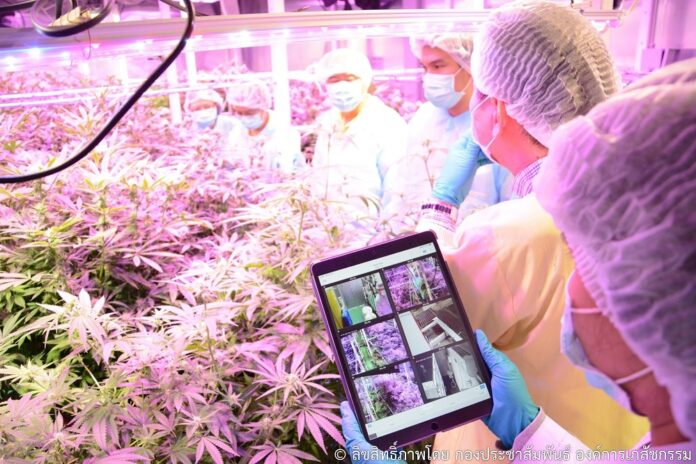
Image: Government Pharmaceutical Organization

Under the current scientific consensus, there is no scientific evidence that cannabis cures cancer. Alleviating negative side effects of cancer treatment maybe, but not curing cancer directly. 

Now, equipped with modern laboratory facilities and freshly provided with scarce cannabis medicines, the National Cancer Institute (NCI) is resolved to find out from its own experiments to test that long held conclusion, to either confirm or disprove it. 

On August 7, the first lot of cannabis medicinal formulas—4,500 5cc bottles of THC oil—were delivered by the Government Pharmaceutical Organization to the Ministry of Public Health who was passing them on to the Department of Medical Services (DMS) and ultimately to the NCI.

wirot.3

Six hundred bottles of this lot, with high concentration of the strong psychoactive anti-inflammation THC component, will at once be headed straight to the NCI’s state-of-the-art sophisticated laboratories for cancer R&D.

Attack on Cancer 

A hundred of the 600 bottles of the THC oil have been put aside for experiments to be conducted in test tubes to determine once and for all whether cannabis can kill cancer cells, diminish them, halt their reproduction, and stop the growth of a cancerous tumor. 

The cancer research program has been designed to attack cancer cells squarely in the hope that cannabis can contribute in some ways to an effort to eradicate those malignant cells.  

Ten types of cancer are targeted, including lung cancer, liver cancer, ovarian cancer, breast cancer and pancreatic cancer, common among Thais. 

The remaining 500 bottles of THC oil will be used on lab animals with the same purpose of confronting cancer cells head on.

Chemotherapy Side Effects

After taking away 600 of the 4,500 bottles that have been delivered to the health ministry, the great majority of the first lot: 3,900 bottles of THC oil will be destined for clinical trials on real cancer patients at the NCI and its 12 affiliated hospitals in a volunteer research program.

The aim for this 3,900-bottle bunch differs from the first 600 bottles: They won’t be used to try to cure cancer and eliminate cancerous cells, but more realistically to treat symptoms of last-stage cancer, such as pain that deprives the patients of their quality of life.

They will also be used to mitigate side effects of chemotherapy, namely nausea and vomiting that cause an inability to eat, and insomnia that leads to health-deprived sleepless nights. 

The central database of patients and their information will then be created and kept by the NCI and DMS.

Second Lot Imminent

By the end of August, the Government Pharmaceutical Organization will focus on manufacturing and delivering to the health ministry a second lot of 2,000 bottles of its finished products—the last two of its three cannabis formulas— 500 10cc bottles of CBD oil and 1,500 5mL bottles of THC/CBD oil at the ratio of THC:CBD = 1:1—from its first harvest cultivated since March.

Yes, it took the agency five full months from planting its first cannabis plants to completing the manufacturing of its cannabis oil, using the mature flowers of those plants.

By the way, 5cc and 5mL are just the same teaspoon size—in case you took notice of the different abbreviations.

For the second lot this time around, just as most of the first lot, the CBD oil—far softer than THC in chemical properties—and  the THC:CBD = 1:1 formula are also planned to be put on clinical trials on real last-stage cancer patients, and those treated with chemotherapy who report the side effects.

The combined first and second lots aggregate 6,500 bottles of THC oil, CBD oil and a mix of THC-CBD oil.

Staggering Number of Applicants 

The NCI has announced a limit of 140 cancer patients, volunteering to be treated in its clinical trial, using cannabis formulas from the first and second lots.

The volunteer program is open for registration to accept cancer-patient candidates during a narrow window of two weeks from August 2 to August 15, to be screened down to 140.

As of August 13, the number of cancer patients registered ballooned to 3,138!

Certainly, the volunteers who won’t make the cut of 140 last-stage cancer patients needed for the research program will be kept on the NCI database for further help.

Drug-Resistant Epilepsy

Parts of the undelivered 2,000-bottle second lot of CBD oil and THC/CBD 1:1 product will be allocated to the DMS’s Prasat Neurological Institute and the Child Neurology Association, Thailand for treatment of severe cases of drug-resistant epilepsy. 

The Institute is keen to treat five neurological illnesses under its care: epilepsy, Parkinson’s, Alzheimer’s, multiple sclerosis and neuralgia. 

The big picture portrayed, last-stage cancer, drug-resistant epilepsy and drug-resistant Parkinson’s are the top three priority diseases that will have direct access to the short supply of the first two lots of 6,500 bottles of the GPO’s THC oil, CBD oil and THC/CBD oil in a special program called the Special Access Scheme.

The program is run by network hospitals under the supervision of the Department of Medical Service.


Wirot Poonsuwan is the Senior Counsel and Head of Special Projects at Blumenthal Richter & Sumet in Bangkok and can be reached at [email protected].
Advertisement

‘Are We Not Human?’: Future Forward MP Weeps as Gender Committee Voted Down

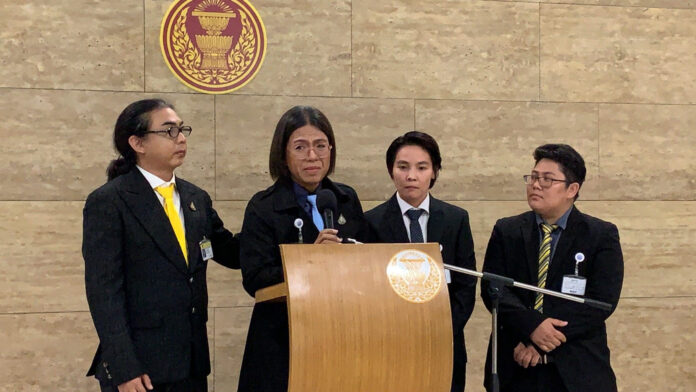
Tanwarin Sukkhapisit, second from the left, and Nathiphat Kunsetthasit, third from the left, and fellow Future Forward MPs during a press conference at the Parliament on Aug. 22.

BANGKOK — A Future Forward MP broke down in tears after a bid to establish a committee on gender diversity was voted down by the Lower House on Thursday.

The proposal to set up a house committee on gender diversity was rejected during a Thursday parliamentary vote 365 to 101, with 13 abstentions. The proposal was initiated by Future Forward MPs Tanwarin Sukkhapisit and Nathiphat Kunsetthasit.

“We tried our best to secure the vote,” Tanwarin, who identifies as kateoy, said. “We talked to other parties who promised to protect LGBT rights during their election campaigns, so we expected a higher number of votes than this.”

Tanwarin said she had hoped the committee would be a mechanism for pushing LGBT rights. The committee would have joined 35 existing committees that cover a variety of issues from agriculture to human rights. Consisting of 15 MPs each, they conduct studies and consider bills before they’re voted on in the Lower House.

Speaking to the press after the vote, Tanwarin announced the result in tears.

“Gender diversity is as important as national income,” Tanwarin said. “Are these seven million people not human?”

“We will push for the establishment of a subcommittee on gender diversity, and an amendment to Section 1448 of the Civil and Commercial Code to allow marriage between anyone, not just men and women,” Tanwarin continued.

As of now, matters related to LGBT rights will continue to be handled by the youth and women’s committee.

Advertisement

Thai Exchangers Ban HK Money Stamped With ‘Anti-Govt’ Slogans

BANGKOK — Two popular money exchange services in Thailand said Friday they don’t accept Hong Kong banknotes printed with political messages related to the ongoing protests.

Employees at Superrich Thailand and Superrich 1965 said that they won’t buy such banknotes from clients because they cannot resell them to Thai commercial banks. Any Thai travelers who possess stamped banknotes were advised to exchange them in Hong Kong.

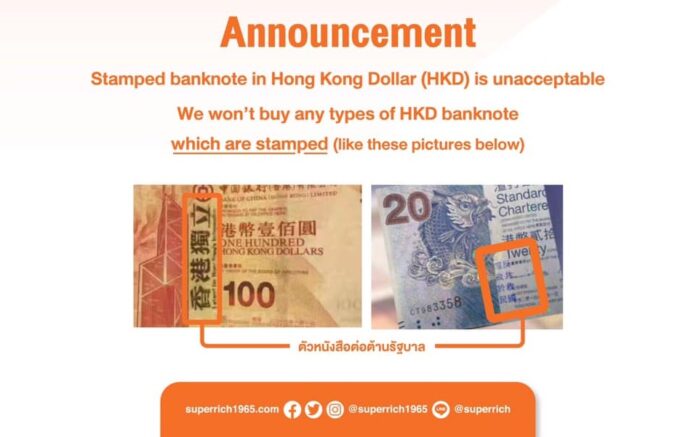
In an online post published by Superrich 1965 (“the orange Superrich”), the firm shows examples of three “anti-government messages” stamped onto Hong Kong banknotes.

The messages appear to read “Hong Kong independence,” “Oppose Communist Party and save the country,” and “Return the sovereign power to the people.”

ประกาศงดรับแลกธนบัตรสกุลเงินฮ่องกง ดอลล่าร์ (HKD) ทุกชนิดและทุกมูลค่าที่มีตราประทับอยู่บนธนบัตร…

โพสต์โดย SUPERRICH เมื่อ วันพุธที่ 21 สิงหาคม 2019

A prolonged protest has been taking place in Hong Kong for nearly three months. Although the movement initially centered on a controversial extradition bill, it has since evolved to include other issues, from alleged police brutality to fuller democratic rule and autonomy from the mainland.

An employee at Superrich 1965 said at least three major banks in Thailand have told the company they will not buy banknotes that bear anti-government slogans: Bank of Ayudhya, Krungthai Bank and Thai Military Bank.

Superrich Thailand (“the green Superrich”) also has a similar policy, according to an employee.

Asked what Thai tourists should do if they happen to have stamped banknotes in their wallets, the employee advised exchanging the money in Hong Kong before flying back. The notes are unlikely to be accepted at any bank or money exchange service in Thailand.

Advertisement

‘Curry in Boxes’: Indian Home That Serves Homemade Indian Food

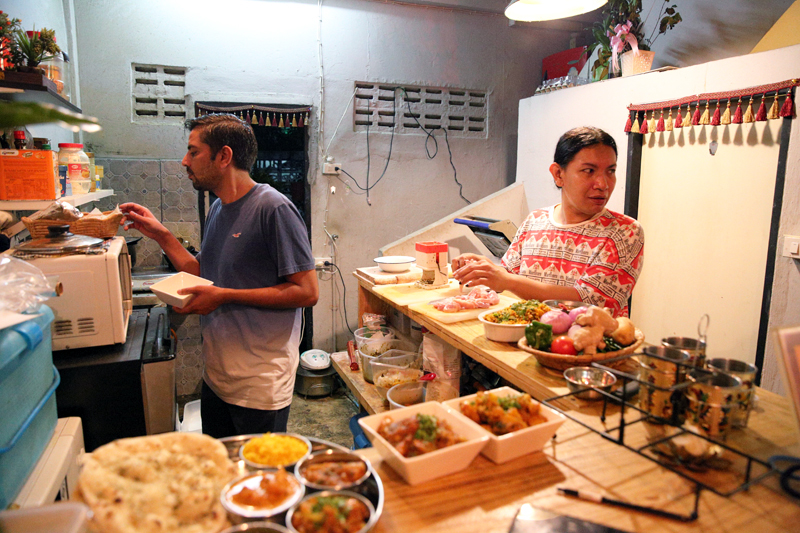
BANGKOK — Tucked away in a residential neighborhood near the ever-crowded Asiatique, Curry in Boxes is a hidden gem that claims to offer an authentic Indian home-dining experience.

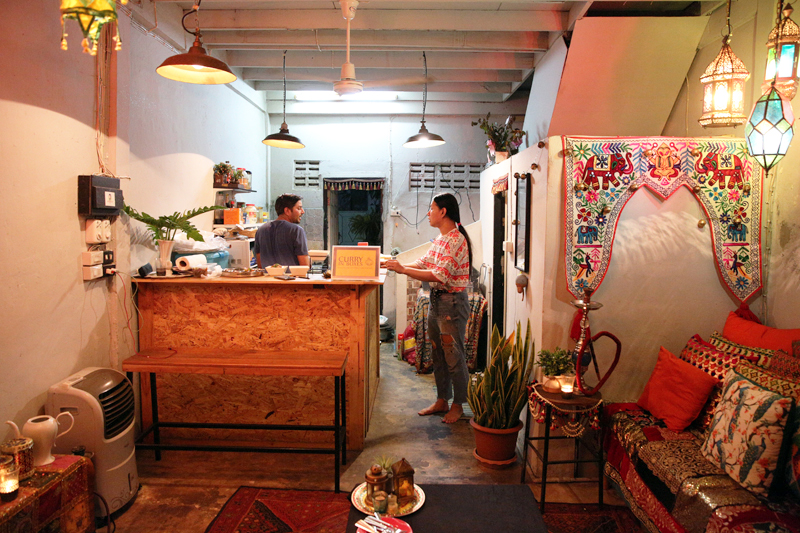
Don’t get this apparent marketing catchphrase wrong, though: it really is a down-to-earth home. Where majestic mahals downtown have opulent gold-plated cutlery, this homespun establishment blends in almost entirely with the other low-rent shophouses in Soi Chan 51.

There is only one table, without chairs, which can only accommodate one group of diners at a time. However, the fare is top-notch with prices starting as low as 100 baht.

“People around me don’t open their hearts to Indian cuisine due to its smell and appearance,” co-founder Chaloampol “Amy” Pimwan said. “Even if they do, it’s quite difficult for them to push through the doors of uninviting Indian restaurants around Bangkok.”

“I want my place to be welcoming for those who are uninitiated to Indian cuisine. The atmosphere is very casual. It’s like having a dinner at a friend’s house,” Amy continued.

It is where a living room is transformed into a makeshift dinette, with attempts to achieve a Mughal decor through Persian lanterns, embroidered mural, and miniature ganesha statue. Breathe in the aromatic incense to maximize the mood for India, before getting distracted by the noise from neighbor’s soap opera.

Throughout three hours of meals and chit-chats, Amy sat down with her customers, serving drinks (which could be anything from the nearby autie store) and talking through each dish. The chef, Sunil Kumar, a native from the northern Indian state of Haryana, prepares the food in an open kitchen by himself.

The foray into Indian cuisine began with the Thali Set (250 baht), which consists of six different offerings. Newcomers should kick off with the staple: velvety and creamy butter chicken. As its spices are mild, the dish is a safe bet for those who have yet to adjust their tongues to more tangy gastronomic adventures.

Thali Set
Thali Set

Next come thicker and spicier curries. Pahadi chicken, a native dish from the Indian highlands, tastes similar to the stir-fry kai pad prik kang, but with a richer taste. The pulpy spinach chicken goes down with a slight puckering flavor. The set also comes with two home-rolled naan, yellow basmati rice, and grilled chicken tikka as side dishes.

Experienced or native Indian foodies might skip ahead to the restaurant’s signature dish: the butter chicken balls (140 baht) – a fusion between India’s best-loved dish and Thailand’s lesser-known larb tod fried meatballs. Alternatively, take a break from meat with the vegetarian Aloo Gobi Sabji (80 baht). The medley of cauliflower and potato is cooked almost dry, isolating the bold flavors of garam marsala. The restaurant uses an in-house blend of more than 20 spices inherited from the chef’s mother.

Butter Chicken Balls
Aloo Gobi Sabji
Aloo Gobi Sabji
Salmon Biryani
Salmon Biryani

In fact, Amy claims that every ingredient used in the restaurant – from spices, paneer cheese, to dipping sauces – are prepared at home.

“We treat our customers like our family members. Everything has to be prepared by ourselves so we can confidently say that we offer homemade cuisine,” Amy said. “It’s healthier for our customers as our cooking contains no artificial flavors or preservatives. The only flavor enhancer we use is salt.”

“But to be honest, the chef is stingy,” Amy laughed.

Amy explained that she intended to make Thai people fell in love with Indian food, but simultaneously did not not want to cheat by bending the flavors.

“Every menu is cooked to Sunil’s original recipe, but we only include menus that are familiar to Thai taste buds,” Amy said.

Due to limited space, Curry in Boxes is intended to be a food delivery service (hence the name). Amy claimed that the experimental dine-in option, which she wanted to be a place where she can socialize with her customers, is fully booked out to October. There are no plans for opening a full restaurant as the amount of orders she received at the moment is out of hand.

IMG 1422

IMG 1477

IMG 1435

Chaloampol “Amy” Pimwan, left, and chef Sunil Kumar, right.

IMG 1413

IMG 1502

Curry in Boxes is open for delivery everyday from 12pm to 9pm. Orders must be placed on their Facebook page one day prior delivery. Dine-in is open on weekdays for dinner from 6pm until late, and on weekends for lunch from 12pm to 3.30pm and for dinner from 5.30pm to 9pm. Reservations must be made on their Facebook page prior to the visit. The restaurant is located on Soi Chan 51 and is reachable by taxi or motorcycle taxi from BTS Saphan Taksin.

This review is unsponsored and based on an announced visit.

Advertisement

YouTube Disables 200 Videos Attacking Hong Kong Protests

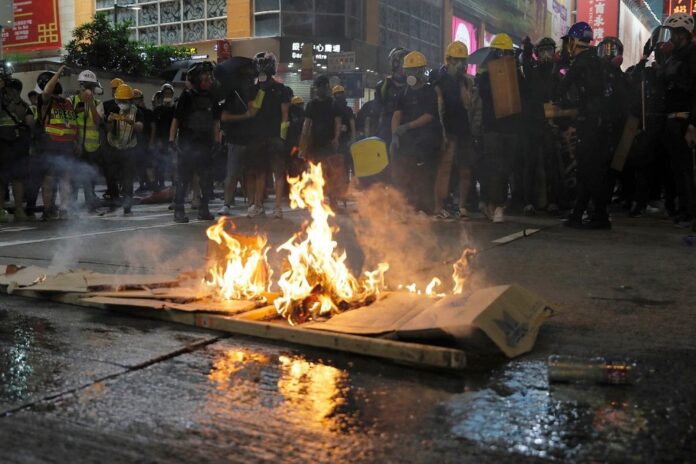
Protesters burn cardboard to form a barrier as they confront with police in Hong Kong on Saturday, Aug. 3, 2019. (AP Photo/Kin Cheung)

SAN FRANCISCO (AP) — YouTube says it disabled more than 200 videos this week that appeared to be part of a coordinated effort to spread misinformation about the ongoing protests in Hong Kong.

The video removals come just days after Twitter said it had suspended more than 200,000 accounts it linked to a Chinese government influence campaign against the protests. Facebook also said it had suspended accounts and removed pages after being notified by Twitter.

Google, which owns YouTube, did not explicitly implicate the Chinese government but said the videos were related to the similar disclosures from Facebook and Twitter.

Social media companies have faced criticism about the spread of misinformation on their sites and have taken actions to combat the spread in recent months.

Advertisement

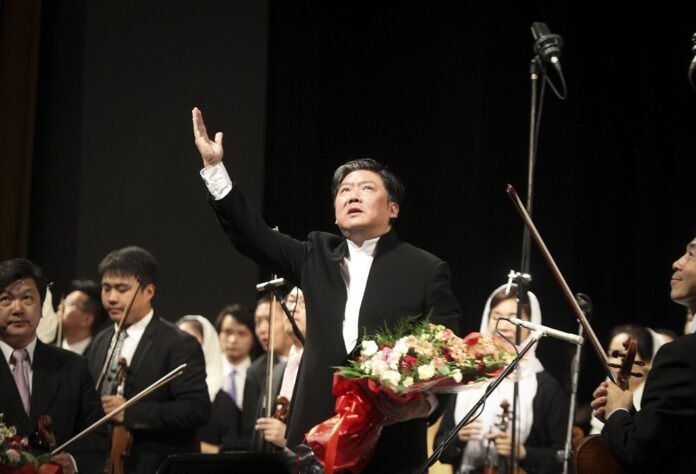
Touring Edinburgh, Conductor Yu Long Hopes to ‘Show a Modern China’

A Xinhua file photo of conductor Yu Long

EDINBURGH, Britain (Xinhua) — Music is a unique means of cultural exchange and the Shanghai Symphony Orchestra hopes to blend Chinese and western cultures and send “China’s voice” across the world to show an inclusive and innovative modern China, Yu Long, a famous conductor and music director of the orchestra has said.

This year marks the 140th anniversary of the founding of the Shanghai Symphony Orchestra (SSO). During the past decades, while performing classical western music, the orchestra has made great efforts to create original Chinese music works to showcase the profound Chinese culture to a global audience, Yu told Xinhua in a recent interview.

The orchestra made its debut at the Edinburgh International Art Festival on Monday evening.

As the opening piece, “Wu Xing” (The Five Elements of gold, wood, water, fire and earth), an original contemporary Chinese music work, vividly depicts an auditory image of ancient Chinese philosophical concept of coexistence and contradiction, which the audience have found stunning and experimenting.

This ancient Chinese philosophy has special significance in the current complex and uncertain international environment, Yu said.

“The Five Elements is a piece of contemporary Chinese music work, which shows a sense of inclusiveness and innovation. Through these young musicians, I hope the audience will see a modern China, or even a China in the future,” he said.

Yu said in recent years, in the field of culture, China has been playing an increasingly leading role on a global stage, just like China’s economic development, and the Shanghai Symphony Orchestra is an exceptional case showing this trend.

The Edinburgh International Festival, which was created in 1947, has presented breathtaking performances from some of the best musicians and artists that the world has to offer. The fact that the Shanghai Symphony Orchestra was invited to the Festival shows that the orchestra is one of the best in Asia and even worldwide.

On Jan. 8, 1879, the North China Daily News published an English advertisement, which mentioned “Shanghai Public Band.” This is seen as the birth of Shanghai Symphony Orchestra.

To celebrate the 70th anniversary of the founding of the People’s Republic of China, the orchestra and the Shanghai Conservatory of Music Press jointly released a special album of “China Symphonic Era.”

Yu Long said that in its 140 years of development, especially after the founding of the People’s Republic of China and China’s reform and opening-up, the orchestra has gradually grown into an organization worthy of respect from the world and the music industry, which also marks China’s growth and cultural prosperity.

Yu said his achievements and career development have benefited from China’s reform and opening-up, as well as its inclusive and open creative atmosphere. As a musician, he stands ready to play a more significant role in cultural exchanges between China and the West.

“As an artist, for us, of course, we pay more attention to the art. However, if our work could contribute to the development of our country, and help bring more meaningful activities in cultural exchanges, we are very willing to serve our country, and make greater contributions to the country,” Yu said.

Advertisement

German City Offers $1.1M to Whoever Proves It Doesn’t Exist

In this May 27, 2017 file photo, a castle is pictured in Bielefeld, Germany. (Friso Gentsch/dpa via AP)

BERLIN (AP) — A German city that’s been the subject of a long-running online light-hearted conspiracy theory claiming it doesn’t really exist is offering big bucks to whoever proves that’s true.

Officials in Bielefeld said Wednesday they’ll give 1 million euros ($1.1 million) to the person who delivers solid proof of its non-existence.

They said there are “no limits to creativity” for entrants, but only incontrovertible evidence will qualify for the prize.

The idea that Bielefeld doesn’t exist was first floated by computer expert Achim Held, who posted the satirical claim on the Internet in 1994 in an effort to poke fun at online conspiracy theories.

Even German Chancellor Angela Merkel once jokingly cast doubt on the existence of Bielefeld, which is allegedly located about 330 kilometers (205 miles) west of Berlin.

Advertisement

China’s Space Tech Robots Find Application on Earth

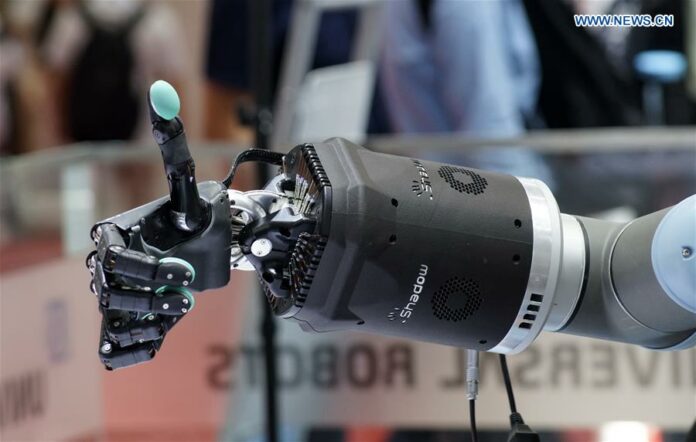
Photo taken on Aug. 21, 2019 shows an industrial robot exhibited at the World Robot Exhibition in Beijing, capital of China. The exhibition, part of the 2019 World Robot Conference that kicked off Tuesday, features various kinds of robots in different uses, including in industries, services and logistics. During the exhibition, the public have the opportunities to see exhibits of cutting-edge robot technologies and products from more than 180 renowned domestic and overseas companies and research institutions engaged in robot industries. (Xinhua/Li Xin)

BEIJING (Xinhua) — A novel patrol and security robot, a dog-like robot that can perform tasks in complex and harsh environments, intelligent searching and environment perception robotic systems.

These robots shown at the ongoing 2019 World Robot Conference have one thing in common: they have benefited from China’s space technology. They were developed by the China Academy of Launch Vehicle Technology (CALT), one of the country’s key developers of carrier rockets.

In recent years, China has achieved breakthroughs in space technology, and stepped up efforts to develop crucial robotics technologies.

Wang Yanbo, a project manager from CALT, said that the academy is trying to transfer advanced space technology into more products that can make a difference to people’s daily lives.

“The highly sophisticated and systematic space technology might help improve robot design and intelligent systems,” Wang said.

640 1
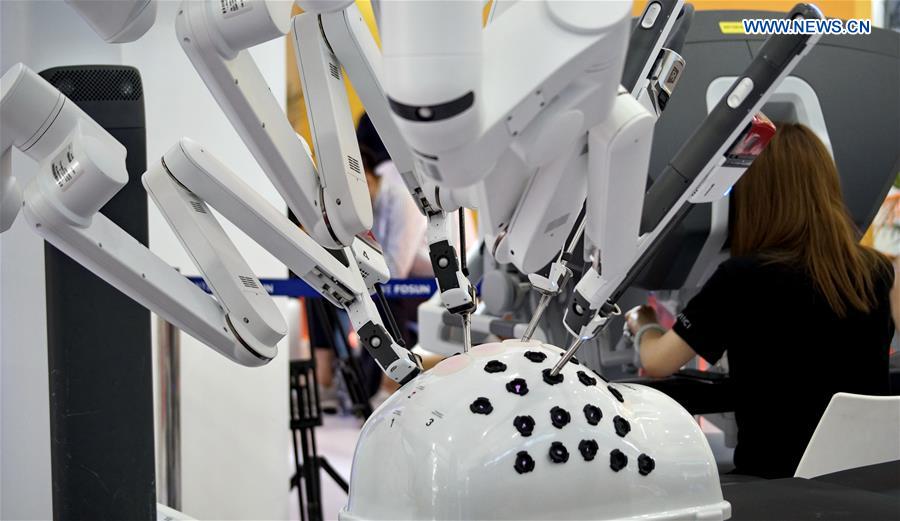
Photo taken on Aug. 21, 2019 shows a robot for minimally invasive surgery exhibited at the World Robot Exhibition in Beijing, capital of China.(Xinhua/Li Xin)

Based on the robotic arms used in space missions, CALT has developed several collaborative robotic arms for industrial use.

Wang said the robotic arms can quickly learn from the instruction of an operator and grab things with the precision of 0.1 mm.

Besides those robots used on assembly lines, the autonomous patrol robot developed by CALT has been applied in some neighbourhoods in Beijing and industrial parks in Chongqing.

Equipped with a 360-degree camera, the robot can walk flexibly on the ground and automatically avoid obstacles in a prescribed area. Once it detects dangerous situations such as fire hazards or anomalous behavior, it will sound the alarm and report to the control system.

“We have borrowed the high-precision navigation technology and infrared detection system used in rocket design,” said Wu Xin, one of the researchers.

The bionic robots including a dog-shaped robot and snake-shaped robot are special-purpose robots which can be used in disaster relief or maintenance work in hard-to-reach areas.

img 20190628 133000
Photo taken on Aug. 21, 2019 shows a robot exhibited at the World Robot Exhibition in Beijing, capital of China. (Xinhua/Li Xin)

“We have designed mechanical parts that can work in the harsh space environment, which has extreme low temperatures and a large amount of radiation, offering inspiration for designing robots that can work in harsh environments here on Earth,” said Li Qiang, a technologist of the bionic robots.

Inspired by the tracking system used to position and collect rocket debris, researchers from CALT have designed an intelligent searching system that can be used in scenarios such as disaster rescue and equipment inspection, said Zhang Xing, a developer of the system.

The system combines a searching drone and processing software that use advanced algorithms such as computer vision algorithms and 3D model reconstruction algorithms. It can lead the drone to track objects less than one meter in diameter at an altitude of 800 meters, Zhang said.

Based on a complicated rocket controlling system and its strong data processing ability, CALT also developed a cloud platform that can act as the “general director” for the management of a team of robots.

The cloud platform gathers operating data of multiple robots and analyzes the data in real time, allowing users to monitor the robots and quickly spot malfunctions through an app.

In the future, the cloud platform will be equipped with a 5G communication module. The high speed and low latency of 5G will allow users to manage robots with more efficiency, said Li Xiang, a technologist from CALT.

Advertisement

Climate Change Turns Arctic Into Strategic, Economic Hotspot

In this Aug. 15, 2019, file photo, a boat navigates at night next to large icebergs in eastern Greenland. As warmer temperatures cause the ice to retreat the Arctic region is taking on new geopolitical and economic importance, and not just the United States hopes to stake a claim, with Russia, China and others all wanting in. (AP Photo/Felipe Dana, File)

TASIILAQ, Greenland (AP) — From a helicopter, Greenland’s brilliant white ice and dark mountains make the desolation seem to go on forever. And the few people who live here — its whole population wouldn’t fill a football stadium — are poor, with a high rate of substance abuse and suicide.

One scientist called it the “end of the planet.”

When U.S. President Donald Trump floated the idea of buying Greenland, it was met with derision, seen as an awkward and inappropriate approach of an erstwhile ally.

But it might also be an Aladdin’s Cave of oil, natural gas and rare earth minerals just waiting to be tapped as the ice recedes.

The northern island and the rest of the Arctic aren’t just hotter due to global warming. As melting ice opens shipping lanes and reveals incredible riches, the region is seen as a new geopolitical and economic asset, with the U.S., Russia, China and others wanting in.

3000 16
In this Aug. 14, 2019, file photo, icebergs are photographed from the window of an airplane carrying NASA scientists as they fly on a mission to track melting ice in eastern Greenland. (AP Photo/Mstyslav Chernov, File)

“An independent Greenland could, for example, offer basing rights to either Russia or China or both,” said Fen Hampson, head of the international security program at the Centre for International Governance Innovation think tank in Waterloo, Ontario, noting the desire by some there to secede as a semi-autonomous territory of Denmark.

“I am not saying this would happen, but it is a scenario that would have major geostrategic implications, especially if the Northwest Passage becomes a transit route for shipping, which is what is happening in the Russian Arctic.”

In April, Russian President Vladimir Putin put forward an ambitious program to reaffirm his country’s presence in the Arctic, including efforts to build ports and other infrastructure and expand its icebreaker fleet. Russia wants to stake its claim in the region that is believed to hold up to one-fourth of the Earth’s undiscovered oil and gas.

China sees Greenland as a possible source of rare earths and other minerals and a port for shipping through the Arctic to the eastern U.S. It called last year for joint development of a “Polar Silk Road” as part of Beijing’s Belt and Road Initiative to build railways, ports and other facilities in dozens of countries.

But while global warming pushes the cold and ice farther north each year, experts caution that the race to the Arctic is an incredibly challenging marathon, not a sprint.

The melting of the Greenland ice sheet creates uncertainty and danger for offshore oil and gas developers, threatening rigs and ships.

“All that ice doesn’t suddenly melt; it creates icebergs that you have to navigate around,” said Victoria Herrmann, managing director of the Arctic Institute, a nonprofit focused on Arctic security.

5262AC6A 8547 4D7E 8FE1 3EA972906D2F
In this Aug. 15, 2019, file photo, a large Iceberg floats away as the sun sets near Kulusuk, Greenland. (AP Photo/Felipe Dana, File)

On the other hand, while mining in Greenland has been expensive due to the environment, development costs have fallen as the ice has melted, making it more attractive to potential buyers, she said.

Strategically, Greenland forms part of what the U.S. views as a key corridor for naval operations between the Arctic and the North Atlantic. It is also part of the broader Arctic region, considered strategically important because of its proximity to the U.S. and economically vital for its natural resources.

Hampson noted it was an American protectorate during World War II, when Nazi Germany occupied Denmark, and the U.S. was allowed to build radar stations and rent-free bases on its territory after the war. That includes today’s Thule Air Force Base, 1,200 kilometers (745 miles) south of the North Pole.

After the war, the U.S. proposed buying Greenland for $100 million after flirting with the idea of swapping land in Alaska for parts of the Arctic island. The U.S. also thought about buying Greenland 80 years earlier.

Trump “may not be as crazy as he sounds despite his ham-fisted offer, which clearly upset the Danes, and rightly so,” Hampson said.

Greenland is part of the Danish realm along with the Faeroe Islands, another semi-autonomous territory, and has its own government and parliament. Greenland’s 56,000 residents got extensive home rule in 1979 but Denmark still handles foreign and defense policies, with an annual subsidy of $670 million.

Its indigenous people are not wealthy, and vehicles, restaurants, stores and basic services are few.

ABA33763 D19A 4590 AB6C 4ED1016DE144
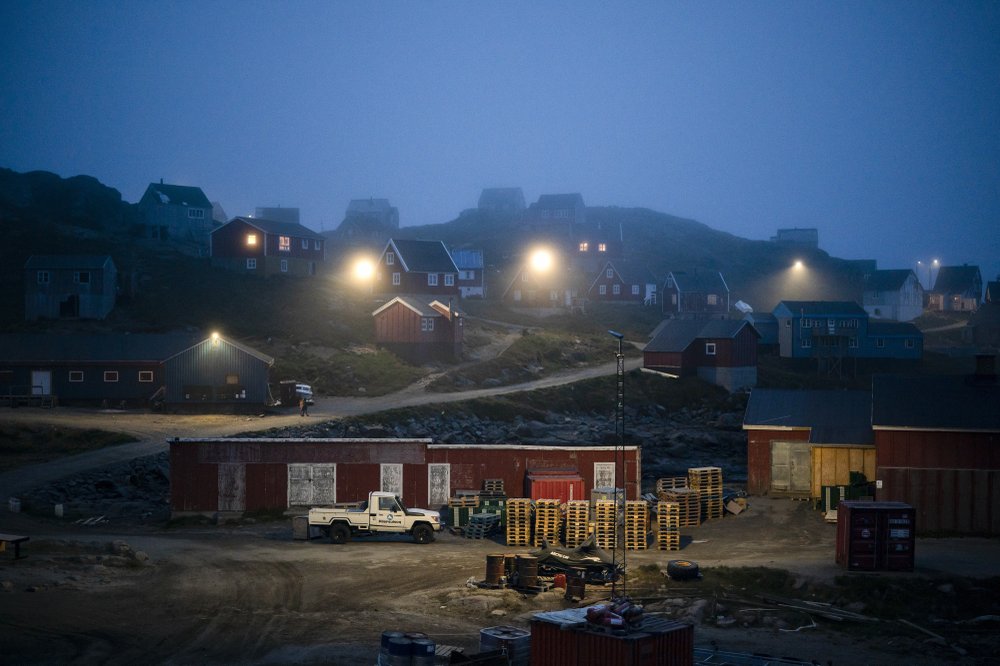
In this Aug. 15, 2019, file photo, early morning fog shrouds homes in Kulusuk, Greenland. (AP Photo/Felipe Dana, File)

Trump said Sunday he’s interested in Greenland “strategically,” but its purchase is “not No. 1 on the burner.”

Although Danish Prime Minister Mette Frederiksen called Trump’s idea to purchase Greenland an “absurd discussion,” prompting him to call her “nasty” and cancel an upcoming visit to Copenhagen, she also acknowledged its importance to both nations.

“The developments in the Arctic region calls for further cooperation between the U.S. and Greenland, the Faeroe Islands and Denmark,” she said. “Therefore I would like to underline our invitation for a stronger cooperation on Arctic affairs still stands.”

Greenland is thought to have the largest deposits outside China of rare earth minerals used to make batteries and cellphones.

Such minerals were deemed critical to economic and national security by the U.S. Interior Department last year, and as demand rises “deposits outside of China will be sought to serve as a counterbalance to any market control that could be exerted by a single large producer,” said Kenneth Medlock, senior director at the Center for Energy Studies at Rice University.

Off Greenland’s shores, the U.S. Geological Survey estimates there could be 17.5 billion undiscovered barrels of oil and 148 trillion cubic feet of natural gas, though the remote location and harsh weather have limited exploration. Around the Arctic Circle, there’s potential for 90 billion barrels of oil.

Only 14 offshore wells were drilled in the past 40 years, according to S&P Global Analytics. So far, no oil in exploitable quantities has been found.

“It’s very speculative, but in theory they could have a lot of oil,” said Michael Lynch, president of Strategic Energy & Economic Research Inc. “It’s perceived as being the new Alaska, where the old Alaska was thought to be worthless and turned out to have huge reserves. And it’s one of the few places on Earth that’s lightly populated, and it’s close to the U.S.”

Michael Byers, an Arctic expert at the University of British Columbia, suggests there are better approaches for Washington than the politically awkward suggestion of purchasing Greenland.

“There’s no security concern that would be dealt with better if Greenland became a part of the United States. It’s part of the NATO alliance,” he said. “As for resources, Greenland is open to foreign investment. Arctic resources are expensive and that is why there is not more activity taking place. That’s the barrier. It’s not about Greenland restricting access.”

That’s been the approach taken by China, which has had mixed success. Greenland officials have visited China to look for investors but Beijing’s interest also has provoked political unease.

In 2016, Denmark reversed plans to sell Groennedal, a former U.S. naval base that the Danish military had used as its command center for Greenland after a Hong Kong company, General Nice Group, emerged as a bidder, according to defencewatch.dk, a Danish news outlet.

Last year, then-U.S. Defense Secretary James Mattis successfully pressured Denmark not to let China bankroll three commercial airports on Greenland, over fears they could give Beijing a military foothold near Canada, The Wall Street Journal reported.

Beijing’s biggest Greenland-related investment to date is an ownership stake by a Chinese company in Australia-based Greenland Minerals Ltd., which plans to mine rare earths and uranium.

“People talk about China, but China can access Arctic resources through foreign investment,” Byers said. “And foreign investment is a lot cheaper than trying to conquer something.”

____

Rising reported from Berlin. Cathy Bussewitz in New York, Joe McDonald in Bejing, Frank Jordans in Berlin, Vladimir Isachenkov in Moscow, Rob Gillies in Toronto, Ben Fox in Washington and Jan M. Olsen in Copenhagen contributed.

Advertisement

Personal Info of Hong Kong Police Officers, Families Leaked Online

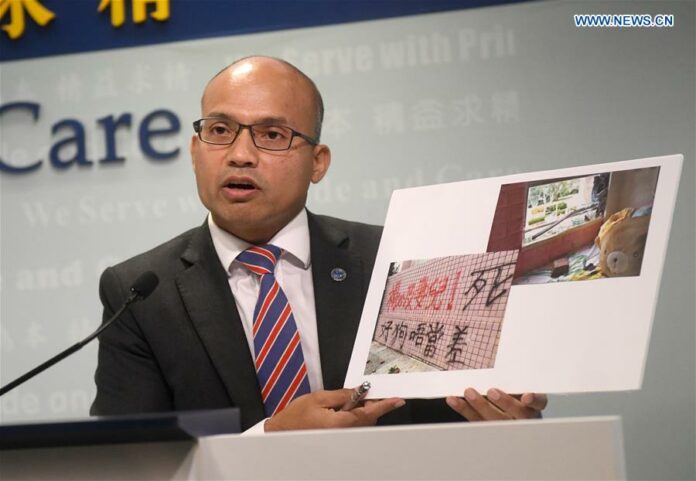
Swalikh Mohammed, Superintendent of Cyber Security and Technology Crime Bureau of the Hong Kong police, shows evidences of threats against Hong Kong police during a press conference in Hong Kong, south China, Aug. 22, 2019. (Xinhua/Lu Hanxin)

HONG KONG (Xinhua) — The Hong Kong police said on Thursday that the personal data of a total of 1,614 police officers and their family members were illegally disclosed online since June.

Swalikh Mohammed, Superintendent of Cyber Security and Technology Crime Bureau of the Hong Kong police, said at a press conference that the disclosed data included names, identity card numbers, birthdays, phone numbers, home addresses, and even pictures of the children of police officers, and information about their schools and classes.

Mohammed said that quite a number of the police officers and their family members were disturbed in different ways after the data disclosure, such as receiving annoying phone messages and threatening letters. Some of the police quarters were defaced and damaged by bricks.

Some people even broke into the police dormitory buildings, leaving words like “misfortunes must come to your wife and children” on the wall, he said.

Mohammed said it is worrying that some online discussions have turned into violent acts in real world. Some radical and extreme remarks on the internet incited others to commit crimes such as making bombs and using petrol bombs to damage the police stations and harm the police officers.

He emphasized that the laws of Hong Kong can be applied to internet crimes and the police will thoroughly investigate into these cases.

A total of 16 people were arrested for unlawful disclosure of information and unlawful obtain information from computers since June, according to the police.

Advertisement

Hot News

LATEST NEWS

Bangkok
overcast clouds
33.5 ° C
35 °
31.1 °
73 %
4kmh
100 %
Mon
34 °
Tue
34 °
Wed
35 °
Thu
31 °
Fri
30 °