






















30.2 C
Bangkok
Tuesday, June 9, 2026
Home Blog Page 1561

CP Vietnam Targets 100% IFFO RS Certified Fishmeal Within 2022

CP Vietnam Corporation (CPV), an investment arm of Charoen Pokphand Foods Public Company Limited (CP Foods), announced that both by-catch and by-product fishmeal used in the company’s operation will be certified International Fishmeal and Fish Oil Organisation Responsible Supply (IFFO RS) or IFFO RS Improver Programme (IFFO RS IP) within 2022 to ensure consumers across the world that its products are made from responsible and slavery-free sources.

Dr. Sujint Thammasart, DVM, Chief Operating Officer – Aquaculture Business of  CP Foods, told that 100% of by-product fishmeal supplies to CPV’s aquaculture business is now certified IFFO RS. Some of the fishmeal from Vietnam is also shipped to Thailand.

For By-catch fishmeal, CP Foods and CPV are currently taken part in pilot programs of IFFO RS IP to develop a credible criteria for multi species fisheries in Thailand and Vietnam. Moreover, CPV is engaging with local fishmeal producers to encourage them to join IFFO RS IP. The improver programme aims at guiding the suppliers with high potential to apply IFFO RS standard toward sustainable practices.

In order to aid them through the application, CPV has encourage its fishmeal suppliers to apply for sustainable sourcing policy and guidelines for business partner. The policy was launched for its partners in Bangkok and extend to Vietnam in late 2017.

“CPV, as CP Foods’ manufacturing arms in Vietnam and a member of the Vung Tau (Vietnam) Fishery Improvement Projects (FIPs), has encourage our partners to apply for our sourcing policy, which is designed to improve their working process and traceability.” he said.

He also noted that IFFO RS IP programme is the first step for the fishmeal factories in Vietnam towards a global recognitions.

“Joining the improver program from IFFO that is the leading marine ingredients organization, will enhance competitiveness of our suppliers. Their products will be globally recognized,” Dr. Sujint said “It will also ensure our clients as well as consumers across the world that our products are made from responsible and slavery-free sources,”

Besides IFFO standards, four of the company’s aquaculture farms in Vietnam have received the Aquaculture Stewardship Council (ASC) Certification, an international certification standard on sustainable seafood production. The remaining farms are preparing to apply for the certificate.

Also, CPV is working on digital traceability system in shrimp business, which will enable the company to track its fishmeal supply back to fishing boat.

In Thailand, CP Foods reported 100% of fishmeal used in Thailand’s operations are sourced from the by-products fishmeal which is traceable and sourced from IFFO RS or the IFFO RS IP certified facilities and in accordance with CP Foods’ Fishmeal Sourcing Restrictions.

Additionally, the by-product fishmeal must not include species at risk from extinction as defined by the World Conservation Union: IUCN Red List of Threatened Species and be traceable by third party.
Advertisement

Putin Says Liberalism ‘Eating Itself,’ Migrant Influx Wrong

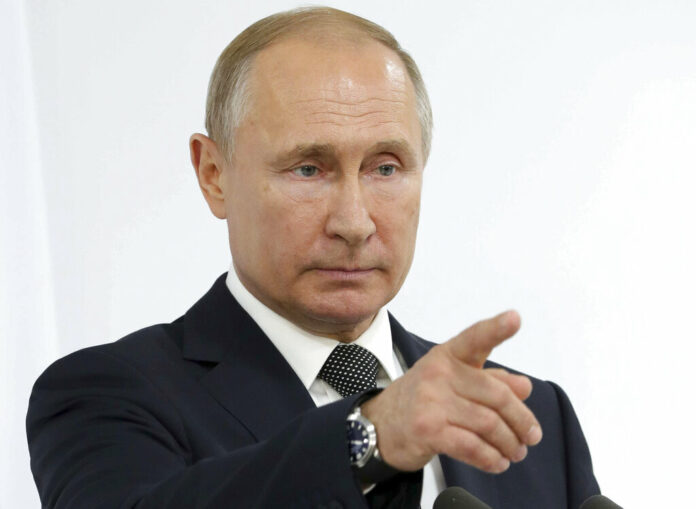
Russian President Vladimir Putin speaks to the media after the G-20 summit in Osaka, western Japan, Saturday, June 29, 2019. Photo: Mikhail Klimentyev, Sputnik, Kremlin Pool Photo via AP

OSAKA — Russian President Vladimir Putin fired a new broadside against Western liberalism at the Group of 20 summit in Japan, saying that policies such as welcoming migrants have hurt people’s interests.

Speaking after the summit in Osaka concluded on Saturday, Putin charged that Donald Trump’s victory in the 2016 U.S. presidential election and a drop of popularity of traditional parties in Europe have been rooted in growing public dismay with mainstream liberal policies.

He said Trump’s election victory was driven by growing disenchantment with liberal policies.

“The liberal idea has started eating itself,” Putin said at a news conference. “Millions of people live their lives, and those who propagate those ideas are separate from them.”

He also charged that the influx of migrants to Europe has infringed on people’s rights. “People live in their own country, according to their own traditions, why should it happen to them?” Putin said.

The Russian leader added that while “liberal ideas remain attractive as a whole,” election results show that people want change.

Putin hailed his meeting with Trump on Friday on the sidelines of the G-20 summit as “business-like and pragmatic.”

“We addressed almost the entire list of issues of mutual concern,” he said. “Of course, we talked about the situation in various parts of the world. Overall, these consultations were useful.”

He said the claims of Russian meddling in the U.S. election were part of the agenda of his talk with Trump.

At the start of Friday’s meeting, the Russian leader laughed when a reporter shouted about Trump warning Putin “not to meddle” in the 2020 presidential election.

Asked Saturday whether the issue was discussed during the meeting, Putin said that “we talked about it,” but didn’t elaborate.

He said he believes it’s necessary to “turn the page” in relations with the U.S., which have plunged to the lowest level since the Cold War era.

In November, Trump abruptly canceled a scheduled round of talks with Putin on the sidelines of the G-20 summit in Argentina over Russia’s seizure of Ukrainian navy ships and their crews. Russia has kept the seamen in custody pending trial.

Putin said that Trump raised the issue during Friday’s meeting and made it a priority.

The Russian leader said the naval incident was a provocation staged by the former Ukrainian president, and signaled that the Ukrainian seamen could be released after their trial is over.

“We should wait until it’s over and then could deal with it,” he said. “They were only fulfilling an order, but they violated the Russian law.”

Putin said he and Trump agreed that the nations’ top diplomats should continue discussions on a possible extension of the New Start nuclear arms reduction treaty that expires in 2021.

They also talked about the need to encourage the development of bilateral economic ties, Putin said.

He also responded to criticism from singer Elton John, who accused Putin of duplicity after he offered a critical view of the Western emphasis on LGBT rights.

“I deeply respect him, he is a musical genius and we all love his performance, but I believe he’s mistaken,” Putin said.

John and the filmmakers of his biopic “Rocketman” have sharply criticized a Russian distributor’s decision to censor scenes from the new movie featuring gay sex and drug use.

Putin argued that Russia’s ban on “propaganda” of LGBT culture among children is aimed at protecting them from aggressive proselytizing by the LGBT community.

“Let a person grow up first before making a choice,” Putin said. “Let the children in peace.”

He said that “our attitude to the LGBT community is absolutely calm and unbiased,” but added that “this part of community aggressively enforces its point of view on others.”

International human rights groups have said that Russia’s “gay propaganda” law has exacerbated hostility toward LGBT people in the country and stifled access to LGBT-inclusive education and support services.

They also strongly protested a 2017 crackdown on gays in the mostly Muslim republic of Chechnya, where more than 100 gay men were arrested and subjected to torture, with some of them killed, according to activists.

Earlier this year, rights activists in Russia reported a new crackdown on gays in Chechnya in which at least two people have died and about 40 people have been detained. Authorities in Chechnya have denied the claims.

Story: Vladimir Isachenkov

Advertisement

At DMZ, Step Into History for Trump as He Offers Hand to Kim

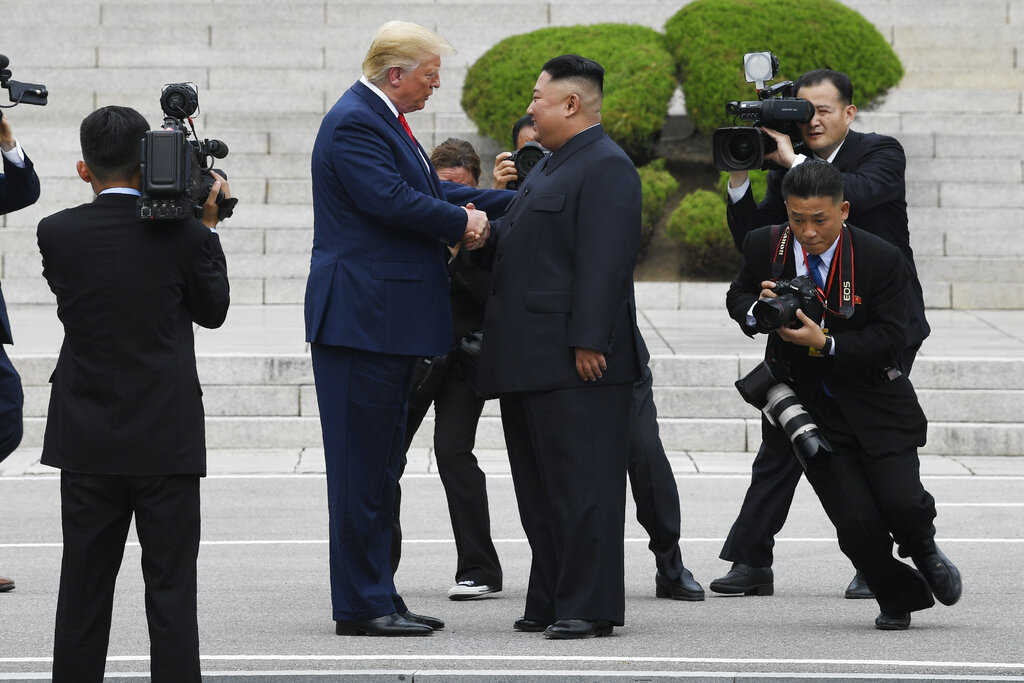
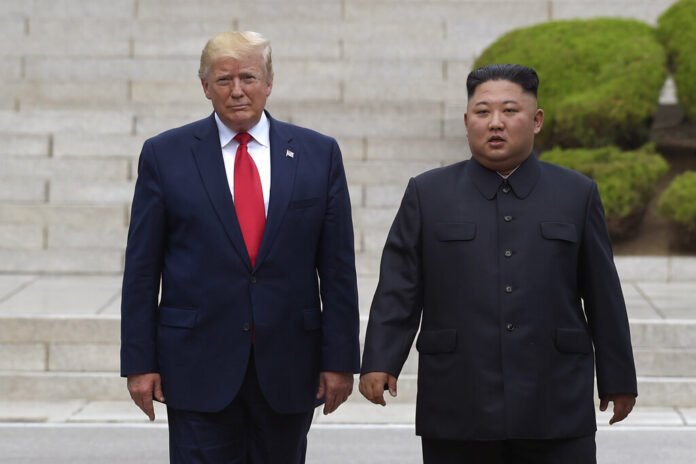
President Donald Trump, left, meets with North Korean leader Kim Jong Un at the North Korean side of the border at the village of Panmunjom in Demilitarized Zone, Sunday, June 30, 2019. Photo: Susan Walsh / AP

PANMUNJOM — With wide grins and a historic handshake, President Donald Trump and North Korea’s Kim Jong Un met at the heavily fortified Demilitarized Zone on Sunday and agreed to revive talks on the pariah nation’s nuclear program. Trump, pressing his bid for a legacy-defining deal, became the first sitting American leader to step into North Korea.

What was intended to be an impromptu exchange of pleasantries turned into a 50-minute meeting, another historic first in the yearlong rapprochement between the two technically warring nations. It marked a return to face-to-face contact between the leaders after talks broke down during a summit in Vietnam in February. Significant doubts remain, though, about the future of the negotiations and the North’s willingness to give up its stockpile of nuclear weapons.

The border encounter was a made-for television moment. The men strode toward one another from opposite sides of the Joint Security Area and shook hands over the raised patch of concrete at the Military Demarcation Line as cameras clicked and photographers jostled to capture the scene.

After asking if Kim wanted him to cross, Trump took 10 steps into the North with Kim at his side, then escorted Kim back to the South for talks at Freedom House, where they agreed to revive the stalled negotiations.

The spectacle marked the latest milestone in two years of roller-coaster diplomacy between the two nations. Personal taunts of “Little Rocket Man” (by Trump) and “mentally deranged U.S. dotard” (by Kim) and threats to destroy one other have given way to on-again, off-again talks, professions of love and flowery letters.

“I was proud to step over the line,” Trump told Kim as they met in on the South Korean side of the truce village of Panmunjom. “It is a great day for the world.”

Kim hailed the moment, saying of Trump, “I believe this is an expression of his willingness to eliminate all the unfortunate past and open a new future.” Kim added that he was “surprised” when Trump issued an unorthodox meeting invitation by tweet on Saturday.

As he left South Korea on his flight to Washington, Trump tweeted that he had “a wonderful meeting” with Kim. “Stood on the soil of North Korea, an important statement for all, and a great honor!”

Trump had predicted the two would greet one another for about “two minutes,” but they ended up spending more than an hour together. The president was joined in the Freedom House conversation with Kim by his daughter and son-in-law, Ivanka Trump and Jared Kushner, both senior White House advisers.

Substantive talks between the countries had largely broken down after the last Trump-Kim summit in Hanoi, which ended early when the leaders hit an impasse.

The North has balked at Trump’s insistence that it give up its weapons before it sees relief from crushing international sanctions. The U.S. has said the North must submit to “complete, verifiable and irreversible denuclearization” before sanctions are lifted.

As he announced the resumptions of talks, Trump told reporters “we’re not looking for speed. We’re looking to get it right.”

He added that economic sanctions on the North would remain. But he seemed to move off the administration’s previous rejection of scaling back sanctions in return for piecemeal North Korean concessions, saying, “At some point during the negotiation things can happen.”

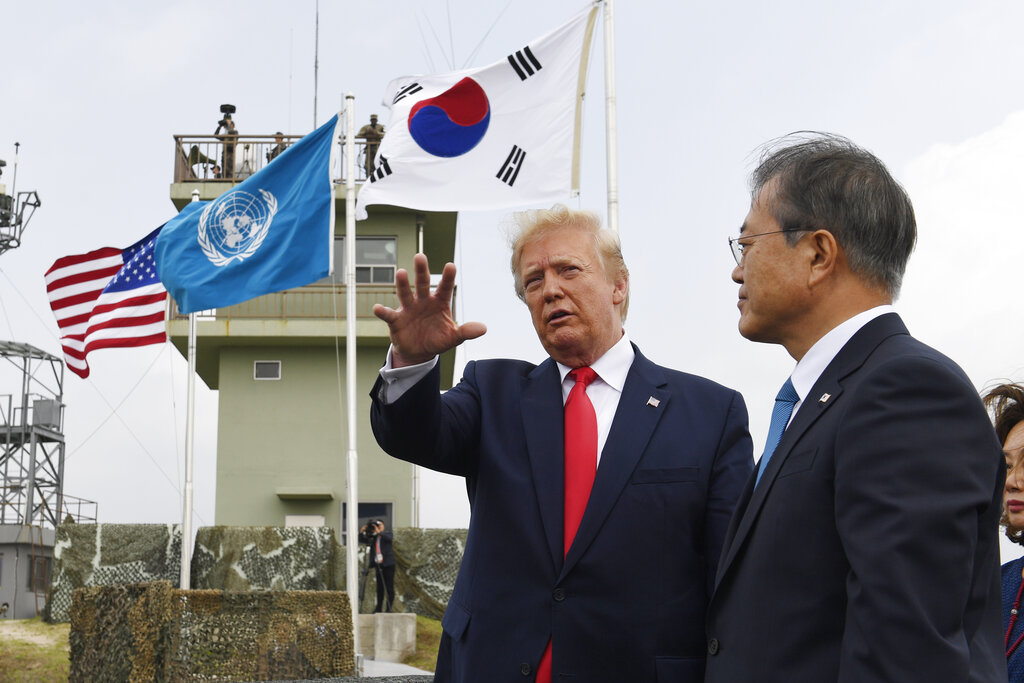
Peering into North Korea from atop Observation Post Ouellette, Trump told reporters before he greeted Kim that there had been “tremendous” improvement since his first meeting with the North’s leader in Singapore last year.

President Donald Trump walks to the North Korean side of the border with North Korean leader Kim Jong Un at the border village of Panmunjom in the Demilitarized Zone, South Korea, Sunday, June 30, 2019. Photo: Susan Walsh / AP

Trump claimed the situation used to be marked by “tremendous danger” but “after our first summit, all of the danger went away.”

But the North has yet to provide an accounting of its nuclear stockpile, let alone begin the process of dismantling its arsenal.

The latest meeting, with the U.S. president coming to Kim, represented a striking acknowledgement by Trump of the authoritarian Kim’s legitimacy over a nation with an abysmal human rights record. Kim is suspected of having ordered the killing of his half brother through a plot using a nerve agent at a Malaysian airport in 2017. Meantime, the United Nations said in May that about 10 million people in North Korea are suffering from “severe food shortages” after the North had one of the worst harvests in a decade.

Trump told reporters he invited the North Korean leader to the United States, and potentially even to the White House.

“I would invite him right now,” Trump said, standing next to Kim. Speaking through a translator, Kim responded that it would be an “honor” to invite Trump to the North Korean capital of Pyongyang “at the right time.”

North Korea’s state media later described the meeting as “an amazing event.”

Trump became the first sitting U.S. president to meet with the leader of the isolated nation last year when they signed an agreement in Singapore to bring the North toward denuclearization.

In the midst of the DMZ gathering, Trump repeatedly complained that he was not receiving more praise for de-escalating tensions on the Korean Peninsula through his personal diplomacy with Kim. Critics say Trump had actually inflamed tensions with his threats to rain “fire and fury” on North Korea, before embracing a diplomatic approach.

North Korea’s nuclear threat has not been contained, according to Richard Haas, president of the New York-based Council on Foreign Relations. He tweeted Sunday that the threat of conflict has subsided only because the Trump administration has decided it can live with North Korea’s “nuclear program while it pursues the chimera of denuclearization.”

Every president since Ronald Reagan has visited the 1953 armistice line, except for George H.W. Bush, who visited when he was vice president. The show of bravado and support for South Korea, one of America’s closest military allies, has evolved over the years to include binoculars and bomber jackets.

While North Korea has not recently tested a long-range missile that could reach the U.S., last month it fired off a series of short-range missiles. Trump has brushed off the significance of those tests, even as his own national security adviser, John Bolton, has said they violated U.N. Security Council resolutions.

President Donald Trump talks with South Korean President Moon Jae-in and views North Korea from the Korean Demilitarized Zone from Observation Post Ouellette at Camp Bonifas in South Korea, Sunday, June 30, 2019. Photo: Susan Walsh / AP

Story: Zeke Miller and Jonathan Lemire. Jill Colvin and Darlene Superville in Washington contributed to this report.

Advertisement

At Least 7 Dead as Sudanese Stage Protests Against Army Rule

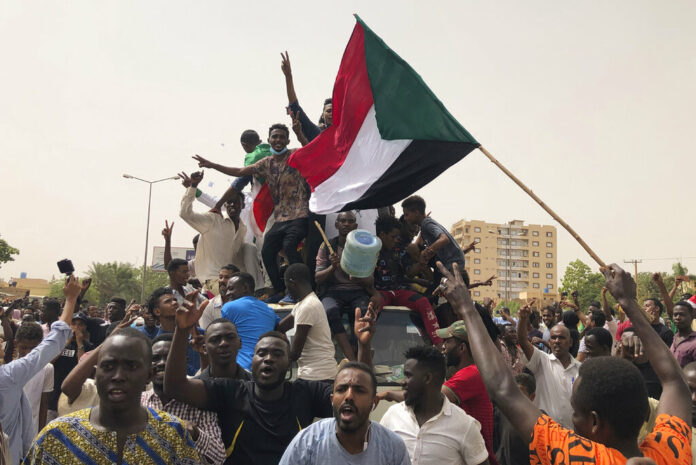
Sudanese shout slogans during a demonstration against the military council, in Khartoum, Sudan, Sunday, June 30, 2019. Tens of thousands of protesters have taken to the streets in Sudan's capital and elsewhere in the country calling for civilian rule nearly three months after the army forced out long-ruling autocrat Omar al-Bashir. The demonstrations came amid a weekslong standoff between the ruling military council and protest leaders. Photo: Hussein Malla / AP

KHARTOUM — Tens of thousands of protesters took to the streets in Sudan’s capital and elsewhere in the country Sunday calling for civilian rule nearly three months after the army forced out long-ruling autocrat Omar al-Bashir.

A government official said at least seven people had been killed and nearly 200 injured during the demonstrations.

The protests came amid a weekslong standoff between the ruling military council and protest leaders. Talks between the two sides over a power-sharing agreement collapsed earlier this month when security forces violently broke up a protest camp in Khartoum.

The ensuing clampdown resulted in at least 128 people killed across Sudan, according to protest organizers. Authorities put the death toll at 61, including three security forces.

Soliman Abdel-Gabar, acting undersecretary of health, reported Sunday night that at least seven people died during the day’s disturbances. He said 181 people were injured, including 27 with bullet wounds.

The marches, the first since the June 3 crackdown, also mark the 30th anniversary of the Islamist-backed coup that brought al-Bashir to power in 1989, toppling Sudan’s last elected government. The military removed al-Bashir in April amid mass protests against his rule.

The crowds gathered at several points across the capital and its sister city of Omdurman before marching toward the homes of those killed since the uprising began.

“This is a very important day for the Sudanese people,” protester Hamdi Karamallah said.

The protest movement erupted in December, triggered by an economic crisis. The protesters remained in the streets after al-Bashir was overthrown and jailed, fearing that the military would cling to power or preserve much of his regime.

Osman Mirghani, a Sudanese analyst and the editor of the daily newspaper al-Tayar, said the marches “changed the equation” in favor of the Forces for Declaration of Freedom and Change, which represents the protesters.

“Now, all pressure cards are in the hands of the FDFC. The marches corrected the situation,” he said.

On Sunday, protesters chanted anti-military slogans like “Burhan’s council, just fall”, according to video clips circulated online. Gen. Abdel-Fattah Burhan is head of the military council.

Video clips showed protesters running away from security forces in the streets of Khartoum and seeking shelter from clouds of tear gas.

On a highway leading to Khartoum’s international airport, a convoy of troops and riot police allowed some demonstrators to pass through as they headed toward the house of a protester who was killed earlier this month.

The protester’s mother was standing outside and joined the demonstration. They waved Sudanese flags and chanted slogans calling for civilian rule.

Mohammed Yousef al-Mustafa, a spokesman for the Sudanese Professionals’ Association, a leading protest organization, told The Associated Press that security forces used tear gas to disperse protesters in Omdurman and the district of Bahri in the capital.

He said protests also erupted in Atbara, a railway city north of the capital and the birthplace of the uprising that led to al-Bashir’s ouster.

The Sudan Doctors Committee, the medical arm of the SPA, said a protester in his 20s was shot dead in Atbara. Nazim Sirraj, a prominent activist, said at least four people were killed in Omdurman.

The SPA later called on protesters to march on the Nile-side presidential palace in Khartoum, as security forces closed off roads and bridges leading to the palace. The groups later said security forces barred the protesters from reaching their destination.

The FDFC called on protesters to head to other squares in Khartoum and Omdurman.

Gen. Mohamed Hamdan Dagalo, deputy head of the military council, said the generals want to reach an “urgent and comprehensive agreement with no exclusion.”

“We in the military council are totally neutral. We are the guardians of the revolution. We do not want to be part of the dispute,” he told a gathering of army supporters.

He said three troops from the paramilitary Rapid Support Forces were wounded during the protests in Khartoum. Dagalo, better known as Hemedti, is the leader of the Rapid Support Forces.

“Our mission is to protect people and any peaceful revolution,” he said.

The previous day, the military council said it did not oppose the demonstrations but warned protest leaders that they would be held responsible for any vandalism or violence during the marches.

The African Union and Ethiopia have meanwhile stepped up their efforts to mediate an end to the crisis and reach a deal over setting up a new transitional government.

Earlier this week the AU and Ethiopia extended a joint proposal. The generals and the protesters voiced their approval but did not immediately restart negotiations.

The military council said in a statement that it submitted its response to the envoys, and that the generals are ready to resume negotiations on Sunday based on the AU and Ethiopian proposal. Lt. Gen. Shams Eddin Kabashi, a spokesman for the council, said it was hoping to reach a “comprehensive political solution” under the umbrella of the AU.

However, the Forces for Declaration of Freedom and Change, which represents the protesters, said talks could only begin once the military has officially ratified the AU-Ethiopian proposal. Al-Mustafa said talks would resume “directly after the military council signs the proposal.”

Story: Hussein Malla and Samy Magdy.

Advertisement

Antifa Clashes With Far Right in Portland; 3 Arrested

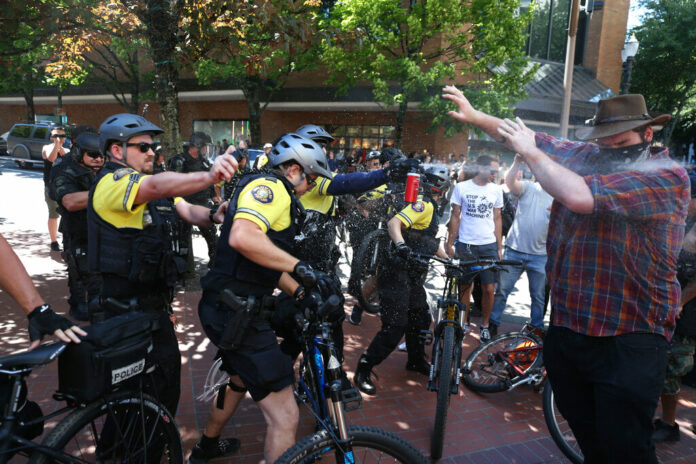
After a confrontation between authorities and protestors, police use pepper spray as multiple groups, including Rose City Antifa, the Proud Boys and others protest in downtown Portland, Ore., on Saturday, June 29, 2019. In separate social media posts later in the day, police declared the situation to be a civil disturbance and warned participants faced arrest. Photo: Dave Killen/The Oregonian via AP

PORTLAND — Competing demonstrations spilled into the streets of downtown Portland on Saturday, with fights breaking out in places as marchers clashed.

At least three groups had planned rallies or demonstrations at different sites in the city, including members of the so-called Proud Boys and anti-fascist groups that include “antifa,” and the fights occurred when participants of the opposing groups met, according to The Oregonian/OregonLive.

In a statement Saturday night, the Portland Police Bureau said three people were arrested on assault and harassment charges in connection with the protests. Police said medics treated eight people, including three police officers, at the scene. Three people were taken to hospitals after they were attacked, police said.

Andy Ngo, who describes himself as an editor at the conservative website Quillette and says he is “hated by antifa,” said on his Twitter feed that he was attacked by anti-fascist protesters and had to be taken to the hospital to treat injuries to his face and head. Ngo also said the attackers took his camera equipment.

Protesters also clashed with police, throwing water bottles and eggs at officers. In separate social media posts later in the day, police declared the situation to be a civil disturbance and warned participants faced arrest.

The Portland Police Bureau on Twitter asked for the public’s help in investigating violent assaults. The bureau also said that it has received reports that some of the milkshakes thrown by protesters contained quick-drying cement.

“Demonstration events are very fluid in nature and the management of these events is complex,” Assistant Chief Chris Davis said in a statement. “There are hundreds of peaceful free speech events in the City in a given year that do not result in violence. Unfortunately, today some community members and officers were injured. We are actively investigating these incidents to hold those responsible accountable.”

Advertisement

Ministry of Culture and Iconsiam to Host Ultimate Art and Cultural Performances “Viva ASEAN”

Ministry of Culture and Iconsiam to Host Ultimate Art and Cultural Performances “Viva Asean” from 10 Asean Countries on July 2, 2019 at River Park, Iconsiam

Ministry of Culture together with ICONSIAM are organising ultimate art and cultural performances “VIVA ASEAN” to present extraordinary performances from 10 ASEAN countries namely Brunei Darussalam, Cambodia, Indonesia, Laos, Malaysia, Myanmar, Philippines, Singapore, Vietnam, and Thailand. The performances include Traditional Folk Dance from Laos (Fon Duang Jum Pa), Kinaree Dance from Thailand (Rabam Kinaree), Rasa Sayang Dance from Singapore, Hóa Vàng Dance from Vietnam, performances that reflect shared culture of ASEAN such as Ramayana, Ronggeng and Joget Dance, Bamboo and coconut shell dance, as well as a newly joint-created performance “Unison for Unity”. The performance will be staged with the majestic view of the Chao Phraya River on July 2, 2019 from 17.00 hrs. onwards at River Park, ICOMSIAM.

1 2

Come indulge in the spectacular of the performances from 10 ASEAN countries combining with the irresistible beauty of the Chao Phraya River on July 2, 2019 from 17.00 hrs. onwards at River Park, ICOMSIAM, Chareon Nakorn Road. Free entry!!! For further information please contact 02-495-7080 or www.iconsiam.com


Advertisement

Footage of Activist’s Assailants Released

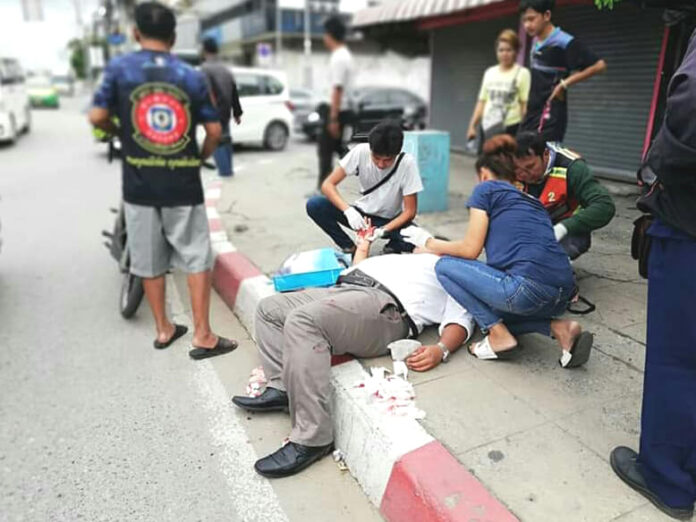
Rescue workers and bystanders come to activist Sirawith Seritiwat's aid on June 28, 2019, following an assault in Bangkok.

BANGKOK — A security camera footage released by an opposition MP shows moments of an attack on a pro-democracy activist, which still left him in serious condition Sunday.

The footage was obtained from four cameras close to where Sirawith “Ja New” Seritiwat was beaten by four masked men on Friday and released by Future Forward MP Rangsiman Rome, who called the assault a work of professionals.

“One thing I have to stress is that this operation looks professional,” Rangsiman wrote on Facebook. “They knew when Ja New would be at that spot.”

The security cameras show four men on two motorcycles stalking Sirawith after he left his home in Khan Na Yao district on Friday. One pair rode ahead of Sirawith while another followed him from behind until they rushed to beat him with what appeared to be batons.

The assault lasted about 20 seconds before the four attackers fled the scene along Ram Intra Road. All of the attackers wore motorcycle helmets to conceal their identities.

Sirawith remains hospitalized with multiple injuries to his face, skull, eyes and lips. His mother said the attack made one of Sirawith’s eyes protrude from the socket, and he may need facial surgery.

The 27-year-old activist is set to move to Ramathibodi Hospital – his third hospital transfer – later today to receive operations on his respiratory system.

No one claimed responsibility for the attack so far, though the critics of the junta note the incident fit a recent pattern of physical assaults that target prominent activists opposed to the military government.

National police chief Chakthip Chaijinda told reporters he has instructed the investigators to swiftly track down and arrest the perpetrators.

Advertisement

Restored Mission Control Comes Alive 50 years After Apollo

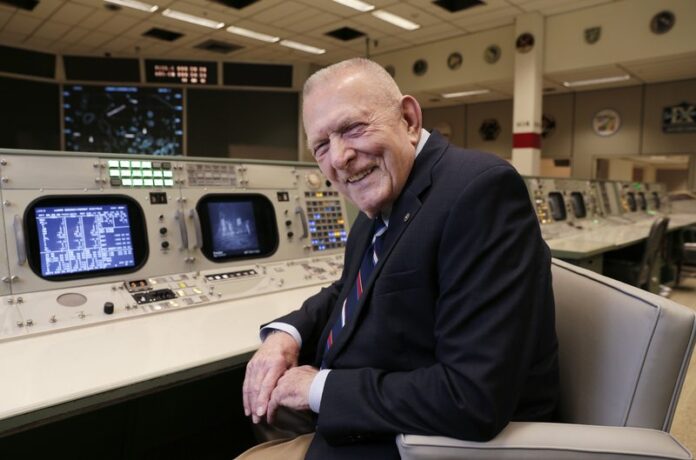
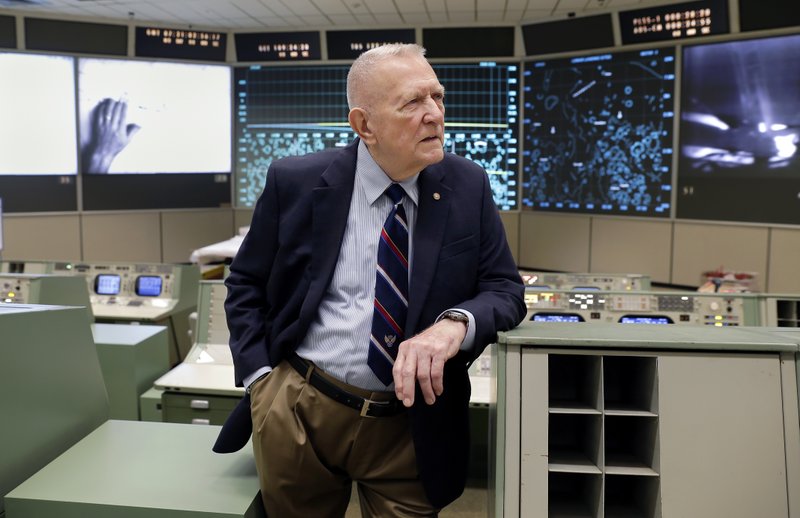
Gene Kranz, aerospace engineer, fighter pilot, an Apollo-era flight director and later director of NASA flight operations, sits at the console where he worked during the Gemini and Apollo missions at the NASA Johnson Space Center Monday, June 17, 2019, in Houston. (AP Photo/Michael Wyke)

HOUSTON — Gone is the haze of cigarette, cigar and pipe smoke. Gone are the coffee, soda and pizza stains. With only a few exceptions, NASA’s Apollo-era Mission Control has been restored to the way it looked 50 years ago when two men landed on the moon.

It gets the stamp of approval from retired flight director Gene Kranz, a man for whom failure — or even a minor oversight — is never an option.

Seated at the console where he ruled over Apollo 11, Apollo 13 and so many other astronaut missions, Kranz pointed out that a phone was missing behind him. And he said the air vents used to be black from all the smoke, not sparkly clean like they are now.

Those couple of details aside, Kranz could close, then open his eyes, and transport himself back to July 20, 1969, and Neil Armstrong and Buzz Aldrin’s momentous moon landing.

“When I sit down here and I’m in the chair at the console … I hear these words, ‘Houston, Tranquility Base here. The Eagle has landed,’” Kranz said during a sneak preview at NASA’s Johnson Space Center.

With all the empty seats, the room reminds him of a shift change when flight controllers would hit the restroom.

“It’s just nice to see the thing come alive again,” said Kranz, who titled his autobiography, “Failure is Not an Option.”

apollo05

Friday’s grand opening — just three weeks shy of the 50th anniversary of humanity’s first otherworldly footsteps — culminates years of work and millions in donations. It opens to the public Monday.

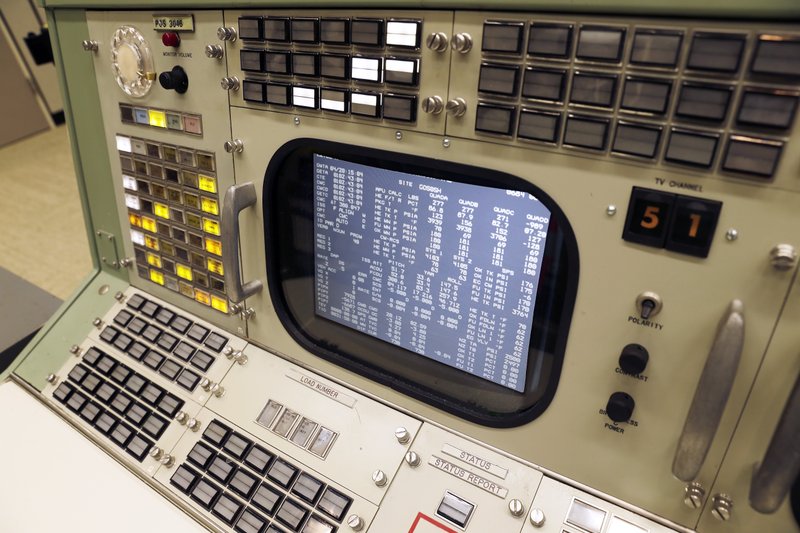
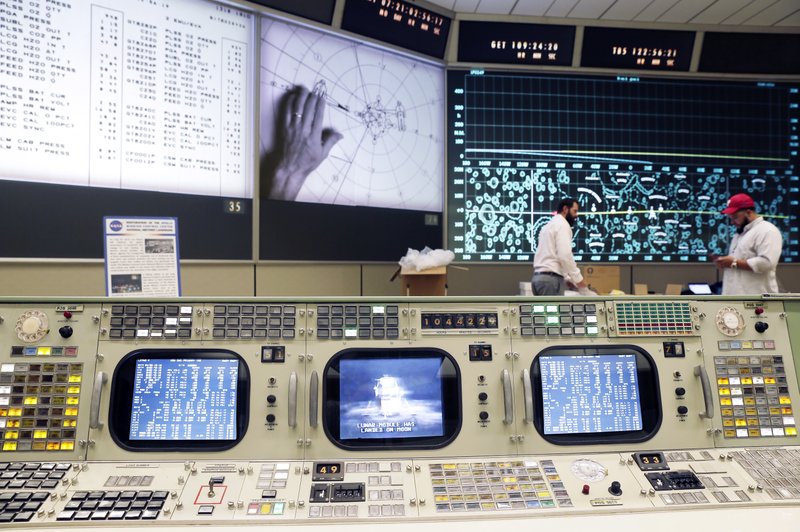
Meticulously recreated down to the tan carpeting, gray-green wallpaper, white ceiling panels, woven-cushioned seats, amber glass ashtrays and retro coffee cups, Project Apollo’s Mission Operations Control Room never looked — or smelled — so good.

The goal was “to capture the look and feel of July of ’69,” said NASA’s restoration project manager Jim Thornton.

“The place is designated a National Historic Landmark,” he said. “It’s not for the brick and mortar of the building, it’s for the amazing feats that happened inside of the building.”

Johnson’s historic preservation officer, Sandra Tetley, strove for accuracy. Her quest began in 2013, after the room had fallen into neglect. It was last used for space shuttle flights in the 1990s, then abandoned and opened to tourists.

apollo02

The restoration effort finally got traction in 2017. The room was closed, and construction began. More than $5 million was raised, most of it donations. The city of Webster across the street kicked in $3.5 million.

Tetley and her team interviewed flight controllers and directors now in their 70s and 80s. They pored through old pictures and brought in specialists in paint, wallpaper, carpeting, electricity and upholstery. Original swatches of carpet and wallpaper and an original ceiling tile turned up.

Intent on authenticity, they scoured eBay and vintage shops for ashtrays and cups and turned to 3D-laser printing to recreate lids for the back-of-the-seat ashtrays in the glassed-in visitors’ section overlooking the control room. Old binders for reams of paper were collected. Seat cushions were handwoven. Ceiling tiles were hand stamped.

Carpeting was custom ordered with special tufting and extra yarn, then cut into 28-inch squares. The restoration team wanted a lived-in look for the carpet and chose a shade reflecting years of nicotine discoloring.

apollo04

And yes, Kranz got his missing rotary-dial wall phone.

“I fought for everything,” Tetley said. “But we’re getting everything we want to make it just completely historically accurate.”

The green consoles were trucked to the Cosmosphere museum in Hutchinson, Kansas, for months of rehab. Cigarette butts were dug out of the consoles, along with gum wrappers and papers.

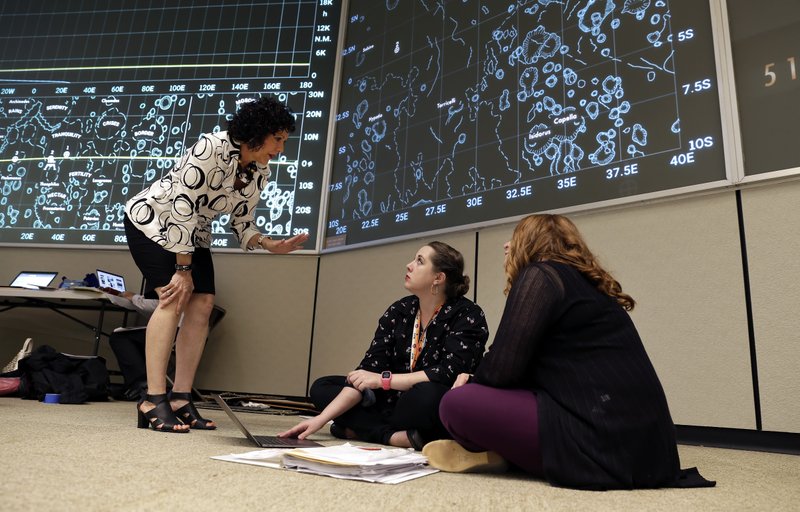
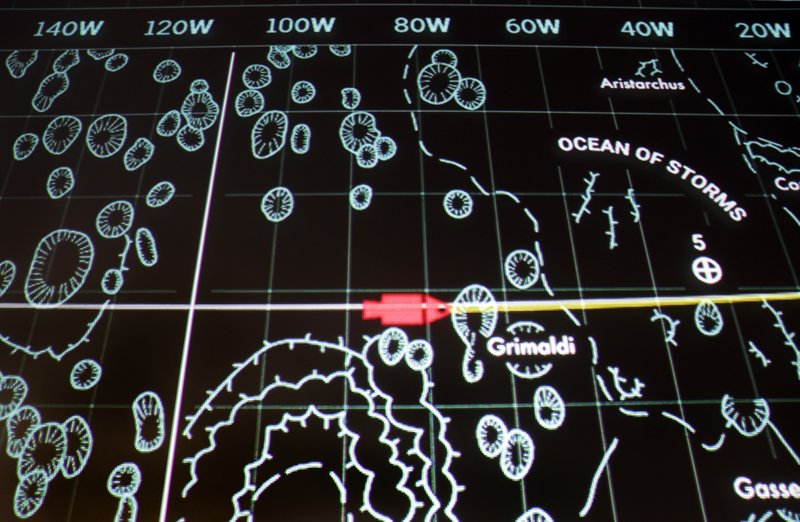
Modern LED lights and flat screens were installed to bring the consoles alive with images and flashing buttons; big screens up front will show key footage from the Apollo 11 mission.

“We’re using technology to make it look old, basically,” Tetley explained. LEDs also replaced the original overhead fluorescent lights that had faded the mission medallions on the walls.

apollo03

With the International Space Station’s Mission Control running 24/7 one floor down and work for future moonshots going on all around, Thornton said it was challenging to create a museum. But the painstaking work paid off. Some Apollo flight controllers were so moved at seeing the restored room that they teared up.

“Then we know that we’ve done it right,” Tetley said.

There’s one artifact, though, that doesn’t fit July 1969. Following their 1970 aborted moon-landing mission, Apollo 13′s Jim Lovell, Fred Haise and Jack Swigert presented a mirror from their spacecraft to Kranz and the rest of the control team. Ever since, the mirror had hung on a plaque above the room’s water fountain “to ‘reflect the image’ of the people in Mission Control who got us back!” Removed during the restoration, it’s now back in its original spot.

apollo06

Kranz, 85, still looms large in the hot seat, where he oversaw the Eagle’s landing.

“It was just absolutely our day, our time, our place,” he said.

The flight controllers meet every year to celebrate the day, although their numbers are dwindling.

They’re proud to have helped resuscitate their Mission Control: “Part of our legacy we’re going to leave for the next generation.”

___

Follow AP’s full coverage of the Apollo 11 anniversary at: https://apnews.com/Apollo11moonlanding

apollo07
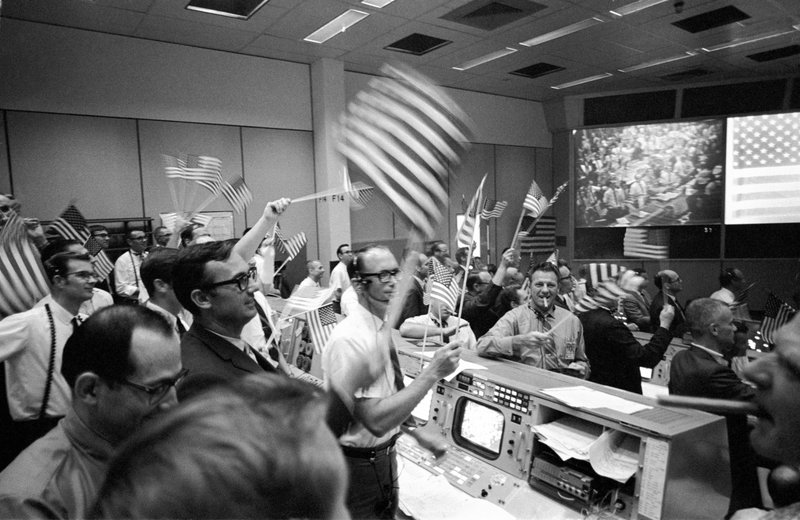
In this July 24, 1969 photo made available by NASA, flight controllers at the Mission Operations Control Room in the Mission Control Center at the Manned Spacecraft Center in Houston, celebrate the successful conclusion of the Apollo 11 lunar landing mission. (NASA via AP)
Advertisement

Trump, Xi Talk Trade as Economic Titans Jockey for Edge

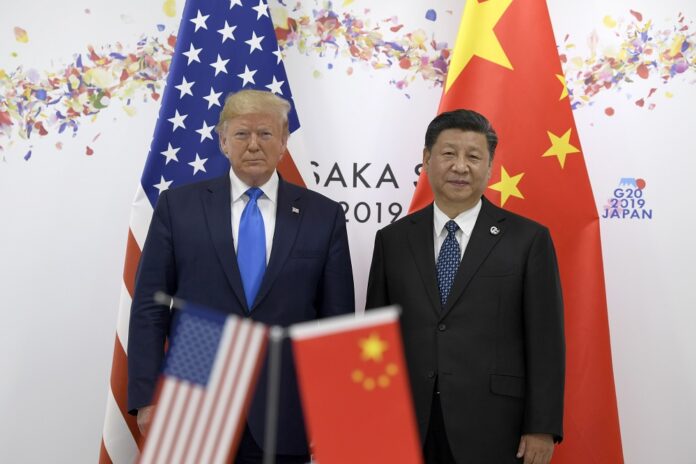
President Donald Trump, left, poses for a photo with Chinese President Xi Jinping during a meeting on the sidelines of the G-20 summit in Osaka, Japan, Saturday, June 29, 2019. (AP Photo/Susan Walsh)

OSAKA, Japan — A trade war between two economic titans faced a critical junction Saturday, as President Donald Trump met with China’s Xi Jinping as both sides signaled a desire to de-escalate the year-long conflict despite doubts about either side’s willingness to compromise.

Taking place on the sidelines of the Group of 20 summit in Japan, the meeting was the centerpiece of four days of diplomacy for Trump, whose re-election chances have been put at risk by the trade war that has both hurt American farmers and battered global markets. Tensions rose in recent weeks after negotiations collapsed last month and the two sides levied intensifying eye-for-an-eye punishments.

“We’ve had an excellent relationship,” Trump told Xi as the meeting opened, “but we want to do something that will even it up with respect to trade.”

Seated across a wide table flanked by top aides, both leaders struck a cautiously optimistic tone after greeting each other and posing for photographs.

“I think this can be a very productive meeting and I think we can go on to do something that will be truly monumental and great for both countries,” Trump said.

Xi, for his part, recounted the era of “ping-pong diplomacy” which helped jump-start U.S.-China relations two generations ago. He said that, since then, “One basic fact remains unchanged: China and the United States both benefit from cooperation and lose in confrontation.”

“Cooperation and dialogue are better than friction and confrontation,” he added.

The meeting with Xi is one of three Trump lined up Saturday with world leaders displaying authoritarian tendencies.

Trump had his first face-to-face sit-down with Saudi Arabia’s Mohammed Bin Salman since the U.S. intelligence community concluded that the crown prince directed the grisly murder of Washington Post columnist, and American resident, Jamal Khashoggi last year. And he will meet with Turkish President Recep Tayyip Erdogan, an ostensible NATO ally whom the U.S. sees as drifting dangerously toward Russia’s sphere of influence.

Meeting with the Saudi crown prince, Trump praised his “friend” for taking steps to open up the kingdom and extend freedoms to Saudi women.

Trump, however, ignored reporters’ questions about Mohammed’s alleged role in Khashoggi’s death. A U.N. expert has called for an investigation into Mohammed’s alleged involvement in the killing at the Saudi consulate in Turkey last year.

Both of those meetings come the day after Trump, with a smirk and a finger point, dryly told another authoritarian leader, Russia’s Vladimir Putin, “Don’t meddle with the election” in their first meeting since the special counsel concluded that Russia extensively interfered with the 2016 campaign.

The diplomacy plays out as Trump’s re-election campaign battle is beginning to heat up, a contest that could be partially defined by whether a resolution to the trade war with China can be found before more economic pain is inflicted on Americans.

The president has threatened to impose tariffs on an additional $300 billion in Chinese imports — on top of the $250 billion in goods he’s already taxed — extending his import taxes to virtually everything China ships to the United States. He has said the new tariffs, which are paid by U.S. importers and usually passed onto consumers, might start at 10%. Earlier, the administration had said additional tariffs might reach 25%.

The two countries are sparring over the Trump administration’s allegations that Beijing steals technology and coerces foreign companies into handing over trade secrets. China denies it engages in such practices. The U.S. has also tried to rally other nations to block Chinese telecom firm Huawei from their upcoming 5G systems, branding the company a national security threat and barring it from buying American technology.

Beijing has retaliated by levying its own tariffs on goods from the United States. On Friday, it criticized what it calls “negative content” about China in legislation before the U.S. Congress, saying it would further damage relations already roiled by disputes over trade and technology.

Chinese Foreign ministry spokesman Geng Shuang said cooperation in important areas would be disrupted if the draft National Defense Authorization Act passes. The bill blocks transfer of sensitive technology to China and prevents Chinese state companies from receiving U.S. federal funds.

But if history repeats itself — and most analysts are betting it will — Trump and Xi will agree to some kind of cease-fire.

Indeed, a senior administration official sought to downplay expectations last week by suggesting that the primary goal for the Trump-Xi meeting is simply an agreement to restart negotiations. The official, who spoke on condition of anonymity to describe White House thinking, said the hard work of finalizing the complex details of any broad new accord would come later, when negotiating teams for the two sides meet.

Under the cease-fire scenario, existing tariffs and counter-tariffs on many of each other’s goods would remain in place. But no additional import taxes would take effect. This would buy time for U.S. and Chinese officials to restart talks that stalled last month after 11 rounds of negotiations. Trump said Friday he had not agreed to a cease-fire with Xi as a precondition for their meeting.

The last time Trump and Xi met — in early December at a G-20 gathering in Buenos Aires, Argentina — they called a truce. That arrangement injected some new momentum into talks between the world’s two biggest economies.

As for Saudi Arabia, Trump has long sought to minimize the crown prince’s role in Khashoggi’s murder, and has been reluctant to criticize the killing of the royal critic. His administration views the kingdom as the lynchpin of its Middle East strategy to counter Iran. The meeting Saturday comes a week after Trump came to the brink of ordering a military strike on that Iran in retaliation for it downing an American unmanned spy-plane. Trump is also relying on the Saudi government to support his administration’s elusive Israel-Palestinian peace plan, which is being developed by his son-in-law, Jared Kushner.

With Erodogan, Trump will find himself trying to paper over differences over Turkey’s planned purchase of the Russian-made S-400 surface-to-air missile system. U.S. officials have threatened that purchase would halt the sale of the U.S.-made F-35 Joint Strike Fighter, though Erdogan’s government has called it a done deal. The pair will also be called to continue difficult discussions about Syria, as Trump’s ordered withdrawal has been slowed.

___

Associated Press writers Patrick Quinn in Beijing and Paul Wiseman in Washington contributed to this report.

Advertisement

Trump Open to Meeting North Korea’s Kim at DMZ

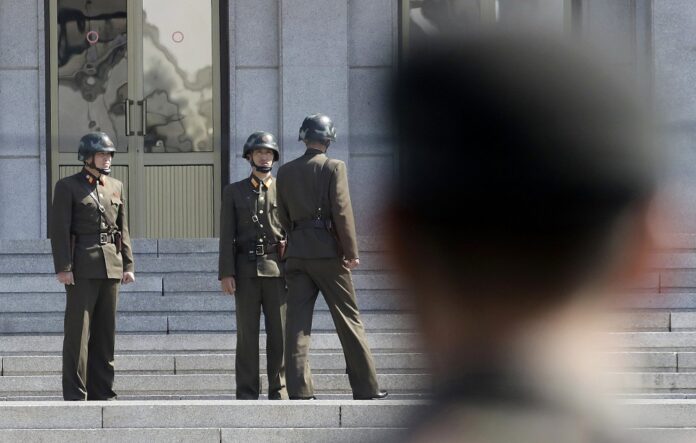
A file photo of North Korean officers at the Panmunjom in the Demilitarized Zone (DMZ). Image: Associated Press

OSAKA, Japan — Eyeing a history-making photo opportunity, President Donald Trump on Saturday issued a Twitter invitation to North Korea’s Kim Jong Un to join him for a hand shake during a visit to the demilitarized zone with South Korea.

The invitation, while long rumored in diplomatic circles, still struck as an impulsive display of showmanship by a president bent on obtaining a legacy-defining nuclear accord. North Korea responded to offer by calling it a “very interesting suggestion.”

Presidential visits to the DMZ are traditionally treated as carefully guarded secrets for security reason. And White House officials couldn’t immediately say whether Kim had agreed to meet with Trump. The president himself claimed he wasn’t even sure Kim was in North Korea to accept the invitation.

“All I did is put out a feeler, if you’d like to meet,” Trump said later of the message to Kim. He added, somewhat implausibly, that “I just thought of it this morning.”

3000 1
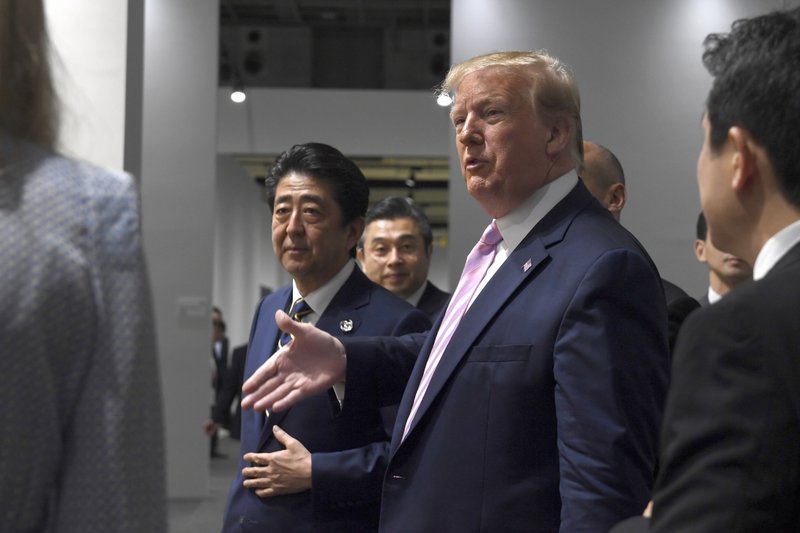
President Donald Trump, walking with Japanese Prime Minister Shinzo Abe stops to ask a question after he arrived at the G-20 summit in Osaka, Japan, Friday, June 28, 2019. (AP Photo/Susan Walsh)

Trump is scheduled to fly to South Korea later Saturday after he concludes meetings at the Group of 20 summit in Osaka, Japan, including with the president of China. He told reporters during a breakfast with Saudi Arabian Crown Prince Mohammed bin Salman that he would be visiting the heavily fortified area between the two Koreas.

“We’re going there,” the president said.

Shortly before the breakfast, Trump tweeted his invitation for Kim to meet him there. “If Chairman Kim of North Korea sees this, I would meet him at the Border/DMZ just to shake his hand and say Hello(?)!” he wrote.

It was not immediately clear what the agenda, if any, would be for the potential third Trump-Kim meeting. Trump predicted that, “If he’s there we’ll see each other for two minutes.” Still, such a spectacle would present a valuable propaganda victory for Kim, who, with his family, has long been denied the recognition they sought on the international stage.

Despite Trump’s comments Saturday, he had told The Hill newspaper in an interview this week that he would be visiting the DMZ and said “he might” meet with Kim. The paper reported it had withheld Trump’s comments, citing security concerns by the White House.

North Korea’s state media made no mention Saturday of a possible meeting between Trump and Kim. South Korea’s presidential Blue House said in a tweet that Trump asked South Korean President Moon Jae-in at the G20 meetings whether he’d seen Trump’s Twitter message to Kim. When Moon replied he had, Trump said ”(Let’s) try doing it” and raised his thumb, the Blue House said.

Trump’s summit with Kim in Vietnam earlier this year collapsed without an agreement for denuclearizing the Korean Peninsula. He became the first sitting U.S. president to meet with the leader of the isolated nation last year in Singapore, where they signed a broad agreement to bring the North toward denuclearization.

Substantive talks between the two nations have largely broken down since then, as the North has balked at Trump’s insistence that it give up its weapons before it sees relief from crushing international sanctions.

Still, Trump has sought to publicly heap praise on Kim, who oversees an authoritarian government, in hopes of keeping the prospects of a deal alive, and the two have traded flowery letters in recent weeks.

Every president since Ronald Reagan has visited the 1953 armistice line, except for George H.W. Bush, who visited when he was vice president. The show of bravado and support for South Korea, one of America’s closest military allies, has evolved over the years to include binoculars and bomber jackets.

Trump, ever the showman, appears to be looking to one-up his predecessors with a meeting with Kim.

As he left the White House for Asia earlier this week, Trump was asked whether he’d meet with Kim while he is in the region.

“I’ll be meeting with a lot of other people … but I may be speaking to him in a different form,” Trump said.

Such trips to the demilitarized zone, the heavily fortified border between North and South Korea, are usually undertaken under heavy security and the utmost secrecy. Trump tried to visit the DMZ when he was in Seoul in November 2017, but his helicopter was grounded by heavy fog.

Trump has staked his self-professed deal-making reputation on his rapprochement with the North and has even turned it into a campaign rallying cry. Trump has repeatedly alleged that if he had lost the 2016 presidential campaign, the U.S. would be “at war” with North Korea over its nuclear weapons and ballistic missile programs.

The meeting would come at a time of escalating tensions. While North Korea has not recently tested a long-range missile that could reach the U.S., it last month a fired off a series of short-range missiles. Trump has brushed off the significance of the tests, even as his own national security adviser, John Bolton, has said they violated U.N. Security Council resolutions.

Trump also suggested Saturday that the North was prepared to turn over additional unidentified remains of unknown American and allied service-members. At least six Americans have been identified from 55 boxes of remains delivered by the North last year after Trump’s first meeting with Kim, but the Defense Department in May announced it was halting efforts to recover additional remains, citing a lack of cooperation from North Korea.

___

Associated Press writers Hyung-jin Kim and Kim Tong-hyung in Seoul, South Korea, and Darlene Superville and Jill Colvin in Washington contributed to this report.

Advertisement

Hot News

LATEST NEWS

Bangkok
overcast clouds
30.2 ° C
31.6 °
28.8 °
76 %
4.5kmh
100 %
Tue
34 °
Wed
34 °
Thu
35 °
Fri
31 °
Sat
31 °