28.8 C
Bangkok
Monday, June 29, 2026
Home Blog Page 1647

Hong Kong Customs Seizes Massive Cocaine Haul

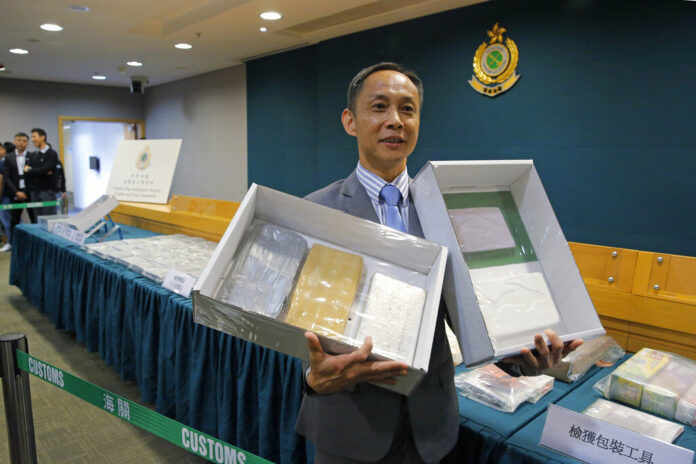
Head of Customs Drug Investigation Bureau Hui Wai-ming holds the seized cocaine during a news conference in Hong Kong, Thursday, April 4, 2019. Photo: Kin Cheung / Associated Press

HONG KONG — A haul of cocaine with an estimated market value of $13 million has been seized in Hong Kong, customs agents said Thursday.

The customs service in the semi-autonomy Chinese territory said one man was arrested in the operation Wednesday that netted 91 kilograms of the drug. The Customs Drug Investigation Bureau plans to hold a news conference later Thursday.

As a major Asian port city, Hong Kong is considered a key transit point for contraband from illegal drugs to endangered wildlife parts. Much of that is bound for mainland China or Southeast Asia where drug laws tend to be much stricter.

Meanwhile, Hong Kong’s large population of finance workers, lawyers and others in well-paid white collar sectors also provides a lucrative market for drugs including cocaine and marijuana.

Hong Kong’s past is steeped in the drug trade, having been founded as a British colony in 1842 as a result of the First Opium War.

Advertisement

Thanathorn Did Not Aid Anti-Coup Protesters: Rangsiman

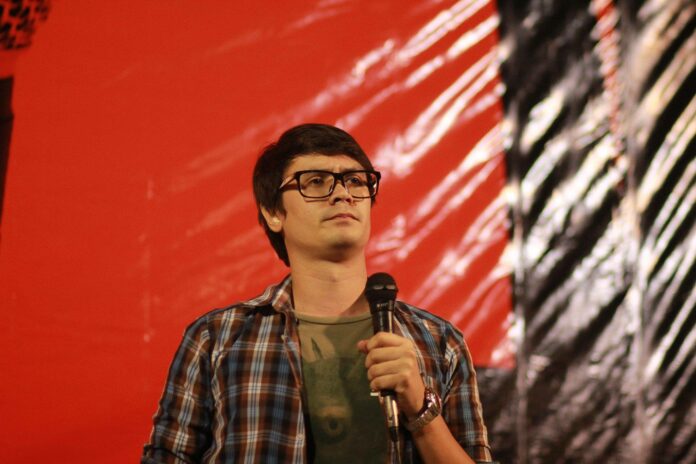
Rangsiman Rome speaks on a stage during a 2018 democracy rally.

BANGKOK — Future Forward Party MP candidate Rangsiman Rome refuted accusations on Thursday that party leader Thanathorn Juangroongruangkit helped him flee from a police station following an anti-coup protest in 2015.

Rangsiman, then a fourth-year law student at Thammasat University, said he went to Pathum Wan police station in June 2015 to file a complaint that he and many other student activists were physically attacked by police and security officers at an anti-junta rally outside the Bangkok Art and Culture Centre.

Rangsiman said that while waiting for a taxi on his way home, then businessman Thanathorn showed up in a van and offered a ride.

“I did not flee. I didn’t think I fled,” said Rangsiman on the phone on Thursday.

Rangsiman reasoned that Thanathorn could not have thought he was fleeing a criminal charge, because Rangsiman himself only learned afterwards that he was charged with violating the junta’s ban on political gatherings for participating in the BACC rally.

Read: Future Forward Leader Hit With Sedition Charge

The comment came after Thanathorn revealed yesterday that he has been charged with sedition. Junta legal officer Col. Burin Thongprapai said the charge was filed because Thanathorn aided Rangsiman and around 20 others flee from the police station in June 2015 before they were arrested.

Deputy police chief Gen. Srivara Rangsibrahmanakul on Wednesday denied that the charge was politically motivated, saying the charge came four years after the rally because the case had changed hands several times.

“It’s not about the elections or about discrediting anyone,” Srivara said, adding that there’s enough evidence to try Thanathorn. Srivara urged supporters of Thanathorn not to break the law if they plan to show up on Saturday at the police station.

Thanathorn formerly served on the board of Matichon Group, the parent company of Khaosod English.

Rangsiman said the account was false and that he and his fellow activists had not been aware of any such arrest warrant that night.

Krisadang Nutcharut, Thanathorn’s lawyer, insisted that his client did not help anyone flee. He said by phone Thursday that he will show written proof on Saturday, when his client appears under police summons to hear the sedition charge, that Rangsiman and his fellow activists went to the police station to press a complaint.

“Police also said they could leave [that night],” Krisadang said.

If convicted of sedition, Thanathorn could face up to seven years in prison.

Advertisement

Australia Could Jail Social Media Execs for Showing Violence

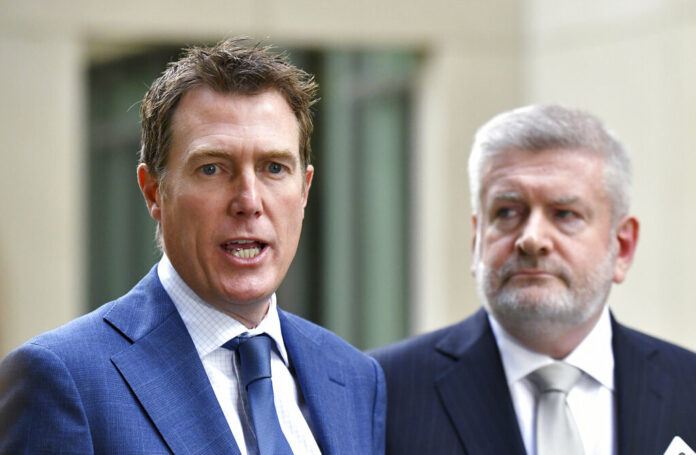
Australia's Attorney-General Christian Porter, left, and Minister for Communications Mitch Fifield hold a press conference at Parliament House, in Canberra, Wednesday, April 4, 2019. Photo: Mick Tsikas / AAP Image via AP

CANBERRA, Australia — Australia’s Parliament passed legislation on Thursday that could imprison social media executives if their platforms stream real violence such as the New Zealand mosque shootings.

Critics warn that some of the most restrictive laws about online communication in the democratic world could have unforeseen consequences, including media censorship and reduced investment in Australia.

The conservative government introduced the bills in response to the March 15 attacks in Christchurch in which an Australian white supremacist apparently used a helmet-mounted camera to broadcast live on Facebook as he shot worshippers in the two mosques.

Australia’s government rushed the legislation through the last two days that Parliament sits before elections are expected in May, dispensing with the usual procedure of a committee scrutinizing its content first.

“Together we must act to ensure that perpetrators and their accomplices cannot leverage online platforms for the purpose of spreading their violent and extreme propaganda — these platforms should not be weaponized for evil,” Attorney General Christian Porter told Parliament while introducing the bill.

The opposition’s spokesman on the attorney general portfolio, Mark Dreyfus, committed his center-left Labor Party to support the bill despite misgivings. If the Labor wins the election, the law would be reviewed by a parliamentary committee.

The law has made it a crime for social media platforms not to remove “abhorrent violent material” quickly. The crime would be punishable by three years in prison and a fine of $7.5 million, or 10% of the platform’s annual turnover, whichever is larger.

Abhorrent violent material is defined as acts of terrorism, murder, attempted murder, torture, rape and kidnapping. The material must be recorded by the perpetrator or an accomplice for the law to apply.

Platforms anywhere in the world would face fines of up to $597,500 if they fail to notify Australian Federal Police if they are aware their service was streaming “abhorrent violent conduct” occurring in Australia.

Dreyfus described the bill as “clumsy and flawed,” and the timetable to pass it as “ridiculous.” Labor first saw the legislation late Monday.

The bill could potentially undermine Australia’s security cooperation with the United States by requiring U.S. internet providers to share content data with Australian Federal Police in breach of U.S. law, Dreyfus said.

“Labor believes that the social media companies must do more in preventing the dissemination of material produced by terrorists, showing of their crimes, and for that reason Labor will, despite reservations … be supporting the passage of this bill,” Dreyfus said.

An attempt by the minor Greens party and independent lawmakers to have the vote scrutinized by a parliamentary committee was rejected.

Arthur Moses, president of the Australian Law Council, the nation’s top lawyers group, said the law could lead to media censorship and prevent whistleblowers from using social media to shine a light on atrocities because of social media companies’ fear of prosecution.

“Media freedom and whistleblowing of atrocities here and overseas have been put at risk by the ill-informed livestream laws passed by the Federal Parliament,” Moses said.

The penalties would be “bad for certainty and bad for business,” which could scare off online business investment in Australia, Moses said.

Australian Industry Group chief executive Innes Willox, a leading business advocate, said more time was required to ensure the law did not unnecessarily impinge on existing fundamental media rights and freedoms.

“Rushing this legislation through will not make Australia safe,” he said.

Scott Farquhar, co-founder of the Sydney-based software company Atlassian, predicted job losses in the technology industry.

“As of today, any person working at any company (globally) that allows users to upload videos or images could go to jail,” Farquhar tweeted. “Guilty until proven innocent.”

Fergus Hanson, head of the International Cyber Policy Center at the Australian Strategic Policy Institute, saw problems in the legislation’s definitions, including how long a company had to “expeditiously” remove offense material.

Alex McCauley, chief executive of national tech startup advocacy organization StartupAUS, described the legislation as “anti-tech.”

“We want to see it (social media) better regulated and we just simply haven’t had the conversation at a national level about what that means and there hasn’t been time and there hasn’t been consultation,” McCauley told Australian Broadcasting Corp.

Facebook livestreamed the Christchurch massacre for 17 minutes without interruption before reacting. Facebook said it removed 1.5 million videos of the shootings during the first 24 hours afterward.

It was filmed by Brenton Harrison Tarrant, 28, whose video and writings included anti-Muslim views and detailed how he planned the attack. Tarrant is scheduled to appear in court Friday and will face 50 murder and 38 attempted murder charges, according to New Zealand police.

Executives of Facebook, Google, Twitter, internet service providers and Australian phone companies met Prime Minister Scott Morrison and three ministers last week to discuss social media regulation. Communications Minister Mitch Fifield said Facebook “did not present any immediate solutions to the issues arising out of the horror that occurred in Christchurch.”

Facebook did not immediately respond to a request for comment on Thursday.

Morrison wants to take the Australian law to a Group of 20 countries forum as a model for holding social media companies to account.

New Zealand’s Justice Minister Andrew Little said his government had also made a commitment to review the role of social media and the obligations of the companies that provide the platforms. He said he had asked officials to look at the effectiveness of current hate speech laws and whether there were gaps that need to be filled.

Little said he didn’t see any irony in that people were watching hearings into a bill that would place new restrictions on guns in real time on Facebook, the same platform the shooter used to broadcast the massacre.

“There’s a world of difference, I think, between the exercise of a democratic function and a democratic institution like a national parliament, and some of the more toxic stuff that you see put out by individuals,” he said.

Story: Rod McGuirk

Advertisement

Ballot Recounts, By-Elections Ordered in Some Polling Stations

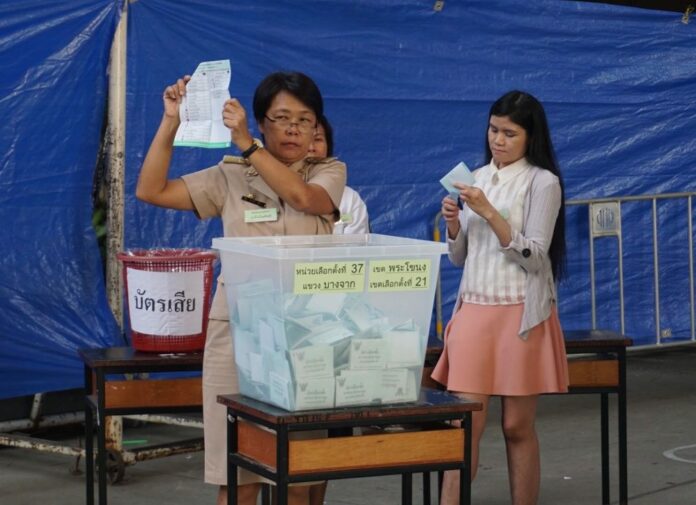
An official counts a ballot on March 24 at a polling station in Bangkok’s Phra Khanong district.

BANGKOK — The Election Commission said Thursday that ballots from two polling stations will be recounted while six others need by-elections.

Commissioner Sawaeng Boonmee said the recount is needed in two of Khon Kaen’s polling stations. By-elections are needed at two polling stations in Lampang, and one in Yasothon, Phetchabun, Phitsanulok and Bangkok, respectively. Sawaeng cited the reported ballot numbers that did not match reported voter turnout in both cases.

It’s not immediately known why by-elections – rather than simply recounts – are needed at the six polling stations and when they will be held. Sawaeng only said that the date will be announced after the national holiday of Songkran.

As the decision doesn’t affect any entire electoral district, it’s unlikely that the recounts or by-elections will have a major impact on the overall results. Constituencies can consist of several dozens polling stations. There were 6,149 polling stations in Bangkok’s 30 constituencies for the March 24 election.

Sawaeng however said that, following further review, some entire districts could require by-elections.

The ordered by-elections affected five constituencies that contributed to the election of two Pheu Thai candidates, two Phalang Pracharath candidates, and one Ruam Jai Thai candidate.

The official election results will be certified by May 9.

Update: This article has been updated with an additional information about candidates that won in the affected constituencies.

Advertisement

Nissan’s Ghosn Arrested Again in Financial Misconduct Case

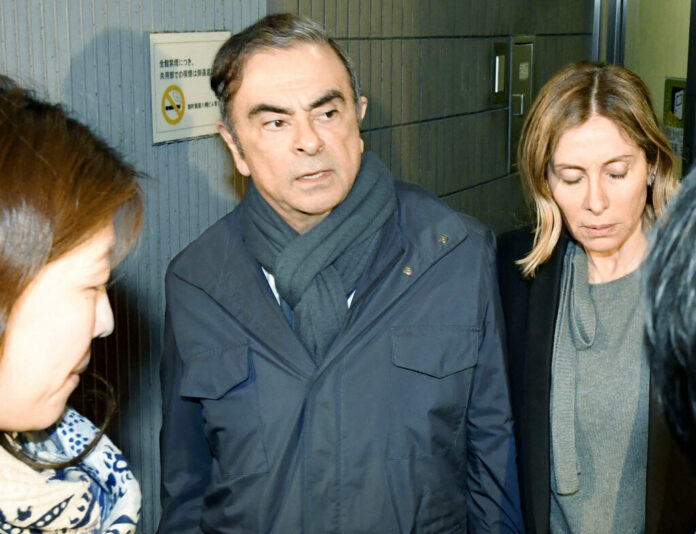
Former Nissan Chairman Carlos Ghosn, center, leaves his lawyer's office in Tokyo, Wednesday, April 3, 2019. Photo: Sadayuki Goto / Kyodo News via AP

TOKYO — Nissan’s former Chairman Carlos Ghosn was arrested Thursday morning for a fourth time by Tokyo prosecutors investigating him for alleged financial misconduct while leading the Japanese automaker.

Tokyo prosecutors said Ghosn’s arrest was on suspicion he diverted $5 million from funds that were being relayed from a Nissan subsidiary to an overseas dealership. Their statement said the money is suspected of going to a company Ghosn virtually ran.

Ghosn’s whereabouts following his detention were unclear. TV footage showed officials entering Ghosn’s apartment in Tokyo, and a car later going to the prosecutors’ office, barely a month after Ghosn was released on bail from the earlier arrests. A car with the same license plate was later seen entering the Tokyo Detention Center, where Ghosn spent more than three months following his arrest on Nov. 19.

A spokesman for Ghosn issued a statement in which he strongly declared his innocence. The spokesman would not be identified due to the sensitivity of the matter.

“My arrest this morning is outrageous and arbitrary,” Ghosn said in the statement. “It is part of another attempt by some individuals at Nissan to silence me by misleading the prosecutors. Why arrest me except to try to break me? I will not be broken. I am innocent of the groundless charges and accusations against me.”

Ghosn, 65, was first arrested on charges of under-reporting his compensation. He was rearrested twice in December, including on breach of trust charges. The multiple arrests prolong detentions without trial and are an oft-criticized prosecution tactic in Japan’s criminal justice system.

The prosecutors’ statement did not mention Oman, but the allegation appears related to the investigation by Nissan Motor Co.’s French alliance partner Renault about payments in Oman to a major dealership, some of which is suspected of having been channeled for Ghosn’s personal use.

Ghosn’s lawyer Junichiro Hironaka denounced the arrest, stressing that a rearrest during release on bail was unusual. His release on bail in March was unusually quick for Japan, where long detentions without convictions are routine

“This is an example of hostage justice,” Hironaka told reporters. “This is meant to hurt Mr. Ghosn and give more advantage to the prosecutors’ side.”

Nissan Chief Executive Hiroto Saikawa expressed surprise about the arrest, although it had been rumored for days.

“So much can happen. I am shocked,” he told reporters as he left his home.

Ghosn’s family expressed worries about another detention, calling it in a statement, “solitary confinement as part of an attempt to force a confession.”

Ghosn has denied the accusations in the earlier charges. On the allegation of under-reported compensation at Nissan, he has said it involved payments that were never decided or that were to be paid in the future. He has also said Nissan never suffered losses for his personal investments and that allegedly dubious payments in Saudi Arabia were for legitimate services.

Ghosn had tweeted he would hold a news conference April 11, where he would tell “the truth” on what was unfolding. A condition for his release on bail included not using the internet, but it is unclear if the authorities are considering the tweet a technical violation.

“I am confident that if tried fairly, I will be vindicated,” he said in the statement Thursday. “I am determined that the truth will come out. I am confident that if tried fairly, I will be vindicated.”

The allegations in the most recent arrest cover three money transfer operations from 2015 through last year, according to the prosecutors.

Ghosn was a star in the auto industry, having steered Nissan for two decades from the brink of bankruptcy to one of the largest groups in the industry, allied with Renault and smaller Japanese partner Mitsubishi Motors Corp.

Nissan declined comment on the criminal proceedings. The company is a co-defendant on the under-reporting of compensation charges.

Hironaka said this week that at least two Nissan employees are cooperating with the prosecutors. Several other Nissan officials have been questioned by the prosecutors as part of the investigation.

The maker of the March subcompact, Leaf electric car and Infiniti luxury models is holding a shareholders’ meeting next week to oust Ghosn from its board.

“Nissan’s internal investigation has uncovered substantial evidence of blatantly unethical conduct,” said company spokesman Nicholas Maxfield.

The maximum penalty upon conviction on charges of under-reporting compensation and breach of trust is 15 years in prison. It is unclear when Ghosn’s trial may begin. Preparations for trials in Japan routinely take months.

Story: Yuri Kageyama

Advertisement

50 Murder Counts Filed on NZ Mosque Attack Suspect

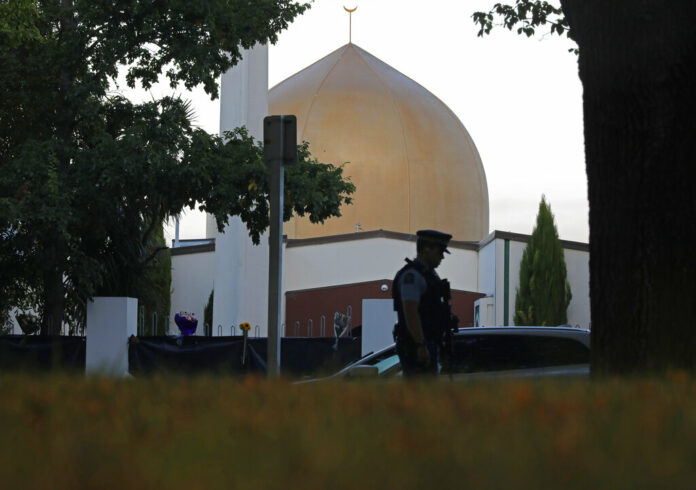
In this March 17, 2019, file photo, a police officer stands guard in front of the Al Noor mosque in Christchurch, New Zealand. Photo: Vincent Yu / Associated Press

WELLINGTON, New Zealand — Police say the man accused of the Christchurch mosque attacks will face 50 murder charges and 39 attempted murder charges at his court appearance on Friday.

Australian Brenton Harrison Tarrant, 28, had been charged with one count of murder after his arrest the day of the March 15 massacre.

Fifty people were killed in the two mosques and dozens of others were shot and wounded.

Tarrant won’t be required to enter a plea on Friday. The judge says the brief hearing will mainly be about Tarrant’s legal representation. He has said he wants to represent himself.

Tarrant earlier dismissed lawyer Richard Peters, who was assigned to represent him at his first court appearance. Many worry that Tarrant will try to use the trial as a soapbox to push his white supremacist views.

New Zealand tightly restricts what can be reported about upcoming court cases to avoid tainting the views of potential jurors.

The judge said he had received applications from 25 media organizations to take film, photographs or audio recordings of the hearing but he denied all of them. He said reporters could remain throughout and take notes.

Advertisement

Flash Floods Hit Pattaya After Hours of Heavy Rain

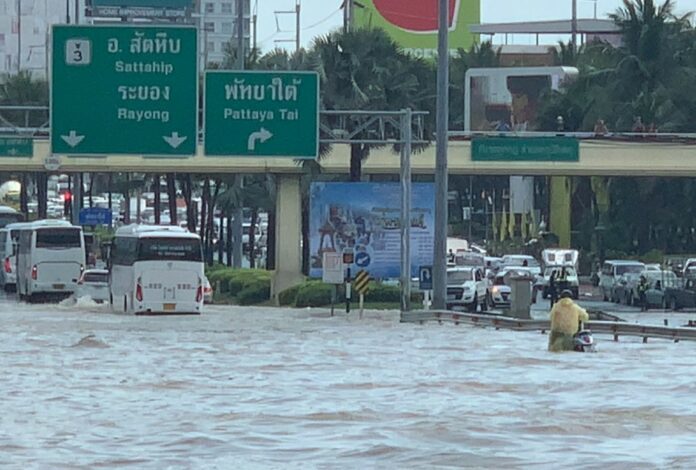
Cars are jammed on a flooded street Wednesday in Pattaya city.

PATTAYA — Pattaya city was hit by flash floods for the second consecutive day on Wednesday after being pounded by thunderstorms.

Several areas were flooded up to a meter high and roads cut off after the touristic coastal city suddenly experienced torrential rain in the afternoon for over two hours. The city yesterday also saw vast areas submerged by floods following hours of heavy rain, damaging many homes and a popular beach.

Many parts of the major road Pattaya Tai were inundated, causing traffic jams several kilometers long. Officials said they expect the flood to dry out within a few hours.

The Meteorological Department today issued a warning of thunderstorms and gusty winds for several provinces in upper Thailand through Thursday. Up to 40 percent of Bangkok could see heavy rain and storms today and tomorrow.

Advertisement

Review: DC Superhero Pic ‘Shazam!’ is a Joy … Seriously

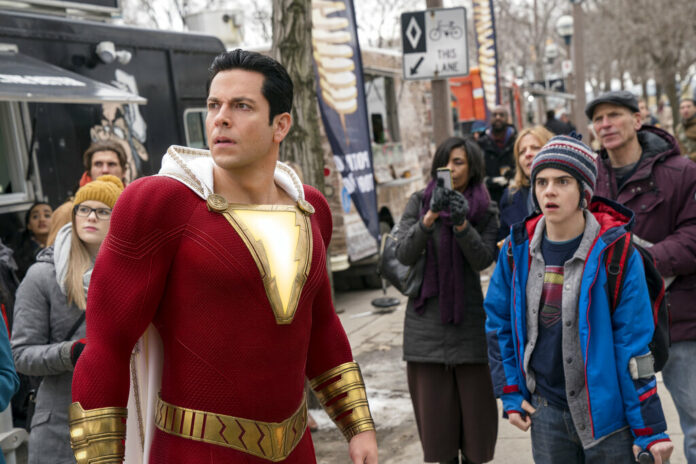
This image released by Warner Bros. shows Zachary Levi, left, and Jack Dylan Grazer in a scene from
This image released by Warner Bros. shows Zachary Levi, left, and Jack Dylan Grazer in a scene from "Shazam!" Photo: Steve Wilkie / Warner Bros. Entertainment via AP

Holy superhero fatigue, Batman, “Shazam!” is actually good.

OK, so it’s basically “Big” with superheroes and villains instead of businesspeople and girlfriends, but director David F. Sandberg has infused his film with so much heart and charm that it hardly matters. Even the deficiencies, like the sluggish beginning and the random, ridiculous villains, fade away under a haze of goodwill because unlike so many big spectacle action pics with sequels in mind, “Shazam!” actually sticks the landing.

But perhaps I’m getting ahead of myself. Don’t worry if you don’t happen to know anything about “Shazam!” or are convinced that you won’t care. I certainly didn’t. Plus, there are a lot of superheroes to keep track of these days and someone who needs an exclamation point is and should be immediately suspect.

The movie isn’t here to judge any lack of knowledge though. It’s an origin story about a jaded 14-year-old Philadelphia foster kid, Billy Batson (Asher Angel), who’s bestowed with superpowers by Djimon Hounsou (naturally). As Shazam, he’s physically altered into an adult and takes the form of Zachary Levi. But of course, even with his height, his muscles, his voice and even his powers, he’s still very much a kid and has a lot to learn.

Those are the basics, but the spirit really comes from the smart writing, the pitch-perfect casting and the supporting world around Billy and Shazam. Right before he gets his powers, he’s placed in a new group foster home led by Rosa (Marta Milans) and Victor Vasquez (Cooper Andrews) that’s full of quirky characters: Freddy (Jack Dylan Grazer), a disabled superhero obsessive with a biting wit; Eugene (Ian Chen), a violent video game obsessive; Darla (Faithe Herman), the adorable youngest; Mary (Grace Fulton) and Pedro (Jovan Armand). The young actors assembled here are astounding, and immediately captivating, especially Grazer as Freddy and Herman as Darla who nearly steal the show. It’s why when the film asks you to believe that it’s really about family, and not merchandising, you’re on board.

Freddy, with his wealth of superhero knowledge, helps Billy/Shazam figure out what to do with these new, strange talents. The training montages have a terrific comedic sensibility and Grazer and Levi are perfectly matched for the job. Levi in particular pulls off the tricky feat of playing a disaffected, but still fairly innocent young teenager while wearing spandex and a cape, no less. Grazer, meanwhile, who we’ve seen before in “It,” is beyond his years with his ability to draw a laugh.

That’s not to say the movie is perfect. The beginning gives an extended origin story for both Billy and the little boy who will grow up to become the megalomaniac villain, Dr. Thaddeus Sivana (Mark Strong). Dr. Sivana is woefully underwritten, too, although Strong does his best being the straight, serious guy. For the most part it comes across as less of a threat and more of a buzzkill that gets in the way all the fun we were having with Freddy and Shazam.
Also, as if Dr. Sivana wasn’t enough, the script gives him Seven Deadly Sins as henchmen. These sins take the form of unimaginative and indistinguishable CG gargoyles. I’m not exactly sure what lust or greed would look like in gargoyle form, but I’m pretty certain this isn’t it. They’re also given dubbed voices that feel about as authentic as the voices of the monsters The Power Rangers battled on Saturday mornings.
There’s also a running gag about a strip club that seemed a little retrograde for a current film. But, nitpicks aside, “Shazam!” is just a lightning bolt of unexpected joy that is certainly worth your time and money.

“Shazam!,” a Warner Bros. release, is rated by the Motion Picture Association of America for “for intense sequences of action, language, and suggestive material.” Running time: 132 minutes. Three and a half stars out of four.

Story: Lindsey Bahr

Advertisement

Brunei’s Anti-Gay Law Comes Into Effect

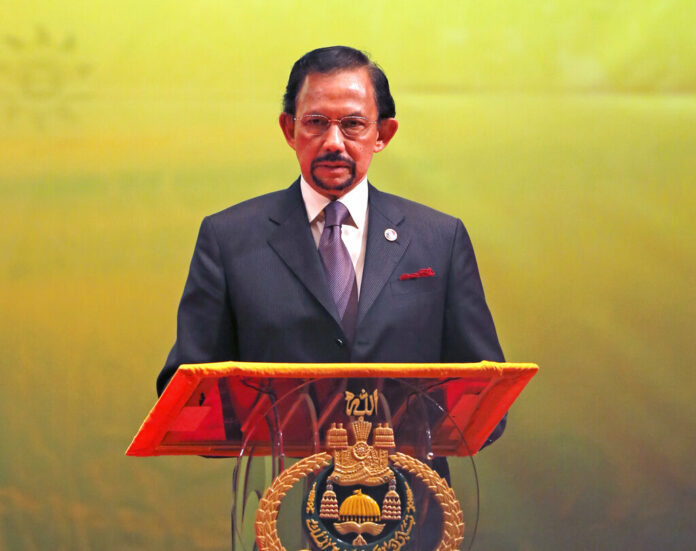
In this Oct, 10, 2013, photo, Brunei's Sultan Hassanal Bolkiah speaks during the closing ceremony and handover of the ASEAN Chairmanship to Myanmar in Bandar Seri Begawan. Photo: Vincent Thian / Associated Press

SINGAPORE — New Islamic criminal laws that took effect in Brunei on Wednesday, punishing gay sex and adultery by stoning offenders to death, have triggered an outcry from countries, rights groups and celebrities far beyond the tiny Southeast Asian nation’s shores.

The penalties were provided for under new sections of Brunei’s Shariah Penal Code. Sultan Hassanal Bolkiah instituted the code in 2014 to bolster the influence of Islam in the oil-rich monarchy of around 430,000 people, two-thirds of whom are Muslim.

Even before 2014, homosexuality was already punishable in Brunei by a jail term of up to 10 years. The first stage of the Shariah Penal Code included fines or jail for offenses such as pregnancy out of wedlock or failing to pray on Fridays.

But under the new laws — which apply to children and foreigners, even if they are not Muslim — those found guilty of gay sex could be stoned to death or whipped. Adulterers risk death by stoning too, while thieves face amputation of a right hand on their first offense and a left foot on their second.

“Living in Brunei, we already knew that our sexual identity is taboo and should not be expressed. We already felt belittled before the law came to place,” said a 23-year-old member of the LGBTQ community who wanted to be identified only as Kun out of fear of reprisal from the authorities.

“Now with it, we feel even smaller and the ones who could potentially oppress us have more opportunity to harass us to say and do what they want,” he said.

Celebrities including George Clooney, Elton John and Ellen DeGeneres have voiced opposition to the new laws, and have rallied a boycott of nine hotels in the U.S. and Europe with ties to Hassanal, who is still sultan.

“Are we really going to help fund the murder of innocent citizens?” Clooney wrote Thursday on Deadline Hollywood.

Clooney said that while you can’t shame “murderous regimes,” you can shame “the banks, the financiers and the institutions that do business with them.”

There has been no vocal opposition to the new penalties in Brunei, where the sultan rules as head of state with full executive authority. Public criticism of his policies is extremely rare in the country.

Hassanal, who has reigned since 1967, has previously said the Penal Code should be regarded as a form of “special guidance” from God and would be “part of the great history” of Brunei.

On Tuesday, the United States joined the United Kingdom, Germany and France in urging Brunei to halt its plans.

“The United States strongly opposes violence, criminalization and discrimination targeting vulnerable groups, including women at risk of violence, religious and ethnic minorities, and lesbian, gay, bisexual, transgender and intersex persons,” State Department deputy spokesman Robert Palladino said in a statement.

Brunei’s Southeast Asian neighbors, some of whom have laws banning sex between men, were silent.

But LGBTQ citizens of other nearby Muslim-majority countries were concerned about the broad penalties.

“I am very worried that Indonesia or Malaysia may follow the lead,” said a 24-year-old man from Kuala Lumpur, Malaysia’s capital, who wanted to be identified only as Ludwig. “I think people nowadays, especially the younger generation, are quite OK with LGBT, but those who are not make the loudest noise and they are the reason why it seems like everyone is against it.”

Nearly two-thirds of Malaysia’s 32 million people are Muslim. They are governed by Islamic courts in family, marriage and personal issues. Last year, two Malaysian Muslim women were convicted under Islamic laws and caned for attempting to have sex with each other.

Michelle Bachelet, the U.N. High Commissioner for Human Rights, urged Brunei’s government to “stop the entry into force of this Draconian new penal code.”

“Any religion-based legislation must not violate human rights, including the rights of those belonging to the majority religion as well as of religious minorities and non-believers,” she said in a statement on Monday.

Phil Robertson, the deputy Asia director for Human Rights Watch, called on the sultan to “immediately suspend amputations, stoning, and all other rights-abusing provisions and punishments.”

“Brunei’s new penal code is barbaric to the core, imposing archaic punishments for acts that shouldn’t even be crimes,” Robertson said in a statement on Wednesday.

Rachel Chhoa-Howard, Brunei researcher at Amnesty International, decried the “vicious” laws and asked the international community to condemn them.

Story: Annabelle Liang

Advertisement

Malaysian Ex-PM Najib Attends 1st Day of Graft Trial

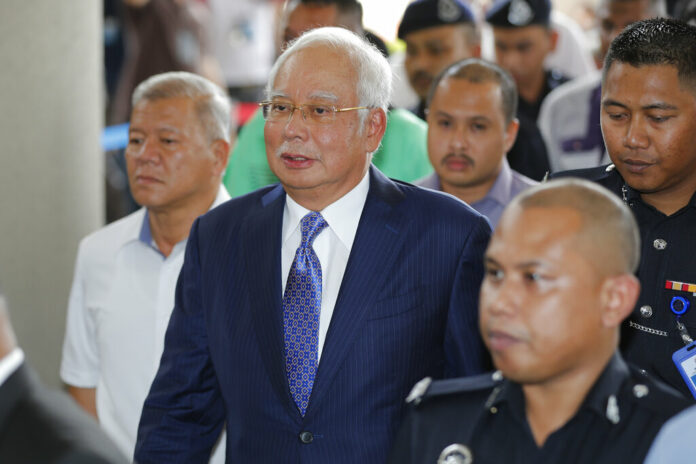
Former Malaysian Prime Minister Najib Razak, center, walks into a courtroom Wednesday at Kuala Lumpur High Court in Kuala Lumpur, Malaysia. Photo: Vincent Thian / Associated Press

KUALA LUMPUR, Malaysia — Former Malaysian Prime Minister Najib Razak appeared in court Wednesday for the start of his corruption trial, exactly 10 years after he was first elected to office only to suffer a spectacular defeat last year on allegations he pilfered millions of dollars from a state investment fund.

The trial was originally due to start in February but was delayed by procedural matters. Najib’s lawyers filed an urgent motion to challenge the charges, which include criminal breach of trust, money laundering and abuse of power. The High Court judge said he will hear the application at a later date and ordered the trial to proceed.

Ten years ago this Wednesday, Najib became Malaysia’s sixth prime minister but anger over the 1MDB investment fund scandal led to his electoral loss last May. U.S. investigators say more than $4.5 billion was stolen from 1MDB by associates of Najib between 2009 and 2014. They say the ill-gotten gains were laundered through layers of bank accounts in the U.S. and other countries to finance Hollywood films and buy hotels, a luxury yacht, art works, jewelry and other extravagances.

Some $700 million from the fund that Najib set up for Malaysia’s economic development allegedly landed in his own bank account.

One of only a few Southeast Asian leaders to be arraigned after losing office, Najib has denied any wrongdoing.

The 65-year-old was greeted by a small group of supporters as he arrived at the courthouse. They all bowed their heads in a short prayer before Najib went up to the courtroom.

Wednesday’s trial is the first of several against Najib, who has been charged with 42 counts of criminal breach of trust, graft, abuse of power and money laundering in one of Malaysia’s biggest criminal proceedings. His wife, Rosmah Mansor, also has been charged with money laundering and tax evasion linked to 1MDB. She has also pleaded not guilty and her trial has not been set.

Najib’s son, Norashman Najib, praised his father for his “tremendous strength and resolve.” He tweeted late Tuesday that the trial will be an “excruciatingly difficult period” for his father but that “with the right attitude, even the most trying of situations can be a blessing from Allah.”

The patrician Najib, whose father and uncle were Malaysia’s second and third prime ministers respectively, has fought back with a political makeover on social media that aims to transform his image from an out-of-touch elitist to a leader for the working class.

A Malay-language catchphrase translating to “What’s to be ashamed about, my boss?” was coined while he was campaigning in a by-election last month and has become his new rallying cry. Expensive tailored suits have been replaced by hoodies and jeans. A picture Najib posted on social media showing himself posing on a Yamaha motorcycle with his new “‘no-shame” meme resonated with many Malay youths disenchanted by Prime Minister Mahathir Mohamad’s new government.

In another offbeat music video that he uploaded on social media, Najib slammed the new government as “liars” and crooned about the “slander and revenge” against him in a Malay-language rendition of the 1970’s R&B soul hit “Kiss and Say Goodbye” by the Manhattans.

He posts a dozen messages daily, mostly mocking the new government and its policies, and touching on the plight of the needy.

Despite his smiles and “cool” public persona, Najib could face years in prison if convicted.

Once a towering figure in politics, Najib has fallen from grace swiftly since his historic electoral loss, which led to the first change of government since Malaysia’s independence from Britain in 1957.

The new government soon after it took office reopened investigations into 1MDB that had been stifled under Najib. He and his wife were barred from leaving the country and grilled by anti-graft officials, and their properties raided. Truckloads of luggage stashed with cash, jewelry and hundreds of expensive designer bags worth a staggering 1.1 billion ringgit ($270 million) were seized from their home and other properties.

Story: Eileen Ng

Advertisement

Hot News

LATEST NEWS

Bangkok
overcast clouds
28.8 ° C
28.8 °
28.8 °
74 %
2.5kmh
97 %
Mon
33 °
Tue
32 °
Wed
33 °
Thu
35 °
Fri
27 °