
























28.3 C
Bangkok
Monday, June 29, 2026
Home Blog Page 1653

A Look at Alleged Raiders of North Korean Embassy in Madrid

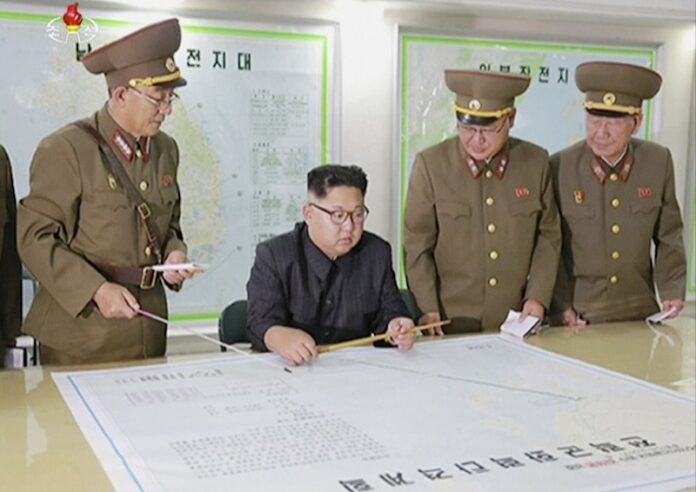
North Korean leader Kim Jong Un receives a military briefing Aug. 14 in Pyongyang, North Korea. Image: Associated Press

SEOUL, South Korea — The 10 people who allegedly raided the North Korean Embassy in Madrid last month belong to a mysterious dissident organization that styles itself as a government-in-exile dedicated to toppling the ruling Kim family dynasty in North Korea.

The leader of the alleged intruders appears to be a Yale-educated human rights activist who was once jailed in China while trying to rescue North Korean defectors living in hiding, according to activists and defectors.

Details have begun trickling out about the raid after a Spanish judge lifted a secrecy order Tuesday and said an investigation of what happened on Feb. 22 uncovered evidence that “a criminal organization” shackled and gagged embassy staff before escaping with computers, hard drives and documents. A U.S. official said the group is named Cheollima Civil Defense, a little-known organization that recently called for international solidarity in the fight against dictatorship in North Korea.

Here’s a look at the intruders and the Cheollima group.


The Group

Details about the creation of the Cheollima Civil Defense group are hazy. The word “Cheollima” – spelled “Chollima” in the North – refers to a mythical winged horse that the government often uses in its propaganda.

In a statement posted on its website on Thursday, the group said it has “temporarily suspended” its activities because of what it described as an “attack of various speculative articles by the media.” The group said it consists of North Korean defectors living in countries around the world, but that it has not worked with or contacted defectors “living under tight security” in South Korea.

“We ask the media to restrain their interest about the truth of our organization or its members. There are bigger things ahead of us,” Cheollima said in a statement written in Korean. “We are an international organization unified by determination to cut off the dynastic power of the Kim family.”

In March 2017, the group said it had arranged the escape of Kim Han Sol, the son of Kim Jong Nam, the half brother of North Korean leader Kim Jong Un who was assassinated at a Malaysian airport earlier that year.

A man claiming to be Kim Han Sol appeared in a YouTube video at the time and said he was safely with his mother and sister.

“My name is Kim Han Sol from North Korea, part of the Kim family,” the man said in English in the 40-second video clip. “My father has been killed a few days ago.”

Recently the group declared on what appears to be its website the establishment of “Free Joseon,” which it described as “a provisional government” that would fight against “the criminal incumbents of the north.” North Korea still calls itself “Joson,” its spelling of “Joseon,” the name of the dynasty that ruled the Korean Peninsula for more than 500 years.

The group also recently posted a video showing an unidentified man destroying glass-encased portraits of North Korea’s two late leaders. South Korean media reported that the group was behind the writing of “Let’s topple Kim Jong Un,” the current North Korean leader, on the wall of the North Korean Embassy in Malaysia.

After the Spanish judge released documents about the Feb. 22 incident, the Cheollima website said it had been responding to an urgent situation at the embassy and was invited onto the property, and that “no one was gagged or beaten.” The group said there were “no other governments involved with or aware of our activity until after the event.”

The Spanish court report said the intruders urged North Korea’s only accredited diplomat in Spain, So Yun Sok, to defect.

The Cheollima website said the group shared “certain information of enormous potential value” with the FBI, under mutually agreed terms of confidentiality.

The FBI said its standard practice is to neither confirm nor deny the existence of investigations.

If Cheollima was behind the embassy break-in, it indicates the involvement of North Korean defectors who have experience working for North Korea’s military or security authorities, said Nam Sung Wook, a former president of the Institute for National Security Strategy, a think tank affiliated with South Korea’s main spy agency.

“There are many young North Korean men who come to the South with more than 10 years of military experience,” said Nam, who now teaches at Korea University in South Korea. “People would be surprised at what they are capable of doing, and they aren’t always being closely watched by the South Korean government.”


The Alleged Leader

A Spanish court document identified the leader of the group that entered the embassy as Adrian Hong Chang.

This is likely to be Adrian Hong, who in 2005 co-founded Liberty in North Korea (LiNK), an activist group devoted to rescuing North Korean refugees, according to North Korean defectors and activists who spoke with The Associated Press.

Hannah Song, CEO of LiNK, said Hong has had no involvement with the organization for more than 10 years. “We have no knowledge of his recent activities,” Song said.

The Spanish judge, Jose de la Mata, described Adrian Hong Chang as a Mexican national and resident of the United States. According to the Spanish court report, the man flew to the United States on Feb. 23, got in touch with the FBI and offered to share material and videos. The report didn’t say what type of information the items contained or whether the FBI accepted the offer.

An online message by AP to a verified Twitter account linked to activist Adrian Hong wasn’t immediately answered.

Hong is known for his work helping North Koreans flee their homeland and resettle in South Korea and elsewhere. LiNK said it has helped more than 1,000 North Koreans reach safety. Fellow activists and North Korean defectors said Hong was detained in China briefly in the 2000s because of his work.

Kang Chol-hwan, a prominent North Korean defector-turned-activist, said he was close to Hong and helped him with LiNK.

Kang, an ex-inmate of North Korea’s notorious Yodok prison camp, said Hong became passionate about North Korean human rights after reading his detention memoir. He said Hong visited Seoul and rallied against what he believed were pro-North Korea sympathizers and those silent on North Korean human rights issues.

Kang, who said he last saw Hong about five years ago, said Hong wanted to “muster anti-government forces (in North Korea) and bring down North Korea from the inside.” Kang said Hong even went to Libya to study the fall of dictator Moammar Gadhafi so he could explore ways to topple the Kim government.

Kang believes Hong heads the whole Cheollima group.

“He has great capacity for organization because of his experience establishing LiNK,” Kang said. “He’s a very smart guy.”

Fellow defector-turned-activist Heu Kang Il, who met Hong around 2005, recalled him as a “passionate young man.”

Testifying before the Canadian Senate in 2016, Hong said: “North Korea is not a normal nation with the government seeking to serve and protect its citizens. It is a brutal totalitarian regime, ruled by a royal family and a class of vassals, both in tenuous concert with one another. It does not care for the welfare of its people.”

In an op-ed for The Christian Science Monitor in 2014, Hong said the international community must support “efforts to strengthen meaningful opposition and civil society in the country, training exiles to one day assume leadership positions, educating younger refugees, and creating more robust programs to help defectors adjust to life on the outside.”

“A class of Korean technocrats must be capable of stabilizing and rebuilding on a national scale,” Hong wrote.

Story: Kim Tong-Hyung, Hyung-jin Kim
Advertisement

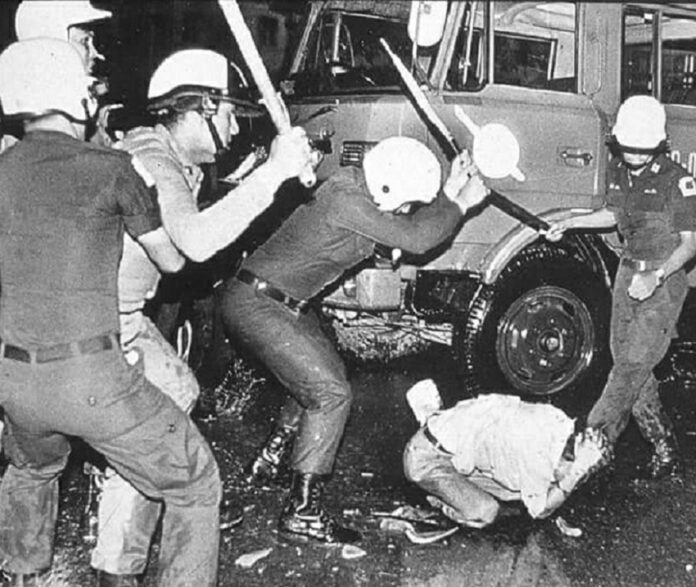
Prayuth, Pheu Thai Should Step Back, Avoid Bloodshed: Activists

Authorities beat a protester in May 1992 in Bangkok. Photo: The Nation

BANGKOK — Thailand could witness further deadly clashes if politicians do not step back from the deadlock, a committee chair for relatives of those killed in the May 1992 political confrontations said Thursday.

Adul Kheawbariboon, chairman of the May 1992 Victims’ Relatives Committee, held a press conference warning that signs that suggest possible deadly political clashes are ominous.

“I am concerned and know well what will happen in such conditions,” said Adul, who lost his 20-year-old son nearly three decades ago during the crackdown on anti-junta protests in May 1992. “This kind of situation will surely lead to the second May Massacre… There will surely be loss of lives and to the economy.”

Speaking with four others who lost their loved ones when the military junta mowed down protesters in 1992 – leading to 44 deaths and more than 50 people missing – Adul said it’s not too late to prevent a similar repetition.

Adul urged junta leader Gen. Prayuth Chan-ocha and candidates of leading anti-junta parties, including Pheu Thai’s Sudarat Keyuraphan of Future Forward’s Thanathorn Juangroongruangkit, to withdraw and allow smaller party candidates with less direct political conflict to become prime minister.

He named Bhumjaithai and the Democrat Party as such smaller parties.

Adul said there is a real risk of political violence if Prayuth insists on having his 250 appointed senators vote him prime minister, despite commanding a minority in the lower house.

He also warned that a Pheu Thai-led coalition could not be formed if they don’t have the support of the senate to select the prime minister – a requirement before a coalition can be formed.

Adul added that politics has become even more divisive after elections.

“We think both sides are caught in a deadlock,” said Adul, who said he would submit a letter to push for their proposals to major political parties next week.

He said it’s still not too late for Prayuth to diffuse the situation.

“It’s time for you to leave and act as a mentor. You still have a chance to be a statesman,” Adul said.

Advertisement

Govt Moves to Protect Bangkok’s Famed ‘Green Lung’

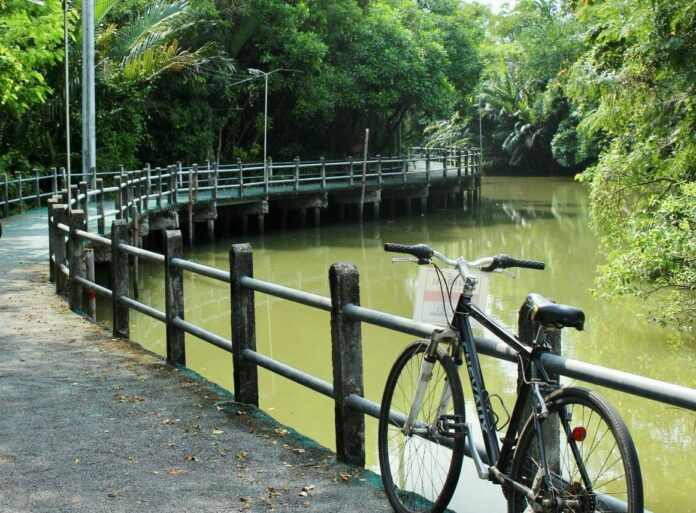
A file photo of a canalside path in Bang Kachao, Samut Prakan.

BANGKOK — The government on Thursday banned large-scale constructions or waste disposal in a river island south of the capital renowned for its lush nature.

An order issued by the natural resources ministry said Bang Kachao area in Samut Prakan province is to be preserved as an environment landmark. It cited the presence of unique and rich biodiversity needed protection from increasing human activity.

The protected area includes six sub-districts – Bang Namphueng, Bang Kachao, Bang Yo, Bang Krasop, Bang Ko Bua, and Song Khanong –  lying on the island formed by a river bend and a canal that covers about 1,900 hectares. The order seeks to encourage more green spaces and environmental conservation measures.

The new rules ban the construction of new commercial properties such as factories, hotels, condominiums, cruise ports and golf courses. They also bar more buildings from being constructed on state-owned land. Any buildings built must not be taller than 9 meters. “Thai-style” buildings can be as tall as 12 meters.

Activities that would damage natural water resources such as waste disposal and waterside construction are also prohibited.

There have been increasing reports regarding threats to the environment of the popular attraction dubbed “Bangkok’s green lung,” and its nearby areas – especially waste problems. In February, local officials on the island’s southern tip filed criminal complaints against an illegal, foreign-owned plastic processing plant for odor pollution and illegal structures encroaching on public water.

Advertisement

Election Results Removed After Media Spot Discrepancies

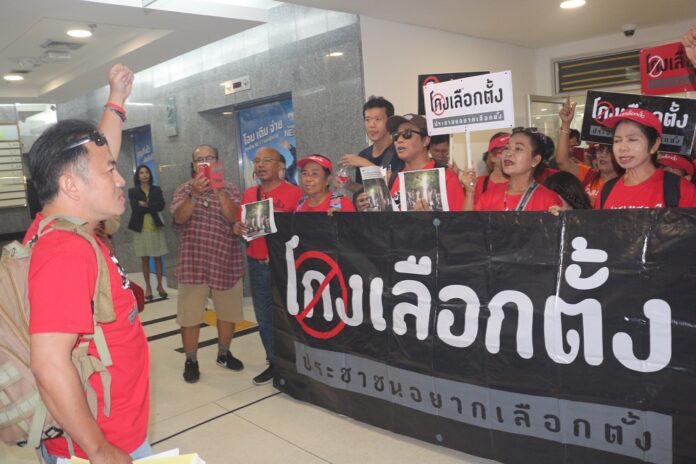
Redshirt activists protest against alleged voting frauds at the Election Commission on March 27, 2019.

BANGKOK — The Election Commission on Thursday took down its full voting report hours after releasing it to the media, amid growing questions of the results’ numerous discrepancies.

The commission posted the report to the media chat group minutes after an abrupt news conference, in which officials declared the pro-junta party as the most-voted party. However, the report was deleted hours later when reporters discover numerous inconsistent numbers.

Another report was accessible on the commission’s official website Thursday evening but it is unclear whether it is the final, accurate version.

Discrepancies include a difference in raw votes announced by the commission and its official document released later; numbers of voters not matching numbers of ballots used; and total votes awarded to political parties not matching number of ballots declared valid.

Voter turnout was 74.69 percent, higher than the initial report of 65 percent, the commission said, without explaining the hike. Leaders of Pheu Thai and Future Forward parties on Thursday afternoon called upon the Election Commission to clarify that increase.

One reporter asked in the commission’s media chat group why numbers of eligible voters announced by officials before and after the election were not the same.

Official in charge of the chat group did not provide any immediate explanation about the inconsistency nor say if it had replaced the report with a corrected version. But commissioner Krit Urwongse said the discrepancy of voter turnout and ballots used could be due to some voters who registered to vote at polling stations leaving without casting ballots.

Voters typically received ballots and marked them almost immediately after registration.

According to the report available online, the five most-voted parties are Phalang Pracharath (8.4 million votes), Pheu Thai (7.9 million votes), Future Forward (6.2 million votes), Democrats (3.9 million votes) and Bhumjaithai (3.7 million votes).

The document released to the media also left out a party name, later identified as Prachathai Party.


There were 2.1 million spoiled ballots in the election, or about 5 percent of the total ballots. About 1.5 percent of voters marked “None of the Above” in their ballots.

The agency said it received about 186 complaints related to voting procedures.

This is the first complete returns of Sunday’s votes. An earlier result released by the Election Commission was based on 95 percent of votes counted.

However, the results will not be endorsed until May 9, the commission said, citing the need to verify the numbers and settle all complaints filed.

Advertisement

Bangkok Roads to Close 5 Days During King’s Coronation (Maps)

By Chayanit Itthipongmaetee and Jintamas Saksornchai

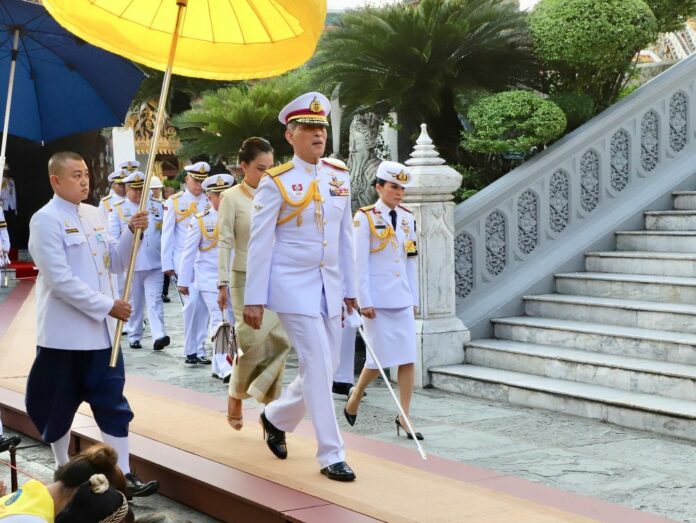
BANGKOK — For five days several roads in the capital city will be closed to traffic for the royal coronation ceremony.

Ratchadamnoen, Sanam Chai and Maharat are among more than 30 roads to be closed May 2 through May 6, which will mark the coronation period of King Vajiralongkorn.

On May 2, at least a dozen of roads will be closed. They include major routes such as Sanam Chai, Maharat, Chatuphon, Si Ayutthaya, Ratchadamnoen Nok.

Six more roads near the Grand Palace will be affected starting 5am on May 3 – Rachini, Sanam Chai, Na Phra That, Phra Chan, Maharat and Thai Wang. All of them will be closed until midnight May 4.


The royal parade will take place May 5 and will lead to the closure of 34 roads from midnight onward. Popular impacted roads include Khao San, Ratchadamnoen Nok, Charoen Krung, Nakhon Sawan, Maha Chai, Dinso, Ram Buttri, Phra Sumen, Rachini and Maharat.


On May 6, when the king meets the public and foreign diplomats, 33 roads will be closed: Rachini, Ratchadamnoen Nai, Ratchadamnoen Klang, Sanam Chai, Na Phra That, Prachan, Maharat, Thai Wang, Ratchabophit, Bamrung Mueang, Charoen Krung among others.

On the same day, three roads will close to one lane only starting from 6am: Chakrabongse, Chao Fa and Phra Atit.

For those who wish to attend the ceremony, metro Bangkok police deputy chief Jirasan Kaewsang-ek said 27 parking spaces will be provided citywide from Muang Thong Thani and Future Park Rangsit to CentralPlaza Salaya and CentralPlaza WestGate. From these places, people can take shuttle buses to six spots near the royal event – Ban Manangkhasila, Ban Phitsanulok, Somdet Phra Pinklao Bridge, Rama VIII Bridge, Wat Thepsirin and Memorial Bridge.

Maj. Gen. Jirasan said 400,000 people are expected to attend the ceremony.

Related stories:

Full Schedule for Royal Coronation Ceremony Unveiled

Advertisement

Breakdancing Makes Next Move to Olympic Status at Paris 2024

A man breakdances in 2016.

LAUSANNE, Switzerland — Breakdancing and three other sports have made the next move toward becoming medal events at the 2024 Paris Olympics.

The International Olympic Committee’s executive board on Wednesday recommended adding breakdancing, skateboarding, sport climbing, and surfing to the Paris program when the full membership meets in June.

A final decision must be made by the board in December 2020 after further monitoring of the four.

Also Wednesday, the IOC board agreed to continue helping North and South Korean athletes and officials work together despite diplomatic setbacks between the neighboring governments in recent days.

Joint Korean teams are being prepared in four sports to try to qualify for the 2020 Tokyo Olympics, and a co-hosting bid for the 2032 Summer Games is a possible aim.

With those 2032 Olympics and the 2030 Winter Games in mind, a panel has been asked to look at ways of making an often expensive and politically unpopular candidate process “more flexible and more targeted.”

“The IOC may approach a city or a region and tell them, ‘Listen, isn’t it not a time for you now?'” IOC President Thomas Bach said at a news conference after the second of three days of board meetings.

Making the Olympic Games more affordable and responsive has been a key aim for Bach. He praised the four likely additions to the Paris medal program as “more gender balanced, more youthful and more urban”

“These four sports also offer the opportunity to connect with the young generation,” he said.

Though breakdancing would be new in the Summer Games, the other three are already confirmed for the 2020 Tokyo Olympics lineup.

All four sports will be assessed for how they are managed, and the integrity of competitions and judging, before being finalized for Paris.

The IOC hosted a meeting of Korean government and sports officials in February, one year after the neighbors fielded a combined teams women’s ice hockey at the Pyeongchang Olympics hosted south of the border.

Last Friday, North Korea withdrew staff from a shared liaison office in its border town of Kaesong. Some staff returned to work on Monday.

“We will try to continue our efforts there with a view to helping and assisting the athletes and the (national Olympic committees),” Bach said.

Combined Korean teams – in women’s basketball, women’s field hockey, mixed team judo, and men’s and women’s rowing – are preparing to enter qualification this year to compete in Tokyo.

If a Korean bid emerges for the 2032 Olympics, it could compete with candidates from Australia, India, Indonesia and Russia which have expressed early interest.

Asked if plans to simplify Olympic bidding could see the IOC approach a favored city, Bach said it was “not our goal.”

“The Olympic Games are too big and too important that you could have an arrangement with a city,” he said.

The new panel of five IOC members, chaired by John Coates of Australia, aims to suggest ideas for the candidate process by the June 24-26 meeting of the full membership in Lausanne.

Story: Graham Dunbar

Advertisement

9 Arrested for Sharing Election Hoax News

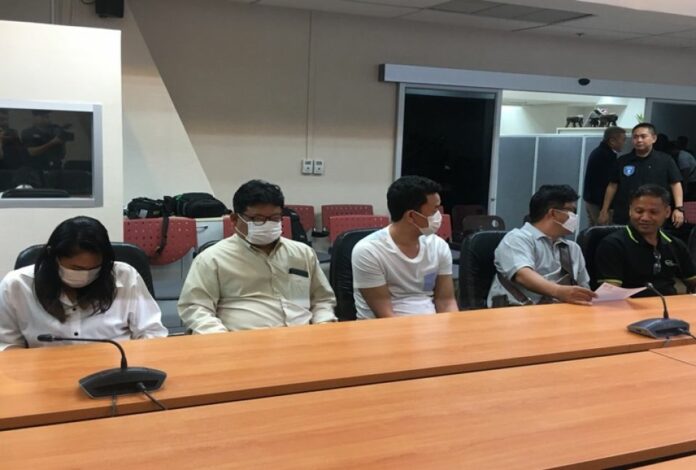
Image: Thai News Agency

BANGKOK — Police said Wednesday they arrested a group of netizens who shared hoax news about the Election Commission.

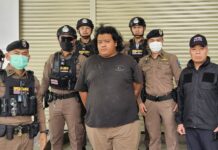
Police Lt. Gen. Surachet Hakparn said the nine suspects were arrested and charged with cybercrime for sharing the news, which claimed that two Election Commissioners were fired after voting irregularities were discovered.

The suspects were brought to yesterday’s news conference wearing facemasks. Police did not name any of them. One of the suspects, a woman, tearfully told reporters she shared the news without knowing it was fake.

Read: US Calls for Immediate Release of Thai Election Results

“I only knew it was hoax news when police arrested me at my home,” the unnamed woman said, according to a report on the state-owned Thai News Agency.

But Surachet, who’s in charge of immigration and internet crimes, said the suspects caused severe “confusion and panic” by sharing the false news.

He also said police already know the identity of those responsible for writing the article, but admitted investigators have yet to establish whether they are in Thailand.

All nine suspects were charged with violating the Computer Crime Act, which carries a maximum penalty of five years in jail.

The Election Commission earlier this week threatened to take legal action against those who shared false information about their work.

The agency has come under fire from junta critics since Sunday’s election, which was fraught with alleged disparities and errors. An activist launched a petition Wednesday to remove the commissioners from office, citing their incompetence.

Advertisement

UK’s May Offers to Step Down If Brexit Deal Passed

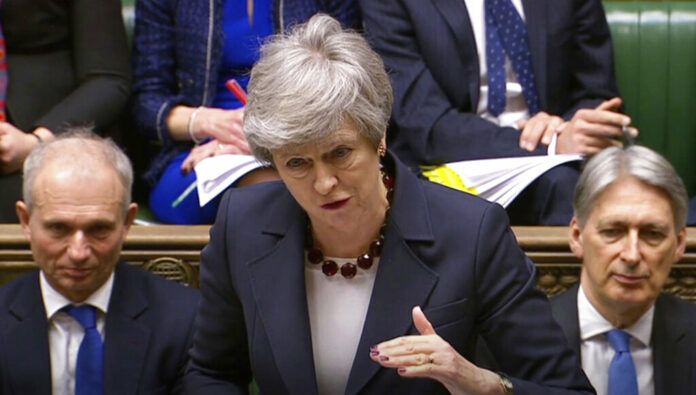
In this grab taken from video, Britain's Prime Minister Theresa May speaks during Prime Minister's Questions in the House of Commons, London, Wednesday March 27, 2019. Photo: House of Commons/PA via AP

LONDON — British Prime Minister Theresa May offered up her job in exchange for her Brexit deal Wednesday, telling colleagues she would quit within weeks if the agreement was passed and Britain left the European Union.

May’s dramatic concession that “there is a desire for a new approach – and new leadership” was a last-ditch effort to bring enough reluctant colleagues on board to push her twice-rejected EU divorce deal over the line.

It looked like it might not be enough, as a key Northern Ireland party said it would not be supporting the deal.

May’s announcement came as lawmakers held an inconclusive series of votes on alternatives to her unpopular deal. It was the first step in an attempt by Parliament to break the Brexit deadlock and stop the country from tumbling out of the bloc within weeks with no exit plan in place.

May has been under mounting pressure from pro-Brexit members of her Conservative Party to quit. Many Brexiteers accuse her of negotiating a bad divorce deal that leaves Britain too closely tied to the bloc after it leaves.

Several have said they would support the withdrawal deal if another leader took charge of the next stage of negotiations, which will determine Britain’s future relations with the EU.

In a packed meeting of Conservative legislators described by participants as “somber,” May finally conceded she would have to go, although she did not set a departure date.

“I am prepared to leave this job earlier than I intended in order to do what is right for our country and our party,” she said, according to a transcript released by her office.

Anti-EU lawmaker Jacob Rees-Mogg, who has clashed with May throughout the Brexit process, said she had been “very clear” that if Britain leaves the EU as foreseen on May 22, she will quit soon after.

He said the prime minister had been “very dignified.”

“She put her case well, and reiterated that she had done her duty,” he said.

It was unclear whether May’s offer to resign would be enough to win backing for her deal, which was defeated by 230 votes in January and by 149 votes earlier this month.

High-profile Brexiteer Boris Johnson announced soon after May’s statement that he would support the agreement, which he has previously called a “humiliation.” Johnson is a likely contender to replace May as prime minister.

But other hard-liners said they would continue to reject the deal, and Northern Ireland’s small but influential Democratic Unionist Party refused to budge in its opposition to the deal.

The DUP’s support was seen as key to persuading other Brexiteers to back the deal. But the staunchly pro-British party fears a provision designed keep an open border between EU member Ireland and the U.K.’s Northern Ireland after Brexit would weaken the bonds between Northern Ireland and the rest of the U.K.

“We cannot sign up to something that would damage the Union,” DUP leader Arlene Foster told Sky News.

Asked if the party might abstain instead, DUP lawmaker Nigel Dodds tweeted: “The DUP do not abstain on the Union.”

Two years ago, Britain triggered a countdown to departure from the EU that ended Friday, March 29, 2019. With that date approaching and no Brexit deal approved by Britain, the EU last week granted a delay. It said that if Parliament approves the proposed divorce deal this week, the U.K. will leave the EU on May 22. If not, the government has until April 12 to tell the 27 remaining EU countries what it plans to do: leave without a deal, cancel Brexit or propose a radically new path.

With May clinging to her Plan A — getting her deal approved — lawmakers this week seized control of the parliamentary timetable for debate and votes Wednesday on a range of Brexit alternatives.

The results underscored the divisions in Parliament, and the country, over Brexit. None of the eight plans received a majority of votes. The most popular were a proposal to remain in a customs union with the bloc, which was defeated 272-264, and a call to hold a public referendum on any divorce deal, which fell by 295 votes to 268. Both ideas got more support than the 242 votes secured by May’s deal earlier this month.

A call to leave the EU without a deal was supported by 160 lawmakers and opposed by 400.

The plan is for the most popular ideas to move to a second vote Monday to find an option that can command a majority. Parliament would then instruct the government to negotiate it with the EU.

May has said she will consider the outcome of the votes, although she has refused to be bound by the result.

Brexit Secretary Stephen Barclay urged lawmakers to back May’s deal, saying the ambiguous result “demonstrates that there are no easy options here.”

Barclay said he had introduced a motion to have Parliament meet Friday if needed for a vote on May’s agreement, but it remained unclear whether it would go ahead. House of Commons Speaker John Bercow said he would not accept another vote on the twice-rejected deal unless substantial changes were made.

Wednesday’s votes produced inconclusive results, but could push Britain in the direction of a softer Brexit that keeps Britain closely tied economically to the EU.

That would probably require the U.K. to seek a longer delay, although that would mean participating in May 23-26 European Parliament elections.

Many EU officials are keen to avoid the messy participation of a departing member state.

But the chief of the European Council told European lawmakers that the EU should let Britain take part if the country indicated it planned to change course on Brexit. Donald Tusk said the bloc could not “betray” the millions of Britons who want to stay in the EU.

“They may feel they are not sufficiently represented by the U.K. Parliament but they must feel that they are represented by you in this chamber. Because they are Europeans,” Tusk said.

Advertisement

Phalang Pracharath Insists on Leading Coalition, Won’t Name Allies

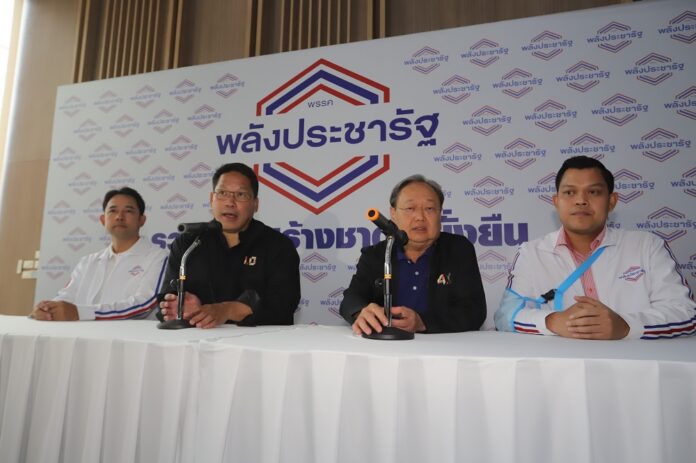
BANGKOK — A party backing junta chairman Prayuth Chan-ocha said Wednesday it would have enough support from other parties to form a coalition government, though it will not disclose who they are.

Phalang Pracharath leader Sontirat Sontijirawong said no details can be given because “this is not the time to declare victory.” He also called a rival coalition being formed by Pheu Thai Party as a pointless “political gesture” that has no legal standing.

“We don’t even know how many parties will join them, and the Election Commission has yet to announce how many votes each party has,” Sontirat said at a news conference. “I’m sure our party will be the leader in forming a government, but this is not the time to declare victory.

He then criticized some media agencies for dubbing the Pheu Thai-led coalition pact a “pro-democracy camp.”

Read: Pheu Thai Announces Coalition With 6 Parties

“I’d like to call upon the media to stop claiming they are a pro-democracy camp … In this election, everyone is pro-democracy. If we weren’t pro-democracy, we wouldn’t have contested in the poll in the first place,” Sontirat said. “Let me ask you: What about 7 million people who voted for Phalang Pracharath? Does it mean their voices should not be respected?”

Phalang Pracharath held its news conference hours after Pheu Thai declared an alliance of seven parties to form a majority coalition as the next government, saying their combined MP seats now exceeded half of the lower house.

But the pro-junta party said it should be the one leading the government because it won the popular vote.

Phalang Pracharath chairman Uttama Savanayana said his party is in talks with other parties to form an alliance, but didn’t name them – not even when a reporter asked if they include Bhumjaithai Party, which places fourth in the election.

“I will not disclose the names of parties we’re talking to. We’re confident we can join hands with parties that share our ideologies and form a government,” Uttama said. “As for how many seats we will have, please wait and see.”

He added that the media “can speculate all you want, but don’t assume anything to be final.”

Related stories: 

General Elections Were Peaceful But Not Fair: Intl Observer

Prayuth Tells Media to Respect People’s Voices

Advertisement

China Defends Tibet Policies, Bashes Exile Government

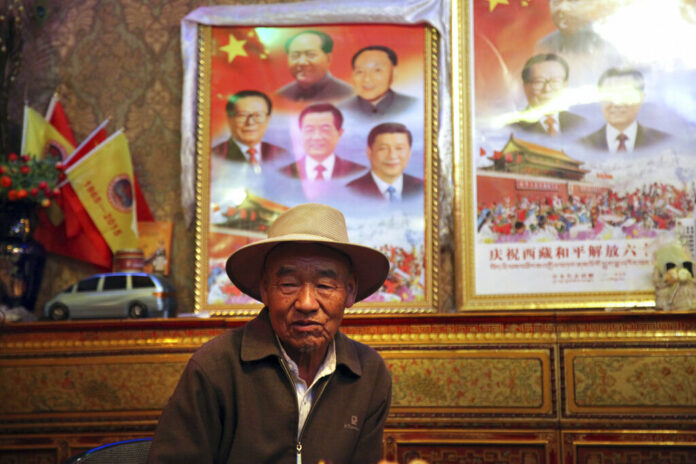
In this Sept. 17, 2015 file photo, Dronjie, 69, sits in his home near two posters displaying the images of current and former leaders of China in Lhasa, capital of the Tibet Autonomous Region of China. Photo: Aritz Parra / Associated Press

BEIJING — Chinese officials responsible for Tibet praised development in the Himalayan region in the 60 years since the suppression of an uprising against Beijing’s rule.

The remarks Wednesday and an accompanying report by China’s Cabinet follow a disclosure from the U.S. this week that American diplomats and officials have been impeded on visits to the region and journalists curbed from making independent assessments of people’s lives there.

Tibet’s executive vice governor Norbu Dondrup reviewed gains in the economy, health care and education since 1959 and castigated the self-declared government-in-exile established by Buddhist leader the Dalai Lama as illegitimate. The now-83-year-old Dalai Lama fled to India after the uprising was suppressed.

Dondrup denied Tibet’s traditional culture and religion were being suppressed but said China would act against “foreign intervention.” He also denied there was any significant support for Tibet as a separate political entity saying, “The issue of Tibetan independence does not exist.”

China insists Tibet has been part of its territory for centuries, but many Tibetans say they were essentially independent before the People’s Liberation Army’s battled its way into the Himalayan region in 1950.

Smothering security appears to largely be keeping the peace, but since 2009, more than 150 Tibetan monks, nuns and laypeople have set themselves on fire in protests against Chinese rule. Such acts appear to have subsided, but the travel ban on foreign media and rights groups make it impossible to confirm reported self-immolations or conditions in Tibetan Buddhist religious institutions that have long been hotbeds of anti-government sentiment.

Despite China’s travel restrictions in Tibet, Dondrup repeatedly emphasized that journalists must travel to the region to see for themselves the conditions there.

The U.S. State Department issued a report on Monday saying China’s government “systematically impeded travel” to Tibet and Tibetan areas outside the official Tibetan Autonomous Region for U.S. diplomats and officials, journalists, and tourists in 2018.

Attempts to visit Tibet by diplomats, including the U.S. ambassador, are frequently rebuffed, and in its report, the State Department said China denied five of nine requests made by U.S. officials last year. On the visits that were approved, Chinese security personnel followed the diplomats closely and blocked access to certain areas even outside the Tibetan Autonomous Region, the report said.

On one occasion in 2017, an employee of the U.S. Consulate General in the city of Chengdu on the edge of the Tibetan Plateau was required to visit a Chinese government official’s residence before dawn to retrieve written permission to visit Tibet, the report said.

Dondrup declined to address issues of access and dismissed reports of Tibetans facing travel restrictions as rumors. Numerous reports say Tibetans are required to obtain far more approvals for documents and permission to travel than non-Tibetan Chinese and can be denied accommodation and employment.

Beijing routinely denies claims of Tibetans having fewer rights than other Chinese while emphasizing the positive impact Chinese rule has had on living standards and denigrating the Dalai Lama and Buddhist religious rule.

The report from China’s Cabinet that was released at the news conference accused the Dalai Lama and Tibet’s former ruling class of maintaining a system of “feudal serfdom under theocracy.”

“Millions of serfs were subjected to cruel exploitation and oppression until democratic reform in 1959,” the report said. “Strict mind control in the name of religion,” was one form of suppression, the report added.

Advertisement

Hot News

LATEST NEWS

Bangkok
overcast clouds
28.3 ° C
28.3 °
28.3 °
79 %
4.1kmh
100 %
Sun
28 °
Mon
34 °
Tue
34 °
Wed
32 °
Thu
33 °