29.4 C
Bangkok
Saturday, July 4, 2026
Home Blog Page 1654

The Week That Was in Asia (Photos)

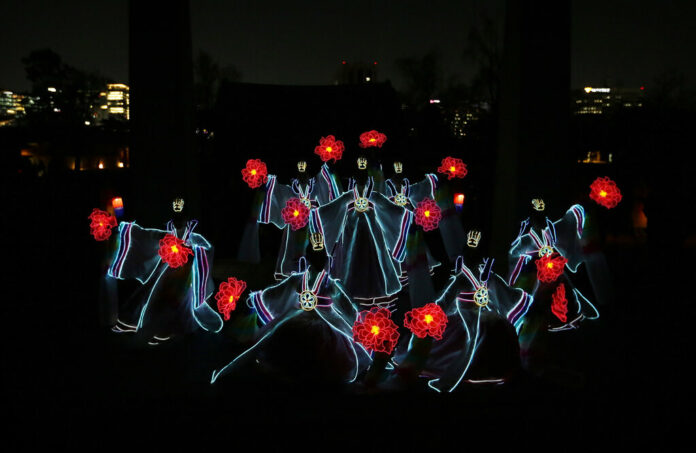
In this Wednesday, April 3, 2019, file photo, dancers dressed in South Korean traditional
In this Wednesday, April 3, 2019, file photo, dancers dressed in South Korean traditional "Hanbok" attire perform during a media preview of the Royal Culture Festival at the Gyeongbok Palace, the main royal palace in the Joseon Dynasty, in Seoul, South Korea. The festival will take place for 9 days, from Apr. 27 to May 5. Photo: Ahn Young-joon / Associated Press

Dancers in traditional Korean “Hanbok” attire perform at the Royal Culture Festival at the Gyeongbok Palace in Seoul.

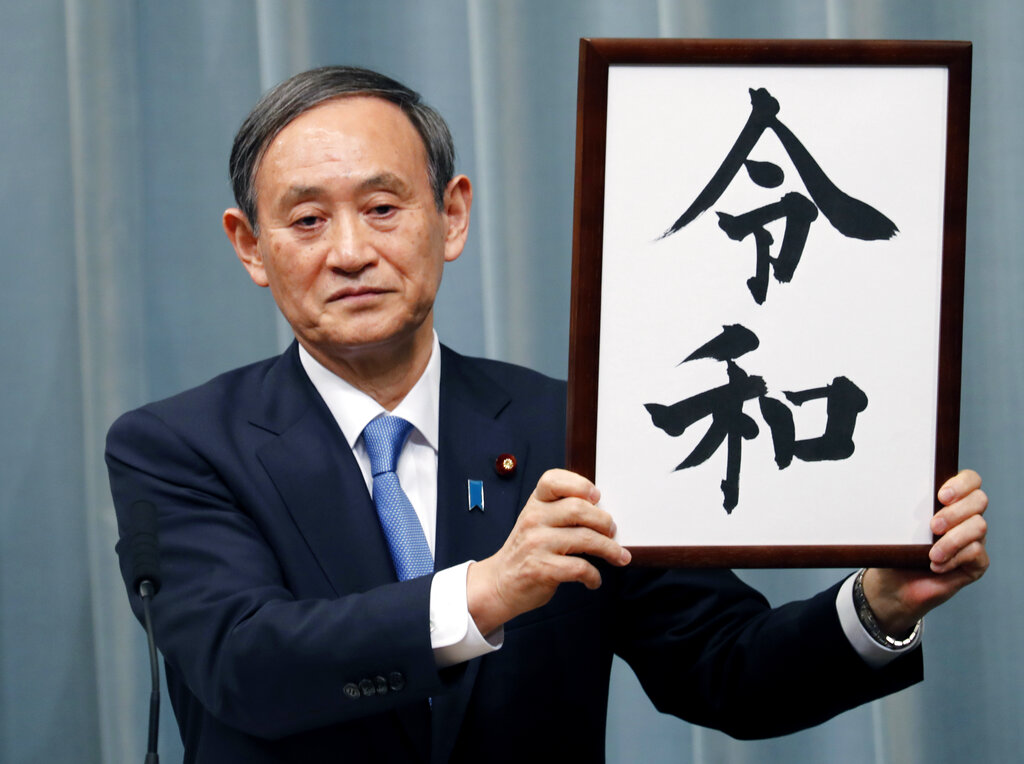
In other images from the Asia-Pacific region this week, Japan’s Chief Cabinet Secretary Yoshihide Suga unveils the name of the new emperor’s era called “Reiwa,” or “Beautiful Harmony,” which will come into force May 1 when Crown Prince Naruhito succeeds his father.

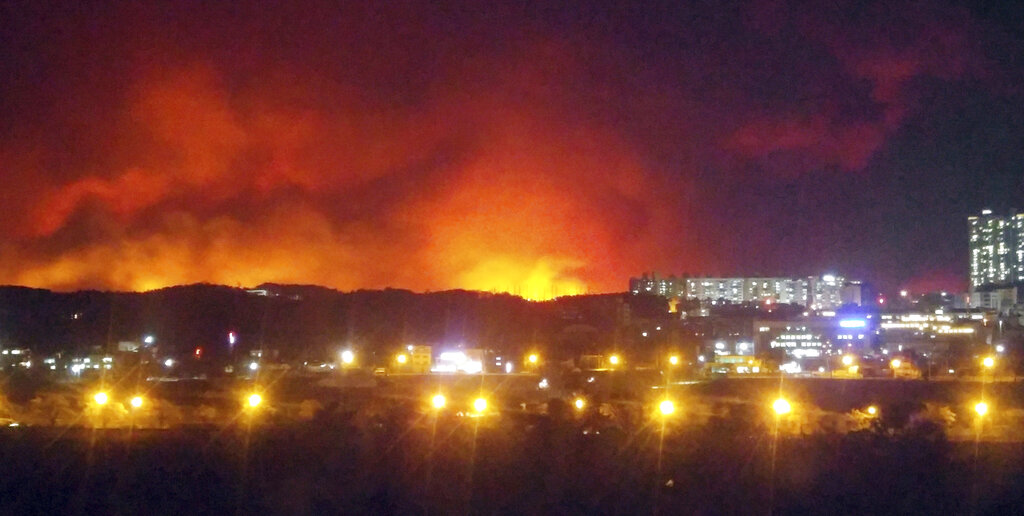
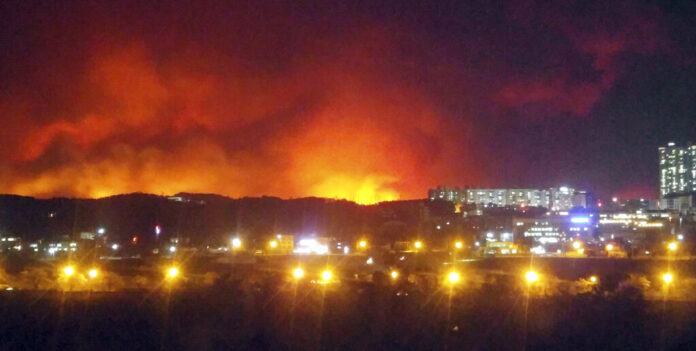
A massive wildfire burns in Goseong, South Korea, fanned by strong winds in a mountainous province that hosted the 2018 Pyeongchang Winter Olympics.

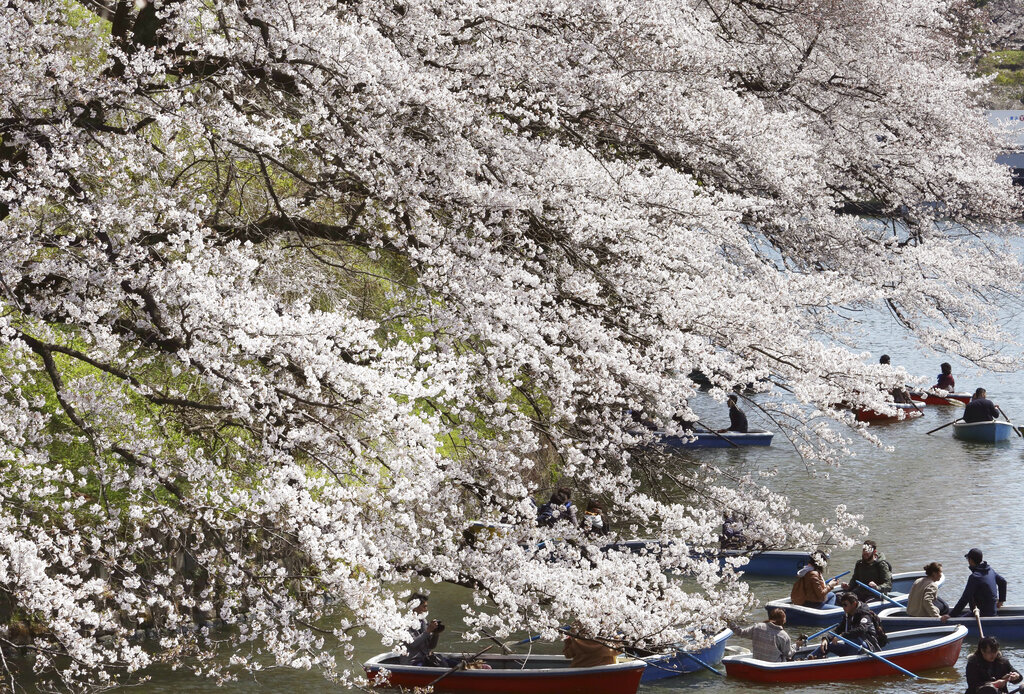
People in Tokyo enjoy blooming cherry blossoms along the Chidorigafuchi Imperial Palace moat.

AP19091106719503
In this Monday, April 1, 2019, file photo, Japan’s Chief Cabinet Secretary Yoshihide Suga unveils the name of new era “Reiwa” at the prime minister’s official residence in Tokyo. Japan says next emperor Naruhito’s era name is Reiwa, effective May 1 when he takes the throne from his father. (AP Photo/Eugene Hoshiko, File)
AP19091151196850
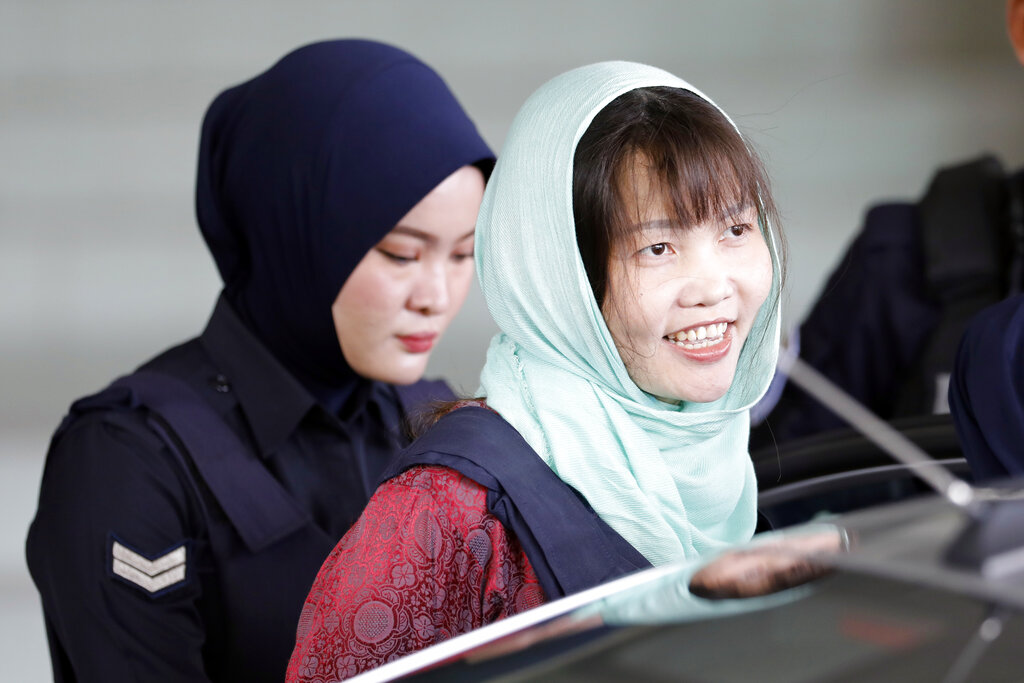
In this Monday, April 1, 2019, file photo, Vietnamese Doan Thi Huong, right, leaves Shah Alam High Court in Shah Alam, Malaysia. The Vietnamese woman who is the only suspect in custody for the killing of the North Korean leader’s brother Kim Jong Nam pleaded guilty to a lesser charge in a Malaysian court on Monday and her lawyer said she could be freed as early as next month. (AP Photo/Vincent Thian, File)
AP19091355904397
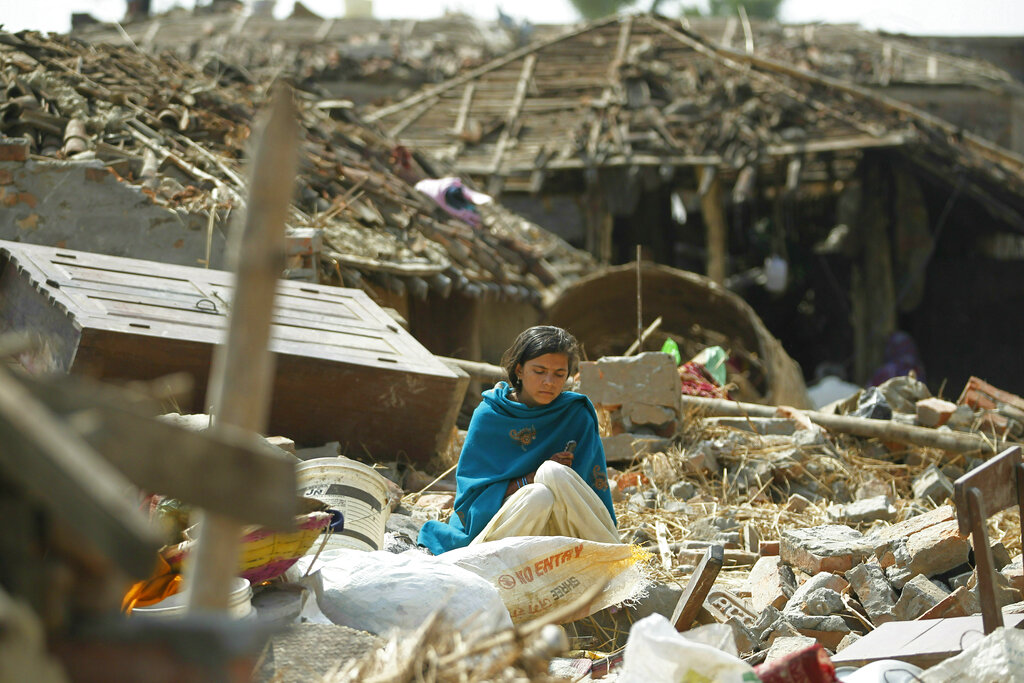
In this Monday, April 1, 2019, file photo, a woman sits in the middle of the debris of a residential house damaged in rainstorm in Bara district, 125 kilometers (75 miles) south of Kathmandu, Nepal. Rescuers struggled Monday to reach villages in southern Nepal cut off by a powerful rainstorm that killed at least 28 people and injured hundreds more. (AP Photo/Niranjan Shrestha, File)
AP19091390351201
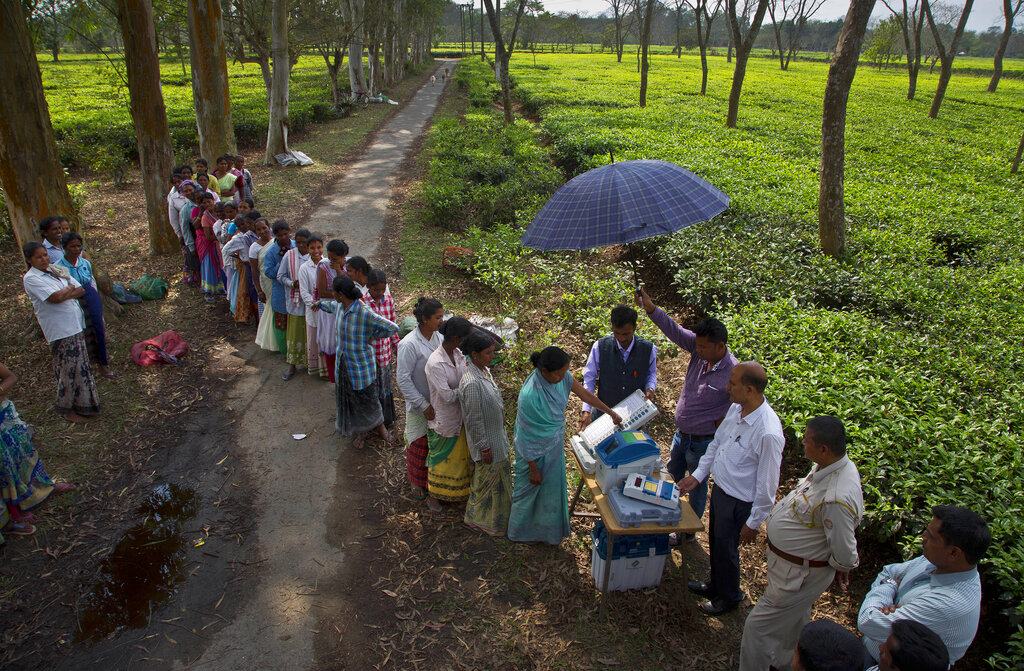
In this Monday, April 1, 2019, file photo, a woman casts her vote on the demo electronic voting machines and checks on Voter Verifiable Paper Audit Trail or VVPAT as others wait in the queue during an election awareness drive by district administration amongst the tea garden laborers ahead of India’s general election in Jorhat, India. A VVPAT vending machine is an independent printing system connected to the electronic voting machines that allows voters to check that their votes are being cast as intended. The system will be used in the upcoming national elections to be held in seven phases starting from April 11. Votes will be counted on May 23. (AP Photo/Anupam Nath, File)
AP19093064703024
In this Feb. 23, 2019, file photo, the Crusader horseman ride around the arena prior to the start of the Super Rugby match between the Crusaders and Hurricanes in Christchurch, New Zealand. The Crusaders announced Wednesday, April 3, 2019, that they will be considering a change to their name and branding following the Christchurch terrorist attacks on March 15 – insisting the status quo is “no longer tenable.” (AP Photo/Mark Baker, File)
AP19093159744085
In this Wednesday, April 3, 2019, file photo, people on boat enjoy blooming cherry blossoms along the Chidorigafuchi Imperial Palace moat in Tokyo. (AP Photo/Koji Sasahara, File)
AP19093358168335
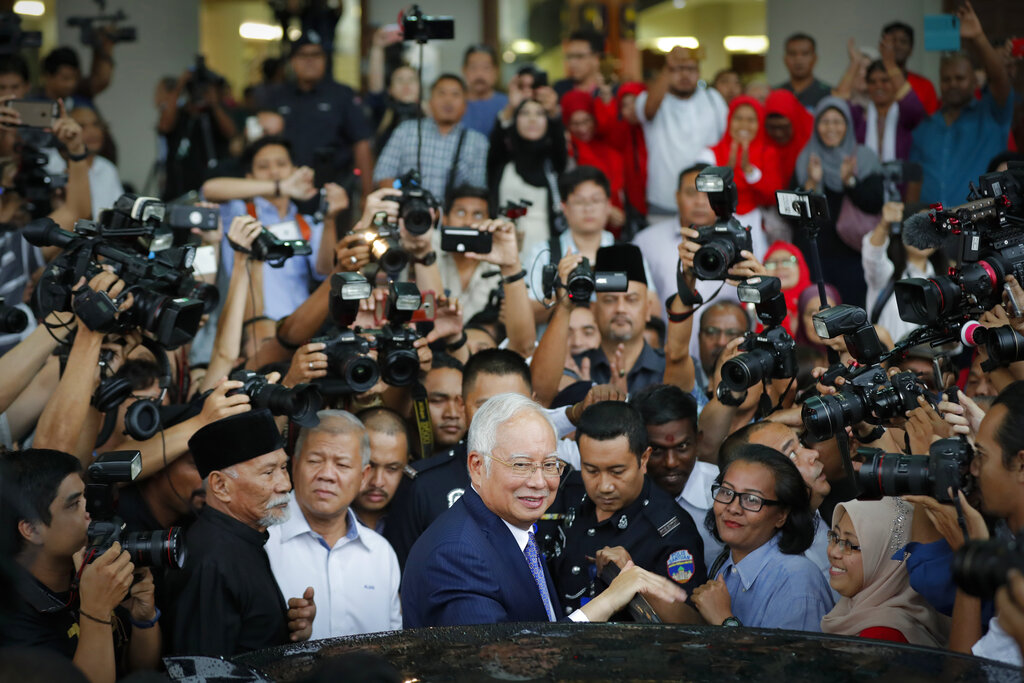
In this Wednesday, April 3, 2019, file photo, former Prime Minister Najib Razak, center, gets into a car after his court appearance at the Kuala Lumpur High Court in Kuala Lumpur, Malaysia. Najib appeared in court Wednesday for the start of his corruption trial, exactly 10 years after he was first elected to office only to suffer a spectacular defeat last year on allegations he pilfered millions of dollars from a state investment fund. (AP Photo/Vincent Thian, File)
AP19095053714810
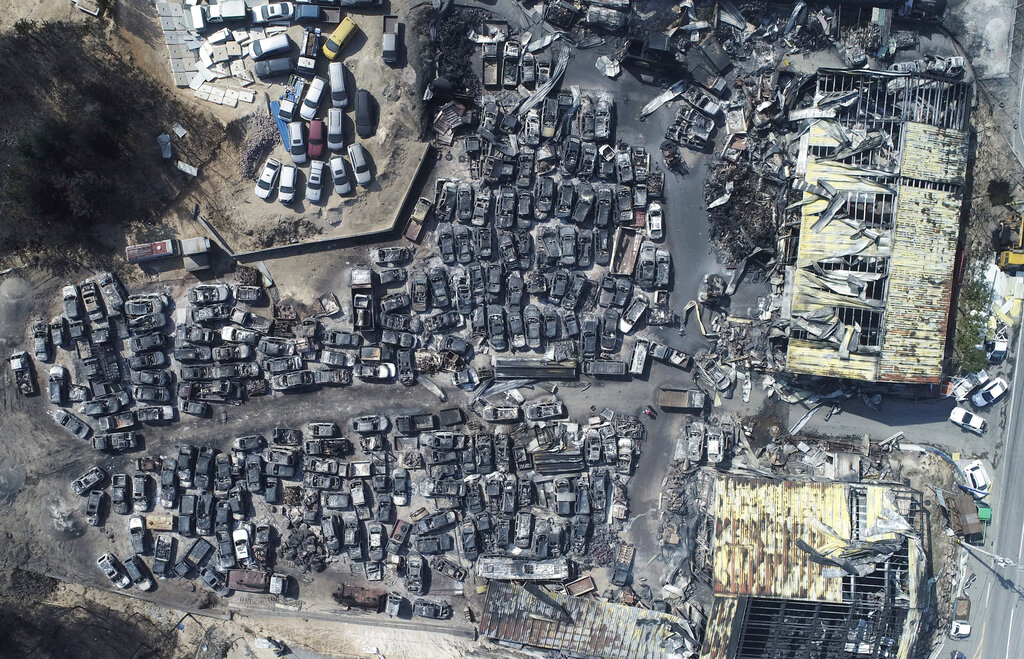
This aerial photo shows burnt vehicles filling a junkyard after being hit by a massive forest fire in Sokcho, South Korea, Friday, April 5, 2019. The fire likely started Thursday night from a transformer spark near a resort in the town of Goseong in Gangwon province about 210 kilometers (130 miles) northeast of Seoul and then spread to the nearby mountains, according to Choi Jin-ho, a fire captain at Gangwon Fire Headquarters. (Kim Do-hoon/Yonhap via AP)
AP19095075519004
In this Thursday, April 4, 2019, file photo, a wildfire burns in Goseong, South Korea. A few people died and thousands were evacuated after strong winds fanned a large fire Friday burning in a mountainous South Korean province that hosted the 2018 Pyeongchang Winter Olympics, officials said. (Lee Jong-geun/Yonhap via AP, File)
AP19089541126689
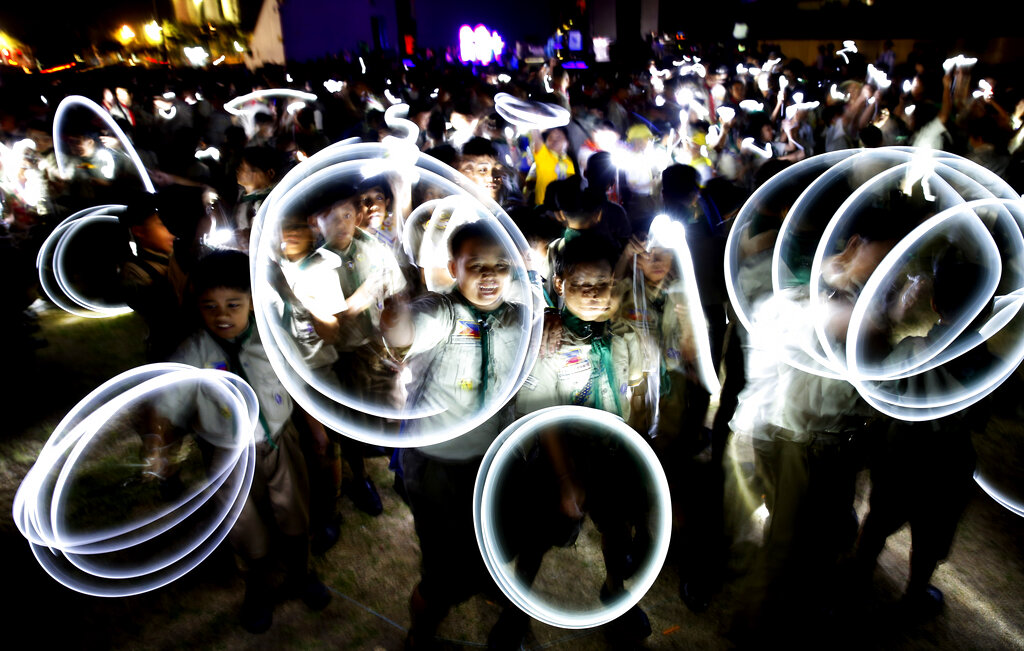
In this Saturday, March 30, 2019, file photo, Philippine Boy Scouts play with their flashlights at the countdown for the 12th Earth Hour event in suburban Makati city, east of Manila, Philippines. Earth Hour is the symbolic switching off of the lights for one hour to help minimize fossil fuel consumption as well as mitigate the effects of climate change. (AP Photo/Bullit Marquez, File)
AP19090442293622
In this Sunday, March 31, 2019, file photo, Sunrisers Hyderabad’s David Warner leaps in the air to celebrate scoring a century during the VIVO IPL T20 cricket match between Sunrisers Hyderabad and Royal Challengers Bangalore in Hyderabad, India. (AP Photo/Mahesh Kumar A., File)
Advertisement

S.Korea Coastal Forest Fire Kills 2, Destroys 120 Homes

A wildfire burns Thursday in Goseong, South Korea. Photo: Lee Jong-geun / Yonhap via AP

SEOUL, South Korea — A forest fire burning in the mountainous region where South Korea hosted the 2018 Winter Olympics has destroyed 120 homes and caused two deaths, authorities said Friday as thousands of people fled.

Firefighters by Friday morning had extinguished large parts of a forest fire likely started Thursday night from a transformer spark near a resort in the town of Goseong and then spread to the nearby mountains, according to Choi Jin-ho, a fire captain at Gangwon Fire Headquarters.

Gangwon province governs the Olympic host city of Pyeongchang and is about 210 kilometers (130 miles) northeast of Seoul.

Videos posted to social media in South Korea showed tall flames rising from large areas of forest, the air filled with embers and debris as cars drove by the raging fire. News photos showed a burnt-out bus, fire engulfing a hill, and residents evacuating apartment complexes and filing into gyms.

Choi said nearly 2,400 people in Goseong and almost 1,250 in the city of Sokcho were evacuated.

Authorities said a 60-year-old man died because of the fire, and a woman in her 70s died after being hit by wide-angle mirror on a road that fell because of strong winds.

The region is close to the border with North Korea. South Korea’s Unification Ministry said Friday it plans to inform North Korea of details about the forest fires.

The Ministry of the Interior and Safety said about 120 homes were burned. The Korea Forestry Service said about 250 hectares of forest was estimated to have burned in Goseong alone.

About 20 firefighting helicopters and 5,600 firefighting personnel were expected to be deployed Friday, the ministry said. The fire also spread toward Ganeung and Donghae, causing the temporary shutdown of a highway and delays in train services from Ganeung to Seoul.

Another Gangwon fire official, who spoke on condition of anonymity because of office rules, said at least 11 people were being treated for injuries. The official wouldn’t comment on the nature of the injuries or how many were serious.

The office of South Korean President Moon Jae-in said he held an emergency meeting early Friday and called for all available resources to be deployed.

Choi said nearly 800 firefighters fought the fire overnight but had trouble because of the wind and darkness, which prevented the use of helicopters.

Fire brigades from all major surrounding regions, including Seoul, were reportedly ordered to send trucks to help fight the blaze.

Story: Jung-yoon Kim and Kim Tong-hyung

Advertisement

Kingdom Prepares for Coronation’s Holy Water Ritual

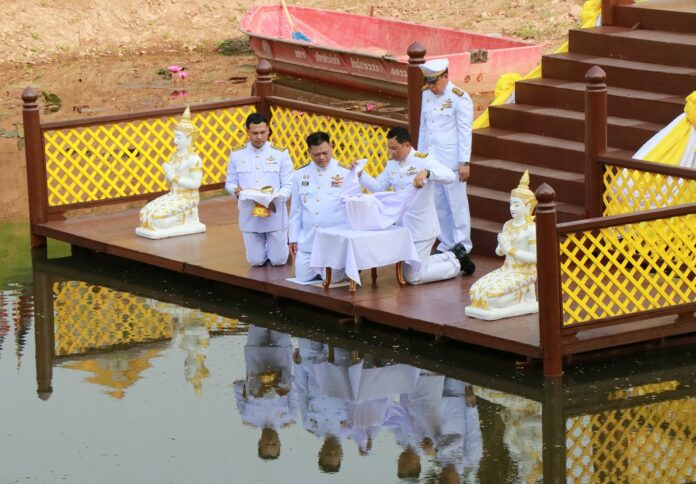
The Phitsanulok Governor, right, leads the Thursday rehearsal to draw holy water for the coronation ceremony.

BANGKOK — Rehearsals to draw and transport sacred water for the May coronation ceremony took place on Thursday across the nation.

A rehearsal of the gathering of sacred water from 126 sources across 76 provinces and Bangkok took place today, with the real process to take place on Saturday. A consecration ceremony for the water will then take place on April 18 at Wat Suthat in Bangkok, before the water is transported to the Emerald Buddha Temple next to the grand palace the next day.

Read: Sacred Water Sources Sought for Coronation Rituals

In Bangkok, governor Aswin Kwanmuang rehearsed transporting sacred water for ablution by car along a specific route to the grand palace.

According to a book entitled “The Royal Coronation Ceremony” published by the Culture Ministry in 2018, drawing sacred water for ablution is the first step in preparations for the royal coronation ceremony, which will take place from May 4-6.

Water from five rivers and four ponds will be collected on Saturday between 11.52am to 12.38am.

“[The water] is combined and blessed to be used as sacred water for ablution of the king in the Purification Ceremony and again in the Anointment Ceremony during the Royal Coronation Ceremony. According to the ancient Brahmanism textbook, the water for the Anointment Ceremony must come from the five main streams of South Asia, or from the country of India to be specific,” the book stated.

It however added that no record from the Sukhothai and Ayutthaya periods show that water was ever taken from India.

Holy water for the ceremony next month will come from the Chao Phraya, Bang Pakong, Pasak, Ratchaburi and Petchburi rivers and several other domestic sources. The river water will be combined with water from four sacred ponds in Suphan Buri province.

King Rama V, the great grandfather of the current king, visited India in 1872 and brought back with him water from the five main streams as prescribed in the Brahmanism textbook. He combined this with water from four sacred ponds in Suphan Buri province for his second coronation in 1873. This is why water from the four ponds in Suphan Buri continued to be used.

Related stories:

Bangkok Roads to Close 5 Days During King’s Coronation (Maps)

Full Schedule for Royal Coronation Ceremony Unveiled

Sacred Water Sources Sought for Coronation Rituals

Advertisement

Philippines Issues Strongly Worded Rebuke at China Flotillas

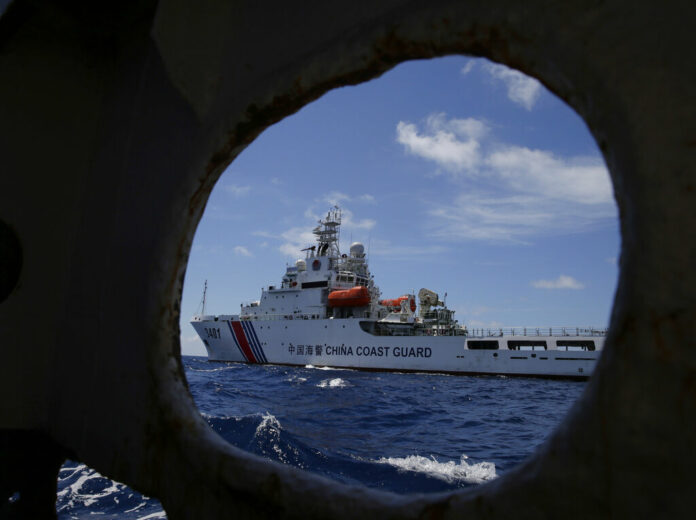
In this photo taken March 29, 2014, a Chinese Coast Guard ship attempts to block a Philippine government vessel as the latter tries to enter Second Thomas Shoal to relieve Philippine troops and resupply provisions. Photo: Bullit Marquez / Associated Press

MANILA, Philippines — The Philippine government protested on Thursday the presence of large numbers of Chinese vessels near islands and islets occupied by the Philippines in the disputed South China Sea as illegal and vowed to take “appropriate action.”

The Department of Foreign Affairs issued the rare public rebuke of the Chinese presence after the Philippine military monitored more than 200 Chinese vessels from January to March in a disputed area named Sandy Cay near a Philippine-occupied island called Pag-asa by Filipinos.

“The presence of Chinese vessels near and around Pag-asa and other maritime features … is illegal,” the department said in a statement. “Such actions are a clear violation of Philippine sovereignty, sovereign rights and jurisdiction as defined under international law.”

The department said it has lodged diplomatic protests and raised concerns in meetings with Chinese officials, and that the presence of Chinese military, fishing or other vessels in the area would “continue to be the subject of appropriate action by the Philippines.”

The Philippines regards a chain of islands and islets, nine of which it occupies, in a contested region named the Spratlys in the South China Sea as a municipality it calls Kalayaan under its western province of Palawan. That claim conflicts with the larger territorial claims of China, Vietnam, and three other governments in a long-simmering Asian dispute.

A 2002 accord between China and the 10-nation Association of Southeast Asian Nations aims to prevent armed confrontation in the busy waterway, where much of Asia’s oil and trade transits.

“We call on concerned parties to desist from any action and activity that contravenes the ASEAN-China Declaration on the Conduct of Parties in the South China Sea as these generate tension, mistrust and uncertainty, and threaten regional peace and stability,” the Philippine statement said.

Chinese boats have swarmed around Sandy Cay, a chain of three sandbars that naturally emerged in recent years, since 2017. The sandbars lie between Pag-asa, which is internationally called Thitu, and a Chinese man-made island called Subi.

The Philippines tried to occupy the largest sandbar, about 2.5 nautical miles (4.6 kilometers) from Thitu, in 2017 but China strongly protested. Shortly after, Chinese navy, coast guard and fishing vessels converged at the sandbars, and the Philippines halted planned construction and withdrew on the orders of President Rodrigo Duterte, Defense Secretary Delfin Lorenzana said at the time.

The Philippines delivered a protest note to the Chinese Embassy in Manila last Friday. Philippine officials again raised strong concern over the Chinese vessels near Sandy Cay and Thitu, along with two other Philippine-occupied islets, in a meeting with Chinese counterparts on Wednesday in Manila, a Philippine official said.

In Beijing, Chinese foreign ministry spokesman Geng Shuang said Chinese and Philippine officials on Wednesday discussed problems in the South China Sea constructively in the latest in a series of meetings that began in 2017.

“The two sides discussed the ways to handle problems with a cooperative attitude and reiterated that they will continue cooperation and discuss measures to promote trust,” he said when asked about the Philippines’ concern.

Duterte has taken a nonconfrontational approach to the territorial disputes with China as he seeks trade, investment and infrastructure funding.

He has so far refused to take up with China a ruling by a U.N.-linked tribunal that invalidated Beijing’s sprawling claims in the South China Sea, sparking criticism from nationalist and left-wing groups, which wanted him to demand immediate Chinese compliance with the landmark decision. China did not participate in the international arbitration and has defied its ruling.

Duterte and Chinese President Xi Jinping agreed in a statement last November to exercise self-restraint to prevent an escalation of the territorial disputes.

“We call on the Chinese government to adhere to this consensus reached at the highest levels, down to its agencies and its military,” the Philippine foreign affairs department said.

Story: Jim Gomez

Advertisement

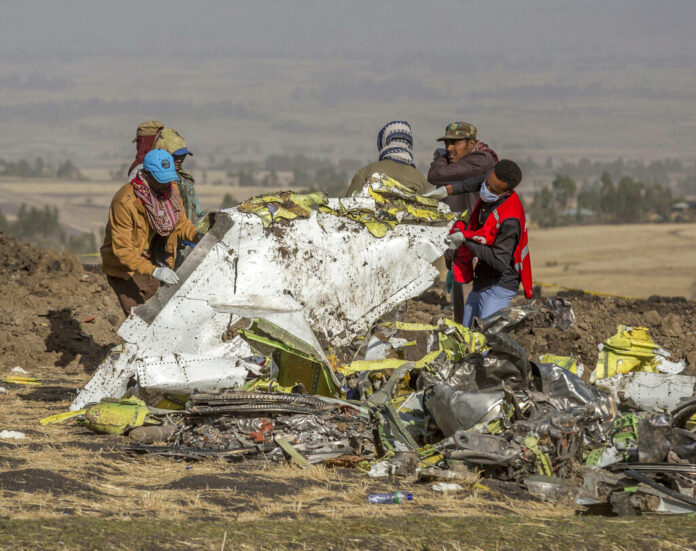
Preliminary Report Says Crew of Ethiopia Jet Followed Boeing Rules

In this March 11, 2019, file photo, rescuers work at the scene of an Ethiopian Airlines flight crash near Bishoftu, Ethiopia. Photo: Mulugeta Ayene / Associated Press

ADDIS ABABA, Ethiopia — The crew of the Ethiopian Airlines jet that crashed shortly after takeoff last month performed all of the procedures recommended by Boeing when the plane started to nose dive but could not control it, according to a preliminary report released Thursday by Ethiopia’s government.

The report was based on data from the recorders of the Boeing 737 Max 8. Boeing declined to comment pending its review of the report.

The Max 8 has been under scrutiny since a Lion Air flight crashed off the coast of Indonesia under similar circumstances in October.

Investigators are looking into the role of a flight-control system known by its acronym, MCAS, which under some circumstances can automatically lower the plane’s nose to prevent an aerodynamic stall. The Max has been grounded worldwide pending a software fix that Boeing is rolling out, which still needs approval from the Federal Aviation Administration and other regulators.

The Ethiopian Airlines jet crashed shortly after takeoff from Addis Ababa on March 10, killing all 157 on board.

Boeing is the focus of investigations by the U.S. Justice Department, the Transportation Department’s inspector general, and congressional committees. Investigations are also looking at the role of the Federal Aviation Administration in the U.S., which certified the Max in 2017 and declined to ground it after the first deadly crash in October.

The FAA said in a statement that it is continuing to work toward a full understanding of what happened and will take appropriate action as findings become available.

Advertisement

S. Korea Launches 5G Smartphone Networks Ahead of Schedule

SK Telecom CEO Park Jung-ho, left, and participants attend a media showcase for its 5G service in Seoul, South Korea, Wednesday, April 3, 2019. Photo: Ahn Young-joon / Associated Press

SEOUL, South Korea — South Korea’s telecommunications carriers turned on super-fast 5G mobile internet networks abruptly ahead of schedule in an attempt to ensure the country becomes the first in the world to launch the services.

The carriers say 5G-enabled smartphones are capable of downloading data 20 times faster than existing 4G devices, which in theory would enable users to download movie files almost instantly. The faster networks would also improve live broadcasts and streaming services for music and video while allowing for a broader range of virtual reality services, the companies say.

The 5G networks of the three South Korean mobile operators went live at 11 p.m. Wednesday, hours before U.S. carrier Verizon turned on its 5G network in some areas of Minneapolis and Chicago a week ahead of schedule. The carriers had initially planned to start their 5G services on Friday, but moved up to stay ahead of Verizon. The change came hours after a meeting between the carriers and government regulators, who modified service terms so that the companies could sign up users earlier.

However, the South Korean 5G services were initially available only to a few individuals selected as brand promoters, including figure skating superstar Yuna Kim, who SK Telecom announced as one of its “first customers.”

Regular customers in capital Seoul and some other major cities will be able to sign up for 5G services starting on Friday. The carriers plan to expand their coverage to 85 cities across the country by the end of the year.

“The government and private companies came together to achieve the world’s first commercialized 5G services and this proves once again our country is undoubtedly the top powerhouse in information and communications,” said You Young-min, South Korean minister for science and information technology.

The supposed milestone is widely seen as symbolic. Park Tae-wan, a ministry official, said a “world’s first” reference could possibly help the mobile industry market’s know-how.

Advertisement

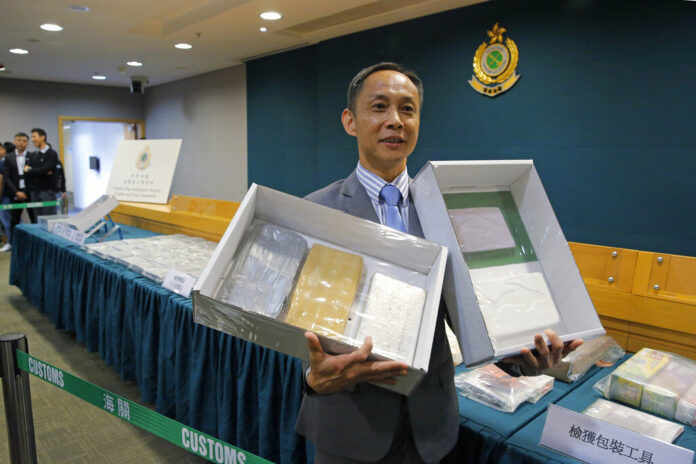
Hong Kong Customs Seizes Massive Cocaine Haul

Head of Customs Drug Investigation Bureau Hui Wai-ming holds the seized cocaine during a news conference in Hong Kong, Thursday, April 4, 2019. Photo: Kin Cheung / Associated Press

HONG KONG — A haul of cocaine with an estimated market value of $13 million has been seized in Hong Kong, customs agents said Thursday.

The customs service in the semi-autonomy Chinese territory said one man was arrested in the operation Wednesday that netted 91 kilograms of the drug. The Customs Drug Investigation Bureau plans to hold a news conference later Thursday.

As a major Asian port city, Hong Kong is considered a key transit point for contraband from illegal drugs to endangered wildlife parts. Much of that is bound for mainland China or Southeast Asia where drug laws tend to be much stricter.

Meanwhile, Hong Kong’s large population of finance workers, lawyers and others in well-paid white collar sectors also provides a lucrative market for drugs including cocaine and marijuana.

Hong Kong’s past is steeped in the drug trade, having been founded as a British colony in 1842 as a result of the First Opium War.

Advertisement

Thanathorn Did Not Aid Anti-Coup Protesters: Rangsiman

Rangsiman Rome speaks on a stage during a 2018 democracy rally.

BANGKOK — Future Forward Party MP candidate Rangsiman Rome refuted accusations on Thursday that party leader Thanathorn Juangroongruangkit helped him flee from a police station following an anti-coup protest in 2015.

Rangsiman, then a fourth-year law student at Thammasat University, said he went to Pathum Wan police station in June 2015 to file a complaint that he and many other student activists were physically attacked by police and security officers at an anti-junta rally outside the Bangkok Art and Culture Centre.

Rangsiman said that while waiting for a taxi on his way home, then businessman Thanathorn showed up in a van and offered a ride.

“I did not flee. I didn’t think I fled,” said Rangsiman on the phone on Thursday.

Rangsiman reasoned that Thanathorn could not have thought he was fleeing a criminal charge, because Rangsiman himself only learned afterwards that he was charged with violating the junta’s ban on political gatherings for participating in the BACC rally.

Read: Future Forward Leader Hit With Sedition Charge

The comment came after Thanathorn revealed yesterday that he has been charged with sedition. Junta legal officer Col. Burin Thongprapai said the charge was filed because Thanathorn aided Rangsiman and around 20 others flee from the police station in June 2015 before they were arrested.

Deputy police chief Gen. Srivara Rangsibrahmanakul on Wednesday denied that the charge was politically motivated, saying the charge came four years after the rally because the case had changed hands several times.

“It’s not about the elections or about discrediting anyone,” Srivara said, adding that there’s enough evidence to try Thanathorn. Srivara urged supporters of Thanathorn not to break the law if they plan to show up on Saturday at the police station.

Thanathorn formerly served on the board of Matichon Group, the parent company of Khaosod English.

Rangsiman said the account was false and that he and his fellow activists had not been aware of any such arrest warrant that night.

Krisadang Nutcharut, Thanathorn’s lawyer, insisted that his client did not help anyone flee. He said by phone Thursday that he will show written proof on Saturday, when his client appears under police summons to hear the sedition charge, that Rangsiman and his fellow activists went to the police station to press a complaint.

“Police also said they could leave [that night],” Krisadang said.

If convicted of sedition, Thanathorn could face up to seven years in prison.

Advertisement

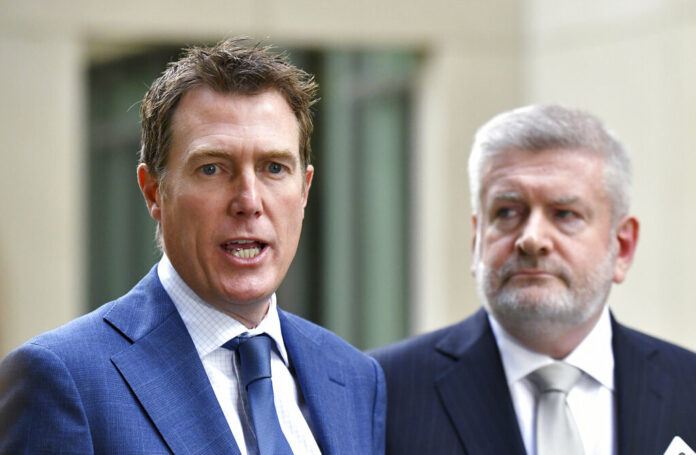
Australia Could Jail Social Media Execs for Showing Violence

Australia's Attorney-General Christian Porter, left, and Minister for Communications Mitch Fifield hold a press conference at Parliament House, in Canberra, Wednesday, April 4, 2019. Photo: Mick Tsikas / AAP Image via AP

CANBERRA, Australia — Australia’s Parliament passed legislation on Thursday that could imprison social media executives if their platforms stream real violence such as the New Zealand mosque shootings.

Critics warn that some of the most restrictive laws about online communication in the democratic world could have unforeseen consequences, including media censorship and reduced investment in Australia.

The conservative government introduced the bills in response to the March 15 attacks in Christchurch in which an Australian white supremacist apparently used a helmet-mounted camera to broadcast live on Facebook as he shot worshippers in the two mosques.

Australia’s government rushed the legislation through the last two days that Parliament sits before elections are expected in May, dispensing with the usual procedure of a committee scrutinizing its content first.

“Together we must act to ensure that perpetrators and their accomplices cannot leverage online platforms for the purpose of spreading their violent and extreme propaganda — these platforms should not be weaponized for evil,” Attorney General Christian Porter told Parliament while introducing the bill.

The opposition’s spokesman on the attorney general portfolio, Mark Dreyfus, committed his center-left Labor Party to support the bill despite misgivings. If the Labor wins the election, the law would be reviewed by a parliamentary committee.

The law has made it a crime for social media platforms not to remove “abhorrent violent material” quickly. The crime would be punishable by three years in prison and a fine of $7.5 million, or 10% of the platform’s annual turnover, whichever is larger.

Abhorrent violent material is defined as acts of terrorism, murder, attempted murder, torture, rape and kidnapping. The material must be recorded by the perpetrator or an accomplice for the law to apply.

Platforms anywhere in the world would face fines of up to $597,500 if they fail to notify Australian Federal Police if they are aware their service was streaming “abhorrent violent conduct” occurring in Australia.

Dreyfus described the bill as “clumsy and flawed,” and the timetable to pass it as “ridiculous.” Labor first saw the legislation late Monday.

The bill could potentially undermine Australia’s security cooperation with the United States by requiring U.S. internet providers to share content data with Australian Federal Police in breach of U.S. law, Dreyfus said.

“Labor believes that the social media companies must do more in preventing the dissemination of material produced by terrorists, showing of their crimes, and for that reason Labor will, despite reservations … be supporting the passage of this bill,” Dreyfus said.

An attempt by the minor Greens party and independent lawmakers to have the vote scrutinized by a parliamentary committee was rejected.

Arthur Moses, president of the Australian Law Council, the nation’s top lawyers group, said the law could lead to media censorship and prevent whistleblowers from using social media to shine a light on atrocities because of social media companies’ fear of prosecution.

“Media freedom and whistleblowing of atrocities here and overseas have been put at risk by the ill-informed livestream laws passed by the Federal Parliament,” Moses said.

The penalties would be “bad for certainty and bad for business,” which could scare off online business investment in Australia, Moses said.

Australian Industry Group chief executive Innes Willox, a leading business advocate, said more time was required to ensure the law did not unnecessarily impinge on existing fundamental media rights and freedoms.

“Rushing this legislation through will not make Australia safe,” he said.

Scott Farquhar, co-founder of the Sydney-based software company Atlassian, predicted job losses in the technology industry.

“As of today, any person working at any company (globally) that allows users to upload videos or images could go to jail,” Farquhar tweeted. “Guilty until proven innocent.”

Fergus Hanson, head of the International Cyber Policy Center at the Australian Strategic Policy Institute, saw problems in the legislation’s definitions, including how long a company had to “expeditiously” remove offense material.

Alex McCauley, chief executive of national tech startup advocacy organization StartupAUS, described the legislation as “anti-tech.”

“We want to see it (social media) better regulated and we just simply haven’t had the conversation at a national level about what that means and there hasn’t been time and there hasn’t been consultation,” McCauley told Australian Broadcasting Corp.

Facebook livestreamed the Christchurch massacre for 17 minutes without interruption before reacting. Facebook said it removed 1.5 million videos of the shootings during the first 24 hours afterward.

It was filmed by Brenton Harrison Tarrant, 28, whose video and writings included anti-Muslim views and detailed how he planned the attack. Tarrant is scheduled to appear in court Friday and will face 50 murder and 38 attempted murder charges, according to New Zealand police.

Executives of Facebook, Google, Twitter, internet service providers and Australian phone companies met Prime Minister Scott Morrison and three ministers last week to discuss social media regulation. Communications Minister Mitch Fifield said Facebook “did not present any immediate solutions to the issues arising out of the horror that occurred in Christchurch.”

Facebook did not immediately respond to a request for comment on Thursday.

Morrison wants to take the Australian law to a Group of 20 countries forum as a model for holding social media companies to account.

New Zealand’s Justice Minister Andrew Little said his government had also made a commitment to review the role of social media and the obligations of the companies that provide the platforms. He said he had asked officials to look at the effectiveness of current hate speech laws and whether there were gaps that need to be filled.

Little said he didn’t see any irony in that people were watching hearings into a bill that would place new restrictions on guns in real time on Facebook, the same platform the shooter used to broadcast the massacre.

“There’s a world of difference, I think, between the exercise of a democratic function and a democratic institution like a national parliament, and some of the more toxic stuff that you see put out by individuals,” he said.

Story: Rod McGuirk

Advertisement

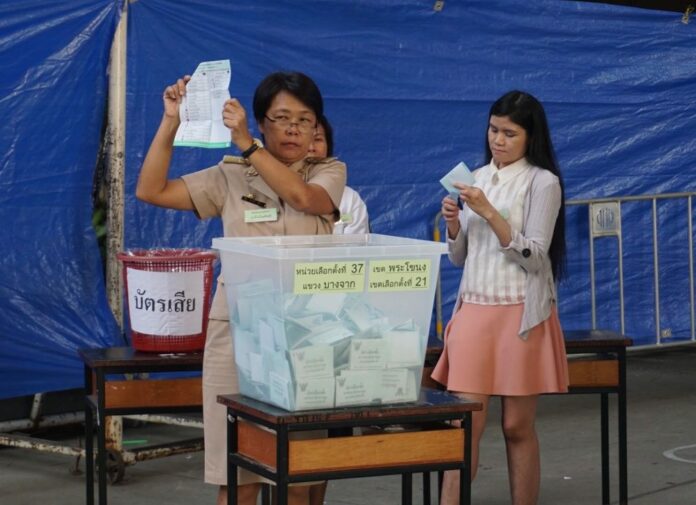
Ballot Recounts, By-Elections Ordered in Some Polling Stations

An official counts a ballot on March 24 at a polling station in Bangkok’s Phra Khanong district.

BANGKOK — The Election Commission said Thursday that ballots from two polling stations will be recounted while six others need by-elections.

Commissioner Sawaeng Boonmee said the recount is needed in two of Khon Kaen’s polling stations. By-elections are needed at two polling stations in Lampang, and one in Yasothon, Phetchabun, Phitsanulok and Bangkok, respectively. Sawaeng cited the reported ballot numbers that did not match reported voter turnout in both cases.
It’s not immediately known why by-elections – rather than simply recounts – are needed at the six polling stations and when they will be held. Sawaeng only said that the date will be announced after the national holiday of Songkran.

As the decision doesn’t affect any entire electoral district, it’s unlikely that the recounts or by-elections will have a major impact on the overall results. Constituencies can consist of several dozens polling stations. There were 6,149 polling stations in Bangkok’s 30 constituencies for the March 24 election.

Sawaeng however said that, following further review, some entire districts could require by-elections.

The ordered by-elections affected five constituencies that contributed to the election of two Pheu Thai candidates, two Phalang Pracharath candidates, and one Ruam Jai Thai candidate.

The official election results will be certified by May 9.

Update: This article has been updated with an additional information about candidates that won in the affected constituencies.

Advertisement

Hot News

LATEST NEWS

Bangkok
overcast clouds
29.4 ° C
29.4 °
25.5 °
77 %
4.8kmh
100 %
Fri
29 °
Sat
31 °
Sun
34 °
Mon
29 °
Tue
30 °