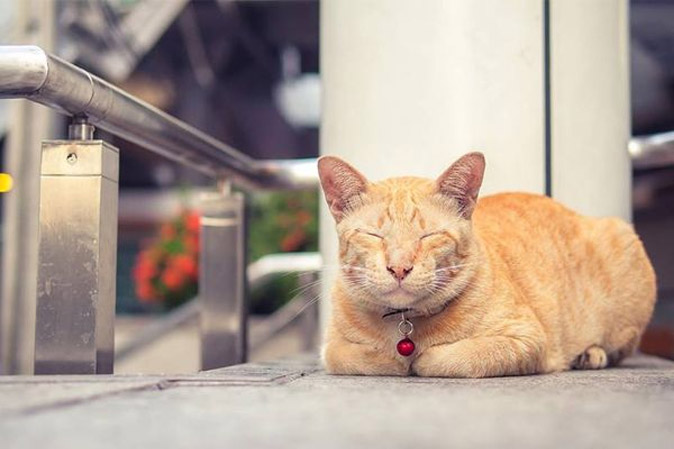
BANGKOK — A cat who rose from humble origins to become one of Thailand’s first internet-famous animals died Thursday.
Maew Asoke, aka Asoke Cat, died last night of chronic kidney disease, according to the Facebook page which harnessed the fame he accrued in the streets of Bangkok into a small media empire. He was about 8; maybe 10.
Asoke was said to have been ill since his partner Mali died last year.
Today Thai social media is filled with celebrity animals and pets, fromfar-less popular dogsto smiling buffalos, but Asoke Cat’s celebrity was organic rather than a product manufactured for online engagement.
Photo: Asoke Cat / Facebook
Before he was raised up to Instagram celebrityhood, Asoke Cat had been a fixture of the intersection he became named for, snoozing on a tourist information counter, slinking through the crowd and accepting pets from any extended friendly hand.
Soon after he hit the media as one of Thailand’s first social media celebrity animals, he was controversially taken from his corner in 2013 by Nutch Prasopsin.
An owner of other cats that she promoted online, Nutch began trotting Asoke Cat around to events and shows. Critics said she was exploiting the cat’s fame; Nutch said she had rescued him from danger – Asoke Cat was something of a fighter – and used his fame for the benefit of animals.
Her page,Kingdom of Tigers, has become possibly Thailand’s largest cat Facebook page with over 3 million likes and followers.
Though he was not known to have fathered any kittens during his second chapter as a house cat, he may very well leave behind any number of litters from his bachelor days.
His funeral was held last night. His ashes will be taken north and spread in Nan province.
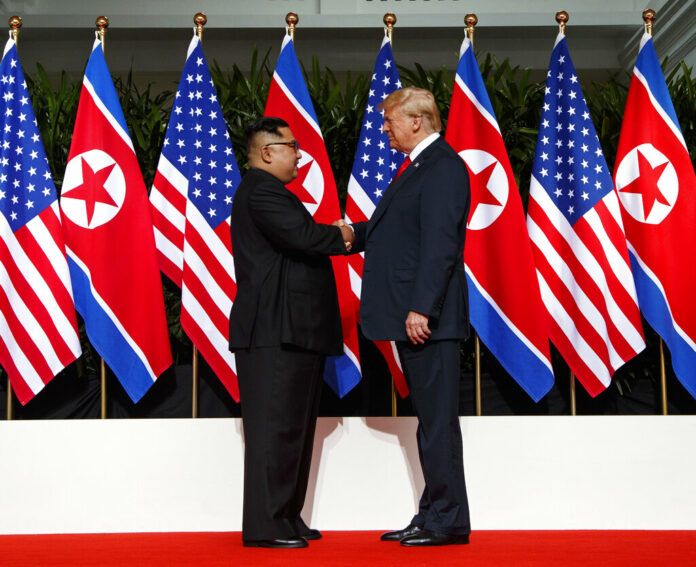
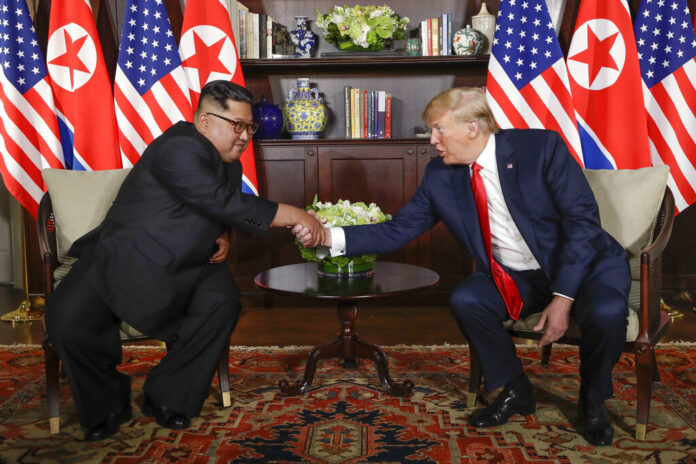
North Korean leader Kim Jong Un, left, and U.S. President Donald Trump shake hands prior to their meeting in June on Sentosa Island in Singapore. Photo: Evan Vucci / Associated Press
TOKYO — President Donald Trump used his biggest stage of the year to announce a second summit with North Korean leader Kim Jong Un.
Trump said in his State of the Union address that he intends to meet Kim on Feb. 27-28 in Vietnam, saying that although much work remains to be done toward peace on the Korean Peninsula, his relationship with Kim is a good one.
But is Kim really ready to make a deal?
Here’s why the stakes will be higher this time around.
Lowering Expectations
Trump’s announcement of the summit’s timing and location was expected. He had been teasing it for weeks. But he kept his North Korea remarks surprisingly short.
After dramatically asserting that if he hadn’t been elected president, the U.S. and North Korea would be fighting a major war now, he acknowledged that much work remains to be done. That’s quite a shift from his claim right after his June summit with Kim in Singapore that the nuclear threat from the North was over.
The president’s tune changed in other ways as well.
The word denuclearization was nowhere to be found. Neither was anything specific about what he achieved in Singapore or what specifically he intends to get out of another meeting.
Trump is smart to give himself a lot of wiggle room.
U.S. intelligence chiefs believe there is little likelihood Kim will voluntarily give up his nuclear weapons or missiles capable of carrying them.
Nevertheless, efforts to nail down the logistics and an agenda for the summit do appear to be on track. Just before Trump spoke, the U.S. special envoy for North Korea, Stephen Biegun, reportedly flew to Pyongyang to try to flesh out summit logistics and an agenda.
Good Reason for Cause
After a year of heightening threats, and in sharp contrast with the standoffish policies of President Barack Obama, Trump got a lot of credit for simply being willing to open a dialogue with the North and to meet directly with Kim.
Trump’s claim that he has played a big role in calming things down is also true, though he helped raise those tensions to begin with through his inflammatory rhetoric and policy of “maximum pressure” to further squeeze the North’s economy and isolate it from the global financial system.
But now that the ice has been broken, just sitting down with Kim won’t likely win Trump more kudos.
Previous presidents refused to meet with Kim and his predecessors because they did not want to legitimize them or bolster their status. Kim got all that and more in Singapore.
Trump needs to prove his relationship with Kim has a purpose that goes beyond photo ops. In his speech, Trump stressed that the North has returned Americans who had been jailed and has not launched any long-range missiles in 15 months.
Kim announced all of that before the Singapore summit, however.
There’s a real risk this time around that if Trump can’t nail down a significant win on the denuclearization front, he could find himself working in direct opposition to his own main objective. Instead of getting Kim to give up his nukes, any tacit acceptance of the status quo could embolden Kim to dig in further as the leader of the world’s newest nuclear power.
Kim’s Multiple Targets
In the hope of getting sanctions relief and possibly a peace treaty to formally end the Korean War, Kim has offered Trump some goodies. He has suggested he is willing to dismantle some nuclear and missile-related facilities, and as Trump pointed out, has maintained his self-proclaimed moratorium on nuclear and long-range missile testing.
But he has been careful not to put all his eggs in Trump’s basket.
Rebuilding ties with South Korea and China is the cornerstone of Kim’s bigger strategy. He has already met Chinese leader Xi Jinping four times and South Korean President Moon Jae-in three times.
Kim has an immediate interest in wooing the Chinese and South Koreans. He wants investment and trade to bolster his economy and help fund infrastructure projects. Beijing and Seoul are already suggesting they believe sanctions against the North should be eased sooner rather than later, despite the Trump administration’s stance that denuclearization must come first.
Weakening Seoul’s security alliance with Washington is another of Kim’s goals.
He scored big in Singapore when Trump agreed to put off joint military exercises with the South, and again when Trump started publicly questioning the value of such exercises and demanding Seoul pay a bigger share of the cost of its own national defense.
Seoul just agreed to boost its share, so that’s a win for Trump. But the reportedly rancorous process appears to have also undercut the South’s confidence in Washington.
The biggest annual U.S.-South Korea exercise, meanwhile, is normally held in March or April. It was postponed and scaled down last to year to ease tensions during the Pyeongchang Winter Olympics.
U.S. officials have said it will likely be scaled down this year as well.
SAMUT SAKHON — Many urban eateries see their share of customers ticketed for parking illegally while getting some food. One such venue came up with a solution: fool customers and police alike into thinking it’s okay to park curbside.
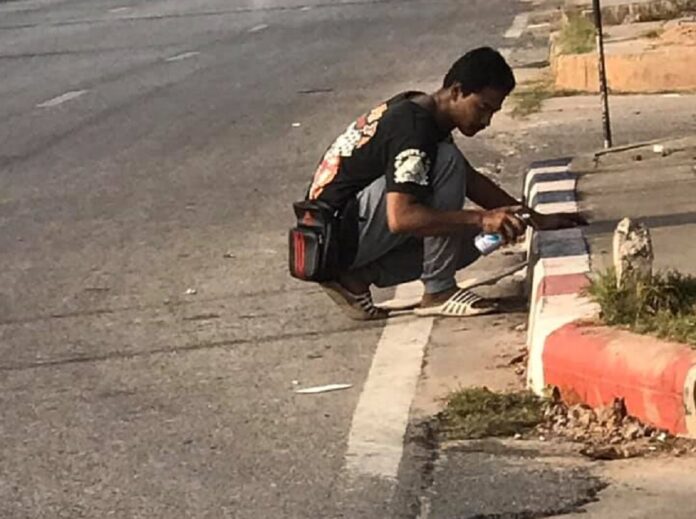
In a post shared to an online Samut Sakhon community, someone published photos of a noodle vendor on Ekachai Road in the process of painting over the red and white colors designating it a no parking area.
“He turned it black and white. Should we support this?” user Parichart Haruansri wrote Tuesday.
Within hours of people sharing the story, local officials visited the scene and ordered the vendor, who was not identified, to restore the curb to its original colors.
As if the instant karma wasn’t juicy enough, the Samut Sakhon city district chief announced afterward that the stall was illegally squatting on a pedestrian walkway. The owner must tear down the stall within seven days, or the authorities will demolish it and charge him for the work, Wutthipong Suphakwanit said.
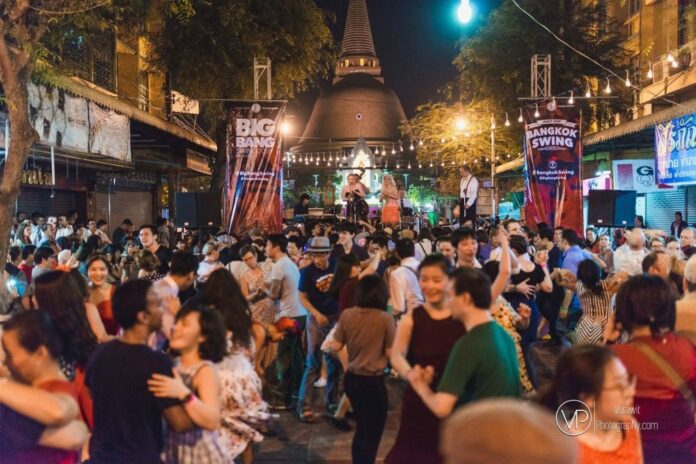
NAKHON PATHOM — For the fourth year, hundreds of swing dancers will shut down the main road in front of the nation’s tallest pagoda for a night of vintage fun later this month.
Bangkok’s swing dance community plans to converge on Nakhon Pathom, the small province comprising western metro Bangkok, for the annual Swing Dancing At Nakhon Pathom.
The event this year features swing and jazz band Shirt Tail Stompers flying in from London. The ensemble will play along with Meschiya Lake, a veteran vocalist from New Orleans.
Two years after she played Shanghai Mansion in Bangkok’s Chinatown, renowned Russian Lindy-hopper Ksenia Parkhatskaya will return to show off her Charleston steps and more to the large crowd.
More than 300 swing dancers from 20 countries are expected to jump and jive in the streets that night.
Swing newbs? The Bangkok Swing elders will offer a 30-minute crash course starting at 7pm.
Swing Dancing At Nakhon Pathom will takes place 7pm to 10pm on Feb. 24 in front of the Phra Pathom Chedi. Admission is free. The stupa is about an hour’s drive from the center of Bangkok and can be reached by van from CentralPlaza Pinklao or BTS Bang Wa.
Bangkok Swing was founded in 2011 by American expat Ben Lepp, dancer Rick Jones and Chayapong “Oat” Naviroj.
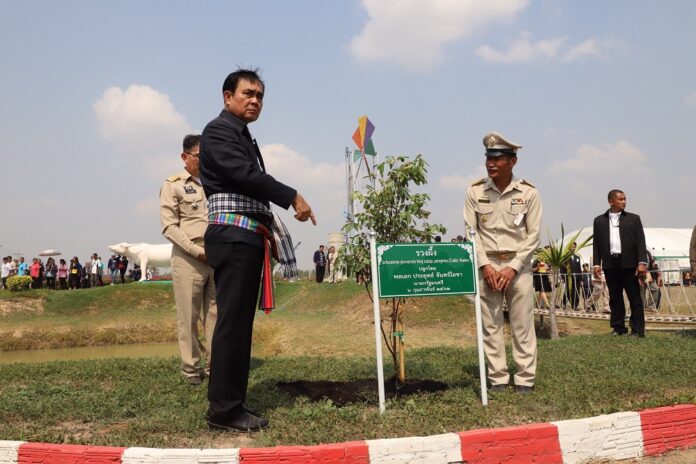
Sowing seeds of doubt? Junta chairman Prayuth Chan-ocha shows reporters a tree he just planted today in Yasothon province
BANGKOK — Junta chairman Prayuth Chan-ocha has not yet decided whether to accept the nomination to serve as prime minister, the party who extended the offer said Wednesday.
Although Prayuth was asked last week to be Palang Pracharat Party’s candidate for prime minister, the junta leader has not given any reply to them, party chairman Uttama Savanayana told reporters today. Friday is the last day for political parties to submit their nominations for the top job.
“I can’t really evaluate that because I have to respect Gen. Prayuth’s deliberation,” Uttama said when asked if Prayuth might say no.
Asked whether Prayuth’s rejection would affect the party’s Election Day prospects, the party leader said he did not want to offer any speculation at this time.
“But we want to make this party a permanent thing, not only something temporary,” said Uttama, who served as energy minister on Prayuth’s cabinet until his resignation last month. “But personally I believe Gen. Prayuth will accept. I have confidence in him.”
Palang Pracharat has explicitly supported Prayuth remaining in power for another term as prime minister. Prayuth, who has held the job since leading a coup five years ago, has talked openly about a political future and embraced a more conventional image in the past two years.
But when he was offered the nomination, Prayuth requested more time to think. Speaking to reporters at his usual Tuesday briefing, the junta leader even struck a melancholy tone by saying he has steeled himself to the possibility he won’t get to serve another term.
“I’m prepared for every event. I’m prepared for everything,” Prayuth told reporters. “It’s up to whoever the people want to vote for.”
The junta leader is on a trip Wednesday to Yasothon province where he visited local agricultural projects.
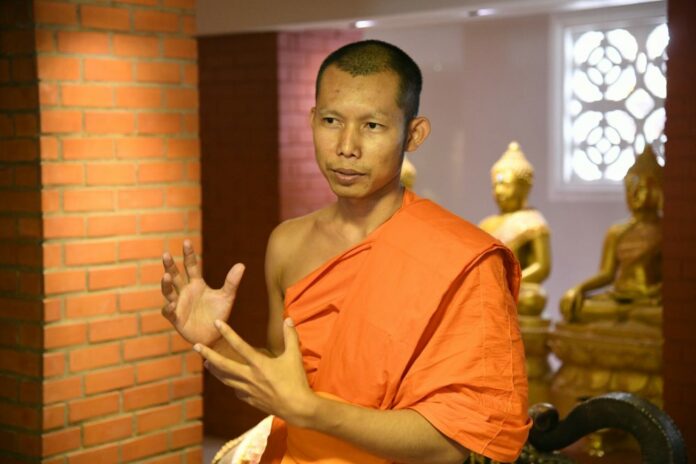
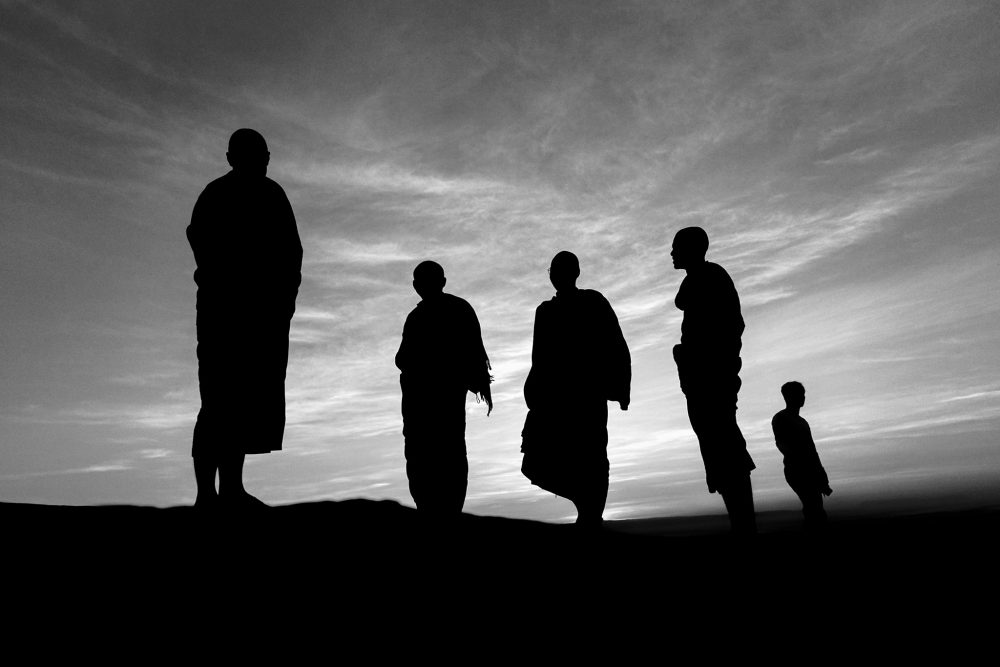
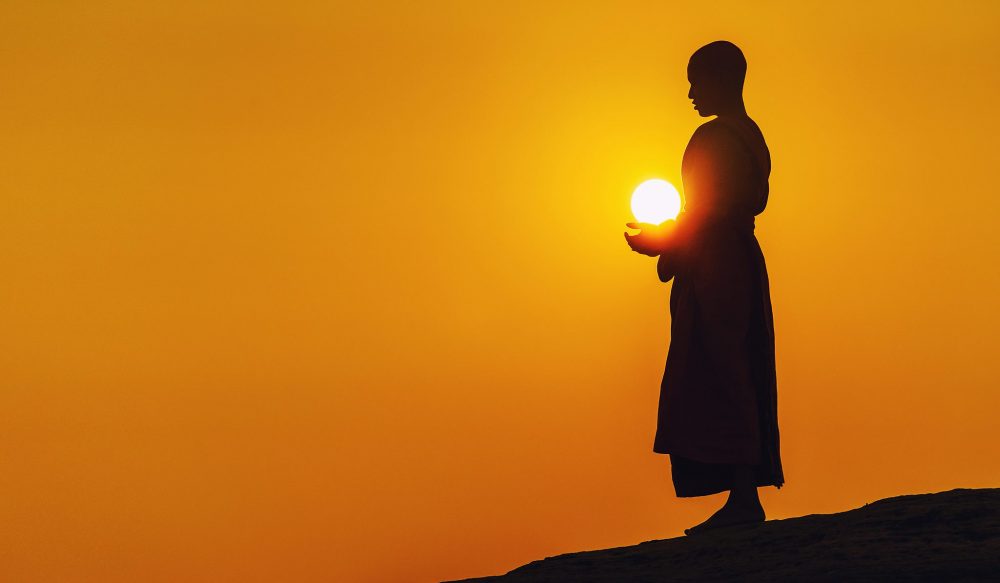
Like many of today’s digital creatives, Ekkachai Arinthamo brings a trained eye to striking photos and videos of people and places he shares online. Simple, arresting images show a bright orange sunset contrasted by the black shadow of a standing man, or an old book read by two boys, one of whom peeks shyly at the camera.
The man is a monk. The boys are novices. The places are remote temples here and overseas. But what sets Ekkachai apart from other Instagram erudites are, in fact, the yellow robes he’s worn over 20 years as an ordained monk.
As younger generations lose interest in organized religion, Ekkachai has devoted his talents to updating the image of Thai Buddhism to be more accessible and relevant. It’s a mission he’s kept at over a decade despite disapproval from some who think it’s an improper pursuit for someone wearing the robes.
If we only stay in the middle of the road, we’ll never know what people want from the religion or how they think of it.
Photo: Ekkachai Arinthamo / Courtesy
For his project “Dhamma on Lens,” Ekkachai not only portrays his idea of Buddhism’s beauty through the lens of his camera but applies it to designing buildings, interiors and graphics for no cost.
He also runs his own self-built website and organizes workshops to teach younger, like-minded monks that there are more ways to promote the religion than preaching and writing.
“I’m doing this project as an example for the new generation of monks who want to work in this field. I want to open a learning space for them,” he said. “I also want people to see that monks can also express their thoughts on the religion in another way that’s not just preaching.”
Along the way, he’s picked up a sizable online following of those impressed or curious to see a monk trafficking in cool design work. This has drawn scorn from purists who object to seeing one using a camera, computer or smartphone, something that’s been an obstacle to his mission.
“There’s this belief that monks are supposed to only study dharma and go straight to nirvana. They think this is not a monk’s duty,” he said.
But it’s not enough to stop him.
“It’s like walking down a road, but I don’t like staying in the middle. I like to run along the edge of it,” he said. “Beyond the edge is the world of ordinary folks. I’m in a position very close to them, so I have to be very careful. … If we only stay in the middle of the road, we’ll never know what people want from the religion or how they think of it.”
‘Tranquility and Simplicity’
To understand the impact of his work, one need only visit his temple.
Wat Nak Prok’s logo.
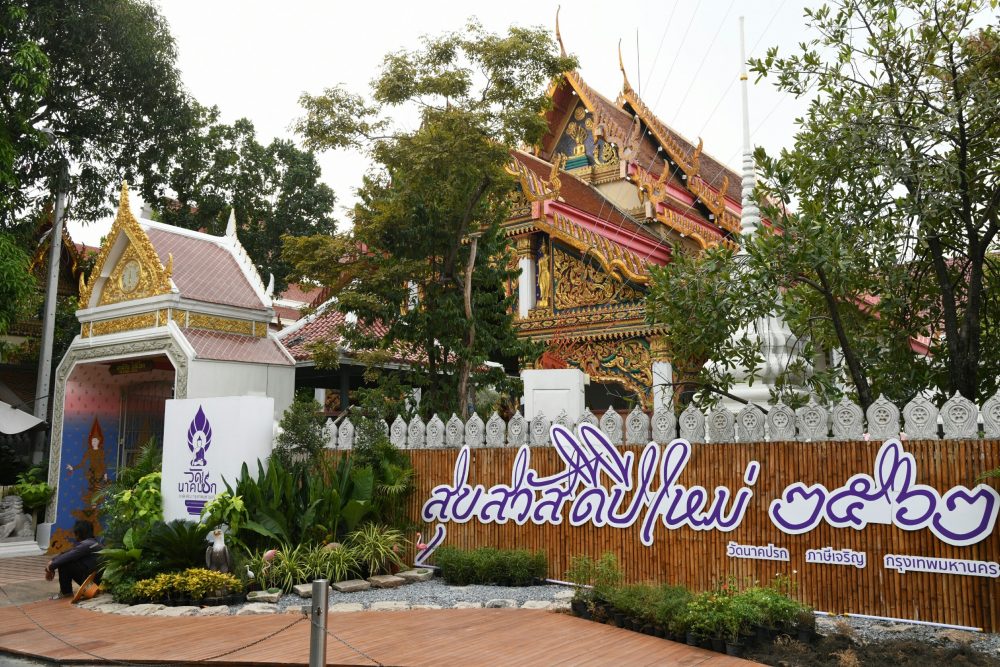
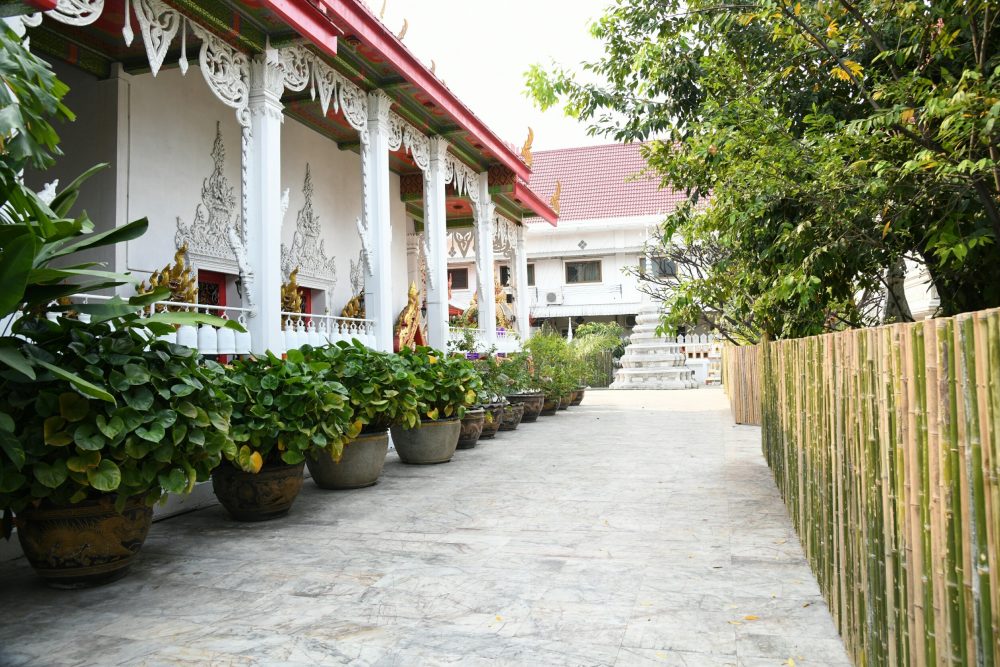
Hidden deep in a small alley behind old shops and houses in the capital’s Phasi Charoen district, Wat Nak Prok looks more welcoming than the typical temple. There are fewer imposing walls, leaving it open to the surrounding community. Here is where Ekkachai has lived since he was 18, and there’s evidence everywhere of his influence.
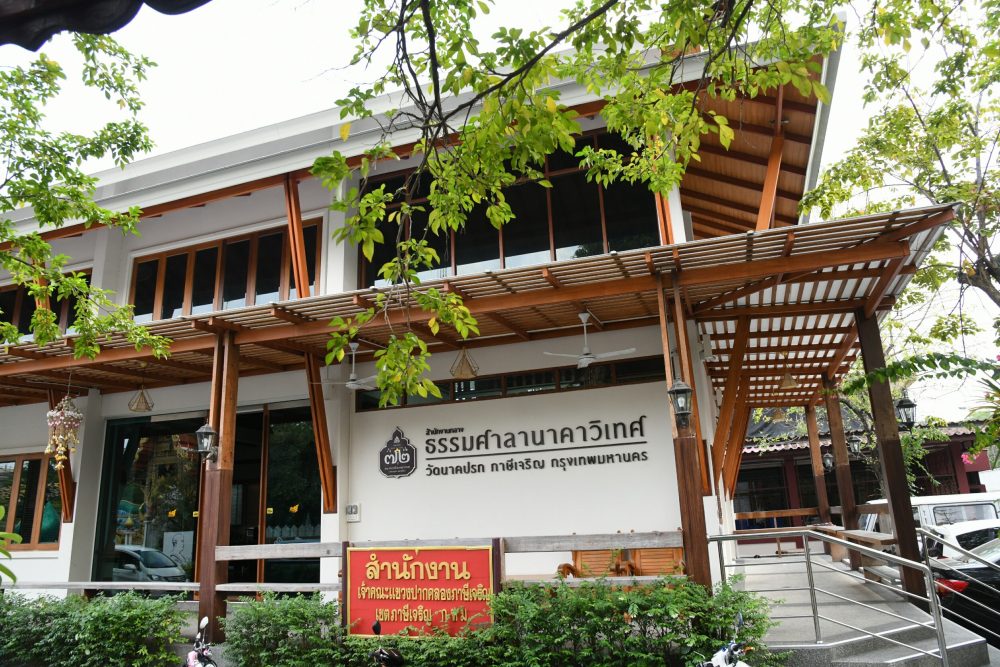
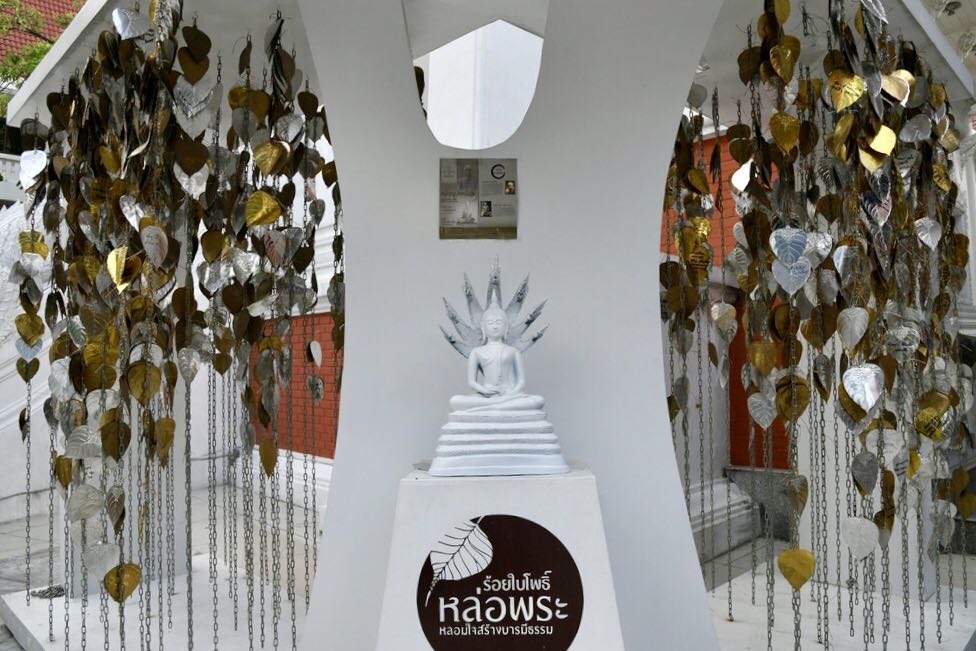
Entering via a small bridge to an open court to see the temple’s spare design contrasts the usual tendency to overstate and embellish in every way imaginable. Welcoming visitors is an eye-catching logo alongside a minimalist portrait of the abbot near the front shrine hall. Across the way sits a modern-looking office building, with design-savvy posters promoting special events here and there.
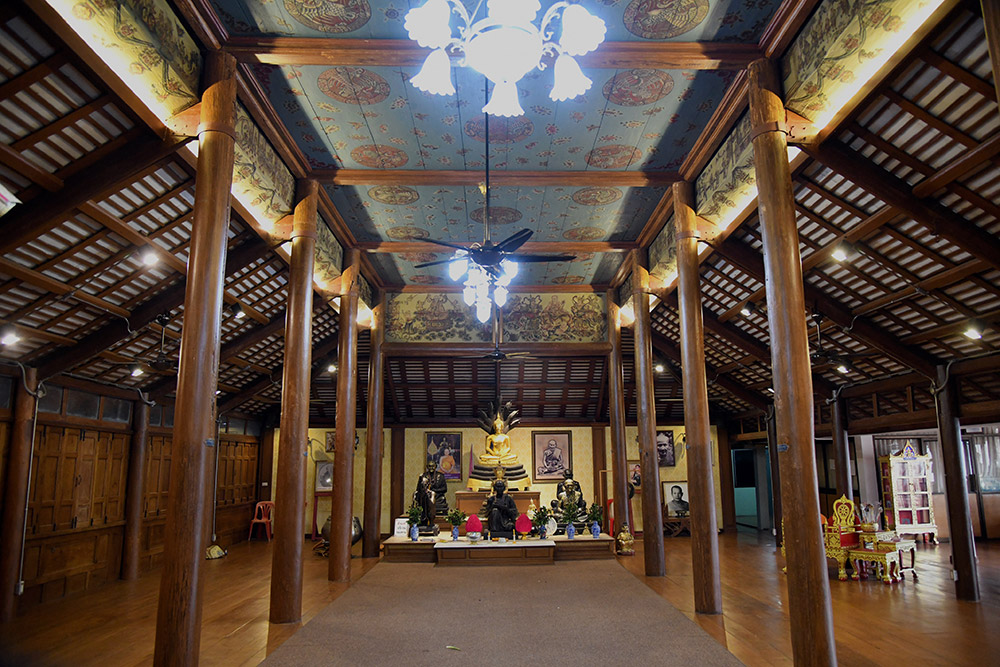
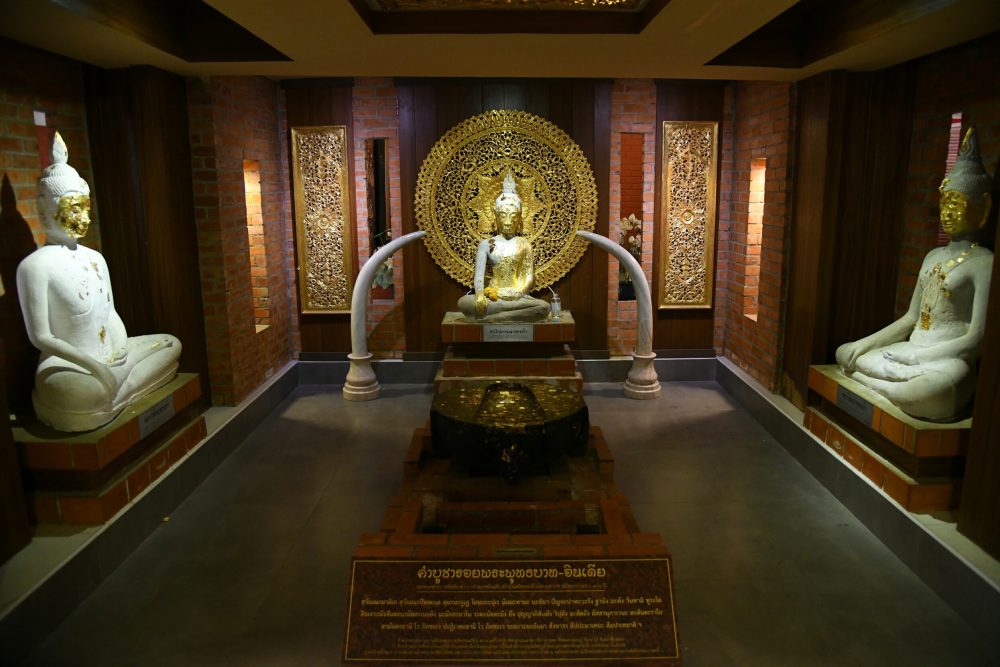
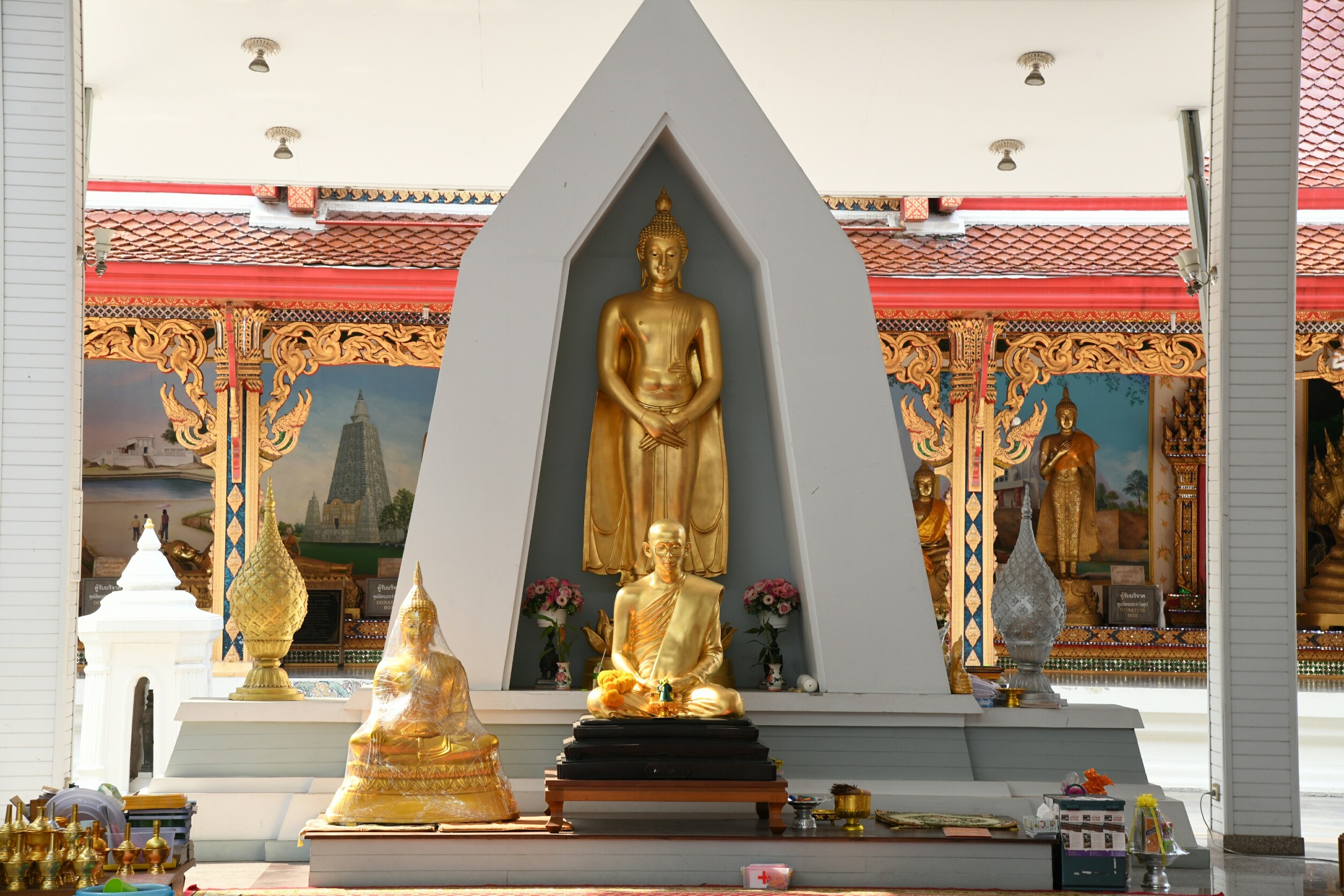
Exploring inside, prayer rooms are more natural wood and bare concrete than the usual gilded and gaudy ornamentation. Most of these came from Ekkachai’s efforts to make the temple more approachable, even for those who don’t identify as Buddhist.
He notes the principles of good design and Buddhism are in harmony.
“Temples, Buddhism, should reflect tranquility and simplicity,” he said. “Even if you’re not a Buddhist, we all have that natural state inside us. So I apply that to communicate with people.”
He came to this thinking while growing up under the monastery’s roof.
Temples still lack architectural designs that conform to the needs of their local communities. What can temples do to make people want to stay for hours, like they do in malls and hotels, without having to hear preaching or meditate?
Like other boys, Ekkachai, now 32, ordained as a novice when he was 12 at his local temple in Maha Sarakham province. Unlike most, he heard the calling and decided he could do more good wearing the robes. And this path, however unlikely, eventually led him to the art world.
“During a school break, my teacher sent me to take short courses in typing, computers and painting for temple fair posters,” he said. “But I was slow in typing, so I dropped it after a while and focused on painting instead.”
He discovered a fondness and talent for it. After moving to Wat Nak Prok, he was entrusted by his superiors with running the temple’s media affairs. Anyone who’s seen temple promotional materials knows they’re also heavy on ornamentation and excess.
Ekkachai felt the usual approach was outdated and created “too much of an eyesore.”
Image: Ekkachai Arinthamo / Courtesy
He said he wants to move away from the traditional imagery of Thai monks and temples, where every color and image imaginable is garishly thrown together with little thought.
“I saw that artwork done by temples was very different from work in other fields,” he said. “The older generation is being replaced by the younger. We need to modernize things, otherwise young people won’t be able to understand us.”
He then sought help from professionals, cultivating digital media skills to keep up with the trends on the outside, as he started to recognize how the power of visual media could be harnessed in favor of the religion.
Next he picked up photography.
“When I started doing graphic design, I saw that the photos I had to use didn’t fit the concepts I had in my mind,” he said, adding that they were “too stiff and formal.”
He said he started shooting for the first time seven years ago in a summer novice program, and found the result illuminating.
“The first time I took a photo, it looked very ordinary, so I tilted the angle a bit. Once I tilted it, it was like a life-changing moment,” he said with a big smile. “I could see many different perspectives. Then I started to realize the importance of photography even more.”
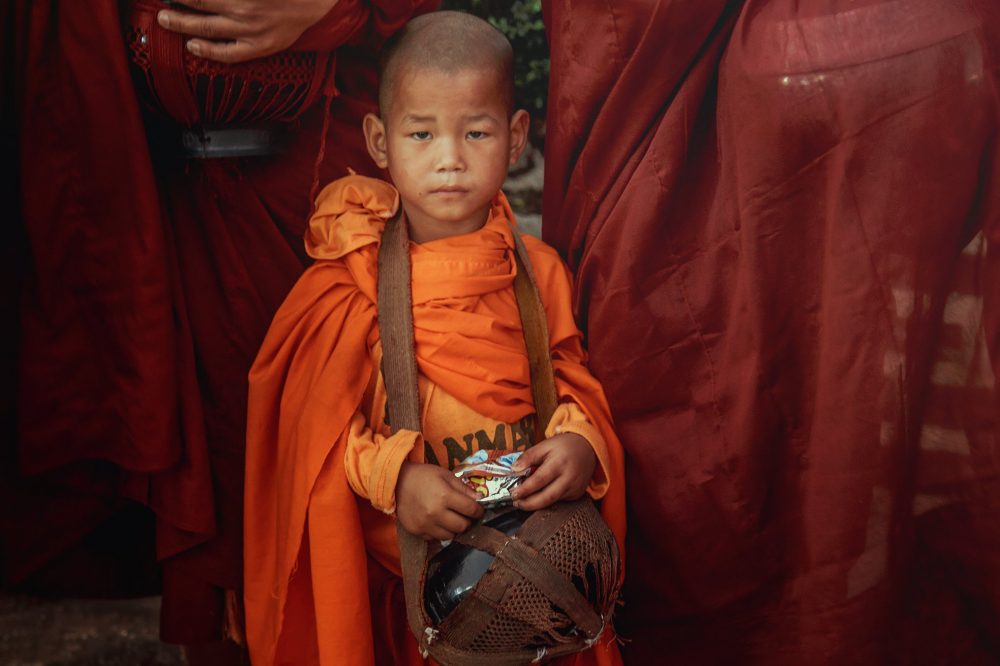
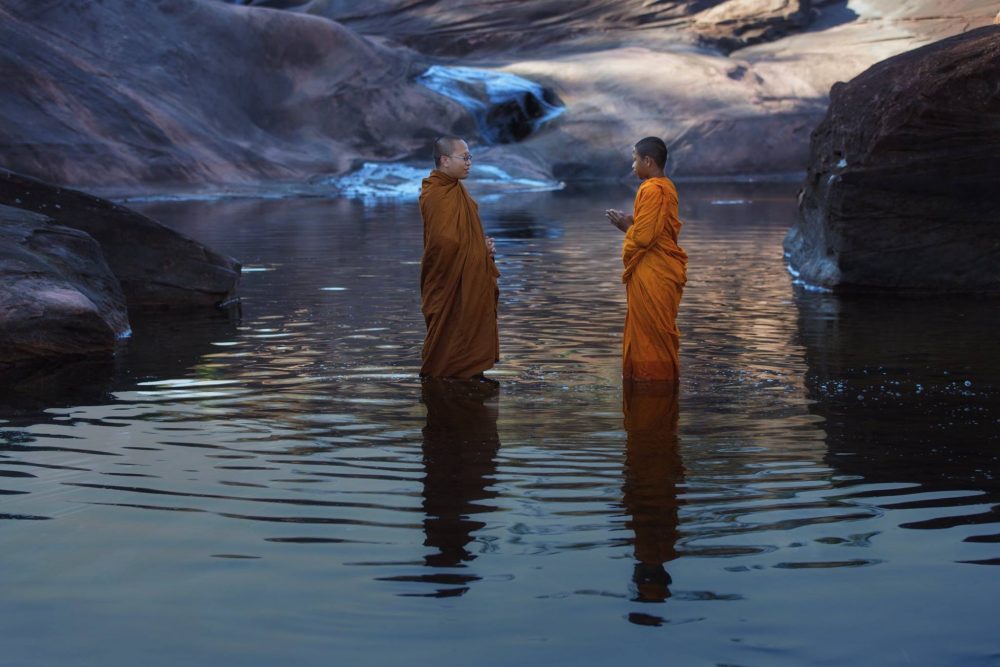
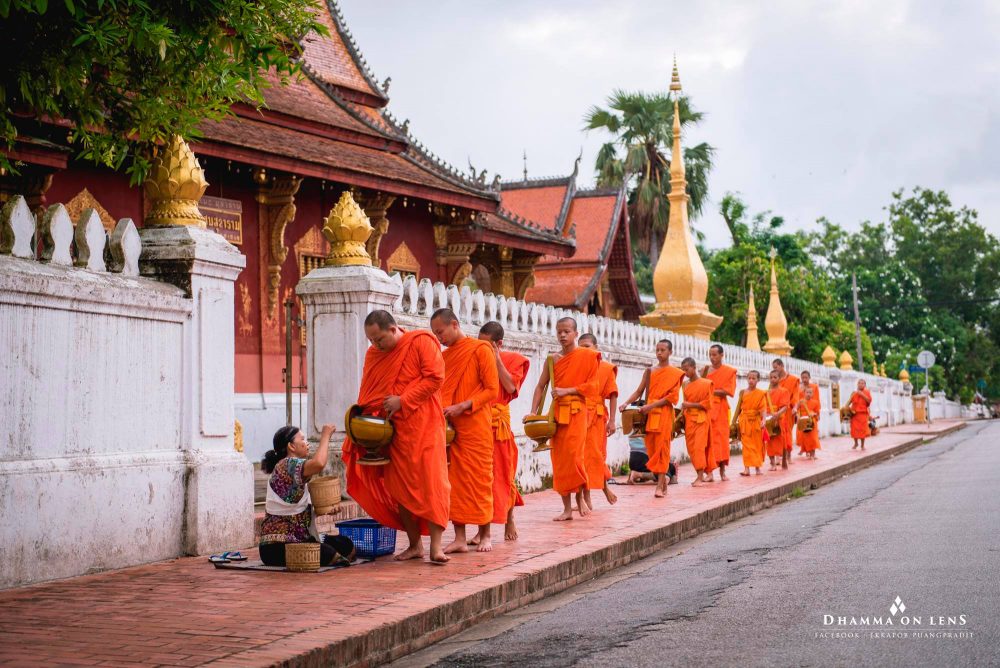
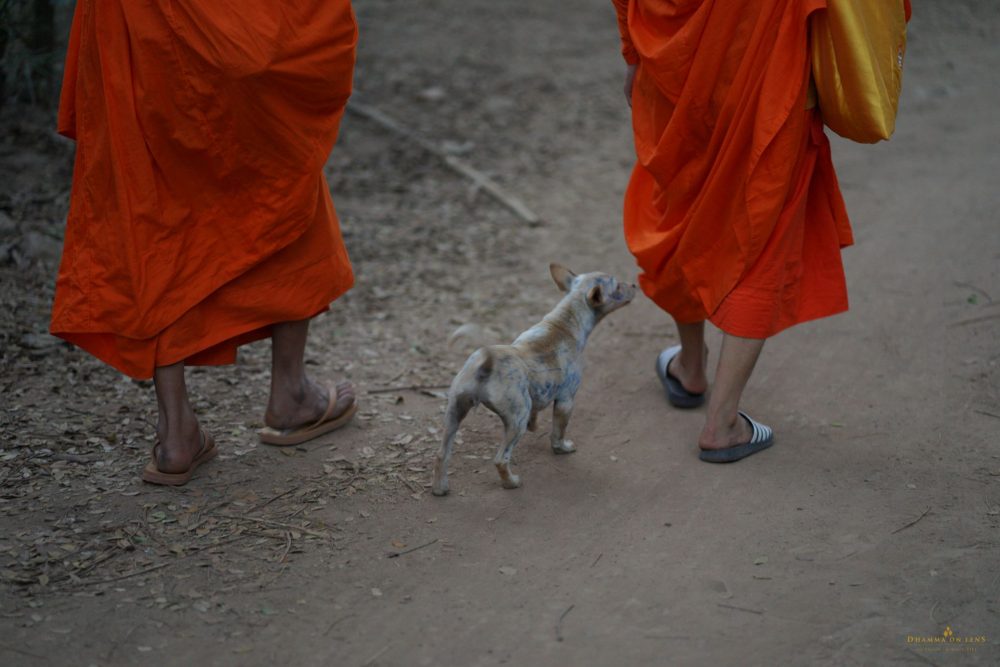
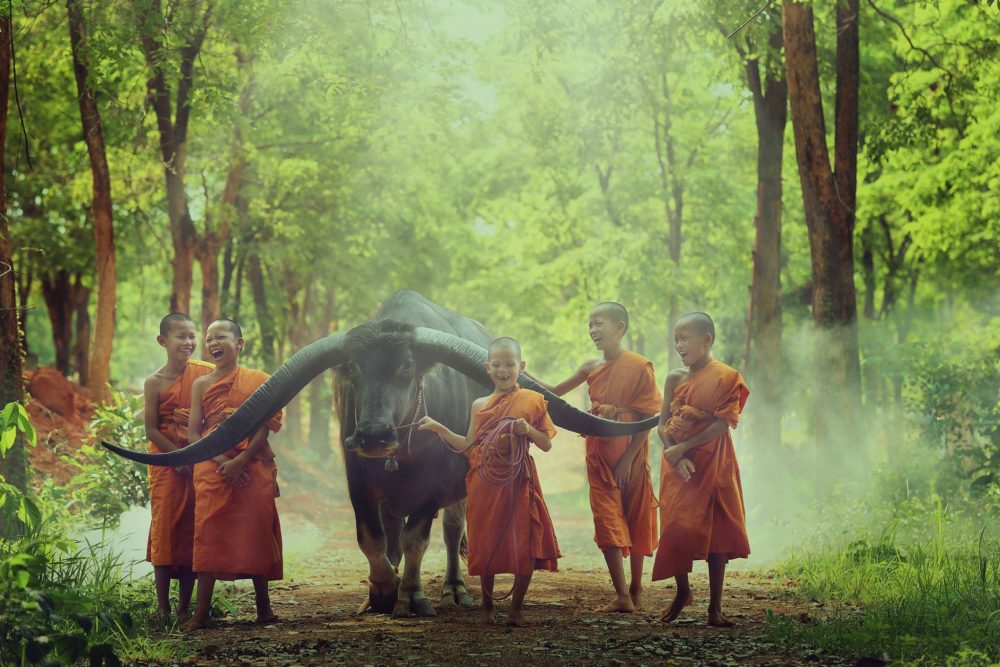
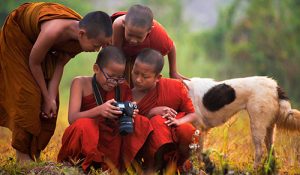
Most of the photos show unguarded moments of monks and novices interacting with each other and normal folks, or simply surrounded by nature. One shows a group of novices playing joyfully with a buffalo as tall as they are in a forest. Another shows a smudged stray dog running along the feet of two monks.
1 of 7
Photo: Ekkachai Arinthamo / Courtesy
Photo: Ekkachai Arinthamo / Courtesy
Photo: Ekkachai Arinthamo / Courtesy
Photo: Dhamma on Lens / Courtesy
Photo: Dhamma on Lens / Courtesy
Photo: Ekkachai Arinthamo / Courtesy
Photo: Dhamma on Lens / Courtesy
Ekkachai regularly shares these photos online, as he believes that showing religious practitioners in their most natural states would help promote Thai Buddhism better at home and abroad.
“Photography can communicate better globally if we do it well. The spoken language is limited to only Thai people,” he said. “I tried thinking about what people worldwide see when they think of Buddhism. They’d see the Mahayana, the Dalai Lama. … Why not Thailand? Is it because there’s no nice, natural photos [of us]?”
“If there are more photos of monks’ regular lives, we’d be able to communicate with folks better,” he said.
Resistance to Change
As society evolves, Ekkachai sees temple life becoming less important to people, and an institution in need of a new strategy to bring people in.
“Now society starts to wonder if monks and temples are still relevant to them,” he said. “Our role now is to support those who experience failure in the secular world. There are two types of people coming to temples: Those who suffer and those who see the suffering.”
That’s where his concepts of “natural, simple and tranquil” come into play with architectural design. He helped redesign not only Wat Nak Prok’s structures, but also its use of open space to create a serene environment that will attract people.
1 of 7
A praying room at Wat Nak Prok.
A praying room at Wat Nak Prok.
Wat Nak Prok's office building.
“Temples still lack architectural designs that conform to the needs of their local communities,” he said. “What can temples do to make people want to stay for hours, like they do in malls and hotels, without having to hear preaching or meditate?”
Ekkachai believes people yearn for escape from chaotic city life, and temples should offer that peaceful corner of the neighborhood where they can find respite.
Although he’s experienced a fair amount of negativity, namely abuse hurled at him online and conflict with traditionalist senior monks, he hopes the rigid notion of what a monk must be will evolve, and people, including monks themselves, will become more open to his way of thinking.
Photo: Dhamma on Lens / Courtesy
“It’s still not a 100-percent success, because there are conflicts between those who come to learn with me and their administrators who don’t see the value of this,” he said. “I want to show them that it has an indirect impact. Some have very good intentions coming to learn, but their ideas are then turned down by the puu yai.”
He says his project has also helped hone his inner thinking in being a better monk.
“This work is quite challenging to your ego. When I first started taking photos, I thought they were really beautiful. I put my name on them, boldly, because I wanted people to know. But then I’ve come to feel shame for doing that,” he said. “And when I started organizing workshops, it helped me learn to become more compassionate. It melted away my sense of possessiveness and self-pride.”
Ekkachai says he isn’t trying to change the religion, just its “shell” facing the public.
“If we make a nice shell, it can attract more people to the core of the religion,” he said. “It doesn’t matter in what way you’re doing it, as long as we’re aiming for the same goal with good intentions.”
See more of Ekkachai’s work online at his website, Facebook page and YouTube channel. Wat Nak Prok is about a 10-minute drive from BTS Wutthakat.
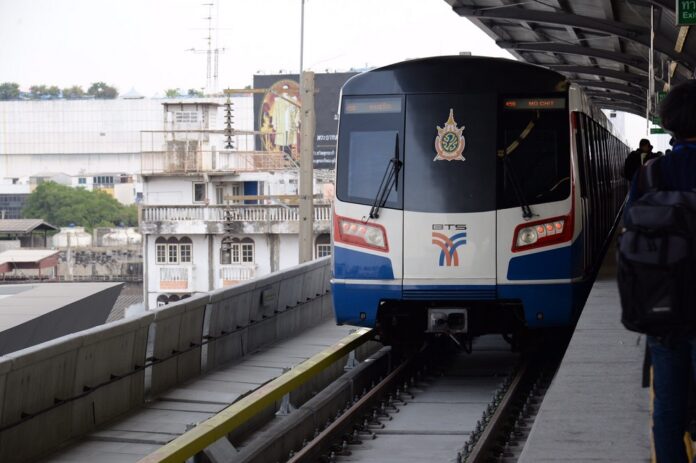
BANGKOK — Starting in nine days, commuters who pay their skytrain fares with top-up cards must give up their ID card numbers, email addresses and phone numbers to the system’s operator.
Citing a clause in 20-year-old anti-money legislation, the BTS said its so-called Rabbit Cards could be used for illicit financial activities and therefore must be registered. The explanation didn’t fly on social media, where many suspected ulterior motives.
“Starting this Feb. 15, when topping up cash or trips at BTS ticket offices and the Rabbit service center at BTS Siam station, staff will ask for your ID card for registration and verification,” the operator announced online earlier this week.
The statement said phone numbers and email address must also be provided. Foreigners must use their passports for registration. After Feb. 15, topping up without registration will not be possible.
The BTS said the Rabbit Cards, which can also be used for purchases at a number of shops and restaurants, could be used for money laundering. But netizens questioned how that could be feasible as the cards are capped at 4,000 baht.
Other systems are also citing the law to make similar demands, but they seem to be unrestricted debit cards that can be used to purchase anything. Users of TrueMoney Wallet, an online cash platform provided by telecom giant True, must also register their personal information by Feb. 28.
One transparency activist noted it was strange that the BTS was pushing for mass registration as the interim parliament is considering an online privacy bill that could be enacted any time soon.
“This is a pessimistic interpretation, but my life experience taught me not to be optimistic about these kind of issues,” Arthit Suriyawongkul wrote online. “The anti-money laundering act has existed for a long time, but they have never forced any registration prior to this.”
The privacy bill – Thailand’s first such law – will ban any use or transaction of personal information without users’ consent, but will also allow information collected prior to the bill’s enactment to be used “according to the original purposes.”
One comment on Blognone, a tech news site, warned that the personal information of BTS users is at risk under the new policy.
“If someday there’s a data breach of all names and surnames tied to all travel records, I wish you all good luck,” user Lew wrote.
“If [Rabbit Cards] can be used for money laundering, the BTS should issue regular top-up cards that can only be used for the BTS, which do not require any verification, just like food court cash cards,” another user Jonathan_Job wrote.
The exposure of private data is not uncommon in Thailand, where activists say there is little protection for users.
In 2017, the police inadvertabtly made information of 790,000 residents visited by police patrols public on their website. The information included names, full addresses, phone numbers and what they told visiting police officers.
A year later, True Corp. exposed scansof its customers national ID cards, passports and driver’s licenses. The firm later blamed the unsecured storage on “hacks.”
The BTS Skytrain is owned by City Hall which grants a management concession to the Bangkok Mass Transit System Co. Ltd..
FILE - In this June 12, 2018, file photo, North Korea leader Kim Jong Un, left, and U.S. President Donald Trump shake hands during their first meeting at the Capella resort on Sentosa Island in Singapore. Photo: Evan Vucci / Associated Press
BANGKOK — Vietnam’s selection as the venue for the second summit between President Donald Trump and North Korean leader Kim Jong Un is largely a matter of convenience and security, but not without bigger stakes.
Washington’s goal for the talks Feb. 27-28 is for North Korea to agree give up its nuclear weapons. North Korea frames the issue more broadly, seeking a removal of the “nuclear threat” from U.S. military forces in South Korea.
Host Vietnam hopes to boost its diplomatic leverage against its powerful neighbor, China, which contests waters in the South China Sea claimed by Hanoi.
But Vietnam’s history as a U.S. adversary that transitioned on its own terms to a dynamic free-market economy under a communist political system suggests a larger meaning for the summit.
“By choosing Vietnam, the two leaders send a strong strategic message to the world that they are willing to make a breakthrough decision to turn an enemy into a friend and together make the world a better place, following the example of the U.S.-Vietnam relationship,” said Le Hong Hiep, a research fellow at the ISEAS Yusof Ishak Institute in Singapore.
A FRESH, SECURE STAGE
America’s past military involvement in Vietnam, whether it’s seen as tragic or noble, provides a historically dramatic stage for Trump to again draw attention to his foreign policy accomplishments.
As a single-party communist state, Vietnam boasts tight political control and an efficient security apparatus, and successfully hosted the Asia-Pacific Economic Cooperation meetings in 2017, and the regional edition of the high-powered World Economic Forum last year, both in the central coastal city of Danang.
“Like Singapore, where they met last time, Vietnam is a very secure place,” said Murray Hiebert, senior associate of the Southeast Asia Program at the Center for Strategic and International Studies in Washington. “Vietnam’s security police are able to keep away crowds of the curious and keep journalists in designated areas.”
Trump’s attendance at the 2017 APEC meeting means “he’s familiar with the country and has good rapport with its leaders,” Hiebert said.
___
COMMUNIST TIES
This is friendly turf for Kim. Even though North Korea has remained mired in Cold War isolation while Vietnam’s postwar path led toward integration with the globalized economy, the two communist countries share a history of anti-imperialist struggle and ambivalent relations with common neighbor China.
“Vietnam and North Korea have long had fraternal communist ties, so North Korea is familiar with the country and its officials. North Korea would also feel confident that Vietnam’s security apparatus could secure Kim’s protection,” Hiebert said.
There’s also the bonus that a flight from Pyongyang to a meeting in Vietnam is roughly two-thirds of the six-hour flying time to Singapore, and none of it over hostile territory.
A forward-looking North Korea might learn something from Vietnam’s impressive economic growth due to “bold economic reforms, proactive integration into the world economy, and excellent partnerships with strategic partners, with the U.S. and South Korea among the most important ones,” said Vu Minh Khuong, associate professor at Singapore’s Lee Kuan Yew School of Public Policy.
U.S. Secretary of State Mike Pompeo made a similar point when he visited Hanoi last July after two days of talks in North Korea.
“The leaders of Vietnam realized their country could reform, it could open up and build relationships without threatening the country’s sovereignty, its independence, and its form of government,” he said in a speech to Hanoi’s business community. “I have a message for Chairman Kim Jong Un: President Trump believes your country can replicate this path. It’s yours if you’ll seize the moment.”
WHAT VIETNAM GAINS
“Vietnam is locked in a pretty intense rivalry with China in the South China Sea, so Hanoi is looking for regional and international diplomatic support as a hedge against Beijing, and hosting a summit like this would certainly strengthen its international profile,” said CSIS scholar Hiebert.
In particular, helping Washington achieve its Korean policy goals could help fulfill Vietnam’s desire for closer relations with the U.S., both to encourage trade and investment and serve as a strategic counterweight to China.
Trump’s abandonment of the Trans-Pacific Partnership free trade group dampened hopes for a takeoff in trade, and Vietnam’s poor human rights record, especially its harsh repression of political dissidents, has hurt chances for closer security links.
However, intense media coverage of the summit would attract significant international attention from tourists and investors, said research fellow Hiep.
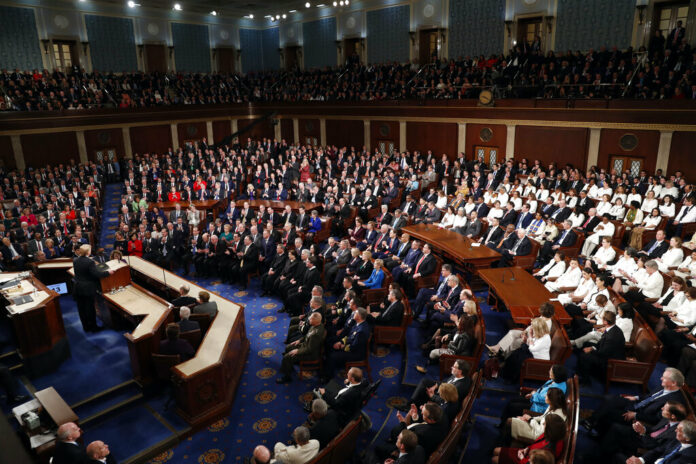
President Donald Trump on Tuesday delivers his State of the Union address to a joint session of Congress on Capitol Hill in Washington. Photo: J. Scott Applewhite / Associated Press
WASHINGTON — President Donald Trump said Tuesday that he will hold a two-day summit with North Korea leader Kim Jong Un Feb. 27-28 in Vietnam to continue his efforts to persuade Kim to give up his nuclear weapons.
Trump has said his outreach to Kim and their first meeting last June in Singapore opened a path to peace. But there is not yet a concrete plan for how denuclearization could be implemented.
Denuclearizing North Korea is something that has eluded the U.S. for more than two decades, since it was first learned that North Korea was close to acquiring the means for nuclear weapons.
“As part of a bold new diplomacy, we continue our historic push for peace on the Korean Peninsula,” Trump said in his State of the Union address.
Director of National Intelligence Dan Coats told Congress last week that U.S. intelligence officials do not believe Kim will eliminate his nuclear weapons or the capacity to build more because he believes they are key to the survival of the regime. Satellite video taken since the June summit has indicated North Korea is continuing to produce nuclear materials at its weapons factories.
Last year, North Korea released American detainees, suspended nuclear and long-range missile tests and dismantled a nuclear test site and parts of a rocket launch facility without the presence of outside experts.
It has repeatedly demanded that the United States reciprocate with measures such as sanctions relief, but Washington has called for North Korea to take steps such as providing a detailed account of its nuclear and missile facilities that would be inspected and dismantled under a potential deal.
At the second Trump-Kim summit, some experts say North Korea is likely to seek to trade the destruction of its main Yongbyon nuclear complex for a U.S. promise to formally declare the end of the 1950-53 Korean War, open a liaison office in Pyongyang and allow the North to resume some lucrative economic projects with South Korea.
“Our hostages have come home, nuclear testing has stopped, and there has not been a missile launch in 15 months,” Trump said. “If I had not been elected President of the United States, we would right now, in my opinion, be in a major war with North Korea.
“Much work remains to be done, but my relationship with Kim Jong Un is a good one,” he said in announcing their second meeting.
Stephen Biegun, Secretary of State Mike Pompeo’s special representative for North Korea, is hopeful, but acknowledges that many issues make it especially complicated for the two countries to “embark on a diplomatic initiative of this magnitude.” Biegun was in Pyongyang on Tuesday.
The Vietnamese city where the two leaders will meet was not announced. The country, however, is keen to project itself on the world stage. It is a single-party communist state that boasts of tight political control and a tough security apparatus similar to Singapore’s.
Where Singapore leans West, generally appreciative of U.S. influence in Asia, Vietnam leans East. Even with its edgy relationship with China, it has a long fraternal history with Asia’s communist states. This is friendly ground for Kim and closer than Singapore.
On a related issue, the State Department said this week that the U.S. and South Korea have reached a tentative agreement on sharing the costs of keeping 28,500 American troops in South Korea, but no final deal has been signed to replace the existing agreement, which expired at the end of 2018. South Korea pays more than $800 million a year, but Trump has demanded that Seoul pay 50 percent more.
News that a tentative agreement has been reached offers relief to those who worried Trump would use the lack of a deal as a reason to pull U.S. troops out of South Korea as part of negotiations with Kim. North Korea has claimed that the presence of American troops in the South is proof that the U.S. has hostile intentions in the region.
Trump said after his first meeting with Kim in June that while he’d like to bring troops home, “that’s not part of the equation right now.”
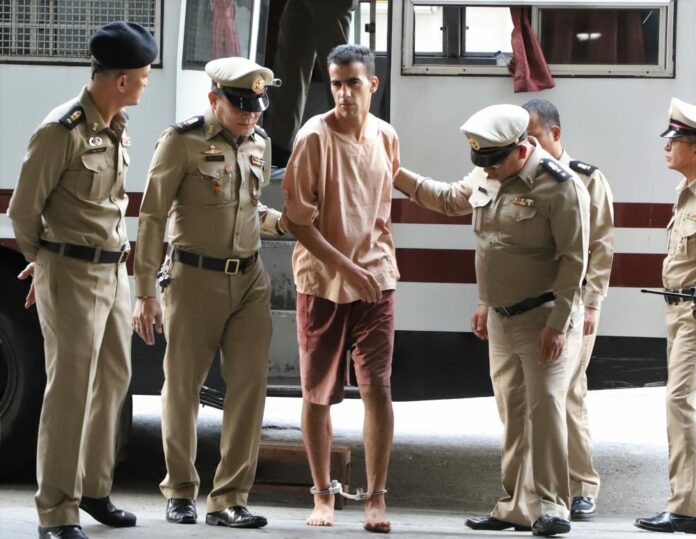
Hakeem AlAraibi is led by police Monday at the Criminal Court in Bangkok.
SYDNEY — Australian football authorities have canceled a game in Thailand to protest the continued detention in Bangkok of a refugee player who is fighting extradition to Bahrain.
Football Federation Australia announced Wednesday it had scrapped the game against China, a scheduled warmup ahead of next month’s qualifiers for the Asian under-23 championships.
Former Australia national team captain Craig Foster and the Australian and international players’ unions have been leading a campaign for the release of Hakeem al-Araibi, a refugee who lives and plays for a semi-professional club in Australia and has been held in Thailand since November at the request of Bahrain.
“Australia’s national teams are united in their support for Hakeem al-Araibi and we call on the community to continue to campaign for his release,” Australia coach Graham Arnold said.
The 25-year-old al-Araibi, a former Bahraini national team player, has said he fled his home country due to political repression and fears he is at risk of being tortured if he returns to Bahrain.
Al-Araibi’s supporters have said he should be freed and is protected under his status as a refugee with Australian residency. Foster and the players unions’ have called on the International Olympic Committee to consider sporting sanctions against Thailand and Bahrain.
The Australian government has urged Thailand to exercise its legal discretion to free al-Araibi, who told a Bangkok court on Monday that he refuses to be voluntarily extradited to Bahrain.
Al-Araibi will stay in custody until an April 22 trial to determine whether authorities will send him to Bahrain or release him so he can return to Australia.
A chained al-Araibi yelled to reporters outside court as he was escorted by prison guards into Monday’s hearing in Bangkok: “Please speak to Thailand, don’t send me to Bahrain. Bahrain won’t defend me.”
Bahrain wants al-Araibi returned to serve a 10-year prison sentence he received in absentia in 2014 for an alleged arson attack that damaged a police station, which he denies.