23.9 C
Bangkok
Monday, July 6, 2026
Home Blog Page 1736

Model in Russian Court Apologizes for US Election Claim

Anastasia Vashukevich, also known on social media as Nastya Rybka, on Saturday is escorted in the court room in Moscow, Russia. Photo: Alexander Zemlianichenko / Associated Press

MOSCOW — A Belarusian model and self-styled sex instructor who last year claimed to have evidence of Russian interference in the 2016 U.S. presidential election said Saturday that she apologizes to a Russian tycoon for the claim and won’t say more about the matter.

Anastasia Vashukevich made the statement in a Moscow court that was considering whether to keep her in jail as she faces charges of inducement to prostitution. The court extended her detention for three more days.

Vashukevich’s statement appears to head off any chance of her speaking to U.S. investigators looking into possible collusion between Russia and President Donald Trump’s campaign.

Vashukevich, who goes by the name Nastya Rybka on social media, was arrested in Thailand last February on prostitution charges. She and several others were arrested in connection with a sex training seminar they were holding in Thailand.

After her arrest she claimed she had audio tapes of Russian tycoon Oleg Deripaska, who is close to President Vladimir Putin, talking about interference in the U.S. election.

She had shot to world attention a few weeks earlier when a Russian opposition leader published an investigation based on her social media posts that suggested corrupt links between Deripaska and Deputy Prime Minister Sergei Prikhodko. The report featured video from Deripaska’s yacht in 2016, when Vashukevich says she was having an affair with him.

She was deported from Thailand on Thursday after pleading guilty and was detained when her flight arrived in Moscow, along with three other deportees including mentor Alexander Kirillov.

She told journalists in the Moscow court that she has apologized to Deripaska and says “I will no longer compromise him.”

Deripaska is among the Russian tycoons and officials who have been sanctioned in recent years by the United States in connection with Russia’s 2014 annexation of Crimea. His business empire includes aluminum, energy and construction assets.

He also once was a client of Paul Manafort, the former campaign manager for Trump. Manafort was convicted last year in the United States of tax and bank fraud.

Story: Jim Heintz

Advertisement

China 2018 Economic Growth Falls to 3-Decade Low

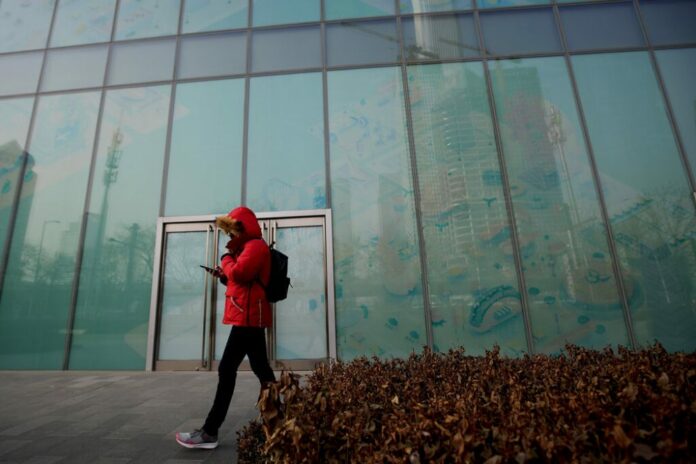
In this Jan. 12, 2019, photo, a man walks by a vacant retail space window panels at the Central Business District in Beijing. Photo: Andy Wong / Associated Press

BEIJING — China’s 2018 economic growth fell to a three-decade low as activity cooled amid a tariff war with Washington.

The world’s second-largest economy expanded by 6.6 percent over a year earlier, down from 2017’s 6.9 percent, official data showed Monday. Growth in the three months ending in December cooled to 6.4 percent from the previous quarter’s 6.5 percent.

Communist leaders are trying to steer China to slower, more self-sustaining growth based on consumer spending instead of trade and investment. But the slowdown has been sharper than expected, prompting Beijing to ease lending controls and step up government spending to shore up growth and avoid politically dangerous job losses.

Economic activity held up through most of 2018 despite President Donald Trump’s tariff hikes on Chinese imports in a fight over Beijing’s technology ambitions. But exports contracted in December as the penalties began to depress demand.

2018’s growth was the lowest since 1990’s 3.9 percent in the aftermath of the violent crackdown on pro-democracy protests centered on Beijing’s Tiananmen Square the year before.

Growth in investment, retail spending and other indicators all declined, the National Bureau of Statistics reported.

Advertisement

Native American Says He Tried to Ease Tensions at Mall

In this Friday, Jan. 18, 2019 image made from video provided by the Survival Media Agency, a teenager wearing a
In this Friday, Jan. 18, 2019 image made from video provided by the Survival Media Agency, a teenager wearing a "Make America Great Again" hat, center left, stands in front of an elderly Native American singing and playing a drum in Washington. Image: Associated Press

DETROIT — A Native American who was seen in online video being taunted outside the Lincoln Memorial said Sunday he felt compelled to get between two groups with his ceremonial drum to defuse a confrontation.

Nathan Phillips said in an interview with The Associated Press that he was trying to keep peace between some Kentucky high school students and a black religious group that was also on the National Mall on Friday. The students were participating in the March for Life, which drew thousands of anti-abortion protesters, and Phillips was attending the Indigenous Peoples March happening the same day.

“Something caused me to put myself between (them) — it was black and white,” said Phillips, who lives in Ypsilanti, Michigan. “What I saw was my country being torn apart. I couldn’t stand by and let that happen.”

Videos show a youth standing very close to Phillips and staring at him as he sang and played the drum. Other students — some in “Make America Great Again” hats and sweatshirts — were chanting, laughing and jeering.

Other videos also showed members of the religious group, who appear to be affiliated with the Black Hebrew Israelite movement, yelling disparaging and profane insults at the students, who taunt them in return. Video also shows the Native Americans being insulted by the small religious group as well.

The U.S. Park Police, who have authority for security on the Mall, were not taking calls from media during the partial government shutdown.

In a joint statement, the Roman Catholic Diocese of Covington and Covington Catholic High School apologized and said they are investigating and will take “appropriate action, up to and including expulsion.”

“We extend our deepest apologies to Mr. Phillips,” the diocese statement read. “This behavior is opposed to the Church’s teachings on the dignity and respect of the human person.”

As of Sunday morning, Covington Catholic’s Facebook page was not available and its Twitter feed was set to private. Calls to the school went unanswered Sunday.

According to the “Indian Country Today” website, Phillips is an Omaha elder and Vietnam War veteran who holds an annual ceremony honoring Native American veterans at Arlington National Cemetery.

Phillips said it was a difficult end to an otherwise great day, in which his group sought to highlight injustices against native people worldwide through marching and prayer. He said his first interaction with the students came when they entered an area permitted for the Indigenous Peoples March.

“They were making remarks to each other … (such as) ‘In my state those Indians are nothing but a bunch of drunks.’ How do I report that?” he said. “These young people were just roughshodding through our space, like what’s been going on for 500 years here — just walking through our territories, feeling like ‘this is ours.”

Nearby, the black religious activists were speaking about being the only true Israelites. Phillips said group members called the Native Americans “sell-outs.”

Marcus Frejo, a member of the Pawnee and Seminole tribes who is also known as Chief Quese Imc, said he had been a part of the march and was among a small group of people remaining after the rally when the boisterous students began chanting slogans such as “make America great” and then began doing the haka, a traditional Maori dance. In a phone interview, Frejo told the AP he felt they were mocking the dance.

One 11-minute video of the confrontation shows the Haka dance and students loudly chanting before Phillips and Frejo approached them.

Frejo said he joined Phillips to defuse the situation, singing the anthem from the American Indian Movement with both men beating out the tempo on hand drums.

During the incident, Phillips said he heard people chanting “Build that wall” or yelling, “Go back to the reservation.” At one point, he said, he sought to ascend to the Lincoln statue and “pray for our country.” Some students backed off, but one student wouldn’t let him move, he added.

Although he feared the crowd could turn ugly, Frejo said he was at peace singing despite the scorn. He briefly felt something special happen as they sang.

“They went from mocking us and laughing at us to singing with us. I heard it three times,” Frejo said. “That spirit moved through us, that drum, and it slowly started to move through some of those youths.”

Eventually, a calm fell over the gathering and it broke up.

The videos prompted a torrent of outrage online. Actress and activist Alyssa Milano tweeted that the footage “brought me to tears,” while actor Chris Evans tweeted that the students’ actions were “appalling” and “shameful.”

Covington Catholic High School, in the northern Kentucky city of Park Hills, was quiet Sunday as the area remained snow-covered with temperatures in the teens. The all-male school, which has more than 580 students, appeared deserted with an empty police car parked in front of the building.

The private school’s website describes its mission as being “to embrace the Gospel message of Jesus Christ in order to educate students spiritually, academically, physically and socially.”

Story: Jeff Karoub

Advertisement

Trump Says ‘Things Are Going Very Well’ With North Korea

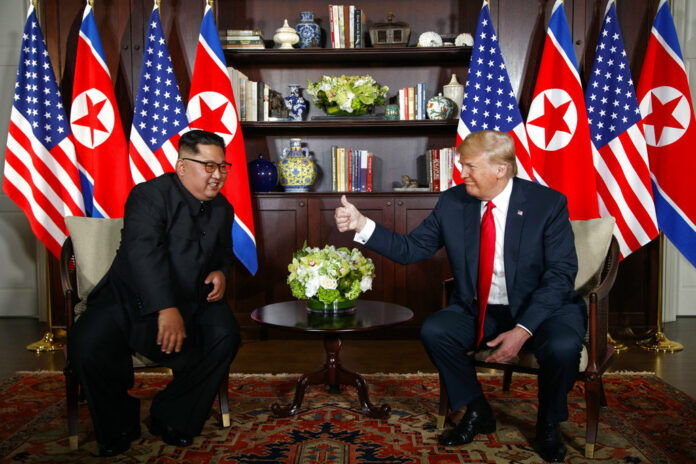
President Donald Trump meets with North Korean leader Kim Jong Un on Sentosa Island in Singapore on June 12, 2018. (AP Photo/Evan Vucci)

WASHINGTON — President Donald Trump said Saturday that “things are going very well with North Korea” and he plans a second summit with leader Kim Jong Un to try to broker a deal that would entice the North to give up its nuclear weapons.

“We’ve agreed to meet sometime probably the end of February. We’ve picked a country, but we’ll be announcing it in the future. Kim Jong Un is looking very forward to it and so am I,” the president told reporters Saturday at the White House.

The initial news of a second meeting with the reclusive North Korean leader came after Trump’s 90-minute session Friday in the Oval Office with a North Korean envoy, Kim Yong Chol, who traveled to Washington to discuss denuclearization talks.

“We have made a lot of progress as far as denuclearization is concerned and we’re talking about a lot of different things,” Trump said, adding it’s “not been reported, unfortunately, but it will be. Things are going very with North Korea.”

In May, North Korea released three American detainees and sent them home with Secretary of State Mike Pompeo after his meeting with the North Korean leader in Pyongyang.

The second summit signals stepped-up efforts by both countries to continue talks. Trump has exchanged letters with the North Korean leader amid little tangible progress on the vague denuclearization agreement reached at their first meeting last June in Singapore.

U.N. Secretary-General Antonio Guterres said “it’s high time” for serious negotiations between the United States and North Korea to outline a road map for the denuclearization of the Korean peninsula. The U.N. chief said New York on Friday that would allow both sides “to know exactly what the next steps will be, and to have predictability in the way negotiations take place.”

Trump has spoken several times of having a second summit early this year. Vietnam has been considered as a possible summit venue, along with Thailand, Hawaii and Singapore.

Since the Singapore talks, several private analysts have published reports detailing continuing North Korean development of nuclear and missile technology. A planned meeting between Pompeo and the envoy, who is North Korea’s former spy chief, in New York last November was abruptly canceled. U.S. officials said at the time that North Korea had called off the session.

The special U.S. envoy for North Korea negotiations, Steve Biegun, planned to travel to Sweden for further talks over the weekend.

The talks have stalled over North Korea’s refusal to provide a detailed accounting of its nuclear and missile facilities that would be used by inspectors to verify any deal to dismantle them. The North also has demanded that the U.S. end harsh economic penalties and provide security guarantees before it takes any steps beyond its initial suspension of nuclear and missile tests.

Harry Kazianis, a North Korea expert at the Center for National Interest, said any talks between the two nations are a positive development, but the hard work of negotiating an agreement has only begun.

As a possible first step, Kazianis said, North Korea could agree to close its nuclear centrifuge facility at Yongbyon in exchange for some relief from U.S. sanctions or a peace declaration ending the Korean War. The three-year war between North and South Korea ended in 1953 with an armistice, not a peace treaty.

South Korea said it expects the second summit between Trump and Kim to be “a turning point in firmly establishing a permanent peace on the Korean Peninsula.”

Kim expressed frustration in an annual New Year’s address over the lack of progress in negotiations. But on a visit to Beijing last week, he said North Korea would pursue a second summit “to achieve results that will be welcomed by the international community,” according to China’s official Xinhua News Agency.

Kim’s latest trip to China, his fourth since last year, came as the North’s strongest ally has encouraged negotiations with the U.S. while at the same time arguing in favor of an immediate easing of sanctions.

The U.S. and North Korea seemed close to war at points during 2017. The North staged a series of weapons tests that brought it closer to its nuclear goal of one day being able to target anywhere on the U.S. mainland. The two sides then turned to insulting each other: Trump called Kim “Little Rocket Man” and North Korea said Trump was a “dotard.”

Story: Matthew Lee, Feb Riechman

Advertisement

A Scaled-Down, But Still Angry, Women’s March Returns

A group hold up signs at freedom plaza during the women's march in Washington on Saturday, Jan. 19, 2019. Photo: Jose Luis Magana / Associated Press

WASHINGTON — Amid internal controversies and a capital city deeply distracted by the partial government shutdown, the third Women’s March returned to Washington on Saturday with an enduring message of anger and defiance aimed directly at President Donald Trump’s White House.

The original march in 2017, the day after Trump’s inauguration, flooded the city with pink-hatted protesters. The exact size of the turnout remains subject to a politically charged debate, but it’s generally regarded as the largest Washington protest since the Vietnam era.

This year was a more modest affair for multiple reasons. An estimated 100,000 protesters packed several blocks around Freedom Plaza, just east of the White House, holding a daylong rally. The march itself took about an hour and only moved about four blocks west along Pennsylvania Avenue past the Trump International Hotel before looping back to Freedom Plaza.

Organizers submitted a permit application estimating up to 500,000 participants even though it was widely expected that the turnout would be smaller. The original plan was to gather on the National Mall. But with the forecast calling for snow and freezing rain and the National Park Service no longer plowing snow because of the shutdown, organizers on Thursday changed the march’s location and route.

As it turned out the weather was chilly but otherwise pleasant, and the mood among the marchers a now-familiar mix of sister-power camaraderie and defiant anger toward Trump and the larger power structure. As always the Trump administration was the direct target of most of the abuse – with fresh bitterness stemming from more recent events like Supreme Court Justice Brett Kavanaugh’s successful confirmation last fall despite a direct accusation of sexual misconduct when he was in high school.

One sign declared, “Strong women only fear weak men.” Another stated, “MOOD: Still pretty mad about Kavanaugh.”

Parallel marches took place in dozens of cities around the country.

In Los Angeles, a few hundred demonstrators gathered in Pershing Square downtown and marched to Grand Park as the crowd swelled to thousands.

“Democracy is not a spectator sport and I came out to continue to stand for that proposition, said Ellen Klugman of Marina Del Rey. “If I don’t go, who will?”

In San Francisco, House Speaker Nancy Pelosi was in the march and video on Twitter showed people clapping and cheering as she passed.

In Denver, protester Jacquelynn Sigl said it’s a mistake to focus solely on Trump.

“It’s not OK, the rhetoric the president has today, but it’s also important to know this isn’t an anti-Trump rally,” she said. “This isn’t about him. It’s about the thought that’s running across the country right now.”

Preparations for this year’s march were roiled by an intense ideological debate among the movement’s senior leadership. In November, Teresa Shook, one of the movement’s founders, accused the four main leaders of the national march organization of anti-Semitism.

The accusation was leveled at two primary leaders: Linda Sarsour, a Palestinian-American who has frequently criticized Israeli policies, and Tamika Mallory, who has maintained a public association with Nation of Islam leader Louis Farrakhan.

Shook, a retired lawyer from Hawaii, has been credited with sparking the movement by creating a Facebook event that went viral and snowballed into the massive protest on Jan. 21, 2017. In a recent Facebook post, she claimed Sarsour and Mallory, along with fellow organizers Bob Bland and Carmen Perez, had “steered the Movement away from its true course” and called for all four to step down.

The four march organizers have denied the charge, but Sarsour has publicly expressed regret that they were not “faster and clearer in helping people understand our values.”

Despite pleas for unity, the internal tensions were most keenly felt in New York. An alternate women’s march organization held a parallel rally a few miles away from the official New York Women’s March protest, and one activist actually disrupted the main protest.

As New York march director Agunda Okeyo was making her opening remarks, an activist named Laura Loomer came on stage and shouted that the march “does not represent Jewish people” and called it “the real Nazi march.”

Loomer is a longtime political provocateur whose previous protests have included handcuffing herself to a Twitter office after the service banned her and jumping a fence at a home owned by House Speaker Nancy Pelosi.

As Loomer was ushered from the stage, Okeyo challenged her.

“This is not a negative day,” Okeyo said. “You’re not coming with that. We’re not doing that today. What we’re doing today is we’re going to uplift each other and we’re going to make sure we stay positive.”

Story: Ashraf Khalil

Advertisement

Students in ‘MAGA’ Hats Mock Native American After Rally

In this Friday, Jan. 18, 2019 image made from video provided by the Survival Media Agency, a teenager wearing a
In this Friday, Jan. 18, 2019 image made from video provided by the Survival Media Agency, a teenager wearing a "Make America Great Again" hat, center left, stands in front of an elderly Native American singing and playing a drum in Washington. Image: Associated Press

FRANKFORT, Kentucky — A diocese in Kentucky apologized Saturday after videos emerged showing students from a Catholic boys’ high school mocking Native Americans outside the Lincoln Memorial after a rally in Washington.

The Indigenous Peoples March in Washington on Friday coincided with the March for Life, which drew thousands of anti-abortion protesters, including a group from Covington Catholic High School in Park Hills.

Videos circulating online show a youth staring at and standing extremely close to Nathan Phillips, a 64-year-old Native American man singing and playing a drum.

Other students, some wearing Covington clothing and many wearing “Make America Great Again” hats and sweatshirts, surrounded them, chanting, laughing and jeering.

In a joint statement, the Roman Catholic Diocese of Covington and Covington Catholic High School apologized to Phillips. Officials said they are investigating and will take “appropriate action, up to and including expulsion.”

“We extend our deepest apologies to Mr. Phillips,” the statement read. “This behavior is opposed to the Church’s teachings on the dignity and respect of the human person.”

According to the “Indian Country Today” website, Phillips is an Omaha elder and Vietnam veteran who holds an annual ceremony honoring Native American veterans at Arlington National Cemetery.

Phillips told The Washington Post that the students and other apparent participants from the nearby March for Life rally were taunting the dispersing indigenous crowd. He said things were “getting ugly” and he tried to walk to the Lincoln Memorial to finish his song when the youth stood in front of him, blocking his path.

“When I was there singing, I heard them saying ‘Build that wall, build that wall,'” Phillips said, as he wiped away tears in a video posted on Instagram. “This is indigenous lands. We’re not supposed to have walls here. We never did.”

He told the newspaper that while he was drumming, he thought about his wife, Shoshana, who died of bone marrow cancer nearly four years ago, and the threats that indigenous communities around the world are facing.

“I felt like the spirit was talking through me,” Phillips said.

State Rep. Ruth Buffalo, a North Dakota state lawmaker and member of the Mandan, Hidatsa and Arikara Nation, said she was saddened to see students showing disrespect to an elder who is also a U.S. military veteran at what was supposed to be a celebration of all cultures.

“The behavior shown in that video is just a snapshot of what indigenous people have faced and are continuing to face,” Buffalo said.

She said she hoped it would lead to some kind of meeting with the students to provide education on issues facing Native Americans.

The videos prompted a torrent of outrage online. Actress and activist Alyssa Milano tweeted that the footage “brought me to tears,” while actor Chris Evans tweeted that the students’ actions were “appalling” and “shameful.”

U.S. Rep. Deb Haaland, D-New Mexico, who is a member of the Pueblo of Laguna and had been at the rally earlier in the day, used Twitter to sharply criticize what she called a “heartbreaking” display of “blatant hate, disrespect, and intolerance.”

Haaland, who is also Catholic, told The Associated Press she was particularly saddened to see the boys mocking an elder, who is revered in Native American culture. She placed some of the blame on President Donald Trump, who has used Indian names like Pocahontas as an insult.

“It is sad that we have a president who uses Native American women’s names as racial slurs and that’s an example that these kids are clearly following considering the fact that they had their ‘Make America Great Again’ hats on,” Haaland said. “He’s really brought out the worst in people.”

Story: Adam Beam, Brian Melley

Advertisement

The Shutdown Today: Trump Plans Major Announcement

President Donald Trump speaks at a Dec. 11 meeting with Democratic leaders in the Oval Office in Washington. Photo: Evan Vucci / Associated Press
President Donald Trump speaks at a Dec. 11 , 2018, meeting with Democratic leaders in the Oval Office in Washington. Photo: Evan Vucci / Associated Press

What’s up with the partial government shutdown on Day 29:


What’s New

President Donald Trump said he’ll be making a “major announcement” on the government shutdown and the southern border on Saturday afternoon as the standstill over his border wall continues into its fifth week.

The White House declined to provide details late Friday about what the president would be announcing. But Trump was not expected to sign the national emergency declaration he’s been threatening as an option to circumvent Congress.


Hitting Home

The partial government shutdown is hitting home for President Donald Trump in a very personal way. He lives in government-run housing, after all. Just 21 of the roughly 80 people who help care for the White House – from butlers to electricians to chefs – are reporting to work. The rest have been furloughed.

In the latest example of brinkmanship during the partial government shutdown, House Speaker Nancy Pelosi canceled her plans to travel by commercial plane to visit U.S. troops in Afghanistan, saying President Donald Trump had caused a security risk by talking about the trip.

The Democratic governors of Michigan, New York and Washington on Friday asked the Trump administration to let states offer unemployment benefits to federal employees who are working without pay during the partial government shutdown that began nearly a month ago.


Quotes of the Day

“Simply put, there is no rational justification to deny these employees the same short-term relief being offered to furloughed federal employees across the country,” said Democratic governors asking the Trump administration to let states offer unemployment benefits to those federal workers still on the job but not getting paid.

“We still have to make sure our kids eat, make sure to have a roof over their head,” said Shalique Caraballo, whose wife is a TSA worker in Atlanta. “We sweat in private and don’t let the kids see the struggle.”


What’s Coming Next?

President Trump says he will make a major announcement on the government shutdown and the southern border at 3 p.m. Saturday from the White House.


What Remains Closed

Nine of the 15 Cabinet-level departments have not been funded, including Agriculture, Homeland Security, State, Transportation, Interior and Justice. Some iconic National Park facilities are shuttered as are the Smithsonian museums and the National Zoo in Washington. Nearly everyone at NASA is being told to stay home.


Who is at Work But Not Getting Paid

An estimated 460,000 employees are working without pay, including at the FBI, TSA and other federal law enforcement offices. Also, about 340,000 workers have been furloughed. Some federal contractors have also discontinued their services, leaving thousands of employees temporarily without work and without a paycheck.

Advertisement

Opinion: A Land of Smiles So Easily Cracked by Conflict

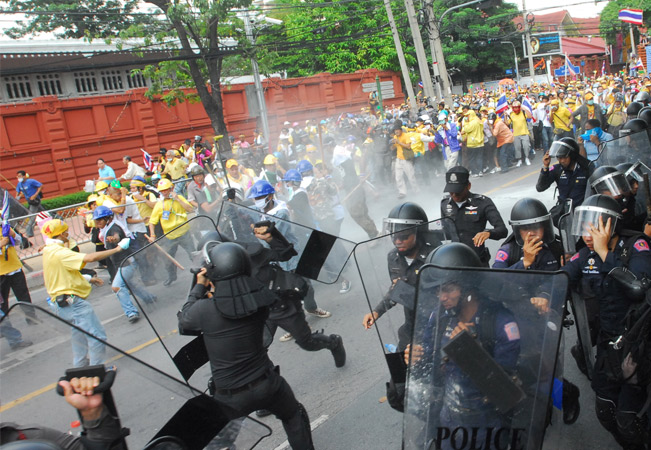
Riot police clash with protesters in front of the parliament on Oct. 7, 2008.

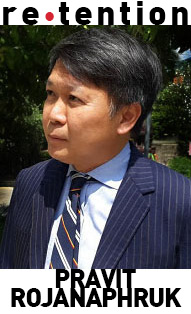
Re•tention: Pravit Rojanaphruk

A man was arrested Tuesday for killing his wife and her family of five in the northern province of Uttaradit. Another man arrested on the same day after killing his girlfriend after she ended their four-year-relationship and refused to be back with him – this time in the southern city of Hat Yai.

Using force to “end” unresolved conflicts – domestic or otherwise – is prevalent in Thailand.

All too often, men resorted to violence when their relationships turn sour. All too often, soldiers and some citizens resort to military coups in a bid to “solve” political conflicts.

All too often, censorship and self-censorship are used as replacements for discussing sensitive topics, particularly the monarchy.

This is a society in need of learning to deal with conflicts in a peaceful way. This is a society in need of learning to understand instead of forcing people to simply accept the brute force of power – military or otherwise.

Change can only come when Thai society recognizes that it is very bad at dealing with conflicts. On one hand, there is the myth of the Land of Smiles, where people coexist happily and in peace. On the other, when conflict avoidance no longer works, people resort to violence to suppress or kill the party of conflicts.

Many Thais tend to superficially avoid conflicts to the point where they do not know how to deal with them in a mature way when confronted with one.

Take Thai politics over the past dozen years, covering both the 2007 and the latest 2014 coups. What was it all about?

Was it just about Thaksin and Yingluck Shinawatra? Was it about suppression of anti-monarchist and republican sentiments? Was it about the military exploiting political conflicts for their own gain as they usurped power from the people twice in 12 years? Or was it about a society still deeply divided on what kind of political system best suits the country?

Discussing the role of the military junta is delicate enough, discussion the role of the monarchy in a critically way in Thailand without breaking the law is almost impossible.

How can we resolve conflicts and move forward as a nation then?

How can we move on as a nation when people in an open disagreement – such as the current call by a small number of demonstrators for an end to further postponements of the promised elections – are painted as troublemakers?

Just before the New Year, the Constitution Defense Monument – a monument marking the 1933 defeat of royalist rebels – was mysteriously removed and not reported by majority of the Thai press. It’s whereabouts are unknown and it could have simply been pulverized by now: yet another act of violence in trying to resolve historical conflicts.

What about the Deep South? It’s another failed spot for conflict resolution where so-called “peace talks” are heading nowhere, while deadly violence has flared up weekly for much of the past decade.

Many Thai Buddhists seem unwilling to find real solutions that would make Thai-Malay Muslims feel significantly more respected, such as allowing for elected governors on the three southernmost provinces of Pattani, Yala and Narathiwat.

Everywhere we look, Thais seem more adept at conflicts avoidance, to the point where when impossible to avoid, they don’t know how to deal with it peacefully and capably.

Without first admitting that we are so bad at conflict resolution and learning to resolve things peacefully, there won’t be any solution except more violence – domestic or national.

Advertisement

Myanmar Army Ordered to Take Offensive Against Arakan Army

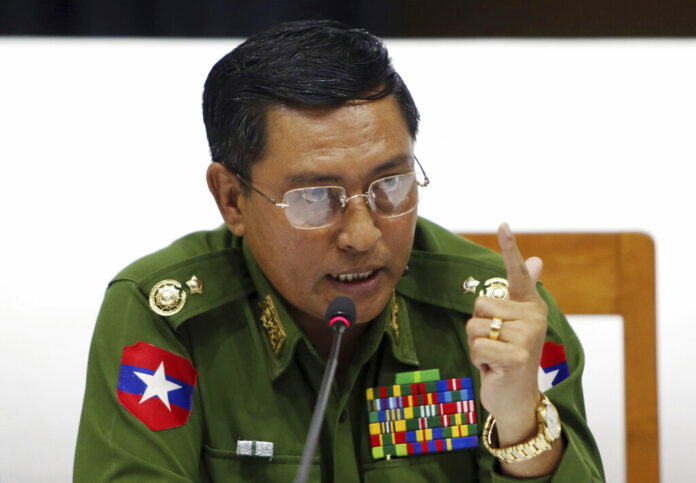
Maj. Gen. Soe Naing Oo, chairman of the Myanmar's military information committee, on Friday talks to journalists during a press conference at the Military Museum in Naypyitaw, Myanmar. Photo: Aung Shine Oo / Associated Press

NAYPYITAW — Myanmar’s military announced Friday that the Arakan Army, a Buddhist rebel group in Rakhine state, has been classified a terrorist organization after mounting a flurry of recent attacks.

The state earlier was the site of a brutal counterinsurgency campaign by the military against the Muslim Rohingya minority, causing more than 700,000 to flee to neighboring Bangladesh.

Military officers said at a news conference in the capital, Naypyitaw, that leader Aung San Suu Kyi ordered security forces to launch the offensive against the Arakan Army.

The insurgent group, which seeks autonomy from the central government, killed 13 police officers and wounded nine in attacks on Jan. 4. The moves to counter the rebels were decided at a Jan. 7 meeting at Myanmar’s presidential offices, the officers said.

Suu Kyi “said the Arakan Army is just a terrorist group and instructed us to defeat them effectively, quickly and clearly,” Maj. Gen. Nyi Nyi Tun, vice chairman of the Myanmar Military Information Committee, told reporters. A terrorist designation criminalizes a group and bans all communication with them.

He said Suu Kyi suggested that if she did not order the military to attack the Arakan Army, the international community would accuse her of religious prejudice for attacking the Muslim guerrillas of the Arakan Rohingya Salvation Army but not Buddhist rebels who committed similar actions with similar goals.

The military in Buddhist-majority Myanmar has been accused of ethnic cleansing, and even genocide, against the Muslim Rohingya. Its counterinsurgency campaign was triggered when a group of Rohingya guerrillas attacked security outposts in August 2017.

The officers said the military clashed with the Arakan Army 15 times in 2015, 26 times in 2016, 56 times in 2017 and 61 times in 2018, while the rebels also planted some mines. They said there have been at least eight armed encounters this year. The guerrillas are known to have trained in areas controlled by other ethnic rebel forces, especially in Kachin state.

The Arakan Army, founded in 2009, is estimated to have several thousand well-armed and organized uniformed members, in contrast to the ragtag and virtually dormant Rohingya guerrillas.

Myanmar’s military in December announced cease-fires in five areas where ethnic rebellions are active, but did not include Rakhine state because it had information that the Arakan Rohingya Salvation Army planned attacks, the officers said.

Brig. Gen. Zaw Min Tun said he believed that the fighting with the Arakan Army would not interfere with plans to repatriate Rohingya refugees from Bangladesh.

At U.N. headquarters in New York, Secretary-General Antonio Guterres spoke about his “enormous frustration with the lack of progress” by Myanmar’s government in creating conditions for the return of the more than 700,000 Rohingyas who fled to Bangladesh in 2017 and are living in “extremely difficult circumstances.”

“It is absolutely essential to create the conditions of confidence and trust,” he told a news conference. “It’s not only physical reconstruction, it’s a matter of reconciliation of communities and strong commitment by the government for that reconciliation of communities to be possible, and for the safety of the Rohingya population to be guaranteed.”

“Unfortunately, the truth is the situation on the ground has not been conducive to it. Things have been too slow,” he said. “One of the dramatic aspects when you fail in solving the root causes of the problem is that violence then tends to erupt again, and that’s what we have seen recently in Myanmar.”

“We insist in the need to create conditions for them to be willing to go back” to Myanmar, Guterres said.

One of first steps could be to solve the problem of the Rohingya who are internally displaced which would “give credibility” to future returns, he said.

Advertisement

Gunmen Kill 2 Monks in Southern Temple Attack

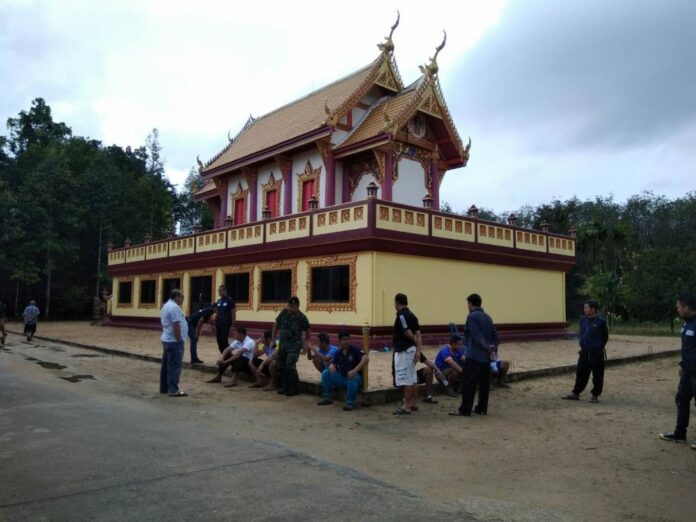
Authorities seen Saturday morning at the Rattana Nuphap Temple, hours after an attack that killed at least  two monks.

NARATHIWAT — Police on Saturday were still looking for the gunmen who attacked a temple in the Deep South, killing two Buddhist monks and injuring two others.

At about 8:30pm on Friday, an unknown number of gunmen attacked the monks at the Rattana Nuphap Temple in Narathiwat’s Su-ngai Padi district. The temple’s abbot, Prakru Prachote Rattananurak – also chief monk of the Sungai Padi district – died at the scene along with monk Phra Samu Auttapon Khun-ampai.

Another two monks were injured and sent for treatment.

The Army Area commander Lt. Gen. Pornsak Poolsawat ordered increased security measures at temples in the Deep South.

Government spokesman Puttipong Bunnakun said on Saturday morning that authorities are looking for the attackers.

Narathiwat is among the Deep South provinces, which have a major ethnic Muslim population.

1547867177766 e15478728136241547867181488 e1547872801753


Advertisement

Hot News

LATEST NEWS

Bangkok
light rain
23.9 ° C
26.6 °
23.9 °
56 %
2.8kmh
100 %
Sun
29 °
Mon
31 °
Tue
36 °
Wed
31 °
Thu
33 °