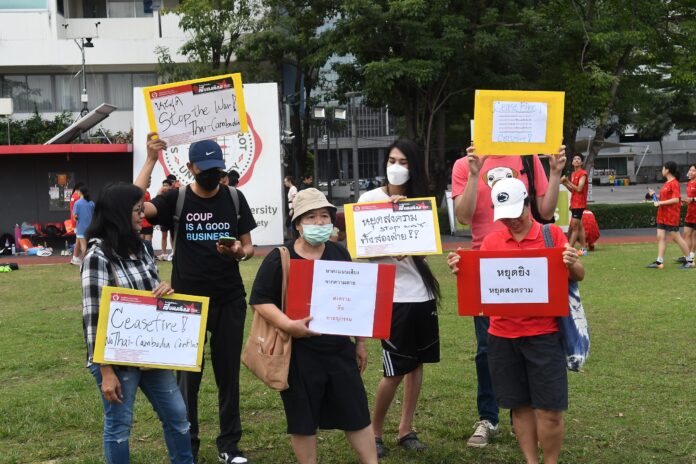





























A prominent senior social activist, Khun Chainarong Setthachua, posted on Facebook yesterday asking:
“…Why is Thai civil society, NGOs, and social activists relatively quiet about the border war? Or do they agree with the war?”
I responded: “The extreme nationalism instilled in schools since childhood—the fact that you managed to break free from it means you are exceptional. You should be asking yourself how you managed to get out of this parochial and nationalist mindset.”
Today, I would like to elaborate: Thai students are taught a single version of national history where Thailand is the protagonist:
- Burma (Myanmar) is the aggressor (despite Ayutthaya’s support for the Mon people was a major reason why Burma launched military campaigns against Ayutthaya which led to the first Fall of Ayutthaya);
- Various Malay (and Lao) city-states were intermittently rebellious and required suppression, including the burning of Vientiane; the Khmers (Cambodians) are portrayed as “cunning and untrustworthy”;
- The Western superpowers, which back then were Great Britain and France, carved away territories under Siam’s control that today became Laos, the northern states of Malaysia, the southern part of Myanmar, and Cambodia.
Simply put, Siam was once a mini imperial power in the region, acting like a big shot in the neighborhood who was then pressured by Britain and France, who snatched away territories that were loyal (or rather compelled to appear loyal) to Bangkok, caused France blamed for causing the problematic border demarcation between Thailand and Cambodia today.
Therefore, it is ‘not surprising’ that the majority of Thais today genuinely believe that we are still the protagonist, the righteous party, and that ‘Khmers are Khmers’— “cunning and untrustworthy” as always, just like in the era of Khmer sovereign Phraya Lawek (Nac Preah Sattha or Nak Preah Sattha) over four centuries ago.
Interestingly enough, the memories among Khmers today regarding that Lovek era of Cambodia is that Cambodians are taught that Thais couldn’t penetrate the well-built citadel, and eventually resorted to the trick by firing metal money into the bamboo fortress and retreated. The Khmer villagers eventually cleared the forest and were subsequently attacked.
“The episode shows Thai cunningness and Khmer naïveté and reminded Cambodians not to be fooled again and careful about Thai intentions,” a prominent Cambodian scholar wrote to me this morning upon reading the draft of this article on my Facebook page.
I told the Cambodian scholar, Prof Deth Sok Udom, a Professor of International Relations and the author of “A History of Cambodia-Thailand Diplomatic Relations, 1950-2020” that Yes, Thais remember that historical episode but was construed inThai history as “our ingenious tactic” however.
This led to my request for the Cambodian scholar to elaborate on the historical episode from the Cambodian collective memories.
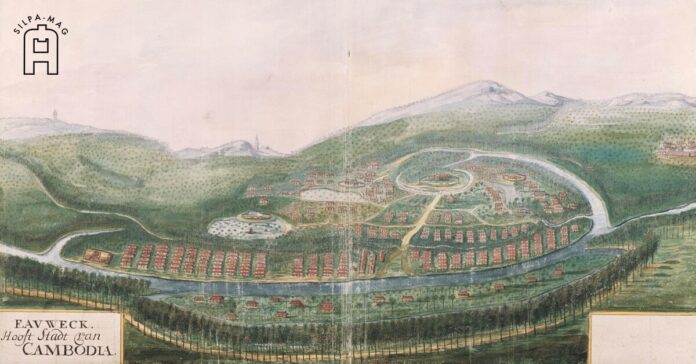
“According to the Cambodian chronicles, in earlier attacks, the Siamese couldn’t penetrate the well-built Lovek fortress. Cambodia’s chronicles mentioned that before his army retreated, [Thai King] Naresuan ordered his soldiers to fire silver coins from cannons into the thick bamboo forest, which was a source of strong protection for the capital of Longvek.
Once they withdrew, Cambodian people and soldiers started to clear the forest in a search for the silver coins. In the Khmer collective memory, the episode demonstrates Thai trickery and Khmer naiveté and reminded Cambodians not to be fooled again and be careful about Thai intentions.
“In reality, there are numerous factors also that the chronicles mentioned (as elaborated by Cambodian scholar Kimly Ngoun):
“The collapse of Longvek (in 1594), based on Cambodian chronicles, came from several causes. These included the strong and larger number of the Siamese forces, the loss of the thick bamboo forest that protected the city, and the anger and disappointment among local people and the King’s officials at King Satha’s inappropriate acts.
At the end of his reign, King Satha had crowned two of his young sons as kings while he himself was only in his late thirties. This caused disappointment among some of his officials and ordinary people.
The King’s admission of two male Thai spies disguised as Buddhist monks known by the names Tepanhao and Sophanhao into his palace in Longvek, and his destruction of Teverak statues (the local, magical god who protects the districts or kingdom) at the suggestion from the two fake monks, angered the people and his officials even more.
In addition, the loss of the thick and strong bamboo forest that had acted as the promising shield for the capital made the situation in the country even more chaotic. When occupying Lovek, the Siamese sacked and burnt the city. They destroyed everything that was immovable including various cult objects and statues which were worshipped by the Khmer […]
The destruction of Longvek and the removal of thousands of people including some royal family, intellectuals, skilled and religious men, precious texts, valuable things and statues to Siam were likely to have made Cambodia lose the necessary resources and manpower for rebuilding the country. The event of the capture of the capital is still in the memory of Cambodian people until the present day” (Ngoun, 2006, pp. 44-45).”
As for America, the Western superpower of today, Thai ultra-nationalists feel that US President Donald Trump should not be sticking his nose in or dictating how Thailand should handle Cambodia. Ultra-nationalists are proud at the Thailand that can say NO to the US.
And who is Malaysian Prime Minister [and ASEAN Chair] Anwar Ibrahim to dare announce a ceasefire on his Facebook page the other day—on Saturday, December 13, 2025—which Thai PM Anutin Charnvirakul chose to ignore because he is rapidly gaining votes (a ‘war for votes’ strategy) by portraying himself as a leader who can say NO to Trump (at least for a while, as Trump is busy with countless other issues: China-Taiwan-Japan, Venezuela, Russia-Ukraine, and Israel-Palestine, not to mention domestic issues in America like illegal immigration arrests and leaked private photos).
It is, therefore, not surprising but appalling that the war with Cambodia in 2025 harks back to the school-indoctrinated memories of not only of the era when Thailand lost its nominal authority over Cambodian leaders to France in 1867, over 150 years ago, and the era when the International Court of Justice (ICJ) ruled that the disputed Preah Vihear Temple belonged to Cambodia in 1962, 63 years ago.
This battle is thus like a rerun, informed by past collective memories of Thais, which includes the Phraya Longvek era, which the Ayutthaya Royal Chronicle states that the siege of Longvek and the execution took place in 1593, 432 years ago.
(However, academic evidence and Cambodian chronicles as well as Spanish records state that Phraya Longvek (Nak Preah Sattha), whom Thais were taught to remember as ‘rebellious and betraying’ Khmer king,’ managed to escape before the city fell to the Siamese forces in 1594.
_______