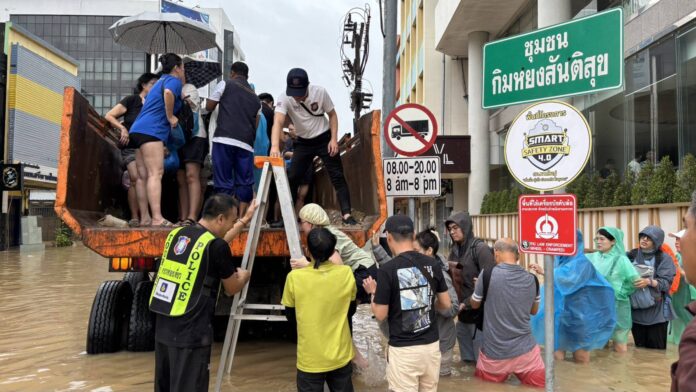
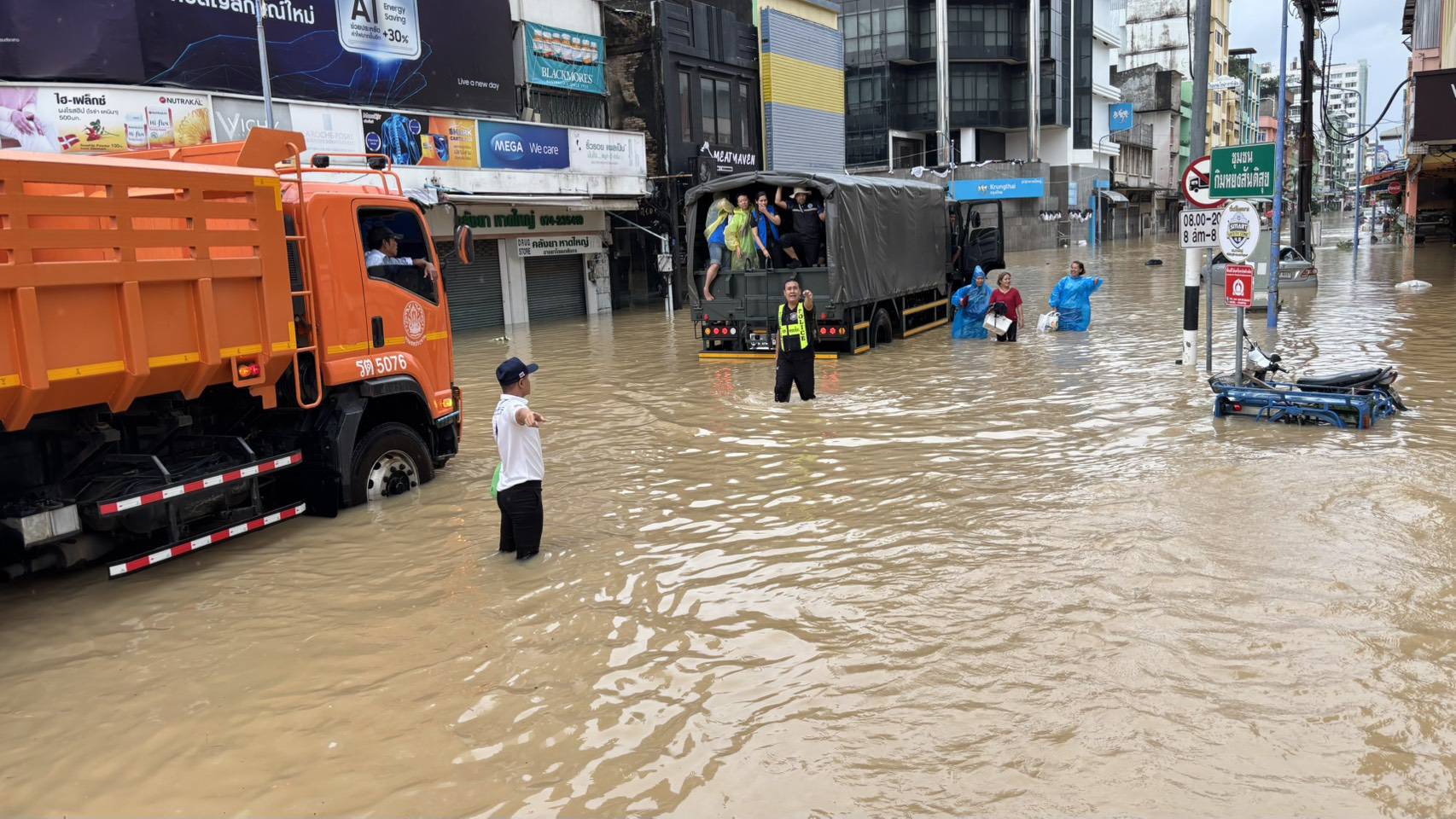
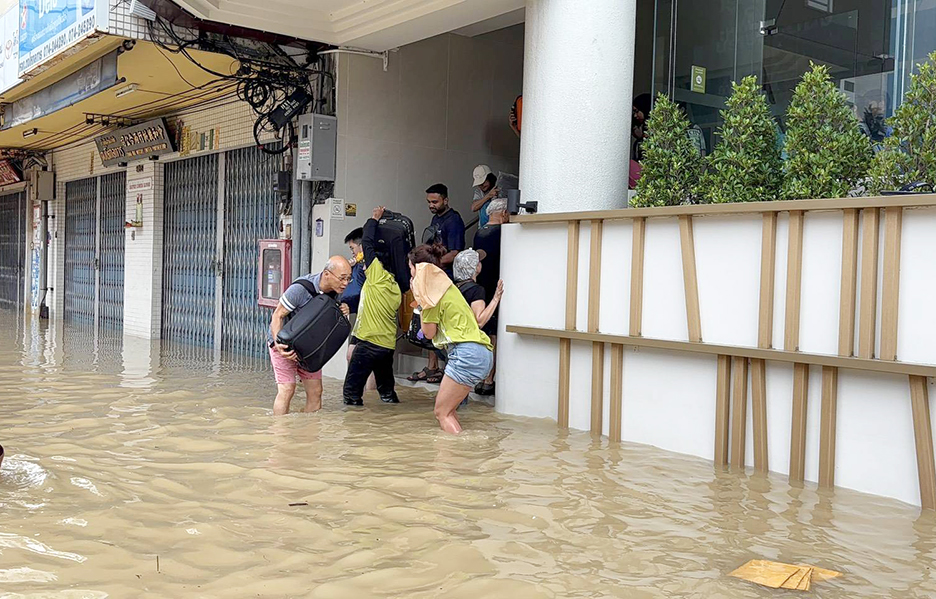
Authorities assist tourists onto high-clearance trucks after rising waters cut off access to hotels in Hat Yai on November 23, 2025.
HAT YAI — Thai authorities evacuated more than 400 tourists from flooded hotels in Hat Yai on Sunday as heavy rains continued to swamp parts of Songkhla Province, officials said.
Tourism and Sports Minister Sudawan Wangsuphakijkosol said on November 24 that agencies worked with embassies, hotel operators and local officials to locate stranded visitors and move them to safety. The Royal Irrigation Department deployed large trucks to ferry both foreign and Thai tourists from inundated areas to temporary shelters, she said, adding that food and water supplies were being provided.
Sudawan also voiced concern about preparations for the SEA Games, which Thailand is set to host December 9–20. Songkhla is one of three host provinces, and flooding has affected the planned Muay Thai venue. Backup sites in the province have been readied, and other sports can resume once waters recede, she said.
Tourists board government trucks during a mass evacuation from 17 flood-hit hotels in Hat Yai on November 23, 2025.
Authorities said 402 tourists from 17 hotels were transported to Hat Yai Municipality shelters on Sunday, with some taken onward to the city’s bus terminal. Malaysian visitors were escorted to the Sadao border checkpoint to catch buses home.
Officials have updated the Singapore Embassy, the Malaysian Consulate and the Indonesian Consulate on the situation and ongoing relief efforts.
Travel platform Agoda reported in July that Hat Yai has continued to rise in popularity as a tourist destination during the first half of 2025, particularly among visitors from Malaysia and Singapore. The city ranked among the top three best-value destinations in Asia for the second consecutive year.
Rescue teams transport visitors to temporary shelters as floodwaters inundate parts of Hat Yai on November 23, 2025.
Asst. Prof. Dr. Somporn Chuayaree of Prince of Songkla University’s Pattani Campus, an expert on southern weather and natural disasters, told BBC Thai that this year’s severe flooding in Hat Yai was primarily caused by unusually intense rainfall along a rain trough that passed directly over the district.
He explained that the heaviest downpours struck Khao Kho Hong, a mountain area on the eastern side of Hat Yai that is not part of the drainage route toward Songkhla Lake. As a result, large volumes of rainwater flowed straight into Hat Yai’s urban area along the mountain’s steep slopes. Combined with heavy rain that also fell directly on the city, this created the critical flooding levels seen this time.
In this Sunday, Nov. 23, 2025, photo, an emergency rescue team transports an elderly woman discovered to still be alive after being considered deceased to a local hospital before her scheduled cremation at Wat Rat Prakhong Tham temple, Nonthaburi province, Thailand. (Wat Rat Prakhong Tham via AP)
BANGKOK (AP) — A woman in Thailand shocked temple staff when she started moving in her coffin after being brought in for cremation.
Wat Rat Prakhong Tham, a Buddhist temple in the province of Nonthaburi on the outskirts of Bangkok, posted a video on its Facebook page, showing a woman lying in a white coffin in the back of a pick-up truck, slightly moving her arms and head, leaving temple staff bewildered.
Pairat Soodthoop, the temple’s general and financial affairs manager, told The Associated Press on Monday that the 65-year-old woman’s brother drove her from the province of Phitsanulok to be cremated.
He said they heard a faint knock coming from the coffin.
“I was a bit surprised, so I asked them to open the coffin, and everyone was startled,” he said. “I saw her opening her eyes slightly and knocking on the side of the coffin. She must have been knocking for quite some time.”
A relative and rescusers rush an elderly woman from Phitsanulok to a nearby hospital after she was discovered to be alive just moments before she was set to be cremated at a temple in Nonthaburi on November 23, 2025.
According to Pairat, the brother said his sister had been bedridden for about two years, when her health deteriorated and she became unresponsive, appearing to stop breathing two days ago. The brother then placed her in a coffin and made the 500-kilometer (300-mile) journey to a hospital in Bangkok, to which the woman had previously expressed a wish to donate her organs.
The hospital refused to accept the brother’s offer as he didn’t have an official death certificate, Pairat said. His temple offers a free cremation service, which is why the brother approached them on Sunday, but was also refused due to the missing document.
The temple manager said that while he was explaining how to get a death certificate when they heard the knocking. They then assessed her and sent her to a nearby hospital.
The abbot said the temple would cover her medical expenses, according to Pairat.
……………
Temple staff and rescue workers open the coffin after hearing knocking sounds from inside, discovering the elderly woman is still alive at Wat Rat Prakhong Tham temple, Nonthaburi province on Nov. 23, 2025.
Additional Report from Khaosod:
Doctors at Bang Yai Hospital, Nonthaburi, confirmed the elderly woman is stable with no respiratory or cardiac arrest detected. What relatives mistook for death was actually hypoglycemia (low blood sugar). She is receiving saline treatment and remains hospitalized under observation.
Wutthinarong Chanrat, Village Headman of Village 9, Ban Nam Thong Noi, Ban Dong Subdistrict, Chattrakarn District, Phitsanulok, admitted he did not thoroughly examine the woman. Knowing she had been bedridden for 2 years under her brother’s care, he assumed she had died as relatives believed and issued a death certificate so her body could be donated to a Bangkok hospital per her wishes.
Jeeno Thitikul of Thailand holds the CME Global Trophy for winning the LPGA Tour Championship golf tournament, Sunday, Nov. 23, 2025, in Naples, Fla. (AP Photo/Marta Lavandier)
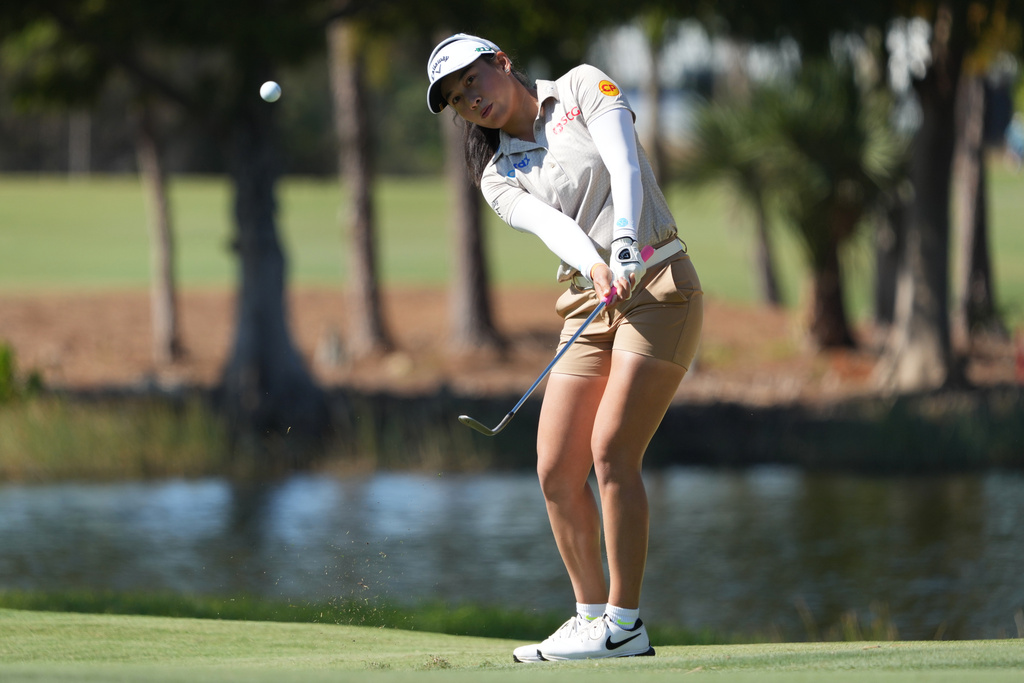
NAPLES, Fla. (AP) — Jeeno Thitikul of Thailand capped off her best year with the biggest cash prize in women’s golf, holding off an early challenge from Pajaree Anannarukarn and closing with a 4-under 68 to win the CME Group Tour Championship by four shots Sunday for another $4 million payoff.
Thitikul won for the third time this year on the LPGA Tour, and one last birdie on the final hole at Tiburon Golf Club gave her the lowest scoring average in tour history.
This was never really in doubt when Thitikul started with a six-shot lead over Nelly Korda, the American she replaced at No. 1 in the women’s world ranking this year.
Thitikul capped off her best year with the biggest payoff in women’s golf, along with her place in the LPGA record book with the lowest scoring average in the tour’s 75-year history.
Jeeno Thitikul of Thailand hits her ball on the first green during the final round of the LPGA Tour Championship golf tournament, Sunday, Nov. 23, 2025, in Naples, Fla. (AP Photo/Marta Lavandier)
As easy as she made it look Sunday with a four-shot victory in the CME Group Tour Championship, she has memories of the road not always being so smooth.
There was that four-putt finish to lose the Kroger Queen City Championship two months ago.
“I have the ice pack put in my eyes because I cried so bad,” she said.
Then came a wrist injury last week from the firm turf at home in Dallas that left her uncertain if she could get through four rounds at Tiburon Golf Club in the season finale, much less win. She curtailed practice sessions to help.
“I think earlier in the week I just saying be able to finish four rounds of golf here just more than I could ask for already,” she said. “But standing here with the trophy on Sunday, it’s just like more than I really, really could ask for for sure.”
Inside the ropes, she looked every bit as dominant as the No. 1 player in women’s golf.
Jeeno Thitikul of Thailand is surrounded by CME Global Trophy, the Bear Trophy and the Player of the Year Trophy following the LPGA Tour Championship golf tournament, Sunday, Nov. 23, 2025, in Naples, Fla. (AP Photo/Marta Lavandier)
Staked to a six-shot lead over Nelly Korda going into the final day at Tiburon Golf Club, Thitikul held off an early challenge from Pajaree Anannarukarn with a pair of birdies early on the back nine and sailed home with a 4-under 68 and a second straight title in the CME Group Tour Championship.
That meant another check for $4 million, the largest in women’s golf, pushing her season earnings to $7,578,300. That final birdie from 10 feet allowed her to break Annika Sorenstam’s scoring record by the slimmest of margins — 68.681 for Thitikul, 68.697 for Sorenstam in 2002.
“I mean, like never, ever dreaming having that record at all,” she said. “And then one time that I can be the lowest score average in my whole career should be really amazing.”
What she didn’t know was how close it got at one point Sunday.
Jeeno Thitikul of Thailand, center, celebrates after winning the LPGA Tour Championship golf tournament, Sunday, Nov. 23, 2025, in Naples, Fla. (AP Photo/Marta Lavandier)
Anannarukarn, playing in the group ahead of her fellow Thai, ran off five birdies in seven holes at the start to close the gap to two shots. It remained a two-shot lead going to the back nine.
But then Thitikul birdied the 10th and the 13th, and Anannarukarn dropped a shot at the par-3 12th. The lead was back to five shots and Thitikul was home free. She just didn’t look at a leaderboard until she got to the par-5 17th, unaware that her Thai friend was on her heels.
Thitikul raised both arms when the final birdie dropped, and before long she was getting soaked with bubbly on the 18th green. Thitikul, who finished at 26-under 262, joined Jin Young Ko as the only back-to-back winners of the CME Group Tour Championship.
Jeeno Thitikul of Thailand kisses the CME Global Trophy after winning the LPGA Tour Championship golf tournament, Sunday, Nov. 23, 2025, in Naples, Fla. (AP Photo/Marta Lavandier)
The victory also assured her winning LPGA player of the year, an outcome that was already decided because Women’s British Open champion Miyu Yamashita would have had to win.
Korda, replaced by Thitikul at No. 1 in women’s golf, became the first player since Tiger Woods in 2010 to go from seven wins in one season to none the following year.
She faced long odds at six shots behind to start the day and fell further back with one bogey and no birdies on the front nine. She holed out for eagle on No. 11 and shot 31 on the back a 68 to finish third. Korda still has the mixed-team Grant Thornton Invitational and the PNC Championship with her father next month.
Asked to describe the year, Korda said, “A grind.”
“I feel like there was a lot of ups and downs and it made me grow a lot mentally, and I would say I’m just also very grateful for it because success is never linear,” she said.
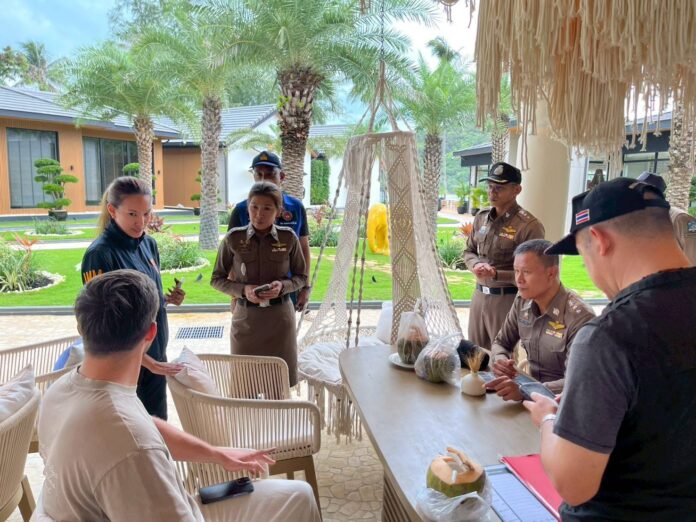
Authorities question a Ukrainian man during an inspection of the luxury villa construction project on Koh Phangan, November 21, 2025.
KOH PHANGNAN — Authorities are investigating a luxury beachfront villa development on Koh Phangan, Sutat Thani Province after discovering suspicious use of Thai nominees by Ukrainian investors holding shares in two companies with combined registered capital exceeding 100 million baht ($3 million).
The investigation stems from the November 4 arrest of an Azerbaijani national for working illegally as an electrician without authorization. Further investigation revealed connections to two limited companies suspected of being the actual employers, raising concerns about nominee arrangements.
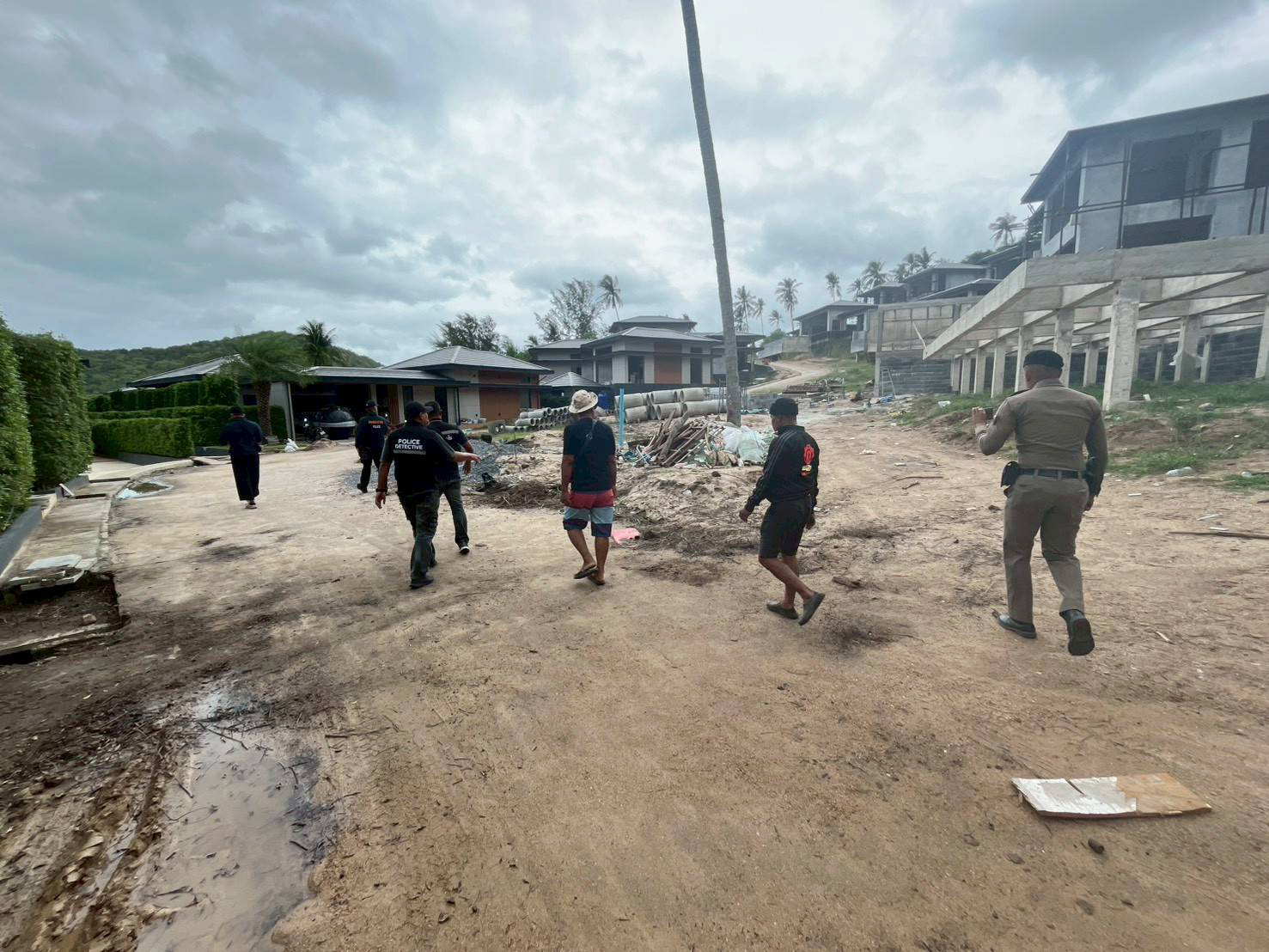
Authorities conduct an inspection at the luxury villa construction project on Koh Phangan, where units are priced at $1.8 million each, November 21, 2025.
Joint Operation Launched
Pol. Maj. Gen. Suwat Suksri, Commander of Surat Thani Provincial Police, ordered relevant agencies—including Immigration Police, Tourist Police, and Koh Phangan District Administration—to inspect the villa construction project near Koh Koma in Moo 8. The operation aimed to determine whether foreigners had violated the law and were using nominee structures.
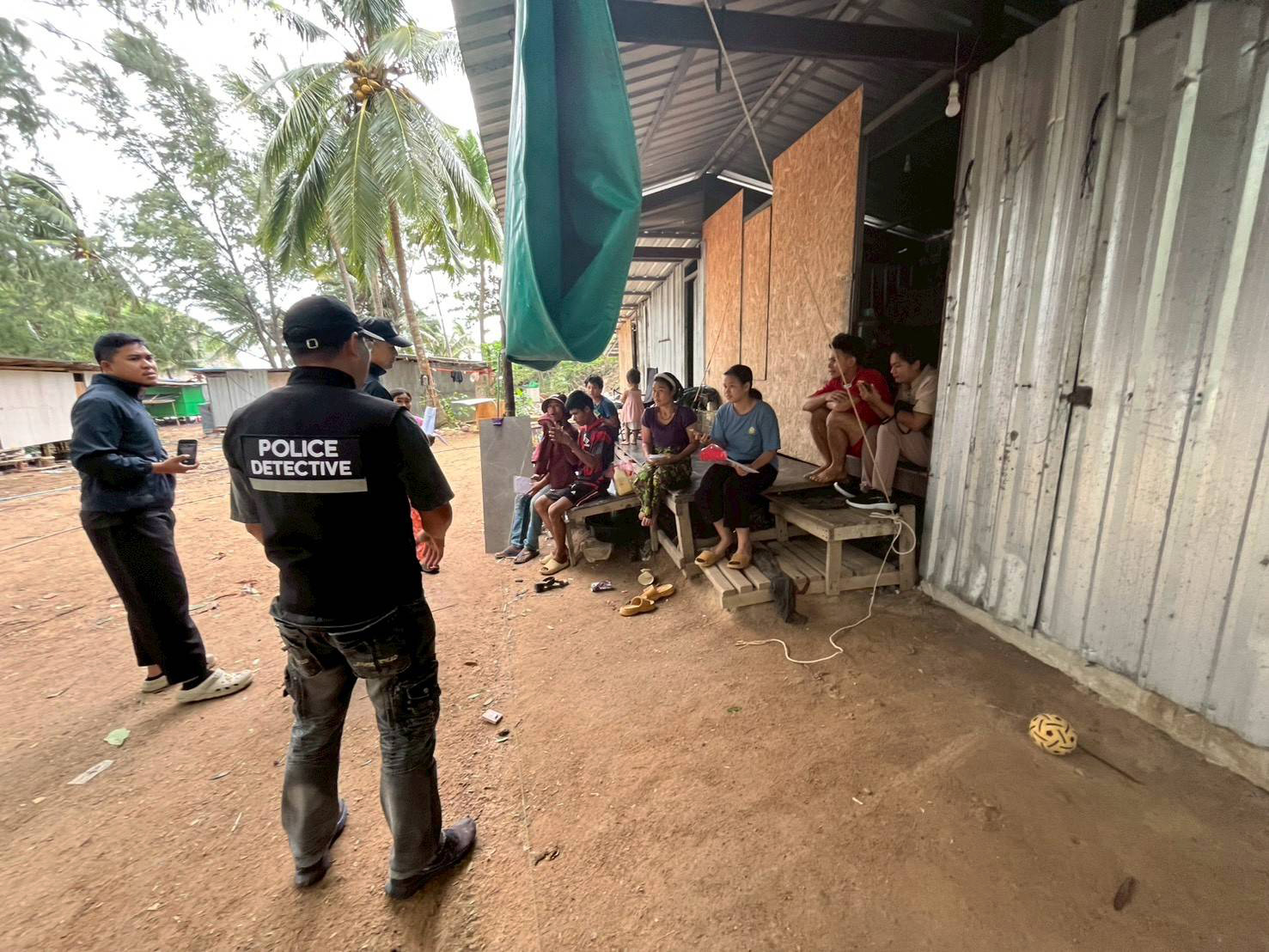
The inspection uncovered evidence of a foreign network operating businesses illegally through nominee arrangements, using Thai nationals as proxy shareholders in the two companies with combined registered capital of over $30,870. Authorities also discovered one Myanmar national working illegally at the construction site who had entered the country without authorization. Legal action was taken against him for being a foreign national in the Kingdom without permission.
Officials inspect workers at the luxury villa construction site on Koh Phangan, where they discovered one illegal Myanmar migrant, November 21, 2025.
Thai Nominee Structure
Pol. Col. Apichat Chansomret, Superintendent of Koh Phangan Police Station, revealed that the villa construction project’s key concern is its management structure. While the managing director is Ukrainian, investigation of the shareholding structure revealed the use of Thai nominees as proxy shareholders to circumvent legal restrictions on foreign business ownership.
The project is marketing villas at prices as high as 59 million baht ($1,821,270) per unit. Currently, over 20 units are under construction. Authorities are gathering evidence to pursue legal action against all parties involved, both for illegal employment practices and violations under the Foreign Business Act.
The case highlights ongoing efforts by Thai authorities to crack down on foreign investors using nominee structures to bypass laws restricting foreign ownership in certain business sectors.
Investigators question Lee, a South Korean suspect accused of joining three Thai men in the kidnapping and assault of a Chinese national, following his arrest in Bangkok on Nov. 23, 2025.
BANGKOK — Thai police have arrested a 46-year-old South Korean man accused of working with three Thai nationals to kidnap, assault and rob a Chinese man of more than $10,000 in cash and cryptocurrency earlier this month. The suspect, identified only as Lee, denies the charges and claims the victim owed him money.
Lee was taken into custody on Nov. 23 at a condominium on Sukhumvit Soi 24 in Bangkok, more than three weeks after the attack. Investigators from the Metropolitan Police Bureau and Bang Rak Police Station carried out the arrest.
The 35-year-old Chinese victim told police he was waiting for a taxi on Mahaseth Road on Nov. 1 when three men — two Thais and one South Korean — pulled up in a Toyota sedan, punched him and forced him into the vehicle. He said he was taken to an underground parking area at an unknown location, where the group beat him, stole 50,000 baht (about $1,540) from his bag and forced him to transfer 9,375 USDT in digital currency to an account linked to Lee.
Thai police arrest a 46-year-old South Korean man, identified as Lee, at his condominium on Sukhumvit Soi 24 in Bangkok on Nov. 23, 2025, for allegedly taking part in the kidnapping and robbery of a Chinese national.
The victim said he was released near Saensuk Soi beside Maleenont Tower on Rama IV Road after the transfers.
Police arrested the first suspect, Nattapong, 35, at Suvarnabhumi Airport on Nov. 10. A second suspect, Chanon, 24, was arrested on Nov. 12, followed by Tanaphat, 29, on Nov. 18. Lee was the last to be detained.
Investigators said Chanon and Tanaphat were recruited by Nattapong, who knew Lee. Police said the two younger Thai suspects did not receive any of the stolen money.
All four suspects face charges of robbery using a vehicle, illegal detention, and assault causing physical or mental harm.
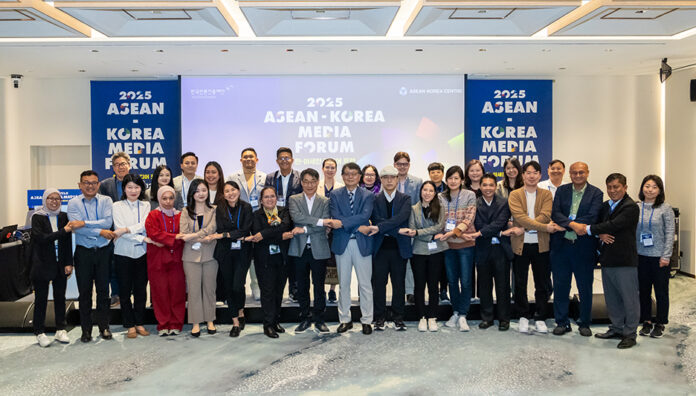
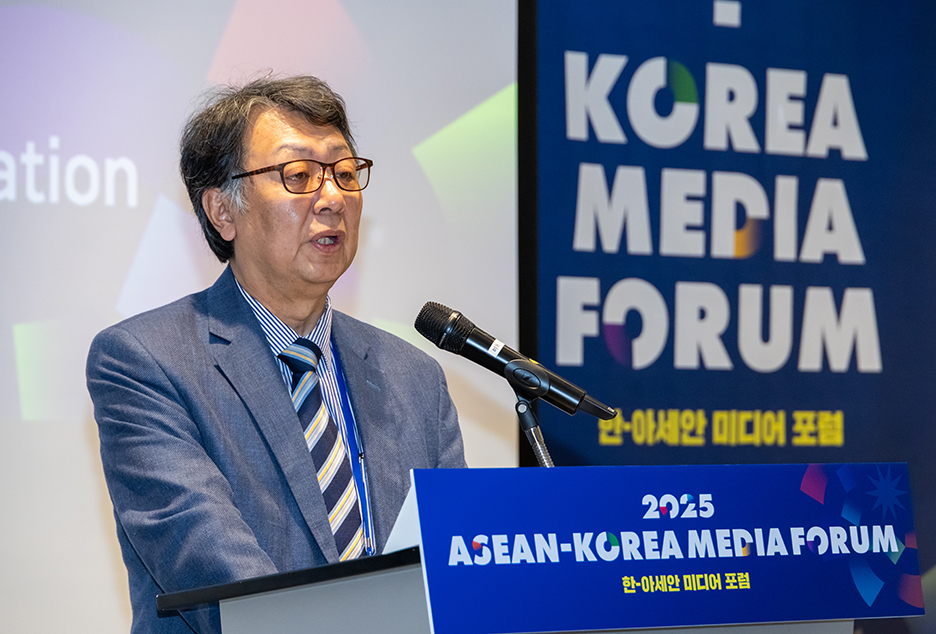
Journalists from ASEAN and South Korea, along with the Secretary-General of the ASEAN-Korea Centre, attend the Media Summit at Parnas Jeju Hotel on Nov. 12, 2025. (Photo: ASEAN-KOREA CENTRE - AKC)
J ournalists, policymakers, and media professionals from Southeast Asia and South Korea convened on November 12 at the Parnas Jeju Hotel for the ASEAN-Korea Media Forum 2025 the first such gathering since 2019 and the first following the launch of the ASEAN-ROK Comprehensive Strategic Partnership (CSP) in October 2024. The forum was a centerpiece of ASEAN Week 2025, a five-day program spanning Seoul, Jeju, and Ilsan, aimed at strengthening political, cultural, and economic ties between the regions.
Organized jointly by the ASEAN-Korea Centre (AKC) and the Korea Press Foundation, the event brought together 20 journalists across ASEAN, alongside South Korean media representatives.
Opening remarks were delivered by Kim Jae-Shin, Secretary-General of the ASEAN-Korea Centre, and Nam Jeong-ho, Executive Director of the Korea Press Foundation. Kim stressed the forum’s role as a platform for idea exchange and cooperation. “Despite geographic proximity, ASEAN and Korea still need to deepen understanding beyond trade and tourism,” he said. “Through this forum, we aim to gather insights from journalists to reflect on the future of ASEAN-Korea relations, enhancing cultural exchange and media collaboration.”
Kim Jae-Shin, Secretary-General of the ASEAN-Korea Centre (Photo: ASEAN-KOREA CENTRE – AKC)Nam Jeong-ho, Executive Director of the Korea Press Foundation (Photo: ASEAN-KOREA CENTRE – AKC)
Nam highlighted the growing integration of ASEAN nationals into Korean society. “ASEAN is no longer a distant region. Workers from ASEAN are essential contributors, and marriages between citizens of both regions are increasing.
Trade between Korea and ASEAN has grown 1.5 times over the past decade, surpassing Korea’s growth with the European Union.” Last year, 9.6 million Koreans traveled to ASEAN countries, while 2.5 million ASEAN nationals visited Korea. Currently, 36% of registered foreigners and 42% of international students in Korea come from ASEAN nations.
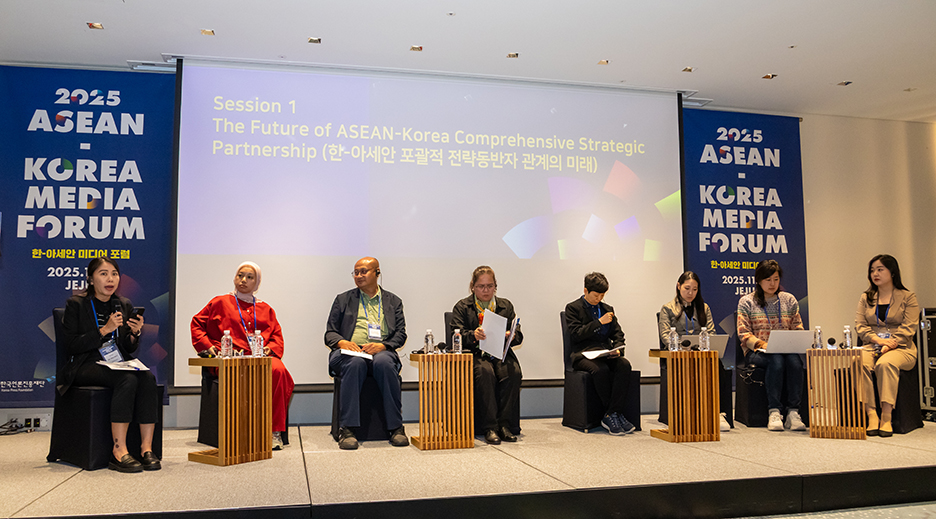
The forum featured two main sessions. The first, “The Future of the ASEAN-Korea Comprehensive Strategic Partnership,” brought together journalists from Brunei, Laos, the Philippines, Thailand, and South Korea to discuss shared values, trust, and collaboration opportunities in digital innovation, green energy, and storytelling for digital-native audiences. Panelists emphasized media’s pivotal role in connecting policymakers, communities, and private sectors across the region.
Journalists from Brunei, Laos, the Philippines, and South Korea discussed digital innovation, green energy, and storytelling at the first session. (Photo: ASEAN-KOREA CENTRE – AKC)
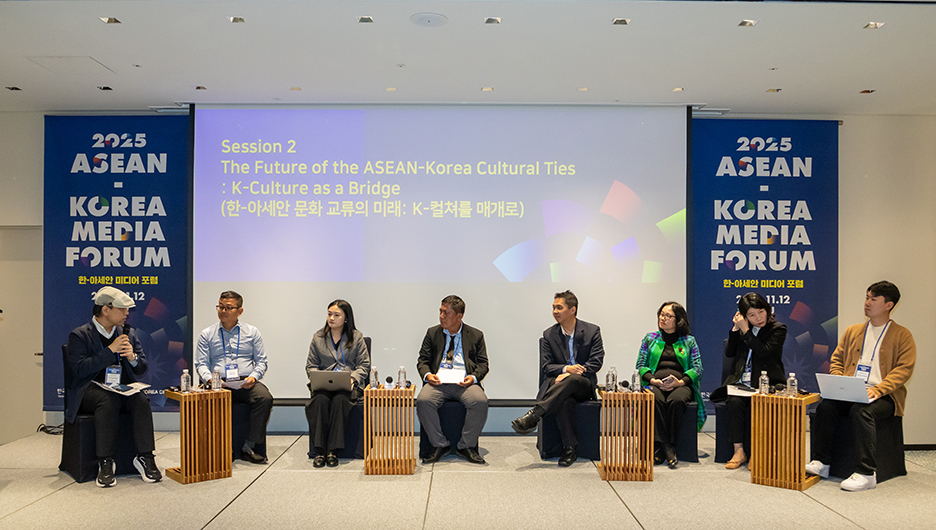
The second session, “The Future of ASEAN-Korea Cultural Exchange: K-Culture as a Bridge,” explored the influence of Korean culture in ASEAN countries. Journalists from Cambodia, Indonesia, Myanmar, Singapore, and Vietnam shared insights on K-pop, K-dramas, and other cultural exports. Discussions also addressed challenges like online scams targeting South Korean nationals. Cambodian journalist Hong Raksmey described Korean culture as a “sharp weapon,” urging media to humanize victims and promote responsible awareness campaigns rather than sensationalist coverage.
Journalists from Cambodia, Indonesia, Myanmar, Singapore, and Vietnam discuss K-pop, K-dramas, and Korean cultural influence in ASEAN at the second session. (Photo: ASEAN-KOREA CENTRE – AKC)
Vietnam News journalist Nguyen My Ha stressed the importance of reciprocal cultural exchange. While K-culture is widely embraced in Vietnam kimchi is now common in markets misunderstandings persist, especially in labor and social contexts. She noted that Korean supervisors in Vietnamese factories are sometimes seen as overly strict, highlighting a cultural gap between Korean directness and Vietnamese coping strategies rooted in humor.
Ha further observed that Vietnamese migrants, including workers and brides, are increasingly integrating into Korean society, contributing their traditions, language, and cuisine. “These ties go way back Vietnamese-Korean connections date to the 13th century,” she noted.
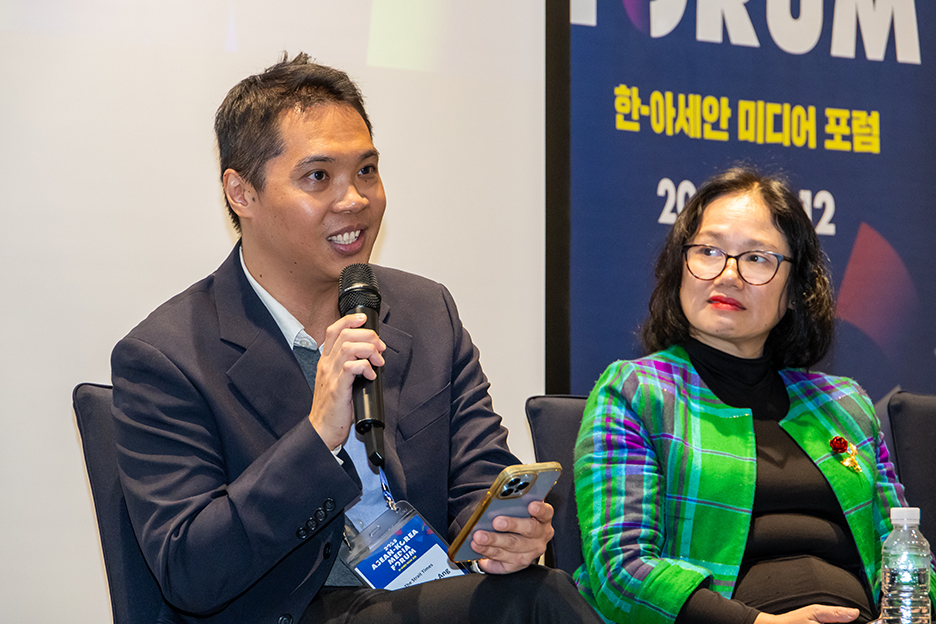
Benson Ang of The Straits Times (Singapore) and Nguyen My Ha (Vietnam News) attend the ASEAN-Korea Media Summit. (Photo: ASEAN-KOREA CENTRE – AKC)
From Indonesia, Yerica Lai of The Jakarta Post highlighted how K-pop fandom has become a form of civic engagement, mobilizing fans for social causes. In Indonesia, BTS fan communities organized tree-planting initiatives and raised 1.4 billion rupiah for disaster relief. “Media coverage of these movements legitimizes activism through organized digital fandom,” she said.
From Singapore, Benson Ang of The Straits Times highlighted how translation at K-pop concerts enables inclusivity. Korean-to-English translators are consistently used at live events, lowering language barriers and bringing in racially diverse audiences, including minority groups. According to Ang, this inclusivity fosters a real sense of community.
Participants suggested leveraging Korea’s cultural platforms for joint media projects addressing issues such as online fraud and forced labor, demonstrating that cultural exchange can be both entertaining and socially impactful.
Beyond culture, the forum examined technological challenges, especially around artificial intelligence (AI) and media literacy.
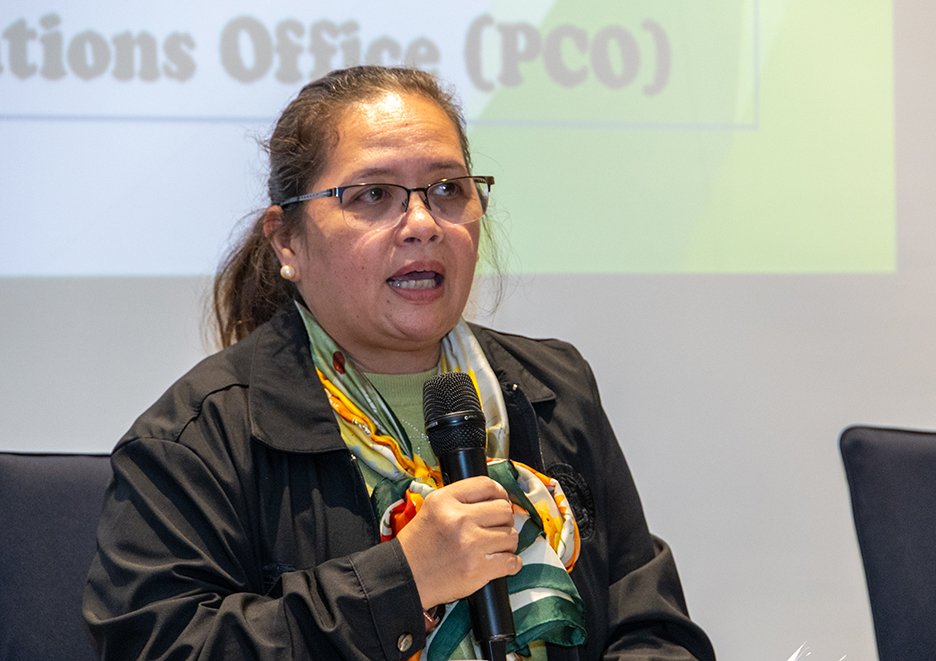
Cecilia Suerte Felipe from the Philippine Presidential Communication Office highlighted Korea’s potential to guide ASEAN in AI adoption, advocating for AI-based public services, enhanced digital infrastructure, and education frameworks.
Cecilia Suerte Felipe from the Philippine Presidential Communication Office (Photo: ASEAN-KOREA CENTRE – AKC)
However, Korean panelist Moon Jae-yeon cautioned that access to technology alone is insufficient. “Cultural literacy and the ability to critically navigate social media are crucial,” he said. “Without media ecosystems emphasizing critical thinking, even advanced AI tools may be misused.”
Rasidah Hj Abu Bakar of Brunei cited practical ASEAN-Korea collaborations, including e-government initiatives, AI-enhanced education programs, and an AI-powered radio project, designed to serve societal needs rather than purely technological goals.
A recurring theme was promoting ASEAN’s cultural identity in South Korea. Despite K-culture’s popularity, ASEAN content often struggles to reach Korean audiences due to language barriers and limited promotion. Ang urged individual ASEAN nations to actively showcase their languages, arts, and media.
The Philippines’ Suerte Felipe highlighted sustainable cooperation, citing Korea-supported climate resilience projects in solar, wind, and hydrogen energy. Rasidah reminded delegates that media storytelling about human experiences beyond trade and policies is essential for understanding ASEAN-Korea cooperation in practice.
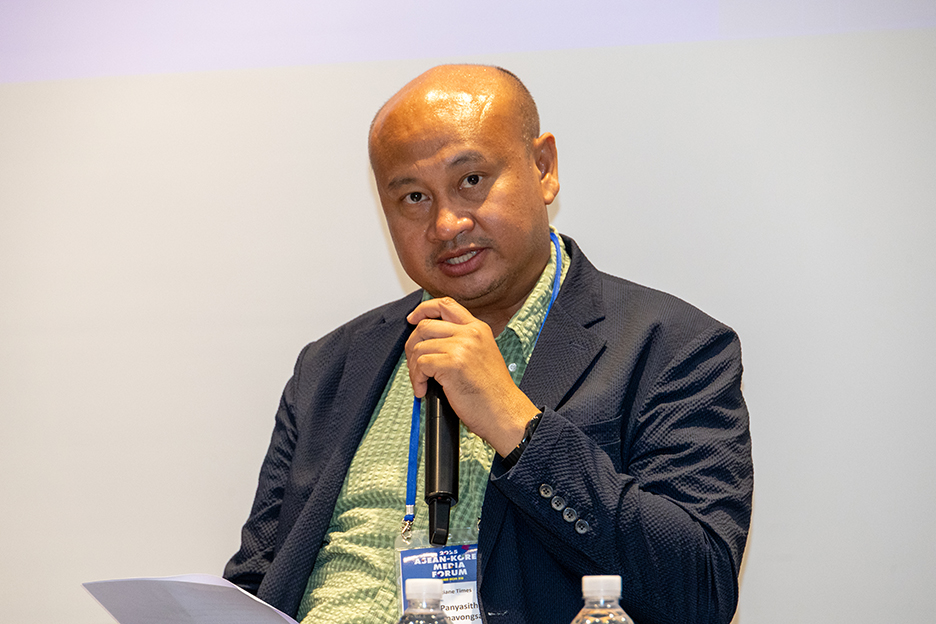
Laotian journalist Panyasith Thammavongsa described the CSP as more than a diplomatic framework, calling it a commitment to “understanding, communication, and shared identity.” He argued that true partnership requires media to reflect shared values and lived experiences.
Laotian journalist Panyasith Thammavongsa (Photo: ASEAN-KOREA CENTRE – AKC)
The ASEAN-Korea Media Forum forms part of the ASEAN Journalists Invitation Program, which brings ASEAN journalists to Korea to build professional networks and people-to-people ties. Officials from AKC and the Korea Press Foundation emphasized that the forum aims to foster mutual understanding, combat misinformation, and develop sustainable collaboration between media professionals in both regions.
As the ASEAN-ROK Comprehensive Strategic Partnership enters its second year, the forum highlighted Korea’s role as a “Contributor to ASEAN’s dreams and aspirations” and a “Partner for peace, growth, and innovation,” according to President Lee Jae Myung. By combining strong economic ties, vibrant cultural exchanges, and collaborative media initiatives, the two regions are laying the groundwork for a closer and more meaningful partnership.
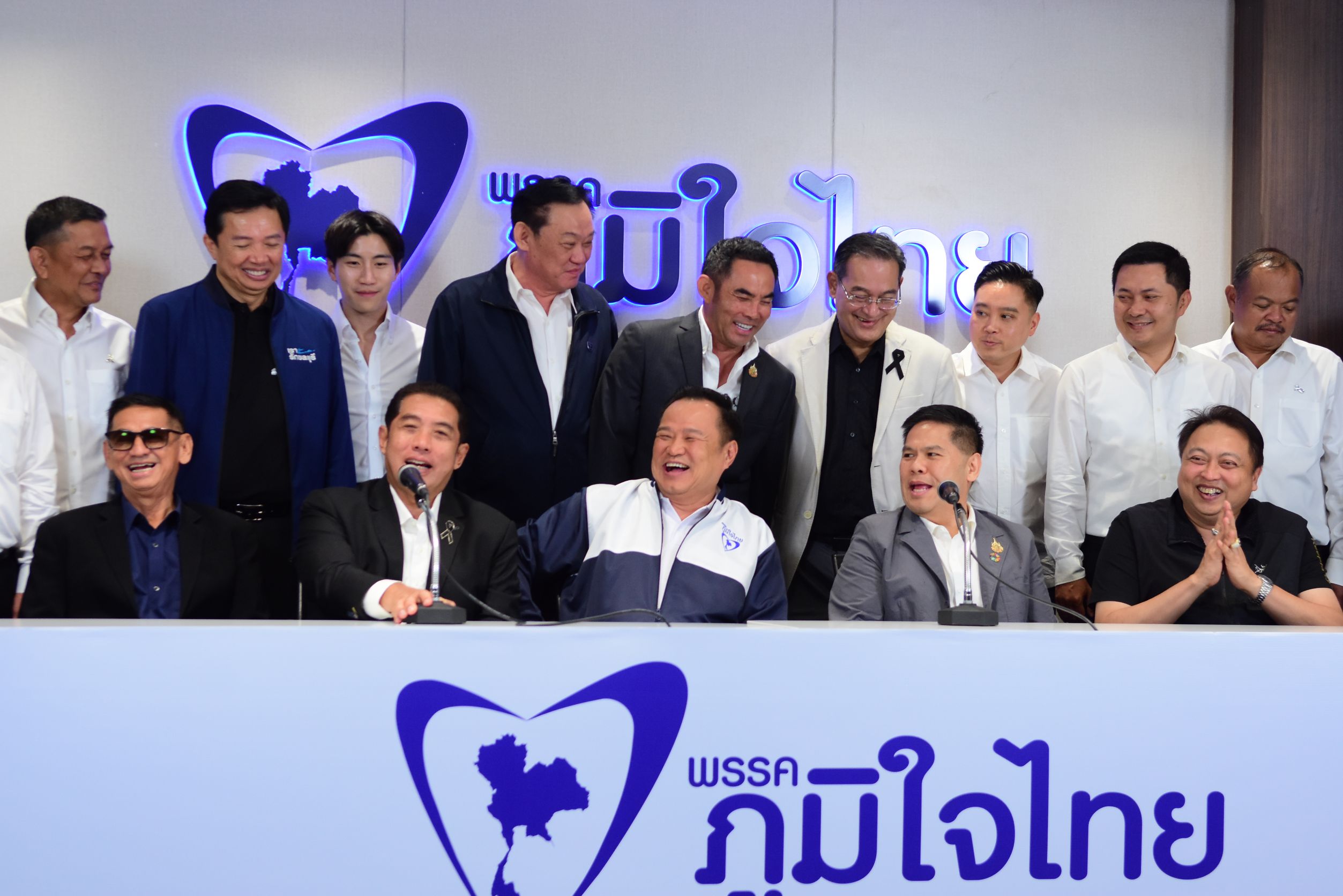
Prime Minister and Bhumjaithai Party leader Anutin Charnvirakul laughs during a press briefing at party headquarters in Bangkok on Nov. 23, 2025, as he appears with newly joined political heavyweights and local power brokers who have defected to the party ahead of the upcoming election. (KHAOSOD Photo/Chavalit Panyong)
BANGKOK — Lawmakers and local political heavyweights from multiple parties are defecting to Thailand’s Bhumjaithai Party as Prime Minister Anutin Charnvirakul positions his “blue” political camp for an election widely expected early next year.
On Sunday, November 23, Varawut Silpa-archa, leader of the Chartthaipattana Party, arrived at Bhumjaithai headquarters with several key party members and sitting MPs to formally announce their move. The group included party director Nikorn Chamnong, along with MPs Anurak Jureemart of Roi Et, Sema-gun Thiantham of Suphan Buri, Panuwat Sasomsub of Nakhon Pathom and Supachok Khajisupakorn, also from Nakhon Pathom.
They were joined by prominent provincial political dynasties. From Chonburi, former Pattaya mayor Sonthaya Khunpluem and his brother, Vitthaya, declared their intention to shift to Bhumjaithai. In Phetchaburi, provincial administrative chief Chaiya Angkinan, MP Thiwalrat Angkinan, and MP Ruak Yoodee — who defected from the United Thai Nation Party — also announced they would join Anutin’s camp.
Rayong provincial chief Piya Pitutecha, brother of Democrat Party deputy leader Satit Pitutecha and chair of the Democrats’ candidate selection panel, attended the gathering as well.
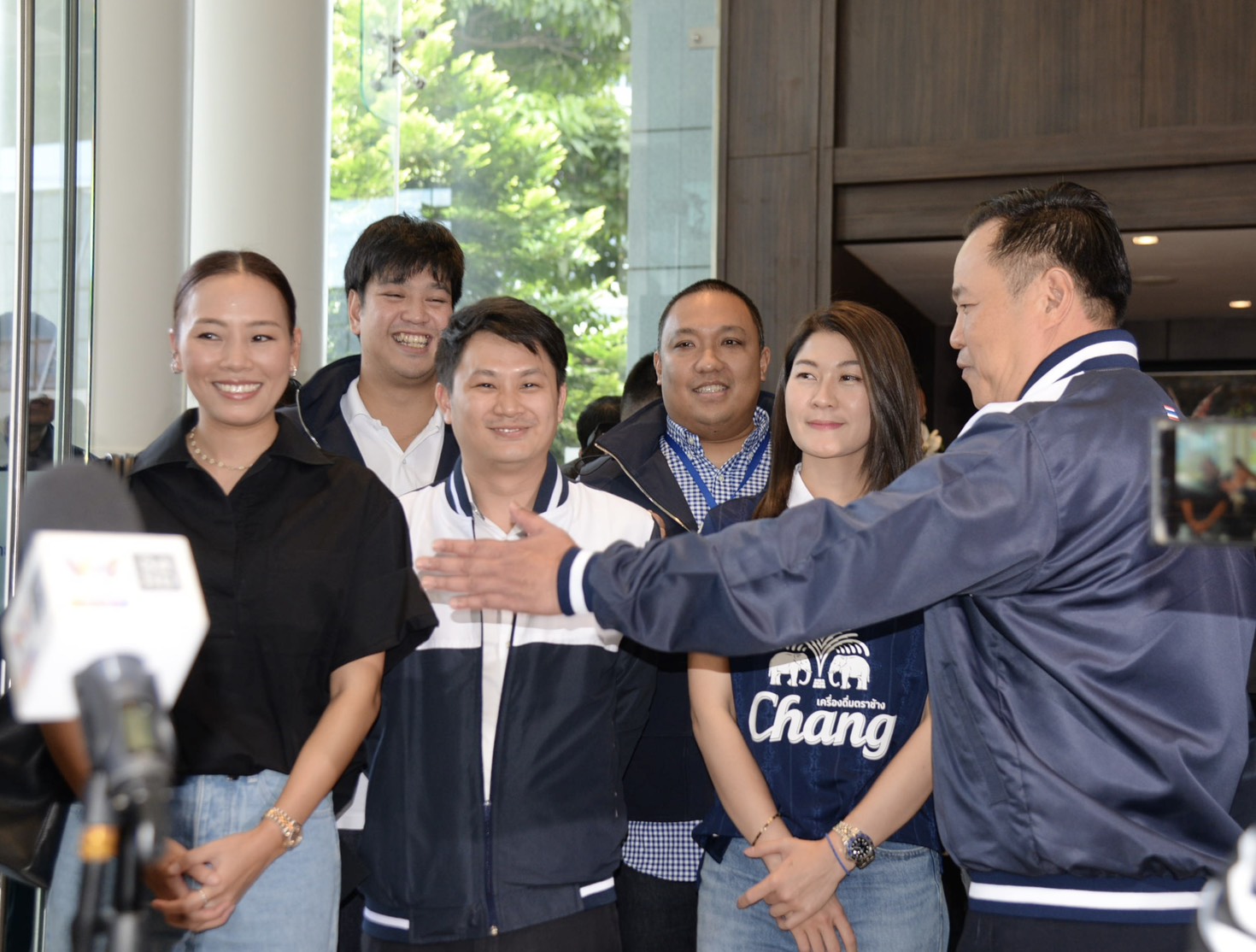
Two high-profile Pheu Thai lawmakers — Sudarat Pitakphonpanlop of Ubon Ratchathani and Sarassanan Annanopphorn of Khon Kaen — appeared at the event, where Anutin personally introduced them to reporters as new members of Bhumjaithai.
Prime Minister and Bhumjaithai Party leader Anutin Charnvirakul introduces two high-profile former Pheu Thai lawmakers — Sudarat Pitakphonpanlop of Ubon Ratchathani and Sarassanan Annanopphorn of Khon Kaen — as new members of his party during an event in Bangkok on Nov. 23, 2025. (KHAOSOD Photo/Chavalit Panyong)
Anutin told reporters the party is preparing for an election “early next year,” and that he had assigned Labor Minister Suchart Chomklin to oversee candidate selection.
Asked whether the influx of factions could undermine party unity, Anutin dismissed the concern. “There are no factions here. There is only one group — mine,” he said. “Everyone calls me ‘phi’ (big brother).”
Pressed on whether he aims to return as prime minister after the election, Anutin replied that his “ultimate dream” is simply for voters to place greater trust in the party. He declined to comment on whether Bhumjaithai might form a government with the People’s Party.
Bhumjaithai’s push to consolidate power comes after former prime minister Paetongtarn Shinawatra was removed from office in August by the Constitutional Court, following the release of a leaked private conversation with Cambodia’s Senate president Hun Sen. Though the content centered on avoiding tensions between the two countries, the ruling opened space for Bhumjaithai to gain dominance.
Prime Minister and Bhumjaithai Party leader Anutin Charnvirakul laughs during a press briefing at party headquarters in Bangkok on Nov. 23, 2025, as he appears with newly joined political heavyweights and local power brokers who have defected to the party ahead of the upcoming election. (KHAOSOD Photo/Chavalit Panyong)
The People’s Party later declared it would back Anutin as prime minister on the condition he dissolve Parliament within four months and amend the constitution.
Pheu Thai points to issues where criticism has been muted, including Thailand’s rare-earth MOU with the United States, investigations into alleged Senate vote-fixing, the stalled Khao Kradong land dispute in Buriram, and what it calls overly nationalistic handling of tensions with Cambodia — a stance that coincided with the U.S. Trade Representative’s decision last week to pause negotiations under the Trade and Investment Framework Agreement.
The “Red Party” has also accused the “Blue Party” of consolidating power across state institutions, pointing to alleged influence over the Senate, broad transfers of civil servants before the election, and an aggressive drive to pull MPs from competing parties.
Meanwhile, Anutin has instructed coalition parties to stand by for a potential signal on December 12 that he may use his authority as Prime Minister to dissolve parliament.
Anutin said he will propose holding a referendum on the draft constitutional amendment to the Cabinet meeting, paving the way for an extraordinary parliamentary session on December 10-11 to amend the constitution.
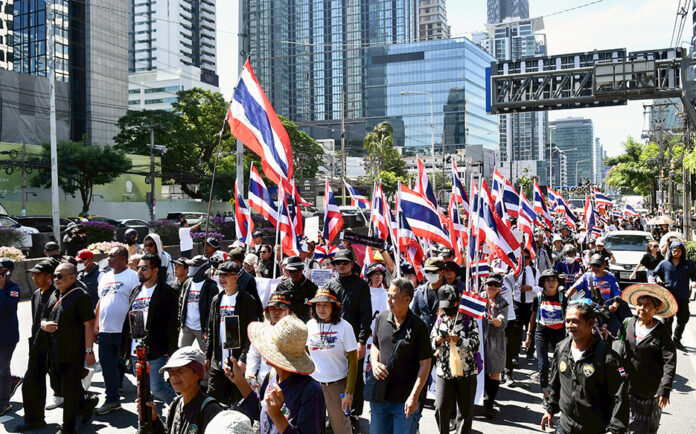
Thai demonstrators from the Unite the Land to Protect Sovereignty group march to the Malaysian and American Embassies in Bangkok on November 22, 2025, demanding both Malaysia and the U.S. stop interfering in Thailand's sovereignty and its handling of relations with Cambodia.
(KHAOSOD Photo/Pattarayoot Phukpol)
T his week I received an email from the Head of the World Press Freedom Index Desk of the Reporters Without Borders, headquartered in Paris, inviting me to help in the survey for Thailand’s annual media freedom again. I have been invited for many consecutive years to take part in the survey, probably about a decade now, but this year is particularly challenging and requires careful consideration when giving an assessment and score.
This is because, following the conflict and the five-day war between Thailand and Cambodia, a significant number of Thai (and Cambodian) media outlets chose to prioritise their identity as Thais (or Cambodians) above their role as media professionals, whose duty is to scrutinize and question those in power in society and the state, and to try to hold them accountable.
Because a substantial number of Thai media outlets chose to view themselves first and foremost as part of “Team Thailand” and declared, “I love my nation too,” they willingly prioritised presenting news that they saw as beneficial to their country (in a myopic way). They turned a blind eye or played down certain negative news, such as the story of the Cambodian woman who illegally fled to Thailand and alleging she was raped by seven Thai soldiers, which was played down or reported on restrictively by the Thai media at present after the government says it was “fake news.”
Moreover, earlier this week, the Navy Spokesman issued a statement “requesting cooperation from the media to refrain from disseminating false or misleading reports that may cause misunderstandings and unnecessary harm,” even though the Thai media could not verify the facts of this matter themselves. (Similarly, last week, the Cambodian media played down the correction and apology issued by the Malaysian state news agency, Bernama News Agency, regarding the mistranslation of the word “new mine” which was incorrectly rendered as “old mine.” My source in Cambodia confirmed to me this week that almost all Khmer media did not report this news.)
Another example of “Team Thailand journalism” is senior military-beat reporter Ms Vassana Na-nuam who has become almost like a unofficial but effectivemilitary spokesperson. Two days ago she was interviewed by fellow Thai reporters saying things like: We must have confidence in the army. We must decisively and quickly defeat Cambodia in the war ohrwise the next military clash might be protracted. Cambodia is not standing still; they are buying new weapons from the Czech Republic and Poland although she added she doesn’t what these claimed new weapons are.
The report on Amarin TV where Vassana currently works for, after a long career at The Bangkok Post, stressed that Vassana had spoken to the Supreme Commander of the Armed Forces.
This is the same Vassana whom before the 5-day war in July shared an AI-generated video clip of the Royal Thai Airforce fictitious attack on Phnom Penh.
We can see that the Thai (and Cambodian) media’s choice to value their national identity above their duty to scrutinize those in power in society has led them to become part of the propaganda machine for ultra-nationalism, ready to accuse the opposing side of lying or stereotyping the entire population of the nation they consider an ‘enemy’ as being untrustworthy, or even inciting and instigating the use of military force again.
In this sense, during a conflict between the role of the media and the identity of being a Thai, even if they have some degree of media freedom, they end up choosing to abandon the true duty as media professionals and abuse the media freedom they possess to produce propaganda that serves the dominant ultra-nationalist ideology.
In the end, they may not be doing a service to even their own country that they profess to love so much as they are playing a crucial role in creating an uncritical society, and an uncritical society is a weak and vulnerable society.
Performing the duties of an honest and truly professional journalist is at its core, an act of a true patriot. This is because it helps the public and society become strong, keep pace with the world affairs, and avoid them being easily manipulated or exploited.
At a time when you insist on publicly disagreeing with the military and ultra-nationalists, you risk being branded as a Cambodian-sympathiser or more.
Regarding those who, over the past few months, repeatedly accuse me of being a Thai journalist with a Khmer heart, of being Khmer, or desperately wanting to be Khmer, I wish to clarify as follows: This is a technique to create “the other” or marginalise dissenting Thai views as opposed to the hegemonic views of ultra-nationalist Thais and the policies of the military (and the Thai government) concerning how to handle the current Thai-Cambodian conflict.
When they cannot counter or debate rationally about why they should care for foot soldiers who will have to die if another round of military confrontation breaks, or the needless suffering of people along the border both in Thailand and Cambodia and the avoidable economic impacts, as well as why we are turning our neighbour into our nemesis, they create hatred and push the narrative that dissenting Thai citizens are in fact the “enemy” or “Cambodians” in their eyes.
49 years ago, Thai conservatives and ultra-nationalists accused the young protesters who gathered at Thammasat University of being “Vietnamese” (who were the enemies of the Thai state and a threat to the Monarchy at the time). This led to the savage massacre of October 6, 1976. Not only were students lynched, but some were raped, burned on rubber tyres, one had a slipper stuck into his lifeless body’s mouth, and their corpses were abused, all while cheering crowds watched in a frenzy of sadistic satisfaction. Thus, the terms “ultra-nationalist” and “monarchy-obsessed fanatics” are not rootless words or mere empty rhetoric in Thailand.
49 years later, the ultra-nationalists are still here. A number of Thais are still using the same old methods, as if Thai society has learned nothing from its shameful past, showing little or no intellectual or social development in this regard.
This is an attempt to suppress internal dissenting voices by forcing the entire nation to hold and express the same opinions on managing the Thai-Cambodian conflict. It is about painting those who deviate from the frantic mainstream as Khmer, as the “enemy” of the Thai nation and the Thai people, causing them to lose their very “Thainess” and credibility.
P.S. I don’t love Thailand any less than many do. However, for me, I view nationhood differently. The nation’s sovereignty rests with ordinary people who have to suffer and incur unnecessary losses, not just the elite, the military, or those socal media “influencers” who manipulate people for engagement metrics and donations.
P.S. 2 What’s more important than being Thai or Khmer is being human. Let us reduce our nationalist sentiment and increase our humanity. One proof of this is the fact that some Thais and Cambodians reacted with laughing emoji signs following the news about the loss of life and suffering of Thais or Cambodians due to accidents, flooding, etc.
The tuk-tuk driver offers a wai in apology to an Indian tourist and his wife at Phra Nakhon Si Ayutthaya Police Station after officers recovered part of the stolen belongings on Nov. 22, 2025.
AYUTTHAYA — Police in Phra Nakhon Si Ayutthaya swiftly arrested a tuk-tuk driver accused of stealing a bag containing cash and personal belongings from an Indian tourist at a historic temple site on Saturday.
Tourist police alerted local officers after a 43-year-old Indian visitor reported his bag missing while touring Wat Lokayasutharam with his wife. Shaken, he waited for police at the temple and told officers he had placed his brown shoulder bag near the foot of the temple’s giant reclining Buddha before walking behind the structure to take photos. He then rejoined his tour group and left, only to realize moments later that he had forgotten the bag and immediately notified his guide.
The victim said the bag contained about 8,000 baht ($250) in cash, credit cards, a phone charger, his hotel room key, and his Indian ID card.
Investigators reviewed security camera footage and spotted a tuk-tuk parked near where the bag had been left. The driver was seen getting out, picking up the bag, and driving off.
Police traced the vehicle to a 60-year-old driver, identified as Thitaphan, and found him at his home in Pak Kran, an area still partly flooded. He admitted taking the bag and removing the cash. He told officers he threw the credit cards and documents into a trash bin behind the nearby Phra Mongkhon Bophit temple.
When officers checked, the trash had already been collected. Only the bag, a phone charger, and more than 3,000 baht ($95) in cash were recovered.
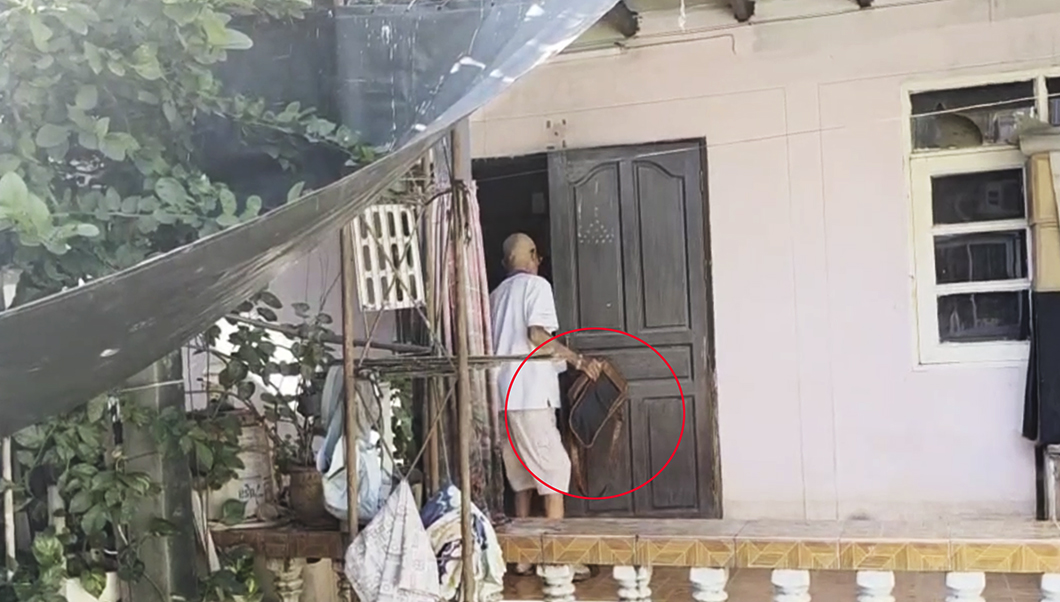
A man takes a brown shoulder bag from his home in Ayutthaya after police arrived to question him about the theft of an Indian tourist’s belongings on Nov. 22, 2025.
Police said the driver had a record of similar behavior, including thefts from passengers and abandoning tourists mid-trip, though previous cases were settled privately. Officers said this incident harms the province’s tourism image and will be pursued without leniency.
The tour guide said he regularly warns tourists not to leave belongings on the ground but noted the victim simply forgot. He praised police for making an arrest in less than an hour.
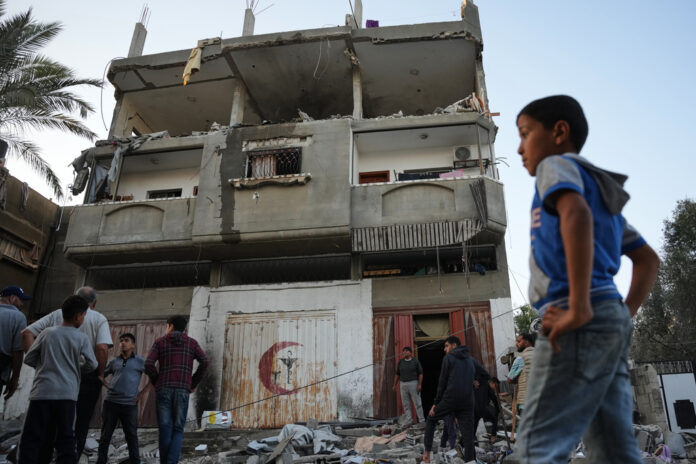
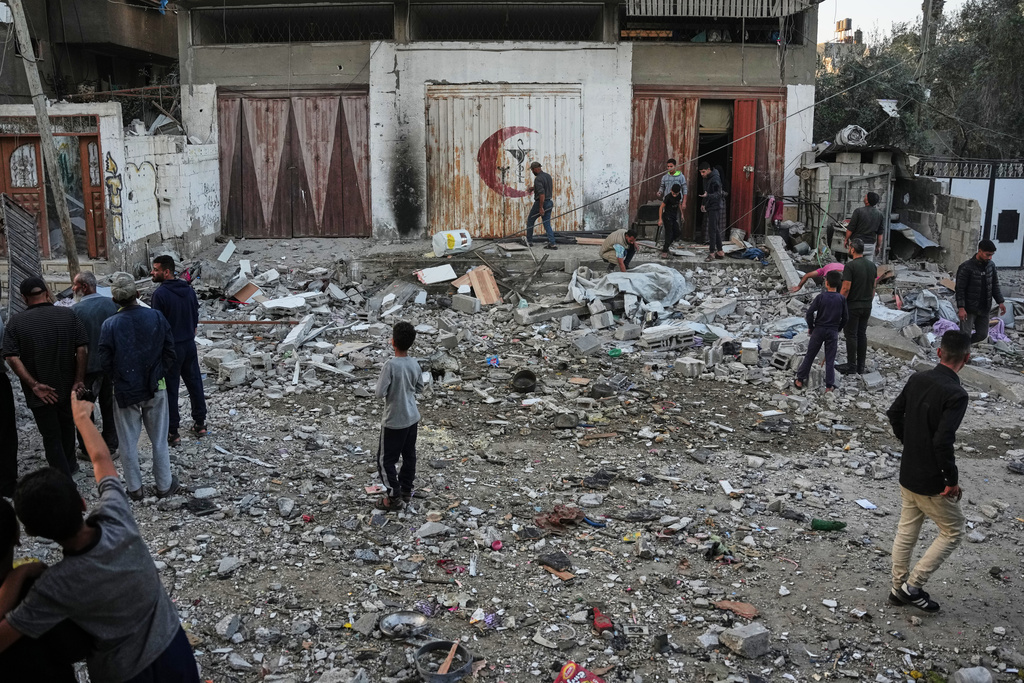
Palestinians inspect the damage to a house targeted by an Israeli strike in Deir al-Balah, in the central Gaza Strip, Saturday, Nov. 22, 2025. (AP Photo/Abdel Kareem Hana)
DEIR AL-BALAH, Gaza Strip (AP) — Israel’s military on Saturday launched airstrikes against Hamas militants in Gaza in the latest test of the ceasefire that began on Oct. 10. Health officials in Gaza reported at least 24 people killed and another 54 wounded, including children.
The Israeli strikes came as international momentum was building on Gaza, with the U.N. Security Council on Monday approving the U.S. blueprint to secure and govern the territory. It authorizes an international stabilization force to provide security, approves a transitional authority to be overseen by President Donald Trump and envisions a possible future path to an independent Palestinian state.
Israel has previously carried out similar waves of strikes after reported attacks on its forces. At least 33 Palestinians were killed over a 12-hour period Wednesday and Thursday, mostly women and children, health officials said.
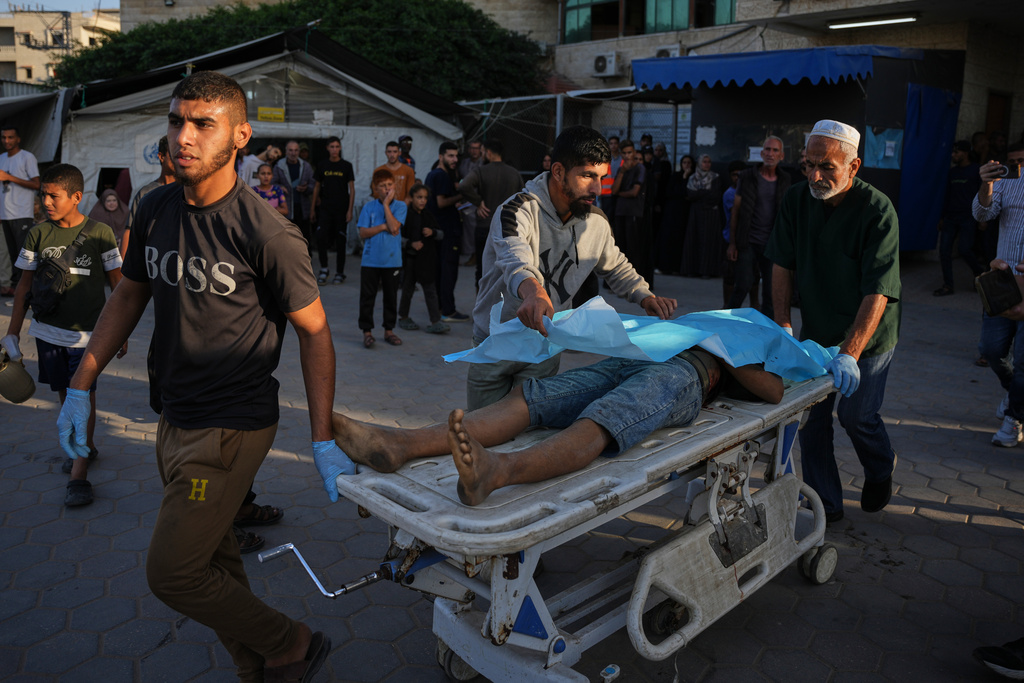
Palestinians wheel the body of a man killed in Israeli strikes on the Gaza Strip to the morgue at Al-Aqsa Hospital in Deir al-Balah, Saturday, Nov. 22, 2025. (AP Photo/Abdel Kareem Hana)
One of Saturday’s strikes targeted a vehicle, killing 11 and wounding over 20 Palestinians in Gaza City’s Rimal neighborhood, said Rami Mhanna, managing director of Shifa Hospital, where the casualties were taken. The majority of the wounded were children, director Mohamed Abu Selmiya said. Associated Press video showed children and others inspecting the blackened vehicle, whose top was blown off.
Another strike targeting a house near Al-Awda Hospital in central Gaza killed at least three people and wounded 11 others, according to the hospital. It said a strike on a house in Nuseirat camp in central Gaza killed at least seven people including a child and wounded 16 others.
And a strike targeting a house in Deir al-Balah in central Gaza killed three people, including a woman, according to Al-Aqsa Hospital.
“Suddenly, I heard a powerful explosion. I looked outside and saw smoke covering the entire area. I couldn’t see a thing. I covered my ears and started shouting to the others in the tent to run,” said Khalil Abu Hatab in Deir al-Balah. “When I looked again, I realized the upper floor of my neighbor’s house was gone.”
He added: “It’s a fragile ceasefire. This is not a life we can live. There’s no safe place.”
Palestinians inspect the damage to a house targeted by an Israeli strike in Deir al-Balah, in the central Gaza Strip, Saturday, Nov. 22, 2025. (AP Photo/Abdel Kareem Hana)
Israel’s military in a statement said it launched attacks against Hamas after an “armed terrorist” crossed into an Israeli-held area and shot at troops in southern Gaza. It said no soldiers were hurt. The military said the person had used a road on which humanitarian aid enters the territory, and called it an “extreme violation” of the ceasefire.
In separate statements, the military said soldiers killed five “terrorists” in the Rafah area, and two others after firing at four people who crossed into Israeli-held areas in northern Gaza and advanced toward soldiers in two separate incidents.
The war began with the Hamas-led attack on southern Israel on Oct. 7, 2023, that killed some 1,200 people and took over 250 hostage. Almost all of the hostages or their remains have been returned in ceasefires or other deals.
Gaza’s Health Ministry says 69,733 Palestinians have been killed and 170,863 injured in Israel’s retaliatory offensive. The toll has gone up during the ceasefire both from new Israeli strikes and from the recovery and identification of bodies of people killed earlier in the war.
The ministry does not distinguish between civilians and combatants in its figures but has said women and children make up a majority of those killed. The ministry, part of the Hamas-run government and staffed by medical professionals, maintains detailed records viewed as generally reliable by independent experts.