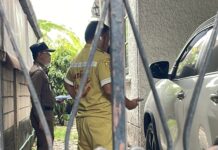
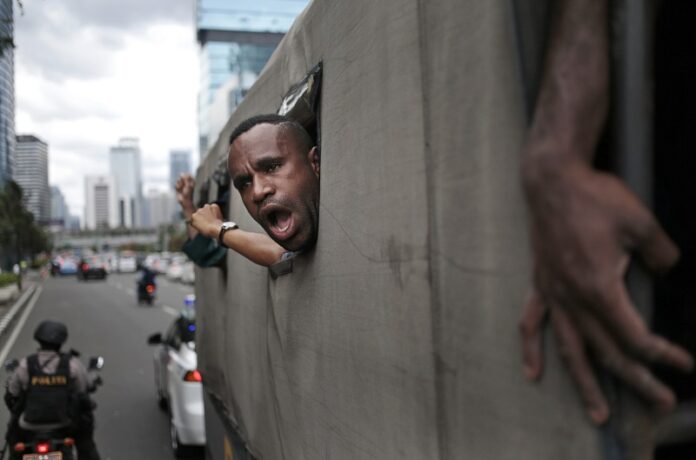
A West Papuan protester shouts slogans as he and others are taken away on a police truck during a rally calling for the remote region's independence, Dec. 1 in Jakarta, Indonesia. Photo: Dita Alangkara / Associated Press
JAKARTA — Indonesian police have detained dozens of people ahead of a West Papua independence protest on Monday.
At least 200 people were arrested in several cities in Papua and Java, said Veronica Koman, a lawyer for Papuan independence activist Filep Karma.
Monday is the 55th anniversary of the official declaration of an Indonesian military campaign to take control of Papua from the Dutch.
Koman said several people were arrested last week when they applied for demonstration permits.
She said the headquarters of the pro-independence National Committee for West Papua in Jayapura, the capital of Papua province, was vandalized during a police raid on Monday.
The Dutch colonizers of the Indonesian archipelago held onto West Papua when Indonesia became independent after World War II. It became part of Indonesia following a U.N.-supervised referendum in 1969 criticized as undemocratic.
Zsa Zsa Gabor, the jet-setting Hungarian actress and socialite who helped invent a new kind of fame out of multiple marriages, conspicuous wealth and jaded wisdom about the glamorous life, died Sunday at her home, her husband said. She was 99.
The middle and most famous of the sisters Gabor died of a heart attack at her Los Angeles home, Frederic von Anhalt said.
Gabor had been hospitalized repeatedly since she broke her right hip in July 2010 after a fall at her home. She already had to use a wheelchair after being partly paralyzed in a 2002 car accident and suffering a stroke in 2005. Most of her right leg was amputated in January 2011 because of gangrene and the left leg was also threatened. Her misfortunes were duly reported to the media by von Anhalt.
The great aunt of Paris Hilton and a spiritual matriarch to the Kardashians, Simpsons and other tabloid favorites, she was the original hall-of-mirrors celebrity, famous for being famous for being famous. Starting in the 1940s, Gabor rose from beauty queen to millionaire’s wife to minor television personality to minor film actress to major public character. With no special talent, no hit TV series such as her sister Eva’s “Green Acres,” Zsa Zsa nevertheless was a long-running hit just being Zsa Zsa — her accent drenched in diamonds, her name synonymous with frivolity and camp as she winked and carried on about men, dahling, and the droll burdens of the idle rich.
She was like popcorn for the public and, for sociologists, the seeming fulfillment of the mindless future imagined in Aldous Huxley’s “Brave New World,” a creation made possible by mass, electronic media; her words and image transcribed and beamed into theaters and living rooms, on the Internet and the shelves of newsstands and supermarket checkout lines.
Her secret, in part, was being in on the joke, once saying about a 1956 TV role, “I play a fabulously rich woman who has just bought her fifth husband; she is very unhappy. I won’t tell you who it’s supposed to be.” Ever game for a laugh, Gabor spoofed her image in a videotaped segment on David Letterman’s “Late Show,” which had the two stars driving from one fast-food restaurant to another, sipping sodas and digging into burgers like they were slabs of wedding cake.
Amid all the trivia, she had a peripheral part in two big scandals of the early 21st century: the death of Anna Nicole Smith (von Anhalt claimed to have had an affair with her) and the alleged financial scam of Bernard Madoff (a lawyer said she might have lost $10 million through him). And she was in the spotlight for a dustup from the late 20th century: “The slap heard ’round the world.”
In June 1989, Gabor smacked Paul Kramer, a police officer, on a Beverly Hills street, after he pulled over her Rolls-Royce Corniche convertible for a traffic violation. She was convicted of misdemeanor battery on a police officer, driving without a driver’s license and having an open container of alcohol in the car. She served three days in jail, performed community service at a woman’s shelter and paid $13,000 in fines and restitution.
When she was freed, she told reporters the jailers were kind but “at first I was petrified. They even took my makeup away.”
Gabor kept up the act in the advice book “How to Catch a Man, How to Keep a Man, How to Get Rid of a Man,” and in the exercise video, “It’s Simple Darling,” in which she banters and stretches with a pair of muscular young trainers. Her memoir, “One Life Is Not Enough,” came out in 1991 and dished about everything from her virginity (gone at 15) to the endless men who came on to her (She would claim that William Paley of CBS promised Gabor her own show if only she would spend an afternoon with him.)
Gabor had one child, Francesca Hilton, from her marriage to hotelier Conrad Hilton. (She would allege the child was conceived after Hilton raped her.) In later years, Gabor, von Anhalt and Francesca battled in court over family finances. Francesca Hilton died of an apparent stroke in 2015.
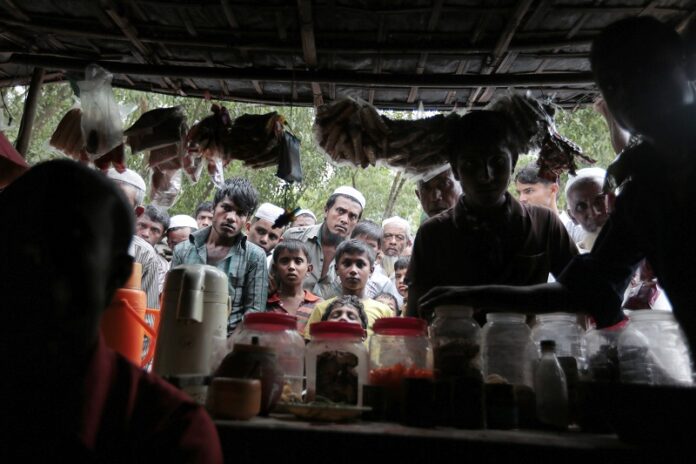
Rohingya from Myanmar, watch a television program about them being played on a mobile phone inside a tea stall, at an unregistered refugee camp in Teknaf, near Cox's Bazar, a southern coastal district about, 296 kilometers (183 miles) south of Dhaka, Bangladesh. Photo: A.M. Ahad / Associated Press
BANGKOK — The actions of Myanmar’s military may constitute crimes against humanity, human rights group Amnesty International has warned, based on accounts of violence against the country’s Muslim Rohingya minority.
Myanmar has come under heavy criticism for its army’s forceful treatment of the Rohingya, and international human rights groups such as Amnesty have accused the military of mass murder, looting and rape.
“The Myanmar military has targeted Rohingya civilians in a callous and systematic campaign of violence,” said Rafendi Djamin, Southeast Asia director for Amnesty International. “The deplorable actions of the military could be part of a widespread and systematic attack on a civilian population and may amount to crimes against humanity.”
Amnesty released a report Monday outlining its accusations. The report comes as Myanmar leader Aung San Suu Kyi is set to meet fellow members of the Association of Southeast Asians Nations at a Monday meeting in Yangon.
The military sweeps were sparked by an Oct. 9 attack on police outposts in Rakhine state that killed nine officers.
Rakhine, located in Myanmar’s west, has long been home to simmering tensions between the Rohingya and the country’s Buddhist majority population. The last major outbreak of violence in 2012 left hundreds dead and drove 140,000 people into internal displacement camps.
Amnesty cautioned that the scale and extent of the violence is unclear, as the military has closed Rakhine to outside observers, including aid workers. But eyewitness accounts detail specific cases of murder, looting and rape.
In one incident on Nov. 12, following an alleged skirmish between the army and villagers armed mostly with swords and other simple weapons, helicopter gunships descended on a village and sprayed bullets indiscriminately, killing civilians fleeing in a panic, Amnesty said. This was corroborated to an extent by Myanmar army officials, who said helicopters opening fire that day and killed six people, who officials said were insurgents.
Refugees told Amnesty that the military is torching villages. Satellite images Amnesty obtained show 1,200 burned structures, which they say is in line with images released by Human Rights Watch in November that showed 1,500 burned homes.
Amnesty’s report follows concerns voiced in an International Crisis Group report released last week that repressive government policies are radicalizing the Rohingya, and sharp criticism from the U.N.’s High Commissioner for Human Rights, Zeid Ra’ad al-Hussein.
“Myanmar’s handling of northern Rakhine is a lesson in how to make a bad situation worse,” al-Hussein said in Geneva on Friday. “The results have been catastrophic, with mass displacement, the nurturing of violent extremism, and everybody ultimately losing.”
The border attacks were coordinated by a new insurgent group calling itself Harakah al-Yaqin, or the Faith Movement, according to the Belgium-based International Crisis Group. Organized by a network of Rohingya in Saudi Arabia and bankrolled by wealthy donors, the militant group is being called a “game changer” for drawing Muslims disillusioned and desperate from years of disenfranchisement by the Myanmar government.
Amnesty is urging the government to immediately cease hostilities, open Rakhine for humanitarian aid groups, and allow independent investigations.
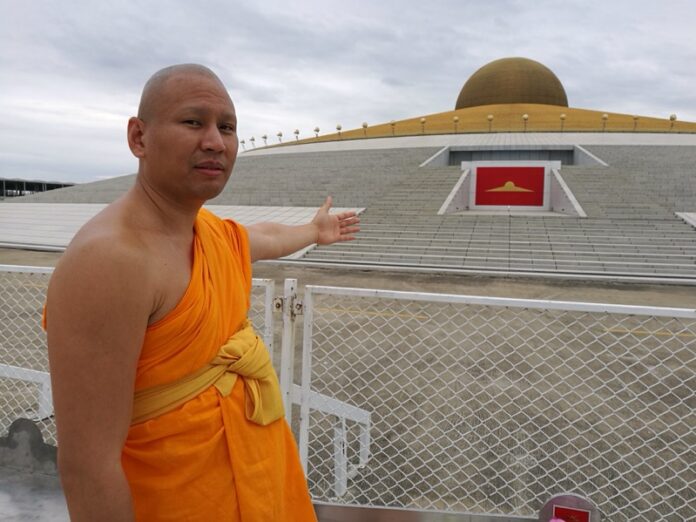
Phra Dantamano at the Maha Dhammakaya Cetiya on Friday at Wat Dhammakaya.
PATHUM THANI— Wat Dhammakaya is arguably the most controversial and largest Buddhist temple in Thailand. Some consider it a cult which has deviated from the core teaching of Buddhism and stresses donations as the path to heaven.
Today, the 46-year-old order and its leader, finds itself wanted by the military regime and loathed by much of the domestic media, which has been barred entry to its sprawling complex north of Bangkok.
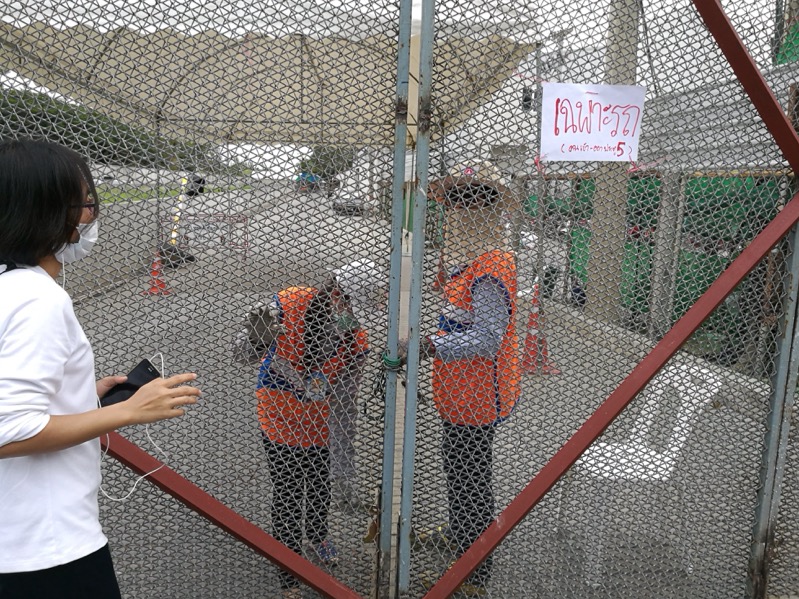
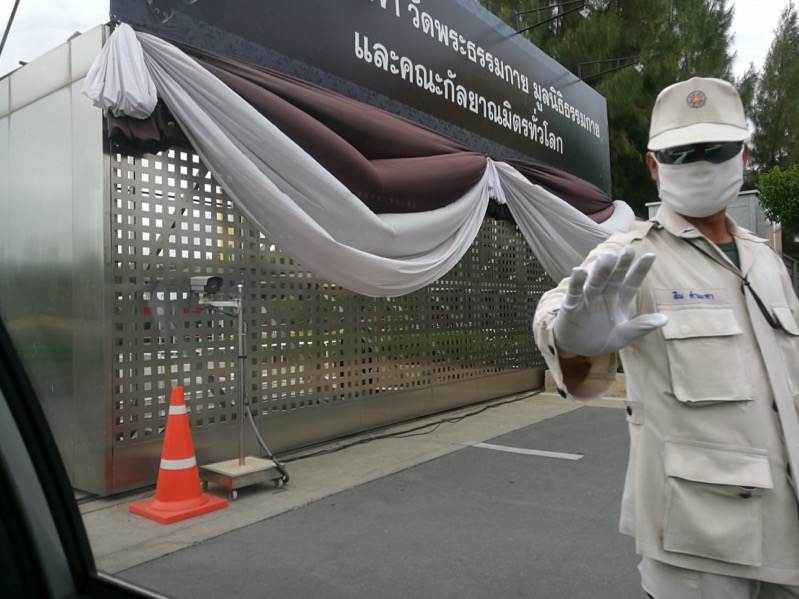
It was in that context I was given the green light to pass through Gate 7 on Friday morning, through which law enforcement has not dared to enter for risk of confrontation. Their objective, to execute search warrants related to accusations that have multiplied to include 111 charges, ranging from various regulatory violations to being party to laundering more than a billion baht in embezzled funds.Even Dhammakaya’s lay spokesman, Ong-art Thamnitha, is now wanted for sedition for allegedly inciting public unrest.
Also on Friday, the Department of Special Investigation’s court-approved search warrants expired, marking the second time in six months that authorities have blinked. Both times that has seemed out of fear of conflict with the followers who’ve assembled to defend the order’s charismatic former abbot, 73-year-old Phrathepyanmahamuni, better known as Phra Dhammachayo, who is regarded as a fugitive by police.
As if the weight of further charges would prize him free of the compound, I would walk out from a three-hour tour to learn the charges against the temple had risen to 158, including violations of traffic law.
Once inside the vast temple campus, a spokesman awaited. It wasn’t Ong-art, who is now wanted and was nowhere to be found. Instead, a tall and soft-spoken monk who goes by the name Phra Pasura Dantamano presented his name card, a lay disciple behind him.
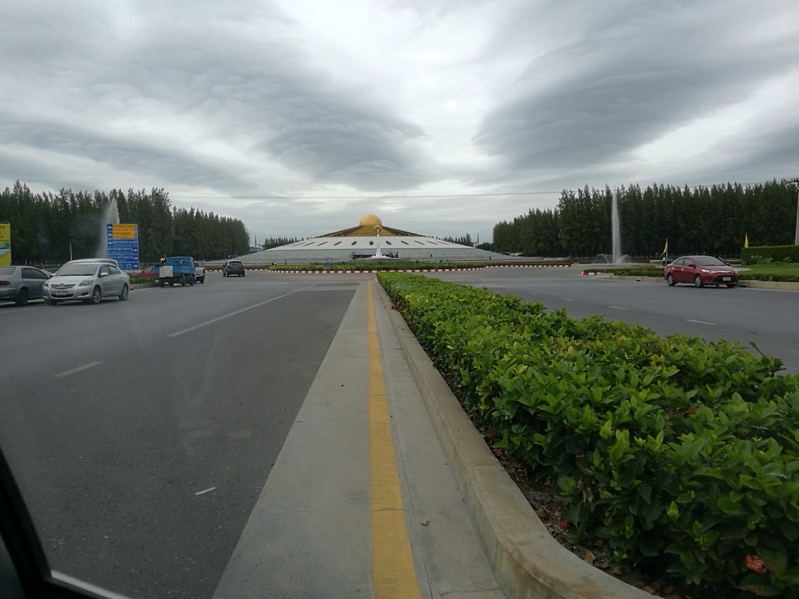
Behind him sprawled the temple’s Memorial Hall, built to honor Phramongkolthepmuni, best known as Luang Por Wat Pak Nam, who the Dhammakaya revere for what they consider his rediscovery of their meditation technique a century ago. It’s a golden, UFO-like structure looks ready to take devotees off to nirvana or outer space.
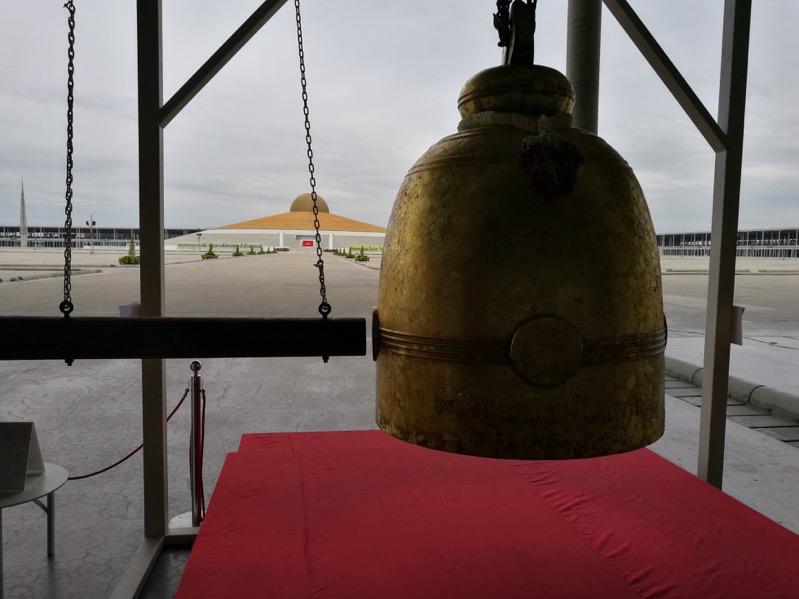
A bell in front of Maha Dhammakaya Cetiya.
Modest Living
The 39-year-old monk knew this was not going to be just an ordinary guided tour, but a combination between that and critical interview. I only assured it would be fair.
“Guided” of course, means not seeing everything one wants. I wasn’t allowed to see Dantamano’s living compound, not to mention that of Most Venerable Dhammachayo, the charismatic former abbot who is rumored of leading a very luxurious life.
The Modest Living Quarter for Novices was shown instead, and it lived up to its name. The monk reminded me that frugal and simple living is at the core of Dhammakaya’s teachings. I was led inside a long, single level where 20 young novices, 13 to 19, sleep. The wooden floor was bare, the walls made of woven dried palm leaves giving a sense of simple monastic lifestyle. The temple hosts some 300 novices who may spend years here, although my ordained guide said only less than one-third entered monkhood afterward.
Novice Living Quarters.
As I said earlier, the venerable Dantamano, a former flight attendant for Thai Airways International, insisted his off-limits living quarters were also modest, with no air conditioning. The monk added that he, like any of the 3,000 plus monks at the sprawling 195 rai or 90-acre temple, has to move from his room to another every year, “so we won’t accumulate many belongings.” He said that were he attached to nice things, he wouldn’t have left his life behind his life as a steward 11 years ago.
Donations the Stairway to Heaven?
Yet modesty in the rank and file doesn’t necessarily extend to the top. The temple is widely perceived for having a competitive donation scheme in which bigger contributions mean getting closer to heaven or reincarnated life.
Names and fingerprints on donation markers on temple ground at Dhammakaya Cetiya ground.
I raised the question to my monk-guide and he flatly denied it. He said the strength of the temple, with its vast followers, is due to its ability to explain Buddha’s teaching in a simplified way that is accessible.
“We made the Tripitaka simple,” said Dantamano. This allegation is so common and widespread that the temple’s spokesperson even has a printed paper listing “reserve your space in heaven” as among the attacks made against Dhammakaya, to mislead the public into hating and despising the temple and see them as a danger to Buddhism.
On the contrary, the temple’s belief is that prosecution or persecution of the temple will, in the words of another page of PR materials given to me by Dantamano, “be the beginning of the destruction of Buddhism in Thailand.”
The monk alluded to the siege mentality inside the temple, stressing that what’s happening is not prosecution but persecution.
Citadel of Worshippers
Bangkok’s Rajamangkala Stadium can accommodate 80,000 people, while the National Stadium can seat 35,000 spectators. A stadium in Pyongyang, North Korea, is believed to hold the most in the world – a whopping 150,000. They have nothing on the Maha Dhammakaya Cetiya, a square-kilometer quadrangle said to accommodate 400,000 worshippers.
Dantamano led me to the citadel, or cetiya. We took a long walk inside the amphitheater-like square, a kilometer on each side, passing worshippers praying in the afternoon in the direction of a large, sci-fi stupa made of a silicon-bronze alloy resistant to corrosion.
It’s most immediate resemblance is to a retro-style UFO from 1950s cinema.
Road from Gate 7 leading to the Memorial Hall.
Dantamano proudly talks of building a stupa or cetiya that would last a thousand years. The choice of gold-hue silicon bronze stupa was thus utilitarian. Surrounding the dome-like stupa were 300,000 small Buddha statues cast from pure silver and gold-plated place and 700,000 more kept inside the inverted bowl-like structure. The monk said for each devotee who donated 10,000 baht, one of the million Buddha statues would be engraved with the person’s name on its 18-centimeter-wide base.
Multiplying 10,000 baht by one million, the figure of 10 billion loomed in my mind as Dantamano took us to our final stop.
Future of Dhammakaya
I asked what will happen to the temple after Dhammachayo was gone. The monk-spokesman assured me that for several years, various committees have been running the temple, as opposed to a single person or monk. Dantamano, who speaks fluent English and holds a bachelor’s degree in the language from Ramkhamhaeng University, for example, is on the international affairs committee.
Dhammachayo is removed from daily operations, he said.
“He doesn’t know about [the daily running of the temple],” he said.
That was the opening to ask why Dhammachayo does not turn himself in and prove his innocence before the courts.
Dantamano said they have no trust in the justice system under the military regime. But he was noncommittal on whether Dhammachayo would turn himself in under an elected government either. Anyhow, he added, the decision is no longer up to the monk who is suffering from diabetes and a blood clot in his leg, but that of the disciples who have no trust in the military regime.
Closely guarded entrance near Master Nun Chand Refectory where many devotees were gathering Friday.
Enemies of the Temple
I asked why the temple thinks it has so many enemies, and whether some of that was because it was perceived as being supportive of fugitive former Prime Minister Thaksin Shinawatra.
Dantamano insisted its devotees are not only Redshirts, but people from across the political spectrum. He said devotees are asked not to discuss politics inside the temple.
Instead, he said it’s normal for a temple with such a vast following to be perceived as a threat to governments, particularly in times of political sensitivity. He said that during the late years of the Cold War, the temple was accused of supporting Communism, for example.
He didn’t appear appreciative when I suggested this recalled the antagonism between China’s dictatorship and its Falun Gong sect.
Tour’s Over
Along the way back, it became clear this wasn’t the only media visit, as New York Times reporter Seth Mydans and his assistant Thai reporter were waiting on the same cart for their tour to begin.
It was the front of Master Nun Chand Refectory, where many worshippers dine and meditate. Although I was not allowed to enter the guarded compound, Dantamano suggested I talk to two police officers positioned outside without the temple’s invitation.
“Why don’t you go and ask them why they’re here,” the monk said.
Even though I felt a little used for having to ask police the question, I was curious myself and proceeded. The replied was that it was a secret.
As I bid farewell to the monk and his assistant, Dantamano blessed me and said he didn’t want me to take side with the temple but to report fairly and accurately.
A temple guard at Gate 7, one of the temple’s 15 gates.
Correction: An earlier version of this story misidentified Phra Dantamano’s academic degree as a master’s degree. In fact he obtained a bachelor’s degree in English from Ramkhamhaeng University.
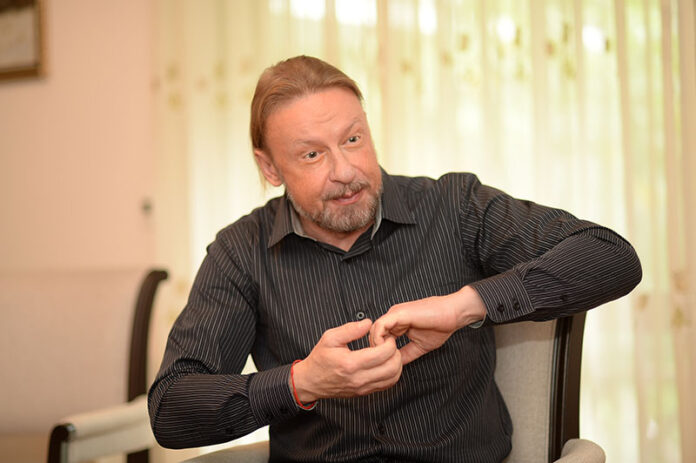
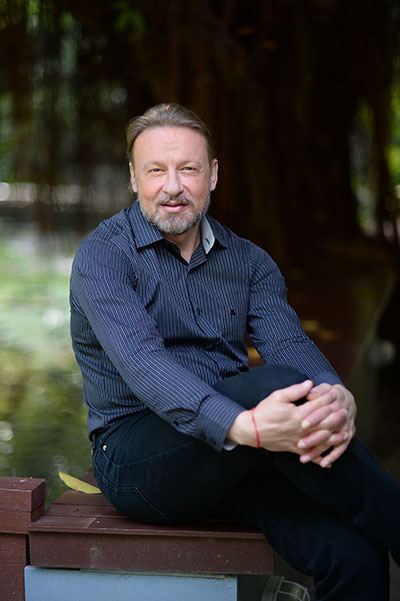
Russian Ambassador Kirill Barsky at his Sathon-area residence in Bangkok.
BANGKOK — The Russian Federation had a headline-grabbing year, from military operations in Syria to accusations it sought to influence the U.S. election. But as it projects an image of strength onto the world stage, its oil-dependent economy remains wrecked by a double blow of historically low oil prices and crippling Western sanctions.
These are the things on the mind of Russian Ambassador Kirill Barsky, who as Moscow’s top diplomat in the kingdom, is tasked with diplomacy’s oldest tradition – drumming up business.
“We have what you need, and you have what we need,” Barsky said of Russian-Thai trade, which has plummeted in recent years.
On a recent afternoon at his sun-soaked residence off Sathorn Road, where the 52 year old lives with his family and a cat named Bucephalus, he talked about opportunities for that trade to grow, along with plans to celebrate 120 years of relations, his encounters with Vladimir Putin and his love of the arts.
But throughout the course of the interview, Barsky circled back to one topic of mutual interest: economic relations.
Russian-Thai trade fell 52 percent from USD$4.9 billion in 2014 to $2.4 billion last year, according to Thailand’s Ministry of Commerce. As of October, this year was down by almost a quarter. Barsky attributes that to falling oil prices, a worsening regional economy and “illegal sanctions by the West.”
Everyone in Russia knows that the best canned fruit comes from Thailand
Yet there are signs of that recovering, and Barsky sees opportunity growing on trees.
“Everyone in Russia knows that the best canned fruit comes from Thailand,” he said.
After Western sanctions were imposed in 2014 for Russia’s annexation of part of the Ukraine, Moscow retaliated with an embargo on E.U. products. A bright spot in that has been a boom in Russia’s agricultural output, as it looks to replace E.U. products such as fruit and dairy.
In May, the Russian Direct Investment Fund announced Thailand’s Charoen Pokphand and a Chinese firm would bring their know-how to operating a USD$1 billion dairy complex to be built outside Moscow.
And with President-elect Trump’s promise to cancel the Trans-Pacific Partnership, nations like Thailand left without a dance partner find themselves courted by Barynya-dancing Mother Russia.
That could mean more auto parts, chemicals, electrical appliances, microchips, silk, fruit and cuisine exported from Thailand to Russia. Russia needs partners for the oil it’s heavily dependent on, related refinery products and other investments in security, real estate, tourism and energy. Rosatom, Russia’s state-run nuclear power enterprise, was recently in Thailand trying to spark interest in its technology.
A resurgence in bilateral trade with Russia’s biggest ASEAN trading partner would require efforts by both governments, Barsky said.
The ambassador referenced Thailand’s recent application to the Eurasian Economic Union, a trade zone consisting of Russia and several former Soviet republics.
Ships from Russia’s Pacific Fleet practiced humanitarian and disaster relief exercises at Sattahip district, Chonburi with warships, a medical ship, and helicopters September 2016.
Other Russia-Thai economic links include energy supplied from Laos via Russian energy supplier Inter RAO’s hydropower and, of course, tourists.
More than 1.7 million Russians visited Thailand in 2013 before falling sharply, Barsky said. While these numbers seem to be recovering as the Russian recession eases, Thai tourism to Russia is still negligible – only 20,000 tourists per year.
“There’s beauty in Russia that you can’t find anywhere else, and there’s also a 30-day visa-free period,” he said. “Still, I suppose not enough Thais visit Russia yet because they are not familiar with the country and not informed about the tourism possibilities yet.”
Russian Ambassador Kirill Barsky.
Putin and Ballet
Trade agreements and politics may be at the center of his mission, but close to Kirill’s heart is Russian ballet, President Putin, and his cat Bucephalus.
“We named him after Alexander the Great’s horse,” Barsky said.
Barsky, who helps secure Russian ballet and opera troupes for international festivals here, hopes to stimulate Thai interest in Russia not only through trade, but culture.
Russian-Thai relations, began under Nikolai II and Rama V, will celebrate their 120th anniversary in 2017. Barsky said the embassy has a host of events planned throughout the year, including a photo exhibition of then-Crown Prince Vajiralongkorn’s visit to the Soviet Union in 1989.
“It was an excellent visit, and the new king is an important link to Russian-Thai relations,” he said.
Other jubilee events include a Thai dance-infused ballet named “Katya and the Prince of Siam.” It’s about Prince Chakrabongse, a son of Rama V who married a Russian woman, and will be staged at the 19th International Festival of Dance and Music in Bangkok. In the latter half of the year, Lumpini Park will also host the Moscow Cultural Festival, with folk music, games, sports, and a park concert featuring the work of Pyotr Shchurovsky, who composed the music of the Thai Royal Anthem.
While Barsky says Russia would rather promote Tchaikovsky than pop culture because it is “not in a competition for cultural dominance,” one can hardly ignore the unintended cultural phenomenon that is Putin. The blue-eyed president is a household name in Thailand, and possibly the only major foreign political figure to have a Thai fanclub.
“It makes me happy to hear that,” Barsky said with a laugh.
Barsky recalls a time when he met the president in 2003. Assigned to China at the time, Barsky was in Moscow with Deng Rong, Deng Xiaoping’s daughter who had penned a biography “My Father, Deng Xiaoping.”
She was on a book tour when Deng and Barsky suddenly got a call from the Kremlin. Putin wanted to meet her – and him to translate the meeting.
“We talked for hours as I translated for them. He was relaxed and enjoyed talking to her for hours, and ignored his staff who told him to wrap it up. He said that he had high respect for her father, and thanked her for coming to his country to present her book.”
Where Putin himself strikes machismo poses for the public and his polar adversaries attribute thugishness, Barsky sees warmth.
“From this meeting, I found out that he’s someone who cherishes friendships and respects historical figures. People mistakenly perceive him as aggressive because of his firm stances. However, when you talk to him, he’s actually thoughtful, caring, and soft-spoken. He talks to you in a human way.”
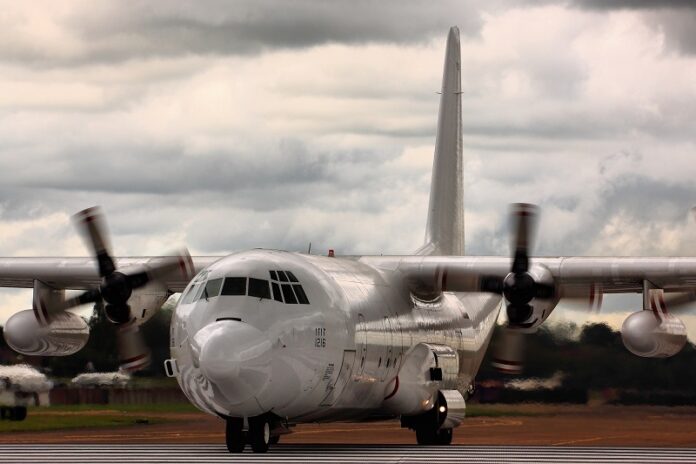
A C-130 Hercules model, similar to the one that crashed Sunday in Papua, is seen here in 2012 at the Royal International Air Tattoo show in Gloucestershire, England. Photo: Airwolfhound / Flickr
JAKARTA — An Indonesian military Hercules C-130 transport plane crashed Sunday in bad weather in the easternmost province of Papua, killing all 13 people on board.
The plane was carrying 12 tons of food supplies and cement from Timika to Wamena, a distance of about 200 kilometers (125 miles), when it crashed just minutes before its scheduled landing, said air force chief of staff Agus Supriatna.
The plane was carrying three pilots and 10 other personnel.
Bad weather and low clouds in Wamena, the capital of the mountainous district of Jayawijaya, were believed to be factors in the crash, deputy air force chief of staff Hadiyan Sumintaatmadja told a news conference.
“The tower in Wamena has spotted the plane, but it was not certain that the plane saw the runway,” he said. He did not rule out that the plane hit a mountain.
An investigation is ongoing. He said the aircraft, purchased from Australia where it was first used in the 1980s, had more than 60 hours left until the next routine maintenance.
The plane took off from Timika at 5:35 a.m. and crashed about four minutes before it was scheduled to land in Wamena. TV footage showed rescuers and locals had reached the wreckage of the plane and brought out all the victims.
It was the third serious air accident in Indonesia in less than a month. On Nov. 24, a Bell 412 EP helicopter from the Indonesian army crashed in the Indonesian part of Borneo island, killing three. A week later, a police plane with 13 people aboard crashed into the sea on the way to the island of Batam, near Singapore.
Indonesia, a sprawling archipelago of more than 250 million people, has been plagued by transportation accidents in recent years, from plane and train crashes to ferry sinkings.
The military, which suffers from low funding, has also regularly suffered airplane and helicopter crashes.
In July last year, an air force Hercules crashed into a neighborhood of Medan, Indonesia’s third largest city, killing more than 140 people including military personnel, family members traveling with them and people on the ground.
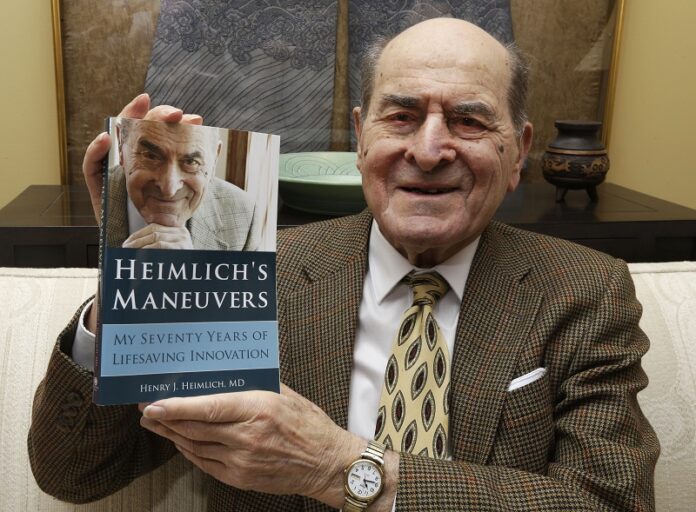
Dr. Henry Heimlich holds his memoir prior to being interviewed at his home in Cincinnati. Photo: Al Behrman / Associated Press
CINCINNATI — The surgeon who created the life-saving Heimlich maneuver for choking victims died early Saturday in Cincinnati. Dr. Henry Heimlich was 96.
His son, Phil, said he died at Christ Hospital after suffering a heart attack earlier in the week.
“My father was a great man who saved many lives,” said Heimlich, an attorney and former Hamilton County commissioner. “He will be missed not only by his family but by all of humanity.”
Heimlich was director of surgery at Jewish Hospital in Cincinnati in 1974 when he devised the treatment for choking victims that made his name a household word.
Rescuers using the procedure abruptly squeeze a victim’s abdomen, pushing in and above the navel with the fist to create a flow of air from the lungs. That flow of air then can push objects out of the windpipe and prevent suffocation.
Much of Heimlich’s 2014 autobiography focuses on the maneuver, which involves thrusts to the abdomen that apply upward pressure on the diaphragm to create an air flow that forces food or other objects out of the windpipe.
The Cincinnati chest surgeon told The Associated Press in a February 2014 interview that thousands of deaths reported annually from choking prompted him in 1972 to seek a solution. During the next two years, he led a team of researchers at Jewish Hospital in Cincinnati. He successfully tested the technique by putting a tube with a balloon at one end down an anesthetized dog’s airway until it choked. He then used the maneuver to force the dog to expel the obstruction.
The Wilmington, Delaware, native estimated the maneuver has saved the lives of thousands of choking victims in the United States alone. It earned him several awards and worldwide recognition. His name became a household word.
The maneuver was adopted by public health authorities, airlines and restaurant associations, and Heimlich appeared on shows including the “The Tonight Show Starring Johnny Carson” and “The Today Show.”
His views on how the maneuver should be used and on other innovations he created or proposed put him at odds with some in the health field. He said his memoir was an effort to preserve his technique.
“I know the maneuver saves lives, and I want it to be used and remembered,” he told the AP. “I felt I had to have it down in print so the public will have the correct information.”
The maneuver has continued to make headlines. Clint Eastwood was attending a golf event in Monterey, California, in 2014 when the then-83-year-old actor saw the tournament director choking on a piece of cheese and successfully performed the technique.
“The best thing about it is that it allows anyone to save a life,” Heimlich told the AP.
In 2016, Heimlich himself was the hero, saving a woman choking on food at his senior living center.
Heimlich said the maneuver is very effective when used correctly, but he did not approve of American Red Cross guidelines calling for back blows followed by abdominal thrusts in choking cases that don’t involve infants or unconscious victims. Red Cross officials said evidence shows using multiple methods can be more effective, but Heimlich said blows can drive obstructions deeper into a windpipe. The American Heart Association backs abdominal thrusts, while stressing that they should not be used on infants or unconscious victims.
Neither organization supports Heimlich’s view that using the maneuver to remove water from the lungs could save drowning victims. They recommend CPR.
Heimlich was proud of some of his other innovations, such as a chest drain valve credited by some with saving soldiers and civilians during the Vietnam War. But he drew sharp criticism for his theory that injecting patients with a curable form of malaria could trigger immunity in patients with the HIV virus that causes AIDS. Medical experts have said injecting patients with malaria would be dangerous and have criticized Heimlich for conducting studies involving malariotherapy on HIV patients in China.
Heimlich mostly brushed off critics.
“I’ll be the first to admit that a number of my ideas are controversial and in some ways unorthodox,” Heimlich told the AP. “But I have enough guts to know that when I am right, it will come about as the thing to do, even if others do the wrong thing for a time.”
One of his most vocal critics has been his son, Peter Heimlich. The younger Heimlich split with his father years ago over a personal rift. He initially circulated anonymous criticisms of his father before openly speaking out against him online and in media interviews.
Peter Heimlich has called many of his father’s theories dangerous and spent years challenging many of his claims and trying to discredit them. The elder Heimlich maintained that his relationship with his son was a family matter refused to comment on it to the media.
The elder Heimlich attended Cornell University undergraduate and medical schools and interned at Boston City Hospital. During World War II, the U.S. Navy sent him to northwest China in 1945 to treat Chinese and American forces behind Japanese lines in the Gobi Desert.
Beginning in the 1950s, he held staff surgeon positions at New York’s Metropolitan Hospital and Montefiore Hospital and Medical Center. He later was an attending surgeon on the staffs at Jewish and Deaconess hospitals in Cincinnati and a researcher at his nonprofit Heimlich Institute.
Heimlich’s wife Jane, daughter of the late dance teacher Arthur Murray, died in November 2012.
He is survived by two sons and two daughters.
Phil Heimlich said a private family service and burial is planned soon. The family hopes to arrange a public memorial, he added, that will give his father’s friends and admirers a chance to pay their respects.
Story: Lisa Cornwell
Correction:In a story Dec. 17 about the death of Dr. Henry Heimlich, The Associated Press erroneously reported the year the U.S. Navy sent him to northwest China. It was 1945, not 1942.
The AP also reported the American Heart Association backs abdominal thrusts in choking cases. The story should have made clear that the association stresses that such thrusts should not be used on infants or unconscious victims.
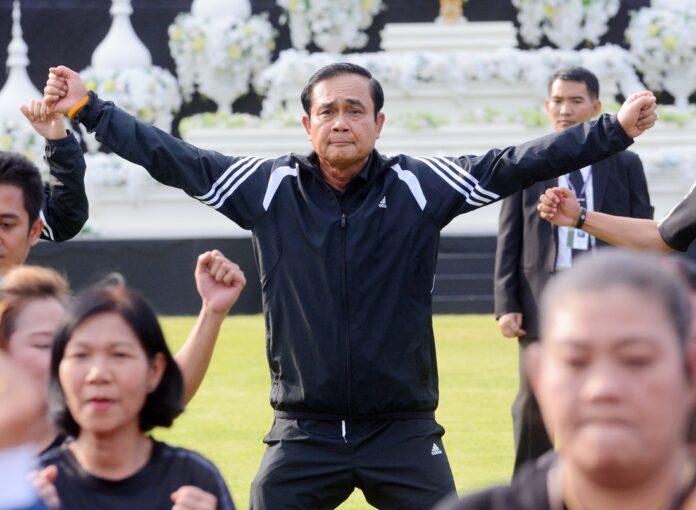
Junta chairman Prayuth Chan-ocha joins an exercise session in November with other officials at Government House in Bangkok.
Dictatorship is about control. They control you through propaganda and fear. Dictatorship is most effective when it makes you obey without questioning its lack of legitimacy.
Intentionally or not, dictator Gen. Prayuth Chan-ocha has recently succeeded in expanding the sphere of control to cover Thai officials’ bodies by ordering government officials to exercise during office hour every Wednesday afternoon.
On the surface this is a harmless, even beneficial and healthy, program and Prayuth managed to even win praise from no less than the World Health Organization (WHO) for the initiative.
For those forgetting that Prayuth is exercising yet another autocratic power by ordering officials to exercise, this is how a dictator can win praise.
Wednesday, Prayuth who acted as the aerobic in chief, or rather aerobic dictator, led officials at the Government House to stretch and sweat and engaged in a bit of football to finish things off.
Such directive is both ingenious and insidious because hardly anyone could oppose a dictator’s attempt to make government officials nationwide more fit. Very few, such as exiled academic cum anti-junta activist Pavin Chachavalpongpun, managed to whine that it’s wrong that officials are doing this during work hours and on tax payers’ money. All it all, forced exercise has been greeted with welcoming smiles if not amusement, however, and no one is raising the issue of the exercise of another dictatorial power.
More subtle is the fact that Prayuth has succeeded in taking greater control over these officials – this time through having them physically moving their buds. And officials obey without a second thought, almost as if they’re zombies.
The control over people’s physical bodies by the junta, known formally as the National Council for Peace and Order (NCPO), began right after the 2014 coup with summons and detentions for what they euphemistically called “attitude adjustment” of hundreds of politicians, dissidents and a very few journalists, myself included.
There we lose control over our bodies as they incarcerate us inside military camps – and repeat the ordeal for those unwilling to cooperate with the illegitimate military regime after the first detention.
Then there’s the ban on the physical political gathering of five or more persons. Our eye sights also suffered a blow when Prayuth launched his weekly monologue on all free TV every Friday night. Prayuth seems demanding of our bodies. After all, dictatorship is about control.
Physical right, enjoyed in a more democratic times, suffered growing restriction over the past two years. ‘Success’ is judged by how willing, or unthinking, those given the order obey. To break the resistance a dictator must either break the will to resist, which is more than physical, but mental, or at least convince those under them that it’s harmless to follow the dictator’s order.
Prayuth’s order for officials to exercise is thus seemingly benign, although hidden underneath is an exercise of another kind – an exercise of illegitimate and autocratic power.
More difficult is the control over the hearts and minds of those who still regard Prayuth, two and half years on since the May 2014, as an illegitimate prime minister.
Coercion through fear and physical control are crude and often counter-productive. Ordering others to engage in some physical exercise, arguably for their own health benefits, blur the line and make dictator appears benign if not legitimate, however.
The last bastion to be conquered by any dictatorship is the mind. Your conscience is the last to be colonized by dictatorship. Without free thought you are just a docile member of society. Through thinking and questioning we still can questions the validity and meaning of this weekly dictator-led aerobic exercise session, however.
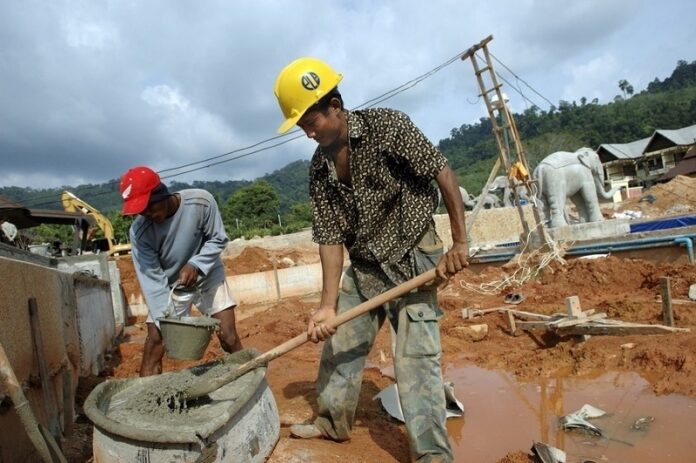
Burmese migrants work in construction projects in Phang Nang. Photo: IOM / Courtesy
By Dana Graber Ladek
International Organization for Migration
She cleans your house, sews your clothes and cooks your food. He catches the fish you eat, builds the house you live in and polishes the shoes you wear. These labor intensive occupations are often the vocation of one group of people – migrants.
Since the year 2000, the United Nations has celebrated these individuals’ hard work by marking 18 December as International Migrants Day, and with good reason. Migrants have an overwhelmingly positive impact on society in both tangible and intangible terms. Economically, their contributions should not be understated. Migrants constitute about 3.5 per cent of the world’s population but contribute to nearly 10 per cent of global GDP, valued at USD $6.7 trillion.
Closer to home, numerous studies have pointed to migrants contributing to Thai GDP growth of at least 1 percent. These numbers do not include the income generated from domestic consumption and indirect taxes. With an unemployment rate of less than 1 percent, Thailand needs migrants now more than ever. Without them, serious labour shortages would occur, particularly in the construction, agriculture and service sectors.
As a country of origin, transit and destination for large numbers of migrants from across the region, Thailand’s migration flows are naturally complex and dynamic. Between 3 to 4 million migrants are estimated to be living and working in the country, including 1 to 1.5 million with irregular status and 110,000 refugees along the Thai-Myanmar border.
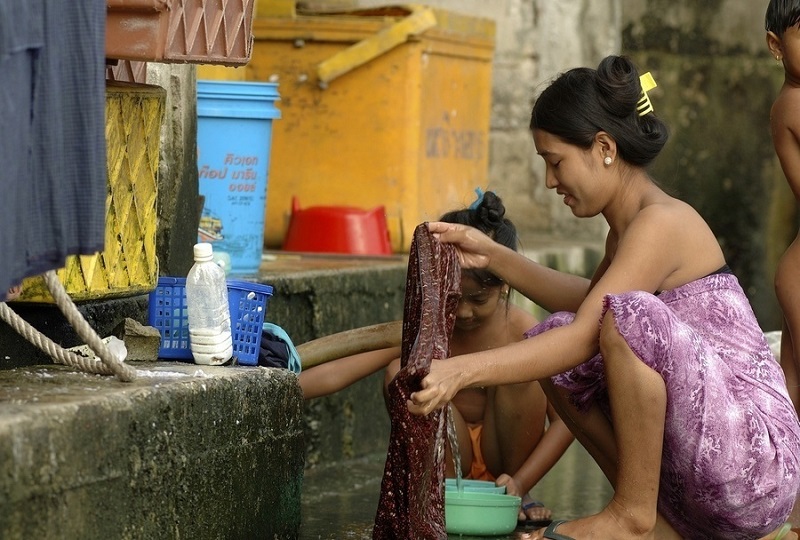
Families of migrants workers in Phang Nang, Thailand. Photo: IOM / Courtesy
Over 80 percent of Thailand’s migrant stock comes from just three countries – Cambodia, Lao People’s Democratic Republic and Myanmar. Their presence signals the economic success of the Thai economy which provides higher wages and better job opportunities. Effective migration management is needed to harness the full potential of migrants and prevent their exploitation at the same time.
Since Thailand joined the International Organization for Migration (IOM) as a member state 30 years ago in 1986, the country has made impressive strides in protecting the rights of migrants while acknowledging their contributions. In recent years, the Royal Thai Government has taken on a practical and innovative approach in developing its own migration management model.
It has created a registration system which allowed millions of undocumented migrants to regularize their status without having to return to their countries of origin. The most recent registration window was successful in registering 1.6 million migrants in 2014. Migrant children with registered parents are entitled to education and welfare benefits while migrant workers are entitled to the same minimum wage as their Thai counterparts. More notably, Thailand stands out as a leader in providing migrants the same universal health care plan that citizens are able to access.
In terms of best practices, the Government has signed Memorandums of Understanding with neighbouring countries to better manage labour demand and supply – providing migrants a legal channel to access job opportunities in Thailand. The recent establishment of Assistance Centres in 10 provinces to provide support and information related to rights, legal status and human trafficking is also a step in the right direction.
Yet in spite of these achievements, many challenges persist. While the MOUs have existed for over a decade, take-up rates are low. Only about one in ten registered migrants have entered Thailand through this arrangement, showing it has not yet become an effective mechanism to meet the demand for migrant labour. High costs, long waiting times and bureaucratic red-tape discourage many from entering to work in Thailand through legal routes.
Burmese migrants work in fishing boats and coastal communities in Phang Nga, Southern Thailand. Photo: IOM / Courtesy
The lack of effective law enforcement has also contributed to several pressing issues such as poor working conditions, exploitation, human smuggling and trafficking, and transnational crime. Recent reports of forced labour in the fishing and agricultural sectors have caught the attention of foreign governments and international media.
It is important to note at this point that movements are now taking place against the backdrop of the newly formed ASEAN Economic Community which came into effect this year. As regional integration deepens, the number of migrants traversing the region is only set to increase in the future. This presents another set of interrelated migration challenges that necessitates bilateral and multilateral cooperation. Lying at the crossroads of mainland Southeast Asia, Thai policy makers will need to keep the region’s context in mind and broaden its partnerships with foreign governments.
In order for Thailand to continue to benefit from migration, it will also be imperative for the Royal Thai Government and its partners to make rights-based and judicious decisions on migration policy that recognizes the contributions of migrants to national development. The end view should always be that migration is a force that is not to be stopped but effectively managed. This will in turn have a lasting positive impact on the country’s growth and development.
Dana Graber Ladek is the chief of mission of the International Organization for Migration’s Mission in Thailand.
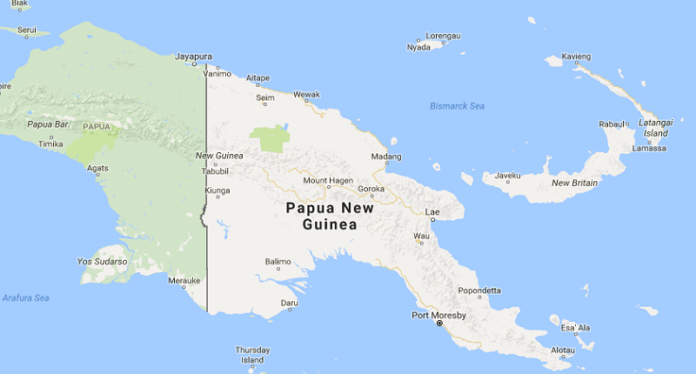
SYDNEY — A very strong earthquake has struck off the coast of Papua New Guinea, and a tsunami threat has been issued to areas near the epicenter.
The U.S. Geological Survey says the magnitude-7.9 quake struck 46 kilometers (29 miles) east of Taron in Papua New Guinea on Saturday. The quake was deep, at 103 kilometers (61 miles). Deeper earthquakes tend to cause less damage than shallow ones.
The Pacific Tsunami Warning Center said there was a threat of a tsunami in Papua New Guinea and nearby areas.
Papua New Guinea sits on the Ring of Fire, the arc of seismic faults around the Pacific Ocean where earthquakes are common.