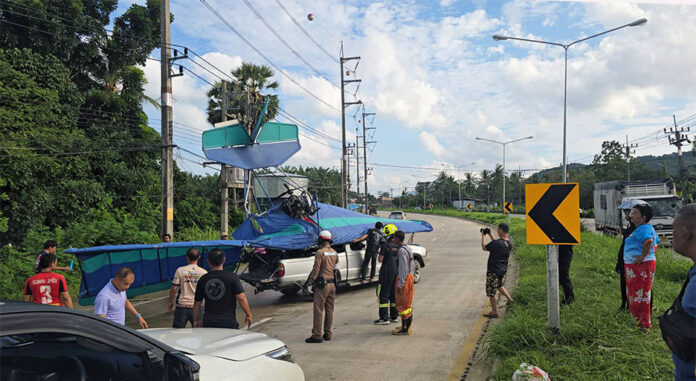
Thalang Police in Phuket secure the ultralight aircraft for investigation on August 17, 2025.
PHUKET — A 40-year-old Thai flight instructor died Monday morning from injuries sustained in a small aircraft crash in Phuket, while his Russian student pilot survived the accident.
The training aircraft crashed on Pa Khlok-Monument Road near Pa Khlok Small Airport in Thalang District on Sunday at approximately 4:10 p.m. on Sunday. Emergency responders found two injured people aboard and provided first aid before transporting both to Thalang Hospital.
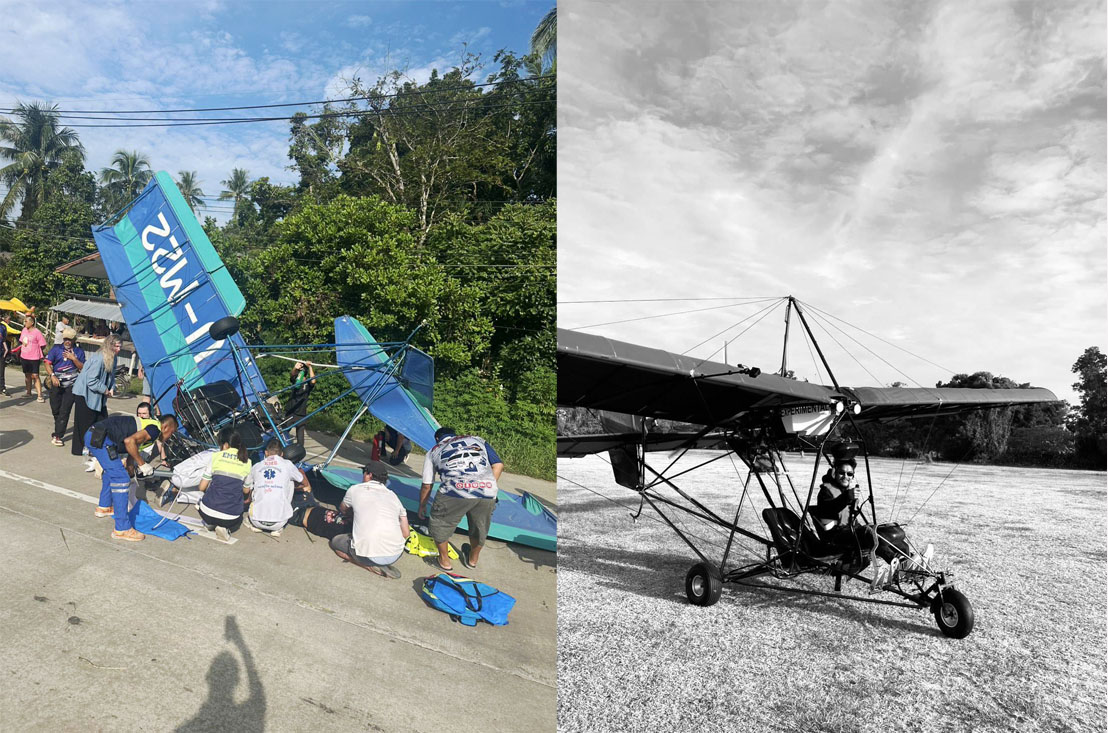
A combination photo: Left – Emergency responders provide first aid to the Thai flight instructor before transporting him to Thalang Hospital on August 17, 2025. Right – Surasak Chana, who died in the accident. (Photo: Facebook page Srs Chana)
The Facebook page “Flying Phuket Thung Kwai Bin” announced that airport manager and instructor Surasak Chana died at 5:47 a.m. on August 18. The family and team expressed gratitude for all the love and support they received, with many people offering condolences on the social media post.
His student pilot, 36-year-old Russian national Sergei, who was training with Surasak, is now in stable condition.
According to the initial investigation, the aircraft had taken off around 2:00 p.m. on August 17 for a training flight. Local residents near the crash site reported hearing a loud noise that sounded like the plane had struck power lines during the accident.
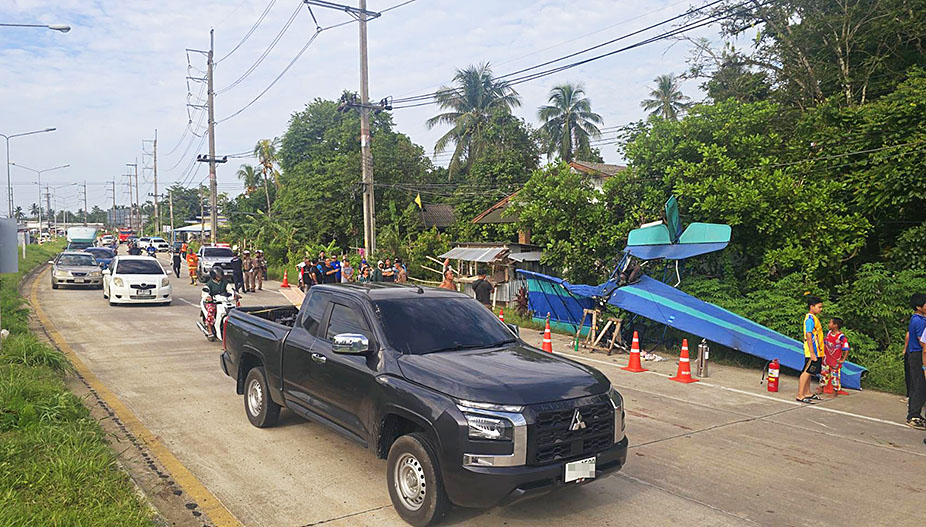
Thalang Police in Phuket cordon off the ultralight aircraft for investigation on August 17, 2025.
Thalang Police have cordoned off the ultralight aircraft for investigation, with the exact cause still under review.
The Phuket Info Center identified the crashed aircraft as an Ultra Light Aircraft, registration UM-22 Quick Silver MXII Sprint. This type of aircraft is considered ideal for flight schools, featuring a single-surface wing design that provides high lift, allowing very short takeoff distances and predictable control even at very low speeds. These characteristics make the MX II Sprint easier to learn on compared to similar aircraft in its class.
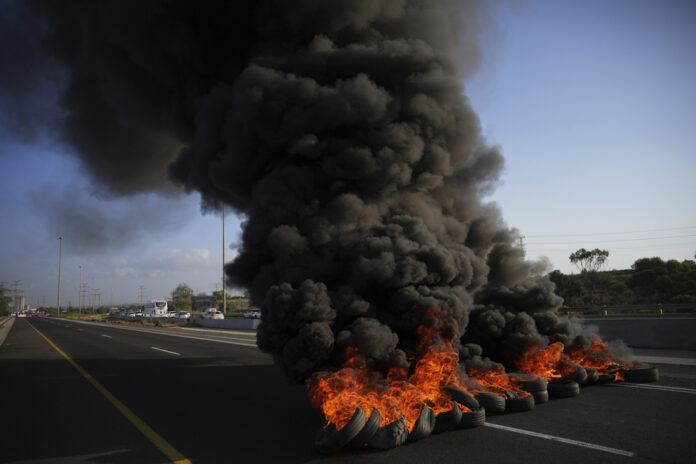
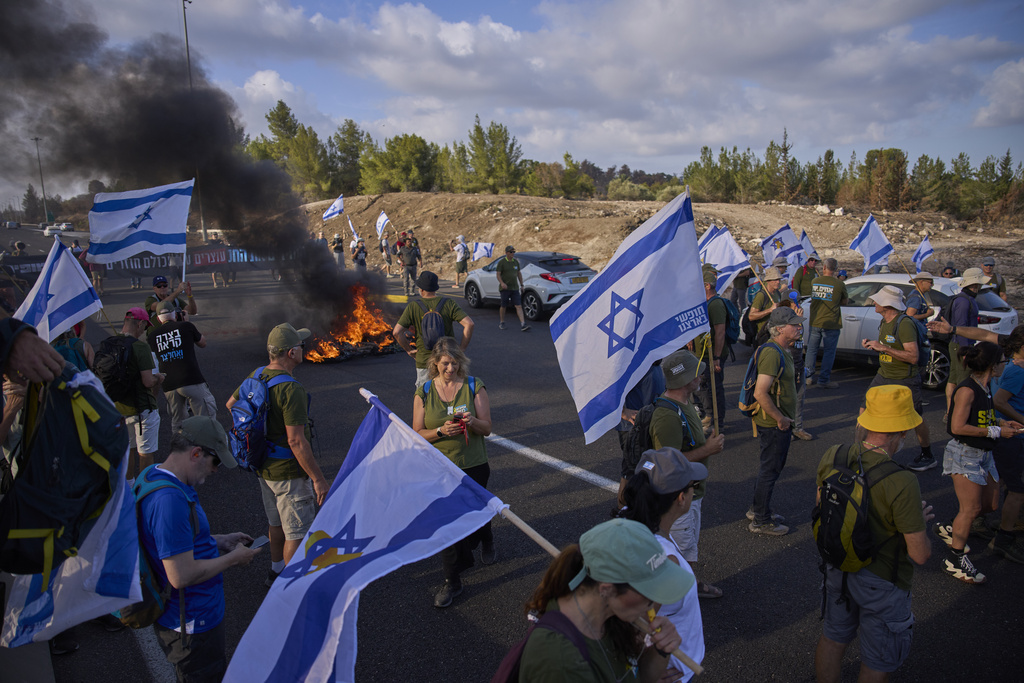
Tires are set on fire to block a road during a protest demanding the immediate release of hostages held by Hamas and calling for the Israeli government to reverse its decision to take over Gaza City and other areas in the Gaza Strip, near Jerusalem, Israel, Sunday, Aug. 17, 2025. (AP Photo/Ohad Zwigenberg)
JERUSALEM (AP) — Israeli protesters demanding a deal to free hostages in Gaza attempted to shut down the country Sunday in one of the largest and fiercest protests in 22 months of war. Organizers, representing the families of hostages, asserted that hundreds of thousands of people took part.
“We live between a terrorist organization that holds our children and a government that refuses to release them for political reasons,” said Yehuda Cohen, whose son Nimrod is held in Gaza.
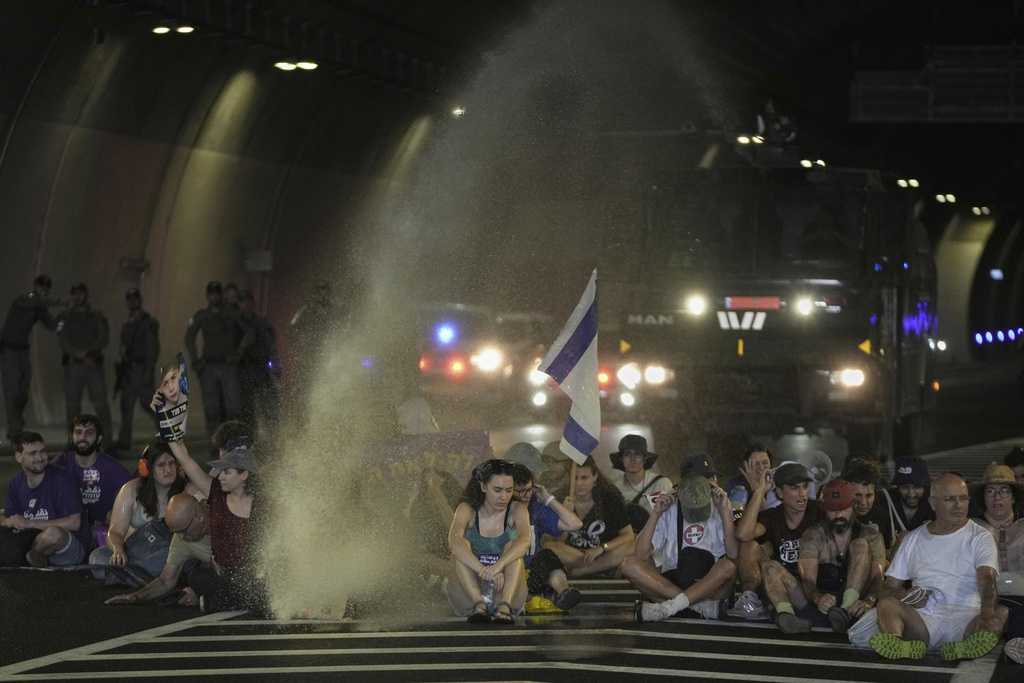
Police uses water canon to disperse demonstrators blocking a road during a protest demanding the immediate release of hostages held by Hamas and calling for the Israeli government to reverse its decision to take over Gaza City and other areas in the Gaza Strip, in Jerusalem, Sunday, Aug. 17, 2025. (AP Photo/Mahmoud Illean)
Protesters gathered at dozens of places including outside politicians’ homes, military headquarters and on major highways. They blocked lanes and lit bonfires. Some restaurants and theaters closed in solidarity. Police said they arrested 38 people.
One protester carried a photo of an emaciated Palestinian child from Gaza. Such images were once rare at Israeli demonstrations but now appear more often as outrage grows over conditions in the territory after more than 250 malnutrition-related deaths.
Netanyahu opposes any deal that leaves Hamas in power
An end to the war does not seem near. Israeli Prime Minister Benjamin Netanyahu is balancing competing pressures including the potential for mutiny within his coalition.
“Those who today call for an end to the war without defeating Hamas are not only hardening Hamas’ position and delaying the release of our hostages, they are also ensuring that the horrors of Oct. 7 will be repeated,” Netanyahu said, referencing the Hamas-led attack in 2023 that killed some 1,200 people and sparked the war.
The last time Israel agreed to a ceasefire that released some hostages earlier this year, far-right members of his cabinet threatened to topple Netanyahu’s government.
Finance Minister Bezalel Smotrich called Sunday’s demonstrations “a bad and harmful campaign that plays into Hamas’ hands, buries the hostages in the tunnels and attempts to get Israel to surrender to its enemies and jeopardize its security and future.”
The new offensive would require the call-up of thousands of reservists, another concern for many Israelis.
Another 17 aid-seekers killed in Gaza
Hospitals and witnesses in Gaza said Israeli forces killed at least 17 aid-seekers on Sunday, including nine awaiting U.N. aid trucks close to the Morag corridor.
Hamza Asfour said he was just north of the corridor awaiting a convoy when Israeli snipers fired, first to disperse the crowds. He saw two people with gunshot wounds.
“It’s either to take this risk or wait and see my family die of starvation,” he said.
The Gaza Humanitarian Foundation, which runs the Israeli-backed and U.S.-supported distribution points that have become the main source of aid since they opened in May, said there was no gunfire “at or near” its sites, which are located in military-controlled areas.
Police officers disperse demonstrators blocking a street during a protest demanding the immediate release of hostages held by Hamas and calling for the Israeli government to reverse its decision to take over Gaza City and other areas in the Gaza Strip, in Jerusalem, Sunday, Aug. 17, 2025. (AP Photo/Mahmoud Illean)
An Israeli strike targeting a group of people in the Bureij camp in central Gaza killed three, according to Al-Awda hospital, which received the casualties.
Israel’s military did not immediately respond to questions.
Israel’s air and ground war has killed more than 61,900 people, according to Gaza’s Health Ministry, which does not specify how many were fighters or civilians but says around half were women and children.
Two children and five adults died of malnutrition-related causes Sunday, according to the ministry, which is part of the Hamas-run government and staffed by medical professionals. The U.N. and independent experts consider it the most reliable source on casualties. Israel disputes its figures but has not provided its own.
The United Nations has warned that levels of starvation and malnutrition in Gaza are at their highest since the war began. Most aid has been blocked from entering Gaza since Israel imposed a total blockade in March after ending a ceasefire. Deliveries have since partially resumed, though aid organizations say the flow is far below what is needed.
Fears of the coming military offensive
It is not clear when Israel’s military will begin the new offensive in crowded Gaza City, Muwasi and what Netanyahu has called the “central camps” of Gaza.
The military body that coordinates its humanitarian aid to Gaza, COGAT, this weekend noted plans to forcibly evacuate people from combat zones to southern Gaza “for their protection.” Designated “safe zones,” however, also have been bombed during the war.
War-weary Palestinians insisted they won’t leave, arguing that there is no safe place in Gaza.
“There are no humanitarian zones at all,” said Raghda Abu Dhaher, who said she has been displaced 10 times during the war and now shelters in a school in western Gaza City.
Mohamed Ahmed also insisted that he won’t move south. “Here is bombing and there is bombing,” he said.
Demonstrators block a road during a protest demanding the immediate release of hostages held by Hamas and calling for the Israeli government to reverse its decision to take over Gaza City and other areas in the Gaza Strip, near Jerusalem, Israel, Sunday, Aug. 17, 2025. (AP Photo/Ohad Zwigenberg)
Airstrike on power plant in Yemen
Israeli airstrikes hit Yemen’s capital Sunday, escalating strikes on the Iran-backed Houthi rebels, who since the war in Gaza began have fired missiles at Israel and targeted ships in the Red Sea.
The Houthi-run Al-Masirah Television said the strikes targeted a power plant in the southern district of Sanhan, knocking it out of service. Israel’s military said the strikes were launched in response to missiles and drones aimed at Israel.
While some projectiles have breached its missile defenses — notably during its 12-day war with Iran in June — Israel has intercepted the vast majority of missiles launched from Yemen. Its military later Sunday said it had intercepted another, and the Houthis claimed they had targeted Israel’s Ben Gurion Airport.
Reignwood Park won the prestigious Thailand Mega Project of the Year 2025 title.
Mr. Dhira Thiongwilai, Chief Executive Officer of Pruksa Real Estate PCL was awarded Real Estate CEO of the Year 2025
Assistant Professor Dr Kessara Thanyalakpark, Managing Director of SENA Development PCL was recognised with the Leadership in Sustainable Living award.
Bangkok, Thailand – The Dot Property Thailand Awards 2025, was a night to remember, bringing together the best and brightest in Thailand’s real estate industry. This highly anticipated annual event, recognized as the pinnacle of excellence in the real estate sector, celebrated the outstanding achievements of developers and their projects that have shaped the landscape of Thailand’s property market.
This year’s Dot Property Thailand Awards presented over 40 accolades to outstanding real estate developers, carrying a deeper significance as the industry reflected on a challenging period marked by an economic slowdown and the unprecedented impact of the Bangkok earthquake. In his opening remarks, Mr.Adam Sutcliffe, Director of Dot Property Group, paid tribute to the strength and unity shown by the real estate sector, particularly developers in the capital who demonstrated unwavering resolve in the face of adversity.
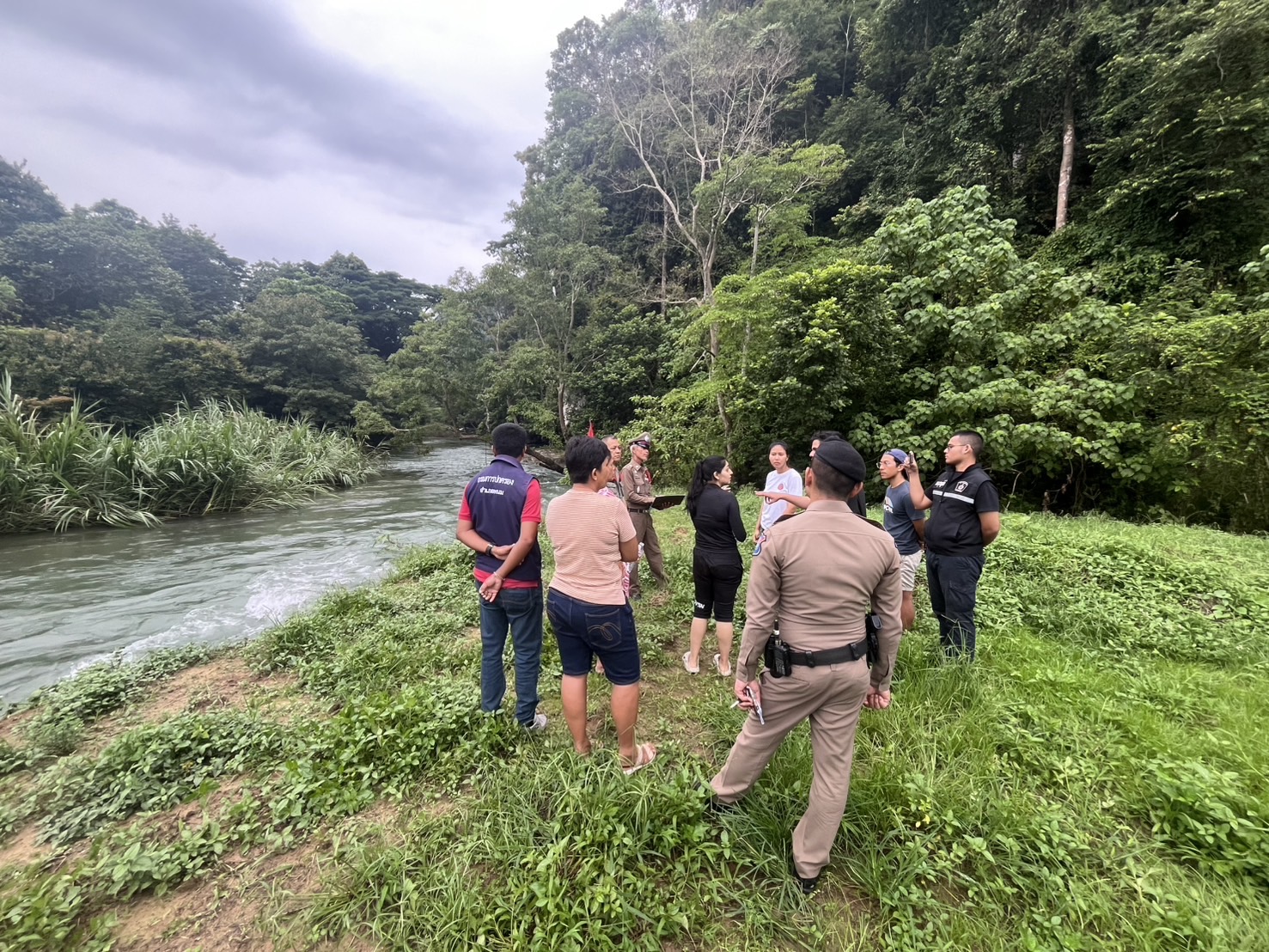
Officials cordon off the area where the body of a Bahraini tourist was found after he fell from an inner tube while river rafting in Khlong Sok, Khao Sok National Park, Surat Thani Province on August 17, 2025.
SURAT THANI — A family vacation turned tragic when a Bahraini tourist fell from his inner tube while river rafting and drowned in Khao Sok National Park, Surat Thani Province in southern Thailand.
Phanom District Chief Suchaow Tumosik received reports around noon on August 17 from Khao Sok rescue volunteers that a Bahraini male tourist had gone missing after falling into the water during tubing activities at Khlong Sok in Moo 6, Khlong Sok Sub-district, Phanom District.
Local authorities, Phanom Police Station officers, Surat Thani Kusonsraddha rescue volunteers from Ban Ta Khun-Phanom, along with water search teams and Khao Sok National Park search units immediately deployed to locate the missing person.
Officials discuss search operations for the Bahraini tourist who fell from his inner tube while river rafting in Khlong Sok, Khao Sok National Park, Surat Thani Province on August 17, 2025.
The victim was identified as Mr. Farouki, 55, a Bahraini tourist visiting Khao Sok National Park with his family of five members.
Before the accident, the family was participating in tubing activities on Khlong Sok canal. Farouki was not wearing a life jacket when he reached for a rope during the ride but slipped from his tube and was swept away by the current.
At 2:58 p.m., authorities were notified that the victim’s body had been found approximately 2 kilometers downstream from the accident site. Phanom Police investigators and doctors from Phanom Hospital were coordinated to examine the scene and transport the Bahraini man’s body for autopsy at Phanom Hospital, while local officials expressed condolences to Farouki’s family.
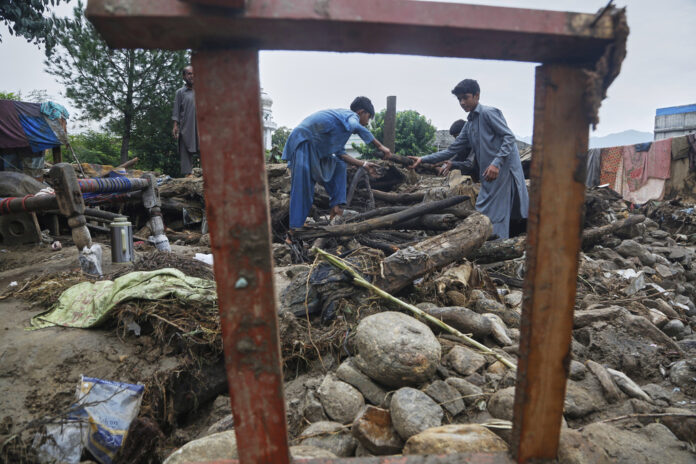
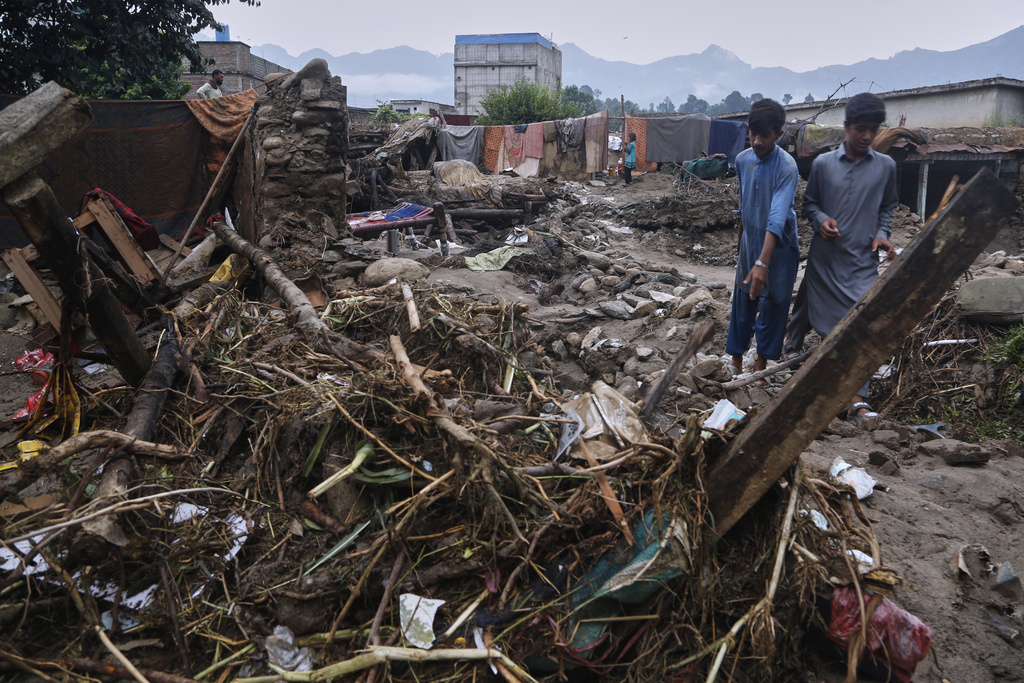
Boys collect wood and other useful items through the rubble of their damaged home following Friday's flash flooding at a neighbourhood of Pir Baba, an area of Buner district, in Pakistan's northwest, Sunday, Aug. 17, 2025. (AP Photo/Muhammad Sajjad)
BUNER, Pakistan (AP) — Torrential rains triggered more flash floods in two villages in the Kathua district of Indian-controlled Kashmir, killing at least seven people and injuring five others overnight, officials said Sunday.
In Kishtwar district, teams are continuing their efforts in the remote village of Chositi, looking for dozens of missing people after the area was hit by flash floods last week during an annual Hindu pilgrimage. At least 60 people were killed, and some 150 injured. Over 300 others were rescued.
In Pakistan, authorities on Sunday defended their response to climate-induced flash floods that killed more than 270 people in a single northwestern district.
Mohammad Suhail, a spokesman for the emergency service, said 54 bodies were found in Buner, a mountainous part in Khyber Pakhtunkhwa province, where torrential rains and cloudbursts triggered massive flooding on Friday.
Suhail said villagers remain missing, and search efforts are focused on areas where homes were flattened by torrents of water that swept down from the mountains, carrying boulders that smashed into houses like explosions.
Authorities have warned of more deluges and possible landslides between now and Tuesday, urging local administrations to remain on alert. Higher-than-normal monsoon rains have lashed the country since June 26 and killed more than 600.
Villagers collect usable items through the rubble of their partially damaged home following Friday’s flash flooding at a neighbourhood of Pir Baba, an area of Buner district, in Pakistan’s northwest, Sunday, Aug. 17, 2025. (AP Photo/Muhammad Sajjad)
Warnings of more intense rain to come
Residents in Buner have accused officials of failing to warn them to evacuate after torrential rain and cloudbursts triggered deadly flooding and landslides. There was no warning broadcast from mosque loudspeakers, a traditional method in remote areas.
The government said that while an early warning system was in place, the sudden downpour in Buner was so intense that the deluge struck before residents could be alerted.
Lt. Gen. Inam Haider, chairman of the National Disaster Management Authority, told a hastily convened news conference in Islamabad that Pakistan was experiencing shifting weather patterns because of climate change. Since the monsoon season began in June, Pakistan has already received 50% more rainfall than in the same period last year, he added.
He warned that more intense weather could follow, with heavy rains forecast to continue this month.
Asfandyar Khan Khattak, director-general of the Provincial Disaster Management Authority, said there was “no forecasting system anywhere in the world” that could predict the exact time and location of a cloudburst.
Mohammad Iqbal, a schoolteacher in Pir Baba village, said the lack of a timely warning system caused casualties and forced many to flee their homes at the last moment.
“Survivors escaped with nothing,” he said. “If people had been informed earlier, lives could have been saved and residents could have moved to safer places.”
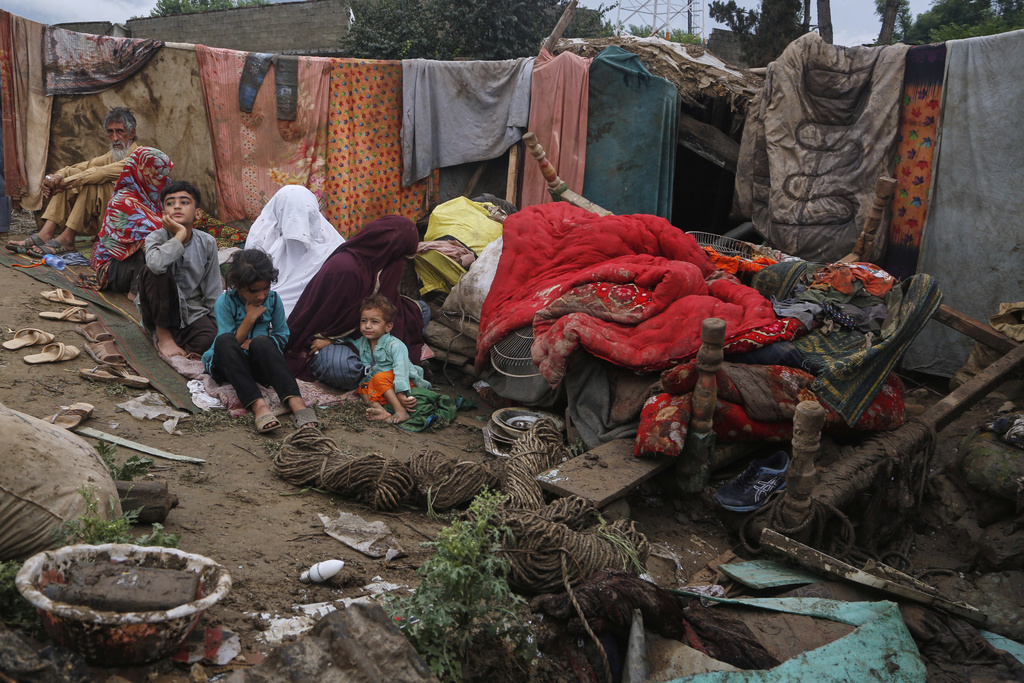
A villager Mateen Khan, left, and his family members sit over the rubble of their damaged home following Friday’s flash flooding at a neighbourhood of Pir Baba, an area of Buner district, in Pakistan’s northwest, Sunday, Aug. 17, 2025. (AP Photo/Muhammad Sajjad)
People still missing
Idrees Mahsud, a disaster management official, said Pakistan’s early warning system used satellite imagery and meteorological data to send alerts to local authorities. These were shared through the media and community leaders. He said monsoon rains that once only swelled rivers now also triggered urban flooding.
An emergency services spokesman in Buner, Mohammad Sohail, said more than half the damaged roads in the district had reopened by Sunday, allowing vehicles and heavy machinery to reach cut-off villages.
Crews were clearing piles of rocks and mud dumped by the floods. They were still using heavy machinery to remove the rubble of collapsed homes after families reported that some of their relatives were missing.
In one of the deadliest incidents, 24 people from one family died in the village of Qadar Nagar when floodwaters swept through their home on the eve of a wedding. The head of the family, Umar Khan, said he survived the floods because he was out of the house at the time. Four of his relatives have yet to be found, he added.
Extreme weather
Pakistan is highly vulnerable to climate-induced disasters. In 2022, a record-breaking monsoon killed nearly 1,700 people and destroyed millions of homes.
The country also suffers regular flash floods and landslides during the monsoon season, which runs from June to September, particularly in the rugged northwest, where villages are often perched on steep slopes and riverbanks.
Khalid Khan, a weather expert, said Pakistan produces less than 1% of planet-warming emissions but faces heatwaves, heavy rains, glacial outburst floods and now cloudbursts, underscoring how climate change is devastating communities within hours.
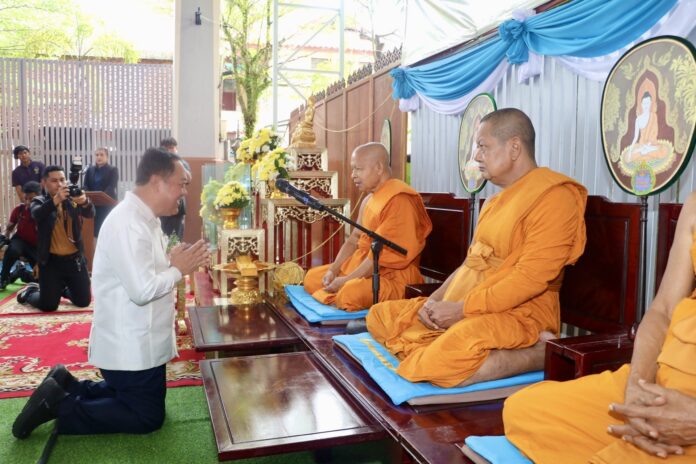
Justice Minister Police Colonel Thawee Sodsong leads a Buddhist merit-making ceremony to honor nearly 6,000 people killed during 22 years of southern border violence, at Wat Tanee Narasomosorn Royal Temple in Pattani Province on August 17, 2025.
PATTANI — Thailand held a solemn ceremony Sunday to remember the 6,000 lives lost and 14,000 injured in two decades of southern border unrest, as the government called for peace and dialogue to end the ongoing violence.
Justice Minister Police Colonel Thawee Sodsong presided over a Buddhist merit-making ceremony on Sunday, August 17, to dedicate merit to victims who died in the southern border unrest at Wat Tanee Narasomosorn Royal Temple in Pattani Province.
The ceremony was attended by approximately 1,200 people, including Deputy Prime Minister’s Office Assistant Minister General Niphath Thonglek, Southern Border Provinces Administrative Centre Secretary-General Police Lieutenant Colonel Wanpong Kocharak, 4th Army Area Commander Lieutenant General Paisal Nusang, Pattani Governor, government officials, and families of Thai Buddhist victims.
The event aimed to make merit for those killed in the southern border unrest while boosting morale and encouraging affected families to resume normal lives.
Justice Minister Police Colonel Thawee Sodsong meets people during a Buddhist merit-making ceremony honoring nearly 6,000 people killed in 22 years of southern border violence at Wat Tanee Narasomosorn Royal Temple in Pattani Province on August 17, 2025.
Nearly 6,000 Deaths in Two Decades
Minister Thawee stated that over the past 20 years, the region has mourned losses from the ongoing unrest, with approximately 6,000 deaths and 14,000-16,000 injuries. “Today we make merit for those who died in the unrest to remember the departed and encourage those who remain after losing loved ones,” he said.
He expressed hope that the ceremony would convey a message that peace and tranquility will prevail, and that affected families’ voices will demonstrate that their loved ones’ deaths and injuries “are not without answers – the answer is the return of peace and harmony.”
“We see that violence brings only tears and suffering, making development difficult in these areas, while non-violent areas continue to progress. We have become areas of suffering that concern the entire nation. It’s time to turn and talk to each other,” Thawee emphasized.
Official Casualty Statistics
According to verified three-party statistics for the southern border provinces from 2004-2025, there have been 10,059 confirmed incidents resulting in 5,989 deaths: 2,849 Buddhists, 3,133 Muslims, and 7 Christians. Injuries totaled 13,445 people: 8,792 Buddhists, 4,645 Muslims, and 8 Christians.
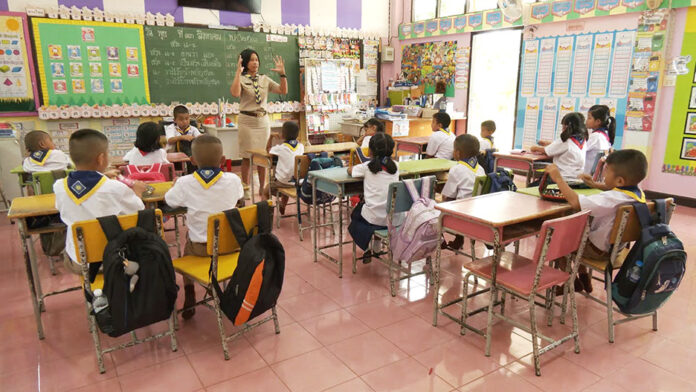
First-grader Khun sits alone at the back of the classroom at Wat Phakgad School in Chanthaburi on August 13, 2025 after his Thai-Cambodian classmate evacuated to Cambodia with family due to border tensions. The student hopes his friend will return to class soon.
Believing that Cambodia has not been adequately punished, and notwithstanding the fragile truce, some Thais are calling for more punitive actions against not just the Cambodian government but also innocent Cambodians in Thailand, including migrant workers and even schoolchildren.
This reflects not just growing hatred against Cambodians among ultra-nationalist Thais but also a myopic view that, in the medium and long term, does not even serve Thailand’s own national interests. (We will not discuss the far right who are still dreaming of Thailand attacking Phnom Penh here, as the repercussions would be too obvious.)
Earlier this week, a group of senators called on the Thai government to cut funding for Cambodian schoolchildren in Thailand. These senators’ demand is not just inhumane and short-sighted but in effect expands the scope of Thai-Cambodian conflicts to arenas that should have been kept separate from the conflict. These kids are innocent; they have nothing to do with the ruling Hun family in Cambodia, or the Cambodian military forces which attacked and killed thirty Thais, including civilians. Children, no matter their nationality, deserve to be protected.
The senators’ myopic demands are in fact undermining Thailand’s soft power and national interests. Instead of caring for and nurturing these Cambodian children in Thailand so they would grow up having a positive attitude towards Thailand, these senators, knowingly or not, want to ostracise them, deny them basic rights to education, and essentially turn them into adults who hold bitter memories and feelings towards Thailand. How does having more foreigners who hate Thailand serve Thai national interests?
On another related issue, acting Prime Minister Phumtham Wechayachai came under fire when he announced on August 13, 2025, that the government had resolved to extend the visa for migrant workers in Cambodia by six months. This led to an uproar among ultra-nationalist Thais and the conservative Thai press. Some of them not only asked why the government was “rewarding” these Cambodian workers despite the conflict but also accused Phumtham of being a traitor.
Blinded by ultra-nationalism, some Thais and media professionals can no longer recognise that the move also benefits the Thai economy. There are about 500,000 Cambodian migrant workers in Thailand, and if more have to leave Thailand due to the conflict (and tens of thousands already had), it will disrupt the Thai economy itself, as it will take time to find replacements and train them.
Also, most importantly, they are innocent. They should not be punished for the deeds committed by Cambodian Senate President Hun Sen and his son, Cambodian PM Hun Manet.
There are some Thais who want all Thais to hate all Cambodians, however.
This week, one of this writer’s Thai Facebook friends (whom I have never met in real life) was very upset after I made a post on Facebook citing that I have Cambodian Facebook friends (whom I also have never met in real life) and that one of my Cambodian Facebook friends said Cambodians along the Thai-Cambodian border were fearful of another Thai military attack on Wednesday night due to widespread rumours.
Apparently, these people want all Thais to be the enemy of all Cambodians. I say no. I say build bridges, not walls.
This is what he wrote in Thai – translated into English.
”Oh, so he has a Cambodian friend. I knew it, his posts have always seemed a bit off. I’ve been following him for years, and it turns out he’s a Thai person with a Khmer heart.”
This man’s world is far away from those facing the consequences of the senseless war and continued conflict.
On Thursday, this writer spoke to a housekeeper working as a cleaner at an upper-middle class condominium in Bangkok. She was originally from Buriram province, which is next to the Cambodian border.
She spoke about how her family and others who are from Baan Kruat district, less than an hour’s drive from the Thai-Cambodian border, are now returning home after the fragile ceasefire agreement was signed but have decided to invest in their own concrete shelters, just in case. She showed me photos of a bomb shelter she and many others are building at home.
They’re buying the materials themselves: large concrete pipes that people can fit inside while squatting. The three concrete pipes cost 4,200 baht. The three truckloads of dirt needed to cover them for blast protection will be another 1,200 baht.
Noi (a pseudonym of the cleaner), who is in her early thirties, told me she believes there’s a significant chance of another military conflict, especially after the latest incident where a Thai soldier stepped on a landmine earlier this week and lost his ankle.
Noi also mentioned that everyone in her area is doing the same thing and paying for it themselves. The government reportedly promised 3,000 baht per family, but it’s unclear when they’ll receive it.
Meanwhile, the so-called keyboard warriors in air-conditioned rooms in Bangkok want another round of military attacks.
P.S. Noi added that Cambodians across the border used to come and offer to harvest rice to earn a living, but she doesn’t know what it will be like in the future with the border now shut. Also, she had never visited the disputed Ta Muen Thom Temple complex in her life, although it’s not far from her home, despite the temple being among the four fiercely contested spots between Thailand and Cambodia and visited by many ultra-nationalist Thais and Cambodians before the five-day war.
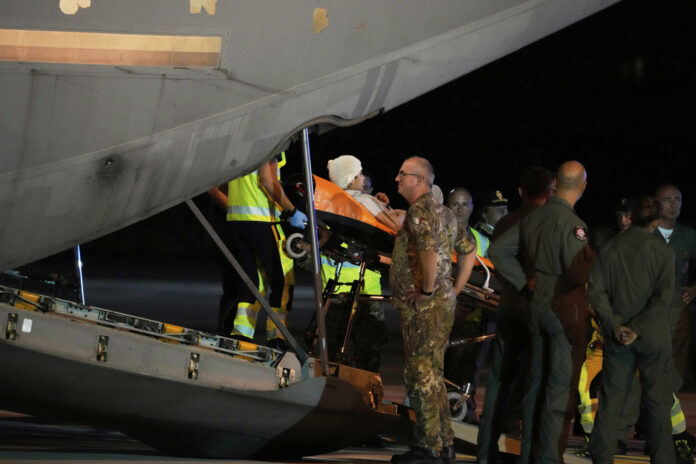
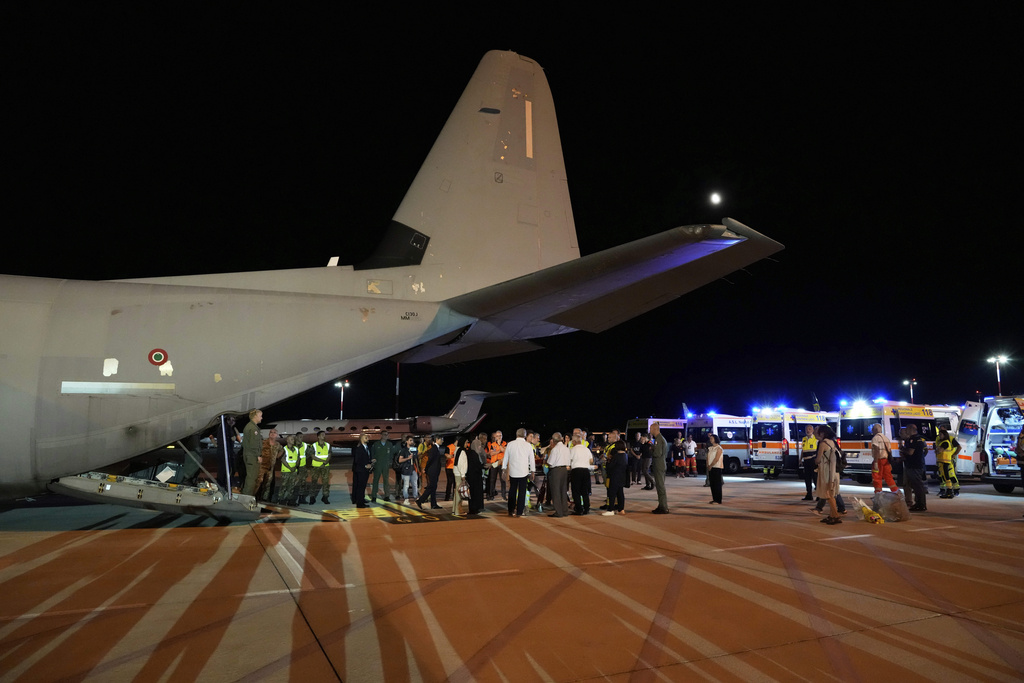
Palestinian children and their families evacuated from Gaza arrive at Rome's Ciampino military airport, Thursday, Aug. 14, 2025. (AP Photo/Gregorio Borgia)
MADRID (AP) — A 20-year old Palestinian woman described as being in a “state of severe physical deterioration” has died after being transferred to Italy for treatment, the hospital said Saturday.
The patient was admitted to Pisa University Hospital late Wednesday and died on Friday. She was removed from the Gaza Strip as part of a humanitarian mission and arrived with a “with a very complex, compromised clinical picture,” according to the hospital.
She died after entering a respiratory crisis and subsequently going into cardiac arrest, it said in a statement.
Hospital staff had performed tests and started supportive therapy before she died, the statement said.
The woman, named by Italian media as Marah Abu Zuhri, had arrived in Italy with her mother.
Italian Foreign Minister Antonio Tajani said almost 120 Palestinians — 31 patients and their families — had been flown to Rome, Milan and Pisa on three planes.
Palestinian children and their families evacuated from Gaza arrive at Rome’s Ciampino military airport, Thursday, Aug. 14, 2025. (AP Photo/Gregorio Borgia)
In a post on X, Tajani said that it was the 14th medical evacuation of Palestinians that Italy had conducted since January 2024, and the largest.
The hospital did not specify whether the woman had suffered from malnutrition, but said that she had arrived in a “state of severe physical deterioration.”
Eugenio Giani, leader of the Tuscan region, expressed his condolences Saturday for the woman’s death.
Earlier in the week, United Nations spokesman Stephane Dujarric said that starvation and malnutrition in Gaza were at their highest levels since the Israel-Hamas war began.
The U.N. says nearly 12,000 children under 5 were found to have acute malnutrition in July — including more than 2,500 with severe malnutrition, the most dangerous level. The World Health Organization says the numbers are likely an undercount.
Israeli Prime Minister Benjamin Netanyahu said last month no one in Gaza is starving. “There is no policy of starvation in Gaza, and there is no starvation in Gaza,” he said.
U.S. President Donald Trump responded to Netanyahu’s claim by noting the images emerging of emaciated people. “I don’t know,” Trump said when asked if he agreed with the Israeli leader’s comment. “I mean, based on television, I would say not particularly because those children look very hungry.”
Over the past two weeks, Israel has allowed around triple the amount of food into Gaza than what had been entering since late May.
That was after two and a half months when Israel barred all food, medicine and other supplies, saying it was to pressure Hamas to release hostages taken during its October 2023 attack that launched the war.
Police escort Myanmar nationals who tested positive for drugs to vehicles for transport to Wang Thonglang Police Station on August 16, 2025.
BANGKOK — Police raided an unlicensed entertainment establishment in Wang Thonglang district after receiving a tip from informants about a private party being held at the venue.
Acting on intelligence that a single-story shophouse located in a side street near a hotel in Phlab Phla subdistrict was hosting an exclusive private party, officers from Wang Thonglang Police Station moved in to investigate the unnamed establishment.
The building was operating as an entertainment venue similar to a karaoke bar with three rooms. Police found approximately 60 male and female party-goers inside and conducted random drug tests on all attendees.
Test results showed that 41 people tested positive for narcotics in their urine – all of whom were Myanmar nationals, comprising 26 men and 15 women. They have been charged with illegal use of Category 1 narcotics.
Police raid illegal entertainment venue party in Bangkok’s Phlab Phla area and conduct drug tests on attendees on August 16, 2025.
Initial investigations revealed that the party-goers had invited each other to what was described as a private birthday celebration among friends who knew each other, held within the karaoke rooms.
During a search of the premises, police found that alcohol was being sold without proper licensing. Officers also discovered four e-cigarette cartridges containing liquid suspected to be Category 2 psychoactive substances, found near the restroom area inside the establishment. The ownership of these items could not be determined.
Police questioned the Thai manager of the venue, identified as Mr. Pong, 48, who admitted that the establishment was operating without proper licensing. He has been charged with operating an entertainment venue without a license and selling alcohol without authorization.
All suspects have been transferred to investigators at Wang Thonglang Police Station for further legal proceedings.
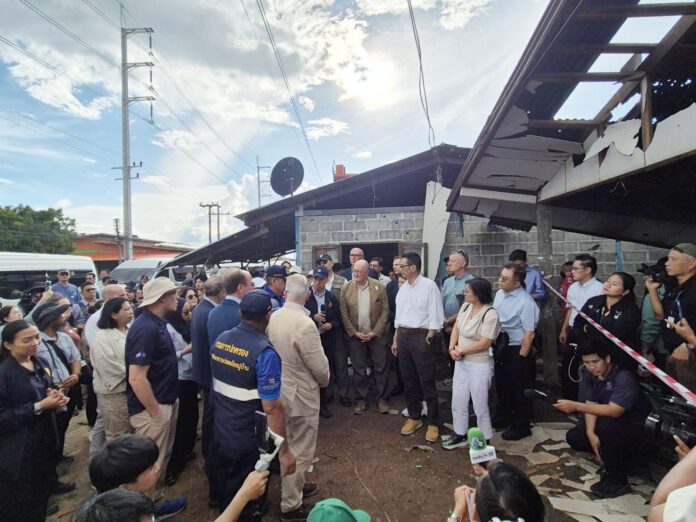
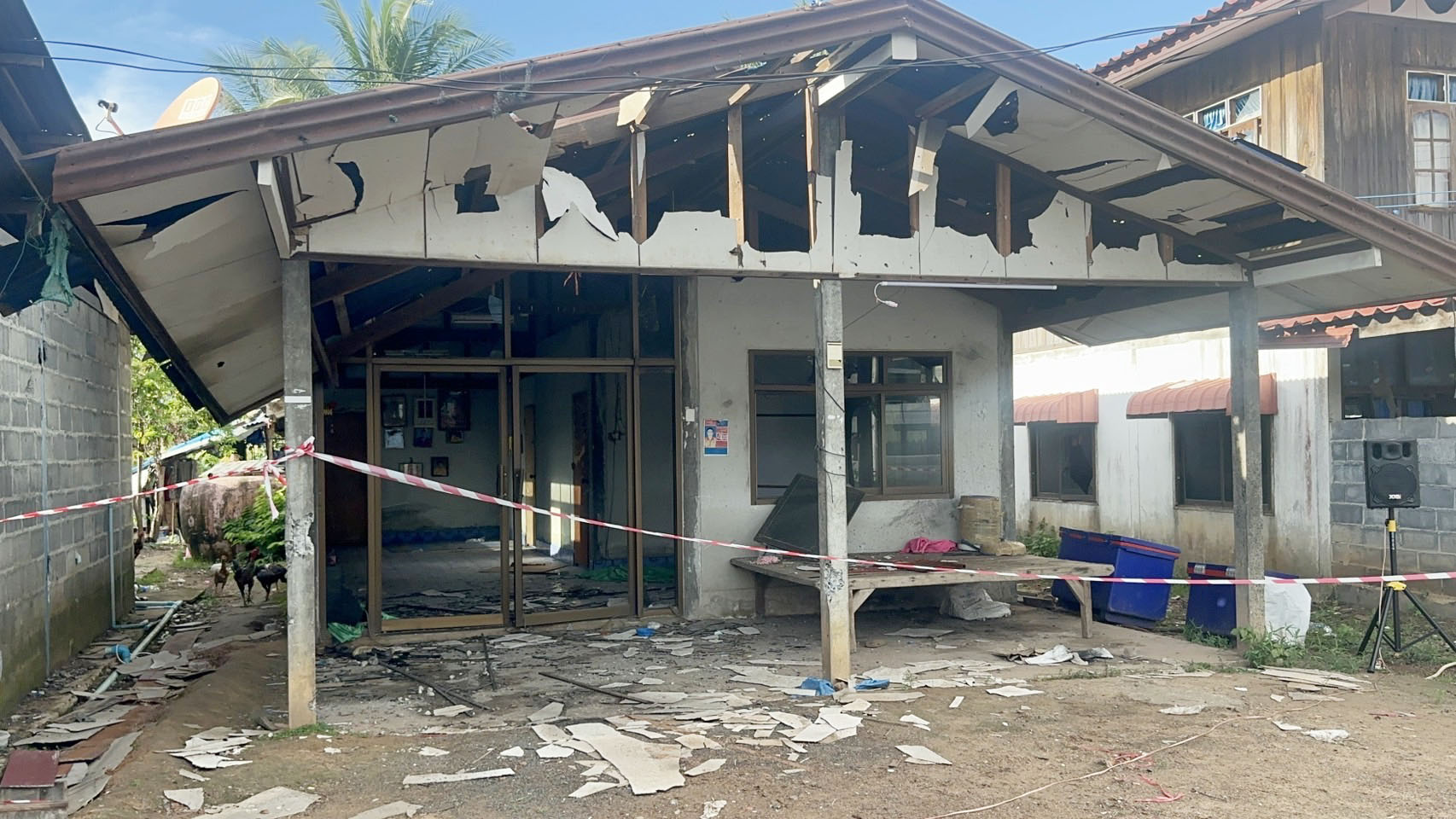
Thailand's Foreign Minister Maris Sangiampongsa and a delegation of diplomatic corps and international organisations survey homes in Kantharalak district, Si Sa Ket province, that were severely damaged by Cambodia's indiscriminate attacks on August 16, 2025.
SISAKET — A Thai-Dutch couple living in Si Sa Ket Province, who were caught up in military clashes along the Thai-Cambodia border, traveled to meet the Dutch Ambassador to Thailand during his visit to observe affected areas on Saturday. They wanted to share their firsthand account of what really happened.
Phitsamai Angkana and her Dutch boyfriend, known as Mr. Ruud, who moved to Thailand over two years ago, described how they had to flee for their lives from artillery shells fired by Cambodian forces into Thai territory in Kantharalak District, Si Sa Ket Province, from the very first day of fighting on July 24.
“We came here specifically to tell them about what happened – both what we experienced ourselves and what Thai people had to endure from Cambodia’s actions against Thailand. We wanted the ambassador to know that his own citizens are living in Thailand too,” Phitsamai said.
Mr. Ruud recounted the day when weapons attacks came from the Cambodian side. He was riding his motorcycle home in a panic while other villagers were evacuating after hearing the sounds of battle. He and his girlfriend decided they had to leave their home too, waiting an hour for her brother to pick them up by car. Just as they were getting into the vehicle, five more shells hit the road nearby, confirming that the area was no longer safe. They then drove 45 kilometers north, thinking they would be safe there.
International Delegation Visits Border Areas
Dutch Ambassador Remco van Wijngaarden was part of a 33-country delegation including diplomats from ASEAN member states, Ottawa Convention signatories, international organization representatives, and civil society groups involved in landmine clearance. The group accompanied a Thai delegation led by Foreign Minister Maris Sangiampongsa to observe areas affected by anti-personnel landmines in Si Sa Ket Province – mines that Thailand insists were recently planted by Cambodia.
Thailand’s Foreign Minister Maris Sangiampongsa leads a delegation of ASEAN diplomats, Ottawa Convention representatives, and international organizations to examine evidence of Cambodian anti-personnel landmines on Thai territory in Si Sa Ket Province on August 16, 2025.
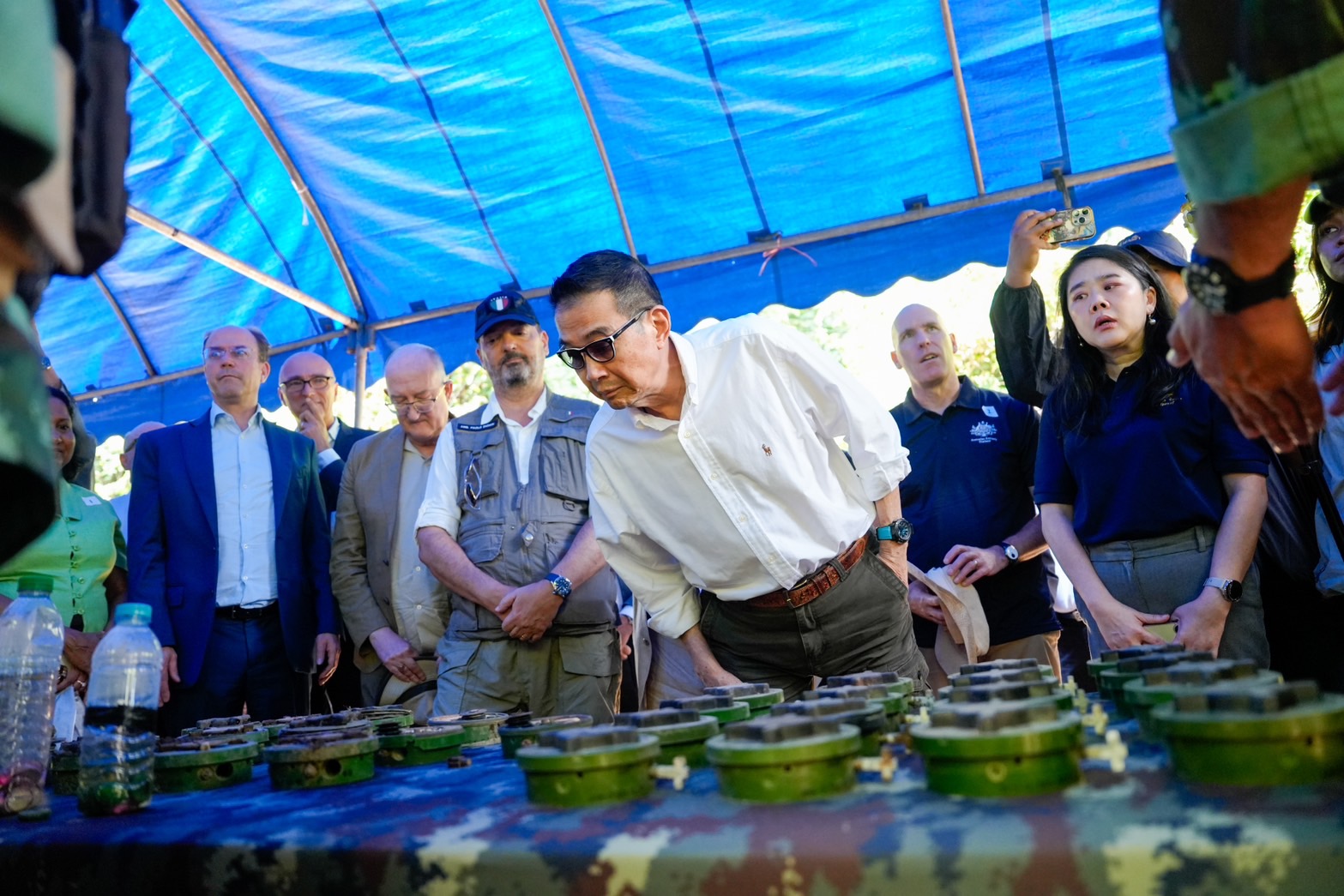
The delegation visited the Phu Ma Khuea operational unit in Kantharalak District to observe landmine clearance operations and examine various ordnance found in the area, with media present to witness the recovery efforts.
Officers from the 4th Engineer Battalion reported that they had successfully cleared 46 anti-personnel landmines, with 16 ready for immediate use. They also discovered anti-tank mines, RPG rockets, and 60mm and 82mm mortar rounds.
The delegation then surveyed damaged civilian homes in Kantharalak District hit by Cambodian weapons. This village, just 5 kilometers from the border, suffered the worst damage in the district. The observers closely inspected the destruction, visiting another completely destroyed house about 100 meters away, where the homeowner came out to provide information personally.
A house severely damaged by Cambodia’s indiscriminate attacks in Kantharalak district, Si Sa Ket province, is shown to a delegation of the diplomatic corps and international organisations on August 16, 2025.
Thailand’s Position on International Law
Foreign Minister Maris reaffirmed Thailand’s commitment to international law, particularly the Ottawa Convention and International Humanitarian Law. He called on the international community to review assistance given to Cambodia for demining while urging Cambodia to cooperate on mine clearance and stop spreading disinformation to improve bilateral cooperation and resolve tensions.
Army Responds to Cambodia’s Denials
Major General Winthai Suvaree, Army spokesperson, said during the briefing that Cambodia continues to distort facts about using landmine weapons against Thai forces, systematically trying to deny evidence by claiming Thailand’s proof is staged or consists of old war remnants – claims that contradict the facts.
Anti-personnel landmines seized by Thai forces from areas along the Thailand-Cambodia border are displayed as evidence during a diplomatic delegation visit to Si Sa Ket Province on August 16, 2025.
The Royal Thai Army presented eight key points of evidence proving Cambodia used landmines against Thai forces:
Tactical Patterns: Every time Cambodia deploys forces, landmine defensive lines appear in forward positions. At five separate incidents between July and August 2025, Thai personnel discovered systematic placement of 3-5 additional PMN-2 landmines.
Who’s in the Area: Only Thai and Cambodian forces operate there, yet in all five incidents, only Thai forces were harmed – making it impossible that Thailand would endanger its own personnel.
Post-Ceasefire Discoveries: After fighting stopped, Thai engineers found numerous hidden PMN-2 landmines along former Cambodian positions.
Social Media Evidence: Photos showed Cambodian influencers creating content near Ta Kwai Temple with clusters of PMN-2 landmines visible in the background.
Intelligence: Audio recordings captured Cambodian soldiers discussing collecting and relocating PMN-2 landmines to new areas.
Diplomatic Stance: Cambodia refuses Thailand’s proposal for joint landmine clearance operations, despite Cambodia’s international image as opposing landmine use and receiving substantial annual funding support.
Previous Clearance: Thai mine action teams had already cleared 1,300 remnant landmines from these areas in 2019, with no PMN-2-type mines found then.
Non-Cooperation: Cambodia frequently fails to cooperate in landmine clearance operations near the border demarcation line, suggesting suspicious behavior and lack of transparency.
Major General Winthai emphasized that all evidence presented consists of verifiable facts that must be shared with the international community to clearly demonstrate Cambodia’s use of landmine weapons against Thai forces – actions that violate humanitarian principles and international obligations.