30.5 C
Bangkok
Tuesday, June 30, 2026
Home Blog Page 3058

Cop-on-Cop Gunfight at Koh Samui Bar Injures Two

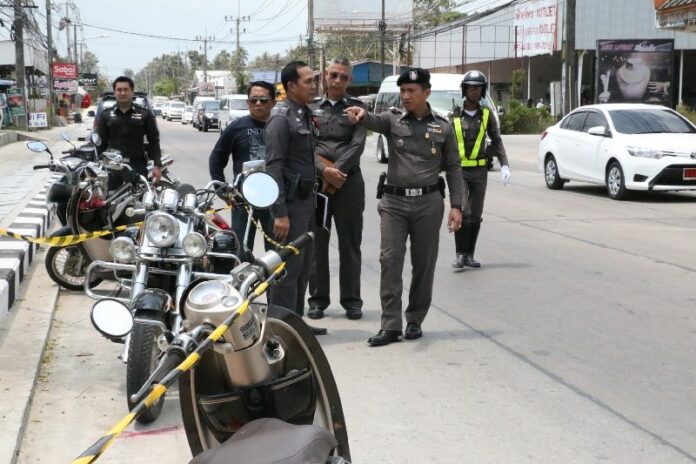
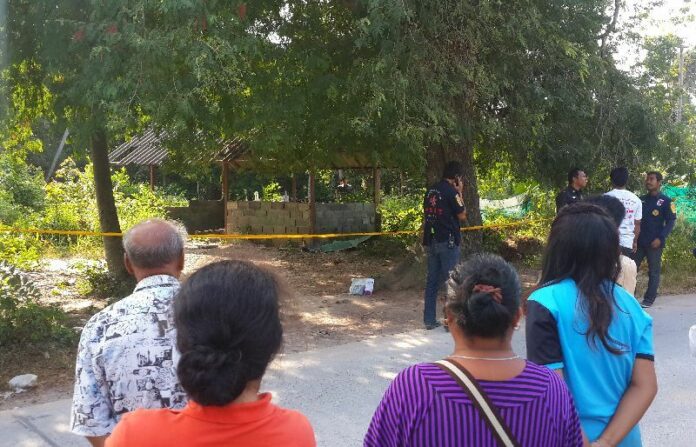
Officers inspect the crime scene where a volunteer policeman exchanged gunfire with a group of police officers on Koh Samui, 6 March 2015.

SURAT THANI—A gunfight broke out between a volunteer police officer and a group of policemen at a bar on Koh Samui island early this morning, injuring two people.

The incident took place at Tawan Chai Cafe on Taweeratphakdee Road at around 2.30 am today, police say. 

Staff at the bar told police that Sitthiporn Poonsawasdi, a volunteer police officer, was drinking heavily until the bar closed at 2 am. According to staff, Sitthiporn drunkenly tried to ask musicians at the bar to leave with him, and became angry when they refused. 

Sitthiporn then reportedly walked to the front of the bar and fired one shot into the air, prompting the staff to alert police.

Police officers soon arrived and ordered Sitthiporn to drop his weapon, witnesses said. However, Sitthiporn allegedly refused and fired at police. A gunfight then broke out between the officers and Sitthiporn.

Sitthiporn was eventually shot in his left leg and apprehended. A police officer, Lt. Somporn Cherdchim, was also shot in his stomach during the gunfight. 

Medical workers say Sitthiporn and Somporn are now in stable condition. 

According to Police Senior Sergeant Chamnan Poonsakda, Sitthiporn was visibly drunk when officers arrived at the scene. He was reportedly waving his handgun in the air and threatening the bar staff. 

"I have known Sitthiporn for a long time because he is a volunteer police officer," Pol.Sen.Sgt. Chamnan said. "So I tried to talk Sitthiporn into dropping his gun, but he was so drunk that we didn't understand what he was saying. He then shot at us." 

Police say they have not yet charged Sitthiporn with any crime.


For comments, or corrections to this article please contact:[email protected]

You can also find Khaosod English on Twitter and Facebook
http://twitter.com/KhaosodEnglish
http://www.facebook.com/KhaosodEnglish

Advertisement

Army Seizes Suspected Holiday Home of Former Princess' Family

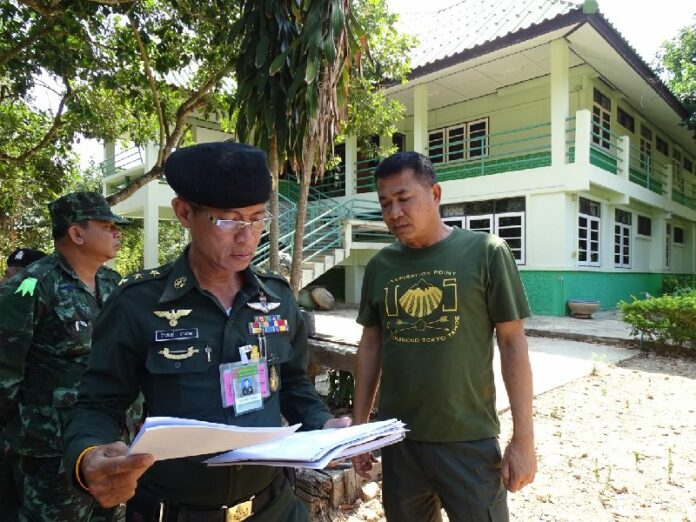
Soldiers inspect a remote residence in the middle of a forest that officers believe was used as a holiday home for former princess Srirasmi Suwadee and her family, 5 March 2015.

PRACHUAP KIRI KHAN — The military has seized a remote residence in the middle of a forest that officers believe was a holiday home for former princess Srirasmi Suwadee and her family.

Soldiers from 15th Military Circle inspected the property, which has no home address, in a forest near Guiburi National Park yesterday. The operation was convened after local residents alerted authorities that the residence was "suspicious" and potentially encroaching on the national park land, said Cpt. Teerapong Namsala, commander of the group. 

\
The houses are located in the bottom section of land, Prachup Kiri Khan Province.

The soldiers invoked the power granted to them under martial law to investigate the property; under the martial law, which was imposed after the military seized power on 22 May 2014, security officers can detain individuals and search homes without warrants. 

The residence consists of two houses surrounded by orchards, located around 70 kilometer away from the nearest highway. Soldiers discovered many framed portraits inside the houses of the family of former princess Srirasmi, the wife of the Crown Prince who resigned her royal status in December 2014.

"There were many photos of Ms. Srirasmi Suwadee's parents," a military officer told reporters, "A photo that was taken next to the creek in front of the house appears to be taken in 2006, according to the date in the photograph. Officials have collected all photos as evidence."

Local residents reportedly told officers that members of the Suwadee family were seen visiting the area occasionally. 

According to the military, the residence and land were registered under the name of Mr. Chaiwat Hooyakorn. The military says an investigation has been launched to determine whether the residence encroached on National Park land. The investigation is expected to take seven days. At the time of publication, no charges had been filed.

Several local residents who lived close to the forest house declined to speak to the media, citing concerns for their safety. One of the residents said simply that no one dared to approach the land because it was believed to belong to "extraordinary people."

"It has to be someone with high influence, and there's also reports that the Suwadee family was involved," said the resident, who asked not to be named. "In the past, we have never seen any state agency inspecting the land. Sometimes state helicopters flew over the area, but there was no inspection." 

Srirasmi resigned from her royal status in December 2014 after several members of her family were arrested and accused of running a massive crime syndicate and citing their ties to the monarchy to intimidate victims. According to police, the network was guilty of extortion, illegal gambling dens, and oil smuggling, among other alleged crimes. 

Srirasmi's uncle has been charged with leading the crime syndicate, which also involved the former Princess's sister and brother, police say.

Srirasmi's parents, Apiruj and Wantanee Suwadee, are also being detained at Bangkok Remand Prison while they await trial for charges of lese majeste (insulting the monarchy), which carries a maximum penalty of 15 years in prison. Apiruj and Wantanee were charged with lese majeste after an employee of a royal charity foundation accused them of using their ties to the monarchy to have her jailed for 18 months on bogus fraud charges.

Srirasmi has not been seen in public since 13 December 2014, when she applied for a new national ID card as a commoner. 

It is unclear whether Srirasmi and the Crown Prince are formally divorced. The couple married in 2001 and have one 9-year-old son. 


For comments, or corrections to this article please contact:[email protected]

You can also find Khaosod English on Twitter and Facebook
http://twitter.com/KhaosodEnglish
http://www.facebook.com/KhaosodEnglish

Advertisement

Thai Teens Arrested for Killing Burmese Man on Koh Samui

The site where a 22-year-old Burmese man was found dead on Koh Samui, 27 Feb 2015.

SURAT THANI — Three Thai teenagers have been arrested for allegedly killing a 22-year-old Burmese man on the southern island of Koh Samui, despite a police officer's earlier suggestion that the killers must have also been Burmese.

The three suspects, said to be 18, 17, and 16 years of age, were arrested on 2 March. According to police, they confessed to stabbing Thet Soe Tar, 23,  to death on the night of 27 February. 

Pol.Col. Thewet Pluemsutthi, superintendent of Bo Put Police Station, said the teens told police that they were riding a motorcycle on the night of 27 February when Thet collided into them with his motorcycle, leading to an argument.

The suspects reportedly asked Thet to pay 500 baht in damages, but the Burmese man said he did not have any money on him, and told the suspects to follow him to his home where he had cash.

"The deceased guided them onto Soi Mod Yim in Bo Put district. It was a dark and isolated street. The Burmese man then decided to put up a fight, and the suspects assaulted the victim, before they stabbed him and cut his throat at the crime scene," Pol.Col. Thewet said. "They took the deceased's motorcycle to be burned in a coconut orchard … before they went home and pretended that nothing happened."

Police say they managed to track down the suspects using CCTV footage and witnesses' testimonies. They have been charged with armed robbery that lead to the death of another. 

In the wake of the killing, Pol.Col. Sirichai Kertsri, deputy superintendent of Bo Put Police Station, said he believed Thet was murdered by another Burmese because of their "violent" behavior. 

"We believe [the perpetrators] are from Burma, judging from their violent behavior. They like to use violence," Pol.Col. Sirichai said on 27 February. 

There are more than one million Burmese migrant workers in Thailand, many of whom are not officially registered under Thai law. Their lack of legal protection, coupled with widespread discrimination against Burmese people in Thailand, means they are often subject to abuse by employers, police, and human traffickers.


For comments, or corrections to this article please contact:[email protected]

You can also find Khaosod English on Twitter and Facebook
http://twitter.com/KhaosodEnglish
http://www.facebook.com/KhaosodEnglish

Advertisement

Media Must Do More Than Report Facts, Says Prayuth

[ลบรูปภาพนี้]     Image is Slide  
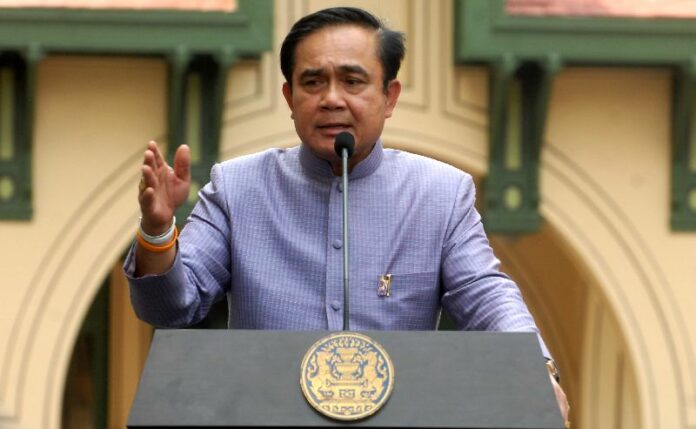
Gen. Prayuth Chan-ocha at the Government House in Bangkok on 3 March 2015.
[ลบรูปภาพนี้]     Set Slide  
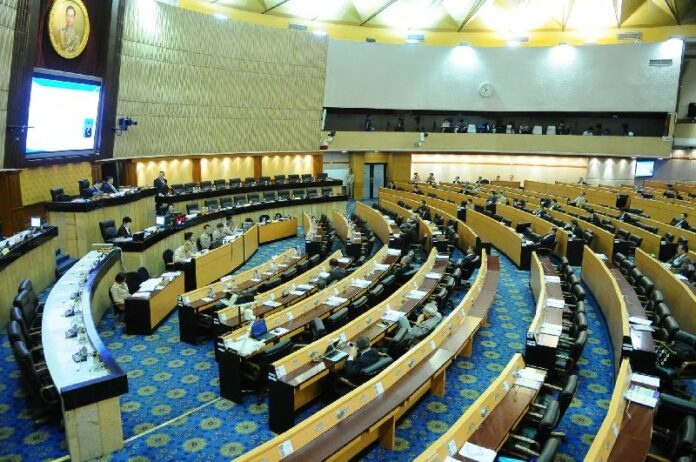
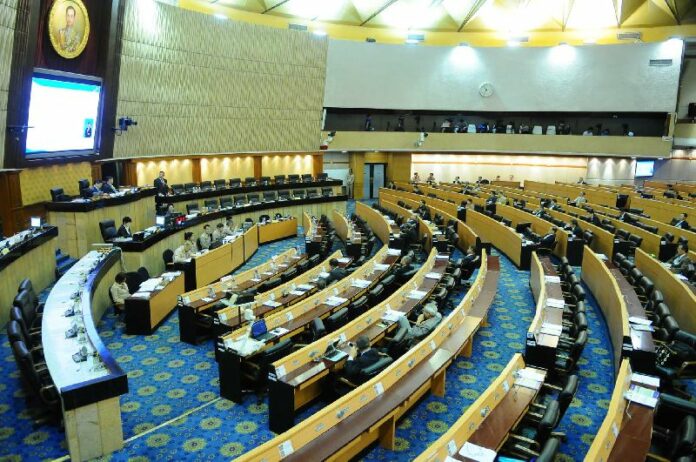
An NLA session at the Parliament House on 5 March 2015.

BANGKOK — Junta chairman and Prime Minister Gen. Prayuth Chan-ocha presented his own view of media ethics in a speech marking Thailand's National Media Day on Thursday, urging journalists to go beyond merely "reporting the facts."

"This morning, someone said the media needs to be impartial. No. I don't think they should say that. It isn't good," Gen. Prayuth said to reporters  on a day intended to celebrate freedom of the press in Thailand.

"What they should say is, first, media should report news that is factual. Second, they should support the government's efforts to move the country forward. And third, they should help reduce conflicts in society, and create understanding about the government's policies that give clear results. Can you not do these three or four things together, dears?"

He continued, "If this person says, this side good, that side not good, if media keeps presenting news like that, when will our country have peace?"

The general then wished the media happiness and told the journalists to "be good reporters, be quality reporters, and be lovely reporters." 

"It's good that some media does cooperate with the government, but some media are not so good. However, I don't want to say their names," said Gen. Prayuth.

Urged by reporters to identify the offending news outlets by name, the junta chairman replied, "No I won't say it. I'm too lazy to do it." 

Since seizing power from an elected government on 22 May 2014, Gen. Prayuth has significantly curtailed freedom of expression in Thailand by imposing a ban on public protests, sending violators to face trial in martial court, and urging the media not to criticize his regime, among other restrictions.

On 27 February, Gen. Prayuth warned that any news anchors or talking heads who present opposing views about his government on television may be summoned for "discussion." 

"Many shows and many channels still have problem with this," he said in a televised address to the nation. "I may need to summon you for a discussion. I am not censoring you. But you invite academics and guests who give totally opposite views of the issues. They talk about things that are incorrect and inaccurate."

Due to the plunge in civil rights and media freedom in post-coup Thailand, the US-based organization Freedom House declared Thailand as "Not Free" in its annual report in January this year.

The status of "Not Free" put Thailand alongside neighboring countries like Myanmar, Vietnam, and Cambodia. The Kingdom was ranked "Free" from 1999 to 2005, and "Partially Free" for the past eight years by Freedom House. 


For comments, or corrections to this article please contact:[email protected]

You can also find Khaosod English on Twitter and Facebook
http://twitter.com/KhaosodEnglish
http://www.facebook.com/KhaosodEnglish
Advertisement

Media Must Do More Than Report Facts, Says Prayuth

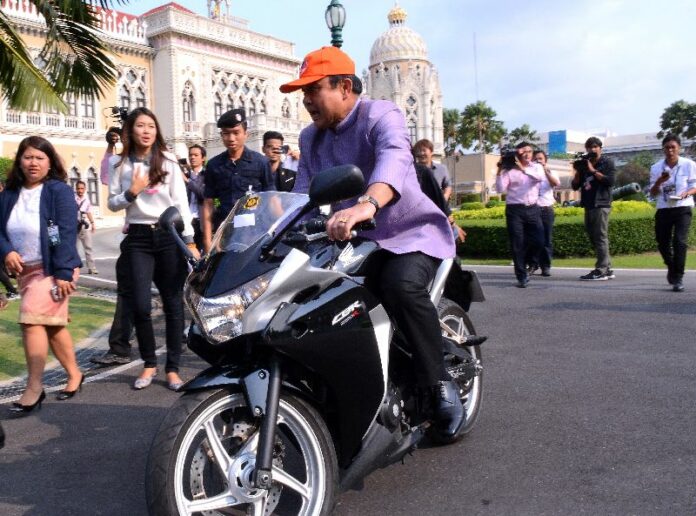
Gen. Prayuth Chan-ocha tests a motorcycle repaired by technical students, Government House in Bangkok, 3 March 2015.

BANGKOK — Junta chairman and Prime Minister Gen. Prayuth Chan-ocha presented his own view of media ethics in a speech marking Thailand's National Media Day on Thursday, urging journalists to go beyond merely "reporting the facts."

"This morning, someone said the media needs to be impartial. No. I don't think they should say that. It isn't good," Gen. Prayuth said to reporters  on a day intended to celebrate freedom of the press in Thailand.

"What they should say is, first, media should report news that is factual. Second, they should support the government's efforts to move the country forward. And third, they should help reduce conflicts in society, and create understanding about the government's policies that give clear results. Can you not do these three or four things together, dears?"

He continued, "If this person says, this side good, that side not good, if media keeps presenting news like that, when will our country have peace?"

The general then wished the media happiness and told the journalists to "be good reporters, be quality reporters, and be lovely reporters." 

"It's good that some media does cooperate with the government, but some media are not so good. However, I don't want to say their names," said Gen. Prayuth.

Urged by reporters to identify the offending news outlets by name, the junta chairman replied, "No I won't say it. I'm too lazy to do it." 

Since seizing power from an elected government on 22 May 2014, Gen. Prayuth has significantly curtailed freedom of expression in Thailand by imposing a ban on public protests, sending violators to face trial in martial court, and urging the media not to criticize his regime, among other restrictions.

On 27 February, Gen. Prayuth warned that any news anchors or talking heads who present opposing views about his government on television may be summoned for "discussion." 

"Many shows and many channels still have problem with this," he said in a televised address to the nation. "I may need to summon you for a discussion. I am not censoring you. But you invite academics and guests who give totally opposite views of the issues. They talk about things that are incorrect and inaccurate."

Due to the plunge in civil rights and media freedom in post-coup Thailand, the US-based organization Freedom House declared Thailand as "Not Free" in its annual report in January this year.

The status of "Not Free" put Thailand alongside neighboring countries like Myanmar, Vietnam, and Cambodia. The Kingdom was ranked "Free" from 1999 to 2005, and "Partially Free" for the past eight years by Freedom House. 


For comments, or corrections to this article please contact:[email protected]

You can also find Khaosod English on Twitter and Facebook
http://twitter.com/KhaosodEnglish
http://www.facebook.com/KhaosodEnglish

Advertisement

Proposal to Ban Junta From Politics Met With Dismissal

An NLA session at the Parliament House on 5 March 2015.

BANGKOK — A proposal to ban members of the ruling military junta from political office for two years after the next national election appears unlikely to pass, with top leaders in the junta and its appointed bodies swiftly dismissing the idea on Thursday.

According to a plan suggested yesterday by charter drafter Jate Thonawanik, members of all five interim governing bodies installed by the military junta following the May 2014 coup would be barred from politics for two years.

The agencies, known as the Five Rivers, include the Cabinet, the National Legislative Assembly (NLA), the National Reform Council (NRC), the Constitutional Drafting Committee (CDC), and the junta itself, which is known officially as the National Council for Peace and Order (NCPO). 

"For the sake of fairness of all sides, there should be a clear time frame of a break from politics for the Five Rivers to prevent them from messing with politics, because they are the people who are directly involved in this constitution," Jate said yesterday. “We have to prevent accusations from the public that the constitution was drafted to help the perpetuation of [their] power."

Gen. Prayuth Chan-ocha, the current junta chairman and Prime Minister, brushed off Jate’s proposal today, advising him and other charter drafters to "stick to the interim constitution," which only bans CDC members from politics, and not the junta or its appointed councils.

"They have to look what the interim charter says, which only mentions the CDC. Stick with it. I also stick with it," Gen. Prayuth said today, "As far as I know, this proposal will cover all of the [Five Rivers], but the interim constitution only bans the CDC. I will stick with the interim charter. This is my opinion, because I enacted this constitution myself."

When a reporter suggested that the wider ban was proposed out of suspicion that the junta will attempt to maintain its power after the next election, Gen. Prayuth teased, "Why would anyone be suspicious about me? If there's so much suspicion, I just won't give up my power."

Gen. Prayuth Chan-ocha has repeatedly cast himself as a reluctant coupmaker who was forced to seize power for the sake of the nation and has no interest in furthering his own political career. He has also insisted that the junta-appointed bodies are impartial in Thai politics and only focused on rooting out corruption and returning peace and order to the country.

Yet Peerasak Porchit, deputy chairman of the NLA, said he also strongly opposes Jate's proposal, and would not have accepted a post in the assembly if knew he would face a two-year ban from politics afterwards. 

"I don't agree with it," Peerasak said. "The NLA is a temporary organization. We are here to perform duties as MP and Senators. We are not related to the constitution and other rules. We have no loss or gain with the constitution, unlike the CDC, so I don't think there should be a restriction of [political] rights for NLA."

He added, "If there's really going to be a ban on politics, please let me know quickly, so I can resign from the NLA."

Alongkorn Pollabutr, former executive of Democrat Party and current member of NRC, said he didn't think the proposal would be "fair" to those working in the junta's interim government. 

"I want the CDC to reconsider the proposal carefully, because it won't be fair to people who decided to serve as NLA and NRC," said Alongkorn. 

He said he worried that the proposal, if enacted, would discourage future elected MPs and Senators from amending the constitution, because they might also face a ban from office for having a say in the charter.

"I am very surprised to see many people from many political parties supporting such a plan without thinking carefully about what kind of consequences it could bring in the future," said Alongkorn.

Speaking to reporters today, Jate agreed that his proposal had little chance of passing.

"In the end, I think this proposal will not be approved, because the CDC won't approve it. There are many CDCs who don't agree with me," Jate said. 

According to a CDC spokesperson, the proposal will be discussed  in a closed meeting tomorrow. 

Thai coup makers have a long history of entering politics after democratic rule is restored. Gen. Sonthi Boonyaratglin, who staged the coup in 2006, later headed a political party called Matubhumi (Motherland) and won a seat in parliament in 2011. Gen. Suchinda Kraprayoon, leader of the 1991 coup, also famously broke his promise of not getting involved in politics to accept the position of Prime Minister in an elected parliament a year after the coup. 


For comments, or corrections to this article please contact:[email protected]

You can also find Khaosod English on Twitter and Facebook
http://twitter.com/KhaosodEnglish
http://www.facebook.com/KhaosodEnglish
Advertisement

Proposal to Ban Junta From Politics Met With Dismissal

An NLA session at the Parliament House on 5 March 2015.

BANGKOK — A proposal to ban members of the ruling military junta from political office for two years after the next national election appears unlikely to pass, with top leaders in the junta and its appointed bodies swiftly dismissing the idea on Thursday.

According to a plan suggested yesterday by charter drafter Jate Thonawanik, members of all five interim governing bodies installed by the military junta following the May 2014 coup would be barred from politics for two years.

The agencies, known as the Five Rivers, include the Cabinet, the National Legislative Assembly (NLA), the National Reform Council (NRC), the Constitutional Drafting Committee (CDC), and the junta itself, which is known officially as the National Council for Peace and Order (NCPO). 

"For the sake of fairness of all sides, there should be a clear time frame of a break from politics for the Five Rivers to prevent them from messing with politics, because they are the people who are directly involved in this constitution," Jate said yesterday. “We have to prevent accusations from the public that the constitution was drafted to help the perpetuation of [their] power."

Gen. Prayuth Chan-ocha, the current junta chairman and Prime Minister, brushed off Jate’s proposal today, advising him and other charter drafters to "stick to the interim constitution," which only bans CDC members from politics, and not the junta or its appointed councils.

"They have to look what the interim charter says, which only mentions the CDC. Stick with it. I also stick with it," Gen. Prayuth said today, "As far as I know, this proposal will cover all of the [Five Rivers], but the interim constitution only bans the CDC. I will stick with the interim charter. This is my opinion, because I enacted this constitution myself."

When a reporter suggested that the wider ban was proposed out of suspicion that the junta will attempt to maintain its power after the next election, Gen. Prayuth teased, "Why would anyone be suspicious about me? If there's so much suspicion, I just won't give up my power."

Gen. Prayuth Chan-ocha has repeatedly cast himself as a reluctant coupmaker who was forced to seize power for the sake of the nation and has no interest in furthering his own political career. He has also insisted that the junta-appointed bodies are impartial in Thai politics and only focused on rooting out corruption and returning peace and order to the country.

Yet Peerasak Porchit, deputy chairman of the NLA, said he also strongly opposes Jate's proposal, and would not have accepted a post in the assembly if knew he would face a two-year ban from politics afterwards. 

"I don't agree with it," Peerasak said. "The NLA is a temporary organization. We are here to perform duties as MP and Senators. We are not related to the constitution and other rules. We have no loss or gain with the constitution, unlike the CDC, so I don't think there should be a restriction of [political] rights for NLA."

He added, "If there's really going to be a ban on politics, please let me know quickly, so I can resign from the NLA."

Alongkorn Pollabutr, former executive of Democrat Party and current member of NRC, said he didn't think the proposal would be "fair" to those working in the junta's interim government. 

"I want the CDC to reconsider the proposal carefully, because it won't be fair to people who decided to serve as NLA and NRC," said Alongkorn. 

He said he worried that the proposal, if enacted, would discourage future elected MPs and Senators from amending the constitution, because they might also face a ban from office for having a say in the charter.

"I am very surprised to see many people from many political parties supporting such a plan without thinking carefully about what kind of consequences it could bring in the future," said Alongkorn.

Speaking to reporters today, Jate agreed that his proposal had little chance of passing.

"In the end, I think this proposal will not be approved, because the CDC won't approve it. There are many CDCs who don't agree with me," Jate said. 

According to a CDC spokesperson, the proposal will be discussed  in a closed meeting tomorrow. 

Thai coup makers have a long history of entering politics after democratic rule is restored. Gen. Sonthi Boonyaratglin, who staged the coup in 2006, later headed a political party called Matubhumi (Motherland) and won a seat in parliament in 2011. Gen. Suchinda Kraprayoon, leader of the 1991 coup, also famously broke his promise of not getting involved in politics to accept the position of Prime Minister in an elected parliament a year after the coup. 


For comments, or corrections to this article please contact:[email protected]

You can also find Khaosod English on Twitter and Facebook
http://twitter.com/KhaosodEnglish
http://www.facebook.com/KhaosodEnglish
Advertisement

NACC to Probe Yingluck's Compensation to Protest Victims

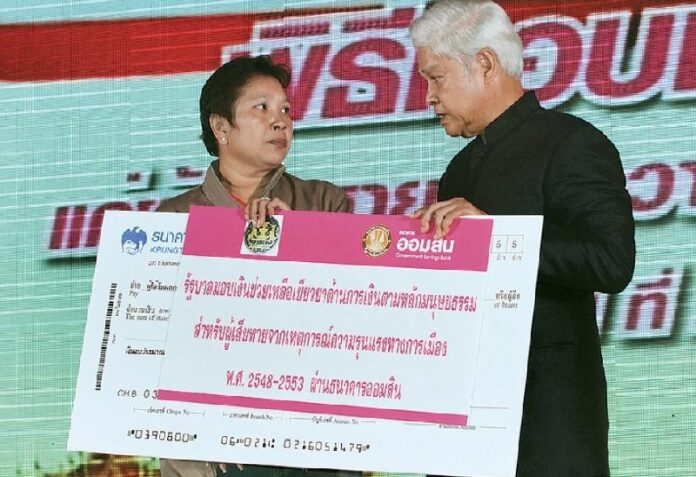
Payao Akhard, mother of a volunteer nurse killed in the 2010 crackdown, receives compensation money from a government representative in a ceremony in Bangkok, 24 May 2012  

BANGKOK — Thailand's national anti-graft body has begun investigating the compensation funds given to victims of political protests by the former government toppled in the 22 May coup.

In 2012, former Prime Minister Yingluck Shinawatra's administration approved a program that awarded financial compensation to those affected by the surges of political unrest that rocked Thailand between 2005 and 2010. The money was given to individuals who were disabled or injured by the violence, as well as the relatives of those who died in the unrest.

According to Panthep Klanarongran, chairman of the National Anti-Corruption Commission (NACC), 524 individuals were compensated under the scheme, totaling 577 million baht of state money. The NACC is now seeking to determine whether the program was rigged in favor of the Redshirts, the political faction that supported Yingluck's government.

"The NACC is investigating the issue. We will see whether the compensation money was paid only to a certain political group, and not to the other group," Panthep told reporters in yesterday's press conference. He named Yingluck and her entire cabinet at the time as defendants.

Thailand has careened back-and-forth between protests organized by rival political camps for much of the last decade, starting with mass demonstrations by the Yellowshirts against then-PM Thaksin Shinawatra in 2005, which culminated in a military coup the following year. Protests organized by Yellowshirt and Redshirt groups continued to erupt in the following years, ending in another military coup in May 2014. 

The bloodiest period of unrest took place between April – May 2010, when Redshirts occupied parts of Bangkok to demand a fresh election from the Yellowshirt-backed government. Then-PM Abhisit Vejjajiva responded by ordering a military crackdown on the protesters, leading to deaths of more than 90 people, mostly civilians. 

Worachai Hema, an MP in Yingluck's government, said the compensation program was not biased, contrary to the NACC's accusation. 

"It wasn't a one-sided compensation. I don't know where the NACC got that information from," Worachai said.

He also said he supported the current government’s plan to compensate victims of the latest round of protests, as long as it covers protesters of "all colors" and security officers who were injured and killed in the violence. Nearly 3o people were killed during the six months of political protests in Bangkok that preceded the 22 May coup.

Junta chairman and Prime Minister Prayuth Chan-ocha announced the plan several days ago, and insisted that the compensation will cover both Yellowshirts and Redshirts.

"Everyone will be included, because everyone is Thai," Gen. Prayuth said. "The government has the duty to take care of everyone without preference."

The NACC has long been accused of harboring a political bias against Yingluck and other politicians allied to the Redshirt movement. In January, the agency successfully brought about Yingluck's retroactive impeachment, resulting in her five-year ban from political office.


For comments, or corrections to this article please contact:[email protected]

You can also find Khaosod English on Twitter and Facebook
http://twitter.com/KhaosodEnglish
http://www.facebook.com/KhaosodEnglish
Advertisement

NACC to Probe Yingluck's Compensation to Protest Victims

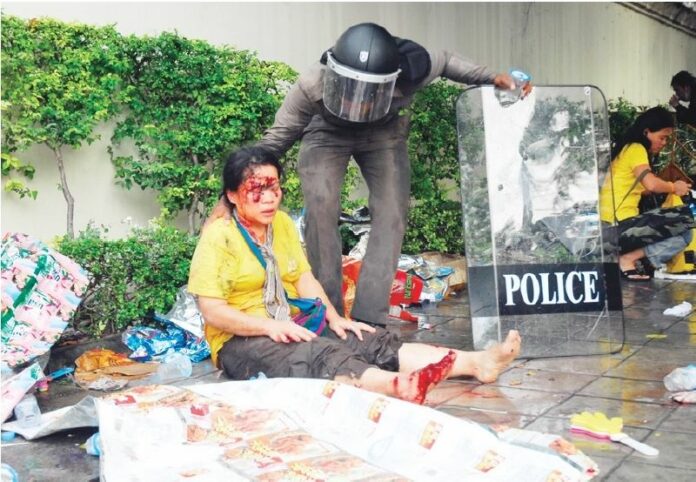
A police officer inspects a Yellowshirt demonstrator injured in a clash between the protesters and riot police in front of Parliament House in Bangkok, 7 October 2008.

BANGKOK — Thailand's national anti-graft body has begun investigating the compensation funds given to victims of political protests by the former government toppled in the 22 May coup.

In 2012, former Prime Minister Yingluck Shinawatra's administration approved a program that awarded financial compensation to those affected by the surges of political unrest that rocked Thailand between 2005 and 2010. The money was given to individuals who were disabled or injured by the violence, as well as the relatives of those who died in the unrest.

According to Panthep Klanarongran, chairman of the National Anti-Corruption Commission (NACC), 524 individuals were compensated under the scheme, totaling 577 million baht of state money. The NACC is now seeking to determine whether the program was rigged in favor of the Redshirts, the political faction that supported Yingluck's government.

"The NACC is investigating the issue. We will see whether the compensation money was paid only to a certain political group, and not to the other group," Panthep told reporters in yesterday's press conference. He named Yingluck and her entire cabinet at the time as defendants.

Thailand has careened back-and-forth between protests organized by rival political camps for much of the last decade, starting with mass demonstrations by the Yellowshirts against then-PM Thaksin Shinawatra in 2005, which culminated in a military coup the following year. Protests organized by Yellowshirt and Redshirt groups continued to erupt in the following years, ending in another military coup in May 2014. 

The bloodiest period of unrest took place between April – May 2010, when Redshirts occupied parts of Bangkok to demand a fresh election from the Yellowshirt-backed government. Then-PM Abhisit Vejjajiva responded by ordering a military crackdown on the protesters, leading to deaths of more than 90 people, mostly civilians. 

Worachai Hema, an MP in Yingluck's government, said the compensation program was not biased, contrary to the NACC's accusation. 

"It wasn't a one-sided compensation. I don't know where the NACC got that information from," Worachai said.

He also said he supported the current government’s plan to compensate victims of the latest round of protests, as long as it covers protesters of "all colors" and security officers who were injured and killed in the violence. Nearly 3o people were killed during the six months of political protests in Bangkok that preceded the 22 May coup.

Junta chairman and Prime Minister Prayuth Chan-ocha announced the plan several days ago, and insisted that the compensation will cover both Yellowshirts and Redshirts.

"Everyone will be included, because everyone is Thai," Gen. Prayuth said. "The government has the duty to take care of everyone without preference."

The NACC has long been accused of harboring a political bias against Yingluck and other politicians allied to the Redshirt movement. In January, the agency successfully brought about Yingluck's retroactive impeachment, resulting in her five-year ban from political office.


For comments, or corrections to this article please contact:[email protected]

You can also find Khaosod English on Twitter and Facebook
http://twitter.com/KhaosodEnglish
http://www.facebook.com/KhaosodEnglish
Advertisement

US Ambassador to South Korea Knifed by Activist

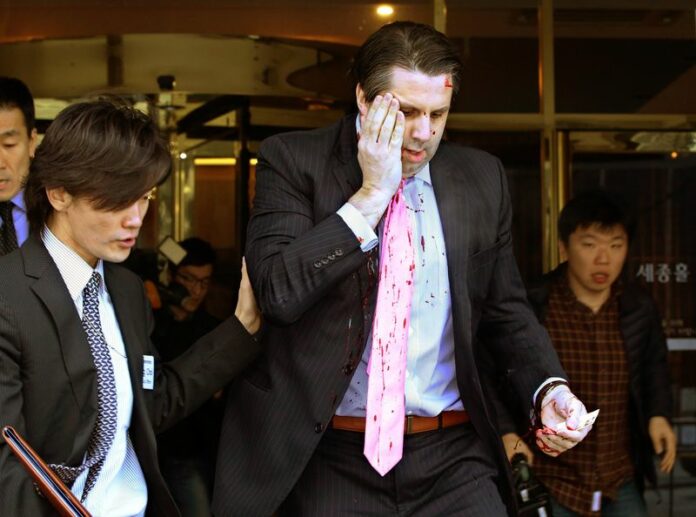
US Ambassador to South Korea Mark Lippert leaves Sejong Center for Performing Arts in downtown Seoul, South Korea, 05 March 2015, after being attacked by a knife-wielding assailant.

SEOUL (DPA) — The US ambassador to South Korea was knifed early Thursday by an activist shouting pro-unification slogans, officials and news reports said.

Mark Lippert was hospitalized with injuries to his right cheek and left wrist, as well as cuts to his arm and fingers, Yonhap News Report said, citing unnamed officials.

His injuries were not life-threatening, the US State Department said. "We strongly condemn this act of violence," it said. "Embassy Seoul is coordinating with local law enforcement authorities."

Suspected attacker Kim Ki Jong reportedly walked up behind Lippert before he was due to give a speech at a breakfast meeting, pushed him on to the table and assaulted him with a paring knife, Yonhap reported. Earlier reports had said a razor was used.

Wearing traditional Korean dress, he shouted "The two Koreas must be reunified" before knifing the ambassador, Chosun Ilbo reported.

Kim, 55, also shouted his opposition to joint US-South Korean military exercises that started Monday, saying they antagonized North Korea, as he was dragged to a police car by officers, Yonhap reported.

The activist on Tuesday wrote in a blog post that the annual Key Resolve and Foal Eagle exercises were "the reason why the reunion between family members couldn't take place."

Prime Minister Lee Wan Koo called the attack on the ambassador "regrettable."

Kim is a member of a South Korean group that favours reunification with North Korea, radio broadcaster KBS reported.

He was reportedly handed a suspended sentence in 2010 for throwing pieces of concrete at Japan's then ambassador.

Kim heads an organization that campaigns against Japan's claim to the South Korean-administrated Dokdo Islands. He changed the address of is family register to the remote islands in 2006, Kyodo said.

Thursday's breakfast event was hosted by the Korean Council for Reconciliation and Cooperation, China Daily reported.

South Korean authorities said they would increase security for US facilities and personnel, Yonhap reported.

Lippert, 42, has been the US envoy in South Korea since October. News reports said he was known for his light use of security, frequently seen walking his dog in the capital. He reportedly gave his son, born in the country, a Korean middle name.

For comments, or corrections to this article please contact:[email protected]

You can also find Khaosod English on Twitter and Facebook
http://twitter.com/KhaosodEnglish
http://www.facebook.com/KhaosodEnglish

 

Advertisement

Hot News

LATEST NEWS

Bangkok
overcast clouds
30.5 ° C
30.5 °
30.5 °
74 %
3.3kmh
95 %
Tue
29 °
Wed
31 °
Thu
34 °
Fri
34 °
Sat
31 °