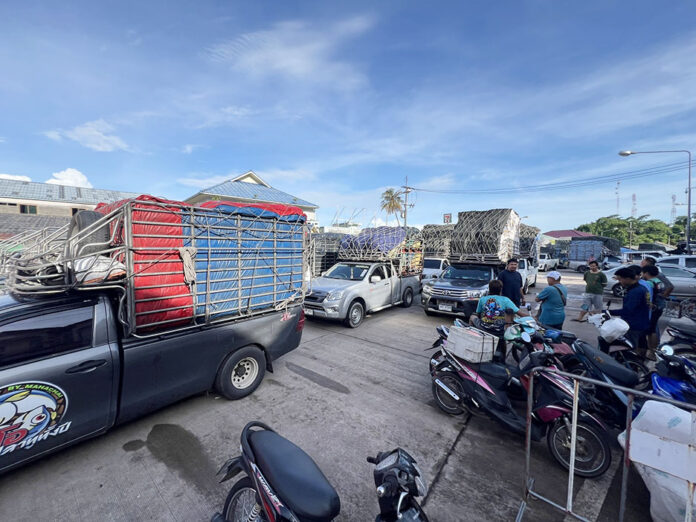
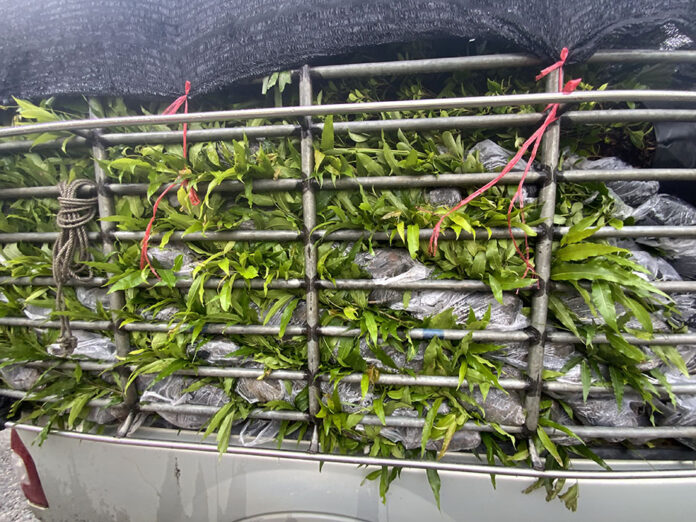
Cargo pickup trucks queue at the Khlong Yai checkpoint in Trat Province waiting to cross to Koh Kong, but Cambodia has strictly banned all fruit and agricultural products from entering on June 17, 2025.
CHANTHABURI — Cambodia has begun banning Thai fruit and vegetables, affecting both workers and farmers.
The situation at the Ban Laem permanent border checkpoint in Thep Nimit sub-district, Pong Nam Ron district, Chanthaburi province, has been tense for several days after the Cambodian government imposed a ban on the import of Thai fruit and vegetables last weekend.
While the Thai authorities opened the gate of the checkpoint on time at 8:00 am, the main gate on the Cambodian side remained closed as usual, so that only the smaller gate could be used by Cambodian workers for entry and exit.
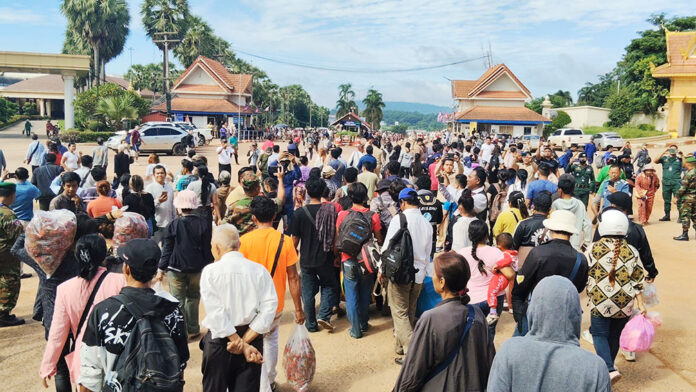
Many Cambodian labourers employed in the Thai agricultural sector stood in long, thick queues in front of the bridge. Meanwhile, some workers, spurred by online rumours that their government might close the border and call them back, packed their belongings and large luggage to return home.
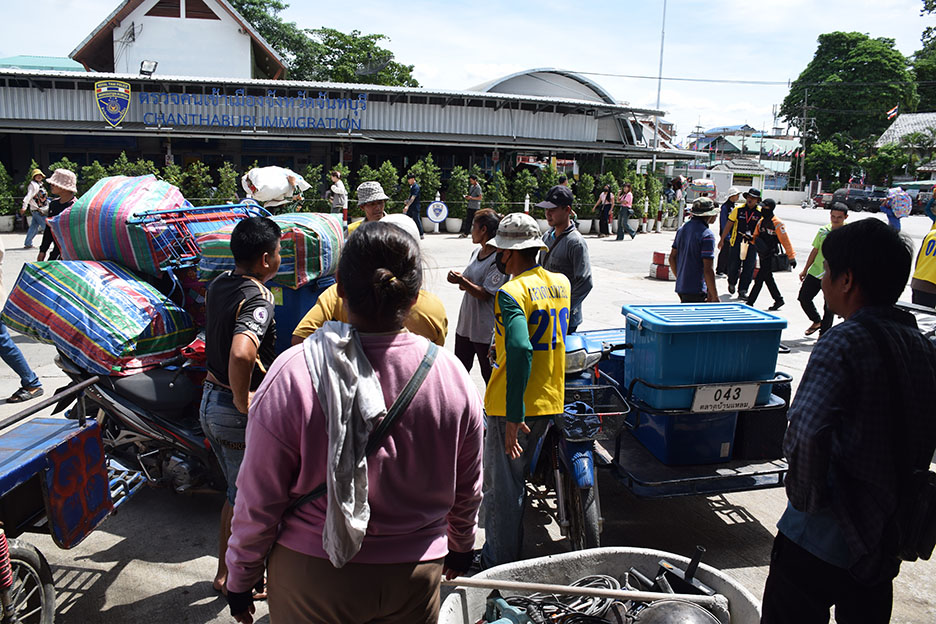
People transport goods to wait at Ban Laem permanent border checkpoint in Thep Nimit sub-district, Pong Nam Ron district, Chanthaburi province on June 17, 2025.
On the Cambodian side of the checkpoint, a Ministry of Labour van had set up a service booth for workers who wanted to return home or feared being deported by Thailand. However, Thai journalists observed that most of the workers did not register at the booth, but instead hurriedly loaded their belongings into the waiting family vehicles.
Chea Khit, a 23-year-old Cambodian worker who has been harvesting longan and other fruits in Thailand for about three years, said she earns about 500 baht per day, or over 1,000 baht on overtime. In comparison, her family in Cambodia farms rice, which generates income only once a year.
She admitted to feeling anxious and remorseful about the possible recall. “I want to continue working in Thailand because the income is better there,” she said, calling on both countries to restore normal border operations and allow workers to cross the border as before.
Pisith Rattawiset, a 37-year-old durian fruit farmer from Nakhon Si Thammarat province, said rumours circulating on Cambodian social media had worried his workers. Of the 30 he employs, more than 10 have already asked to return home.
This labour shortage has severely affected the operation of his nine mangosteen orchards, which are worth about 3 million baht, just as the fruit is ripening at the peak of the season. As a result, the mangosteen fruits are turning black and losing quality.
To make matters worse, the Cambodian ban on imports of Thai produce, especially from Chanthaburi, prevents him from exporting mangosteen. With nowhere to sell and liquidity dwindling, he called on both governments to urgently negotiate a solution, fearing that the situation, if it continues, could affect the entire agricultural economy.
Burapha Task Force patrols the Thai-Cambodia border in Aranyaprathet district after announcing that Thai people should refrain from crossing the border to Cambodia for safety reasons on June 17, 2025.
Meanwhile, Thai labourers attempting to enter Cambodia, especially those working in casinos or entertainment venues in Poipet, were warned by officials at the Aranyaprathet border crossing in Sa Kaeo province that they would not be allowed entry. Only those who had important business to conduct and had the appropriate papers were allowed to enter.
Pol. Col. Naphatphong Suphab, superintendent of the Immigration Department in Sa Kaeo, said the Immigration Department had received orders from the Burapha Task Force on Monday night to enforce this measure from 8:00am on 17 June. He also advised Thai nationals currently in Poipet to return to Thailand as soon as possible for their own safety and to protect their property.
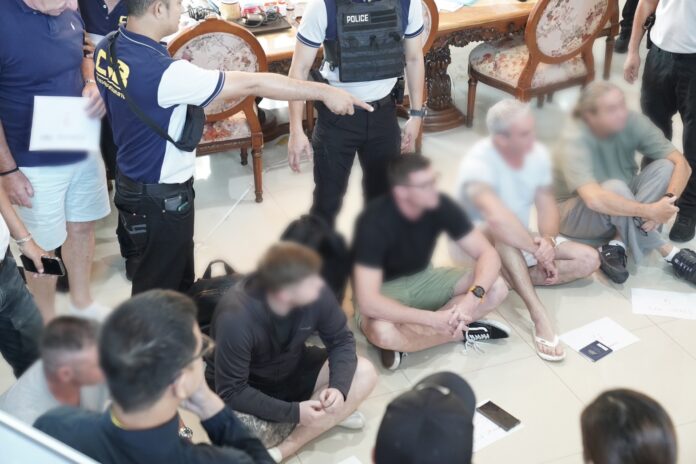
Central Investigation Bureau officers arrest a transnational scammer network involving Australian, British, Canadian, and South African nationals at a residence in Samut Prakan Province on June 16, 2025.
BANGKOK — Thai Central Investigation Bureau (CIB) and Australian Federal Police (AFP) launched Operation Firestorm to dismantle a transnational scammer network involving Australian, British, Canadian, and South African nationals that had duped people out of at least 2 million Australian dollars (about $1.3 million).
Officials from both countries announced the arrest results at Central Investigation Bureau headquarters in Bangkok on June 17, led by Pol. Lt. Gen. Jiraphop Phuridech, CIB Commander, and Ms. Kristie-Lee Cressy, Senior Officer of the Australian Federal Police.
20-Year Criminal Operation
Pol. Lt. Gen. Jiraphop revealed that AFP investigators discovered a criminal group that had been defrauding Australian citizens for 20 years. While some members were recently arrested in Indonesia, the British and Australian gang leaders escaped to Thailand and established a “boiler room” call center operation.
The network’s call center lured Australian citizens into bond investments promising high returns of 7-10% annually over 1-3 years. When AFP discovered the operation, they requested CIB cooperation for a joint investigation.
Ms. Kristie stated that Australia has seen numerous victims in scam cases, with damages exceeding 4.45 billion Australian dollars over the past four years. Money laundering was conducted through cryptocurrency channels.
“Money that we say was stolen from hard-working Australians and not invested as promised. Shutting down this scam center is a significant win for the communities of Thailand and Australia,” she said.
Surveillance and Raid
Investigations revealed gang members had been in Pattaya since early 2024 before relocating to Bangkok, with key figures meeting at a hotel on Chalem Phrakiat Rama 9 Road in Dok Mai, Prawet District.
Officers tracked the group to a residence in Moo 9, Bang Phli Yai Subdistrict, Bang Phli District, Samut Prakan Province. The house was listed for sale at 70 million baht or rental at 120,000 baht monthly, with lease terms until January 2026.
The one-rai (1,600 square-meter) property featured tight perimeter fencing, a dead-end location, CCTV cameras, and a covered garage with canvas screens that were opened and closed when vehicles entered or exited.
Surveillance showed four vehicles regularly entering around 5:00 a.m. and leaving around 3:30 p.m., matching Sydney business hours (9:00 a.m. to 6:00 p.m.). The secretive behavior included covering vehicles when entering the garage to conceal occupants.
Pol. Lt. Gen. Jiraphop Phuridech, CIB Commander, and Ms. Kristie-Lee Cressy, Senior Officer of the Australian Federal Police hold a press conference to announce the arrest of members of a transnational scammer network, at the CIB office on June 17, 2025.
Computer Data Reveals Victims
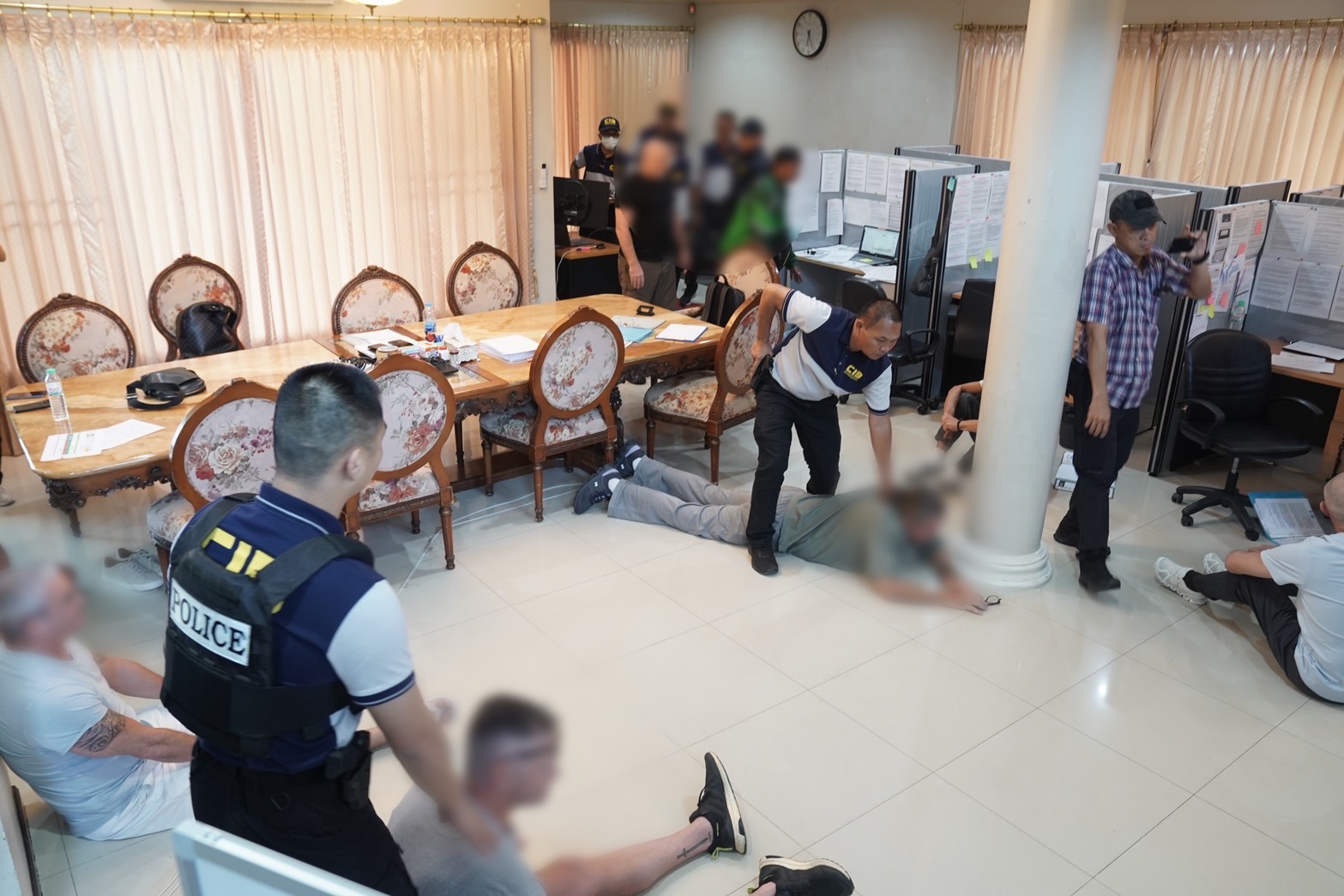
Armed with a court search warrant, officers raided the residence on June 16 at approximately 8:30 a.m. They found foreign nationals seated in the ground floor hall, which had been converted into an office-like space with partitions, while suspects were actively making phone calls.
Each workstation contained computers, laptops, mobile phones, documents, conversation scripts, and materials about companies and bonds used to solicit investments, claiming legitimate overseas operations.
Computer data revealed over 14,000 Australian names currently being verified by AFP, with some confirmed as actual fraud victims. Preliminary investigations show damages exceeding 2 million Australian dollars (1.3 million USD or approximately 40 million baht).
British and Australian Ring Leaders
Immigration records showed none of the suspects had work permits in Thailand. When questioned, all admitted to lacking proper work authorization and could not produce valid documentation.
Central Investigation Bureau officers arrest a transnational scammer network involving Australian, British, Canadian, and South African nationals at a residence in Samut Prakan Province on June 16, 2025.
Operation Firestorm resulted in 13 foreign national arrests: 5 Australians, 6 British, 1 Canadian, and 1 South African. Key figures identified include Mr. Mark, 54, Australian national, and Mr. Mark Andrew, 56, British national, whom AFP identified as operation leaders.
Authorities seized 58 items of electronic equipment and documents, including computers, network equipment, laptops, investment solicitation scripts, and mobile phones. All suspects face charges for criminal conspiracy and illegal employment as temporary residents without proper authorization.
Defendants initially denied wrongdoing, claiming friends recruited them for regular work found through job websites offering 3,000 Australian dollars salary plus 2.5% commission for calling customers to solicit company investments from provided contact lists.
Pol. Col. Ploen Klinphayom, Deputy Commander of Immigration Division 3, confirmed all 13 suspects entered Thailand on various visas without overstaying. Following legal proceedings, their visas will be revoked and they will be permanently blacklisted from re-entering Thailand.
Police apprehend the German suspect with 2.61 grams of cocaine and some of the buy money as evidence in Central Pattaya on June 16, 2025.
PATTAYA — A 42-year-old German man who operated a beer bar and sports club in Pattaya for over four years has been arrested for using his business as a front for cocaine trafficking while carrying illegal firearms.
Following extensive surveillance of Maik, the German suspect, Pattaya Police collaborated with narcotics officers to conduct an undercover drug purchase operation. They arranged to buy 2 grams of cocaine for 5,000 baht (approximately $154) at the Xcite shopping center parking lot in Central Pattaya, Chonburi province.
At the scheduled meeting time, Maik posed as a tourist and sat inside a popular fried chicken restaurant before negotiating with undercover agents. When the transaction was completed and officers moved to arrest him, Maik quickly fled the restaurant on a motorcycle toward a beer bar in Soi Buakhao.
Police immediately pursued and apprehended him with 2.61 grams of cocaine and some of the buy money as evidence.
Police apprehend the German suspect with 2.61 grams of cocaine and some of the buy money as evidence in Central Pattaya on June 16, 2025.
During a subsequent search of his residence in Central Pattaya, authorities discovered an additional 424 grams of cocaine and a .380 caliber pistol with ammunition. The total value of seized evidence was nearly 500,000 baht (approximately $15,400).
In preliminary questioning, Maik claimed a fellow German national supplied him with cocaine at 2,500-3,000 baht per gram, delivering up to 1 kilogram at a time. He allegedly distributed the drugs among foreign nationals in the Pattaya area before splitting the profits.
However, authorities remain skeptical of his testimony and are expanding their investigation to arrest accomplices, suspecting this may be part of a larger drug trafficking network operating in Thailand’s key tourist areas.
Police arrest Chinese nationals who worked as employees sending malicious links to private companies in China for ransomware deployment on the 8th floor of a hotel in central Pattaya on June 16, 2025.
PATTAYA — Thai authorities arrested multiple Chinese nationals and other Southeast Asian suspects after raiding a Pattaya hotel that housed both an illegal gambling den and offices used by Chinese scammers for ransomware operations.
Immigration Police Division 3 and Chonburi Immigration, working with Pattaya Police and administrative officials, conducted a joint operation to investigate a large-scale illegal gambling operation in Pattaya after receiving reports it was operating from a hotel.
Following intelligence gathering, investigators deployed undercover agents who confirmed suspicious activity at the Antai Holiday Hotel on Soi Phen Yat Chang in Bang Lamung District, Chonburi. The 8-story building showed heavy foreign national activity during nighttime hours, raising suspicions of illegal gambling operations.
Police raid arrests foreign gamblers and seizes poker tables with large quantities of cash chips on the 2nd floor of a hotel in central Pattaya on June 16, 2025.
On June 16 at 11:30 p.m., authorities conducted floor-by-floor searches of the building. The first floor served as a reception area with Thai staff handling accommodation bookings, floors 3-7 contained guest rooms, while the second floor housed the gambling operation with 20 foreign gamblers and poker tables with large quantities of cash chips. The 8th floor served as the workplace for Chinese employees.
On June 17, officials confirmed the operation’s results, arresting suspects in three main groups:
Group 1 – Gambling Operation: 20 foreign nationals caught gambling, including 16 Chinese, 3 Vietnamese, and 1 Singaporean. Authorities seized poker tables and large amounts of cash chips.
Group 2 – Immigration Violations: 24 individuals violating immigration and foreign worker laws, including 16 Chinese, 2 Singaporeans, 1 Cambodian, and 5 Myanmar nationals (with 3 having illegally entered the country).
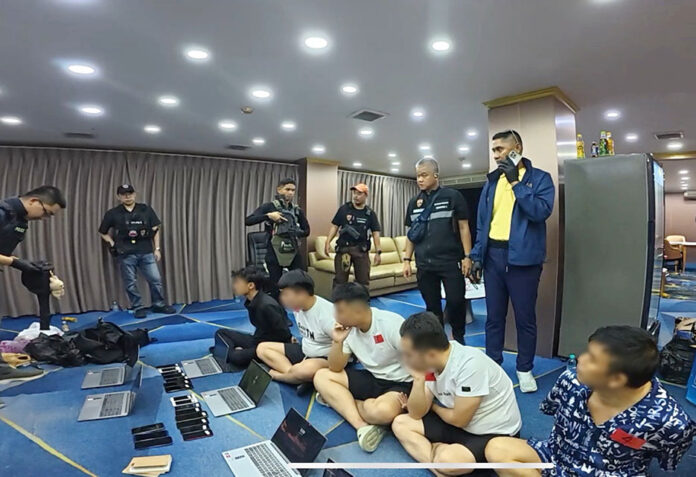
Group 3 – Ransomware Scammers: 6 Chinese nationals operating from the 8th floor, working online to send malicious links to Chinese companies for ransomware deployment. Computer evidence showed they were paid employees distributing links to release ransomware.
Police arrest Chinese nationals who worked as employees sending malicious links to private companies in China for ransomware deployment on the 8th floor of a hotel in central Pattaya on June 16, 2025.
They were charged with being members of a criminal organization with concealed methods and illegal purposes, plus working without permits. Authorities seized 9 laptop computers and 15 mobile phones.
All suspects have been charged according to applicable laws and transferred to investigators for prosecution. They will be sent to court and immediately deported to their home countries, with permanent blacklisting preventing future entry to Thailand.
Smoke rises from the building of Iran's state-run television after an Israeli strike in Tehran, Iran, Monday, June 16, 2025. (AP Photo)
TEL AVIV, Israel (AP) — Israel warned hundreds of thousands of people to evacuate the middle of Iran’s capital as Israel’s air campaign on Tehran appeared to broaden on the fourth day of an intensifying conflict.
An Iranian television anchor fled her studio during a live broadcast as bombs fell on the headquarters of the country’s state-run TV station.
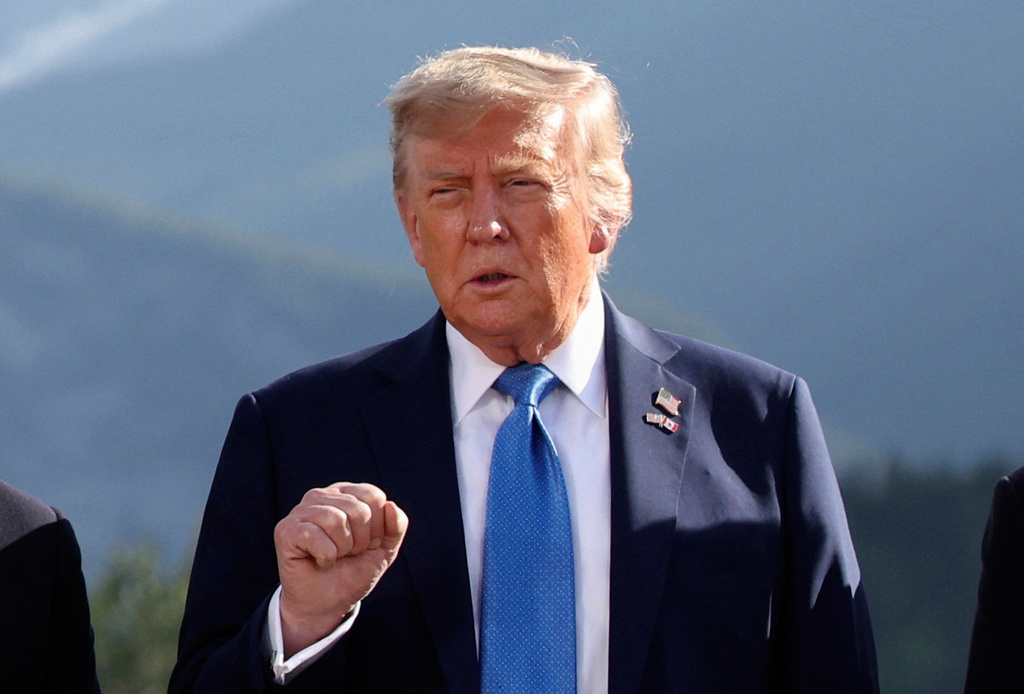
U.S. President Donald Trump posted an ominous message on his social media site later Monday calling for the immediate evacuation of Tehran.
“IRAN CAN NOT HAVE A NUCLEAR WEAPON,” Trump wrote, adding that “Everyone should immediately evacuate Tehran!”
White House press secretary Karoline Leavitt said on social media shortly after Trump’s post that he was returning from the G7 summit in Canada a day early due to the intensifying conflict between.
U.S. President Donald Trump gestures as he attends a family photo session during the G7 Summit, in Kananaskis, Alberta, Monday, June 16, 2025. (Suzanne Plunkett/Pool Photo via AP)
Israel says its sweeping assault on Iran’s top military leaders, uranium enrichment sites and nuclear scientists, is necessary to prevent its longtime adversary from getting any closer to building an atomic weapon. The strikes have killed at least 224 people since Friday.
Iran maintains that its nuclear program is peaceful, and the U.S. and others have assessed that Tehran has not had an organized effort to pursue a nuclear weapon since 2003. The head of the International Atomic Energy Agency has repeatedly warned that the country has enough enriched uranium to make several nuclear bombs should it choose to do so.
The back-and-forth has raised concerns about all-out war between the countries and propelled the region, already on edge, into even greater upheaval.
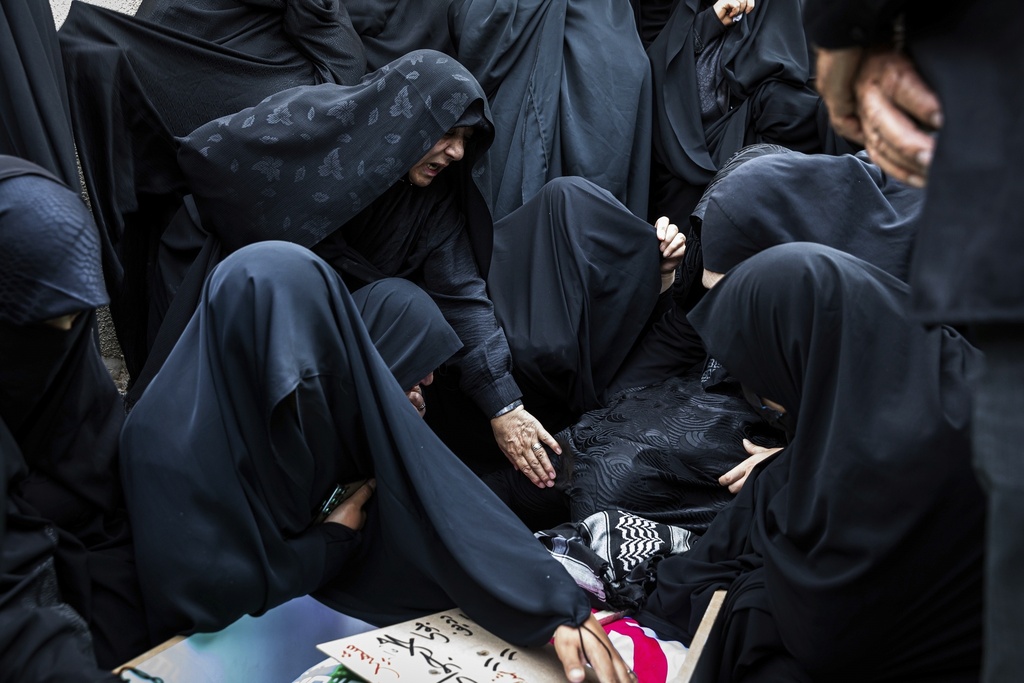
Women mourn over the body of Mohammadi Javad Naseri, who was reportedly killed in Israeli strikes in the northwestern Iranian city of Tabriz, Monday, June 16, 2025. (AP Photo/Matin Hashemi)
Israel’s military issues evacuation warning affecting up to 330,000 people
Earlier Monday, Israel’s military issued an evacuation warning to 330,000 people in a part of central Tehran that houses the country’s state TV and police headquarters, as well as three large hospitals, including one owned by Iran’s paramilitary Revolutionary Guard. The city, one of the region’s largest, is home to around 9.5 million people.
Israel’s military has issued similar evacuation warnings for civilians in parts of Gaza and Lebanon ahead of strikes.
State-run television abruptly stopped a live broadcast after the station was hit, according to Iran’s state-run news agency. While on the air, an Iranian state television reporter said the studio was filling with dust after “the sound of aggression against the homeland.” Suddenly, an explosion occurred, cutting the screen behind her as she hurried off camera.
The broadcast quickly switched to prerecorded programs. The station later said its building was hit by four bombs.
An anchor said on air that a few colleagues had been hurt, but their families should not be worried. The network said its live programs were transferred to another studio.
Israel claims ‘full aerial superiority’ over Tehran
Israeli military spokesperson Brig. Gen. Effie Defrin said Monday that his country’s forces had “achieved full aerial superiority over Tehran’s skies.”
The military said it destroyed more than 120 surface-to-surface missile launchers in central Iran, a third of Iran’s total, as well as two F-14 planes that Iran used to target Israeli aircraft and multiple launchers just before they launched ballistic missiles towards Israel.
Israeli military officials also said fighter jets had struck 10 command centers in Tehran belonging to Iran’s Quds Force, an elite arm of its Revolutionary Guard that conducts military and intelligence operations outside Iran.
The Israeli strikes “amount to a deep and comprehensive blow to the Iranian threat,” Defrin said.
One missile fell near the American consulate in Tel Aviv, with its blast waves causing minor damage, U.S. Ambassador Mike Huckabee said on X. He added that no American personnel were injured.
Explosions rock Tel Aviv, Petah Tikva and Haifa oil refinery
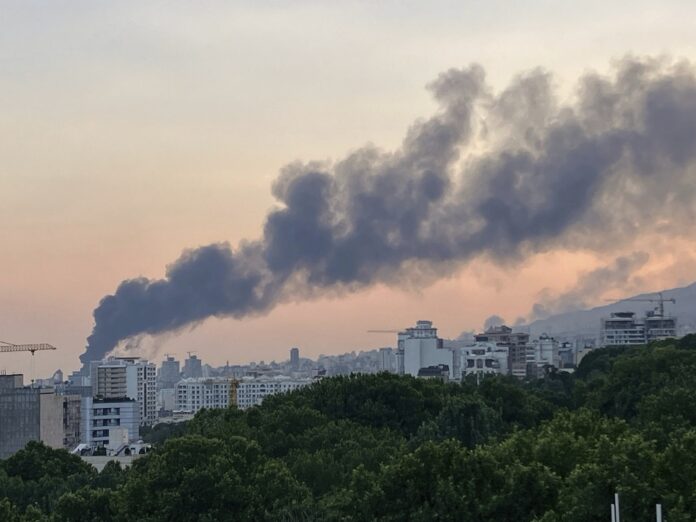
Powerful explosions rocked Tel Aviv shortly before dawn Monday, sending plumes of black smoke into the sky over the coastal city.
Authorities in the central Israeli city of Petah Tikva said Iranian missiles hit a residential building there, charring concrete walls, shattering windows and ripping the walls off multiple apartments.
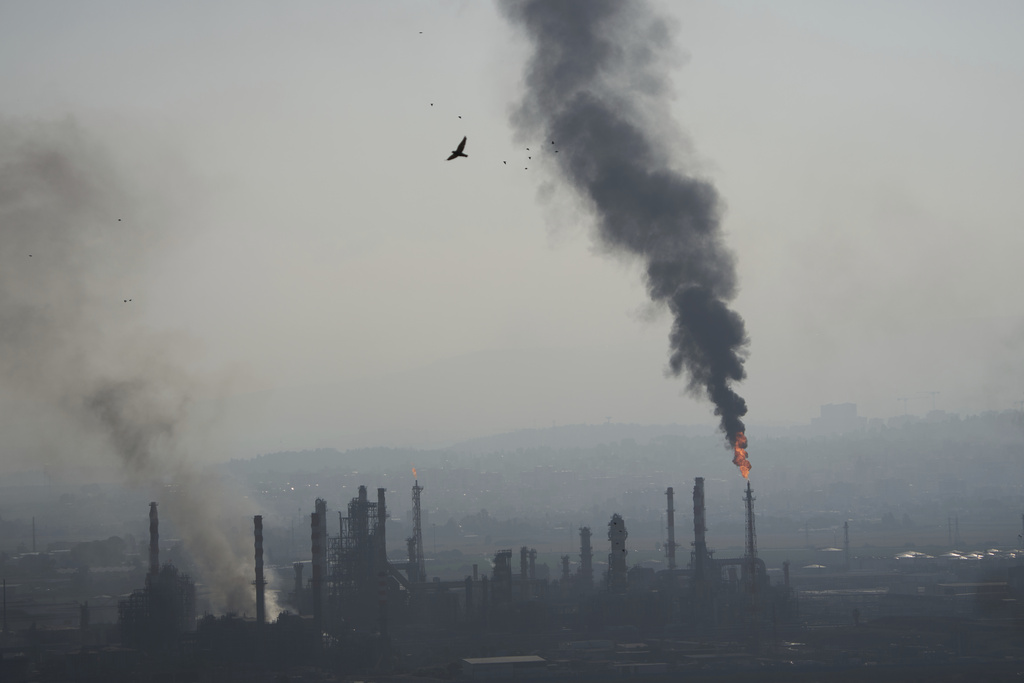
Smoke billows after an Iranian missile struck an oil refinery in Haifa, northern Israel, early Monday, June 16, 2025. (AP Photo/Ariel Schalit)
Iranian missiles also hit an oil refinery in the northern city of Haifa for the second night in a row. The early morning strike killed three workers, ignited a significant fire and damaged a building, Israel’s fire and rescue services said. The workers were sheltering in the building’s safe room when the impact caused a stairwell to collapse, trapping them inside.
Firefighters rushed to extinguish the fire and rescue them, but the three died before rescuers could reach them.
No sign of conflict letting up
Iran’s foreign minister, Abbas Araghchi, appeared to make a veiled outreach Monday for the U.S. to step in and negotiate an end to hostilities between Israel and Iran.
In a post on X, Araghchi wrote that if Trump is “genuine about diplomacy and interested in stopping this war, next steps are consequential.”
“It takes one phone call from Washington to muzzle someone like Netanyahu,” Iran’s top diplomat wrote. “That may pave the way for a return to diplomacy.”
The message to Washington was sent as the latest talks between the U.S. and Iran were canceled over the weekend after Israel targeted key military and political officials in Tehran.
On Sunday, Araghchi said that Iran will stop its strikes if Israel does the same.
The conflict has also forced most countries in the Middle East to close their airspace. Dozens of airports have stopped all flights or severely reduced operations, leaving tens of thousands of passengers stranded and others unable to flee the conflict or travel home.
Health authorities reported that 1,277 people were wounded in Iran. Iranians also reported fuel rationing.
Rights groups such as the Washington-based Iranian advocacy group Human Rights Activists have suggested that the Iranian government’s death toll is a significant undercount. The group says it has documented more than 400 people killed, among them 197 civilians.
Ahead of Israel’s initial attack, its Mossad spy agency positioned explosive drones and precision weapons inside Iran. Since then, Iran has reportedly detained several people and hanged one on suspicion of espionage.
Cambodia says on June 16, 2025, it would stop importing Thai fruits and vegetables if Thailand refused to lift border restrictions.
PHNOM PENH, Cambodia (AP) — Cambodia on Monday said it would stop importing Thai fruits and vegetables if Thailand refused to lift border restrictions imposed following a deadly clash in one of the disputed areas between the two countries.
An armed confrontation at the border on May 28 left one Cambodian soldier dead. The incident, which each side blamed on the other, reportedly took place in a relatively small “no man’s land” along their border that both countries claim as their own.
Cambodian and Thai authorities have engaged in saber-rattling since last week, and continue to implement or threaten measures short of armed force, keeping tensions high. Thailand has added restrictions at border crossings, and Cambodia has banned Thai movies and TV shows and implemented a boycott of the neighboring country’s international internet links.
Cambodian Senate President Hun Sen, the former prime minister, said in a televised speech Monday that the ban on Thai fruits and vegetables would take effect if Thailand doesn’t lift the border restrictions by Tuesday.
Thai Prime Minister Paetongtarn Shinawatra later said Thailand decided to impose the border restrictions out of safety concerns for the citizens of both countries due to the heavier presence of armed forces along the areas. She also said any “unprofessional communication” that was conveyed outside a bilateral mechanism would only hurt the interests of both sides.
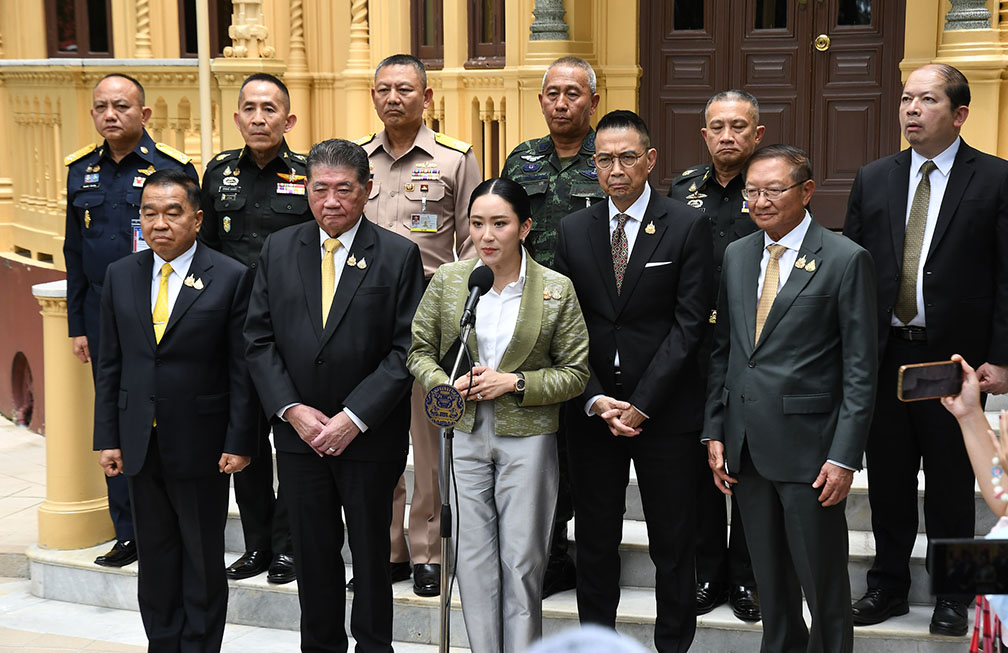
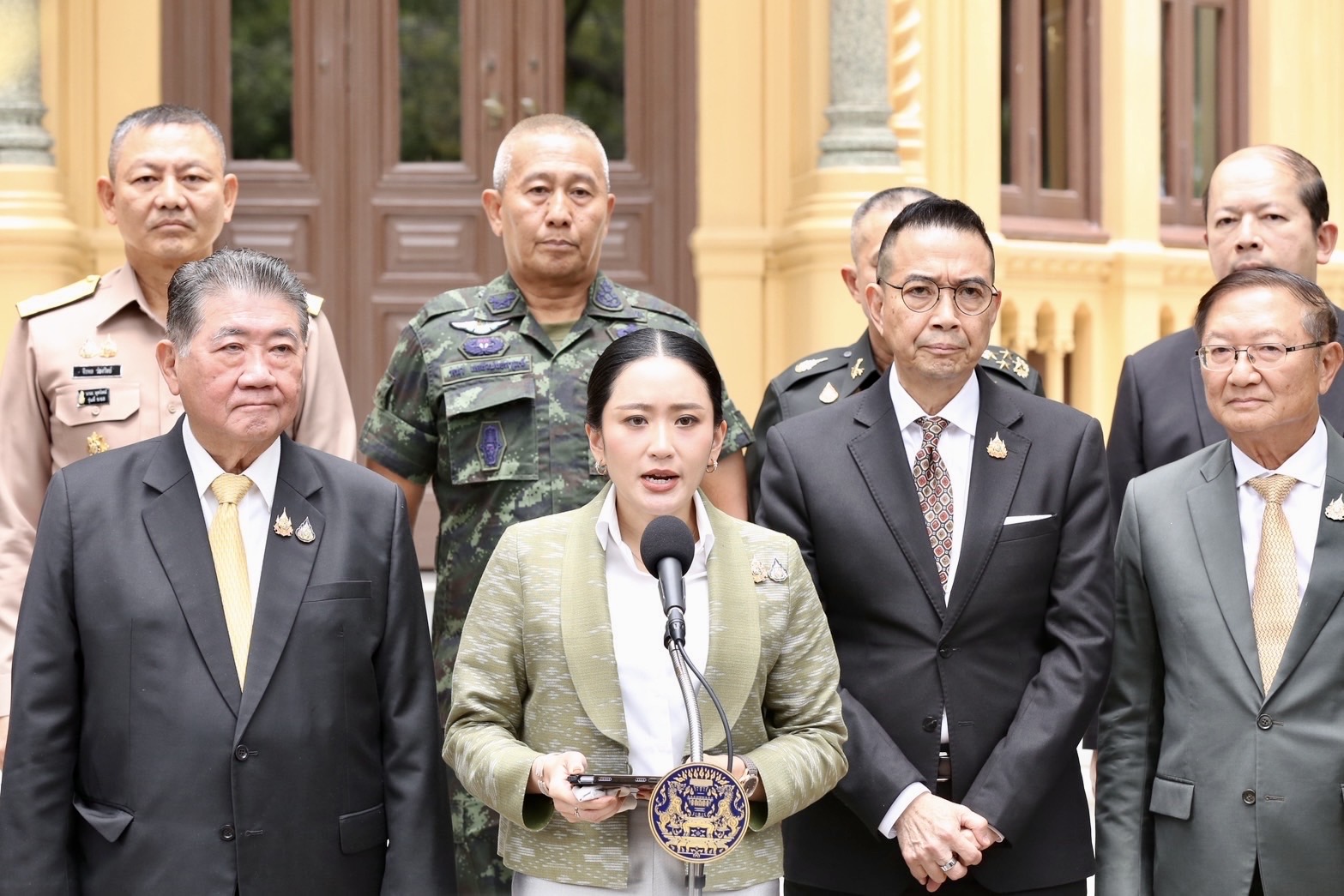
Prime Minister Paetongtarn Shinawatra holds a press conference after convening a meeting of relevant agencies to discuss the results of the Thai-Cambodia Joint Border Committee (JBC) meeting at Ban Phitsanulok on June 16, 2025.
Officials of the two countries met over the weekend in Cambodia’s capital, Phnom Penh, on the conflicting territorial claims that led to last month’s deadly confrontation. While both sides said the meeting was held in a good atmosphere, it appears no major breakthrough was achieved to resolve the current spat.
Cambodia on Sunday said it has officially submitted a request to the U.N.’s International Court of Justice, seeking a resolution to the ongoing border disputes with Thailand in four areas. The Cambodia’s State Secretariat of Border Affairs said after the weekend meetings concluded that Cambodia would no longer discuss these areas under the bilateral mechanism of the two countries.
The Thai Ministry of Foreign Affairs said Monday that it was deeply disappointed that Cambodia refused to address the disputes through the existing mechanism and reiterated that Thailand does not accept the jurisdiction of the International Court of Justice.
Both however agreed to participate in the next round of meetings on border issues to be hosted by Thailand in September.
Much of their war of words has appeared intended to mollify nationalistic critics on both sides of the border. In Thailand, the elected government of Prime Minister Paetongtarn has been attacked by right-wing nationalists who are longtime foes of her father, former Prime Minister Thaksin Shinawatra.
There is a long history to the territorial disputes between the two countries. Thailand is still rankled by a 1962 ICJ ruling that awarded Cambodia the disputed territory where the historic Preah Vihear temple stands. There were sporadic though serious clashes there in 2011. The ruling was reaffirmed in 2013.
——-
Sopheng Cheang reported from Cambodia. Associated Press writer Jintamas Saksornchai in Bangkok contributed to this report.
BANGKOK — A major disruption has emerged in Thailand’s airport business sector as King Power Duty Free Company Limited (KPD) submitted a formal request to cancel its duty-free concession contracts with Airports of Thailand Public Company Limited (AOT).
The news first surfaced on social media on June 13, indicating that the cancellation affects five airports: Suvarnabhumi Airport, Don Mueang International Airport, Phuket International Airport, Chiang Mai International Airport, and Hat Yai International Airport.
The announcement immediately impacted AOT’s stock price, which plummeted 8.40% on Monday morning. AOT brought the matter to its board meeting on June 16, where Acting CEO Ms. Paveena Jariyathitipong revealed that the board resolved to establish a working committee to review solutions for duty-free operations across AOT-managed airports.
The company will also engage consultants from state universities to study legal, economic, financial, and business management alternatives, with consultants expected to be appointed within two weeks and the study completed within 60 days or by August 2025.
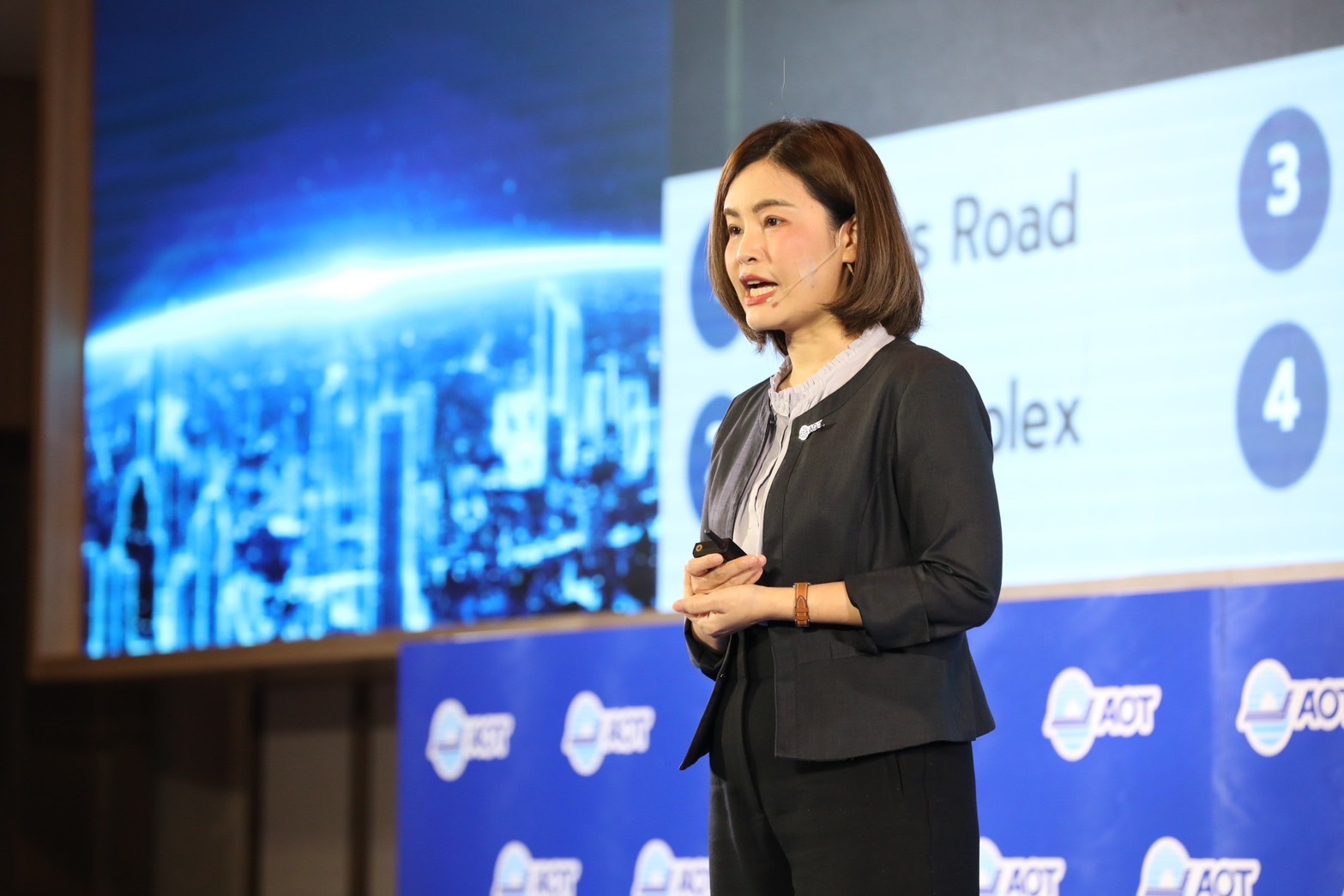
Paveena Jariyathitipong, Acting CEO of Airports of Thailand (AOT)
King Power Contributes 17% of AOT Revenue
Ms. Paveena disclosed that revenue from King Power accounts for 17% of AOT’s total income. She emphasized that AOT maintains strong financial stability and has plans to diversify revenue sources, including electrical system services, air conditioning systems, ground services, and commercial development around all six AOT airports. These initiatives will strengthen financial security and support future investment plans without affecting organizational stability.
AOT is scheduled to hold discussions with King Power on June 17 to gather additional input and seek fair solutions. Regarding outstanding payments owed by King Power, these remain within the security guarantee limits that King Power has provided as collateral under contract terms, serving as financial security for unexpected circumstances.
Government Maintains No Loss if New Operator Found
Thibodi Wattanakul, Director of the State Enterprise Policy Office (SEPO) under the Ministry of Finance, stated he is closely monitoring the situation as AOT targets approximately 3 billion baht in annual treasury contributions, with 33% derived from King Power’s lease agreements. Of this amount, roughly 10-20% comes from areas King Power is requesting to return, while the remaining 70-80% comes from Suvarnabhumi Airport space rentals.
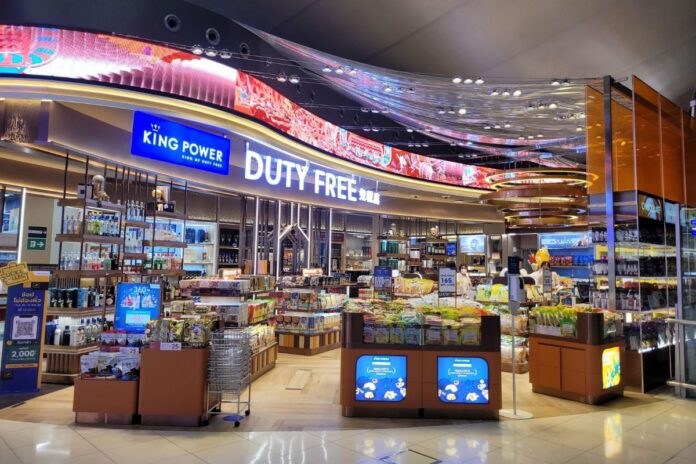
Duty-free shops at Suvarnabhumi Airport
He noted that while lost revenue won’t be substantial, any revenue loss would still disadvantage the state. However, he believes that if contracts are cancelled, AOT will need to find new tenants. “If AOT can secure new bidders, the state may not suffer losses,” he said.
As the Ministry of Finance is a shareholder in AOT, it must await explanations alongside other shareholders. In its capacity overseeing state enterprises, the ministry will monitor the contract cancellation and its impact on state revenue. If King Power’s contracts are terminated, penalty payments will be due to AOT, and both parties must comply with contractual obligations.
New CEO Appointment Precedes Cancellation Request
The contract termination request emerged after King Power appointed Nitinai Sirisarntkarn as its new CEO on June 4, 2025. Nitinai previously served as AOT’s CEO for two terms, totaling eight years.
In its letter to AOT, KPD cited various factors necessitating contract termination discussions, including:
Cessation of inbound duty-free shop operations in line with government policy
Tax reductions on wine affecting duty-free sales volumes
Reclamation of AOT’s commercial space
Lack of proactive public sector measures for tourist safety management, resulting in declining Chinese tourist numbers
“All of these factors have direct and indirect effects on KPD’s inability to operate business and comply with the established contracts and caused KPD’s continuous loss. The abovementioned force majeure factors are beyond KPD’s control,” the KPD letter stated.
KPD’s operating contract with AOT runs from September 28, 2020, to March 31, 2033. According to reports, KPD has requested negotiations conclude within 45 days. During the interim period before resolution, the company proposed paying concession fees at 20% of monthly duty-free sales starting in July, with payments to AOT due by August 29, requesting this not be considered a payment default.
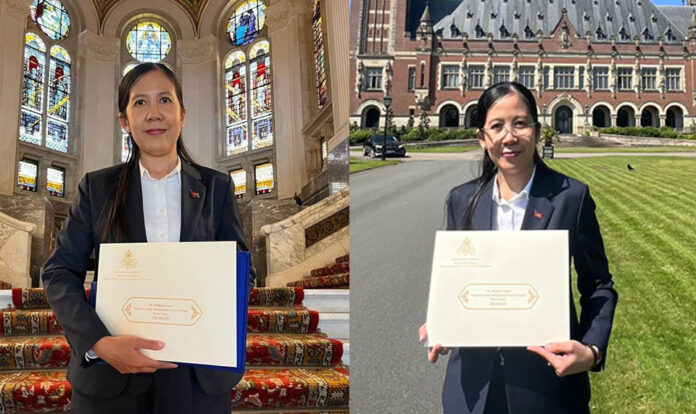
Image from Cambodian Prime Minister Hun Manet's Facebook page, where he stated that Kim Sour Sovannary, Ambassador of Cambodia to the Netherlands, officially submitted a letter to the ICJ in The Hague, Netherlands, on June 16, 2025.
BANGKOK — Thailand has criticized Cambodia for bypassing established bilateral mechanisms by taking their temple border dispute to the International Court of Justice, calling the move a violation of international protocol that undermines ongoing diplomatic efforts.
Cambodian Prime Minister Hun Manet posted on social media confirming the ICJ submission on June 16, saying: “Kim Sour Sovannary, Ambassador of Cambodia to the Netherlands handed over Cambodia’s official letter to the ICJ to help find a solution to the border issues in the area of Prasat Taman Thom, Taman Toch Temple, Tak Krobey Temple and Mumbai area. The government will continue to do this with commitment and high responsibility to protect the sovereignty of the land, as well as the national interests and the Khmer people.”
On the same day, Prime Minister Paetongtarn Shinawatra spoke at a press conference at Ban Phitsanulok, reaffirming that Thailand has not accepted ICJ jurisdiction and confirming that legal studies and historical background research have been completed with all information now ready.
Prime Minister Paetongtarn Shinawatra holds a press conference at Ban Phitsanulok on June 16. She reaffirmed that Thailand does not accept the jurisdiction of the International Court of Justice, and that legal studies and historical background research have been completed with all information now ready.
Thailand Maintains 1960 Stance
The Ministry of Foreign Affairs separately held a detailed briefing for media, criticizing Cambodia’s decision to skip direct negotiations over the three disputed temple sites.
Thailand reiterated its position of not accepting ICJ jurisdiction, a stance it has maintained since 1960 and shares with over 118 other UN member states. The dispute centers on areas around Prasat Ta Muean Thom, Prasat Ta Muean Tot, and Prasat Ta Kwai temples.
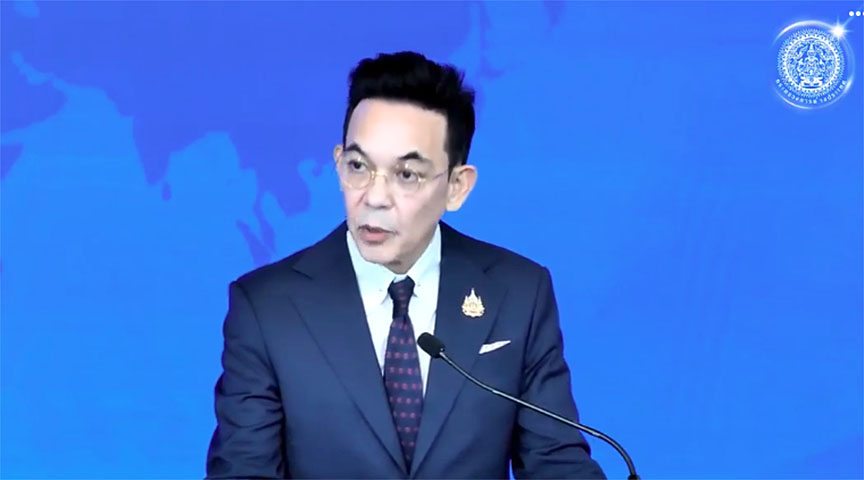
“Thailand participated in the latest Joint Boundary Commission meeting with sincerity and good faith to find a constructive solution,” said Nikorndej Balankura, Director-General of the Department of Information, speaking for the Foreign Ministry. “However, we were disappointed that Cambodia chose not to discuss the four disputed areas within the JBC forum.”
Nikorndej Balankura, Director-General of the Department of Information, holds a press conference at the Ministry of Foreign Affairs on June 16, 2025.
The comments came after the 6th Thai-Cambodian Joint Boundary Commission meeting in Phnom Penh from June 14-15, where Cambodia reportedly avoided discussing the contentious temple areas.
Protocol Violation Alleged
Thai officials accused Cambodia of violating the 2000 Memorandum of Understanding (MOU 43) between the two countries, which stipulates that interpretation or enforcement issues must be discussed jointly before any unilateral action.
“Cambodia’s actions may be considered ‘skipping steps’ according to international principles,” said Benjamean Sukajanajtee, Director-General of the Department of Treaties and Legal Affairs.
Thailand has established a legal team with world-class international advisors to handle the matter, though officials stressed they have not yet received formal notification from either Cambodia or the ICJ about the filing.
Technical Progress Despite Tensions
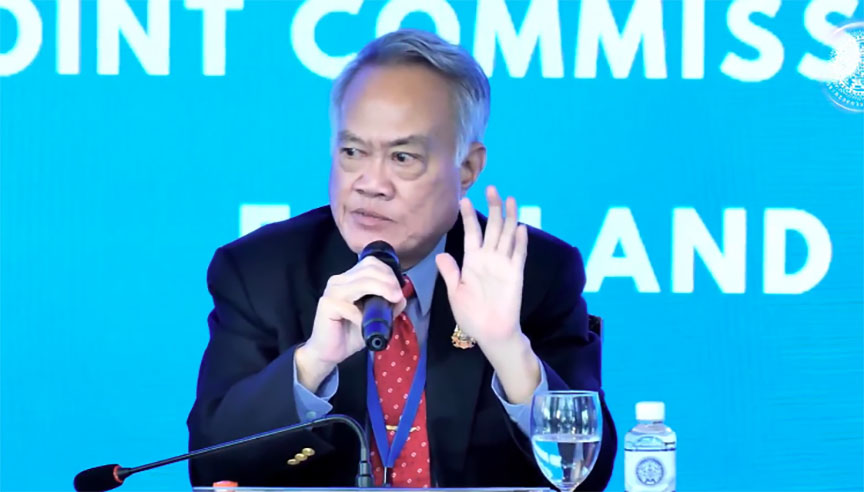
Despite the diplomatic friction, Thai officials reported technical progress in boundary demarcation. Prasas Prasasvinitchai, Chairman of the Thai side of the JBC, said the recent meeting was “the smoothest” of the five he has attended.
The commission has jointly confirmed 45 out of 74 mutually agreed boundary markers and is producing new maps using advanced Orthophoto and LIDAR technology at a 1:50,000 scale – not the 1:200,000 scale referenced in some media reports.
“The appropriate map for practical work is the 1:50,000 scale, which both sides are jointly producing, making it naturally binding,” Prasas explained.
“Prasas Prasasvinitchai, Chairman of the Thai side of the JBC, answers the media at a press conference at the Ministry of Foreign Affairs on June 16, 2025.
Peaceful Approach Emphasized
Thai officials emphasized their commitment to peaceful resolution and warned against emotional reactions that could escalate tensions. The government promised not to use the international relations issue for domestic political purposes.
“Thailand is adopting a cautious approach, avoiding emotional reactions or escalating the conflict,” Nikorndej said. “The Thai government has no intention to attack the people.”
Officials also cautioned against misinformation spread through social media, noting that such platforms are not official communication channels and could lead to widespread misunderstandings.
September Meeting Planned
Despite the ICJ filing, Thailand remains committed to bilateral dialogue. The country is prepared to host a special JBC meeting in September, which the Cambodian side has reportedly accepted.
Thai officials argue that bilateral mechanisms like the JBC, General Border Committee (GBC), and Regional Border Committee (RBC) remain the most appropriate forums for resolving the dispute in accordance with UN Charter principles and international law.
The Franco-Siam Treaties of 1904 and 1907 serve as the legal framework for negotiations, officials noted, emphasizing these are international legal obligations rather than voluntary agreements.
Border disputes between the two Southeast Asian neighbors have persisted for decades, with the temple areas representing some of the most sensitive and politically charged territorial issues in the region.
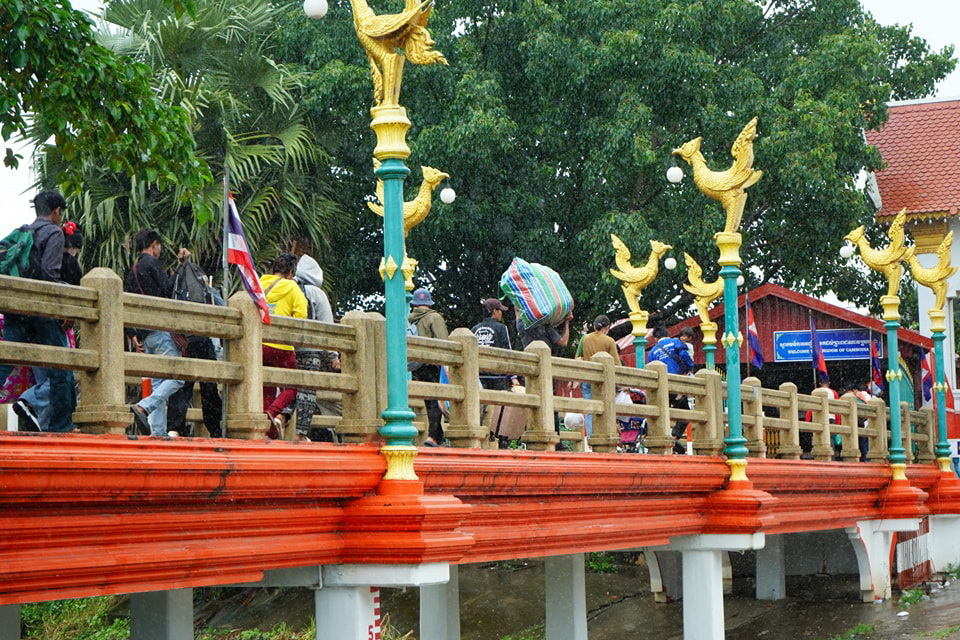
Cambodian nationals carry bags and belongings as they return to Cambodia through the Chong Chom border crossing in Dan Subdistrict, Kab Choeng District, Surin Province. Many are temporary laborers who said they want to go back and wait to see how the situation develops, on June 16, 2025.
BANGKOK — Thailand reaffirms support for Cambodian workers, citing higher wages The Thai labour sector has confirmed that employment of Cambodian workers is continuing as usual, especially for the more than 400,000 legally registered migrants.
Labour unions have not received any reports of workers wanting to return to Cambodia. Wages in the Thai construction sector are said to be three times higher than those in Cambodia.
Cambodian Prime Minister Hun Manet has announced several times, most recently on Monday 16 June after a meeting of the Thai-Cambodian Joint Border Committee (JBC), that Cambodia is preparing to recall its citizens currently working in Thailand. He instructed the ministries to prepare for their return as there was tension with Thailand after a brief clash at the border on May 28, 2025.
Thai PM Rejects Worker Expulsion Claims
Thai Prime Minister Paetongtarn Shinawatra reiterated that the Thai government has never intended to expel migrant workers from any country. She emphasised that Thailand adheres to human rights principles and continues to offer protection to workers.
However, if a country takes measures to bring back its workers and provides employment opportunities, it is within the rights and obligations of that country to allow workers to choose freely.
It was reported from the border provinces of Surin, Sa Kaeo and Chanthaburi on the morning of June 16 that some Cambodian nationals were seen returning home with bags and important items.
Meanwhile, the transport of goods was interrupted from the Thai side. Lorries were stuck in long queues at the border for three days in a row.
Prime Minister Paetongtarn Shinawatra holds a press conference after convening a meeting of relevant agencies to discuss the results of the Thai-Cambodia Joint Border Committee (JBC) meeting at Ban Phitsanulok on June 16, 2025.
Cambodian Workers Still Employed in Thailand
Labour Minister Pipat Ratchakitprakarn explained that around 500,000 Cambodian workers are currently employed in Thailand.
The ministry has instructed five provincial labour offices to monitor developments in their respective areas and asked employers hiring Cambodian workers to report any workforce-related problems immediately. So far, Cambodian workers have been able to continue working without interruption.
The 500,000 Cambodian laborers in Thailand can be divided into three groups: Over 400,000 legally registered workers Undocumented workers About 20,000 seasonal workers, who mostly work in the fruit harvest and commute across the border.
Passport Extension for Cambodian Workers
The Thai Employers’ Federation has recently confirmed that many Cambodian workers remain employed in various sectors and there are no official reports of workers intending to return home. If someone wants to leave voluntarily, the Thai government will not prevent them from doing so.
The Labour Minister added that the Ministry of Labour will grant a one-year extension to Cambodian workers whose passports have expired and who cannot return home to renew them. Employers have the assurance that legal Cambodian workers can continue to work even in times of increasing tensions at the border.
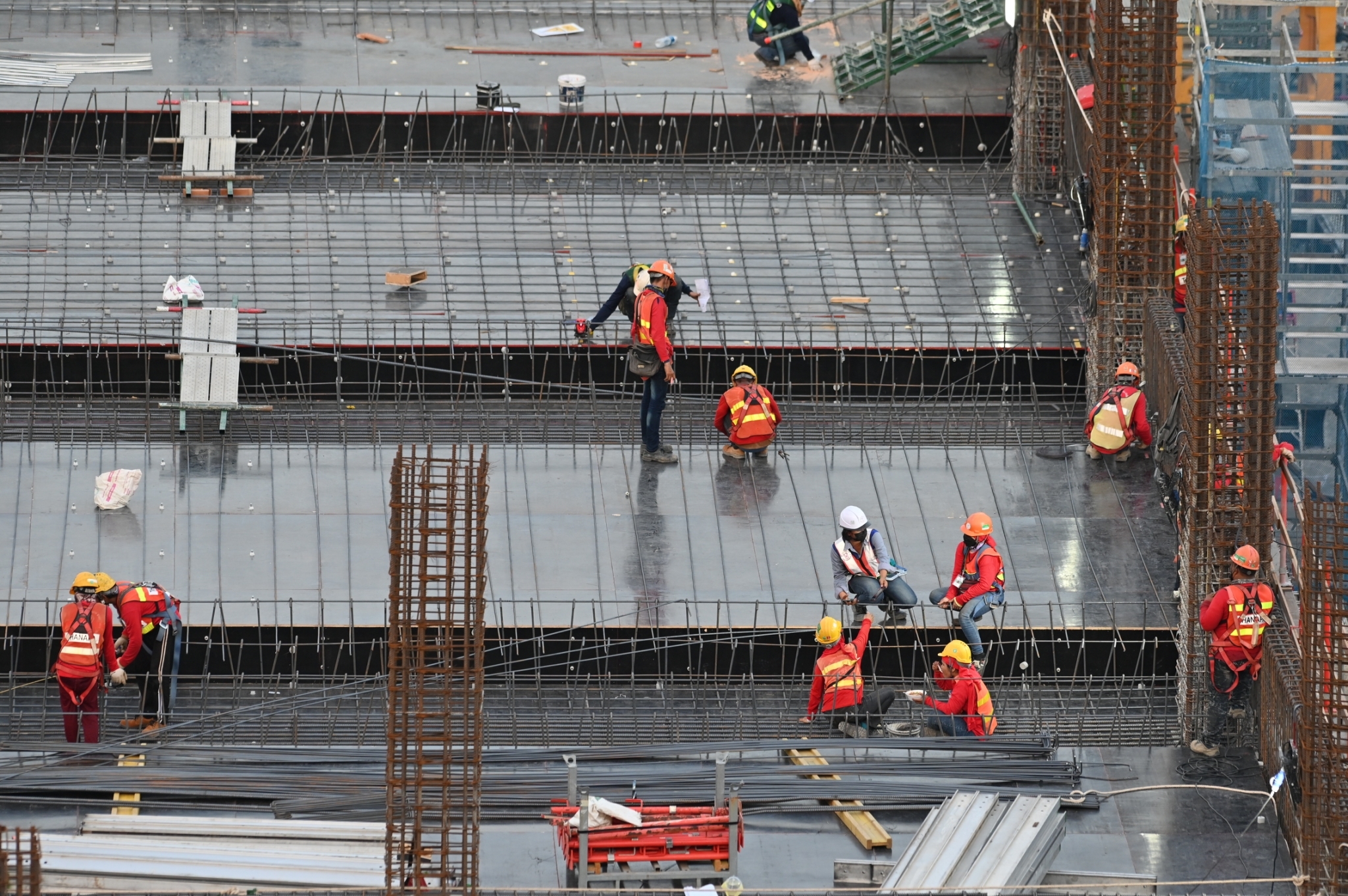
Around 200,000 Cambodian nationals, both documented and undocumented, are currently working in the Thai construction sector.
In addition, under the MoU (Memorandum of Understanding) with Cambodia, many workers have recently extended their contracts, which are valid until February 2026.
In the event that the situation lasts longer, the Ministry of Labour has drawn up contingency plans. In addition to Cambodia, Thailand also legally employs labour from Myanmar, Laos and Vietnam, of which Myanmar accounts for the largest share.
Thailand is currently renewing its MoU with Myanmar for another two years, covering more than 2 million workers, with more workers from Myanmar awaiting registration. These workers are already in Thailand and working there. The ministry confirmed that the country has sufficient foreign labour.
Thai Employers Continue to Hire Normally
Dr. Naowarat Songsawatichai, president of the Employers Confederation of Thailand (ECONTHAI), echoed this sentiment, stating that there is currently no indication that Cambodian workers want to return home. She believes that most will stay in Thailand and continue to work with a valid work permit.
Thai employers continue to recruit labour and are monitoring developments in both countries to see if any changes are needed. She added that legally registered Cambodian workers can continue to work normally.
Cambodians cross on foot with their belongings from Thailand to Cambodia at Ban Laem border crossing, Chanthaburi province, June 14, 2025.
When asked if the sudden return of Cambodian workers would affect Thai businesses, Dr Naowarat explained that Cambodian workers do not make up a large part of the labour force in Thailand, as most migrant workers are from Myanmar.
However, should there be a sudden, unannounced departure, this would indeed cause problems for employers due to a lack of replacement labour. Nevertheless, she expressed confidence that both governments will work together to find a suitable solution.
Thai Wages Three Times Higher Than in Cambodia
Krisda Chancharasangsang, vice president of the Thai Contractors Association Under Royal Patronage, explained that the reports of Cambodians returning probably refer to day labourers in the border area and not those employed in the construction sector.
So far, no major movements have been observed among Cambodian construction workers. If there is a return, it could be undocumented workers. It is assumed that legally registered workers with proper work permits will remain in Thailand unless the situation escalates into armed conflict or an official order to repatriate is issued.
An important reason for this is that wages in Thailand are about three times higher than in Cambodia. Around 200,000 Cambodian nationals, both documented and undocumented, are currently working in the Thai construction sector.
The daily minimum wage for women is around 360 baht (depending on the province). For men, it starts at around 400 baht per day. Skilled labourers such as bricklayers, welders, electricians and painters can earn between 500 and 600 baht per day.
The semi-final of this regionwide competition was staged at W Bangkok, as Marriott’s talented bartenders were challenged to revive forgotten ingredients and create sustainable cocktails
From left to right: The six best entrants from JW Marriott Khao Lak Resort & Spa, Hua Hin Marriott Resort & Spa, W Bangkok, Moxy Bangkok Ratchaprasong, Royal Orchid Sheraton Riverside Hotel Bangkok, and Phuket Marriott Resort & Spa, Merlin Beach
Bangkok, Thailand: June 16, 2025 – Marriott International has successfully staged the semi-final of its “Sustainable Bartender Championship” at W Bangkok, celebrating the talent, creativity, and innovation of the mixologists at its hotels & resorts in Thailand and Cambodia. In a dynamic event on June 6th, 2025, six highly skilled bartenders shook up their original concoctions in front of an expert panel of judges, with two winners going through to the Asia Pacific “Rising Stars” grand final in September.
This year’s competition challenged the contestants to invent fresh new cocktails that revive forgotten local ingredients from their destination, while also eliminating food waste and demonstrating a sustainable mindset, in line with Marriott’s ESG (Environmental, Social, and Governance) values.
The contest was staged in collaboration with Pernod Ricard’s leading beverage brands, including Codigo 1530, Monkey 47, Martell, Chivas Regal, Ki No Bi, and Absolut Elyx. The bartenders were required to use these premium products, along with their chosen “forgotten ingredients” to create a highly original and delicious cocktail. Having recorded a compelling reel to present their drinks, and a one-month period to promote and sell this special cocktail at their bar, the six best entrants from Thailand and Cambodia were invited to W Bangkok for the semi-final, where each competitor had 20 minutes to present their cocktail to the judges.
Having selected their top three cocktails, the judges welcomed the finalists to the last challenge – a daunting “Black Box Final”! In this live, high-pressure finale, the three bartenders had to craft cocktails using secret ingredients. After a tense wait, the two winners were crowned.
“The level of skill and creativity on display at this event was truly inspiring. I would like to thank every contestant who entered; it gives us great confidence that there are so many talented, up-and-coming mixologists at Marriott Bonvoy’s portfolio of hotels and resorts across the region. It is also heart-warming to see that, while many of them are young, they are embracing the time-honored ingredients and authentic flavors of their regions. The future is bright for the beverage industry in Thailand and Cambodia,” said Brad Edman, Market Vice President for Thailand, Cambodia & Myanmar.
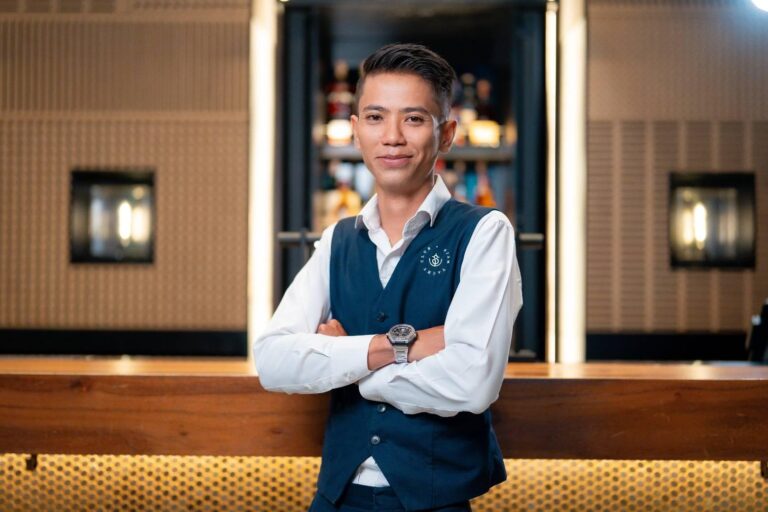
The two winners who were crowned as Marriott’s 2025 “Rising Stars” are Satichai “James” Sommao from Siam Yacht Club, Royal Orchid Sheraton Riverside Hotel Bangkok and Jakkrit “Golf” Promchaisit from Bar Sathorn, W Bangkok.
James wowed the judges with The Kyoto Goldsail, which takes the often-overlooked vegetable bok choy and blends it with the richness of Thai tea, enhanced with the botanicals of Ki No Bi Kyoto Dry Gin and finished with a Thai tea smoke. Every element is crafted with a zero-waste mindset – from bok choy-infused vermouth to dehydrated garnishes and pickled stalks – making it both a creative and conscious tribute to modern mixology.
Golf’s original cocktail, Sathorn Garden, embodies a circular approach to sustainability. It starts at W Bangkok’s rooftop garden, where food waste from the hotel’s restaurants is composted into nutrient-rich soil, where herbs like mint are grown for use behind the bar. Cold-infused coconut cream was blended with fresh mint and Japanese cucumber to create a near zero-waste cocktail that champions local produce, mindful consumption, and a deep respect for the ingredients.
“At Marriott International, our commitment to sustainability runs throughout every aspect of our business. In terms of F&B, we work tirelessly to minimize food waste and partner with trusted local suppliers to source sustainable ingredients, creating long-term benefits for the community and the environment. So, it is wonderful to see how our associates are embracing this philosophy and moving our business forward. Events such as the ‘Sustainable Bartender Championship’ underscore our dedication to ‘Doing Good in Every Direction’, in line with Serve360, our sustainability and social impact platform,” added Vincent Van Mechelen, Senior Director of Operations for Thailand, Cambodia & Myanmar
The two regional winners will now compete in the Asia Pacific Regional Finals, where they have a chance to win the grand prize from our sponsor partner, Pernod Ricard: an all-expenses-paid trip to the Pernod Ricard Brand House, plus a guest bartending tour of some of the region’s top bars.
To learn more about Marriott Bonvoy’s hotels and resorts in Asia Pacific, please visit www.marriott.com