Students aged 16-20 years are the latest group for which the government approved the distribution of 10,000 baht to stimulate the economy, being the first phase to receive money in digital form.
BANGKOK — At the first meeting of the Economic Stimulus Policy Committee 2025, the government approved the distribution of 10,000 baht in digital cash to 2.7 million young people between the ages of 16 and 20.
The program is scheduled to start in Q2 2025 and will allow recipients to buy anything, but not tuition fees, utility bills, and phone bills, which are considered services.
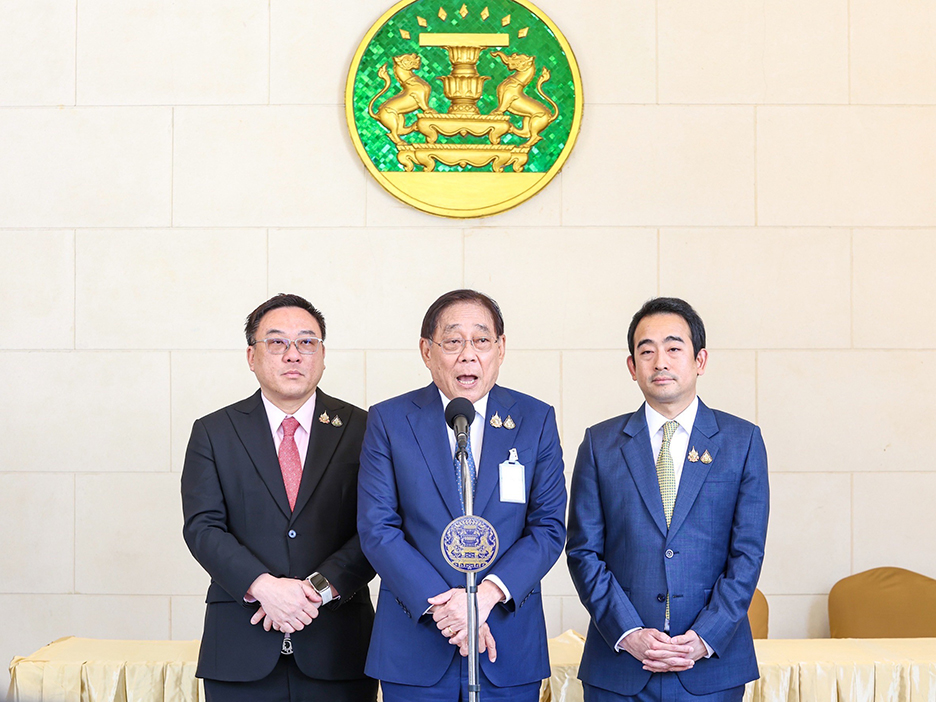
Deputy Prime Minister and Finance Minister Pichai Chunhavajira announced the decision after the meeting chaired by Prime Minister Paetongtarn Shinawatra. The approved initiative, called Phase 1 of the Digital Wallet Scheme, is expected to be disbursed to registered recipients aged 16-20 between the end of the second quarter and the beginning of the third quarter of 2025.
The government believes this will provide financial support to parents, while the inclusion of the 20–60 age group is still under consideration.
Deputy PM and Finance Minister Pichai Chunhavajira (center) with two deputy ministers, Chulaphan Amornvivat, and Phaophum Rojanasakul, announce the approval of 10,000 baht scheme in digital cash to 2.7 million young people between the ages of 16 and 20, at the Government House, on March 10, 2025.
“The digital wallet project offers numerous advantages in its first phase. Although the system is complex to develop, it offers better control over spending compared to other subsidies. The digital wallet enables targeted spending and ensures that funds flow into the economy as intended. It also provides valuable insights into citizens’ living conditions and helps shape future economic plans. This initiative lays the foundation for Thailand’s digital economy,” explained Pichai.
Deputy Finance Minister Chulaphan Amornvivat announced that the digital cash of 10,000 baht for the 16–20 age group comes with relaxed conditions. The previous negative list, which restricted certain purchases, has been completely removed.
This means that the money can be used for tuition fees, electricity bills and electronics, among other things. In addition, all types of businesses can withdraw the funds as cash, not just tax-registered merchants. However, the specific time frame for the use of the funds will still be determined per district.
The next step is to submit the plan to the Cabinet (CRC) for final approval in the coming weeks. If the program is approved, it should start as early as the 2nd or 3rd quarter of 2025.
Deputy Finance Minister Phaophum Rojanasakul emphasized that the 2.7 million young beneficiaries were selected because of their high digital adoption, strong technology awareness and greater ability to adapt to digital transactions compared to other groups.
For the next phase, the government has allocated 150 billion baht for further economic stimulus at an appropriate time, especially in the third quarter of 2025.
“We need to use these funds within Q3 because of budget constraints. The government must ensure that every baht is spent efficiently and at the right time,” Phaophum explained.
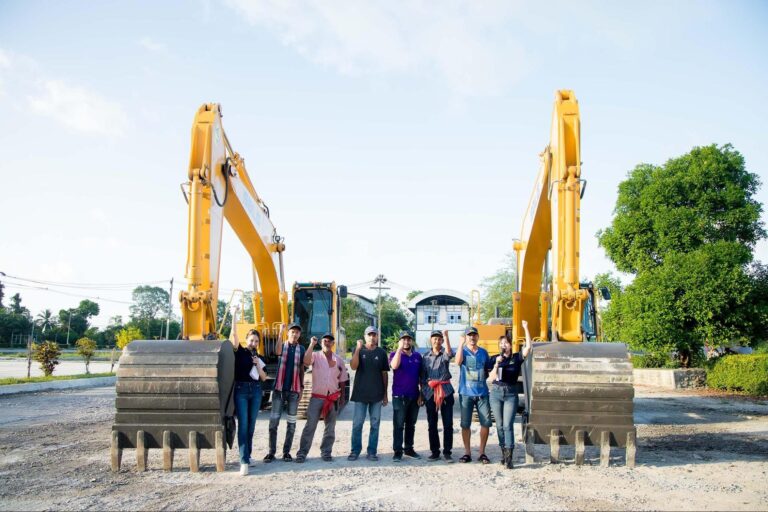
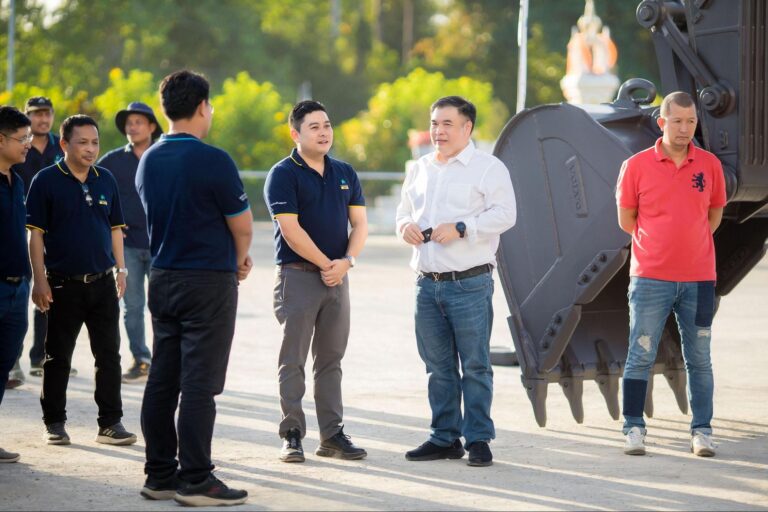
Nakhon Si Thammarat, Thailand – February 27, 2025 – ITALTHAI | SDLG is setting a new benchmark in heavy machinery excellence with the launch of ‘Master the Performance,’ a high-stakes competition designed to showcase the precision, power, and reliability of SDLG excavators and wheel loaders in real-world operations.
Hosted at Wangsila Na Nakorn Concrete Limited Partnership, a key ITALTHAI Partner in Nakhon Si Thammarat, the event brings together top-tier heavy machinery operators and business owners from across the region. Participants take on structured challenges, testing their skills in machine control, accuracy, and operational efficiency under real-world, time-sensitive conditions.
‘Master the Performance’ is more than a showcase of ITALTHAI | SDLG machinery—it’s a platform for the skilled operators driving industry success. This competition highlights their expertise, precision, and control in high-stakes challenges, navigating SDLG excavators and wheel loaders through demanding, time-sensitive tasks that mirror real-world conditions. Beyond testing skill, it celebrates the professionals who power progress, proving that true performance comes from both the machine and the people behind it.
Mr. Yuthachai Charanachitta, CEO of ITALTHAI | SDLG, emphasized the significance of the event, stating “This competition is not just about testing the performance of our machines—it’s about elevating operator skills and setting new industry standards. At ITALTHAI | SDLG, we believe true performance comes from both the machinery and the skilled professionals behind it. We are honored to collaborate with Mr. Piya Na Nakorn from Wangsila Na Nakorn ConcreteLimited Partnership in hosting this event, while also strengthening the ITALTHAI Partner program to support the growth of Thailand’s construction and heavy-machinery industries.”
This competition not only provides a platform for heavy machinery operators to showcase their skills but also reinforces the strong partnerships within the ITALTHAI Partner program. As a strategic collaboration network, ITALTHAI Partner enables businesses to access high-quality SDLG heavy machinery, professional after-sales services, and localized support from partners across key regions nationwide.
Mr. Piya Na Nakorn, Managing Director of Wangsila Na Nakorn Concrete Limited Partnership, a business partner under the ITALTHAI Partner program, shared his confidence in ITALTHAI | SDLG machinery, stating “‘Master the Performance’ is more than just a competition—it reinforces expertise, reliability, and the standard of excellence that industry professionals trust in heavy machinery. I choose ITALTHAI | SDLG because of its high quality, durability, and ease of control. Our operators consistently provide positive feedback on its precision and efficiency. I highly encourage others to try it and experience the difference firsthand.”
More than just a competition, ‘Master the Performance’ underscores ITALTHAI | SDLG’s dedication to building trust and driving sustainable growth in the heavy machinery industry. Through innovation, advanced technology, and skilled professionals, ITALTHAI | SDLG equips both businesses and operators with the tools and expertise needed to stay competitive in an industry that is rapidly evolving.
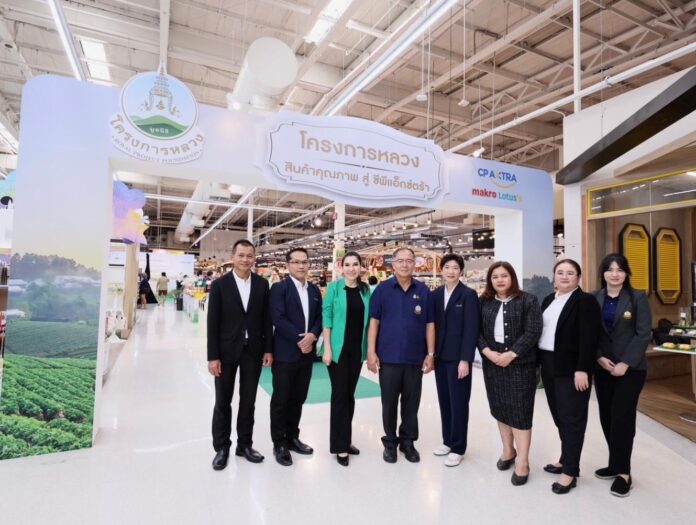
CP AXTRA Public Company Limited, an operator of Asia’s leading wholesaler and retailer Makro and Lotus’s, has partnered with the Royal Project to launch the ‘Royal Project Quality Products for CP AXTRA.’ This collaboration continues to bring high-quality, fresh, and reliable produce from hill tribe farmers directly from the mountaintops to Makro and Lotus’s stores nationwide. The project reinforces CP AXTRA’s role as a destination for high-quality fresh food and products, ensuring consumers have access to quality products while improving the livelihoods of hill tribe farmers through sustainable income generation.
The event was inaugurated by Dr. Narongchai Pipatthanawong, Executive Director of the Royal Project Foundation. This marks another significant milestone in the collaboration between the private sector and civil society, reaffirming a shared commitment to supporting highland farmers by promoting sustainable agricultural careers and encouraging the cultivation of cash crops as an alternative to opium farming. The project aligns with the “Royal Project Model,” which prioritizes economic, social, and environmental development, fostering long-term sustainability.
The “Royal Project Quality Products for CP AXTRA” strengthens local economies by bringing produce from highland farmers to Makro and Lotus’s stores nationwide. It showcases a carefully curated selection of locally sourced produce, ensuring freshness, cleanliness, and safety from farm to consumers. Consumers can explore a diverse selection of products, including vegetables, fruits, flowers, health and processed goods. Beyond supporting highland farmers, this collaboration also promotes ‘Health and Well-Being’ by making nutritious, high-quality food more accessible at affordable prices.
CP AXTRA is dedicated to conducting business in alignment with Environmental, Social, and Governance (ESG) principles. By consistently sourcing produce from local farmers, CP AXTRA not only ensures their financial stability but also enhances their quality of life, elevates agricultural standards, empowers communities, and drives local economic growth—paving the way for a more sustainable future.
Discover Royal Project products at Makro and Lotus’s stores nationwide and enjoyexclusive promotions. Buy 1 Get 1 Free deals on selected items and exclusive perks for My Lotus’s members who spend 599 baht or more on Royal Project products will receive a complimentary red or green tea (one privilege per receipt). Additionally, explore special prices starting at just 29 baht at Makro and Makro Pro, all available now until April 3, 2025.
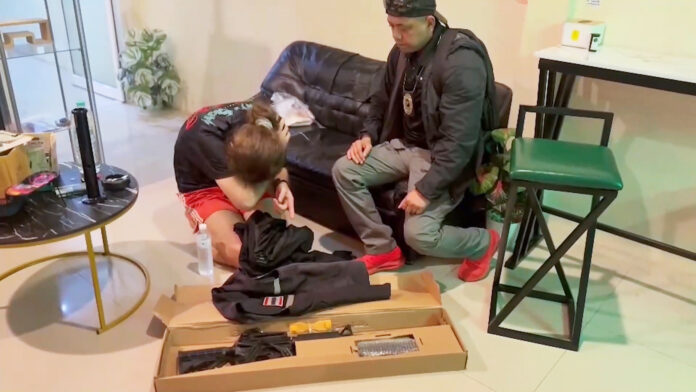
Vladislav shows police his tactical vest, an M4A1 airsoft gun, and handcuffs that he had purchased online, at his Koh Phangan's resident on March 9, 2025.
KOH PHANGAN — Thai Tourist Police have arrested a Russian national who allegedly extorted fellow Russians on Koh Phangan island in Surat Thani province by posing as a mafia member with connections to high-ranking Thai officials.
The 27-year-old suspect, identified only as Vladislav, was apprehended on Sunday evening (March 9) at a cannabis shop in Moo 4, Ban Tai sub-district, where he was working as a sales employee.
Tourist Police received multiple complaints from visitors to the popular holiday island about a foreign man who intimidated Russian tourists, photographed himself wearing tactical vests with firearms, and collected protection money. The suspect reportedly claimed he worked with high-ranking Thai government officials and could help resolve legal issues.
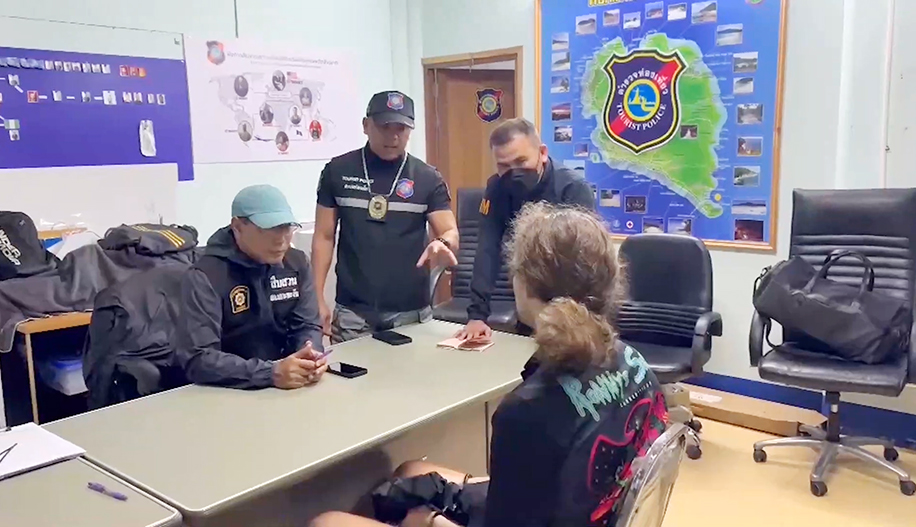
Police Lieutenant General Saksira Phuek-am, commander of the Tourist Police, ordered an investigation that confirmed the allegations. Officers obtained a court warrant and arrested Vladislav while he was selling cannabis products at the shop’s counter.
Police question a Russian suspect who allegedly extorted fellow Russians on Koh Phangan island in Surat Thani province on March 9, 2025.
Authorities charged him with working without a permit. After a drug test revealed cocaine in his system, he was additionally charged with Category 2 narcotic use. The case has been transferred to Koh Phangan Police Station for further legal proceedings.
During questioning, Vladislav admitted to working at the cannabis shop, receiving 17% of total sales as payment plus free accommodation on the premises. He also confessed to the intimidation allegations and showed police his tactical vest, an M4A1 airsoft gun, and handcuffs that he had purchased online.
“We urge any Russian tourists or others who have been threatened, extorted, or harmed by this individual to file complaints with Koh Phangan Police Station or contact the Tourist Police hotline at 1155,” said Police Lieutenant Colonel Winit Boonchit, investigation inspector for the Tourist Police.
Lieutenant General Saksira has instructed tourist police chiefs in pilot tourist areas and nearby regions to crack down on foreign criminals operating in Thailand and to prosecute all cases without exception.
Event backdrop (From left to right): Ms. Kristine Anvik Leach, Managing Director at Jotun Thailand, H.E. Mrs. Astrid Emilie Helle, the Ambassador of Norway to Thailand, Mr. Pongpol Yodmuangcharoen, Secretary to the Minister of Industry, Mr. Axel Blom, President of the Thai-Norwegian Chamber of Commerce, Ms. Gloyta Nathalang, Senior Executive Vice President, Sustainability Management and Corporate Communications at Bangchak Corporation Public Company Limited (BCP).
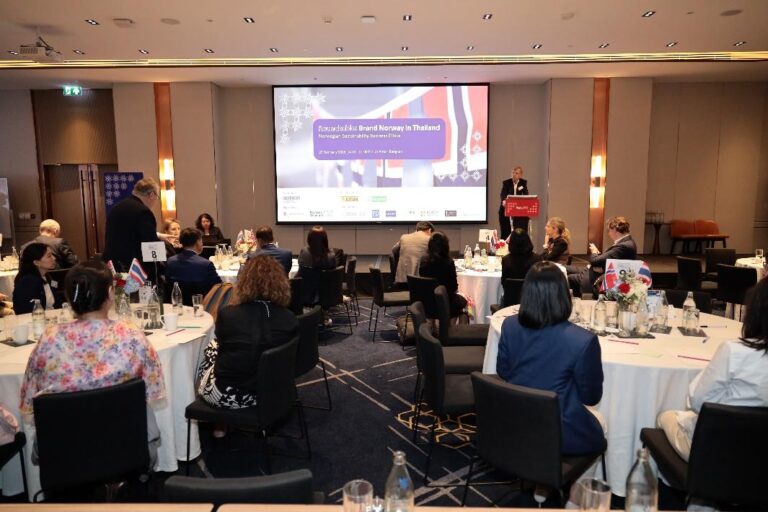
BANGKOK – The “Brand Norway in Thailand – Norwegian Sustainability Business Ethics” roundtable organised by the Thai-Norwegian Chamber of Commerce, held on February 27, 2025 at the Amari Hotel Bangkok.
The event brought together leaders from business, academia and government to explore the intersection of sustainability and business ethics. The event, celebrating 120 years of diplomatic relations between Norway and Thailand, aimed to highlight the importance of Environmental, Social and Governance (ESG) practices and the Sustainable Development Goals (SDGs) in today’s global business environment.
Opening Remarks and Keynote Address
H.E. Mrs. Astrid Emilie Helle, the Ambassador of Norway to Thailand, underlined the importance of sustainable economic development and good corporate governance to support the economic competitiveness as well as social and environmental progress. Norway has introduced regulations that obligates Norwegian enterprises to align with OECD’s guidelines and to carry out due diligence throughout the value chain, in or outside Norway.
Norway is ready to support Thailand on its road to membership of the OECD. Ms. Helle also highlighted the Thailand-EFTA Free Trade Agreement (FTA) as a significant step towards strengthening trade and investment ties between the two nations. The agreement contains specific commitments related to the environment, climate, labor rights and equality.
Marking 120 years of Thailand-Norway diplomatic relations, she reaffirmed the enduring partnership built on shared commitment to sustainability – paving the way for future growth and cooperation.
Mr. Pongpol Yodmuangcharoen, Secretary to the Minister of Industry, delivered a keynote address reaffirming Thailand’s commitment to Environmental, Social, and Governance (ESG) principles and sustainable economic development.
Speaking on “Thailand’s Commitment to ESG and a Sustainable Future,” he emphasized the importance of the circular economy and the Bio-Circular-Green (BCG) model as core strategies for driving sustainable growth. “Thailand is dedicated to fostering an economy where sustainability and innovation go hand in hand. The BCG model plays a crucial role in promoting responsible production, resource efficiency, and green innovation across industries,” he stated.
Panel Discussions Offer Practical Insights on Sustainability
The roundtable featured two key panel discussions, each offering actionable insights from leaders in the field.
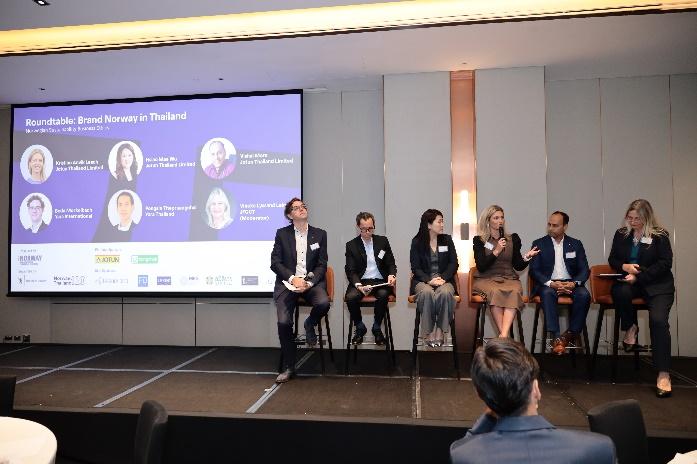
Panel discussion – First session (from left to right): Ms. Ava Hider, Eco Sales and Marketing Coordinator at Starboard, Mr. Johan Martin Seland, Head of Sustainability at Telenor Asia, Ms. Gloyta Nathalang, Senior Executive Vice President, Sustainability Management and Corporate Communications at Bangchak Corporation Public Company Limited (BCP), Mr. Martin Venzky-Stalling, Chair, Sustainable Development Committee (SDC), Joint Foreign Chambers of Commerce (JFCCT).
The first panel, “Bridging Values: Norway-Thailand Partnerships for Ethical Growth,” focused on the shared values between Norway and Thailand in advancing ethical business practices. Representatives from Bangchak Corporation PCL, Telenor Asia and Starboard discussed how integrating sustainability into corporate strategy can drive long-term success. The session was moderated by Mr. Martin Venzky-Stalling, Chair of the Sustainable Development Committee at the Joint Foreign Chambers of Commerce (JFCCT).
During the session, Ms. Gloyta Nathalang, Senior Executive Vice President, Sustainability Management and Corporate Communications at Bangchak Corporation Public Company Limited (BCP), highlighted Bangchak’s commitment to sustainability and responsible energy solutions.
“At Bangchak, sustainability is not just a goal—it is embedded in our business strategy. Our investment in Norway, particularly through our partnership with OKEA, reflects a commitment to responsible energy solutions, innovation, and long-term energy security. This cross-border cooperation not only strengthens our ability to develop cleaner energy alternatives while learning from Norway’s expertise in sustainable resource management, but also provides a blueprint for expanding these sustainable practices into high‑potential markets across Asia. By working together, we can create impactful, long-term solutions that benefit both economies and drive meaningful progress toward a low-carbon future.”
Similarly, Mr. Johan Martin Seland, Head of Sustainability at Telenor Asia, highlighted the role of technology in tackling emissions and optimizing energy use across industries. Ms. Ava Hider, Eco Sales and Marketing Coordinator at Starboard, emphasized the critical role businesses can play in advancing environmental sustainability through ethical and responsible practices.
Panel discussion – Second session (from left to right): Mr. Beda Merkelbach, Yara’s Senior Vice President for Asia Pacific, Mr. Pongsin Thepruangchai, Government Relations and Public Affairs Manager for Thailand, Ms. Hsiao Mae Wu, Marketing Manager at Jotun Thailand, Ms. Kristine Anvik Leach, Managing Director at Jotun Thailand, Mr. Vishal More, Operations Manager at Jotun Thailand, Ms. Vibeke Lyssand Leirvåg, Chairwoman, Joint Foreign Chamber of Commerce (JFCCT).
The second panel, “From Vision to Practice: The Sustainability Roadmap,” provided real-world examples from Jotun Thailand and Yara, as they shared their strategies for implementing ESG initiatives. Ms. Vibeke Lyssand Leirvåg, Chairwoman of JFCCT, moderated the session, highlighting how businesses can turn sustainability visions into practical, everyday actions.
During the session, Ms. Kristine Anvik Leach, Managing Director at Jotun Thailand, highlighted Jotun’s commitment to sustainability. “Jotun is committed to integrating sustainability into every aspect of our operations, from product innovation to responsible supply chain management. In Thailand, we actively align with the UN’s 17 Sustainable Development Goals by reducing our environmental footprint, implementing energy-efficient production methods and low VOC products and marine coatings that reduce fuel consumption thus contributing to cleaner oceans.
Norway and Thailand share a mutual ambition for sustainable growth and we are proud to be a part of this collaboration.” Mr. Vishal More, Operations Manager, and Ms. Hsiao Mae Wu, Marketing Manager at Jotun Thailand, also shared insights on how Jotun is prioritizing inclusive business practices, ensuring safe working conditions, diversity, and strong governance across its operations.
Mr. Beda Merkelbach, Yara’s Senior Vice President for Asia Pacific and Mr. Pongsin Thepruangchai, Government Relations and Public Affairs Manager for Thailand, reinforced Yara’s mission to foster sustainable agriculture through innovation, partnerships, and improving farmer productivity. In addition, Yara collaborates with governments and trade associations to promote policy-making that reflects real-world challenges, empowering farmers to adopt sustainable practices and drive long-term sustainability across the industry.
Interactive Workshop Promotes Collaborative Solutions A key feature of the roundtable was the interactive workshop, “Building Sustainable Futures Through Collaboration,” led by Mr. Martin Venzky-Stalling. 2030 SDGs Game session encouraged participants to collaborate and brainstorm solutions to advance sustainability in business. The group exercise allowed attendees to develop practical, collective strategies to tackle the challenges of implementing sustainable practices in diverse industries.
Closing remarks: Mr. Axel Blom, President of the Thai-Norwegian Chamber of Commerce, delivering closing remarks.
Closing Remarks and Reflections on a Successful Roundtable
The event concluded with Mr. Axel Blom, President of the Thai-Norwegian Chamber of Commerce, delivering closing remarks. He reaffirmed the importance of responsible business practices in promoting both social and environmental well-being, stressing that the day’s discussions had reinforced the strong partnership between Norway and Thailand in working towards a sustainable future.
Mr. Blom also emphasised the opportunities presented by the Thailand-EFTA Free Trade Agreement (FTA) in enhancing sustainable trade and investment. Looking ahead, he encouraged businesses to continue integrating ESG values into their strategies, ensuring long-term growth and positive impact while fostering more bilateral projects, knowledge-sharing and joint ventures to drive sustainability forward.
The success of this roundtable marks a significant step in strengthening the ties between Norwegian and Thai businesses, with a shared commitment to advancing sustainability and business ethics in the region.
Phulay Bay, a Ritz-Carlton Reserve, Elevates Southern Thailand’s Gastronomy as Chef Deepanker Khosla and Chef Christian Herrgesell Present Creative, Sustainable Cuisine in a Stunning Seafront Setting
Krabi, Thailand – Phulay Bay, a Ritz-Carlton Reserve, the ultra-luxury sanctuary on Krabi’s pristine shores, will continue to redefine the culinary landscape of Southern Thailand this March. On 19 March, the resort’s Michelin-starred Executive Chef Christian Herrgesell will collaborate with Chef Deepanker Khosla, the visionary Chef Patron of HAŌMA in Bangkok, to present an extraordinary Four Hands Dinner at Lae Lay, blending artistic innovation with sustainable neo-Indian flavors.
Chef Deepanker, whose philosophy is embodied in his words, “We grow what we cook, we cook what we love” is renowned for his commitment to sustainability and the celebration of seasonal, local ingredients. At HAŌMA, this vision comes to life as he sources from dedicated farmers, breeders, and fisherfolk, alongside produce from the restaurant’s own verdant garden.
His neo-Indian creations shine through thoughtfully curated seasonal tasting menus including a captivating vegetarian option, all served in a Nordic-style dining room where even the decor features unused plant elements, showcasing his holistic approach to sustainability.
His innovative approach earned HAŌMA its first Michelin star since 2022, and Chef Deepanker was honored with the inaugural “Champion of Change” award by The World’s 50 Best Restaurants List in 2021, celebrating his leadership in socially and environmentally conscious cuisine.
The evening’s menu will feature a harmonious blend of both chefs’ creations, inviting guests to indulge in delicacies such as the smoked eggplant crowned with caviar on brioche and the aromatic goby fish with smoked char roe and moiley curry. These vibrant flavors will be seamlessly interwoven with Chef Christian’s inspired dishes, delivering a dining experience that embodies the spirit of Phulay Bay’s ultra-luxurious and evocative setting.
“Lae Lay, our elegant oceanfront restaurant, is an oasis of creativity where exceptional cuisine is heightened by evocative views. It is the perfect stage to showcase the remarkable talents of Chef Deepanker Khosla alongside our own Chef Christian Herrgesell. Together, they will present an evening of culinary artistry that transcends expectations,” said Vidya Sagar, General Manager, Phulay Bay, a Ritz-Carlton Reserve.
With limited seating available for this exclusive dining event, early reservations are highly recommended. For more information or to secure your table, please contact +66 75 628111
To learn more about Phulay Bay, a Ritz-Carlton Reserve, please visit www.ritzcarlton.com/en/hotels/phulay-bay/hotel-overview.
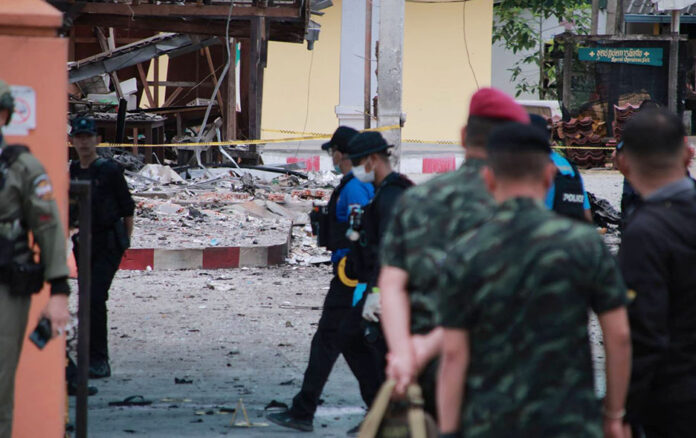
The bombing site at the Sungai Kolok District Office, Narathiwat Province, where two civilian defense volunteers were killed
NARATHIWAT — In response to Saturday night’s deadly attacks in Thailand’s southern border provinces, security forces have implemented revised safety protocols across the region. The twin attacks in Sungai Kolok district, Narathiwat province, and Sai Buri district, Pattani province, claimed the lives of five security personnel and volunteers, while injuring 13 others.
Lt. Gen. Paisan Nusang, Commander of the 4th Army Region and Director of the Internal Security Operations Command Region 4, visited the attack sites on March 9 to assess damage and coordinate an immediate security response. During an emergency tri-party meeting with military, police, and administrative officials at the Sungai Kolok Police Station, he outlined new security measures.
Lt. Gen. Paisan Nusang, Commander of the 4th Army Region, inspects the bombing site at the Sungai Kolok District Office, Narathiwat Province, where two civilian defense volunteers were killed, on March 9, 2025.
Investigators at the Sungai Kolok attack site discovered remains of a bronze Toyota sedan that had been converted into a car bomb. The vehicle was parked in front of the district office’s auditorium. The explosive device, contained in a 100-kilogram cooking gas cylinder and detonated by radio signal, functioned with devastating effectiveness.
The blast radius extended over 100 meters, severely damaging the auditorium facade, the revenue department building, the district office’s second-floor meeting room, the fire engine garage, the old district office building used for storage, and a National Housing Authority apartment building behind the district office. Windows, doors, louvers, roofing, trucks, and armored vehicles were all damaged by bomb fragments.
The vehicle used as a car bomb at the Sungai Kolok District Office, Narathiwat Province, which killed two civilian defense volunteers on the night of March 8, was discovered on March 9 parked in front of the auditorium building inside the district office compound.
“We need to review our security plans and assess intelligence gaps to strengthen our approach, especially regarding targeted attacks against operational bases and volunteer personnel,” Lt. Gen. Paisan said. “This attack was well-planned. The perpetrators had been active in the area for some time, likely before Ramadan, and are probably associated with groups operating in Sungai Padi district.”
The commander emphasized that he doesn’t view the attacks as connected to peace dialogue efforts or any administrative vacuum. Instead, he stressed the need for improved intelligence gathering and closing security gaps, particularly during Ramadan.
He noted that violent incidents typically occur during the final 10 days of Ramadan due to misguided religious beliefs, but this year’s attacks happened early in the holy month, requiring heightened vigilance.
Lt. Gen. Paisan urged public cooperation, encouraging citizens to report suspicious activities. He later visited injured personnel at Sungai Kolok Hospital, bringing gifts and commending their bravery and sacrifice.
In Bangkok, Prime Minister Paetongtarn Shinawatra, returning from Germany on March 9, expressed condolences to victims’ families upon landing at Suvarnabhumi Airport. She called for enhanced remedial measures, increased security forces—especially during nighttime—and greater attention to public psychological security.
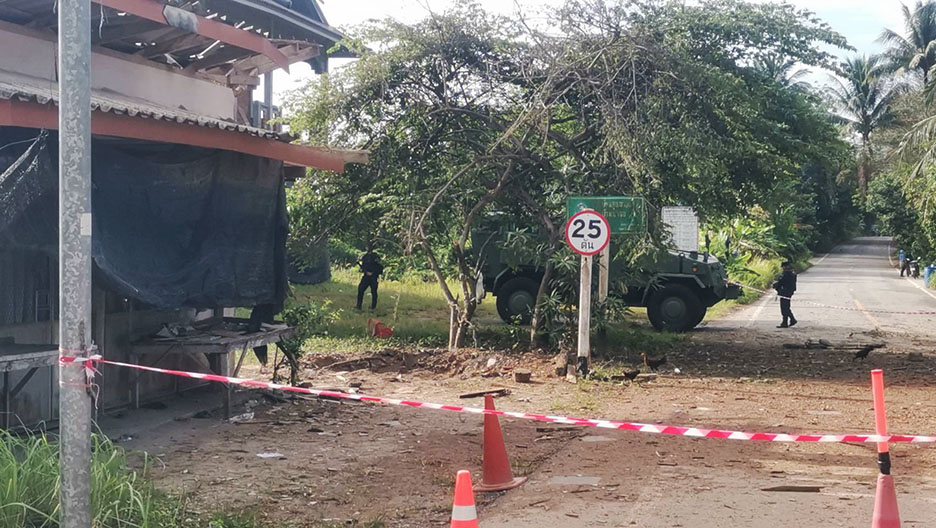
Officials cordon off a pavilion near the Hoo Tae Gor-lae intersection in Village No. 3, Terae Bon Subdistrict, Sai Buri District, Pattani Province, which was bombed late Saturday night, killing three local officials, on March 9, 2025.
Deputy Prime Minister and Interior Minister Anutin Charnvirakul has ordered all local security agencies to implement 24-hour guards at district offices, government buildings, and operational bases. He mandated thorough vehicle inspections for all entering and exiting the area, prohibiting unauthorized vehicles, maintaining records of all vehicles near district offices, and requiring immediate reporting of suspicious activities.
“As we are currently in the month of Ramadan, a time of peace for our Muslim brothers and sisters, all officers must operate with extreme caution,” Anutin stated. “District volunteer company commanders and subdistrict protection unit chiefs must oversee safety throughout this period—before, during, and after Ramadan.
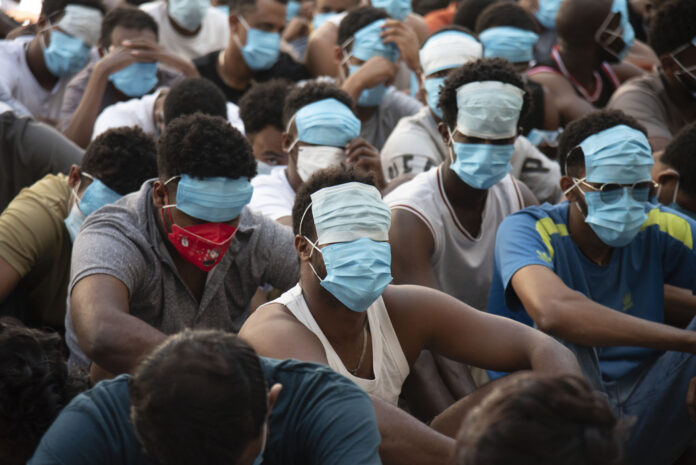
People from China, Vietnam and Ethiopia, believed to have been trafficked and forced to work in scam centers, sit with their faces masked while in detention after being released from the centers in Myawaddy district in eastern Myanmar, Wednesday, Feb. 26, 2025. (AP Photo/Thanaphon Wuttison)
MAE SOT, Thailand (AP) — Thousands of sick, exhausted and terrified young men and women, from countries all over the world squat in rows, packed shoulder to shoulder, surgical masks covering their mouths and eyes.
Their nightmare was supposed to be over.
Last month, a dramatic and highly publicized operation by Thai, Chinese and Myanmar authorities led to the release of more than 7,000 people from locked compounds in Myanmar where they were forced to trick Americans and others out of their life savings. But survivors have found themselves trapped once again, this time in overcrowded facilities with no medical care, limited food and no idea when they’ll be sent home.
One young man from India said about 800 people were being held in the same facility as him, sharing 10 dirty toilets. He said many of the people there were feverish and coughing. Like all former enslaved scammers who talked to The Associated Press, he spoke on condition of anonymity out of concern for his safety.
“If we die here with health issues, who is responsible for that?” he asked.
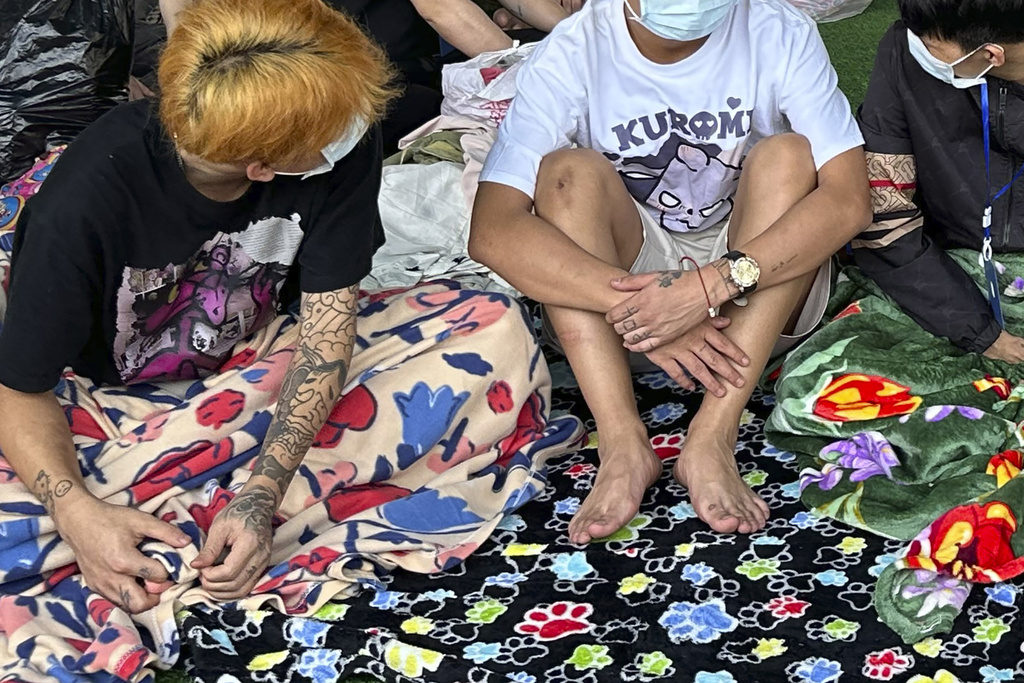
People from China, believed to have been trafficked and forced to work in scam centers, sit with their faces masked while in detention after being released from the centers in Myawaddy district in eastern Myanmar, Wednesday, Feb. 26, 2025. (AP Photo/Chiravuth Rungjamratratsami)
The armed groups who are holding the survivors, as well as Thai officials across the border, say they are awaiting action from the detainees’ home governments.
It’s one of the largest potential rescues of forced laborers in modern history, but advocates say the first major effort to crack down on the cyber scam industry has turned into a growing humanitarian crisis.
The people released are just a small fraction of what could be 300,000 people working in similar scam operations across the region, according to an estimate from the United States Institute of Peace. Human rights groups and analysts add that the networks that run these illegal scams will continue to operate unless much broader action is taken against them.
A high-profile crackdown
The trapped people, some of whom are highly educated and fluent in English, were initially lured to Thailand with promises of lucrative office jobs, only to find themselves locked in buildings where they describe being forced to sit at computers up to 16 hours a day running scams. Refusing to work could bring beatings, starvation and electric shocks.
“Your passport is confiscated, you cannot go outside and everything is like hell, a living hell,” a trapped Pakistani man told The Associated Press.
Cyber scams run from compounds have flourished during the pandemic, targeting people around the world. The United Nations Office on Drugs and Crimes estimates that between $18 billion and $37 billion was lost in Asia alone in 2023, with minimal government action against the criminal industry’s spread.
Beijing began pushing the region’s governments to crack down this year after a young Chinese actor was trafficked to Myanmar by people who promised him an acting job in Thailand. His girlfriend spearheaded a viral social media campaign that led to his release.
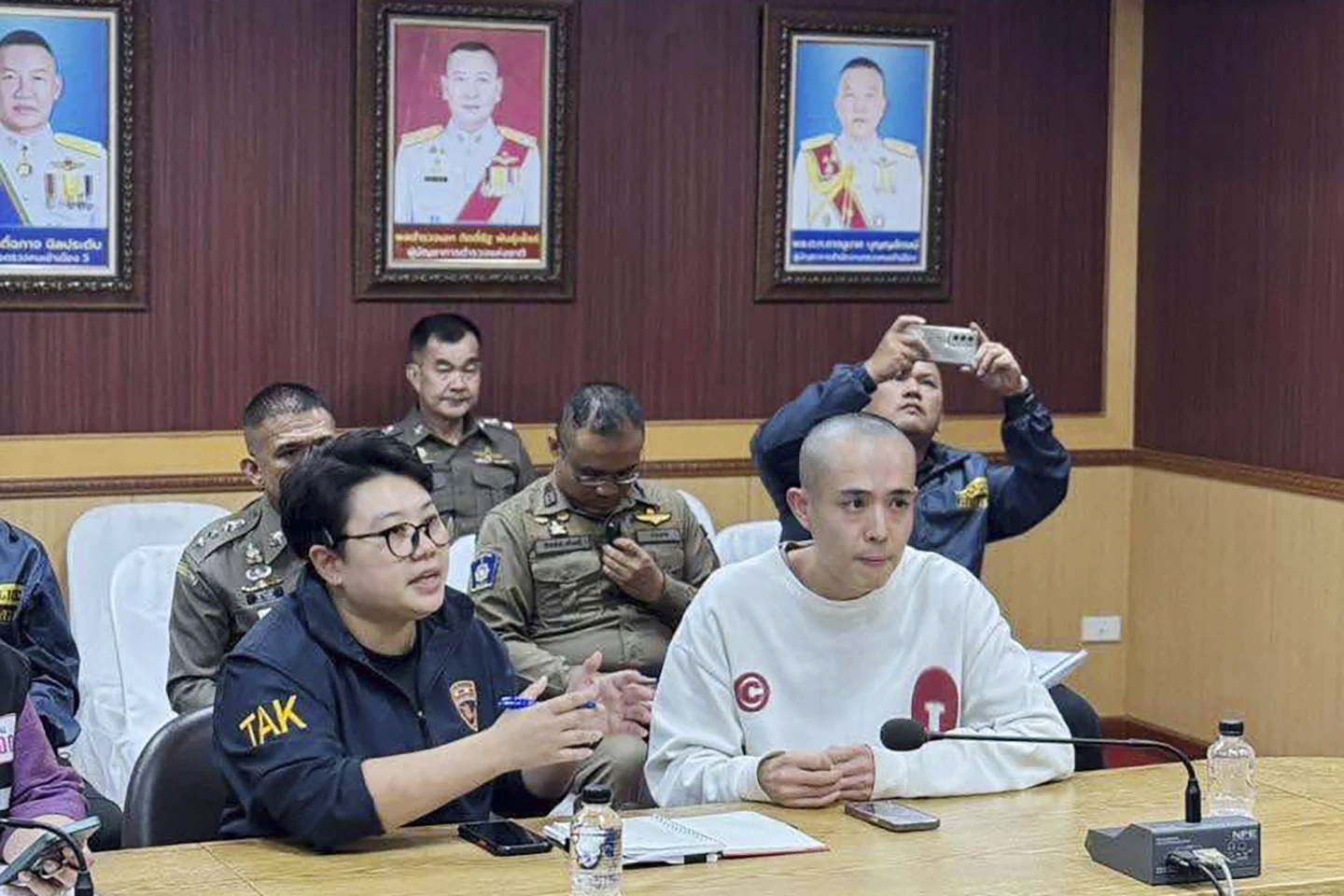
Chinese actor Wang Xing, right, talks with Thai police officers in Mae Sot district, in Thai-Myanmar border, Tak province Tuesday, Jan. 7, 2025. (The Royal Thai Police via AP)
Following that rescue, a senior Chinese government official visited Thailand and Myanmar demanding an end to the scams. In response, Thailand cut electricity, internet and gas supplies to five border towns in Myanmar.
Shortly after, the ethnic militia groups that rule this part of Myanmar — the Kayin Border Guard Force and the Democratic Kayin Buddhist Army — asked some of the trapped scammers if they wanted to leave, and then escorted them out of their compounds.
From forced labor to detention
As the number of people released grew into the thousands, formerly enslaved scammers found themselves caught in indefinite detention just across a narrow, slow-moving river’s width from freedom.
Most are being held either in army camps controlled by the Kayin Border Guard Force, or repurposed scam compounds, where many have been since early February.
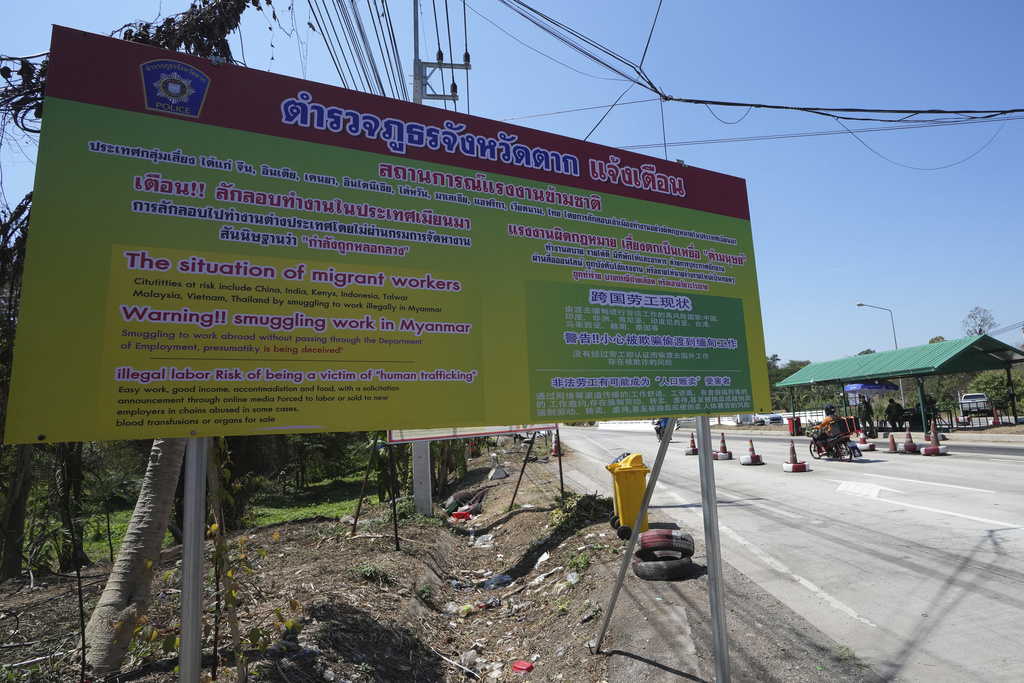
A sign near military checkpoint warns in Thai, English and Chinese of the danger of being trafficked and forced to work in locked scam compounds across the Myanmar border, in Mae Sot, Thailand, Wednesday, Feb. 26, 2025. (AP Photo/Sakchai Lalit)
For weeks, men and women have shared unsanitary conditions, sleeping on the floor and eating what their captors provide. At one point, the Border Guard Force said that over 7,000 people were crammed into these facilities, as China began busing citizens across the border for flights.
Exclusive photos obtained by AP underscore the detainees’ desperation: Surgical masks, often two per face, cover their eyes, noses and mouths as they huddle under the watchful eyes of armed guards.
“It felt like a blessing that we came out of that trap, but the actual thing is that every person just wants to go back home,” said another Indian man, 24, speaking softly on a contraband phone from inside a makeshift detention center. He asked to not publish his name out of concern for his safety and because the militias guarding them had confiscated their phones.
Last week, fights broke out between Chinese citizens waiting to go home and the security forces guarding them, two detainees told the AP.
An unconfirmed list provided by authorities in Myanmar says they’re holding citizens from 29 countries including Philippines, Kenya and the Czech Republic.
Waiting for a $600 plane ticket
Authorities in Thailand say they cannot allow foreigners to cross the border from Myanmar unless they can be sent home immediately, leaving many to wait for help from embassies that has been long in coming.
Thai soldiers provide security for Indonesian nationals being sent home after being forced to work at scam centers in eastern Myanmar in Mae Sot, Thailand on Thursday, Feb. 27, 2025. (AP Photo/Sakchai Lalit)
China sent a chartered flight Thursday to the tiny Mae Sot airport to pick up a group of its citizens, but few other governments have matched that. There are roughly 130 Ethiopians waiting in a Thai military base, stuck for want of a $600 plane ticket. Dozens of Indonesians were bused out one morning last week, pushing suitcases and carrying plastic bags with their meager possessions as they headed to Bangkok for a flight home.
Thai officials held a meeting this week with representatives from foreign embassies, promising to move “as quickly as possible” to allow them to rescue their trapped citizens. But they warned that Thailand can only manage to receive 300 people per day, down from 500 previously, Monday through Fridays. It also announced it would let embassy staff cross over into Myanmar.
“The ministry attaches very high importance to this and is aware that there are sick people, and that they need to be repatriated,” Nikorndej Balankura, spokesman for Thailand’s Ministry of Foreign Affairs said on Thursday.
The Indian Embassy in Bangkok did not respond to requests for comment. The Czech Foreign Ministry says it cannot confirm a Czech citizen is among those repatriated. It says it is in touch with the embassies in Bangkok and Yangon over the issue and that the embassies have not been asked for assistance.
Amy Miller, the Southeast Asia director of Acts of Mercy International who is based at the Thai-Myanmar border, says it’s hard for the world to understand why all of the released workers aren’t free.
“You can literally, with your naked eye, stand at the border and see people inside, on their balconies, in these compounds, and yet we cannot reach them,” she said. Pausing a moment, she gestured out a nearby window toward the Friendship Bridge to Myanmar just blocks away. “I think what people don’t understand is that to enter into another country is an act of war. You cannot just go in and receive these people out.”
Assistance is scarce
Aiding the work on the front lines, especially for those countries with fewer resources, are a handful of small nonprofit groups with very limited funds.
In a nondescript Mae Sot home, Miller’s organization receives escapees and a trickle of survivors who have made it across the river with comfortable couches, clean water, food and working phones to reach their families. She said today’s unprecedented numbers are overwhelming the aid available across the river.
“When we’re looking at numbers in the thousands, the ability to get them over to Thailand and process them and house them and feed them would be impossible for most governments,” said Miller. “It really does require a kind of a global response.”
Amy Miller, Southeast Asia director of aid group Acts of Mercy International, collects shampoo supplies into a bag in Mae Sot, Thailand Wednesday, Feb. 26, 2025. (AP Photo/Sakchai Lalit)
The recent abrupt halt to U.S. foreign aid funding has made it even harder to get help to released scam center workers.
The United Nations’ International Organization for Migration, for example, previously funded care for victims of trafficking in scam compounds in one shelter in Cambodia, but was forced to halt that work by the Trump Administration’s funding freeze announced in January, according to a source with direct knowledge of the situation. The halt to funding has also impacted a network of civil society groups that worked to stop human trafficking and rescue survivors in Thailand.
“It’s really heartbreaking to see that there’s such an immense amount of people that are in need of assistance,” said Saskia Kok, Head of Protection Unit in Thailand for the IOM.
In a statement, U.S. officials acknowledged the high pressure impasse.
“The United States remains deeply concerned about online scam operations throughout Southeast Asia, which affect thousands of Americans and individuals from many other countries,” said a State Department spokesperson in a statement sent to the AP.
A bigger problem
While advocates estimate some 50 million people are living in modern slavery, mass rescues of enslaved workers are rare. In 2015, more than 2,000 fishermen were rescued from brutal conditions at sea, liberated after an Associated Press investigation exposed their plight. That same year hundreds of Indians were rescued from brick factories in India. And last year Brazilian prosecutors rescued 163 Chinese nationals working in “slavery-like” conditions at an electric vehicle factory construction site in northeastern Brazil.
“What we are seeing at the Thai-Myanmar border now is the result of years of inaction on a trafficking crisis that has had a devastating impact on thousands of people, many of whom were simply seeking better economic prospect, but were lured to these compounds on false pretenses,” said Amnesty International Myanmar researcher Joe Freeman.
Being forced to commit a crime under threat of violence should not be criminalized, said Freeman. “However, in general we are aware of countries in the region repatriating their nationals from scam compounds only to then charge them with crimes.”
Thai soldiers provide security for the transfer of Indonesia nationals who had worked at scam centers in eastern Myanmar, on their arrival at Thailand’s Mae Sot, Tak province before being sent back to Indonesia on Thursday, Feb. 27, 2025. (AP Photo/Sakchai Lalit)
Business as usual
It’s not clear how much of an effect these releases will have on the criminal groups that run the scam centers.
February marked the third time the Thais have cut internet or electricity to towns across the river. Each time, the compounds have managed to work around the cuts. Large compounds have access to diesel-powered generators, as well as access to internet provider Starlink, experts working with law enforcement say.
“The resources is the one thing that they are not lacking and they’ve been able to bring them to bear in the past,” said Benedikt Hoffman, acting representative for the United Nations Office on Drugs and Crime in the region.
The armed groups that staged the crackdown have also been accused of helping to run scam compounds in Myawaddy. The head of the Kayin Border Guard Force, General Saw Chit Thu, has been sanctioned by the European Union and the United Kingdom for profiting from scam compounds and human trafficking, respectively. Compounds in the DKBA’s control are less well-documented in the public record, but activists say they also control a fair number.
“There is clearly a lot of pressure on the Border Guard Force to take action and helping people to leave is one of the most visible ways to do so,” Hoffman said. “That said, it likely also reflects an adjustment to the business model, reducing the number of people involved — and with less attention, continuing lower key operations.”
It will take simultaneous pressure exerted in multiple areas to truly shut down the compounds, said Hoffman.
In this crackdown, there have been no major prosecutions or compounds shut down.
“This doesn’t affect anything,” said a 23-year-old Pakistani man who had hoped to be freed only to be trapped in an army camp. The bosses, he said, are “rich as hell” and can buy anything they need to keep the lucrative operations going. Meanwhile, he said, conditions are worsening.
“My friends are in really bad condition, we can’t survive here,” he said, requesting anonymity out of fear for retribution from his guards. He asks a question that’s been haunting him day in and day out for weeks: “Is anyone coming for us?”
___
Mendoza reported for FRONTLINE (PBS). AP reporters Karel Janicek in Prague, Czech Republic, and Niniek Karmini and AP video journalist Andi Jatmiko in Jakarta, Indonesia, contributed to this report.
Screenshots from video show a Thai woman sitting in the front passenger seat of a Phuket taxi turning to the Russian tourist and slapping her in the face on Jan. 28, 2025.
PHUKET — A Russian female tourist has reached out to local media after her case involving an assault by a Phuket taxi driver’s girlfriend has shown no progress. She is requesting assistance from the Chalong Police Station to follow up on the investigation.
The incident, which was captured on video and shared on the “Hod Jung Phuket” Facebook page, shows a Thai woman sitting in the front passenger seat of a taxi, presumably the driver’s girlfriend, turning to the tourist and saying, “This is my country, you know” before slapping her in the face. The tourist can be heard screaming in shock while the driver is heard saying, “Why did you hit her?”
After the video was shared online, internet users expressed various opinions, particularly criticizing the taxi driver for bringing his girlfriend in the vehicle, as hired transportation should only include the driver and the vehicle.
On March 9, Ms. Ekaterina, a 31-year-old Russian national, sent a message to the media regarding the assault. She stated that she had filed a police report with Police Lieutenant Thiti Champat, Deputy Investigation Inspector at Chalong Police Station, on January 29, 2025. According to her report, the incident occurred at 4:00 p.m. on January 28 when she used the “In Driver” application to call a ride from her friend’s house in Patong Soi 11 in Karon sub-district to return to her accommodation in Choeng Thale sub-district.
She explained that the vehicle was a commercial service car and provided clear license plate details to the police. She noted that a woman was sitting in the front passenger seat beside the driver, believed to be his wife. When the car was driving near Global House Chalong on Patak Road in Chalong sub-district, Mueang Phuket district, this woman slapped her in the face, causing injuries.
Ms. Ekaterina clearly stated that she wishes to pursue legal action against her attacker until the case reaches its conclusion. However, there has been no progress on the case so far, which is why she has turned to the media for assistance in bringing attention to the matter.
A side-by-side image of Field Marshal Sarit Thanarat and General Prayut Chan-o-cha accompanying the article 'Dictatorship Builds the Nation, People Nostalgia for Strong Leadership-Economic Prosperity,' published and self-censored by Thai PBS.
In a sign that self-censorship is alive and well in Thailand, Thai PBS, the public broadcasting news organization, recently ran a controversial article on February 28, regarding how some Thais were nostalgic for military rule, and that these military dictators played an instrumental role in building a modern Thai nation and “economic success”. Former junta leader Gen Prayut Chan-o-cha and Field Marshal Sarit Thanarat, the latter known for ordering alleged arsonists back in the 1960s, to be summarily executed by a firing on spot without going through a justice system, were featured in the article.
Many readers and netizens were outraged. They accuse Thai PBS of being a mouthpiece for military dictatorship. Soon enough, the organization issued a statement, saying the article (which has no byline) “was not sufficiently well-rounded and could lead to inaccurate understanding, leading to debate, and become a political tool without the intention of Thai PBS.”
The statement ended by telling the public that they have removed the article from all of its platforms.
To summarize, a good number of Thais who claim to support democracy do not have a problem with Thai PBS censoring its own content simply because they disapprove or oppose the content. These people would rather read and hear only things that they agree with or approve of.
While the article may be disturbing to these people, it’s an important reminder that there are still Thais who prefer military dictatorship over elected government. Disturbing as it may be, it’s the reality. Forcing Thai PBS to eventually delete its controversial article will not change the mindset of pro-junta people. It will simply sweep the issue under the ideological rug. What was achieved was not changing the minds of supporters, but self-denial and more self-censorship for Thai society.
Thailand already has more than its fair share of self-censorship. The mainstream Thai press routinely self-censor anything deemed mildly critical of the monarchy to the point where many journalists can earnestly say they are for press freedom and do not see the royal defamation laws as a major impediment to press freedom.
Back to Thai PBS. We need to remind ourselves that Thai PBS’ funding comes from the so-called sin tax, the money made by the government from taxing and imposing tariffs on alcohol and tobacco. It is thus only fair that such media organizations would try to represent diverse political views, including those who admire and are nostalgic for a military coup, simply because these people are also among those who indirectly funded Thai PBS when buying booze and cigarettes.
How can we truly understand Thai society, and co-exist with others in peace, if there is no acknowledgement that there are people who think like that and engage in a dialogue, if not deliberation, in hope of finding a common solution, or compromise, for a peaceful co-existence. Are we so feeble intellectually that we have to suppress and delete differing views because we fear that other people are not critical enough to read such content and make their own conclusion? Supporters of such a move have no trust in the intelligence of the general public.
These people think that others will simply believe in what they read verbatim and in toto – be it content from a pro-junta writer, from an ambassador of a country that its leader was declared a war criminal by the International Criminal Court like Israel trying to defend what they did in Gaza, or from the embassy of an illiberal state like China assuring us that all the 40 Uyghurs recently sent back by the Thai government to China are in fact leading a normal life. Sadly, their mentality resembles those who call for the censorship of anything mildly critical of the Thai monarchy.
Some Thais, including those who insist on standing for freedom and democracy, were more than happy to see texts that they disagree with being censored, being deleted.
Clearly, our society still has a long way to go before we would be mature enough to defend the views of those whom we vehemently disagree with.
It’s not just these people that failed, but Thai PBS also failed to defend the freedom of expression of its writer. Thai PBS should have known better.