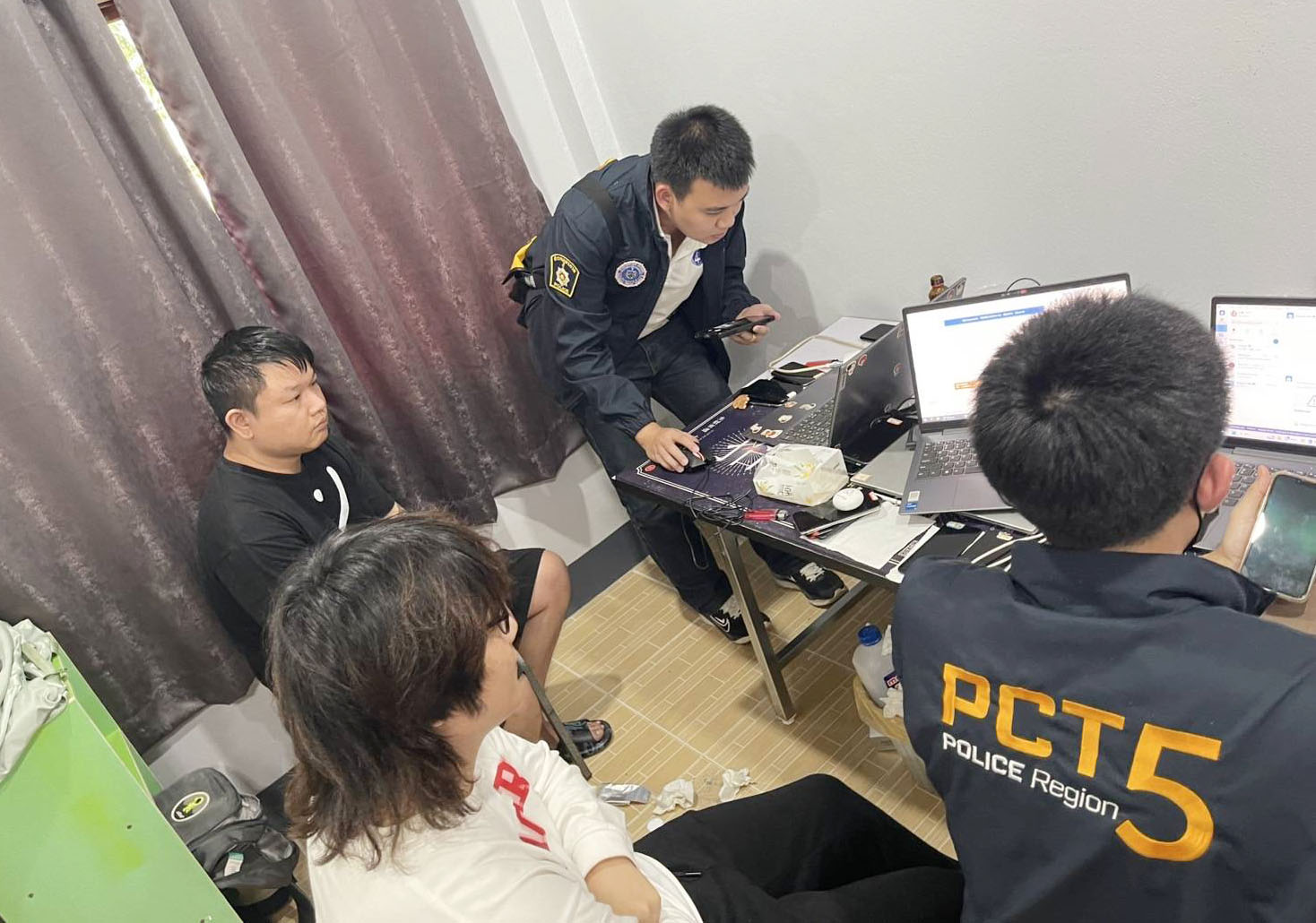
A Police Region 5 officer points at a computer used by suspects who created fake social media profiles with attractive photos to randomly select victims.
CHIANG RAI — Thai police have arrested nine Chinese nationals who were operating a sophisticated “hybrid scam” from Chiang Rai province in northern Thailand. The scammers allegedly targeted victims primarily in the United States and Canada.
According to Police Major General Thawatchai Pongwiwatchai, Deputy Commander of Provincial Police Region 5, the suspects were using fake social media profiles with attractive photos to randomly select victims. They would then build rapport through conversations using AI tools including ChatGPT, eventually persuading victims to invest in cryptocurrency through foreign digital wallets.
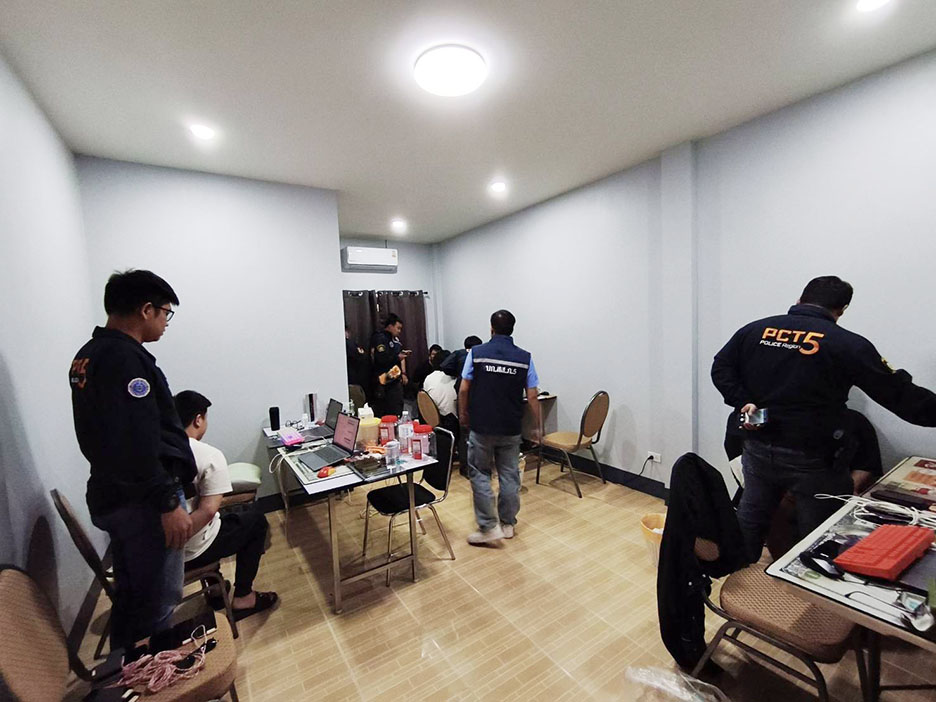
Police officers raid the Chinese suspect group’s base in Ban Du subdistrict of Mueang district, Chiang Rai on February 28, 2025.
Following an investigation, officers raided the group’s base in Ban Du subdistrict of Mueang district, Chiang Rai on February 28, 2025. Police seized significant evidence, including 14 computers, 81 mobile phones, and various internet connection devices.
Among those arrested were nine Chinese nationals with varying immigration statuses. Six of the suspects—Mr. Cao TaiQing (32), Mr. Tu Xing (29), Mr. Yi Xiu (30), Mr. Cheng Yue (20), Mr. Jrang Kai Hang (32), and Mr. Huang RangXin (26)—had illegally entered Thailand through natural border crossings from Laos, primarily near Chiang Saen, without proper documentation.
Police officers raid the Chinese suspect group’s base in Ban Du subdistrict of Mueang district, Chiang Rai on February 28, 2025.
The remaining three suspects entered Thailand legally but under questionable circumstances. Mr. Duan Guang Shun (21) and Mr. Li Jiawei (22) both arrived by plane from Laos on February 12, 2025, using valid passports with student visas set to expire on August 20, 2025. Mr. Yang Lianwei (24) entered on February 7, 2025, flying directly from China with similar documentation. Authorities are investigating whether these student visas were obtained fraudulently as part of the operation.
A Thai national, Ms. Orthai Semue, 21, who is reportedly the wife of Mr. Cao TaiQing, was also present during the arrests.
Authorities found that most suspects had either entered Thailand illegally through natural border crossings or had entered on student visas but continued to stay after their documentation expired. The suspects are initially being charged with illegal entry and violations of Thailand’s foreign workers management decree while the investigation into the scam operation continues.
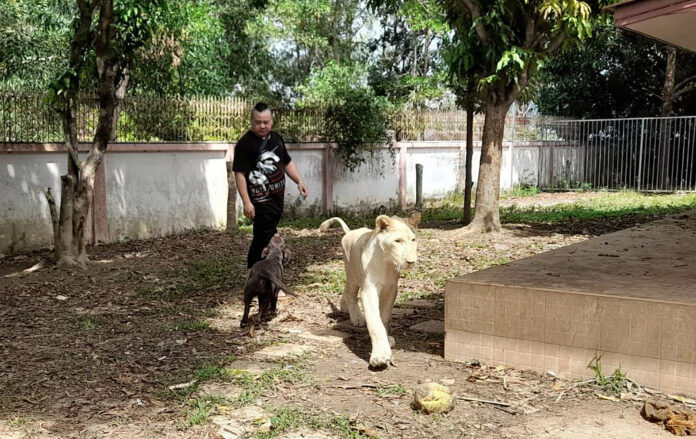
A 3-year-old lion named Simba is found in a residence in Moo 11, Khlong Nararat sub-district, Mueang district, Chanthaburi province, on Feb. 26, 2025.
CHANTHABURI — Park officials have successfully rescued a lion named ‘Simba’ during an investigation into illegal wildlife possession by Chinese nationals in Chanthaburi province. Tragically, a tiger cub that was also seized during the operation died after escaping its cage and being struck by a vehicle.
The case began when Central Investigation Bureau officers received intelligence about the illegal transportation of a tiger cub to a residence in Moo 11, Khlong Nararat sub-district, Mueang district, Chanthaburi province, which was under the care of Chinese nationals. Officials obtained a court warrant and conducted a search on February 26, seizing both the tiger cub and a lion named Simba.
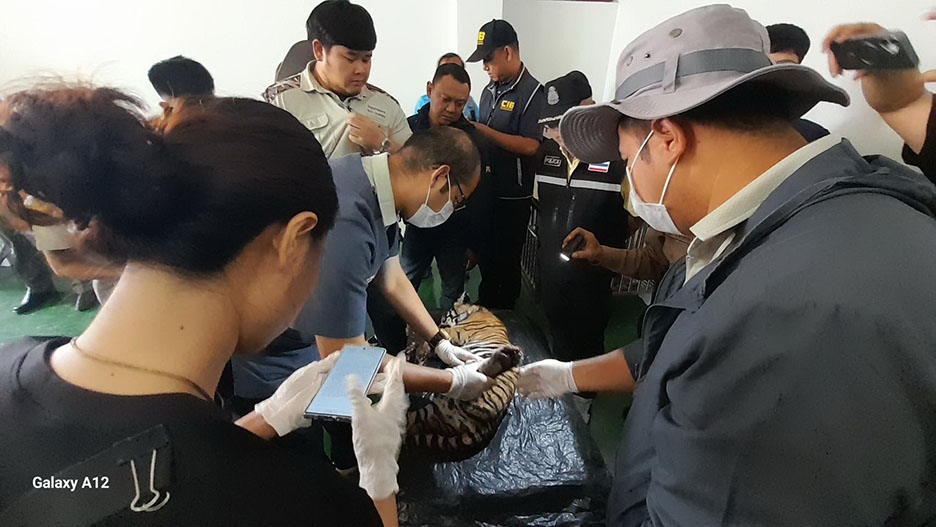
However, during the transportation of the seized animals, the tiger cub escaped from its cage and jumped from the vehicle, resulting in a fatal collision with another vehicle. Police and wildlife officials from the Khlong Khrueawai Wildlife Sanctuary conducted an examination of the tiger cub’s remains, estimated to be 6-8 months old. The examination revealed a broken left hind leg and torn internal organs, which were determined to be the cause of death.
The officers examine the tiger cub remains after it escaped from a cage and jumped from the vehicle, resulting in a fatal collision with another vehicle on Feb. 26, 2025.
During questioning, a Chinese man identified as Mr. An Yi, a resident of the house, admitted to being the caretaker of both the tiger cub and three-year-old Simba. Officials charged him with illegal possession of protected wildlife (tiger) without permission under Section 19 and possession of controlled wildlife without proper registration as required by law.
On February 28, Mr. Nawi Chang Phirom, head of the Wildlife and Plant Crime Suppression Operation Unit (Hawk’s Nest) of the Department of National Parks, Wildlife and Plant Conservation, explained the circumstances of the tiger cub’s escape.
Police arrest a Chinese man who admitted to being the caretaker of both the tiger cub and three-year-old Simba in a residence in Moo 11, Khlong Nararat sub-district, Mueang district, Chanthaburi province, on Feb. 26, 2025.
According to his statement, officials had secured the cage with latches on two sides and covered it with a tarpaulin. However, wind caused the tarpaulin to shift during transport, resulting in the latches coming loose. Additionally, the tiger cub had chewed through the restraining ropes, enabling its escape and subsequent death.
Regarding Simba the lion, officials initially kept him at the residence due to his large size, but have since relocated him to a properly licensed lion farm in Bang Suan, Bang Khla district, Chachoengsao province.
Veterinary examination of the lion revealed an implanted microchip that matched a proper permit for keeping the animal. However, there remains a legal violation as the actual location where the lion was being kept did not match the registered address.
Officials are continuing their investigation to determine whether these Chinese nationals are connected to an international wildlife trafficking network.
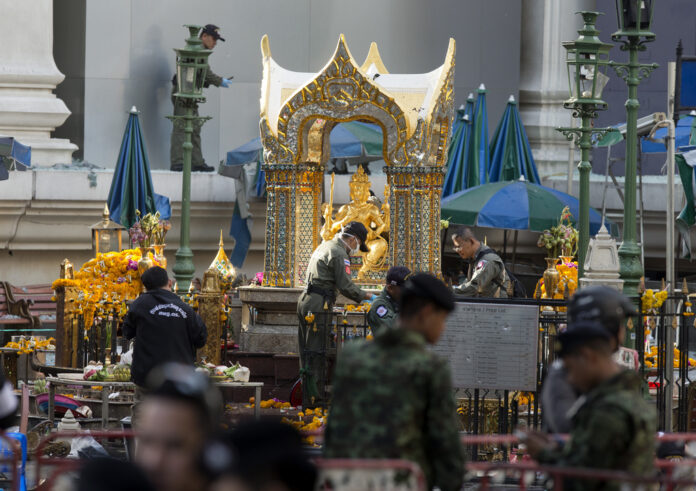
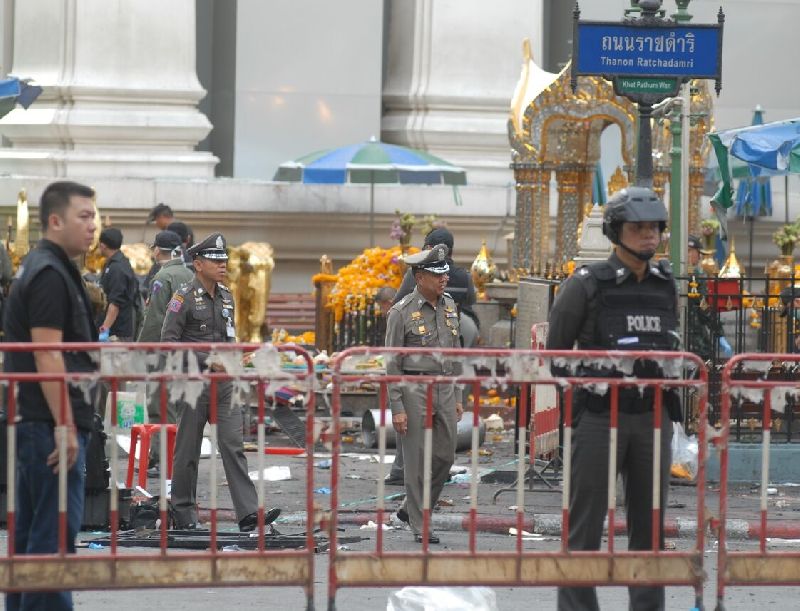
FILE - Police investigate the scene around the Erawan Shrine the morning after an explosion in Bangkok,Thailand, Tuesday, Aug. 18, 2015. (AP Photo/Mark Baker, File)
BANGKOK — Both the US and Japanese embassies in Thailand have issued security alerts to their citizens following the Thai government’s deportation of 40 Uyghur asylees to China on February 27, 2025.
The diplomatic missions cited concerns based on historical precedent. In 2015, after Thailand deported Uyghurs to China, a bombing occurred at Bangkok’s Erawan Shrine on August 17, killing 20 people and injuring 125 others, including foreign tourists. The shrine is particularly popular with Chinese visitors.
The US Embassy in Bangkok has advised American citizens to “exercise increased caution and vigilance, especially in crowded locations frequented by tourists due to the potential for increased collateral risk.” Additionally, Americans are urged to review their personal security plans and follow instructions from local authorities.
Investigators comb the Erawan Shrine for evidence on Aug. 18, the day after a bomb killed 20 people there, mostly tourists.
Similarly, the Japanese Embassy has warned its citizens to remain vigilant, particularly in areas where large numbers of people gather, such as tourist attractions, event venues, restaurants, hotels, shopping centers, public transportation, and religious sites, as these locations may become potential targets.
Japanese nationals are also encouraged to stay informed through local media reports and consult resources like Tabi-Reji and overseas safety websites for the latest security information, while ensuring they take appropriate safety measures according to the situation.
The alerts come amid heightened security concerns that similar retaliatory attacks could occur following this recent deportation.
Deputy Prime Minister and Defense Minister Phumtham Wechayachai dismissed earlier security concerns following the Uyghur deportation. He maintained the deportees are currently safe. He suggested any security issues that emerge would be the responsibility of those who “deviate from what should be.”
Lotus’s, the leading retail under CP AXTRA Public Company Limited, has launched a spectacular campaign to thank customers for their support over the past 30 years. ‘Dine & Shop at Top Brands and Earn Lotus’s Coins’, a mall loyalty campaign that will give away 1 million Lotus’s Coins (equivalent to 1 million baht) every month throughout 2025, offering customers more ways than ever to earn and redeem exclusive benefits.
By shopping or dining at participating partner brands in any Lotus’s Mall, customers can collect Lotus’s Coins that work like cash-equivalent discounts or can be redeemed for exclusive privileges. The ‘Dine & Shop at Top Brands and Earn Lotus’s Coins’ campaign aims not only to deliver exceptional value for money but to enhance the overall shopping and dining experience for customers nationwide. Participating partner brands include Dairy Queen, Dunkin’ Donuts, KFC, MR.DIY, MC Jeans, Major Cineplex, S&P, Swensen’s, The Pizza Company and Top Charoen.
Don’t miss out on the monthly Lotus’s giveaway! Earning Lotus’s Coins is easier than ever—just follow three simple steps:
Shop – Spend at participating brands in Lotus’s Mall.
Upload – Snap a photo of your receipt and upload it via Lotus’s SMART Application.
Get Rewarded Instantly – Earn Lotus’s Coins to use as cash-equivalent discounts or redeem for exclusive perks at top brands nationwide!
Lotus’s customers can collect coins now through 31 December 2025. For full details, visit
The first 10,000 km of your Mercedes-Benz journey is more important than you think!
At Benz BKK Vipawadee, we value every vehicle our customers have purchased. Wherever you bought your vehicle, you can participate in our First Mile, First Service special campaign. When you drive off in a brand-new Mercedes-Benz, you should have complete confidence that it’s receiving the best care.
Customers who receive Service A at Benz BKK Vipawadee and have driven less than 10,000 km. are eligible.
Exclusive Offer:
By just scheduling a maintenance check beforehand,
you will receive our special offer of MB Oil Discount 50%*
(For customers receiving Service A maintenance with their mileage less than 10,000 km.)
Campaign period: February 1 to March 31, 2025.
*Reserved only for the first 100 customers
*Customers can bring in brand new vehicles purchased from any Mercedes-Benz dealership for service
*Conditions are as specified by the company
Understanding Service A & Service B for Your Mercedes- Benz
At Benz BKK Vipawadee, we help you understand the differences between Service A and Service B for your Mercedes-Benz
Our experts will carefully check your Mercedes-Benz vehicle in detail, and will perform an oil change, and change vehicle parts with Mercedes-Benz standard spare parts. Service A consists of varied inspections, and Service B includes an inspection of body parts related to safety and comfort in using your vehicle – all for your enjoyment and safe travels in your Mercedes-Benz.
Service A – A service for every 10,000 km in mileage
Or within 365 days after receiving your vehicle, the details include:
Engine oil change
Engine oil filter change
Checking the vehicle’s fluid level
Checking tire pressure and condition
Resetting service code
Service B – A service for the next 10,000 km in mileage
Or within 365 days after receiving Service A
The details include:
Engine oil change
Engine oil filter change
Checking the vehicle’s fluid level
Checking tire pressure and condition
Resetting service code
Changing the cabin air filter
Changing the brake system’s fluids
Service A and Service B alternate every 10,000 km to ensure optimal performance and safety for your vehicle. For expert maintenance and premium service, trust Benz BKK Vipawadee.
Our professional team ensures meticulous care at every step.
Book your service appointment today to enjoy exclusive offers and top-tier service!
For inquiries:
Tel : 02 930 1888 Hotline : 064 157 7939 Line@ : @benzbkkvipawadee Facebook : @benzbkkvipawadee Instagram : @benzbkkofficial Tiktok : @benzbkkofficial Google Map :https://bit.ly/GoogleMapBKKvipawadee . Benz BKK Vipawadee (Soi Vibhavadi 38) An official Mercedes-Benz Service center
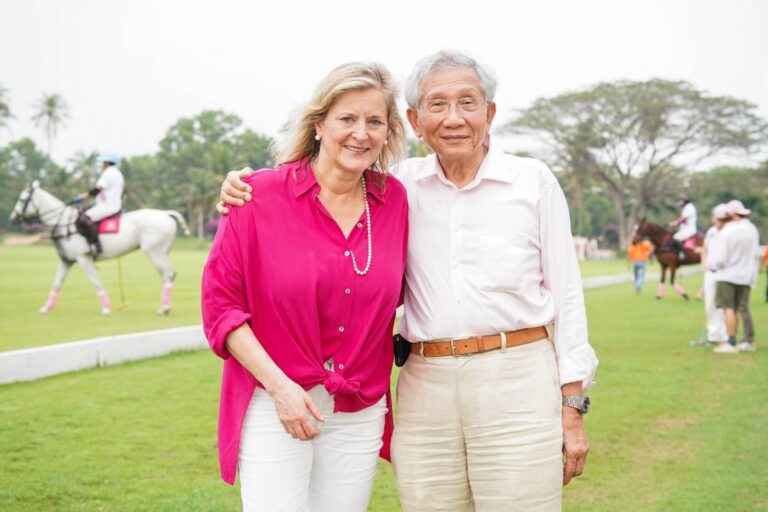
The Queen’s Cup Pink Polo 2025, a prestigious charity women’s polo tournament, concluded in spectacular fashion. Held on Saturday, February 22, 2025, at Thai Polo & Equestrian Club, Pattaya, the event was organized by B.Grimm, led by Mr. Harald Link, Chairman of B.Grimm and Thailand Equestrian Federation President, alongside Nunthinee Tanner, Vice President of the Thailand Equestrian. This celebrated annual tournament raises funds for the The Queen Sirikit Centre for Breast Cancer Foundation.
The thrilling final match featured Team Thailand and Team Malaysia, with Team Malaysia emerging victorious and lifting the prestigious Queen’s Cup.
A Tournament with a Purpose
Nunthinee Tanner, Thailand’s first female polo player, emphasized that Pink Polo serves a greater cause beyond competition. “Through this event, we aim to empower women with knowledge on the importance of early screening while supporting those affected by the disease. As a woman, I encourage all women to unite and contribute to this meaningful cause,” she stated. She also highlighted the significance of promoting women’s participation in polo, fostering new talents, and encouraging Thai female players to compete internationally.
Supporting Breast Cancer Patients and Research
Dr. Kris Chatamra, Founder and Chairman of the Queen Sirikit Centre for Breast Cancer Foundation, expressed the urgency of breast cancer awareness, noting that it remains the leading cause of death among Thai women. “The Queen Sirikit Centre for Breast Cancer was established in 2007 as Thailand’s first comprehensive treatment and research facility dedicated to breast cancer. Our goal is to provide the best possible care, from early diagnosis to palliative care for underprivileged patients. This center serves as a beacon of hope, fulfilling Her Majesty Queen Sirikit’s The Queen Mother vision of supporting women’s health,” he explained.
A Spectacle of Equestrian Excellence
Prior to the main polo event, the Asian Equestrian Federation Cup CSIJ-B Pattaya 2025, a regional show jumping competition, brought together riders from over 15 Asian nations. Beyond the thrilling polo action, attendees enjoyed a variety of engaging activities, including exclusive sponsor showcases such as Royal Salute’s luxury booth.
A highlight of the day was the classic car parade, leading the competing teams onto the field, followed by a breathtaking horseback fashion show, led by Nunthinee Tanner herself, along with distinguished guest models.
Adding to the tradition of polo, spectators enthusiastically participated in the Stomping of the Divots, a customary ritual of flattening the field during halftime. This year’s event featured a special violin performance by Bing Han, Concertmaster of the Royal Bangkok Symphony Orchestra, enchanting the audience during the stomping session.
The event concluded with the presentation of the Best Dressed,Best Hat, and Mr. Pink Polo Awards, recognizing the most stylish attendees who embraced the elegance of Pink Polo.
A Legacy of Charity and Sportsmanship
Now in its 16th year, The Queen’s Cup Pink Polo 2025 was not only a remarkable sporting event but also a powerful symbol of compassion, happiness, and women’s strength. Through the shared love of polo and the spirit of giving, the event embodied B.Grimm’s commitment to creating a better world through business with compassion.
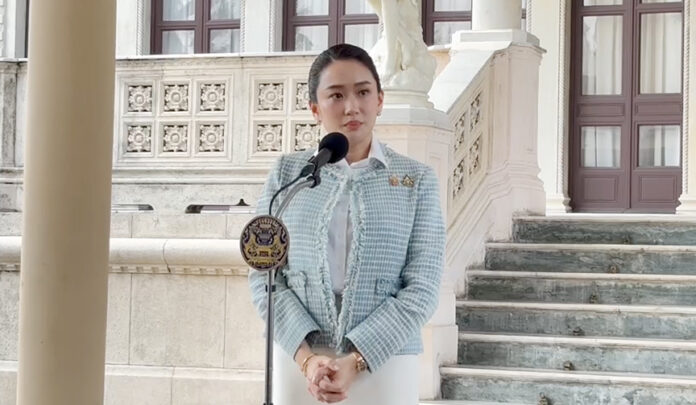
Thai Prime Minister Paetongtarn Shinawatra firmly denies allegations of a trade deal with China in exchange for repatriating Uyghur detainees on Feb. 28, 2025.
BANGKOK — Thai Prime Minister Paetongtarn Shinawatra firmly denied allegations of a trade deal with China in exchange for repatriating Uyghur detainees, emphasizing that “people are not commodities.”
During a press conference at Government House on Thursday, Shinawatra addressed international criticism from the United States and European countries regarding Thailand’s recent decision to return a group of Uyghurs to China.
“We have thoroughly examined what could be done in this situation,” the Prime Minister stated. “These Uyghur individuals entered Thailand illegally and have been imprisoned here for 11 years, which is a considerable punishment. Throughout this period, no third country ever contacted us offering to accept these individuals.”
Shinawatra explained that Chinese authorities provided evidence confirming the detainees were Chinese citizens. “If they were from any other country and we could verify their nationality, we would return them to that country. We have not violated any United Nations regulations or human rights principles,” she insisted.
This photo provided by Thailand’s daily web newspaper Prachatai shows trucks with black tape covering the windows leave a detention center in Bangkok, Thailand Thursday, Feb. 27, 2025.(Nuttaphol Meksobhon/Prachatai via AP)
The Prime Minister revealed that the Thai government received assurances from Chinese officials that the repatriated Uyghurs would not face prosecution or interrogation upon their return and would be allowed to reunite with their families and reintegrate into society.
“This matter has been discussed between our governments for some time. With proper management from both countries, we can ensure the safety of these Uyghur individuals,” Shinawatra said. “There may have been mishandling in the past, but during my official visit to China, I discussed this with leaders at various levels who guaranteed Thailand that everyone returning would be safe. Otherwise, we certainly would not have proceeded with the repatriation.”
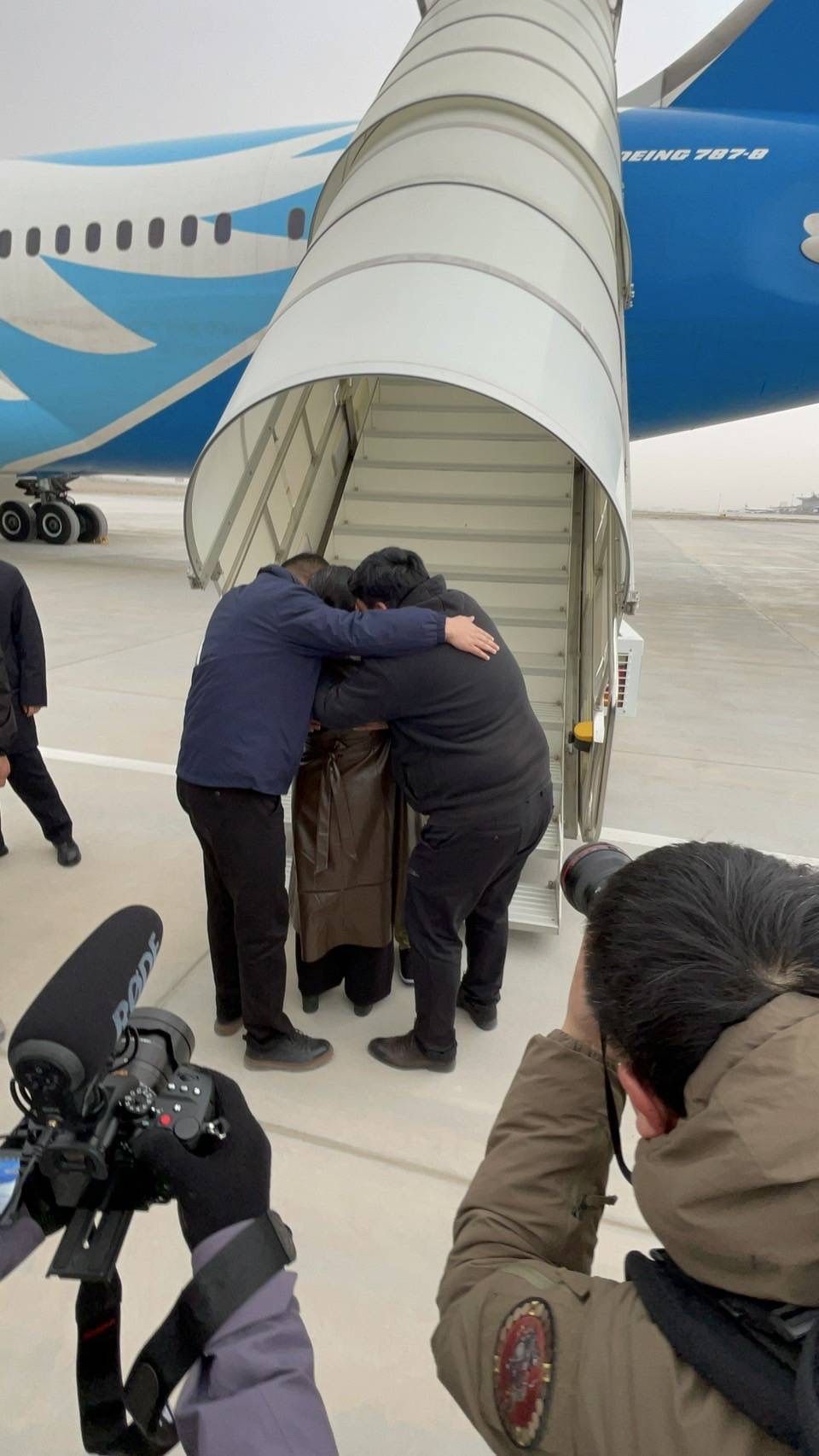
She added, “You may have seen images of the Uyghurs embracing their family members, which is a positive development. Furthermore, Chinese authorities have permitted us to visit or inquire about their well-being. They are not restricting access in this regard.”
A photo of ethnic Uyghurs repatriated to China, shared by the Chinese embassy on Feb. 27, 2025.
When questioned about criticism suggesting the repatriation was linked to trade benefits with China, the Prime Minister firmly denied such allegations: “Absolutely not. There is no trade exchange whatsoever connected to the repatriation of Uyghurs. These matters are entirely separate. If we wanted to discuss trade, we would address trade specifically. This involves people, not merchandise. People are not commodities to be exchanged.”
Regarding why she did not immediately confirm the repatriation when questioned the previous day, Shinawatra explained it was related to security protocols and international diplomatic procedures regarding which country would make the announcement first. “This is a matter of national security that cannot be addressed with just a few words. It requires proper explanation.”
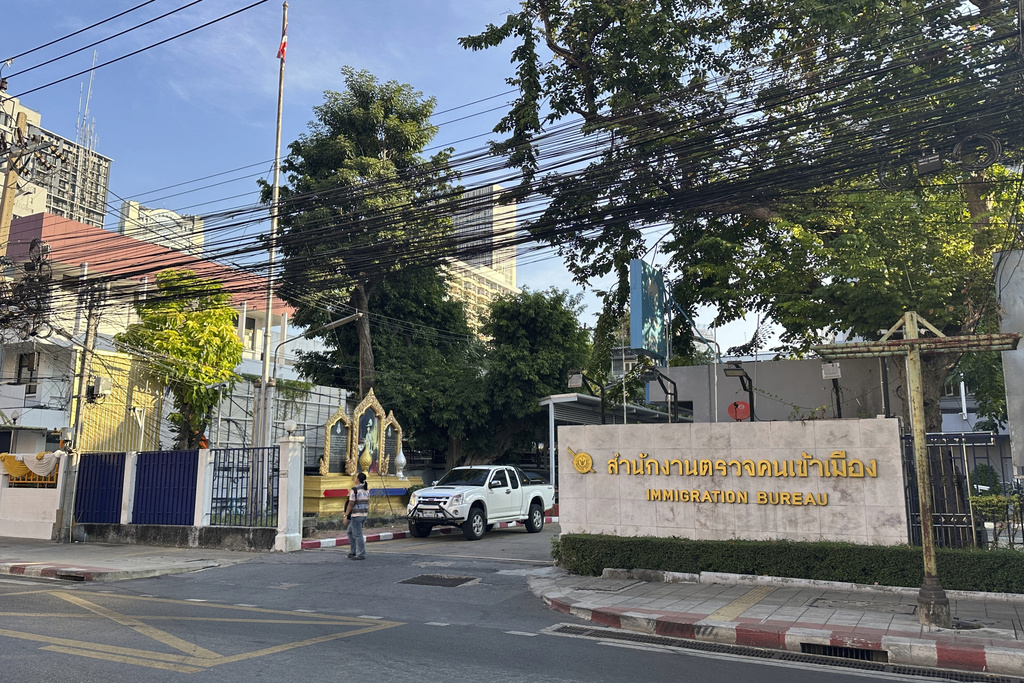
This photo shows an immigration detention center where Uyghur detainees are held in Bangkok, Thailand, Saturday, Jan. 11, 2025. The detainees say they are facing deportation back to China, where they fear persecution. (AP Photo/Haruka Nuga)
The Prime Minister confirmed that all Uyghurs returned voluntarily, though she was uncertain about specific documentation. She emphasized that the government prioritized their safety throughout the process.
Addressing concerns about potential impacts on Thailand’s relationships with Muslim countries, Shinawatra acknowledged that time would be needed for explanation, but pointed to the safe return of the Uyghurs as evidence of Thailand’s careful handling of the situation.
“We need to see if they remain safe after returning, which appears to be the case. This should indicate that Thailand has coordinated thoroughly behind the scenes. If we weren’t certain of their safety, we wouldn’t have proceeded. If anything happened to them after their return, I couldn’t accept that either. We understand that we are all human beings, so we had to be absolutely certain before taking this action,” she concluded.
BANGKOK — Thailand adjusts tourism strategy while taking action against fraudsters
The Thai tourism sector has been facing major challenges since the beginning of the year, especially after the case of Chinese actor Wang Xing, who was deceived by fraudsters and disappeared in Myanmar.
While this case led to a large-scale crackdown on fraud networks, it also had a negative impact on the number of international tourists, especially from China.
Sorawong Thienthong, Minister of Tourism and Sports, acknowledged that the situation has prompted the Thai Travel Agents Association (ATTA) to estimate that the number of Chinese tourists may not reach the targeted 8.5 million in 2025 and could fall below 7 million.
However, he explained that this must be accepted as fighting crime remains a priority.
He also noted that February is usually a time when tourist numbers naturally decline, so the government is not overly concerned. The main focus now is on attracting quality tourists.
FILE – Sorawong Thienthong, Minister of Tourism and Sports, presides over the 33rd SEA Games Management Committee meeting at the Ministry of Tourism and Sports conference room on February 26, 2025.
Chinese Visitors Will Eventually Return
Sorawong expressed confidence that Chinese tourists will eventually return after the government’s firm crackdown on scam networks. The Prime Minister has also held direct talks with the Chinese government and there will be several joint activities this year, which marks the 50th anniversary of diplomatic relations between Thailand and China. There will be a series of joint activities to mark this occasion.
“The measures taken by the Chinese side assure us that tourists will be better controlled when entering Thailand. I have heard directly from the Chinese side that those who have canceled their trips to Thailand were mainly first-time travelers or, to put it bluntly, zero-dollar travel groups. These groups buy travel packages for as little as 12,000 baht for a 4-night 5-day trip to Thailand, including the flight — a remarkably low price,” Minister of Tourism explained.
Imbalance with Japanese Travelers
He highlighted another concerning trend: the significant drop in Japanese visitors to Thailand. In a historic shift during 2024, the number of Thai tourists visiting Japan exceeded Japanese visitors coming to Thailand for the first time. This imbalance has underscored the urgency for Thailand to develop comprehensive tourism initiatives.
With the launch of the “Amazing Thailand Grand Tourism and Sports Year 2025” campaign, the minister emphasized the need for major events and attractions to draw international travelers back to the country.
“I am confident that we can reach the target of 39 million tourists. The total revenue from tourism is expected to reach 3.5 trillion baht. Every sector is making great efforts to achieve this target,” Sorawong explained.
Foreign tourists pose in traditional Thai costumes with Wat Arun (Temple of Dawn) in Bangkok as a backdrop on October 22, 2024.
Landing Fee Is Set to Begin
Regarding the domestic tourism fee for foreign visitors, commonly known as the “landing fee”,” he announced that collection is set to begin in 2025. If the policy is officially announced in March, it could be implemented within 5-6 months, which coincides with Thailand’s peak tourist season at the end of the year.
The fee will remain at 300 baht per person per visit, but will be charged as a fee for multiple entries within a 30-60 day period.
The fee will be integrated into the Thailand Digital Arrival Card (TDAC) system, which will also be linked to the online immigration form TM.6 to provide a seamless one-stop service. The TDAC system is scheduled to be reintroduced on May 1, 2025. Suwong dismissed concerns that the fee could reduce the number of foreign tourists, citing similar practices in other countries.
Eyes 2.4 Million Indian Tourists
At the same time, the Ministry of Tourism is actively recruiting tourists from other countries, especially India.
Jakrapol Tangsuthitham, Deputy Minister of Tourism and Sports, stated that the target for Indian tourists in 2025 is 2.4 million, compared to 2.1 million last year, generating approximately 100 billion baht in revenue from Indian tourists. India is expected to become the third largest source of international visitors to Thailand.
Indian tourists
So far, the outlook is positive, between January 1 and February 18, 2025, over 200,000 Indian tourists have already visited Thailand. The Tourism Authority of Thailand (TAT) is working with airlines from both countries to increase the number of flights between Thailand and India, targeting 3.5 million seats in 2025, up from 2.9 million last year.
In addition, marketing campaigns and events will be held throughout the year to encourage Indian travelers to experience Thailand’s rich and memorable tourism offerings.
Jakrapol also pointed out that the average stay of Indian tourists is 6-7 days and they spend an average of 36,000-37,000 baht per trip. If Thailand wants to attract more luxury tourists from India, it needs to implement several strategies, including the development of premium destinations to expand tourism business in different market segments.
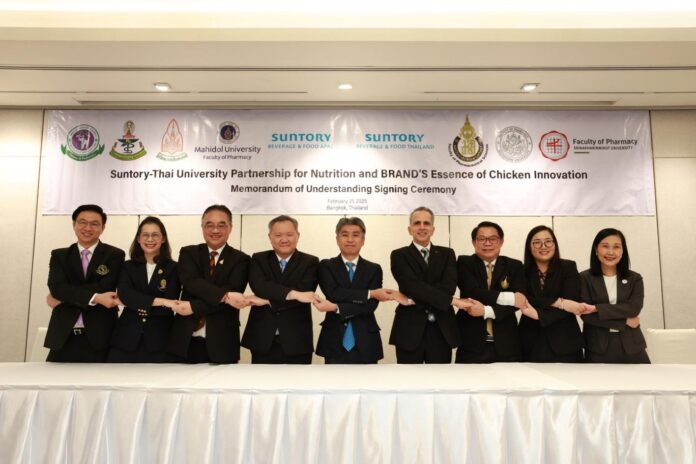
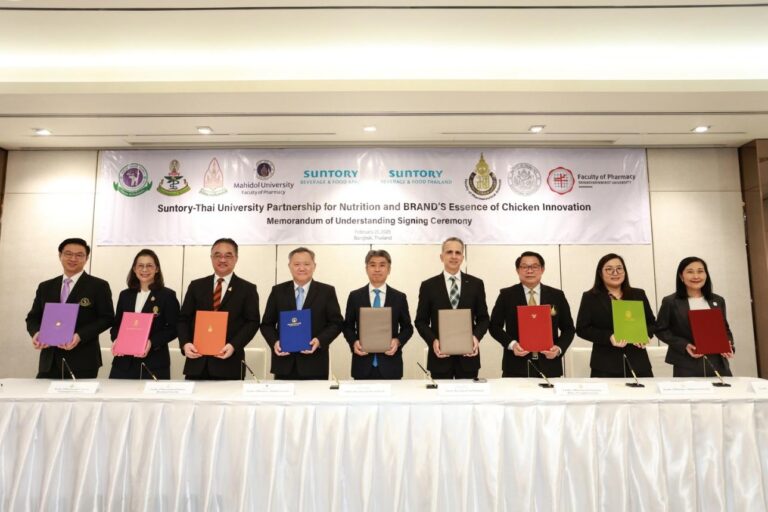
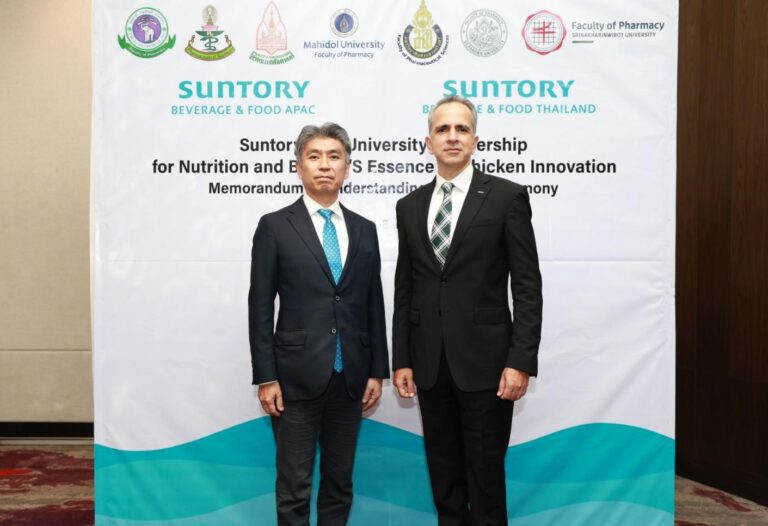
Suntory Beverage & Food Asia Pacific, with support from Suntory Beverage & Food (Thailand) signed an MOU with the Faculty of Pharmacy from seven of Thailand’s top universities to investigate the efficacy of “Essence of Chicken” in delaying biological aging, promoting good health and improving the quality of life for the Thai people.
Suntory Beverage & Food Asia Pte. Ltd. (SBFAP), the Singapore-based headquarter of Suntory Beverage & Food in Asia, with support from Suntory Beverage & Food (Thailand) Co., Ltd. (SBFT), the leader of health enrichment products under BRAND’S trademark in Thailand and Asia, held a signing ceremony of a Memorandum of Understanding with the Faculty of Pharmacy from seven top Thai universities as part of the Research Collaboration on Nutrition Project, at Chatrium Hotel Riverside Bangkok on February 21, 2025.
The project aims to advance nutrition knowledge through research and scientific exchange, with a focus on examining the efficacy of essence of chicken in slowing down biological aging in response to Thailand’s demographic shift toward an aging society and the trend of consumers becoming more health conscious.
According to Mr. Hideki Maki, Chief Research and Development Officer, Suntory Beverage & Food Asia Pacific (SBFAP), the world-renowned manufacturer and distributor of non-alcoholic beverages and health enrichment products is committed to excellence in scientific innovation and high product quality in order to develop health supplements and products for consumers.
Modern medical technology has extended people’s lifespan, the total number of years a person lives. Unfortunately, healthspan, the number of years a person lives in good health, has not kept pace with the rise in lifespan. Therefore, ways to slow down the aging process are crucial in extending one’s time in excellent health.
Additionally, biological age, a measure of how long one remains in good health, can be influenced by lifestyle and dietary choices. As a result, the industry’s role in offering products that address lifestyle needs and sensible consumption is becoming more crucial.
With confidence in the expertise of researchers and leading health and nutrition specialists in Southeast Asia, the company recognizes the importance of research partnerships with top Thai universities. This private and academic sector partnership will advance our understanding of biological aging, benefiting Thailand’s public health system and its population as consumers.
“We believe that good health is the cornerstone of a valuable and meaningful life, aligning with the company’s purpose to inspire the brilliance of life. With this in mind, we may eventually extend our research collaboration to other countries in the region to study the efficacy of chicken essence in aging in greater detail,” he said.
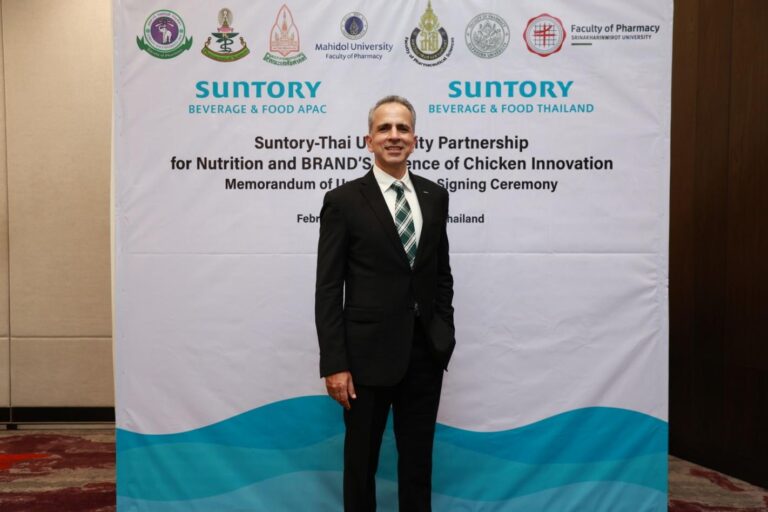
According to Mr. Omer Malik, CEO, Thailand and Indochina, Suntory Beverage & Food Thailand, Co., Ltd., the supporter of the MOU, Thailand is one of the fastest-aging countries in Southeast Asia. By 2040, according to the National Statistical Office, Thailand will become a super-aged society. Strongly committed to the Suntory Group’s shared purpose on inspiring the brilliance of life, the company has dedicated its 50 years of operations in Thailand to enhancing the health and well-being of its consumers by offering health enrichment products, supported by its scientific expertise and talented workforce.
This aims to extend the period of good health and slow down biological aging, as the nation’s economy and society heavily depend on the population’s health and quality of life.
The company therefore supports the partnership between Suntory Beverage & Food Asia Pacific, which leads scientific research and product development under the BRAND’S trademark, and the Faculty of Pharmacy from seven of Thailand’s top universities: Mahidol University, Chiang Mai University, Chulalongkorn University, Khon Kaen University, Prince of Songkhla University, Silpakorn University, and Srinakharinwirot University.
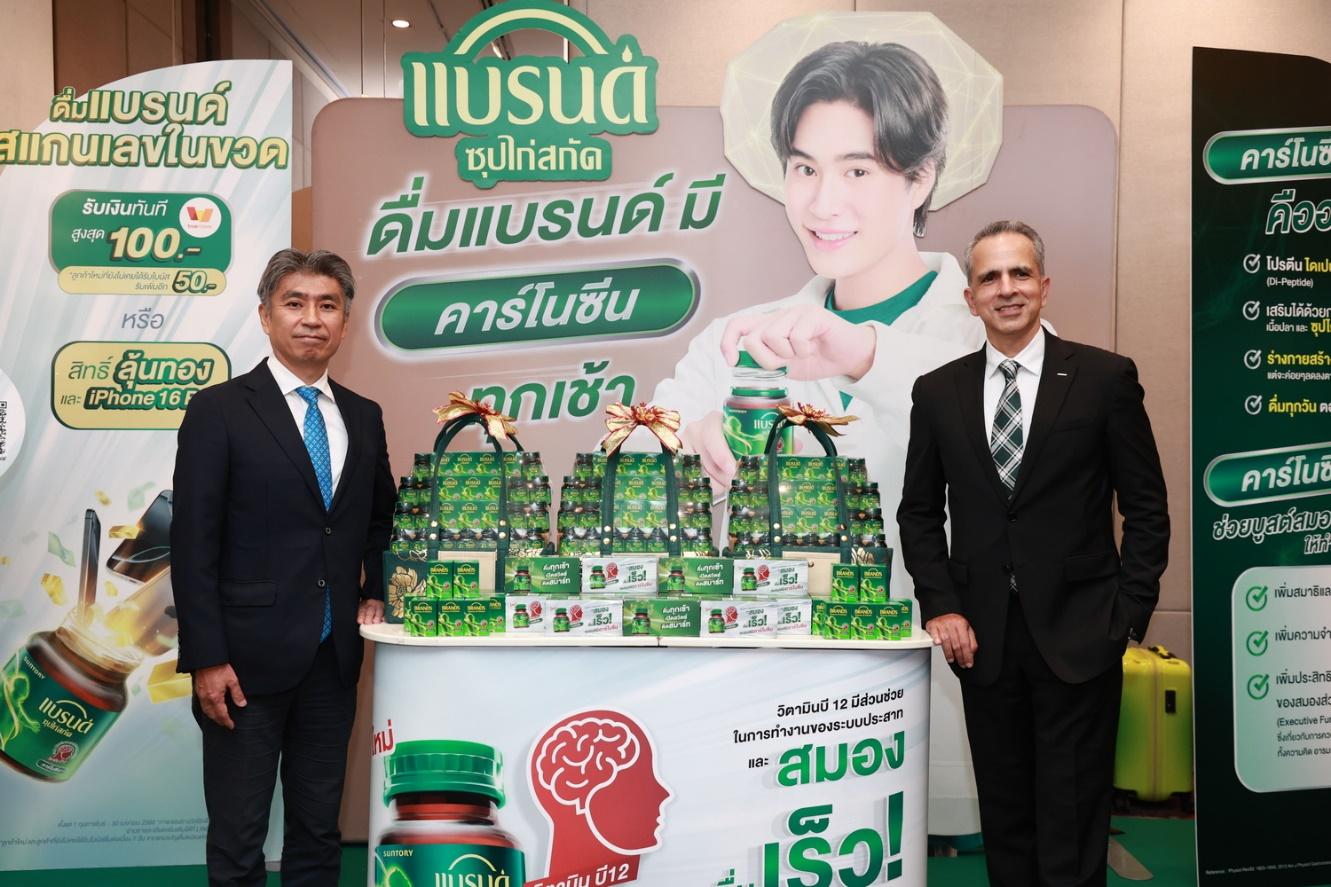
This partnership aims to share scientific knowledge on nutrition, focusing on the efficacy of chicken essence in delaying biological aging, in addition to the benefit of Carnosine and Vitamin B12 in supporting the normal functioning of the brain and nervous system. The company anticipates that this five-year collaboration will generate new knowledge, advancing research initiatives to sustainably promote consumers’ health.
A photo of ethnic Uyghurs repatriated to China, shared by the Chinese embassy on Feb. 27, 2025.
BANGKOK — Thailand has found itself at the center of diplomatic tensions after deporting 40 Uyghurs back to China, drawing sharp criticism from Western nations while defending its decision as a necessary legal action.
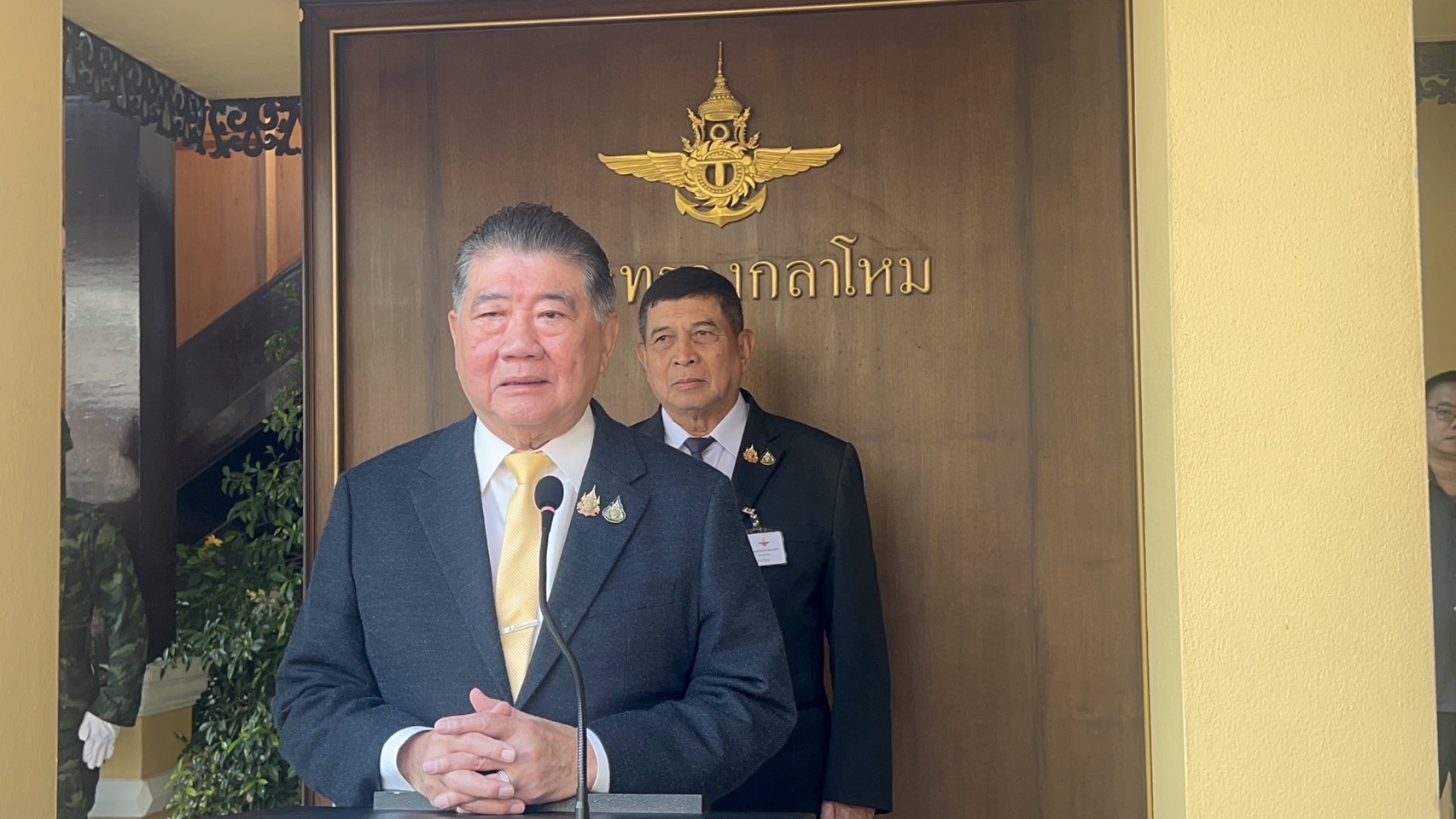
Deputy Prime Minister and Defense Minister Phumtham Wechayachai firmly defended the deportation during a press conference at the Ministry of Defense on February 28, 2025, stating that Thailand “had no choice” and acted in full compliance with the law.
“If we had sent the Uyghurs back and they faced life-threatening danger, that would be a matter for serious consideration,” Phumtham stated. “But China has the right to request the return of these individuals, who are Chinese citizens of Uyghur ethnicity with clear places of residence.”
The Deputy Prime Minister highlighted Thailand’s previous successful efforts to send over a hundred Uyghurs to Turkey, but noted that after 11 years of detention, no other countries were willing to accept the remaining detainees.
Deputy Prime Minister and Defense Minister Phumtham Wechayachai defends Thailand’s decision to return Uyghurs to China, following condemnation statements from Western nations, at the Ministry of Defense on February 28, 2025.
“I’ve told Western nations that if they would accept these people, there would be no problem, but they have refused, prioritizing their own national interests,” he said.
Phumtham argued that continuing to detain the Uyghurs would violate Thailand’s 2022 Prevention and Suppression of Torture and Enforced Disappearance Act, making deportation “the best solution” while promising to monitor their safety periodically.
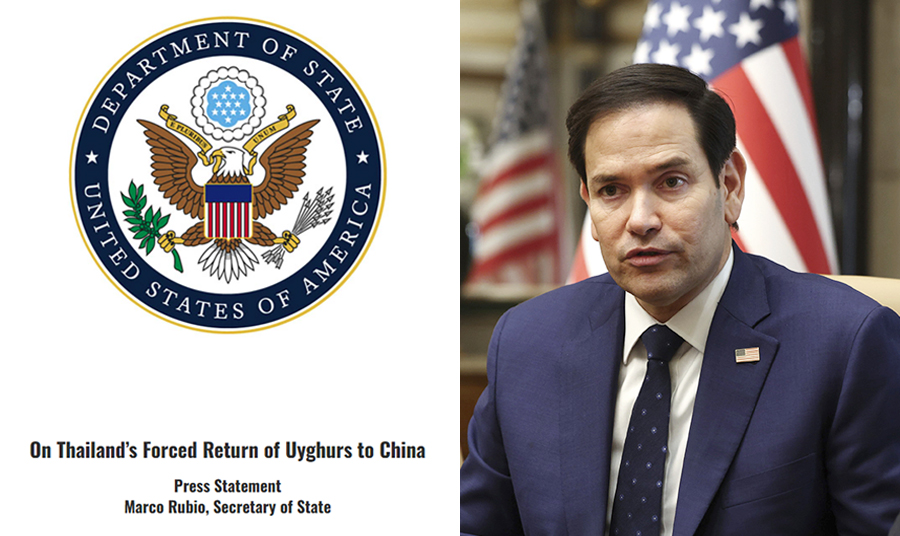
The United States swiftly condemned the action. U.S. Secretary of State Marco Rubio issued a statement on February 27 expressing alarm: “We condemn in the strongest possible terms Thailand’s forced return of at least 40 Uyghurs to China, where they lack due process rights and where Uyghurs have faced persecution, forced labor, and torture.”
Rubio further stated that the deportation “risks running afoul of Thailand’s international obligations under the UN Convention Against Torture and the International Convention on the Protection of All Persons from Enforced Disappearance.”
U.S. Secretary of State Marco Rubio issues a statement on Thailand’s Forced Return of Uyghurs to China on Feb. 27, 2025.Spokesperson of the European Union on Feb 27 issues a statement expressing regrets that the Thai government deported 40 Uygurs to China on Feb. 27, 2025.
Similarly, the European Union expressed deep regret over the deportation, calling it “a breach of the principle of non-refoulement and Thailand’s obligations under national and international law as a member of the Human Rights Council.”
China, however, defended the repatriation. China’s Ministry of Public Security said the 40 “illegal migrants” had been deported “in accordance with international law.” Ministry spokesman Lin Jian described the action as “a concrete measure of cooperation between China and Thailand in combating cross-border crimes.”
Chinese state news agency Xinhua reported that the individuals had been “bewitched by criminal organisations” and were stranded in Thailand, adding that their families had repeatedly asked the Chinese government to assist in their return.
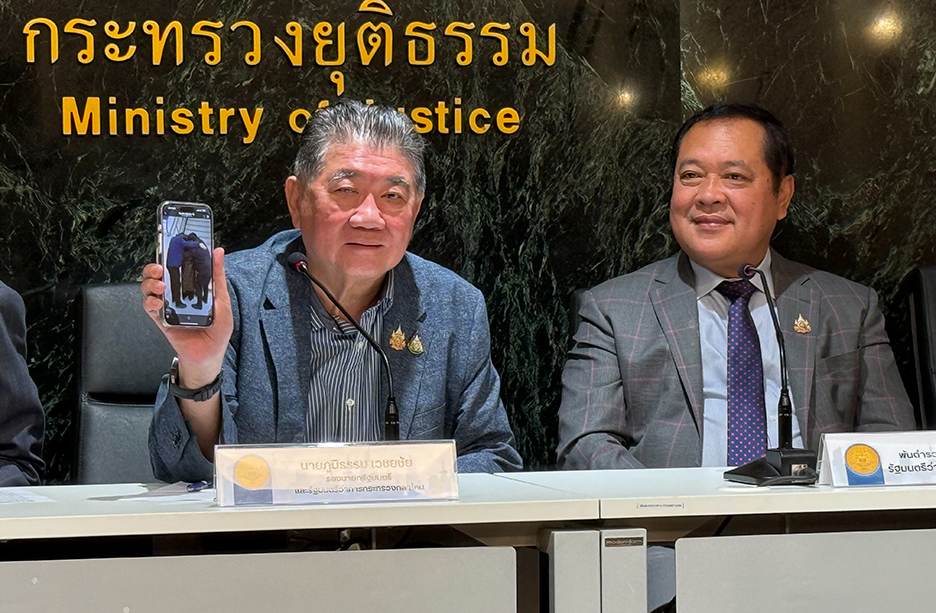
Deputy Prime Minister and Defense Minister Phumtham Wechayachai displays photos on his mobile phone received from Chinese authorities, showing that the Uyghurs returned by Thailand arrived safely in Xinjiang and were reunited with their waiting relatives on Feb. 27, 2025.
The deportation comes as Thailand and China celebrate 50 years of diplomatic relations and are working together to crack down on scammer networks in the region, leading some to view Thailand’s decision as tilting toward Chinese interests.
Thailand has historically faced challenges in navigating diplomatic pressures between Western nations and China, particularly on human rights issues. The country typically sends individuals involved in such disputes to third countries, making this direct deportation to China a notable departure from past practices.
When questioned about potential security threats related to the deportation, Phumtham insisted: “We haven’t violated anyone’s rights. If we had sent them to their deaths, there would be cause for concern, but currently they are fine. Any problems that arise now would be due to those who deviate from what should be.”