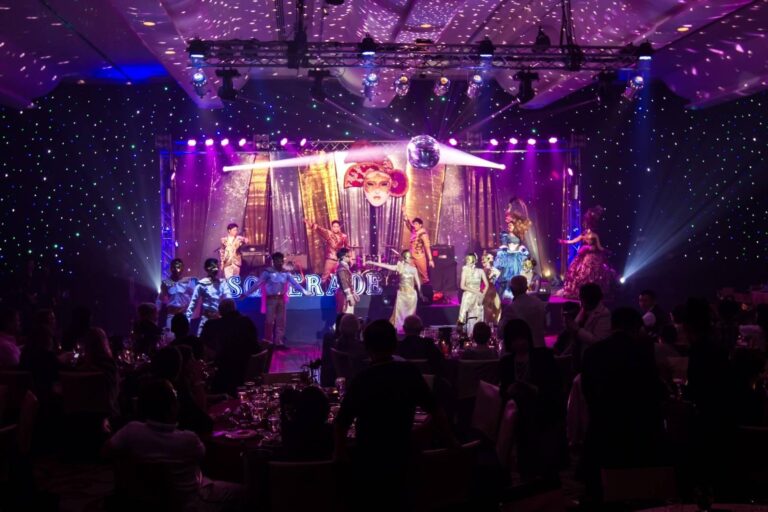
The Royal Bangkok Symphony Orchestra Foundation, in collaboration with the Tourism Authority of Thailand and B. Grimm Group Ltd., will present a concert titled “Emmanuel Ceysson plays Glière’s Harp Concerto” at 7:30 p.m. on Friday, August 9th, at the Thailand Cultural Centre. This concert will be on the auspicious occasion of Her
This concert celebrates the auspicious birthday anniversary of RBSO’s Royal Patron, Her Royal Highness Princess Sirivannavari Nariratana Rajakanya on the 8th of January.
In keeping with the Concert name, the RBSO wishes to showcase the talented women in music by inviting female conductor and soloist. Katharina Wincor will lead the RBSO; A rising star in the conducting world, she studied conducting at the University of Music and Performing Arts in Vienna and Zurich University. Wincor received the Neeme Järvi Prize in 2017 and the third prize winner of the Mahler competition in 2020. Wincor is an assistant conductor in the Dallas Symphony Orchestra, where she has worked with Fabio Luisi since 2019. She has previously worked with the BBC Symphony Orchestra, Cincinnati Symphony Orchestra, Deutsches Symphony Orchestra Berlin, the Bruckner Orchester Linz, Seattle Symphony, Vancouver Symphony, Naples Philharmonic, Tiroler Symphonieorchester Innsbruck, and the Utah Symphony.
The first piece is Tchaikovsky’s Piano Concerto No.1, which is among the best-known pieces of music. This work was written in 1874 and will be performed by Ukrainian extraordinary pianist Anna Fedorova, who graduated from the Lysenko School of Music in Kyiv with Borys Fedorov and the Accademia Pianistica in Imola, Italy, with Leonid Margarius. She received her Master’s degree and Artist Diploma at the Royal College of Music, London, under the guidance of Norma Fisher. She has performed with many orchestras, including the Philharmonia Orchestra, Verbier Festival Orchestra, Tokyo Symphony, Yomiuri Orchestra, Dallas Symphony, Hong Kong Philharmonic, and the Netherlands Philharmonic. Nicknamed the ‘house pianist’ of the Concertgebouw, Anna Fedorova has given over 45 concerts in this prestigious concert hall in Amsterdam. She is a regular guest at leading music festivals such as Verbier and Menuhin Festivals in Switzerland, Stift Music Festival in the Netherlands, Festival de Sintra in Portugal, and Ravinia Festival in the US.
The second half will consist of Tickets are available at Thaiticketmajor: https://www.thaiticketmajor.com/concert/rbso-2025-lessence-feminie-de-la-musique.html
Bangkok, Thailand – Marriott Bonvoy®, Marriott International’s award-winning travel program and marketplace, is inviting companies, colleagues, families and friends to come together and celebrate the festive season in style with a choice of private party packages in Thailand! From glamorous urban galas to blissful beachside gatherings, Marriott sets the stage for unforgettable end-of-year events.
In the Thai capital, Bangkok Marriott Marquis Queen’s Park is letting guests say “Cheers to the Year” with double Marriott Bonvoy points and enticing rewards for year-end events, while its new Teeshot Bar, a state-of-the-art karaoke and sports simulator bar, is giving groups the chance to challenge each other with fun, interactive packages throughout December. Royal Orchid Sheraton Hotel & Towers offers a tailored year-end celebration experience, organize your next special event with enjoy up to 3 choices of exclusive perks such as complimentary free-flow soft drink and special price for 2-hour after-party. Le Méridien Bangkok is helping guests to stay “Forever Young” with its rewarding package, including venue hire and soft drinks, and JW Marriott Hotel Bangkok is taking bookings for “Intimate Affairs (50-100 guests), “Elegant Ensembles” (101-300 guests) and “Majestic Celebrations” (301 or more guests), including a wide range of perks such as room rental, drinks, and lucky draw prizes.
For businesses who want to escape the Thai capital and treat their teams to a seafront celebration, Marriott has a wealth of inspiring beachside options. At Rayong Marriott Resort & Spa, the “Happy Holiday Bash” package is available for groups of various sizes, including four hours of venue hire and free-flow soft drinks, house wine, Marriott Bonvoy bonus points and more, plus options for an outdoor BBQ party! For major corporate events, Sheraton Hua Hin Resort & Spa can host up to 800 people at its The Chandelier or outdoor lawn, while @Black is an ideal venue for chic parties and social soirées.
At Courtyard by Marriott Phuket Town, groups can wrap up 2024 with a “Year-End Party” and “Social Event Package”, including gourmet menus, entertainment and chic spaces for 30 or more guests in the heart of Phuket’s old town, and further along the Andaman coast at JW Marriott Khao Lak Resort & Spa, a “Year End Party” package for 200 revelers includes a BBQ buffet dinner, free-flow soft drinks, equipment, décor, and more. Upbeat end-of-year island events can be staged at W Koh Samui, where expert mixologists will serve special cocktails at WOOBAR, and a live DJ will curate an exclusive playlist especially for the occasion!
For organizers who want to infuse the cultural charm and natural beauty of Northern Thailand into their festive gathering, Chiang Mai Marriott Hotel has crafted an inspiring “Social Event Package” in its Grand Ballroom, including free-flow soft drinks and a vibrant buffet dinner featuring authentic Thai, signature Northern Thai, and international dishes. Finally, at Le Méridien Chiang Rai Resort, a choice of sophisticated indoor and outdoor spaces can host immersive events, with free corkage charge, a special room rate and a 60 minutes complimentary massage at Parvati spa for guests who stay overnight.
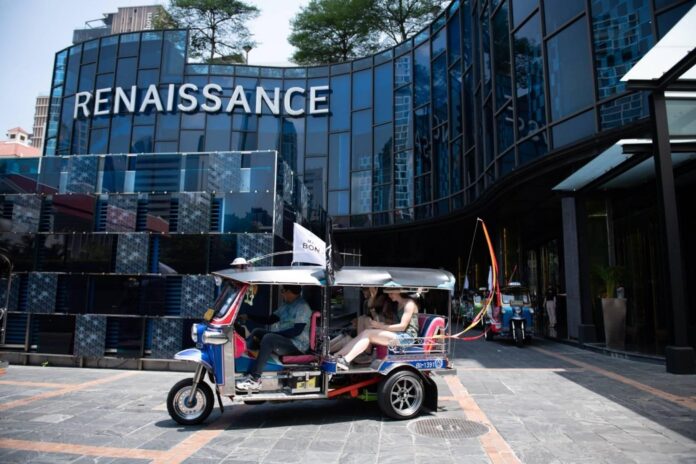
Rooted in the spirit of discovery, four Renaissance Hotels in Thailand deliver unexpected experiences beyond the convention of travel with launch of R Finds
Renaissance Hotels, part of Marriott Bonvoy’s global portfolio of over 30 extraordinary hotel brands, is gearing up to celebrate its 10th annual Global Day of Discovery on November 19th, 2024. In celebration of this special occasion, all 170+ Renaissance Hotels properties around the world – including four hotels and resorts in Thailand – will reimagine their Evenings at Renaissance program with a dynamic Evenings Market, spotlighting local retailers and businesses.
Over the past ten years, the Global Day of Discovery has been the one day in the year when all 170+ Renaissance Hotels around the world activate an elevated, on-property experience – underscoring Renaissance Hotels as a brand that connects locals and travelers to the DNA of the neighborhood through its unexpected design, entertaining programming, and engaging Navigators – the brand’s neighborhood ambassadors. This year, Global Day of Discovery 2024 continues to demonstrate Renaissance Hotels’ promise to making measurable impacts on its local communities – not just on Global Day of Discovery, but every day – with the launch of R Finds, a global marketplace for local discovery.
“As we celebrate the 10th anniversary of Global Day of Discovery, we are excited to introduce a new way for our guests and consumers to connect with local communities and discover unique treasures from small businesses around the world with the launch of R Finds. This further reinforces Renaissance Hotels’ brand values of authenticity, culture and the joy of discovery, appealing to travelers who seek more than just a place to stay,” said John Toomey, Chief Sales and Marketing Officer, Asia Pacific excluding China (APEC).
Evenings Market – Inviting Global Travelers to Experience Unexpected Discovery and Celebrate Localism
Guests visiting Renaissance Hotels around the world on Global Day of Discovery can look forward to witnessing the transformation of the signature Evenings at Renaissance program into a vibrant Evenings Market – an elevated edition of a night market featuring local vendors, street fare, delicious food & beverages, and live performances that bring Renaissance’s theatricality to life. Travelers and local guests alike are welcome to browse bespoke, artisanal products and experience local culture in a lively, inspiring atmosphere.
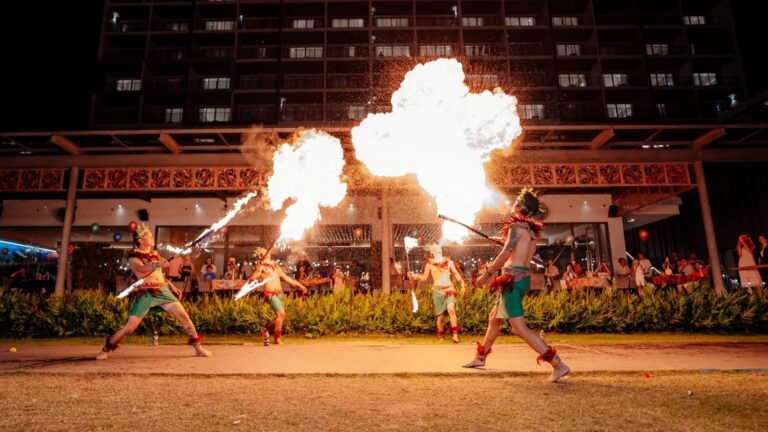
Guests can enjoy unique experiences at Renaissance Bangkok Ratchaprasong Hotel, from day to night, including a neighborhood tour with exclusive workshops, a bustling night market, and the chance to groove with Thai disco legend Burin Boonvisut live, plus an exclusive meet & greet with Marriott Bonvoy Moments, starting at 15,000 points! Alternatively, opt for the full experience with an all-inclusive stay starting at 50,000 points. An exciting two-day event at Renaissance Pattaya Resort & Spa will let eco-conscious explorers dive into workshops and discover the thrill of sea turtle and baby shark releases, followed by a vibrant Evenings Market with fire dance performances.
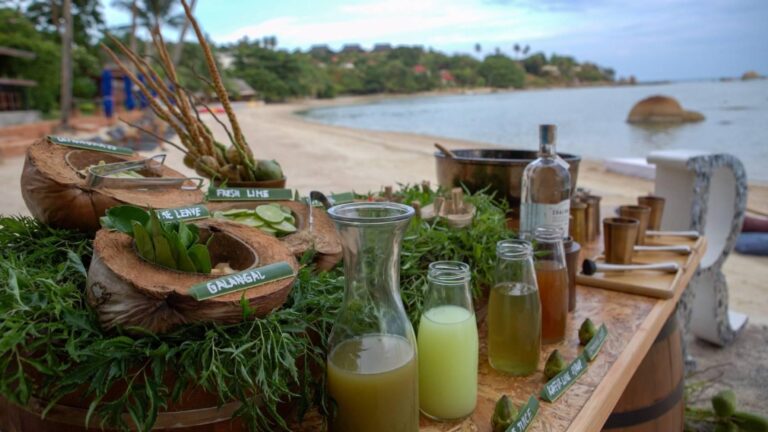
Renaissance Phuket Resort & Spa will immerse guests in a world of curated art, cuisine, and cocktails inspired by Sino-Portuguese heritage with the Sino-R Evenings Market that showcases O-aew, a zero-waste local delicacy crafted with Phuket bananas. In Koh Samui, the island’s artisans will come together at Renaissance Koh Samui Resort & Spa’s Evenings Market, including the chance to sip the Samui-JiTo, a tropical twist on a classic mojito that celebrates Samui’s authentic flavors and locally sourced ingredients.
Renaissance Hotels participates in Marriott Bonvoy – the award-winning travel program from Marriott International – allowing members to earn and redeem points for their stay at the hotel, and at other hotels and resorts across Marriott Bonvoy’s extraordinary portfolio of brands. With the Marriott Bonvoy app, members enjoy a level of personalization and a contactless experience that allows them to travel with peace of mind.
For more information about Renaissance Hotels or to make a reservation, please visit https://renaissance-hotels.marriott.com and follow Renaissance Hotels’ Facebook, Instagram, and X.
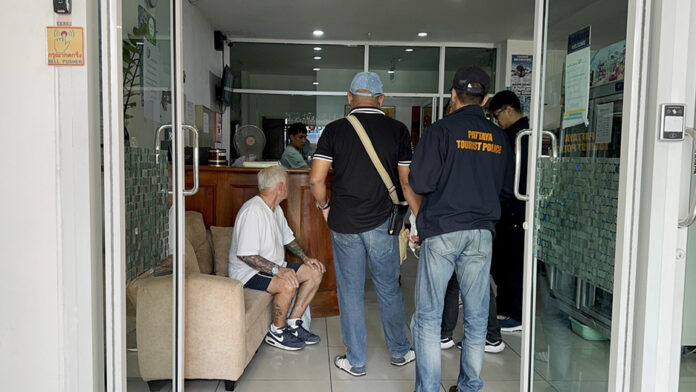
Pattaya traffic police officers conduct a license check on a British motorcyclist in front of Pattaya Police Station on Saturday evening, December 21, 2024.
PATTAYA — In an unusual incident that left Pattaya traffic police officers stunned, a muscular British man swallowed his traffic ticket and washed it down with water right in front of the Pattaya Police Station, before resisting arrest.
The incident occurred on December 21 when traffic police were conducting routine checks at their checkpoint in front of Pattaya Police Station on Beach Road, Chonburi Province. At around 6:30 p.m., officers stopped a tall, well-built foreign man wearing only red shorts on his motorcycle.
Pattaya traffic police officers conduct a license check on a British motorcyclist in front of Pattaya Police Station on Saturday evening, December 21, 2024.
The man, who refused to cooperate with police officers, not only declined to show his documentation but also displayed a dismissive attitude. Officers then issued him a ticket for driving without a license and not wearing a helmet, directing him to pay the fine inside the police station.
In a shocking turn of events, the man suddenly stuffed the ticket into his mouth, chewed it, and swallowed it with water, leaving the officers bewildered. Despite attempts to reason with him, the man remained unresponsive, sitting on his motorcycle while listening to music through headphones. Police then had to wheel-lock his motorcycle to prevent escape and called for backup to detain him.
Pattaya traffic police officers escort the British man who ate his traffic ticket into Pattaya Police Station to calm down on Saturday evening, December 21, 2024.
Initially appearing to comply with arrest, the situation escalated when the man became agitated and managed to break free from his handcuffs. Officers then took him into the police station to calm down.
The man was later identified as a 34-year-old British national from Hammersmith. Police charged him with disorderly conduct and provided a translator to explain Thai laws to him. Officers also counseled him about appropriate behavior to prevent similar incidents in the future.
In a follow-up development on the evening of December 22, Investigation Officer Lt. Thanawee Yarangsi called in the British national to face additional charges beyond the original charge of driving without a license. The suspect, now dressed in rapper-style attire and showing a markedly calmer demeanor, was informed that destroying government documents carries penalties of up to three years in prison, a fine of up to 6,000 baht, or both.
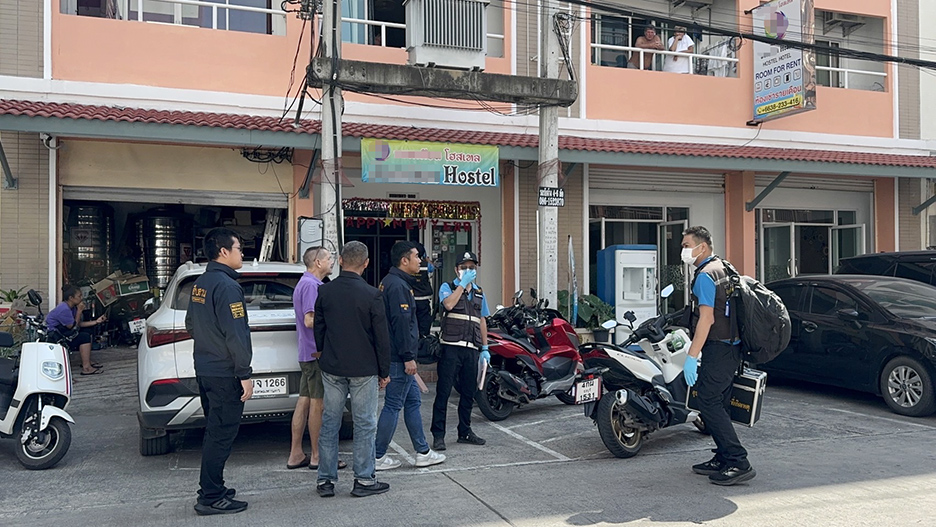
Police escort the Irish man, owner of the room where a Thai woman's body was found in a Jomtien hostel, for questioning on December 22, 2024.
PATTAYA — Chonburi Police and Pattaya City Police investigators are examining the mysterious death of a Thai woman discovered on Sunday in a fifth-floor hostel in a five-story building in the Jomtien area, Moo 12, Nongprue, Banglamung, Chonburi.
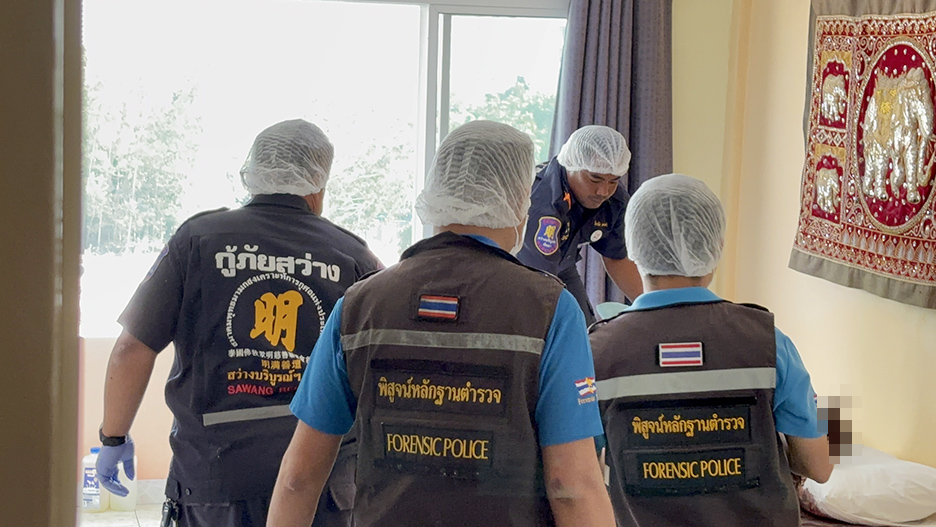
Forensic experts and medical teams from Banglamung Hospital are gathering evidence before transferring the body to the Institute of Forensic Medicine to determine whether the death was due to illness or homicide.
Police identified the deceased as Ms. Duangta, age 45, who had been dead for at least three days. Investigators found no signs of struggle or ransacking in the room, which she shared with “Mr. B” (alias), a 77-year-old Irish national. Police confirmed the man had left the room Sunday morning.
Police officers inspect a hostel in Jomtien, Pattaya, after receiving reports of a Thai woman’s body discovered in an Irish man’s room, where she had been dead for three days, on December 22, 2024.Forensic officers and rescue workers transport the body of a Thai woman found in an Irish man’s rental room in Jomtien area to the Institute of Forensic Medicine on December 22, 2024.
Authorities later located Mr. B walking along Jomtien Beach and brought him in for questioning. He claimed Ms. Duangta had been previously assaulted by someone else and had asked to stay with him since December 18.
Police are particularly concerned about why Mr. B made no attempt to report the death during the three days before other residents noticed the smell and alerted authorities. He has been taken to Pattaya City Police Station for further detailed questioning.
Building staff reported that the Irish man had been renting the room since October 16, initially on a daily basis before switching to monthly terms. They noted he frequently brought different women to stay with him. The exact nature of his relationship with the deceased remains unclear, and investigators are awaiting autopsy results before proceeding with the case.
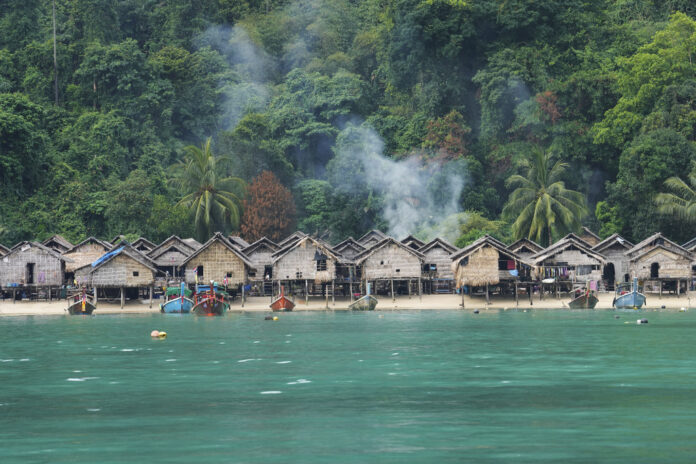
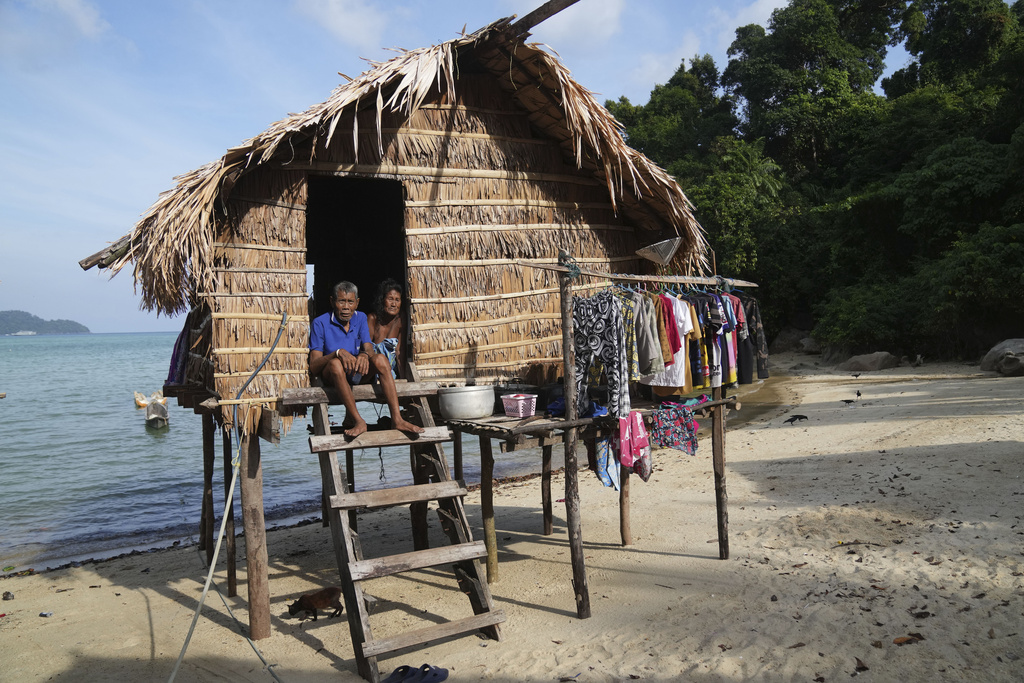
A general view in Moken village of Surin Islands, Phang Nga province, Thailand, Thursday, Dec. 12, 2024. (AP Photo/Sakchai Lalit)
SURIN ISLANDS — When Hook was a child, he started his days by jumping off the boat that his family lived on and into the ocean. By age 3, he could already swim and dive in shallow waters. His home was a kabang, a boat, that his family sailed in Thailand’s southern waters. The ocean was his backyard.
Now Hook, whose full name is Suriyan Klathale, lives on land like the rest of his community, a people known as the Moken. The recollections of his childhood, which many Moken of his generation still have, are mostly just memories.
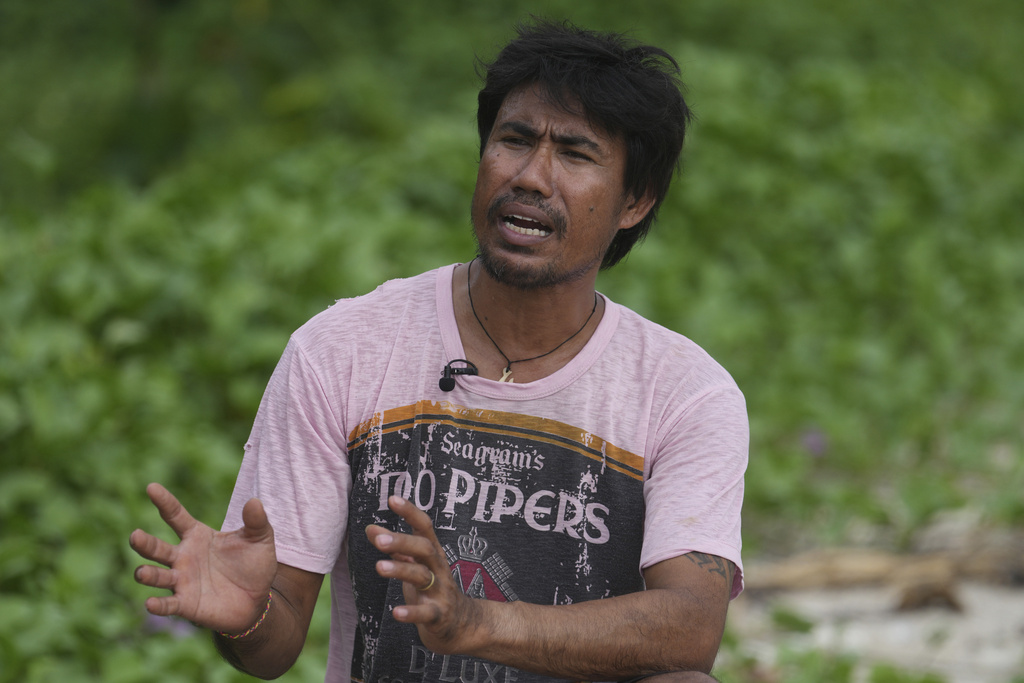
Suriyan Klathale speaks during an interview with The Associated Press at Surin Islands, Phang Nga Province, Thailand, Monday, Dec. 9, 2024. (AP Photo/Sakchai Lalit)
The community, a group of indigenous people from Thailand and Myanmar, came to worldwide attention for its members’ understanding of waves when the Indian Ocean Tsunami struck in December 2004 and killed more than 200,000 people. The few tourists who happened to be on the islands inhabited by the Moken survived because locals knew when they saw the water recede that people needed to get to higher ground.
Today, things are different and changing fast. This once free-sailing people have been grounded by powerful forces of change.
How do you hold onto tradition when everything is working against it?
The Moken are one of the various tribal groups and indigenous communities not formally recognized by the Thai government. For years, activists from these communities have tried to push for formal recognition with a bill that would help them hold on to traditions.
But as recently as October, the latest draft of this proposed bill, called the Protection and Promotion of Ethnic Groups’ Way of Life, was tabled by Parliament. The bill would legally guarantee these communities’ basic rights, such as health care, education and land, as well as provide government support to preserve their ethnic identities.
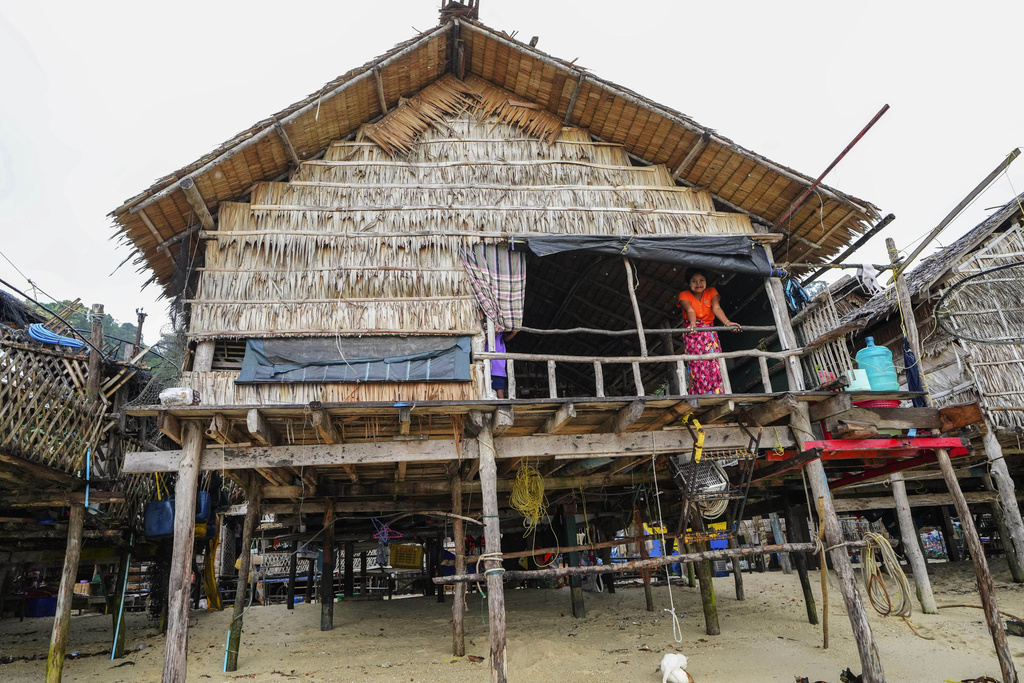
Kiroom Klathale stands on her house at Surin Islands in Phang Nga Province, Thailand, Thursday, Dec. 12, 2024. (AP Photo/Sakchai Lalit)
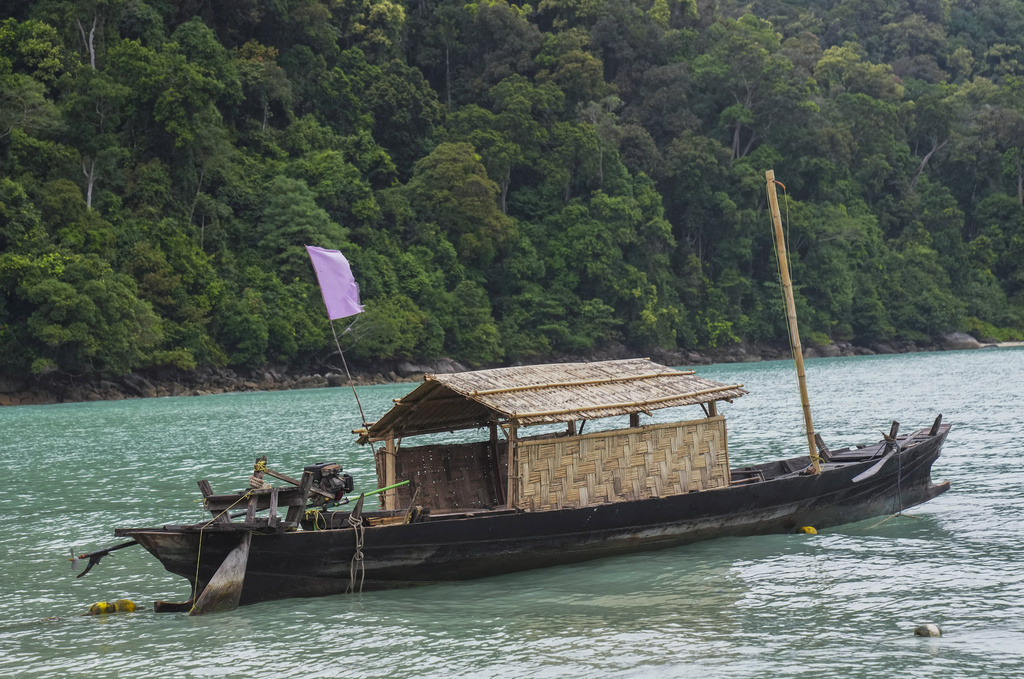
For the Moken, the kabang and their way of living on the ocean are something they hope the law could help preserve. The wooden boat, with a distinctive curve that juts out from its bow and a pavilion set in the middle, is central to the Moken’s identity. “It’s like a lifetime of a person, of a family,” Hook said. “In the past, we lived and died on that boat.”
Multiple generations could live on a kabang, which were much bigger in the past. The parents would stay in the middle of the boat; their married children lived at the front until they built their own boat.
Tat, an elder in the Moken community who uses only one name, said that a Moken became an adult when he could build a boat. It meant he was capable of starting a family.
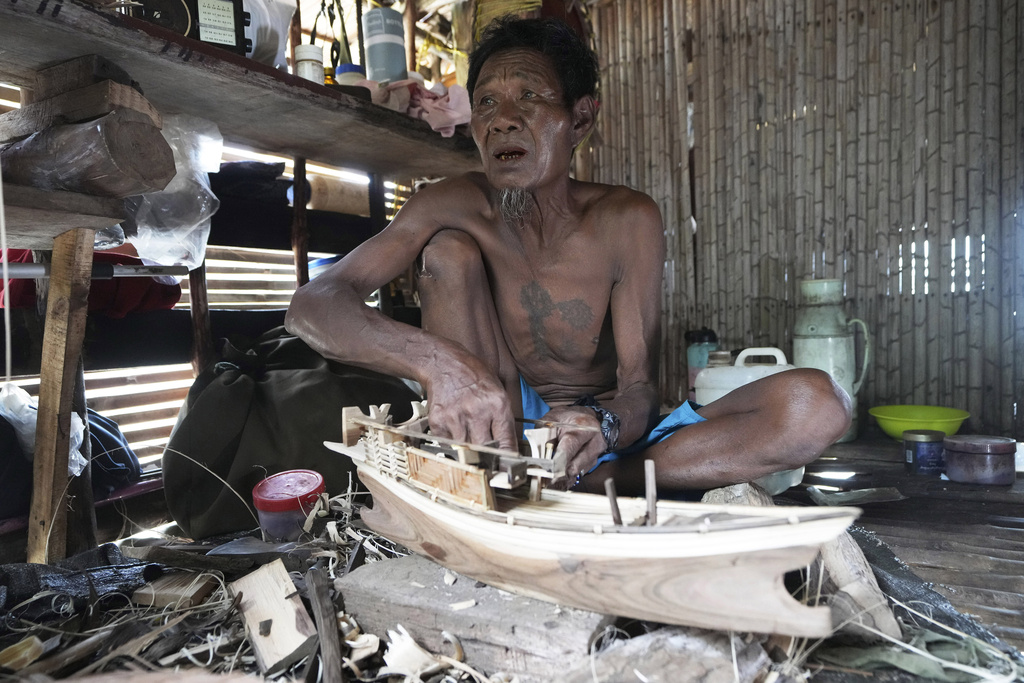
Tat Klathale makes a Kabang boat model for tourists to buy at Surin Islands in Phang Nga Province, Thailand, Thursday, Dec. 12, 2024. (AP Photo/Sakchai Lalit)
Today, though, almost no one lives on a boat. Narumon Arunotai, an associate professor at Chulalongkorn University in Bangkok who has worked with the Moken and other indigenous communities for decades, said the shift toward permanent dwelling on land had already started more than 40 years ago.
It was a gradual shift, driven both by stricter border controls as well as the inability to get the wood necessary to build the kabangs. Further, the Indian Ocean tsunami in 2004 destroyed many of the traditional boats. The change to dwelling on land has happened with other communities known colloquially as sea nomads in Thailand as well.
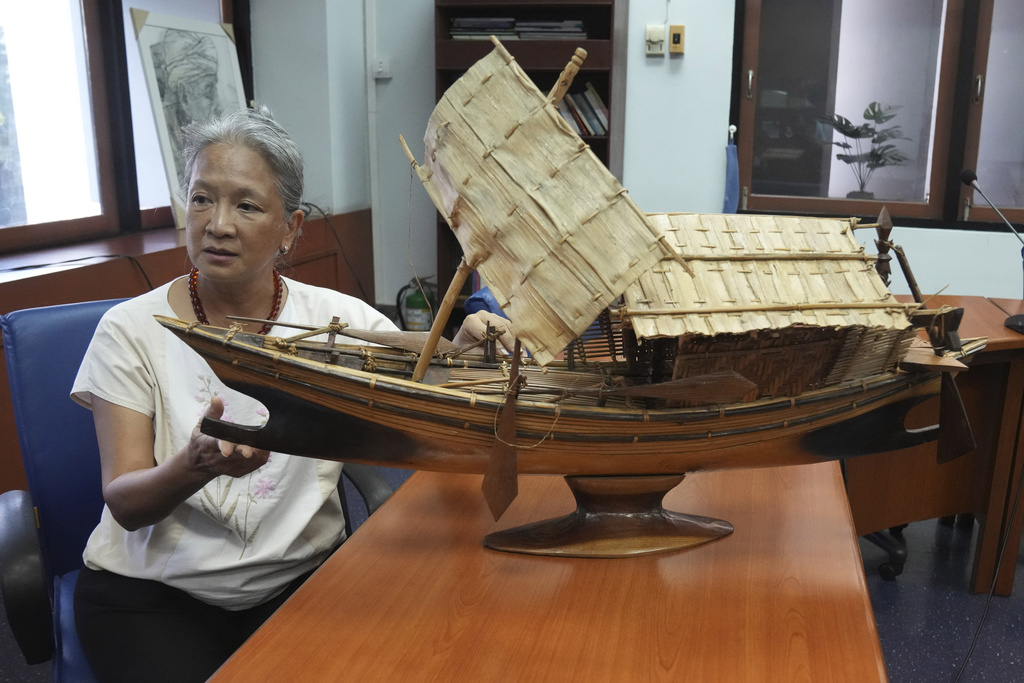
Narumon Arunotai, who works closely with the Moken and indigenous communities, speaks during an interview with The Associated Press, discussing the Kabang boat at Chualongkorn University in Bangkok, Thailand, Monday, Dec. 2, 2024. (AP Photo/Sakchai Lalit)
The Moken are scattered across an archipelago of some 800 islands on the coast of Myanmar and Thailand. In the days when they lived on boats, Moken stayed on land only during the monsoon season, which started around May. They’d stay on land until the winds shifted, usually around December, and then abandon their temporary homes for the sea. For food, they fished and foraged.
Many of the older generation were born on boats and sailed regularly amongst the islands.
“We could move freely without having to worry about the Myanmar government or the Thai government,” said Tawan Klathale, Hook’s older brother, who was born on a boat. All Moken in Thailand use the surname Klathale, given to the community by one of Thailand’s former queens.
“Back then,” said the brother, who is known as Ngui, “there was no clear line to where is Myanmar and where is Thailand.”
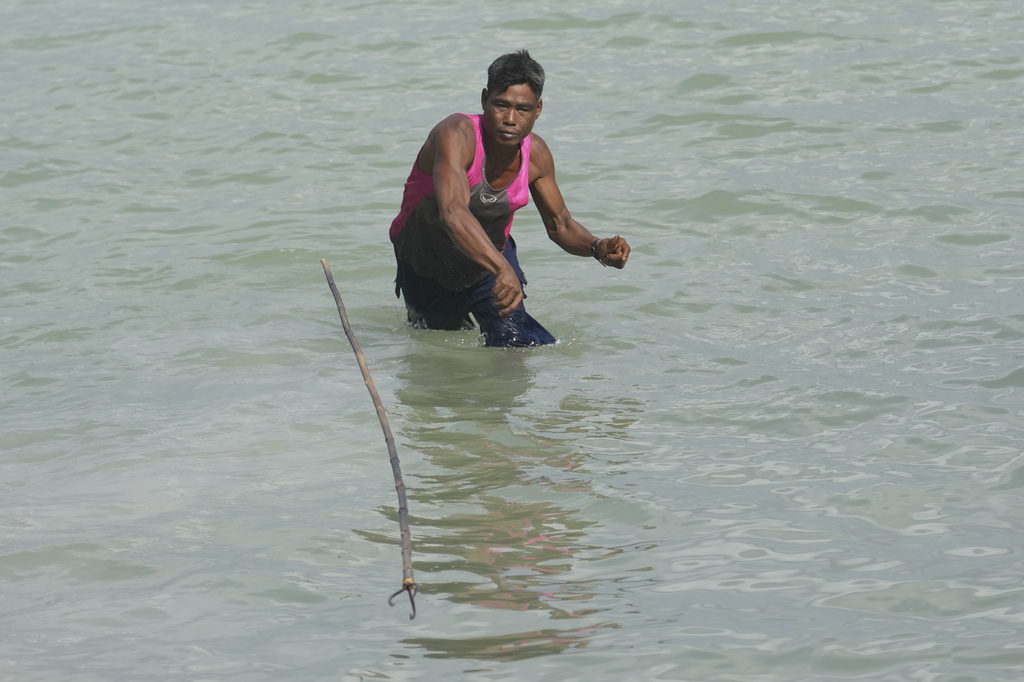
Tawan Klathale demonstrates to throw a spear to hunt fish for tourists in Moken village at Surin Islands in Phang Nga Province, Thailand, Wednesday, Dec. 11, 2024. (AP Photo/Sakchai Lalit)
Freedoms began to constrict, and making boats became harder
But by the time Ngui and Hook were teenagers, they could no longer travel as freely between those islands. Many Moken started settling more permanently in the Surin Islands, off the Thai coast. Some came from Myanmar to Thailand, looking for jobs and safety from pirates. Hook’s family stayed ashore.
The parts of the community that stayed in Thailand found that the land they had always visited each season had become a national park by 1981. As a result, they could no longer cut down the large trees they needed to build their boats.
A Kabang boat is docked on Surin Islands, Phang Nga Province, Thailand, Thursday, Dec. 12, 2024. (AP Photo/Sakchai Lalit)
To make a kabang, one needs a good strong tree, at least 1 meter wide and 10 meters tall. The trunk needs to be straight and be free of defects. Over the course of months, men of the community would dig out the trunk and carve it into a boat’s hull, while also using fire to make the wood pliable and stretch it out. It was a communal thing, involving up to 10 people.
Now, it’s difficult to gather enough people. Other men of the village would often be out working during the day. They did not have time to join and work together on a boat.
Ngui and other members of an informal group called Moken Pa Ti’ao, concerned they were losing the knowledge of boat-building, said they approached the park now and then across the years get a tree to make the boat. They were refused years ago by the chief of Mu Ko Surin National Park. The group hasn’t asked since.
Jepen Klathale and his wife Boomkoyoung Klathale sit on their house in Moken village at Surin Islands in Phang Nga Province, Thailand, Wednesday, Dec. 11, 2024. (AP Photo/Sakchai Lalit)
The park allows them to cut down only small trees, said Ngui, who is also assistant to the village chief in Surin Island. “The restrictions has been like this as far as we can remember.”
Today, the village in Surin only has one kabang, built by Tat and used mostly to ferry tourists and take children out on day trips. Hook, who lives on the mainland in Thailand, also has a kabang built with the funding of a private donor from Norway after a filmmaker made a documentary about his journey to make one such boat in 2014. But his kabang is built with planks of wood, rather than a single hollowed out tree.
They are among the few keen to remember the boats and other traditions. Tat says he has made sure to pass down what he knew to his children, from songs to boat building.
“If my generation is gone, there would be just very few people left who know how to do these things,” Tat said.
Wilasnee Klathale speaks to reporters during an interview with The Associated Press at Moken village at Surin Islandin Phang Nga Province, Thailand, Thursday, Dec. 12, 2024, (AP Photo/Sakchai Lalit)
Learning about the ocean remains a priority
Together, Tat and Wilasinee Klathale, a teacher at the school on the island, also try to take village children out on the boats to teach them about the ocean as well as about music and dance.
“It’s not in the curriculum, but I added them myself, because I could see that these things are going to be lost,” Wilasinee said.
Today, young Moken are more worried about their livelihoods and finding jobs than how to build a boat. Most only make money during Thailand’s peak tourist season when the national park is open to tourists, from November to April, and have to live on that money for the rest of the year.
Boyen Klathale, a young Moken man, said it’s difficult to find a job. On Surin, the opportunities are either with the national park or operating boats to take tourists out. Though it’s peak season, he wasn’t able to find a job this year, and he didn’t want to leave behind his family to find work on the mainland.
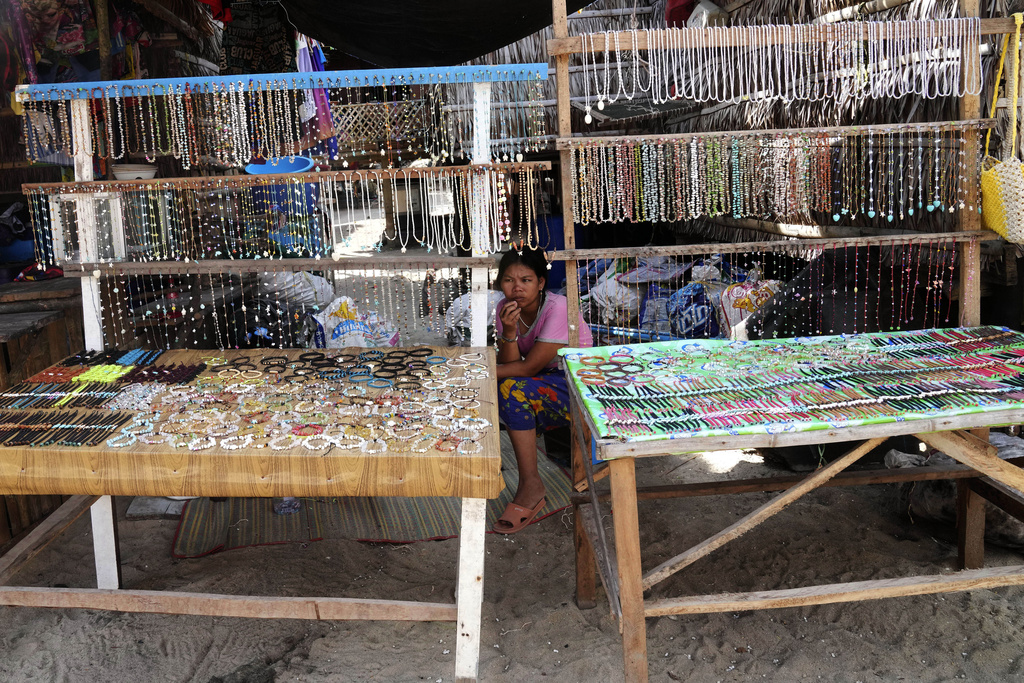
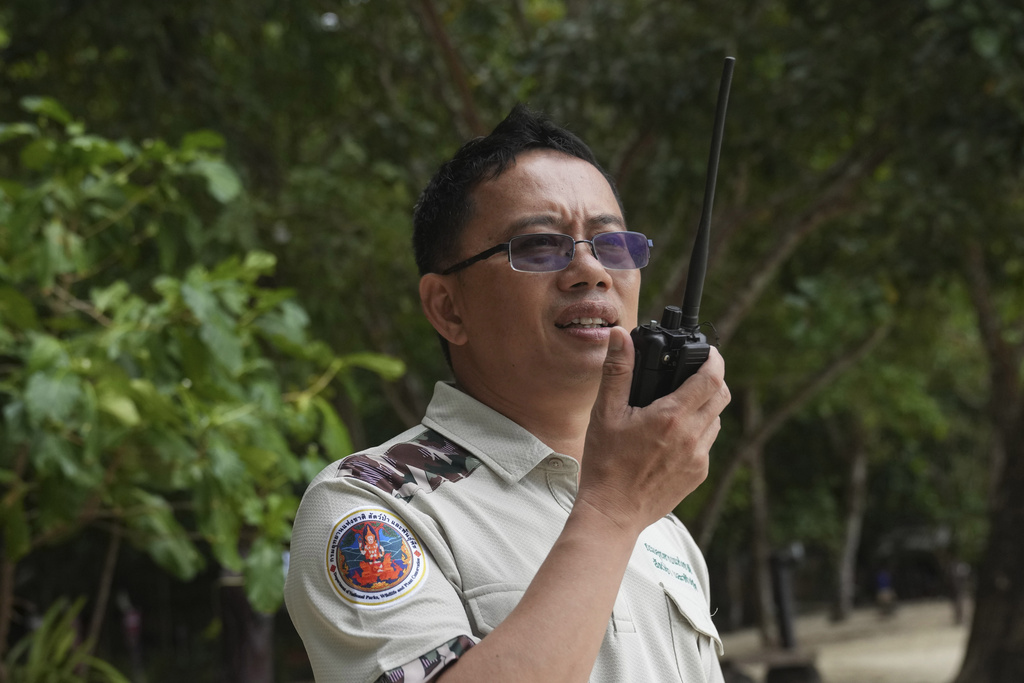
York Klathale waits for customers to buy souvenirs at Moken village at Surin Islands in Phang Nga Province, Thailand, Wednesday, Dec. 11, 2024. (AP Photo/Sakchai Lalit)Chief of Surin national park Kriengkrai Pohcharoen speaks on walkie-talkie to his staff at Surin Islands in Phang Nga Province, Thailand, Friday, Dec. 13, 2024. (AP Photo/Sakchai Lalit)
The Moken have asked for more fishing rights in the past, but were denied a further quota beyond the subsistence amount they’re allowed from the park. Ngui, the village chief’s assistant, said he hopes the Moken can sell the souvenirs they make to tourists all year around with help from the government.
The future holds some hope. In 2024, the Surin Islands National Park appointed a new chief, Kriengkrai Pohcharoen. In a shift, he said he was open to collaborating with the Moken on a kabang — as long as it was a tree that fell over on its own.
“I think about how to improve their quality of life, and how they can sustainably live in nature,” he said. “I want them to have a good quality of life.”
The Moken are realistic about their permanent switch to land. These days, most prefer it. But some still remember the old ways — and an aquamarine bay filled with handmade kabangs.
“The world is changing and that’s the way it is, if you ask me,” Ngui said. “I think everything is bound to be lost at some point, but I just want it to stay as long as possible.”
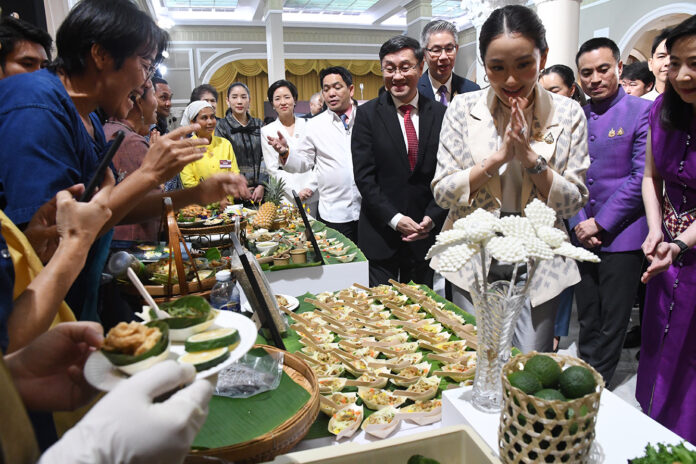
Prime Minister Paetongtarn Shinawatra visits "Mini Showcase: The Best of Thai Foods in Different Regions" exhibition at the opening ceremony of the Food Soft Power Promotion Project at Government House on December 20, 2024. (Khaosod Photo/Yokin Charoenying)
Hardly a week passed without the Paetongtarn Shinawatra mentioning the term “soft power”.
Earlier this week the PM even launched a “one family one soft power” initiative, whatever that is supposed to mean.
While people in the English-speaking world understood soft power, particularly in international politics as the ability to co-opt instead of coercing other states through hard power by means of making one’s country appealing and attractive through the use of culture, political values, and foreign policies to enact change, Thais defined the term soft power with more confined focus on how to make Thai culture, or traditional and contemporaries, both tangible and intangible, more appealing to the world in order to attract more foreign tourists and sell more Thai food, and products, around the world.
Without blowing Thailand’s horn, which has been on many global ranking lists as surveys as a leading tourists and food destinations, here’s my two cents (or two satangs) on what we can do to elevate Thailand’s soft power in 2025 and beyond.
The keyword is to focus on excellence in everything we do.
Food and drinks:
On food, the government is on the right track to promote regional Thai foods. It’s time to educate the world about the different regional Thai foods and how they differ from one another. The days of promoting pad thai, tom yum kung, som tum, and green curry are over. Let’s do more to promote less familiar regional food to foreigners in hope they can soon be accustomed and enjoy a wide range of regional Thai foods.
Khao soi, the northern curry noodle, is already making a mark with a popular restaurant specializing in the dish operating in London, for example. The fact that Sorn, a Bangkok-based Southern Thai restaurant became the first Thai restaurant to be awarded three Michelin stars this year should also help promote and familiarize more foreigners to southern-Thai cuisine.
Nevertheless, the focus should be on quality and affordability, any public and private initiatives to improve the qualities and taste of classic Thai dishes including pad thai and pad kra pao, through annual competitions, awards, and promotions, should be the path.
As for drinks, local craft beer is making its mark but the government should assist them to ensure its price is more competitive. The same can be said about the nascent cacao farming. I talked to a Thai cacao farmer who works in Tak province earlier this year and he said while they swear in the quality of Thai cacao, hot chocolate, chocolate bar, and more, the government can and should do more to reduce or altogether lift the taxes for imported machineries used in the industry.
As for single origin Thai arabica coffee, they are doing alright as more Thais developed more sophisticated tastes for a good cup of espresso, americano, flat white, or drip coffee, but perhaps it’s time to come up with a new Thai way of preparing a good cup of coffee. Japan invented dirty coffee, Australia concocted flat white, now we need something specifically Thai and modern in order to elevate Thai coffee soft power. Back to alcoholic beverages, some are now making decent Thai rum and that should be our natural strength as we have all the required raw materials, be it in sugarcane, pineapple, and more to make quality rum.
More challenging is making a decent bottle of single malt whisky but ThaiBev this year launched Thailand’s first premium single malt whisky in an ambitious move (more of that in the next few days on Khaosod English) These are drinks, both alcoholic and non alcoholic and Thai embassies abroad can serve with pride to further strengthen Thailand’s soft power.
Travel and tourism:
As for Thailand as a tourist destination, the government via TAT should try harder to promote new less-known destinations and make sure they are adequately accessible from big cities like Bangkok. The focus should also be how locals and small businesses benefit more. We should also focus more on wealthy tourists from neighbouring countries where flying to Thailand takes no more than 5 hours because it makes shorter trips (read weekends) and repeated visits more viable. Come 2025, we should also seriously capitalize on our ethnic Indian communities.
While Bangkok’s Chinatown is already an established tourist and food destination, the next-door Little India, or Phahurat Road, has been more or less neglected by the Tourism Authority of Thailand. It’s time to find ways to make Phahurat and tourist destination in its own right (which will further boost next-door Yaowarat, or Chinatown) and make our small but diligent Thai-Indian communities more visible as they can further promote the diversity of Bangkok and beyond through their food, music, and culture.
Also, an estimated one to two million or so migrant workers from Myanmar who are mostly invisible in Bangkok should be able to celebrate their cultures, food, and diversities. This is not just about making Bangkok more attractive tourist destination but will make these hardworking workers from Myanmar feel more at home and proud and educate Thai people in the process.
Come Jan 22, 2025, same-sex marriage will be legalised in Thailand and the LGBT-friendly culture will further boost Thai tourism and ensure greater equal rights among Thais. This is where Thailand can use its soft power to convince others that equal rights for all is the way to go.
FILE - A fighter jet maneuvers on the deck of the USS Dwight D. Eisenhower in the Red Sea, June 11, 2024. (AP Photo/Bernat Armangue, File)
DUBAI, United Arab Emirates (AP) — Two U.S. Navy pilots were shot down Sunday over the Red Sea in an apparent “friendly fire” incident, the U.S military said, marking the most serious incident to threaten troops in over a year of America targeting Yemen’s Houthi rebels.
Both pilots were recovered alive after ejecting from their stricken aircraft, with one suffering minor injuries. But the shootdown underlines just how dangerous the Red Sea corridor has become, with ongoing attacks on shipping by the Iranian-backed Houthis despite U.S. and European military coalitions patrolling the area.
The U.S. military had conducted airstrikes targeting Yemen’s Houthi rebels at the time of the friendly fire incident, though the U.S. military’s Central Command did not elaborate on what the pilots’ mission was and did not respond to questions from The Associated Press.
The F/A-18 shot down had just flown off the deck of the USS Harry S. Truman aircraft carrier, Central Command said. On Dec. 15, Central Command acknowledged the Truman had entered the Mideast, but hadn’t specified that the carrier and its battle group was in the Red Sea.
“The guided-missile cruiser USS Gettysburg, which is part of the USS Harry S. Truman Carrier Strike Group, mistakenly fired on and hit the F/A-18,” Central Command said in a statement.
From the military’s description, the aircraft shot down was a two-seat F/A-18 Super Hornet fighter jet assigned to the “Red Rippers” of Strike Fighter Squadron 11 out of Naval Air Station Oceana, Virginia.
FILE – Aircraft carrier USS Harry S. Truman is moored near Split, Croatia, Feb. 14, 2022. (AP Photo/Darko Bandic, File)
It wasn’t immediately clear how the Gettysburg could mistake an F/A-18 for an enemy aircraft or missile, particularly as ships in a battle group remain linked by both radar and radio communication.
However, Central Command said that warships and aircraft earlier shot down multiple Houthi drones and an anti-ship cruise missile launched by the rebels. Incoming hostile fire from the Houthis has given sailors just seconds to make decisions in the past.
Since the Truman’s arrival, the U.S. has stepped up its airstrikes targeting the Houthis and their missile fire into the Red Sea and the surrounding area. However, the presence of an American warship group may spark renewed attacks from the rebels, like what the USS Dwight D. Eisenhower saw earlier this year. That deployment marked what the Navy described as its most intense combat since World War II.
On Saturday night and early Sunday, U.S. warplanes conducted airstrikes that shook Sanaa, the capital of Yemen which the Houthis have held since 2014. Central Command described the strikes as targeting a “missile storage facility” and a “command-and-control facility,” without elaborating.
Houthi-controlled media reported strikes in both Sanaa and around the port city of Hodeida, without offering any casualty or damage information. In Sanaa, strikes appeared particularly targeted at a mountainside known to be home to military installations. However, there were no images or information released regarding the strikes — which has happened previously when airstrikes hit vital facilities for the rebels.
Brig. Gen. Yahya Saree, a Houthi military spokesman, released a prerecorded statement hours later in which he claimed the rebels launched eight drones and 17 cruise missiles in their attack. He also claimed without offering any evidence that the Houthis shot down the F/A-18, likely following a pattern of him making exaggerated claims. During the Eisenhower’s deployment, he repeatedly falsely claimed the carrier had been struck by Houthi fire.
The Houthis have targeted about 100 merchant vessels with missiles and drones since the Israel-Hamas war in the Gaza Strip started in October 2023 after Hamas’ surprise attack on Israel that killed 1,200 people and saw 250 others taken hostage.
Israel’s grinding offensive in Gaza has killed more than 45,000 Palestinians, local health officials say. The tally doesn’t distinguish between combatants and civilians.
The Houthis have seized one vessel and sunk two in a campaign that has also killed four sailors. Other missiles and drones have either been intercepted by separate U.S.- and European-led coalitions in the Red Sea or failed to reach their targets, which have also included Western military vessels.
The rebels maintain that they target ships linked to Israel, the U.S. or the United Kingdom to force an end to Israel’s campaign against Hamas in Gaza. However, many of the ships attacked have little or no connection to the conflict, including some bound for Iran.
The Houthis also have increasingly targeted Israel itself with drones and missiles, resulting in retaliatory Israeli airstrikes.
On Sunday, Israeli Prime Minister Benjamin Netanyahu said his country would act “forcefully” against the Houthis, as it has against other allies of Iran, “only in this case, we are not acting alone.”
BANGKOK — The mysterious disappearance of jewelry worth over US$22,000 from a Bangkok luxury hotel room continues to puzzle investigators, as the case takes an intriguing turn with multiple conflicting accounts.
The Lumpini Police Station investigators revealed they need to conduct additional in-person interviews with the Indonesian wife who filed the complaint. According to police, previous telephone interviews with her have yielded statements that were inconsistent with factual evidence, adding another layer of mystery to the case.
The case stems from a November 2 incident at a luxury hotel in in Bangkok’s Klong Toey district, where the jewelry – three diamond rings (including a Tiffany wedding ring) and a bracelet – allegedly disappeared from the couple’s room. The items were reportedly left in the bathroom around 2:00 p.m. on their check-out day.
The Singaporean husband stated that at 2:40 p.m. he went down to check out and requested hotel staff to retrieve their packed luggage from the room. The staff brought down their luggage at 2:55 p.m. He then informed the reception staff that he and his wife would be stepping out for a while. While they were outside, his wife suddenly remembered she hadn’t packed her jewelry and called to notify the hotel.
The missing jewelry as published by Stomp, Singapore’s online journalism blog
At 4:30 p.m., the complainant stated that a hotel staff member called to ask if her rings were white. At 5:00 p.m., when the couple returned to the hotel, staff allowed the Indonesian wife to inspect their room. However, the jewelry was nowhere to be found, and she discovered the room had already been cleaned. They then proceeded to file a police report.
Police have already questioned five hotel staff members who entered the room that day and reviewed CCTV footage. They are also examining the bank account activities of the interviewed staff members.
The hotel management maintains that their internal investigation found no wrongdoing by staff members. Meanwhile, the hotel has acknowledged the situation but declines to provide additional details, citing confidentiality concerns.
The investigation remains ongoing, with police now focusing on resolving the discrepancies in testimonies while continuing to trace the missing jewelry.
Forensics work on a damaged car sitting with its doors open after a driver plowed into a busy Christmas market in Magdeburg, Germany, early Saturday, Dec. 21, 2024. (Hendrik Schmidt/dpa via AP)
MAGDEBURG, Germany (AP) — Germans on Saturday mourned a violent attack and their shaken sense of security after a Saudi doctor intentionally drove a black BMW into a Christmas market teeming with holiday shoppers, killing at least five people, including a small child, and injuring at least 200 others.
The state governor, Reiner Haseloff, told reporters that the death toll rose to five from a previous figure of two and that more than 200 people in total were injured.
Chancellor Olaf Scholz said that nearly 40 of them “are so seriously injured that we must be very worried about them.”
“There is no more peaceful and cheerful place than a Christmas market,” Scholz said. “What a terrible act it is to injure and kill so many people there with such brutality.”
Authorities arrested a 50-year-old man at the site of the attack Friday evening and took him into custody for questioning. He has lived in Germany for nearly two decades, practicing medicine, officials said.
Several German media outlets identified the man as Taleb A., withholding his last name in line with privacy laws, and reported that he was a specialist in psychiatry and psychotherapy.
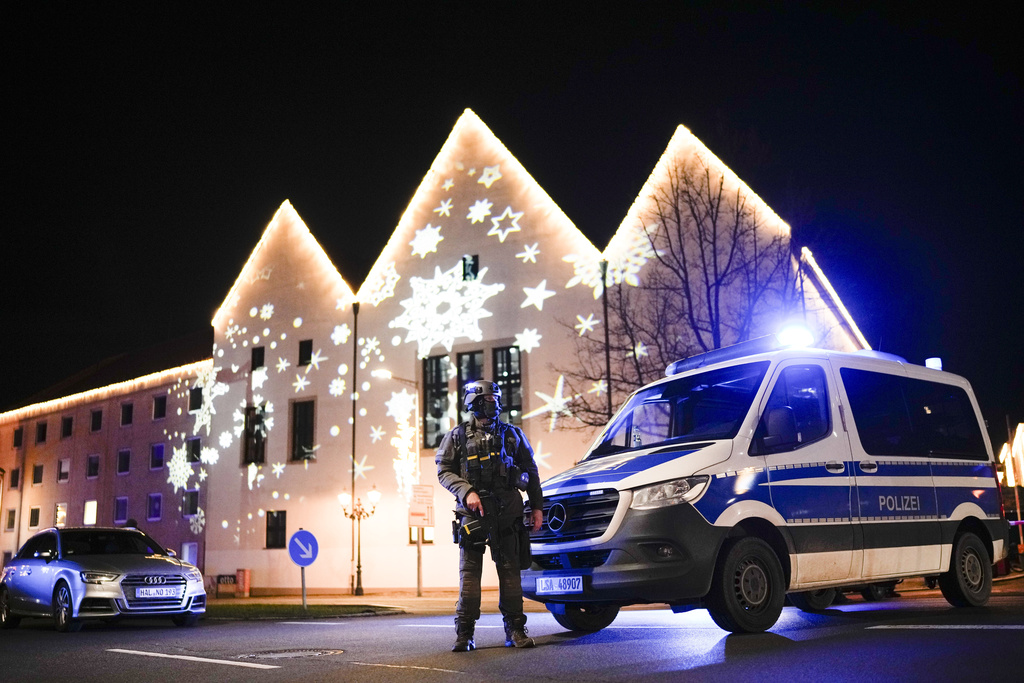
A police officer guards at a blocked road near a Christmas market after an incident in Magdeburg, Germany, Friday, Dec. 20, 2024. (AP Photo/Ebrahim Noroozi)
There were still no answers Saturday as to what caused him to drive into a crowd in the eastern German city of Magdeburg.
Describing himself as a former Muslim, he shared dozens of tweets and retweets daily focusing on anti-Islam themes, criticizing the religion and congratulating Muslims who left the faith.
He also accused German authorities of failing to do enough to combat what he said was the “Islamism of Europe.” Some described him as an activist who helped Saudi women flee their homeland. He has also voiced support for the far-right and anti-immigrant Alternative for Germany (AfD) party.
Recently, he seemed focused on his theory that German authorities have been targeting Saudi asylum seekers.
Prominent German terrorism expert Peter Neumann said he had yet to come across a suspect in an act of mass violence with that profile.
“After 25 years in this ‘business’ you think nothing could surprise you anymore. But a 50-year-old Saudi ex-Muslim who lives in East Germany, loves the AfD and wants to punish Germany for its tolerance towards Islamists — that really wasn’t on my radar, ” Neumann, the director of the International Centre for the Study of Radicalization and Political Violence at King’s College London, wrote on X.
The car that was crashed into a crowd of people at the Magdeburg Christmas market is seen following the attack in Magdeburg, Germany, Saturday early morning, Dec. 21, 2024. (AP Photo/Ebrahim Noroozi)
The violence shocked Germany and the city, bringing its mayor to the verge of tears and marring a festive event that’s part of a centuries-old German tradition. It prompted several other German towns to cancel their weekend Christmas markets as a precaution and out of solidarity with Magdeburg’s loss. Berlin, where a truck attack on a Christmas market in 2016 killed 12 people, kept its markets open but has increased its police presence at them.
Germany has suffered a string of extremist attacks in recent years, including an attack in which a man with a knife killed three people and seriously wounded others at a festival in the western city of Solingen in August, wounding eight.
Chancellor Olaf Scholz and Interior Minister Nancy Faeser were due to travel to Magdeburg on Saturday, and a memorial service is to take place in the city cathedral in the evening.
“My thoughts are with the victims and their relatives,” Scholz wrote on X. “We stand beside them and beside the people of Magdeburg.”
Verified bystander footage distributed by the German news agency dpa showed the suspect’s arrest at a tram stop in the middle of the road. A nearby police officer pointing a handgun at the man shouted at him as he lay prone, his head arched up slightly. Other officers swarmed around the suspect and took him into custody.
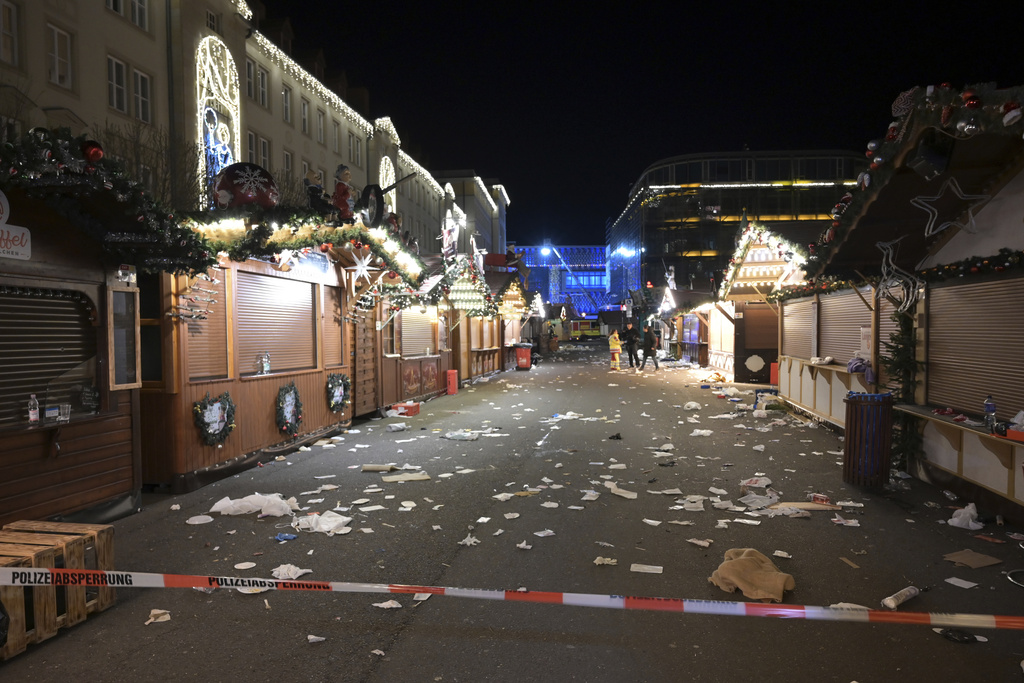
A view of the cordoned-off Christmas market after an incident in Magdeburg, Germany, Friday Dec. 20, 2024. (Heiko Rebsch/dpa via AP)
The two people confirmed dead were an adult and a toddler, but officials said additional deaths couldn’t be ruled out because 15 people had been seriously injured.
“As things stand, he is a lone perpetrator, so that as far as we know there is no further danger to the city,” Saxony-Anhalt’s governor, Reiner Haseloff, told reporters. “Every human life that has fallen victim to this attack is a terrible tragedy and one human life too many.”
Authorities identified the suspect as a 50-year-old Saudi doctor who moved to Germany in 2006 and who had been practicing medicine in Bernburg, about 40 kilometers (25 miles) south of Magdeburg.
Saudi Arabia’s foreign ministry condemned the attack on X but did not mention the suspect’s connection to the kingdom.
Christmas markets are a German holiday tradition cherished since the Middle Ages, now successfully exported to much of the Western world.
Hours after Friday’s tragedy, the wail of sirens clashed with the market’s festive ornaments, stars and leafy garlands.
Magdeburg resident Dorin Steffen told dpa that she was at a concert in a nearby church when she heard the sirens. The cacophony was so loud “you had to assume that something terrible had happened,” she said, calling it “a dark day” for the city.
The attack reverberated far beyond Magdeburg, with Haseloff calling it a catastrophe for the city, state and country. He said flags would be lowered to half-staff in Saxony-Anhalt and that the federal government planned to do the same.
“It is really one of the worst things one can imagine, particularly in connection with what a Christmas market should bring,” the governor said.