SURAT THANI — 13 May 2026, Thai Prime Minister on Wednesday ordered an investigation into suspected nominee business arrangements involving foreign investoAdd Postrs on Koh Phangan, after authorities found allegedly illegal luxury pool villas linked to Israeli nationals.
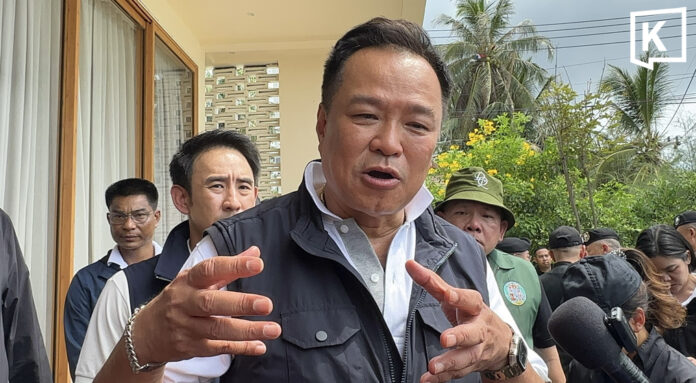
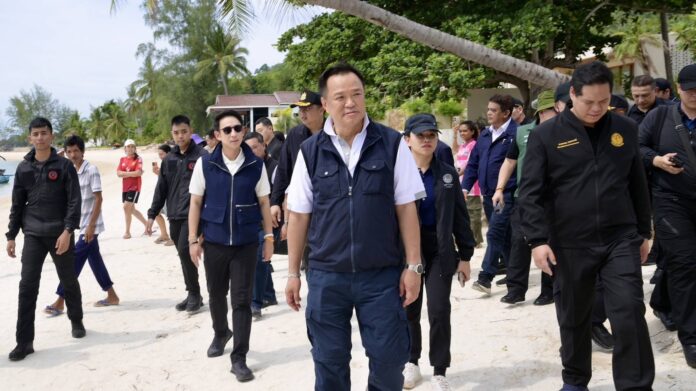
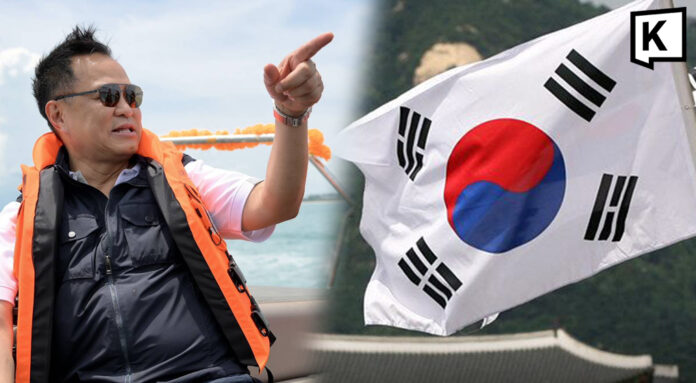
At 14:10 on 13 May, Anutin Charnvirakul, Prime Minister and Minister of Interior, along with his delegation, conducted a field visit to monitor and expedite solutions for issues affecting local residents and businesses in major tourist destinations. The visit focused on the illegal use of Thai nationals as legal fronts (nominees) for foreign-owned businesses and the problem of unauthorized encroachment on public beachfront areas.
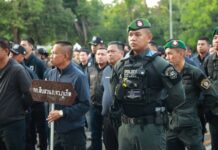
Anutin visited a property connected to a company under investigation and held discussions with ministers and local officials in front of a pool villa allegedly constructed without proper permits. Deputy national police chief Samran Nuanma, reported on the unauthorized construction of these villas owned by Israeli nationals, following the policy to dismantle foreign nominee networks on Koh Phangan.
Anutin asked Samran to prove whether the shareholders are indeed foreigners. He also ordered the authorities to examine the company’s financial transactions and source of funds.
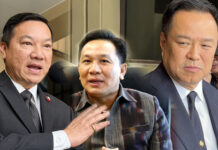
Next, Anutin addressed controversy surrounding a cabinet resolution approved to ease procedures for foreign investors in eight business sectors, allowing foreign investors to operate without needing a license. He apologized for confusion on 12 May caused by comments from a newly appointed deputy government spokesperson, who had suggested foreigners would no longer need licenses to operate businesses in Thailand. In his eagerness to see the new appointee begin working promptly, he had instructed them to announce this specific matter immediately.
He has already reprimanded the Government Spokesperson, noting that each coalition party is already responsible for specific ministries—for example, the Pheu Thai Party oversees the Ministry of Agriculture and Cooperatives and the Ministry of Labor. Each individual should focus on their assigned responsibilities. Therefore, I must apologize for the mistake in assigning a Deputy Government Spokesperson to announce such a critical matter. He sincerely apologizes for this error.
When asked to confirm that the resolution was not a move toward full liberalization of foreign business, he clarified that the policy was intended only to reduce duplicated administrative procedures. For instance, if a foreign national wishes to operate a business in Thailand, they must already obtain permits from the Department of Public Works and Town and Country Planning, the Department of Industrial Works, or the Ministry of Interior. This change means they will no longer need to file a redundant application with the Ministry of Commerce. This was the initiative of the Minister of Commerce, aimed at eliminating unnecessary overlap.
The Ministry of Commerce is responsible for business registration and issuing licenses for various operations. Once the primary regulatory agency grants permission, the business can proceed. However, on 12 May, the Deputy Government Spokesperson likely gave a brief and summarized statement that foreigners can operate in Thailand without a license, which is incorrect.
Anutin emphasized that it is not true at all. Foreigners must still obtain permission from the relevant authorities. They simply no longer need to file a redundant request with the Ministry of Commerce. The government is striving to reduce redundant steps and transition toward a One-Stop Service as much as possible, in line with our ease-of-doing-business policy.
Asked about the nominee issue in Koh Phangan, Anutin said he was here today specifically to address the nominee problem. More importantly, let his team not yet focus on whether there is land encroachment, the Ministry of Natural Resources and Environment and the Department of Lands will handle that. Today, authorities are looking at the practice of setting up companies to sell them to foreigners. Foreign shareholding must not exceed 49%.
However, authorities are currently seeing multiple companies established with cross-shareholding structures. This makes a company appear Thai on paper, but in reality, the control and direction of the firm are 100% foreign-owned. This violates the spirit of Thai law.
To own land, a Thai company must maintain at least 51% Thai shareholding. In these cases, it is effectively 100% foreign; the company exists as a shell, but its Thainess is gradually dissolved. To put it simply, it is like putting a black wig on a foreigner to make them look Thai, but ultimately, the foreigner is still the one in control. That must be fixed.
Regarding the involvement of lawyers and legal advisors, Anutin noted that companies have legal and accounting advisors. Normally, with seven founders where Thais hold more than 50% capital, the Ministry of Commerce would approve the registration. But when the intent is to circumvent the law, such as one individual holding shares in over 200 shell companies to sell them as legal fronts for foreign businesses, this violates the spirit of our major laws. Therefore, he believed legal action can be taken.
In addition, the police must investigate the source of funds to see if money is being laundered into land ownership, granting foreigners the power to do as they please. These activities need to be blocked from happening.
He explained that the policy was intended only to reduce duplicated administrative procedures by removing the need for investors to obtain additional approvals from the Commerce Ministry after already securing licenses from sector-specific agencies.
Following the inspection, Anutin met local residents along the beach and urged the community to help preserve the island’s environment. “Please help keep the beaches clean and the water clear,” he said.
The prime minister later exchanged jokes with fishermen and residents who invited him squid fishing before he departed for neighboring Phuket province.