BANGKOK — 12 May 2026, Thailand’s Department of Special Investigation (DSI) has launched investigations into 34 companies on Koh Samui and Koh Phangan, Surat Thani, suspected of operating as nominee businesses using Thai nationals as proxy shareholders for foreign investors.
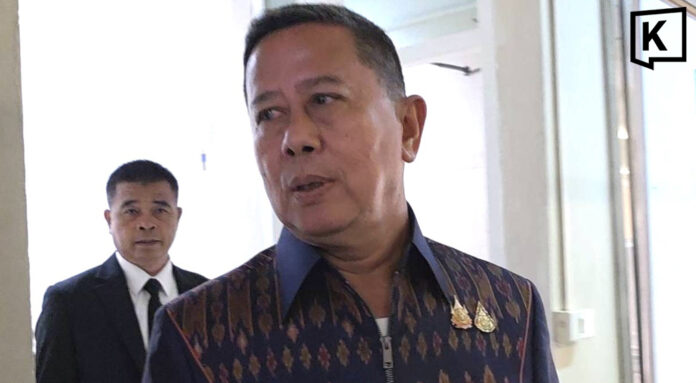
DSI Director-General, Pol. Maj. Yutthana Praedam, and Director of Bureau of Security Crime, Pol. Lt. Col. Chanchai Likitkantason, discuss on strengthening efforts to combat illegal foreign business operations in major tourist destinations with Mr. Poonpong Naiyanapakorn, Director-General of Department of Business Development (DBD), and relevant officials, to establish a collaborative framework for investigating and suppressing nominee businesses in Thailand’s major tourist destinations. The crackdown follows direct orders from the Prime Minister and the Minister of Justice, aimed at protecting national interests and ensuring fair business competition.
Following the meeting, investigators said data scans of companies in several tourism provinces revealed widespread risks of nominee structures involving increasingly complex ownership arrangements. Officials also cited complaints from local residents alleging that some groups of foreigners had improperly exploited local resources and engaged in activities that disrupted communities while disregarding Thai law. In response, the DSI and DBD are now teaming up to implement a strategic audit of these suspected nominee firms.
The initial focus will centre on Koh Samui and Koh Phangan in Surat Thani province, the first sites of a major proactive investigation. Authorities analysed more than 11,426 registered companies and categorised them by high, medium and low risk to ensure a systematic and efficient investigation. Furthermore, this nominee probe is expected to expand later to other tourism hubs including Phuket, Krabi, Phang Nga, Pattaya and Hua Hin.
On 12 May, Yutthana revealed that after exchanging intelligence with Director-General of Department of Business Development, the DSI had assigned its security cases bureau to conduct a formal inquiry into companies suspected of using Thai shareholders as nominees for foreign owners. The Department of Business Development submitted information on 34 companies with combined assets exceeding 100 million baht each to the DSI for deeper investigation.
Authorities have already identified around 20 of the 34 companies with assets of at least 100 million baht each as requiring further scrutiny. Investigators will examine shareholder structures, ownership proportions and whether Thai shareholders possess financial backgrounds consistent with their investments. A key part of the nominee test is checking financial credibility that whether a shareholder’s reported income matches their multi-million baht investment. Officials will also review whether ownership changed hands suspiciously during company operations. Overall, the investigation aims to determine whether shareholders genuinely own the businesses or merely hold shares on behalf of foreign nationals. Authorities noted that this detailed verification is a standard procedure but will take time to ensure all facts are gathered.
Yutthana further revealed that the 20 companies currently under DSI investigation operate in various industries. However, investigators must verify whether these activities are prohibited under Thailand’s Foreign Business Act of 1999 in restricted sectors. If evidence of nominee arrangements is confirmed, the cases could be accepted as special investigations leading to criminal prosecution.
The report also indicated that the Department of Business Development utilizes digital systems, specifically “DBD Biz Regist” (E-Biz) for company incorporation and shareholder changes, and “DBD e-Filing” for submitting financial statements and shareholder lists. Theoretically, these platforms are technically capable of identifying unusual shareholder patterns, including individuals holding shares in multiple companies beyond their apparent financial capacity. However, it has been noted that nominee-based company structures can reportedly be established within a single day.
Data compiled by the department showed particularly high levels of foreign investment participation in the major tourist hubs in Surat Thani, specifically Koh Samui and Koh Phangan, a high prevalence of potential nominee business operations was identified.
In Surat Thani province, 11,649 out of 21,717 registered companies ,or 53.6%, involve foreign investors. The top 10 nationalities by investment volume are:
French (2,365 companies / 20%)
British (1,446 / 12%)
Russian (1,205 / 10%)
Israeli (1,147 / 10%)
German (608 / 5%)
Chinese (569 / 5%)
American (444 / 4%)
Australian (335 / 3%)
Italian (258 / 2%)
Belgian (222 / 2%).
On Koh Phangan, 3,213 out of 4,761 companies, or 67.48%, involve foreign investment. The top 10 nationalities participating in these ventures are:
Israeli (720 / 22%)
French (426 / 13%)
British (359 / 11%)
Russians (306 / 10%)
German (194 / 6%)
American (144 / 4%)
Italians (89 / 3%)
Ukrainian (69 / 2%)
Australian (58 / 2%)
Belgian (56 / 2%)
On Koh Samui, 8,213 out of 12,050 companies, or 68.16%, include foreign investment, led mainly by investors from:
French (1,937 / 24%)
British (1,077 / 13%)
Russian (885 / 11%)
Chinese (478 / 6%)
Israeli (419 / 5%)
German (406 / 5%)
American (291 / 4%)
Australian (273 / 3%)
Swiss (173 / 2%)
Italian (169 / 2%)
Combined, Koh Samui and Koh Phangan host 11,426 foreign-invested companies, representing 67.97% of the 16,811 companies across the two islands, with authorities noting that investors frequently originate from the same groups of countries.