



























38.3 C
Bangkok
Tuesday, June 23, 2026
Home Blog Page 49

Thai PM defends South Korea ban on illegal workers

Thai PM defends South Korea ban on illegal workers

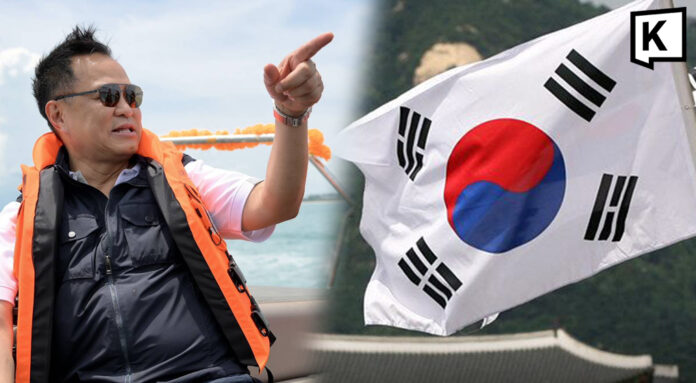
SURAT THANI — 13 May 2026, Thai Prime Minister on Wednesday said the government could not help Thai workers banned by South Korea for violating immigration or labor laws, insisting individuals must take responsibility for their actions abroad.

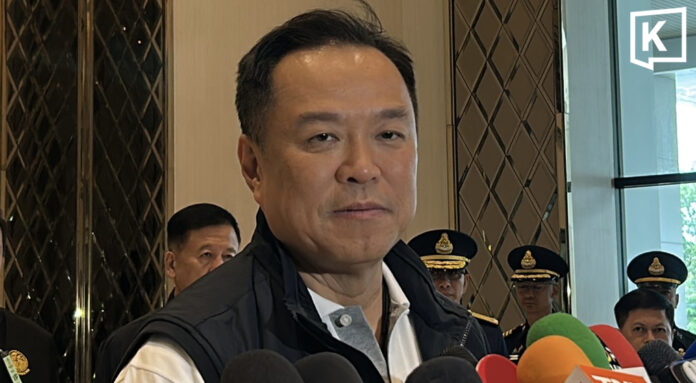
Giving an interview at 14:20 during a visit to Koh Phangan in Surat Thani province, Thai Prime Minister and Minister of Interior, Anutin Charnvirakul responded to reports that South Korea had blacklisted seasonal agricultural and fisheries workers from four northeastern Thai provinces: Udon Thani, Khon Kaen, Chaiyaphum, and Maha Sarakham, for the whole of 2026.

Anutin said he had not yet received an official report on the matter but stressed that countries had the right to ban foreign workers who entered or worked illegally. It is the same as foreigners illegally working in Thailand, they are also banned. He pointed to ongoing inspections on Koh Phangan, where authorities had uncovered unlicensed accommodation, illegal villas, and businesses operating without permits. Even if individuals say they are investing money in Thailand, that is not enough if they are breaking the law. Likewise, if Thai people go to work abroad and break their laws, they have the right to ban them as well. Therefore, one must simply not break the law.

Regarding the government’s plan to resolve this issue, Anutin replied, “We will not. We cannot help because you broke the law yourself.” However, he emphasized that the Thai government would provide full assistance if Thai citizens working legally overseas were unfairly treated or mistreated.

Asked whether South Korea’s restrictions could affect Thai tourists travelling to the country, Anutin said, “One rotten fish spoils the whole basket.” He urged Thai workers overseas to act responsibly and added that labor issues and tourism should not be confused. He rejected suggestions that Thai tourists would face increasing difficulties entering South Korea, noting that South Korea continued to benefit economically from Thai visitors as it also wants tourism revenue from Thai people because Thais spend money shopping and on beauty services. So, Thailand is an important economic partner for South Korea. Anutin emphasized that if problems arose, he would discuss the matter directly with the South Korean government, saying Thai and South Korean officials maintained good relations.
Advertisement

Chaiyaphum labour office recognises workers absconding after Korea E-8 ban

Chaiyaphum labour office recognises workers absconding after Korea E-8 ban

CHAIYAPHUM — 13 May 2026, South Korea has suspended the recruitment of seasonal agricultural and fishery workers from four Thai provinces after multiple workers absconded from employers, Thai labour officials said.

Chutima Jumangmo, chief of the Chaiyaphum Provincial Employment Office, acknowledged that workers from the province had fled employers while working in South Korea under the E-8 seasonal worker visa programme.

She said South Korea had blacklisted Chaiyaphum, Udon Thani, Khon Kaen and Maha Sarakham from participating in the programme throughout 2026.

The restriction took effect from 1 January to 31 December 2026 after South Korean authorities reported a high rate of Thai workers fleeing employers, damaging confidence in the programme.

The E-8 visa scheme allows Thai workers to take seasonal jobs in South Korea’s agricultural and fishing sectors under a memorandum of understanding between the two governments.

Chutima stressed that the suspension applied only to E-8 visa holders and did not affect Thai workers travelling to South Korea under other labour programmes.

According to provincial employment figures, 103 workers from Chaiyaphum travelled to South Korea during the current fiscal year, including 94 sent through the Labour Ministry and seven through private recruitment companies.

Of those workers, 10 reportedly absconded from their employers after arriving in South Korea under the E-8 programme, violating the agreement and contributing to South Korea’s decision to suspend recruitment from the province.

Chutima said two workers from Chaiyaphum who travelled to South Korea on 5 May and 12 May would also be affected by the suspension and would no longer be permitted to work under the E-8 programme for the remainder of the year.

Thai authorities warned that workers who flee employers abroad risk arrest, imprisonment, deportation and blacklisting from future overseas employment opportunities.

Advertisement

Police raid gambling network with 72-million-baht turnover

Police raid gambling network with 72-million-baht turnover

RANONG — 13 May 2026, Thai cybercrime police have dismantled an online gambling network operating from the southern province of Ranong, arresting a woman accused of working as an administrator for a platform that allegedly handled more than 72 million baht annually.

On Tuesday, Pol. Lt. Gen. Surapol Prembutr, Commissioner of the Cyber Crime Investigation Bureau (CCIB), and Pol. Maj. Gen. Sarayut Chunnawat, Commander of CCIB Division 2, directed a specialized task force to execute a crackdown. The operation, led by Pol. Col. Torsak Panklinput, Superintendent of CCIB Sub-division 4, along with Pol. Lt. Col. Ekarin Sonnak, Pol. Maj. Praphas Somwong, and Pol. Lt. Kookiat Cherdsoongnern, targeted key locations linked to online gambling websites in Ranong Province.

Investigators from Division 2 executed a search warrant (No. K.26/2026), issued by the Ranong Provincial Court, at a house in Moo 3, Bang Non subdistrict in Muang district, Ranong province. Authorities arrested a 24-year-old woman identified as Thipsiwan, a Ranong resident, and seized a computer, mobile phone, and internet router as evidence.

Following an investigation by the investigative team of CCIB Sub-Division 4 and Division 2, authorities identified the gambling website, known as “AM 08”, had been operating for more than two years and attracted more than 36,000 members, generating average monthly transactions of around six million baht, totaling over 72 million baht annually. According to investigators, the website offered a range of illegal gambling activities, including lotteries, slot machines, overseas football betting, baccarat, dragon tiger, and poker-style games.

Officers tracked the operation’s headquarters to Mueang Ranong District. Digital forensics revealed that the network had repeatedly changed the platform’s name while retaining its existing customer base in an effort to avoid detection and make it more difficult for authorities to trace those involved.

Investigators also found that before operating under the name “AM 08”, the gambling operation had previously generated transactions worth tens of millions of baht per month. Based on this evidence, authorities obtained a court-approved search warrant for the suspect’s residence, leading to the successful apprehension of the offenders and the seizure of various incriminating assets.

During the initial interrogation, the suspect admitted during questioning that she had worked as a customer service administrator for the gambling network for more than a year and received a monthly salary of 15,000 baht.

She has been charged with organizing, promoting, or soliciting, whether directly or indirectly, others to engage in unauthorized gambling activities through electronic media, police said.

Advertisement

Albrecht Weinberg, a Holocaust survivor who returned to Germany in his 80s, dies at 101

FILE - Albrecht Weinberg, one of the last survivors of the Holocaust, sits in the Leer town hall in Leer, Germany, March 5, 2025. (Hauke-Christian Dittrich/dpa via AP, File)

BERLIN (AP) — Albrecht Weinberg, who survived several Nazi concentration and death camps and lost most of his family in the Holocaust before returning to Germany in his 80s, has died at the age of 101, authorities in his home region said Tuesday.

Weinberg died in Leer, in northwestern Germany, weeks after he marked his birthday and the premiere of a film about his life, “Es ist immer in meinem Kopf” (“It is always in my head”), attended by hundreds of guests, the city said in a statement.

“Since returning from New York to his East Frisian home 14 years ago, Albrecht recounted tirelessly and with incredible energy his terrible experiences during the Nazi era and warned again and again against forgetting,” Mayor Claus-Peter Horst said.

Weinberg, who was born in Rhauderfehn, near Leer, on March 7, 1925, survived incarceration at the Auschwitz, Mittelbau-Dora and Bergen-Belsen camps as well as three death marches at the end of World War II. He spent years teaching high school students and others about the atrocities he had to live through.

Speaking last year, Weinberg said the memories of his wartime experiences still haunted him. “I sleep with it, I wake up with it, I sweat, I have nightmares; that is my present,” he said.

He said he worried what would happen when he was no longer around to bear witness.

“When my generation is not in this world anymore, when we disappear from the world, then the next generation can only read it out of the book,” he said.

Weinberg was awarded Germany’s Order of Merit in 2017 but handed it back last year in protest at a parliamentary vote in which a motion put forward by Friedrich Merz, now the country’s chancellor, calling for many more migrants to be turned back at Germany’s borders passed with the help of a far-right party.

Israel’s ambassador to Germany, Ron Prosor, said in a post on X that he had got to know Weinberg well and paid tribute to him as “a bridge — between past and present, between pain and hope, between the dead he could never forget and the young people whom he encouraged to seek the truth.”

Advertisement

Thai PM denies AI clip on Cambodia border reopening and confirms MOU 44 cancellation

Thai PM denies AI clip on Cambodia border reopening

BANGKOK — 13 May 2026, Thai Prime Minister and Minister of Interior, Anutin Charnvirakul, on Wednesday dismissed as artificial intelligence-generated a viral audio clip claiming the government planned to reopen border crossings with Cambodia, insisting that no crossings would be reopened.

Speaking at 11:00 at Military Air Terminal 2, Wing 6 Airport in Bangkok’s Don Mueang district, Anutin said the clip circulating on social media was fabricated.

“That is clearly AI. I do not speak that well,” Anutin told reporters. “Do not believe it. The methods being used are becoming more inappropriate every day. It is completely unreliable. I never said it, and there will definitely be no reopening of the border.”

Anutin was responding to questions about tensions between Thailand and Cambodia following Thailand’s cancellation of the 2001 memorandum of understanding, commonly known as MOU 44, concerning overlapping maritime claims.

Asked about posts by Cambodian Senate President, Hun Sen, urging Phnom Penh not to hold further bilateral negotiations with Thailand on maritime disputes, Anutin said the cancellation of MOU 44 was undertaken solely by Thailand. Do not need to seek permission from or report to anyone. Moreover, he had informed the Cambodian prime minister of Thailand’s decision during a meeting arranged on the sidelines of an ASEAN gathering in Cebu, Philippines, last week. Hun Sen acknowledged it and expressed disappointment, yet maintained his composed demeanor.

Anutin stated that the issue was raised during the meeting’s statements. Hun Sen confirmed that Cambodia would pursue compulsory conciliation mechanisms, while Thailand would proceed under the framework of the United Nations Convention on the Law of the Sea, or UNCLOS, adding that no format for future negotiations had yet been established, and Thailand was in no particular rush or distress regarding the matter.

Regarding Thai nationals reportedly detained by Cambodian soldiers and facing legal proceedings in Cambodia, Anutin said Thai authorities were coordinating assistance, which such incidents were minor in the past as Cambodian citizens have unintentionally crossed the border through natural routes or while fishing, and if investigations found they posed no threat to national security, authorities returned them. Hoping the same principle will apply to Thai citizens if they have not violated Cambodian law. He stressed that ordinary citizens should not become entangled in political disputes between governments.

On plans to construct additional border barriers, Anutin said the government is no longer the point of inquiry because it had already approved necessary funding and left implementation to security agencies overseeing different sections of the frontier, including the army, navy, and armed forces headquarters.

Advertisement

BMA faces 1.3 billion baht Chatuchak debt as appeal continues

BANGKOK — 13 May 2026, the Bangkok Metropolitan Administration (BMA) said it is continuing efforts to manage debt obligations and oversee operations at the Chatuchak Weekend Market, with outstanding payments owed to the State Railway of Thailand totalling 1.338 billion baht in unpaid land rental fees.

According to a source at Bangkok City Hall, the amount includes 672 million baht under a court ruling, consisting of 605.7 million baht in principal rent covering a period of three years, six months and 27 days, along with 66.4 million baht in interest calculated up to the filing date of 27 June 2022.

The BMA also faces additional interest charges of 5 percent on the principal amount, totalling 101.3 million baht, calculated from 27 June 2022 to 31 October 2025, as well as monthly compensation payments of 14.1 million baht from 1 July 2022 to 31 October 2025, amounting to another 564.7 million baht over three years and four months.

Bangkok Governor Chadchart Sittipunt said the administration maintains the principle that debts must be repaid once fair and accurate figures are agreed upon. He said the BMA has sufficient budget reserves, but the case remains under appeal as officials seek clarification on the final amount and request relief from interest accrued during the COVID-19 crisis.

Chadchart also said the BMA plans to return management of the market to the State Railway of Thailand, citing the administration’s lack of expertise in market operations. He added that the railway agency or the government could further develop the site into a “soft power gateway” to strengthen tourism in the future.

Earlier this year, BMA executives inspected the market to accelerate collection of overdue payments from vendors and improve the market’s financial management system ahead of a legal resolution and any future handover or new operating agreement.

Advertisement

Three Chinese held over illegal “zombie vape” lab in Pattaya

Three Chinese held over illegal “zombie vape” lab in Pattaya

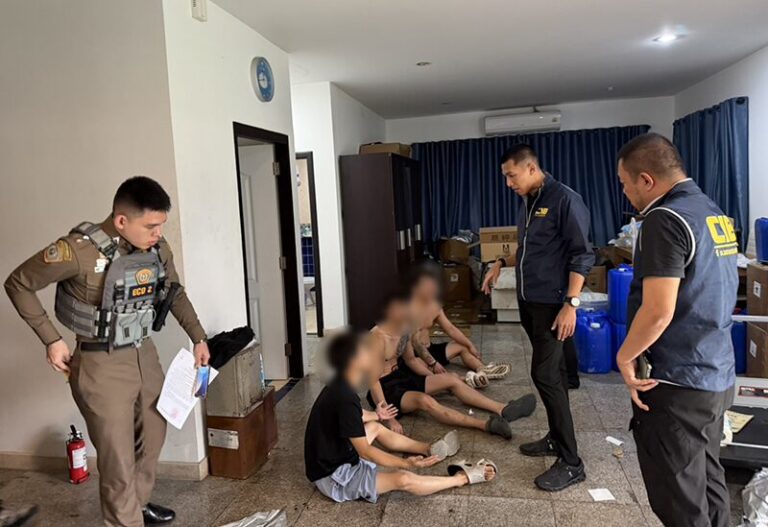
CHONBURI — 12 May 2026, Thai police arrested three Chinese nationals during a raid on a luxury house in Pattaya allegedly used to produce “zombie vapes” containing the controlled sedative etomidate, authorities said.

The operation was carried out by officers from the Economic Crime Suppression Division under orders from Police Lieutenant General Natthasak Chaowanasai and Pol. Maj. Gen. Thatphum Charuprat, with Police Colonel Naruephon Karuna leading the arrest team.

The three Chinese suspects were arrested at a property on Nong Krabok Road in Bang Lamung district.

Police charged them with illegally producing and possessing etomidate, a Category 2 psychotropic substance, for commercial distribution. They were also accused of working outside the scope permitted for foreign nationals in Thailand.

S 58712120 0

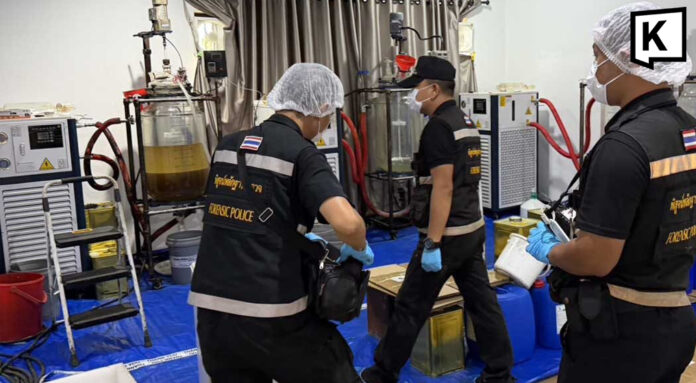
Authorities seized a large quantity of chemicals and manufacturing equipment from the two-storey house, including industrial chemical containers, white chemical powder, sodium bicarbonate, production machinery, weighing and sealing equipment, and around 2,700 empty vape pod packages believed to be intended for sale.

Investigators said the property appeared to have been used as a production site for “zombie vapes”, a term used in Thailand for e-cigarettes mixed with etomidate, an anaesthetic drug that can cause severe drowsiness and dangerous side effects.

Police said forensic officers later tested the substances found at the scene and confirmed the presence of etomidate, which is classified in Thailand as a Category 2 psychotropic substance and a key ingredient in the illicit vape products.

The suspects denied the allegations during questioning. They were taken into custody along with the seized evidence for further legal action by narcotics suppression investigators.

Advertisement

Cambodia urges Thailand to delist disputed border temples

PHNOM PENH, Cambodia — Cambodia’s Ministry of Culture and Fine Arts has demanded that Thailand withdraw its registration of several disputed ancient temples along the Thai-Cambodian border, calling the move a violation of Cambodian sovereignty.

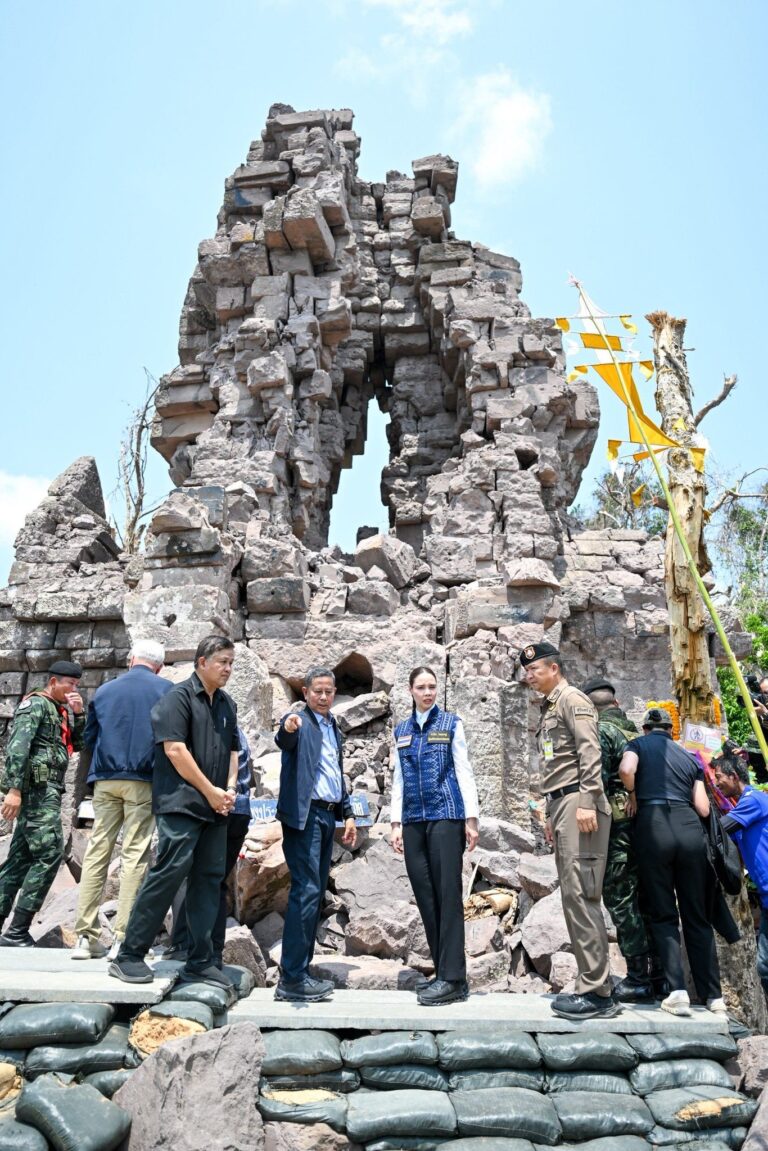
In a statement issued on Wednesday, the ministry said it strongly protests and firmly rejects the decision by Thailand’s Fine Arts Department to include the Ta Muen Thom temple complex, Ta Kwai temple, and other archaeological sites in Thailand’s national register of ancient monuments. The official document asserts that these sites are located within Cambodian sovereign territory.

678311002 1514278790067814 8920193865160290377 n 1

The ministry described Thailand’s action as illegal, null, and without legal effect, arguing that unilateral registration cannot be used as evidence of territorial sovereignty or border demarcation. It maintained that unresolved border issues must be addressed through international law and existing bilateral mechanisms.

The statement specifically referred to the 1907 Franco-Siamese Treaty, the 2000 Memorandum of Understanding, the 2003 Terms of Reference, and the mandate of the Joint Boundary Commission as the only recognized frameworks for settlement.

Cambodia further accused Thailand of attempting to create an artificial legal appearance over the sites, claiming the move undermines the spirit of peaceful dialogue and mutual respect between the neighboring nations. The ministry called on the Thai government to immediately revoke the registration and refrain from further unilateral actions.

Advertisement

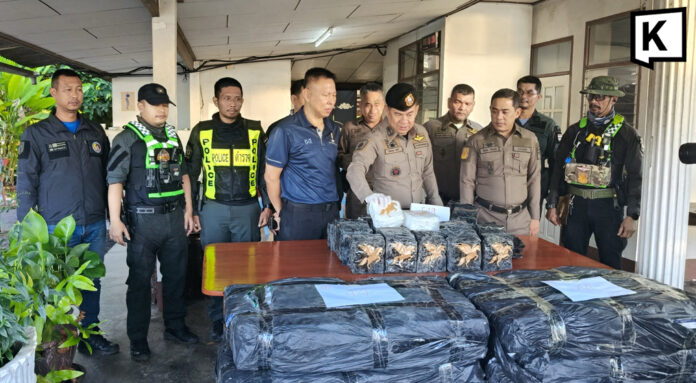
Police seize 519kg of crystal meth in south Thailand

Police seize 519kg of crystal meth in south Thailand

CHUMPHON — 13 May 2026, Thai police seized more than 519 kilogrammes of crystal methamphetamine and arrested two suspects during a late-night drug interdiction operation in southern Thailand, authorities said.

The suspects were detained at about 04:10 near the Pathomphon checkpoint on Phetkasem Road in Muang district, Chumphon province, a key transit route to Thailand’s southern region.

Police also confiscated a vehicle and two mobile phones during the operation.

The seizure was carried out by officers from the Pathomphon checkpoint under the supervision of Provincial Police Region 8 and Chumphon provincial police, which had intensified inspections along major southern highways amid continuing attempts by traffickers to move narcotics through the area.

The operation was directed by Lt. Gen. Sitthichai Lokanphai, commissioner of Provincial Police Region 8, along with senior regional and provincial police commanders.

Officers led by Lt. Col. Piyaphon Chatphum, chief of the Pathomphon checkpoint, stopped and searched the suspects’ vehicle before discovering the methamphetamine shipment, police said.

Authorities charged the two suspects with possession of a Category 1 narcotic with intent to distribute without authorisation, an offence linked to commercial trafficking and threats to public security under Thai law.

Investigators said they were expanding the inquiry to identify additional suspects and trace the wider trafficking network believed to be operating in southern Thailand and neighbouring provinces.

Advertisement

Sacred oxen forecast strong trade and food supplies in Royal Ploughing Ceremony

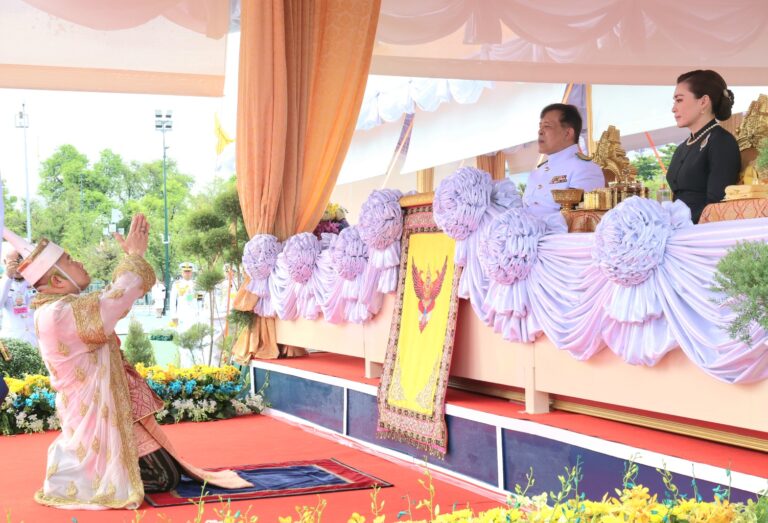
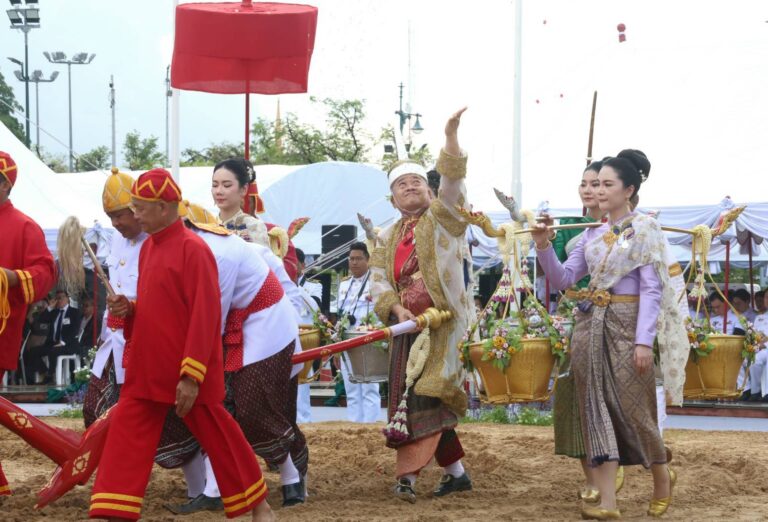
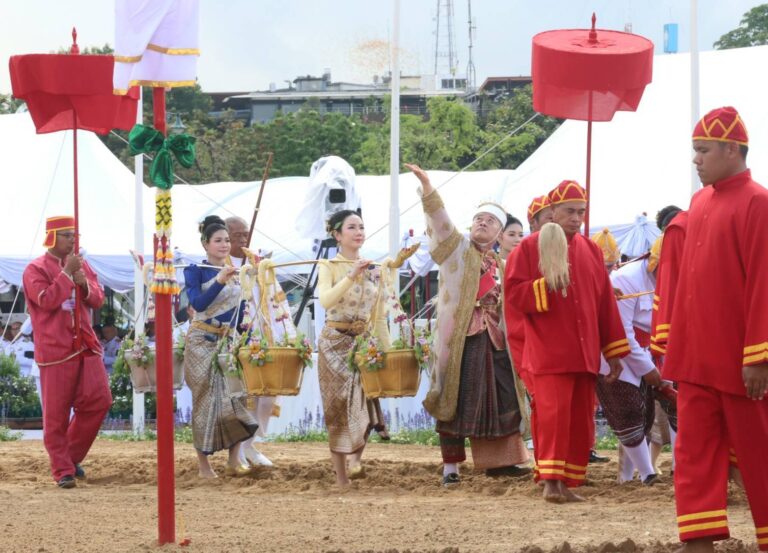
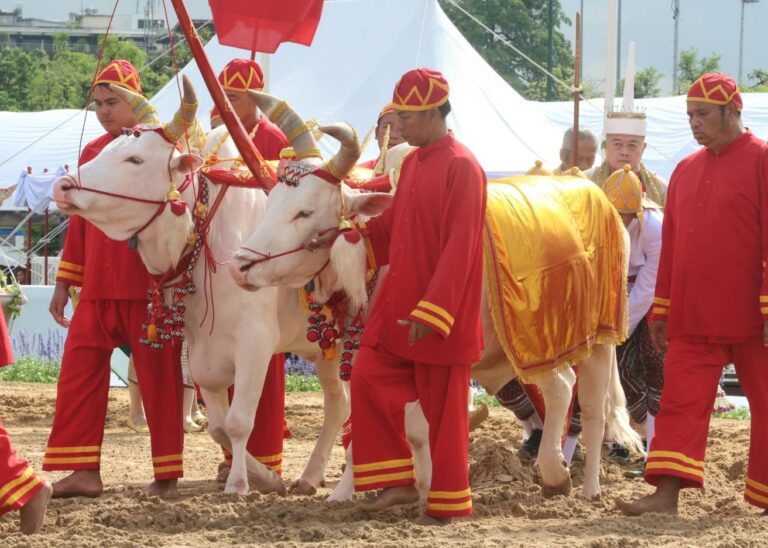
Thailand’s annual Royal Ploughing Ceremony on Wednesday forecast strong trade, economic growth and abundant food supplies after the sacred oxen selected beans, sesame seeds, water and liquor during the centuries-old rite at Sanam Luang in Bangkok.

32996 0

The Royal Ploughing Ceremony is one of Thailand’s oldest royal traditions, dating back more than 700 years to the Sukhothai period. Rooted in ancient Brahmin beliefs from India and later combined with Buddhist practices, the ceremony marks the start of the rice-growing season and is intended to bring prosperity while predicting agricultural conditions for the year ahead. The rite has continued as an important annual royal ceremony closely tied to Thailand’s agricultural heritage.

Their Majesties King Maha Vajiralongkorn and Queen Suthida travelled by royal motorcade from Dusit Palace to the ceremonial pavilion at Sanam Luang to preside over the rite.

32966 0

Permanent Secretary of the Ministry of Agriculture and Cooperatives Winairoat Subsongsook served as the Ploughing Lord, leading a ceremonial procession from the Brahmin Ceremonial Hall to the field alongside consecrated ladies, royal pundits and Brahmins. The sacred oxen were then yoked to a traditional plough, completing three lengthwise and three crosswise circuits around the field before rice seeds were scattered.

32971 0

Earlier in the ceremony, the Ploughing Lord selected a six-khuep cloth, or about 1.5 metres, in the traditional garment selection ritual. Royal astrologers interpreted the choice as a sign of limited rainfall this year, predicting strong yields for lowland rice fields but possible damage and reduced harvests in upland farming areas.

After the ploughing ritual, seven offerings — rice, maize, green beans, sesame seeds, liquor, water and grass — were presented to the sacred oxen for their symbolic selection.

32927 0

The oxen chose beans and sesame seeds, predicting abundant crops and food supplies. Their selection of water and grass was interpreted as a sign of sufficient rainfall and plentiful agricultural produce and livestock, while drinking liquor was seen as a positive omen for transportation, international trade and economic prosperity.

Advertisement

Hot News

LATEST NEWS

Bangkok
scattered clouds
38.3 ° C
38.3 °
36.1 °
48 %
5.4kmh
36 %
Tue
35 °
Wed
37 °
Thu
36 °
Fri
36 °
Sat
37 °